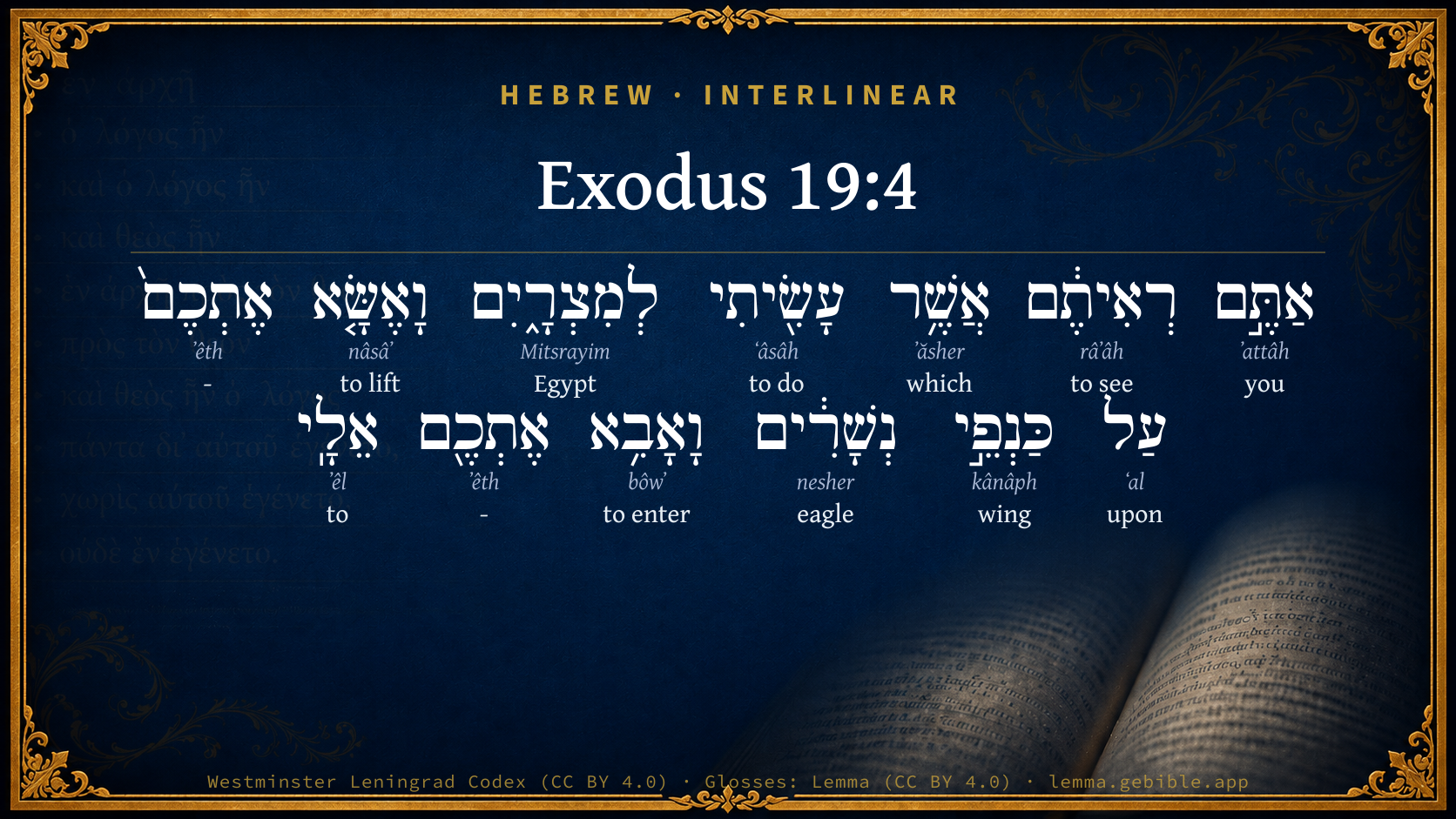
Exodus 19:4

Hebrew (Westminster Leningrad Codex) Exodus 19:4 appears in the Hebrew Old Testament. The text above is from the Westminster Leningrad Codex. Each word links to its Strong’s number, a concise gloss, and parsing drawn from the Open Scriptures Hebrew Bible morphology. Click any word for its full Brown-Driver-Briggs (BDB) entry.
Download image
Cite this verse

Exodus 19:4 (World English Bible). Public Domain. Lemma interlinear Bible study tool, https://lemma.gebible.app/v/exodus/19/4.

Show BibTeX & RIS
BibTeX
RIS
English Translation
'You have seen what I did to the Egyptians, and how I bore you on eagles' wings, and brought you to myself.
World English Bible · Public Domain
Highlights
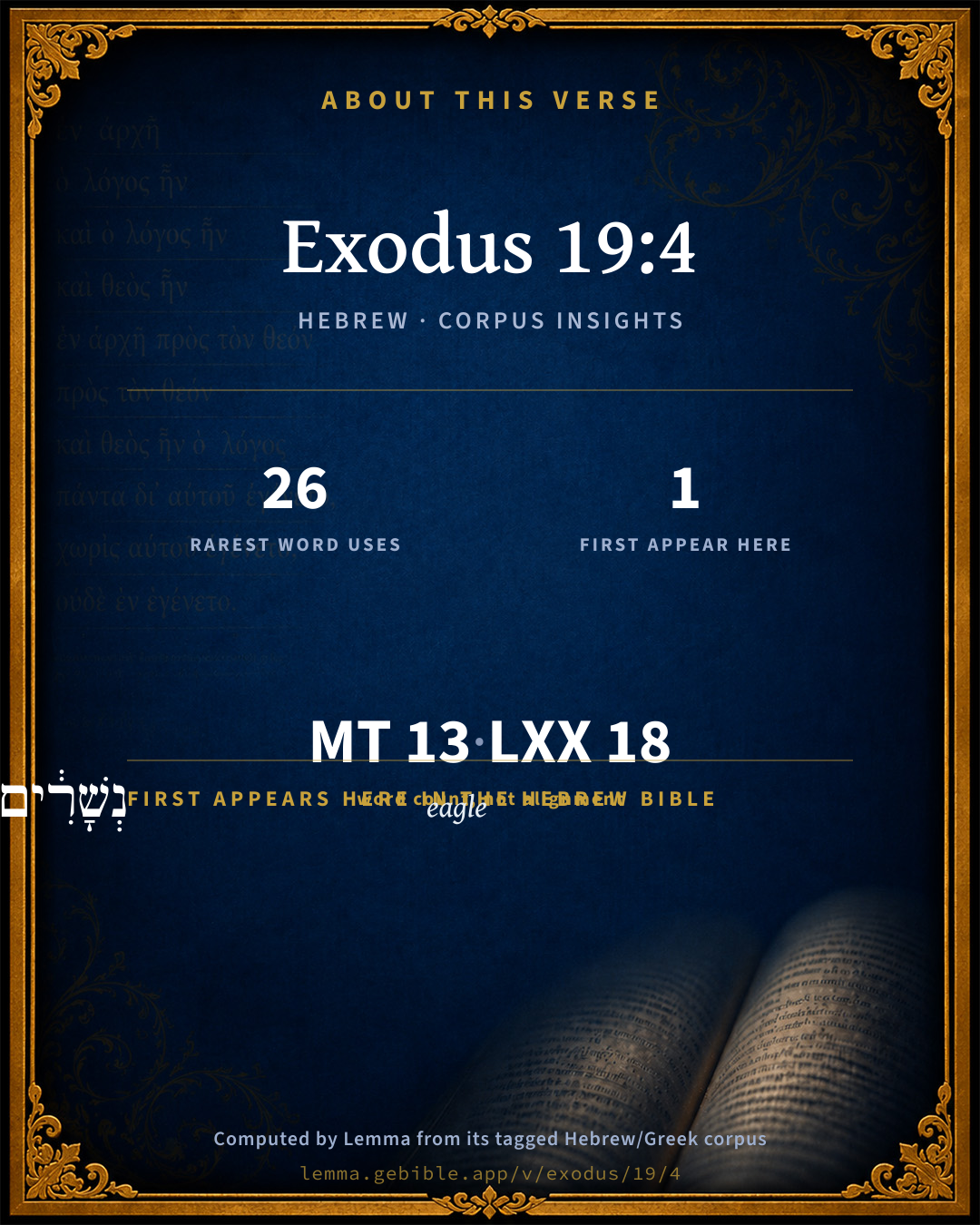
  • 1 first appearance in the Hebrew Bible
Full analysis ↓
Download a study sheet

One document with this verse’s original text, its word-by-word gloss line, the meaning frame, cross-references with their text, attributed commentary, and full source and license credits — printable, and it pastes into notes with its structure intact.

This verse Autodidact and up

Study sheet (.html) Plain text (.txt)

A passage Seminary Student

Up to 50 verses in one chapter. A passage sheet keeps up to 6 commentary sources and 12 cross-references per verse, in the order this page ranks them, and says so on the sheet whenever that leaves anything out. Ask for a single verse and you get the Autodidact verse sheet above.

Everything on this page stays free to read, with no account — the sheet is a download of what is already on screen, not access to it.

Want to remove ads? Support Godless Engineer
Compare translations 3

The same verse in 3 English versions, stacked beneath the original-language interlinear above. Click any original word for its lexicon entry.

Each is an independent rendering of the whole verse — the interlinear is not word-aligned to these translations.

Highlighted words mark where these versions differ — a whole-verse word diff, not a word-by-word alignment.

  • World English Bible Public Domain
    'You have seen what I did to the Egyptians, and how I bore you on eagles' wings, and brought you to myself.
  • King James Version Public Domain
    Ye have seen what I did unto the Egyptians, and how I bare you on eagles' wings, and brought you unto myself.
  • unfoldingWord Literal Text CC BY-SA 4.0
    ‘You yourselves saw what I did to the Egyptians, how I carried you on the wings of eagles and brought you to myself.

unfoldingWord Literal Text — © unfoldingWord, licensed CC BY-SA 4.0. Word-aligned USFM3 via Door43 (git.door43.org/unfoldingWord/en_ult).

Versions to compare (up to 4)

3 of 4 selected

Show all 18 translations

Every available English version of this verse, each an independent rendering of the whole verse.

  • World English Bible Public Domain
    'You have seen what I did to the Egyptians, and how I bore you on eagles' wings, and brought you to myself.
  • Berean Standard Bible Public Domain
    ‘You have seen for yourselves what I did to Egypt, and how I carried you on eagles’ wings and brought you to Myself.
  • Majority Standard Bible Public Domain
    ‘You have seen for yourselves what I did to Egypt, and how I carried you on eagles’ wings and brought you to Myself.
  • King James Version Public Domain
    Ye have seen what I did unto the Egyptians, and how I bare you on eagles' wings, and brought you unto myself.
  • American Standard Version (1901) Public Domain
    Ye have seen what I did unto the Egyptians, and how I bare you on eagles' wings, and brought you unto myself.
  • Revised Version (1885) Public Domain
    Ye have seen what I did unto the Egyptians, and how I bare you on eagles’ wings, and brought you unto myself.
  • Geneva Bible (1599) Public Domain
    Ye haue seene what I did vnto the Egyptians, and how I caryed you vpon eagles wings, and haue brought you vnto me.
  • Douay-Rheims (1899) Public Domain
    You have seen what I have done to the Egyptians, how I have carried you upon the wings of eagles, and have taken you to myself.
  • Young's Literal Translation Public Domain
    Ye -- ye have seen that which I have done to the Egyptians, and I bear you on eagles' wings, and bring you in unto Myself.
  • Literal Standard Version CC BY-SA 4.0
    You have seen that which I have done to the Egyptians, and [how] I carry you on eagles’ wings and bring you to Myself.
  • Unlocked Literal Bible CC BY-SA 4.0
    You have seen what I did to the Egyptians, how I carried you on eagles' wings and brought you to myself.
  • unfoldingWord Literal Text CC BY-SA 4.0
    ‘You yourselves saw what I did to the Egyptians, how I carried you on the wings of eagles and brought you to myself.
  • Darby Bible Public Domain
    Ye have seen what I have done to the Egyptians, and [how] I have borne you on eagles' wings and brought you to myself.
  • World Messianic Bible Public Domain
    ‘You have seen what I did to the Egyptians, and how I bore you on eagles’ wings, and brought you to myself.
  • Webster's Bible Public Domain
    Ye have seen what I did to the Egyptians, and how I bore you on eagles' wings, and brought you to myself.
  • Free Bible Version CC BY-SA 4.0
    ‘You saw for yourselves what I did to the Egyptians, and how I carried you on eagles' wings, how I brought you to myself.
  • Bible in Basic English Public Domain
    You have seen what I did to the Egyptians, and how I took you, as on eagles' wings, guiding you to myself.
  • JPS Tanakh (1917) Public Domain
    Ye have seen what I did unto the Egyptians, and how I bore you on eagles' wings, and brought you unto Myself.

Literal Standard Version (2020), Covenant Press — licensed CC BY-SA 4.0. Text via the HelloAO Bible API (eBible.org). Unlocked Literal Bible (unfoldingWord) — licensed CC BY-SA 4.0. Text via the HelloAO Bible API (eBible.org). unfoldingWord Literal Text — © unfoldingWord, licensed CC BY-SA 4.0. Word-aligned USFM3 via Door43 (git.door43.org/unfoldingWord/en_ult). Free Bible Version, Dr. Jonathan Gallagher — licensed CC BY-SA 4.0. Text via the HelloAO Bible API (eBible.org).

Word by word

More ways to search: Search by grammar → Find every occurrence → Compare this word →

Practice this passage: Drill this verse → Learn its vocabulary →

נְשָׁרִ֔ים
nesher
H5404
“eagles”
Noun, Common, Masculine, Plural, Absolute
Part of Speech
Noun
Type
Common
Gender
Masculine
Number
Plural
State
Absolute
Full BDB Definition

Origin: from an unused root meaning to lacerate

TWOT: 1437

eagle, vulture, griffon-vulture
  1. אַתֶּ֣ם ʼattâh H859 “you” Pronoun, Personal, 2nd Person, Masculine, Plural
  2. רְאִיתֶ֔ם râʼâh H7200 “to see” Verb, Qal, Perfect, 2nd Person, Masculine, Plural
  3. אֲשֶׁ֥ר ʼăsher H834 “which” Particle, Relative
  4. עָשִׂ֖יתִי ʻâsâh H6213 “to do” Verb, Qal, Perfect, 1st Person, Common, Singular
  5. לְמִצְרָ֑יִם Mitsrayim H4714 “to/for · Egypt” Preposition + Noun, Proper
  6. וָאֶשָּׂ֤א nâsâʼ H5375 “and · to lift” Conjunction + Verb, Qal, Sequential Imperfect, 1st Person, Common, Singular
  7. אֶתְכֶם֙ ʼêth H853 “- · you” Particle, Direct Object + Suffix, Personal, 2nd Person, Masculine, Plural
  8. עַל ʻal H5921 “upon” Preposition
  9. כַּנְפֵ֣י kânâph H3671 “wings of” Noun, Common, Feminine, Dual, Construct
  10. וָאָבִ֥א bôwʼ H935 “and · to enter” Conjunction + Verb, Hiphil, Sequential Imperfect, 1st Person, Common, Singular
  11. אֶתְכֶ֖ם ʼêth H853 “- · you” Particle, Direct Object + Suffix, Personal, 2nd Person, Masculine, Plural
  12. אֵלָֽי ʼêl H413 “to · me” Preposition + Suffix, Personal, 1st Person, Common, Singular

About this verse

These counts appear in no published source. They are computed here, from the morphology-tagged text and Lemma’s own curated glosses. What Lemma adds →

13
words
12
distinct lemmas
Pentateuch
section

First appearance in Scripture

This word makes its first canonical appearance in the Hebrew Bible here:

  • נְשָׁרִ֔ים eagle H5404

Shared distinctive vocabulary

נְשָׁרִ֔ים eagle H5404 occurs in 26 verses of the Hebrew Bible. Also found in:

Grammatical profile

  • 4 verbs
  • 3 nouns
  • 1 pronoun
  • 2 prepositions
  • 3 particles

Verb forms

  • רְאִיתֶ֔ם Qal · Perfect
  • עָשִׂ֖יתִי Qal · Perfect
  • וָאֶשָּׂ֤א Qal · Sequential Imperfect
  • וָאָבִ֥א Hiphil · Sequential Imperfect

Hebrew & Septuagint length

In English translation the verse runs 22 words from the Hebrew and 27 from the Septuagint (LXX English) — closely comparable.

A rough comparison of the two English renderings, which tokenize alike — not a word-level alignment.

Word counts can differ between the Hebrew and the Greek without any difference in meaning — e.g. the Hebrew direct-object marker אֵת has no separate Greek word, and Greek often adds the article ὁ.

In the original languages it is 13 Hebrew tokens and 18 Greek tokens — but the two are counted differently (Hebrew bundles its prefixes and suffixes into one token; the Greek is in lemma form), so that isn’t a like-for-like length.

Cross-references

8

Topical passages linked to Exodus 19:4 in the Treasury of Scripture Knowledge — connected by theme and wording, ordered by reader-vote popularity; previews shown in the World English Bible.

  • Deuteronomy 32:11–12 As an eagle that stirs up her nest, That flutters over her young, He spread abroad his wings, he took them, He bore them on his feathers.
  • Isaiah 63:9 In all their affliction he was afflicted, and the angel of his presence saved them: in his love and in his pity he redeemed them; and he bore them, and carried them all the days of old.
  • Isaiah 40:31 but those who wait for Yahweh shall renew their strength; they shall mount up with wings as eagles; they shall run, and not be weary; they shall walk, and not faint.
  • Deuteronomy 29:2 Moses called to all Israel, and said to them, You have seen all that Yahweh did before your eyes in the land of Egypt to Pharaoh, and to all his servants, and to all his land;
  • Revelation 12:14 Two wings of the great eagle were given to the woman, that she might fly into the wilderness to her place, so that she might be nourished for a time, and times, and half a time, from the face of the serpent.
  • Deuteronomy 4:33–36 Did ever a people hear the voice of God speaking out of the midst of the fire, as you have heard, and live?
  • Deuteronomy 4:9 Only take heed to yourself, and keep your soul diligently, lest you forget the things which your eyes saw, and lest they depart from your heart all the days of your life; but make them known to your children and your children's children;
  • Exodus 7:1–14 Yahweh said to Moses, "Behold, I have made you as God to Pharaoh; and Aaron your brother shall be your prophet.

Cross-references courtesy of OpenBible.info (CC BY 4.0).

Hebrew and Greek witnesses Masoretic Hebrew ↔ Greek Septuagint

The same verse in the two great witnesses to the Old Testament, shown verse-for-verse.

These are two independent witnesses, not word-aligned to each other, and the Septuagint is shown in lemma (dictionary) form.

Hebrew Exodus 19:4 Masoretic · Westminster Leningrad Codex

אַתֶּ֣ם רְאִיתֶ֔ם אֲשֶׁ֥ר עָשִׂ֖יתִי לְמִצְרָ֑יִם וָאֶשָּׂ֤א אֶתְכֶם֙ עַל כַּנְפֵ֣י נְשָׁרִ֔ים וָאָבִ֥א אֶתְכֶ֖ם אֵלָֽי

'You have seen what I did to the Egyptians, and how I bore you on eagles' wings, and brought you to myself.

World English Bible · Public Domain

Greek LXX Exodus 19:4 Septuagint · lemma form

αὐτός ὁράω ὅσος ποιέω ὁ αἰγύπτιος καί ἀναλαμβάνω σύ ὡσεί ἐπί πτέρυξ ἀετός καί προςἄγω σύ πρός ἐμαυτοῦ

You⌃ have seen all that I have done to the Egyptians, and I took you up as upon eagles' wings, and I brought you near to myself.

LXX2012 (modern English Septuagint) · Public Domain

Hebrew: Westminster Leningrad Codex (CC BY 4.0). Greek: Septuagint (public domain); English from LXX2012 (modern English Septuagint) (Public Domain). How the Septuagint differs from the Hebrew →

Targum (Aramaic paraphrase)

2

The Targum is the ancient Jewish Aramaic paraphrase of the Hebrew Scriptures — an interpretive translation, not the Hebrew text itself. Onkelos (literal) and Pseudo-Jonathan (expansive) render the Torah, and Jonathan the Prophets. Coverage is partial: where no permissively-licensed English translation exists for a verse, only the Aramaic is shown. This is verse-level text, not a word-by-word alignment to the Hebrew.

  1. Targum Onkelos Torah (Genesis–Deuteronomy)
    אַתּוּן חֲזִתּוּן דִי עֲבָדִית לְמִצְרָיִם וּנְטָלִית (נ״‎א וְאַטְּלִית) יָתְכוֹן כִּדְעַל גַדְפֵי נִשְׁרִין וְקָרֵבִית יָתְכוֹן לְפָלְחָנִי:

    (no public-domain English translation for this verse)

    Targum Onkelos — Aramaic: “Onkelos Genesis” (public domain); “Onkelos Exodus” (public domain); “Onkelos Leviticus” (public domain); “Onkelos Numbers” (public domain); “Onkelos Deuteronomy” (public domain). English: “Sefaria Community Translation” (CC0 1.0 (public-domain dedication)); “J.W. Etheridge. The Targums of Onkelos and Jonathan Ben Uzziel on the Pentateuch. London: Longmans, Green, 1862” (public domain). Text via Sefaria.

  2. Targum Pseudo-Jonathan Torah (Genesis–Deuteronomy)
    אַתּוּן חֲמִיתוּן מַה דִּי עֲבָדִית לְמִצְרָאֵי וּטְעָנִית יַתְכוֹן עַל עֲנָנִין הֵי כְּעַל גַּדְפֵי נִשְׁרִין מִן פִּילוּסִין וְאוֹבֵילִית יַתְכוֹן לְאַתַר בֵּית מוּקְדָּשָׁא לְמֶעֱבַד תַּמָּן פִּסְחָא וּבְהַהוּא לֵילְיָא אֲתֵיבִית יַתְכוֹן לְפִילוּסִין וּמִתַּמָּן קְרִיבִית יַתְכוֹן לְאוּלְפַן אוֹרַיְיתִי

    Ye have seen what I did to the Mizraee; and how I bare you upon the clouds as upon eagles' wings from Pelusin, to take you to the place of the sanctuary, there to solemnize the Pascha; and in the same night brought you back to Pelusin, and from thence have brought you nigh, to (receive) the doctrine of My law.

    Targum Pseudo-Jonathan — Aramaic: “Targum Jonathan on Genesis” (public domain); “Targum Jonathan on Exodus” (public domain); “Targum Jonathan on Leviticus” (public domain); “Targum Jonathan on Numbers” (public domain); “Targum Jonathan on Deuteronomy” (public domain). English: “The Targum of Jonathan ben Uzziel, trans. J. W. Etheridge, London, 1862” (public domain). Text via Sefaria.

Commentary

Notes on Exodus 19:4 from classic Christian and Jewish commentators (each source and its license shown beneath its notes). The classic Christian expositions comment on the surrounding passage and are grouped to its opening verse, so a note may address several verses; the Jewish commentaries on the Tanakh (Rashi and others) are per-verse, so they appear only where the commentator wrote on this verse.

Lemma curates 59 commentaries, every one of them public domain or Creative Commons licensed, each selected and text-cleaned for this edition rather than reprinted as found. About our sources →

Trapp's Complete Commentary

John Trapp

Exo 19:4 Ye have seen what I did unto the Egyptians, and [how] I bare you on eagles’ wings, and brought you unto myself.

Ver. 4. On eagles’ wings.] The eagle beats her young ones out of their sluggish nest, that they may learn to fly: there was somewhat to do to bring Israel out of Egypt. The eagle carries her young upon her wings - and not between her talons, as other birds do - openly, safely, speedily: so did God his Israel, being choice and chary of them all the way; securing them also from their enemies, who could do them as little harm as any can do the eagle’s young, which cannot be shot but through the body of the old one. {a} Some by eagles here understand Moses and Aaron, who are so called, say they, propter acumen intelligentiae et altitudinem vitae, for the sharpness of their understanding and the loftiness of their lives. {See Trapp on "Deu 32:11"}

{a} Munster, in Schol. in Deu 32:11, ex R. Solomon.

John Trapp, A Commentary or Exposition upon All the Books of the Old and New Testament (1647–1656) — public domain. Text from a community e-Sword module.

Joseph Benson's Commentary

Exo 19:4. Ye have seen how I bare you on eagles’ wings — A high expression of the wonderful tenderness God showed for them. It denotes great speed; God not only came upon the wing for their deliverance, but he hastened them out, as it were, upon the wing. Also that he did it with great ease, with the strength as well as the swiftness of an eagle. They that faint not, nor are weary, are said to “mount up with wings as eagles,” Isa 40:31. Especially it signifies God’s particular care of them, and affection to them. Even Egypt was the nest in which these young ones were first formed as the embryo of a nation: when by the increase of their numbers they grew to some maturity, they were carried out of that nest. I brought you unto myself — They were brought not only into a state of liberty, but into covenant and communion with God. This God aims at in all the gracious methods of his providence and grace, to bring us back to himself, from whom we have revolted, and to bring us home to himself, in whom alone we can be happy.

Joseph Benson's Commentary on the Old and New Testaments (1811–1818) — public domain. Text from a community e-Sword module.

Geneva Bible (1599)

Geneva Bible translators

For the Eagle by flying high, is out of danger, and by carrying her birds rather on her wings than in her talons declareth her love.

Geneva Bible (1599) marginal notes — public domain. Text via Bolls.life.

Adam Clarke's Commentary

Verse 4. How I bare you on eagles' wings] Mr. Bruce contends that the word נשר nesher does not mean the bird we term eagle; but a bird which the Arabs, from its kind and merciful disposition, call rachama, which is noted for its care of its young, and its carrying them upon its back. See his Travels, vol. vii., pl. 33. It is not unlikely that from this part of the sacred history the heathens borrowed their fable of the eagle being a bird sacred to Jupiter, and which was employed to carry the souls of departed heroes, kings, c., into the celestial regions. The Romans have struck several medals with this device, which may be seen in different cabinets, among which are the following: one of Faustina, daughter of Antoninus Pius, on the reverse of which she is represented ascending to heaven on the back of an eagle and another of Salonia, daughter of the Emperor Galienus, on the reverse of which she is represented on the back of an eagle, with a scepter in her hand, ascending to heaven. Jupiter himself is sometimes represented on the back of an eagle also, with his thunder in his hand, as on a medal of Licinus. This brings us nearer to the letter of the text, where it appears that the heathens confounded the figure made use of by the sacred penman, I bare you on eagles' wings, with the manifestation of God in thunder and lightning on Mount Sinai. And it might be in reference to all this that the Romans took the eagle for their ensign. See Scheuchzer, Fusellius, c.

Brought you unto myself.] In this and the two following verses, we see the design of God in selecting a people for himself.

1. They were to obey his voice, Ex 19:5, to receive a revelation from him, and to act according to that revelation, and not according to their reason or fancy, in opposition to his declarations.

2. They were to obey his voice indeed, שמוע תשמעו shamoa tishmeu, in hearing they should hear they should consult his testimonies, hear them whenever read or proclaimed, and obey them as soon as heard, affectionately and steadily.

3. They must keep his covenant-not only copy in their lives the ten commandments, but they must receive and preserve the grand agreement made between God and man by sacrifice, in reference to the incarnation and death of Christ; for from the foundation of the world the covenant of God ratified by sacrifices referred to this, and now the sacrificial system was to be more fully opened by the giving of the law.

4. They should then be God's peculiar treasure, סגלה segullah, his own patrimony, a people in whom he should have all right, and over whom he should have exclusive authority above all the people of the earth; for though all the inhabitants of the world were his by his right of creation and providence, yet these should be peculiarly his, as receiving his revelation and entering into his covenant.

5. They should be a kingdom of priests, Ex 19:6. Their state should be a theocracy; and as God should be the sole governor, being king in Jeshurun, so all his subjects should be priests, all worshippers, all sacrificers, every individual offering up the victim for himself. A beautiful representation of the Gospel dispensation, to which the Apostles Peter and John apply it, 1Pe 2:5, 1Pe 2:9; Re 1:6; Re 5:10, and Re 20:6; under which dispensation every believing soul offers up for himself that Lamb of God which was slain for and which takes away the sin of the world, and through which alone a man can have access to God.

Adam Clarke's Commentary on the Bible (1810–1826) — public domain. Text from a community e-Sword/MySword module.

Ellicott's Commentary for English Readers

(4) I bare you on eagles’ wings.—Comp. Deu_32:11, “As an eagle stirreth up her nest, fluttereth over her young, spreadeth abroad her wings, taketh them, beareth them upon her wings.” When its young are first fledged, the eagle is said to assist them in their flight by flying beneath them, so that they may settle upon its wings or back, if necessary. God means that He has bestowed upon His people the same tender and powerful care, has borne them up mightily when they might have fallen, supported their first flight as fledglings, and so saved them from disaster.

Brought you unto myself.—Not so much “brought you to my presence here on Sinai,” as “brought you out of Egypt and its corrupting influences (Jos_24:14), and led you back to my pure worship and true religion.” That is spoken of as accomplished, whereof God had begun the accomplishment.

A Bible Commentary for English Readers, edited by Charles John Ellicott (1878–1897) — public domain. Text from a community e-Sword module.

The Cambridge Bible for Schools and Colleges

gen. ed. J. J. S. Perowne

4. Ye] the pron. is emphatic: in Exo_20:22 expressed by Ye yourselves. on eagles’ wings] A fine figure for the swiftness, the security, and the affectionate care with which the deliverance from Egypt had been effected. Cf. the development of the same figure in Deu_32:10-11.

‘Eagle,’ though it suffices in a popular version, is not however an exact rend. of the Heb. nésher. As Tristram has shewn (NHB. p. 172 ff.), nésher, on account especially of the term ‘baldness’ in Mic_1:16, must denote really the griffon-vulture, a large and majestic bird, very abundant in Palestine, and constantly seen there circling in the air.

unto myself] i.e. to my abode in Sinai, the ‘mount of God’ (Di.; cf. on Exo_3:1).

4. In the ‘Blessing of Moses,’ Exo_33:9, the covenant with the tribe of Levi (i.e. their consecration to the priesthood, which was probably once narrated after Exo_32:29). Cf. Mal_2:4-5; Mal_2:8.

In P:—1. The covenant with Noah, Gen_6:18; Gen_9:9-16.

The Cambridge Bible for Schools and Colleges (gen. ed. J. J. S. Perowne; Cambridge University Press, 1878–1918) — public domain. Text from a community e-Sword module.

John Gill's Exposition

Ye have seen what I did to the Egyptians,.... The plagues he brought upon them in Egypt, and the destruction of them at the Red sea; these things they were eyewitnesses of, and needed no other proof or evidence to convince and assure them of them, and therefore must be under obligation to attend to what he was about to recommend unto them, for which reason this is observed:

and how I bare you on eagles' wings; that is, as on eagles' wings, the note of similitude being wanting, but to be supplied; for it cannot be thought that they were literally bore on eagles' wings; but as that creature is reported to be very affectionate to its young, and careful of it, and, as is said, only to one; for, having more, it will cast away all but one, and reserve that, which it carefully nourishes; and being swift of flight, and strong of wing, it will in a remarkable manner take its young upon it, and safely and swiftly convey it where it pleases; of which See Gill on Deu 32:11. The eagle excels other birds both in its strength and in the size of its body; and especially its pectoral muscles, by which its wings are supported; are very strong, so that it can carry its young, and other things, on its back and wings; and some such thing nature itself seems to have required, as naturalists observe (d); and there are some histories, which, if true, greatly confirm and illustrate this. Aelianus (e) reports of Tilgamus, a Babylonian, and who afterwards was king of Babylon, and who seems to be the Tilgath Pilneser of the Scriptures, king of Assyria, that when a lad, being thrown down from the top of a tower, an eagle, which is a very quick sighted bird, saw him, and, before he came to the ground, flew under him, took him upon its back, and carried him into a garden, and gently let him down. So it is related of Aristomenes (f), that as he was casting headlong into a deep ditch by the Lacedemonians, where they used to throw condemned malefactors, an eagle flew under him, and bore him on its wings, and carried him to the bottom, without any hurt to any part of his body. Jarchi observes, that whereas other birds carry their young between their feet, for fear of those that fly above them, the eagle flying above all others, and so in no fear of them, carries its young upon its wings, judging it better that a dart should pierce that than its young. The Targums of Jonathan and Jerusalem paraphrase the words,"and I bore you on clouds, as on eagles' wings;''which covered, and protected, and sustained them, as the eagles' wings do its young; the former adds, from Pelusium, a city in Egypt, supposed by the Targumist to be the same with Rameses; where Jarchi observes the people of Israel were very swiftly gathered together as the place of their rendezvous, and were as safely brought from thence to the place where they now were. Thus the Lord showed an affectionate concern for Israel, took them under his care and protection, stood between them and the Egyptians in a pillar of cloud, and secured them from their arrows, and swiftly and safely removed them from the land of Egypt to the place where they now were, distinguishing them from all other nations, having chosen them to be a special people to himself:

and brought you unto myself: to the mountain of God, where he had appeared to Moses, and given this as a sign and token of the truth of his mission, that he and Israel, when brought out of Egypt by him, should serve him on this mount; and now they were brought thither, where he was about not only to grant his presence in a very singular manner, but to deliver his law unto them, and enter into a covenant with them, and establish and settle them as his people; so that they were a people near unto the Lord, taken into covenant, and indulged with communion with him, and made partakers of various distinguished blessings of his: both the above Targums are, "I brought you to the doctrine of my law", to receive it at this mount.

(d) Scheuchzer. Physica Sacra, vol. 2. p. 186. (e) Hist. Animal. l. 12. c. 21. (f) Pausaniae Messenica, sive, l. 4. p. 250, 251.

John Gill's Exposition of the Whole Bible (1746–1763) — public domain (CC PDM 1.0). Text via the HelloAO Bible API.

Albert Barnes' Notes on the Bible

On eagles’ wings - Both in the law Deu 32:11 and in the Gospel Mat 23:37, the Church is compared to fledgelings which the mother cherishes and protects under her wings: but in the law that mother is an eagle, in the Gospels “a hen”; thus shadowing forth the diversity of administration under each covenant: the one of power, which God manifested when He brought His people out of Egypt with a mighty hand and an outstretched arm, and led them into the promised land; the other of grace, when Christ came in humility and took the form of a servant and became obedient unto death, even the death of the Cross. Compare also Rev 12:14.

Albert Barnes' Notes on the Bible (1834–1885) — public domain. Text from a community e-Sword/MySword module.

Haydock's Catholic Bible Commentary

Eagles. Out of the reach of danger. As eagles carry their young upon their wings, so I have protected you from all your enemies, Deuternomy xxxii. 11. (Calmet)

George Leo Haydock (1774–1849), Haydock's Catholic Family Bible and Commentary, 1859 edition — public domain. Excludes Psalms (Douay-Rheims chapter numbering differs from Protestant) and Deuterocanonical books (Catholic canon only).

Matthew Poole's English Annotations

i. e. Safely, out of the reach of danger; and strongly, against all opposition. Compare Deu 32:11; Isa 63:9; Rev 12:14.

Unto myself, into my presence, and favour, and fellowship, to be my peculiar people, to serve and worship me as your only Lord and King.

Matthew Poole's English Annotations on the Holy Bible (1683–1685) — public domain. Text from a community e-Sword/MySword module.

Whedon's Commentary on the Bible

Daniel D. Whedon

4. I bare you on eagles’ wings — This figure is finely elaborated in Deu_32:11 : “As an eagle stirreth up her nest, fluttereth over her young, spreadeth abroad her wings, taketh them, beareth them on her wings,” etc. The strength and the tenderness of God are thus set forth in this metaphor. Comp. Rev_12:14.

Unto myself — Out of the bondage of Egypt and into the immediate protection and oversight of Jehovah at Sinai. The sacred place in front of the hallowed mount was as the presence-chamber of the Most High.

Daniel D. Whedon (gen. ed.), Commentary on the Old and New Testaments (1874–1909) — public domain. Text from a community e-Sword module.

The Pulpit Commentary

Ye have seen what I did unto the Egyptians. God prefaces his appeal to Israel with respect to the future, by reminding them of what he had done for them in the past. In the fewest possible words he recalls to their recollection the whole series of signs and wonders wrought in Egypt, from the turning of the water into blood to the destruction of Pharaoh"s host in the Red Sea. These, he implies, ought to have taught them to trust him. I bare you on eagle"s wings, (compare Deu_32:11) where the metaphor is expanded at considerable length The strength and might of God"s sustaining care, and its loving tenderness, are especially glanced at in the comparison. Brought you unto myself. "Brought you," i.e. , "to Sinai, the mount of God, where it pleases me especially to reveal myself to you."

The Pulpit Commentary (1880–1919), ed. H.D.M. Spence-Jones & Joseph S. Exell — public domain. Text from a community e-Sword module.

John Wesley's Explanatory Notes

Ye have seen what I did unto the Egyptians, and how I bare you on Eagle's wings - An high expression of the wonderful tenderness God shewed for them. It notes great speed; God not only came upon the wing for their deliverance, but he hastened them out, as it were upon the wing. Also that he did it with great ease, with the strength as well as with the swiftness of an eagle. They that faint not, nor are weary, are said to mount up with wings as eagles, Isaiah xl, 31. Especially it notes God's particular care of them, and affection to them. Even Egypt was the nest in which these young ones were first formed as the embryo of a nation: when by the increase of their numbers they grew to some maturity, they were carried out of that nest. I brought you unto myself - They were brought not only into a state of liberty, but into covenant and communion with God. This, God aims at in all the gracious methods of his providence and grace, to bring us back to himself, from whom we have revolted, and to bring us home to himself, in whom alone we can be happy.

John Wesley, Explanatory Notes Upon the Whole Bible (1754–1765) — public domain. Text via the GEBible commentary corpus.

Rashi

Rabbi Shlomo Yitzchaki (Rashi)

אתם ראיתם YE HAVE SEEN — It is not a tradition in your possession, not in written words do I send a message to you, not by means of eye-witnesses do I attest this to you, but you yourselves have seen אשר עשיתי למצרים WHAT I DID UNTO EGYPT — on account of many sins were they liable to Me for punishment before they came into contact with you, but I did not exact punishment from them except on your account (cf. Mekhilta).

ואשא אתכם AND I BARE YOU [ON EAGLES’ WINGS] — This happened on that day when the Israelites came to Rameses (the place where they all assembled on the night when they left Egypt) (Mekhilta), because the Israelites were living dispersed throughout the whole district of Goshen and in one brief moment — when they came there to set out and to leave Egypt — they all gathered together at Rameses. Onkelos translates ואשא as though it were [וְאַסִּיעַ [אתכם — viz., ואטלית יתכון “and I made you travel” (cf. the Targum on וַיַּסַע Exodus 15:22); he adapted the expression in a manner that is consonant with the respect due to the Most High God.

על כנפי נשרים UPON EAGLES’ WINGS — as an eagle which bears its fledglings upon its wings. Scripture uses this metaphor because all other birds place their young between their feet since they are afraid of another bird that flies above them, but the eagle fears none except man — apprehending that perhaps he may cast an arrow at it — since no bird can fly above it; therefore he places it (its young) upon its wings, saying, “Better that the arrow should pierce me than my young!” (Mekhilta). — “I, too”, said God, “did thus”: (Exodus 14:19, 20) “And the angel of God … journeyed etc…. And he came between the camp of Egypt etc.” … and the Egyptians were casting arrows and stone missiles and the cloud caught these (cf. Rashi on these verses).

ואבא אתכם אלי AND I BROUGHT YOU UNTO MYSELF — Explain this as the Targum does: “and I have brought you near to My service”.

Rashi on the Tanakh — English translations: “The Judaica Press complete Tanach with Rashi, translated by A. J. Rosenberg” (CC BY 4.0); “Pentateuch with Rashi's commentary by M. Rosenbaum and A.M. Silbermann, 1929-1934” (public domain); “The Metsudah Tanach series, Lakewood, N.J” (CC BY 4.0); and “The Book of Joshua, Metsudah Publications, 1997” (CC BY 4.0). Text via Sefaria.

Ramban (Nachmanides)

Rabbi Moshe ben Nachman (Ramban / Nachmanides)

AND I BROUGHT YOU UNTO MYSELF. I.e., “to the place of My Glory, namely, this mountain where My Presence abides there with you.” Now Onkelos translated: “and I brought you near to My service.” [To avoid a literal translation], Onkelos adapted an expression of respect towards Him Who is on high.

Ramban (Nachmanides) on the Tanakh — English translation: “Commentary on the Torah by Ramban (Nachmanides). Translated and annotated by Charles B. Chavel. New York, Shilo Pub. House, 1971-1976” (CC BY 4.0). Text via Sefaria.

Lesson kit

Teaching starters — assembled from the data on this page, not authored interpretation. Every prompt links to the verse data it draws on. Edit before teaching.

Exodus, in the Pentateuch, opens this verse with 13 words (12 distinct Hebrew lemmas). Its most distinctive word is nesher (“eagle”). A historical commentator’s framing appears above. Read the whole chapter for the surrounding context.

Discussion questions

  1. What does “eagle” (nesher) contribute to the verse as a whole?
  2. The word “eagle” first appears here in Scripture. What is being introduced at this debut?
  3. Leviticus 11:13 shares the word «eagle» with this verse. How do the two illuminate each other?
  4. These translations render this verse differently. What is at stake in choosing one wording over another?
  5. The verb «רְאִיתֶ֔ם» is Qal Perfect. How does its form color the action?
  6. Reading how Trapp's Complete Commentary and Joseph Benson's Commentary read this verse, where do the two commentators agree and where do they part?

Things to notice

Reading settings

Reading text

Shown beneath each verse's original-language words.

Old Testament
Old Testament edition

Read the OT as the Masoretic Hebrew (MT) or the Greek Septuagint (LXX).

English shown for the Greek Septuagint (in the Hebrew ↔ Greek comparison).

Comparing translations? Open the Compare panel on any verse page to stack up to four side by side.