
2 Samuel 15:24

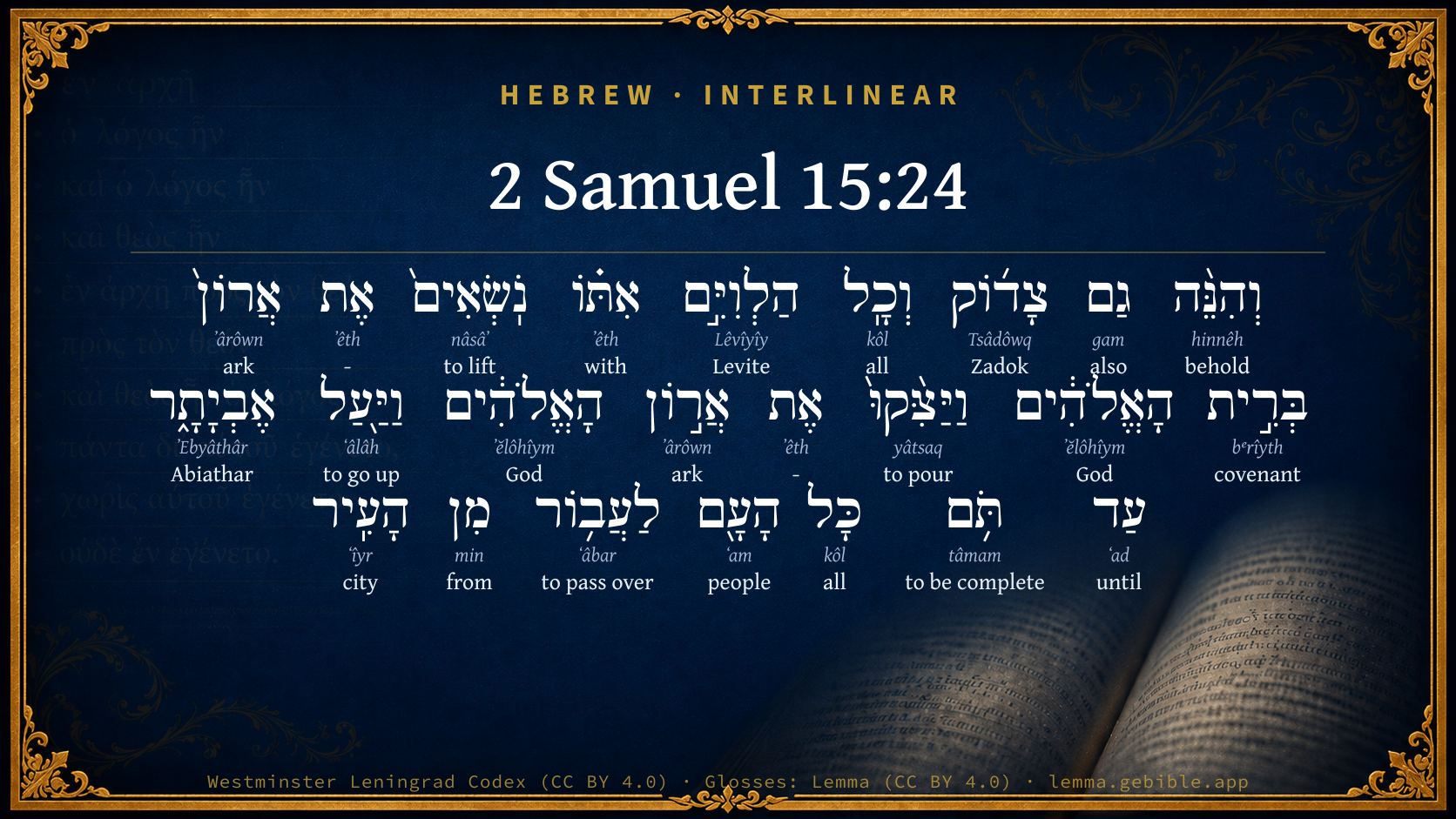
Hebrew (Westminster Leningrad Codex) 2 Samuel 15:24 appears in the Hebrew Old Testament. The text above is from the Westminster Leningrad Codex. Each word links to its Strong’s number, a concise gloss, and parsing drawn from the Open Scriptures Hebrew Bible morphology. Click any word for its full Brown-Driver-Briggs (BDB) entry.
Download image
Cite this verse

2 Samuel 15:24 (World English Bible). Public Domain. Lemma interlinear Bible study tool, https://lemma.gebible.app/v/2-samuel/15/24.

Show BibTeX & RIS
BibTeX
RIS
English Translation
Behold, Zadok also [came], and all the Levites with him, bearing the ark of the covenant of God; and they set down the ark of God; and Abiathar went up, until all the people had done passing out of the city.
World English Bible · Public Domain
Download a study sheet

One document with this verse’s original text, its word-by-word gloss line, the meaning frame, cross-references with their text, attributed commentary, and full source and license credits — printable, and it pastes into notes with its structure intact.

This verse Autodidact and up

Study sheet (.html) Plain text (.txt)

A passage Seminary Student

Up to 50 verses in one chapter. A passage sheet keeps up to 6 commentary sources and 12 cross-references per verse, in the order this page ranks them, and says so on the sheet whenever that leaves anything out. Ask for a single verse and you get the Autodidact verse sheet above.

Everything on this page stays free to read, with no account — the sheet is a download of what is already on screen, not access to it.

Want to remove ads? Support Godless Engineer
Compare translations 3

The same verse in 3 English versions, stacked beneath the original-language interlinear above. Click any original word for its lexicon entry.

Each is an independent rendering of the whole verse — the interlinear is not word-aligned to these translations.

Highlighted words mark where these versions differ — a whole-verse word diff, not a word-by-word alignment.

  • World English Bible Public Domain
    Behold, Zadok also [came], and all the Levites with him, bearing the ark of the covenant of God; and they set down the ark of God; and Abiathar went up, until all the people had done passing out of the city.
  • King James Version Public Domain
    And lo Zadok also, and all the Levites were with him, bearing the ark of the covenant of God: and they set down the ark of God; and Abiathar went up, until all the people had done passing out of the city.
  • unfoldingWord Literal Text CC BY-SA 4.0
    And behold, Zadok and all of the Levites with him were also carrying the Box of the Covenant of God. And they set down the Box of God, but Abiathar went up until all of the people had finished passing from the city.

unfoldingWord Literal Text — © unfoldingWord, licensed CC BY-SA 4.0. Word-aligned USFM3 via Door43 (git.door43.org/unfoldingWord/en_ult).

Versions to compare (up to 4)

3 of 4 selected

Show all 18 translations

Every available English version of this verse, each an independent rendering of the whole verse.

  • World English Bible Public Domain
    Behold, Zadok also [came], and all the Levites with him, bearing the ark of the covenant of God; and they set down the ark of God; and Abiathar went up, until all the people had done passing out of the city.
  • Berean Standard Bible Public Domain
    Zadok was also there, and all the Levites with him were carrying the ark of the covenant of God. And they set down the ark of God, and Abiathar offered sacrifices until the people had passed out of the city.
  • Majority Standard Bible Public Domain
    Zadok was also there, and all the Levites with him were carrying the ark of the covenant of God. And they set down the ark of God, and Abiathar offered sacrifices until all the people had passed out of the city.
  • King James Version Public Domain
    And lo Zadok also, and all the Levites were with him, bearing the ark of the covenant of God: and they set down the ark of God; and Abiathar went up, until all the people had done passing out of the city.
  • American Standard Version (1901) Public Domain
    And, lo, Zadok also `came', and all the Levites with him, bearing the ark of the covenant of God; and they set down the ark of God; and Abiathar went up, until all the people had done passing out of the city.
  • Revised Version (1885) Public Domain
    And, lo, Zadok also came, and all the Levites with him, bearing the ark of the covenant of God; and they set down the ark of God, and Abiathar went up, until all the people had done passing out of the city.
  • Geneva Bible (1599) Public Domain
    And lo, Zadok also was there, and all the Leuites with him, bearing the Arke of the couenant of God: and they set downe the Arke of God, and Abiathar went vp vntill the people were all come out of the citie.
  • Douay-Rheims (1899) Public Domain
    And Sadoc the priest also came, and all the Levites with him carrying the ark of the covenant of God, and they set down the ark of God: and Abiathar went up, till all the people that was come out of the city had done passing.
  • Young's Literal Translation Public Domain
    and lo, also Zadok, and all the Levites with him, bearing the ark of the covenant of God, and they make the ark of God firm, and Abiathar goeth up, till the completion of all the people to pass over out of the city.
  • Literal Standard Version CC BY-SA 4.0
    and behold, also Zadok, and all the Levites with him, are carrying the Ark of the Covenant of God, and they make the Ark of God firm, and Abiathar goes up, until the completion of all the people to pass over out of the city.
  • Unlocked Literal Bible CC BY-SA 4.0
    Even Zadok with all the Levites, carrying the ark of the covenant of God, were present. They set the ark of God down, and then Abiathar joined them. They waited until all the people had passed by out of the city.
  • unfoldingWord Literal Text CC BY-SA 4.0
    And behold, Zadok and all of the Levites with him were also carrying the Box of the Covenant of God. And they set down the Box of God, but Abiathar went up until all of the people had finished passing from the city.
  • Darby Bible Public Domain
    And behold, Zadok also, and all the Levites with him, bearing the ark of the covenant of God; and they set down the ark of God; and Abiathar went up, until all the people had passed completely out of the city.
  • World Messianic Bible Public Domain
    Behold, Zadok also came, and all the Levites with him, bearing the ark of the covenant of God; and they set down God’s ark; and Abiathar went up until all the people finished passing out of the city.
  • Webster's Bible Public Domain
    And lo, Zadok also, and all the Levites were with him bearing the ark of the covenant of God: and they set down the ark of God; and Abiathar went up, until all the people had done passing out of the city.
  • Free Bible Version CC BY-SA 4.0
    Zadok was there too, and all the Levites were with him, carrying the Ark of God's Agreement. They set down the Ark of God, and Abiathar offered sacrifices until everyone had left the city.
  • Bible in Basic English Public Domain
    Then Zadok came, and Abiathar, and with them the ark of God's agreement: and they put down the ark of God, till all the people from the town had gone by.
  • JPS Tanakh (1917) Public Domain
    And, lo, Zadok also came, and all the Levites with him, bearing the ark of the covenant of God; and they set down the ark of God — but Abiathar went up — until all the people had done passing out of the city.

Literal Standard Version (2020), Covenant Press — licensed CC BY-SA 4.0. Text via the HelloAO Bible API (eBible.org). Unlocked Literal Bible (unfoldingWord) — licensed CC BY-SA 4.0. Text via the HelloAO Bible API (eBible.org). unfoldingWord Literal Text — © unfoldingWord, licensed CC BY-SA 4.0. Word-aligned USFM3 via Door43 (git.door43.org/unfoldingWord/en_ult). Free Bible Version, Dr. Jonathan Gallagher — licensed CC BY-SA 4.0. Text via the HelloAO Bible API (eBible.org).

Word by word

More ways to search: Search by grammar → Find every occurrence → Compare this word →

Practice this passage: Drill this verse → Learn its vocabulary →

אֶבְיָתָ֑ר
ʼEbyâthâr
H54
“Abiathar”
Noun, Proper
Part of Speech
Noun
Type
Proper
Full BDB Definition

Origin: contracted from H1 and H3498

TWOT: None

Abiathar = "my father is great" - priest, son of Ahitub (Ahimelech), faithful to David, but later rebelled with Adonijah
  1. וְהִנֵּ֨ה hinnêh H2009 “and · behold” Conjunction + Particle, Demonstrative
  2. גַם gam H1571 “also” Adverb
  3. צָד֜וֹק Tsâdôwq H6659 “Zadok” Noun, Proper
  4. וְכָֽל kôl H3605 “and · all of” Conjunction + Noun, Common, Masculine, Singular, Construct
  5. הַלְוִיִּ֣ם Lêvîyîy H3881 “the · Levites” Particle, Definite Article + Noun, Gentilic, Masculine, Plural, Absolute
  6. אִתּ֗וֹ ʼêth H854 “with · him” Preposition + Suffix, Personal, 3rd Person, Masculine, Singular
  7. נֹֽשְׂאִים֙ nâsâʼ H5375 “lifting” Verb, Qal, Participle Active, Masculine, Plural, Absolute
  8. אֶת ʼêth H853 “-” Particle, Direct Object
  9. אֲרוֹן֙ ʼârôwn H727 “ark of” Noun, Common, Both, Singular, Construct
  10. בְּרִ֣ית bᵉrîyth H1285 “covenant of” Noun, Common, Feminine, Singular, Construct
  11. הָאֱלֹהִ֔ים ʼĕlôhîym H430 “the · God(s)” Particle, Definite Article + Noun, Common, Masculine, Plural, Absolute
  12. וַיַּצִּ֨קוּ֙ yâtsaq H3332 “and · to pour” Conjunction + Verb, Hiphil, Sequential Imperfect, 3rd Person, Masculine, Plural
  13. אֶת ʼêth H853 “-” Particle, Direct Object
  14. אֲר֣וֹן ʼârôwn H727 “ark of” Noun, Common, Both, Singular, Construct
  15. הָאֱלֹהִ֔ים ʼĕlôhîym H430 “the · God(s)” Particle, Definite Article + Noun, Common, Masculine, Plural, Absolute
  16. וַיַּ֖עַל ʻâlâh H5927 “and · to go up” Conjunction + Verb, Qal, Sequential Imperfect, 3rd Person, Masculine, Singular
  17. עַד ʻad H5704 “until” Preposition
  18. תֹּ֥ם tâmam H8552 “to be complete” Verb, Qal, Infinitive Construct
  19. כָּל kôl H3605 “all of” Noun, Common, Masculine, Singular, Construct
  20. הָעָ֖ם ʻam H5971 “the · people” Particle, Definite Article + Noun, Common, Masculine, Singular, Absolute
  21. לַעֲב֥וֹר ʻâbar H5674 “to pass over” Preposition + Verb, Qal, Infinitive Construct
  22. מִן min H4480 “from” Preposition
  23. הָעִֽיר ʻîyr H5892 “the · city” Particle, Definite Article + Noun, Common, Feminine, Singular, Absolute

About this verse

These counts appear in no published source. They are computed here, from the morphology-tagged text and Lemma’s own curated glosses. What Lemma adds →

24
words
20
distinct lemmas
Historical
section

Shared distinctive vocabulary

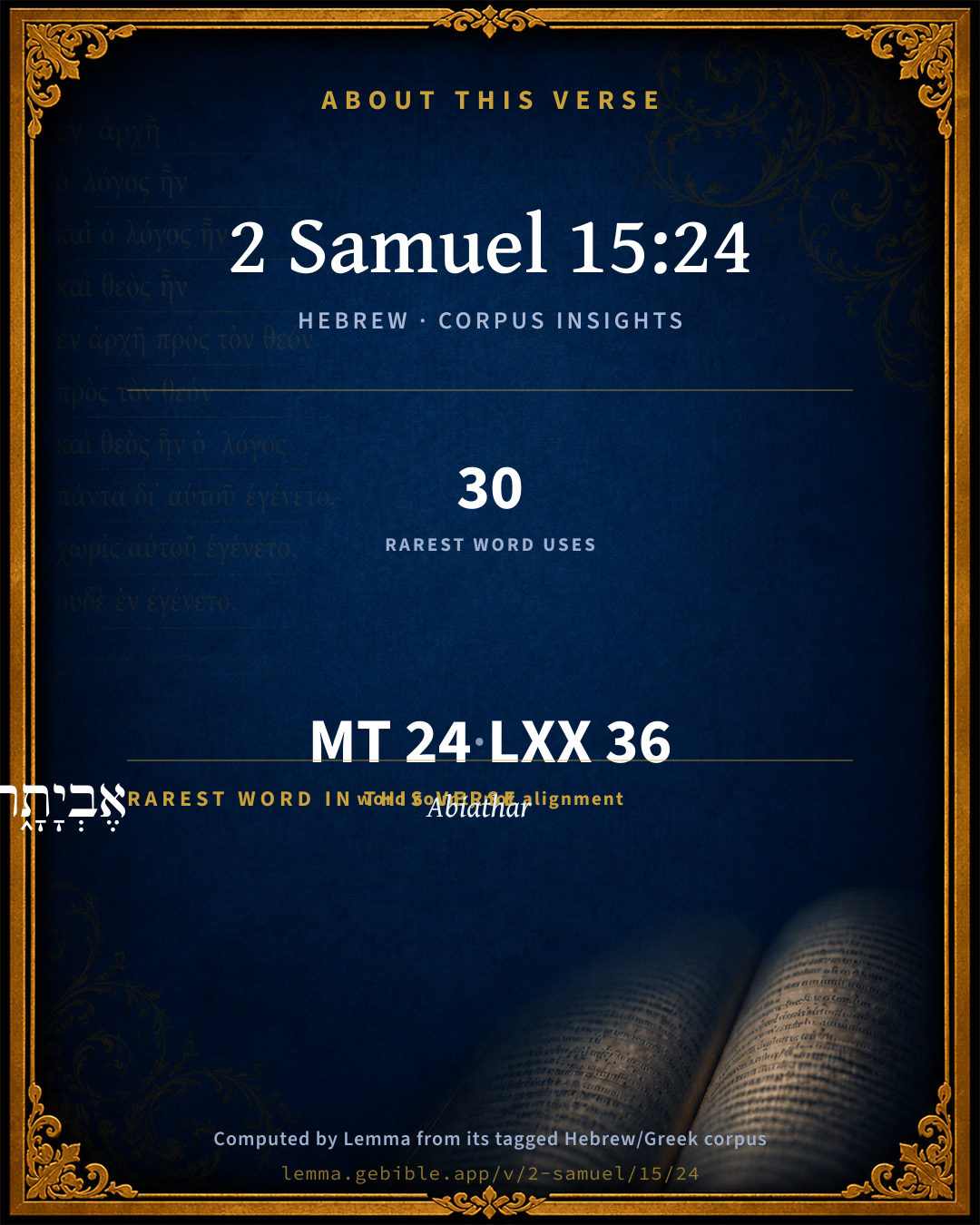
אֶבְיָתָ֑ר Abiathar H54 occurs in 28 verses of the Hebrew Bible. Also found in:

Grammatical profile

  • 5 verbs
  • 12 nouns
  • 3 prepositions
  • 1 adverb
  • 3 particles

Verb forms

  • נֹֽשְׂאִים֙ Qal · Participle Active
  • וַיַּצִּ֨קוּ֙ Hiphil · Sequential Imperfect
  • וַיַּ֖עַל Qal · Sequential Imperfect
  • תֹּ֥ם Qal · Infinitive Construct
  • לַעֲב֥וֹר Qal · Infinitive Construct

Repetition

Words recur within this verse — often emphatic in Hebrew:

  • וְכָֽל all H3605 ×2
  • אֲרוֹן֙ ark H727 ×2
  • הָאֱלֹהִ֔ים God H430 ×2

Hebrew & Septuagint length

In English translation the verse runs 41 words from the Hebrew and 44 from the Septuagint (LXX English) — closely comparable.

A rough comparison of the two English renderings, which tokenize alike — not a word-level alignment.

Word counts can differ between the Hebrew and the Greek without any difference in meaning — e.g. the Hebrew direct-object marker אֵת has no separate Greek word, and Greek often adds the article ὁ.

In the original languages it is 24 Hebrew tokens and 36 Greek tokens — but the two are counted differently (Hebrew bundles its prefixes and suffixes into one token; the Greek is in lemma form), so that isn’t a like-for-like length.

Cross-references

22

Topical passages linked to 2 Samuel 15:24 in the Treasury of Scripture Knowledge — connected by theme and wording, ordered by reader-vote popularity; previews shown in the World English Bible.

  • Numbers 4:15 "When Aaron and his sons have finished covering the sanctuary, and all the furniture of the sanctuary, as the camp moves forward; after that, the sons of Kohath shall come to carry it: but they shall not touch the sanctuary, lest they die. These things are the burden of the sons of Kohath in the Tent of Meeting.
  • 2 Samuel 8:17 and Zadok the son of Ahitub, and Ahimelech the son of Abiathar, were priests; and Seraiah was scribe;
  • 2 Samuel 20:25 and Sheva was scribe; and Zadok and Abiathar were priests;
  • 1 Samuel 22:20 One of the sons of Ahimelech, the son of Ahitub, named Abiathar, escaped, and fled after David.
  • Numbers 7:9 But to the sons of Kohath he gave none, because the service of the sanctuary belonged to them; they carried it on their shoulders.
  • Joshua 3:3 and they commanded the people, saying, When you see the ark of the covenant of Yahweh your God, and the priests the Levites bearing it, then you shall remove from your place, and go after it.
  • Joshua 3:6 Joshua spoke to the priests, saying, Take up the ark of the covenant, and pass over before the people. They took up the ark of the covenant, and went before the people.
  • Joshua 3:15–17 and when those who bore the ark were come to the Jordan, and the feet of the priests who bore the ark were dipped in the brink of the water (for the Jordan overflows all its banks all the time of harvest),
  • Joshua 4:16–18 Command the priests who bear the ark of the testimony, that they come up out of the Jordan.
  • Joshua 6:4 Seven priests shall bear seven trumpets of rams' horns before the ark: and the seventh day you shall compass the city seven times, and the priests shall blow the trumpets.
  • Joshua 6:6 Joshua the son of Nun called the priests, and said to them, Take up the ark of the covenant, and let seven priests bear seven trumpets of rams' horns before the ark of Yahweh.
  • 1 Samuel 4:3–5 When the people were come into the camp, the elders of Israel said, Why has Yahweh struck us today before the Philistines? Let us get the ark of the covenant of Yahweh out of Shiloh to us, that it may come among us, and save us out of the hand of our enemies.
  • 1 Samuel 4:11 The ark of God was taken; and the two sons of Eli, Hophni and Phinehas, were slain.
  • 2 Samuel 6:13 It was so, that, when those who bore the ark of Yahweh had gone six paces, he sacrificed an ox and a fattened calf.
  • 2 Samuel 15:27 The king said also to Zadok the priest, "Aren't you a seer? Return into the city in peace, and your two sons with you, Ahimaaz your son, and Jonathan the son of Abiathar.
  • 2 Samuel 15:35 Don't you have Zadok and Abiathar the priests there with you? therefore it shall be, that whatever thing you shall hear out of the king's house, you shall tell it to Zadok and Abiathar the priests.
  • 1 Kings 1:8 But Zadok the priest, and Benaiah the son of Jehoiada, and Nathan the prophet, and Shimei, and Rei, and the mighty men who belonged to David, were not with Adonijah.
  • 1 Kings 2:35 The king put Benaiah the son of Jehoiada in his room over the host; and Zadok the priest did the king put in the room of Abiathar.
  • 1 Kings 4:2–4 These were the princes whom he had: Azariah the son of Zadok, the priest;
  • 1 Chronicles 6:8–12 and Ahitub became the father of Zadok, and Zadok became the father of Ahimaaz,
  • 1 Chronicles 15:2 Then David said, None ought to carry the ark of God but the Levites: for them has Yahweh chosen to carry the ark of God, and to minister to him forever.
  • Ezekiel 48:11 [It shall be] for the priests who are sanctified of the sons of Zadok, who have kept my charge, who didn't go astray when the children of Israel went astray, as the Levites went astray.

Cross-references courtesy of OpenBible.info (CC BY 4.0).

Hebrew and Greek witnesses Masoretic Hebrew ↔ Greek Septuagint

The same verse in the two great witnesses to the Old Testament, shown verse-for-verse.

These are two independent witnesses, not word-aligned to each other, and the Septuagint is shown in lemma (dictionary) form.

Hebrew 2 Samuel 15:24 Masoretic · Westminster Leningrad Codex

וְהִנֵּ֨ה גַם צָד֜וֹק וְכָֽל הַלְוִיִּ֣ם אִתּ֗וֹ נֹֽשְׂאִים֙ אֶת אֲרוֹן֙ בְּרִ֣ית הָאֱלֹהִ֔ים וַיַּצִּ֨קוּ֙ אֶת אֲר֣וֹן הָאֱלֹהִ֔ים וַיַּ֖עַל אֶבְיָתָ֑ר עַד תֹּ֥ם כָּל הָעָ֖ם לַעֲב֥וֹר מִן הָעִֽיר

Behold, Zadok also [came], and all the Levites with him, bearing the ark of the covenant of God; and they set down the ark of God; and Abiathar went up, until all the people had done passing out of the city.

World English Bible · Public Domain

Greek LXX 2 Samuel 15:24 Septuagint · lemma form

καί ὁράω καί γέ σαδωκ καί πᾶς ὁ λευείτης μετά αὐτός αἴρω ὁ κιβωτός διαθήκη κύριος ἀπό βαιθαρ καί ἵστημι ὁ κιβωτός ὁ θεός καί ἀναβαίνω αβιαθαρ ἕως παύω πᾶς ὁ λαός παραἔρχομαι ἐκ ὁ πόλις

And behold also Sadoc, and all the Levites were with him, bearing the ark of the covenant of the Lord from Baethar: and they set down the ark of God; and Abiathar went up, until all the people had passed out of the city.

LXX2012 (modern English Septuagint) · Public Domain

Hebrew: Westminster Leningrad Codex (CC BY 4.0). Greek: Septuagint (public domain); English from LXX2012 (modern English Septuagint) (Public Domain). How the Septuagint differs from the Hebrew →

Targum (Aramaic paraphrase)

1

The Targum is the ancient Jewish Aramaic paraphrase of the Hebrew Scriptures — an interpretive translation, not the Hebrew text itself. Onkelos (literal) and Pseudo-Jonathan (expansive) render the Torah, and Jonathan the Prophets. Coverage is partial: where no permissively-licensed English translation exists for a verse, only the Aramaic is shown. This is verse-level text, not a word-by-word alignment to the Hebrew.

  1. Targum Jonathan Prophets (Joshua–Malachi)
    וְהָא אַף צָדוֹק וְכָל לְוָאֵי עִמֵיהּ נַטְלִין יַת אֲרוֹן קְיָמָא דַייָ וַאֲקִימוּ יַת אֲרוֹנָא דַייָ וּסְלִיק אֶבְיָתָר עַד דִשְׁלִים כָּל עַמָא לְמֶעְבַּר מִן קַרְתָּא:

    (no public-domain English translation for this verse)

    Targum Jonathan — Aramaic: “Mikraot Gedolot” (public domain). English: “Sefaria Community Translation” (CC0 1.0 (public-domain dedication)); “London "Chaldee Paraphrase," 1871” (public domain). Text via Sefaria.

Commentary

Notes on 2 Samuel 15:24 from classic Christian and Jewish commentators (each source and its license shown beneath its notes). The classic Christian expositions comment on the surrounding passage and are grouped to its opening verse, so a note may address several verses; the Jewish commentaries on the Tanakh (Rashi and others) are per-verse, so they appear only where the commentator wrote on this verse.

Lemma curates 59 commentaries, every one of them public domain or Creative Commons licensed, each selected and text-cleaned for this edition rather than reprinted as found. About our sources →

Matthew Henry's Commentary

Here we have, I. The fidelity of the priests and Levites and their firm adherence to David and his interest. They knew David's great affection to them and their office, notwithstanding his failings. The method Absalom took to gain people's affections made no impression upon them; he had little religion in him, and therefore they steadily adhered to David. Zadok and Abiathar, and all the Levites, if he go, will accompany him, and take the ark with them, that, by it, they may ask counsel of God for him, Sa2 15:24. Note, Those that are friends to the ark in their prosperity will find it a friend to them in their adversity. Formerly David would not rest till he had found a resting-place for the ark; and now, if the priests may have their mind, the ark shall not rest till David return to his rest.

II. David's dismission of them back into the city, Sa2 15:25, Sa2 15:26. Abiathar was high priest (Kg1 2:35), but Zadok was his assistant, and attended the ark most closely, while Abiathar was active in public business, Sa2 15:24. Therefore David directs his speech to Zadok, and an excellent speech it is, and shows him to be in a very good frame under his affliction, and that still he holds fast his integrity. 1. He is very solicitous for the safety of the ark: "By all means carry the ark back into the city, let not that be unsettled and exposed with me, lodge that again in the tent pitched for it; surely Absalom, bad as he is, will do that no harm." David's heart, like Eli's trembles for the ark of God. Note, It argues a good principle to be more concerned for the church's prosperity than for our own, to prefer Jerusalem before our chief joy (Psa 137:6), the success of the gospel, and the flourishing of the church, above our own wealth, credit, ease, and safety, even when they are most in hazard. 2. He is very desirous to return to the enjoyment of the privileges of God's house. He will reckon it the greatest instance of God's favour to him if he may but once more be brought back to see it and his habitation. This will be more his joy than to be brought back to his own palace and throne again. Note, Gracious souls measure their comforts and conveniences in this world by the opportunity they give them of communion with God. Hezekiah wished for the recovery of his health for this reason, that he might go up to the house of the Lord, Isa 38:22. 3. He is very submissive to the holy will of God concerning the issue of this dark dispensation. He hopes the best (Sa2 15:25), and hopes for it from the favour of God, which he looks upon to be the fountain of all good: "If God favour me so far, I shall be settled again as formerly." But he provides for the worst: "If he deny me this favour - if he thus say, I have no delight in thee - I know I deserve the continuance of his displeasure; his holy will be done." See him here patiently awaiting the event: "Behold, here am I, as a servant expecting orders;" and see him willing to commit himself to God concerning it: "Let him do to me as seemeth good to him. I have nothing to object. All is well that God does." Observe with what satisfaction and holy complacency he speaks of the divine disposal: not only, "He can do what he will," subscribing to his power (Job 9:12), or, "He has a right to do what he will," subscribing to his sovereignty (Job 33:13), or, "He will do what he will," subscribing to his unchangeableness (Job 23:13, Job 23:15), but, "Let him to what he will," subscribing to his wisdom and goodness. Note, It is our interest, as well as duty, cheerfully to acquiesce in the will of God, whatever befals us. That we may not complain of what is, let us see God's hand in all events; and, that we may not be afraid of what shall be, let us see all events in God's hand.

III. The confidence David put in the priests that they would serve his interest to the utmost of their power in his absence. He calls Zadok a seer (Sa2 15:27), that is, a wise man, a man that can see into business and discern time and judgment: "Thou hast thy eyes in thy head (Ecc 2:14), and therefore art capable of doing me service, especially by sending me intelligence of the enemy's motions and resolutions." One friend that is a seer, in such an exigency as this, was worth twenty that were not so quick-sighted. For the settling of a private correspondence with the priests in his absence, he appoints, 1. Whom they should send to him - their two sons, Ahimaaz and Jonathan, whose coat, it might be hoped, would be their protection, and of whose prudence and faithfulness he had probably had experience. 2. Whither they should send. He would encamp in the plain of the wilderness till he heard from them (Sa2 15:28), and then would move according to the information and advice they should send him. Hereupon they returned to the city, to await the event. It was a pity that any disturbance should be given to a state so happy as this was, when the prince and the priests had such an entire affection for the confidence in each other.

IV. The melancholy posture that David and his men put themselves into, when, at the beginning of their march, they went up the mount of Olives, Sa2 15:30.

1. David himself, as a deep mourner, covered his head and face for shame and blushing, went bare-foot, as a prisoner or a slave, for mortification, and went weeping. Did it become a man of his reputation for courage and greatness of spirit thus to cry like a child, only for fear of an enemy at a distance, against whom he might easily have made head, and perhaps with one bold stroke have routed him? Yes, it did not ill become him, considering how much there was in this trouble, (1.) Of the unkindness of his son. He could not but weep to think that one who came out of his bowels, and had so often lain in his arms, should thus lift up the heel against him. God himself is said to be grieved with the rebellions of his own children (Psa 95:10) and even broken with their whorish heart, Eze 6:9. (2.) There was much of the displeasure of his God in it. This infused the wormwood and gall into the affliction and misery, Lam 3:19. His sin was ever before him (Psa 51:3), but never so plain nor ever appearing so black as now. He never wept thus when Saul hunted him: but a wounded conscience makes troubles lie heavily, Psa 38:4.

2. When David wept all his company wept likewise, being much affected with his grief and willing to share in it. It is our duty to weep with those that weep, especially our superiors, and those that are better than we; for, if this be done in the green tree, what will be done in the dry? We must weep with those that weep for sin. When Hezekiah humbled himself for his sin all Jerusalem joined with him, Ch2 32:26. To prevent suffering with sinners, let us sorrow with them.

Matthew Henry's Commentary on the Whole Bible (1708–1710) — public domain (CC PDM 1.0). Text via the HelloAO Bible API.

Trapp's Complete Commentary

John Trapp

2Sa 15:24 And lo Zadok also, and all the Levites [were] with him, bearing the ark of the covenant of God: and they set down the ark of God; and Abiathar went up, until all the people had done passing out of the city.

Ver. 24. And Abiathar went up,] viz., Into some high place to see what store came, and when they left coming out of the city. In a time of common calamity, every man must do his devoir. Hμεις παντες κινδυνευομεν, και ου παιζεις; Are we perishing, and dost thou trifle? said one to another, that in a great tempest at sea asked many frivolous questions. {a}

{a} Aul. Gell.

John Trapp, A Commentary or Exposition upon All the Books of the Old and New Testament (1647–1656) — public domain. Text from a community e-Sword module.

Joseph Benson's Commentary

2Sa 15:24. Zadok also, and all the Levites were with him — They knew David’s great regard for them and their office, notwithstanding his failings; and the arts which Absalom had used to gain the people’s affections had made no impression upon them. They saw that he had little religion in him, and therefore they steadily adhered to David. Bearing the ark of the covenant of God — As a pledge of God’s presence and assistance. And they set down the ark of God — Either in expectation of drawing forth more people to David’s party, if not from their loyalty to their lawful king, yet from their piety and reverence to the ark; or, that all the people might pass along, and the ark might come in the rear of them, for their safeguard and encouragement. Abiathar went up — From the ark to the city, which was on higher ground; that so he, being high-priest, might use his authority with the people, to persuade them to do their duty; and there he stayed until all those whom he could persuade were gone forth.

Joseph Benson's Commentary on the Old and New Testaments (1811–1818) — public domain. Text from a community e-Sword module.

Tyndale Open Study Notes

Tyndale Open Resources

15:24 Zadok was one of two priests who served David (8:17). He later anointed Solomon (1 Kgs 1:39) and became the high priest after Abiathar was deposed (1 Kgs 2:26-27).

Tyndale Open Study Notes — © Tyndale Open Resources, licensed CC BY-SA 4.0. Text via the HelloAO Bible API.

Geneva Bible (1599)

Geneva Bible translators

To stand by the Ark.

Which was the charge, of the Kohathites, Num. 4:4.

Geneva Bible (1599) marginal notes — public domain. Text via Bolls.life.

Jamieson, Fausset & Brown

Robert Jamieson, A. R. Fausset & David Brown

Zadok also, and all the Levites . . ., bearing the ark--Knowing the strong religious feelings of the aged king, they brought it to accompany him in his distress. But as he could not doubt that both the ark and their sacred office would exempt them from the attacks of the rebels, he sent them back with it--not only that they might not be exposed to the perils of uncertain wandering, for he seems to place more confidence in the symbol of the divine presence than in God Himself--but that, by remaining in Jerusalem, they might render him greater service by watching the enemy's movements.

Jamieson, Fausset & Brown — Commentary Critical and Explanatory on the Whole Bible (1871) — public domain (CC PDM 1.0). Text via the HelloAO Bible API.

Adam Clarke's Commentary

Verse 24. Bearing the ark] The priests knew that God had given the kingdom to David; they had no evidence that he had deposed him: they therefore chose to accompany him, and take the ark, the object of their charge, with them.

Adam Clarke's Commentary on the Bible (1810–1826) — public domain. Text from a community e-Sword/MySword module.

Ellicott's Commentary for English Readers

(24) Zadok also.—Zadok appears here as in charge of the ark, and David (2Sa_15:27) addresses him exclusively, while Abiathar is merely mentioned. This gives no indication of the relations existing between the two, but merely shows how matters went on this day of hurry and confusion. The language is obscure, but probably means that Zadok and the Levites brought the ark out of the city, and set it down while the multitude were assembling; meantime Abiathar led the multitude forward up the Mount of Olives until they had all come out of the city.

A Bible Commentary for English Readers, edited by Charles John Ellicott (1878–1897) — public domain. Text from a community e-Sword module.

The Cambridge Bible for Schools and Colleges

gen. ed. J. J. S. Perowne

24–29. The Ark sent back to Jerusalem

24. and Abiathar went up] The Ark halted, to allow the people who were still coming out of the city time to overtake the procession. Meanwhile Abiathar went on up the Mount of Olives, for some purpose which is not stated, possibly to watch the stream of people coming out of the city. He then returned to carry the Ark back. It seems best to suppose that the narrative goes back here, and that the Ark was not taken across the Kidron. Certainly it does not seem to have been carried up the Mount of Olives.

The Cambridge Bible for Schools and Colleges (gen. ed. J. J. S. Perowne; Cambridge University Press, 1878–1918) — public domain. Text from a community e-Sword module.

John Gill's Exposition

And, lo, Zadok also,.... The priest, as he is called, Sa2 15:27,

and all the Levites were with him: with Zadok, or with David, and indeed with both; but the former is rather meant here, being the immediate antecedent:

bearing the ark of the covenant of God: these were the Kohathite Levites, whose business it was to bear the ark when carried from place to place, Num 3:31; called the ark of the covenant, because the law which was the covenant between God and the people, was put into it:

and they set down the ark of God: from off their shoulders, on which they carried it:

and Abiathar went up; who was the high priest, and whose business it was to attend the ark, and inquire before it, as occasion required; he went up very probably to the mount of Olives, later mentioned, Sa2 15:30,

until all the people had done passing out of the city; for from the top of that mountain he could see the city of Jerusalem, and the people as they passed out of it, and observe when they were all come out, or however ceased coming, and so knew when it was a proper time to march forward.

John Gill's Exposition of the Whole Bible (1746–1763) — public domain (CC PDM 1.0). Text via the HelloAO Bible API.

Albert Barnes' Notes on the Bible

Abiathar went up - i. e., continued to ascend the Mount of Olives. Abiathar was high priest 1Ki 2:35. Perhaps Zadok is addressed by David 2Sa 15:25 as the chief of those who were actually bearing the ark.

Albert Barnes' Notes on the Bible (1834–1885) — public domain. Text from a community e-Sword/MySword module.

Haydock's Catholic Bible Commentary

Went up to the ark, or along with the rest. (Calmet)

George Leo Haydock (1774–1849), Haydock's Catholic Family Bible and Commentary, 1859 edition — public domain. Excludes Psalms (Douay-Rheims chapter numbering differs from Protestant) and Deuterocanonical books (Catholic canon only).

Matthew Poole's English Annotations

Bearing the ark of the covenant of God; as a pledge of God’s presence and assistance, and that David might inquire at it upon occasion.

They set down the ark of God; either in expectation of drawing forth more people to David’s party, if not from their loyalty to their lawful king, yet from their piety and reverence to the ark; or that all the people might pass along, and the ark might come in the rear of them for their safeguard and encouragement.

Abiathar went up; either,

1. From the ark, which now was in the low ground, being near the brook Cedron, to the top of the Mount of Olives, whence he had the prospect of the city and temple, as appears from Mar 13:3, where he could discern when the people ceased to come out of the city after David; which when they did, he gave notice to David that he should wait no longer, but march away and carry the ark with him. Or,

2. From the ark to the city, which was in a higher ground, that so he being high priest, might use his authority and interest with the people to persuade them to do their duty, in going forth to defend and help their king against his rebellious son; and there he staid until all those whom he could persuade were gone forth.

Matthew Poole's English Annotations on the Holy Bible (1683–1685) — public domain. Text from a community e-Sword/MySword module.

Whedon's Commentary on the Bible

Daniel D. Whedon

24. Zadok — See 2Sa_8:17, and note on 2Sa_6:17.

Bearing the ark — They felt it would not do to let this holy shrine fall into the hands of the conspirators.

Abiathar went up — Went up the ascent of Mount Olivet, leading a vast concourse of the people, until, from its side or summit, he saw the end of the procession outside the city. Here we see that Zadok and Abiathar, though at the head of different establishments, were sometimes together, and acted conjointly in the priesthood. On this occasion it seems that Zadok accompanied the ark, and remained by it while it rested in the Kidron valley, while Abiathar marched on at the head of the procession of people.

Daniel D. Whedon (gen. ed.), Commentary on the Old and New Testaments (1874–1909) — public domain. Text from a community e-Sword module.

The Pulpit Commentary

And Abiathar went up. This rendering, though confirmed by the versions, is very unintelligible. Whither did Abiathar go up? And moreover it is said that he continued going up until all David"s followers had passed out of the city. Another possible rendering is, "And Abiathar offered (sacrifices) until all the people had done passing out of the city." Passages quoted in proof that the verb may be so rendered without the addition of the word "sacrifice" are 1Sa_2:28 and 2Sa_24:22; but in both these places the context makes the sense plain. Such a sacrifice would, of course, sanctify both king and people in their flight; but as none of the versions support this method of translating the text, it seems unsafe to adopt it, and the passage must remain obscure. On the one hand, it is unlikely that there would be time to offer sacrifices at so hasty a flight; but on the other hand, the removal of the ark was a solemn thing, which probably required some such religious ceremonial, and Cahen and other Jewish authorities translate, "Abiathar offered burnt offerings."

The Pulpit Commentary (1880–1919), ed. H.D.M. Spence-Jones & Joseph S. Exell — public domain. Text from a community e-Sword module.

John Wesley's Explanatory Notes

Went up - From the ark to the city, which was on higher ground, that so he being high-priest, might use his authority with the people, to persuade them to do their duty; and there he staid until all those whom he could persuade were gone forth.

John Wesley, Explanatory Notes Upon the Whole Bible (1754–1765) — public domain. Text via the GEBible commentary corpus.

unfoldingWord translationNotes

Door43 World Missions Community

I find favor in the eyes of Yahweh

Here the "eyes of Yahweh" refer to Yahweh's thoughts and opinion. If you "find favor" with someone it means that they are pleased with you. AT: "Yahweh is pleased with me" (See: Metonymy and Idiom)

where he lives

"where his presence is." The ark of the covenant symbolizes Yahweh's presence. This refers to the place where the ark is. AT: "where it is kept" (See: Metonymy)

translationWords

Zadok

Levi

ark of the covenant

God

Abiathar

favor

unfoldingWord translationNotes — © Distant Shores Media and the Door43 World Missions Community, licensed CC BY-SA 4.0. Source: git.door43.org/Door43/en_tn.

Rashi

Rabbi Shlomo Yitzchaki (Rashi)

They set down. Like, "They stopped," [Yonasan translates:] "They stopped the Ark." They stood it off to one side and the people passed by because Dovid wanted it brought with him.

And Evyosor went off [to the side] until [all the people] finished etc. This is a shortened verse they set down the Ark of God until all the people finished travelling.

Evyosor went off [to the side]. That day he was removed from the Kohanite service. because He inquired of the Urim and Tumim but was not answered, Tzodok then replaced him. This is what we learned in Seder Olam in tractate Yuma.

Rashi on the Tanakh — English translations: “The Judaica Press complete Tanach with Rashi, translated by A. J. Rosenberg” (CC BY 4.0); “Pentateuch with Rashi's commentary by M. Rosenbaum and A.M. Silbermann, 1929-1934” (public domain); “The Metsudah Tanach series, Lakewood, N.J” (CC BY 4.0); and “The Book of Joshua, Metsudah Publications, 1997” (CC BY 4.0). Text via Sefaria.

Lesson kit

Teaching starters — assembled from the data on this page, not authored interpretation. Every prompt links to the verse data it draws on. Edit before teaching.

2 Samuel, in the Historical, opens this verse with 24 words (20 distinct Hebrew lemmas). Its most distinctive word is ʼEbyâthâr (“Abiathar”). A historical commentator’s framing appears above. Read the whole chapter for the surrounding context.

Discussion questions

  1. How does “Abiathar” (ʼEbyâthâr) shape what this verse is saying?
  2. How does 1 Samuel 22:20, which shares the word «Abiathar», read alongside this verse?
  3. What does the repetition of “all” (2× in this one verse) do in this verse?
  4. These translations render this verse differently; the difference is in the English rendering, not the original. What questions does that raise?
  5. «נֹֽשְׂאִים֙» is a Qal Participle Active verb. How does that grammatical form shape the action described?
  6. Compare how Matthew Henry's Commentary and Trapp's Complete Commentary read this verse. Where do they agree or differ?

Things to notice

Reading settings

Reading text

Shown beneath each verse's original-language words.

Old Testament
Old Testament edition

Read the OT as the Masoretic Hebrew (MT) or the Greek Septuagint (LXX).

English shown for the Greek Septuagint (in the Hebrew ↔ Greek comparison).

Comparing translations? Open the Compare panel on any verse page to stack up to four side by side.