
1 Chronicles 10:12

Hebrew (Westminster Leningrad Codex) 1 Chronicles 10:12 appears in the Hebrew Old Testament. The text above is from the Westminster Leningrad Codex. Each word links to its Strong’s number, a concise gloss, and parsing drawn from the Open Scriptures Hebrew Bible morphology. Click any word for its full Brown-Driver-Briggs (BDB) entry.
Download image
Cite this verse

1 Chronicles 10:12 (World English Bible). Public Domain. Lemma interlinear Bible study tool, https://lemma.gebible.app/v/1-chronicles/10/12.

Show BibTeX & RIS
BibTeX
RIS
English Translation
all the valiant men arose, and took away the body of Saul, and the bodies of his sons, and brought them to Jabesh, and buried their bones under the oak in Jabesh, and fasted seven days.
World English Bible · Public Domain
Highlights
  • 1 first appearance in the Hebrew Bible
Full analysis ↓
Download a study sheet

One document with this verse’s original text, its word-by-word gloss line, the meaning frame, cross-references with their text, attributed commentary, and full source and license credits — printable, and it pastes into notes with its structure intact.

This verse Autodidact and up

Study sheet (.html) Plain text (.txt)

A passage Seminary Student

Up to 50 verses in one chapter. A passage sheet keeps up to 6 commentary sources and 12 cross-references per verse, in the order this page ranks them, and says so on the sheet whenever that leaves anything out. Ask for a single verse and you get the Autodidact verse sheet above.

Everything on this page stays free to read, with no account — the sheet is a download of what is already on screen, not access to it.

Want to remove ads? Support Godless Engineer
Compare translations 3

The same verse in 3 English versions, stacked beneath the original-language interlinear above. Click any original word for its lexicon entry.

Each is an independent rendering of the whole verse — the interlinear is not word-aligned to these translations.

Highlighted words mark where these versions differ — a whole-verse word diff, not a word-by-word alignment.

  • World English Bible Public Domain
    all the valiant men arose, and took away the body of Saul, and the bodies of his sons, and brought them to Jabesh, and buried their bones under the oak in Jabesh, and fasted seven days.
  • King James Version Public Domain
    They arose, all the valiant men, and took away the body of Saul, and the bodies of his sons, and brought them to Jabesh, and buried their bones under the oak in Jabesh, and fasted seven days.
  • unfoldingWord Literal Text CC BY-SA 4.0
    And all of the men of valor arose and carried away the corpse of Saul and the corpses of his sons, and they brought them to Jabesh. And they buried their bones under the oak tree in Jabesh. And they fasted seven days.

unfoldingWord Literal Text — © unfoldingWord, licensed CC BY-SA 4.0. Word-aligned USFM3 via Door43 (git.door43.org/unfoldingWord/en_ult).

Versions to compare (up to 4)

3 of 4 selected

Show all 18 translations

Every available English version of this verse, each an independent rendering of the whole verse.

  • World English Bible Public Domain
    all the valiant men arose, and took away the body of Saul, and the bodies of his sons, and brought them to Jabesh, and buried their bones under the oak in Jabesh, and fasted seven days.
  • Berean Standard Bible Public Domain
    all their men of valor set out and retrieved the bodies of Saul and his sons and brought them to Jabesh. And they buried their bones under the oak in Jabesh and fasted seven days.
  • Majority Standard Bible Public Domain
    all their men of valor set out and retrieved the bodies of Saul and his sons and brought them to Jabesh. And they buried their bones under the oak in Jabesh and fasted seven days.
  • King James Version Public Domain
    They arose, all the valiant men, and took away the body of Saul, and the bodies of his sons, and brought them to Jabesh, and buried their bones under the oak in Jabesh, and fasted seven days.
  • American Standard Version (1901) Public Domain
    all the valiant men arose, and took away the body of Saul, and the bodies of his sons, and brought them to Jabesh, and buried their bones under the oak in Jabesh, and fasted seven days.
  • Revised Version (1885) Public Domain
    all the valiant men arose, and took away the body of Saul, and the bodies of his sons, and brought them to Jabesh, and buried their bones under the oak in Jabesh, and fasted seven days.
  • Geneva Bible (1599) Public Domain
    Then they arose (all the valiant men) and tooke the body of Saul, and the bodies of his sonnes, and brought them to Iabesh, and buryed the bones of them vnder an oke in Iabesh, and fasted seuen dayes.
  • Douay-Rheims (1899) Public Domain
    All the valiant men of them arose, and took the bodies of Saul and of his sons, and brought them to Jabes, and buried their bones under the oak that was in Jabes, and they fasted seven days.
  • Young's Literal Translation Public Domain
    and all the men of valour rise and bear away the body of Saul, and the bodies of his sons, and bring them in to Jabesh, and bury their bones under the oak in Jabesh, and fast seven days.
  • Literal Standard Version CC BY-SA 4.0
    and all the men of valor rise and carry away the body of Saul, and the bodies of his sons, and bring them to Jabesh, and bury their bones under the oak in Jabesh, and fast seven days.
  • Unlocked Literal Bible CC BY-SA 4.0
    all the fighting men went and took away the body of Saul and those of his sons, and brought them to Jabesh. They buried their bones under the oak in Jabesh and fasted seven days.
  • unfoldingWord Literal Text CC BY-SA 4.0
    And all of the men of valor arose and carried away the corpse of Saul and the corpses of his sons, and they brought them to Jabesh. And they buried their bones under the oak tree in Jabesh. And they fasted seven days.
  • Darby Bible Public Domain
    all the valiant men arose, and took up the body of Saul and the bodies of his sons, and brought them to Jabesh, and buried their bones under the terebinth of Jabesh, and fasted seven days.
  • World Messianic Bible Public Domain
    all the valiant men arose and took away the body of Saul and the bodies of his sons, and brought them to Jabesh, and buried their bones under the oak in Jabesh, and fasted seven days.
  • Webster's Bible Public Domain
    They arose, all the valiant men, and took away the body of Saul, and the bodies of his sons, and brought them to Jabesh, and buried their bones under the oak in Jabesh, and fasted seven days.
  • Free Bible Version CC BY-SA 4.0
    all their fighting men went and recovered the bodies of Saul and his sons. They brought them back and buried them under the large tree in Jabesh. Then they fasted for seven days.
  • Bible in Basic English Public Domain
    All the fighting-men came up and took away Saul's body and the bodies of his sons, and took them to Jabesh, and put their bones to rest under the oak-tree in Jabesh, and took no food for seven days.
  • JPS Tanakh (1917) Public Domain
    all the valiant men arose, and took away the body of Saul, and the bodies of his sons, and brought them to Jabesh, and buried their bones under the terebinth in Jabesh, and fasted seven days.

Literal Standard Version (2020), Covenant Press — licensed CC BY-SA 4.0. Text via the HelloAO Bible API (eBible.org). Unlocked Literal Bible (unfoldingWord) — licensed CC BY-SA 4.0. Text via the HelloAO Bible API (eBible.org). unfoldingWord Literal Text — © unfoldingWord, licensed CC BY-SA 4.0. Word-aligned USFM3 via Door43 (git.door43.org/unfoldingWord/en_ult). Free Bible Version, Dr. Jonathan Gallagher — licensed CC BY-SA 4.0. Text via the HelloAO Bible API (eBible.org).

Word by word

More ways to search: Search by grammar → Find every occurrence → Compare this word →

Practice this passage: Drill this verse → Learn its vocabulary →

גּוּפַ֣ת
gûwphâh
H1480
“corpse of”
Noun, Common, Feminine, Singular, Construct
Part of Speech
Noun
Type
Common
Gender
Feminine
Number
Singular
State
Construct
Full BDB Definition

Origin: from H1479

TWOT: 329a

body, corpse
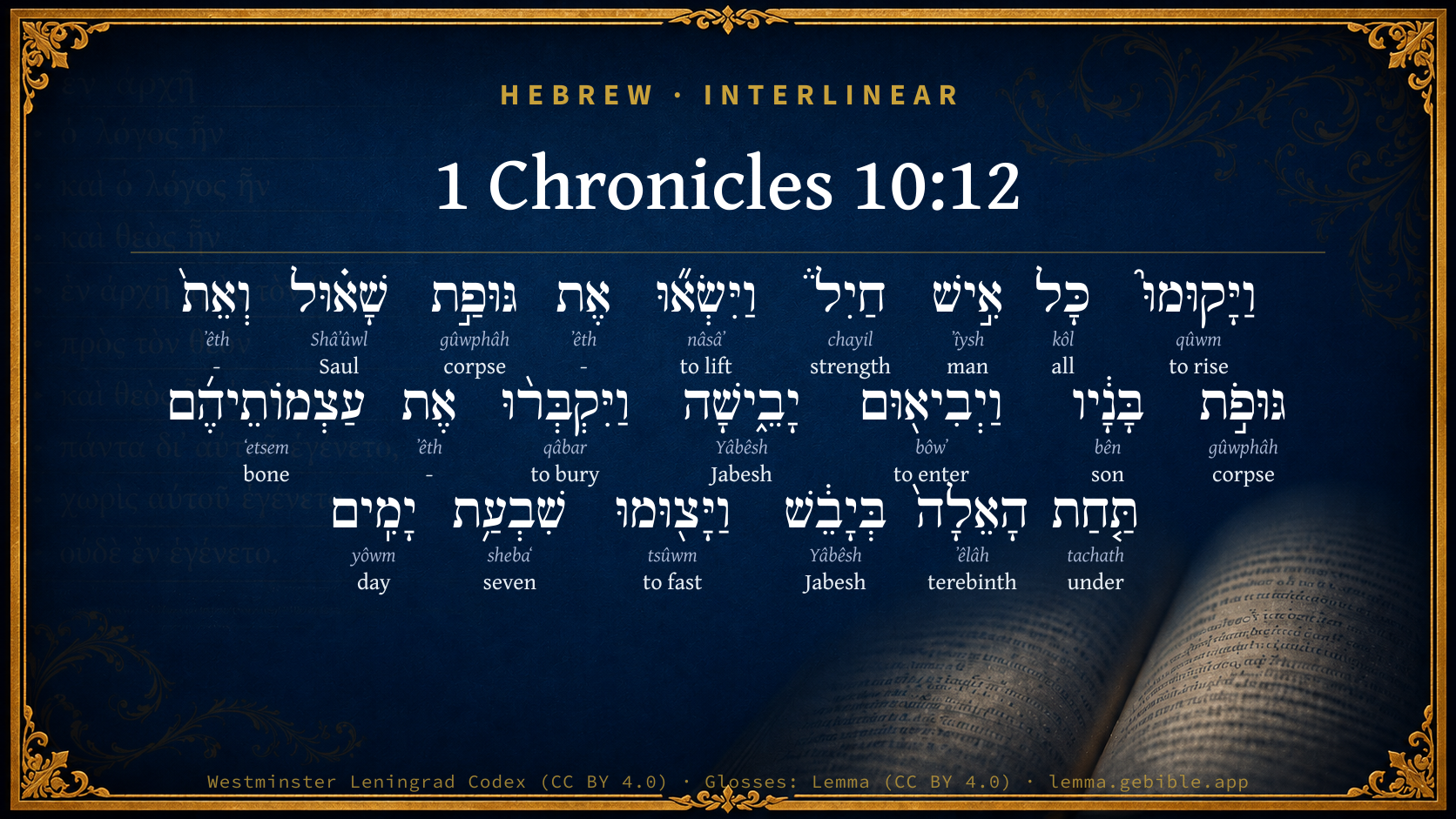
  1. וַיָּקוּמוּ֮ qûwm H6965 “and · to rise” Conjunction + Verb, Qal, Sequential Imperfect, 3rd Person, Masculine, Plural
  2. כָּל kôl H3605 “all of” Noun, Common, Masculine, Singular, Construct
  3. אִ֣ישׁ ʼîysh H376 “man of” Noun, Common, Masculine, Singular, Construct
  4. חַיִל֒ chayil H2428 “strength” Noun, Common, Masculine, Singular, Absolute
  5. וַיִּשְׂא֞וּ nâsâʼ H5375 “and · to lift” Conjunction + Verb, Qal, Sequential Imperfect, 3rd Person, Masculine, Plural
  6. אֶת ʼêth H853 “-” Particle, Direct Object
  7. שָׁא֗וּל Shâʼûwl H7586 “Saul” Noun, Proper
  8. וְאֵת֙ ʼêth H853 “and · -” Conjunction + Particle, Direct Object
  9. גּוּפֹ֣ת gûwphâh H1480 “corpses of” Noun, Common, Feminine, Plural, Construct
  10. בָּנָ֔יו bên H1121 “sons · his” Noun, Common, Masculine, Plural, Construct + Suffix, Personal, 3rd Person, Masculine, Singular
  11. וַיְבִיא֖וּם bôwʼ H935 “and · to enter · them” Conjunction + Verb, Hiphil, Sequential Imperfect, 3rd Person, Masculine, Plural + Suffix, Personal, 3rd Person, Masculine, Plural
  12. יָבֵ֑ישָׁה Yâbêsh H3003 “Jabesh · toward” Noun, Proper + Suffix, Demonstrative
  13. וַיִּקְבְּר֨וּ qâbar H6912 “and · to bury” Conjunction + Verb, Qal, Sequential Imperfect, 3rd Person, Masculine, Plural
  14. אֶת ʼêth H853 “-” Particle, Direct Object
  15. עַצְמוֹתֵיהֶ֜ם ʻetsem H6106 “bones · their” Noun, Common, Feminine, Plural, Construct + Suffix, Personal, 3rd Person, Masculine, Plural
  16. תַּ֤חַת tachath H8478 “under” Preposition
  17. הָאֵלָה֙ ʼêlâh H424 “the · terebinth” Particle, Definite Article + Noun, Common, Feminine, Singular, Absolute
  18. בְּיָבֵ֔שׁ Yâbêsh H3003 “in/at · Jabesh” Preposition + Noun, Proper
  19. וַיָּצ֖וּמוּ tsûwm H6684 “and · to fast” Conjunction + Verb, Qal, Sequential Imperfect, 3rd Person, Masculine, Plural
  20. שִׁבְעַ֥ת shebaʻ H7651 “seven” Adjective, Cardinal number, Masculine, Singular, Construct
  21. יָמִֽים yôwm H3117 “days” Noun, Common, Masculine, Plural, Absolute

About this verse

These counts appear in no published source. They are computed here, from the morphology-tagged text and Lemma’s own curated glosses. What Lemma adds →

22
words
18
distinct lemmas
Historical
section

Notable vocabulary

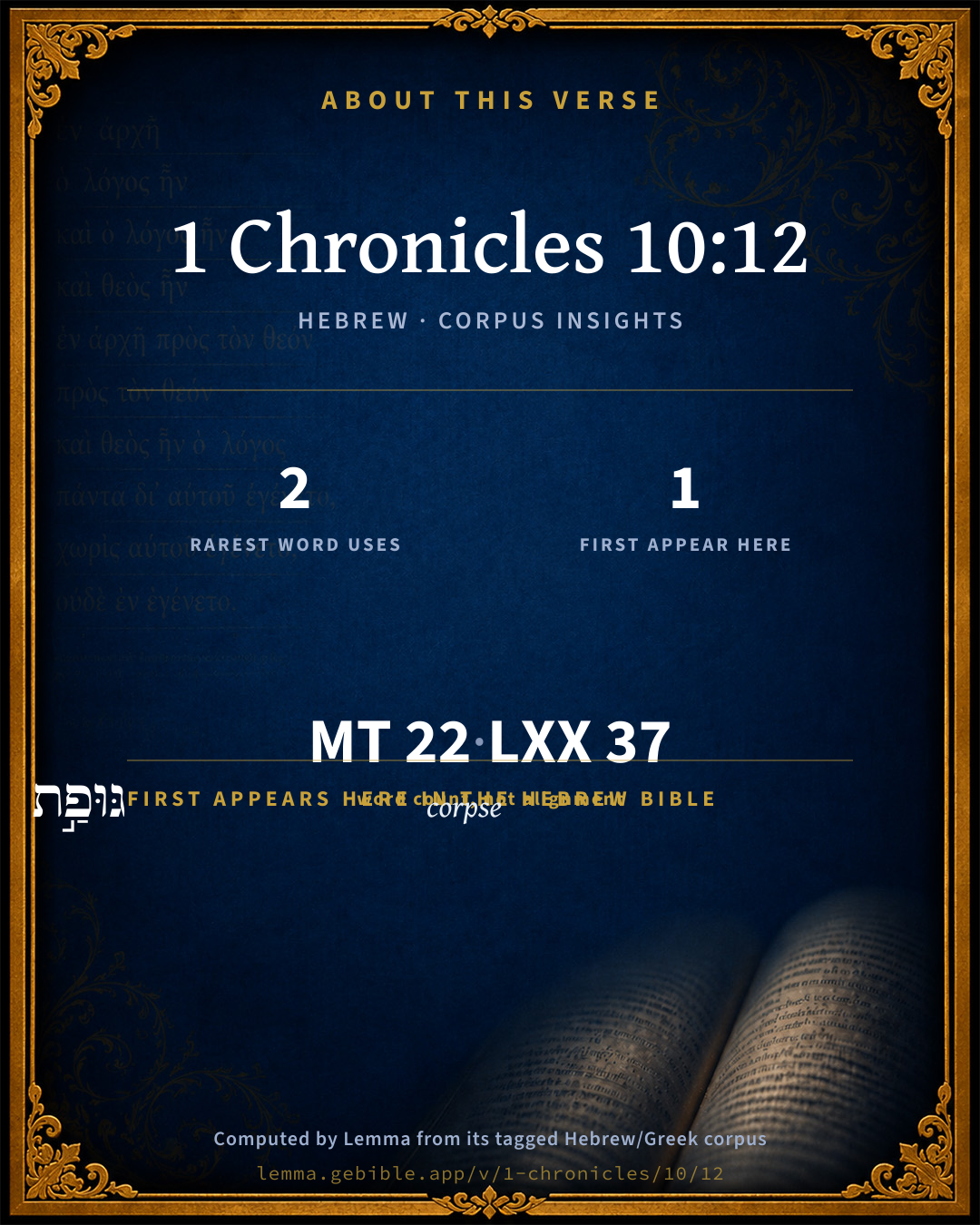
The rarest word here is גּוּפַ֣ת corpse H1480 — appearing just 2 times in the whole Hebrew Bible.

First appearance in Scripture

This word makes its first canonical appearance in the Hebrew Bible here:

  • גּוּפַ֣ת corpse H1480

Grammatical profile

  • 5 verbs
  • 12 nouns
  • 1 adjective
  • 1 preposition
  • 3 particles

Verb forms

  • וַיָּקוּמוּ֮ Qal · Sequential Imperfect
  • וַיִּשְׂא֞וּ Qal · Sequential Imperfect
  • וַיְבִיא֖וּם Hiphil · Sequential Imperfect
  • וַיִּקְבְּר֨וּ Qal · Sequential Imperfect
  • וַיָּצ֖וּמוּ Qal · Sequential Imperfect

Repetition

Words recur within this verse — often emphatic in Hebrew:

  • גּוּפַ֣ת corpse H1480 ×2
  • יָבֵ֑ישָׁה Jabesh H3003 ×2

Hebrew & Septuagint length

In English translation the verse runs 36 words from the Hebrew and 40 from the Septuagint (LXX English) — closely comparable.

A rough comparison of the two English renderings, which tokenize alike — not a word-level alignment.

Word counts can differ between the Hebrew and the Greek without any difference in meaning — e.g. the Hebrew direct-object marker אֵת has no separate Greek word, and Greek often adds the article ὁ.

In the original languages it is 22 Hebrew tokens and 37 Greek tokens — but the two are counted differently (Hebrew bundles its prefixes and suffixes into one token; the Greek is in lemma form), so that isn’t a like-for-like length.

Cross-references

4

Topical passages linked to 1 Chronicles 10:12 in the Treasury of Scripture Knowledge — connected by theme and wording, ordered by reader-vote popularity; previews shown in the World English Bible.

  • 2 Samuel 3:35 All the people came to cause David to eat bread while it was yet day; but David swore, saying, God do so to me, and more also, if I taste bread, or anything else, until the sun be down.
  • 2 Samuel 21:12–14 David went and took the bones of Saul and the bones of Jonathan his son from the men of Jabesh Gilead, who had stolen them from the street of Beth-shan, where the Philistines had hanged them, in the day that the Philistines killed Saul in Gilboa;
  • Genesis 35:8 Deborah, Rebekah's nurse, died, and she was buried below Bethel under the oak; and the name of it was called Allon Bacuth.
  • Genesis 50:10 They came to the threshing floor of Atad, which is beyond the Jordan, and there they lamented with a very great and sore lamentation. He mourned for his father seven days.

Cross-references courtesy of OpenBible.info (CC BY 4.0).

Hebrew and Greek witnesses Masoretic Hebrew ↔ Greek Septuagint

The same verse in the two great witnesses to the Old Testament, shown verse-for-verse.

These are two independent witnesses, not word-aligned to each other, and the Septuagint is shown in lemma (dictionary) form.

Hebrew 1 Chronicles 10:12 Masoretic · Westminster Leningrad Codex

וַיָּקוּמוּ֮ כָּל אִ֣ישׁ חַיִל֒ וַיִּשְׂא֞וּ אֶת גּוּפַ֣ת שָׁא֗וּל וְאֵת֙ גּוּפֹ֣ת בָּנָ֔יו וַיְבִיא֖וּם יָבֵ֑ישָׁה וַיִּקְבְּר֨וּ אֶת עַצְמוֹתֵיהֶ֜ם תַּ֤חַת הָאֵלָה֙ בְּיָבֵ֔שׁ וַיָּצ֖וּמוּ שִׁבְעַ֥ת יָמִֽים

all the valiant men arose, and took away the body of Saul, and the bodies of his sons, and brought them to Jabesh, and buried their bones under the oak in Jabesh, and fasted seven days.

World English Bible · Public Domain

Greek LXX 1 Chronicles 10:12 Septuagint · lemma form

καί ἐγείρω ἐκ γαλαάδ πᾶς ἀνήρ δυνατός καί λαμβάνω ὁ σῶμα σαούλ καί ὁ σῶμα ὁ υἱός αὐτός καί φέρω αὐτός εἰς ιαβις καί θάπτω ὁ ὀστέον αὐτός ὑπό ὁ δρῦς ἐν ιαβις καί νηστεύω ἑπτά ἡμέρα

And all the mighty men rose up from Galaad, and they took the body of Saul, and the bodies of his sons, and brought them to Jabis, and buried their bones under the oak in Jabis, and fasted seven days.

LXX2012 (modern English Septuagint) · Public Domain

Hebrew: Westminster Leningrad Codex (CC BY 4.0). Greek: Septuagint (public domain); English from LXX2012 (modern English Septuagint) (Public Domain). How the Septuagint differs from the Hebrew →

Commentary

Notes on 1 Chronicles 10:12 from classic Christian and Jewish commentators (each source and its license shown beneath its notes). The classic Christian expositions comment on the surrounding passage and are grouped to its opening verse, so a note may address several verses; the Jewish commentaries on the Tanakh (Rashi and others) are per-verse, so they appear only where the commentator wrote on this verse.

Lemma curates 59 commentaries, every one of them public domain or Creative Commons licensed, each selected and text-cleaned for this edition rather than reprinted as found. About our sources →

Trapp's Complete Commentary

John Trapp

1Ch 10:12 They arose, all the valiant men, and took away the body of Saul, and the bodies of his sons, and brought them to Jabesh, and buried their bones under the oak in Jabesh, and fasted seven days.

Ver. 12. And took away the body of Saul, and the bodies of his sons.] Which the Philistines, in disgrace of them, had fastened to the wall of Bethshan, afterwards called Scythopolis.

And fasted seven days.] A tanto, but not a toto, as Dan 10:2. In public calamities lugendum, scilicet non indulgendum genio, men must be deeply affected with the divine displeasure.

John Trapp, A Commentary or Exposition upon All the Books of the Old and New Testament (1647–1656) — public domain. Text from a community e-Sword module.

Joseph Benson's Commentary

1Ch 10:12. And fasted seven days — Every day till evening, after the manner of the Jewish fasts.

Joseph Benson's Commentary on the Old and New Testaments (1811–1818) — public domain. Text from a community e-Sword module.

Ellicott's Commentary for English Readers

(12) All the valiant men.—Literally, every man of valour. Samuel adds, “and marched all the night.”

Took away.—Carried off. Samuel has “took,” (ceperunt).

The body.—A common Aramaic word, gûfâh, only read here in the Old Testament, for which Samuel has the pure Hebrew synonym a’wîyah. Samuel adds, “from the wall of Beth-shan.”

And brought them.—Samuel, “and came to Jabesh, and burnt them there.” To burn a corpse was a further degradation of executed criminals (Jos_7:25; Lev_20:14; Lev_21:9), and as the Jews did not ordinarily practise cremation, it is supposed that the phrase “burnt them,” in 1 Samuel 31 means “made a burning for them” of costly spices, as was done at the funerals of kings (Jer_34:5; 2Ch_16:14; 2Ch_21:19). But perhaps the bodies were burnt in this exceptional case because they had been mutilated by the enemy.

Buried their bones.—Samuel, “took and buried.” The phrase “their bones,” contrasted with their “corpses,” certainly seems to imply that the latter had been burnt.

The oak.—Heb., terebinth, or turpentine tree. Samuel, “tamarisk.” The difference points to another source used by Chronicles.

And fasted seven days.—In token of mourning. (Comp. the friends of Job, Job_2:11-13; and Ezekiel among the exiles at Tel-abib, Eze_3:15.) For the behaviour of the men of Jabesh, comp. 1 Samuel 11

A Bible Commentary for English Readers, edited by Charles John Ellicott (1878–1897) — public domain. Text from a community e-Sword module.

The Cambridge Bible for Schools and Colleges

gen. ed. J. J. S. Perowne

12. took away] i.e. from the walls of Beth-shan (so Pesh.).

to Jabesh] Samuel adds “and burned them there.” The Chronicler omits this statement perhaps because the bones were not destroyed by this burning; cp. 2Sa_21:12-14 (the bones of Saul and Jonathan brought from Jabesh in David’s reign and re-interred in the family sepulchre). Burning was not a usual funeral rite among the Jews (cp. 2Ch_16:14, note), and probably the perfunctory burning carried out by the men of Jabesh was merely a ruse to give the Philistines the impression that Saul’s remains were destroyed and that therefore it was useless to disturb his grave.

under the oak] R.V. mg., under the terebinth. Large trees, being rare in Palestine, frequently serve as landmarks; cp. Jdg_4:5; 1Sa_22:6 (“tamarisk tree” R.V.).

fasted seven days] Fasting involved abstinence from food during daylight. David fasted “till the evening” in mourning for Saul (2Sa_1:12) and for Abner (ib. 2Sa_3:35). The fast of Jabesh was a sevenfold fast.

13, 14 (peculiar to Chron.). The Moral of the Overthrow of the House of Saul

Such reflexions as these are characteristic of the Chronicler; cp. 2Ch_12:2 (note); 1Ch_22:7; 1Ch_24:24; 1Ch_25:27. They are not so frequent in Sam. and Kings.

The Cambridge Bible for Schools and Colleges (gen. ed. J. J. S. Perowne; Cambridge University Press, 1878–1918) — public domain. Text from a community e-Sword module.

Haydock's Catholic Bible Commentary

Oak, well known at Jabes. Elsewhere the word is translated, the grove. (Calmet)

George Leo Haydock (1774–1849), Haydock's Catholic Family Bible and Commentary, 1859 edition — public domain. Excludes Psalms (Douay-Rheims chapter numbering differs from Protestant) and Deuterocanonical books (Catholic canon only).

Matthew Poole's English Annotations

To wit, every day till evening, after the manner of the Jewish fasts.

Matthew Poole's English Annotations on the Holy Bible (1683–1685) — public domain. Text from a community e-Sword/MySword module.

Whedon's Commentary on the Bible

Daniel D. Whedon

12. Buried their bones under the oak in Jabesh — Samuel has, “under a tree,” or rather, under the tree, (האשׂל), that is, some well-known tree which this writer designates as האלה, the oak, or terebinth.

Daniel D. Whedon (gen. ed.), Commentary on the Old and New Testaments (1874–1909) — public domain. Text from a community e-Sword module.

The Pulpit Commentary

Jabesh. This is the only place where "Jabesh" is used as an abbreviation for Jabesh-gilead, of which it was the chief city. Gilead comprised the lots of Reuben and Gad (Num_32:1-5, Num_32:25-32, Num_32:39-41) and of half Manasseh. (1Ch_27:21) Saul had on a celebrated occasion (1Sa_11:1-13) befriended the people of Jabesh-gilead, coming to their rescue against Nahath the Ammonite, of which kindness they are now mindful, show that rarest of virtues, gratitude to a fallen monarch, and are further on (2Sa_2:5) commended for it by David. This verse does not tell us, as the parallel (1Sa_31:12) does, of the first burning of the bodies, and then of the burying of the calcined bones. The silence is very remarkable. It does name the kind of tree, the "oak" or "terebinth." The word for the tree, however, in both passages is of doubtful and perhaps only generic signification. The several Hebrew words translated in various places as "oak," all share a common root, significant of the idea of strength. Dr. Thomson ("The Land and the Book," pp. 243, 244) says that the country owns still to an abundance of oaks of very fine growth in some eases, and that these are exceedingly more plentiful and altogether a stronger tree than the "terebinth." The different names, though all connected with one root, referred to are probably owing to the large variety of oaks. With the statement of the burying of the bones under a tree, and the fasting of seven days on the part of these brave and grateful men of Jabesh-gilead, the parallel account comes to its end.

The Pulpit Commentary (1880–1919), ed. H.D.M. Spence-Jones & Joseph S. Exell — public domain. Text from a community e-Sword module.

John Wesley's Explanatory Notes

Seven days - Every day 'till evening, after the manner of the Jewish fasts.

John Wesley, Explanatory Notes Upon the Whole Bible (1754–1765) — public domain. Text via the GEBible commentary corpus.

Rashi

Rabbi Shlomo Yitzchaki (Rashi)

and brought them to Jabesh to Jabesh Gilead

and they fasted seven days Why did they imperil their lives more than the rest of Israel to remove the bodies of Saul and his sons from Mount Gilboa? Because Saul had done them a favor by saving them when Nahash the Ammonite marched upon them. [They fasted seven days] corresponding to the seven days that they [the Ammonites] gave them [to see] if a savior would come [to save] them, [at which time] they fasted seven days; perhaps a savior would come to them. Since Saul came and saved them, they fasted now too seven days, and also because of the mourning which was customary to observe seven days, because they were also their kinsmen, for when Israel slew the inhabitants of Gibeah in the incident of the concubine in Gibeah (at the end of Judges), the people of Jabesh Gilead gave their daughters to Benjamin, when they grabbed them from the dances.

Rashi on the Tanakh — English translations: “The Judaica Press complete Tanach with Rashi, translated by A. J. Rosenberg” (CC BY 4.0); “Pentateuch with Rashi's commentary by M. Rosenbaum and A.M. Silbermann, 1929-1934” (public domain); “The Metsudah Tanach series, Lakewood, N.J” (CC BY 4.0); and “The Book of Joshua, Metsudah Publications, 1997” (CC BY 4.0). Text via Sefaria.

Lesson kit

Teaching starters — assembled from the data on this page, not authored interpretation. Every prompt links to the verse data it draws on. Edit before teaching.

1 Chronicles, in the Historical, opens this verse with 22 words (18 distinct Hebrew lemmas). Its most distinctive word is gûwphâh (“corpse”). A historical commentator’s framing appears above. Read the whole chapter for the surrounding context.

Discussion questions

  1. The word gûwphâh carries the sense “corpse.” How does it shape the verse?
  2. This is the first place “corpse” appears in Scripture (first appears here). What does its debut here establish?
  3. How does 2 Samuel 3:35, which shares this passage’s theme, read alongside this verse?
  4. What does the repetition of “corpse” (2× in this one verse) do in this verse?
  5. The translations on this page render this verse differently — a whole-verse word diff, not a word-by-word alignment. What might account for the different wordings?
  6. «וַיָּקוּמוּ֮» is a Qal Sequential Imperfect verb. How does that grammatical form shape the action described?
  7. Compare how Trapp's Complete Commentary and Joseph Benson's Commentary read this verse. Where do they agree or differ?

Things to notice

Reading settings

Reading text

Shown beneath each verse's original-language words.

Old Testament
Old Testament edition

Read the OT as the Masoretic Hebrew (MT) or the Greek Septuagint (LXX).

English shown for the Greek Septuagint (in the Hebrew ↔ Greek comparison).

Comparing translations? Open the Compare panel on any verse page to stack up to four side by side.