
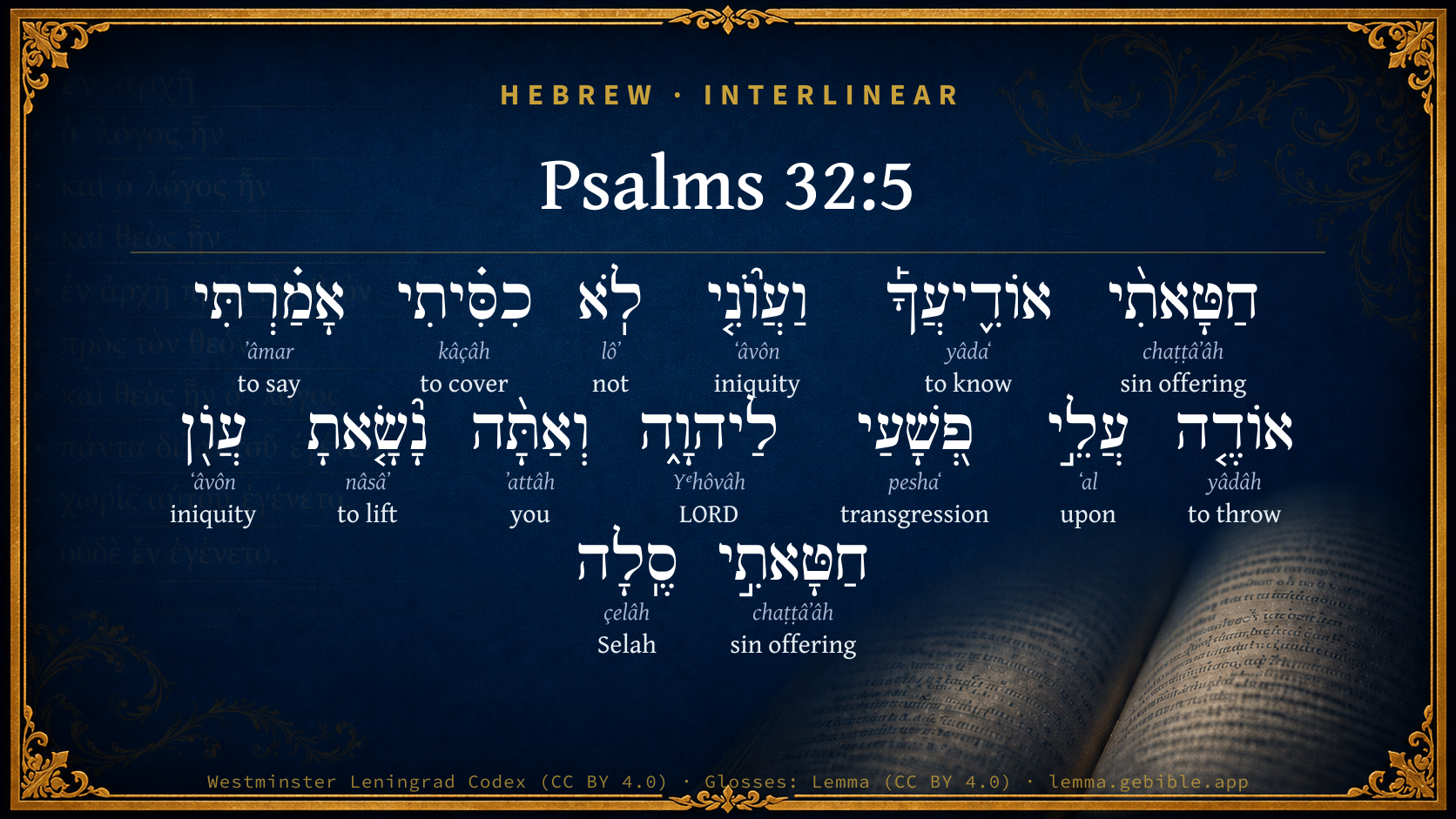
Psalms 32:5

Hebrew (Westminster Leningrad Codex) Psalms 32:5 appears in the Hebrew Old Testament. The text above is from the Westminster Leningrad Codex. Each word links to its Strong’s number, a concise gloss, and parsing drawn from the Open Scriptures Hebrew Bible morphology. Click any word for its full Brown-Driver-Briggs (BDB) entry.
Download image
Cite this verse

Psalms 32:5 (World English Bible). Public Domain. Lemma interlinear Bible study tool, https://lemma.gebible.app/v/psalms/32/5.

Show BibTeX & RIS
BibTeX
RIS
English Translation
I acknowledged my sin to you. I didn't hide my iniquity. I said, I will confess my transgressions to Yahweh, And you forgave the iniquity of my sin. Selah.
World English Bible · Public Domain
Download a study sheet

One document with this verse’s original text, its word-by-word gloss line, the meaning frame, cross-references with their text, attributed commentary, and full source and license credits — printable, and it pastes into notes with its structure intact.

This verse Autodidact and up

Study sheet (.html) Plain text (.txt)

A passage Seminary Student

Up to 50 verses in one chapter. A passage sheet keeps up to 6 commentary sources and 12 cross-references per verse, in the order this page ranks them, and says so on the sheet whenever that leaves anything out. Ask for a single verse and you get the Autodidact verse sheet above.

Everything on this page stays free to read, with no account — the sheet is a download of what is already on screen, not access to it.

Want to remove ads? Support Godless Engineer
Compare translations 3

The same verse in 3 English versions, stacked beneath the original-language interlinear above. Click any original word for its lexicon entry.

Each is an independent rendering of the whole verse — the interlinear is not word-aligned to these translations.

Highlighted words mark where these versions differ — a whole-verse word diff, not a word-by-word alignment.

  • World English Bible Public Domain
    I acknowledged my sin to you. I didn't hide my iniquity. I said, I will confess my transgressions to Yahweh, And you forgave the iniquity of my sin. Selah.
  • King James Version Public Domain
    I acknowledge my sin unto thee, and mine iniquity have I not hid. I said, I will confess my transgressions unto the LORD; and thou forgavest the iniquity of my sin. Selah.
  • unfoldingWord Literal Text CC BY-SA 4.0
    My sin I acknowledged to you, and my guilt I did not cover. I said, “I will confess my transgressions to Yahweh,” and you lifted up the guilt of my sin. Selah

unfoldingWord Literal Text — © unfoldingWord, licensed CC BY-SA 4.0. Word-aligned USFM3 via Door43 (git.door43.org/unfoldingWord/en_ult).

Versions to compare (up to 4)

3 of 4 selected

Show all 18 translations

Every available English version of this verse, each an independent rendering of the whole verse.

  • World English Bible Public Domain
    I acknowledged my sin to you. I didn't hide my iniquity. I said, I will confess my transgressions to Yahweh, And you forgave the iniquity of my sin. Selah.
  • Berean Standard Bible Public Domain
    Then I acknowledged my sin to You and did not hide my iniquity. I said, “I will confess my transgressions to the LORD,” and You forgave the guilt of my sin. Selah
  • Majority Standard Bible Public Domain
    Then I acknowledged my sin to You and did not hide my iniquity. I said, “I will confess my transgressions to the LORD,” and You forgave the guilt of my sin. Selah
  • King James Version Public Domain
    I acknowledge my sin unto thee, and mine iniquity have I not hid. I said, I will confess my transgressions unto the LORD; and thou forgavest the iniquity of my sin. Selah.
  • American Standard Version (1901) Public Domain
    I acknowledged my sin unto thee, And mine iniquity did I not hide: I said, I will confess my transgressions unto Jehovah; And thou forgavest the iniquity of my sin. Selah
  • Revised Version (1885) Public Domain
    I acknowledged my sin unto thee, and mine iniquity have I not hid: I said, I will confess my transgressions unto the LORD; and thou forgavest the iniquity of my sin. Selah
  • Geneva Bible (1599) Public Domain
    Then I acknowledged my sinne vnto thee, neither hid I mine iniquitie: for I thought, I will confesse against my selfe my wickednesse vnto the Lord, and thou forgauest the punishment of my sinne. Selah.
  • Douay-Rheims (1899) Public Domain
    I have acknowledged my sin to thee, and my injustice I have not concealed. I said I will confess against myself my injustice to the Lord: and thou hast forgiven the wickedness of my sin.
  • Young's Literal Translation Public Domain
    My sin I cause Thee to know, And mine iniquity I have not covered. I have said, `I confess concerning My transgressions to Jehovah,' And Thou -- Thou hast taken away, The iniquity of my sin. Selah.
  • Literal Standard Version CC BY-SA 4.0
    I cause You to know my sin, || And I have not covered my iniquity. I have said, “I confess to YHWH concerning My transgressions,” || And You have taken away the iniquity of my sin. Selah.
  • Unlocked Literal Bible CC BY-SA 4.0
    Then I acknowledged my sin to you, and I no longer hid my iniquity. I said, “I will confess my transgressions to Yahweh,” and you forgave the guilt of my sin. Selah
  • unfoldingWord Literal Text CC BY-SA 4.0
    My sin I acknowledged to you, and my guilt I did not cover. I said, “I will confess my transgressions to Yahweh,” and you lifted up the guilt of my sin. Selah
  • Darby Bible Public Domain
    I acknowledged my sin unto thee, and mine iniquity I covered not; I said, I will confess my transgressions unto Jehovah, and *thou* forgavest the iniquity of my sin. Selah.
  • World Messianic Bible Public Domain
    I acknowledged my sin to you. I didn’t hide my iniquity. I said, I will confess my transgressions to the LORD, and you forgave the iniquity of my sin. Selah.
  • Webster's Bible Public Domain
    I acknowledged my sin to thee, and my iniquity have I not hid. I said, I will confess my transgressions to the LORD; and thou forgavest the iniquity of my sin. Selah.
  • Free Bible Version CC BY-SA 4.0
    Then I confessed my sins to you. I did not hide the wrongs I had done. I said to myself, “I will confess my disobedience to the Lord,” and you forgave the guilt of my sins. Selah.
  • Bible in Basic English Public Domain
    I made my wrongdoing clear to you, and did not keep back my sin. I said, I will put it all before the Lord; and you took away my wrongdoing and my sin. (Selah.)
  • JPS Tanakh (1917) Public Domain
    I acknowledged my sin unto Thee, and mine iniquity have I not hid; I said: 'I will make confession concerning my transgressions unto the LORD' — and Thou, Thou forgavest the iniquity of my sin. Selah

Literal Standard Version (2020), Covenant Press — licensed CC BY-SA 4.0. Text via the HelloAO Bible API (eBible.org). Unlocked Literal Bible (unfoldingWord) — licensed CC BY-SA 4.0. Text via the HelloAO Bible API (eBible.org). unfoldingWord Literal Text — © unfoldingWord, licensed CC BY-SA 4.0. Word-aligned USFM3 via Door43 (git.door43.org/unfoldingWord/en_ult). Free Bible Version, Dr. Jonathan Gallagher — licensed CC BY-SA 4.0. Text via the HelloAO Bible API (eBible.org).

Word by word

More ways to search: Search by grammar → Find every occurrence → Compare this word →

Practice this passage: Drill this verse → Learn its vocabulary →

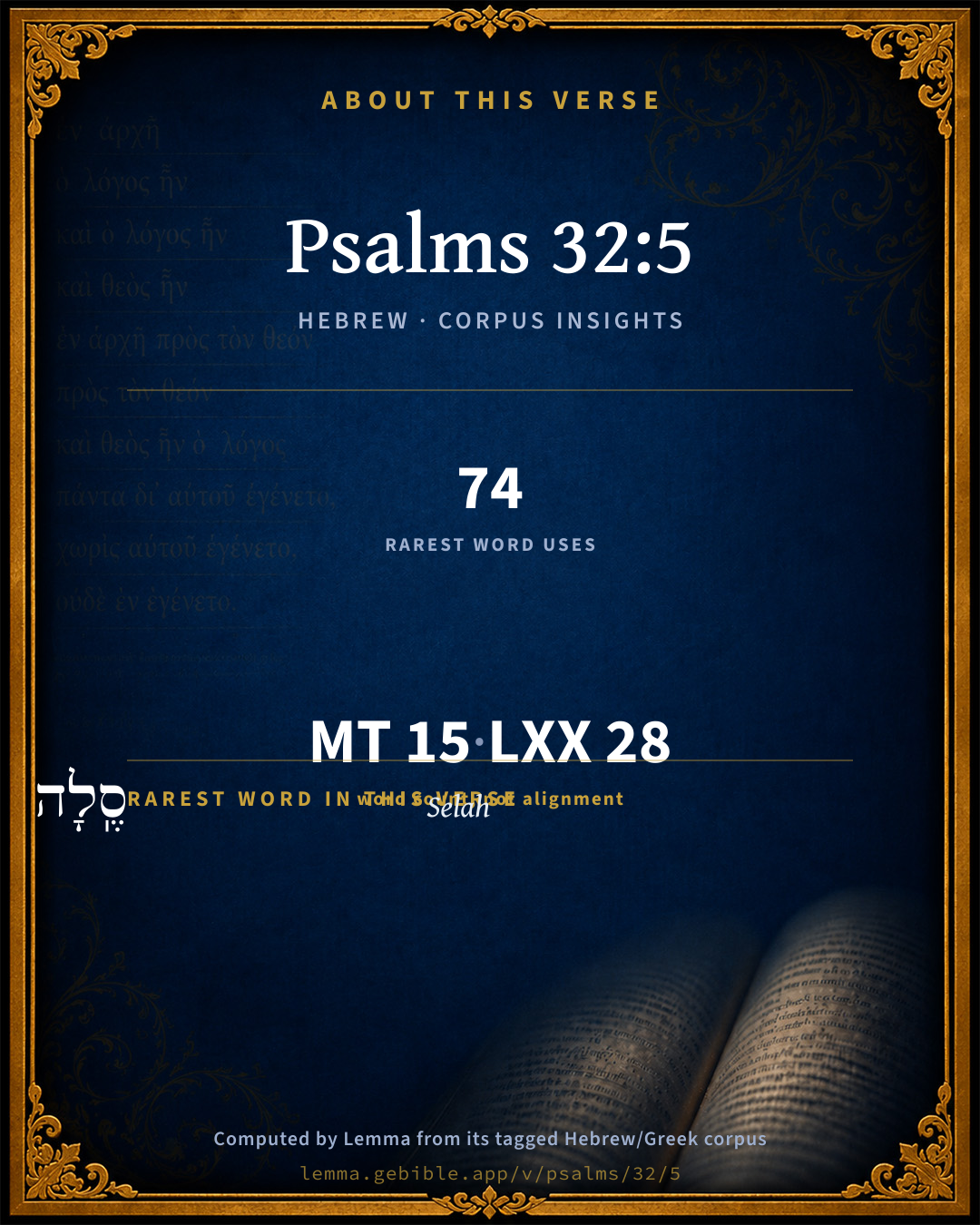
סֶֽלָה
çelâh
H5542
“Selah”
Particle, Interjection
Part of Speech
Particle
Type
Interjection
Full BDB Definition

Origin: from H5541

TWOT: 1506a

to lift up, exalt - Selah - a technical musical term probably showing accentuation, pause, interruption
  1. חַטָּאתִ֨י chaṭṭâʼâh H2403 “sin offering · my” Noun, Common, Feminine, Singular, Construct + Suffix, Personal, 1st Person, Common, Singular
  2. אוֹדִ֪יעֲךָ֡ yâdaʻ H3045 “to know · you” Verb, Hiphil, Imperfect, 1st Person, Common, Singular + Suffix, Personal, 2nd Person, Masculine, Singular
  3. וַעֲוֺ֘נִ֤י ʻâvôn H5771 “and · iniquity · my” Conjunction + Noun, Common, Both, Singular, Construct + Suffix, Personal, 1st Person, Common, Singular
  4. לֹֽא lôʼ H3808 “not” Particle, Negative
  5. כִסִּ֗יתִי kâçâh H3680 “to cover” Verb, Piel, Perfect, 1st Person, Common, Singular
  6. אָמַ֗רְתִּי ʼâmar H559 “to say” Verb, Qal, Perfect, 1st Person, Common, Singular
  7. אוֹדֶ֤ה yâdâh H3034 “to throw” Verb, Hiphil, Imperfect, 1st Person, Common, Singular
  8. עֲלֵ֣י ʻal H5921 “upon” Preposition
  9. פְ֭שָׁעַי peshaʻ H6588 “transgressions · my” Noun, Common, Masculine, Plural, Construct + Suffix, Personal, 1st Person, Common, Singular
  10. לַיהוָ֑ה Yᵉhôvâh H3068 “to/for · LORD” Preposition + Noun, Proper
  11. וְאַתָּ֨ה ʼattâh H859 “and · you” Conjunction + Pronoun, Personal, 2nd Person, Masculine, Singular
  12. נָ֘שָׂ֤אתָ nâsâʼ H5375 “to lift” Verb, Qal, Perfect, 2nd Person, Masculine, Singular
  13. עֲוֺ֖ן ʻâvôn H5771 “iniquity of” Noun, Common, Both, Singular, Construct
  14. חַטָּאתִ֣י chaṭṭâʼâh H2403 “sin offering · my” Noun, Common, Feminine, Singular, Construct + Suffix, Personal, 1st Person, Common, Singular

About this verse

These counts appear in no published source. They are computed here, from the morphology-tagged text and Lemma’s own curated glosses. What Lemma adds →

15
words
13
distinct lemmas
Wisdom
section

Grammatical profile

  • 5 verbs
  • 6 nouns
  • 1 pronoun
  • 1 preposition
  • 2 particles

Verb forms

  • אוֹדִ֪יעֲךָ֡ Hiphil · Imperfect
  • כִסִּ֗יתִי Piel · Perfect
  • אָמַ֗רְתִּי Qal · Perfect
  • אוֹדֶ֤ה Hiphil · Imperfect
  • נָ֘שָׂ֤אתָ Qal · Perfect

Repetition

Words recur within this verse — often emphatic in Hebrew:

  • חַטָּאתִ֨י sin offering H2403 ×2
  • וַעֲוֺ֘נִ֤י iniquity H5771 ×2

Hebrew & Septuagint length

In English translation the verse runs 29 words from the Hebrew and 30 from the Septuagint (LXX English) — closely comparable.

A rough comparison of the two English renderings, which tokenize alike — not a word-level alignment.

Word counts can differ between the Hebrew and the Greek without any difference in meaning — e.g. the Hebrew direct-object marker אֵת has no separate Greek word, and Greek often adds the article ὁ.

In the original languages it is 15 Hebrew tokens and 28 Greek tokens — but the two are counted differently (Hebrew bundles its prefixes and suffixes into one token; the Greek is in lemma form), so that isn’t a like-for-like length.

Cross-references

28

Topical passages linked to Psalms 32:5 in the Treasury of Scripture Knowledge — connected by theme and wording, ordered by reader-vote popularity; previews shown in the World English Bible.

  • Proverbs 28:13 He who conceals his sins doesn't prosper, But whoever confesses and renounces them finds mercy.
  • 2 Samuel 12:13 David said to Nathan, "I have sinned against Yahweh." Nathan said to David, "Yahweh also has put away your sin. You will not die.
  • Psalms 51:3–5 For I know my transgressions. My sin is constantly before me.
  • Psalms 38:18 For I will declare my iniquity. I will be sorry for my sin.
  • Psalms 30:5 For his anger is but for a moment; His favor is for a lifetime. Weeping may stay for the night, But joy comes in the morning.
  • Isaiah 65:24 It shall happen that, before they call, I will answer; and while they are yet speaking, I will hear.
  • Psalms 103:12 As far as the east is from the west, So far has he removed our transgressions from us.
  • Hosea 6:1 "Come, and let us return to Yahweh; For he has torn us to pieces, And he will heal us; He has injured us, And he will bind up our wounds.
  • 1 John 1:8–10 If we say that we have no sin, we deceive ourselves, and the truth is not in us.
  • 2 Samuel 24:10 David's heart struck him after that he had numbered the people. David said to Yahweh, I have sinned greatly in that which I have done: but now, Yahweh, put away, I beg you, the iniquity of your servant; for I have done very foolishly.
  • Job 33:27 He sings before men, and says, 'I have sinned, and perverted that which was right, And it didn't profit me.
  • Luke 7:47 Therefore I tell you, her sins, which are many, are forgiven, for she loved much. But to whom little is forgiven, the same loves little."
  • Joshua 7:19 Joshua said to Achan, My son, please give glory to Yahweh, the God of Israel, and make confession to him; and tell me now what you have done; don't hide it from me.
  • 2 Samuel 12:9 Why have you despised the word of Yahweh, to do that which is evil in his sight? You have struck Uriah the Hittite with the sword, and have taken his wife to be your wife, and have slain him with the sword of the children of Ammon.
  • Psalms 86:5 For you, Lord, are good, and ready to forgive; Abundant in loving kindness to all those who call on you.
  • Psalms 86:15 But you, Lord, are a merciful and gracious God, Slow to anger, and abundant in loving kindness and truth.
  • Psalms 103:3 Who forgives all your sins; Who heals all your diseases;
  • Jeremiah 3:13 Only acknowledge your iniquity, that you have transgressed against Yahweh your God, and have scattered your ways to the strangers under every green tree, and you have not obeyed my voice, says Yahweh.
  • Ephesians 4:32 And be kind to one another, tenderhearted, forgiving each other, just as God also in Christ forgave you.
  • Job 31:33 If like Adam I have covered my transgressions, By hiding my iniquity in my heart,
  • Proverbs 30:20 So is the way of an adulterous woman: She eats and wipes her mouth, And says, 'I have done nothing wrong.'
  • Jeremiah 2:23 How can you say, I am not defiled, I have not gone after the Baals? see your way in the valley, know what you have done: [you are] a swift dromedary traversing her ways;
  • Jeremiah 2:35 Yet you said, I am innocent; surely his anger is turned away from me. Behold, I will enter into judgment with you, because you say, I have not sinned.
  • Malachi 3:8 Will a man rob God? Yet you rob me! But you say, 'How have we robbed you?' In tithes and offerings.
  • Jeremiah 31:20 Is Ephraim my dear son? is he a darling child? for as often as I speak against him, I do earnestly remember him still: therefore my heart yearns for him; I will surely have mercy on him, says Yahweh.
  • Luke 15:17–23 But when he came to himself he said, 'How many hired servants of my father's have bread enough to spare, and I'm dying with hunger!
  • Leviticus 26:39–40 Those of you who are left will pine away in their iniquity in your enemies' lands; and also in the iniquities of their fathers shall they pine away with them.
  • Luke 16:15 He said to them, "You are those who justify yourselves in the sight of men, but God knows your hearts. For that which is exalted among men is an abomination in the sight of God.

Cross-references courtesy of OpenBible.info (CC BY 4.0).

Hebrew and Greek witnesses Masoretic Hebrew ↔ Greek Septuagint

The same verse in the two great witnesses to the Old Testament, shown verse-for-verse.

You’re reading Greek Psalm 31 (Hebrew Psalm 32). The Septuagint counts the superscription, so verse numbers can differ from the Hebrew — chapter-level alignment, not verse-by-verse. Numbering follows Rahlfs.

These are two independent witnesses, not word-aligned to each other, and the Septuagint is shown in lemma (dictionary) form.

Hebrew Psalms 32:5 Masoretic · Westminster Leningrad Codex

חַטָּאתִ֨י אוֹדִ֪יעֲךָ֡ וַעֲוֺ֘נִ֤י לֹֽא כִסִּ֗יתִי אָמַ֗רְתִּי אוֹדֶ֤ה עֲלֵ֣י פְ֭שָׁעַי לַיהוָ֑ה וְאַתָּ֨ה נָ֘שָׂ֤אתָ עֲוֺ֖ן חַטָּאתִ֣י סֶֽלָה

I acknowledged my sin to you. I didn't hide my iniquity. I said, I will confess my transgressions to Yahweh, And you forgave the iniquity of my sin. Selah.

World English Bible · Public Domain

Greek LXX Greek Psalm 31:5 Septuagint · lemma form

ὁ ἁμαρτία ἐγώ γνωρίζω καί ὁ ἀνομία ἐγώ οὐ καλύπτω εἶπον ἐκἀγορεύω κατά ἐγώ ὁ ἀνομία ἐγώ ὁ κύριος καί σύ ἀποἵημι ὁ ἀσέβεια ὁ ἁμαρτία ἐγώ διάψαλμα

I acknowledged my sin, and hid not my iniquity: I said, I will confess my iniquity to the Lord against myself; and you forgave the ungodliness of my heart. Pause.

LXX2012 (modern English Septuagint) · Public Domain

Hebrew: Westminster Leningrad Codex (CC BY 4.0). Greek: Septuagint (public domain); English from LXX2012 (modern English Septuagint) (Public Domain). How the Septuagint differs from the Hebrew →

Commentary

Notes on Psalms 32:5 from classic Christian and Jewish commentators (each source and its license shown beneath its notes). The classic Christian expositions comment on the surrounding passage and are grouped to its opening verse, so a note may address several verses; the Jewish commentaries on the Tanakh (Rashi and others) are per-verse, so they appear only where the commentator wrote on this verse.

Lemma curates 59 commentaries, every one of them public domain or Creative Commons licensed, each selected and text-cleaned for this edition rather than reprinted as found. About our sources →

Trapp's Complete Commentary

John Trapp

Psa 32:5 I acknowledged my sin unto thee, and mine iniquity have I not hid. I said, I will confess my transgressions unto the LORD; and thou forgavest the iniquity of my sin. Selah.

Ver. 5. I acknowledged my sin unto thee] Though it were long first, yet thou broughtest me to it. The soul is ready to hang her comforts on every hedge, to shift and shirk in every bycorner for comfort, rather than to repair to the right fountain. Lot should have escaped to the mountains at first; but he would needs go to Zoar; which yet was soon too hot to hold him: David should have acknowledged his sin ere this time; he should speedily have cast up the poison he had swallowed down, before it got to the vitals; but he had no mind to it till he had tasted of the whip, and then he agonized his sin unto the Lord, he put himself into the hands of justice, in hope of mercy. The properties or conditions of sound confession are these, say the schoolmen in this four lines of verse:

Sit simplex, humilis confessio, pura, fidelis,

Atque frequens, nuda et discreta, lubens, verecunda,

Integra, secreta, et lachrymabilis, accelerata,

Fortis, et accusans, et se punire parata.

And mine iniquity have I not hid] In confession we must show the Lord the iniquity of our sin, the filthiness of our lewdness, the abomination of our provocations, Rom 7:13. We must bring out our sins (as they took the vessels of the sanctuary, Ezr 8:34) by number and by weight; laying open how many transgressions are wrapped up in our sins, and their circumstances. See for this Lev 16:21.

I said, I will confess, &c.] i.e. I resolved and purposed so to do; but ere that could be done "thou forgavest," &c. God’s ear was in David’s heart before his confession could be in his tongue. So, at another time, he did but conceive a purpose to build God a house, and God rewarded it with the building and establishing of David’s house, 2Sa 7:12-13; 2Sa 7:16

And thou forgavest the iniquity of my sin] The sting and stain of it, the criminal and penal part of it, the worst thing that was in it; not the fire only, but the filth that was in it; reserving still to thyself a power of fatherly corrections and medicinal miseries. Vel peccatum peccati. Utitur duobus vocabulis ad aggravandum peccatum suum (Kimchi). As we say, terra pulveris, or caenum luti. But the iniquity of sin is wiped off by the sponge of true confession. Homo agnoscit, Dens ignoscit. Man no sooner acknowledgeth the debt but God crosseth the book. It is, therefore, good counsel that a father giveth, Fac confitendo propitium, quem tacendo non facis nescium, Confess and find mercy; since by a senseless silence thou canst not keep thy sins from God’s knowledge of them. Let out that bad blood by opening a vein, that good health may enter.

Per miserere mei, tollitur ira Dei.

Know you what? said Henry VIII to the duke of Suffolk, concerning Stephen Gardiner, when he had confessed his Popery, for which he should have been the morrow after sent to the Tower; he hath confessed himself as guilty in this matter as his man, and hath with much sorrow and pensiveness sued for my pardon. And you know what my nature and custom hath been in such cases, evermore to pardon them that will not dissemble, but confess their fault, &c. (Acts and Mon. fol. 1177).

Selah] q.d. I speak it joyfully, there being no such matter of mirth in all the world as the sweet sense of forgiveness of sin. O singularem (inquit David hic) Dei erga homines peccata sua agnoscentes gratiam et benevolentiam!

John Trapp, A Commentary or Exposition upon All the Books of the Old and New Testament (1647–1656) — public domain. Text from a community e-Sword module.

The Biblical Illustrator

Joseph S. Exell

Psa_32:5

I said I will confess my transgressions unto the Lord; and Thou for-gavest the iniquity of my sin.

Confession

It is hard to look things in the face; yet we must do so; we must own our sins honestly.

I. To our own hearts--and then, down comes our pride. We thought ourselves tolerably good, and that we could pass muster as well as most; but beginning to look, we detect, here first, and then there, a blemish, an infirmity, a gross sin. It is best to be frank, and rather to make the most than the least of our faults. The iron-founder examines the huge mass of some iron girder, on which he has spent much labour; he sees one tiny crack, but passes it by, hoping, though with strong misgiving, that the real strength of the metal will not be affected; and ere long he hears that the bridge has fallen, and men have been killed by it, and that the disaster is traced to a flaw in the metal. He had better have faced the disappointment, and have had the piece re-cast, than have been responsible for the accident.

II. To others. When a man knows his own fault, he does not like others to know it: He would prefer to remain in their eyes the spotless man he once was in his own. It is a degrading thought that others should know that you have been guilty of a meanness, of intemperance, of passion, of untruthfulness; and yet by trying to conceal it from them, you may be adding deception to your former error. Not that we are bound to blaze abroad our faults; that might do more harm than good: but to cover them, or palliate them, so as to retain the good opinion of others, is fruitless and insincere. Bitter though it be to lose the good opinion of friends, still even that is better than disingenuousness.

III. To God. It is God whom we have offended: to God must our confession be made. With abject sorrow, and unfeigned shame that we should in any, the least, point have outraged the majesty, the purity, the honour of God; with body, soul, and spirit all bowed down; with reason silent, with no excuses, no special pleading, no attempt to set off against our faults any good things which we have done; but simply engrossed in our hatred of the evil thing we have done, and unreservedly acknowledging its wickedness.

IV. If you cannot quiet your conscience by secret confession to God, use the ministry of reconciliation. Something human the man craves, some human voice to tell him to his face that he is forgiven, to assure him, and to dispel doubts. (G. F. Prescott, M. A.)

Sin confesssd and unconfessed

I. sin unconfessed, working misery in the soul.

1. This misery was corporeally emaciating.

2. This misery lasted as long as the silence.

3. This misery was felt to be from God.

II. sin confessed, divinely removed from the soul.

1. The removal of sin from man is a possible act.

2. A blessed act.

3. An encouraging act.

4. A saving act,

(1) It makes safe in the greatest dangers.

(2) It secures the protection of God Himself.

(3) It encircles the life with Divine music. (Homilist.)

Relief afforded by confession

I. the psalmist had kept silence. In this he was wrong. Sin had been committed, and the fruits were fermenting and fomenting in his bosom, gendering turmoil and breeding corruption. So sin will dwell in our souls, and we fondle and turn it into a means of enjoyment. We have not the courage to look at these sins as sins, and to cast them out from what ought to be the temple of the Lord. We try as far as possible not even to notice them. We prefer thinking of our supposed excellences, of the good deeds we have done, of our talents, courage, prowess, generosity, and roll these as a sweet morsel under our tongue. We decline thinking on the abuse made of the gifts bestowed on us,--on our ingratitude, ungodliness, our lusts cherished, our envy, our evil temper, our selfishness. There will be times, indeed, when these iniquities are forced upon our attention by the accusations of conscience or the reproaches of our fellow men, or by the troubles into which they bring us. But on these occasions we put ourselves on the defensive and parry off the attack; and when these weapons of defence are wrested from us, then we bring excuses and urge palliations referring to extenuating circumstances, or pleading seductions, or pointing to the fairer side of the offence, to the pleasure it gave, or the kindness or frankness which characterized it. Under such pretexts as these we keep silence when we should speak out, when we should confess the sin and acknowledge the transgression, cast them out from our hearts and slay them before the Lord.

II. when he kept silence he was troubled. God speaks. He speaks in the conscience, saying, this deed, this thought was evil. He speaks in the Word, saying, The wages of sin is death. He speaks to us by His Spirit, striving to subdue the resistance. But the ear is stopped, that it may not hear; or when the voice is so loud that it cannot but be heard, no attention is paid to it, or it is openly disobeyed. There is now a terrible conflict. There is a voice commanding, but there is a determined effort to drown it, as loud and dismal as the sound of the gong which was used in Mexico to drown the cry of the tortured and bleeding human victims on the altar. What earnestness in the voice demanding, the voice entreating! but there is equal earnestness in the struggles resisting, and the hatred resenting. No wonder that the moisture is turned into the drought of summer. The terrible heat, exceeding that of a tropical sun, burns up every living thing. The soul is left as an arid waste, without a scrap of vegetation.

III. the psalmist confesses his sins.

IV. the psalmist had his sins forgiven. We are not to understand that the confession can merit the forgiveness. The confession can no more merit the forgiveness than the forgiveness can merit the confession. Both are gifts of God, and so bound together that you cannot have the one without the other. An old author represents Christ as coming to us with a gift in each hand. In the one hand He holds out forgiveness, free forgiveness; in the other hand He holds out repentance and confession. If we begin to say, We are very willing to take the one of these; we know we have sinned, and are most anxious to have the forgiveness; but as to this wringing repentance and its proper fruit, a humbling confession, we wish to avoid them, then Christ will give us neither. But if in simple faith we will only take both, we shall receive both without money and without price. At the same instant that we break silence and cry in faith for mercy, Heaven also breaks the awful silence, and the mercy is bestowed and received. And now the crowded bosom finds relief; the confined soul experiences enlargement; the fettered spirit is free; the prison doors are thrown open, and the soul walks at liberty and expatiates abroad, on before untrodden ground, and gazes on new and lovely scenes. New affections are called forth, and new-born feelings spring up. The evil burnouts have been let out, and the body feels health returning, and, with health, motive and activity. (J. McCosh.)

The forgiveness of sins

If you blot out of Davids psalms his profound sense of moral evil in all its bare, black iniquity, as the great reality of mans experience and life, you blot out those psalms at the same time from the literature of the world: their work is done, their power is dead. But it is the firmness with which he grasps the hand which redeems from this evil, which gives him such a wonderful hold on the heartstrings of humanity. Slave, beggar, soldier, scholar, statesman, priest, all feel equally that he belongs to them, because his experience is so profoundly human; because man the sinner, God the Saviour, are the great themes of his meditation, and of his vivid, burning utterance to the world. Sin and salvation must be the main burden of every gospel which lays masterful hold on human hearts. There are two aspects of sin which need sometimes to be separately considered, that we may see the true method of its Divine treatment, and trace the principles on which it rests.

I. its essential iniquity. The revelation of Scripture is that sin is a personal act against a person. It runs directly counter to our modern philosophizing on the subject. Man knows that he has sinned, himself has done it. I have sinned, I have perverted that which is right. That I means something which, whatever it may be, distinctly is not Nature and is not God (Psa_51:4). The heart may be broken at beholding the ruin and anguish sin has wrought, but the core of the matter is not reached until its iniquity, the wrong before God, is seen to be the essence of it. Only when the sin is comprehended in all its evil, can God the Redeemer begin its cure.

II. its disastrous fruits. Here is a second gauge of the evil of sin--the utter misery which it works (Gen_3:24; Gen_4:1-15). Let a man be selfish, envious, lustful, grasping, in the most hidden imaginations of his heart, he can no more help being the author of sorrow to every one who has intimate relations with him, than a dunghill can help breeding fever. It is a terrible subject, this inevitable fruit of sin. This is Gods ordinance about sin--its fruit shall be misery. It is the grand hold which He keeps on sinners. Sin is in their power; misery is in His; and it is the hand by which He withholds them from swift perdition (1Ti_1:15; Rom_7:1-25.; 1Jn_1:6-10). The text casts a valuable light on the essential nature of forgiveness. God forgives the iniquity of the sin, while the mischief which it has wrought He sets Himself to repair. This is and must be slow and toilsome work. It is the work of God in the government of the world, to repair the evil which sin has wrought. But the forgiveness is prompt, absolute and final.

III. the forgiveness of sin by God--

1. In its nature. It does not touch the accidents of the sin, but its very essence. The accidents will be cured in time. There are two elements to be dealt with--the Divine anger and the sense of alienation and wretchedness in the child. Now as to the first, God when He forgives declares that it is gone. The sinner is slow to believe this, but it is true, and God has His own ways of lodging the sense of it in penitent hearts.

2. Its conditions. How can God forgive sin? Not by ignoring it. The answer of the Gospel is that by mans righteousness, mans iniquity has been put away. Christ stands for man before God, and His righteousness has become a stronger part in humanity than Adams sin. One has undertaken for us, stands for us, who can make and will make Gods righteousness the dominant thing, the conquering thing, the characteristic thing, in humanity; and in Christ God justifies man. But what then has confession to do with it? It is the vital link between the soul and Christ. It is the plea of the soul to the Father, Behold me, sinner as I am, in Christ. My will goes with Him; in His obedience, His hatred of sin, I desire to share; make me partaker of His victorious life. Confession, as the fruit of penitence, transmutes the relation of the soul to Christ. From formal it becomes vital. The name becomes a power. It makes, by the stirring of the thought and will of a free being, the oneness with Christ a spiritual reality. It declares that through Christ there is born in the soul that which is not sinful, which is of the essence of holiness, and ever struggling upwards towards God. Confession rests on Christ, and connects us vitally with His righteousness.

3. Its fruits. Perfect, absolute, and eternal peace, if the sinner but keep firm hold on the fact, Thou forgavest the iniquity of my sin. Man will forgive himself when God forgives him. The fruits of his sin may be there; a broken body, a stained name, poverty, struggle, and sad, sad memories. But all the anguish has gone out of the soul, all the dread, if God forgives. All things, even the bitter fruits of transgression, must work together for good to Gods justified children. (J. B. Brown, B. A.)

The penitents progress

David describes three states of mind through which he passed.

I. A state of guilt. When I kept silence, etc. It was his own bitter experience. He darkly and sullenly turned away from God. Though a voice within him bade him turn, he would not. He hung back and shunned the presence of his God, like Adam in the garden. It is an unspeakably wretched state of mind. There are two cases in which a man may feel what David felt.

1. An awakened sinner may feel it--a sinner for the first time brought to a sense of his transgression.

2. The other case in which a man may experience what David did, is that of one who, after he has known somewhat of God and the comfort of religion, has unhappily in some degree departed from God again, and fallen into sin, and does not at once return to Him with earnest prayer for forgiveness, with full confession of his sin, with renewed applications to the blood of sprinkling. This was Davids case; and this, too, was Jonahs. It is easy even for a good man, through negligence and unwatchfulness, to fall into sin and consequent misery; it is not so easy for him to arise and regain the paths of righteousness; it is not so easy to betake himself indeed to the Saviour, and, through the penitent and believing application of His atoning blood, to recover peace of conscience, and with it renewed liberty in the service of God. But there is help for the penitent, help in the abundant mercy of God our Saviour for them that unfeignedly seek it.

II. For mark the next stage of Davids experience, as it is described in the text:--I acknowledged my sin unto Thee, and mine iniquity have I not hid: I said, I will confess my transgressions unto the Lord. A great change was here. David no longer kept silence. O happy is it, when the guilty mind comes to this resolution!

III. A state of holy joy at being reconciled to God. Blessed is he whose transgression is forgiven, whose, etc. Then he represents himself as secure and happy under the guidance and protection of God. And then, once more, he has communion with God in prayer. Are any conscious of sin committed? Dissemble it not. Cloke it not. Go to God your Saviour; confess your sin; and ask forgiveness through the blood of Jesus Christ. Thus, and thus only, can you find peace. (E. Blencowe, M. A.)

Penitential confession of sin

I. Davids conduct.

1. It was deliberate. I said, I will, etc. He was not dull or unfeeling in his sense of sin; but, like one infirm in body, yet strong in courage, he resolved manfully to go through the operation, however painful, having respect to the recompense of the expected cure.

2. It was humble: I will confess. By this is signified his intention of owning, without any excuses, and specifying, his fault--as was required of the Israelite seeking pardon (Lev_5:5), of the high-priest making atonement (Lev_16:21); and as was practised by the people (1Sa_12:19), and by the prophet Daniel (Dan_9:3). With this would be connected submission to his trouble, as designed for punishment of his sin, and acknowledgment of its justice; to which course a particular promise was made under the law (Lev_26:40-42).

3. It was personal. My sin. Many, anxious to pass hastily and lightly over their own failings, try to effect their purpose by making stepping-stones of their neighbours faults. With the general confession, I am a grievous sinner, they couple the truth, and so are we all; and to the admission, I have done wickedly, they add the hackneyed saying, this is a wicked world we live in. Thus they seem to derive a false comfort from the number of their fellow-offenders, as though the crowd of criminals could screen them from the piercing eye, or the daring band of rebels protect them from the avenging hand of a long-suffering, but all-seeing and almighty Judge.

4. It was intelligent, i.e. with understanding: I will confess my transgressions. The word transgression implies a boundary-line to be passed, a fence to be broken; and, without knowing where this is fixed, a man will not be able to see and acknowledge his fault.

5. It was private: I will confess unto the Lord. David could abase himself before the prophet (2Sa_12:13) and his household (verses 16, 17); but on this occasion he carried his burden to the Lord. It may be asked, Where is the need of confessing to that Lord who trieth the hearts and reins and understandeth our thoughts afar off? We answer, The need is ours, and the benefit is ours. The exercise of mentioning our sins leads the mind to dwell longer upon them, discovering their guilt more fully; and helps to mortify our pride, though no mortal ear listens to the recital. It may be further remarked, that Davids confession to the Lord was an appeal to his judgment, as to his sincerity; and pledged the penitent to a forsaking the sins which he professed to lament.

6. The happy consequences: Thou forgavest the iniquity of my sin. Here is a benefit, beyond the mere ease obtained by giving vent to the feelings; here is the entire removal of the guilt of acknowledged transgression.

II. application to ourselves.

1. In dwelling on Davids confession to the Lord, I would by no means neglect or undervalue the exhortation of the apostle (Jam_5:16) to well-chosen confidence and sympathy.

2. I would suggest to parents, sponsors, and teachers, as concerned in the training of the young, the importance of insisting on the duty of confession before they pardon their offences. (G. Newnham, M. A.)

A conscious sense of sin

I. A conscious sense of sin is accompanied with--

1. Self-abasement (Jer_2:26; Ezr_9:6; Jer_6:15). 2, Self-condemnation (Psa_51:3-7).

3. Such self-abhorrence must reduce the sinner, who is not altogether abandoned, to self-denial, and abstinence from his former course of wickedness. The trembling penitent adopts the language of Ephraim (Jer_31:18-20); and, prodigal-like (Luk_15:12-32), returns to his compassionate Father

II. The prodigal finding a kind reception, contrary to expectation, must be overwhelmed with gratitude and thankfulness. (J, Kidd, D. D.)

Repentance

1. Notice the elements of this repentance as they come out in this psalm:

(1) Clear consciousness of sin--I acknowledged my sin.

(2) Loathing sorrow for sin--Mine iniquity have I not hid.

(3) Confession of sin--I acknowledged my sin.

(4) Forsaking of sin (Psa_32:9).

2. Ask these questions:

(1) Having sinned, is not this the noblest possible way in which a sinner can treat his sin--to repent of it?

(2) Is it not far better and nobler thus to repent of it than heedlessly and blindly to go on in sin?

(3) Do you think that, going on in sin carelessly and blindly, it is possible to go on thus toward God?

(4) Therefore can you not see the necessity of repentance? (W. Hoyt, D. D.)

Selah.

Selah

The word signifies a vehement, a pathetic, a hyperbolical asseveration, and attestation, and ratification of something said before. Such, in a proportion, as our Saviours Amen, amen is, Verily, verily I say unto you; such as St. Pauls fidelis sermo, with which he seals so many truths, is, This is a faithful saying; such as that apostles Coram domino is, with which he ratifies many things, Before the Lord I speak it; and such as Moses, As I live, saith the Lord, and As the Lord liveth. And therefore, though God be in all His words, Yea, and Amen, no word of His can perish in itself, nor should perish in us, that is, pass without observation, yet, in setting this seal of Selah to this doctrine, He hath testified His will that He would have all these things the better understood, and the deeper imprinted, that if a man conceal and smother his sins, Selah, assuredly, God will open that mans mouth, and it shall not show forth His praise, but God will bring him to fearful exclamations out of the sense of the affliction, if not of the sin; Selah, assuredly, God will shiver his bones, shake his best actions, and discover their impurity; Selah, assuredly, God will suffer to be dried up all his moisture, all possibility of repentant tears, and all interest in the blood of Christ Jesus. (J. Donne, D. D.)

The Biblical Illustrator, edited by Joseph S. Exell (c. 1880s–1900s) — public domain. Text from a community e-Sword module.

J. A. Alexander on Psalms

Joseph Addison Alexander

5. (Psa 32:5) My sin I will make known to thee, and my guilt I did not conceal. I said, I will make confession of my transgressions to Jehovah. And thou didst take away the guilt of my sin. Selah. Most interpreters explain the future verb of the first clause as a preterite, because all the other verbs are preterites; but this only renders the future form of the first verb more remarkable, and makes it harder to explain why a past tense was not used in this, as in all the other cases, if the writer intended to express past time. The only consistent method of solution is to understand the first clause as a reminiscence of the Psalmist's resolution in the time of his distress, repeated in the second clause, and, in both cases, followed by a recital of the execution of his purpose. (I said) my sin I will make known to thee, and my guilt I (accordingly) did not conceal. I said, I will make confession to Jehovah, and thou didst take away the guilt of my sin. See above, on Psa 30:9 (8).

Joseph Addison Alexander, The Psalms Translated and Explained (1850) — public domain. Text from a community e-Sword module.

Tyndale Open Study Notes

Tyndale Open Resources

32:5 God has forgiven the guilt and rebellion of 32:1. The Lord’s nature is to reconcile and forgive (78:38; 85:2; 130:4), but he requires confession and repentance.

Tyndale Open Study Notes — © Tyndale Open Resources, licensed CC BY-SA 4.0. Text via the HelloAO Bible API.

Geneva Bible (1599)

Geneva Bible translators

He showeth that as God’s mercy is the only cause of forgiveness of sins, so the means thereof are repentance and confession which proceed of faith.

Geneva Bible (1599) marginal notes — public domain. Text via Bolls.life.

Jamieson, Fausset & Brown

Robert Jamieson, A. R. Fausset & David Brown

A prompt fulfilment of the purposed confession is followed by a prompt forgiveness.

Jamieson, Fausset & Brown — Commentary Critical and Explanatory on the Whole Bible (1871) — public domain (CC PDM 1.0). Text via the HelloAO Bible API.

Adam Clarke's Commentary

Verse 5. I acknowledged my sin] When this confession was made thoroughly and sincerely, and I ceased to cover and extenuate my offence, then thou didst forgive the iniquity of my sin. I felt the hardness of heart: I felt the deep distress of soul; I felt power to confess and abhor my sin; I felt confidence in the mercy of the Lord; and I felt the forgiveness of the iniquity of my sin.

Selah.] This is all true; I know it; I felt it; I feel it.

Adam Clarke's Commentary on the Bible (1810–1826) — public domain. Text from a community e-Sword/MySword module.

John Calvin's Commentaries

5. I have acknowledged my sin unto thee. The prophet now describes the issue of his misery, in order to show to all the ready way of obtaining the happiness of which he makes mention. When his feeling of divine wrath sorely vexed and tormented him, his only relief was unfeignedly to condemn himself before God, and humbly to flee to him to crave his forgiveness. He does not say, however, that his sins merely came to his remembrance, for so also did the sins of Cain and Judas, although to no profit; because, when the consciences of the wicked are troubled with their sins, they cease not to torment themselves, and to fret against God: yea, although he forces them unwillingly to his bar, they still eagerly desire to hide themselves. But here there is described a very different method of acknowledging sin; namely, when the sinner willingly betakes himself to God, building his hope of salvation not on stubbornness or hypocrisy, but on supplication for pardon. This voluntary confession is always conjoined with faith; for otherwise the sinner will continually seek lurking-places where he may hide himself from God. David’s words clearly show that he came unfeignedly and cordially into the presence of God, that he might conceal nothing. When he tells us that he acknowledged his sin, and did not hide it, the latter clause is added, according to the Hebrew idiom, for the sake of amplification. There is no doubt, therefore, that David, when he appeared before God, poured out all his heart. Hypocrites, we know, that they may extenuate their evil doings, either disguise or misrepresent them; in short, they never make an honest confession of them, with an ingenuous and open mouth. But David denies that he was chargeable with this baseness. Without any dissimulation he made known to God whatever grieved him; and this he confirms by the words, I have said While the wicked are dragged by force, just as a judge compels offenders to come to trial, he assures us that he came deliberately and with full purpose of mind; for the term, said, just signifies that he deliberated with himself. It therefore follows, that he promised and assured himself of pardon through the mercy of God, in order that terror might not prevent him from making a free and an ingenuous confession of his sins.

The phrase, upon myself, or against myself, intimates that David put away from him all the excuses and pretences by which men are accustomed to unburden themselves, transferring their fault, or tracing it to other people. David, therefore, determined to submit himself entirely to God’s judgment, and to make known his own guilt, that being self-condemned, he might as a suppliant obtain pardon.

And thou didst remit the guilt of my sin. This clause is set in opposition to the grievous and direful agitations by which he says he was harassed before he approached by faith the grace of God. But the words also teach, that as often as the sinner presents himself at the throne of mercy, with ingenuous confession, he will find reconciliation with God awaiting him. In other words, the Psalmist means that God was not only willing to pardon him, but that his example afforded a general lesson that those in distress should not doubt of God’s favor towards them, so soon as they should betake themselves to him with a sincere and willing mind. Should any one infer from this, that repentance and confession are the cause of obtaining grace, the answer is easy; namely, that David is not speaking here of the cause but of the manner in which the sinner becomes reconciled to God. Confession, no doubt, intervenes, but we must go beyond this, and consider that it is faith which, by opening our hearts and tongues, really obtains our pardon. It is not admitted that every thing which is necessarily connected with pardon is to be reckoned amongst its causes. Or, to speak more simply, David obtained pardon by his confession, not because he merited it by the mere act of confessing, but because, under the guidance of faith, he humbly implored it from his judge. Moreover, as the same method of confession ought to be in use among us at this day, which was formerly employed by the fathers under the law, this sufficiently refutes that tyrannical decree of the Pope, by which he turns us away from God, and sends us to his priests to obtain pardon.

John Calvin's Commentaries (1540-1563) — public domain. Text from the Calvin Translation Society English edition (1840s-50s) via the Christian Classics Ethereal Library (ccel.org). Calvin's coverage is partial (roughly two-thirds of the Bible); uncommented books and verses are honest gaps, never fabricated. The 19th-century editor's footnotes and remarks are omitted so the notes are faithfully Calvin's own voice.

Ellicott's Commentary for English Readers

(5) I acknowledged.—The fact that this verb is future, as also “I will confess” in the next clause, as well as the requirements of the passage, uphold Hupfeld’s suggestion that “I said” has changed its place, and should be replaced at the beginning of the verse. (Comp. Psa_73:15, and Note.) The sense is,

“I said, ‘I will acknowledge my sin unto thee,

And I did not hide mine iniquity.

(I said) ‘I will confess my transgression unto Jehovah,

And thou forgavest the guilt of my sin.”

A Bible Commentary for English Readers, edited by Charles John Ellicott (1878–1897) — public domain. Text from a community e-Sword module.

The Cambridge Bible for Schools and Colleges

gen. ed. J. J. S. Perowne

5. The way of restoration. Lit. I began to make known to thee my sin, and mine iniquity did I not cover. The tense of the first verb graphically represents the confession being made (Psa_25:8, note): the second verb is the same as that in Psa_32:1. Not until man ceases to hide his sin will it be hidden from God. “Quantum tibi non peperceris,” says Tertullian, quoted by Abp. Leighton, “tantum tibi parcet Deus.” “The less you spare yourself, the more will God spare you.”

and thou forgavest] Thou is emphatic, and the form of the sentence expresses the immediateness of the pardon. “Vox nondum est in ore et vulnus sanatur.” St Augustine.

The musical interlude may have expressed the joy of forgiveness, and served to separate this record of experience from the application which follows.

The Cambridge Bible for Schools and Colleges (gen. ed. J. J. S. Perowne; Cambridge University Press, 1878–1918) — public domain. Text from a community e-Sword module.

John Gill's Exposition

I acknowledged my sin unto thee,.... The sin of Adam, in which he was concerned; original sin, the corruption of his nature, the sin that dwelt in him, his private and secret sins, which none knew but God and himself; even all his sins, which were many, with all their aggravated circumstances; wherefore he uses various words to express them by, in this and the following clauses; as "sin", "iniquity", and "transgressions"; the same that are used in the doctrine of pardon in the preceding verses; his confession being of the same extent with pardon, and all these he calls his own; as nothing is more a man's own than his sins are; and these the psalmist acknowledged to the Lord; or "made", or "will make known" (p) to him: not that any sin is unknown to God, even the most secret ones; but they may be said to be made known to God, when a sinner makes a sincere and hearty acknowledgment of them before him, and expresses his own sense of them; how that they are with him, and ever before him, what knowledge rather he has of them, how much he is affected with them, and concerned for the commission of them; and such an acknowledgment the Lord expects and requires of his people, Jer 3:12;

and mine iniquity have I not hid; by retaining it as a sweet morsel under his tongue; for he not only acknowledged it, but forsook it; or by not confessing it, as Achan; for not confessing sin is the of hiding it; or by denying it, as Gehazi, Ananias and Sapphira; or by palliating and extenuating it; or by casting the blame on others, as did Adam and his wife; see Job 31:33; or by covering it with a guise of sanctify and religion;

I said, I will confess my transgressions unto the Lord; not unto men, though in some cases confession of sin is to be made to men; a confession of it in general is to be made to the churches, and administrators of ordinances, in order to admission into a church state, and to the ordinances of Christ, Mat 3:6; and in case of private offences, faults are to be confessed one to another, and forgiveness granted; and in case of public offences, a confession should be made to a church publicly; partly for the satisfaction of the church, and partly for the glory of divine grace; but confession is not to be made to a priest, or to a person in a ministerial character, in order for absolution; but to the Lord only, against whom sin is committed, and who only can pardon it: and this the psalmist saith in his heart he would do, and did do it; he not only confessed facts, but the fault of them, with their evil circumstances, and that he justly deserved punishment for them; and this he did from his heart, with abhorrence of the sins committed by him, and in faith, with a view to the pardoning mercy of God in Christ;

and thou forgavest the iniquity of my sin. That is, either the guilt of his sin, which he took away from him; or the punishment of it, which he delivered him from: moreover, this phrase may denote the exceeding sinfulness of sin, and so may both express the sense which the psalmist had of it, and exalt the grace of God in the forgiveness of it; by which must be meant a fresh manifestation and application of pardon to his soul: now, when confession of sin, and remission of it, are thus put together, the sense is not that confession of sin is the cause of pardon; it is not the moving cause of it, that is the grace and mercy of God; nor the procuring and meritorious cause of it, that is the blood of Christ: it is not for the sake of a sinner's confession of sin, but for Christ's sake, that sin is forgiven; but this is the way in which it is enjoyed; and such as truly repent of sin, and sincerely confess it, are the persons to whom the Lord manifests his forgiving love; such may expect it, Pro 28:13.

Selah; on this word; see Gill on Psa 3:2.

(p) "cognoscere feci te", Pagninus, Montanus; so Musculus, Vatablus; so Junius & Tremellius, Piscator, & Gejerus, to the same purport.

John Gill's Exposition of the Whole Bible (1746–1763) — public domain (CC PDM 1.0). Text via the HelloAO Bible API.

Albert Barnes' Notes on the Bible

I acknowledged my sin unto thee - That is, then I confessed my guilt. I had borne the dreadful pressure as long as I could. I had endeavored to conceal and suppress my conviction, but I found no relief. The anguish became deeper and deeper; my strength was failing; I was crushed under the intolerable burden, and when I could no longer bear it I went and made humble confession, and found relief. The verb used here is in the future tense, “I will acknowledge my sin;” but in order to a correct understanding of it, it should be regarded as referring to the state of mind at the time referred to in the psalm, and the resolution which the psalmist then formed. The words “I said” should be understood here. This he expresses in a subsequent part of the verse, referring doubtless to the same time. “I said,” or I formed a resolution to this effect. The idea is, that he could find no relief in any other way. He could not banish these serious and troublous thoughts from his mind; his days and nights were spent in anguish. He resolved to go to God and to confess his sin, and to see what relief could be found by such an acknowledgment of guilt.

And mine iniquity have I not hid - That is, I did not attempt then to hide it. I made a frank, a full confession. I stated it all, without any attempt to conceal it; to apologise for it; to defend it. before, he had endeavored to conceal it, and it was crushing him to the earth. He now resolved to confess it all, and he found relief.

I said - I formed the resolution.

I will confess my transgressions unto the Lord - I will no longer attempt to hide them, or to suppress the convictions of guilt. I will seek the only proper relief by making confession of my sin, and by obtaining forgiveness. This resolution was substantially the same as that of the prodigal son: “I will arise and go to my father, and will say unto him, Father, I have sinned,” Luk 15:18.

And thou forgavest the iniquity of my sin - He found that God was willing to pardon; he no sooner made confession than he obtained the evidence of pardon. “All the guilt,” or the “iniquity” of his sin, was at once forgiven; and, as a consequence, he found peace. In what way he had evidence that his sin was forgiven he does not state. It may have been in his case by direct revelation, but it is more probable that he obtained this evidence in the same way that sinners do now, by the internal peace and joy which follows such an act of penitent confession. In regard to this, we may observe:

(a) The very act of making confession tends to give relief to the mind; and, in fact, relief never can be found when confession is not made.

(b) We have the assurance that when confession is made in a proper manner, God will pardon. See the notes at 1Jo 1:9.

(c) When such confession is made, peace will flow into the soul; God will show himself merciful and gracious. The peace which follows from a true confession of guilt before God, proves that God “has” heard the prayer of the penitent, and has been merciful in forgiving his offences.

Thus, without any miracle, or any direct revelation, we may obtain evidence that our sins are washed away, which will give comfort to the soul.

Albert Barnes' Notes on the Bible (1834–1885) — public domain. Text from a community e-Sword/MySword module.

Matthew Poole's English Annotations

At last I took up a full resolution, that I would no longer daily nor deal deceitfully with God, nor vainly seek to hide my sins from the all-seeing God, but that I would openly and candidly confess and bewail all my sins with all their aggravations, and humbly implore the pardon of them.

The iniquity of my sin, i.e. the guilt of my sin. Or, Thou didst take away the punishment (as this Hebrew word oft signifies) of my sin; or, my exceeding sinful sin; two words signifying the same thing, being here put together by way of aggravation, according to the manner of the Hebrews.

Matthew Poole's English Annotations on the Holy Bible (1683–1685) — public domain. Text from a community e-Sword/MySword module.

The Treasury of David

Charles H. Spurgeon

Ver. 5. I acknowledged my sin unto thee. After long lingering, the broken heart bethought itself of what it ought to have done at the first, and laid bare its bosom before the Lord. The lancet must be let into the gathering ulcer before relief can be afforded. The least thing we can do, if we would be pardoned, is to acknowledge our fault; if we are too proud for this we double deserve punishment. And mine iniquity have I not hid. We must confess the guilt as well as the fact of sin. It is useless to conceal it, for it is well known to God; it is beneficial to us to own it, for a full confession softens and humbles the heart. We must as far as possible unveil the secrets of the soul, dig up the hidden treasure of Achan, and by weight and measure bring out our sins. I said. This was his fixed resolution. I will confess my transgressions unto the Lord. Not to my fellow men or to the high priest, but unto Jehovah; even in those days of symbol the faithful looked to God alone for deliverance from sin's intolerable load, much more now, when types and shadows have vanished at the appearance of the dawn. When the soul determines to lay low and plead guilty, absolution is near at hand; hence we read, And thou forgavest the iniquity of my sin. Not only was the sin itself pardoned, but the iniquity of it; the virus of its guilt was put away, and that at once, so soon as the acknowledgment was made. God's pardons are deep and thorough: the knife of mercy cuts at the roots of the ill weed of sin. Selah. Another pause is needed, for the matter is not such as may be hurried over.

"Pause, my soul, adore and wonder,

Ask, O why such love to me?

Grace has put me in the number

Of the Saviour's family.

Hallelujah!

Thanks, eternal thanks, to thee."

Ver. 5. Selah. See Volume I., pp 25, 29, 346, 352; and Vol. II., pp 249-252.

Ver. 5. I acknowledged my sin unto thee, and mine iniquity have I not hid. The godly man is ingenuous in laying open his sins. The hypocrite doth vail and smother his sin; he doth not abscindere peccatum, but abscondere; like a patient that hath some loathsome disease in his body, he will rather die than confess his disease; but a godly man's sincerity is seen in thishe will confess and shame himself for sin. "Lo, I have sinned, and I have done wickedly." 2Sa 24:17. Nay, a child of God will confess sin in particular; an unsound Christian will confess sin by wholesale; he will acknowledge he is a sinner in general, whereas David doth, as it were, point with his finger to the sore: "I have done this evil" Ps 51:4; he doth not say I have done evil, but this evil. He points at his blood guiltiness. Thomas Watson.

Ver. 5. I said, I will confess my transgressions unto the Lord; and thou forgavest the iniquity of my sin. Be thine own accuser in the free confession of thy sins. Peccavi pater (as the prodigal child), "Father, I have sinned against heaven, and in thy sight." For it fares not in the court of heaven as it doth in our earthly tribunals. With men a free confession makes way for a condemnation; but with God, the more a sinner bemoans his offence, the more he extenuates the anger of his Judge. Sin cannot but call for justice, as it is an offence against God; yet, when once it is a wound to the soul it moveth him to mercy and clemency. Wherefore as David having but resolved to confess his sins, was accosted eftsoon with an absolution: so, Tu agnosce, et Dominus ignoscet (Augustine.) Be thou unfeigned in confessing, and God will be faithful in forgiving. 1Jo 1:9. Only let confessio peccati be professo desinendi (Hilary.) the acknowledgment of thy sin an obligation to leave it; and then thou mayest build upon it. "He that confesseth and forsaketh shall have mercy." Pr 28:13. Isaac Craven's Sermon at Paul's Cross, 1630

Ver. 5. I said, I will confess, etc. Justified persons, who have their sins forgiven, are yet bound to confess sin to God...There are many queries to be dispatched in the handling of this point. The first query is, what are the reasons why persons justified and pardoned are yet bound to make confession of sin unto God in private? The reasons are six. First, they are to confess sin unto God because holy confession gives a great deal of ease and holy quiet unto the mind of a sinner: concealed and indulged guilt contracts horror and dread on the conscience. Secondly, because God loves to hear the complaints and the confessions of his own people. Lying on the face is the best gesture, and the mourning weed the best garment that God is well pleased with. A third reason is, because confession of sin doth help to quicken the heart to strong and earnest supplication to God (see Ps 32:6). Confession is to the soul as the whetstone is to the knife, that sharpens it and puts an edge on it; so doth confession of sin. Confessing thy evils to God doth sharpen and put an edge on thy supplication; that man will pray but faintly that doth confess sin but slightly. A fourth reason is, because confession of sin will work a holy contrition and a godly sorrow in the heart. Ps 38:18. Declaration doth work compunction. Confession of sin is but the causing of sin to recoil on the conscience, which causeth blushing and shame of face, and grief of heart. A fifth reason is, because secret confession of sin doth give a great deal of glory to God. It gives glory to God's justice. I do confess sin, and do confess God in justice may damn me for my sin. It gives glory to God's mercy. I confess sin, yet mercy may save me. It gives glory to God's omniscience. In confessing sin I do acknowledge that God knoweth my sin. A sixth reason why justified persons must confess sin unto God is, because holy confession of sin will embitter sin, and endear Christ to them, when a man shall let sin recoil on his conscience, by a confession. Condensed from Christopher Love's "Soul's Cordial, "1683.

Ver. 5. I said, I will confess...and thou forgavest. It remaineth as a truth, remission is undoubtedly annexed to confession. Tantum valent tres syllabae PEC-CA-VI, saith St. Austin, of so great force are those three syllables in the Latin, three words in the English, when uttered with a contrite heart, "I have sinned." Nathanael Hardy.

Ver. 5. Thou forgavest the iniquity of my sin. This sin seems very probably to have been his adultery with Bathsheba, and murder of Uriah. Now David, to make the pardoning mercy of God more illustrious, saith he did not only forgive his sin, but the iniquity of his sin; and what was that? Surely the worst that can be said of that, his complicated sin, is that there was so much hypocrisy in it, he woefully juggled with God and man in it; this, I do not doubt to say, was the iniquity of his sin, and put a colour deeper on it than the blood which he shed. And the ratherI lay the accent therebecause God himself, when he would set out the heinousness of this sin, seems to do it rather from the hypocrisy in the fact than the fact itself, as appears by the testimony given this holy man 1Ki 15:5: "David did that which was right in the eyes of the Lord, and turned not aside from any thing that he commanded him all the days of his life, save only in the matter of Uriah the Hittite." Were there not other false steps which David took beside this? Doth the Spirit of God, by excepting this, declare his approbation of all that else he ever did? No, sure the Spirit of God records other sins that escaped this eminent servant of the Lord; but all those are drowned here, and this mentioned is the only stain of his life. But why? Surely because there appeared less sincerity, yea, more hypocrisy in this one sin than in all his others put together; though David in them was wrong as to the matter of his actions, yet his heart was more right in the manner of committing them. But here his sincerity was sadly wounded, though not to the total destruction of the habit, yet to lay it in a long swoon, as to any actings thereof. And truly the wound went very deep when that grace was stabbed in which did run the life blood of all the rest. We see, then, God hath reason, though his mercy prompted him, yea, his covenant obliged him, not to let his child die of this wound, yet so to heal it that a scar might remain upon the place, a mark upon the sin, whereby others might know how odious hypocrisy is to God. William Gurnall.

Ver. 5. Thou forgavest the iniquity of my sin. We must observe the matter forgiven, and the manner of forgiving. The matter forgiven is the iniquity of his sin. It is disputed what is here meant by iniquity, whether culpa or paena. Some understand paenam, and think that an allusion is made in this word unto the message of Nathan, wherein God doth remit the heaviest stroke of his wrath, but yet retains some part in punishing the child, and permitting Absalom to rebel and abuse king David's concubines: so Theodoret, Deus non condigna paena Davidem punivit. Some understand culpam, and will have this phrase to be an amplification of that, as if superbia defendens, or taciturnitas celans, or impietas contra Deum assurgens, or some such great guilt were meant by this phrase. But as I do not censure these opinions, which may well stand, so I think the phrase looks back into that word which was in the confession. The sin confessed was (evp) and this is but an analysis of this word; for (ytajx Nwe), what is it, word for word, but the perverseness of my aberration? (hajx) is an aberration from the scope or mark whereat we aim; all men aim at felicity, but most men stray from it, because they are not led by the law that guides unto it, the violating whereof is called (hajx) But some do stray out of mere ignorance, and they only break the law; some out of stubbornness, which will not submit themselves to the Lawgiver; these men's sin is called perverseness, which God is said here to forgive. So that David did not confess more against himself than God includes in his pardon. Well may God exceed our desire; he never doth come short thereof if it do concern our spiritual, our eternal good. As he doth exclude no sinner that doth confess, so doth he except against no sin that is confessed. Arthur Lake.

Ver. 5. The gracious results of a full confession; or, confession and absolution scripturally explained.

Psalms 32:6*

Charles H. Spurgeon's The Treasury of David (1869–1885) — public domain. Psalms only. Text from a community e-Sword/MySword module.

Whedon's Commentary on the Bible

Daniel D. Whedon

5. I acknowledged my sin—This evidently dates from the faithful reproof of the prophet Nathan. 2Sa_12:13. As the first verb of the verse is in the Hebrew future, (I will acknowledge, etc.,) and all the others in the past tense, some suppose it to be expressive of a promise made in the past which he now fulfils; and this accords with the second part of the verse, I said, I will confess. But no intimation is elsewhere given of such a promise, and the text indicates that the resolve to “confess” was immediately followed by the confession, and this soon after, and in regular sequence, by pardon. It is better, therefore, to follow the common version, and most interpreters, and explain the verb in the past tense.

Iniquity of my sin—Sin has a perverse and polluting effect upon the soul, as well as a penal relation to God’s law. To forgive the “iniquity of sin” is not only to remit its penalty, but to obliterate from mind and character its existence and evil effect.

Daniel D. Whedon (gen. ed.), Commentary on the Old and New Testaments (1874–1909) — public domain. Text from a community e-Sword module.

The Pulpit Commentary

I acknowledged my sin unto thee. (comp. 2Sa_12:13) Conscience once fully awakened, all reticence was broken down. David confessed his sin fully and freely confessed it as "sin," as "transgression," and as "iniquity" (compare the comment on ver. 1). And mine iniquity have I not hid; rather, did I not hide. I did not attempt to gloss over or conceal the extent of my guilt, but laid my soul bare before thee. Hengstenberg well remarks that the psalmist is probably not speaking of a "making known by the mouth," but of "an inward confession, such as is accompanied with painful repentance and sorrow, with begging of pardon for sin and for the offence rendered to the Divine Majesty." I said, I will confess my transgressions unto the Lord; and thou forgavest the iniquity of my sin. Upon David"s confession, whether it were inward or outward, followed without any interval God"s forgiveness forgiveness which, however, did not preclude the exaction of a penalty required for the justification of God"s ways to man, (2Sa_12:14) and also, perhaps, for proper impressing of the offender himself, who would have been less sensible of the heinousness of his sin, if it had gone unpunished.

Confession of sin.

Let men argue as they please against the Bible; they cannot deny or alter the fact that this book has a power of laying hold on the heart and conscience, unrivalled and unique. One reason is its penetrating knowledge of human nature; another, its deep and wide sympathy. Oar interest is quickened, sympathy roused, because we are presented, not with abstract truth, dry dogma, but with living experience. Conscience can be impartial, judgment cool, because it is another"s case, not our own, we contemplate. Suddenly, when we thought we were looking at a picture, we find it is a mirror. The still small voice says, "Thou art the man!

I A BURDENED SPIRIT HIDING ITSELF BEHIND DUMB LIPS. David "kept silence" would not acknowledge his sins even to himself, therefore, of course, not to God. Forget them, he could not. But (we may assume) he excused them laid the blame (as we so easily do) on temptation and circumstance and nature. Besides, was a king to be bound within as strict limits as an ordinary person? Had not his blackest crime the murder of his brave, faithful general been in a manner forced on him? He "kept silence" before others, perhaps was specially exemplary in public worship and pious ceremony; "kept silence" before God. perhaps keeping up rigidly the form of prayer, but, through his lips prayed, his heart was numb. Wonderful is the deceitfulness of sin; the self-ignorance into which it betrays us.! (Jam_1:14, Jam_1:15)

II THE BROKEN HEART AND CONTRITE SPIRIT POURING OUT ITS PENITENT CONFESSION TO GOD. As long as David "kept silence," the Lord had a controversy with him. His "hand was heavy." Possibly in some stroke of sickness; perhaps only in the bodily disorder which springs from mental suffering. The ghastly secret refused to be buried in silence and oblivion. The burden grew intolerable. At last he said, "I will confess my transgressions.

1. To his own conscience. "The first step is the hardest;" and perhaps the hardest thing in frank confession is to acknowledge sin to one"s self. It is easy to say, "We have erred and strayed," when everybody else says so; quite another thing to say, in the lonely Silence of your own thought, "I am wrong." No one likes that. No one ought to like it. But it has to be done, or confession to God or to man is a vain form.

2. What next? The carrying out of the purpose; the soul alone with God, saying, "Father, I have sinned!" Many a man blames himself inwardly, bitterly, proudly; but it leads to nothing. He does not acknowledge his sin to God. Here are three words which give three views of sin.

(1) Sin. The Hebrew word properly means "error," "failure," "missing the mark.

(2) Iniquity: perverseness, depravity, with the added idea of guilt: "The iniquity or, "guilt of my sin.

3. Transgression: breaking away, viz. from obedience to God"s Law; rebellion. (In vers. 1, 2 same words in different order.)

III THE IMMEDIATE RELIEF AND INFINITE COMFORT FOUND IN TURNING TO GOD. The guilty silence is broken. The veil of self-delusion is rent off. The sinner takes his right attitude, his true position before God. Not the same as though he had not sinned, that is impossible; but that which belongs to him in fact. There is a dawn of comfort in this. At least we have done with falsehood, come on to the firm ground of truth. But the only real comfort is, not in our penitence, but in God"s promises. Confession and repentance do not lay the ground of forgiveness, or of the hope and certainty of it. God has laid that. (2Co_5:19-21) The name of God is significant here: not "God" the Almighty Creator, but "the Lord," i.e. Jehovah God"s covenant name with Israel. Nature holds out no inducement to confess sin, no hope of pardon. Its law is, "Reap what you have sown." If the ground of acceptance were our repentance, we never could be assured that it was adequate. But God"s faithfulness and justice are pledged to grant what his love has already provided in the gift of his Son. (1Jn_1:9) Confession is just the breaking down of the barrier raised, not by our sin, but by impenitence and unbelief; at once the stream of Divine mercy flows unhindered, "Thou forgavest," etc.

Conclusion. This experience was too exemplary, too instructive, too precious, to be permitted to perish in forgetfulness. The Holy Spirit (as we said) does not merely paint a picture, but holds up a mirror. David"s experience may be ours.

The Pulpit Commentary (1880–1919), ed. H.D.M. Spence-Jones & Joseph S. Exell — public domain. Text from a community e-Sword module.

John Wesley's Explanatory Notes

The iniquity - The guilt of my sin.

John Wesley, Explanatory Notes Upon the Whole Bible (1754–1765) — public domain. Text via the GEBible commentary corpus.

unfoldingWord translationNotes

Door43 World Missions Community

Selah

This may be a musical term that tells people how to sing or play their instruments here. Some translations write the Hebrew word, and some translations do not include it. See how you translated this in Psalms 3:2. (See: Copy or Borrow Words)

at a time of great distress

"when they are in great trouble."

Then when the surging waters overflow, they will not reach those people

Difficulties are spoken of as if they were a flood of water. AT: "Then when difficulties come like a flood of water, those people will be safe" (See: Metaphor)

translationWords

acknowledge

sin

iniquity

confess

transgress

selah

godly

pray

water

unfoldingWord translationNotes — © Distant Shores Media and the Door43 World Missions Community, licensed CC BY-SA 4.0. Source: git.door43.org/Door43/en_tn.

Rashi

Rabbi Shlomo Yitzchaki (Rashi)

I would inform You of my sin always. This is a present tense. For I said, It is good that I should confess my transgressions to the Lord, and now that I confessed and said to Nathan the prophet, “I have sinned,” (as in II Samuel 12:13)...You forgave the iniquity of my sin as the matter that is stated there (verse 13): “Also the Lord has removed your sin, etc.”

Rashi on the Tanakh — English translations: “The Judaica Press complete Tanach with Rashi, translated by A. J. Rosenberg” (CC BY 4.0); “Pentateuch with Rashi's commentary by M. Rosenbaum and A.M. Silbermann, 1929-1934” (public domain); “The Metsudah Tanach series, Lakewood, N.J” (CC BY 4.0); and “The Book of Joshua, Metsudah Publications, 1997” (CC BY 4.0). Text via Sefaria.

Lesson kit

Teaching starters — assembled from the data on this page, not authored interpretation. Every prompt links to the verse data it draws on. Edit before teaching.

Psalms, in the Wisdom, opens this verse with 15 words (13 distinct Hebrew lemmas). Its most distinctive word is çelâh (“Selah”). A historical commentator’s framing appears above. Read the whole chapter for the surrounding context.

Discussion questions

  1. How does “Selah” (çelâh) shape what this verse is saying?
  2. Proverbs 28:13 shares this passage’s theme. How do the two illuminate each other?
  3. “sin offering” occurs 2× in this one verse. What is the effect of the repetition?
  4. These translations render this verse differently; the difference is in the English rendering, not the original. What questions does that raise?
  5. The verb «אוֹדִ֪יעֲךָ֡» is Hiphil Imperfect. How does its form color the action?
  6. Reading how Trapp's Complete Commentary and The Biblical Illustrator read this verse, where do the two commentators agree and where do they part?

Things to notice

Reading settings

Reading text

Shown beneath each verse's original-language words.

Old Testament
Old Testament edition

Read the OT as the Masoretic Hebrew (MT) or the Greek Septuagint (LXX).

English shown for the Greek Septuagint (in the Hebrew ↔ Greek comparison).

Comparing translations? Open the Compare panel on any verse page to stack up to four side by side.