
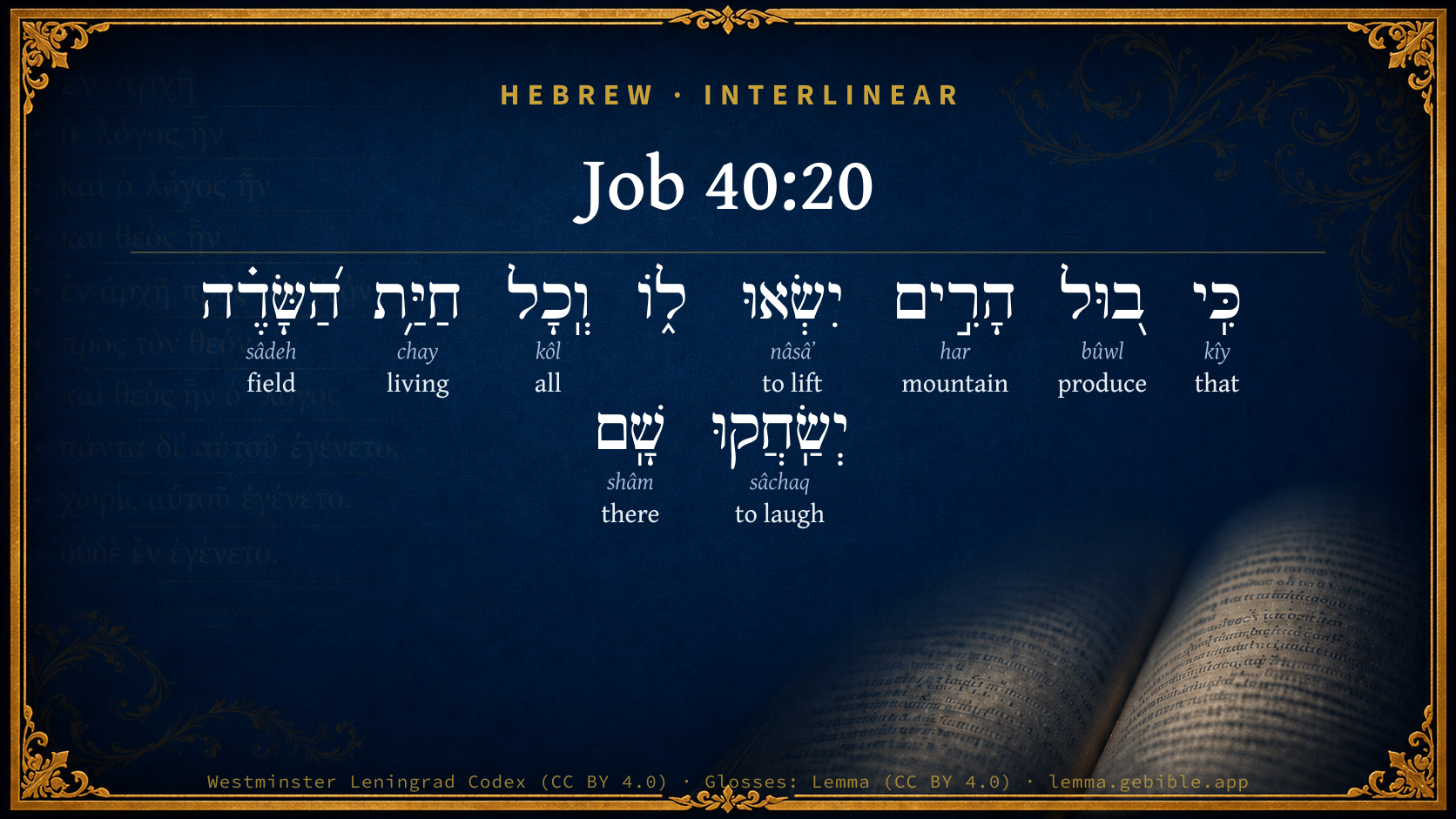
Job 40:20

Hebrew (Westminster Leningrad Codex) Job 40:20 appears in the Hebrew Old Testament. The text above is from the Westminster Leningrad Codex. Each word links to its Strong’s number, a concise gloss, and parsing drawn from the Open Scriptures Hebrew Bible morphology. Click any word for its full Brown-Driver-Briggs (BDB) entry.
Download image
Cite this verse

Job 40:20 (World English Bible). Public Domain. Lemma interlinear Bible study tool, https://lemma.gebible.app/v/job/40/20.

Show BibTeX & RIS
BibTeX
RIS
English Translation
Surely the mountains bring him forth food, Where all the animals of the field do play.
World English Bible · Public Domain
Highlights
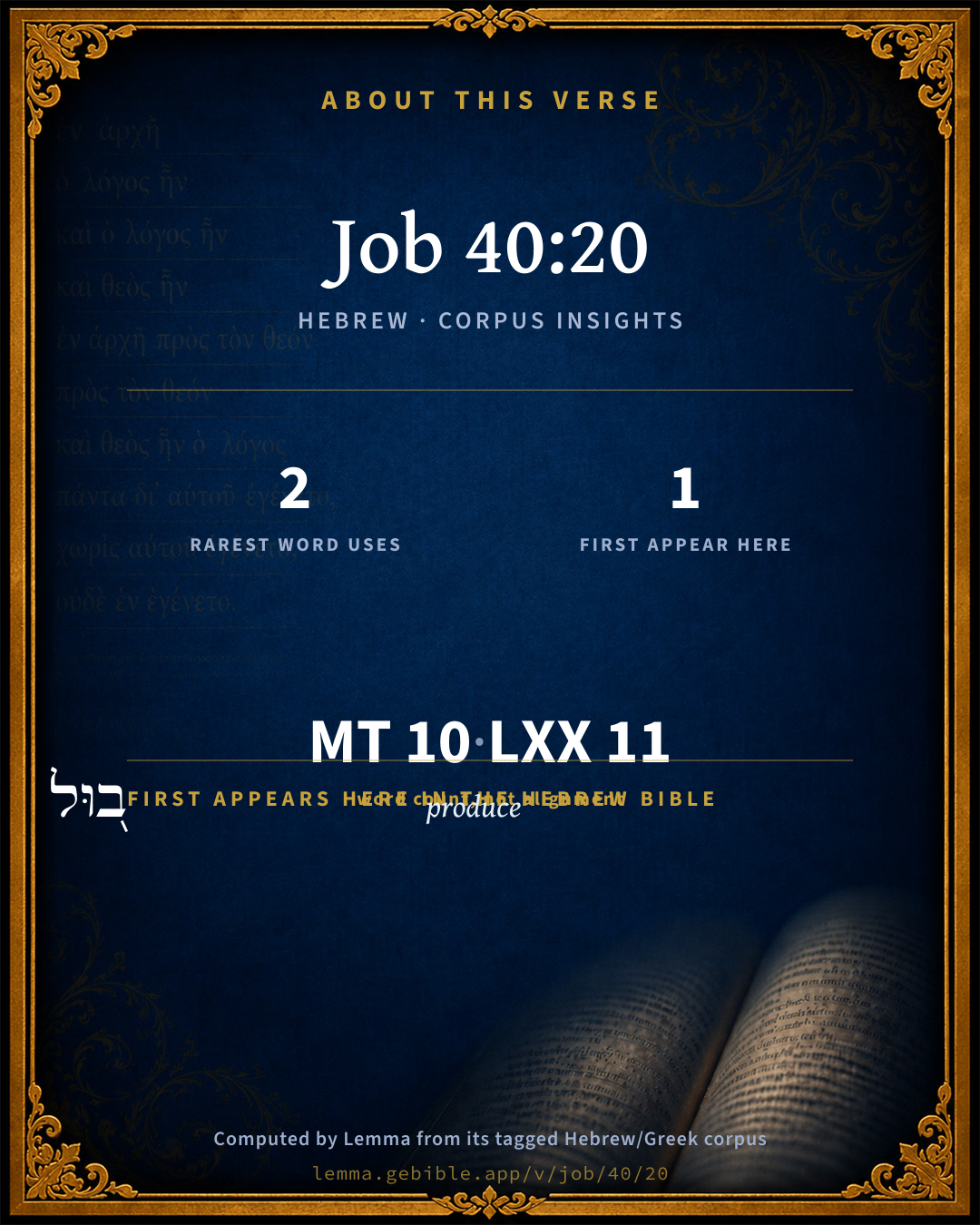
  • 1 first appearance in the Hebrew Bible
Full analysis ↓
Download a study sheet

One document with this verse’s original text, its word-by-word gloss line, the meaning frame, cross-references with their text, attributed commentary, and full source and license credits — printable, and it pastes into notes with its structure intact.

This verse Autodidact and up

Study sheet (.html) Plain text (.txt)

A passage Seminary Student

Up to 50 verses in one chapter. A passage sheet keeps up to 6 commentary sources and 12 cross-references per verse, in the order this page ranks them, and says so on the sheet whenever that leaves anything out. Ask for a single verse and you get the Autodidact verse sheet above.

Everything on this page stays free to read, with no account — the sheet is a download of what is already on screen, not access to it.

Want to remove ads? Support Godless Engineer
Compare translations 3

The same verse in 3 English versions, stacked beneath the original-language interlinear above. Click any original word for its lexicon entry.

Each is an independent rendering of the whole verse — the interlinear is not word-aligned to these translations.

Highlighted words mark where these versions differ — a whole-verse word diff, not a word-by-word alignment.

  • World English Bible Public Domain
    Surely the mountains bring him forth food, Where all the animals of the field do play.
  • King James Version Public Domain
    Surely the mountains bring him forth food, where all the beasts of the field play.
  • unfoldingWord Literal Text CC BY-SA 4.0
    For the hills provide food for it, and all of the beasts of the field play there.

unfoldingWord Literal Text — © unfoldingWord, licensed CC BY-SA 4.0. Word-aligned USFM3 via Door43 (git.door43.org/unfoldingWord/en_ult).

Versions to compare (up to 4)

3 of 4 selected

Show all 18 translations

Every available English version of this verse, each an independent rendering of the whole verse.

  • World English Bible Public Domain
    Surely the mountains bring him forth food, Where all the animals of the field do play.
  • Berean Standard Bible Public Domain
    The hills yield him their produce, while all the beasts of the field play nearby.
  • Majority Standard Bible Public Domain
    The hills yield him their produce, while all the beasts of the field play nearby.
  • King James Version Public Domain
    Surely the mountains bring him forth food, where all the beasts of the field play.
  • American Standard Version (1901) Public Domain
    Surely the mountains bring him forth food, Where all the beasts of the field do play.
  • Revised Version (1885) Public Domain
    Surely the mountains bring him forth food; where all the beasts of the field do play.
  • Geneva Bible (1599) Public Domain
    Canst thou drawe out Liuiathan with an hooke, and with a line which thou shalt cast downe vnto his tongue?
  • Douay-Rheims (1899) Public Domain
    Canst thou draw out the leviathan with a hook, or canst thou tie his tongue with a cord?
  • Young's Literal Translation Public Domain
    For food do mountains bear for him, And all the beasts of the field play there.
  • Literal Standard Version CC BY-SA 4.0
    For mountains bear food for him, || And all the beasts of the field play there.
  • Unlocked Literal Bible CC BY-SA 4.0
    For the hills provide him with food; the beasts of the field play nearby.
  • unfoldingWord Literal Text CC BY-SA 4.0
    For the hills provide food for it, and all of the beasts of the field play there.
  • Darby Bible Public Domain
    For the mountains bring him forth food, where all the beasts of the field play.
  • World Messianic Bible Public Domain
    Surely the mountains produce food for him, where all the animals of the field play.
  • Webster's Bible Public Domain
    \\41:1\\Canst thou draw out leviathan with a hook? or his tongue with a cord which thou lettest down?
  • Free Bible Version CC BY-SA 4.0
    The hills produce food for it, and all the wild animals play there.
  • Bible in Basic English Public Domain
    Is it possible for Leviathan to be pulled out with a fish-hook, or for a hook to be put through the bone of his mouth?
  • JPS Tanakh (1917) Public Domain
    Surely the mountains bring him forth food, and all the beasts of the field play there.

Literal Standard Version (2020), Covenant Press — licensed CC BY-SA 4.0. Text via the HelloAO Bible API (eBible.org). Unlocked Literal Bible (unfoldingWord) — licensed CC BY-SA 4.0. Text via the HelloAO Bible API (eBible.org). unfoldingWord Literal Text — © unfoldingWord, licensed CC BY-SA 4.0. Word-aligned USFM3 via Door43 (git.door43.org/unfoldingWord/en_ult). Free Bible Version, Dr. Jonathan Gallagher — licensed CC BY-SA 4.0. Text via the HelloAO Bible API (eBible.org).

Word by word

More ways to search: Search by grammar → Find every occurrence → Compare this word →

Practice this passage: Drill this verse → Learn its vocabulary →

About this verse

These counts appear in no published source. They are computed here, from the morphology-tagged text and Lemma’s own curated glosses. What Lemma adds →

10
words
9
distinct lemmas
Wisdom
section

Notable vocabulary

The rarest word here is ב֭וּל produce H944 — appearing just 2 times in the whole Hebrew Bible.

First appearance in Scripture

This word makes its first canonical appearance in the Hebrew Bible here:

  • ב֭וּל produce H944

Shared distinctive vocabulary

ב֭וּל produce H944 occurs in 2 verses of the Hebrew Bible. Also found in:

Grammatical profile

  • 2 verbs
  • 5 nouns
  • 1 preposition
  • 1 conjunction
  • 1 adverb

Verb forms

  • יִשְׂאוּ Qal · Imperfect
  • יְשַֽׂחֲקוּ Piel · Imperfect

Hebrew & Septuagint length

In English translation the verse runs 16 words from the Hebrew and 16 from the Septuagint (LXX English) — the same length.

A rough comparison of the two English renderings, which tokenize alike — not a word-level alignment.

Word counts can differ between the Hebrew and the Greek without any difference in meaning — e.g. the Hebrew direct-object marker אֵת has no separate Greek word, and Greek often adds the article ὁ.

In the original languages it is 10 Hebrew tokens and 11 Greek tokens — but the two are counted differently (Hebrew bundles its prefixes and suffixes into one token; the Greek is in lemma form), so that isn’t a like-for-like length.

Cross-references

4

Topical passages linked to Job 40:20 in the Treasury of Scripture Knowledge — connected by theme and wording, ordered by reader-vote popularity; previews shown in the World English Bible.

  • Psalms 104:14 He causes the grass to grow for the cattle, And plants for man to cultivate, That he may bring forth food out of the earth:
  • Psalms 104:26 There the ships go, And leviathan, whom you formed to play there.
  • Job 40:15 "See now, behemoth, which I made as well as you. He eats grass as an ox.
  • Psalms 147:8–9 Who covers the sky with clouds, Who prepares rain for the earth, Who makes grass grow on the mountains.

Cross-references courtesy of OpenBible.info (CC BY 4.0).

Hebrew and Greek witnesses Masoretic Hebrew ↔ Greek Septuagint

The same verse in the two great witnesses to the Old Testament, shown verse-for-verse.

These are two independent witnesses, not word-aligned to each other, and the Septuagint is shown in lemma (dictionary) form.

Hebrew Job 40:20 Masoretic · Westminster Leningrad Codex

כִּֽי ב֭וּל הָרִ֣ים יִשְׂאוּ ל֑וֹ וְֽכָל חַיַּ֥ת הַ֝שָּׂדֶ֗ה יְשַֽׂחֲקוּ שָֽׁם

Surely the mountains bring him forth food, Where all the animals of the field do play.

World English Bible · Public Domain

Greek LXX Job 40:20 Septuagint · lemma form

ἐπιἔρχομαι δέ ἐπί ὄρος ἀκρότομος ποιέω χαρμονή τετράπους ἐν ὁ τάρταρος

But will you catch the serpent with a hook, and put a halter about his nose?

LXX2012 (modern English Septuagint) · Public Domain

On this verse, Haydock's Catholic Bible Commentary discusses the Septuagint’s reading. Read the note in Commentary ↓

Hebrew: Westminster Leningrad Codex (CC BY 4.0). Greek: Septuagint (public domain); English from LXX2012 (modern English Septuagint) (Public Domain). How the Septuagint differs from the Hebrew →

Commentary

Notes on Job 40:20 from classic Christian and Jewish commentators (each source and its license shown beneath its notes). The classic Christian expositions comment on the surrounding passage and are grouped to its opening verse, so a note may address several verses; the Jewish commentaries on the Tanakh (Rashi and others) are per-verse, so they appear only where the commentator wrote on this verse.

Lemma curates 59 commentaries, every one of them public domain or Creative Commons licensed, each selected and text-cleaned for this edition rather than reprinted as found. About our sources →

Trapp's Complete Commentary

John Trapp

Job 40:20 Surely the mountains bring him forth food, where all the beasts of the field play.

Ver. 20. Surely the mountains briny him forth food] And food enough, though he be of a huge body. Learn we to trust unto God’s providence for our necessary provision: the earth is the Lord’s, and the fulness thereof. See Job 40:15.

Where all the beasts of the field play] And play they may securely for him; for he is so far from using his sword to destroy them, that when he is to pass through the herds of other beasts or cattle, he maketh way, saith Pliny, with his snout, that he may not hurt any of them, and beckoneth to them therewith, as it were with his hand, that he will only pass by them, and do them no harm.

John Trapp, A Commentary or Exposition upon All the Books of the Old and New Testament (1647–1656) — public domain. Text from a community e-Sword module.

Joseph Benson's Commentary

Job 40:20. The mountains bring him forth food — Though this creature be so vastly large, and require much food, and no man careth for it, yet God provides for it out of his own stores, and makes the desert mountains to afford it sufficient sustenance. This particular of the description seems more applicable to the elephant than the hippopotamus, which, though he fetches his food, in a great measure, from the land, feeding on the herbage on the banks of the Nile, and among the lakes and fens of Ethiopia, through which that river passes, yet can hardly be said to pasture upon the mountains. Both animals consume great quantities of food, and it must be acknowledged to be an instance of the goodness of God that he hath so ordered it that they feed on grass, and the other products of the field, and not on flesh; for if the latter had been their usual food, great multitudes of creatures must have died continually to keep them alive. Where all the beasts of the field play — This is equally applicable both to the elephant and the river-horse. The beasts of the field not only feed securely, but sport themselves by both of them, being taught by experience that they are gentle and harmless, and never prey upon them.

Joseph Benson's Commentary on the Old and New Testaments (1811–1818) — public domain. Text from a community e-Sword module.

Geneva Bible (1599)

Geneva Bible translators

Meaning, the whale.

Geneva Bible (1599) marginal notes — public domain. Text via Bolls.life.

Jamieson, Fausset & Brown

Robert Jamieson, A. R. Fausset & David Brown

The mountain is not his usual haunt. BOCHART says it is sometimes found there (?).

beasts . . . play--a graphic trait: though armed with such teeth, he lets the beasts play near him unhurt, for his food is grass.

Jamieson, Fausset & Brown — Commentary Critical and Explanatory on the Whole Bible (1871) — public domain (CC PDM 1.0). Text via the HelloAO Bible API.

Adam Clarke's Commentary

Verse 20. The mountains bring him forth food] It cannot therefore be the hippopotamus, as he is seldom found far from the rivers where he has his chief residence.

Where all the beasts of the field play.] He frequents those places where he can have most prey. He makes a mock of all the beasts of the field. They can neither resist his power, nor escape from his agility. All this answers to what we know of the mammoth, but not at all to the hippopotamus.

Adam Clarke's Commentary on the Bible (1810–1826) — public domain. Text from a community e-Sword/MySword module.

The Cambridge Bible for Schools and Colleges

gen. ed. J. J. S. Perowne

20. The verse seems to mean that in order to satisfy his hunger the animal depastures whole mountains, tracts where all the beasts of the field play. The hippopotamus is said to wander to the higher grounds, at a distance from the river, when food cannot be found in its vicinity.

The Cambridge Bible for Schools and Colleges (gen. ed. J. J. S. Perowne; Cambridge University Press, 1878–1918) — public domain. Text from a community e-Sword module.

John Gill's Exposition

He lieth under the shady trees, in the covert of the reed,

and fens. This may be thought to agree very well with the river horse, the inhabitant of the Nile, where reeds in great plenty grew, and adjoining to which were fenny and marshy places, and shady trees; and, as historians relate (e), this creature takes its lodging among high reeds, and in shady places; yea, the reeds and sugar canes, and the leaves of the papyrus, are part of the food on which it lives; and hence the hunters of them sometimes cover their bait with a reed to take them; though it must be allowed that the elephant delights to be about rivers, and in clayey and fenny places (f), and therefore Aelianus (g) says it may be called the fenny animal.

(e) Ammian. Marcellin. l. 22. Bellonius & Achilles Tatius apud Bochart ut supra. (Apud Hierozoic. par. 2. l. 5. c. 14. col. 760.) (f) Aristot. Hist. Animal. l. 9. c. 46. Plin. l. 8. c. 10. Aelian. de Animal. l. 9. c. 56. (g) lbid. l. 9. c. 24.

John Gill's Exposition of the Whole Bible (1746–1763) — public domain (CC PDM 1.0). Text via the HelloAO Bible API.

Albert Barnes' Notes on the Bible

Surely the mountains bring him forth food - That is, though he lies commonly among the reeds and fens, and is in the water a considerable portion of his time, yet he also wanders to the mountains, and finds his food there. But the point of the remark here does not seem to be, that the mountains brought forth food for him, but that he gathered it “while all the wild beasts played around him, or sported in his very presence.” It was remarkable that an animal so large and mighty, and armed with such a set of teeth, should not be carnivorous, and that the wild beasts on the mountains should continue their sports without danger or alarm in his very presence. This fact could be accounted for partly because the “motions” of the hippopotamus were so very slow and clumsy that the wild beasts had nothing to fear from him, and could easily escape from him if he were disposed to attack them, and partly from the fact that he seems to have “preferred” vegetable food. The hippopotamus is seldom carnivorous, except when driven by extreme hunger, and in no respect is he formed to be a beast of prey. In regard to “the fact” that the hippopotamus is sometimes found in mountainous or elevated places, see Bochart.

Albert Barnes' Notes on the Bible (1834–1885) — public domain. Text from a community e-Sword/MySword module.

Haydock's Catholic Bible Commentary

Leviathan: the whale, or some sea monster. (Challoner) --- Protestants’ marginal note, "or a whirlpool." (Haydock) --- But some animal is designated; and Bochart understands the crocodile, which agrees very well with the context. The Thalmudists also say that the calbish is a small fish, which gets into the throat of the leviathan. They mean probably the ichneumon, which kills the crocodile by that means. Leviathan, "the winding serpent," (Calmet) often denotes the dragon or crocodile, (Psalm ciii. 26., and Isaias xxvii. 1.) which frequents the Nile. (Haydock) --- It can live as well by land as under water, (Watson, p. 293) and hence may be translated, (Haydock) "the coupled dragon." (Parkhurst) --- Moses mentions the choled, (Leviticus xi. 29.) which the Septuagint and most others translate, "the land crocodile:" but what could induce the Protestants "to render it tortoise, we are at a loss to determine." Crocodiles lay about sixty eggs, like those of geese, in the sand, the warmth of which soon hatches them. Their bodies are covered with scales, which are scarcely penetrable, except under the belly; and they are between twenty and thirty feet in length, running very fast, straight forward, though their feet be short, and they cannot turn easily. The have several rows of sharp teeth, which enter one within another, and their throat is very wide. (Button.) --- The same word may however denote whales, (Parkhurst) which are the greatest fishes with which man is acquainted. (Haydock) --- They may also be styled coupled dragons, because many smaller fishes accompany them, and they are well protected by scales, &c. (Menochius) --- This huge fish, perhaps the whale, representing the devil, is subject to God. (Worthington) --- Cord. The crocodile may be taken, but with the utmost hazard; though the Tentyrites attacked it without fear, chap. iii. 8. Herodotus (ii. 70.) says it may be caught with a hook, baited with hog’s flesh, while the fisher has a pig grunting, at which the crocodile come open-mouthed. Having swallowed the hook, it is drawn to land, and its small eyes being filled with dirt it is easily slain. But the method was not yet invented, or was deemed too rash in Job’s days.

George Leo Haydock (1774–1849), Haydock's Catholic Family Bible and Commentary, 1859 edition — public domain. Excludes Psalms (Douay-Rheims chapter numbering differs from Protestant) and Deuterocanonical books (Catholic canon only).

Matthew Poole's English Annotations

Though this creature be vastly great, and require much food, and no man careth for it; yet God provides for it out of his own stores, and makes even desert mountains to afford him sufficient sustenance. The hippopotamus also, though he live most in the water, fetched his food from the land, and from the mountains or hills, which are nigh unto the river Nile.

Where all the beasts of the field play; they not only feed securely, but sport themselves by him or with him, being taught by experience that he is gentle and harmless, and never preys upon them.

Matthew Poole's English Annotations on the Holy Bible (1683–1685) — public domain. Text from a community e-Sword/MySword module.

Whedon's Commentary on the Bible

Daniel D. Whedon

20. Surely — Yet; used adversatively.

The mountains — Ezekiel (Eze_43:15) calls the altar a הר, “mountain” of God. The word הרים may also mean “hills.” In the Praeneste pavement, hippopotami are pictured on eminences. “Not only do these animals visit the margin of the river,” says Sir Samuel Baker, “but they wander at night to great distances from the water, attracted by good pasturage; and, although clumsy and ungainly in appearance, they clamber up steep banks and precipitous ravines with astonishing power and ease. In places where they are perfectly undisturbed, they not only enjoy themselves in the sunshine by basking half asleep upon the surface of the water, but they lie upon the shore, beneath the shady trees, upon the river’s brink. I have seen them when disturbed by our sudden arrival during the march, take a leap from a bank, about twenty feet perpendicular depth, into the water below.”… — Nile Tributaries of Abyssinia, page 342. The mountain ranges that skirt the Nile in some places approach the river very closely.

Where all the beasts of the field play — All authorities attest the peaceable disposition of this animal, except when hunted by man. The distinguished traveller above quoted remarks: “Although the hippopotamus is generally harmless, the solitary old bulls are extremely vicious, especially when in the water. I have frequently known them charge a boat, and I have myself narrowly escaped being upset in a canoe by one of these creatures, without the slightest provocation. The females are extremely shy and harmless, and they are most affectionate mothers. The only instances I have known of a female attacking a man have been those in which the calf had been stolen.” — Ibid., page 340.

Daniel D. Whedon (gen. ed.), Commentary on the Old and New Testaments (1874–1909) — public domain. Text from a community e-Sword module.

The Pulpit Commentary

Surely the mountains bring him forth food. Neither the hippopotamus nor the elephant is an inhabitant of "mountains," according to our use of the word. But the harim ( of the original is used of very moderate eminences. In the highly poetical language of Job, and especially of this passage, the term may well be applied to the hills on either side of the Nile, which approach closely to the river, and to this day furnish the hippopotamus with a portion of its food (see Hasselquist, "Travels," p. 188). Where all the beasts of the field play. By "the beasts of the field" seem to be meant the cattle and other do-mastic animals which are not driven from their pasture-grounds by the "river-horse" (Tristram, "Nat. Hist. of the Bible," p. 52).

The Pulpit Commentary (1880–1919), ed. H.D.M. Spence-Jones & Joseph S. Exell — public domain. Text from a community e-Sword module.

John Wesley's Explanatory Notes

Mountains - Though he lives most in the water, yet he often fetches his food from the land, and from the mountains or hills, which are nigh the river Nile. Play - They not only feed securely, but sport themselves by him, being taught by experience that he is gentle and harmless.

John Wesley, Explanatory Notes Upon the Whole Bible (1754–1765) — public domain. Text via the GEBible commentary corpus.

Rashi

Rabbi Shlomo Yitzchaki (Rashi)

For the mountains bear food for him And it is written in the Book of Psalms (50:10): “Behemoth upon a thousand mountains.” A thousand mountains bear food for him. He feeds on all of them every day, [and they are grown again the next day].

Rashi on the Tanakh — English translations: “The Judaica Press complete Tanach with Rashi, translated by A. J. Rosenberg” (CC BY 4.0); “Pentateuch with Rashi's commentary by M. Rosenbaum and A.M. Silbermann, 1929-1934” (public domain); “The Metsudah Tanach series, Lakewood, N.J” (CC BY 4.0); and “The Book of Joshua, Metsudah Publications, 1997” (CC BY 4.0). Text via Sefaria.

Lesson kit

Teaching starters — assembled from the data on this page, not authored interpretation. Every prompt links to the verse data it draws on. Edit before teaching.

Job, in the Wisdom, opens this verse with 10 words (9 distinct Hebrew lemmas). Its most distinctive word is bûwl (“produce”). A historical commentator’s framing appears above. Read the whole chapter for the surrounding context.

Discussion questions

  1. How does “produce” (bûwl) shape what this verse is saying?
  2. This is the first place “produce” appears in Scripture (first appears here). What does its debut here establish?
  3. How does Isaiah 44:19, which shares the word «produce», read alongside this verse?
  4. These translations render this verse differently; the difference is in the English rendering, not the original. What questions does that raise?
  5. «יִשְׂאוּ» is a Qal Imperfect verb. How does that grammatical form shape the action described?
  6. Compare how Trapp's Complete Commentary and Joseph Benson's Commentary read this verse. Where do they agree or differ?

Things to notice

Reading settings

Reading text

Shown beneath each verse's original-language words.

Old Testament
Old Testament edition

Read the OT as the Masoretic Hebrew (MT) or the Greek Septuagint (LXX).

English shown for the Greek Septuagint (in the Hebrew ↔ Greek comparison).

Comparing translations? Open the Compare panel on any verse page to stack up to four side by side.