
1 Kings 5:9

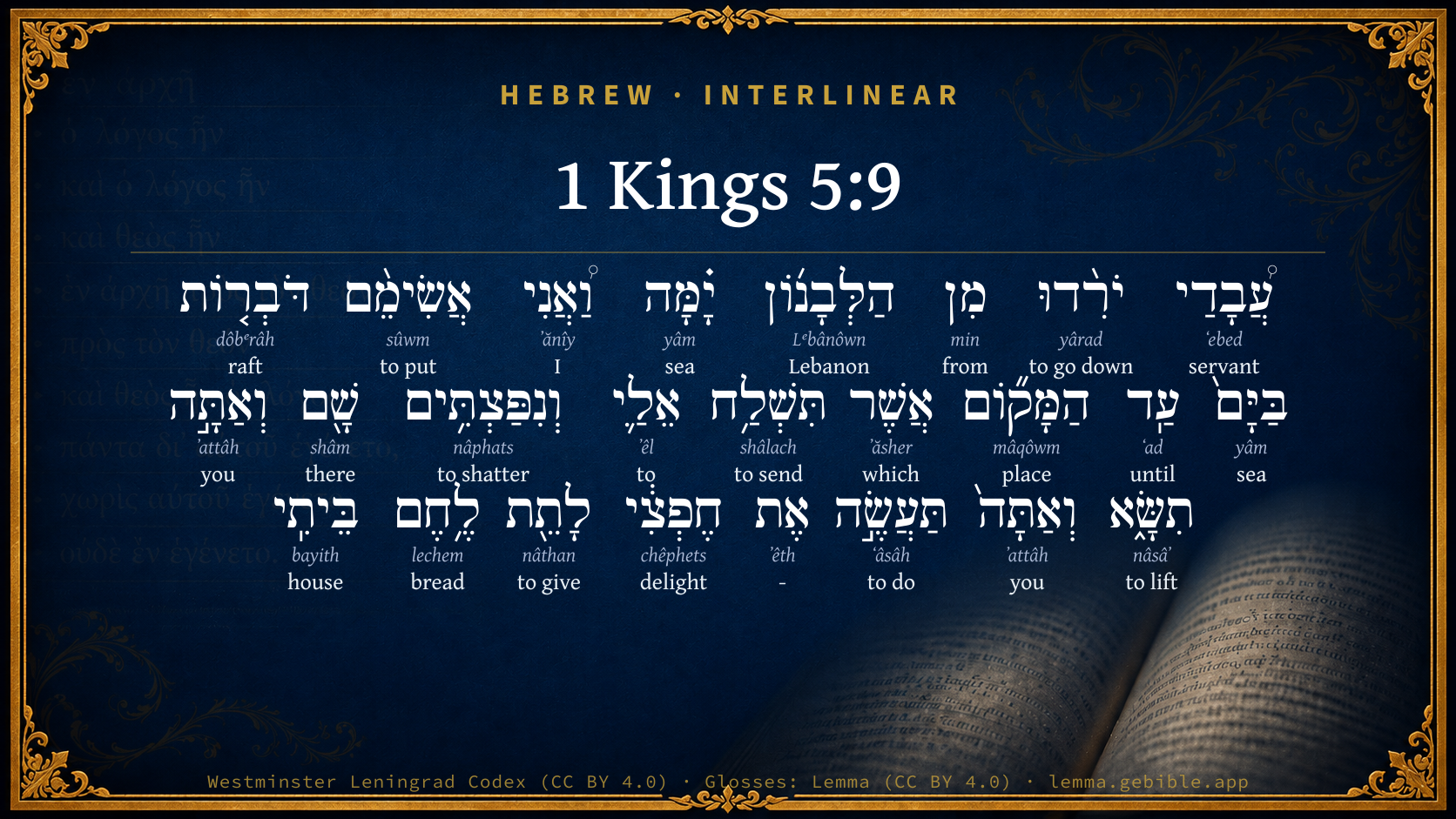
Hebrew (Westminster Leningrad Codex) 1 Kings 5:9 appears in the Hebrew Old Testament. The text above is from the Westminster Leningrad Codex. Each word links to its Strong’s number, a concise gloss, and parsing drawn from the Open Scriptures Hebrew Bible morphology. Click any word for its full Brown-Driver-Briggs (BDB) entry.
Download image
Cite this verse

1 Kings 5:9 (World English Bible). Public Domain. Lemma interlinear Bible study tool, https://lemma.gebible.app/v/1-kings/5/9.

Show BibTeX & RIS
BibTeX
RIS
English Translation
My servants shall bring them down from Lebanon to the sea; and I will make them into rafts to go by sea to the place that you shall appoint me, and will cause them to be broken up there, and you shall receive them; and you shall accomplish my desire, in giving food for my household.
World English Bible · Public Domain
Highlights
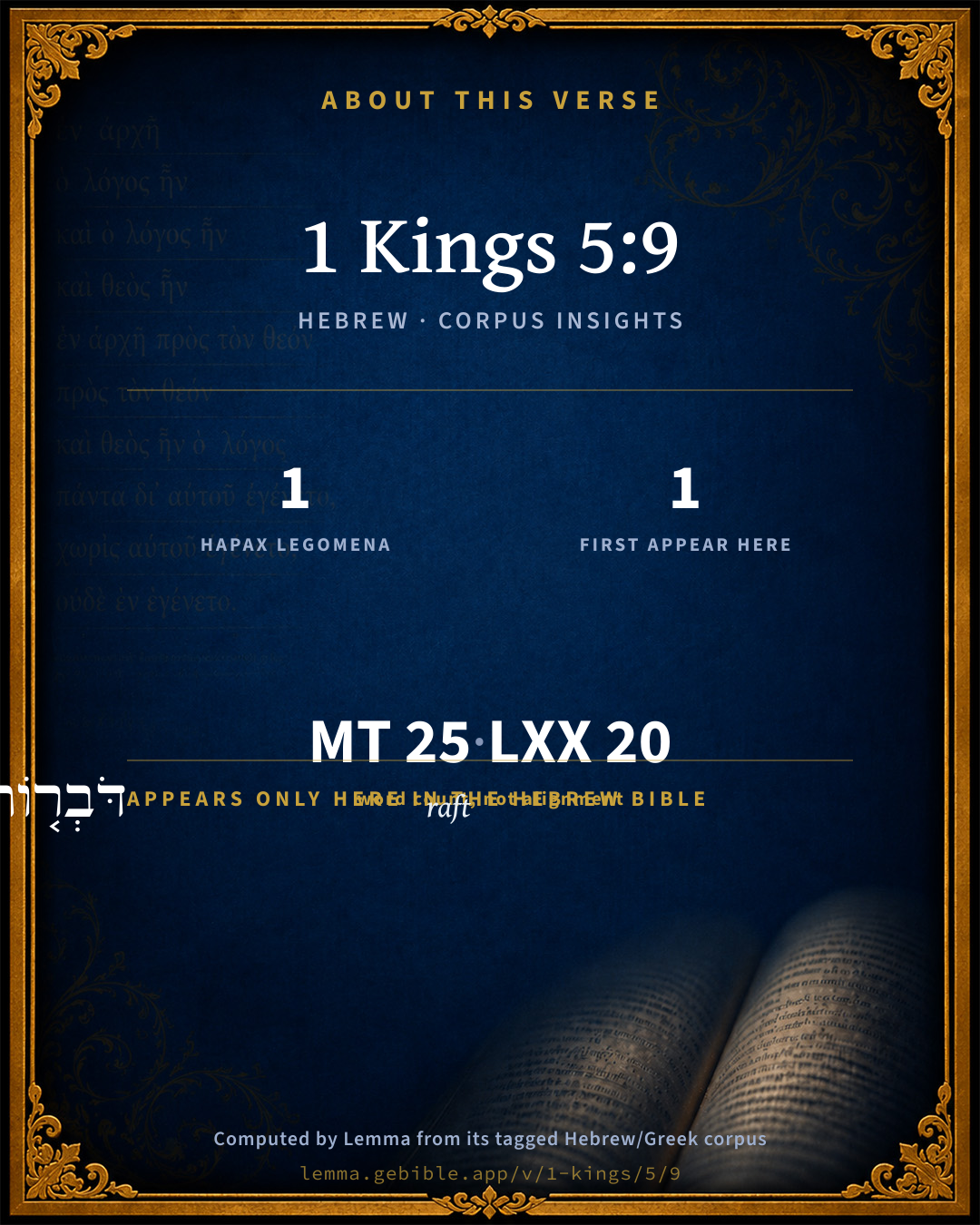
  • 1 hapax legomenon — only here in the Hebrew Bible
  • 1 first appearance in the Hebrew Bible
Full analysis ↓
Download a study sheet

One document with this verse’s original text, its word-by-word gloss line, the meaning frame, cross-references with their text, attributed commentary, and full source and license credits — printable, and it pastes into notes with its structure intact.

This verse Autodidact and up

Study sheet (.html) Plain text (.txt)

A passage Seminary Student

Up to 50 verses in one chapter. A passage sheet keeps up to 6 commentary sources and 12 cross-references per verse, in the order this page ranks them, and says so on the sheet whenever that leaves anything out. Ask for a single verse and you get the Autodidact verse sheet above.

Everything on this page stays free to read, with no account — the sheet is a download of what is already on screen, not access to it.

Want to remove ads? Support Godless Engineer
Compare translations 3

The same verse in 3 English versions, stacked beneath the original-language interlinear above. Click any original word for its lexicon entry.

Each is an independent rendering of the whole verse — the interlinear is not word-aligned to these translations.

Highlighted words mark where these versions differ — a whole-verse word diff, not a word-by-word alignment.

  • World English Bible Public Domain
    My servants shall bring them down from Lebanon to the sea; and I will make them into rafts to go by sea to the place that you shall appoint me, and will cause them to be broken up there, and you shall receive them; and you shall accomplish my desire, in giving food for my household.
  • King James Version Public Domain
    My servants shall bring them down from Lebanon unto the sea: and I will convey them by sea in floats unto the place that thou shalt appoint me, and will cause them to be discharged there, and thou shalt receive them: and thou shalt accomplish my desire, in giving food for my household.
  • unfoldingWord Literal Text CC BY-SA 4.0
    And my servants will bring down from Lebanon to the sea, and I, I will set rafts on the sea to the place that you send to me, and I will break them up there. And you, you will lift. And you, you will do my desire by giving the bread of my house.”

unfoldingWord Literal Text — © unfoldingWord, licensed CC BY-SA 4.0. Word-aligned USFM3 via Door43 (git.door43.org/unfoldingWord/en_ult).

Versions to compare (up to 4)

3 of 4 selected

Show all 18 translations

Every available English version of this verse, each an independent rendering of the whole verse.

  • World English Bible Public Domain
    My servants shall bring them down from Lebanon to the sea; and I will make them into rafts to go by sea to the place that you shall appoint me, and will cause them to be broken up there, and you shall receive them; and you shall accomplish my desire, in giving food for my household.
  • Berean Standard Bible Public Domain
    My servants will haul the logs from Lebanon to the Sea, and I will float them as rafts by sea to the place you specify. There I will separate the logs, and you can take them away. And in exchange, you can meet my needs by providing my household with food.”
  • Majority Standard Bible Public Domain
    My servants will haul the logs from Lebanon to the Sea, and I will float them as rafts by sea to the place you specify. There I will separate the logs, and you can take them away. And in exchange, you can meet my needs by providing my household with food.”
  • King James Version Public Domain
    My servants shall bring them down from Lebanon unto the sea: and I will convey them by sea in floats unto the place that thou shalt appoint me, and will cause them to be discharged there, and thou shalt receive them: and thou shalt accomplish my desire, in giving food for my household.
  • American Standard Version (1901) Public Domain
    My servants shall bring them down from Lebanon unto the sea; and I will make them into rafts to go by sea unto the place that thou shalt appoint me, and will cause them to be broken up there, and thou shalt receive them; and thou shalt accomplish my desire, in giving food for my household.
  • Revised Version (1885) Public Domain
    My servants shall bring them down from Lebanon unto the sea: and I will make them into rafts to go by sea unto the place that thou shalt appoint me, and will cause them to be broken up there, and thou shalt receive them: and thou shalt accomplish my desire, in giving food for my household.
  • Geneva Bible (1599) Public Domain
    My seruants shall bring them downe from Lebanon to the sea: and I will conuey them by sea in raftes vnto the place that thou shalt shew me, and wil cause them to be discharged there, and thou shalt receiue them: nowe thou shalt doe mee a pleasure to minister foode for my familie.
  • Douay-Rheims (1899) Public Domain
    My servants shall bring them down from Libanus to the sea: and I will put them together in floats in the sea, and convey them to the place, which thou shalt signify to me; and will land them there, and thou shalt receive them: and thou shalt allow me necessaries, to furnish food for my household.
  • Young's Literal Translation Public Domain
    my servants bring down from Lebanon to the sea, and I make them floats in the sea unto the place that thou sendest unto me, and I have spread them out there; and thou dost take `them' up, and thou dost execute my desire, to give the food of my house.'
  • Literal Standard Version CC BY-SA 4.0
    my servants bring [them] down from Lebanon to the sea, and I make them floats in the sea to the place that you send to me, and I have spread them out there; and you take [them] up, and you execute my desire, to give the food [for] my house.”
  • Unlocked Literal Bible CC BY-SA 4.0
    My servants will bring the trees down from Lebanon to the sea, and I will make them into rafts to go by sea to the place that you direct me. I will have them broken up there, and you will take them away. You will do what I desire by giving food for my household.”
  • unfoldingWord Literal Text CC BY-SA 4.0
    And my servants will bring down from Lebanon to the sea, and I, I will set rafts on the sea to the place that you send to me, and I will break them up there. And you, you will lift. And you, you will do my desire by giving the bread of my house.”
  • Darby Bible Public Domain
    My servants shall bring [them] down from Lebanon to the sea; and I will convey them by sea [in] rafts to the place that thou shalt appoint me, and will cause them to be broken up there, and thou shalt receive them. And thou shalt accomplish my desire in giving food for my household.
  • World Messianic Bible Public Domain
    My servants will bring them down from Lebanon to the sea. I will make them into rafts to go by sea to the place that you specify to me, and will cause them to be broken up there, and you will receive them. You will accomplish my desire, in giving food for my household.”
  • Webster's Bible Public Domain
    My servants shall bring them down from Lebanon to the sea: and I will convey them by sea in floats to the place that thou shalt appoint me, and will cause them to be discharged there, and thou shalt receive them: and thou shalt accomplish my desire, in giving food for my household.
  • Free Bible Version CC BY-SA 4.0
    My workers will bring the logs down from Lebanon to the sea, and I will have them floated in rafts by sea to wherever you decide. I will have the rafts broken apart there, and you can take the logs away. In return I would like you to provide food for my household.”
  • Bible in Basic English Public Domain
    My men will take them down from Lebanon to the sea, where I will have them corded together to go by sea to whatever place you say, and I will have them cut up there so that you may take them away; as for payment, it will be enough if you give me food for my people.
  • JPS Tanakh (1917) Public Domain
    (5-23) My servants shall bring them down from Lebanon unto the sea; and I will make them into rafts to go by sea unto the place that thou shalt appoint me, and will cause them to be broken up there, and thou shalt receive them; and thou shalt accomplish my desire, in giving food for my household.'

Literal Standard Version (2020), Covenant Press — licensed CC BY-SA 4.0. Text via the HelloAO Bible API (eBible.org). Unlocked Literal Bible (unfoldingWord) — licensed CC BY-SA 4.0. Text via the HelloAO Bible API (eBible.org). unfoldingWord Literal Text — © unfoldingWord, licensed CC BY-SA 4.0. Word-aligned USFM3 via Door43 (git.door43.org/unfoldingWord/en_ult). Free Bible Version, Dr. Jonathan Gallagher — licensed CC BY-SA 4.0. Text via the HelloAO Bible API (eBible.org).

Word by word

More ways to search: Search by grammar → Find every occurrence → Compare this word →

Practice this passage: Drill this verse → Learn its vocabulary →

דֹּבְר֤וֹת
dôbᵉrâh
H1702
“rafts”
Noun, Common, Feminine, Plural, Absolute
Part of Speech
Noun
Type
Common
Gender
Feminine
Number
Plural
State
Absolute
Full BDB Definition

Origin: act. participle of H1696

TWOT: 399d

floats, rafts
  1. עֲ֠בָדַי ʻebed H5650 “servants · my” Noun, Common, Masculine, Plural, Construct + Suffix, Personal, 1st Person, Common, Singular
  2. יֹרִ֨דוּ yârad H3381 “to go down” Verb, Hiphil, Imperfect, 3rd Person, Masculine, Plural
  3. מִן min H4480 “from” Preposition
  4. הַלְּבָנ֜וֹן Lᵉbânôwn H3844 “the · Lebanon” Particle, Definite Article + Noun, Proper
  5. יָ֗מָּה yâm H3220 “sea · toward” Noun, Common, Masculine, Singular, Absolute + Suffix, Demonstrative
  6. וַ֠אֲנִי ʼănîy H589 “and · I” Conjunction + Pronoun, Personal, 1st Person, Common, Singular
  7. אֲשִׂימֵ֨ם sûwm H7760 “to put · them” Verb, Qal, Imperfect, 1st Person, Common, Singular + Suffix, Personal, 3rd Person, Masculine, Plural
  8. בַּיָּם֙ yâm H3220 “in/at the · sea” Preposition, Determined + Noun, Common, Masculine, Singular, Absolute
  9. עַֽד ʻad H5704 “until” Preposition
  10. הַמָּק֞וֹם mâqôwm H4725 “the · place” Particle, Definite Article + Noun, Common, Masculine, Singular, Absolute
  11. אֲשֶׁר ʼăsher H834 “which” Particle, Relative
  12. תִּשְׁלַ֥ח shâlach H7971 “to send” Verb, Qal, Imperfect, 2nd Person, Masculine, Singular
  13. אֵלַ֛י ʼêl H413 “to · me” Preposition + Suffix, Personal, 1st Person, Common, Singular
  14. וְנִפַּצְתִּ֥ים nâphats H5310 “and · to shatter · them” Conjunction + Verb, Piel, Sequential Perfect, 1st Person, Common, Singular + Suffix, Personal, 3rd Person, Masculine, Plural
  15. שָׁ֖ם shâm H8033 “there” Adverb
  16. וְאַתָּ֣ה ʼattâh H859 “and · you” Conjunction + Pronoun, Personal, 2nd Person, Masculine, Singular
  17. תִשָּׂ֑א nâsâʼ H5375 “to lift” Verb, Qal, Imperfect, 2nd Person, Masculine, Singular
  18. וְאַתָּה֙ ʼattâh H859 “and · you” Conjunction + Pronoun, Personal, 2nd Person, Masculine, Singular
  19. תַּעֲשֶׂ֣ה ʻâsâh H6213 “to do” Verb, Qal, Imperfect, 2nd Person, Masculine, Singular
  20. אֶת ʼêth H853 “-” Particle, Direct Object
  21. חֶפְצִ֔י chêphets H2656 “delight · my” Noun, Common, Masculine, Singular, Construct + Suffix, Personal, 1st Person, Common, Singular
  22. לָתֵ֖ת nâthan H5414 “to give” Preposition + Verb, Qal, Infinitive Construct
  23. לֶ֥חֶם lechem H3899 “bread of” Noun, Common, Both, Singular, Construct
  24. בֵּיתִֽי bayith H1004 “house · my” Noun, Common, Masculine, Singular, Construct + Suffix, Personal, 1st Person, Common, Singular

About this verse

These counts appear in no published source. They are computed here, from the morphology-tagged text and Lemma’s own curated glosses. What Lemma adds →

25
words
23
distinct lemmas
Historical
section

Notable vocabulary

1 hapax legomenon — a word that appears only here in the entire Hebrew Bible:

  • דֹּבְר֤וֹת raft H1702

First appearance in Scripture

This word makes its first canonical appearance in the Hebrew Bible here:

  • דֹּבְר֤וֹת raft H1702

Shared distinctive vocabulary

וְנִפַּצְתִּ֥ים to shatter H5310 occurs in 17 verses of the Hebrew Bible. Also found in:

Grammatical profile

  • 7 verbs
  • 9 nouns
  • 3 pronouns
  • 3 prepositions
  • 1 adverb
  • 2 particles

Verb forms

  • יֹרִ֨דוּ Hiphil · Imperfect
  • אֲשִׂימֵ֨ם Qal · Imperfect
  • תִּשְׁלַ֥ח Qal · Imperfect
  • וְנִפַּצְתִּ֥ים Piel · Sequential Perfect
  • תִשָּׂ֑א Qal · Imperfect
  • תַּעֲשֶׂ֣ה Qal · Imperfect
  • לָתֵ֖ת Qal · Infinitive Construct

Repetition

Words recur within this verse — often emphatic in Hebrew:

  • יָ֗מָּה sea H3220 ×2
  • וְאַתָּ֣ה you H859 ×2

Hebrew & Septuagint length

In English translation the verse runs 56 words from the Hebrew and 54 from the Septuagint (LXX English) — closely comparable.

A rough comparison of the two English renderings, which tokenize alike — not a word-level alignment.

Word counts can differ between the Hebrew and the Greek without any difference in meaning — e.g. the Hebrew direct-object marker אֵת has no separate Greek word, and Greek often adds the article ὁ.

In the original languages it is 25 Hebrew tokens and 20 Greek tokens — but the two are counted differently (Hebrew bundles its prefixes and suffixes into one token; the Greek is in lemma form), so that isn’t a like-for-like length.

Cross-references

6

Topical passages linked to 1 Kings 5:9 in the Treasury of Scripture Knowledge — connected by theme and wording, ordered by reader-vote popularity; previews shown in the World English Bible.

  • Ezra 3:7 They gave money also to the masons, and to the carpenters; and food, and drink, and oil, to them of Sidon, and to them of Tyre, to bring cedar trees from Lebanon to the sea, to Joppa, according to the grant that they had of Cyrus king of Persia.
  • Ezekiel 27:17 Judah, and the land of Israel, they were your traffickers: they traded for your merchandise wheat of Minnith, and confections, and honey, and oil, and balm.
  • 2 Chronicles 2:16 and we will cut wood out of Lebanon, as much as you shall need; and we will bring it to you in floats by sea to Joppa; and you shall carry it up to Jerusalem.
  • Acts 12:20 Now Herod was very angry with the people of Tyre and Sidon. They came with one accord to him, and, having made Blastus, the king's chamberlain, their friend, they asked for peace, because their country depended on the king's country for food.
  • Deuteronomy 3:25 Please let me go over and see the good land that is beyond the Jordan, that goodly mountain, and Lebanon.
  • 2 Chronicles 1:15 The king made silver and gold to be in Jerusalem as stones, and cedars made he to be as the sycamore trees that are in the lowland, for abundance.

Cross-references courtesy of OpenBible.info (CC BY 4.0).

Hebrew and Greek witnesses Masoretic Hebrew ↔ Greek Septuagint

The same verse in the two great witnesses to the Old Testament, shown verse-for-verse.

These are two independent witnesses, not word-aligned to each other, and the Septuagint is shown in lemma (dictionary) form.

Hebrew 1 Kings 5:9 Masoretic · Westminster Leningrad Codex

עֲ֠בָדַי יֹרִ֨דוּ מִן הַלְּבָנ֜וֹן יָ֗מָּה וַ֠אֲנִי אֲשִׂימֵ֨ם דֹּבְר֤וֹת בַּיָּם֙ עַֽד הַמָּק֞וֹם אֲשֶׁר תִּשְׁלַ֥ח אֵלַ֛י וְנִפַּצְתִּ֥ים שָׁ֖ם וְאַתָּ֣ה תִשָּׂ֑א וְאַתָּה֙ תַּעֲשֶׂ֣ה אֶת חֶפְצִ֔י לָתֵ֖ת לֶ֥חֶם בֵּיתִֽי

My servants shall bring them down from Lebanon to the sea; and I will make them into rafts to go by sea to the place that you shall appoint me, and will cause them to be broken up there, and you shall receive them; and you shall accomplish my desire, in giving food for my household.

World English Bible · Public Domain

Greek LXX 1 Kings 5:9 Septuagint · lemma form

καί δίδωμι κύριος φρόνησις ὁ σαλωμών καί σοφία πολύς σφόδρα καί χύμα καρδία ὡς ὁ ἄμμος ὁ παρά ὁ θάλασσα

my servants shall bring them down from Libanus to the sea: I will form them into rafts, and bring them to the place which you shall send to me about; and I will land them there, and you shall take them up: and you shall do my will, in giving bread to my household.

LXX2012 (modern English Septuagint) · Public Domain

Hebrew: Westminster Leningrad Codex (CC BY 4.0). Greek: Septuagint (public domain); English from LXX2012 (modern English Septuagint) (Public Domain). How the Septuagint differs from the Hebrew →

Targum (Aramaic paraphrase)

1

The Targum is the ancient Jewish Aramaic paraphrase of the Hebrew Scriptures — an interpretive translation, not the Hebrew text itself. Onkelos (literal) and Pseudo-Jonathan (expansive) render the Torah, and Jonathan the Prophets. Coverage is partial: where no permissively-licensed English translation exists for a verse, only the Aramaic is shown. This is verse-level text, not a word-by-word alignment to the Hebrew.

  1. Targum Jonathan Prophets (Joshua–Malachi)
    וִיהַב יְיָ חוּכְמְתָא לִשְׁלֹמֹה וְסוּכְלְתָנוּתָא סַגִי לַחֲדָא וּפַתְיוּת לִבָּא כְּחָלָא דְעַל כַּף יַמָא:

    (no public-domain English translation for this verse)

    Targum Jonathan — Aramaic: “Mikraot Gedolot” (public domain). English: “Sefaria Community Translation” (CC0 1.0 (public-domain dedication)); “London "Chaldee Paraphrase," 1871” (public domain). Text via Sefaria.

Commentary

Notes on 1 Kings 5:9 from classic Christian and Jewish commentators (each source and its license shown beneath its notes). The classic Christian expositions comment on the surrounding passage and are grouped to its opening verse, so a note may address several verses; the Jewish commentaries on the Tanakh (Rashi and others) are per-verse, so they appear only where the commentator wrote on this verse.

Lemma curates 59 commentaries, every one of them public domain or Creative Commons licensed, each selected and text-cleaned for this edition rather than reprinted as found. About our sources →

Trapp's Complete Commentary

John Trapp

1Ki 5:9 My servants shall bring [them] down from Lebanon unto the sea: and I will convey them by sea in floats unto the place that thou shalt appoint me, and will cause them to be discharged there, and thou shalt receive [them]: and thou shalt accomplish my desire, in giving food for my household.

Ver. 9. Unto the place that thou shalt appoint me.] To Joppa, {2Ch 2:16} which had a harbour. {Act 9:43}

And thou shalt receive them.] David had, before his death, prepared abundantly both workmen and cedar trees, &c., {1Ch 22:2-4; 1Ch 29:3} but yet nothing near enough for so great a work.

In giving food] Which in that country was a scarce commodity. They were supplied from other countries, and especially from Jewry; {Act 12:20 Eze 27:17} for their own was such as wherein they could neither sow nor reap, saith A. Lapide.

John Trapp, A Commentary or Exposition upon All the Books of the Old and New Testament (1647–1656) — public domain. Text from a community e-Sword module.

Joseph Benson's Commentary

1Ki 5:9. From Lebanon unto the sea — The Mediterranean sea, on which his city stood. I will convey them — in floats — Or rafts. It is thought the pieces of timber were tied together in the water, as now is usual, and so, by the help of boats or ships, conveyed to the appointed place, which was at no great distance. Unto the place thou shalt appoint me — Which was Joppa, a famous seaport in the country of Israel, 2Ch 2:16. Will cause them to be discharged there — Hebrew, dispersed, or dissolved; which implies that they were tied together. In giving food for my household — My family and court; which, most properly, is called his household. Though they had plenty of money, being great merchants, yet they wanted corn and other provisions: and in after times, it appears, they were supported by provisions from Judea, Act 12:20.

Joseph Benson's Commentary on the Old and New Testaments (1811–1818) — public domain. Text from a community e-Sword module.

Geneva Bible (1599)

Geneva Bible translators

Or, floats.

While my servants are occupied about thy business.

Geneva Bible (1599) marginal notes — public domain. Text via Bolls.life.

Adam Clarke's Commentary

Verse 9. Shall bring them down from Lebanon unto the sea] As the river Adonis was in the vicinity of the forest of Lebanon, and emptied itself into the Mediterranean sea, near Biblos, Hiram could transport the timber all squared, and not only cut to scantling, but cut so as to occupy the place it was intended for in the building, without any farther need of axe or saw. It might be readily sent down the coast on rafts and landed at Joppa, or Jamnia, just opposite to Jerusalem, at the distance of about twenty-five miles. See 2Ch 2:16. The carriage could not be great, as the timber was all fitted for the building where it was hewn down. The materials had only to be put together when they arrived at Jerusalem. See 1Kg 6:7.

Adam Clarke's Commentary on the Bible (1810–1826) — public domain. Text from a community e-Sword/MySword module.

Ellicott's Commentary for English Readers

(9) Shall bring them.—The timber was to be carried down, or, perhaps, let down on slides along the face of the mountain towards the sea, and brought round by rafts to Joppa (2Ch_2:16), to save the enormous cost and difficulty of land carriage. The grant of “food for his household” in return (instead of “hire”) brings out that which is recorded so many ages afterwards in Act_12:20—that the country of the Tyrians was “nourished” by Palestine. The commerce and wealth of the Tyrians collected a large population; the narrow slip of land along the coast, backed by Lebanon, must have been, in any case, insufficient to maintain them; and, moreover, all their energies were turned, not to agriculture, but to seamanship. In the grand description in Ezekiel 27 of the imports of Tyre from all parts of the world, Judah and Israel are named as supplying “wheat, and honey, and oil, and balm.”

A Bible Commentary for English Readers, edited by Charles John Ellicott (1878–1897) — public domain. Text from a community e-Sword module.

The Cambridge Bible for Schools and Colleges

gen. ed. J. J. S. Perowne

9. from Lebanon unto the sea] Providing for the shortest land passage down the side of the mountain and to the coast of the Mediterranean. Probably Sidon itself would be as convenient a place as any to which to bring the timber down. We learn from Josephus (c. Apion i. 18) that Hiram was quite experienced in this work. On his accession he had done much for the adornment of Tyre, especially in its sacred buildings and it is said of him ὕλην ξύλων ἀπελθὼν ἔκοψεν ἀπὸ τοῦ λεγομένου ὄρους Λιβάνου, κέδρινα ξύλα εἰς τὰς τῶν ἱερῶν στέγας, καθελών τε τὰ ἀρξαῖα ἱερὰ καινοὺς (sic) ᾠκοδόμησε.

in flotes] There is no preposition in the original. The idea probably would be more nearly expressed by ‘as flotes.’ R.V. I will make them into rafts to go by sea. The flotes would be made of the trees fastened side by side, and formed into long raftlike structures, somewhat like those which may be seen often on the Rhine, sent down from Switzerland. Such flotes would keep close to the shore and be anchored at night. In this way they might easily be brought along the coasts of Phœnicia and the Holy Land.

unto the place] The Chronicler (2Ch_2:16) makes mention of the name, Joppa. This would be the most convenient port for Jerusalem, and at that point the wood was to be delivered to Solomon’s officers. The compiler of the Kings of course knew where the timber had been delivered, but as it was not recorded in his authority he made no mention of it.

thou shalt appoint] The word is not the same as that so rendered in 1Ki_5:6. The literal sense is ‘to send’ but it is often used of ‘sending a message’ without the addition of any object. Thus in 1Ki_21:11, ‘They did as Jezebel had sent unto them.’ Cf. 2Ki_16:11.

thou shalt accomplish my desire] Josephus explains why a supply of such provisions as Solomon proposed to give would be most acceptable to the Tyrian monarch, making him say in his letter, ὅπως δὲ καὶ σὺ παράσχῃς ἡμῖν ἀντὶ τούτων σῖτον, οὗ διὰ τὸ νῆσον οἰκεῖν δεόμεθα, φρόντισον. The Tyrians were a maritime people, living on an island near a mountainous shore, and so with no chance of getting food supplies from their own land.

The Cambridge Bible for Schools and Colleges (gen. ed. J. J. S. Perowne; Cambridge University Press, 1878–1918) — public domain. Text from a community e-Sword module.

John Gill's Exposition

My servants shall bring them down from Lebanon unto the sea,.... The Mediterranean sea, on which Tyre stood:

and I will convey them by sea in floats; which were either a sort of carriage for the timber the Tyrians and Sidonians had, being furnished with various navigable vessels; or these were the timber itself, and the planks of it, which being fastened together, were set afloat under the direction of some boats with oars, of which they had plenty:

unto the place that thou shalt appoint me; which was Joppa, as appears from Ch2 2:16; belonging to the land of Israel, in the same sea:

and will cause them to be discharged there; either to be unloaded from the vessels, or to be unloosed and taken up separately:

and thou shalt receive them; by his servants appointed there to bring them to Jerusalem, which was forty miles from Joppa:

and thou shalt accomplish my desire in giving food for my household; signifying, that all that he desired in return was, that he would supply him with corn or wheat, which he stood in need of, and his letter in Josephus (d) expresses; and we find in later times this place was supplied with bread corn from Judea, see Ezr 3:7 Act 12:20.

(d) Ut supra. (Antiqu. l. 8. c. 2. sect. 8.)

John Gill's Exposition of the Whole Bible (1746–1763) — public domain (CC PDM 1.0). Text via the HelloAO Bible API.

Albert Barnes' Notes on the Bible

See the marginal reference. The timber was first carried westward from the flanks of Lebanon to the nearest part of the coast, where it was collected into floats, or rafts, which were then conveyed southward along the coast to Joppa, now Jaffa, from where the land journey to Jerusalem was not more than about forty miles. A similar course was taken on the building of the second temple Ezr 3:7.

Food for my household - The Phoenician cities had very little arable territory of their own, the mountain range of Lebanon rising rapidly behind them; and they must always have imported the chief part of their sustenance from abroad. They seem commonly to have derived it from Judaea (marginal references). Hiram agreed now to accept for his timber and for the services of his workmen 1Ki 5:6 a certain annual payment of grain and oil, both of them the best of their kind, for the sustentation of his court. This payment was entirely distinct from the supplies furnished to the workmen (marginal reference “l”).

Albert Barnes' Notes on the Bible (1834–1885) — public domain. Text from a community e-Sword/MySword module.

Haydock's Catholic Bible Commentary

There. Joppe was fixed upon, as the port nearest Jerusalem, 2 Paralipomenon ii. 16. The trees were squared and rolled, (Calmet) or dragged (Haydock) from the mountain-top to the river Adonis, or the plain of Biblos, and then sent in floats by sea. (Calmet) --- Household, for the workmen employed in cutting the wood; (2 Paralipomenon; Menochius) and also for Hiram’s other servants, as the kings of the East paid them not with money. (Calmet) --- The Tyrians neglected agriculture. (Servius)

George Leo Haydock (1774–1849), Haydock's Catholic Family Bible and Commentary, 1859 edition — public domain. Excludes Psalms (Douay-Rheims chapter numbering differs from Protestant) and Deuterocanonical books (Catholic canon only).

Matthew Poole's English Annotations

Unto the sea; the midland sea.

In floats, or ships, or rafts. It is thought the timbers were tied together in the water, as now it is usual, and so by the help of boats or ships conveyed to the appointed place, which was at no great distance.

Unto the place that thou shalt appoint me; which was Joppa, 2Ch 2:16, a town upon the sea, Jos 19:46; Act 9:43.

Discharged, Heb. dispersed, or dissolved; which implies that they were tied together.

Food for my household, i.e. either, first, My kingdom or people; for the word house or family is sometimes used for a nation or people, as Jdg 13:2; 18:11; Zec 12:13; 14:18. The reason of this desire is, because the country belonging to Tyre and Sidon was very barren, and the people there being very numerous, depended upon Solomon’s country for relief, as is manifest from Act 12:20; compare Ezr 3:7; Eze 27:17. And this relief or provisions Hiram doth not desire to be freely given to him, but to be sold to him and his people at a reasonable rate, as Josephus reports it. Or, secondly, My servants employed in the work, as it is expressed, 2Ch 2:15; though divers, both Jewish and Christian, interpreters conceive that this and that are differing accounts; and that here he speaks of the recompence which was given to Hiram himself, and to his house, for the materials which were taken out of his territories; and in 2Ch 2 of what was given to his servants for their labour. Or, thirdly, My royal family and court, which most properly is called his house.

Matthew Poole's English Annotations on the Holy Bible (1683–1685) — public domain. Text from a community e-Sword/MySword module.

Whedon's Commentary on the Bible

Daniel D. Whedon

9. By sea in floats — The timber was cut on the western sides of Lebanon, and thence conveyed, probably by beasts of burden, to the Mediterranean Sea; there it was bound together in rafts, and floated along the coast to Joppa, and thence conveyed again overland to Jerusalem. 2Ch_2:16. The timber was probably hewn out and prepared for use in the mountain, thus facilitating transportation.

Food for my household — Provisions for the royal court of Tyre. Compare Solomon’s provision, 1Ki_4:22-23.

Daniel D. Whedon (gen. ed.), Commentary on the Old and New Testaments (1874–1909) — public domain. Text from a community e-Sword module.

The Pulpit Commentary

My servants shall bring them No word in the Hebrew; "Timber of Cedar," etc., must be supplied or understood from the preceding verse down It is generally a steep descent from the cedar grove, and indeed all the Lebanon district, to the coast from Lebanon unto the sea This must have been a great undertaking. The cedars are ten hours distant from Tripoli, and the road must always have been a bad one. ("What a road it is for mortals. In some spots it seems to have been intended for mountain goats only..... It winds up sublime glens, and zigzags up rocky acclivities, and passes over stone-strewn terraces," etc. (Porter, Handbook, p. 583.) To the writer it appeared to be the most rugged and dangerous road in Palestine. It is possible that the timber was collected and floated at Gebal (Biblus. See note on ver. 18). Beyrout, the present port of the Lebanon, is 27 hours distant via Tripoli. But cedars would then, no doubt, be found nearer the sea. And the ancients (as the stones of Baalbek, etc., prove) were not altogether deficient in mechanical appliances. The transport of cedars to the Mediterranean would be an easy undertaking compared with the carriage of them to Nineveh, and we know from the inscriptions that they were imported by the Assyrian kings and I will convey them by sea in floats (Heb.) I will make (or put) them rafts in the sea. This was the primitive, as it was the obvious, way, of conveying timber, among Greeks and Romans, as well as among Eastern races. The reader will probably have seen such rafts on the Rhine or other river unto the place which thou shalt appoint Heb. send me. In 2Ch_2:16, Hiram assumes that this place will be Joppa, now Yafo, the port of Jerusalem, and 40 miles distant from the Holy City. The transport over these 40 miles, also of most rugged and trying road, must have involved, if possible, a still greater toil than that from Lebanon to the sea and will cause them to be discharged there, and thou shalt receive them: and thou shalt accomplish Heb. do, same word as in ver. 8, and probably used designedly will perform thy desire.., and thou shalt perform my desire." There shall be a strict quid pro quo my desire, in giving food for my household Hiram states in his reply in what shape he would prefer the hire promised by Solomon (ver. 6). The food for the royal household must be carefully distinguished from the food given to the workmen. (2Ch_2:10) The fact that 20, 000 ears of wheat formed a part of each has led to their being confounded ( e.g. in the marginal references). It is noticeable that when the second temple was built, cedar wood was again brought to Jerusalem, rid Joppa, in return for "meat and drink and oil unto them of Zidon". (Ezr_3:7) The selection of food as the hire of his servants by Hiram almost amounts to an undesigned coincidence. Their narrow strip of cornland, between the roots of Lebanon and the coast Phoenicia proper ("the great plain of the city of Sidon," Josephus. Ant. 5:3, 1) is only 28 miles long, with an average breadth of one mile-compelled the importation of corn and oil. Ezekiel (Eze_27:17) mentions wheat, honey, oil, and balm as exported from Palestine to the markets of Tyre. It has been justly remarked that the fact that Phoenicia was thus dependent upon Palestine for its breadstuffs explains the unbroken peace that prevailed between the two countries (Heeren. See Dict. Bib. if. p. 865).

The Pulpit Commentary (1880–1919), ed. H.D.M. Spence-Jones & Joseph S. Exell — public domain. Text from a community e-Sword module.

John Wesley's Explanatory Notes

The sea - The mid-land sea. Floats - Or, rafts. It is thought the timber were tied together in the water, as now is usual, and so by the help of boats or ships, conveyed to the appointed place, which was at no great distance. Household - My family and court, which most properly is called his house.

John Wesley, Explanatory Notes Upon the Whole Bible (1754–1765) — public domain. Text via the GEBible commentary corpus.

unfoldingWord translationNotes

Door43 World Missions Community

General Information:

King Hiram continues to answer Solomon.

make them into rafts

"tie them together so they will float in groups"

them broken up there

This can be translated in active form. AT: "my workers untie the logs from each other" (See: Active or Passive)

You will do what I desire

"You can do what I want" or "You can pay me"

translationWords

household

unfoldingWord translationNotes — © Distant Shores Media and the Door43 World Missions Community, licensed CC BY-SA 4.0. Source: git.door43.org/Door43/en_tn.

Lesson kit

Teaching starters — assembled from the data on this page, not authored interpretation. Every prompt links to the verse data it draws on. Edit before teaching.

1 Kings, in the Historical, opens this verse with 25 words (23 distinct Hebrew lemmas). Its most distinctive word is dôbᵉrâh (“raft”). A historical commentator’s framing appears above. Read the whole chapter for the surrounding context.

Discussion questions

  1. How does “raft” (dôbᵉrâh) shape what this verse is saying?
  2. 1 word here appears nowhere else in the Hebrew Bible. Why might the author reach for such rare wording?
  3. This is the first place “raft” appears in Scripture (first appears here). What does its debut here establish?
  4. How does Genesis 9:19, which shares the word «to shatter», read alongside this verse?
  5. What does the repetition of “sea” (2× in this one verse) do in this verse?
  6. The translations on this page render this verse differently — a whole-verse word diff, not a word-by-word alignment. What might account for the different wordings?
  7. «יֹרִ֨דוּ» is a Hiphil Imperfect verb. How does that grammatical form shape the action described?
  8. Compare how Trapp's Complete Commentary and Joseph Benson's Commentary read this verse. Where do they agree or differ?

Things to notice

  • 1 word in this verse appears nowhere else in the Hebrew Bible.
  • 1 word makes its first canonical appearance in Scripture here.
  • This verse counts 25 Hebrew ↔ 20 Greek words.
  • These translations choose different wording for 24 words in this verse.
  • “sea” occurs 2× in this single verse.

Reading settings

Reading text

Shown beneath each verse's original-language words.

Old Testament
Old Testament edition

Read the OT as the Masoretic Hebrew (MT) or the Greek Septuagint (LXX).

English shown for the Greek Septuagint (in the Hebrew ↔ Greek comparison).

Comparing translations? Open the Compare panel on any verse page to stack up to four side by side.