
Psalms 106:26

Hebrew (Westminster Leningrad Codex) Psalms 106:26 appears in the Hebrew Old Testament. The text above is from the Westminster Leningrad Codex. Each word links to its Strong’s number, a concise gloss, and parsing drawn from the Open Scriptures Hebrew Bible morphology. Click any word for its full Brown-Driver-Briggs (BDB) entry.
Download image
Cite this verse

Psalms 106:26 (World English Bible). Public Domain. Lemma interlinear Bible study tool, https://lemma.gebible.app/v/psalms/106/26.

Show BibTeX & RIS
BibTeX
RIS
English Translation
Therefore he swore to them That he would overthrow them in the wilderness,
World English Bible · Public Domain
Download a study sheet

One document with this verse’s original text, its word-by-word gloss line, the meaning frame, cross-references with their text, attributed commentary, and full source and license credits — printable, and it pastes into notes with its structure intact.

This verse Autodidact and up

Study sheet (.html) Plain text (.txt)

A passage Seminary Student

Up to 50 verses in one chapter. A passage sheet keeps up to 6 commentary sources and 12 cross-references per verse, in the order this page ranks them, and says so on the sheet whenever that leaves anything out. Ask for a single verse and you get the Autodidact verse sheet above.

Everything on this page stays free to read, with no account — the sheet is a download of what is already on screen, not access to it.

Want to remove ads? Support Godless Engineer
Compare translations 3

The same verse in 3 English versions, stacked beneath the original-language interlinear above. Click any original word for its lexicon entry.

Each is an independent rendering of the whole verse — the interlinear is not word-aligned to these translations.

Highlighted words mark where these versions differ — a whole-verse word diff, not a word-by-word alignment.

  • World English Bible Public Domain
    Therefore he swore to them That he would overthrow them in the wilderness,
  • King James Version Public Domain
    Therefore he lifted up his hand against them, to overthrow them in the wilderness:
  • unfoldingWord Literal Text CC BY-SA 4.0
    Then he raised his hand to them to make them fall in the desert,

unfoldingWord Literal Text — © unfoldingWord, licensed CC BY-SA 4.0. Word-aligned USFM3 via Door43 (git.door43.org/unfoldingWord/en_ult).

Versions to compare (up to 4)

3 of 4 selected

Show all 18 translations

Every available English version of this verse, each an independent rendering of the whole verse.

  • World English Bible Public Domain
    Therefore he swore to them That he would overthrow them in the wilderness,
  • Berean Standard Bible Public Domain
    So He raised His hand and swore to cast them down in the wilderness,
  • Majority Standard Bible Public Domain
    So He raised His hand and swore to cast them down in the wilderness,
  • King James Version Public Domain
    Therefore he lifted up his hand against them, to overthrow them in the wilderness:
  • American Standard Version (1901) Public Domain
    Therefore he sware unto them, That he would overthrow them in the wilderness,
  • Revised Version (1885) Public Domain
    Therefore he lifted up his hand unto them, that he would overthrow them in the wilderness:
  • Geneva Bible (1599) Public Domain
    Therefore hee lifted vp his hande against them, to destroy them in the wildernesse,
  • Douay-Rheims (1899) Public Domain
    And he lifted up his hand over them: to overthrow them in the desert;
  • Young's Literal Translation Public Domain
    And He lifteth up His hand to them, To cause them to fall in a wilderness,
  • Literal Standard Version CC BY-SA 4.0
    And He lifts up His hand to them, || To cause them to fall in a wilderness,
  • Unlocked Literal Bible CC BY-SA 4.0
    Therefore he raised his hand and swore to them that he would let them die in the desert,
  • unfoldingWord Literal Text CC BY-SA 4.0
    Then he raised his hand to them to make them fall in the desert,
  • Darby Bible Public Domain
    And he lifted up his hand to them, that he would make them fall in the wilderness;
  • World Messianic Bible Public Domain
    Therefore he swore to them that he would overthrow them in the wilderness,
  • Webster's Bible Public Domain
    Therefore he lifted up his hand against them, to overthrow them in the wilderness:
  • Free Bible Version CC BY-SA 4.0
    So he raised his hand to give them a serious warning that he would bring them down in the wilderness,
  • Bible in Basic English Public Domain
    So he made an oath against them, to put an end to them in the waste land:
  • JPS Tanakh (1917) Public Domain
    Therefore He swore concerning them, that He would overthrow them in the wilderness;

Literal Standard Version (2020), Covenant Press — licensed CC BY-SA 4.0. Text via the HelloAO Bible API (eBible.org). Unlocked Literal Bible (unfoldingWord) — licensed CC BY-SA 4.0. Text via the HelloAO Bible API (eBible.org). unfoldingWord Literal Text — © unfoldingWord, licensed CC BY-SA 4.0. Word-aligned USFM3 via Door43 (git.door43.org/unfoldingWord/en_ult). Free Bible Version, Dr. Jonathan Gallagher — licensed CC BY-SA 4.0. Text via the HelloAO Bible API (eBible.org).

Word by word

More ways to search: Search by grammar → Find every occurrence → Compare this word →

Practice this passage: Drill this verse → Learn its vocabulary →

בַּמִּדְבָּֽר
midbâr
H4057
“in/at the · wilderness”
Preposition, Determined + Noun, Common, Masculine, Singular, Absolute
Part of Speech
Preposition + Noun
Type
Common
Gender
Masculine
Number
Singular
State
Absolute
Full BDB Definition

Origin: from H1696 in the sense of driving

TWOT: 399k , 399 L

wilderness - pasture - uninhabited land, wilderness - large tracts of wilderness (around cities) - wilderness (figuratively) - mouth - mouth (as organ of speech)
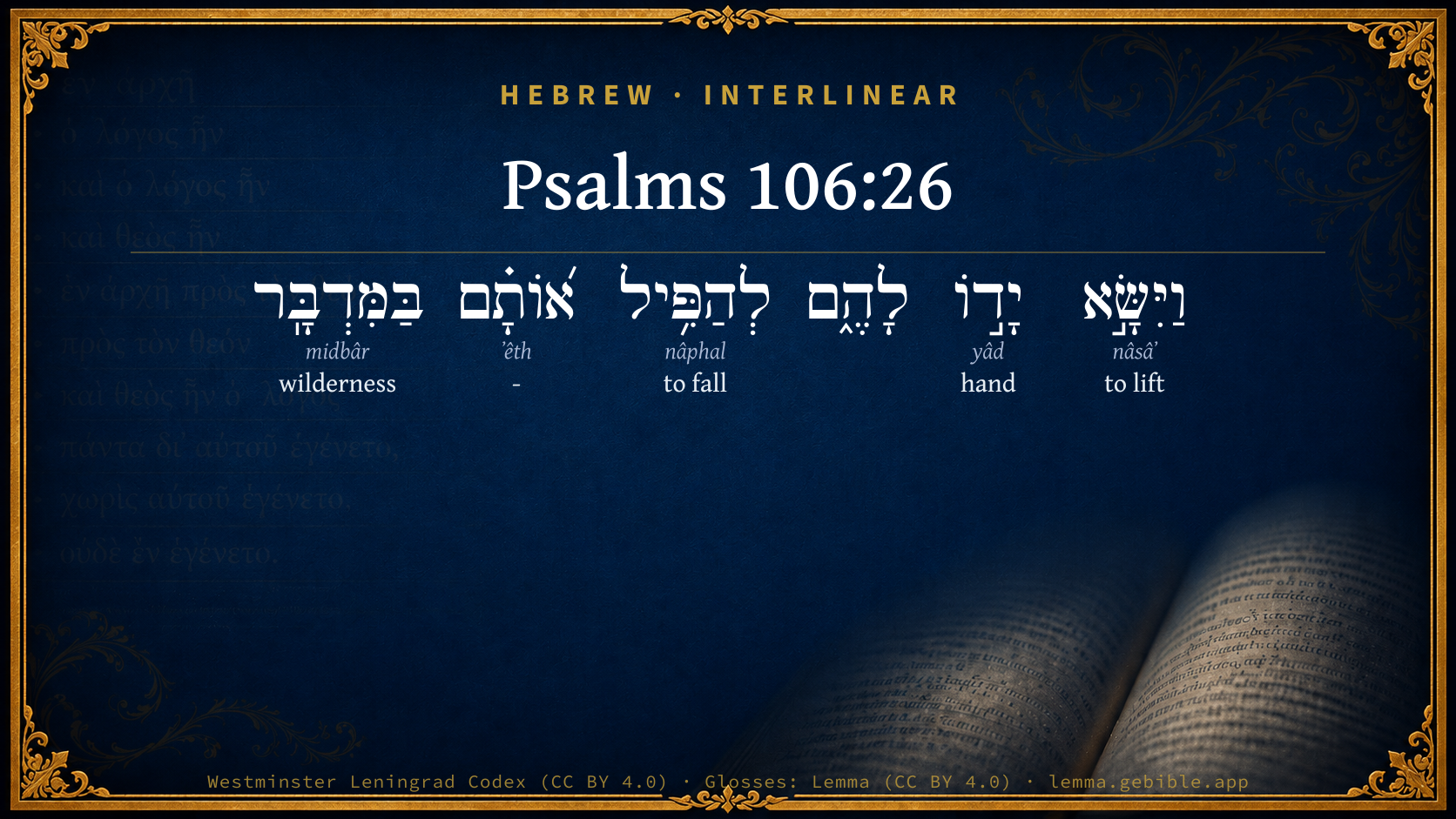
  1. וַיִּשָּׂ֣א nâsâʼ H5375 “and · to lift” Conjunction + Verb, Qal, Sequential Imperfect, 3rd Person, Masculine, Singular
  2. יָד֣וֹ yâd H3027 “hand · his” Noun, Common, Both, Singular, Construct + Suffix, Personal, 3rd Person, Masculine, Singular
  3. לְהַפִּ֥יל nâphal H5307 “to fall” Preposition + Verb, Hiphil, Infinitive Construct
  4. א֝וֹתָ֗ם ʼêth H853 “- · them” Particle, Direct Object + Suffix, Personal, 3rd Person, Masculine, Plural

About this verse

These counts appear in no published source. They are computed here, from the morphology-tagged text and Lemma’s own curated glosses. What Lemma adds →

6
words
5
distinct lemmas
Wisdom
section

Grammatical profile

  • 2 verbs
  • 2 nouns
  • 1 preposition
  • 1 particle

Verb forms

  • וַיִּשָּׂ֣א Qal · Sequential Imperfect
  • לְהַפִּ֥יל Hiphil · Infinitive Construct

Hebrew & Septuagint length

In English translation the verse runs 13 words from the Hebrew and 15 from the Septuagint (LXX English) — closely comparable.

A rough comparison of the two English renderings, which tokenize alike — not a word-level alignment.

Word counts can differ between the Hebrew and the Greek without any difference in meaning — e.g. the Hebrew direct-object marker אֵת has no separate Greek word, and Greek often adds the article ὁ.

Cross-references

10

Topical passages linked to Psalms 106:26 in the Treasury of Scripture Knowledge — connected by theme and wording, ordered by reader-vote popularity; previews shown in the World English Bible.

  • Ezekiel 20:15 Moreover also I swore to them in the wilderness, that I would not bring them into the land which I had given them, flowing with milk and honey, which is the glory of all lands;
  • Numbers 14:28–35 Tell them, As I live, says Yahweh, surely as you have spoken in my ears, so will I do to you:
  • Psalms 95:11 Therefore I swore in my wrath, "They won't enter into my rest."
  • Hebrews 3:11 As I swore in my wrath, 'They will not enter into my rest.'"
  • Exodus 6:8 I will bring you into the land which I swore to give to Abraham, to Isaac, and to Jacob; and I will give it to you for a heritage: I am Yahweh.'"
  • Deuteronomy 1:34–35 Yahweh heard the voice of your words, and was angry, and swore, saying,
  • Hebrews 3:18 To whom did he swear that they wouldn't enter into his rest, but to those who were disobedient?
  • Genesis 14:22–23 Abram said to the king of Sodom, "I have lifted up my hand to Yahweh, God Most High, possessor of heaven and earth,

Cross-references courtesy of OpenBible.info (CC BY 4.0).

Hebrew and Greek witnesses Masoretic Hebrew ↔ Greek Septuagint

The same verse in the two great witnesses to the Old Testament, shown verse-for-verse.

You’re reading Greek Psalm 105 (Hebrew Psalm 106). The Septuagint counts the superscription, so verse numbers can differ from the Hebrew — chapter-level alignment, not verse-by-verse. Numbering follows Rahlfs.

These are two independent witnesses, not word-aligned to each other, and the Septuagint is shown in lemma (dictionary) form.

Hebrew Psalms 106:26 Masoretic · Westminster Leningrad Codex

וַיִּשָּׂ֣א יָד֣וֹ לָהֶ֑ם לְהַפִּ֥יל א֝וֹתָ֗ם בַּמִּדְבָּֽר

Therefore he swore to them That he would overthrow them in the wilderness,

World English Bible · Public Domain

Greek LXX Greek Psalm 105:26 Septuagint · lemma form

καί ἐπιαἴρω ὁ χείρ αὐτός αὐτός ὁ καταβάλλω αὐτός ἐν ὁ ἔρημος

So he lifted up his hand against them, to cast them down in the wilderness;

LXX2012 (modern English Septuagint) · Public Domain

Hebrew: Westminster Leningrad Codex (CC BY 4.0). Greek: Septuagint (public domain); English from LXX2012 (modern English Septuagint) (Public Domain). How the Septuagint differs from the Hebrew →

Commentary

Notes on Psalms 106:26 from classic Christian and Jewish commentators (each source and its license shown beneath its notes). The classic Christian expositions comment on the surrounding passage and are grouped to its opening verse, so a note may address several verses; the Jewish commentaries on the Tanakh (Rashi and others) are per-verse, so they appear only where the commentator wrote on this verse.

Lemma curates 59 commentaries, every one of them public domain or Creative Commons licensed, each selected and text-cleaned for this edition rather than reprinted as found. About our sources →

Trapp's Complete Commentary

John Trapp

Psa 106:26 Therefore he lifted up his hand against them, to overthrow them in the wilderness:

Ver. 26. Therefore he lifted up his hand] i.e. He solemnly swore, as Num 14:30, or he was fetching his full blow at them.

To overthrow them in the wilderness] Which also befell them according to their own wicked wish. Let men false heed of wishing evil to themselves, lest God say Amen to it.

John Trapp, A Commentary or Exposition upon All the Books of the Old and New Testament (1647–1656) — public domain. Text from a community e-Sword module.

J. A. Alexander on Psalms

Joseph Addison Alexander

26. (Psa 106:26) And he lifted his hand to them, to make them fall in the wilderness. The first phrase does not mean, he raised his hand; against them, or to strike them, but as the ancient gesture of swearing. See Num 14:28; Num 14:30, Deu 1:34; Deu 2:14. The last clause contains the oath itself, or what he swore, to wit, that he would make them fall, slay them, in the wilderness. See Num 14:29; Num 14:32.

Joseph Addison Alexander, The Psalms Translated and Explained (1850) — public domain. Text from a community e-Sword module.

Tyndale Open Study Notes

Tyndale Open Resources

106:26-27 God’s judgment when Israel refused to obey was death and exile (Num 14:26-30). The occasion for these severe judgments seems to have been disobeying God’s word (Ps 106:24-25) and provoking the Lord’s wrath (106:28-46).

Tyndale Open Study Notes — © Tyndale Open Resources, licensed CC BY-SA 4.0. Text via the HelloAO Bible API.

Geneva Bible (1599)

Geneva Bible translators

That is, he sware. Sometimes also it meaneth, to punish.

Geneva Bible (1599) marginal notes — public domain. Text via Bolls.life.

John Calvin's Commentaries

26. And he lifted up. He describes another example of the vengeance of God, the recollection of which ought to have been deeply seated in their hearts, so that cherishing a constant fear of him, they might watch over themselves with the utmost solicitude. No good having ensued from all this, it is obvious that the madness of that people was incurable. At that time God did restrain his anger, in that he did not disperse their offspring throughout various parts of the earth; but his threatening of itself ought to have sufficed for the subduing of their pride, had they not been incorrigible. To lift up the hand is in this passage susceptible of two meanings. In Scripture God is frequently said to lift up his hand to inflict punishment. But as it is generally admitted that the prophet is here speaking of swearing, with this opinion I most readily coincide. The practice of lifting up the hand, as if they would have called God down from heaven, was a solemn usual rite among them, accompanying an oath; and is therefore improperly applied to God, whose sublimity rises above all things, and who, as the apostle says, cannot swear by a greater than himself, (Hebrews 6:13) In employing it, therefore, it must be understood that he borrows it from the common customs which prevail among men. Had not the Holy Land been preserved to the people by the prayers of Moses, awful indeed would their dispersion have been.

John Calvin's Commentaries (1540-1563) — public domain. Text from the Calvin Translation Society English edition (1840s-50s) via the Christian Classics Ethereal Library (ccel.org). Calvin's coverage is partial (roughly two-thirds of the Bible); uncommented books and verses are honest gaps, never fabricated. The 19th-century editor's footnotes and remarks are omitted so the notes are faithfully Calvin's own voice.

Ellicott's Commentary for English Readers

(26) Lifted up his hand.—Not to strike, but to give emphasis to the oath pronounced against the sinners. (See Exo_6:8, margin; Deu_32:40; comp. Psa_144:8.) The substance of the oath here referred to is given in Num_14:28-35.

A Bible Commentary for English Readers, edited by Charles John Ellicott (1878–1897) — public domain. Text from a community e-Sword module.

The Cambridge Bible for Schools and Colleges

gen. ed. J. J. S. Perowne

26. So he lifted up his hand unto them

That he would make them fall in the wilderness.

i.e. He swore solemnly. See Num_14:28-29; Num_14:32, “As I live … your carcases shall fall in the wilderness.” ‘Lifting up the hand’ to heaven is man’s gesture as he appeals to God in an oath. The phrase is transferred ‘anthropopathically’ to God. Cp. Exo_6:8; Deu_32:40; Eze_20:23.

The Cambridge Bible for Schools and Colleges (gen. ed. J. J. S. Perowne; Cambridge University Press, 1878–1918) — public domain. Text from a community e-Sword module.

John Gill's Exposition

Therefore he lifted up his hand against them,.... A gesture used in swearing, Gen 14:22. So the Targum understands it here,

"and he lifted up his hand with an oath, because of them:''

and so it is interpreted by Aben Ezra, Jarchi, Kimchi, and Ben Melech; and agrees with Num 14:28. The same gesture was used by the Heathens in swearing, as by Latinus (s). Or he lifted up his hand, in a way of judgment, to strike the blow; and which, when it lights on man with the indignation of his anger, falls heavy; see Isa 26:11. To overthrow them in the wilderness; as he did all the murmuring generation that came out of Egypt, all but Caleb and Joshua; all from twenty years and upwards, their carcasses fell in the wilderness; there they were wasted, consumed, and died, Num 14:32.

(s) "----Tenditque ad sidera dextram--Terram, mare, sidera juro", Virg. Aeneid. 12.

John Gill's Exposition of the Whole Bible (1746–1763) — public domain (CC PDM 1.0). Text via the HelloAO Bible API.

Albert Barnes' Notes on the Bible

Therefore he lifted up his hand against them - Num 14:27-33. He resolved to cut them off, so that none of them should reach the promised land.

To overthrow them in the wilderness - literally, to cause them to “fall.”

Albert Barnes' Notes on the Bible (1834–1885) — public domain. Text from a community e-Sword/MySword module.

Matthew Poole's English Annotations

He lifted up his hand; he sware, as this phrase is commonly used, as Gen 14:22; Deu 32:40; Neh 9:15; Rev 10:5,6; of this dreadful and irrevocable sentence and oath of God, see Num 14.

Matthew Poole's English Annotations on the Holy Bible (1683–1685) — public domain. Text from a community e-Sword/MySword module.

The Treasury of David

Charles H. Spurgeon

Ver. 26. Therefore he lifted up his hand against them, to overthrow them in the wilderness. He swore in his wrath that they should not enter into his rest; he commenced his work of judgment upon them, and they began to die. Only let God lift his hand against a man and his day has come; he falls terribly whom Jehovah overthrows.

To overthrow their seed also among the nations, and to scatter them in the lands. Foreseeing that their descendants would reproduce their sins, he solemnly declared that he would give them over to captivity and the sword. Those whose carcases fell in the wilderness were, in a sense, exiles from the land of promise, and, being surrounded by many hostile tribes, they were virtually in a foreign land: to die far off from their father's inheritance was a just and weighty doom, which their rebellions had richly deserved. Our own loss of fellowship with God, and the divisions in our churches, doubtless often come to us as punishments for the sins out of which they grow. If we will not honour the Lord we cannot expect him to honour us. Our captains shall soon become captives, and our princes shall be prisoners if we forget the Lord and despise his mercies. Our singing shall be turned into sighing, and our mirth into misery if we walk contrary to the mind of the Lord.

Psalms 106:27*

see Exposition of Verse 26

see Notes of Verse 26

see Hints of Verse 26

Psalms 106:28*

Charles H. Spurgeon's The Treasury of David (1869–1885) — public domain. Psalms only. Text from a community e-Sword/MySword module.

Whedon's Commentary on the Bible

Daniel D. Whedon

26. He lifted up his hand—In form of making oath, as in Deu_32:40; Gen_14:22. In the passage alluded to, (Num_14:30,) for “I sware,” the Hebrew is, I lifted up my hand.

Daniel D. Whedon (gen. ed.), Commentary on the Old and New Testaments (1874–1909) — public domain. Text from a community e-Sword module.

The Pulpit Commentary

Therefore he lifted up his hand against them. (comp. Num_14:30, marginal rendering) The phrase is used with reference to the uplifting of the hand width accompanied an oath. To overthrow them in the wilderness. (see Num_14:29, Num_14:32, Num_14:37) The death in the wilderness of the entire generation which had set out from Egypt, save only Joshua and Caleb, is the "overthrow" intended.

The Pulpit Commentary (1880–1919), ed. H.D.M. Spence-Jones & Joseph S. Exell — public domain. Text from a community e-Sword module.

John Wesley's Explanatory Notes

Lifted up - He swear. Of this dreadful and irrevocable oath of God, see Num. xiv, 11, 12.

John Wesley, Explanatory Notes Upon the Whole Bible (1754–1765) — public domain. Text via the GEBible commentary corpus.

unfoldingWord translationNotes

Door43 World Missions Community

raised his hand

The word "his" refers to Yahweh. Also, it was custom to raise a hand when swearing an oath.

scatter their descendants ... in foreign lands

These two phrases have basically the same meaning and are used together for emphasis. AT: "and that he would make their descendants live in foreign lands" (See: Parallelism)

scatter

This means to disperse or spread out something.

translationWords

oath

die

descend

nation

alien

unfoldingWord translationNotes — © Distant Shores Media and the Door43 World Missions Community, licensed CC BY-SA 4.0. Source: git.door43.org/Door43/en_tn.

Rashi

Rabbi Shlomo Yitzchaki (Rashi)

He raised His hand with an oath.

Rashi on the Tanakh — English translations: “The Judaica Press complete Tanach with Rashi, translated by A. J. Rosenberg” (CC BY 4.0); “Pentateuch with Rashi's commentary by M. Rosenbaum and A.M. Silbermann, 1929-1934” (public domain); “The Metsudah Tanach series, Lakewood, N.J” (CC BY 4.0); and “The Book of Joshua, Metsudah Publications, 1997” (CC BY 4.0). Text via Sefaria.

Lesson kit

Teaching starters — assembled from the data on this page, not authored interpretation. Every prompt links to the verse data it draws on. Edit before teaching.

Psalms, in the Wisdom, opens this verse with 6 words (5 distinct Hebrew lemmas). Its most distinctive word is midbâr (“wilderness”). A historical commentator’s framing appears above. Read the whole chapter for the surrounding context.

Discussion questions

  1. How does “wilderness” (midbâr) shape what this verse is saying?
  2. How does Ezekiel 20:15, which shares this passage’s theme, read alongside this verse?
  3. The translations on this page render this verse differently — a whole-verse word diff, not a word-by-word alignment. What might account for the different wordings?
  4. «וַיִּשָּׂ֣א» is a Qal Sequential Imperfect verb. How does that grammatical form shape the action described?
  5. Compare how Trapp's Complete Commentary and J. A. Alexander on Psalms read this verse. Where do they agree or differ?

Things to notice

Reading settings

Reading text

Shown beneath each verse's original-language words.

Old Testament
Old Testament edition

Read the OT as the Masoretic Hebrew (MT) or the Greek Septuagint (LXX).

English shown for the Greek Septuagint (in the Hebrew ↔ Greek comparison).

Comparing translations? Open the Compare panel on any verse page to stack up to four side by side.