
Job 30:22

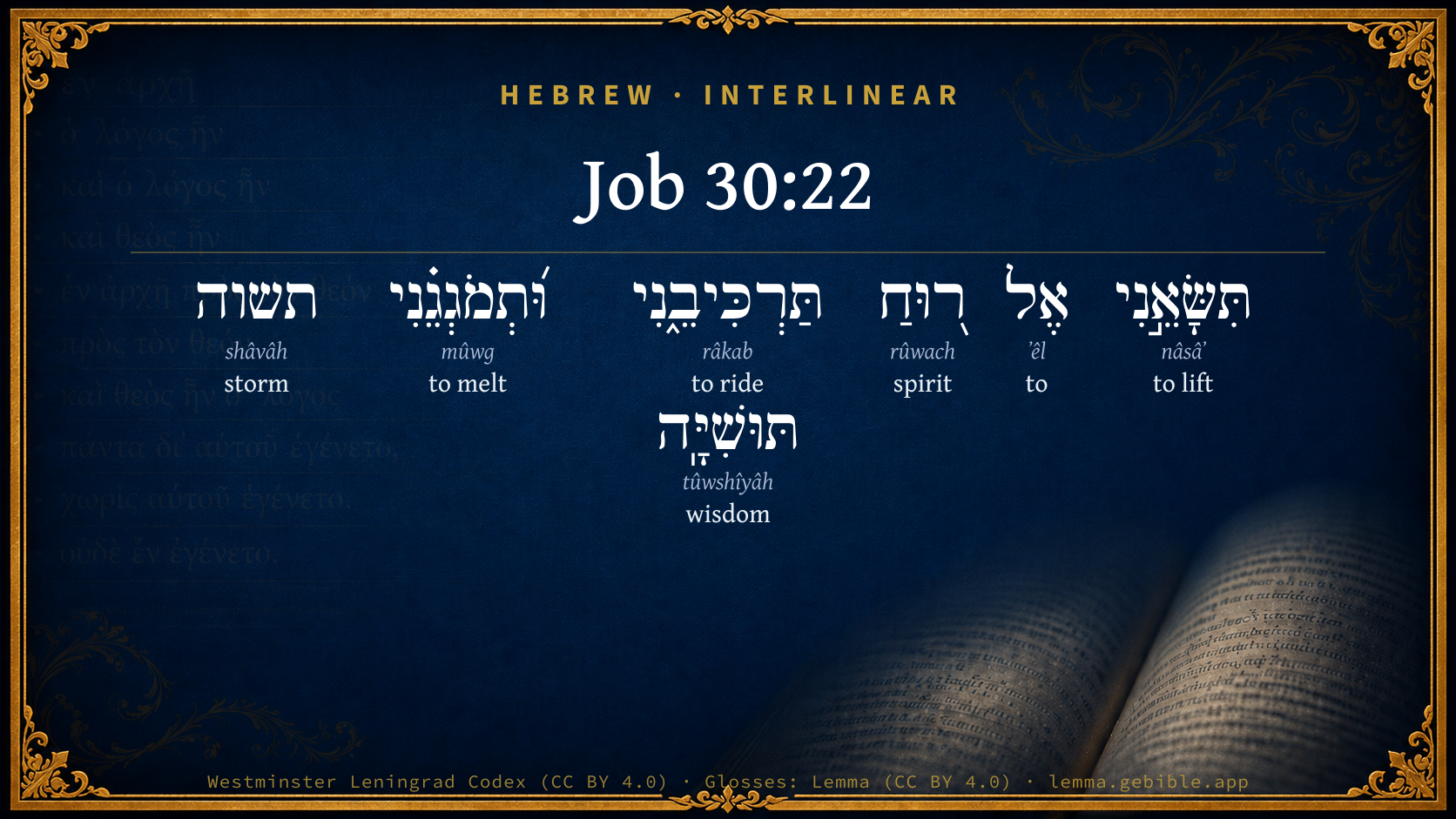
Hebrew (Westminster Leningrad Codex) Job 30:22 appears in the Hebrew Old Testament. The text above is from the Westminster Leningrad Codex. Each word links to its Strong’s number, a concise gloss, and parsing drawn from the Open Scriptures Hebrew Bible morphology. Click any word for its full Brown-Driver-Briggs (BDB) entry.
Download image
Cite this verse

Job 30:22 (World English Bible). Public Domain. Lemma interlinear Bible study tool, https://lemma.gebible.app/v/job/30/22.

Show BibTeX & RIS
BibTeX
RIS
English Translation
You lift me up to the wind, and drive me with it. You dissolve me in the storm.
World English Bible · Public Domain
Highlights
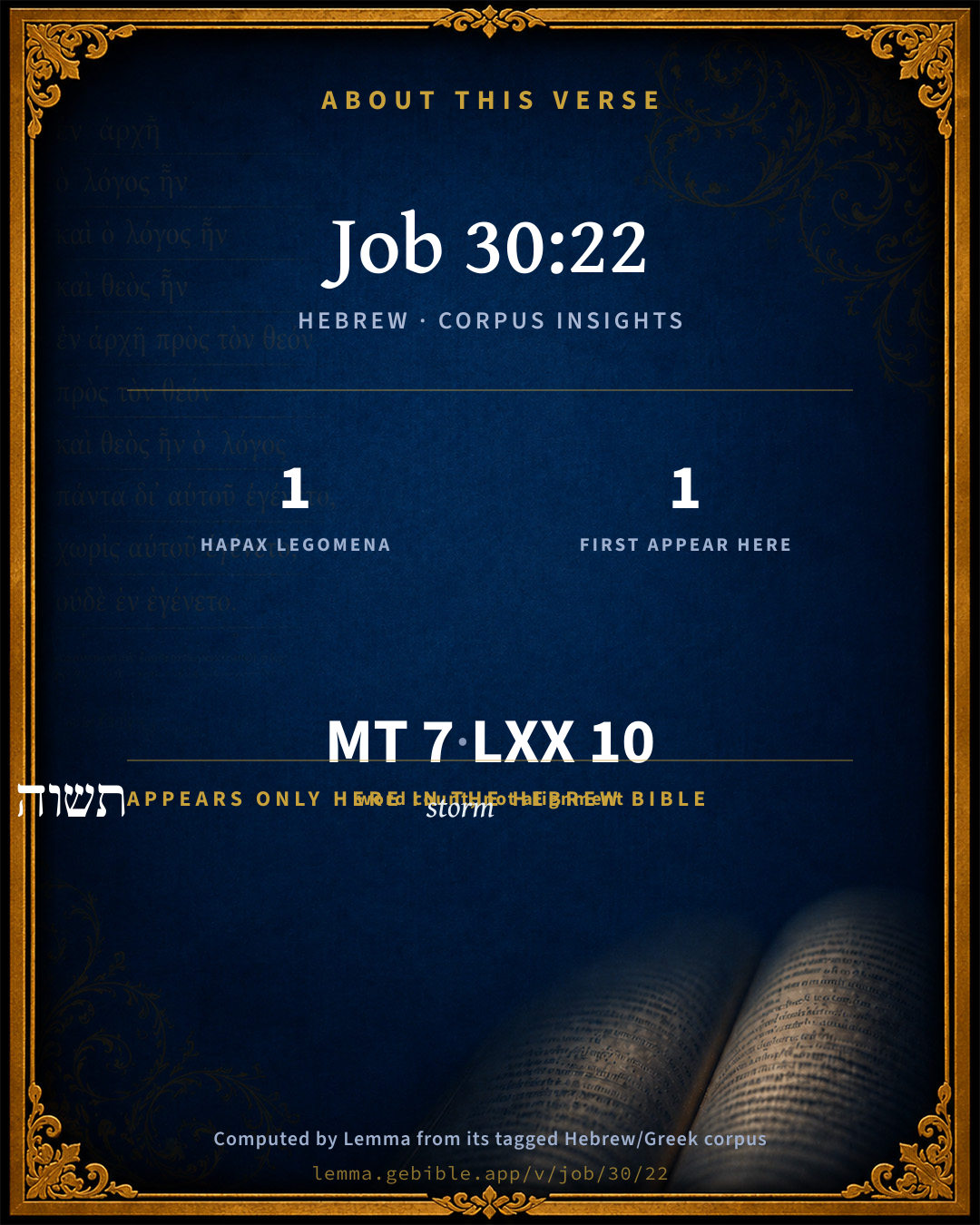
  • 1 hapax legomenon — only here in the Hebrew Bible
  • 1 first appearance in the Hebrew Bible
Full analysis ↓
Download a study sheet

One document with this verse’s original text, its word-by-word gloss line, the meaning frame, cross-references with their text, attributed commentary, and full source and license credits — printable, and it pastes into notes with its structure intact.

This verse Autodidact and up

Study sheet (.html) Plain text (.txt)

A passage Seminary Student

Up to 50 verses in one chapter. A passage sheet keeps up to 6 commentary sources and 12 cross-references per verse, in the order this page ranks them, and says so on the sheet whenever that leaves anything out. Ask for a single verse and you get the Autodidact verse sheet above.

Everything on this page stays free to read, with no account — the sheet is a download of what is already on screen, not access to it.

Want to remove ads? Support Godless Engineer
Compare translations 3

The same verse in 3 English versions, stacked beneath the original-language interlinear above. Click any original word for its lexicon entry.

Each is an independent rendering of the whole verse — the interlinear is not word-aligned to these translations.

Highlighted words mark where these versions differ — a whole-verse word diff, not a word-by-word alignment.

  • World English Bible Public Domain
    You lift me up to the wind, and drive me with it. You dissolve me in the storm.
  • King James Version Public Domain
    Thou liftest me up to the wind; thou causest me to ride upon it, and dissolvest my substance.
  • unfoldingWord Literal Text CC BY-SA 4.0
    You lift me up on the wind; you make me ride on it, and you toss me about a storm.

unfoldingWord Literal Text — © unfoldingWord, licensed CC BY-SA 4.0. Word-aligned USFM3 via Door43 (git.door43.org/unfoldingWord/en_ult).

Versions to compare (up to 4)

3 of 4 selected

Show all 18 translations

Every available English version of this verse, each an independent rendering of the whole verse.

  • World English Bible Public Domain
    You lift me up to the wind, and drive me with it. You dissolve me in the storm.
  • Berean Standard Bible Public Domain
    You snatch me up into the wind and drive me before it; You toss me about in the storm.
  • Majority Standard Bible Public Domain
    You snatch me up into the wind and drive me before it; You toss me about in the storm.
  • King James Version Public Domain
    Thou liftest me up to the wind; thou causest me to ride upon it, and dissolvest my substance.
  • American Standard Version (1901) Public Domain
    Thou liftest me up to the wind, thou causest me to ride `upon it'; And thou dissolvest me in the storm.
  • Revised Version (1885) Public Domain
    Thou liftest me up to the wind, thou causest me to ride upon it; and thou dissolvest me in the storm.
  • Geneva Bible (1599) Public Domain
    Thou takest me vp and causest mee to ride vpon the winde, and makest my strength to faile.
  • Douay-Rheims (1899) Public Domain
    Thou hast lifted me up, and set me as it were upon the wind, and thou hast mightily dashed me.
  • Young's Literal Translation Public Domain
    Thou dost lift me up, On the wind Thou dost cause me to ride, And Thou meltest -- Thou levellest me.
  • Literal Standard Version CC BY-SA 4.0
    You lift me up, || You cause me to ride on the wind, || And You melt—You level me.
  • Unlocked Literal Bible CC BY-SA 4.0
    You lift me up to the wind and cause it to drive me along; you throw me back and forth in a storm.
  • unfoldingWord Literal Text CC BY-SA 4.0
    You lift me up on the wind; you make me ride on it, and you toss me about a storm.
  • Darby Bible Public Domain
    Thou liftest me up to the wind; thou causest me to be borne away, and dissolvest my substance.
  • World Messianic Bible Public Domain
    You lift me up to the wind, and drive me with it. You dissolve me in the storm.
  • Webster's Bible Public Domain
    Thou liftest me up to the wind; thou causest me to ride upon it, and dissolvest my substance.
  • Free Bible Version CC BY-SA 4.0
    You pick me up and blow me along in the wind; tossing me about in the whirlwind.
  • Bible in Basic English Public Domain
    Lifting me up, you make me go on the wings of the wind; I am broken up by the storm.
  • JPS Tanakh (1917) Public Domain
    Thou liftest me up to the wind, Thou causest me to ride upon it; and Thou dissolvest my substance.

Literal Standard Version (2020), Covenant Press — licensed CC BY-SA 4.0. Text via the HelloAO Bible API (eBible.org). Unlocked Literal Bible (unfoldingWord) — licensed CC BY-SA 4.0. Text via the HelloAO Bible API (eBible.org). unfoldingWord Literal Text — © unfoldingWord, licensed CC BY-SA 4.0. Word-aligned USFM3 via Door43 (git.door43.org/unfoldingWord/en_ult). Free Bible Version, Dr. Jonathan Gallagher — licensed CC BY-SA 4.0. Text via the HelloAO Bible API (eBible.org).

Word by word

More ways to search: Search by grammar → Find every occurrence → Compare this word →

Practice this passage: Drill this verse → Learn its vocabulary →

About this verse

These counts appear in no published source. They are computed here, from the morphology-tagged text and Lemma’s own curated glosses. What Lemma adds →

7
words
7
distinct lemmas
Wisdom
section

Notable vocabulary

1 hapax legomenon — a word that appears only here in the entire Hebrew Bible:

First appearance in Scripture

This word makes its first canonical appearance in the Hebrew Bible here:

Shared distinctive vocabulary

תּוּשִׁיָּֽה wisdom H8454 occurs in 12 verses of the Hebrew Bible. Also found in:

Grammatical profile

  • 4 verbs
  • 2 nouns
  • 1 preposition

Verb forms

  • תִּשָּׂאֵ֣נִי Qal · Imperfect
  • תַּרְכִּיבֵ֑נִי Hiphil · Imperfect
  • וּ֝תְמֹגְגֵ֗נִי Polel · Imperfect
  • תשוה Pual · Imperfect

Hebrew & Septuagint length

In English translation the verse runs 18 words from the Hebrew and 14 from the Septuagint (LXX English) — closely comparable.

A rough comparison of the two English renderings, which tokenize alike — not a word-level alignment.

Word counts can differ between the Hebrew and the Greek without any difference in meaning — e.g. the Hebrew direct-object marker אֵת has no separate Greek word, and Greek often adds the article ὁ.

In the original languages it is 7 Hebrew tokens and 10 Greek tokens — but the two are counted differently (Hebrew bundles its prefixes and suffixes into one token; the Greek is in lemma form), so that isn’t a like-for-like length.

Cross-references

11

Topical passages linked to Job 30:22 in the Treasury of Scripture Knowledge — connected by theme and wording, ordered by reader-vote popularity; previews shown in the World English Bible.

  • Job 27:21 The east wind carries him away, and he departs; It sweeps him out of his place.
  • Psalms 1:4 The wicked are not so, But are like the chaff which the wind drives away.
  • Job 9:17 For he breaks me with a tempest, Multiplies my wounds without cause.
  • Job 21:18 That they are as stubble before the wind, As chaff that the storm carries away?
  • Psalms 18:10 He rode on a cherub, and flew. Yes, he soared on the wings of the wind.
  • Psalms 104:3 He lays the beams of his chambers in the waters. He makes the clouds his chariot. He walks on the wings of the wind.
  • Isaiah 17:13 The nations shall rush like the rushing of many waters: but he shall rebuke them, and they shall flee far off, and shall be chased as the chaff of the mountains before the wind, and like the whirling dust before the storm.
  • Jeremiah 4:11–12 At that time shall it be said to this people and to Jerusalem, A hot wind from the bare heights in the wilderness toward the daughter of my people, not to winnow, nor to cleanse;
  • Ezekiel 5:2 A third part shall you burn in the fire in the midst of the city, when the days of the siege are fulfilled; and you shall take a third part, and strike with the sword round about it; and a third part you shall scatter to the wind, and I will draw out a sword after them.
  • Hosea 4:19 The wind has wrapped her up in its wings; And they shall be disappointed because of their sacrifices.
  • Hosea 13:3 Therefore they will be like the morning cloud, And like the dew that passes away early, Like the chaff that is driven with the whirlwind out of the threshing floor, And like the smoke out of the chimney.

Cross-references courtesy of OpenBible.info (CC BY 4.0).

Hebrew and Greek witnesses Masoretic Hebrew ↔ Greek Septuagint

The same verse in the two great witnesses to the Old Testament, shown verse-for-verse.

These are two independent witnesses, not word-aligned to each other, and the Septuagint is shown in lemma (dictionary) form.

Hebrew Job 30:22 Masoretic · Westminster Leningrad Codex

תִּשָּׂאֵ֣נִי אֶל ר֭וּחַ תַּרְכִּיבֵ֑נִי וּ֝תְמֹגְגֵ֗נִי תשוה תּוּשִׁיָּֽה

You lift me up to the wind, and drive me with it. You dissolve me in the storm.

World English Bible · Public Domain

Greek LXX Job 30:22 Septuagint · lemma form

τάσσω δέ ἐγώ ἐν ὀδύνη καί ἀποῥίπτω ἐγώ ἀπό σωτηρία

And you have put me to grief, and have cast me away from safety.

LXX2012 (modern English Septuagint) · Public Domain

On this verse, Haydock's Catholic Bible Commentary discusses the Septuagint’s reading. Read the note in Commentary ↓

Hebrew: Westminster Leningrad Codex (CC BY 4.0). Greek: Septuagint (public domain); English from LXX2012 (modern English Septuagint) (Public Domain). How the Septuagint differs from the Hebrew →

Commentary

Notes on Job 30:22 from classic Christian and Jewish commentators (each source and its license shown beneath its notes). The classic Christian expositions comment on the surrounding passage and are grouped to its opening verse, so a note may address several verses; the Jewish commentaries on the Tanakh (Rashi and others) are per-verse, so they appear only where the commentator wrote on this verse.

Lemma curates 59 commentaries, every one of them public domain or Creative Commons licensed, each selected and text-cleaned for this edition rather than reprinted as found. About our sources →

Trapp's Complete Commentary

John Trapp

Job 30:22 Thou liftest me up to the wind; thou causest me to ride [upon it], and dissolvest my substance.

Ver. 22. Thou liftest me up to the wind] Thou whifflest and wherriest me about as chaff or thistle down. Pro libidine tractas me thou usest me at thy pleasure (Brent.).

Thou causest me to ride upon it] Upon the wings of the wind, lifting me up aloft, that I may fall with the greater poise, as the eagle is said to do the tortoise; Ut lapsu graviore ruam. -

Thou dissolvest my substance] Or, Thou meltest my wisdom. I have neither flesh nor reason remaining. The issue that he expecteth of all these his forementioned miseries, followeth:

John Trapp, A Commentary or Exposition upon All the Books of the Old and New Testament (1647–1656) — public domain. Text from a community e-Sword module.

Joseph Benson's Commentary

Job 30:22-23. Thou liftest me up to the wind — Thou exposest me to all sorts of storms and calamities, so that I am like chaff or stubble lifted up to the wind, and violently tossed hither and thither in the air. And dissolvest my substance — By which my body is almost consumed, and my heart is melted within me. I know that thou wilt bring me to death — Rather, I verily know, or am persuaded, that by these lingering and painful disorders thou art gradually bringing me to death; the house appointed for all living — The grave, to which all living men are hastening. The grave is a narrow, dark, cold house, but there we shall rest and be safe. It is our home, for it is our mother’s lap, and in it we are gathered to our fathers. It is a house appointed for us by him that has appointed the bounds of all our habitations. And it is appointed for all living. It is the common receptacle for rich and poor; we must all be brought thither, and that shortly.

Joseph Benson's Commentary on the Old and New Testaments (1811–1818) — public domain. Text from a community e-Sword module.

Tyndale Open Study Notes

Tyndale Open Resources

30:22 Job felt tossed into the whirlwind and blown about like worthless straw or chaff (9:17; 21:18; 27:21; Ps 1:4; Isa 17:13).

Tyndale Open Study Notes — © Tyndale Open Resources, licensed CC BY-SA 4.0. Text via the HelloAO Bible API.

Geneva Bible (1599)

Geneva Bible translators

He compareth his afflictions to a tempest or whirlwind.

Or, wisdom, or law.

Geneva Bible (1599) marginal notes — public domain. Text via Bolls.life.

Jamieson, Fausset & Brown

Robert Jamieson, A. R. Fausset & David Brown

liftest . . . to wind--as a "leaf" or "stubble" (Job 13:25). The moving pillars of sand, raised by the wind to the clouds, as described by travellers, would happily depict Job's agitated spirit, if it be to them that he alludes.

dissolvest . . . substance--The marginal Hebrew reading (Keri), "my wealth," or else "wisdom," that is, sense and spirit, or "my hope of deliverance." But the text (Chetib) is better: Thou dissolvest me (with fear, Exo 15:15) in the crash (of the whirlwind; see on Job 30:14) [MAURER]. UMBREIT translates as a verb, "Thou terrifiest me."

Jamieson, Fausset & Brown — Commentary Critical and Explanatory on the Whole Bible (1871) — public domain (CC PDM 1.0). Text via the HelloAO Bible API.

Adam Clarke's Commentary

Verse 22. Thou liftest me up to the wind] Thou hast so completely stripped me of all my substance, that I am like chaff lifted up by the wind; or as a straw, the sport of every breeze; and at last carried totally away, being dissipated into particles by the continued agitation.

Adam Clarke's Commentary on the Bible (1810–1826) — public domain. Text from a community e-Sword/MySword module.

Ellicott's Commentary for English Readers

(22) Thou liftest me up to the wind.—Some render this verse, “Thou liftest me up to the wind, and causest me to ride upon it; Thou dissolvest me in thy blast;” others understand him to express the contrast between his former prosperous state and his present low condition: “Thou usedst to raise me and make me ride upon the wind, and now Thou dissolvest my substance, my very being.” (Comp. Psa_102:10 : “Thou hast lifted me up and cast me down.”)

A Bible Commentary for English Readers, edited by Charles John Ellicott (1878–1897) — public domain. Text from a community e-Sword module.

The Cambridge Bible for Schools and Colleges

gen. ed. J. J. S. Perowne

22. dissolvest my substance] Rather, dissolvest me in the tempest; lit. in the roar of the storm. He is carried away and dissolved or dissipated, that is, destroyed in the whirlwind.

The Cambridge Bible for Schools and Colleges (gen. ed. J. J. S. Perowne; Cambridge University Press, 1878–1918) — public domain. Text from a community e-Sword module.

John Gill's Exposition

Thou liftest me up to the wind,.... Of affliction and adversity, to be carried up with it, and tossed about by it, as chaff or stubble, or a dry leaf, being no more able to stand up against it than such things are to oppose the wind; though some interpret this of God's lifting him up in his state of prosperity, in which he was very visible and conspicuous to all, and enjoyed much light and comfort; but then he raised him to such an estate, with a view to cast him down, and that his fall and ruin might be the greater; and so this is observed as a proof of his being become cruel to him:

thou causest me to ride upon it; seemingly in great pomp and state, but in great uncertainty and danger, being at best in a slippery place, in very fickle circumstances, as the event showed; or rather the sense is, that he was swiftly carried into destruction, as if he rode on the wings of the wind to it, and was hurried thither at once, as soon as he was taken up with the tempest of adversity:

and dissolvest my substance; his outward substance, his wealth and riches, his family, and the health of his body, all which as it were melted away, or were carried away as with a flood; and so as the metaphor of a tempestuous wind is used in the former clause, here that of an overflowing flood, which removed from him what seemed to be the most solid and substantial: the word is sometimes used for wisdom, and even sound wisdom, Pro 2:7; wherefore some have interpreted it of his being at his wits' end, of losing his reason and understanding, and which were at least disturbed and confounded by his afflictions; but his discourses and speeches show the contrary, and he himself denies that wisdom was driven from him, Job 6:13.

John Gill's Exposition of the Whole Bible (1746–1763) — public domain (CC PDM 1.0). Text via the HelloAO Bible API.

Albert Barnes' Notes on the Bible

Thou liftest me up to the wind - The sense here is, that he was lifted up as stubble is by a tempest, and driven mercilessly along. The figure of riding upon the wind or the whirlwind, is common in Oriental writers, and indeed elsewhere. So Milton says,

“They ride the air in whirlwind.”

So Addison, speaking of the angel that executes the commands of the Almighty, says,

“Rides in the whirlwind, and directs the storm.”

Coverdale renders this verse, “In times past thou didst set me up on high, as it were above the wind, but now hast thou given me a very sore fall.” Rosenmuller thinks that the image here is not taken from straw or chaff that is driven by the wind, but that the meaning of Job is, that he is lifted up and borne aloft like a cloud. But the image of chaff or straw taken up by the whirlwind and driven about, seems best to accord with the scope of the passage. The idea is, that the tempest of calamity had swept everything away, and had driven him about as a worthless object, until he was wasted away and ruined. It is possible that Job refers in this passage to the sand-storm which occurs sometimes in the deserts of Arabia. The following description of such a storm by Mr. Bruce (vol. 4:pp. 553, 554), will furnish an illustration of the force and sublimity of the passage. It is copied from Taylor’s Fragments, in Calmet’s Dictionary, vol. 3:235: “On the fourteenth,” says Bruce, “at seven in the morning, we left Assa Nagga, our course being due north. At one o’clock we alighted among some acacia trees at Waadiel Halboub, having gone twenty-one miles. We were here at once surprised and terrified by a sight, surely one of the most magnificent in the world. In that vast expanse of desert from west and to northwest of us, we saw a number of prodigious pillars of sand at different distances, at times moving with qreat celerity, at others stalking on with a majestic slowness; at intervals we thought they were coming in a very few minutes to overwhelm us, and small quantities of sand did actually more than once reach us. Again they would retreat so as to be almost out of sight - their tops reaching to the very clouds. There the tops often separated from the bodies; and these, once disjoined, dispersed in the air, and did not appear more.

Sometimes they were broken near the middle, as if struck with a large cannon shot. About noon they began to advance with considerable swiftness upon us, the wind being very strong at north. Eleven of them ranged alongside of us about the distance of three miles. The greatest diameter of the largest appeared to me at that distance as if it would measure two feet. They retired from us with a wind at southeast, leaving an im pression upon my mind to which I can give no name, though surely one ingredient in it was fear, with a considerable deal of wonder and astonishment. It was in vain to think of flying; the swiftest horse, or fastest sailing ship, could be of no use to carry us out of this danger, and the full persuasion of this riveted me as if to the spot where I stood, and let the camels gain on me so much in my state of lameness, that it was with some difficulty I could overtake them.

“The whole of our company were much disheartened, except Idris, and imagined that they were advancing into whirlwinds of moving sand, from which they should never be able to extricate themselves; but before four o’clock in the afternoon these phantoms of the plain had all of them fallen to the ground and disappeared. In the evening we came to Waadi Dimokea, where we passed the night, much disheartened, and our fear more increased, when we found, upon wakening in the morning, that one side was perfectly buried in the sand that the wind had blown above us in the night.

“The sun shining through the pillars, which were thicker, and contained more sand, apparently, than any of the preceding days, seemed to give those nearest us an appearance as if spotted with stars of gold. I do not think at any time they seemed to be nearer than two miles. The most remarkable circumstance was, that the sand seemed to keep in that vast circular space, surrounded by the Nile on our left, in going round by Chaigie toward Dougola, and seldom was observed much to the eastward of a meridian, passing along the Nile through the Magizan, before it takes that turn; whereas the simoom was always on the opposite side of our course, coming upon us from the southeast.

“The same appearance of moving pillars of sand presented themselves to us this day in form and disposition like those we had seen at Waadi Halboub, only they seemed to be more in number, and less in size. They came several times in a direction close upon us, that is, I believe, within less than two miles. They began, immediately after sunrise, like a thick wood, and almost darkened the sun; his rays shining through them for near an hour, gave them an appearance of pillars of fire.”

“If my conjecture,” says Taylor, “be admissible, we now see a magnificence in this imagery, not apparent before: we see how Job’s dignity might be exalted in the air; might rise to great grandeur, importance, and even terror, in the sight of beholders; might ride upon the wind, which bears it about, causing it to advance or to recede; and, after all, when the wind diminishes, might disperse, dissipate, melt this pillar of sand into the undistinguished level of the desert. This comparison seems to be precisely adapted to the mind of an Arab; who must have seen, or have been informed of, similar phenomena in the countries around him.”

And dissolvest my substance - Margin, or wisdom. The word rendered “dissolvest,” means to melt, to flow down, and then to cause to melt, to cause to pine away and perish; Isa 64:7. It is applied to a host or army that appears to melt away; 1Sa 14:16. It is also applied to one who seems to melt away with fear and terror; Exo 15:15; Jos 2:9, Jos 2:24. Here the meaning probably is, that God caused Job to melt away, as it were, with terrors and alarms. He was like one caught up in a whirlwind, and driven along with the storm, and who, in such circumstances, would be dissolved with fear. The word rendered “substance” (תשׁיה tûshı̂yâh) has been very variously interpreted. The word, as it is written in the text, means help, deliverance, purpose, enterprise, counsel, or understanding; see Job 5:12; Job 6:13; Job 11:6. But by some, and among others. Gesenius, Umbreit, and Noyes, it is supposed that it should be read as a verb, תשוה from שוה - to fear. According to this, the meaning is, “thou terrifiest me.” This agrees better with the connection; is more abrupt and emphatic, and is probably the true interpretation.

Albert Barnes' Notes on the Bible (1834–1885) — public domain. Text from a community e-Sword/MySword module.

Haydock's Catholic Bible Commentary

Dashed me in pieces, as if I had been raised so high for that purpose. Hebrew, "thou hast dissolved my substance," wisdom, &c. The signification of tushiova (Haydock) is very indeterminate, chap. v. 12. (Calmet) --- "Thou hast cast me far away from salvation." (Septuagint and Theodotion) (Haydock)

George Leo Haydock (1774–1849), Haydock's Catholic Family Bible and Commentary, 1859 edition — public domain. Excludes Psalms (Douay-Rheims chapter numbering differs from Protestant) and Deuterocanonical books (Catholic canon only).

Matthew Poole's English Annotations

Thou liftest me up to the wind; thou dost not suffer me to rest or lie still for a moment, but disquietest me, and exposest me to all sorts of storms and calamities; so that I am like chaff or stubble lifted up to the wind, and violently tossed hither and thither in the air, without the least stop or hinderance.

To ride upon it, i.e. to be carried and hurried about by it. By this restlessness, and the vehemency of these winds, my body is almost consumed and wasted, and my heart is melted within me.

Matthew Poole's English Annotations on the Holy Bible (1683–1685) — public domain. Text from a community e-Sword/MySword module.

Whedon's Commentary on the Bible

Daniel D. Whedon

22. The wind; thou causest me to ride upon — This figure is common in Oriental writers. “In Arabic they say of one who hurries rapidly by that he rides upon the wings of the wind.” — Delitzsch. Comp. Psa_102:10.

Dissolvest my substance — Rather, according to the Kethib, Dissolvest me in the tempest; more literally, the crash of a tempest.

Daniel D. Whedon (gen. ed.), Commentary on the Old and New Testaments (1874–1909) — public domain. Text from a community e-Sword module.

The Pulpit Commentary

Thou liftest me up to the wind; thou tensest me to ride upon it; i.e. thou makest me to be storm-tossed. I am as it were a straw caught up by a whirlwind, and borne hither and thither in the wide regions of space, unknowing whither I go. I am treated as I have described the wicked man to be treated. (Job_27:20, Job_27:21) And dissolvest my substance. "Dissolvest me entirely" (Professor Lee); dissolvest me in the storms (Revised Version).

The Pulpit Commentary (1880–1919), ed. H.D.M. Spence-Jones & Joseph S. Exell — public domain. Text from a community e-Sword module.

John Wesley's Explanatory Notes

Thou - Thou exposest me, to all sorts of storms and calamities; so that I am like chaff or stubble lifted up to the wind, and violently tossed hither and thither in the air. Substance - By which, my body is almost consumed, and my heart is melted within me.

John Wesley, Explanatory Notes Upon the Whole Bible (1754–1765) — public domain. Text via the GEBible commentary corpus.

unfoldingWord translationNotes

Door43 World Missions Community

Connecting Statement:

Job continues speaking to God.

lift me up to the wind ... throw me back and forth in a storm

These expressions represent the extreme suffering that God made Job endure. (See: Metaphor)

cause it to drive me along

"cause the wind to push me along"

you will bring me to death

Here "bring me to death" represents causing Job to die. AT: "you will cause me to die" (See: Metaphor)

the house appointed for all the living

Job speaks of the world of the dead as if it were a house to which God has appointed all living things to go. AT: "the world of the dead, to which everything that has ever lived goes" (See: Metaphor)

all the living

That is, all things now alive, but that will die one day.

translationWords

die

house

unfoldingWord translationNotes — © Distant Shores Media and the Door43 World Missions Community, licensed CC BY-SA 4.0. Source: git.door43.org/Door43/en_tn.

Rashi

Rabbi Shlomo Yitzchaki (Rashi)

You lift me up to the spirit of the demons.

You cause me to ride [on it], and weakness melts me away Weakness and feebleness of strength melted me away.

and weakness melts me away Heb. ותמגגני, a feminine form, the subject of which is תֻּשִיָה, and this “tav” is not like the “tav” of “You lift me up (תשאני).”

Rashi on the Tanakh — English translations: “The Judaica Press complete Tanach with Rashi, translated by A. J. Rosenberg” (CC BY 4.0); “Pentateuch with Rashi's commentary by M. Rosenbaum and A.M. Silbermann, 1929-1934” (public domain); “The Metsudah Tanach series, Lakewood, N.J” (CC BY 4.0); and “The Book of Joshua, Metsudah Publications, 1997” (CC BY 4.0). Text via Sefaria.

Lesson kit

Teaching starters — assembled from the data on this page, not authored interpretation. Every prompt links to the verse data it draws on. Edit before teaching.

Job, in the Wisdom, opens this verse with 7 words (7 distinct Hebrew lemmas). Its most distinctive word is shâvâh (“storm”). A historical commentator’s framing appears above. Read the whole chapter for the surrounding context.

Discussion questions

  1. The word shâvâh carries the sense “storm.” How does it shape the verse?
  2. This verse holds 1 word here found nowhere else in the Hebrew Bible. What might the rare word draw attention to?
  3. The word “storm” first appears here in Scripture. What is being introduced at this debut?
  4. Job 5:12 shares the word «wisdom» with this verse. How do the two illuminate each other?
  5. These translations render this verse differently. What is at stake in choosing one wording over another?
  6. The verb «תִּשָּׂאֵ֣נִי» is Qal Imperfect. How does its form color the action?
  7. Reading how Trapp's Complete Commentary and Joseph Benson's Commentary read this verse, where do the two commentators agree and where do they part?

Things to notice

Reading settings

Reading text

Shown beneath each verse's original-language words.

Old Testament
Old Testament edition

Read the OT as the Masoretic Hebrew (MT) or the Greek Septuagint (LXX).

English shown for the Greek Septuagint (in the Hebrew ↔ Greek comparison).

Comparing translations? Open the Compare panel on any verse page to stack up to four side by side.