
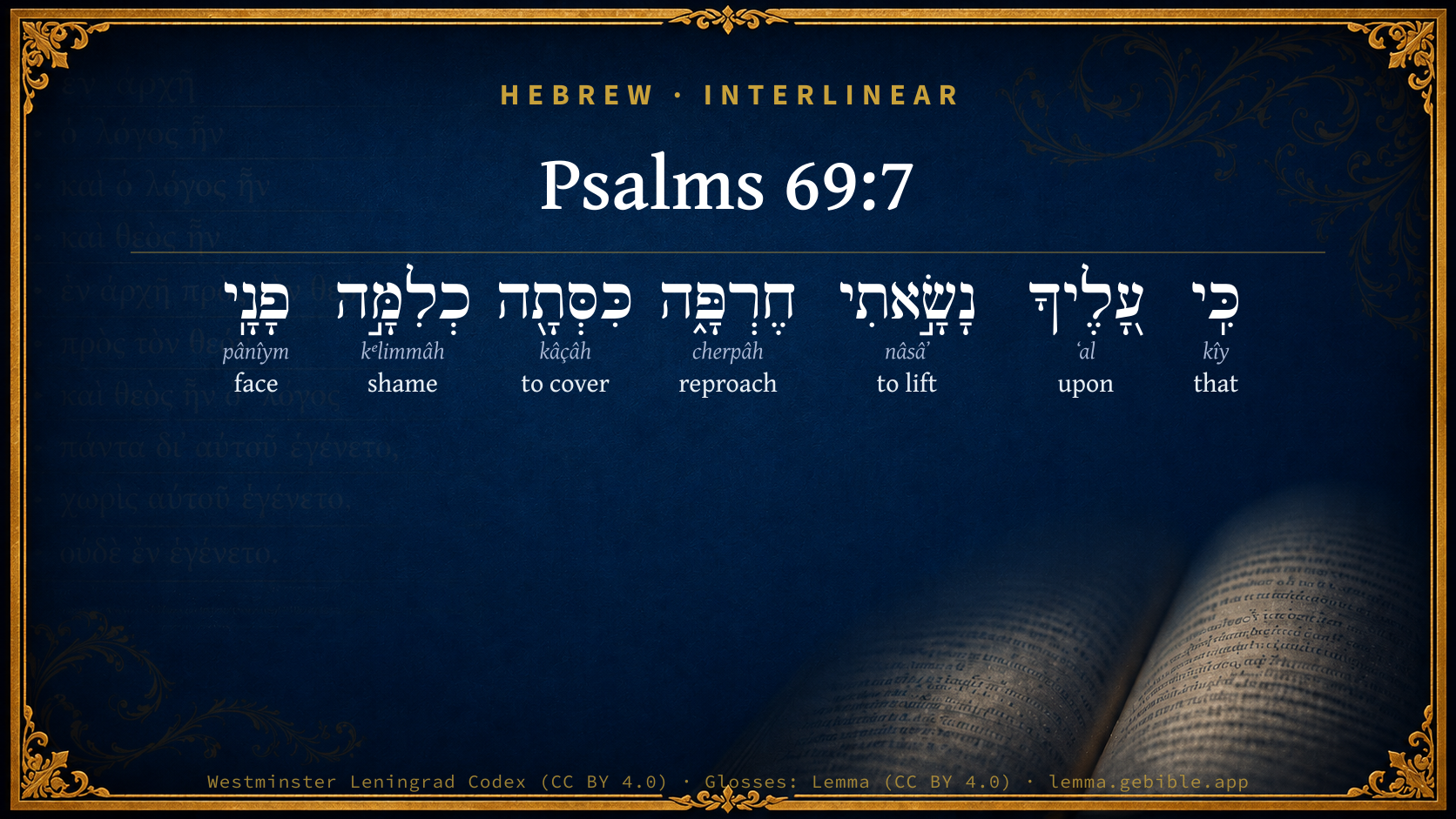
Psalms 69:7

Hebrew (Westminster Leningrad Codex) Psalms 69:7 appears in the Hebrew Old Testament. The text above is from the Westminster Leningrad Codex. Each word links to its Strong’s number, a concise gloss, and parsing drawn from the Open Scriptures Hebrew Bible morphology. Click any word for its full Brown-Driver-Briggs (BDB) entry.
Download image
Cite this verse

Psalms 69:7 (World English Bible). Public Domain. Lemma interlinear Bible study tool, https://lemma.gebible.app/v/psalms/69/7.

Show BibTeX & RIS
BibTeX
RIS
English Translation
Because for your sake, I have borne reproach. Shame has covered my face.
World English Bible · Public Domain
Download a study sheet

One document with this verse’s original text, its word-by-word gloss line, the meaning frame, cross-references with their text, attributed commentary, and full source and license credits — printable, and it pastes into notes with its structure intact.

This verse Autodidact and up

Study sheet (.html) Plain text (.txt)

A passage Seminary Student

Up to 50 verses in one chapter. A passage sheet keeps up to 6 commentary sources and 12 cross-references per verse, in the order this page ranks them, and says so on the sheet whenever that leaves anything out. Ask for a single verse and you get the Autodidact verse sheet above.

Everything on this page stays free to read, with no account — the sheet is a download of what is already on screen, not access to it.

Want to remove ads? Support Godless Engineer
Compare translations 3

The same verse in 3 English versions, stacked beneath the original-language interlinear above. Click any original word for its lexicon entry.

Each is an independent rendering of the whole verse — the interlinear is not word-aligned to these translations.

Highlighted words mark where these versions differ — a whole-verse word diff, not a word-by-word alignment.

  • World English Bible Public Domain
    Because for your sake, I have borne reproach. Shame has covered my face.
  • King James Version Public Domain
    Because for thy sake I have borne reproach; shame hath covered my face.
  • unfoldingWord Literal Text CC BY-SA 4.0
    For because of you I have borne reproach; humiliation has covered my face.

unfoldingWord Literal Text — © unfoldingWord, licensed CC BY-SA 4.0. Word-aligned USFM3 via Door43 (git.door43.org/unfoldingWord/en_ult).

Versions to compare (up to 4)

3 of 4 selected

Show all 18 translations

Every available English version of this verse, each an independent rendering of the whole verse.

  • World English Bible Public Domain
    Because for your sake, I have borne reproach. Shame has covered my face.
  • Berean Standard Bible Public Domain
    For I have endured scorn for Your sake, and shame has covered my face.
  • Majority Standard Bible Public Domain
    For I have endured scorn for Your sake, and shame has covered my face.
  • King James Version Public Domain
    Because for thy sake I have borne reproach; shame hath covered my face.
  • American Standard Version (1901) Public Domain
    Because for thy sake I have borne reproach; Shame hath covered my face.
  • Revised Version (1885) Public Domain
    Because for thy sake I have borne reproach; shame hath covered my face.
  • Geneva Bible (1599) Public Domain
    For thy sake haue I suffred reproofe: shame hath couered my face.
  • Douay-Rheims (1899) Public Domain
    Let not them be ashamed for me, who look for thee, O Lord, the Lord of hosts. Let them not be confounded on my account, who seek thee, O God of Israel.
  • Young's Literal Translation Public Domain
    For because of Thee I have borne reproach, Shame hath covered my face.
  • Literal Standard Version CC BY-SA 4.0
    For because of You I have borne reproach, || Shame has covered my face.
  • Unlocked Literal Bible CC BY-SA 4.0
    For your sake I have borne rebuke; shame has covered my face.
  • unfoldingWord Literal Text CC BY-SA 4.0
    For because of you I have borne reproach; humiliation has covered my face.
  • Darby Bible Public Domain
    Because for thy sake I have borne reproach; confusion hath covered my face.
  • World Messianic Bible Public Domain
    Because for your sake, I have borne reproach. Shame has covered my face.
  • Webster's Bible Public Domain
    \\69:6\\Let not them that wait on thee, O Lord GOD of hosts, be ashamed for my sake: let not those that seek thee be confounded for my sake, O God of Israel.
  • Free Bible Version CC BY-SA 4.0
    For your sake I put up with the insults; my face shows my embarrassment.
  • Bible in Basic English Public Domain
    I have been wounded with sharp words because of you; my face has been covered with shame.
  • JPS Tanakh (1917) Public Domain
    (69-8) Because for Thy sake I have borne reproach; confusion hath covered my face.

Literal Standard Version (2020), Covenant Press — licensed CC BY-SA 4.0. Text via the HelloAO Bible API (eBible.org). Unlocked Literal Bible (unfoldingWord) — licensed CC BY-SA 4.0. Text via the HelloAO Bible API (eBible.org). unfoldingWord Literal Text — © unfoldingWord, licensed CC BY-SA 4.0. Word-aligned USFM3 via Door43 (git.door43.org/unfoldingWord/en_ult). Free Bible Version, Dr. Jonathan Gallagher — licensed CC BY-SA 4.0. Text via the HelloAO Bible API (eBible.org).

Word by word

More ways to search: Search by grammar → Find every occurrence → Compare this word →

Practice this passage: Drill this verse → Learn its vocabulary →

About this verse

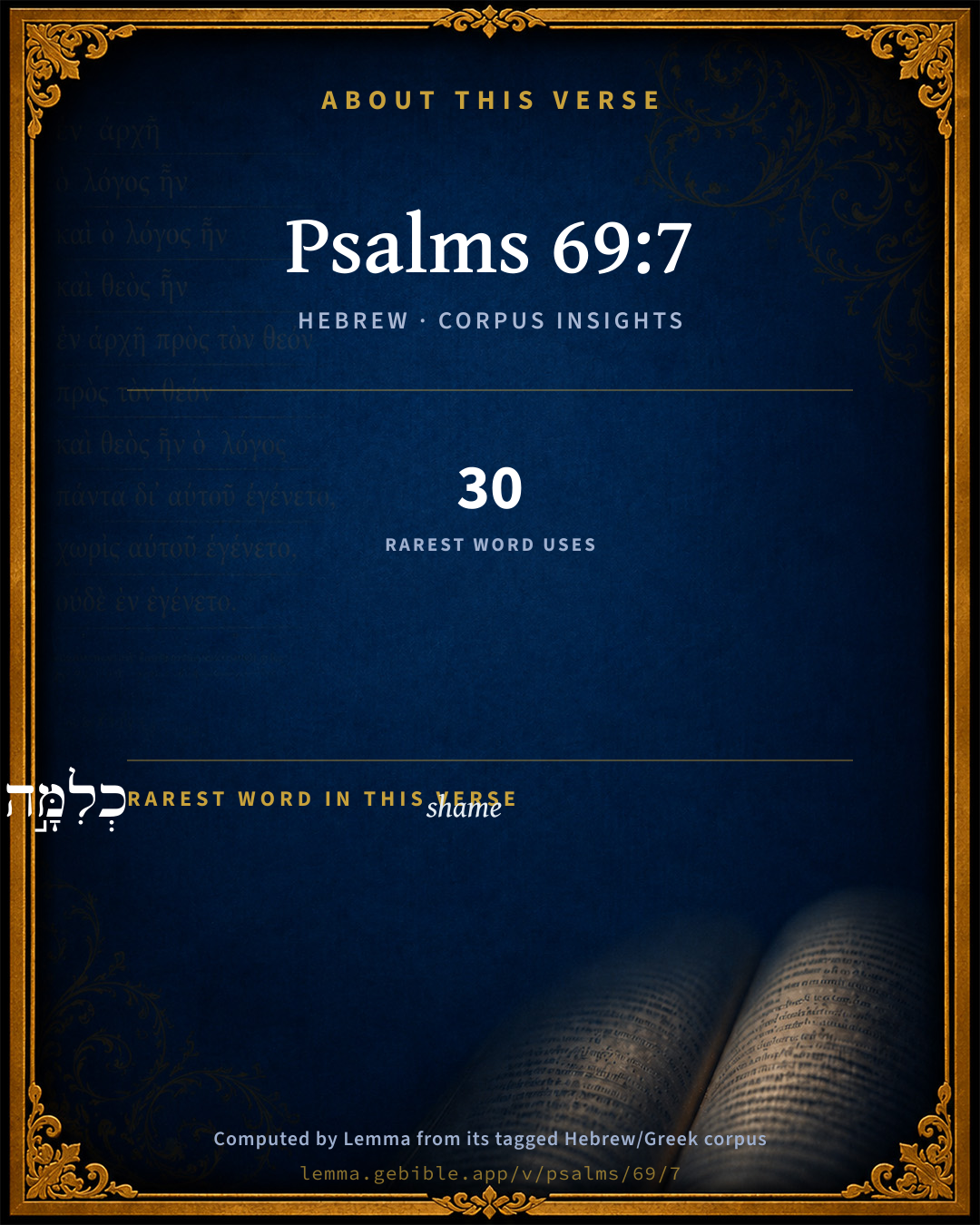
These counts appear in no published source. They are computed here, from the morphology-tagged text and Lemma’s own curated glosses. What Lemma adds →

7
words
7
distinct lemmas
Wisdom
section

Shared distinctive vocabulary

כְלִמָּ֣ה shame H3639 occurs in 29 verses of the Hebrew Bible. Also found in:

Grammatical profile

  • 2 verbs
  • 3 nouns
  • 1 preposition
  • 1 conjunction

Verb forms

  • נָשָׂ֣אתִי Qal · Perfect
  • כִּסְּתָ֖ה Piel · Perfect

Hebrew & Septuagint length

In English translation the verse runs 13 words from the Hebrew and 13 from the Septuagint (LXX English) — the same length.

A rough comparison of the two English renderings, which tokenize alike — not a word-level alignment.

Word counts can differ between the Hebrew and the Greek without any difference in meaning — e.g. the Hebrew direct-object marker אֵת has no separate Greek word, and Greek often adds the article ὁ.

Cross-references

13

Topical passages linked to Psalms 69:7 in the Treasury of Scripture Knowledge — connected by theme and wording, ordered by reader-vote popularity; previews shown in the World English Bible.

  • Isaiah 50:6 I gave my back to the strikers, and my cheeks to those who plucked off the hair; I didn't hide my face from shame and spitting.
  • Psalms 44:22 Yes, for your sake we are killed all day long. We are regarded as sheep for the slaughter.
  • Jeremiah 15:15 Yahweh, you know; remember me, and visit me, and avenge me of my persecutors; don't take me away in your longsuffering: know that for your sake I have suffered reproach.
  • Hebrews 12:2 looking to Jesus, the author and perfecter of faith, who for the joy that was set before him endured the cross, despising shame, and has sat down at the right hand of the throne of God.
  • Isaiah 53:3 He was despised, and rejected by men; a man of suffering, and acquainted with disease: and as one from whom men hide their face he was despised; and we didn't respect him.
  • Luke 23:11 Herod with his soldiers humiliated him and mocked him. Dressing him in luxurious clothing, they sent him back to Pilate.
  • John 15:21–24 But all these things will they do to you for my name's sake, because they don't know him who sent me.
  • Psalms 22:6–8 But I am a worm, and no man; A reproach of men, and despised by the people.
  • Psalms 44:15 All day long my dishonor is before me, And shame covers my face,
  • Matthew 26:67–68 Then they spit in his face and beat him with their fists, and some slapped him,
  • Matthew 27:29–30 They braided a crown of thorns and put it on his head, and a reed in his right hand; and they kneeled down before him, and mocked him, saying, "Hail, King of the Jews!"
  • Matthew 27:38–44 Then there were two robbers crucified with him, one on his right hand and one on the left.
  • Luke 23:35–37 The people stood watching. The rulers with them also scoffed at him, saying, "He saved others. Let him save himself, if this is the Christ of God, his chosen one!"

Cross-references courtesy of OpenBible.info (CC BY 4.0).

Hebrew and Greek witnesses Masoretic Hebrew ↔ Greek Septuagint

The same verse in the two great witnesses to the Old Testament, shown verse-for-verse.

You’re reading Greek Psalm 68 (Hebrew Psalm 69). The Septuagint counts the superscription, so verse numbers can differ from the Hebrew — chapter-level alignment, not verse-by-verse. Numbering follows Rahlfs.

These are two independent witnesses, not word-aligned to each other, and the Septuagint is shown in lemma (dictionary) form.

Hebrew Psalms 69:7 Masoretic · Westminster Leningrad Codex

כִּֽי עָ֭לֶיךָ נָשָׂ֣אתִי חֶרְפָּ֑ה כִּסְּתָ֖ה כְלִמָּ֣ה פָנָֽי

Because for your sake, I have borne reproach. Shame has covered my face.

World English Bible · Public Domain

Greek LXX Greek Psalm 68:7 Septuagint · lemma form

μή αἰσχύνω ἐπί ἐγώ ὁ ὑπομένω σύ κύριος κύριος ὁ δύναμις μή ἐντρέπω ἐπί ἐγώ ὁ ζητέω σύ ὁ θεός ὁ ἰσραήλ

For I have suffered reproach for your sake; shame has covered my face.

LXX2012 (modern English Septuagint) · Public Domain

Hebrew: Westminster Leningrad Codex (CC BY 4.0). Greek: Septuagint (public domain); English from LXX2012 (modern English Septuagint) (Public Domain). How the Septuagint differs from the Hebrew →

Commentary

Notes on Psalms 69:7 from classic Christian and Jewish commentators (each source and its license shown beneath its notes). The classic Christian expositions comment on the surrounding passage and are grouped to its opening verse, so a note may address several verses; the Jewish commentaries on the Tanakh (Rashi and others) are per-verse, so they appear only where the commentator wrote on this verse.

Lemma curates 59 commentaries, every one of them public domain or Creative Commons licensed, each selected and text-cleaned for this edition rather than reprinted as found. About our sources →

Trapp's Complete Commentary

John Trapp

Psa 69:7 Because for thy sake I have borne reproach; shame hath covered my face.

Ver. 7. Because for thy sake I have borne reproach] Whatever mine enemies pretend, they strike at thee, Lord, through my sides; and for thy sake alone it is that I am so bespattled, that I am even ashamed to look any one in the face. The most innocent may, upon the fulness of an aspersion, be put out of countenance.

John Trapp, A Commentary or Exposition upon All the Books of the Old and New Testament (1647–1656) — public domain. Text from a community e-Sword module.

The Biblical Illustrator

Joseph S. Exell

Psa_69:7-8

For Thy sake I have borne reproach.

Suffering torture for Christs sake

An echo of the Boxer risings in China was heard in the address of Dr. Whitfield Guinness. In July, 1900, the little party with which he was connected was shut up in Honan, and as the speaker detailed those days of anxiety until deliverance came, many were deeply impressed. After leaving the city, thirteen days were spent hiding in the cabin of a boat. Time after time the boat was examined by the customs officials, who, in the order of Gods providence, failed to detect the presence of Englishmen. To indicate the genuineness of the Honanese converts, the speaker told a pathetic story. In a few weeks after one of the converts had been baptized, the Boxers pillaged his home, and securing the mans hands behind him, drew him up by a rope to the roof. While thus suspended the man was asked to recant. On refusing, the poor fellow was subjected to horrible tortures and suffering. Some time afterwards Dr. Guinness put to him the question, Was it worth while to suffer like that for Jesus sake? The man replied, Worth while! I would go through it all again to-morrow for His sake.

The Biblical Illustrator, edited by Joseph S. Exell (c. 1880s–1900s) — public domain. Text from a community e-Sword module.

Joseph Benson's Commentary

Psa 69:7-9. Because for thy sake — For my trust in thy promises, obedience to thy commands, and zeal for thy glory; “because I adhere to thee, and will use no unlawful means to right myself;” I have borne reproach — For they turn all these things into matter of contempt and derision. I am become a stranger to my brethren, &c. — They behave themselves toward me as if I were a perfect stranger, or a man of another country and religion. For the zeal of thy house — That fervent love which I have for thy house and service, and glory, and people; hath eaten me up — Exhausted my spirits. And this is the reason of that alienation of my brethren and others from me, because there is a great difference and contrariety in our dispositions, desires, and designs. For they regard not thy service and glory, nor the concerns of religion; but are wholly taken up with the world, and the cares and pursuits of it. And the reproaches of them that reproached thee — That spoke contemptuously or wickedly of thy name, or providence, or truth, or worship, and service; are fallen upon me — I have been as deeply affected with thy reproaches as with my own. This whole verse, though truly belonging to David, yet was also directed by the Spirit of God in him to a higher use, to represent the disposition and condition of Christ, in whom this was more truly and fully accomplished than in David; and to whom, therefore, it is applied in the New Testament, the first part of it, Joh 2:17, and the latter, Rom 15:3.

Joseph Benson's Commentary on the Old and New Testaments (1811–1818) — public domain. Text from a community e-Sword module.

J. A. Alexander on Psalms

Joseph Addison Alexander

8. (Psa 69:7). Because for thee (or thy sake) I have borne reproach, disgrace hash covered my face. In his disgrace all God's servants must participate, because he is one of them, and as such suffers. With the first clause compare Psa 44:22, Jer 15:15, with the last, Psa 44:15.

Joseph Addison Alexander, The Psalms Translated and Explained (1850) — public domain. Text from a community e-Sword module.

Tyndale Open Study Notes

Tyndale Open Resources

69:7-12 Mistreated and abandoned by family, friends, and community, the psalmist turns to the Lord for comfort, relief (69:13-18), and redress (69:22-28).

Tyndale Open Study Notes — © Tyndale Open Resources, licensed CC BY-SA 4.0. Text via the HelloAO Bible API.

Jamieson, Fausset & Brown

Robert Jamieson, A. R. Fausset & David Brown

This plea contemplates his relation to God as a sufferer in His cause. Reproach, domestic estrangement (Mar 3:21; Joh 7:5), exhaustion in God's service (Joh 2:17), revilings and taunts of base men were the sufferings.

Jamieson, Fausset & Brown — Commentary Critical and Explanatory on the Whole Bible (1871) — public domain (CC PDM 1.0). Text via the HelloAO Bible API.

Adam Clarke's Commentary

Verse 7. For thy sake I have borne reproach] The Gentiles have said, "Why such an obstinate attachment to the worship of a Being who treats you so rigorously, and who interests not himself in your comfort and deliverance?" And in these cuttting reproaches some of the ungodly Jews took a part: "I am an alien to my mother's children."

Adam Clarke's Commentary on the Bible (1810–1826) — public domain. Text from a community e-Sword/MySword module.

John Calvin's Commentaries

7 For on thy account I have suffered reproach He now expresses more distinctly what he had stated ironically in the fifth verse, where he asserts that his faults were not hidden from God. Nay, he proceeds farther, declaring not only that the evil treatment which he met with from his enemies was unjust and altogether unmerited, but also that his cause was really God’s cause, since whatever he had undertaken and engaged in was expressly in obedience to the command of God. Saul no doubt had other reasons, or at least other pretences, for persecuting David; but as the hatred which he entertained against him most unquestionably proceeded from God’s having called and anointed him to be king, David here justly protests that it was not for any wickedness which he had committed, but because he had obeyed God, that men in general disapproved of and rashly condemned him. It is a source of great consolation to true believers when they can protest that they have the warrant and call of God for whatever they undertake or engage in. If we are hated by the world for making a public confession of the faith, a thing which we are to expect, it being evident from observation that the wicked ordinarily are never more fierce than when they assault the truth of God and the true religion, we have ground to entertain double confidence. We also learn from this passage how monstrous is the malice of men, who convert into a ground for reproach and reprehension the zeal for the Divine glory by which true believers are animated. But it is well for us that God not only wipes away the reproaches with which the wicked load us, but also so ennobles them, that they surpass all the honors and triumphs of the world. The Psalmist farther aggravates his complaint by the additional circumstance, that he was cruelly cast off by his own relations and friends; from which we are taught, that when by our devotedness to the cause of religion we cannot avoid exciting the displeasure of our brethren against us, it is our duty simply to follow God, and not to confer with flesh and blood.

John Calvin's Commentaries (1540-1563) — public domain. Text from the Calvin Translation Society English edition (1840s-50s) via the Christian Classics Ethereal Library (ccel.org). Calvin's coverage is partial (roughly two-thirds of the Bible); uncommented books and verses are honest gaps, never fabricated. The 19th-century editor's footnotes and remarks are omitted so the notes are faithfully Calvin's own voice.

Ellicott's Commentary for English Readers

(7) Because.—Better, for.

For thy sake.—It is plain from Psa_69:9 that these words can only mean that the reproach under which the psalmist (or the community of which he was the spokesman) laboured was borne in the cause of religion. (Comp. Jer_15:15.)

A Bible Commentary for English Readers, edited by Charles John Ellicott (1878–1897) — public domain. Text from a community e-Sword module.

The Cambridge Bible for Schools and Colleges

gen. ed. J. J. S. Perowne

7. So Jeremiah pleads, “Know that for thy sake I bear reproach” (Jer_15:15). shame &c.] cp. Psa_44:15.

7–12. Such discouragement must be the inevitable consequence if he is abandoned, for it is for God’s sake that he is persecuted and defamed. Comp. the plea of the nation in Psa_44:14 ff.

The Cambridge Bible for Schools and Colleges (gen. ed. J. J. S. Perowne; Cambridge University Press, 1878–1918) — public domain. Text from a community e-Sword module.

John Gill's Exposition

Because for thy sake I have borne reproach,.... Being reckoned a sinner, called a deceiver, said to be a Samaritan, and to have a devil; with many other reproaches, which he bore patiently for the sake of the word and worship of God, and for the sake of the glory of God, which he all along sought; and to repair the loss of it, which was sustained through the sin of man;

shame hath covered my face; when he was spit upon by some, and smote by others with a rod upon his cheek; and when he was blindfolded, and bid to prophesy who smote him; see Isa 50:6.

John Gill's Exposition of the Whole Bible (1746–1763) — public domain (CC PDM 1.0). Text via the HelloAO Bible API.

Albert Barnes' Notes on the Bible

Because for thy sake I have borne reproach - In thy cause; in defense of thy truth; because I have professed to be a friend of God. The true reason why these calamities have come upon me is that I have been thy professed friend, and have endeavored to do my duty to thee. The reproach connected with religion in a world of sin, or where true religion is hated, has fallen on me.

Shame hath covered my face - The idea here is not that he had himself been ashamed of religion or of the service of God, but that he had suffered shame, derision, reproach among people for his professed attachment to the truth. Compare Psa 44:15-16.

Albert Barnes' Notes on the Bible (1834–1885) — public domain. Text from a community e-Sword/MySword module.

Matthew Poole's English Annotations

For thy sake; for my trust in thy promise, and obedience to thy commands, and zeal for thy glory, and against all wickedness; all which they turn into matter of derision and reproach.

My face; in which man’s majesty and glory is most evident, which I am in a manner ashamed to show amongst men.

Matthew Poole's English Annotations on the Holy Bible (1683–1685) — public domain. Text from a community e-Sword/MySword module.

The Treasury of David

Charles H. Spurgeon

Ver. 7. Because for thy sake I have borne reproach. Because he undertook to do the Father's will, and teach his truth, the people were angry; because he declared himself to be the Son of God, the priesthood raved. They could find no real fault in him, but were forced to hatch up a lying accusation before they could commence their sham trial of him. The bottom of the quarrel was, that God was with him, and he with God, while the Scribes and Pharisees sought only their own honour. Reproach is at all times very cutting to a man of integrity, and it must have come with acute force upon one of so unsullied a character as our Lord; yet see, how he turns to his God, and finds his consolation in the fact that he is enduring all for his Father's sake. The like comfort belongs to all misrepresented and persecuted saints.

Shame hath covered my face. Men condemned to die frequently had their faces covered as they were dragged away from the judge's seat, as was the case with the wicked Haman in Es 7:8: after this fashion they first covered our Lord with a veil of opprobrious accusation, and then hurried him away to be crucified. Moreover, they passed him through the trial of cruel mockings, besmeared his face with spittle, and covered it with bruises, so that Pilate's "Ecce Homo" called the world's attention to an unexampled spectacle of woe and shame. The stripping on the cross must also have suffused the Redeemer's face with a modest blush, as he hung there exposed to the cruel gaze of a ribald multitude. Ah, blessed Lord, it was our shame which thou wast made to bear! Nothing more deserves to be reproached and despised than sin, and lo, when thou wast made sin for us thou wast called to endure abuse and scorn. Blessed be thy name it is over now, but we owe thee more than heart can conceive for thine amazing stoop of love.

Ver. 7. Shame hath covered my face. It is a great question whether shame or death be the greater evil. There have been those who have rather chosen death, and have wiped off a dishonour with their blood. So Saul slew himself rather than he would fall into the hands of the Philistines, who would have insulted over him, and mocked him as they did Samson. So that king (Jer 38:19) rather chose to lose his country, life and all, than to be given to the Jews, his subjects, to be mocked of them... Confusion of face is one of the greatest miseries that hell itself is set forth unto us by. There is nothing that a noble nature more abhors than shame, for honour is a spark of God's image; and the more of God's image there is in any one, the more is shame abhorred by him, which is the debasing of it, and so the greater and more noble any one's spirit, the more he avoids it. To a base, low spirit, indeed, shame is nothing; but to a great spirit (as to David), than to have his "glory turned into shame, "as Ps 4:2, is nothing more grievous. And the greater glory any loseth, the greater is his shame. What must it be then to Christ, who because he was to satisfy God in point of honour debased by man's sin, therefore of all punishments besides, he suffered most of shame; it being also (as was said) one of the greatest punishments in hell. And Christ, as he assumed other infirmities of our nature, that made him passible in other things--as to be sensible of hunger, want of sleep, bodily torments, of unkindness, contempt, so likewise of disgrace and shame. He took that infirmity as well as fear; and though he had a strength to bear and despise it (as the author of the Hebrews speaks), yet none was ever more sensible of it. As the delicacy of the temper of his body made him more sensible of pains than ever any man was, so the greatness of his spirit made him more apprehensive of the evil of shame than ever any was. So likewise the infinite love and candour of his spirit towards mankind made him take in with answerable grief the unkindness and injuries which they heaped upon him. Thomas Goodwin.

None.

Psalms 69:8*

Charles H. Spurgeon's The Treasury of David (1869–1885) — public domain. Psalms only. Text from a community e-Sword/MySword module.

Whedon's Commentary on the Bible

Daniel D. Whedon

7. Because for thy sake—The true point of the temptation to weak faith, deprecated Psa_69:6, is here fully brought out. My sufferings are not for my faults, as between me and my enemies, but for thy sake. Rom_15:3. I suffer because I am innocent, because I love God and hate sin. As applied to Christ how true! Fidelity to all the will of God provoked the hatred and hostility of the world. See on Psa_69:4; Joh_7:7; Joh_15:24

Daniel D. Whedon (gen. ed.), Commentary on the Old and New Testaments (1874–1909) — public domain. Text from a community e-Sword module.

The Pulpit Commentary

Because for thy sake I have borne reproach. The real secret of the enmity which David provoked, both on the part of Saul, of Absalom, of Joab, and of other ungodly men, was his own piety and devotion to God"s service. Irreligious men hate those who are religions, whose conduct shames them by its contrast with their own evil courses. They revenge themselves, sometimes by scoffing at the religious observances of the pious (ver. 10), sometimes by insinuating that all profession of religion is hypocrisy. Shame hath covered my face. I have been made to feel shame at the charges which have been brought against me. (see 2Sa_15:3 2Sa_16:7, 2Sa_16:8)

The Pulpit Commentary (1880–1919), ed. H.D.M. Spence-Jones & Joseph S. Exell — public domain. Text from a community e-Sword module.

John Wesley's Explanatory Notes

For thy sake - For my obedience to thy commands, and zeal for thy glory.

John Wesley, Explanatory Notes Upon the Whole Bible (1754–1765) — public domain. Text via the GEBible commentary corpus.

unfoldingWord translationNotes

Door43 World Missions Community

For your sake

"On your behalf" or "For you"

I have borne rebuke

The rebukes of the writer's enemies are spoken of as if they are a heavy load that he has had to carry. AT: "I have endured the insults of my enemies" (See: Metaphor)

shame has covered my face

The writer speaks of the shame that he feels as if it is a foul thing on his face that everyone can clearly see. AT: "I am thoroughly humiliated" (See: Metaphor)

I have become a stranger to my brothers

The writer speaks of himself as if he were not part of his own family. AT: "My brothers no longer know or accept me at all" (See: Metaphor)

a stranger to my brothers ... an alien to my mother's children

These two phrases mean the same thing. They are repeated to stress his separation from his own family. (See: Parallelism)

an alien to my mother's children

It is implied that "I have become" should be understood here. The writer speaks of himself as if he were not part of his own family. AT: "my brothers no longer know or trust me at all" (See: Ellipsis and Metaphor)

the zeal of your house has eaten me up

The writer speaks of his zeal for God's temple as if it was a wild animal that devours the writer. AT: "the zeal I have for your house consumes me" (See: Personification)

has eaten me up

This idiom means that the writer's zeal for the temple takes over all of his thoughts and actions. AT: "completely controls all that I think and do" (See: Idiom)

the rebukes ... have fallen on me

The writer speaks of the rebukes of Gods' enemies as if they were rocks that were thrown at the writer. AT: "those who rebuke you have also thrown their rebukes at me" (See: Metaphor)

translationWords

rebuke

shame

face

brother

zeal

house

unfoldingWord translationNotes — © Distant Shores Media and the Door43 World Missions Community, licensed CC BY-SA 4.0. Source: git.door43.org/Door43/en_tn.

Rashi

Rabbi Shlomo Yitzchaki (Rashi)

Do not let those who hope for You be shamed Do not leave me in their hands lest those who hope for You be shamed by what happens to me and say, “Didn’t that happen to one who hopes to the Holy One, blessed be He?”

Rashi on the Tanakh — English translations: “The Judaica Press complete Tanach with Rashi, translated by A. J. Rosenberg” (CC BY 4.0); “Pentateuch with Rashi's commentary by M. Rosenbaum and A.M. Silbermann, 1929-1934” (public domain); “The Metsudah Tanach series, Lakewood, N.J” (CC BY 4.0); and “The Book of Joshua, Metsudah Publications, 1997” (CC BY 4.0). Text via Sefaria.

Lesson kit

Teaching starters — assembled from the data on this page, not authored interpretation. Every prompt links to the verse data it draws on. Edit before teaching.

Psalms, in the Wisdom, opens this verse with 7 words (7 distinct Hebrew lemmas). Its most distinctive word is kᵉlimmâh (“shame”). A historical commentator’s framing appears above. Read the whole chapter for the surrounding context.

Discussion questions

  1. What does “shame” (kᵉlimmâh) contribute to the verse as a whole?
  2. Job 20:3 shares the word «shame» with this verse. How do the two illuminate each other?
  3. The translations on this page render this verse differently — a whole-verse word diff, not a word-by-word alignment. What might account for the different wordings?
  4. The verb «נָשָׂ֣אתִי» is Qal Perfect. How does its form color the action?
  5. Reading how Trapp's Complete Commentary and The Biblical Illustrator read this verse, where do the two commentators agree and where do they part?

Things to notice

Reading settings

Reading text

Shown beneath each verse's original-language words.

Old Testament
Old Testament edition

Read the OT as the Masoretic Hebrew (MT) or the Greek Septuagint (LXX).

English shown for the Greek Septuagint (in the Hebrew ↔ Greek comparison).

Comparing translations? Open the Compare panel on any verse page to stack up to four side by side.