
Job 42:9

Hebrew (Westminster Leningrad Codex) Job 42:9 appears in the Hebrew Old Testament. The text above is from the Westminster Leningrad Codex. Each word links to its Strong’s number, a concise gloss, and parsing drawn from the Open Scriptures Hebrew Bible morphology. Click any word for its full Brown-Driver-Briggs (BDB) entry.
Download image
Cite this verse

Job 42:9 (World English Bible). Public Domain. Lemma interlinear Bible study tool, https://lemma.gebible.app/v/job/42/9.

Show BibTeX & RIS
BibTeX
RIS
English Translation
So Eliphaz the Temanite and Bildad the Shuhite and Zophar the Naamathite went, and did what Yahweh commanded them, and Yahweh accepted Job.
World English Bible · Public Domain
Download a study sheet

One document with this verse’s original text, its word-by-word gloss line, the meaning frame, cross-references with their text, attributed commentary, and full source and license credits — printable, and it pastes into notes with its structure intact.

This verse Autodidact and up

Study sheet (.html) Plain text (.txt)

A passage Seminary Student

Up to 50 verses in one chapter. A passage sheet keeps up to 6 commentary sources and 12 cross-references per verse, in the order this page ranks them, and says so on the sheet whenever that leaves anything out. Ask for a single verse and you get the Autodidact verse sheet above.

Everything on this page stays free to read, with no account — the sheet is a download of what is already on screen, not access to it.

Want to remove ads? Support Godless Engineer
Compare translations 3

The same verse in 3 English versions, stacked beneath the original-language interlinear above. Click any original word for its lexicon entry.

Each is an independent rendering of the whole verse — the interlinear is not word-aligned to these translations.

Highlighted words mark where these versions differ — a whole-verse word diff, not a word-by-word alignment.

  • World English Bible Public Domain
    So Eliphaz the Temanite and Bildad the Shuhite and Zophar the Naamathite went, and did what Yahweh commanded them, and Yahweh accepted Job.
  • King James Version Public Domain
    So Eliphaz the Temanite and Bildad the Shuhite and Zophar the Naamathite went, and did according as the LORD commanded them: the LORD also accepted Job.
  • unfoldingWord Literal Text CC BY-SA 4.0
    And Eliphaz the Temanite and Bildad the Shuhite Zophar the Naamathite went and did as Yahweh had spoken to them, and Yahweh lifted the face of Job.

unfoldingWord Literal Text — © unfoldingWord, licensed CC BY-SA 4.0. Word-aligned USFM3 via Door43 (git.door43.org/unfoldingWord/en_ult).

Versions to compare (up to 4)

3 of 4 selected

Show all 18 translations

Every available English version of this verse, each an independent rendering of the whole verse.

  • World English Bible Public Domain
    So Eliphaz the Temanite and Bildad the Shuhite and Zophar the Naamathite went, and did what Yahweh commanded them, and Yahweh accepted Job.
  • Berean Standard Bible Public Domain
    So Eliphaz the Temanite, Bildad the Shuhite, and Zophar the Naamathite went and did as the LORD had told them; and the LORD accepted Job’s request.
  • Majority Standard Bible Public Domain
    So Eliphaz the Temanite, Bildad the Shuhite, and Zophar the Naamathite went and did as the LORD had told them; and the LORD accepted Job’s prayer.
  • King James Version Public Domain
    So Eliphaz the Temanite and Bildad the Shuhite and Zophar the Naamathite went, and did according as the LORD commanded them: the LORD also accepted Job.
  • American Standard Version (1901) Public Domain
    So Eliphaz the Temanite and Bildad the Shuhite and Zophar the Naamathite went, and did according as Jehovah commanded them: and Jehovah accepted Job.
  • Revised Version (1885) Public Domain
    So Eliphaz the Temanite and Bildad the Shuhite and Zophar the Naamathite went, and did according as the LORD commanded them: and the LORD accepted Job.
  • Geneva Bible (1599) Public Domain
    So Eliphaz the Temanite, and Bildad the Shuhite, and Zophar the Naamathite went, and did according as the Lord had saide vnto them, and the Lord accepted Iob.
  • Douay-Rheims (1899) Public Domain
    So Eliphaz the Themanite, and Baldad the Suhite, and Sophar the Naamathite went, and did as the Lord had spoken to them, and the Lord accepted the face of Job.
  • Young's Literal Translation Public Domain
    And they go -- Eliphaz the Temanite, and Bildad the Shuhite, Zophar the Naamathite -- and do as Jehovah hath spoken unto them; and Jehovah doth accept the face of Job.
  • Literal Standard Version CC BY-SA 4.0
    And they go—Eliphaz the Temanite, and Bildad the Shuhite, Zophar the Naamathite—and do as YHWH has spoken to them; and YHWH accepts the face of Job.
  • Unlocked Literal Bible CC BY-SA 4.0
    So Eliphaz the Temanite, Bildad the Shuhite, and Zophar the Naamathite went and did as Yahweh had commanded them, and Yahweh accepted Job.
  • unfoldingWord Literal Text CC BY-SA 4.0
    And Eliphaz the Temanite and Bildad the Shuhite Zophar the Naamathite went and did as Yahweh had spoken to them, and Yahweh lifted the face of Job.
  • Darby Bible Public Domain
    Then Eliphaz the Temanite, and Bildad the Shuhite, and Zophar the Naamathite, went and did according as Jehovah had said unto them; and Jehovah accepted Job.
  • World Messianic Bible Public Domain
    So Eliphaz the Temanite and Bildad the Shuhite and Zophar the Naamathite went and did what the LORD commanded them, and the LORD accepted Job.
  • Webster's Bible Public Domain
    So Eliphaz the Temanite and Bildad the Shuhite and Zophar the Naamathite went, and did according as the LORD commanded them: the LORD also accepted Job.
  • Free Bible Version CC BY-SA 4.0
    So Eliphaz the Temanite, Bildad the Shuhite, and Zophar the Naamathite did what the Lord commanded them, and the Lord accepted Job's prayer.
  • Bible in Basic English Public Domain
    And Eliphaz the Temanite, and Bildad the Shuhite, and Zophar the Naamathite, went and did as the Lord had said. And the Lord gave ear to Job.
  • JPS Tanakh (1917) Public Domain
    So Eliphaz the Temanite and Bildad the Shuhite and Zophar the Naamathite went, and did according as the LORD commanded them; and the LORD accepted Job.

Literal Standard Version (2020), Covenant Press — licensed CC BY-SA 4.0. Text via the HelloAO Bible API (eBible.org). Unlocked Literal Bible (unfoldingWord) — licensed CC BY-SA 4.0. Text via the HelloAO Bible API (eBible.org). unfoldingWord Literal Text — © unfoldingWord, licensed CC BY-SA 4.0. Word-aligned USFM3 via Door43 (git.door43.org/unfoldingWord/en_ult). Free Bible Version, Dr. Jonathan Gallagher — licensed CC BY-SA 4.0. Text via the HelloAO Bible API (eBible.org).

Word by word

More ways to search: Search by grammar → Find every occurrence → Compare this word →

Practice this passage: Drill this verse → Learn its vocabulary →

צֹפַר֙
Tsôwphar
H6691
“Zophar”
Noun, Proper
Part of Speech
Noun
Type
Proper
Full BDB Definition

Origin: from H6852

TWOT: None

Zophar = "sparrow" - the 3rd friend of Job
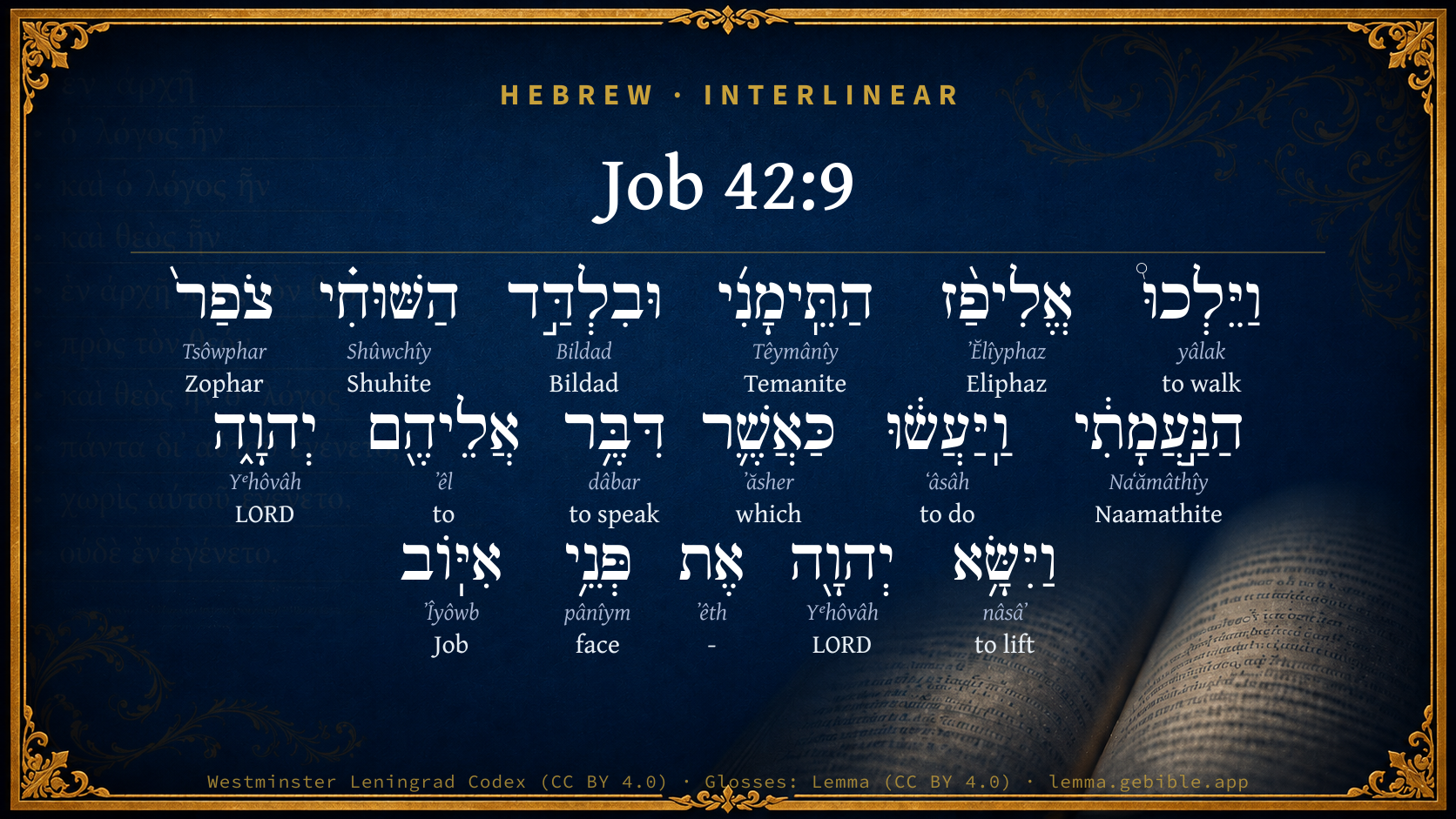
  1. וַיֵּלְכוּ֩ yâlak H3212 “and · to walk” Conjunction + Verb, Qal, Sequential Imperfect, 3rd Person, Masculine, Plural
  2. אֱלִיפַ֨ז ʼĔlîyphaz H464 “Eliphaz” Noun, Proper
  3. הַתֵּֽימָנִ֜י Têymânîy H8489 “the · Temanite” Particle, Definite Article + Noun, Gentilic, Masculine, Singular, Absolute
  4. וּבִלְדַּ֣ד Bildad H1085 “and · Bildad” Conjunction + Noun, Proper
  5. הַשּׁוּחִ֗י Shûwchîy H7747 “the · Shuhite” Particle, Definite Article + Noun, Gentilic, Masculine, Singular, Absolute
  6. הַנַּ֣עֲמָתִ֔י Naʻămâthîy H5284 “the · Naamathite” Particle, Definite Article + Noun, Gentilic, Masculine, Singular, Absolute
  7. וַֽיַּעֲשׂ֔וּ ʻâsâh H6213 “and · to do” Conjunction + Verb, Qal, Sequential Imperfect, 3rd Person, Masculine, Plural
  8. כַּאֲשֶׁ֛ר ʼăsher H834 “like/as · which” Preposition + Particle, Relative
  9. דִּבֶּ֥ר dâbar H1696 “to speak” Verb, Piel, Perfect, 3rd Person, Masculine, Singular
  10. אֲלֵיהֶ֖ם ʼêl H413 “to · them” Preposition + Suffix, Personal, 3rd Person, Masculine, Plural
  11. יְהוָ֑ה Yᵉhôvâh H3068 “LORD” Noun, Proper
  12. וַיִּשָּׂ֥א nâsâʼ H5375 “and · to lift” Conjunction + Verb, Qal, Sequential Imperfect, 3rd Person, Masculine, Singular
  13. יְהוָ֖ה Yᵉhôvâh H3068 “LORD” Noun, Proper
  14. אֶת ʼêth H853 “-” Particle, Direct Object
  15. פְּנֵ֥י pânîym H6440 “face(s) of” Noun, Common, Both, Plural, Construct
  16. אִיּֽוֹב ʼÎyôwb H347 “Job” Noun, Proper

About this verse

These counts appear in no published source. They are computed here, from the morphology-tagged text and Lemma’s own curated glosses. What Lemma adds →

17
words
16
distinct lemmas
Wisdom
section

Notable vocabulary

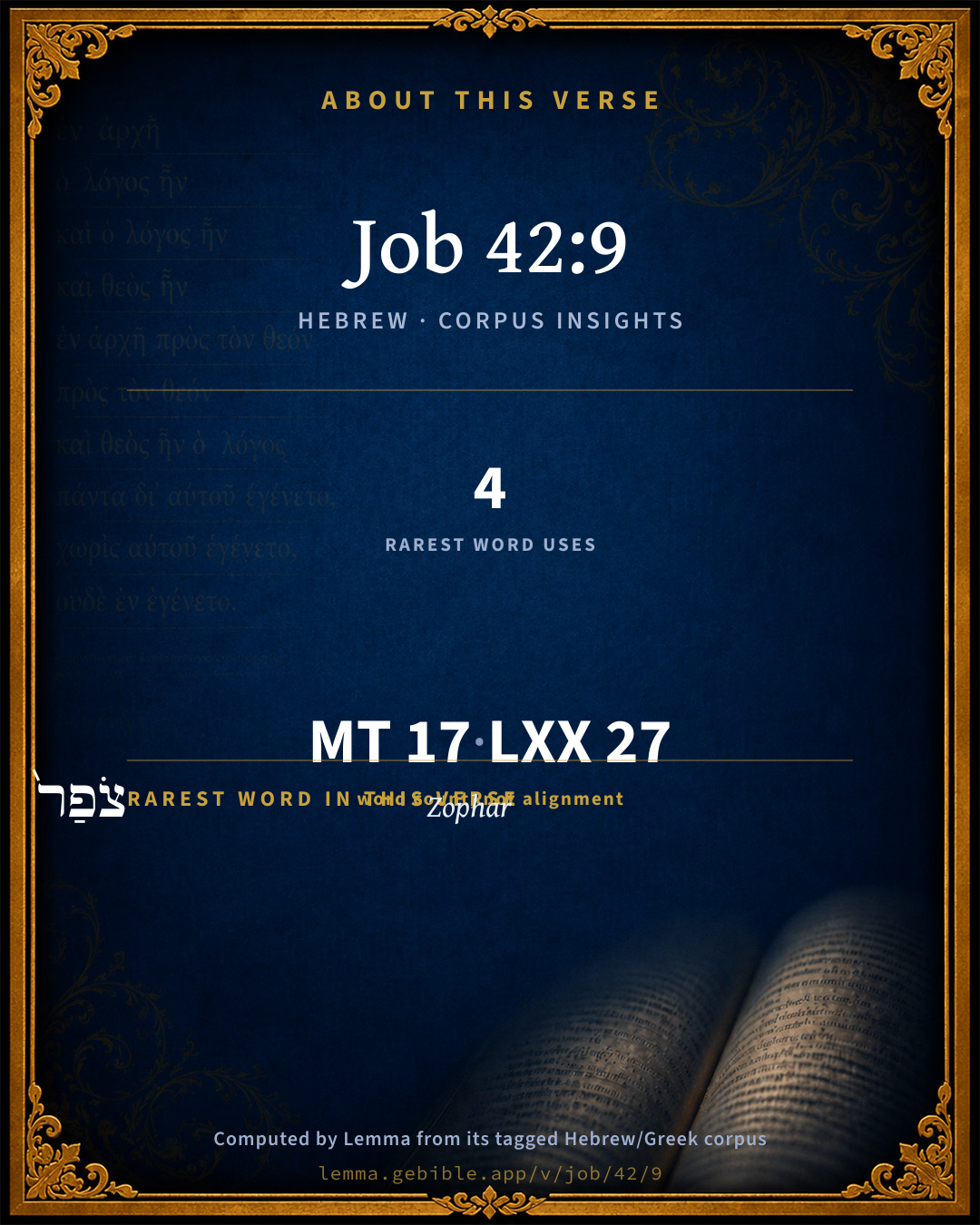
The rarest word here is צֹפַר֙ Zophar H6691 — appearing just 4 times in the whole Hebrew Bible.

Shared distinctive vocabulary

צֹפַר֙ Zophar H6691 occurs in 4 verses of the Hebrew Bible. Also found in:

Grammatical profile

  • 4 verbs
  • 10 nouns
  • 1 preposition
  • 2 particles

Verb forms

  • וַיֵּלְכוּ֩ Qal · Sequential Imperfect
  • וַֽיַּעֲשׂ֔וּ Qal · Sequential Imperfect
  • דִּבֶּ֥ר Piel · Perfect
  • וַיִּשָּׂ֥א Qal · Sequential Imperfect

Repetition

A word recurs within this verse — often emphatic in Hebrew:

  • יְהוָ֑ה LORD H3068 ×2

Hebrew & Septuagint length

In English translation the verse runs 23 words from the Hebrew and 30 from the Septuagint (LXX English) — closely comparable.

A rough comparison of the two English renderings, which tokenize alike — not a word-level alignment.

Word counts can differ between the Hebrew and the Greek without any difference in meaning — e.g. the Hebrew direct-object marker אֵת has no separate Greek word, and Greek often adds the article ὁ.

In the original languages it is 17 Hebrew tokens and 27 Greek tokens — but the two are counted differently (Hebrew bundles its prefixes and suffixes into one token; the Greek is in lemma form), so that isn’t a like-for-like length.

Cross-references

11

Topical passages linked to Job 42:9 in the Treasury of Scripture Knowledge — connected by theme and wording, ordered by reader-vote popularity; previews shown in the World English Bible.

  • Hebrews 11:8 By faith, Abraham, when he was called, obeyed to go out to the place which he was to receive for an inheritance. He went out, not knowing where he went.
  • Acts 9:6 But rise up, and enter into the city, and you will be told what you must do."
  • Acts 10:33 Therefore I sent to you at once, and it was good of you to come. Now therefore we are all here present in the sight of God to hear all things that have been commanded you by God."
  • Matthew 7:24 "Everyone therefore who hears these words of mine, and does them, I will liken him to a wise man, who built his house on a rock.
  • Job 22:27 You shall make your prayer to him, and he will hear you. You shall pay your vows.
  • Job 42:8 Now therefore, take to yourselves seven bulls and seven rams, and go to my servant Job, and offer up for yourselves a burnt offering; and my servant Job shall pray for you, for I will accept him, that I not deal with you according to your folly. For you have not spoken of me the thing that is right, as my servant Job has."
  • Proverbs 3:11–12 My son, don't despise Yahweh's discipline, Neither be weary of his reproof:
  • Ecclesiastes 9:7 Go your way--eat your bread with joy, and drink your wine with a merry heart; for God has already accepted your works.
  • Isaiah 60:14 The sons of those who afflicted you shall come bending to you; and all those who despised you shall bow themselves down at the soles of your feet; and they shall call you The city of Yahweh, The Zion of the Holy One of Israel.
  • John 2:5 His mother said to the servants, "Whatever he says to you, do it."
  • Job 34:31–32 "For has any said to God, 'I am guilty, but I will not offend any more.

Cross-references courtesy of OpenBible.info (CC BY 4.0).

Hebrew and Greek witnesses Masoretic Hebrew ↔ Greek Septuagint

The same verse in the two great witnesses to the Old Testament, shown verse-for-verse.

These are two independent witnesses, not word-aligned to each other, and the Septuagint is shown in lemma (dictionary) form.

Hebrew Job 42:9 Masoretic · Westminster Leningrad Codex

וַיֵּלְכוּ֩ אֱלִיפַ֨ז הַתֵּֽימָנִ֜י וּבִלְדַּ֣ד הַשּׁוּחִ֗י צֹפַר֙ הַנַּ֣עֲמָתִ֔י וַֽיַּעֲשׂ֔וּ כַּאֲשֶׁ֛ר דִּבֶּ֥ר אֲלֵיהֶ֖ם יְהוָ֑ה וַיִּשָּׂ֥א יְהוָ֖ה אֶת פְּנֵ֥י אִיּֽוֹב

So Eliphaz the Temanite and Bildad the Shuhite and Zophar the Naamathite went, and did what Yahweh commanded them, and Yahweh accepted Job.

World English Bible · Public Domain

Greek LXX Job 42:9 Septuagint · lemma form

πορεύομαι δέ ελιφας ὁ θαιμανίτης καί βαλδαδ ὁ σαυχίτης καί σωφαρ ὁ μιναῖος καί ποιέω καθώς συντάσσω αὐτός ὁ κύριος καί λύω ὁ ἁμαρτία αὐτός διά ιωβ

So Eliphaz the Thaemanite, and Baldad the Sauchite, and Sophar the Minaean, went and did as the Lord commanded them: and he pardoned their sin for the sake of Job.

LXX2012 (modern English Septuagint) · Public Domain

Hebrew: Westminster Leningrad Codex (CC BY 4.0). Greek: Septuagint (public domain); English from LXX2012 (modern English Septuagint) (Public Domain). How the Septuagint differs from the Hebrew →

Commentary

Notes on Job 42:9 from classic Christian and Jewish commentators (each source and its license shown beneath its notes). The classic Christian expositions comment on the surrounding passage and are grouped to its opening verse, so a note may address several verses; the Jewish commentaries on the Tanakh (Rashi and others) are per-verse, so they appear only where the commentator wrote on this verse.

Lemma curates 59 commentaries, every one of them public domain or Creative Commons licensed, each selected and text-cleaned for this edition rather than reprinted as found. About our sources →

Trapp's Complete Commentary

John Trapp

Job 42:9 So Eliphaz the Temanite and Bildad the Shuhite [and] Zophar the Naamathite went, and did according as the LORD commanded them: the LORD also accepted Job.

Ver. 9. So Eliphaz the Temanite, &c.] Here was resipiscentia ex fide constans, saith Brentius, the repentance of faith, the obedience also of faith readily yielded. Had not these been good and godly men they would have stuck at the cost of so great a sacrifice, they would also have scorned to have sought to Job, whom they had so much slighted, and to beg his prayers, of whom they had so ill deserved. But they had not so learned Christ. God, they saw well, was greatly offended and Job highly accepted; glad therefore were they by any good means to ingratiate, each of them saying to God for himself, as he did once to Caesar,

Iussa sequi tam velle mihi quam posse necesse est (Lucan) (Lucan).

Omne trahit secum Numinis ira malum (Ovid).

The Lord also accepted Job] Whether he testified his good acceptance by consuming his sacrifice with fire from heaven is uncertain. It is enough for us to know that he showed himself reconciled unto them, and well pleased with Job’s prayer for them, and their own prayers joined no doubt with his, and proceeding from faith in the merits and mediation of Jesus Christ. And hitherto God’s decisive sentence, whereby all the strife was graciously ended, and all parties happily and heartily reconciled. What became of Satan, a chief actor in this tragedy, we read not; Victus enim abiit. And as God would not once call him to account, when he had beguiled our first parents, Gen 3:1-7, because he meant him no mercy; so here he never mentioned him, as being judged already, and by Job bravely worsted and defeated. All that we find of him is, that his commisslon to vex Job any further was now taken away, for so it followeth,

John Trapp, A Commentary or Exposition upon All the Books of the Old and New Testament (1647–1656) — public domain. Text from a community e-Sword module.

Joseph Benson's Commentary

Job 42:9. So Eliphaz, &c., did as the Lord commanded — Showing their repentance by their submission to God, and to Job for God’s sake, and by taking shame to themselves. The Lord also accepted Job — Both for his friends and for himself, as the next verse explains it. And as Job prayed and offered sacrifice for those who had grieved and wounded his spirit, so Christ prayed and died for his persecutors, and ever lives making intercession for transgressors.

Joseph Benson's Commentary on the Old and New Testaments (1811–1818) — public domain. Text from a community e-Sword module.

Whedon's Commentary on the Bible

Daniel D. Whedon

THE ACCEPTANCE OF JOB TAKES PLACE IN THE ACT OF OFFERING SACRIFICE IN BEHALF OF HIS FRIENDS, Job_42:9-10 a.

9. Accepted Job — Literally, lifted up the face of Job, as in Job_42:8. Cocceius supposes that this acceptance was by some outward visible sign, perhaps in a mode similar to that in which Jerome conjectures God showed his respect unto Abel and his offering, by sending down fire to consume the sacrifices.

Daniel D. Whedon (gen. ed.), Commentary on the Old and New Testaments (1874–1909) — public domain. Text from a community e-Sword module.

Jamieson, Fausset & Brown

Robert Jamieson, A. R. Fausset & David Brown

The forgiving spirit of Job foreshadows the love of Jesus Christ and of Christians to enemies (Mat 5:44; Luk 23:34; Act 7:60; Act 16:24, Act 16:28, Act 16:30-31).

Jamieson, Fausset & Brown — Commentary Critical and Explanatory on the Whole Bible (1871) — public domain (CC PDM 1.0). Text via the HelloAO Bible API.

John Gill's Exposition

And the Lord turned the captivity of Job,.... Not literally, in such sense as Lot's captivity was turned, Gen 14:12; for Job's person was not seized on and carried away, though his cattle were: nor spiritually, being delivered from the captivity of sin; that had been his case many years ago, when first converted: but it is to be understood of his restoration from afflictions and calamities to a happy state; as of the return of his substance, his health and friends, and especially of his deliverance from Satan, in whose hands he had been some time, and by him distressed both in body and mind. But now his captivity was turned, and he was freed from all his distresses; and even from those which arose from the dealings of God with him, which he was now fully satisfied about; and this was done,

when he prayed for his friends; as he was directed to do. A good man will not only pray for himself, as Job doubtless did, but for others also; for his natural and spiritual friends, yea, for unkind friends, and even for enemies likewise: and the prayer of an upright man is very acceptable to the Lord; and many mercies and blessings come by it; and even prayer for others is profitable to a man's self; and sometimes he soon reaps the benefit of it, as Job now did. For when and while he was praying, or quickly upon it, there was a turn in his affairs: he presently found himself in better health; his friends came about him, and his substance began to increase; Satan had no more power over him, and the presence of God was with him. All which was of the Lord; and he enjoyed it in the way of prayer, and as the fruit of that;

also the Lord gave Job twice as much as he had before: or added to him double. Which chiefly respects his substance; his cattle, as appears from Job 42:12, and might be true both with respect to things temporal and spiritual. "Double" may denote an abundance, a large measure of good things; see Zac 9:12.

John Gill's Exposition of the Whole Bible (1746–1763) — public domain (CC PDM 1.0). Text via the HelloAO Bible API.

Albert Barnes' Notes on the Bible

The Lord also accepted Job - Margin, as in Job 42:8, “the face of.” The meaning is, that he accepted his prayers and offerings in behalf of his friends.

Albert Barnes' Notes on the Bible (1834–1885) — public domain. Text from a community e-Sword/MySword module.

Matthew Poole's English Annotations

Did according as the Lord commanded them; showing their repentance by their submission to God, and to Job for God’s sake, and by taking shame to themselves.

The Lord also accepted Job, both for his friends and for himself, as the next verse explains it.

Matthew Poole's English Annotations on the Holy Bible (1683–1685) — public domain. Text from a community e-Sword/MySword module.

The Pulpit Commentary

So Eliphaz the Temanite and Bildad the Shuhite and Zophar the Naamathite went, and did according as the Lord commanded them; i.e. "went" to Job, and asked his aid and interposition, and obtained it. The Lord also accepted Job; i.e. looked favourably on Job"s intercession, and for his sake pardoned those for whom he made his prayer. Job is thus a type of Christ, not merely in his sufferings, but also in his mediatorial character.

The Pulpit Commentary (1880–1919), ed. H.D.M. Spence-Jones & Joseph S. Exell — public domain. Text from a community e-Sword module.

John Wesley's Explanatory Notes

Accepted Job - And as Job prayed and offered sacrifice for those who had grieved and wounded his spirit, so Christ prayed and died for his persecutors, and ever lives, making intercession for transgressors.

John Wesley, Explanatory Notes Upon the Whole Bible (1754–1765) — public domain. Text via the GEBible commentary corpus.

Rashi

Rabbi Shlomo Yitzchaki (Rashi)

and the Lord favored Job Heb. וישא, [lit. and the Lord lifted His countenance] as in (Gen. 19: 21), “I have favored you (נשאתי) also in this respect,” that He accepted his prayer and showed him a bright countenance.

Rashi on the Tanakh — English translations: “The Judaica Press complete Tanach with Rashi, translated by A. J. Rosenberg” (CC BY 4.0); “Pentateuch with Rashi's commentary by M. Rosenbaum and A.M. Silbermann, 1929-1934” (public domain); “The Metsudah Tanach series, Lakewood, N.J” (CC BY 4.0); and “The Book of Joshua, Metsudah Publications, 1997” (CC BY 4.0). Text via Sefaria.

Lesson kit

Teaching starters — assembled from the data on this page, not authored interpretation. Every prompt links to the verse data it draws on. Edit before teaching.

Job, in the Wisdom, opens this verse with 17 words (16 distinct Hebrew lemmas). Its most distinctive word is Tsôwphar (“Zophar”). A historical commentator’s framing appears above. Read the whole chapter for the surrounding context.

Discussion questions

  1. What does “Zophar” (Tsôwphar) contribute to the verse as a whole?
  2. Job 2:11 shares the word «Zophar» with this verse. How do the two illuminate each other?
  3. “LORD” occurs 2× in this one verse. What is the effect of the repetition?
  4. The translations on this page render this verse differently — a whole-verse word diff, not a word-by-word alignment. What might account for the different wordings?
  5. The verb «וַיֵּלְכוּ֩» is Qal Sequential Imperfect. How does its form color the action?
  6. Reading how Trapp's Complete Commentary and Joseph Benson's Commentary read this verse, where do the two commentators agree and where do they part?

Things to notice

Reading settings

Reading text

Shown beneath each verse's original-language words.

Old Testament
Old Testament edition

Read the OT as the Masoretic Hebrew (MT) or the Greek Septuagint (LXX).

English shown for the Greek Septuagint (in the Hebrew ↔ Greek comparison).

Comparing translations? Open the Compare panel on any verse page to stack up to four side by side.