
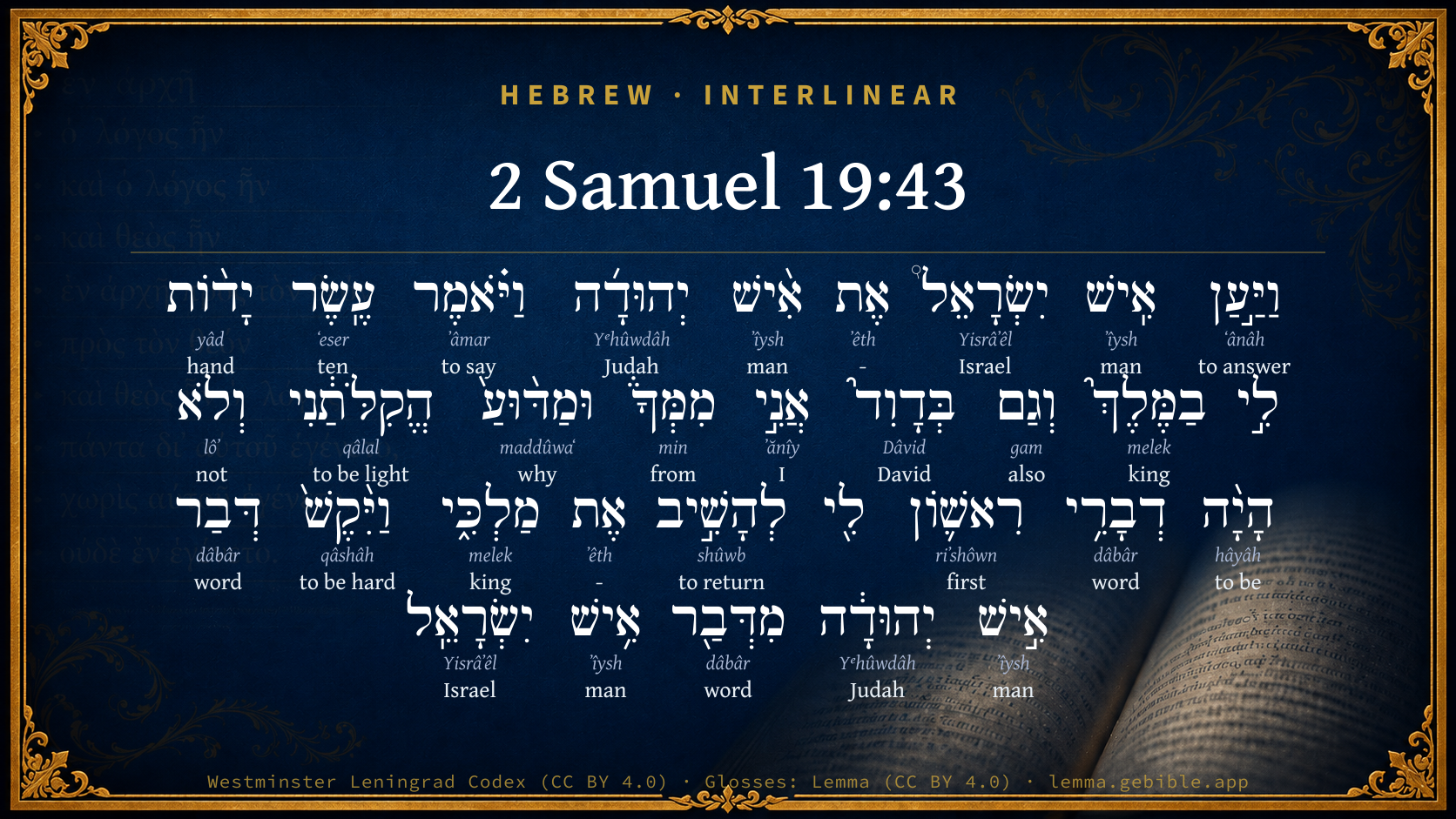
2 Samuel 19:43

Hebrew (Westminster Leningrad Codex) 2 Samuel 19:43 appears in the Hebrew Old Testament. The text above is from the Westminster Leningrad Codex. Each word links to its Strong’s number, a concise gloss, and parsing drawn from the Open Scriptures Hebrew Bible morphology. Click any word for its full Brown-Driver-Briggs (BDB) entry.
Download image
Cite this verse

2 Samuel 19:43 (World English Bible). Public Domain. Lemma interlinear Bible study tool, https://lemma.gebible.app/v/2-samuel/19/43.

Show BibTeX & RIS
BibTeX
RIS
English Translation
The men of Israel answered the men of Judah, and said, We have ten parts in the king, and we have also more [right] in David than you: why then did you despise us, that our advice should not be first had in bringing back our king? The words of the men of Judah were fiercer than the words of the men of Israel.
World English Bible · Public Domain
Download a study sheet

One document with this verse’s original text, its word-by-word gloss line, the meaning frame, cross-references with their text, attributed commentary, and full source and license credits — printable, and it pastes into notes with its structure intact.

This verse Autodidact and up

Study sheet (.html) Plain text (.txt)

A passage Seminary Student

Up to 50 verses in one chapter. A passage sheet keeps up to 6 commentary sources and 12 cross-references per verse, in the order this page ranks them, and says so on the sheet whenever that leaves anything out. Ask for a single verse and you get the Autodidact verse sheet above.

Everything on this page stays free to read, with no account — the sheet is a download of what is already on screen, not access to it.

Want to remove ads? Support Godless Engineer
Compare translations 3

The same verse in 3 English versions, stacked beneath the original-language interlinear above. Click any original word for its lexicon entry.

Each is an independent rendering of the whole verse — the interlinear is not word-aligned to these translations.

Highlighted words mark where these versions differ — a whole-verse word diff, not a word-by-word alignment.

  • World English Bible Public Domain
    The men of Israel answered the men of Judah, and said, We have ten parts in the king, and we have also more [right] in David than you: why then did you despise us, that our advice should not be first had in bringing back our king? The words of the men of Judah were fiercer than the words of the men of Israel.
  • King James Version Public Domain
    And the men of Israel answered the men of Judah, and said, We have ten parts in the king, and we have also more right in David than ye: why then did ye despise us, that our advice should not be first had in bringing back our king? And the words of the men of Judah were fiercer than the words of the men of Israel.
  • unfoldingWord Literal Text CC BY-SA 4.0
    And a man of Israel answered a man of Judah, and he said, “Ten hands to me in the king, and also in David, I more than you. So why have you despised me? Was not my word first, to bring back my king to me?” But the word of a man of Judah was harsher than the word of a man of Israel.

unfoldingWord Literal Text — © unfoldingWord, licensed CC BY-SA 4.0. Word-aligned USFM3 via Door43 (git.door43.org/unfoldingWord/en_ult).

Versions to compare (up to 4)

3 of 4 selected

Show all 18 translations

Every available English version of this verse, each an independent rendering of the whole verse.

  • World English Bible Public Domain
    The men of Israel answered the men of Judah, and said, We have ten parts in the king, and we have also more [right] in David than you: why then did you despise us, that our advice should not be first had in bringing back our king? The words of the men of Judah were fiercer than the words of the men of Israel.
  • Berean Standard Bible Public Domain
    “We have ten shares in the king,” answered the men of Israel, “so we have more claim to David than you. Why then do you despise us? Were we not the first to speak of restoring our king?” But the men of Judah pressed even harder than the men of Israel.
  • Majority Standard Bible Public Domain
    “We have ten shares in the king,” answered the men of Israel, “so we have more claim to David than you. Why then do you despise us? Were we not the first to speak of restoring our king?” But the men of Judah spoke more fiercely than the men of Israel.
  • King James Version Public Domain
    And the men of Israel answered the men of Judah, and said, We have ten parts in the king, and we have also more right in David than ye: why then did ye despise us, that our advice should not be first had in bringing back our king? And the words of the men of Judah were fiercer than the words of the men of Israel.
  • American Standard Version (1901) Public Domain
    And the men of Israel answered the men of Judah, and said, We have ten parts in the king, and we have also more `right' in David than ye: why then did ye despise us, that our advice should not be first had in bringing back our king? And the words of the men of Judah were fiercer than the words of the men of Israel.
  • Revised Version (1885) Public Domain
    And the men of Israel answered the men of Judah, and said, We have ten parts in the king; and we have also more right in David than ye: why then did ye despise us, that our advice should not be first had in bringing back our king? And the words of the men of Judah were fiercer than the words of the men of Israel.
  • Geneva Bible (1599) Public Domain
    And the men of Israel answered the men of Iudah, and saide, Wee haue ten partes in the King, and haue also more right to Dauid then ye: Why then did ye despise vs, that our aduise should not bee first had in restoring our King? And the wordes of the men of Iudah were fiercer then the wordes of the men of Israel.
  • Douay-Rheims (1899) Public Domain
    And the men of Israel answered the men of Juda, and said: I have ten parts in the king more than thou, and David belongeth to me more than to thee: why hast thou done me a wrong, and why was it not told me first, that I might bring back my king? And the men of Juda answered more harshly than the men of Israel.
  • Young's Literal Translation Public Domain
    And the men of Israel answer the men of Judah, and say, `Ten parts we have in the king, and also in David more than you; and wherefore have ye lightly esteemed us, that our word hath not been first to bring back our king?' And the word of the men of Judah is sharper than the word of the men of Israel.
  • Literal Standard Version CC BY-SA 4.0
    And the men of Israel answer the men of Judah, and say, “We have ten parts in the king, and also more than you in David; and why have you lightly esteemed us, that our word has not been first to bring back our king?” And the word of the men of Judah is sharper than the word of the men of Israel.
  • Unlocked Literal Bible CC BY-SA 4.0
    The men of Israel answered the men of Judah, “We have ten tribes related to the king, so we have even more right to David than you. Why then did you despise us? Was not our proposal to bring back our king the first to be heard?” But the words of the men of Judah were even more harsh than the words of the men of Israel.
  • unfoldingWord Literal Text CC BY-SA 4.0
    And a man of Israel answered a man of Judah, and he said, “Ten hands to me in the king, and also in David, I more than you. So why have you despised me? Was not my word first, to bring back my king to me?” But the word of a man of Judah was harsher than the word of a man of Israel.
  • Darby Bible Public Domain
    And the men of Israel answered the men of Judah and said, I have ten parts in the king and I have also more right in David than thou; and why didst thou slight me? and was not my advice the first, to bring back my king? And the words of the men of Judah were harsher than the words of the men of Israel.
  • World Messianic Bible Public Domain
    The men of Israel answered the men of Judah, and said, “We have ten parts in the king, and we have also more claim to David than you. Why then did you despise us, that our advice should not be first had in bringing back our king?” The words of the men of Judah were fiercer than the words of the men of Israel.
  • Webster's Bible Public Domain
    And the men of Israel answered the men of Judah, and said, We have ten parts in the king, and we have also more right in David than ye: why then did ye despise us, that our advice should not be first had in bringing back our king? And the words of the men of Judah were fiercer than the words of the men of Israel.
  • Free Bible Version CC BY-SA 4.0
    “We've got ten shares in the king,” the men of Israel replied, “so we have a greater claim on David than you do. Why do you look down on us? Weren't we the first ones to talk about bringing back our king?” But the men of Judah argued even more strongly than the men of Israel.
  • Bible in Basic English Public Domain
    And in answer to the men of Judah, the men of Israel said, We have ten parts in the king, and we are the first in order of birth: why did you make nothing of us? and were we not the first to make suggestions for getting the king back? And the words of the men of Judah were more violent than the words of the men of Israel.
  • JPS Tanakh (1917) Public Domain
    (19-44) And the men of Israel answered the men of Judah, and said: 'We have ten parts in the king, and we have also more right in David than ye; why then did ye despise us, that our advice should not be first had in bringing back our king?' And the words of the men of Judah were fiercer than the words of the men of Israel.

Literal Standard Version (2020), Covenant Press — licensed CC BY-SA 4.0. Text via the HelloAO Bible API (eBible.org). Unlocked Literal Bible (unfoldingWord) — licensed CC BY-SA 4.0. Text via the HelloAO Bible API (eBible.org). unfoldingWord Literal Text — © unfoldingWord, licensed CC BY-SA 4.0. Word-aligned USFM3 via Door43 (git.door43.org/unfoldingWord/en_ult). Free Bible Version, Dr. Jonathan Gallagher — licensed CC BY-SA 4.0. Text via the HelloAO Bible API (eBible.org).

Word by word

More ways to search: Search by grammar → Find every occurrence → Compare this word →

Practice this passage: Drill this verse → Learn its vocabulary →

וַיִּ֨קֶשׁ֙
qâshâh
H7185
“and · to be hard”
Conjunction + Verb, Qal, Sequential Imperfect, 3rd Person, Masculine, Singular
Part of Speech
Conjunction + Verb
Stem
Qal
Form
Sequential Imperfect
Person
3rd Person
Gender
Masculine
Number
Singular
Full BDB Definition

Origin: a primitive root

TWOT: 2085

to be hard, be severe, be fierce, be harsh - (Qal) - to be hard, be difficult - to be hard, be severe - (Niphal) - to be ill-treated - to be hard pressed - (Piel) to have severe labour (of women) - (Hiphil) - to make difficult, make difficulty - to make severe, make burdensome - to make hard, make stiff, make stubborn - of obstinacy (figuratively) - to show stubbornness
  1. וַיַּ֣עַן ʻânâh H6030 “and · to answer” Conjunction + Verb, Qal, Sequential Imperfect, 3rd Person, Masculine, Singular
  2. אִֽישׁ ʼîysh H376 “man of” Noun, Common, Masculine, Singular, Construct
  3. יִשְׂרָאֵל֩ Yisrâʼêl H3478 “Israel” Noun, Proper
  4. אֶת ʼêth H853 “-” Particle, Direct Object
  5. אִ֨ישׁ ʼîysh H376 “man of” Noun, Common, Masculine, Singular, Construct
  6. יְהוּדָ֜ה Yᵉhûwdâh H3063 “Judah” Noun, Proper
  7. וַיֹּ֗אמֶר ʼâmar H559 “and · to say” Conjunction + Verb, Qal, Sequential Imperfect, 3rd Person, Masculine, Singular
  8. עֶֽשֶׂר ʻeser H6235 “ten” Adjective, Cardinal number, Feminine, Singular, Absolute
  9. יָד֨וֹת yâd H3027 “hands” Noun, Common, Both, Plural, Absolute
  10. בַמֶּלֶךְ֮ melek H4428 “in/at the · king” Preposition, Determined + Noun, Common, Masculine, Singular, Absolute
  11. וְגַם gam H1571 “and · also” Conjunction + Particle, Accusative
  12. בְּדָוִד֮ Dâvid H1732 “in/at · David” Preposition + Noun, Proper
  13. אֲנִ֣י ʼănîy H589 “I” Pronoun, Personal, 1st Person, Common, Singular
  14. מִמְּךָ֒ min H4480 “from · you” Preposition + Suffix, Personal, 2nd Person, Masculine, Singular
  15. וּמַדּ֨וּעַ֙ maddûwaʻ H4069 “and · why” Conjunction + Particle, Interrogative
  16. הֱקִלֹּתַ֔נִי qâlal H7043 “to be light · me” Verb, Hiphil, Perfect, 2nd Person, Masculine, Singular + Suffix, Personal, 1st Person, Common, Singular
  17. וְלֹא lôʼ H3808 “and · not” Conjunction + Particle, Negative
  18. הָיָ֨ה hâyâh H1961 “to be” Verb, Qal, Perfect, 3rd Person, Masculine, Singular
  19. דְבָרִ֥י dâbâr H1697 “word · my” Noun, Common, Masculine, Singular, Construct + Suffix, Personal, 1st Person, Common, Singular
  20. רִאשׁ֛וֹן riʼshôwn H7223 “first” Adjective, Adjective, Masculine, Singular, Absolute
  21. לְהָשִׁ֣יב shûwb H7725 “to return” Preposition + Verb, Hiphil, Infinitive Construct
  22. אֶת ʼêth H853 “-” Particle, Direct Object
  23. מַלְכִּ֑י melek H4428 “king · my” Noun, Common, Masculine, Singular, Construct + Suffix, Personal, 1st Person, Common, Singular
  24. דְּבַר dâbâr H1697 “word of” Noun, Common, Masculine, Singular, Construct
  25. אִ֣ישׁ ʼîysh H376 “man of” Noun, Common, Masculine, Singular, Construct
  26. יְהוּדָ֔ה Yᵉhûwdâh H3063 “Judah” Noun, Proper
  27. מִדְּבַ֖ר dâbâr H1697 “from · word of” Preposition + Noun, Common, Masculine, Singular, Construct
  28. אִ֥ישׁ ʼîysh H376 “man of” Noun, Common, Masculine, Singular, Construct
  29. יִשְׂרָאֵֽל Yisrâʼêl H3478 “Israel” Noun, Proper

About this verse

These counts appear in no published source. They are computed here, from the morphology-tagged text and Lemma’s own curated glosses. What Lemma adds →

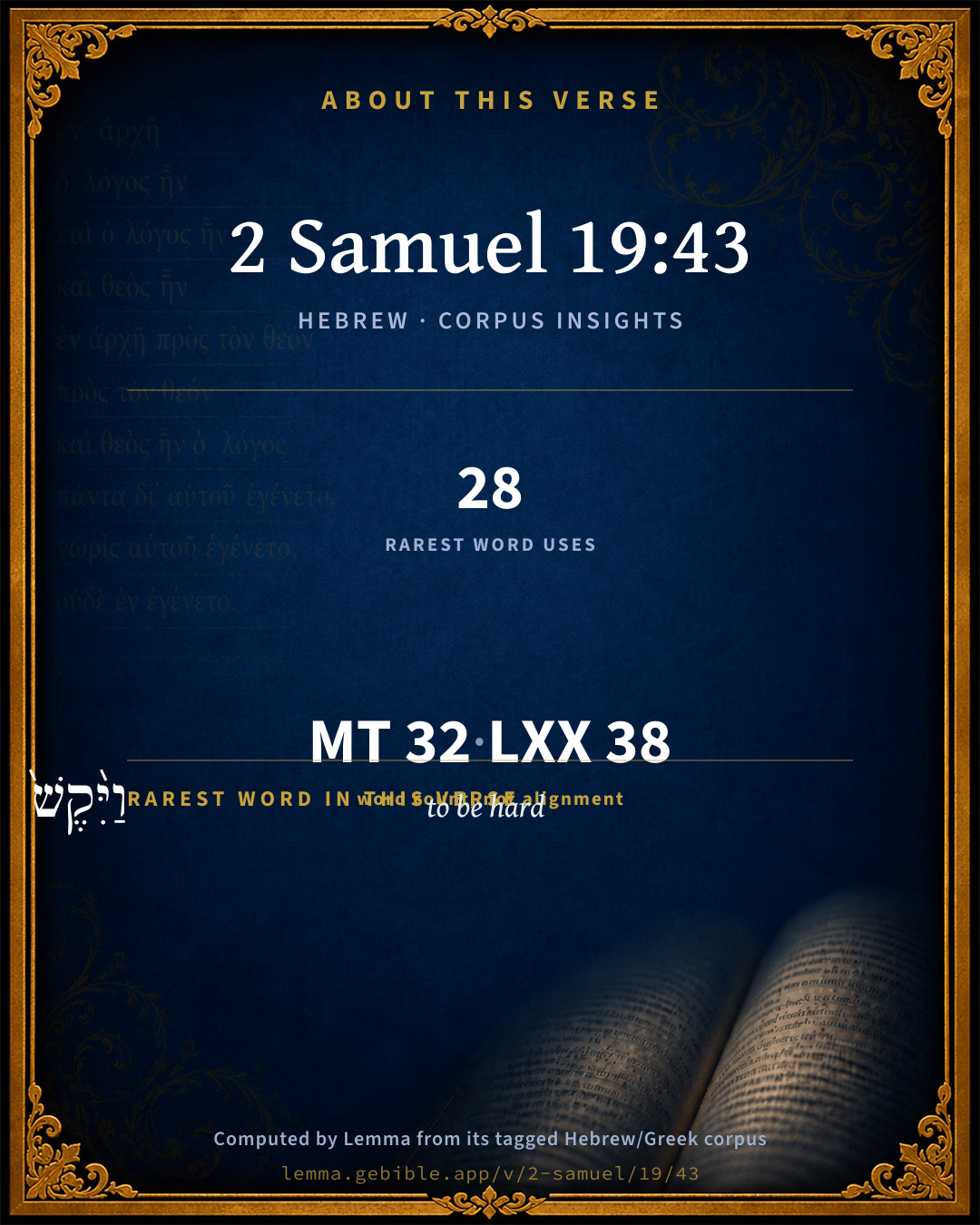
32
words
21
distinct lemmas
Historical
section

Shared distinctive vocabulary

וַיִּ֨קֶשׁ֙ to be hard H7185 occurs in 28 verses of the Hebrew Bible. Also found in:

Grammatical profile

  • 6 verbs
  • 15 nouns
  • 2 adjectives
  • 1 pronoun
  • 3 prepositions
  • 5 particles

Verb forms

  • וַיַּ֣עַן Qal · Sequential Imperfect
  • וַיֹּ֗אמֶר Qal · Sequential Imperfect
  • הֱקִלֹּתַ֔נִי Hiphil · Perfect
  • הָיָ֨ה Qal · Perfect
  • לְהָשִׁ֣יב Hiphil · Infinitive Construct
  • וַיִּ֨קֶשׁ֙ Qal · Sequential Imperfect

Repetition

Words recur within this verse — often emphatic in Hebrew:

  • אִֽישׁ man H376 ×4
  • דְבָרִ֥י word H1697 ×3
  • יִשְׂרָאֵל֩ Israel H3478 ×2
  • יְהוּדָ֜ה Judah H3063 ×2
  • בַמֶּלֶךְ֮ king H4428 ×2

Hebrew & Septuagint length

In English translation the verse runs 64 words from the Hebrew and 75 from the Septuagint (LXX English) — closely comparable.

A rough comparison of the two English renderings, which tokenize alike — not a word-level alignment.

Word counts can differ between the Hebrew and the Greek without any difference in meaning — e.g. the Hebrew direct-object marker אֵת has no separate Greek word, and Greek often adds the article ὁ.

In the original languages it is 32 Hebrew tokens and 38 Greek tokens — but the two are counted differently (Hebrew bundles its prefixes and suffixes into one token; the Greek is in lemma form), so that isn’t a like-for-like length.

Cross-references

23

Topical passages linked to 2 Samuel 19:43 in the Treasury of Scripture Knowledge — connected by theme and wording, ordered by reader-vote popularity; previews shown in the World English Bible.

  • Galatians 5:20 idolatry, sorcery, hatred, strife, jealousies, outbursts of anger, rivalries, divisions, heresies,
  • 2 Samuel 5:1 Then came all the tribes of Israel to David to Hebron, and spoke, saying, Behold, we are your bone and your flesh.
  • 1 Kings 11:30–31 Ahijah laid hold of the new garment that was on him, and tore it in twelve pieces.
  • James 3:14–16 But if you have bitter jealousy and selfish ambition in your heart, don't boast and don't lie against the truth.
  • James 4:1–5 Where do wars and fightings among you come from? Don't they come from your pleasures that war in your members?
  • Judges 8:1 The men of Ephraim said to him, Why have you served us thus, that you didn't call us, when you went to fight with Midian? They did chide with him sharply.
  • Judges 9:23 God sent an evil spirit between Abimelech and the men of Shechem; and the men of Shechem dealt treacherously with Abimelech:
  • Judges 12:1–6 The men of Ephraim were gathered together, and passed northward; and they said to Jephthah, Why did you pass over to fight against the children of Ammon, and didn't call us to go with you? we will burn your house on you with fire.
  • 2 Samuel 19:9 All the people were at strife throughout all the tribes of Israel, saying, The king delivered us out of the hand of our enemies, and he saved us out of the hand of the Philistines; and now he is fled out of the land from Absalom.
  • 2 Samuel 19:14 He bowed the heart of all the men of Judah, even as [the heart of] one man; so that they sent to the king, [saying], Return you, and all your servants.
  • 2 Samuel 20:1 There happened to be there a base fellow, whose name was Sheba, the son of Bichri, a Benjamite: and he blew the trumpet, and said, We have no portion in David, neither have we inheritance in the son of Jesse: every man to his tents, Israel.
  • 2 Samuel 20:6 David said to Abishai, Now will Sheba the son of Bichri do us more harm than did Absalom: take your lord's servants, and pursue after him, lest he get him fortified cities, and escape out of our sight.
  • 1 Kings 12:16 When all Israel saw that the king didn't listen to them, the people answered the king, saying, What portion have we in David? neither have we inheritance in the son of Jesse: to your tents, Israel: now see to your own house, David. So Israel departed to their tents.
  • Proverbs 13:10 Pride only breeds quarrels, But with ones who take advice is wisdom.
  • Proverbs 15:1 A gentle answer turns away wrath, But a harsh word stirs up anger.
  • Proverbs 17:14 The beginning of strife is like breaching a dam, Therefore stop contention before quarreling breaks out.
  • Proverbs 18:19 A brother offended is more difficult than a fortified city; And disputes are like the bars of a castle.
  • Romans 12:21 Don't be overcome by evil, but overcome evil with good.
  • Galatians 5:15 But if you bite and devour one another, be careful that you don't consume one another.
  • Galatians 5:26 Let's not become conceited, provoking one another, and envying one another.
  • Philippians 2:3 doing nothing through rivalry or through conceit, but in humility, each counting others better than himself;
  • James 1:20 for the anger of man doesn't produce the righteousness of God.
  • James 3:2–10 For in many things we all stumble. If anyone doesn't stumble in word, the same is a perfect man, able to bridle the whole body also.

Cross-references courtesy of OpenBible.info (CC BY 4.0).

Hebrew and Greek witnesses Masoretic Hebrew ↔ Greek Septuagint

The same verse in the two great witnesses to the Old Testament, shown verse-for-verse.

These are two independent witnesses, not word-aligned to each other, and the Septuagint is shown in lemma (dictionary) form.

Hebrew 2 Samuel 19:43 Masoretic · Westminster Leningrad Codex

וַיַּ֣עַן אִֽישׁ יִשְׂרָאֵל֩ אֶת אִ֨ישׁ יְהוּדָ֜ה וַיֹּ֗אמֶר עֶֽשֶׂר יָד֨וֹת לִ֣י בַמֶּלֶךְ֮ וְגַם בְּדָוִד֮ אֲנִ֣י מִמְּךָ֒ וּמַדּ֨וּעַ֙ הֱקִלֹּתַ֔נִי וְלֹא הָיָ֨ה דְבָרִ֥י רִאשׁ֛וֹן לִ֖י לְהָשִׁ֣יב אֶת מַלְכִּ֑י וַיִּ֨קֶשׁ֙ דְּבַר אִ֣ישׁ יְהוּדָ֔ה מִדְּבַ֖ר אִ֥ישׁ יִשְׂרָאֵֽל

The men of Israel answered the men of Judah, and said, We have ten parts in the king, and we have also more [right] in David than you: why then did you despise us, that our advice should not be first had in bringing back our king? The words of the men of Judah were fiercer than the words of the men of Israel.

World English Bible · Public Domain

Greek LXX 2 Samuel 19:43 Septuagint · lemma form

καί ἀποκρίνω πᾶς ἀνήρ ιουδα πρός ἀνήρ ἰσραήλ καί εἶπον διότι ἐγγίζω πρός ἐγώ ὁ βασιλεύς καί ἵνα τίς οὕτως θυμόω περί ὁ λόγος οὗτος μή βρῶσις ἐσθίω ἐκ ὁ βασιλεύς ἤ δόμα δίδωμι ἤ ἄρσις αἴρω ἐγώ

And the men of Israel answered the men of Juda, and said, We have ten parts in the king, and we are older than you, we have also an interest in David above you: and why have you⌃ thus insulted us, and why was not our advice taken before that of Juda, to bring back our king? And the speech of the men of Juda was sharper than the speech of the men of Israel.

LXX2012 (modern English Septuagint) · Public Domain

On this verse, Ellicott's Commentary for English Readers discusses the Septuagint’s reading. Read the note in Commentary ↓

Hebrew: Westminster Leningrad Codex (CC BY 4.0). Greek: Septuagint (public domain); English from LXX2012 (modern English Septuagint) (Public Domain). How the Septuagint differs from the Hebrew →

Targum (Aramaic paraphrase)

1

The Targum is the ancient Jewish Aramaic paraphrase of the Hebrew Scriptures — an interpretive translation, not the Hebrew text itself. Onkelos (literal) and Pseudo-Jonathan (expansive) render the Torah, and Jonathan the Prophets. Coverage is partial: where no permissively-licensed English translation exists for a verse, only the Aramaic is shown. This is verse-level text, not a word-by-word alignment to the Hebrew.

  1. Targum Jonathan Prophets (Joshua–Malachi)
    וַאֲתֵיב כָּל אֱנַשׁ יְהוּדָה עַל אֱנַשׁ יִשְׂרָאֵל אֲרֵי קָרִיב לִי מַלְכָּא מִדִילָךְ וּלְמָה דְנַן תְּקוֹף לָךְ עַל פִתְגָמָא הָדֵין הֲמֵיכַל אֲכִילְנָא מִנִכְסֵי מַלְכָּא אִם מַתְּנָא מַנֵי לָנָא:

    (no public-domain English translation for this verse)

    Targum Jonathan — Aramaic: “Mikraot Gedolot” (public domain). English: “Sefaria Community Translation” (CC0 1.0 (public-domain dedication)); “London "Chaldee Paraphrase," 1871” (public domain). Text via Sefaria.

Commentary

Notes on 2 Samuel 19:43 from classic Christian and Jewish commentators (each source and its license shown beneath its notes). The classic Christian expositions comment on the surrounding passage and are grouped to its opening verse, so a note may address several verses; the Jewish commentaries on the Tanakh (Rashi and others) are per-verse, so they appear only where the commentator wrote on this verse.

Lemma curates 59 commentaries, every one of them public domain or Creative Commons licensed, each selected and text-cleaned for this edition rather than reprinted as found. About our sources →

Trapp's Complete Commentary

John Trapp

2Sa 19:43 And the men of Israel answered the men of Judah, and said, We have ten parts in the king, and we have also more [right] in David than ye: why then did ye despise us, that our advice should not be first had in bringing back our king? And the words of the men of Judah were fiercer than the words of the men of Israel.

Ver. 43. Why then did ye despise us?] Gens haec, - saith Gerald concerning the Irish, - sicut et natio quaevis barbara, quanquam honorem nesciant, honorari tamen supra modum affectant. None can endure to be slighted.

And the words of the men of Judah were fiercer.] Heb., Harder; that is, more arrogant and insolent in the judgment of Him who will one day execute judgment upon ungodly sinners for all their hard speeches. {Jdg 1:15} The tribe of Judah, binding upon the king’s favour, and backed by his guard, duriore sermone Israelitas abegit, berated the Israelites with their rough language; and this caused a sedition, as the next chapter showeth. The Rabbis say that they gave them the lie. David either spake not at all, or could not be heard in that tumult. "Behold, how great a matter a little fire kindleth!" {Jas 3:5}

John Trapp, A Commentary or Exposition upon All the Books of the Old and New Testament (1647–1656) — public domain. Text from a community e-Sword module.

The Biblical Illustrator

Joseph S. Exell

2Sa_19:43

And the words of the men of Judah were fiercer than the words of the men of Israel.

Controversy

Here is the beginning of a long controversy which ended in the dismemberment of Gods people, and in the permanent alienation of those who by tradition, by hopes, and by privileges, were common children of a common Lord. Here is the little cloud no bigger than a mans hand, of fierce invective, and party jealousy; soon the whole heaven will be black with the cloud and storm of disaster, and divided, Israel and Judah fall an easy prey to their enemy, who leads them away captive into exile and degradation, and failure of purpose, for which they had paved the way by the quarrels between brethren.

I. The history of religious dissension is a long and a sad one. There is a monotonous iteration about it which makes one almost despair of human nature, did we not know that freedom of the will, liberty of opinion, and individuality ill all its waywardness, are signs, however perverted they may be, of mans pre-eminence in creation as made in the image and likeness of God, Who wills and no man lets Him, Who moves unfettered by necessity, and untrammelled by restraint. It is easy enough to arrange, in order, and in beauty artificial flowers, with all their semblance of life and brilliancy of colour. The real flowers bend their heads, and snap and fall and hang down; but they have this virtue, that they are alive, they are fragrant, they are tinged with that living colour which no art can give. Puppets offer no resistance; they stand where they are placed; they are absolutely at the disposal of the hand which orders them. But puppets cannot think, cannot resist, cannot organise movement, or march to victory. No, in spite of its waywardness, its readiness to yield to temptation, its pettiness of jealousy, its infirmity of purpose, we would not part with our freedom of the will. There is no struggle which appears to men so much as a struggle for liberty. We all of us passionately cry out, Persuade me if you can, but you shall never drive me. We will yield to arguments, but not to force. You cannot drive a man with a stick, nor convince him by violence. Men must have arguments, and not blows, because man is free. It is a sad spectacle to be forced to regard in Holy Scripture that which at first sight seems to be the utter failure of the purpose of God, through the pettiness and infirmity of human nature. Guard, I beseech you, against the controversial spirit. It has been well said by the late Bishop Morley that the temper which prefers to denounce sin rather than faithfully and Weekly endeavours to increase holiness in oneself and others; which rather likes railing at want of discipline, than sets itself in gentleness and prayer to bring about the restoration of it, is nearly connected with the feebleness of moral fibre. Certainly a great deal of personal self-indulgence is apt to hide itself (even from its own eyes) under the cloak of a burning and railing zeal for discipline, and personal weakness to find a kind of factitious strength in the complaints of the unholiness of others. Guard against the controversial spirit. It more than anything else serves to damage the sensitiveness of the soul. Look at that poor woman of Samaria, in the Gospel, bow nearly she lost the supreme opportunity of her life. Jesus meets her in her sensual, unspiritual condition; He brushes past her unmannerly roughness, her churlish discourtesy, and He speaks to her with that home-thrust of love on which her salvation depended--Go, call thy husband, anal come hither. You notice how she avoided it. Like the cuttle-fish which tries to escape from its antagonist by the inky stream which it leaves behind it, she tries to get away in the obscuring flood of controversy. Sir, she said, I perceive that thou art a prophet. Controversy is a dangerous exercise, and, like one of the big guns which our modern military science has produced, may sometimes crumble to pieces the fort from which it is fired if unprepared for the weight of its discharge, and damage those who use it.

II. But while we deplore--as deplore we must--the divisions of Israel and Judah, the divisions which rend the seamless robe of Christ, we must not forget, at the same time, that as God can use the fierceness and the passions of men, so He can overrule for good our unhappy divisions. Nay, we may go further and say that, bad as they are, divisions are not all bad; and sad as it is, disunion is no ground for despair. Peace with honour, if you like, but a disastrous war is better than an unworthy peace. The presence of controversy, and even the sad spectacle of division, does bear witness to the intense importance of Truth. Is it worth while, the sceptic asks with a sneer, to convulse the Church for a dipththong? Yes, we answer, emphatically, Yes, if it means that it is to be an open question whether the Church believes our Blessed Lord to be of the same substance of the Father, or only of like substance. Can anything be more trivial, says the superficial observer, than the addition of one short clause to the Creed, as a cause of separation between Eastern and Western Christendom? Not at all, if it bears witness to the fact that no addition must be made to the Creed of Christendom without the sanction and consent of the whole Church. The great importance of truth must come before everything else. There are words of our Blessed Lord which are a strange comment on the angelic song which blazed across the Heaven on the first Christmas Eve: Glory to God in the highest, sang the angels, and on earth peace, goodwill towards men. And shepherds heard it on the peaceful upland in all the pastoral simplicity of idyllic calm. But, as our Blessed Lord sat on the Mount of Olives, where the sun was setting blood-red behind doomed Jerusalem, where the air was full of judgment and of gloom, within three days of Good Friday, He said: Ye shall be betrayed both by parents, and brethren, and kinsfolk, and friends, and some of you will they cause to be put to death, and ye shall be hated of all men for My Names sake, but he that shall endure unto the end shall be saved. It is possible that we shall often find principles inconvenient things.

II. Controversy is a blinding, maddening thing. Yet even dissension has its uses. It is better than apathy, and it witnesses to the eternal force of truth. But, nevertheless, he who would use the weapons of controversy aright, whether in attack or defence, must look to it that he wears the right equipment, or he will find himself injured by the very force of the weapons which he was trying to wield. (W. E. E. Newbolt, M. A.)

The Biblical Illustrator, edited by Joseph S. Exell (c. 1880s–1900s) — public domain. Text from a community e-Sword module.

Joseph Benson's Commentary

2Sa 19:43. We have ten parts in the king — Or kingdom rather, and consequently there was the greater reason why we should be consulted upon a point of so much importance. They say but ten, though strictly there were eleven; either because they counted Joseph, which comprehended both Ephraim and Manasseh under it, for one tribe; or because Simeon, whose lot lay within the tribe of Judah, was joined with Judah in this action. And we have more right in David — As in general we have more right in the king and kingdom, so particularly we have more right in David than you, because you were the beginners, and the most zealous promoters of this rebellion: and if it had been otherwise, as he is king we justly claim a greater interest in him than you, inasmuch as we are the far greatest part of his subjects. This was a natural contest between greater power and nearer relation; both claim a preference, which both cannot have; and which those of nearer relation should have yielded, both in point of prudence and affection for their friend, which the men of Judah did not. In all disputes it is natural for the party injured to be more angry; and therefore they who are in the wrong often assume that character, by supplying from passion whatever is wanting to them in point of reason and argument, as the tribe of Judah did now; for the text informs us, that the words of the men of Judah were fiercer than the words of the men of Israel — That is, more vehement: instead of mollifying the Israelites with gentle words they answered them with greater fierceness: or they had the advantage of the men of Israel in their argument. As David did not think fit to interpose, the Israelites judged that he was partial, and favoured Judah, and thence arose a new rebellion.

Joseph Benson's Commentary on the Old and New Testaments (1811–1818) — public domain. Text from a community e-Sword module.

Geneva Bible (1599)

Geneva Bible translators

Or, have not we first spoken to bring home the King? verse 11.

Geneva Bible (1599) marginal notes — public domain. Text via Bolls.life.

Adam Clarke's Commentary

Verse 43. We have ten parts in the king, and - more right] We are ten tribes to one, or we are ten times so many as you; and consequently should have been consulted in this business.

The words of the men of Judah were fiercer than the words of the men of Israel.] They had more weight, for they had more reason on their side.

IT is pleasant when every province, canton, district, and county, vie with each other in personal attachment to the prince, and loyal attachment to his government. From such contentions as these civil wars are never likely to arise. And how blessed it must be for the country where the king merits all this! where the prince is the pastor and father of his people, and in all things the minister of and to them for good!

It is criminal in the prince not to endeavour to deserve the confidence and love of his people; and it is highly criminal in the people not to repay such endeavours with the most loyal and affectionate attachment.

Where the government is not despotic, the king acts by the counsels of his ministers, and while he does so he is not chargeable with miscarriages and misfortunes; they either came through bad counsels, or directly thwarting providences. On this ground is that political maxim in our laws formed, the king can do no wrong. Sometimes God will have things otherwise than the best counsels have determined, because he sees that the results will, on the whole, be better for the peace and prosperity of that state. "God is the only Ruler of princes." And as the peace of the world depends much on civil government, hence kings and civil governors are peculiar objects of the Almighty's care. Wo to him who labours to bring about a general disaffection; as such things almost invariably end in general disappointment and calamity. It is much easier to unsettle than to settle; to pull down than to build up.

Adam Clarke's Commentary on the Bible (1810–1826) — public domain. Text from a community e-Sword/MySword module.

Ellicott's Commentary for English Readers

(43) More right in David than ye.—The LXX. adds “and I am the firstborn rather than thou,”—an unnecessary gloss, and certainly untrue as respects Benjamin, who was probably prominent in the discussion.

That our advice should not be first had.—Better, was not our word the first for bringing back the king? (Comp. 2Sa_19:9-10.)

A Bible Commentary for English Readers, edited by Charles John Ellicott (1878–1897) — public domain. Text from a community e-Sword module.

The Cambridge Bible for Schools and Colleges

gen. ed. J. J. S. Perowne

43. ten parts] The northern tribes claimed a share of the king in proportion to their number. Ephraim and Manasseh are counted as one in the reckoning of Israel as ten tribes. Cp. 1Ki_11:31; 1Ki_11:35.

and we have also more right in David than ye] And even in David we have more right than ye: lit. I … than thou. They claim a share of the king, as king, in proportion to their number, and maintain this to be their right even in the case of David, whom the men of Judah might assert to belong specially to them as being their kinsman. But the Sept. preserves (in addition to a rendering of the present Heb. text), a different and very remarkable reading, which is perhaps the true one: and I am the firstborn rather than thou. Reuben, the natural firstborn, forfeited his birthright, and it was transferred to Joseph, the eldest son of Jacob’s second wife. In virtue of the birthright Joseph inherited a double portion (Deu_21:17) by Jacob’s adoption of his two sons Ephraim and Manasseh. See 1Ch_5:1-2; Gen_48:22; Jos_16:4. It was most natural for Ephraim, speaking on behalf of the northern tribes, “the house of Joseph” (2Sa_19:20), to assert such a claim at the present crisis.

why then, &c.] Better: why then hast thou despised me? was not my word the first for bringing back my king? a reference to the movement described in 2Sa_19:9-10.

The Cambridge Bible for Schools and Colleges (gen. ed. J. J. S. Perowne; Cambridge University Press, 1878–1918) — public domain. Text from a community e-Sword module.

John Gill's Exposition

And the men of Israel answered the men of Judah, and said,.... They replied to them, as follows:

we have ten parts in the king; being ten tribes, reckoning Simeon in the tribe of Judah, within which it lay, Jos 19:1,

and we have, also more right in David than ye; being more numerous than they; or, according to the Targum, they had more affection and good will towards David than the men of Judah, though he was of their tribe, and dwelt among them; since the rebellion was begun, and was cherished and carried on among them:

why then did ye despise us, that our advice should not be first had in bringing back our king? they were as ready and as desirous as they to fetch the king back; and since they were far the largest body of men, and the far greater part of the nation, they thought they ought to have been consulted in an affair of so much importance, and that doing it without them was slighting them, and casting contempt upon them, and insinuating as if they were enemies to the king; or, as the Targum expresses it,"was not my word first to bring back my king?''the first motion was from them, as appears from Sa2 19:11; and therefore the thing should not have been done without them; they should have been apprized of it, that they might at least have joined them, and shared in the honour with them of bringing the king back:

and the words of the men of Judah were fiercer than the words of the men of Israel; not those that are here recorded, but what followed, and are not written, being so very warm and indecent; and David being silent in this hot dispute between them, which was interpreted taking the part of Judah, the men of Israel were incensed at it; and hence arose a new rebellion, of which more in the next chapter how it began, and was crushed.

Next: 2 Samuel Chapter 20

John Gill's Exposition of the Whole Bible (1746–1763) — public domain (CC PDM 1.0). Text via the HelloAO Bible API.

Haydock's Catholic Bible Commentary

Ten parts. They might have said they were twelve tribes for one; and though the tribe of Juda was more numerous than many others, it was not equal to them all. (Calmet) --- But the disproportion was by no means so great as ten to one; so that the Israelites unjustly pretended, that they had so much greater pretensions to the honour of bringing the king to his capital, in a sort of triumph. David might perhaps have waited a little longer, (Haydock) and shewed less predilection for his own tribe. (Calmet) (Salien) --- But what obligation was there for either? He had been long enough from Jerusalem, and eager to return, as soon as Amasa brought to him the tribe of Juda, and several of Benjamin, ver. 16. What hindered the rest from coming in time? They seem to have pretended more loyalty than they really possessed; otherwise they would not have joined in every rebellion. (Haydock) --- First. Hebrew may be, "did not I first propose the bringing back the king?" ver. 11. (Calmet) --- Israel. Tostat says, it is probable Juda asserted that the king did not, at all, belong to Israel; and hence Seba repeated the words with indignation, chap. xx. 1. It is wonderful that David did not repress this altercation. Abulensis supposes that he leaned too much towards his own tribe; for which, if true, we behold he was soon chastised; as God is always ready to reward or punish his servants. (Salien) --- But all that David said is not recorded. He could hardly have continued silent. All his endeavours to appease the sedition were, however, rendered abortive, by the evil dispositions of his subjects. (Haydock)

George Leo Haydock (1774–1849), Haydock's Catholic Family Bible and Commentary, 1859 edition — public domain. Excludes Psalms (Douay-Rheims chapter numbering differs from Protestant) and Deuterocanonical books (Catholic canon only).

Matthew Poole's English Annotations

We have ten parts; they say but ten, though strictly there were eleven; either because they accounted Joseph (which comprehends both Ephraim and Manasseh under it) for one tribe, as it is sometimes reckoned; or because Simeon, whose lot lay within the tribe of Judah, were joined with them in this action.

In the king, i.e. in the kingdom, and the management of the affairs of it; the word king being put for kingdom, as it is 2Ch 23:20; Isa 23:15; Dan 7:17; Hos 10:15. Or, in the king’s person, and the disposal thereof.

We have also more right in David than ye; as in the general we have more right in the king and kingdom, so particularly we have more right in David, than you, because you were the first beginners and the most zealous promoters of this rebellion; and as David is nearest of kin to you, so he hath been most injured by you; howsoever, as he is king, we justly claim a greater interest in him than you, inasmuch as we are the far greatest part of his subjects.

That our advice should not be first had in bringing back our king; that we being the far greater number, should not have the first and chiefest vote in this action. But the words are by some, and may well be, rendered interrogatively, And was not my word first about bringing the king back? Did not we make the first mention of it, before you could be drawn to it? For so indeed they did, 2Sa 19:11; and therefore the neglect of their advice herein might seem more inexcusable.

The words of the men of Judah were fiercer; instead of mollifying them with gentle words, they answered them with greater fierceness and insolency; so that David durst not interpose himself in the matter.

Matthew Poole's English Annotations on the Holy Bible (1683–1685) — public domain. Text from a community e-Sword/MySword module.

Whedon's Commentary on the Bible

Daniel D. Whedon

43. We have ten parts — They were ten tribes, and Judah but one.

Also more right in David than ye — Though David was of the tribe of Judah, yet as king he belonged to one tribe as much as to another, and the united voice of ten tribes was of more weight than that of one.

Despise us — Treat us with contempt.

That our advice should not be first had — This translation is faulty. It should be, And was not my word the first to bring back my king? That is, We first suggested the propriety of bringing back our king with becoming honours. This was true, as we have seen in 2Sa_19:10-11.

Fiercer — More violent and spirited, and helped to provoke the rebellion of Sheba, which is recorded in the next chapter.

Daniel D. Whedon (gen. ed.), Commentary on the Old and New Testaments (1874–1909) — public domain. Text from a community e-Sword module.

The Pulpit Commentary

I have ten parts in the king. One tribe disappears, which certainly was not Benjamin; nor was this warlike state thus early awed into obedience to Judah. In 1Ki_11:31, 1Ki_11:35, again, we have ten tribes given to Jeroboam, and here, also, not only must Benjamin be counted, but be included in the tribes rent from the house of David. The tribe that had disappeared was that of Simeon, partly lost among the desert races south of the Negeb, and partly absorbed by Judah. Its position always made it unimportant, and no trace can be found of its taking any part in the political life of Israel. Some strangers from Simeon are mentioned in 2Ch_15:9 as coming to the great gathering of Judah and Benjamin at Jerusalem after Asa had defeated Zerah the Ethiopian; and Josiah carried out his reformation in Simeon as well as in Manasseh, Ephraim, and Naphtali. (2Ch_34:6) But it never seems to have emerged from a state of semi-barbarism, and no town can be found within its territories. We must, therefore, omit Simeon, and of course the Levites, who took no part in politics, and thus we have Judah standing alone, and all the rest determined to resist any attempt on its part to establish a hegemony, and restless even at having to endure the more ancient claims of Ephraim to be the leading tribe. By the ten parts which they claim in the king, they meant that, as king, he belonged equally to all, and not to his own tribe only. In this they were expressing a sound view of the royal position. The next words, literally, are, "And also in David I am more than thou;" to which the Septuagint adds, "And I am the firstborn rather than thou." This is in accordance with 1Ch_5:1, and states an important claim always made by Ephraim; whereas the Hebrew, "I in David am more than thou," is unintelligible. Except upon the score of numbers already stated, the right of each tribe in David was equal. Why then, etc.? rather, Why hast thou despised me? Was not my word the first for bringing back the king? (see ver. 9, and note on ver. 40). Were fiercer. While the Israelites debated the matter calmly, the men of Judah met their complaint with harsh and bitter rejoinders. This explains the feud which followed.

The Pulpit Commentary (1880–1919), ed. H.D.M. Spence-Jones & Joseph S. Exell — public domain. Text from a community e-Sword module.

John Wesley's Explanatory Notes

Ten - They say but ten, though strictly there were eleven; either, because they accounted Joseph (which comprehends both Ephraim and Manasseh under it) for one tribe, or because Simeon, whose lot lay within the tribe of Judah, were joined with them in this action. More right - As in the general we have more right in the king and kingdom; so particularly, we have more right in David than you, because you were the first beginners, and the most zealous promoters of this rebellion; howsoever, as he is king, we justly claim a greater interest in him, than you; inasmuch as we are the far greatest part of his subjects. Fiercer - Instead of mollifying them with gentle words, they answered them with greater fierceness so that David durst not interpose in the matter.

John Wesley, Explanatory Notes Upon the Whole Bible (1754–1765) — public domain. Text via the GEBible commentary corpus.

Rashi

Rabbi Shlomo Yitzchaki (Rashi)

Because the king is close to us. He is from our tribe.

Have any presents. As we find, "A present". A present from the king's palace.

Rashi on the Tanakh — English translations: “The Judaica Press complete Tanach with Rashi, translated by A. J. Rosenberg” (CC BY 4.0); “Pentateuch with Rashi's commentary by M. Rosenbaum and A.M. Silbermann, 1929-1934” (public domain); “The Metsudah Tanach series, Lakewood, N.J” (CC BY 4.0); and “The Book of Joshua, Metsudah Publications, 1997” (CC BY 4.0). Text via Sefaria.

Lesson kit

Teaching starters — assembled from the data on this page, not authored interpretation. Every prompt links to the verse data it draws on. Edit before teaching.

2 Samuel, in the Historical, opens this verse with 32 words (21 distinct Hebrew lemmas). Its most distinctive word is qâshâh (“to be hard”). A historical commentator’s framing appears above. Read the whole chapter for the surrounding context.

Discussion questions

  1. How does “to be hard” (qâshâh) shape what this verse is saying?
  2. Genesis 35:16 shares the word «to be hard» with this verse. How do the two illuminate each other?
  3. “man” occurs 4× in this one verse. What is the effect of the repetition?
  4. The translations on this page render this verse differently — a whole-verse word diff, not a word-by-word alignment. What might account for the different wordings?
  5. The verb «וַיַּ֣עַן» is Qal Sequential Imperfect. How does its form color the action?
  6. Reading how Trapp's Complete Commentary and The Biblical Illustrator read this verse, where do the two commentators agree and where do they part?

Things to notice

Reading settings

Reading text

Shown beneath each verse's original-language words.

Old Testament
Old Testament edition

Read the OT as the Masoretic Hebrew (MT) or the Greek Septuagint (LXX).

English shown for the Greek Septuagint (in the Hebrew ↔ Greek comparison).

Comparing translations? Open the Compare panel on any verse page to stack up to four side by side.