
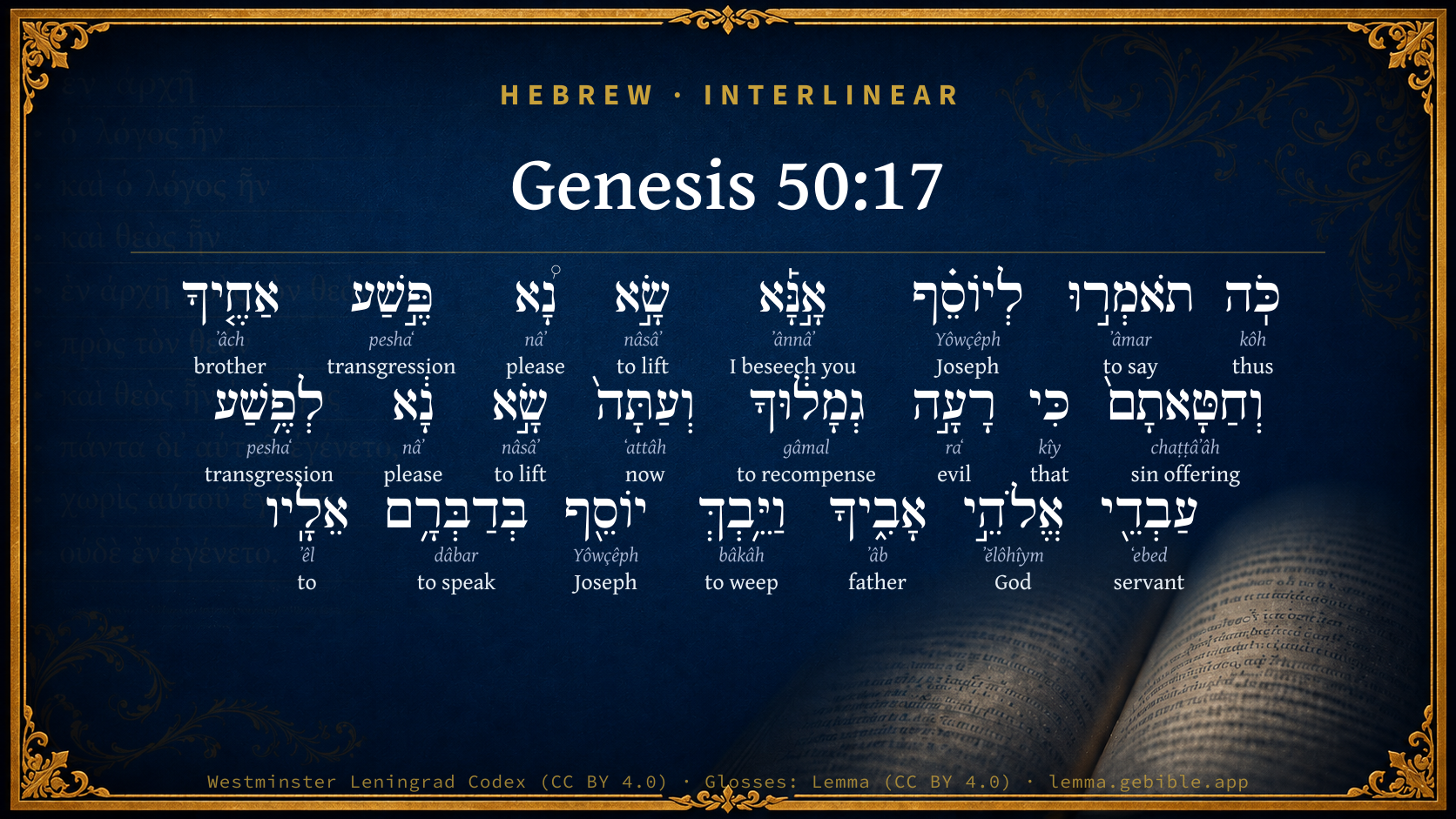
Genesis 50:17

Hebrew (Westminster Leningrad Codex) Genesis 50:17 appears in the Hebrew Old Testament. The text above is from the Westminster Leningrad Codex. Each word links to its Strong’s number, a concise gloss, and parsing drawn from the Open Scriptures Hebrew Bible morphology. Click any word for its full Brown-Driver-Briggs (BDB) entry.
Download image
Cite this verse

Genesis 50:17 (World English Bible). Public Domain. Lemma interlinear Bible study tool, https://lemma.gebible.app/v/genesis/50/17.

Show BibTeX & RIS
BibTeX
RIS
English Translation
"So you shall tell Joseph, 'Now please forgive the disobedience of your brothers, and their sin, because they did evil to you.' Now, please forgive the disobedience of the servants of the God of your father." Joseph wept when they spoke to him.
World English Bible · Public Domain
Highlights
  • 1 first appearance in the Hebrew Bible
Full analysis ↓
Download a study sheet

One document with this verse’s original text, its word-by-word gloss line, the meaning frame, cross-references with their text, attributed commentary, and full source and license credits — printable, and it pastes into notes with its structure intact.

This verse Autodidact and up

Study sheet (.html) Plain text (.txt)

A passage Seminary Student

Up to 50 verses in one chapter. A passage sheet keeps up to 6 commentary sources and 12 cross-references per verse, in the order this page ranks them, and says so on the sheet whenever that leaves anything out. Ask for a single verse and you get the Autodidact verse sheet above.

Everything on this page stays free to read, with no account — the sheet is a download of what is already on screen, not access to it.

Want to remove ads? Support Godless Engineer
Compare translations 3

The same verse in 3 English versions, stacked beneath the original-language interlinear above. Click any original word for its lexicon entry.

Each is an independent rendering of the whole verse — the interlinear is not word-aligned to these translations.

Highlighted words mark where these versions differ — a whole-verse word diff, not a word-by-word alignment.

  • World English Bible Public Domain
    "So you shall tell Joseph, 'Now please forgive the disobedience of your brothers, and their sin, because they did evil to you.' Now, please forgive the disobedience of the servants of the God of your father." Joseph wept when they spoke to him.
  • King James Version Public Domain
    So shall ye say unto Joseph, Forgive, I pray thee now, the trespass of thy brethren, and their sin; for they did unto thee evil: and now, we pray thee, forgive the trespass of the servants of the God of thy father. And Joseph wept when they spake unto him.
  • unfoldingWord Literal Text CC BY-SA 4.0
    ‘This you must say to Joseph: “I beg, please forgive the crime of your brothers and their sin, because they did evil to you.”’ So now, please forgive the crime of the servants of your father’s God.” And Joseph cried when they spoke to him.

unfoldingWord Literal Text — © unfoldingWord, licensed CC BY-SA 4.0. Word-aligned USFM3 via Door43 (git.door43.org/unfoldingWord/en_ult).

Versions to compare (up to 4)

3 of 4 selected

Show all 18 translations

Every available English version of this verse, each an independent rendering of the whole verse.

  • World English Bible Public Domain
    "So you shall tell Joseph, 'Now please forgive the disobedience of your brothers, and their sin, because they did evil to you.' Now, please forgive the disobedience of the servants of the God of your father." Joseph wept when they spoke to him.
  • Berean Standard Bible Public Domain
    ‘This is what you are to say to Joseph: I beg you, please forgive the transgression and sin of your brothers, for they did you wrong.’ So now, Joseph, please forgive the transgression of the servants of the God of your father.” When their message came to him, Joseph wept.
  • Majority Standard Bible Public Domain
    ‘This is what you are to say to Joseph: I beg you, please forgive the transgression and sin of your brothers, for they did you wrong.’ So now, Joseph, please forgive the transgression of the servants of the God of your father.” When their message came to him, Joseph wept.
  • King James Version Public Domain
    So shall ye say unto Joseph, Forgive, I pray thee now, the trespass of thy brethren, and their sin; for they did unto thee evil: and now, we pray thee, forgive the trespass of the servants of the God of thy father. And Joseph wept when they spake unto him.
  • American Standard Version (1901) Public Domain
    So shall ye say unto Joseph, Forgive, I pray thee now, the transgression of thy brethren, and their sin, for that they did unto thee evil. And now, we pray thee, forgive the transgression of the servants of the God of thy father. And Joseph wept when they spake unto him.
  • Revised Version (1885) Public Domain
    So shall ye say unto Joseph, Forgive, I pray thee now, the transgression of thy brethren, and their sin, for that they did unto thee evil: and now, we pray thee, forgive the transgression of the servants of the God of thy father. And Joseph wept when they spake unto him.
  • Geneva Bible (1599) Public Domain
    Thus shall ye say vnto Ioseph, Forgiue now, I pray thee, the trespasse of thy brethren, and their sinne: for they rewarded thee euil. And nowe, we pray thee, forgiue the trespasse of the seruants of thy fathers God. And Ioseph wept, when they spake vnto him.
  • Douay-Rheims (1899) Public Domain
    That we should say thus much to thee from him: I beseech thee to forget the wickedness of thy brethren, and the sin and malice they practiced against thee: we also pray thee, to forgive the servants of the God of thy father this wickedness. And when Joseph heard this, he wept.
  • Young's Literal Translation Public Domain
    Thus ye do say to Joseph, I pray thee, bear, I pray thee, with the transgression of thy brethren, and their sin, for they have done thee evil; and now, bear, we pray thee, with the transgression of the servants of the God of thy father;' and Joseph weepeth in their speaking unto him.
  • Literal Standard Version CC BY-SA 4.0
    Thus you say to Joseph: Ah, now, please bear with the transgression of your brothers and their sin, for they have done you evil; and now, please bear with the transgression of the servants of the God of your father”; and Joseph weeps in their speaking to him.
  • Unlocked Literal Bible CC BY-SA 4.0
    'Tell Joseph this, “Please forgive the transgression of your brothers and their sin when they did evil to you.”' Now please forgive the servants of the God of your father.” Joseph wept when they spoke to him.
  • unfoldingWord Literal Text CC BY-SA 4.0
    ‘This you must say to Joseph: “I beg, please forgive the crime of your brothers and their sin, because they did evil to you.”’ So now, please forgive the crime of the servants of your father’s God.” And Joseph cried when they spoke to him.
  • Darby Bible Public Domain
    Thus shall ye speak to Joseph: Oh forgive, I pray thee, the transgression of thy brethren, and their sin! for they did evil to thee. And now, we pray thee, forgive the transgression of the servants of the God of thy father. And Joseph wept when they spoke to him.
  • World Messianic Bible Public Domain
    ‘You shall tell Joseph, “Now please forgive the disobedience of your brothers, and their sin, because they did evil to you.”’ Now, please forgive the disobedience of the servants of the God of your father.” Joseph wept when they spoke to him.
  • Webster's Bible Public Domain
    So shall ye say to Joseph, Forgive, I pray thee now, the trespass of thy brethren, and their sin; for they did to thee evil: and now, we pray thee, forgive the trespass of the servants of the God of thy father. And Joseph wept when they spoke to him.
  • Free Bible Version CC BY-SA 4.0
    ‘This is what you are to tell Joseph: Forgive your brothers their sins, the bad things they did to you, treating you in such a nasty way.’ Now please forgive us our sins, we who are servants of the God of your father.” When Joseph received their message, he cried.
  • Bible in Basic English Public Domain
    You are to say to Joseph, Let the wrongdoing of your brothers be overlooked, and the evil they did to you: now, if it is your pleasure, let the sin of the servants of your father's God have forgiveness. And at these words, Joseph was overcome with weeping.
  • JPS Tanakh (1917) Public Domain
    So shall ye say unto Joseph: Forgive, I pray thee now, the transgression of thy brethren, and their sin, for that they did unto thee evil. And now, we pray thee, forgive the transgression of the servants of the God of thy father.' And Joseph wept when they spoke unto him.

Literal Standard Version (2020), Covenant Press — licensed CC BY-SA 4.0. Text via the HelloAO Bible API (eBible.org). Unlocked Literal Bible (unfoldingWord) — licensed CC BY-SA 4.0. Text via the HelloAO Bible API (eBible.org). unfoldingWord Literal Text — © unfoldingWord, licensed CC BY-SA 4.0. Word-aligned USFM3 via Door43 (git.door43.org/unfoldingWord/en_ult). Free Bible Version, Dr. Jonathan Gallagher — licensed CC BY-SA 4.0. Text via the HelloAO Bible API (eBible.org).

Word by word

More ways to search: Search by grammar → Find every occurrence → Compare this word →

Practice this passage: Drill this verse → Learn its vocabulary →

אָ֣נָּ֡א
ʼânnâʼ
H577
“I beseech you”
Particle, Exhortation
Part of Speech
Particle
Type
Exhortation
Full BDB Definition

Origin: apparent contracted from H160 and H4994

TWOT: 122

ah now! I/we beseech you, oh now!, pray now! (participle of entreaty usually followed by the imperative verb)
  1. כֹּֽה kôh H3541 “thus” Adverb
  2. תֹאמְר֣וּ ʼâmar H559 “to say” Verb, Qal, Imperfect, 2nd Person, Masculine, Plural
  3. לְיוֹסֵ֗ף Yôwçêph H3130 “to/for · Joseph” Preposition + Noun, Proper
  4. שָׂ֣א nâsâʼ H5375 “lift” Verb, Qal, Imperative, 2nd Person, Masculine, Singular
  5. נָ֠א nâʼ H4994 “please” Particle, Exhortation
  6. פֶּ֣שַׁע peshaʻ H6588 “transgression of” Noun, Common, Masculine, Singular, Construct
  7. אַחֶ֤יךָ ʼâch H251 “brothers · your” Noun, Common, Masculine, Plural, Construct + Suffix, Personal, 2nd Person, Masculine, Singular
  8. וְחַטָּאתָם֙ chaṭṭâʼâh H2403 “and · sin offering · their” Conjunction + Noun, Common, Feminine, Singular, Construct + Suffix, Personal, 3rd Person, Masculine, Plural
  9. כִּי kîy H3588 “that” Conjunction
  10. רָעָ֣ה raʻ H7451 “evil” Noun, Common, Feminine, Singular, Absolute
  11. גְמָל֔וּךָ gâmal H1580 “to recompense · you” Verb, Qal, Perfect, 3rd Person, Common, Plural + Suffix, Personal, 2nd Person, Masculine, Singular
  12. וְעַתָּה֙ ʻattâh H6258 “and · now” Conjunction + Adverb
  13. שָׂ֣א nâsâʼ H5375 “lift” Verb, Qal, Imperative, 2nd Person, Masculine, Singular
  14. נָ֔א nâʼ H4994 “please” Particle, Exhortation
  15. לְפֶ֥שַׁע peshaʻ H6588 “to/for · transgression of” Preposition + Noun, Common, Masculine, Singular, Construct
  16. עַבְדֵ֖י ʻebed H5650 “servants of” Noun, Common, Masculine, Plural, Construct
  17. אֱלֹהֵ֣י ʼĕlôhîym H430 “God(s) of” Noun, Common, Masculine, Plural, Construct
  18. אָבִ֑יךָ ʼâb H1 “father · your” Noun, Common, Masculine, Singular, Construct + Suffix, Personal, 2nd Person, Masculine, Singular
  19. וַיֵּ֥בְךְּ bâkâh H1058 “and · to weep” Conjunction + Verb, Qal, Sequential Imperfect, 3rd Person, Masculine, Singular
  20. יוֹסֵ֖ף Yôwçêph H3130 “Joseph” Noun, Proper
  21. בְּדַבְּרָ֥ם dâbar H1696 “in/at · to speak · them” Preposition + Verb, Piel, Infinitive Construct + Suffix, Personal, 3rd Person, Masculine, Plural
  22. אֵלָֽיו ʼêl H413 “to · him” Preposition + Suffix, Personal, 3rd Person, Masculine, Singular

About this verse

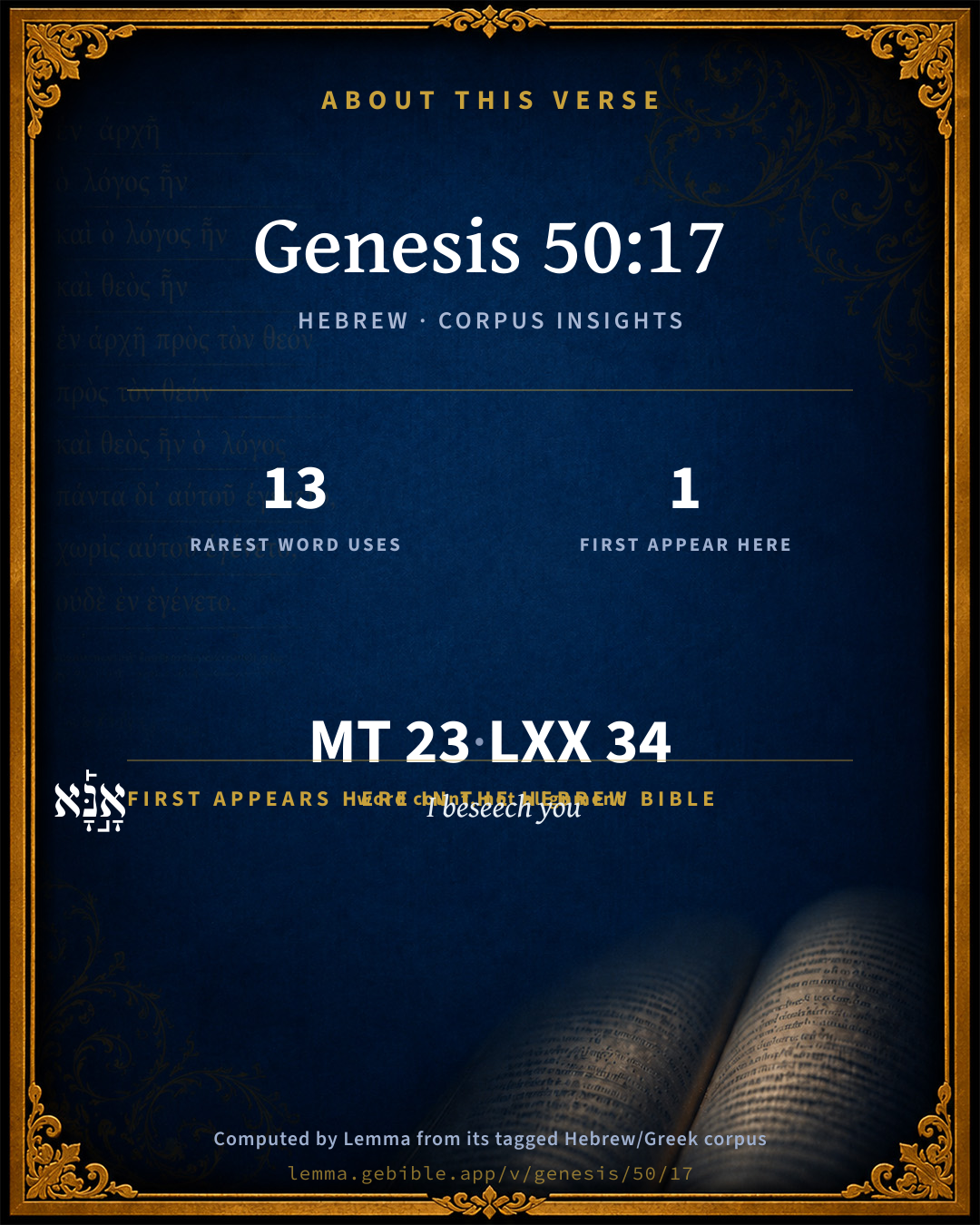
These counts appear in no published source. They are computed here, from the morphology-tagged text and Lemma’s own curated glosses. What Lemma adds →

23
words
19
distinct lemmas
Pentateuch
section

Notable vocabulary

The rarest word here is אָ֣נָּ֡א I beseech you H577 — appearing just 13 times in the whole Hebrew Bible.

First appearance in Scripture

This word makes its first canonical appearance in the Hebrew Bible here:

  • אָ֣נָּ֡א I beseech you H577

Shared distinctive vocabulary

אָ֣נָּ֡א I beseech you H577 occurs in 12 verses of the Hebrew Bible. Also found in:

Grammatical profile

  • 6 verbs
  • 10 nouns
  • 1 preposition
  • 1 conjunction
  • 2 adverbs
  • 3 particles

Verb forms

  • תֹאמְר֣וּ Qal · Imperfect
  • שָׂ֣א Qal · Imperative
  • גְמָל֔וּךָ Qal · Perfect
  • שָׂ֣א Qal · Imperative
  • וַיֵּ֥בְךְּ Qal · Sequential Imperfect
  • בְּדַבְּרָ֥ם Piel · Infinitive Construct

Repetition

Words recur within this verse — often emphatic in Hebrew:

  • לְיוֹסֵ֗ף Joseph H3130 ×2
  • שָׂ֣א to lift H5375 ×2
  • נָ֠א please H4994 ×2
  • פֶּ֣שַׁע transgression H6588 ×2

Hebrew & Septuagint length

In English translation the verse runs 43 words from the Hebrew and 41 from the Septuagint (LXX English) — closely comparable.

A rough comparison of the two English renderings, which tokenize alike — not a word-level alignment.

Word counts can differ between the Hebrew and the Greek without any difference in meaning — e.g. the Hebrew direct-object marker אֵת has no separate Greek word, and Greek often adds the article ὁ.

In the original languages it is 23 Hebrew tokens and 34 Greek tokens — but the two are counted differently (Hebrew bundles its prefixes and suffixes into one token; the Greek is in lemma form), so that isn’t a like-for-like length.

Cross-references

22

Topical passages linked to Genesis 50:17 in the Treasury of Scripture Knowledge — connected by theme and wording, ordered by reader-vote popularity; previews shown in the World English Bible.

  • Matthew 6:14–15 "For if you forgive men their trespasses, your heavenly Father will also forgive you.
  • Ephesians 4:32 And be kind to one another, tenderhearted, forgiving each other, just as God also in Christ forgave you.
  • Genesis 45:4–5 Joseph said to his brothers, "Come near to me, please." They came near. "He said, I am Joseph, your brother, whom you sold into Egypt.
  • Genesis 45:8 So now it wasn't you who sent me here, but God, and he has made me a father to Pharaoh, lord of all his house, and ruler over all the land of Egypt.
  • Genesis 49:25 Even by the God of your father, who will help you, By the Almighty, who will bless you, With blessings of heaven above, Blessings of the deep that lies below, Blessings of the breasts, and of the womb.
  • Psalms 21:11 For they intended evil against you. They plotted evil against you which cannot succeed.
  • Proverbs 28:13 He who conceals his sins doesn't prosper, But whoever confesses and renounces them finds mercy.
  • Luke 17:3–4 Be careful. If your brother sins against you, rebuke him. If he repents, forgive him.
  • Genesis 31:42 Unless the God of my father, the God of Abraham, and the fear of Isaac, had been with me, surely now you would have sent me away empty. God has seen my affliction and the labor of my hands, and rebuked you last night."
  • Genesis 42:21–24 They said one to another, "We are most assuredly guilty concerning our brother, in that we saw the distress of his soul, when he begged us, and we wouldn't listen. Therefore this distress has come on us."
  • Genesis 50:20 As for you, you meant evil against me, but God meant it for good, to bring to pass, as it is this day, to save many people alive.
  • Job 33:27–28 He sings before men, and says, 'I have sinned, and perverted that which was right, And it didn't profit me.
  • Matthew 6:12 Forgive us our debts, as we also forgive our debtors.
  • Matthew 10:42 Whoever gives one of these little ones just a cup of cold water to drink in the name of a disciple, most assuredly I tell you he will in no way lose his reward."
  • Matthew 18:35 So my heavenly Father will also do to you, if you don't each forgive your brother from your hearts for his misdeeds."
  • Matthew 25:40 "The King will answer them, 'Most assuredly I tell you, inasmuch as you did it to one of the least of these my brothers, you did it to me.'
  • Mark 10:41 When the ten heard it, they began to be indignant towards James and John.
  • Galatians 6:10 So then, as we have opportunity, let's do what is good toward all men, and especially toward those who are of the household of the faith.
  • Galatians 6:16 As many as walk by this rule, peace and mercy be on them, and on God's Israel.
  • Colossians 3:12–13 Put on therefore, as God's chosen ones, holy and beloved, a heart of compassion, kindness, lowliness, humility, and perseverance;
  • Philemon 1:8–20 Therefore, though I have all boldness in Christ to command you that which is appropriate,
  • James 5:16 Confess your offenses to one another, and pray one for another, that you may be healed. The effective, earnest prayer of a righteous man is powerfully effective.

Cross-references courtesy of OpenBible.info (CC BY 4.0).

Hebrew and Greek witnesses Masoretic Hebrew ↔ Greek Septuagint

The same verse in the two great witnesses to the Old Testament, shown verse-for-verse.

These are two independent witnesses, not word-aligned to each other, and the Septuagint is shown in lemma (dictionary) form.

Hebrew Genesis 50:17 Masoretic · Westminster Leningrad Codex

כֹּֽה תֹאמְר֣וּ לְיוֹסֵ֗ף אָ֣נָּ֡א שָׂ֣א נָ֠א פֶּ֣שַׁע אַחֶ֤יךָ וְחַטָּאתָם֙ כִּי רָעָ֣ה גְמָל֔וּךָ וְעַתָּה֙ שָׂ֣א נָ֔א לְפֶ֥שַׁע עַבְדֵ֖י אֱלֹהֵ֣י אָבִ֑יךָ וַיֵּ֥בְךְּ יוֹסֵ֖ף בְּדַבְּרָ֥ם אֵלָֽיו

"So you shall tell Joseph, 'Now please forgive the disobedience of your brothers, and their sin, because they did evil to you.' Now, please forgive the disobedience of the servants of the God of your father." Joseph wept when they spoke to him.

World English Bible · Public Domain

Greek LXX Genesis 50:17 Septuagint · lemma form

οὕτως εἶπον ιωσηφ ἀποἵημι αὐτός ὁ ἀδικία καί ὁ ἁμαρτία αὐτός ὅτι πονηρός σύ ἐνδεικνύω καί νῦν δέχομαι ὁ ἀδικία ὁ θεράπων ὁ θεός ὁ πατήρ σύ καί κλαίω ιωσηφ λαλέω αὐτός πρός αὐτός

Thus say you⌃ to Joseph, Forgive them their injustice and their sin, forasmuch as they have done you evil; and now pardon the injustice of the servants of the God of your father. And Joseph wept while they spoke to him.

LXX2012 (modern English Septuagint) · Public Domain

Hebrew: Westminster Leningrad Codex (CC BY 4.0). Greek: Septuagint (public domain); English from LXX2012 (modern English Septuagint) (Public Domain). How the Septuagint differs from the Hebrew →

Targum (Aramaic paraphrase)

2

The Targum is the ancient Jewish Aramaic paraphrase of the Hebrew Scriptures — an interpretive translation, not the Hebrew text itself. Onkelos (literal) and Pseudo-Jonathan (expansive) render the Torah, and Jonathan the Prophets. Coverage is partial: where no permissively-licensed English translation exists for a verse, only the Aramaic is shown. This is verse-level text, not a word-by-word alignment to the Hebrew.

  1. Targum Onkelos Torah (Genesis–Deuteronomy)
    כְּדֵין תֵּימְרוּן לְיוֹסֵף בְּבָעוּ שְׁבוֹק כְּעַן לְחוֹבָא אַחָיךְ וְלַחֲטָאֵהוֹן אֲרֵי בִישְׁתָא גְמָלוּךְ וּכְעַן שְׁבוֹק כְּעַן לְחוֹבָא עַבְדֵי אֱלָהָא דְאָבוּךְ וּבְכָא יוֹסֵף בְּמַלָלוּתְהוֹן עִמֵּהּ

    (no public-domain English translation for this verse)

    Targum Onkelos — Aramaic: “Onkelos Genesis” (public domain); “Onkelos Exodus” (public domain); “Onkelos Leviticus” (public domain); “Onkelos Numbers” (public domain); “Onkelos Deuteronomy” (public domain). English: “Sefaria Community Translation” (CC0 1.0 (public-domain dedication)); “J.W. Etheridge. The Targums of Onkelos and Jonathan Ben Uzziel on the Pentateuch. London: Longmans, Green, 1862” (public domain). Text via Sefaria.

  2. Targum Pseudo-Jonathan Torah (Genesis–Deuteronomy)
    כִּדְנָא תֵימְרוּן לְיוֹסֵף בְּמָטוּ שְׁבוֹק כְּדוֹן לְחוֹבֵי אָחָךְ וּלְחַטָאֵיהוֹן אֲרוּם בִּישָׁא גָמְלוּ יָתָךְ וּכְדוֹן שְׁבוֹק בְּבָעוּ לְחוֹבֵי עַבְדֵי אֱלָהָא דְאָבוּךְ וּבְכָא יוֹסֵף בְּמַלָלוּתְהוֹן עִמֵיהּ

    Thus shall you say to Joseph, Forgive now the guilt of thy brethren and their sin, for they committed evil against thee; but forgive, I beseech thee, the guilt of the servants of the God of thy father. And Joseph wept when they spake with him.

    Targum Pseudo-Jonathan — Aramaic: “Targum Jonathan on Genesis” (public domain); “Targum Jonathan on Exodus” (public domain); “Targum Jonathan on Leviticus” (public domain); “Targum Jonathan on Numbers” (public domain); “Targum Jonathan on Deuteronomy” (public domain). English: “The Targum of Jonathan ben Uzziel, trans. J. W. Etheridge, London, 1862” (public domain). Text via Sefaria.

Commentary

Notes on Genesis 50:17 from classic Christian and Jewish commentators (each source and its license shown beneath its notes). The classic Christian expositions comment on the surrounding passage and are grouped to its opening verse, so a note may address several verses; the Jewish commentaries on the Tanakh (Rashi and others) are per-verse, so they appear only where the commentator wrote on this verse.

Lemma curates 59 commentaries, every one of them public domain or Creative Commons licensed, each selected and text-cleaned for this edition rather than reprinted as found. About our sources →

Trapp's Complete Commentary

John Trapp

Gen 50:17 So shall ye say unto Joseph, Forgive, I pray thee now, the trespass of thy brethren, and their sin; for they did unto thee evil: and now, we pray thee, forgive the trespass of the servants of the God of thy father. And Joseph wept when they spake unto him.

Ver. 17. Forgive, I pray thee now.] In this case a man is bound, not only to let fall all wrath and desire of revenge, but to make a solemn profession of hearty forgiveness. {Luk 17:4} If the wrongdoer say, "I repent," you must say, "I forgive," as ever you hope to be forgiven of God. Our Saviour {Luk 11:4} seems to make our forgiving our trespassers the intervenient cause - that which they call, sine qua non - of God’s forgiving us. Mark this, lest we be constrained to do, as Latimer reports of some in his days, that being not willing to forgive their enemies, would not say their pater noster, lest they should therein curse themselves, but instead thereof, took their lady psalter in hand, because they were persuaded that, by that they might obtain forgiveness of favour [ ex gratis] without the putting of so hard a condition as forgiveness of their enemies.

For they did unto thee evil.] Joseph had long ago seen their sorrow; never, till now, heard their confession, and is abundantly satisfied. Think the same of God. Do but confess, and he must forgive, upon his faithfulness. {1Jn 1:9} In the courts of men, it is the safest plea, saith Quintilian, to cry, Non feci; not so here. "Take away the iniquity of thy servant," saith David and to prove himself so, he adds, "For I have done foolishly." {2Sa 24:10} Acknowledge the debt, and God will forthwith cross the book.

Forgive the trespass of the servants of the God, &c.] Nothing should more persuade to unity than religion. {Eph 4:3-5} Others may cleave together, as the clay in Nebuchadnezzar’s image, but the saints only incorporate into each other.

John Trapp, A Commentary or Exposition upon All the Books of the Old and New Testament (1647–1656) — public domain. Text from a community e-Sword module.

Joseph Benson's Commentary

Gen 50:17. Forgive the trespass of the servants of the God of thy father — Not only children of the same Jacob, but worshippers of the same Jehovah. Though we must be ready to forgive all that injure us, yet we must especially take heed of bearing malice toward any that are the servants of the God of our father; those we should always treat with a peculiar tenderness, for we and they have the same Master. He wept when they spake to him — These were tears of sorrow for their suspicion of him, and tears of tenderness upon their submission.

Joseph Benson's Commentary on the Old and New Testaments (1811–1818) — public domain. Text from a community e-Sword module.

Geneva Bible (1599)

Geneva Bible translators

Meaning, that they which have one God should be joined in most sure love.

Or, the messenger.

Geneva Bible (1599) marginal notes — public domain. Text via Bolls.life.

Adam Clarke's Commentary

Verse 17. The servants of the God of thy father.] These words were wonderfully well chosen, and spoken in the most forcible manner to Joseph's piety and filial affection. No wonder then that he wept when they spake to him.

Adam Clarke's Commentary on the Bible (1810–1826) — public domain. Text from a community e-Sword/MySword module.

John Calvin's Commentaries

17. Forgive, I pray thee now. They do not dissemble the fact that they had grievously sinned; and they are so far from extenuating their fault, that they freely heap up words in charging themselves with guilt. They do not, therefore, ask that pardon should be granted them as if the offense were light: but they place in opposition to the atrocity of their crime, first, the authority of their father, and then the sacred name of God. Their confession would have been worthy of commendation, had they proceeded directly, and without tortuous contrivances, to appease their brother. Now, since they have drawn from the fountain of piety the instruction that it is right for sin to be remitted to the servants of God; we may receive it as a common exhortation, that if we have been injured by the members of the Church, we must not be too rigid and immovable in pardoning the offense. This humanity indeed is generally enjoined upon us towards all men: but when the bond of religion is superadded, we are harder than iron, if we are not inclined to the exercise of compassion. And we must observe, that they expressly mention the God of Jacob: because the peculiar faith and worship by which they were distinguished from the rest of the nations, ought to unite them with each other in a closer bond: as if God, who had adopted that family, stood forth in the midst of them as engaged to produce reconciliation.

And Joseph wept when they spake unto him. It cannot be ascertained with certainty from the words of Moses, whether the brethren of Joseph were present, and were speaking, at the time he wept. Some interpreters imagine that a part was here acted designedly; so that when the mind of Joseph had been sounded by others, the brethren, soon afterwards, came in, during the discourse. I rather incline to a different opinion; namely, that, when he knew, from the messengers, that their minds were tormented, and they were troubling themselves in vain, he was moved with sympathy towards them. Then, having sent for them, he set them free from all care and fear; and their speech, when they themselves were deprecating his anger, drew forth his tears. Moreover, by thus affectionately weeping over the sorrow and anxiety of his brethren, he affords us a remarkable example of compassion. But if we have an arduous conflict with the impetuosity of an angry temper, or the obstinacy of a disposition to hatred, we must pray to the Lord for a spirit of meekness, the force of which manifests itself not less effectually, at this day, in the members of Christ, than formerly in Joseph.

John Calvin's Commentaries (1540-1563) — public domain. Text from the Calvin Translation Society English edition (1840s-50s) via the Christian Classics Ethereal Library (ccel.org). Calvin's coverage is partial (roughly two-thirds of the Bible); uncommented books and verses are honest gaps, never fabricated. The 19th-century editor's footnotes and remarks are omitted so the notes are faithfully Calvin's own voice.

The Cambridge Bible for Schools and Colleges

gen. ed. J. J. S. Perowne

17. the God of thy father] Cf. Gen_49:26. They call themselves “the servants of the God of thy father,” as if it constituted a stronger appeal than “the sons of thy father.” They and Joseph serve one God.

Joseph wept] Cf. note on Gen_45:1.

The Cambridge Bible for Schools and Colleges (gen. ed. J. J. S. Perowne; Cambridge University Press, 1878–1918) — public domain. Text from a community e-Sword module.

John Gill's Exposition

And his brethren also went,.... The messengers being returned to them, and acquainting them with what Joseph had said, they took courage and went from Goshen to Joseph's house or palace, be it where it may:

and fell down before his face; in an humble suppliant manner:

and they said, behold, we be thy servants; they were content to be so, would he but forgive their sin, and not resent their ill behaviour to him; thus they further fulfilled his dream of the eleven stars making obeisance to him, Gen 37:9.

John Gill's Exposition of the Whole Bible (1746–1763) — public domain (CC PDM 1.0). Text via the HelloAO Bible API.

Haydock's Catholic Bible Commentary

Wept, that they should entertain no doubts respecting the reconciliation, which had taken place seventeen years before. (Haydock)

George Leo Haydock (1774–1849), Haydock's Catholic Family Bible and Commentary, 1859 edition — public domain. Excludes Psalms (Douay-Rheims chapter numbering differs from Protestant) and Deuterocanonical books (Catholic canon only).

Matthew Poole's English Annotations

The God of thy father, for whose sake pardon those that join with thee in his worship.

Joseph wept; partly in compassion to their fear and trouble; and partly because they still retained a diffidence in his kindness, after all his great and real demonstrations of it.

Matthew Poole's English Annotations on the Holy Bible (1683–1685) — public domain. Text from a community e-Sword/MySword module.

Whedon's Commentary on the Bible

Daniel D. Whedon

17. Forgive the trespass of the servants of the God of thy father — “All the arguments that would touch Joseph are woven into a few words with great pathos and power. They cast themselves absolutely upon his mercy, and call up before him his venerated father, and his father’s God, whose servants they also are. Joseph replied in a way to scatter all doubt and soothe all fear — he wept. At first he made no answer in words, but his tears were richer to them than speech. It was the golden silence, that cannot, from very fulness, speak.” — Newhall.

Daniel D. Whedon (gen. ed.), Commentary on the Old and New Testaments (1874–1909) — public domain. Text from a community e-Sword module.

John Wesley's Explanatory Notes

We are the servants of the God of thy father - Not only children of the same Jacob, but worshippers of the same Jehovah. Though we must be ready to forgive all that injure us, yet we must especially take heed of bearing malice towards any that are the servants of the God of our father; those we should always treat with a peculiar tenderness, for we and they have the same master. He wept when they spake to him - These were tears of sorrow for their suspicion of him, and tears of tenderness upon their submission.

John Wesley, Explanatory Notes Upon the Whole Bible (1754–1765) — public domain. Text via the GEBible commentary corpus.

Rashi

Rabbi Shlomo Yitzchaki (Rashi)

שא נא לפשע עבדי אלהי אביך NOW, PRAY, FORGIVE THE TRESSPASS OF THE SERVANTS OF THE GOD OF THY FATHER — After having repeated to Joseph the words which his brothers stated had been their fathers message, “forgive thy brothers’ sin” the messengers were to add as a petition of the brothers “Now, pray etc.”, meaning “If you will not forgive them although they are your brothers, forgive them because they are the servants of the God of thy father”, implying though your father be dead, his God still lives and they are his servants.

Rashi on the Tanakh — English translations: “The Judaica Press complete Tanach with Rashi, translated by A. J. Rosenberg” (CC BY 4.0); “Pentateuch with Rashi's commentary by M. Rosenbaum and A.M. Silbermann, 1929-1934” (public domain); “The Metsudah Tanach series, Lakewood, N.J” (CC BY 4.0); and “The Book of Joshua, Metsudah Publications, 1997” (CC BY 4.0). Text via Sefaria.

Lesson kit

Teaching starters — assembled from the data on this page, not authored interpretation. Every prompt links to the verse data it draws on. Edit before teaching.

Genesis, in the Pentateuch, opens this verse with 23 words (19 distinct Hebrew lemmas). Its most distinctive word is ʼânnâʼ (“I beseech you”). A historical commentator’s framing appears above. Read the whole chapter for the surrounding context.

Discussion questions

  1. What does “I beseech you” (ʼânnâʼ) contribute to the verse as a whole?
  2. This is the first place “I beseech you” appears in Scripture (first appears here). What does its debut here establish?
  3. How does Exodus 32:31, which shares the word «I beseech you», read alongside this verse?
  4. What does the repetition of “Joseph” (2× in this one verse) do in this verse?
  5. The translations on this page render this verse differently — a whole-verse word diff, not a word-by-word alignment. What might account for the different wordings?
  6. «תֹאמְר֣וּ» is a Qal Imperfect verb. How does that grammatical form shape the action described?
  7. Compare how Trapp's Complete Commentary and Joseph Benson's Commentary read this verse. Where do they agree or differ?

Things to notice

Reading settings

Reading text

Shown beneath each verse's original-language words.

Old Testament
Old Testament edition

Read the OT as the Masoretic Hebrew (MT) or the Greek Septuagint (LXX).

English shown for the Greek Septuagint (in the Hebrew ↔ Greek comparison).

Comparing translations? Open the Compare panel on any verse page to stack up to four side by side.