
1 Samuel 14:12

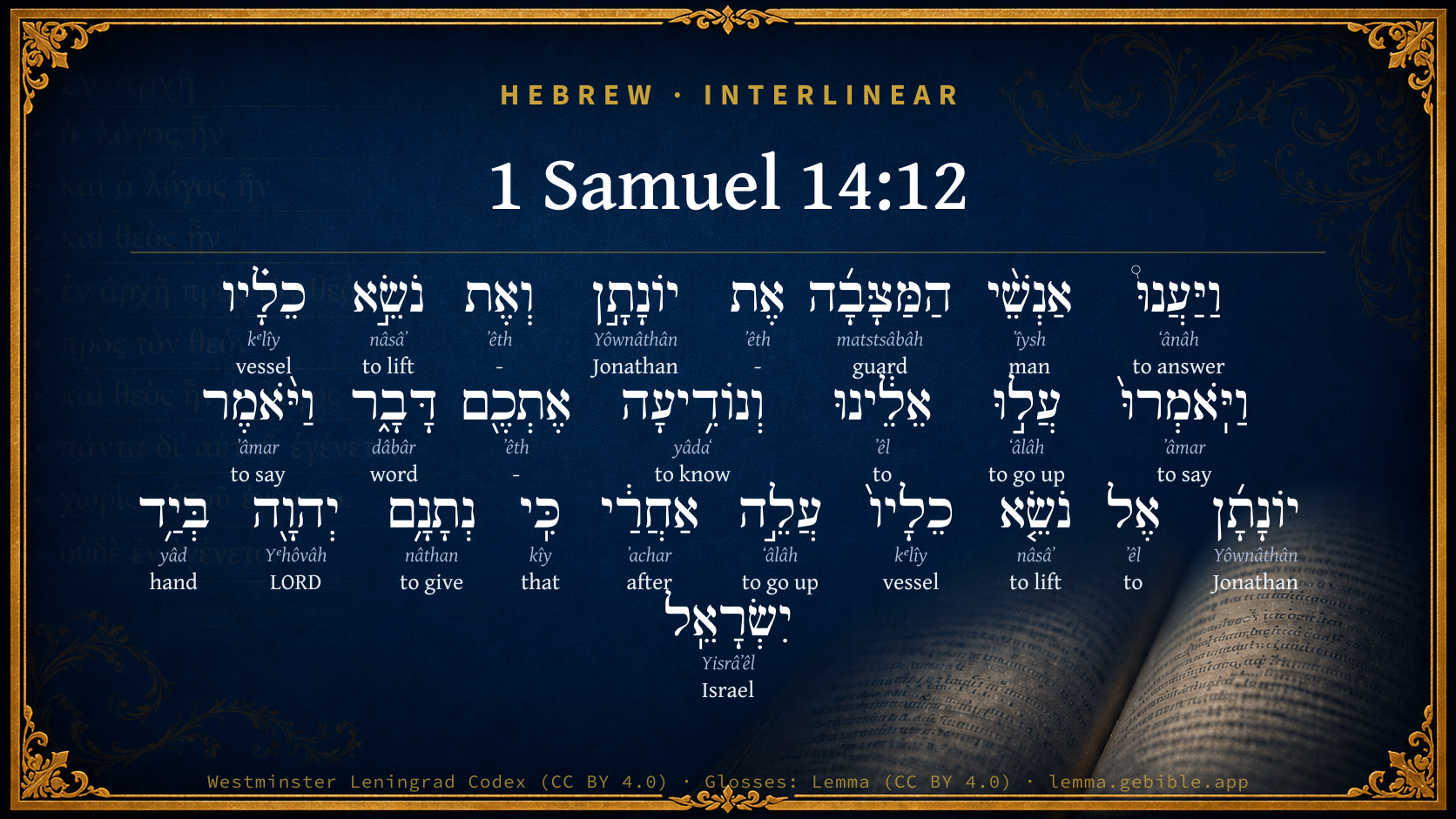
Hebrew (Westminster Leningrad Codex) 1 Samuel 14:12 appears in the Hebrew Old Testament. The text above is from the Westminster Leningrad Codex. Each word links to its Strong’s number, a concise gloss, and parsing drawn from the Open Scriptures Hebrew Bible morphology. Click any word for its full Brown-Driver-Briggs (BDB) entry.
Download image
Cite this verse

1 Samuel 14:12 (World English Bible). Public Domain. Lemma interlinear Bible study tool, https://lemma.gebible.app/v/1-samuel/14/12.

Show BibTeX & RIS
BibTeX
RIS
English Translation
The men of the garrison answered Jonathan and his armor bearer, and said, Come up to us, and we will show you a thing. Jonathan said to his armor bearer, Come up after me; for Yahweh has delivered them into the hand of Israel.
World English Bible · Public Domain
Highlights
  • 1 first appearance in the Hebrew Bible
Full analysis ↓
Download a study sheet

One document with this verse’s original text, its word-by-word gloss line, the meaning frame, cross-references with their text, attributed commentary, and full source and license credits — printable, and it pastes into notes with its structure intact.

This verse Autodidact and up

Study sheet (.html) Plain text (.txt)

A passage Seminary Student

Up to 50 verses in one chapter. A passage sheet keeps up to 6 commentary sources and 12 cross-references per verse, in the order this page ranks them, and says so on the sheet whenever that leaves anything out. Ask for a single verse and you get the Autodidact verse sheet above.

Everything on this page stays free to read, with no account — the sheet is a download of what is already on screen, not access to it.

Want to remove ads? Support Godless Engineer
Compare translations 3

The same verse in 3 English versions, stacked beneath the original-language interlinear above. Click any original word for its lexicon entry.

Each is an independent rendering of the whole verse — the interlinear is not word-aligned to these translations.

Highlighted words mark where these versions differ — a whole-verse word diff, not a word-by-word alignment.

  • World English Bible Public Domain
    The men of the garrison answered Jonathan and his armor bearer, and said, Come up to us, and we will show you a thing. Jonathan said to his armor bearer, Come up after me; for Yahweh has delivered them into the hand of Israel.
  • King James Version Public Domain
    And the men of the garrison answered Jonathan and his armourbearer, and said, Come up to us, and we will show you a thing. And Jonathan said unto his armourbearer, Come up after me: for the LORD hath delivered them into the hand of Israel.
  • unfoldingWord Literal Text CC BY-SA 4.0
    And the men of the garrison answered Jonathan and the carrier of his equipment and said, “Come up to us, and let us make you know a thing.” And Jonathan said to the carrier of his equipment, “Come up after me, for Yahweh has given them into the hand of Israel.”

unfoldingWord Literal Text — © unfoldingWord, licensed CC BY-SA 4.0. Word-aligned USFM3 via Door43 (git.door43.org/unfoldingWord/en_ult).

Versions to compare (up to 4)

3 of 4 selected

Show all 18 translations

Every available English version of this verse, each an independent rendering of the whole verse.

  • World English Bible Public Domain
    The men of the garrison answered Jonathan and his armor bearer, and said, Come up to us, and we will show you a thing. Jonathan said to his armor bearer, Come up after me; for Yahweh has delivered them into the hand of Israel.
  • Berean Standard Bible Public Domain
    So the men of the outpost called out to Jonathan and his armor-bearer, “Come on up, and we will teach you a lesson!” “Follow me,” Jonathan told his armor-bearer, “for the LORD has delivered them into the hand of Israel.”
  • Majority Standard Bible Public Domain
    So the men of the outpost called out to Jonathan and his armor-bearer, “Come on up, and we will teach you a lesson!” “Follow me,” Jonathan told his armor-bearer, “for the LORD has delivered them into the hand of Israel.”
  • King James Version Public Domain
    And the men of the garrison answered Jonathan and his armourbearer, and said, Come up to us, and we will show you a thing. And Jonathan said unto his armourbearer, Come up after me: for the LORD hath delivered them into the hand of Israel.
  • American Standard Version (1901) Public Domain
    And the men of the garrison answered Jonathan and his armorbearer, and said, Come up to us, and we will show you a thing. And Jonathan said unto his armorbearer, Come up after me; for Jehovah hath delivered them into the hand of Israel.
  • Revised Version (1885) Public Domain
    And the men of the garrison answered Jonathan and his armourbearer, and said, Come up to us, and we will shew you a thing. And Jonathan said unto his armourbearer, Come up after me: for the LORD hath delivered them into the hand of Israel.
  • Geneva Bible (1599) Public Domain
    And the men of the garison answered Ionathan, and his armour bearer, and said, Come vp to vs: for we will shewe you a thing. Then Ionathan said vnto his armour bearer, Come vp after me: for the Lord hath deliuered them into the hand of Israel.
  • Douay-Rheims (1899) Public Domain
    And the men of the garrison spoke to Jonathan, and to his armourbearer, and said: Come up to us, and we will shew you a thing. And Jonathan said to his armourbearer: Let us go up, follow me: for the Lord hath delivered them into the hands of I srael.
  • Young's Literal Translation Public Domain
    And the men of the station answer Jonathan, and the bearer of his weapons, and say, `Come up unto us, and we cause you to know something.' And Jonathan saith unto the bearer of his weapons, `Come up after me, for Jehovah hath given them into the hand of Israel.'
  • Literal Standard Version CC BY-SA 4.0
    And the men of the station answer Jonathan, and the bearer of his weapons, and say, “Come up to us, and we cause you to know something.” And Jonathan says to the bearer of his weapons, “Come up after me, for YHWH has given them into the hand of Israel.”
  • Unlocked Literal Bible CC BY-SA 4.0
    Then the men of the garrison called to Jonathan and his armor bearer, and said, “Come up to us, and we will show you something.” Jonathan said to his armor bearer, “Follow after me, because Yahweh has given them into the hand of Israel.”
  • unfoldingWord Literal Text CC BY-SA 4.0
    And the men of the garrison answered Jonathan and the carrier of his equipment and said, “Come up to us, and let us make you know a thing.” And Jonathan said to the carrier of his equipment, “Come up after me, for Yahweh has given them into the hand of Israel.”
  • Darby Bible Public Domain
    And the men of the garrison answered Jonathan and his armour-bearer and said, Come up to us, and we will shew you something. And Jonathan said to his armour-bearer, Come up after me; for Jehovah has delivered them into the hand of Israel.
  • World Messianic Bible Public Domain
    The men of the garrison answered Jonathan and his armor bearer, and said, “Come up to us, and we will show you something!” Jonathan said to his armor bearer, “Come up after me, for the LORD has delivered them into the hand of Israel.”
  • Webster's Bible Public Domain
    And the men of the garrison answered Jonathan and his armor-bearer, and said, Come up to us, and we will show you a thing. And Jonathan said to his armor-bearer, Come up after me: for the LORD hath delivered them into the hand of Israel.
  • Free Bible Version CC BY-SA 4.0
    The men from the garrison called down to Jonathan and his armor-bearer, “Come up here, and we'll teach you a thing or two!” “Follow me up,” Jonathan told his armor-bearer, “for the Lord has handed them over to Israel.”
  • Bible in Basic English Public Domain
    And the armed men of the force gave Jonathan and his servant their answer, saying, Come up here to us, and we will let you see something. Then Jonathan said to his servant, Come up after me: for the Lord has given them up into the hands of Israel.
  • JPS Tanakh (1917) Public Domain
    And the men of the garrison spoke to Jonathan and his armour-bearer, and said: 'Come up to us, and we will show you a thing.' And Jonathan said unto his armour-bearer: 'Come up after me; for the LORD hath delivered them into the hand of Israel.'

Literal Standard Version (2020), Covenant Press — licensed CC BY-SA 4.0. Text via the HelloAO Bible API (eBible.org). Unlocked Literal Bible (unfoldingWord) — licensed CC BY-SA 4.0. Text via the HelloAO Bible API (eBible.org). unfoldingWord Literal Text — © unfoldingWord, licensed CC BY-SA 4.0. Word-aligned USFM3 via Door43 (git.door43.org/unfoldingWord/en_ult). Free Bible Version, Dr. Jonathan Gallagher — licensed CC BY-SA 4.0. Text via the HelloAO Bible API (eBible.org).

Word by word

More ways to search: Search by grammar → Find every occurrence → Compare this word →

Practice this passage: Drill this verse → Learn its vocabulary →

הַמַּצָּבָ֜ה
matstsâbâh
H4675
“the · guard”
Particle, Definite Article + Noun, Common, Feminine, Singular, Absolute
Part of Speech
Particle + Noun
Type
Common
Gender
Feminine
Number
Singular
State
Absolute
Full BDB Definition

Origin: from H4673

TWOT: 1398f

guard, watch, army
  1. וַיַּעֲנוּ֩ ʻânâh H6030 “and · to answer” Conjunction + Verb, Qal, Sequential Imperfect, 3rd Person, Masculine, Plural
  2. אַנְשֵׁ֨י ʼîysh H376 “men of” Noun, Common, Masculine, Plural, Construct
  3. אֶת ʼêth H853 “-” Particle, Direct Object
  4. יוֹנָתָ֣ן Yôwnâthân H3129 “Jonathan” Noun, Proper
  5. וְאֶת ʼêth H853 “and · -” Conjunction + Particle, Direct Object
  6. נֹשֵׂ֣א nâsâʼ H5375 “lifting” Verb, Qal, Participle Active, Masculine, Singular, Construct
  7. כֵלָ֗יו kᵉlîy H3627 “vessels · his” Noun, Common, Masculine, Plural, Construct + Suffix, Personal, 3rd Person, Masculine, Singular
  8. וַיֹּֽאמְרוּ֙ ʼâmar H559 “and · to say” Conjunction + Verb, Qal, Sequential Imperfect, 3rd Person, Masculine, Plural
  9. עֲל֣וּ ʻâlâh H5927 “go up” Verb, Qal, Imperative, 2nd Person, Masculine, Plural
  10. אֵלֵ֔ינוּ ʼêl H413 “to · us” Preposition + Suffix, Personal, 1st Person, Common, Plural
  11. וְנוֹדִ֥יעָה yâdaʻ H3045 “and · to know” Conjunction + Verb, Hiphil, Cohortative, 1st Person, Common, Plural
  12. אֶתְכֶ֖ם ʼêth H853 “- · you” Particle, Direct Object + Suffix, Personal, 2nd Person, Masculine, Plural
  13. דָּבָ֑ר dâbâr H1697 “word” Noun, Common, Masculine, Singular, Absolute
  14. וַיֹּ֨אמֶר ʼâmar H559 “and · to say” Conjunction + Verb, Qal, Sequential Imperfect, 3rd Person, Masculine, Singular
  15. יוֹנָתָ֜ן Yôwnâthân H3129 “Jonathan” Noun, Proper
  16. אֶל ʼêl H413 “to” Preposition
  17. נֹשֵׂ֤א nâsâʼ H5375 “lifting” Verb, Qal, Participle Active, Masculine, Singular, Construct
  18. כֵלָיו֙ kᵉlîy H3627 “vessels · his” Noun, Common, Masculine, Plural, Construct + Suffix, Personal, 3rd Person, Masculine, Singular
  19. עֲלֵ֣ה ʻâlâh H5927 “go up” Verb, Qal, Imperative, 2nd Person, Masculine, Singular
  20. אַחֲרַ֔י ʼachar H310 “after · me” Preposition + Suffix, Personal, 1st Person, Common, Singular
  21. כִּֽי kîy H3588 “that” Conjunction
  22. נְתָנָ֥ם nâthan H5414 “to give · them” Verb, Qal, Perfect, 3rd Person, Masculine, Singular + Suffix, Personal, 3rd Person, Masculine, Plural
  23. יְהוָ֖ה Yᵉhôvâh H3068 “LORD” Noun, Proper
  24. בְּיַ֥ד yâd H3027 “in/at · hand of” Preposition + Noun, Common, Both, Singular, Construct
  25. יִשְׂרָאֵֽל Yisrâʼêl H3478 “Israel” Noun, Proper

About this verse

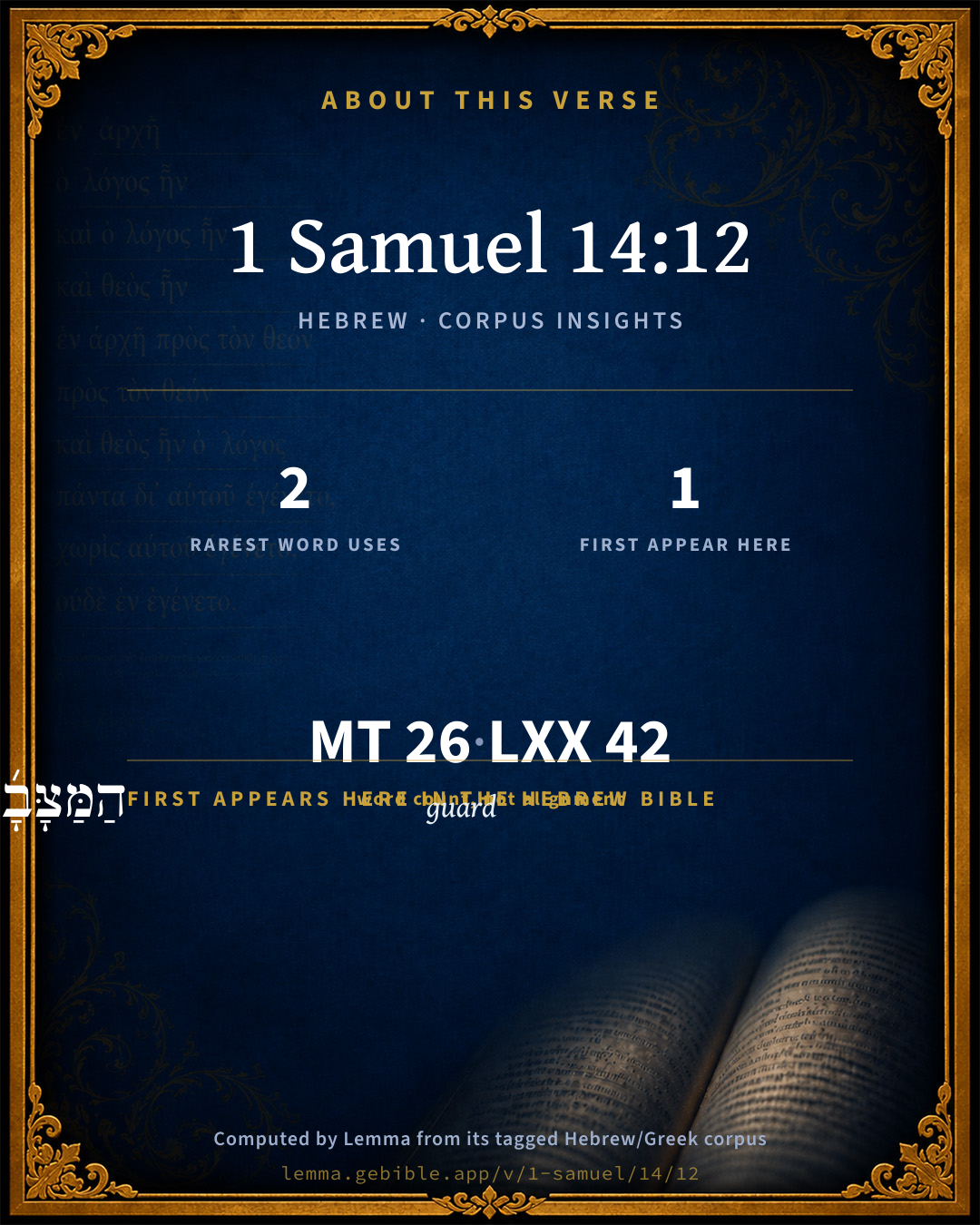
These counts appear in no published source. They are computed here, from the morphology-tagged text and Lemma’s own curated glosses. What Lemma adds →

26
words
18
distinct lemmas
Historical
section

Notable vocabulary

The rarest word here is הַמַּצָּבָ֜ה guard H4675 — appearing just 2 times in the whole Hebrew Bible.

First appearance in Scripture

This word makes its first canonical appearance in the Hebrew Bible here:

  • הַמַּצָּבָ֜ה guard H4675

Shared distinctive vocabulary

הַמַּצָּבָ֜ה guard H4675 occurs in 2 verses of the Hebrew Bible. Also found in:

Grammatical profile

  • 9 verbs
  • 10 nouns
  • 3 prepositions
  • 1 conjunction
  • 3 particles

Verb forms

  • וַיַּעֲנוּ֩ Qal · Sequential Imperfect
  • נֹשֵׂ֣א Qal · Participle Active
  • וַיֹּֽאמְרוּ֙ Qal · Sequential Imperfect
  • עֲל֣וּ Qal · Imperative
  • וְנוֹדִ֥יעָה Hiphil · Cohortative
  • וַיֹּ֨אמֶר Qal · Sequential Imperfect
  • נֹשֵׂ֤א Qal · Participle Active
  • עֲלֵ֣ה Qal · Imperative
  • נְתָנָ֥ם Qal · Perfect

Repetition

Words recur within this verse — often emphatic in Hebrew:

  • יוֹנָתָ֣ן Jonathan H3129 ×2
  • נֹשֵׂ֣א to lift H5375 ×2
  • כֵלָ֗יו vessel H3627 ×2
  • וַיֹּֽאמְרוּ֙ to say H559 ×2
  • עֲל֣וּ to go up H5927 ×2
  • אֵלֵ֔ינוּ to H413 ×2

Hebrew & Septuagint length

In English translation the verse runs 44 words from the Hebrew and 44 from the Septuagint (LXX English) — the same length.

A rough comparison of the two English renderings, which tokenize alike — not a word-level alignment.

Word counts can differ between the Hebrew and the Greek without any difference in meaning — e.g. the Hebrew direct-object marker אֵת has no separate Greek word, and Greek often adds the article ὁ.

In the original languages it is 26 Hebrew tokens and 42 Greek tokens — but the two are counted differently (Hebrew bundles its prefixes and suffixes into one token; the Greek is in lemma form), so that isn’t a like-for-like length.

Cross-references

10

Topical passages linked to 1 Samuel 14:12 in the Treasury of Scripture Knowledge — connected by theme and wording, ordered by reader-vote popularity; previews shown in the World English Bible.

  • 1 Samuel 17:43–44 The Philistine said to David, Am I a dog, that you come to me with sticks? The Philistine cursed David by his gods.
  • 2 Samuel 5:24 It shall be, when you hear the sound of marching in the tops of the mulberry trees, that then you shall bestir yourself; for then is Yahweh gone out before you to strike the host of the Philistines.
  • Genesis 24:26–27 The man bowed his head, and worshiped Yahweh.
  • Genesis 24:42 I came this day to the spring, and said, 'Yahweh, the God of my master Abraham, if now you do prosper my way which I go.
  • Genesis 24:48 I bowed my head, and worshiped Yahweh, and blessed Yahweh, the God of my master Abraham, who had led me in the right way to take my master's brother's daughter for his son.
  • Judges 4:14 Deborah said to Barak, Up; for this is the day in which Yahweh has delivered Sisera into your hand; hasn't Yahweh gone out before you? So Barak went down from Mount Tabor, and ten thousand men after him.
  • Judges 7:15 It was so, when Gideon heard the telling of the dream, and the interpretation of it, that he worshiped; and he returned into the camp of Israel, and said, Arise; for Yahweh has delivered into your hand the host of Midian.
  • 1 Samuel 14:10 But if they say thus, Come up to us; then we will go up; for Yahweh has delivered them into our hand: and this shall be the sign to us.
  • 2 Samuel 2:14–17 Abner said to Joab, Please let the young men arise and play before us. Joab said, Let them arise.
  • 2 Kings 14:8 Then Amaziah sent messengers to Jehoash, the son of Jehoahaz son of Jehu, king of Israel, saying, Come, let us look one another in the face.

Cross-references courtesy of OpenBible.info (CC BY 4.0).

Hebrew and Greek witnesses Masoretic Hebrew ↔ Greek Septuagint

The same verse in the two great witnesses to the Old Testament, shown verse-for-verse.

These are two independent witnesses, not word-aligned to each other, and the Septuagint is shown in lemma (dictionary) form.

Hebrew 1 Samuel 14:12 Masoretic · Westminster Leningrad Codex

וַיַּעֲנוּ֩ אַנְשֵׁ֨י הַמַּצָּבָ֜ה אֶת יוֹנָתָ֣ן וְאֶת נֹשֵׂ֣א כֵלָ֗יו וַיֹּֽאמְרוּ֙ עֲל֣וּ אֵלֵ֔ינוּ וְנוֹדִ֥יעָה אֶתְכֶ֖ם דָּבָ֑ר וַיֹּ֨אמֶר יוֹנָתָ֜ן אֶל נֹשֵׂ֤א כֵלָיו֙ עֲלֵ֣ה אַחֲרַ֔י כִּֽי נְתָנָ֥ם יְהוָ֖ה בְּיַ֥ד יִשְׂרָאֵֽל

The men of the garrison answered Jonathan and his armor bearer, and said, Come up to us, and we will show you a thing. Jonathan said to his armor bearer, Come up after me; for Yahweh has delivered them into the hand of Israel.

World English Bible · Public Domain

Greek LXX 1 Samuel 14:12 Septuagint · lemma form

καί ἀποκρίνω ὁ ἀνήρ μεσσαβ πρός ιωναθαν καί πρός ὁ αἴρω ὁ σκεῦος αὐτός καί λέγω ἀναβαίνω πρός ἐγώ καί γνωρίζω σύ ῥῆμα καί εἶπον ιωναθαν πρός ὁ αἴρω ὁ σκεῦος αὐτός ἀναβαίνω ὀπίσω ἐγώ ὅτι παραδίδωμι αὐτός κύριος εἰς χείρ ἰσραήλ

And the men of Messab answered Jonathan and his armor-bearer, and said, Come up to us, and we will show you a thing: and Jonathan said to his armor-bearer, Come up after me, for the Lord has delivered them into the hands of Israel.

LXX2012 (modern English Septuagint) · Public Domain

Hebrew: Westminster Leningrad Codex (CC BY 4.0). Greek: Septuagint (public domain); English from LXX2012 (modern English Septuagint) (Public Domain). How the Septuagint differs from the Hebrew →

Targum (Aramaic paraphrase)

1

The Targum is the ancient Jewish Aramaic paraphrase of the Hebrew Scriptures — an interpretive translation, not the Hebrew text itself. Onkelos (literal) and Pseudo-Jonathan (expansive) render the Torah, and Jonathan the Prophets. Coverage is partial: where no permissively-licensed English translation exists for a verse, only the Aramaic is shown. This is verse-level text, not a word-by-word alignment to the Hebrew.

  1. Targum Jonathan Prophets (Joshua–Malachi)
    וַאֲתִיבוּ אֱנָשֵׁי מַטַרְתָּא יַת יוֹנָתָן וְיַת נְטַל זְיָנֵיהּ וַאֲמָרוּ סָקוּ עֲלָנָא וּנְהוֹדַע יַתְכוֹן פִּתְגָמָא וַאֲמַר יוֹנָתָן לִנְטַל זְיָנֵיהּ סַק בַּתְרַי אֲרֵי מַסְרִינוּן יְיָ בִּידָא דְיִשְׂרָאֵל:

    (no public-domain English translation for this verse)

    Targum Jonathan — Aramaic: “Mikraot Gedolot” (public domain). English: “Sefaria Community Translation” (CC0 1.0 (public-domain dedication)); “London "Chaldee Paraphrase," 1871” (public domain). Text via Sefaria.

Commentary

Notes on 1 Samuel 14:12 from classic Christian and Jewish commentators (each source and its license shown beneath its notes). The classic Christian expositions comment on the surrounding passage and are grouped to its opening verse, so a note may address several verses; the Jewish commentaries on the Tanakh (Rashi and others) are per-verse, so they appear only where the commentator wrote on this verse.

Lemma curates 59 commentaries, every one of them public domain or Creative Commons licensed, each selected and text-cleaned for this edition rather than reprinted as found. About our sources →

Trapp's Complete Commentary

John Trapp

1Sa 14:12 And the men of the garrison answered Jonathan and his armourbearer, and said, Come up to us, and we will shew you a thing. And Jonathan said unto his armourbearer, Come up after me: for the LORD hath delivered them into the hand of Israel.

Ver. 12. Come up to us, and we will show you a thing.] The thing that ye seem to seek, by climbing up these steep rocks, and to be ambitious of - viz., your bane, your passport.

John Trapp, A Commentary or Exposition upon All the Books of the Old and New Testament (1647–1656) — public domain. Text from a community e-Sword module.

Adam Clarke's Commentary

Verse 12. Come up to us, and we will show you a thing.] This was the favourable sign which Jonathan had requested. The Philistines seem to have meant, Come, and we will show you how well fortified we are, and how able to quell all the attacks of your countrymen.

Adam Clarke's Commentary on the Bible (1810–1826) — public domain. Text from a community e-Sword/MySword module.

The Cambridge Bible for Schools and Colleges

gen. ed. J. J. S. Perowne

12. we will shew you a thing] Either, “give you some information;” or, “teach you a lesson.” Cp. Jdg_8:16. Perhaps a colloquial phrase, used of course contemptuously.

The Cambridge Bible for Schools and Colleges (gen. ed. J. J. S. Perowne; Cambridge University Press, 1878–1918) — public domain. Text from a community e-Sword module.

John Gill's Exposition

And the men of the garrison answered Jonathan and his armourbearer,.... The guards that were set to watch the garrison, who descrying them, called to them, and said:

come up to us, and we will show you a thing; we have something to say to you, a pretty thing to show you, when you shall pay dear for your boldness and impudence, in daring to come so near; not imagining that they could come, or would dare to attempt to come any further:

and Jonathan said unto his armourbearer, come up after me; follow me, and never fear but we will find a way to come up to them, however difficult it may be:

for the Lord hath delivered them into the hand of Israel; he knew by their language that God had given them a spirit of fear, that they durst not come out of their hold, and come down to them; and that he had cast them into a spirit of security and vain confidence, that they could never come at them, and give them any trouble; and from thence he concluded deliverance was at hand for the people of Israel, he seeking not his own private interest and glory, but the public good; and which he was ready to ascribe not to his own valour and courage, but to the power, kindness, and goodness of God.

John Gill's Exposition of the Whole Bible (1746–1763) — public domain (CC PDM 1.0). Text via the HelloAO Bible API.

Albert Barnes' Notes on the Bible

We will show you a thing - Said mockingly.

Albert Barnes' Notes on the Bible (1834–1885) — public domain. Text from a community e-Sword/MySword module.

Haydock's Catholic Bible Commentary

A thing, making you pay dear for this temerity. Herodotus (v.) mentions, that the Peonians were commanded by the oracle not to attack the Perinthians, unless they were challenged. They did so, and gained a complete victory.

George Leo Haydock (1774–1849), Haydock's Catholic Family Bible and Commentary, 1859 edition — public domain. Excludes Psalms (Douay-Rheims chapter numbering differs from Protestant) and Deuterocanonical books (Catholic canon only).

Matthew Poole's English Annotations

We will show you a thing; we having something of importance to communicate to you. A speech of contempt and derision.

The Lord hath delivered them; he piously and modestly ascribes the success which he now foresees to God only.

Matthew Poole's English Annotations on the Holy Bible (1683–1685) — public domain. Text from a community e-Sword/MySword module.

Whedon's Commentary on the Bible

Daniel D. Whedon

12. We will show you a thing — We will make known something of importance to you. These words, like Ehud’s to the king of Moab, (Jdg_3:20,) were spoken in irony, and concealed a deadly intention.

Daniel D. Whedon (gen. ed.), Commentary on the Old and New Testaments (1874–1909) — public domain. Text from a community e-Sword module.

The Pulpit Commentary

Come up to us, and we will show you a thing. The Philistines thus give Jonathan the very omen he had desired. The last clause is a popular phrase, and expresses a sort of amused contempt for the two adventurers. Raillery of this sort is not at all uncommon between the outposts of two armies.

The Pulpit Commentary (1880–1919), ed. H.D.M. Spence-Jones & Joseph S. Exell — public domain. Text from a community e-Sword module.

John Wesley's Explanatory Notes

Come up, &c. - A speech of contempt and derision. The Lord - He piously and modestly ascribes the success which he now foresees, to God only. And he does not say, into our hand, but into the hand of Israel; for he fought not his own glory, but the public good. His faith being thus strengthened, nothing can stand against him: he climbs the rock upon all four, though he had nothing to cover him, none to second him, but his servant, nor any probability of any thing but death before him.

John Wesley, Explanatory Notes Upon the Whole Bible (1754–1765) — public domain. Text via the GEBible commentary corpus.

Rashi

Rabbi Shlomo Yitzchaki (Rashi)

[They] called out. An expression of raising [one's] voice.

Rashi on the Tanakh — English translations: “The Judaica Press complete Tanach with Rashi, translated by A. J. Rosenberg” (CC BY 4.0); “Pentateuch with Rashi's commentary by M. Rosenbaum and A.M. Silbermann, 1929-1934” (public domain); “The Metsudah Tanach series, Lakewood, N.J” (CC BY 4.0); and “The Book of Joshua, Metsudah Publications, 1997” (CC BY 4.0). Text via Sefaria.

Lesson kit

Teaching starters — assembled from the data on this page, not authored interpretation. Every prompt links to the verse data it draws on. Edit before teaching.

1 Samuel, in the Historical, opens this verse with 26 words (18 distinct Hebrew lemmas). Its most distinctive word is matstsâbâh (“guard”). A historical commentator’s framing appears above. Read the whole chapter for the surrounding context.

Discussion questions

  1. The word matstsâbâh carries the sense “guard.” How does it shape the verse?
  2. The word “guard” first appears here in Scripture. What is being introduced at this debut?
  3. Zechariah 9:8 shares the word «guard» with this verse. How do the two illuminate each other?
  4. “Jonathan” occurs 2× in this one verse. What is the effect of the repetition?
  5. The translations on this page render this verse differently — a whole-verse word diff, not a word-by-word alignment. What might account for the different wordings?
  6. The verb «וַיַּעֲנוּ֩» is Qal Sequential Imperfect. How does its form color the action?
  7. Reading how Trapp's Complete Commentary and Adam Clarke's Commentary read this verse, where do the two commentators agree and where do they part?

Things to notice

Reading settings

Reading text

Shown beneath each verse's original-language words.

Old Testament
Old Testament edition

Read the OT as the Masoretic Hebrew (MT) or the Greek Septuagint (LXX).

English shown for the Greek Septuagint (in the Hebrew ↔ Greek comparison).

Comparing translations? Open the Compare panel on any verse page to stack up to four side by side.