
2 Chronicles 14:13

Hebrew (Westminster Leningrad Codex) 2 Chronicles 14:13 appears in the Hebrew Old Testament. The text above is from the Westminster Leningrad Codex. Each word links to its Strong’s number, a concise gloss, and parsing drawn from the Open Scriptures Hebrew Bible morphology. Click any word for its full Brown-Driver-Briggs (BDB) entry.
Download image
Cite this verse

2 Chronicles 14:13 (World English Bible). Public Domain. Lemma interlinear Bible study tool, https://lemma.gebible.app/v/2-chronicles/14/13.

Show BibTeX & RIS
BibTeX
RIS
English Translation
Asa and the people who were with him pursued them to Gerar: and there fell of the Ethiopians so many that they could not recover themselves; for they were destroyed before Yahweh, and before his host; and they carried away very much booty.
World English Bible · Public Domain
Download a study sheet

One document with this verse’s original text, its word-by-word gloss line, the meaning frame, cross-references with their text, attributed commentary, and full source and license credits — printable, and it pastes into notes with its structure intact.

This verse Autodidact and up

Study sheet (.html) Plain text (.txt)

A passage Seminary Student

Up to 50 verses in one chapter. A passage sheet keeps up to 6 commentary sources and 12 cross-references per verse, in the order this page ranks them, and says so on the sheet whenever that leaves anything out. Ask for a single verse and you get the Autodidact verse sheet above.

Everything on this page stays free to read, with no account — the sheet is a download of what is already on screen, not access to it.

Want to remove ads? Support Godless Engineer
Compare translations 3

The same verse in 3 English versions, stacked beneath the original-language interlinear above. Click any original word for its lexicon entry.

Each is an independent rendering of the whole verse — the interlinear is not word-aligned to these translations.

Highlighted words mark where these versions differ — a whole-verse word diff, not a word-by-word alignment.

  • World English Bible Public Domain
    Asa and the people who were with him pursued them to Gerar: and there fell of the Ethiopians so many that they could not recover themselves; for they were destroyed before Yahweh, and before his host; and they carried away very much booty.
  • King James Version Public Domain
    And Asa and the people that were with him pursued them unto Gerar: and the Ethiopians were overthrown, that they could not recover themselves; for they were destroyed before the LORD, and before his host; and they carried away very much spoil.
  • unfoldingWord Literal Text CC BY-SA 4.0
    And Asa and the people who were with him pursued them until Gerar. And there fell from the Cushites so that there was none to them something living; for they were broken before Yahweh and before his camp. And they carried away very much plunder.

unfoldingWord Literal Text — © unfoldingWord, licensed CC BY-SA 4.0. Word-aligned USFM3 via Door43 (git.door43.org/unfoldingWord/en_ult).

Versions to compare (up to 4)

3 of 4 selected

Show all 18 translations

Every available English version of this verse, each an independent rendering of the whole verse.

  • World English Bible Public Domain
    Asa and the people who were with him pursued them to Gerar: and there fell of the Ethiopians so many that they could not recover themselves; for they were destroyed before Yahweh, and before his host; and they carried away very much booty.
  • Berean Standard Bible Public Domain
    Then Asa and his army pursued them as far as Gerar. The Cushites fell and could not recover, for they were crushed before the LORD and His army. So the people of Judah carried off a great amount of plunder
  • Majority Standard Bible Public Domain
    Then Asa and his army pursued them as far as Gerar. The Cushites fell and could not recover, for they were crushed before the LORD and His army. So the people of Judah carried off a great amount of plunder
  • King James Version Public Domain
    And Asa and the people that were with him pursued them unto Gerar: and the Ethiopians were overthrown, that they could not recover themselves; for they were destroyed before the LORD, and before his host; and they carried away very much spoil.
  • American Standard Version (1901) Public Domain
    And Asa and the people that were with him pursued them unto Gerar: and there fell of the Ethiopians so many that they could not recover themselves; for they were destroyed before Jehovah, and before his host; and they carried away very much booty.
  • Revised Version (1885) Public Domain
    And Asa and the people that were with him pursued them unto Gerar: and there fell of the Ethiopians so many that they could not recover themselves; for they were destroyed before the LORD, and before his host; and they carried away very much booty.
  • Geneva Bible (1599) Public Domain
    And Asa and the people that was with him, pursued them vnto Gerar. And the Ethiopians hoste was ouerthrowen, so that there was no life in them: for they were destroyed before the Lord and before his hoste: and they caryed away a mightie great spoyle.
  • Douay-Rheims (1899) Public Domain
    And Asa and the people that were with him pursued them to Gerara: and the Ethiopians fell even to utter destruction, for the Lord slew them, and his army fought against them, and they were destroyed. And they took abundance of spoils,
  • Young's Literal Translation Public Domain
    and Asa and the people who `are' with him pursue them even to Gerar, and there fall of the Cushim, for they have no preserving, because they have been broken before Jehovah, and before His camp; and they bear away very much spoil,
  • Literal Standard Version CC BY-SA 4.0
    and Asa and the people who [are] with him pursue them even to Gerar, and there falls [many] from the Cushim, for they have no preserving, because they have been broken before YHWH and before His camp; and [those of Judah] carry away very much spoil,
  • Unlocked Literal Bible CC BY-SA 4.0
    Asa and the soldiers with him pursued them to Gerar. So many Cushites fell that they could not recover, for they were completely destroyed before Yahweh and his army. The army carried away very much plunder.
  • unfoldingWord Literal Text CC BY-SA 4.0
    And Asa and the people who were with him pursued them until Gerar. And there fell from the Cushites so that there was none to them something living; for they were broken before Yahweh and before his camp. And they carried away very much plunder.
  • Darby Bible Public Domain
    And Asa and the people that were with him pursued them to Gerar; and the Ethiopians were overthrown, that none of them was left alive; for they were crushed before Jehovah and before his army. And they carried away very much spoil.
  • World Messianic Bible Public Domain
    Asa and the people who were with him pursued them to Gerar. So many of the Ethiopians fell that they could not recover themselves, for they were destroyed before the LORD and before his army. Judah’s army carried away very much booty.
  • Webster's Bible Public Domain
    And Asa and the people that were with him pursued them to Gerar: and the Cushites were overthrown, that they could not recover themselves; for they were destroyed before the LORD, and before his host; and they carried away very much spoil.
  • Free Bible Version CC BY-SA 4.0
    Asa and his army chased them as far as Gerar. The Ethiopians were killed—there were none who survived, for they were caught between the Lord and his army. The men of Judah carried off a large amount of plunder.
  • Bible in Basic English Public Domain
    And Asa and the people who were with him went after them as far as Gerar; and so great was the destruction among the Ethiopians that they were not able to get their army together again, for they were broken before the Lord and before his army; and they took away a great amount of their goods.
  • JPS Tanakh (1917) Public Domain
    (14-12) And Asa and the people that were with him pursued them unto Gerar; and there fell of the Ethiopians so that none remained alive; for they were shattered before the LORD, and before His host; and they carried away very much booty.

Literal Standard Version (2020), Covenant Press — licensed CC BY-SA 4.0. Text via the HelloAO Bible API (eBible.org). Unlocked Literal Bible (unfoldingWord) — licensed CC BY-SA 4.0. Text via the HelloAO Bible API (eBible.org). unfoldingWord Literal Text — © unfoldingWord, licensed CC BY-SA 4.0. Word-aligned USFM3 via Door43 (git.door43.org/unfoldingWord/en_ult). Free Bible Version, Dr. Jonathan Gallagher — licensed CC BY-SA 4.0. Text via the HelloAO Bible API (eBible.org).

Word by word

More ways to search: Search by grammar → Find every occurrence → Compare this word →

Practice this passage: Drill this verse → Learn its vocabulary →

מִֽחְיָ֔ה
michyâh
H4241
“sustenance”
Noun, Common, Feminine, Singular, Absolute
Part of Speech
Noun
Type
Common
Gender
Feminine
Number
Singular
State
Absolute
Full BDB Definition

Origin: from H2421

TWOT: 644h

preservation of life, sustenance - preservation of life - sustenance - reviving - the quick of the flesh, live flesh, tender or raw flesh
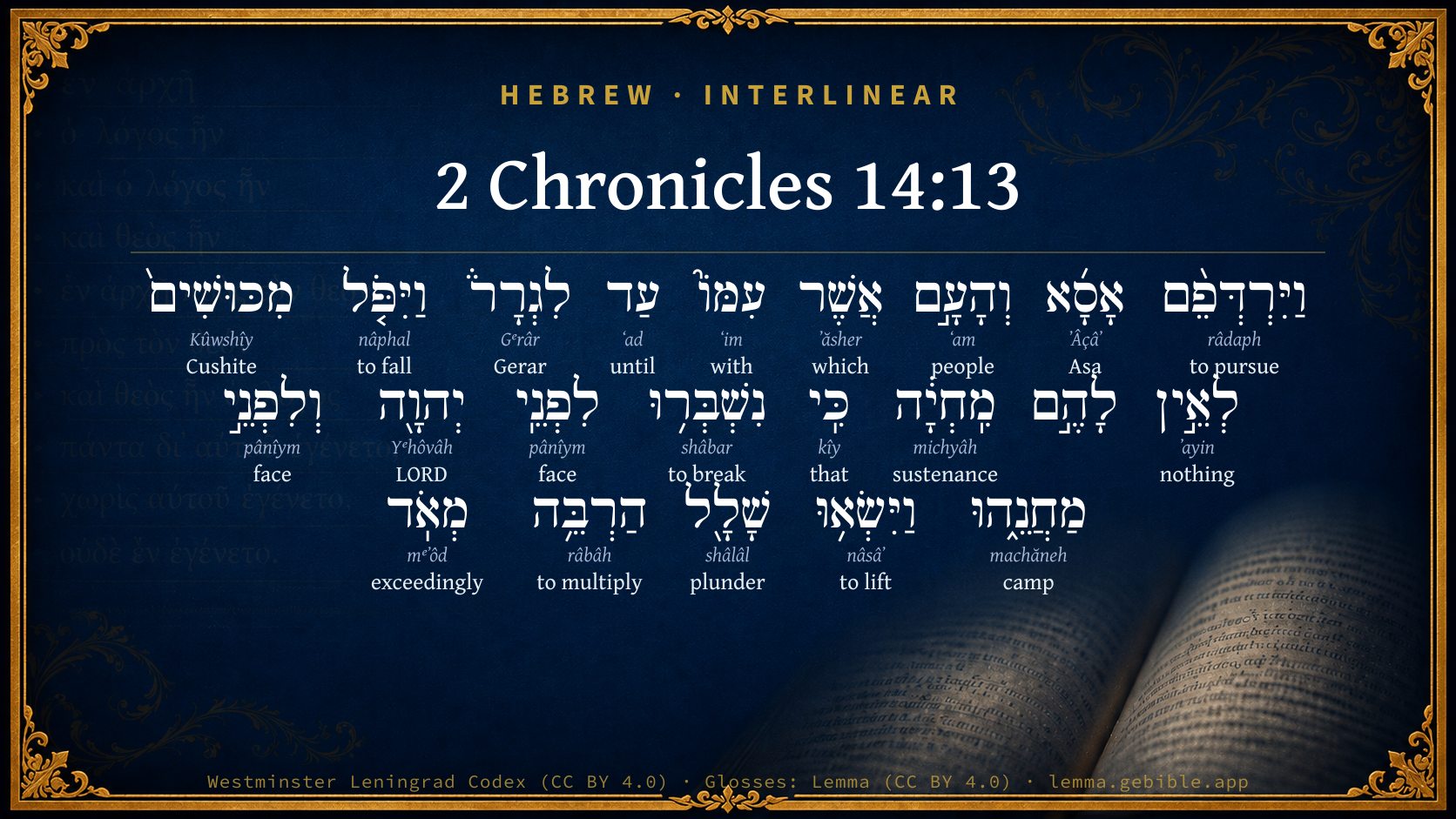
  1. וַיִּרְדְּפֵ֨ם râdaph H7291 “and · to pursue · them” Conjunction + Verb, Qal, Sequential Imperfect, 3rd Person, Masculine, Singular + Suffix, Personal, 3rd Person, Masculine, Plural
  2. אָסָ֜א ʼÂçâʼ H609 “Asa” Noun, Proper
  3. וְהָעָ֣ם ʻam H5971 “and · the · people” Conjunction + Particle, Definite Article + Noun, Common, Masculine, Singular, Absolute
  4. אֲשֶׁר ʼăsher H834 “which” Particle, Relative
  5. עִמּוֹ֮ ʻim H5973 “with · him” Preposition + Suffix, Personal, 3rd Person, Masculine, Singular
  6. עַד ʻad H5704 “until” Preposition
  7. לִגְרָר֒ Gᵉrâr H1642 “to/for · Gerar” Preposition + Noun, Proper
  8. וַיִּפֹּ֤ל nâphal H5307 “and · to fall” Conjunction + Verb, Qal, Sequential Imperfect, 3rd Person, Masculine, Singular
  9. מִכּוּשִׁים֙ Kûwshîy H3569 “from · Cushites” Preposition + Noun, Gentilic, Masculine, Plural, Absolute
  10. לְאֵ֣ין ʼayin H369 “to/for · nothing” Preposition + Particle, Negative
  11. כִּֽי kîy H3588 “that” Conjunction
  12. נִשְׁבְּר֥וּ shâbar H7665 “to break” Verb, Niphal, Perfect, 3rd Person, Common, Plural
  13. לִפְנֵֽי pânîym H6440 “to/for · face(s) of” Preposition + Noun, Common, Both, Plural, Construct
  14. יְהוָ֖ה Yᵉhôvâh H3068 “LORD” Noun, Proper
  15. וְלִפְנֵ֣י pânîym H6440 “and · to/for · face(s) of” Conjunction + Preposition + Noun, Common, Both, Plural, Construct
  16. מַחֲנֵ֑הוּ machăneh H4264 “camp · his” Noun, Common, Both, Singular, Construct + Suffix, Personal, 3rd Person, Masculine, Singular
  17. וַיִּשְׂא֥וּ nâsâʼ H5375 “and · to lift” Conjunction + Verb, Qal, Sequential Imperfect, 3rd Person, Masculine, Plural
  18. שָׁלָ֖ל shâlâl H7998 “plunder” Noun, Common, Masculine, Singular, Absolute
  19. הַרְבֵּ֥ה râbâh H7235 “to multiply” Verb, Hiphil, Infinitive Absolute
  20. מְאֹֽד mᵉʼôd H3966 “exceedingly” Adverb

About this verse

These counts appear in no published source. They are computed here, from the morphology-tagged text and Lemma’s own curated glosses. What Lemma adds →

22
words
20
distinct lemmas
Historical
section

Notable vocabulary

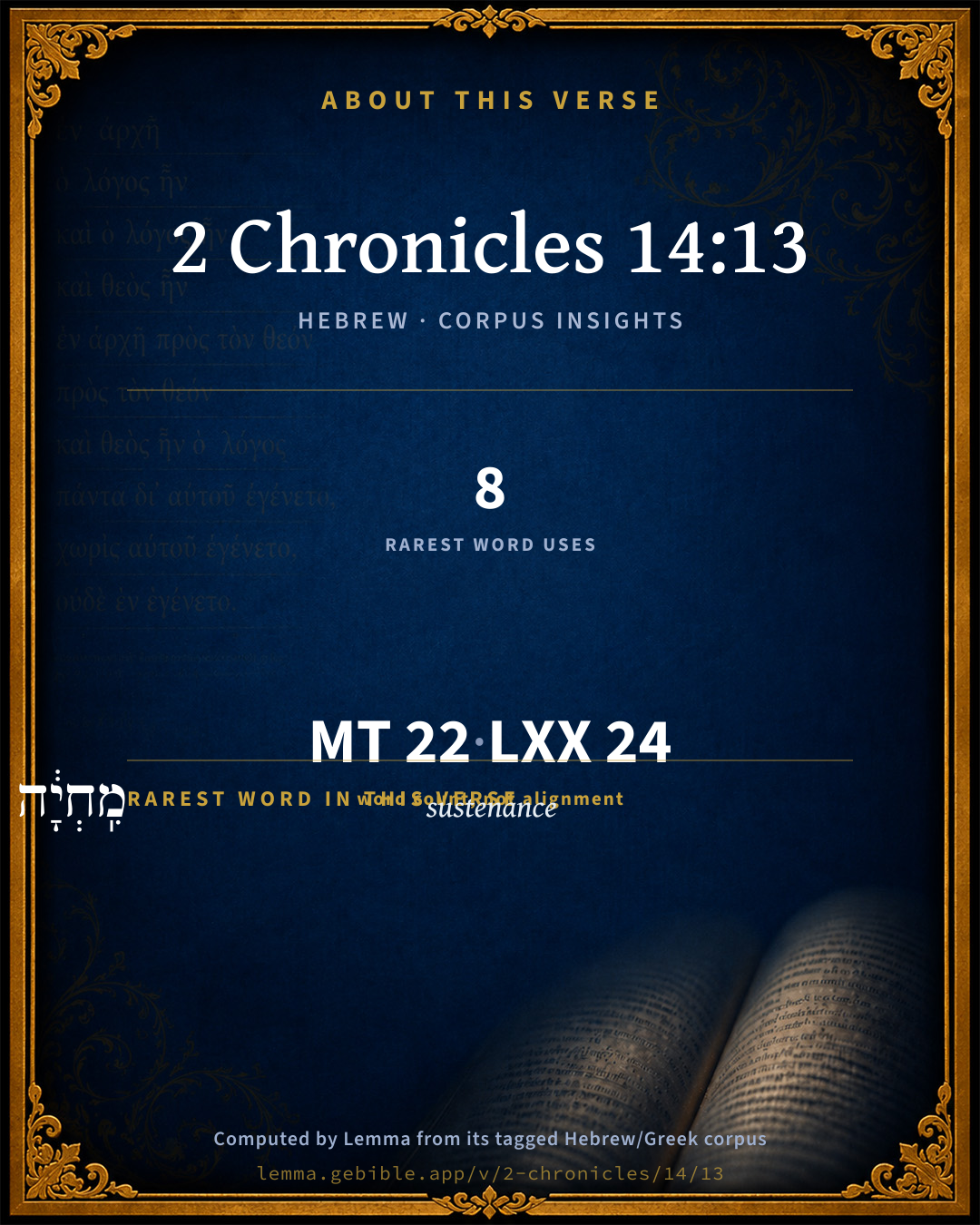
The rarest word here is מִֽחְיָ֔ה sustenance H4241 — appearing just 8 times in the whole Hebrew Bible.

Shared distinctive vocabulary

מִֽחְיָ֔ה sustenance H4241 occurs in 8 verses of the Hebrew Bible. Also found in:

Grammatical profile

  • 5 verbs
  • 10 nouns
  • 3 prepositions
  • 1 conjunction
  • 1 adverb
  • 2 particles

Verb forms

  • וַיִּרְדְּפֵ֨ם Qal · Sequential Imperfect
  • וַיִּפֹּ֤ל Qal · Sequential Imperfect
  • נִשְׁבְּר֥וּ Niphal · Perfect
  • וַיִּשְׂא֥וּ Qal · Sequential Imperfect
  • הַרְבֵּ֥ה Hiphil · Infinitive Absolute

Repetition

A word recurs within this verse — often emphatic in Hebrew:

  • לִפְנֵֽי face H6440 ×2

Hebrew & Septuagint length

In English translation the verse runs 43 words from the Hebrew and 36 from the Septuagint (LXX English) — closely comparable.

A rough comparison of the two English renderings, which tokenize alike — not a word-level alignment.

Word counts can differ between the Hebrew and the Greek without any difference in meaning — e.g. the Hebrew direct-object marker אֵת has no separate Greek word, and Greek often adds the article ὁ.

In the original languages it is 22 Hebrew tokens and 24 Greek tokens — but the two are counted differently (Hebrew bundles its prefixes and suffixes into one token; the Greek is in lemma form), so that isn’t a like-for-like length.

Cross-references

12

Topical passages linked to 2 Chronicles 14:13 in the Treasury of Scripture Knowledge — connected by theme and wording, ordered by reader-vote popularity; previews shown in the World English Bible.

  • Genesis 10:19 The border of the Canaanites was from Sidon, as you go toward Gerar, to Gaza; as you go toward Sodom, Gomorrah, Admah, and Zeboiim, to Lasha.
  • Genesis 20:1 Abraham traveled from there toward the land of the South, and lived between Kadesh and Shur. He lived as a foriegner in Gerar.
  • Genesis 26:1 There was a famine in the land, besides the first famine that was in the days of Abraham. Isaac went to Abimelech king of the Philistines, to Gerar.
  • 2 Chronicles 14:14 They struck all the cities round about Gerar; for the fear of Yahweh came on them: and they despoiled all the cities; for there was much spoil in them.
  • Genesis 10:1 Now this is the history of the generations of the sons of Noah and of Shem, Ham, and Japheth. Sons were born to them after the flood.
  • Joshua 5:14 He said, No; but [as] prince of the host of Yahweh am I now come. Joshua fell on his face to the earth, and did worship, and said to him, What says my lord to his servant?
  • 1 Samuel 25:28 Please forgive the trespass of your handmaid: for Yahweh will certainly make my lord a sure house, because my lord fights the battles of Yahweh; and evil shall not be found in you all your days.
  • 1 Chronicles 12:22 For from day to day men came to David to help him, until there was a great host, like the host of God.
  • Job 6:9 Even that it would please God to crush me; That he would let loose his hand, and cut me off!
  • Job 9:4 God who is wise in heart, and mighty in strength: Who has hardened himself against him, and prospered?
  • Psalms 108:11 Haven't you rejected us, God? You don't go forth, God, with our armies.
  • 2 Thessalonians 1:9 who will pay the penalty: eternal destruction from the face of the Lord and from the glory of his might,

Cross-references courtesy of OpenBible.info (CC BY 4.0).

Hebrew and Greek witnesses Masoretic Hebrew ↔ Greek Septuagint

The same verse in the two great witnesses to the Old Testament, shown verse-for-verse.

These are two independent witnesses, not word-aligned to each other, and the Septuagint is shown in lemma (dictionary) form.

Hebrew 2 Chronicles 14:13 Masoretic · Westminster Leningrad Codex

וַיִּרְדְּפֵ֨ם אָסָ֜א וְהָעָ֣ם אֲשֶׁר עִמּוֹ֮ עַד לִגְרָר֒ וַיִּפֹּ֤ל מִכּוּשִׁים֙ לְאֵ֣ין לָהֶ֣ם מִֽחְיָ֔ה כִּֽי נִשְׁבְּר֥וּ לִפְנֵֽי יְהוָ֖ה וְלִפְנֵ֣י מַחֲנֵ֑הוּ וַיִּשְׂא֥וּ שָׁלָ֖ל הַרְבֵּ֥ה מְאֹֽד

Asa and the people who were with him pursued them to Gerar: and there fell of the Ethiopians so many that they could not recover themselves; for they were destroyed before Yahweh, and before his host; and they carried away very much booty.

World English Bible · Public Domain

Greek LXX 2 Chronicles 14:13 Septuagint · lemma form

καί ἐκκόπτω ὁ κώμη αὐτός κύκλος γεδωρ ὅτι γίγνομαι ἔκστασις κύριος ἐπί αὐτός καί σκυλεύω πᾶς ὁ πόλις αὐτός ὅτι πολύς σκῦλον γίγνομαι αὐτός

And Asa and his people pursued them to Gedor; and the Ethiopians fell, so that they could not recover themselves; for they were crushed before the Lord, and before his host; and they took many spoils.

LXX2012 (modern English Septuagint) · Public Domain

On this verse, Ellicott's Commentary for English Readers discusses the Septuagint’s reading. Read the note in Commentary ↓

Hebrew: Westminster Leningrad Codex (CC BY 4.0). Greek: Septuagint (public domain); English from LXX2012 (modern English Septuagint) (Public Domain). How the Septuagint differs from the Hebrew →

Commentary

Notes on 2 Chronicles 14:13 from classic Christian and Jewish commentators (each source and its license shown beneath its notes). The classic Christian expositions comment on the surrounding passage and are grouped to its opening verse, so a note may address several verses; the Jewish commentaries on the Tanakh (Rashi and others) are per-verse, so they appear only where the commentator wrote on this verse.

Lemma curates 59 commentaries, every one of them public domain or Creative Commons licensed, each selected and text-cleaned for this edition rather than reprinted as found. About our sources →

Trapp's Complete Commentary

John Trapp

2Ch 14:13 And Asa and the people that [were] with him pursued them unto Gerar: and the Ethiopians were overthrown, that they could not recover themselves; for they were destroyed before the LORD, and before his host; and they carried away very much spoil.

Ver. 13. Unto Gerar.] A city of the Philistines, who took part, it is likely, with these Ethiopians, and therefore suffered with them.

That they could not recover themselves.] Heb., There was no life in them; pecoris instar trucidabantur, they were slain as dogs.

And before his host.] His host of angels, saith Lyra

And they carried away very much spoil.] A good amends for the treasure that Shishak, king of Egypt and Ethiopia, took from Rehoboam. Riches come and go, accedunt et recedunt instar Euripi, they do often change masters.

John Trapp, A Commentary or Exposition upon All the Books of the Old and New Testament (1647–1656) — public domain. Text from a community e-Sword module.

Ellicott's Commentary for English Readers

(13) Pursued them unto Gerar.—(Gen_20:1.) Kirbet-el-Gerar, in the Wady Gerar, about eight miles S.S.E. of Gaza, on the route to Egypt (LXX. Gedor).

And the Ethiopians were overthrown, that they could not recover themselves.—Literally, And there fell of Kushites until they had no revival, or survival (Ezr_9:8-9). The latter seems preferable, as a vivid hyperbole, like 2Ki_19:35, “When men arose in the morning, behold, they were all dead corpses.” So Vulg., “usque ad internecionem.”

Destroyed.—See margin.

Before his host.—Or camp. Asa’s army is the Lord’s army.

A Bible Commentary for English Readers, edited by Charles John Ellicott (1878–1897) — public domain. Text from a community e-Sword module.

The Cambridge Bible for Schools and Colleges

gen. ed. J. J. S. Perowne

13. Gerar] Identified with Jerâr, ruins three hours south of Gaza; cp. 1Ch_4:39 (read “Gerar,” LXX. Γέραρα).

the Ethiopians were overthrown, that they could not recover themselves] R.V. there fell of the Ethiopians (read “the Cushites”) so many that they could not recover themselves.

very much spoil] R.V. very much booty. The phrase used belongs to a style earlier than that of the Chronicler. Cp. note on 2Ch_14:9 (against them).

The Cambridge Bible for Schools and Colleges (gen. ed. J. J. S. Perowne; Cambridge University Press, 1878–1918) — public domain. Text from a community e-Sword module.

John Gill's Exposition

And they smote all the cities round about Gerar,.... The cities of the Philistines, who were auxiliaries and confederates with these Ethiopians, and colonies from them, according to Theodoret, and who says, about Eleutheropolis was a place, called, in his time, Geraron Saton:

for the fear of the Lord came upon them; so that they had no power to defend themselves, and oppose the men of Judah:

and they spoiled all the cities; of the goods and substance that were in them:

for there was exceeding much spoil in them; great wealth and riches of one kind or another.

John Gill's Exposition of the Whole Bible (1746–1763) — public domain (CC PDM 1.0). Text via the HelloAO Bible API.

Haydock's Catholic Bible Commentary

Gerara was on the southern borders, twenty-three miles from Maresa. (Eusebius) (Calmet) --- The Ethiopians were pursued perhaps for many days. (Tirinus) --- Destruction. Protestants, "they they could not recover themselves." Hebrew, "there was no quarter given;" or, "so that none were left alive." (Calmet) --- If this were the case, the number of the slain far exceeded that the Jeroboam’s army, chap. xiii. (Haydock)

George Leo Haydock (1774–1849), Haydock's Catholic Family Bible and Commentary, 1859 edition — public domain. Excludes Psalms (Douay-Rheims chapter numbering differs from Protestant) and Deuterocanonical books (Catholic canon only).

Matthew Poole's English Annotations

Gerar; a city of the Philistines, who probably were confederate with them in this design.

Matthew Poole's English Annotations on the Holy Bible (1683–1685) — public domain. Text from a community e-Sword/MySword module.

Whedon's Commentary on the Bible

Daniel D. Whedon

13. Pursued them unto Gerar — A distance of twenty miles or more, on the way from Mareshah to Egypt. Gerar was an ancient Philistine town, the abode for a time of Abraham and of Isaac. Gen_20:1; Gen_26:1. It is probable that Mr. Williams discovered the site of this ancient city in the ruins el Gerar, some three hours south of Gaza, situated in a wady of the same name; but this identification has not yet been confirmed by more recent exploration. It was a nomadic region, and, lying on the borders of the desert, it would be likely to abound in cattle, sheep, and camels. 2Ch_14:15.

Daniel D. Whedon (gen. ed.), Commentary on the Old and New Testaments (1874–1909) — public domain. Text from a community e-Sword module.

The Pulpit Commentary

And the Ethiopians before his host. It is evident that these words, with the clauses they include, should be placed in brackets, and so leave "they," the subject of the verb "carried" in the last clause, to refer to its proper noun-subject, Asa and the people. Gerar. This place is mentioned as defining a full distant spot as the limit of the pursuit of the flying army. While it was nearly four hours south of Gaza, on the road to Egypt, it is calculated that it was more than twenty miles distant from Mareshah.

The Pulpit Commentary (1880–1919), ed. H.D.M. Spence-Jones & Joseph S. Exell — public domain. Text from a community e-Sword module.

Lesson kit

Teaching starters — assembled from the data on this page, not authored interpretation. Every prompt links to the verse data it draws on. Edit before teaching.

2 Chronicles, in the Historical, opens this verse with 22 words (20 distinct Hebrew lemmas). Its most distinctive word is michyâh (“sustenance”). A historical commentator’s framing appears above. Read the whole chapter for the surrounding context.

Discussion questions

  1. How does “sustenance” (michyâh) shape what this verse is saying?
  2. How does Genesis 45:5, which shares the word «sustenance», read alongside this verse?
  3. What does the repetition of “face” (2× in this one verse) do in this verse?
  4. The translations on this page render this verse differently — a whole-verse word diff, not a word-by-word alignment. What might account for the different wordings?
  5. «וַיִּרְדְּפֵ֨ם» is a Qal Sequential Imperfect verb. How does that grammatical form shape the action described?
  6. Compare how Trapp's Complete Commentary and Ellicott's Commentary for English Readers read this verse. Where do they agree or differ?

Things to notice

Reading settings

Reading text

Shown beneath each verse's original-language words.

Old Testament
Old Testament edition

Read the OT as the Masoretic Hebrew (MT) or the Greek Septuagint (LXX).

English shown for the Greek Septuagint (in the Hebrew ↔ Greek comparison).

Comparing translations? Open the Compare panel on any verse page to stack up to four side by side.