

Job 13:10

Hebrew (Westminster Leningrad Codex) Job 13:10 appears in the Hebrew Old Testament. The text above is from the Westminster Leningrad Codex. Each word links to its Strong’s number, a concise gloss, and parsing drawn from the Open Scriptures Hebrew Bible morphology. Click any word for its full Brown-Driver-Briggs (BDB) entry.
Download image
Cite this verse

Job 13:10 (World English Bible). Public Domain. Lemma interlinear Bible study tool, https://lemma.gebible.app/v/job/13/10.

Show BibTeX & RIS
BibTeX
RIS
English Translation
He will surely reprove you If you secretly show partiality.
World English Bible · Public Domain
Download a study sheet

One document with this verse’s original text, its word-by-word gloss line, the meaning frame, cross-references with their text, attributed commentary, and full source and license credits — printable, and it pastes into notes with its structure intact.

This verse Autodidact and up

Study sheet (.html) Plain text (.txt)

A passage Seminary Student

Up to 50 verses in one chapter. A passage sheet keeps up to 6 commentary sources and 12 cross-references per verse, in the order this page ranks them, and says so on the sheet whenever that leaves anything out. Ask for a single verse and you get the Autodidact verse sheet above.

Everything on this page stays free to read, with no account — the sheet is a download of what is already on screen, not access to it.

Want to remove ads? Support Godless Engineer
Compare translations 3

The same verse in 3 English versions, stacked beneath the original-language interlinear above. Click any original word for its lexicon entry.

Each is an independent rendering of the whole verse — the interlinear is not word-aligned to these translations.

Highlighted words mark where these versions differ — a whole-verse word diff, not a word-by-word alignment.

  • World English Bible Public Domain
    He will surely reprove you If you secretly show partiality.
  • King James Version Public Domain
    He will surely reprove you, if ye do secretly accept persons.
  • unfoldingWord Literal Text CC BY-SA 4.0
    Reproving, he would reprove you if in secret you were lifting faces.

unfoldingWord Literal Text — © unfoldingWord, licensed CC BY-SA 4.0. Word-aligned USFM3 via Door43 (git.door43.org/unfoldingWord/en_ult).

Versions to compare (up to 4)

3 of 4 selected

Show all 18 translations

Every available English version of this verse, each an independent rendering of the whole verse.

  • World English Bible Public Domain
    He will surely reprove you If you secretly show partiality.
  • Berean Standard Bible Public Domain
    Surely He would rebuke you if you secretly showed partiality.
  • Majority Standard Bible Public Domain
    Surely He would rebuke you if you secretly showed partiality.
  • King James Version Public Domain
    He will surely reprove you, if ye do secretly accept persons.
  • American Standard Version (1901) Public Domain
    He will surely reprove you If ye do secretly show partiality.
  • Revised Version (1885) Public Domain
    He will surely reprove you, if ye do secretly respect persons.
  • Geneva Bible (1599) Public Domain
    He will surely reprooue you, if ye doe secretly accept any person.
  • Douay-Rheims (1899) Public Domain
    He shall reprove you, because in secret you accept his person.
  • Young's Literal Translation Public Domain
    He doth surely reprove you, if in secret ye accept faces.
  • Literal Standard Version CC BY-SA 4.0
    He surely reproves you, if you accept faces in secret.
  • Unlocked Literal Bible CC BY-SA 4.0
    He would surely reprove you if in secret you showed partiality.
  • unfoldingWord Literal Text CC BY-SA 4.0
    Reproving, he would reprove you if in secret you were lifting faces.
  • Darby Bible Public Domain
    He will certainly reprove you, if ye do secretly accept persons.
  • World Messianic Bible Public Domain
    He will surely reprove you if you secretly show partiality.
  • Webster's Bible Public Domain
    He will surely reprove you, if ye do secretly accept persons.
  • Free Bible Version CC BY-SA 4.0
    No, he will definitely rebuke you if you secretly show him favoritism!
  • Bible in Basic English Public Domain
    He will certainly put you right, if you have respect for persons in secret.
  • JPS Tanakh (1917) Public Domain
    He will surely reprove you, if ye do secretly show favour.

Literal Standard Version (2020), Covenant Press — licensed CC BY-SA 4.0. Text via the HelloAO Bible API (eBible.org). Unlocked Literal Bible (unfoldingWord) — licensed CC BY-SA 4.0. Text via the HelloAO Bible API (eBible.org). unfoldingWord Literal Text — © unfoldingWord, licensed CC BY-SA 4.0. Word-aligned USFM3 via Door43 (git.door43.org/unfoldingWord/en_ult). Free Bible Version, Dr. Jonathan Gallagher — licensed CC BY-SA 4.0. Text via the HelloAO Bible API (eBible.org).

Word by word

More ways to search: Search by grammar → Find every occurrence → Compare this word →

Practice this passage: Drill this verse → Learn its vocabulary →

About this verse

These counts appear in no published source. They are computed here, from the morphology-tagged text and Lemma’s own curated glosses. What Lemma adds →

7
words
6
distinct lemmas
Wisdom
section

Shared distinctive vocabulary

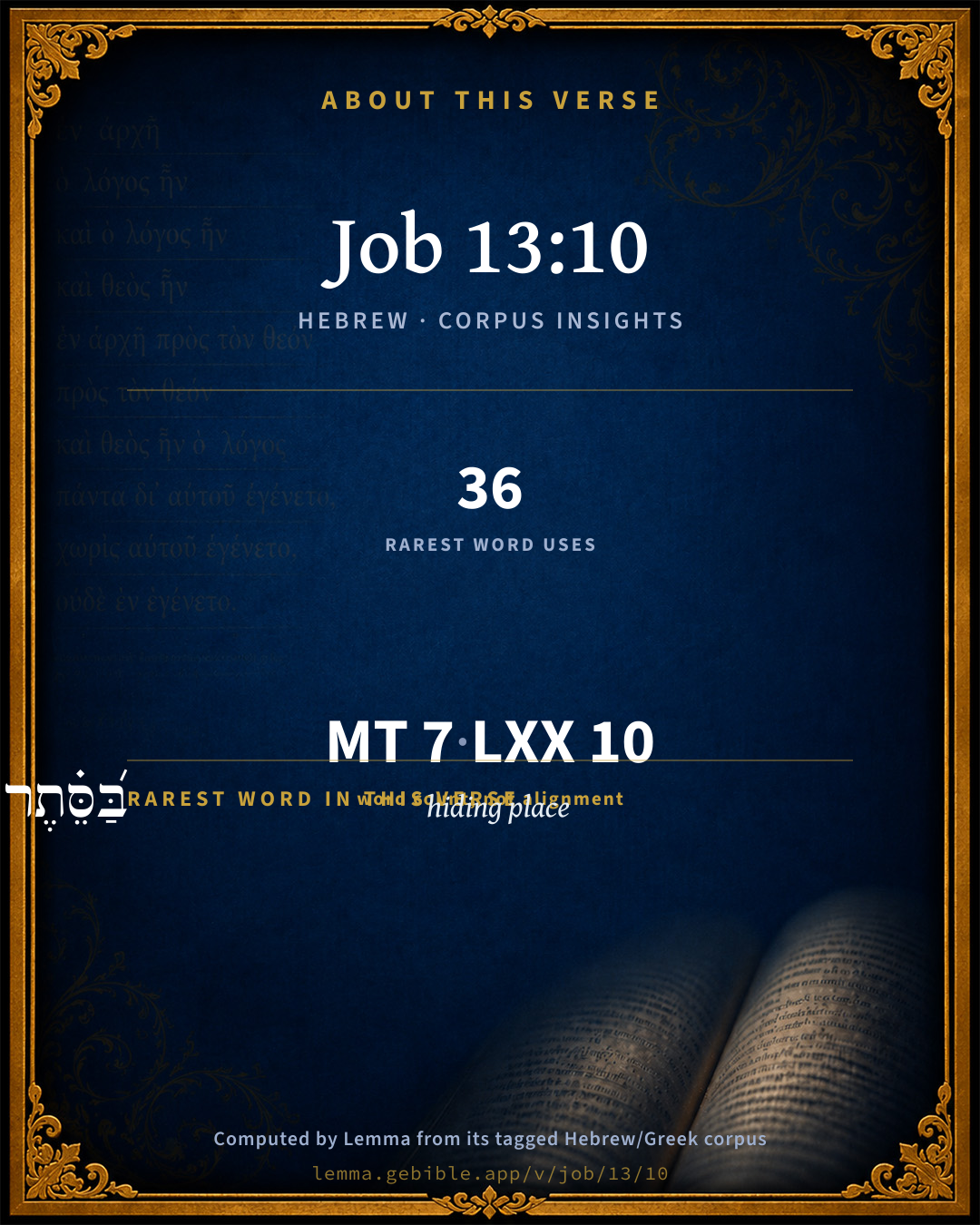
בַּ֝סֵּ֗תֶר hiding place H5643 occurs in 36 verses of the Hebrew Bible. Also found in:

Grammatical profile

  • 3 verbs
  • 2 nouns
  • 1 conjunction
  • 1 particle

Verb forms

  • הוֹכֵ֣חַ Hiphil · Infinitive Absolute
  • יוֹכִ֣יחַ Hiphil · Imperfect
  • תִּשָּׂאֽוּן Qal · Imperfect

Repetition

A word recurs within this verse — often emphatic in Hebrew:

  • הוֹכֵ֣חַ to reprove H3198 ×2

Hebrew & Septuagint length

In English translation the verse runs 10 words from the Hebrew and 17 from the Septuagint (LXX English) — the Septuagint runs noticeably longer here. See the side-by-side →

A rough comparison of the two English renderings, which tokenize alike — not a word-level alignment.

Word counts can differ between the Hebrew and the Greek without any difference in meaning — e.g. the Hebrew direct-object marker אֵת has no separate Greek word, and Greek often adds the article ὁ.

In the original languages it is 7 Hebrew tokens and 10 Greek tokens — but the two are counted differently (Hebrew bundles its prefixes and suffixes into one token; the Greek is in lemma form), so that isn’t a like-for-like length.

Cross-references

4

Topical passages linked to Job 13:10 in the Treasury of Scripture Knowledge — connected by theme and wording, ordered by reader-vote popularity; previews shown in the World English Bible.

  • James 2:9 But if you show partiality, you commit sin, being convicted by the law as transgressors.
  • Psalms 50:21–22 You have done these things, and I kept silent. You thought that the "I AM" was just like you. I will rebuke you, and accuse you in front of your eyes.
  • Psalms 82:2 "How long will you judge unjustly, And show partiality to the wicked?" Selah.
  • Job 42:7–8 It was so, that after Yahweh had spoken these words to Job, Yahweh said to Eliphaz the Temanite, "My wrath is kindled against you, and against your two friends; for you have not spoken of me the thing that is right, as my servant Job has.

Cross-references courtesy of OpenBible.info (CC BY 4.0).

Hebrew and Greek witnesses Masoretic Hebrew ↔ Greek Septuagint

The same verse in the two great witnesses to the Old Testament, shown verse-for-verse.

Here the Septuagint runs noticeably longer than the Hebrew — LXX2012 (modern English Septuagint) 17 words vs World English Bible 10. A rough length comparison of the two English translations, not a word-level alignment — read both below.

These are two independent witnesses, not word-aligned to each other, and the Septuagint is shown in lemma (dictionary) form.

Hebrew Job 13:10 Masoretic · Westminster Leningrad Codex

הוֹכֵ֣חַ יוֹכִ֣יחַ אֶתְכֶ֑ם אִם בַּ֝סֵּ֗תֶר פָּנִ֥ים תִּשָּׂאֽוּן

He will surely reprove you If you secretly show partiality.

World English Bible · Public Domain

Greek LXX Job 13:10 Septuagint · lemma form

οὐδείς ἥσσων ἐλέγχω σύ εἰ δέ καί κρυφῇ πρόσωπον θαυμάζω

he will not reprove you at all the less: but if moreover you⌃ should secretly respect persons,

LXX2012 (modern English Septuagint) · Public Domain

Hebrew: Westminster Leningrad Codex (CC BY 4.0). Greek: Septuagint (public domain); English from LXX2012 (modern English Septuagint) (Public Domain). How the Septuagint differs from the Hebrew →

Commentary

Notes on Job 13:10 from classic Christian and Jewish commentators (each source and its license shown beneath its notes). The classic Christian expositions comment on the surrounding passage and are grouped to its opening verse, so a note may address several verses; the Jewish commentaries on the Tanakh (Rashi and others) are per-verse, so they appear only where the commentator wrote on this verse.

Lemma curates 59 commentaries, every one of them public domain or Creative Commons licensed, each selected and text-cleaned for this edition rather than reprinted as found. About our sources →

Trapp's Complete Commentary

John Trapp

Job 13:10 He will surely reprove you, if ye do secretly accept persons.

Ver. 10. He will surely reprove you] That is all the thank you are like to have from God; your work in pleading for him so stoutly, though it be materially good, yet it will never prove so formally and eventually, because you so confidently determine things you do not understand, but only by a light conjecture. You do secretly, that is, cunningly and deceitfully, accept persons, that is, God’s own person, while ye wrong me for his sake, and under a pretence of doing him right, condemn me for a wicked hypocrite, whom till thus afflicted, you ever counted honest and upright. This the righteous judge, who loveth judgment, and hateth robbery for a burnt offering, Isa 61:8, will at no hand endure. No, but he will certainly reprove you, arguendo arguet, he will surely and severely blame and punish you. Carry it never so cleanly, cover it so closely, God, who seeth in secret, will reprove you openly; that is, he will chide you, smite you, curse you for it (if repentance interpose not to take up the matter), he will so set it on, as no creature shall be able to take it off. Men reprove offenders sometimes slightly and overtly, deest ignis, as Latimer said, whereby they do more harm than good; for their reproofs are rather soothings than reprovings, Personatae reprehensione sfrigent (Junius). Such was that of Eli to his sons, 1Sa 2:23. Such also was that of Jehoshaphat to wicked Ahab, "Let not the king say so," 1Ki 22:8. But when God took those same men to do, he handled them after another manner: he gives it them both by words and blows, till both their ears tingled, till their hearts ached, and quaked within them; so fearful a thing it is to fall into the punishing hands of the living God. Let all those look to it, especially that are in place of judicature, Psa 82:1-3. Let them hear causes without prejudicate impiety, judiciously examine them without sinister obliquity, and sincerely judge them without unjust partiality, remembering that Acceptatio personarum est iudiciorum pestis, partiality is the pest of justice.

John Trapp, A Commentary or Exposition upon All the Books of the Old and New Testament (1647–1656) — public domain. Text from a community e-Sword module.

Jamieson, Fausset & Brown

Robert Jamieson, A. R. Fausset & David Brown

If ye do, though secretly, act partially. (See on Job 13:8; Psa 82:1-2). God can successfully vindicate His acts, and needs no fallacious argument of man.

Jamieson, Fausset & Brown — Commentary Critical and Explanatory on the Whole Bible (1871) — public domain (CC PDM 1.0). Text via the HelloAO Bible API.

Adam Clarke's Commentary

Verse 10. He will surely reprove you] You may expect, not only his disapprobation, but his hot displeasure.

Adam Clarke's Commentary on the Bible (1810–1826) — public domain. Text from a community e-Sword/MySword module.

The Cambridge Bible for Schools and Colleges

gen. ed. J. J. S. Perowne

10. God’s rectitude and impartiality are such that He will punish partiality shewn even for Himself—a statement which, when taken along with the imputations which Job has cast on God, shews a singular condition of his mind.

The Cambridge Bible for Schools and Colleges (gen. ed. J. J. S. Perowne; Cambridge University Press, 1878–1918) — public domain. Text from a community e-Sword module.

John Gill's Exposition

He will surely reprove you,.... Or "in reproving he will reprove you" (r); he will certainly do it, it may be depended upon, and be expected; he will never suffer sin to go unreproved and uncorrected; he will do it to the purpose, with sharpness and severity, as the nature of the crime requires; he reproves by his spirit, and it is well for men when he thoroughly, and in a spiritual and saving way, reproves them by him, and convinces them of sin, righteousness, and judgment; and he reproves by his word, which is written for reproof and correction; and by his ministers, one part of whose work it is to rebuke and reprove men for bad practices, and bad principles; and in some cases they are to use sharpness, and which when submitted to, and kindly taken, it is well; and sometimes he reproves by his providences, by afflictive dispensations, and that either in love, as he rebukes his own children, or in wrath and hot displeasure, as others, which is here designed; and as it is always for sin he rebukes men, so particularly he rebukes for the following, as might be expected:

if ye do secretly accept persons; acceptance of persons in judgment is prohibited by God, and is highly resented by him; yea, even the acceptance of his own person to the prejudice of the character of an innocent man; which seems to be what Job has respect unto, as appears from Job 13:8; and some versions render it, "if ye accept his face" (a); and though this may be done no openly and publicly, but in a covert and secret manner, under disguise, and with specious pretences to the honour and glory of God.

(r) "arguiendo arguet", Pagninus, Montanus, Munster, Bolducius, Mercerus, Cocceius, Schmidt; "redarguendo redarguet", Michaelis. (a) "faciem ejus", V. L. Munster, Piscator; "personam ipsius", Beza, so the Targum.

John Gill's Exposition of the Whole Bible (1746–1763) — public domain (CC PDM 1.0). Text via the HelloAO Bible API.

Albert Barnes' Notes on the Bible

He will surely reprove you, if ye do secretly accept persons - If you show partiality, you will incur his disapprobation. This seems to have much era proverbial cast, and to mean that under no possible circumstances was it right to show partiality. No matter for whom it may be done, it will be displeasing to God. Even if it be in favor of the righteous, the widow, the fatherless, or of himself, if there is not a disposition to judge according to truth and evidence, God will frown upon you. No matter who the parties might be; no matter what their rank; no matter what friendship there might be for one or the other of them, it was never to be assumed that one was right and the other wrong without evidence. The exact truth was to be sought after, and the judgement made up accordingly. Even when God was one of the parties, the same course was to be pursued. His character was capable of being successfully vindicated, and he would not be pleased to have his cause defended or decided by partiality, or by mere favor. Hence, he encourages people to bring forth their strong reasons, and to adduce all that can be said against his government and laws. See the notes at Isa. 41:1-21.

Albert Barnes' Notes on the Bible (1834–1885) — public domain. Text from a community e-Sword/MySword module.

Haydock's Catholic Bible Commentary

His. Hebrew, "persons." Because you see me afflicted, you infer that I am guilty; and think this mode of judging most honourable to God, whom you wish thus to please. (Haydock) --- But he stands not in need of lies; (Calmet) and something farther is still to be proved. (Haydock) --- You judge rashly, as if you designed to please a prince, (Menochius) without examining the cause of the accused. (Haydock)

George Leo Haydock (1774–1849), Haydock's Catholic Family Bible and Commentary, 1859 edition — public domain. Excludes Psalms (Douay-Rheims chapter numbering differs from Protestant) and Deuterocanonical books (Catholic canon only).

Matthew Poole's English Annotations

i.e. Punish you; as this word is oft used, as hath been once and again observed.

Secretly; though it be concealed in your own breasts, and no eye see it; yea, though it be so close that your own minds and consciences, through ignorance, or inadvertency, or slothfulness, do not perceive it; yet He, who is greater than your consciences, sees and knows it.

Matthew Poole's English Annotations on the Holy Bible (1683–1685) — public domain. Text from a community e-Sword/MySword module.

The Pulpit Commentary

He will surely reprove you, if ye do secretly accept persons. Even though it is his own person which you accept, his own cause that you unduly favour, he, as the God of truth, and Maintainer of right, will assuredly reprove and condemn you.

The Pulpit Commentary (1880–1919), ed. H.D.M. Spence-Jones & Joseph S. Exell — public domain. Text from a community e-Sword module.

Rashi

Rabbi Shlomo Yitzchaki (Rashi)

He will surely reprove you Will He not let you know your speech?

When you stand before Him in judgment, will you secretly show Him partiality, saying there. “We showed You partiality”?

Rashi on the Tanakh — English translations: “The Judaica Press complete Tanach with Rashi, translated by A. J. Rosenberg” (CC BY 4.0); “Pentateuch with Rashi's commentary by M. Rosenbaum and A.M. Silbermann, 1929-1934” (public domain); “The Metsudah Tanach series, Lakewood, N.J” (CC BY 4.0); and “The Book of Joshua, Metsudah Publications, 1997” (CC BY 4.0). Text via Sefaria.

Lesson kit

Teaching starters — assembled from the data on this page, not authored interpretation. Every prompt links to the verse data it draws on. Edit before teaching.

Job, in the Wisdom, opens this verse with 7 words (6 distinct Hebrew lemmas). Its most distinctive word is çêther (“hiding place”). The Greek Septuagint runs longer here. A historical commentator’s framing appears above. Read the whole chapter for the surrounding context.

Discussion questions

  1. The word çêther carries the sense “hiding place.” How does it shape the verse?
  2. Deuteronomy 13:6 shares the word «hiding place» with this verse. How do the two illuminate each other?
  3. “to reprove” occurs 2× in this one verse. What is the effect of the repetition?
  4. Compared with the Hebrew, the Septuagint runs longer here. What questions does that raise?
  5. The translations on this page render this verse differently — a whole-verse word diff, not a word-by-word alignment. What might account for the different wordings?
  6. The verb «הוֹכֵ֣חַ» is Hiphil Infinitive Absolute. How does its form color the action?
  7. Reading how Trapp's Complete Commentary and Jamieson, Fausset & Brown read this verse, where do the two commentators agree and where do they part?

Things to notice

Reading settings

Reading text

Shown beneath each verse's original-language words.

Old Testament
Old Testament edition

Read the OT as the Masoretic Hebrew (MT) or the Greek Septuagint (LXX).

English shown for the Greek Septuagint (in the Hebrew ↔ Greek comparison).

Comparing translations? Open the Compare panel on any verse page to stack up to four side by side.