
2 Samuel 19:42

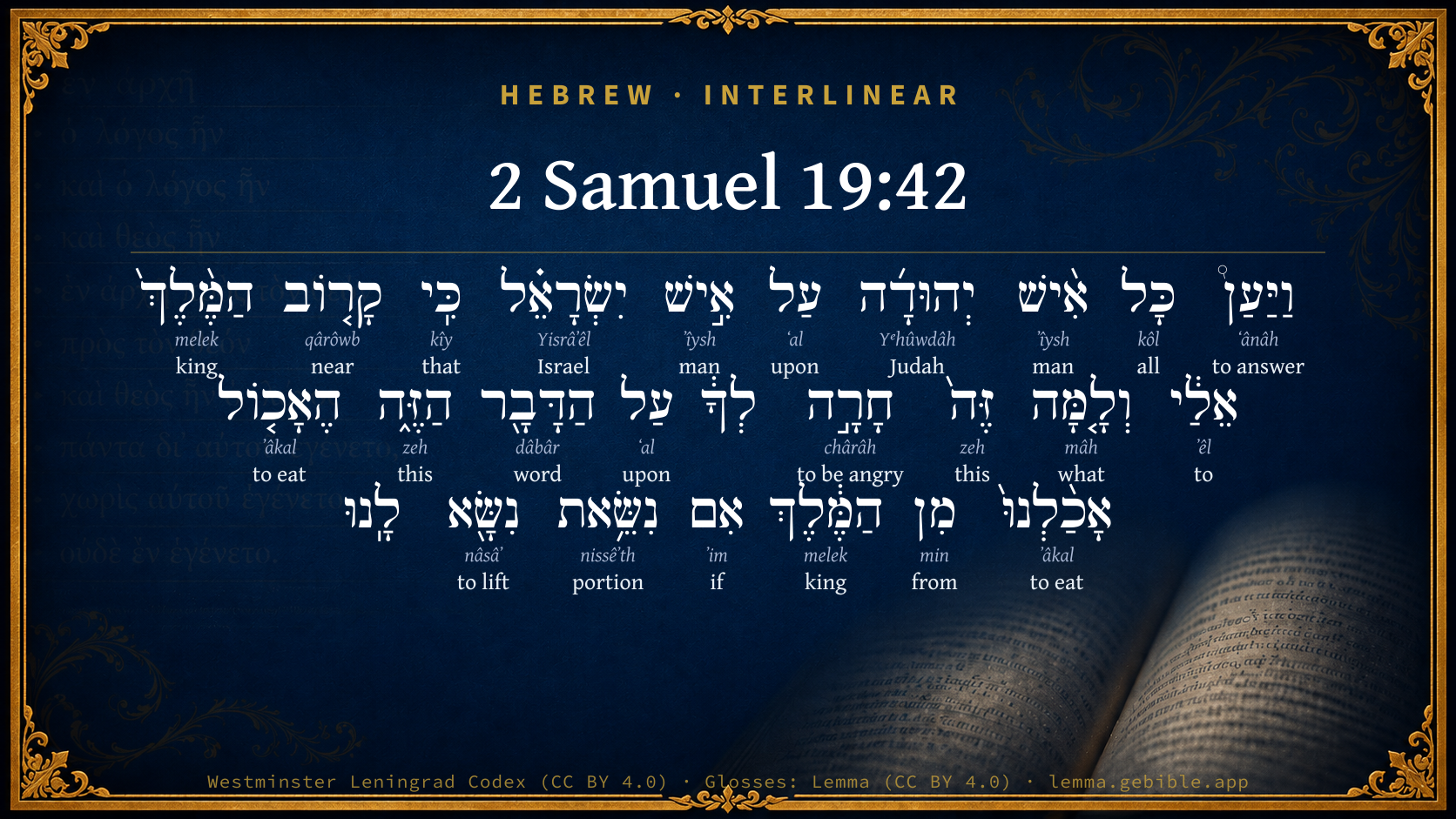
Hebrew (Westminster Leningrad Codex) 2 Samuel 19:42 appears in the Hebrew Old Testament. The text above is from the Westminster Leningrad Codex. Each word links to its Strong’s number, a concise gloss, and parsing drawn from the Open Scriptures Hebrew Bible morphology. Click any word for its full Brown-Driver-Briggs (BDB) entry.
Download image
Cite this verse

2 Samuel 19:42 (World English Bible). Public Domain. Lemma interlinear Bible study tool, https://lemma.gebible.app/v/2-samuel/19/42.

Show BibTeX & RIS
BibTeX
RIS
English Translation
All the men of Judah answered the men of Israel, Because the king is a close relative to us: why then are you angry for this matter? have we eaten at all at the king's cost? or has he given us any gift?
World English Bible · Public Domain
Highlights
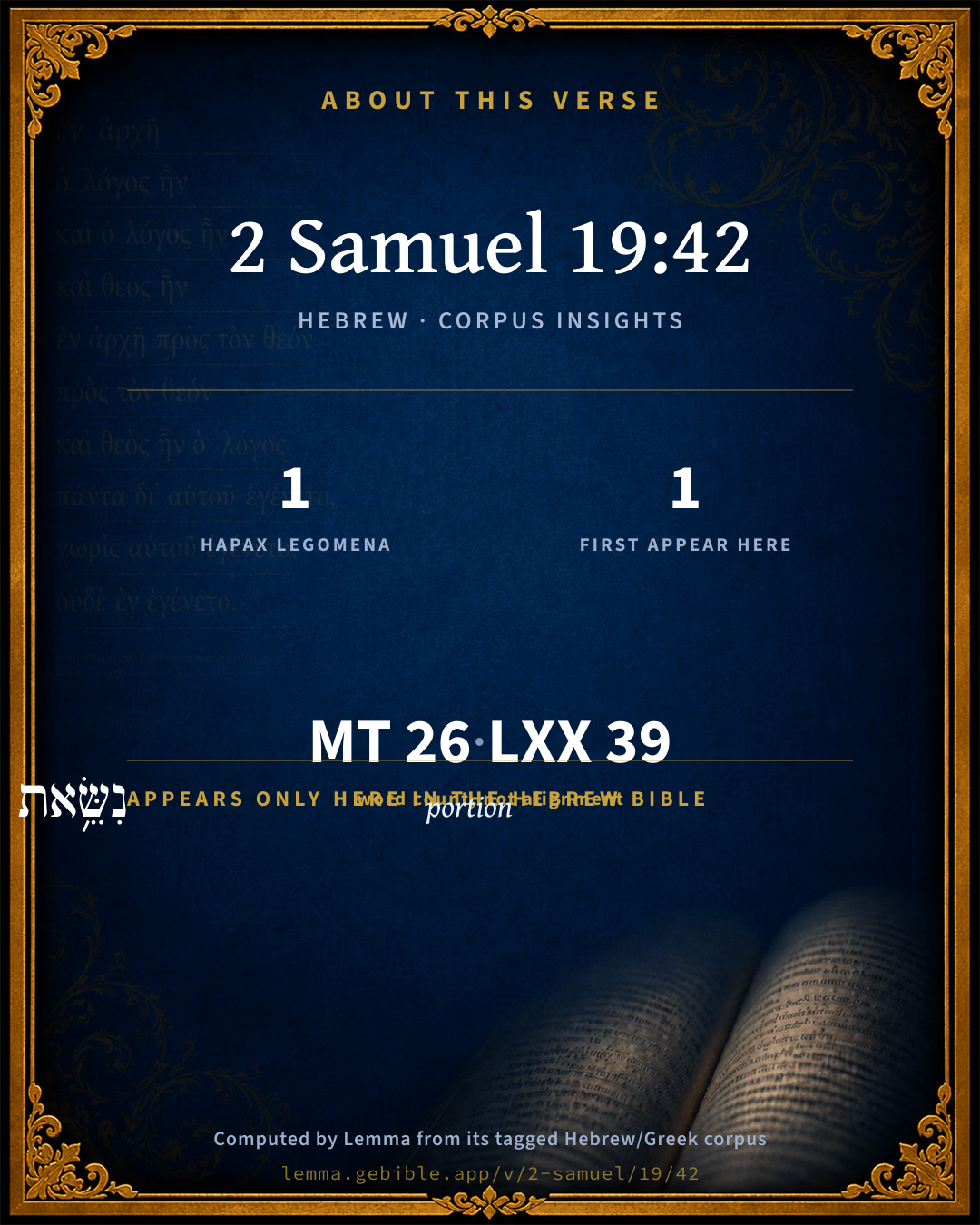
  • 1 hapax legomenon — only here in the Hebrew Bible
  • 1 first appearance in the Hebrew Bible
Full analysis ↓
Download a study sheet

One document with this verse’s original text, its word-by-word gloss line, the meaning frame, cross-references with their text, attributed commentary, and full source and license credits — printable, and it pastes into notes with its structure intact.

This verse Autodidact and up

Study sheet (.html) Plain text (.txt)

A passage Seminary Student

Up to 50 verses in one chapter. A passage sheet keeps up to 6 commentary sources and 12 cross-references per verse, in the order this page ranks them, and says so on the sheet whenever that leaves anything out. Ask for a single verse and you get the Autodidact verse sheet above.

Everything on this page stays free to read, with no account — the sheet is a download of what is already on screen, not access to it.

Want to remove ads? Support Godless Engineer
Compare translations 3

The same verse in 3 English versions, stacked beneath the original-language interlinear above. Click any original word for its lexicon entry.

Each is an independent rendering of the whole verse — the interlinear is not word-aligned to these translations.

Highlighted words mark where these versions differ — a whole-verse word diff, not a word-by-word alignment.

  • World English Bible Public Domain
    All the men of Judah answered the men of Israel, Because the king is a close relative to us: why then are you angry for this matter? have we eaten at all at the king's cost? or has he given us any gift?
  • King James Version Public Domain
    And all the men of Judah answered the men of Israel, Because the king is near of kin to us: wherefore then be ye angry for this matter? have we eaten at all of the king's cost? or hath he given us any gift?
  • unfoldingWord Literal Text CC BY-SA 4.0
    And each man of Judah answered to a man of Israel, “Because the king near to me. And why this, it burns to you about this matter? Eating, have we eaten from the king? Or being taken, has it been taken for us?”

unfoldingWord Literal Text — © unfoldingWord, licensed CC BY-SA 4.0. Word-aligned USFM3 via Door43 (git.door43.org/unfoldingWord/en_ult).

Versions to compare (up to 4)

3 of 4 selected

Show all 18 translations

Every available English version of this verse, each an independent rendering of the whole verse.

  • World English Bible Public Domain
    All the men of Judah answered the men of Israel, Because the king is a close relative to us: why then are you angry for this matter? have we eaten at all at the king's cost? or has he given us any gift?
  • Berean Standard Bible Public Domain
    And all the men of Judah replied to the men of Israel, “We did this because the king is our relative. Why does this anger you? Have we ever eaten at the king’s expense or received anything for ourselves?”
  • Majority Standard Bible Public Domain
    And all the men of Judah replied to the men of Israel, “We did this because the king is our relative. Why does this anger you? Have we ever eaten at the king’s expense or received anything for ourselves?”
  • King James Version Public Domain
    And all the men of Judah answered the men of Israel, Because the king is near of kin to us: wherefore then be ye angry for this matter? have we eaten at all of the king's cost? or hath he given us any gift?
  • American Standard Version (1901) Public Domain
    And all the men of Judah answered the men of Israel, Because the king is near of kin to us: wherefore then are ye angry for this matter? have we eaten at all at the king's cost? or hath he given us any gift?
  • Revised Version (1885) Public Domain
    And all the men of Judah answered the men of Israel, Because the king is near of kin to us: wherefore then be ye angry for this matter? have we eaten at all of the king’s cost? or hath he given us any gift?
  • Geneva Bible (1599) Public Domain
    And all the men of Iudah answered the men of Israel, Because the King is neere of kin to vs: and wherefore now be ye angry for this matter? haue we eaten of the Kings cost, or haue wee taken any bribes?
  • Douay-Rheims (1899) Public Domain
    And all the men of Juda answered the men of Israel: Because the king is nearer to me: why art thou angry for this matter? have we eaten any thing of the king's, or have any gifts been given us?
  • Young's Literal Translation Public Domain
    And all the men of Judah answer against the men of Israel, `Because the king `is' near unto us, and why `is' this -- ye are displeased about this matter? have we at all eaten of the king's `substance?' a gift hath he lifted up to us?'
  • Literal Standard Version CC BY-SA 4.0
    And all the men of Judah answer against the men of Israel, “Because the king [is] near to us, and why [is] this [that] you are displeased about this matter? Have we eaten of the king’s [substance] at all? Has he lifted up a gift to us?”
  • Unlocked Literal Bible CC BY-SA 4.0
    So the men of Judah answered the men of Israel, “It is because the king is more closely related to us. Why then are you angry about this? Have we eaten anything that the king had to pay for? Has he given us any gifts?”
  • unfoldingWord Literal Text CC BY-SA 4.0
    And each man of Judah answered to a man of Israel, “Because the king near to me. And why this, it burns to you about this matter? Eating, have we eaten from the king? Or being taken, has it been taken for us?”
  • Darby Bible Public Domain
    And all the men of Judah answered the men of Israel, Because the king is near of kin to me; and why then are ye angry for this matter? have we eaten anything which came from the king, or has he given us any present?
  • World Messianic Bible Public Domain
    All the men of Judah answered the men of Israel, “Because the king is a close relative to us. Why then are you angry about this matter? Have we eaten at all at the king’s cost? Or has he given us any gift?”
  • Webster's Bible Public Domain
    And all the men of Judah answered the men of Israel, Because the king is near of kin to us: why then are ye angry for this matter? have we eaten at all at the king's cost? or hath he given us any gift?
  • Free Bible Version CC BY-SA 4.0
    The men of Judah explained to the men of Israel, “We did this because the king is one of our relatives. Why are you getting upset about this? When did we ever eat the king's food? When did we ever get anything for ourselves?”
  • Bible in Basic English Public Domain
    And all the men of Judah gave this answer to the men of Israel, Because the king is our near relation: why then are you angry about this? have we taken any of the king's food, or has he given us any offering?
  • JPS Tanakh (1917) Public Domain
    (19-43) And all the men of Judah answered the men of Israel: 'Because the king is near of kin to us; wherefore then are ye angry for this matter? have we eaten at all of the king's cost? or hath any gift been given us?'

Literal Standard Version (2020), Covenant Press — licensed CC BY-SA 4.0. Text via the HelloAO Bible API (eBible.org). Unlocked Literal Bible (unfoldingWord) — licensed CC BY-SA 4.0. Text via the HelloAO Bible API (eBible.org). unfoldingWord Literal Text — © unfoldingWord, licensed CC BY-SA 4.0. Word-aligned USFM3 via Door43 (git.door43.org/unfoldingWord/en_ult). Free Bible Version, Dr. Jonathan Gallagher — licensed CC BY-SA 4.0. Text via the HelloAO Bible API (eBible.org).

Word by word

More ways to search: Search by grammar → Find every occurrence → Compare this word →

Practice this passage: Drill this verse → Learn its vocabulary →

נִשֵּׂ֥את
nissêʼth
H5379
“portion”
Verb, Niphal, Infinitive Absolute
Part of Speech
Verb
Stem
Niphal
Form
Infinitive Absolute
Full BDB Definition

Origin: from H5375

TWOT: 1421

gift, portion (as something taken up)
  1. וַיַּעַן֩ ʻânâh H6030 “and · to answer” Conjunction + Verb, Qal, Sequential Imperfect, 3rd Person, Masculine, Singular
  2. כָּל kôl H3605 “all of” Noun, Common, Masculine, Singular, Construct
  3. אִ֨ישׁ ʼîysh H376 “man of” Noun, Common, Masculine, Singular, Construct
  4. יְהוּדָ֜ה Yᵉhûwdâh H3063 “Judah” Noun, Proper
  5. עַל ʻal H5921 “upon” Preposition
  6. אִ֣ישׁ ʼîysh H376 “man of” Noun, Common, Masculine, Singular, Construct
  7. יִשְׂרָאֵ֗ל Yisrâʼêl H3478 “Israel” Noun, Proper
  8. כִּֽי kîy H3588 “that” Conjunction
  9. קָר֤וֹב qârôwb H7138 “near” Adjective, Adjective, Masculine, Singular, Absolute
  10. הַמֶּ֨לֶךְ֙ melek H4428 “the · king” Particle, Definite Article + Noun, Common, Masculine, Singular, Absolute
  11. אֵלַ֔י ʼêl H413 “to · me” Preposition + Suffix, Personal, 1st Person, Common, Singular
  12. וְלָ֤מָּה mâh H4100 “and · to/for · what” Conjunction + Preposition + Particle, Interrogative
  13. זֶּה֙ zeh H2088 “this” Pronoun, Demonstrative, Masculine, Singular
  14. חָרָ֣ה chârâh H2734 “to be angry” Verb, Qal, Perfect, 3rd Person, Masculine, Singular
  15. עַל ʻal H5921 “upon” Preposition
  16. הַדָּבָ֖ר dâbâr H1697 “the · word” Particle, Definite Article + Noun, Common, Masculine, Singular, Absolute
  17. הַזֶּ֑ה zeh H2088 “the · this” Particle, Definite Article + Pronoun, Demonstrative, Masculine, Singular
  18. הֶאָכ֤וֹל ʼâkal H398 “to eat” Particle, Interrogative + Verb, Qal, Infinitive Absolute
  19. אָכַ֨לְנוּ֙ ʼâkal H398 “to eat” Verb, Qal, Perfect, 1st Person, Common, Plural
  20. מִן min H4480 “from” Preposition
  21. הַמֶּ֔לֶךְ melek H4428 “the · king” Particle, Definite Article + Noun, Common, Masculine, Singular, Absolute
  22. אִם ʼim H518 “if” Conjunction
  23. נִשָּׂ֖א nâsâʼ H5375 “to lift” Verb, Niphal, Perfect, 3rd Person, Masculine, Singular

About this verse

These counts appear in no published source. They are computed here, from the morphology-tagged text and Lemma’s own curated glosses. What Lemma adds →

26
words
19
distinct lemmas
Historical
section

Notable vocabulary

1 hapax legomenon — a word that appears only here in the entire Hebrew Bible:

  • נִשֵּׂ֥את portion H5379

First appearance in Scripture

This word makes its first canonical appearance in the Hebrew Bible here:

  • נִשֵּׂ֥את portion H5379

Grammatical profile

  • 6 verbs
  • 8 nouns
  • 1 adjective
  • 2 pronouns
  • 6 prepositions
  • 2 conjunctions
  • 1 particle

Verb forms

  • וַיַּעַן֩ Qal · Sequential Imperfect
  • חָרָ֣ה Qal · Perfect
  • הֶאָכ֤וֹל Qal · Infinitive Absolute
  • אָכַ֨לְנוּ֙ Qal · Perfect
  • נִשֵּׂ֥את Niphal · Infinitive Absolute
  • נִשָּׂ֖א Niphal · Perfect

Repetition

Words recur within this verse — often emphatic in Hebrew:

  • אִ֨ישׁ man H376 ×2
  • עַל upon H5921 ×2
  • הַמֶּ֨לֶךְ֙ king H4428 ×2
  • הֶאָכ֤וֹל to eat H398 ×2
  • זֶּה֙ this H2088 ×2

Hebrew & Septuagint length

In English translation the verse runs 43 words from the Hebrew and 53 from the Septuagint (LXX English) — closely comparable.

A rough comparison of the two English renderings, which tokenize alike — not a word-level alignment.

Word counts can differ between the Hebrew and the Greek without any difference in meaning — e.g. the Hebrew direct-object marker אֵת has no separate Greek word, and Greek often adds the article ὁ.

In the original languages it is 26 Hebrew tokens and 39 Greek tokens — but the two are counted differently (Hebrew bundles its prefixes and suffixes into one token; the Greek is in lemma form), so that isn’t a like-for-like length.

Cross-references

3

Topical passages linked to 2 Samuel 19:42 in the Treasury of Scripture Knowledge — connected by theme and wording, ordered by reader-vote popularity; previews shown in the World English Bible.

  • 2 Samuel 19:12 You are my brothers, you are my bone and my flesh: why then are you the last to bring back the king?
  • 2 Samuel 5:1 Then came all the tribes of Israel to David to Hebron, and spoke, saying, Behold, we are your bone and your flesh.
  • 1 Chronicles 2:3–17 The sons of Judah: Er, and Onan, and Shelah; which three were born to him of Shua's daughter the Canaanitess. Er, Judah's firstborn, was wicked in the sight of Yahweh; and he killed him.

Cross-references courtesy of OpenBible.info (CC BY 4.0).

Hebrew and Greek witnesses Masoretic Hebrew ↔ Greek Septuagint

The same verse in the two great witnesses to the Old Testament, shown verse-for-verse.

These are two independent witnesses, not word-aligned to each other, and the Septuagint is shown in lemma (dictionary) form.

Hebrew 2 Samuel 19:42 Masoretic · Westminster Leningrad Codex

וַיַּעַן֩ כָּל אִ֨ישׁ יְהוּדָ֜ה עַל אִ֣ישׁ יִשְׂרָאֵ֗ל כִּֽי קָר֤וֹב הַמֶּ֨לֶךְ֙ אֵלַ֔י וְלָ֤מָּה זֶּה֙ חָרָ֣ה לְךָ֔ עַל הַדָּבָ֖ר הַזֶּ֑ה הֶאָכ֤וֹל אָכַ֨לְנוּ֙ מִן הַמֶּ֔לֶךְ אִם נִשֵּׂ֥את נִשָּׂ֖א לָֽנוּ

All the men of Judah answered the men of Israel, Because the king is a close relative to us: why then are you angry for this matter? have we eaten at all at the king's cost? or has he given us any gift?

World English Bible · Public Domain

Greek LXX 2 Samuel 19:42 Septuagint · lemma form

καί ἰδού πᾶς ἀνήρ ἰσραήλ παραγίγνομαι πρός ὁ βασιλεύς καί εἶπον πρός ὁ βασιλεύς τίς ὅτι κλέπτω σύ ὁ ἀδελφός ἐγώ ἀνήρ ιουδα καί διαβιβάζω ὁ βασιλεύς καί ὁ οἶκος αὐτός ὁ ἰορδάνης καί πᾶς ἀνήρ δαυίδ μετά αὐτός

And all the men of Juda answered the men of Israel, and said, Because the king is near of kin to us: and why were you thus angry concerning this matter? have we indeed eaten of the king's food? or has he given us a gift, or has he sent us a portion?

LXX2012 (modern English Septuagint) · Public Domain

Hebrew: Westminster Leningrad Codex (CC BY 4.0). Greek: Septuagint (public domain); English from LXX2012 (modern English Septuagint) (Public Domain). How the Septuagint differs from the Hebrew →

Targum (Aramaic paraphrase)

1

The Targum is the ancient Jewish Aramaic paraphrase of the Hebrew Scriptures — an interpretive translation, not the Hebrew text itself. Onkelos (literal) and Pseudo-Jonathan (expansive) render the Torah, and Jonathan the Prophets. Coverage is partial: where no permissively-licensed English translation exists for a verse, only the Aramaic is shown. This is verse-level text, not a word-by-word alignment to the Hebrew.

  1. Targum Jonathan Prophets (Joshua–Malachi)
    וְהָא כָּל אֱנַשׁ יִשְׂרָאֵל אֲתָן לְוַת מַלְכָּא וַאֲמַרוּ לְמַלְכָּא מָא דֵין כַּסְיוּךְ מִנָנָא אֲחָנָא אֱנַשׁ יְהוּדָה וְאַעְבָּרוּ יַת מַלְכָּא וְיַת אֱנַשׁ בֵּיתֵיהּ יַת יַרְדְנָא וְכָל גַבְרֵי דָוִד עִמֵיהּ:

    (no public-domain English translation for this verse)

    Targum Jonathan — Aramaic: “Mikraot Gedolot” (public domain). English: “Sefaria Community Translation” (CC0 1.0 (public-domain dedication)); “London "Chaldee Paraphrase," 1871” (public domain). Text via Sefaria.

Commentary

Notes on 2 Samuel 19:42 from classic Christian and Jewish commentators (each source and its license shown beneath its notes). The classic Christian expositions comment on the surrounding passage and are grouped to its opening verse, so a note may address several verses; the Jewish commentaries on the Tanakh (Rashi and others) are per-verse, so they appear only where the commentator wrote on this verse.

Lemma curates 59 commentaries, every one of them public domain or Creative Commons licensed, each selected and text-cleaned for this edition rather than reprinted as found. About our sources →

Trapp's Complete Commentary

John Trapp

2Sa 19:42 And all the men of Judah answered the men of Israel, Because the king [is] near of kin to us: wherefore then be ye angry for this matter? have we eaten at all of the king’s [cost]? or hath he given us any gift?

Ver. 42. Have we eaten at all of the king’s cost?] Have we, as parasites, used our tongues to purvey for our teeth? have we sought ourselves in this service? were we hired or waged to do that we did?

John Trapp, A Commentary or Exposition upon All the Books of the Old and New Testament (1647–1656) — public domain. Text from a community e-Sword module.

Joseph Benson's Commentary

2Sa 19:42. The king is near of kin to us — Of the same tribe with us, and therefore both oweth the more respect to us, and might expect more respect from us. Hath he given us any gift? — We have neither sought nor gained any advantage to ourselves hereby, but only discharged our duty and testified our love to the king, and used all expedition in bringing him back, which you also should have done, and not have come by halves, and so coldly as you have done.

Joseph Benson's Commentary on the Old and New Testaments (1811–1818) — public domain. Text from a community e-Sword module.

Adam Clarke's Commentary

Verse 42. Wherefore then be ye angry for this matter?] We have not done this for our own advantage; we have gained nothing by it; we did it through loyal attachment to our king.

Adam Clarke's Commentary on the Bible (1810–1826) — public domain. Text from a community e-Sword/MySword module.

Ellicott's Commentary for English Readers

(42) Have we eaten.—Judah justifies its course by its nearness of relationship to the king, and repels the idea of having received any especial favours from him. In this, then, may be a taunt to the Benjamites on account of the partiality shown them by Saul. On the other hand, the Israelites urge their claim of numerical superiority. The whole dispute is a remarkable testimony to the fairness of David’s government as between the tribes.

A Bible Commentary for English Readers, edited by Charles John Ellicott (1878–1897) — public domain. Text from a community e-Sword module.

The Cambridge Bible for Schools and Colleges

gen. ed. J. J. S. Perowne

42. to us] Lit. to me: and so art thou angry: and in 2Sa_19:43 the pronouns are singular throughout; each party being as it were personified and regarded as a unit.

42. have we eaten at all of the king’s cost, &c.] They defend themselves by alleging the purity of their motives. Some see in the words a side-thrust at the Benjamites, who had enjoyed special privileges during Saul’s reign (1Sa_22:7).

The Cambridge Bible for Schools and Colleges (gen. ed. J. J. S. Perowne; Cambridge University Press, 1878–1918) — public domain. Text from a community e-Sword module.

John Gill's Exposition

And all the men of Judah answered the men of Israel,.... Such of them as went down to fetch the king back, replied to the men of Israel that now met them, and objected to their conduct:

because the king is near of kin to us; being of their tribe, and his palace was within their borders, and therefore they were proper persons to bring him home:

wherefore then be ye angry for this matter? for bringing the king back, and being the first in it; for who so proper as they, not only to do their duty, but to show their affection to the king as early as possible?

have we eaten at all of the king's cost? they had maintained themselves at their own expense, going and returning; they had no self-interest or selfish views to serve, but on the contrary had been at a considerable charge to meet the king, and conduct him home:

or hath he given us any gift? no, he had not, nor did they expect any; it was not with a view to any reward that they had taken this step, but purely out of affection to the king, and for the good of their country.

John Gill's Exposition of the Whole Bible (1746–1763) — public domain (CC PDM 1.0). Text via the HelloAO Bible API.

Haydock's Catholic Bible Commentary

Nearer related. (Haydock) --- Us. What advantage have we gained? or, what have you lost? (Calmet)

George Leo Haydock (1774–1849), Haydock's Catholic Family Bible and Commentary, 1859 edition — public domain. Excludes Psalms (Douay-Rheims chapter numbering differs from Protestant) and Deuterocanonical books (Catholic canon only).

Matthew Poole's English Annotations

Near of kin to us; of the same tribe with us, and therefore both oweth the more respect to us, and might expect and challenge more respect from us. Hath he given us any gift? we have neither sought nor gained any advantage to ourselves hereby, but only discharged our duty to the king, and used all expedition in bringing him back, which you also should have done, and not have come in by halves, and so coldly as you have done. See 2Sa 19:40.

Matthew Poole's English Annotations on the Holy Bible (1683–1685) — public domain. Text from a community e-Sword/MySword module.

Whedon's Commentary on the Bible

Daniel D. Whedon

42. The king is near of kin to us — Of our tribe, and therefore descended from the same father. Compare 2Sa_19:12.

Have we eaten at all of the king’s — Have we received any special favours or honours?

Hath he given us any gift — Such as fields, vineyards, or offices, as Saul did to the Benjamites. See 1Sa_22:7.

Daniel D. Whedon (gen. ed.), Commentary on the Old and New Testaments (1874–1909) — public domain. Text from a community e-Sword module.

The Pulpit Commentary

The king is near of kin to us. The pronouns are singular throughout: "He is near of kin to me. Why art thou angry? Have I eaten... I have ten parts Why didst thou despise me?" and so everywhere. This is much more piquant; but such personification is contrary to the genius of our language. Have I eaten, etc.? Saul had boasted of enriching the Benjamites, (1Sa_22:7) but probably the speaker intended only to protest the purity of his motives.

The Pulpit Commentary (1880–1919), ed. H.D.M. Spence-Jones & Joseph S. Exell — public domain. Text from a community e-Sword module.

John Wesley's Explanatory Notes

Of kin - Of the same tribe with us, and therefore both oweth the more respect to us, and might expect more respect from us. Gifts - We have neither sought nor gained any advantage to ourselves hereby, but only discharged our duty to the king, and used all expedition in bringing him back, which you also should have done, and not have come in by halves, and so coldly as you have done.

John Wesley, Explanatory Notes Upon the Whole Bible (1754–1765) — public domain. Text via the GEBible commentary corpus.

unfoldingWord translationNotes

Door43 World Missions Community

Why then are you angry about this?

The men of Judah ask this rhetorical question to rebuke the men of Israel. This can be written as a statement. AT: "But you have no reason to be upset about this." (See: Rhetorical Question)

Have we eaten anything that the king had to pay for? Has he given us any gifts?

The men of Judah ask the question to express that they have not taken anything from the king. This can be written as a statement. AT: "The king has never paid for our food, and he has never given us any gifts." (See: Rhetorical Question)

we have even more right to David than you

"we have a greater claim to David than you do." It may be helpful to state clearly what having "more right" means. AT: "we have more right to serve the king and to be with the king than you do" (See: Assumed Knowledge and Implicit Information)

Why then did you despise us?

The men of Israel ask this rhetorical question to express their anger. This can be written as a statement. AT: "You should not have despised us!" (See: Rhetorical Question)

Was not our proposal to bring back our king the first to be heard?

The men of Israel ask this question to remind and rebuke the people of Judah. This can be written as a statement. AT: "We were the first to suggest that we bring back the king!" (See: Rhetorical Question)

the words of the men of Judah were even more harsh than the words of the men of Israel

"the men of Judah spoke even more harshly than the men of Israel did"

translationWords

Judah

Israel

anger

gift

tribe

word

unfoldingWord translationNotes — © Distant Shores Media and the Door43 World Missions Community, licensed CC BY-SA 4.0. Source: git.door43.org/Door43/en_tn.

Lesson kit

Teaching starters — assembled from the data on this page, not authored interpretation. Every prompt links to the verse data it draws on. Edit before teaching.

2 Samuel, in the Historical, opens this verse with 26 words (19 distinct Hebrew lemmas). Its most distinctive word is nissêʼth (“portion”). A historical commentator’s framing appears above. Read the whole chapter for the surrounding context.

Discussion questions

  1. The word nissêʼth carries the sense “portion.” How does it shape the verse?
  2. 1 word here appears nowhere else in the Hebrew Bible. Why might the author reach for such rare wording?
  3. This is the first place “portion” appears in Scripture (first appears here). What does its debut here establish?
  4. How does 2 Samuel 19:12, which shares this passage’s theme, read alongside this verse?
  5. What does the repetition of “man” (2× in this one verse) do in this verse?
  6. These translations render this verse differently. What is at stake in choosing one wording over another?
  7. «וַיַּעַן֩» is a Qal Sequential Imperfect verb. How does that grammatical form shape the action described?
  8. Compare how Trapp's Complete Commentary and Joseph Benson's Commentary read this verse. Where do they agree or differ?

Things to notice

  • 1 word in this verse appears nowhere else in the Hebrew Bible.
  • 1 word makes its first canonical appearance in Scripture here.
  • This verse counts 26 Hebrew ↔ 39 Greek words.
  • These translations choose different wording for 25 words in this verse.
  • “man” occurs 2× in this single verse.

Reading settings

Reading text

Shown beneath each verse's original-language words.

Old Testament
Old Testament edition

Read the OT as the Masoretic Hebrew (MT) or the Greek Septuagint (LXX).

English shown for the Greek Septuagint (in the Hebrew ↔ Greek comparison).

Comparing translations? Open the Compare panel on any verse page to stack up to four side by side.