Deuteronomy 33:3

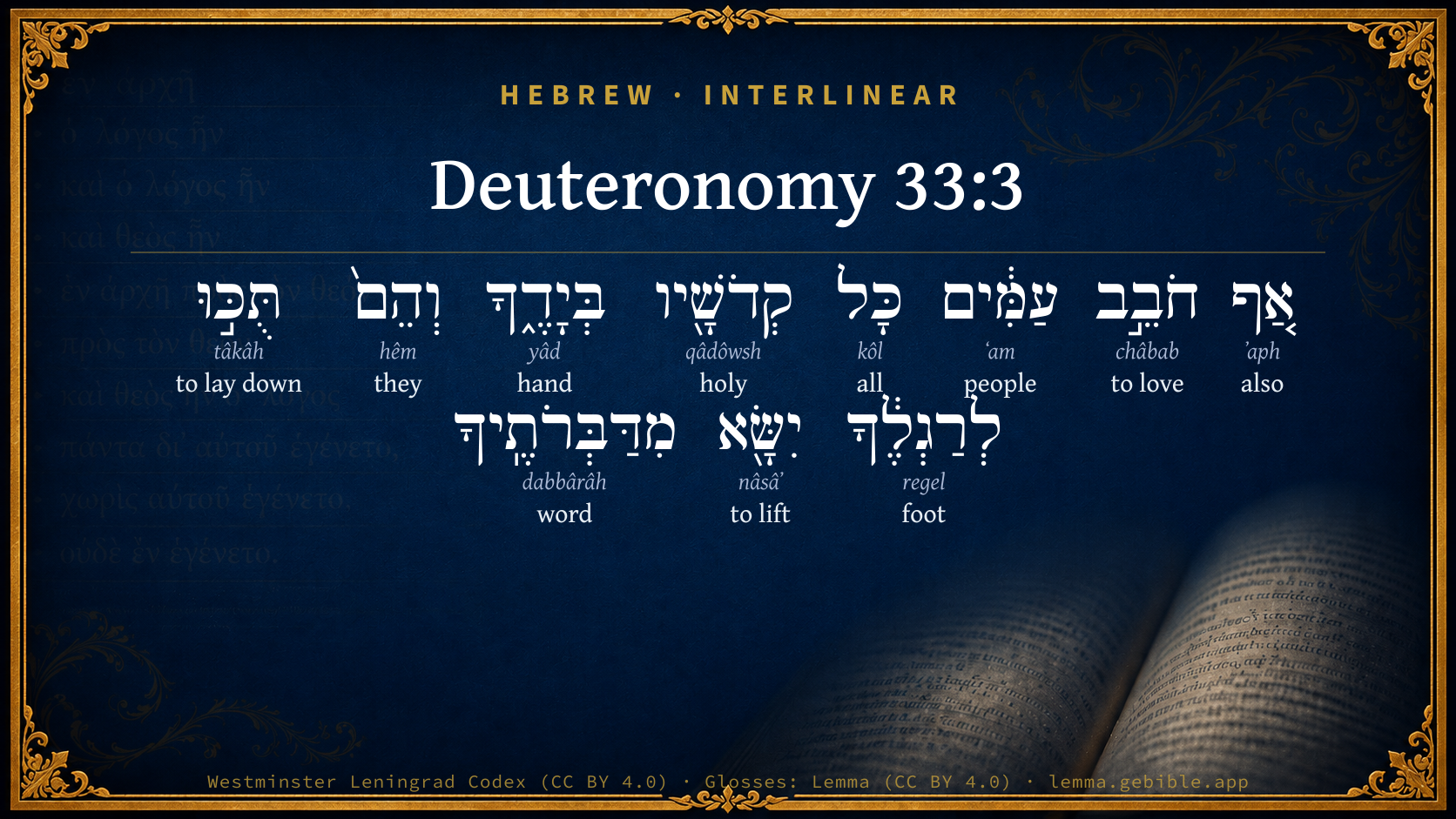
Hebrew (Westminster Leningrad Codex) Deuteronomy 33:3 appears in the Hebrew Old Testament. The text above is from the Westminster Leningrad Codex. Each word links to its Strong’s number, a concise gloss, and parsing drawn from the Open Scriptures Hebrew Bible morphology. Click any word for its full Brown-Driver-Briggs (BDB) entry.
Download image
Cite this verse

Deuteronomy 33:3 (World English Bible). Public Domain. Lemma interlinear Bible study tool, https://lemma.gebible.app/v/deuteronomy/33/3.

Show BibTeX & RIS
BibTeX
RIS
English Translation
Yes, he loves the people; All his saints are in your hand: They sat down at your feet; [Everyone] shall receive of your words.
World English Bible · Public Domain
Highlights
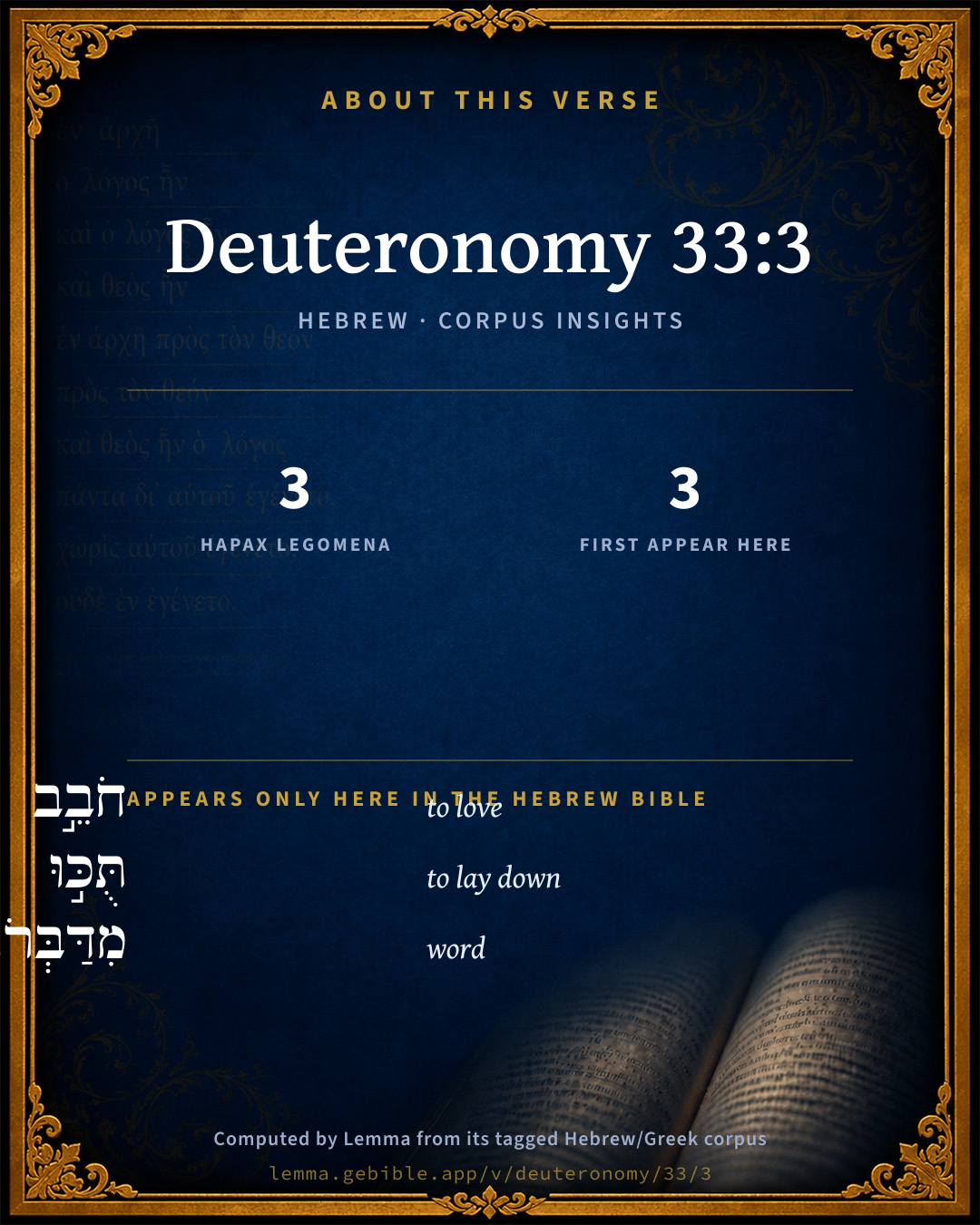
  • 3 hapax legomena — only here in the Hebrew Bible
  • 3 first appearances in the Hebrew Bible
Full analysis ↓
Download a study sheet

One document with this verse’s original text, its word-by-word gloss line, the meaning frame, cross-references with their text, attributed commentary, and full source and license credits — printable, and it pastes into notes with its structure intact.

This verse Autodidact and up

Study sheet (.html) Plain text (.txt)

A passage Seminary Student

Up to 50 verses in one chapter. A passage sheet keeps up to 6 commentary sources and 12 cross-references per verse, in the order this page ranks them, and says so on the sheet whenever that leaves anything out. Ask for a single verse and you get the Autodidact verse sheet above.

Everything on this page stays free to read, with no account — the sheet is a download of what is already on screen, not access to it.

Want to remove ads? Support Godless Engineer
Compare translations 3

The same verse in 3 English versions, stacked beneath the original-language interlinear above. Click any original word for its lexicon entry.

Each is an independent rendering of the whole verse — the interlinear is not word-aligned to these translations.

Highlighted words mark where these versions differ — a whole-verse word diff, not a word-by-word alignment.

  • World English Bible Public Domain
    Yes, he loves the people; All his saints are in your hand: They sat down at your feet; [Everyone] shall receive of your words.
  • King James Version Public Domain
    Yea, he loved the people; all his saints are in thy hand: and they sat down at thy feet; every one shall receive of thy words.
  • unfoldingWord Literal Text CC BY-SA 4.0
    Yes, he loves the peoples. All his sanctified in your hand, and they will be tied to your feet, he will take from your words.

unfoldingWord Literal Text — © unfoldingWord, licensed CC BY-SA 4.0. Word-aligned USFM3 via Door43 (git.door43.org/unfoldingWord/en_ult).

Versions to compare (up to 4)

3 of 4 selected

Show all 18 translations

Every available English version of this verse, each an independent rendering of the whole verse.

  • World English Bible Public Domain
    Yes, he loves the people; All his saints are in your hand: They sat down at your feet; [Everyone] shall receive of your words.
  • Berean Standard Bible Public Domain
    Surely You love the people; all the holy ones are in Your hand, and they sit down at Your feet; each receives Your words—
  • Majority Standard Bible Public Domain
    Surely You love the people; all the holy ones are in Your hand, and they sit down at Your feet; each receives Your words—
  • King James Version Public Domain
    Yea, he loved the people; all his saints are in thy hand: and they sat down at thy feet; every one shall receive of thy words.
  • American Standard Version (1901) Public Domain
    Yea, he loveth the people; All his saints are in thy hand: And they sat down at thy feet; `Every one' shall receive of thy words.
  • Revised Version (1885) Public Domain
    Yea, he loveth the peoples; All his saints are in thy hand: And they sat down at thy feet; Every one shall receive of thy words.
  • Geneva Bible (1599) Public Domain
    Though hee loue the people, yet all thy Saints are in thine handes: and they are humbled at thy foete, to receiue thy words.
  • Douay-Rheims (1899) Public Domain
    He hath loved the people, all the saints are in his hand: and they that approach to his feet, shall receive of his doctrine.
  • Young's Literal Translation Public Domain
    Also He `is' loving the peoples; All His holy ones `are' in thy hand, And they -- they sat down at thy foot, `Each' He lifteth up at thy words.
  • Literal Standard Version CC BY-SA 4.0
    Indeed, He [is] loving the peoples; All His holy ones [are] in Your hand, || And they sat down at Your foot, || [Each] lifts up Your words.
  • Unlocked Literal Bible CC BY-SA 4.0
    Indeed, he loves the peoples; all his holy ones are in your hand, and they bowed down at your feet; they received your words.
  • unfoldingWord Literal Text CC BY-SA 4.0
    Yes, he loves the peoples. All his sanctified in your hand, and they will be tied to your feet, he will take from your words.
  • Darby Bible Public Domain
    Yea, he loveth the peoples, All his saints are in thy hand, And they sit down at thy feet; Each receiveth of thy words.
  • World Messianic Bible Public Domain
    Yes, he loves the people. All his holy ones are in your hand. They sat down at your feet. Each receives your words.
  • Webster's Bible Public Domain
    Yea, he loved the people; all his saints are in thy hand: and they sat down at thy feet; every one shall receive of thy words.
  • Free Bible Version CC BY-SA 4.0
    How much you love the people; you hold all the holy ones in your hand. They sit down at your feet to listen to your words:
  • Bible in Basic English Public Domain
    All his holy ones are at his hand; they go at his feet; they are lifted up on his wings.
  • JPS Tanakh (1917) Public Domain
    Yea, He loveth the peoples, all His holy ones — they are in Thy hand; and they sit down at Thy feet, receiving of Thy words.

Literal Standard Version (2020), Covenant Press — licensed CC BY-SA 4.0. Text via the HelloAO Bible API (eBible.org). Unlocked Literal Bible (unfoldingWord) — licensed CC BY-SA 4.0. Text via the HelloAO Bible API (eBible.org). unfoldingWord Literal Text — © unfoldingWord, licensed CC BY-SA 4.0. Word-aligned USFM3 via Door43 (git.door43.org/unfoldingWord/en_ult). Free Bible Version, Dr. Jonathan Gallagher — licensed CC BY-SA 4.0. Text via the HelloAO Bible API (eBible.org).

Word by word

More ways to search: Search by grammar → Find every occurrence → Compare this word →

Practice this passage: Drill this verse → Learn its vocabulary →

חֹבֵ֣ב
châbab
H2245
“loving”
Verb, Qal, Participle Active, Masculine, Singular, Absolute
Part of Speech
Verb
Stem
Qal
Form
Participle Active
Gender
Masculine
Number
Singular
State
Absolute
Full BDB Definition

Origin: a primitive root [compare H2244 , H2247 ]

TWOT: 589

(Qal) to love fervently, cherish
  1. אַ֚ף ʼaph H637 “also” Particle, Accusative
  2. עַמִּ֔ים ʻam H5971 “peoples” Noun, Common, Masculine, Plural, Absolute
  3. כָּל kôl H3605 “all of” Noun, Common, Masculine, Singular, Construct
  4. קְדֹשָׁ֖יו qâdôwsh H6918 “holy · his” Adjective, Adjective, Masculine, Plural, Construct + Suffix, Personal, 3rd Person, Masculine, Singular
  5. בְּיָדֶ֑ךָ yâd H3027 “in/at · hand · your” Preposition + Noun, Common, Both, Singular, Construct + Suffix, Personal, 2nd Person, Masculine, Singular
  6. וְהֵם֙ hêm H1992 “and · they” Conjunction + Pronoun, Personal, 3rd Person, Masculine, Plural
  7. תֻּכּ֣וּ tâkâh H8497 “to lay down” Verb, Pual, Perfect, 3rd Person, Common, Plural
  8. לְרַגְלֶ֔ךָ regel H7272 “to/for · foot · your” Preposition + Noun, Common, Feminine, Singular, Construct + Suffix, Personal, 2nd Person, Masculine, Singular
  9. יִשָּׂ֖א nâsâʼ H5375 “to lift” Verb, Qal, Imperfect, 3rd Person, Masculine, Singular
  10. מִדַּבְּרֹתֶֽיךָ dabbârâh H1703 “from · words · your” Preposition + Noun, Common, Feminine, Plural, Construct + Suffix, Personal, 2nd Person, Masculine, Singular

About this verse

These counts appear in no published source. They are computed here, from the morphology-tagged text and Lemma’s own curated glosses. What Lemma adds →

11
words
11
distinct lemmas
Pentateuch
section

Notable vocabulary

3 hapax legomena — words that appear only here in the entire Hebrew Bible:

  • חֹבֵ֣ב to love H2245
  • תֻּכּ֣וּ to lay down H8497
  • מִדַּבְּרֹתֶֽיךָ word H1703

First appearance in Scripture

These words make their first canonical appearance in the Hebrew Bible here:

  • חֹבֵ֣ב to love H2245
  • תֻּכּ֣וּ to lay down H8497
  • מִדַּבְּרֹתֶֽיךָ word H1703

Grammatical profile

  • 3 verbs
  • 5 nouns
  • 1 adjective
  • 1 pronoun
  • 1 particle

Verb forms

  • חֹבֵ֣ב Qal · Participle Active
  • תֻּכּ֣וּ Pual · Perfect
  • יִשָּׂ֖א Qal · Imperfect

Hebrew & Septuagint length

In English translation the verse runs 24 words from the Hebrew and 25 from the Septuagint (LXX English) — closely comparable.

A rough comparison of the two English renderings, which tokenize alike — not a word-level alignment.

Word counts can differ between the Hebrew and the Greek without any difference in meaning — e.g. the Hebrew direct-object marker אֵת has no separate Greek word, and Greek often adds the article ὁ.

Cross-references

26

Topical passages linked to Deuteronomy 33:3 in the Treasury of Scripture Knowledge — connected by theme and wording, ordered by reader-vote popularity; previews shown in the World English Bible.

  • Luke 10:39 She had a sister called Mary, who also sat at Jesus' feet, and heard his word.
  • Deuteronomy 7:6–8 For you are a holy people to Yahweh your God: Yahweh your God has chosen you to be a people for his own possession, above all peoples who are on the face of the earth.
  • Malachi 1:2 "I have loved you," says Yahweh. Yet you say, "How have you loved us?" "Wasn't Esau Jacob's brother?" says Yahweh, "Yet I loved Jacob;
  • Luke 8:35 People went out to see what had happened. They came to Jesus, and found the man from whom the demons had gone out, sitting at Jesus' feet, clothed and in his right mind; and they were afraid.
  • Acts 22:3 "I am indeed a Jew, born in Tarsus of Cilicia, but brought up in this city at the feet of Gamaliel, instructed according to the strict manner of the law of our fathers, being zealous for God, even as you all are this day.
  • Romans 8:35–39 Who shall separate us from the love of Christ? Could oppression, or anguish, or persecution, or famine, or nakedness, or peril, or sword?
  • Ephesians 2:4–5 But God, being rich in mercy, for his great love with which he loved us,
  • Colossians 3:3–4 For you died, and your life is hidden with Christ in God.
  • 1 Peter 1:5 who by the power of God are guarded through faith for a salvation ready to be revealed in the last time.
  • Exodus 19:5–6 Now therefore, if you will indeed obey my voice, and keep my covenant, then you shall be my own possession from among all peoples; for all the earth is mine;
  • Deuteronomy 14:2 For you are a holy people to Yahweh your God, and Yahweh has chosen you to be a people for his own possession, above all peoples who are on the face of the earth.
  • 1 Samuel 2:9 He will keep the feet of his holy ones; But the wicked shall be put to silence in darkness; For by strength shall no man prevail.
  • Psalms 31:15 My times are in your hand. Deliver me from the hand of my enemies, and from those who persecute me.
  • Psalms 47:4 He chooses our inheritance for us, The glory of Jacob whom he loved. Selah.
  • Psalms 50:5 "Gather my saints together to me, Those who have made a covenant with me by sacrifice."
  • Psalms 147:19–20 He shows his word to Jacob; His statutes and his ordinances to Israel.
  • Proverbs 2:1 My son, if you will receive my words, And store up my commandments within you;
  • Jeremiah 31:3 Yahweh appeared of old to me, [saying], Yes, I have loved you with an everlasting love: therefore with loving kindness have I drawn you.
  • Jeremiah 32:40 and I will make an everlasting covenant with them, that I will not turn away from following them, to do them good; and I will put my fear in their hearts, that they may not depart from me.
  • Hosea 11:1 "When Israel was a child, then I loved him, And called my son out of Egypt.
  • Luke 2:46 It happened after three days they found him in the temple, sitting in the midst of the teachers, both listening to them, and asking them questions.
  • John 10:28–29 I give eternal life to them. They will never perish, and no one will snatch them out of my hand.
  • John 17:11–15 I am no more in the world, but these are in the world, and I am coming to you. Holy Father, keep them through your name which you have given me, that they may be one, even as we are.
  • Romans 9:11–13 For being not yet born, neither having done anything good or bad, that the purpose of God according to election might stand, not of works, but of him who calls,
  • 1 Thessalonians 1:6 You became imitators of us, and of the Lord, having received the word in much affliction, with joy of the Holy Spirit,
  • 1 John 4:19 We love Him, because he first loved us.

Cross-references courtesy of OpenBible.info (CC BY 4.0).

Hebrew and Greek witnesses Masoretic Hebrew ↔ Greek Septuagint

The same verse in the two great witnesses to the Old Testament, shown verse-for-verse.

These are two independent witnesses, not word-aligned to each other, and the Septuagint is shown in lemma (dictionary) form.

Hebrew Deuteronomy 33:3 Masoretic · Westminster Leningrad Codex

אַ֚ף חֹבֵ֣ב עַמִּ֔ים כָּל קְדֹשָׁ֖יו בְּיָדֶ֑ךָ וְהֵם֙ תֻּכּ֣וּ לְרַגְלֶ֔ךָ יִשָּׂ֖א מִדַּבְּרֹתֶֽיךָ

Yes, he loves the people; All his saints are in your hand: They sat down at your feet; [Everyone] shall receive of your words.

World English Bible · Public Domain

Greek LXX Deuteronomy 33:3 Septuagint · lemma form

καί φείδομαι ὁ λαός αὐτός καί πᾶς ὁ ἁγιάζω ὑπό ὁ χείρ σύ καί οὗτος ὑπό σύ εἰμί καί δέχομαι ἀπό ὁ λόγος αὐτός

And he spared his people, and all his sanctified ones are under your hands; and they are under you; and he received of his words

LXX2012 (modern English Septuagint) · Public Domain

On this verse, The Cambridge Bible for Schools and Colleges discusses the Septuagint’s reading. Read the note in Commentary ↓

Hebrew: Westminster Leningrad Codex (CC BY 4.0). Greek: Septuagint (public domain); English from LXX2012 (modern English Septuagint) (Public Domain). How the Septuagint differs from the Hebrew →

Targum (Aramaic paraphrase)

2

The Targum is the ancient Jewish Aramaic paraphrase of the Hebrew Scriptures — an interpretive translation, not the Hebrew text itself. Onkelos (literal) and Pseudo-Jonathan (expansive) render the Torah, and Jonathan the Prophets. Coverage is partial: where no permissively-licensed English translation exists for a verse, only the Aramaic is shown. This is verse-level text, not a word-by-word alignment to the Hebrew.

  1. Targum Onkelos Torah (Genesis–Deuteronomy)
    אַף חַבִּיבִנוּן לְשִׁבְטַיָא כָּל קַדִישׁוֹהִי בֵית יִשְׁרָאֵל בִּגְבוּרָא אַפֵּקִנוּן מִמִצְרָיִם וְאִנוּן מִדַבְּרִין תִּחוֹת עֲנָנָךְ נָטִלִין עַל מֵימְרָךְ

    (no public-domain English translation for this verse)

    Targum Onkelos — Aramaic: “Onkelos Genesis” (public domain); “Onkelos Exodus” (public domain); “Onkelos Leviticus” (public domain); “Onkelos Numbers” (public domain); “Onkelos Deuteronomy” (public domain). English: “Sefaria Community Translation” (CC0 1.0 (public-domain dedication)); “J.W. Etheridge. The Targums of Onkelos and Jonathan Ben Uzziel on the Pentateuch. London: Longmans, Green, 1862” (public domain). Text via Sefaria.

  2. Targum Pseudo-Jonathan Torah (Genesis–Deuteronomy)
    אוּף כָּל מַה דְאוֹדָאָה לְעַמְמַיָא מְטוֹל לִמְחַבְבָא עַמֵיהּ בֵּית יִשְרָאֵל כֻּלְהוֹן קָרָא לְהוֹן קַדִישִׁין לְמֵקוּם בַּאֲתַר בֵּית שְׁכִינְתֵּיהּ וְכַד הִנוּן נַטְרִין מִצְוָותָא דְאוֹרַיְיתָא מְדַבְּרִין לְרֶגֶל עֲנָנֵי יְקָרָךְ נַיְיחִין וְשַׁרְיַין כְּמִין פִּסָא דְבַר

    And whatever hath befallen to the nations (hath been done) because He loved His people of Beth Israel, and all of them He hath called to be saints, to stand in the place of His sanctuary. And when they observed the precepts of the law, they were conducted at the foot of Thy glorious Cloud, they rested and encamped according to the dictate of the Word.

    Targum Pseudo-Jonathan — Aramaic: “Targum Jonathan on Genesis” (public domain); “Targum Jonathan on Exodus” (public domain); “Targum Jonathan on Leviticus” (public domain); “Targum Jonathan on Numbers” (public domain); “Targum Jonathan on Deuteronomy” (public domain). English: “The Targum of Jonathan ben Uzziel, trans. J. W. Etheridge, London, 1862” (public domain). Text via Sefaria.

Commentary

Notes on Deuteronomy 33:3 from classic Christian and Jewish commentators (each source and its license shown beneath its notes). The classic Christian expositions comment on the surrounding passage and are grouped to its opening verse, so a note may address several verses; the Jewish commentaries on the Tanakh (Rashi and others) are per-verse, so they appear only where the commentator wrote on this verse.

Lemma curates 59 commentaries, every one of them public domain or Creative Commons licensed, each selected and text-cleaned for this edition rather than reprinted as found. About our sources →

The Cambridge Bible for Schools and Colleges

gen. ed. J. J. S. Perowne

3. he loveth] Heb. partic. ḥobeb, only here; the meaning is assured from other Semitic dialects.

the peoples] If the Heb. is accepted render tribes. But LXX has his people.

his saints] Not in an ethical sense, but as hallowed, or set apart, to Him; either all Israel or more probably their specially consecrated warriors; see Deu_2:34, Deu_20:2 ff., and cp. the other form of the same root, meḳuddashaw for warriors in Isa_13:3.

thy hand] So Sam. LXX; Luc. his hands, Vulg. his hand; Pesh. he blesses.

The text of the next couplet is uncertain; they sat down is a doubtful conjecture from the Ar. of the meaning of the Heb. verb otherwise unknown. But warriors do not sit. The LXX these are under thee and Sam. they humble, or submit, themselves suggest they fall in (in their ranks) which suits the following at thy feet, i.e. behind thee; cp. Jdg_5:15 rushed forth at his feet, 1Sa_25:42; shall receive, Heb. imperf. better rendered as a present take up. Ball conjectures, they went at his feet, they travelled in his ways, and Berth. he sustains thy lot and keeps his covenant with thee, both ingenious but unsupported by textual evidence, and the former tame.

3–6 (4–7). Nor shall Ammonites, nor Moabites, nor their Descendants Enter the Congregation (3), for these nations gave no provision to Israel on the way from Egypt (4a), but he (?) hired Balaam to curse Israel (4b, 5); Israel must never seek their welfare (6). Deu_33:3 is quoted in Lam_1:10 : evidence in favour, but not conclusive, of its being an original part of D’s code. The originality of Deu_33:4-6 is more doubtful.

They make the law longer than the others of this group, cp. the deuteronomic additions to the ‘Ten Words.’ Deu_33:3 is sufficiently accounted for, through its connection with the previous law, by the incestuous origin of Ammon and Moab (J, Gen_19:30-38); but Deu_33:4-6 besides being quotations (see below) give other reasons for the law. The question is further complicated by the introduction of Balaam, not mentioned in chs. 1–3, and the difference between Deu_33:4 a and Deu_2:29. But whether Deu_33:3 is an earlier law to which D or editors have added (at different times) the two quotations, Deu_33:4-6; or whether Deu_33:3 is D’s own law, to which editors have added the rest—it is impossible to say. On Ammon and Moab see ch. 2.

The Cambridge Bible for Schools and Colleges (gen. ed. J. J. S. Perowne; Cambridge University Press, 1878–1918) — public domain. Text from a community e-Sword module.

Trapp's Complete Commentary

John Trapp

Deu 33:3 Yea, he loved the people; all his saints [are] in thy hand: and they sat down at thy feet; [every one] shall receive of thy words.

Ver. 3. Yea, he loved the people.] With a general love, with a common philanthropy. But the love of God in Christ is that we must all labour after; such a love as doth better for a man than restore him to sight, or raise him when bowed down. {Psa 146:8}

Are in thy hand.] And so in a safe hand. {Joh 10:29}

And they sat down at thy feet.] As attentive and tractable disciples. See Act 22:3 Luk 10:39 2Ki 2:5. "Knowest thou not that the Lord will take thy master from thy head?" A phrase taken from their manner of sitting at the feet of their teachers.

John Trapp, A Commentary or Exposition upon All the Books of the Old and New Testament (1647–1656) — public domain. Text from a community e-Sword module.

Joseph Benson's Commentary

Deu 33:3. He loved the people — The tribes of Israel. The sense is, this law, though delivered with fire, and smoke, and thunder, which might seem to portend nothing but hatred and terror, yet in truth was given to Israel in great love, as being the great mean of their temporal and eternal salvation. Yea, he embraced the people, and laid them in his bosom! So the word signifies, which speaks not only the dearest love, but the most tender and careful protection. All God’s saints or holy ones, that is, his people, were in thy hand, that is, under God’s care, to protect, direct, and govern them. These words are spoken to God; the change of persons, his and thy, is most frequent in the Hebrew tongue. This clause may further signify God’s kindness to Israel, in upholding them when the fiery law was delivered, which was done with so much terror that not only the people were ready to sink under it, but even Moses did exceedingly fear and quake. But God sustained both Moses and the people, in or by his hand, whereby he, in a manner, covered them, that no harm might come to them. At thy feet — Like scholars, to receive instructions. He alludes to the place where the people waited when the law was delivered, which was at the foot of the mount. Every one — Of the people will receive or submit to thy instructions and commands. This may respect either the people’s promise when they heard the law, that they would hear and do all that was commanded; or, their duty to do so.

Joseph Benson's Commentary on the Old and New Testaments (1811–1818) — public domain. Text from a community e-Sword module.

MacLaren's Expositions of Holy Scripture

Alexander MacLaren

Deuteronomy

GOD AND HIS SAINTS

Deu 33:3.

The great ode of which these words are a part is called ‘the blessing wherewith Moses blessed the children of Israel before his death.’ It is mainly an invocation of blessing from Heaven on the various tribes, but it begins, as the national existence of Israel began, with the revelation of God on Sinai, and it lays that as the foundation of everything. It does not matter, for my purposes, in the smallest degree, who was the author of this great song. Whoever he was, he has, by dint of divine inspiration and of his own sympathy with the inmost spirit of the Old Covenant, anticipated the deepest things of Christian truth; and these are here in the words of our text.

I. The first thing that I would point out is the Divine Love which is the foundation of all.

‘He loved the people.’ That is the beginning of everything. The word that this singer uses is one that only appears in this place, and if we regard its etymology, there lies in it a very tender and beautiful expression of the warmth of the divine love, for it is probably connected with words in an allied language which mean the bosom and a tender embrace, and so the picture that we have is of that great divine Lover folding ‘the people’ to His heart, as a mother might her child, and cherishing them in His bosom.

Still further, the word is in a form in the Hebrew which implies that the act spoken about is neither past, present, nor future only, but continuous and perpetual. Thus it suggests to us the thought of timeless, eternal love, which has no beginning, and therefore has no end, which does not grow, and therefore will never decline nor decay, but which runs on upon one lofty level, with neither ups nor downs, and with no variation of the impulse which sends it forth; always the same, and always holding its objects in the fervent embrace of which the text speaks.

Further, mark the place in this great song where this thought comes in. As I said, it is laid as the beginning of everything. ‘We love Him because He first loved us’ was the height to which the last of the Apostles attained in the last of his writings. But this old singer, with the mists of antiquity around him, who knew nothing about the Cross, nothing about the historical Christ, who had only that which modern thinkers tell us is a revelation of a wrathful God, somehow or other rose to the height of the evangelical conception of God’s love as the foundation of the very existence of a people who are His. Like an orchid growing on a block of dry wood and putting forth a gorgeous bloom, this singer, with so much less to feed his faith than we have, has yet borne this fair flower of deep and devout insight into the secret of things and the heart of God. ‘He loved the people’- therefore He formed them for Himself; therefore He brought them out of bondage; therefore He came down in flashing fire on Sinai and made known His will, which to know and do is life. All begins from the tender, timeless love of God.

And if the question is asked, Why does God thus love? the only answer is, Because he is God. ‘Not for your sakes, O house of Israel . . . but for Mine own name’s sake.’ The love of God is self-originated. In it, as in all His acts, He is His own motive, as His name, ‘I am that I am,’ proclaims. It is inseparable from His being, and flows forth before, and independent of, anything in the creature which could draw it out. Men’s love is attracted by their perception or their imagination of something loveable in its objects. It is like a well, where there has to be much work of the pump-handle before the gush comes. God’s love is like an artesian well, or a fountain springing up from unknown depths in obedience to its own impulse. All that we can say is, ‘Thou art God. It is Thy nature and property to be merciful.’

‘God loved the people.’ The bed-rock is the spontaneous, unalterable, inexhaustible, ever-active, fervent love of God, like that with which a mother clasps her child to her maternal breast. The fair flower of this great thought was a product of Judaism. Let no man say that the God of Love is unknown to the Old Testament.

II. Notice how, with this for a basis, we have next the guardian care extended to all those that answer love by love.

The singer goes on to say, mixing up his pronouns, in the fashion of Hebrew poetry, somewhat arbitrarily, ‘all His saints are in Thy hand.’ Now, what is a ‘saint’? A man who answers God’s love by his love. The notion of a saint has been marred and mutilated by the Church and the world. It has been taken as a special designation of certain selected individuals, mostly of the ascetic and monastic type, whereas it belongs to every one of God’s people. It has been taken by the world to mean sanctimoniousness and not sanctity, and is a term of contempt rather than of admiration on their lips. And even those of us, who have got beyond thinking that it is a title of honour belonging only to the aristocracy of Christ’s Kingdom, are too apt to mistake what it really does mean. It may be useful to say a word about the Scriptural use and true meaning of that much-abused term. The root idea of sanctity or holiness is not moral character, goodness of disposition and of action, but it is separation from the world and consecration to God. As surely as a magnet applied to a heap of miscellaneous filings will pick out every little bit of iron there, so surely will that love which He bears to the people, when it is responded to, draw to itself, and therefore draw out of the heap, the men that feel its impulse and its preciousness. And so ‘saint’ means, secondly, righteous and pure, but it means, first, knit to God, separated from evil, and separated by the power of His received love.

Now, brethren, here is a question for each of us: Do I yield to that timeless, tender clasp of the divine Father and Mother in one? Do I answer it by my love? If I do, then I am a ‘saint,’ because I belong to Him, and He belongs to me, and in that commerce I have broken with the world. If we are true to ourselves, and true to our Lord, and true to the relation between us, the purity of character, which is popularly supposed to be the meaning of holiness, will come. Not without effort, not without set-backs, not without slow advance, but it will come; for he that is consecrated to the Lord is ‘separated’ from iniquity. Such is the meaning of ‘saint.’

‘All His saints are in Thy hand.’ The first metaphor of our text spoke of God’s bosom, to which He drew the people and folded them there. This one speaks of His ‘hand.’ They lie in it. That means two things. It means absolute security, for will He not close His fingers over His palm to keep the soul that has laid itself there? And ‘none shall pluck them out of My Father’s hand.’ No one but yourself can do that. And you can do it, if you cease to respond to His love, and so cease to be a saint. Then you will fall out of His hand, and how far you will fall God only knows.

Being in God’s hand means also submission. Loyola said to his black army, ‘Be like a stick in a man’s hand.’ That meant utter submission and abnegation of self, the willingness to be put anywhere, and used anyhow, and done anything with. And if I by my reception of, and response to, that timeless love, am a saint belonging to God, then not only shall I be secure, but I must be submissive. ‘All His saints are in Thy hand.’ Do not try to get out of it; be content to let it guide you as the steersman’s hand turns the spokes of the wheel and directs the ship.

Now, there is a last thought here. I have spoken of the foundation of all as being divine love, of the security and guardian care of the saints, and there follows one thought more:-

III. The docile obedience of those that are thus guarded.

As the words stand in our Bible, they are as follow:-’They sat down at Thy feet; every one shall receive of Thy words.’ These two clauses make up one picture, and one easily understands what it is. It represents a group of docile scholars, sitting at the Master’s feet. He is teaching them, and they listen open-mouthed and open-eared to what he says, and will take his words into their lives, like Mary sitting at Christ’s feet, whilst Martha was bustling about His meal. But, beautiful as that picture is, there has been suggested a little variation in the words which gives another one that strikes me as being even more beautiful. There are some difficulties of language with which I need not trouble you. But the general result is this, that perhaps instead of ‘sitting down at Thy feet’ we should read ‘followed at Thy feet.’ That suggests the familiar metaphor of a guide and those led by him who, without him, know not their road. As a dog follows his master, as the sheep their shepherd, so, this singer felt, will saints follow the God whom they love. Religion is imitation of God. That was a deep thought for such a stage of revelation, and it in part anticipates Christ’s tender words: ‘He goeth before them, and the sheep follow Him, for they know His voice.’ They follow at His feet. That is the blessedness and the power of Christian morality, that it is keeping close at Christ’s heels, and that instead of its being said to us, ‘Go,’ He says, ‘Come,’ and instead of our being bid to hew out for ourselves a path of duty, He says to us, ‘He that followeth Me shall not walk in darkness, but shall have the light of life.’ They follow at His feet, as the dog at his master’s, as the sheep at their shepherd’s.

They ‘receive His words.’ Yes, if you will keep close to Him, He will turn round and speak to you. If you are near enough to Him to catch His whisper He will not leave you without guidance. That is one side of the thought, that following we receive what He says, whereas the people that are away far behind Him scarcely know what His will is, and never can catch the low whisper which will come to us by providences, by movements in our own spirits, through the exercise of our own faculties of judgment and common-sense, if only we will keep near to Him. ‘Be ye not as the horse or as the mule, which have no understanding, whose mouths must be held in with bit and with bridle, else they will not come near to thee,’ but walk close behind Him, and then the promise will be fulfilled: ‘I will guide thee with Mine eye.’ A glance tells two people who are in sympathy what each wishes, and Jesus Christ will speak to us, if we keep close at His heels.

They that follow Him will ‘receive His words’ in another sense. They will take them in, and His words will not be wasted. And they will receive them in yet another sense. They will carry them out and do them, and His words will not be in vain.

So, dear brethren, the peace, the strength, the blessedness, the goodness, of our lives flow from these three stages, which this singer so long ago had found to be the essence of everything, recognition of the timeless tenderness of God, the yielding to and answering that love, so that it separates us for Himself, the calm security and happy submission which follow thereon, the imitation of Him in daily life, and the walking in His steps, which is rewarded and made more perfect by hearing more distinctly the whisper of His loving, commanding voice.

Alexander MacLaren, Expositions of Holy Scripture (1904–1910) — public domain. Text from a community e-Sword module.

Tyndale Open Study Notes

Tyndale Open Resources

33:3 In covenant contexts, to love is frequently synonymous with to choose. The Lord does love his people, but here it means that he chooses them as his special possession (4:20). • his hands: This phrase figuratively conveys the security that Israel (his holy ones) had in the Lord. • his steps: Following the Lord requires adopting his lifestyle and going where he goes. • His teaching refers particularly and pertinently to the Torah in all its fullness.

Tyndale Open Study Notes — © Tyndale Open Resources, licensed CC BY-SA 4.0. Text via the HelloAO Bible API.

Geneva Bible (1599)

Geneva Bible translators

As thy disciples.

Hebrew, his Saints, that is, the children of Israel.

Geneva Bible (1599) marginal notes — public domain. Text via Bolls.life.

Adam Clarke's Commentary

Verse 3. Yea, he loved the people] This is the inference which Moses makes from those glorious appearances, that God truly loved the people; and that all his saints, קדשיו kedoshaiv, the people whom he had consecrated to himself, were under his especial benediction; and that in order to make them a holy nation, God had displayed his glory on Mount Sinai, where they had fallen prostrate at his feet with the humblest adoration, sincerely promising the most affectionate obedience; and that God had there commanded them a law which was to be the possession and inheritance of the children of Jacob, De 33:4. And to crown the whole, he had not only blessed them as their lawgiver, but had also vouchsafed to be their king, De 33:5.

Dr. Kennicott proposes to translate the whole five verses thus: -

-- Verse 1. And this is the blessing wherewith Moses, the man of God, blessed the children of Israel before his death. And he said,

2. Jehovah came from SINAI,

And he arose upon them from SEIR;

He shone forth from Mount PARAN,

And he came from MERIBAH-KADESH:

From his right hand a fire shone forth upon them.

3. Truly, he loved the people,

And he blessed all his saints:

For they fell down at his feet,

And they received of his words.

4. He commanded us a law,

The inheritance of the congregation of Jacob.

5. And he became king in Jeshurun;

When the heads of the people were assembled,

Together with the tribes of Israel.

We have already seen that Dr. Kennicott reads מריבה קדש Meribah-Kadesh, the name of a place, instead of מרבבת קדש meribeboth kodesh, which, by a most unnatural and forced construction, our version renders ten thousands of saints, a translation which no circumstance of the history justifies.

Instead of a fiery law, אש דת esh dath, he reads, following the Samaritan version, אש אור esh ur, a fire shining out upon them. In vindication of this change in the original, it may be observed,

1. That, though דת dath signifies a law, yet it is a Chaldee term, and appears nowhere in any part of the sacred writings previously to the Babylonish captivity: תורה torah being the term constantly used to express the Law, at all times prior to the corruption of the Hebrew, by the Chaldee.

2. That the word itself is obscure in its present situation, as the Hebrew Bibles write it and esh in one word eshdath, which has no meaning; and which, in order to give it one, the Massorah directs should be read separate, though written connected.

3. That the word is not acknowledged by the two most ancient versions, the Septuagint and Syriac.

4. That in the parallel place, Hab 3:3-4, a word is used which expresses the rays of light, קרנים karnayim, horns, that is, splendours, rays, or effulgence of light.

5. That on all these accounts, together with the almost impossibility of giving a rational meaning to the text as it now stands, the translation contended for should be adopted.

Instead of All his saints are in his hand, Dr. Kennicott reads, He blessed all his saints - changing בידך beyadecha, into ברך barach, he blessed, which word, all who understand the Hebrew letters will see, might be easily mistaken for the other; the ד daleth and the ר resh being, not only in MSS., but also in printed books, often so much alike, that analogy alone can determine which is the true letter; and except in the insertion of the י yod, which might have been easily mistaken for the apex at the top of the ב beth very frequent in MSS., both words have the nearest resemblance. To this may be added, that the Syriac authorizes this rendering.

Instead of לרגלך leraglecha, and מדברתיך middabberotheycha, THY feet, and THY words, Dr. Kennicott reads the pronouns in the third person singular, לרגליו leraglaiv and מדברותיו middabberothaiv, HIS feet, HIS words, in which he is supported both by the Septuagint and Vulgate. He also changes ישא yissa, HE shall receive, into ישאו yisseu, THEY shall receive.

He contends also that משה Mosheh, Moses, in the fourth verse, was written by mistake for the following word מורשה morashah, inheritance; and when the scribe found he had inserted a wrong word, he added the proper one, and did not erase the first. The word Moses, he thinks, should therefore be left out of the text, as it is improbable that he should here introduce his own name; and that if the word be allowed to be legitimate, then the word king must apply to him, and not to GOD, which would be most absurd. See Kennicott's first Dissertation, p. 422, &c.

Adam Clarke's Commentary on the Bible (1810–1826) — public domain. Text from a community e-Sword/MySword module.

Ellicott's Commentary for English Readers

(3) Yea, he loved.—The connection appears to be this—

“From His right hand went a fire, a law for them (Israel).

Loving the peoples also;

(i.e., all who should hereafter become His people)

All His saints are in Thy hand:

(the hand of Him who spake on Sinai, and now “speaketh from heaven”)

And they are seated at Thy feet;

(the feet of the same heavenly Prophet. Comp. Mat_5:1-2)

Every one shall receive of Thy words.”

Or, possibly, He, that prophet, will take of thy (i.e., of Moses’) words, We know he did so.

A Bible Commentary for English Readers, edited by Charles John Ellicott (1878–1897) — public domain. Text from a community e-Sword module.

John Gill's Exposition

Moses commanded us a law,.... The law was of God, it came forth from his right hand, Deu 33:2; it is of his enacting, a declaration of his will, and has his authority stamped upon it, who is the lawgiver, and which lays under obligation to regard it; but it was delivered to Moses, and by him to the children of Israel, on whom he urged obedience to it; and so it is said to come by him, and sometimes is called the law of Moses, see Joh 1:17,

even the inheritance of the congregation of Jacob; which either describes the persons who were commanded to keep the law, the tribes of Jacob or congregation of Israel, who were the Lord's people, portion, and inheritance, Deu 32:9; or the law commanded, which was to be valued, not only as a peculiar treasure, but to be considered a possession, an estate, an inheritance, to be continued among them, and to be transmitted to their posterity, see Psa 119:111; these are the words of the people of Israel, and therefore are thus prefaced in the Targums of Jonathan and Jerusalem,"the children of Israel said, Moses commanded, &c.''they were represented by Moses.

John Gill's Exposition of the Whole Bible (1746–1763) — public domain (CC PDM 1.0). Text via the HelloAO Bible API.

Albert Barnes' Notes on the Bible

“The people” are the twelve tribes, not the Gentiles; and his saints refer to God’s chosen people just before spoken of. Compare Deu 7:18, Deu 7:21; Exo 19:6; Dan 7:8-21.

Albert Barnes' Notes on the Bible (1834–1885) — public domain. Text from a community e-Sword/MySword module.

Haydock's Catholic Bible Commentary

People, (populos.) God loves and watches over all, but particularly (Calmet) over the nation which he has chosen. (Chaldean) See Wisdom iii. 1., and Isaias xlix. 16. --- Doctrine. It was formerly the custom for disciples to sit at their master’s feet, (Acts xxii. 3,) as it is still in the Eastern countries. (Bellon. iii. 12.) Septuagint, "and these are under thee;" (Haydock) subject to thy orders. (Calmet) --- Hebrew is here extremely confused: "Yea, he loved the people; all his saints are in thy hand, and they eat down at thy feet; every one shall receive of thy words." Moses here addresses the Lord. How could he say therefore, all his, &c.? whose saints, and in whose hand? The Vulgate and Chaldean have not the same difficulty, as they read, in his hand, bidu. but the Syriac has, "and he blessed all his saints." Boroc is not very unlike the present Hebrew bidoc, (Kennicott) r and d being frequently mistaken for each other, and i as often neglected by the Hebrew copyists. (Haydock) --- the Samaritan version confirms this alteration; and the text also has the v, and, at the beginning, which makes the whole to be clearly connected, particularly if we allow that c, which stands for thy, has been substituted for v, his, in the following words, thy feet and thy words, which ought to be his, as all the context speaks of God in the third person. This is agreeable to the Vulgate and to the Septuagint also, in the last instance. In the former, the Hebrew is printed thy foot, though the Samaritan and several manuscripts read thy feet. Instead of yissa, "he shall receive," (Haydock) the plural ought to be substituted, v being omitted both at the beginning and end, as it is in the name of Benaihu, 1 Paralipomenon xi. 22. See 2 Kings xxiii. 20. The Samaritan, Syriac, and Arabic, read and they received, (Kennicott) and the Vulgate, they shall receive. The Septuagint seem to refer this to Moses, "And Moses received from his words, the law which he enjoined to us." (Haydock) --- That Moses should speak of himself, in this manner, seems very unaccountable, and therefore a word may perhaps have crept in, on account of its resemblance with the following term, Mursse. If it has not, Moses must have assumed the title of king, (ver. 5,) which he seems nevertheless to have disclaimed; (chap. xvii. 14,) and there was none in Israel before Saul, 1 Kings viii. 7. (Kennicott) --- We may, however, supposes that he puts these words in the mouths of the people, who would repeat this blessing after he was dead, and mention with gratitude how Moses had delivered to them so excellent a law, and administered the affairs of state with all the power and dignity of a king. (Haydock)

George Leo Haydock (1774–1849), Haydock's Catholic Family Bible and Commentary, 1859 edition — public domain. Excludes Psalms (Douay-Rheims chapter numbering differs from Protestant) and Deuterocanonical books (Catholic canon only).

Matthew Poole's English Annotations

The people, i.e. the tribes of Israel, which are called people, Gen 48:19; Jdg 5:14; Act 4:27. The sense is, This law, though delivered with fire, and smoke, and thunder, which might seem to portend nothing but hatred and terror, yet in truth it was given to Israel in great love, as being the great mean of their temporal and eternal salvation. And although God shows a general and common kindness to all men, yet he loved this people in a singular and peculiar manner.

All his saints; all God’s saints or holy ones, i.e. his people, as they are now called, the people of Israel, who are all called holy, Exo 19:6; Num 16:3; Deu 7:6; Dan 7:25; 8:24; 12:7, because they all professed to be so, and were obliged to be so, and many of them were such; though some appropriate this to the true saints in Israel.

Are in thy hand, or, were in thy hand, i.e. under God’s care, to protect, and direct, and govern them, as that phrase signifies, Num 4:28,33; Joh 10:28,29. These words are spoken to God; and for the change of persons, his and thy, that is most frequent in the Hebrew tongue. See Dan 9:4. This clause may further note God’s kindness to Israel in upholding and preserving them when the fiery law was delivered, which was done with so much dread and terror, that not only the people trembled and were ready to sink under it, Exo 20:18,19, but even Moses himself did exceedingly fear and quake, Heb 12:21. But in this fright God sustained both Moses and the people in or by his hand, whereby he in a manner hid and covered them, that no harm might come to them by this terrible apparition.

They sat down at thy feet, like scholars, to receive instructions and counsels from thee. He alludes either,

1. To the manner of disciples among the Jews, who used to sit at their masters’ feet, Luk 10:39; Act 22:3. See also Gen 49:10; 2Ki 4:38. But it is doubtful whether this custom was so ancient as Moses. Or,

2. To the place where the people waited when the law was delivered, which was at the foot of the mount.

Shall receive of thy words; the people, easily understood from the foregoing words, did or will receive or submit to thy instructions and commands. This may respect either,

1. The people’s promise when they heard the law, that they would hear and do all that was commanded, Deu 5:27. Or,

2. The people’s duty to do so.

3. The people’s privilege, that they were admitted to receive so great a privilege as the words and laws of God were.

Matthew Poole's English Annotations on the Holy Bible (1683–1685) — public domain. Text from a community e-Sword/MySword module.

Whedon's Commentary on the Bible

Daniel D. Whedon

3. Yea, he loved the people — Keil’s explanation of this is, that Jehovah embraces all nations with his love. We think the reference is to Israel.

Daniel D. Whedon (gen. ed.), Commentary on the Old and New Testaments (1874–1909) — public domain. Text from a community e-Sword module.

The Pulpit Commentary

Yea, he loved the people. The proper rendering is, he loveth peoples ( This is generally understood of the tribes of Israel; but some would understand it of nations in general, on the ground that such is the proper meaning of the word, as in Deu_32:8 and other places. A reference to nations at large, however, would seem incongruous here; and the use of the word in relation to Israel in such passages as Gen_28:3; Jud_1:5:14; Isa_3:13; Hos_10:14; Zec_11:10, justifies the taking it so here. All his saints are in thy hand. The people of Israel are here called God"s saints, or holy ones, because they were chosen by and consecrated to him. It is not probable, as some suggest, that the angels are here intended. The change from the third person to the second is not uncommon in Hebrew poetry. (cf. Deu_32:15; Psa_49:14, etc.) They sat down at thy feet. The verb rendered "sat down" here (WKTu) is found only in this passage, and is of uncertain meaning. Kimchi explains it as they united or assembled together to follow thy steps;" Knobel makes it "they wandered at thy feet," and understands it of Israel"s following the lead of Jehovah in the wilderness, when the ark of the covenant preceded them in their march; Gesenius and Furst, "they lie down at thy feet." This last is accepted by Keil, and seems to have most in its favor. Every one shall receive of thy words. Some render here, they rise up at thy words; but though the verb acn; is sometimes used intransitively, it is properly an active verb, and there seems no reason why it should not be so regarded here: every one receives the singular, aCyi, used distributively thy words.

God"s saints.

1. Their happiness loved of God.

2. Their safety in God"s hand.

3. Their attitude sitting at God"s feet at the feet of God"s Son. (Luk_10:3, Luk_10:9)

(1) Willing to know God"s will.

(2) Seeking instruction in it.

(3) Waiting on God for that instruction.

(4) Their duty to receive of God"s words.

The receiving to be of the practical kind of hiding God"s words in the heart, and going on to put them in practice. J.O. (Mat_13:23)

The Pulpit Commentary (1880–1919), ed. H.D.M. Spence-Jones & Joseph S. Exell — public domain. Text from a community e-Sword module.

John Wesley's Explanatory Notes

The people - The tribes of Israel. The sense is, this law, though delivered with fire and smoke and thunder, which might seem to portend nothing but hatred and terror, yet in truth was given to Israel, in great love, as being the great mean of their temporal and eternal salvation. Yea, he, embraced the people, and laid them in his bosom! so the word signifies, which speaks not only the dearest love, but the most tender and careful protection. All God's saints or holy ones, that is, his people, were in thy hand, that is, under God's care to protect, direct and govern them. These words are spoken to God: the change of persons, his and thy, is most frequent in the Hebrew tongue. This clause may farther note God's kindness to Israel, in upholding them when the fiery law was delivered, which was done with so much terror that not only the people were ready to sink under it, but even Moses did exceedingly fear and quake. But God sustained both Moses and the people, in or by his hand, whereby he in a manner covered them that no harm might come to them. At thy feet - Like scholars to receive instructions. He alludes to the place where the people waited when the law was delivered, which was at the foot of the mount. Everyone - Of the people will receive or submit to thy instructions and commands. This may respect either, the peoples promise when they heard the law, that they would hear and do all that was commanded. Or, their duty to do so.

John Wesley, Explanatory Notes Upon the Whole Bible (1754–1765) — public domain. Text via the GEBible commentary corpus.

unfoldingWord translationNotes

Door43 World Missions Community

General Information:

Moses continues to bless the tribes of Israel, which he began to do in Deuteronomy 33:2. Moses speaks the blessing in the form of short poems. (See: Parallelism)

General Information:

These verses are difficult to understand.

the peoples

"the people of Israel"

all his holy ones are in your hand ... your feet ... your words

The pronouns "his" and "your" refer to Yahweh. AT: "all Yahweh's holy ones are in his hand ... his feet ... his words" (See: Pronouns)

all his holy ones are in your hand

The hand is a metonym for power and protection. AT: "you protect all his holy people" (See: Metonymy)

an inheritance

"a possession" or "a precious possession"

translationWords

love

holy

hand

bow

receive

word

command

law, laws

inherit

assembly

Jacob

unfoldingWord translationNotes — © Distant Shores Media and the Door43 World Missions Community, licensed CC BY-SA 4.0. Source: git.door43.org/Door43/en_tn.

Rashi

Rabbi Shlomo Yitzchaki (Rashi)

אף חבב עמים YEA, HE LOVED THE PEOPLES — Also He loved the tribes with exceeding love. — Each individual tribe may be termed עם (or גוי), “a people”, for, you see, Benjamin alone was yet to be born when the Holy One, blessed be He, said to Jacob, (Genesis 25:11, see Rashi thereon) “A nation and a congregation of nations shall be of you."

כל קדשיו בידך ALL HIS SAINTS ARE IN THY HAND — the souls of the righteous are stored up with Him, just as it is said, (I Samuel 25:29) “And the soul of my lord shall be bound up in the bundle of life with the Lord thy God" (Sifrei Devarim 344:7).

והם תכו לרגלך AND THEY SAT AT THY FOOT — And they are deserving of this, because they betook themselves right into the middle within the underpart of the mountain unto Thy foot at Sinai.

— The word תכו expresses the idea of “they were acted upon” (a passive) — “they placed themselves right in the middle (תוך) between Thy feet”.

ישא מדברתיך EVERYONE RECEIVED THY WORDS — they bore upon themselves the yoke of the Law (Sifrei Devarim 344:3).

מדברתיך. The מ in it (in this word) has a close affinity to a root letter (i.e., it is an integral part of the noun and is not a prefix), as in (Numbers 7:89) “And he heard the voice uttering itself (מִדַּבֵּר) unto him”, and (Ezekiel 2:2) “And I heard Him that uttered Himself (מִדַּבֵּר) unto me”, which is the same as מִתְדַּבֵּר (see Rashi on Numbers 7:89). So, too, this word מדברתיך denotes: that which Thou didst speak unto Thyself to make it audible to me that I might tell them; tes pourparlers in old French, [English = thy utterances]. — Onkelos, however, translated it in the sense that they travelled in accordance with Thy words (only at Thy command), so that the מ in it is a servile letter (a prefix) used in the sense of מן. — Another explanation of this verse: אף חבב עמים, YEA, HE LOVED THE PEOPLES — even at the time of Thy love for the nations of the world — when You did show unto the nations a smiling (friendly) countenance and did deliver Israel into their power, even then כל קדשיו בידך ALL HIS SAINTS WERE IN THY HAND — all their righteous and pious people clung to You and did not depart from You and You did guard them (Bava Batra 8a),

והם תכו לרגלך and they betook themselves right into the midst of, and gathered beneath Thy shadow,

ישא מדברתיך they gladly accepted Thy decrees and Thy laws. And these were their words:

Rashi on the Tanakh — English translations: “The Judaica Press complete Tanach with Rashi, translated by A. J. Rosenberg” (CC BY 4.0); “Pentateuch with Rashi's commentary by M. Rosenbaum and A.M. Silbermann, 1929-1934” (public domain); “The Metsudah Tanach series, Lakewood, N.J” (CC BY 4.0); and “The Book of Joshua, Metsudah Publications, 1997” (CC BY 4.0). Text via Sefaria.

Ramban (Nachmanides)

Rabbi Moshe ben Nachman (Ramban / Nachmanides)

APH CHOVEIV AMIM.’ Commentators have explained that the word choveiv is of the Aramaic language [as Onkelos rendered and ye shall be Mine ‘segulah’]: “and you shall be chavivin (beloved) before Me.” The verse [here] is thus stating: “Yea, He loves Israel which consists of many peoples” [i.e., tribes], similar to what is stated, after thee, Benjamin, among thy peoples. And all His holy ones of Israel, namely, the Levites, are in Thy hand, for You have brought them near You to encamp around the ark. It appears to me that the word choveiv is from the same root as by hiding ‘b’chubi’ (in my bosom) mine iniquity, related to the expressions: into an inner chamber ‘l’heichavei’ (to hide thyself); and there is ‘chevyon’ (the hiding of) His power. He is thus stating [here]: “You are also hiding and protecting with Your hand the peoples — all the holy ones of Israel.” The above-mentioned [phrase] suggests that all the congregation are holy, every one of them, and G-d protects them with His hand, similar in meaning to the verse, And I have put My words in thy mouth, and have covered thee in the shadow of My hand, and like the expression, Thou art my hiding place and my shield. Similarly, and they take counsel against Thy hidden ones., 83:4. This alludes to what he said, inasmuch as Thou Eternal art seen face to face, and Thy cloud standeth over them. And similarly he said in the Song [of Ha’azinu], He compassed him about, He cared for him, He kept him as the apple of His eye.

AND THEY ‘TUKU.’ This is like ‘huku’ (and they were smitten) in the word tuku replaces the letter hei [huku], and as explained further on: “‘they were smitten’ and endured all hardships because they followed You wherever You took them.” Rashi explains that the word tuku is derived from the word toch (middle) — “and they placed themselves in the middle.” According to this interpretation the tav cannot be in place of a hei. [at Thy feet], as Scripture says ‘tirgalti l’Ephraim’ (I taught Ephraim to walk) in place of hirgalti. replaces a hei. Similarly the feminine hei is exchanged for a thav in the following expressions: I will not give ‘sh’nath’ (sleep) to mine eyes; is in place of sheinah (sleep). The letter thav thus replaces a hei. a sinner doeth evil ‘m’ath’ (a hundred times), is in place of meiah (a hundred). and there are many such examples. He is thus stating that “‘they were smitten’ with every plague in the wilderness by following You wherever You went; they cared not for hunger, thirst, the affliction of serpents and scorpions. They only followed Thy feet and ran after You.” This is similar to what is stated, I remember for thee the affection of thy youth, the love of thine espousals, thy going after Me in the wilderness, in a land that was not sown.

YISA MIDABROTHECHA.’ The word yisa is similar to: Thou shall not ‘thisa’ (take) the Name of the Eternal thy G-d in vain; and nor ‘esa’ do I take their names upon my lips; ‘yisa’ (he shall swear) in that day, saying. And the word midabrothecha is like the expression ‘umidbareich’ (and thy mouth) is comely. He thus states [in the verse before us] that Israel will take Your words upon his lips and meditate upon them always.”

Ramban (Nachmanides) on the Tanakh — English translation: “Commentary on the Torah by Ramban (Nachmanides). Translated and annotated by Charles B. Chavel. New York, Shilo Pub. House, 1971-1976” (CC BY 4.0). Text via Sefaria.

Lesson kit

Teaching starters — assembled from the data on this page, not authored interpretation. Every prompt links to the verse data it draws on. Edit before teaching.

Deuteronomy, in the Pentateuch, opens this verse with 11 words (11 distinct Hebrew lemmas). Its most distinctive word is châbab (“to love”). A historical commentator’s framing appears above. Read the whole chapter for the surrounding context.

Discussion questions

  1. The word châbab carries the sense “to love.” How does it shape the verse?
  2. This verse holds 3 words here found nowhere else in the Hebrew Bible. What might the rare words draw attention to?
  3. 3 words here appear for the first time in Scripture. What is being introduced at this debut?
  4. Luke 10:39 shares this passage’s theme. How do the two illuminate each other?
  5. These translations render this verse differently. What is at stake in choosing one wording over another?
  6. The verb «חֹבֵ֣ב» is Qal Participle Active. How does its form color the action?
  7. Reading how The Cambridge Bible for Schools and Colleges and Trapp's Complete Commentary read this verse, where do the two commentators agree and where do they part?

Things to notice

  • 3 words in this verse appear nowhere else in the Hebrew Bible.
  • 3 words make their first canonical appearance in Scripture here.
  • These translations choose different wording for 18 words in this verse.
  • 11 distinct Hebrew lemmas span 11 words in this verse.

Reading settings

Reading text

Shown beneath each verse's original-language words.

Old Testament
Old Testament edition

Read the OT as the Masoretic Hebrew (MT) or the Greek Septuagint (LXX).

English shown for the Greek Septuagint (in the Hebrew ↔ Greek comparison).

Comparing translations? Open the Compare panel on any verse page to stack up to four side by side.