Habakkuk 1:3

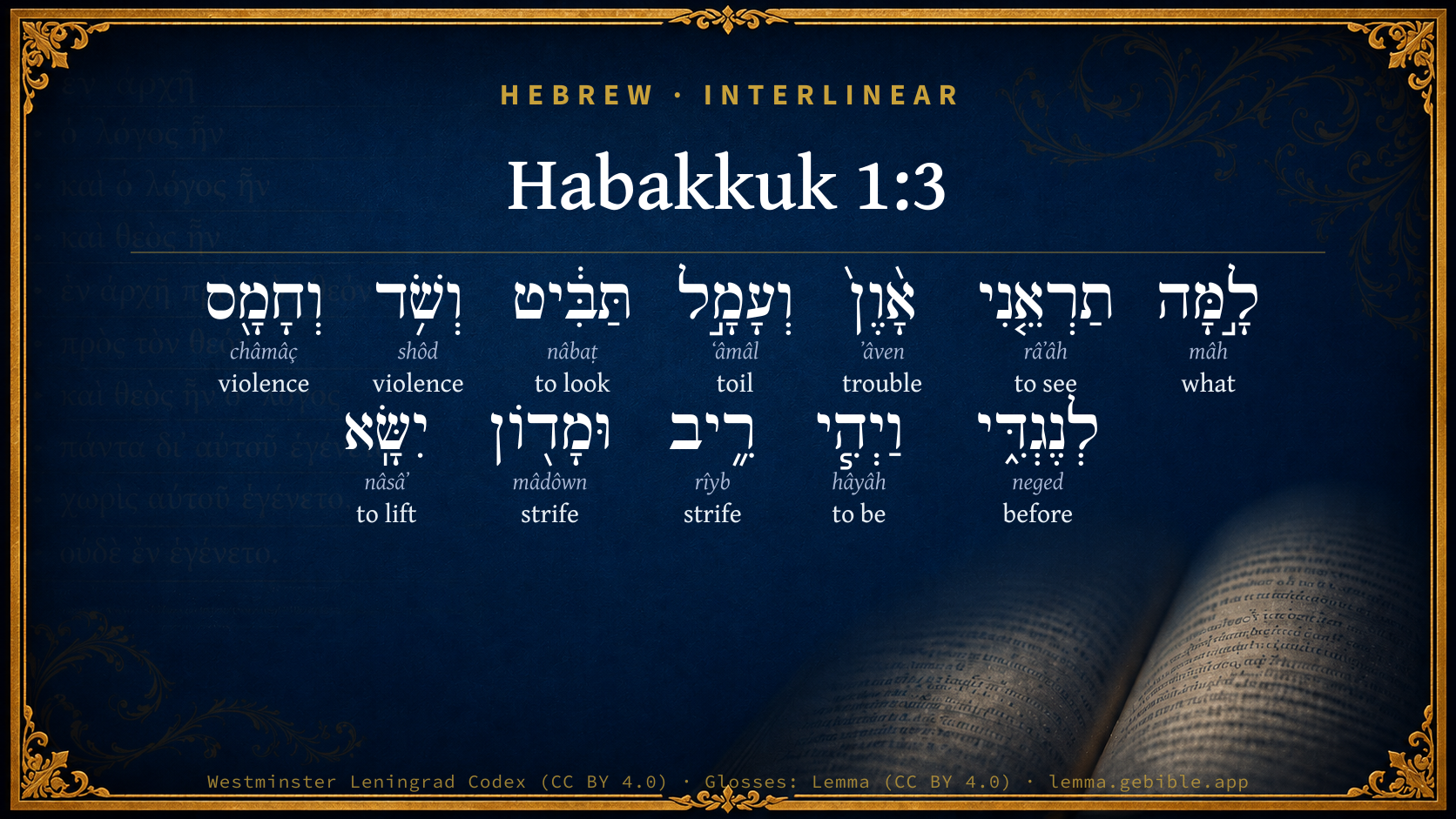
Hebrew (Westminster Leningrad Codex) Habakkuk 1:3 appears in the Hebrew Old Testament. The text above is from the Westminster Leningrad Codex. Each word links to its Strong’s number, a concise gloss, and parsing drawn from the Open Scriptures Hebrew Bible morphology. Click any word for its full Brown-Driver-Briggs (BDB) entry.
Download image
Cite this verse

Habakkuk 1:3 (World English Bible). Public Domain. Lemma interlinear Bible study tool, https://lemma.gebible.app/v/habakkuk/1/3.

Show BibTeX & RIS
BibTeX
RIS
English Translation
Why do you show me iniquity, and look at perversity? For destruction and violence are before me. There is strife, and contention rises up.
World English Bible · Public Domain
Download a study sheet

One document with this verse’s original text, its word-by-word gloss line, the meaning frame, cross-references with their text, attributed commentary, and full source and license credits — printable, and it pastes into notes with its structure intact.

This verse Autodidact and up

Study sheet (.html) Plain text (.txt)

A passage Seminary Student

Up to 50 verses in one chapter. A passage sheet keeps up to 6 commentary sources and 12 cross-references per verse, in the order this page ranks them, and says so on the sheet whenever that leaves anything out. Ask for a single verse and you get the Autodidact verse sheet above.

Everything on this page stays free to read, with no account — the sheet is a download of what is already on screen, not access to it.

Want to remove ads? Support Godless Engineer
Compare translations 3

The same verse in 3 English versions, stacked beneath the original-language interlinear above. Click any original word for its lexicon entry.

Each is an independent rendering of the whole verse — the interlinear is not word-aligned to these translations.

Highlighted words mark where these versions differ — a whole-verse word diff, not a word-by-word alignment.

  • World English Bible Public Domain
    Why do you show me iniquity, and look at perversity? For destruction and violence are before me. There is strife, and contention rises up.
  • King James Version Public Domain
    Why dost thou shew me iniquity, and cause me to behold grievance? for spoiling and violence are before me: and there are that raise up strife and contention.
  • unfoldingWord Literal Text CC BY-SA 4.0
    Why do you make me see iniquity, and do you behold trouble? And destruction and violence to the front of me, and is strife, and contention arises.

unfoldingWord Literal Text — © unfoldingWord, licensed CC BY-SA 4.0. Word-aligned USFM3 via Door43 (git.door43.org/unfoldingWord/en_ult).

Versions to compare (up to 4)

3 of 4 selected

Show all 18 translations

Every available English version of this verse, each an independent rendering of the whole verse.

  • World English Bible Public Domain
    Why do you show me iniquity, and look at perversity? For destruction and violence are before me. There is strife, and contention rises up.
  • Berean Standard Bible Public Domain
    Why do You make me see iniquity? Why do You tolerate wrongdoing? Destruction and violence are before me. Strife is ongoing, and conflict abounds.
  • Majority Standard Bible Public Domain
    Why do You make me see iniquity? Why do You tolerate wrongdoing? Destruction and violence are before me. Strife is ongoing, and conflict abounds.
  • King James Version Public Domain
    Why dost thou shew me iniquity, and cause me to behold grievance? for spoiling and violence are before me: and there are that raise up strife and contention.
  • American Standard Version (1901) Public Domain
    Why dost thou show me iniquity, and look upon perverseness? for destruction and violence are before me; and there is strife, and contention riseth up.
  • Revised Version (1885) Public Domain
    Why dost thou shew me iniquity, and look upon perverseness? for spoiling and violence are before me: and there is strife, and contention riseth up.
  • Geneva Bible (1599) Public Domain
    Why doest thou shewe mee iniquitie, and cause me to beholde sorowe? for spoyling, and violence are before me: and there are that rayse vp strife and contention.
  • Douay-Rheims (1899) Public Domain
    Why hast thou shewn me iniquity and grievance, to see rapine and injustice before me? and there is a judgment, but opposition is more powerful.
  • Young's Literal Translation Public Domain
    Why dost Thou shew me iniquity, And perversity dost cause to behold? And spoiling and violence `are' before me, And there is strife, and contention doth lift `itself' up,
  • Literal Standard Version CC BY-SA 4.0
    Why do You show me iniquity, || And cause [me] to behold perversity? And spoiling and violence [are] before me, || And there is strife, and contention lifts [itself] up,
  • Unlocked Literal Bible CC BY-SA 4.0
    Why do you make me see iniquity and look upon wrongdoing? Destruction and violence are before me; there is strife, and contention rises up.
  • unfoldingWord Literal Text CC BY-SA 4.0
    Why do you make me see iniquity, and do you behold trouble? And destruction and violence to the front of me, and is strife, and contention arises.
  • Darby Bible Public Domain
    Why dost thou cause me to see iniquity, and lookest thou upon grievance? For spoiling and violence are before me; and there is strife, and contention riseth up.
  • World Messianic Bible Public Domain
    Why do you show me iniquity, and look at perversity? For destruction and violence are before me. There is strife, and contention rises up.
  • Webster's Bible Public Domain
    Why dost thou show me iniquity, and cause me to behold grievance? for devastation and violence are before me: and there are that raise strife and contention.
  • Free Bible Version CC BY-SA 4.0
    Why do you force me to see this wickedness and suffering? Why do you just observe such destruction and violence? Arguments and fighting happen right in front of me!
  • Bible in Basic English Public Domain
    Why do you make me see evil-doing, and why are my eyes fixed on wrong? for wasting and violent acts are before me: and there is fighting and bitter argument.
  • JPS Tanakh (1917) Public Domain
    Why dost Thou show me iniquity, and beholdest mischief? And why are spoiling and violence before me? so that there is strife, and contention ariseth.

Literal Standard Version (2020), Covenant Press — licensed CC BY-SA 4.0. Text via the HelloAO Bible API (eBible.org). Unlocked Literal Bible (unfoldingWord) — licensed CC BY-SA 4.0. Text via the HelloAO Bible API (eBible.org). unfoldingWord Literal Text — © unfoldingWord, licensed CC BY-SA 4.0. Word-aligned USFM3 via Door43 (git.door43.org/unfoldingWord/en_ult). Free Bible Version, Dr. Jonathan Gallagher — licensed CC BY-SA 4.0. Text via the HelloAO Bible API (eBible.org).

Word by word

More ways to search: Search by grammar → Find every occurrence → Compare this word →

Practice this passage: Drill this verse → Learn its vocabulary →

וּמָד֖וֹן
mâdôwn
H4066
“and · strife”
Conjunction + Noun, Common, Masculine, Singular, Absolute
Part of Speech
Conjunction + Noun
Type
Common
Gender
Masculine
Number
Singular
State
Absolute
Full BDB Definition

Origin: from H1777

TWOT: 426c

strife, contention - strife, contention - object of contention
  1. לָ֣מָּה mâh H4100 “to/for · what” Preposition + Particle, Interrogative
  2. תַרְאֵ֤נִי râʼâh H7200 “to see · me” Verb, Hiphil, Imperfect, 2nd Person, Masculine, Singular + Suffix, Personal, 1st Person, Common, Singular
  3. אָ֨וֶן֙ ʼâven H205 “trouble” Noun, Common, Masculine, Singular, Absolute
  4. וְעָמָ֣ל ʻâmâl H5999 “and · toil” Conjunction + Noun, Common, Both, Singular, Absolute
  5. תַּבִּ֔יט nâbaṭ H5027 “to look” Verb, Hiphil, Imperfect, 2nd Person, Masculine, Singular
  6. וְשֹׁ֥ד shôd H7701 “and · violence” Conjunction + Noun, Common, Masculine, Singular, Absolute
  7. וְחָמָ֖ס châmâç H2555 “and · violence” Conjunction + Noun, Common, Masculine, Singular, Absolute
  8. לְנֶגְדִּ֑י neged H5048 “to/for · before · me” Preposition + Preposition + Suffix, Personal, 1st Person, Common, Singular
  9. וַיְהִ֧י hâyâh H1961 “and · to be” Conjunction + Verb, Qal, Sequential Imperfect, 3rd Person, Masculine, Singular
  10. רִ֦יב rîyb H7379 “strife” Noun, Common, Both, Singular, Absolute
  11. יִשָּֽׂא nâsâʼ H5375 “to lift” Verb, Qal, Imperfect, 3rd Person, Masculine, Singular

About this verse

These counts appear in no published source. They are computed here, from the morphology-tagged text and Lemma’s own curated glosses. What Lemma adds →

12
words
12
distinct lemmas
Prophets
section

Notable vocabulary

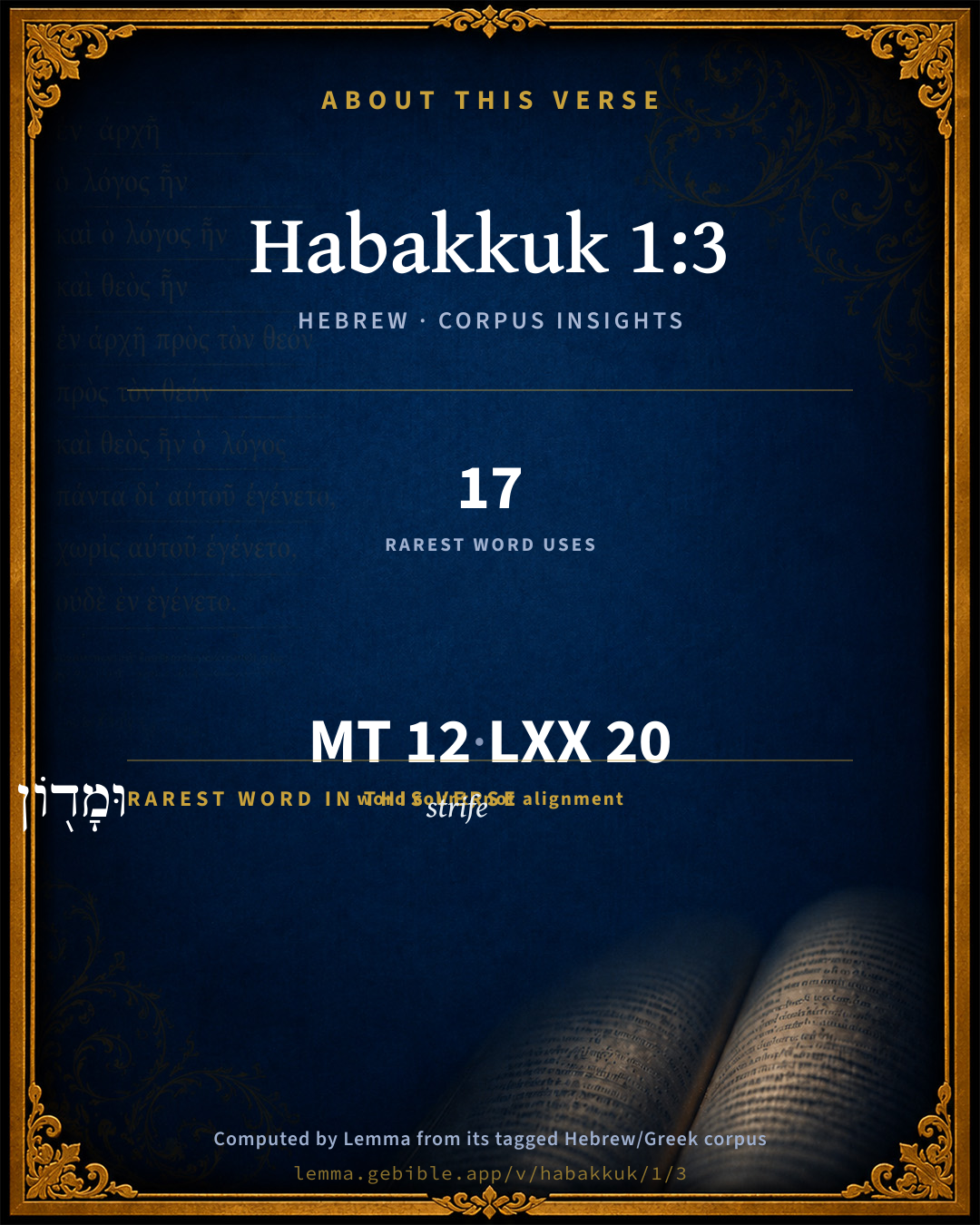
The rarest word here is וּמָד֖וֹן strife H4066 — appearing just 17 times in the whole Hebrew Bible.

Shared distinctive vocabulary

וּמָד֖וֹן strife H4066 occurs in 17 verses of the Hebrew Bible. Also found in:

Grammatical profile

  • 4 verbs
  • 6 nouns
  • 1 preposition
  • 1 particle

Verb forms

  • תַרְאֵ֤נִי Hiphil · Imperfect
  • תַּבִּ֔יט Hiphil · Imperfect
  • וַיְהִ֧י Qal · Sequential Imperfect
  • יִשָּֽׂא Qal · Imperfect

Hebrew & Septuagint length

In English translation the verse runs 24 words from the Hebrew and 24 from the Septuagint (LXX English) — the same length.

A rough comparison of the two English renderings, which tokenize alike — not a word-level alignment.

Word counts can differ between the Hebrew and the Greek without any difference in meaning — e.g. the Hebrew direct-object marker אֵת has no separate Greek word, and Greek often adds the article ὁ.

In the original languages it is 12 Hebrew tokens and 20 Greek tokens — but the two are counted differently (Hebrew bundles its prefixes and suffixes into one token; the Greek is in lemma form), so that isn’t a like-for-like length.

Cross-references

12

Topical passages linked to Habakkuk 1:3 in the Treasury of Scripture Knowledge — connected by theme and wording, ordered by reader-vote popularity; previews shown in the World English Bible.

  • Psalms 55:9–11 Confuse them, Lord, and confound their language, For I have seen violence and strife in the city.
  • Ecclesiastes 5:8 If you see the oppression of the poor, and the violent taking away of justice and righteousness in a district, don't marvel at the matter: for one official is eyed by a higher one; and there are officials over them.
  • Jeremiah 9:2–6 Oh that I had in the wilderness a lodging-place of wayfaring men; that I might leave my people, and go from them! for they are all adulterers, an assembly of treacherous men.
  • Jeremiah 20:8 For as often as I speak, I cry out; I cry, Violence and destruction! because the word of Yahweh is made a reproach to me, and a derision, all the day.
  • Micah 7:1–4 Misery is mine! Indeed, I am like one who gathers the summer fruits, as gleanings of the vinyard: There is no cluster of grapes to eat. My soul desires to eat the early fig.
  • Psalms 12:1–2 Help, Yahweh; for the godly man ceases. For the faithful fail from among the children of men.
  • Psalms 73:3–9 For I was envious of the arrogant, When I saw the prosperity of the wicked.
  • Psalms 120:5–6 Woe is me, that I live in Meshech, That I dwell among the tents of Kedar!
  • Ecclesiastes 4:1 Then I returned and saw all the oppressions that are done under the sun: and, behold, the tears of those who were oppressed, and they had no comforter; and on the side of their oppressors there was power; but they had no comforter.
  • Ezekiel 2:6 You, son of man, don't be afraid of them, neither be afraid of their words, though briers and thorns are with you, and you do dwell among scorpions: don't be afraid of their words, nor be dismayed at their looks, though they are a rebellious house.
  • Matthew 10:16 "Behold, I send you out as sheep in the midst of wolves. Therefore be wise as serpents, and harmless as doves.
  • 2 Peter 2:8 (for that righteous man dwelling among them, was tormented in his righteous soul from day to day with seeing and hearing lawless deeds):

Cross-references courtesy of OpenBible.info (CC BY 4.0).

Hebrew and Greek witnesses Masoretic Hebrew ↔ Greek Septuagint

The same verse in the two great witnesses to the Old Testament, shown verse-for-verse.

These are two independent witnesses, not word-aligned to each other, and the Septuagint is shown in lemma (dictionary) form.

Hebrew Habakkuk 1:3 Masoretic · Westminster Leningrad Codex

לָ֣מָּה תַרְאֵ֤נִי אָ֨וֶן֙ וְעָמָ֣ל תַּבִּ֔יט וְשֹׁ֥ד וְחָמָ֖ס לְנֶגְדִּ֑י וַיְהִ֧י רִ֦יב וּמָד֖וֹן יִשָּֽׂא

Why do you show me iniquity, and look at perversity? For destruction and violence are before me. There is strife, and contention rises up.

World English Bible · Public Domain

Greek LXX Habakkuk 1:3 Septuagint · lemma form

ἵνα τίς ἐγώ δεικνύω κόπος καί πόνος ἐπιβλέπω ταλαιπωρία καί ἀσέβεια ἐκ ἐναντίος ἐγώ γίγνομαι κρίσις καί ὁ κριτής λαμβάνω

Therefore have you shown me troubles and griefs to look upon, misery and ungodliness? judgment is before me, and the judge receives a reward.

LXX2012 (modern English Septuagint) · Public Domain

On this verse, Haydock's Catholic Bible Commentary discusses the Septuagint’s reading. Read the note in Commentary ↓

Hebrew: Westminster Leningrad Codex (CC BY 4.0). Greek: Septuagint (public domain); English from LXX2012 (modern English Septuagint) (Public Domain). How the Septuagint differs from the Hebrew →

Targum (Aramaic paraphrase)

1

The Targum is the ancient Jewish Aramaic paraphrase of the Hebrew Scriptures — an interpretive translation, not the Hebrew text itself. Onkelos (literal) and Pseudo-Jonathan (expansive) render the Torah, and Jonathan the Prophets. Coverage is partial: where no permissively-licensed English translation exists for a verse, only the Aramaic is shown. This is verse-level text, not a word-by-word alignment to the Hebrew.

  1. Targum Jonathan Prophets (Joshua–Malachi)
    לְמָא אֲנָא חָזֵי אֲנוֹסִין וּמִסְתַּכֵּיל כְּעָבְדֵי לֵיאוּת שְׁקַר בְּזוֹזִין וַחֲטוֹפִין לְקִבְלִי דִבְתַחֲרוּתָא וּבִזְדוֹנָא אִינוּן מִתְגַבְּרִין:

    (no public-domain English translation for this verse)

    Targum Jonathan — Aramaic: “Mikraot Gedolot” (public domain). English: “Sefaria Community Translation” (CC0 1.0 (public-domain dedication)); “London "Chaldee Paraphrase," 1871” (public domain). Text via Sefaria.

Commentary

Notes on Habakkuk 1:3 from classic Christian and Jewish commentators (each source and its license shown beneath its notes). The classic Christian expositions comment on the surrounding passage and are grouped to its opening verse, so a note may address several verses; the Jewish commentaries on the Tanakh (Rashi and others) are per-verse, so they appear only where the commentator wrote on this verse.

Lemma curates 59 commentaries, every one of them public domain or Creative Commons licensed, each selected and text-cleaned for this edition rather than reprinted as found. About our sources →

Trapp's Complete Commentary

John Trapp

Hab 1:3 Why dost thou shew me iniquity, and cause [me] to behold grievance? for spoiling and violence [are] before me: and there are [that] raise up strife and contention.

Ver. 3. Why dost thou show me iniquity? &c.] These were Hazaels to Habakkuk’s eyes, he could not see them with dry eyes, he could not but vex his righteous soul from day to day, as Lot did at Sodom, with their unlawful deeds, 2Pe 2:8, privately committed (as here in their common commerce), and publicly, as in the next words, in courts and consistories; for all was out of order.

And cause me to behold grievance] Molestation and mischief done to those that would live peaceably in the land, {Psa 7:14; Psa 7:16; Psa 94:20; Psa 55:11} to the poor that are fallen into their nets, debts, bonds, and mortgages, Psa 10:9. It is as if the prophet should say, Why dost thou not punish these enormous practices, but suffer evildoers to abuse thy longsufferance, to thy dishonour? Averroes, the philosopher, drew an argument from God’s patience to deny his providence. But what saith Austin? Some wicked God punisheth here, lest his providence, and but some, lest his patience and promise of judgment, should be called in question.

For spoiling and violence are before me] E regione mei vastatio et violentia, so that I cannot look beside them, I cannot but complain of them. Elijah and Jeremiah were more passionate, 1Ki 19:4; 1Ki 19:10; 1Ki 19:14 Jer 15:10; Jer 20:14.

And there are that raise up strife and contention] These are Satan’s seeds men, and kindling coals. He is an unquiet spirit, and strives to make others so; loves to fish in troubled waters, doth all he can to set one man against another, that he may prey upon both; as the master of the pit suppeth upon the bodies of those cocks whom he hath set to kill one another. Be not mischief maker, seeds men of sedition.

John Trapp, A Commentary or Exposition upon All the Books of the Old and New Testament (1647–1656) — public domain. Text from a community e-Sword module.

Tyndale Open Study Notes

Tyndale Open Resources

1:3 In Habakkuk’s day, destruction and violence permeated Judean society (see Habakkuk Book Introduction, “Setting”).

Tyndale Open Study Notes — © Tyndale Open Resources, licensed CC BY-SA 4.0. Text via the HelloAO Bible API.

Jamieson, Fausset & Brown

Robert Jamieson, A. R. Fausset & David Brown

cause me to behold grievance--MAURER denies that the Hebrew verb is ever active; he translates, "(Wherefore) dost Thou behold (without doing aught to check) grievance?" The context favors English Version.

there are that raise up strife and contention--so CALVIN. But MAURER, not so well, translates, "There is strife, and contention raises itself."

Jamieson, Fausset & Brown — Commentary Critical and Explanatory on the Whole Bible (1871) — public domain (CC PDM 1.0). Text via the HelloAO Bible API.

Adam Clarke's Commentary

Verse 3. And cause me to behold grievance] עמל amal, labour, toil, distress, misery, &c., the common fruits of sin.

Adam Clarke's Commentary on the Bible (1810–1826) — public domain. Text from a community e-Sword/MySword module.

John Calvin's Commentaries

He afterwards adds, How long wilt thou show me iniquity, and make me to see trouble? Here the Prophet briefly relates the cause of his indignation,—that he could not, without great grief, yea, without anguish of mind, behold such evils prevailing among God’s chosen people; for they who apply this to the Chaldeans, do so strainedly, and without any necessity, and they have not observed the reason which I have stated—that the Prophet does not here teach the Jews, but prepares them for a coming judgement, as they could not but see that they were justly condemned, since they were proved guilty by the cry and complaints made by all the godly.

Now this passage teaches us, that all who really serve and love God, ought, according to the Prophet’s example, to burn with holy indignation whenever they see wickedness reigning without restraint among men, and especially in the Church of God. There is indeed nothing which ought to cause us more grief than to see men raging with profane contempt for God, and no regard had for his law and for divine truth, and all order trodden under foot. When therefore such a confusion appears to us, we must feel roused, if we have in us any spark of religion. If it be objected, that the Prophet exceeded moderation, the obvious answer is this,—that though he freely pours forth his feelings, there was nothing wrong in this before God, at least nothing wrong is imputed to him: for wherefore do we pray, but that each of us may unburden his cares, his griefs, and anxieties, by pouring them into the bosom of God? Since, then, God allows us to deal so familiarly with him, nothing wrong ought to be ascribed to our prayers when we thus freely pour forth our feelings, provided the bridle of obedience keeps us always within due limits, as was the case with the Prophet; for it is certain that he was retained under the influence of real kindness. Jeremiah did indeed pray with unrestrained fervor (Jeremiah 15:10): but his case was different from that of our Prophet; for he proceeds not here to an excess, as Jeremiah did when he cursed the day of his birth, and when he expostulated with God for being made a man of contention. But our Prophet undertakes here the defense of justice; for he could not endure the law of God to be made a sport, and men to allow themselves every liberty in sinning.

We now, then, see that the Prophet can be justly excused, though he expostulates here with God, for God does not condemn this freedom in our prayers; but, on the contrary, the end of praying is, that every one of us pour forth, as it is said in the Psalms, his heart before God. As, then, we communicate our cares and sorrows to God, it is no wonder that the Prophet, according to the manner of men, says, Why dost thou show me iniquity, and make me to see trouble? Trouble is to be taken here in an active sense, and the verb תבימ, tabith, has a transitive meaning. Some render it, Why dost thou look on trouble? as though the Prophet indignantly bore the connivance of God. But the context necessarily requires that this verb should be taken in a transitive sense. “Why dost thou show me iniquity?” and then, “and makest me to look on violence?” He says afterwards, in the third place, in my sight is violence. But I have said, that the word trouble is to be taken actively; for the prophet means not that he was worn out with weariness, but that wicked men were troublesome to the good and the innocent, as it is usually the case when a freedom in sinning prevails.

And why, he says, are violence and plunder in my sight? and there is he who excites, etc.? The verb נשא, nusha means not here to undertake, as some render it; but, on the contrary, to raise. Others render it, “Who supports,” but this is frigid. Therefore the translation which I have stated is the most suitable—And why is there one who excites strife and contention?

But the Prophet here accuses them only of sins against the second table of the law: he speaks not of the superstitions of people, and of the corrupted worship of God; but he briefly says, that they had no regard for what was just and right: for the stronger any one was, the more he distressed the helpless and the innocent. It was then for this reason that he mentioned iniquity, trouble, plunder, violence, contention, strife. In short, the Prophet here deplores, that there was now no equity and no brotherly kindness among the people, but that robberies, rapines, and tyrannical violence prevailed everywhere. It follows—

John Calvin's Commentaries (1540-1563) — public domain. Text from the Calvin Translation Society English edition (1840s-50s) via the Christian Classics Ethereal Library (ccel.org). Calvin's coverage is partial (roughly two-thirds of the Bible); uncommented books and verses are honest gaps, never fabricated. The 19th-century editor's footnotes and remarks are omitted so the notes are faithfully Calvin's own voice.

Ellicott's Commentary for English Readers

(3) Why dost thou shew me iniquity? . . .—Better, Why dost thou show me distress and look upon grievance; oppression and violence are before me; and there is strife, and contention exalts itself.” The question, “Why dost thou . . . look upon grievance?” is illustrated by Hab_1:13, “Thou art of purer eyes than to behold evil.” Grievance, or “trouble wilfully caused.” Heb. âmâl, associated again with âven, a term of similar import, in Psa_10:7; Psa_55:11.

A Bible Commentary for English Readers, edited by Charles John Ellicott (1878–1897) — public domain. Text from a community e-Sword module.

The Cambridge Bible for Schools and Colleges

gen. ed. J. J. S. Perowne

3. shew me iniquity] cause me to see iniquity. God by His interposition might have checked the iniquity; by His refraining the continuance of it is virtually due to Him. One thing pains the prophet—that he has to behold iniquity; and another perplexes him—that God, the Righteous One, brings him into such a trial, or leaves him in it. The Hebrew mind was the more profoundly agitated by the moral anomalies in the world, because it could not help ascribing them directly to God, Who was the immediate cause of all things. The feeling is often expressed in Job, e.g. Job_23:16-17.

The term “iniquity” is used both of physical evil, “affliction” (Jer_4:14; Job_5:6), and moral evil, “wickedness”; here of the latter, as generally, e.g. in the common phrase “workers of iniquity.”

cause me to behold grievance] and dost look upon trouble. The term grievance or trouble (Hab_1:13 R.V. perverseness), properly “labour,” toil, has also the double sense of misery, pain, sorrow, travail (Isa_53:11), or mischief, wrongdoing (Psa_7:15; Psa_94:20; Isa_59:4). The latter half of the verse “spoiling and violence” is in favour of understanding all the terms not so much of evils suffered as of evils inflicted. The prophet is perplexed because God looks on unconcerned when men perpetrate wrong.

spoiling and violence are before me] The words again combined, Jer_6:7; Jer_20:8; Eze_45:9; Amo_3:10. The term “spoiling” means violent mishandling when used of a person, destruction or devastation when said of a thing. Isa_13:6; Job_5:21-22; Hos_7:13; Psa_12:6. With “before me” comp. Jer_6:7.

there are that raise up strife] Rather as R.V.: and there is strife, and contention riseth up (for Heb. constr. cf. Psa_89:9). This is the condition of things that has come about and prevails. The terms “strife” and “contention” certainly suggest animosities between members of the same community rather than injuries inflicted on a subject people by their conquerors. The conquerors of Israel did not mix among the inhabitants or interfere with individual persons, they merely demanded political subjection and tribute, and the latter they collected not from the people but from their rulers. Comp. the use of the two words in Jer_15:10.

The Cambridge Bible for Schools and Colleges (gen. ed. J. J. S. Perowne; Cambridge University Press, 1878–1918) — public domain. Text from a community e-Sword module.

John Gill's Exposition

Why dost thou show me iniquity, and cause me to behold grievance?.... That is, wicked men, and such as give a great deal of trouble vexation, and grief to others, by their rapine and oppression; suggesting that he could not turn his eyes any where, but such persons presented themselves to his view; and that their wicked actions were performed by them openly and publicly, in the sight of all, without any shame or fear. So the Targum,

"why do I see oppressors, and behold those that do the labour of falsehood?''

For spoiling and violence are before me; in my sight and presence, though a prophet, and notwithstanding all my remonstrances, exhortations, and reproofs; such were the hardness, obstinacy, and impudence of this people; to such a height and pitch of iniquity were they arrived, as to regard not the prophets of the Lord. The Targum is,

"spoilers and robbers are before me:''

or, "against me" (q), as in the text; these sins were committed against him, he was injuriously used himself; or they were done to others, contrary to his advice and persuasion:

and there are that raise up strife and contention; in the kingdom, in cities, in families; in one man, brother, friend, and neighbour, against another; which occasion lawsuits, and in them justice is not done, as follows. It may be rendered, and "there shall be and is a man of strife"; so Japhet: "and he shall raise up contention"; one man given to strife will and does use great contention in communities, civil and religious.

(q) "contra me", Pagninus, Montanus; "e regione mei", Junius & Tremellius, Piscator, Tarnovius.

John Gill's Exposition of the Whole Bible (1746–1763) — public domain (CC PDM 1.0). Text via the HelloAO Bible API.

Albert Barnes' Notes on the Bible

Why dost Thou shew me iniquity, and cause me to behold - , or rather, “Why beholdest Thou grievance?” God seemed to reverse what He had said by Balaam Num 23:21, “He hath not beheld iniquity in Jacob, and hath not seen grievousness in Israel”; and in the Psalms Psa 10:14, “Thou hast seen, for thou (emphatic) beholdest grievousness and wrong, to put it in Thy hand,” i. e., Thou layest it up in Thy hand, to cast it back on the head of the evildoer. Now He seemed to behold it and leave it unpunished, which yet Habakkuk says to God below, He could not do Hab 1:13; “Thou canst not look upon iniquity.” What then did this mean? What was the solution?

All forms and shapes of sin are multiplied; oppressive “violence” , such as “covered the earth” before the flood, and brought it down; which Nineveh had to put away Jon 3:8, and it was spared; “iniquity,” i. e., what is unequal and contrary to truth, falsehood.

Grievance - literally, burdensome wearisome “toil”; “spoiling,” or open robbery; “strife and contention,” both through perversion of the law and, without it, through endless jarrings of man with man. Sin recoils on the sinner. So what he beholds is not “iniquity” only, but (in the same word) “vanity”; “grievance”; which is a burden both to him who suffers, and yet more to him who inflicts it. For nothing is so burdensome as sin, nothing so empty as wickedness. And while to him who suffers, the suffering is temporal, to him who inflicts it, it is eternal. And yet the prophet and whose prays against ungodliness, “must commiserate him who doth wrong yet more, since they hurt what is most precious, their own soul, and that eternally” . All then is full of evil. Wherever the prophet looks, some fresh violence is before him; it confronts him on every side; “strife hath arisen” , come up, exists where it was not before; “contention lifteth itself” on high, bowing down all beside.

Albert Barnes' Notes on the Bible (1834–1885) — public domain. Text from a community e-Sword/MySword module.

Haydock's Catholic Bible Commentary

Opposition. Septuagint, "the judge receives" bribes. (Haydock) --- Such was the state of Juda after Josias, Jeremias xxi. 12.

George Leo Haydock (1774–1849), Haydock's Catholic Family Bible and Commentary, 1859 edition — public domain. Excludes Psalms (Douay-Rheims chapter numbering differs from Protestant) and Deuterocanonical books (Catholic canon only).

Matthew Poole's English Annotations

Why dost thou show me? it is a most unpleasing sight, and that which troubles me and every good man, to see unjust and injurious men without control, and unpunished, to act their iniquity; and yet, O God, thou not only permittest it to be done, but to be done in sight, and to the grief of thy servants: thus God showeth it, and it is not without just cause, though the cause be hidden.

Iniquity; men of iniquity and vanity, unrighteous toward men, and vain in their thoughts and practices of religion toward God.

And cause me to behold: this explains the former. Grievance: so it is in regard of the effect it hath upon beholders, and such as suffer by this iniquity; it is grief and sorrow to them, it is a grievance they groan under.

For spoiling, such as wasteth, and undoeth them that fall under it,

and violence, perverting judgment, and turning it into wormwood; or else it is a Hebraism, spoiling and violence, that is, most violent robbing and spoiling each other.

Are before me; every where I see it, to the breaking of mine heart.

There are that raise up strife; or, and there is strife, that is, little else but strife among men, occasioned by these oppressive practices.

And contention: so it will be a Hebraism, expressing endless contentions. It would bear, and judgment is taken away, which suits the next verse.

Matthew Poole's English Annotations on the Holy Bible (1683–1685) — public domain. Text from a community e-Sword/MySword module.

The Pulpit Commentary

Why dost thou show meWhy dost thou let me see daily with my own eyes iniquity abounding, the very evil which Balaam says (Num_23:21) the Lord had not found in Israel? Cause me to behold grievance. This should be, Dost thou look upon perverseness? He asks how God can look on this evil and leave it unpunished. The LXX and the Vulgate translate the word amal "trouble," or "labour;" Keil, "distress." In this case it means the trouble and distress which a man inflicts on others, as wrong doing seems to be generally spoken of. Spoiling and violence are before me. "Spoiling" is robbery that causes desolation. "Violence" is conduct that wrongs one"s neighbour. The two words are often joined; e.g. Jer_6:7; Amo_3:10. Vulgate, praedam et injustitiam. These are continually coming before the prophet"s eyes. There are that raise up strife and contention; better, there is strife, and contention is raised. This refers to the abuse of the Law by grasping, quarrelsome nobles. Septuagint, "Against me judgment hath gone, and the judge receiveth bribes." So the Syriac and Arabic. The Vulgate gives, Factum est judicium, et contradictio potentior, where judicium is used in a bad sense.

The Pulpit Commentary (1880–1919), ed. H.D.M. Spence-Jones & Joseph S. Exell — public domain. Text from a community e-Sword module.

unfoldingWord translationNotes

Door43 World Missions Community

General Information:

Habakkuk continues his prayer to God.

Destruction and violence are before me

The words "destruction" and "violence" can be translated with a verbal phrase. The idiom "before me" means that Habakkuk witnesses these things happening. AT: "I witness people destroying things and acting violently" (See: Abstract Nouns and Idiom)

contention rises up

The word "contention" refers to conflict between people and can be translated with a verbal phrase. Habakkuk speaks of there being more contention between people as if contention rises up. AT: "there is more conflict between people" (See: Abstract Nouns and Metaphor)

the law is weakened

Habakkuk speaks of people not obeying or enforcing the law as if they had made the law weak and unable to act. AT: "no one enforces the law" (See: Metaphor)

the wicked surround the righteous

Habakkuk speaks of wicked people causing righteous people to suffer injustice as if the wicked people surrounded the righteous people. (See: Metaphor and Nominal Adjectives)

false justice goes out

Habakkuk speaks of judges giving decisions that they say are just but that are not as if "false justice" were going out to the people. AT: "judges give verdicts that are not just" (See: Metaphor)

translationWords

iniquity

strife

raise

law

just

evil

righteous

unfoldingWord translationNotes — © Distant Shores Media and the Door43 World Missions Community, licensed CC BY-SA 4.0. Source: git.door43.org/Door43/en_tn.

Rashi

Rabbi Shlomo Yitzchaki (Rashi)

iniquity plunder and violence.

and look upon mischief You look upon this mischief, but You do not help.

and the one who bears quarrel and strife endures And this wicked man who bears quarrel and strife, will live, remain in existence, and prosper.

endures He who bears quarrel and strife will endure. So did Jonathan render.

Rashi on the Tanakh — English translations: “The Judaica Press complete Tanach with Rashi, translated by A. J. Rosenberg” (CC BY 4.0); “Pentateuch with Rashi's commentary by M. Rosenbaum and A.M. Silbermann, 1929-1934” (public domain); “The Metsudah Tanach series, Lakewood, N.J” (CC BY 4.0); and “The Book of Joshua, Metsudah Publications, 1997” (CC BY 4.0). Text via Sefaria.

Lesson kit

Teaching starters — assembled from the data on this page, not authored interpretation. Every prompt links to the verse data it draws on. Edit before teaching.

Habakkuk, in the Prophets, opens this verse with 12 words (12 distinct Hebrew lemmas). Its most distinctive word is mâdôwn (“strife”). A historical commentator’s framing appears above. Read the whole chapter for the surrounding context.

Discussion questions

  1. The word mâdôwn carries the sense “strife.” How does it shape the verse?
  2. Psalms 80:6 shares the word «strife» with this verse. How do the two illuminate each other?
  3. These translations render this verse differently. What is at stake in choosing one wording over another?
  4. The verb «תַרְאֵ֤נִי» is Hiphil Imperfect. How does its form color the action?
  5. Reading how Trapp's Complete Commentary and Tyndale Open Study Notes read this verse, where do the two commentators agree and where do they part?

Things to notice

Reading settings

Reading text

Shown beneath each verse's original-language words.

Old Testament
Old Testament edition

Read the OT as the Masoretic Hebrew (MT) or the Greek Septuagint (LXX).

English shown for the Greek Septuagint (in the Hebrew ↔ Greek comparison).

Comparing translations? Open the Compare panel on any verse page to stack up to four side by side.