Job 10:15

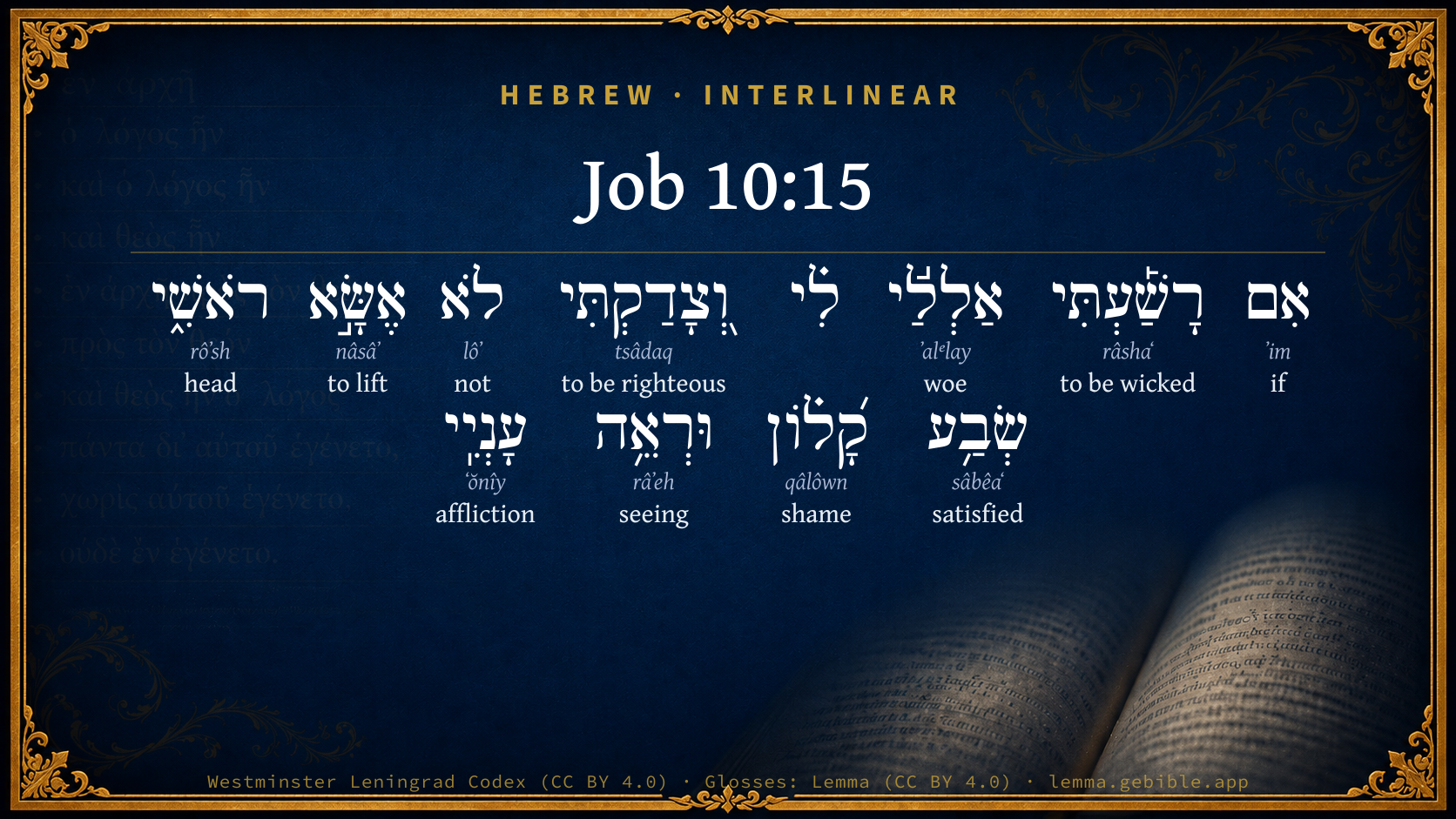
Hebrew (Westminster Leningrad Codex) Job 10:15 appears in the Hebrew Old Testament. The text above is from the Westminster Leningrad Codex. Each word links to its Strong’s number, a concise gloss, and parsing drawn from the Open Scriptures Hebrew Bible morphology. Click any word for its full Brown-Driver-Briggs (BDB) entry.
Download image
Cite this verse

Job 10:15 (World English Bible). Public Domain. Lemma interlinear Bible study tool, https://lemma.gebible.app/v/job/10/15.

Show BibTeX & RIS
BibTeX
RIS
English Translation
If I am wicked, woe to me. If I am righteous, I still shall not lift up my head, Being filled with disgrace, And conscious of my affliction.
World English Bible · Public Domain
Highlights
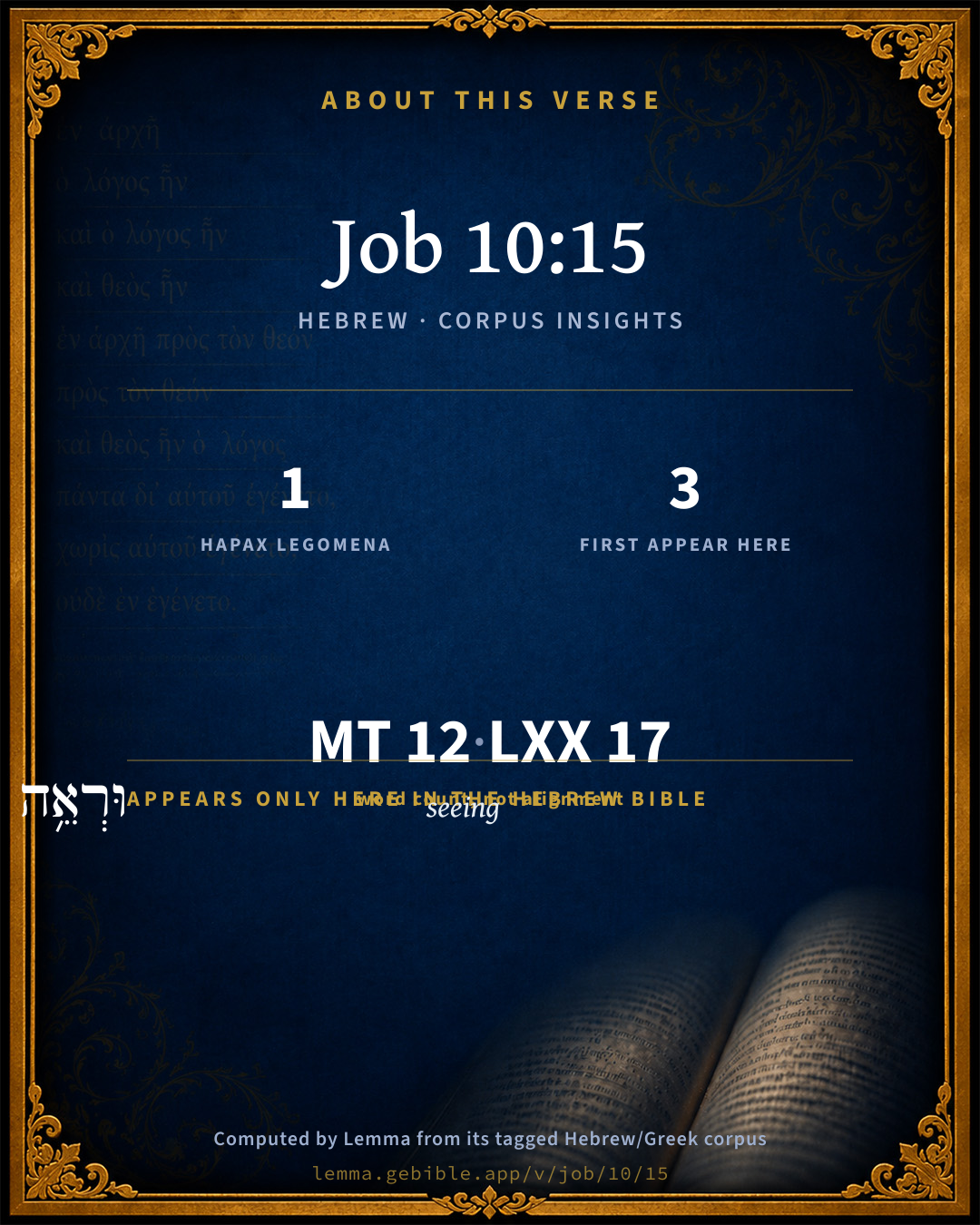
  • 1 hapax legomenon — only here in the Hebrew Bible
  • 3 first appearances in the Hebrew Bible
Full analysis ↓
Download a study sheet

One document with this verse’s original text, its word-by-word gloss line, the meaning frame, cross-references with their text, attributed commentary, and full source and license credits — printable, and it pastes into notes with its structure intact.

This verse Autodidact and up

Study sheet (.html) Plain text (.txt)

A passage Seminary Student

Up to 50 verses in one chapter. A passage sheet keeps up to 6 commentary sources and 12 cross-references per verse, in the order this page ranks them, and says so on the sheet whenever that leaves anything out. Ask for a single verse and you get the Autodidact verse sheet above.

Everything on this page stays free to read, with no account — the sheet is a download of what is already on screen, not access to it.

Want to remove ads? Support Godless Engineer
Compare translations 3

The same verse in 3 English versions, stacked beneath the original-language interlinear above. Click any original word for its lexicon entry.

Each is an independent rendering of the whole verse — the interlinear is not word-aligned to these translations.

Highlighted words mark where these versions differ — a whole-verse word diff, not a word-by-word alignment.

  • World English Bible Public Domain
    If I am wicked, woe to me. If I am righteous, I still shall not lift up my head, Being filled with disgrace, And conscious of my affliction.
  • King James Version Public Domain
    If I be wicked, woe unto me; and if I be righteous, yet will I not lift up my head. I am full of confusion; therefore see thou mine affliction;
  • unfoldingWord Literal Text CC BY-SA 4.0
    If I am wicked, woe to me! And I am righteous, I will not lift my head. full of disgrace. Yes, see my affliction!

unfoldingWord Literal Text — © unfoldingWord, licensed CC BY-SA 4.0. Word-aligned USFM3 via Door43 (git.door43.org/unfoldingWord/en_ult).

Versions to compare (up to 4)

3 of 4 selected

Show all 18 translations

Every available English version of this verse, each an independent rendering of the whole verse.

  • World English Bible Public Domain
    If I am wicked, woe to me. If I am righteous, I still shall not lift up my head, Being filled with disgrace, And conscious of my affliction.
  • Berean Standard Bible Public Domain
    If I am guilty, woe to me! And even if I am righteous, I cannot lift my head. I am full of shame and aware of my affliction.
  • Majority Standard Bible Public Domain
    If I am guilty, woe to me! And even if I am righteous, I cannot lift my head. I am full of shame and aware of my affliction.
  • King James Version Public Domain
    If I be wicked, woe unto me; and if I be righteous, yet will I not lift up my head. I am full of confusion; therefore see thou mine affliction;
  • American Standard Version (1901) Public Domain
    If I be wicked, woe unto me; And if I be righteous, yet shall I not lift up my head; Being filled with ignominy, And looking upon mine affliction.
  • Revised Version (1885) Public Domain
    If I be wicked, woe unto me; and if I be righteous, yet shall I not lift up my head; being filled with ignominy and looking upon mine affliction.
  • Geneva Bible (1599) Public Domain
    If I haue done wickedly, wo vnto me: if I haue done righteously, I will not lift vp mine head, being full of confusion, because I see mine affliction.
  • Douay-Rheims (1899) Public Domain
    And if I be wicked, woe unto me: and if just, I shall not lift up my head, being filled with affliction and misery.
  • Young's Literal Translation Public Domain
    If I have done wickedly -- wo to me, And righteously -- I lift not up my head, Full of shame -- then see my affliction,
  • Literal Standard Version CC BY-SA 4.0
    If I have done wickedly—woe to me, || And righteously—I do not lift up my head, || Full of shame—then see my affliction,
  • Unlocked Literal Bible CC BY-SA 4.0
    If I have acted wickedly, woe to me; and even if I acted righteously, I could not lift up my head, since I am filled with disgrace— see my affliction!
  • unfoldingWord Literal Text CC BY-SA 4.0
    If I am wicked, woe to me! And I am righteous, I will not lift my head. full of disgrace. Yes, see my affliction!
  • Darby Bible Public Domain
    If I were wicked, woe unto me! and righteous, I will not lift up my head, being [so] full of shame, and beholding mine affliction; --
  • World Messianic Bible Public Domain
    If I am wicked, woe to me. If I am righteous, I still will not lift up my head, being filled with disgrace, and conscious of my affliction.
  • Webster's Bible Public Domain
    If I be wicked, woe to me; and if I be righteous, yet will I not lift up my head. I am full of confusion; therefore see thou my affliction;
  • Free Bible Version CC BY-SA 4.0
    If I'm guilty I'm in trouble, if I'm innocent I can't hold my head high because I'm totally disgraced as I look at my sufferings.
  • Bible in Basic English Public Domain
    That, if I was an evil-doer, the curse would come on me; and if I was upright, my head would not be lifted up, being full of shame and overcome with trouble.
  • JPS Tanakh (1917) Public Domain
    If I be wicked, woe unto me; and if I be righteous, yet shall I not lift up my head — being filled with ignominy and looking upon mine affliction.

Literal Standard Version (2020), Covenant Press — licensed CC BY-SA 4.0. Text via the HelloAO Bible API (eBible.org). Unlocked Literal Bible (unfoldingWord) — licensed CC BY-SA 4.0. Text via the HelloAO Bible API (eBible.org). unfoldingWord Literal Text — © unfoldingWord, licensed CC BY-SA 4.0. Word-aligned USFM3 via Door43 (git.door43.org/unfoldingWord/en_ult). Free Bible Version, Dr. Jonathan Gallagher — licensed CC BY-SA 4.0. Text via the HelloAO Bible API (eBible.org).

Word by word

More ways to search: Search by grammar → Find every occurrence → Compare this word →

Practice this passage: Drill this verse → Learn its vocabulary →

וּרְאֵ֥ה
râʼeh
H7202
“and · seeing”
Conjunction + Verb, Qal, Imperative, 2nd Person, Masculine, Singular
Part of Speech
Conjunction + Verb
Stem
Qal
Form
Imperative
Person
2nd Person
Gender
Masculine
Number
Singular
Full BDB Definition

Origin: from H7200

TWOT: 2095a

(Qal) seeing
  1. אִם ʼim H518 “if” Conjunction
  2. רָשַׁ֡עְתִּי râshaʻ H7561 “to be wicked” Verb, Qal, Perfect, 1st Person, Common, Singular
  3. אַלְלַ֬י ʼalᵉlay H480 “woe” Particle, Interjection
  4. וְ֭צָדַקְתִּי tsâdaq H6663 “and · to be righteous” Conjunction + Verb, Qal, Sequential Perfect, 1st Person, Common, Singular
  5. לֹא lôʼ H3808 “not” Particle, Negative
  6. אֶשָּׂ֣א nâsâʼ H5375 “to lift” Verb, Qal, Imperfect, 1st Person, Common, Singular
  7. רֹאשִׁ֑י rôʼsh H7218 “head · my” Noun, Common, Masculine, Singular, Construct + Suffix, Personal, 1st Person, Common, Singular
  8. שְׂבַ֥ע sâbêaʻ H7649 “satisfied of” Adjective, Adjective, Masculine, Singular, Construct
  9. קָ֝ל֗וֹן qâlôwn H7036 “shame” Noun, Common, Masculine, Singular, Absolute
  10. עָנְיִֽי ʻŏnîy H6040 “affliction · my” Noun, Common, Masculine, Singular, Construct + Suffix, Personal, 1st Person, Common, Singular

About this verse

These counts appear in no published source. They are computed here, from the morphology-tagged text and Lemma’s own curated glosses. What Lemma adds →

12
words
11
distinct lemmas
Wisdom
section

Notable vocabulary

1 hapax legomenon — a word that appears only here in the entire Hebrew Bible:

  • וּרְאֵ֥ה seeing H7202

First appearance in Scripture

These words make their first canonical appearance in the Hebrew Bible here:

  • אַלְלַ֬י woe H480
  • קָ֝ל֗וֹן shame H7036
  • וּרְאֵ֥ה seeing H7202

Shared distinctive vocabulary

אַלְלַ֬י woe H480 occurs in 2 verses of the Hebrew Bible. Also found in:

Grammatical profile

  • 4 verbs
  • 3 nouns
  • 1 adjective
  • 1 preposition
  • 1 conjunction
  • 2 particles

Verb forms

  • רָשַׁ֡עְתִּי Qal · Perfect
  • וְ֭צָדַקְתִּי Qal · Sequential Perfect
  • אֶשָּׂ֣א Qal · Imperfect
  • וּרְאֵ֥ה Qal · Imperative

Hebrew & Septuagint length

In English translation the verse runs 28 words from the Hebrew and 26 from the Septuagint (LXX English) — closely comparable.

A rough comparison of the two English renderings, which tokenize alike — not a word-level alignment.

Word counts can differ between the Hebrew and the Greek without any difference in meaning — e.g. the Hebrew direct-object marker אֵת has no separate Greek word, and Greek often adds the article ὁ.

In the original languages it is 12 Hebrew tokens and 17 Greek tokens — but the two are counted differently (Hebrew bundles its prefixes and suffixes into one token; the Greek is in lemma form), so that isn’t a like-for-like length.

Cross-references

20

Topical passages linked to Job 10:15 in the Treasury of Scripture Knowledge — connected by theme and wording, ordered by reader-vote popularity; previews shown in the World English Bible.

  • Isaiah 3:11 Woe to the wicked! Disaster is upon them; For the deeds of his hands will be paid back to him.
  • Job 9:15 Whom, though I were righteous, yet would I not answer. I would make supplication to my judge.
  • Job 9:20–21 Though I am righteous, my own mouth shall condemn me. Though I am blameless, it shall prove me perverse.
  • Job 10:7 Although you know that I am not wicked, There is no one who can deliver out of your hand.
  • Psalms 25:18 Consider my affliction and my travail. Forgive all my sins.
  • Isaiah 6:5 Then I said, "Woe is me! For I am undone, because I am a man of unclean lips, and I dwell in the midst of a people of unclean lips: for my eyes have seen the King, Yahweh of Hosts!"
  • Malachi 3:18 Then you shall return and discern between the righteous and the wicked, between him who serves God and him who doesn't serve him.
  • Exodus 3:7 Yahweh said, "I have surely seen the affliction of my people who are in Egypt, and have heard their cry because of their taskmasters, for I know their sorrows.
  • Job 9:12 Behold, he snatches away; who can hinder him? Who will ask him, 'What are you doing?'
  • Job 9:29 I shall be condemned; Why then do I labor in vain?
  • Job 21:6 When I remember, I am troubled. Horror takes hold of my flesh.
  • Job 23:15 Therefore I am terrified at his presence. When I consider, I am afraid of him.
  • Job 27:7 "Let my enemy be as the wicked, Let him who rises up against me be as the unrighteous.
  • Psalms 9:17 The wicked shall be turned back to Sheol, Even all the nations that forget God.
  • Psalms 119:153 Consider my affliction, and deliver me, For I don't forget your law.
  • Isaiah 64:5–6 You meet him who rejoices and works righteousness, those who remember you in your ways: behold, you were angry, and we sinned: in them [have we been] of long time; and shall we be saved?
  • Lamentations 1:20 See, Yahweh; for I am in distress; my heart is troubled; My heart is turned within me; for I have grievously rebelled: Abroad the sword bereaves, at home there is as death.
  • Lamentations 5:1–22 Remember, Yahweh, what has come on us: Look, and see our reproach.
  • Luke 17:10 Even so you also, when you have done all the things that are commanded you, say, 'We are unworthy servants. We have done our duty.'"
  • Romans 2:8–9 but to those who are self-seeking, and don't obey the truth, but obey unrighteousness, will be wrath and indignation,

Cross-references courtesy of OpenBible.info (CC BY 4.0).

Hebrew and Greek witnesses Masoretic Hebrew ↔ Greek Septuagint

The same verse in the two great witnesses to the Old Testament, shown verse-for-verse.

These are two independent witnesses, not word-aligned to each other, and the Septuagint is shown in lemma (dictionary) form.

Hebrew Job 10:15 Masoretic · Westminster Leningrad Codex

אִם רָשַׁ֡עְתִּי אַלְלַ֬י לִ֗י וְ֭צָדַקְתִּי לֹא אֶשָּׂ֣א רֹאשִׁ֑י שְׂבַ֥ע קָ֝ל֗וֹן וּרְאֵ֥ה עָנְיִֽי

If I am wicked, woe to me. If I am righteous, I still shall not lift up my head, Being filled with disgrace, And conscious of my affliction.

World English Bible · Public Domain

Greek LXX Job 10:15 Septuagint · lemma form

ἐάν τε γάρ ἀσεβής εἰμί οἴμμοι ἐάν τε εἰμί δίκαιος οὐ δύναμαι ἀνακύπτω πλήρης γάρ ἀτιμία εἰμί

Or if I should be ungodly, woe is me: and if I should be righteous, I can’t lift myself up, for I am full of dishonor.

LXX2012 (modern English Septuagint) · Public Domain

On this verse, John Gill's Exposition discusses the Septuagint’s reading. Read the note in Commentary ↓

Hebrew: Westminster Leningrad Codex (CC BY 4.0). Greek: Septuagint (public domain); English from LXX2012 (modern English Septuagint) (Public Domain). How the Septuagint differs from the Hebrew →

Commentary

Notes on Job 10:15 from classic Christian and Jewish commentators (each source and its license shown beneath its notes). The classic Christian expositions comment on the surrounding passage and are grouped to its opening verse, so a note may address several verses; the Jewish commentaries on the Tanakh (Rashi and others) are per-verse, so they appear only where the commentator wrote on this verse.

Lemma curates 59 commentaries, every one of them public domain or Creative Commons licensed, each selected and text-cleaned for this edition rather than reprinted as found. About our sources →

Trapp's Complete Commentary

John Trapp

Job 10:15 If I be wicked, woe unto me; and [if] I be righteous, [yet] will I not lift up my head. [I am] full of confusion; therefore see thou mine affliction;

Ver. 15. If I be wicked, woe unto me] Here he bringeth a dilemma, whereby he declareth himself every way miserable, saith Mercer; whether he be bad or good, suffer he must without remedy. "If I be wicked, woe unto me"; woe is the wicked man’s portion; tell him so from me, saith God, Isa 3:10-11. Though he love not to hear on that ear, but can bless himself in his heart, when God curseth him with his mouth, Deu 29:19. And a godly man setteth the terror of sin’s woes before his flesh, that slave, that must be frighted at least with the sight of the whip. Woe be to me, saith Paul, if I preach not the gospel, 1Co 9:16. Or if, when I have preached to others, I myself should be a castaway, 1Co 9:27; which to prevent, he kept under his body (his corruption), and gave it a blue eye; for we are not debtors to the flesh, saith he, Rom 8:10. We owe nothing but stripes and menaces, cursing it in every respect, &c.

And if l be righteous, yet I will not llft up my head] indeed I cannot, because I am so bowed down with changes of sorrows, armies of afflictions: my pains are continued, and I shall surely sink under them; much ado I have now to keep head above water. Others make this a description of Job’s humility: "I will not lift up my head," viz. in pride, but humble myself to walk with my God, as that poor publican did who stood afar off, and would not lift up so much as his eyes to heaven, Luk 18:13.

I am full of confusion] Cast upon me by my friends, who reproach me for a hypocrite, and make my cheeks glow. The fulness of an aspersion may possibly put an innocent person to the blush; and it is the property of defamations to leave a kind of lower estimation many times, even where they are not believed. This was the confusion that Job complained of, the stomach of his mind was full of it, even to satiety and surfeit.

Therefore see thou mine affliction] My pressing and piercing affliction, see it and remedy it, as Psa 119:153. Let not all my trouble seem little unto thee, as Neh 9:32. See, Lord, see, behold, it is high time for thee to set in.

John Trapp, A Commentary or Exposition upon All the Books of the Old and New Testament (1647–1656) — public domain. Text from a community e-Sword module.

Joseph Benson's Commentary

Job 10:15. If I be wicked — That is, an ungodly hypocrite, as my friends esteem me; wo unto me — I am truly and extremely miserable; and, if I continue wicked, must be eternally so. And if I be righteous — An upright man; yet will I not, or yet can I not, lift up my head — Yet I have no comfort, nor hope of any good: so, whether I am good or bad, all comes to one. I am full of confusion; therefore see thou mine affliction — I am confounded within myself, not knowing what to say or do. Let my extremity move thee to pity and help me.

Joseph Benson's Commentary on the Old and New Testaments (1811–1818) — public domain. Text from a community e-Sword module.

Geneva Bible (1599)

Geneva Bible translators

I will always walk in fear and humility, knowing that none is just before thee.

Geneva Bible (1599) marginal notes — public domain. Text via Bolls.life.

Jamieson, Fausset & Brown

Robert Jamieson, A. R. Fausset & David Brown

lift up my head--in conscious innocence (Psa 3:3).

see thou--rather, "and seeing I see (I too well see) mine affliction," (which seems to prove me guilty) [UMBREIT].

Jamieson, Fausset & Brown — Commentary Critical and Explanatory on the Whole Bible (1871) — public domain (CC PDM 1.0). Text via the HelloAO Bible API.

Adam Clarke's Commentary

Verse 15. If I be wicked] I must meet with that punishment that is due to the workers of iniquity.

If I be righteous] I am only in the state which my duty to my Creator requires me to be in; and I cannot therefore suppose that on this account I can deserve any thing by way of favour from the justice of my Maker.

I am full of confusion] I am confounded at my state and circumstances. I know that thou art merciful, and dost not afflict willingly the children of men; I know I have not wickedly departed from thee; and yet I am treated by thee as if I were an apostate from every good. I am therefore full of confusion. See thou to my affliction; and bring me out of it in such a way as shall at once prove my innocence, the righteousness of thy ways, and the mercy of thy nature.

Adam Clarke's Commentary on the Bible (1810–1826) — public domain. Text from a community e-Sword/MySword module.

The Cambridge Bible for Schools and Colleges

gen. ed. J. J. S. Perowne

15. if I be wicked] Better, were I wicked—guilty of great offences. Job cannot express what would be the punishment of greater sins were e guilty of them, but indicates its incalculable severity by the exclamation, Woe unto me! This the second supposition.

and if I be righteous] Rather, and were I righteous.

yet will I not lift up] Or, yet must I not lift up my head.

I am full of confusion] The words to the end of the verse must mean, being filled with shame and beholding (or, and with the sight of) mine affliction. Were Job righteous he must not lift up his head in the consciousness of innocence or to protest against his being held guilty. This is the third supposition, which is further illustrated in the next verse.

The Cambridge Bible for Schools and Colleges (gen. ed. J. J. S. Perowne; Cambridge University Press, 1878–1918) — public domain. Text from a community e-Sword module.

John Gill's Exposition

For it increaseth,.... That is, the affliction increaseth; which is a reason why pity should be shown him, seeing his troubles instead of abating were growing upon him; he had as much, or more, than he could well bear, and yet more was added to it; so that he was an object of compassion: or, "it lifteth itself up" (c); these proud waves of affliction rise, swell, and lift themselves on high, and threaten to overwhelm and utterly destroy; some render it as a "wish, oh, that it increased" (d); that it would come to its height, and quickly and at once put an end to this miserable life of mine: Job's affliction was a lingering one, it proceeded slowly; he wished it would make more haste, and become stronger, and soon dispatch him; see Job 6:9;

thou huntest me as a fierce lion; as the ramping shakal, as Mr. Broughton; the lion rampant, that is hungry, fierce, and ravenous, that pursues its prey with great eagerness, and never leaves till it comes up to it, when it seizes and devours it at once; or it, the affliction, hunteth me, pursues me closely, and will not leave, but threatens destruction to me; or rather, thou, that is God, who is often in Scripture compared to a lion, particularly when afflicting, or about to afflict the sons of men; see Isa 38:13; some (e) interpret the words, as if Job was compared to a lion hunted by men, at which darts were cast, for which nets were prepared, and pits were dug: according to this sense Job was dealt with as if, in the time of his prosperity, he had been like a fierce and cruel lion, preying upon and oppressing others; now the Lord was taking methods with him, both to restrain him from hurting others, and to chastise him for what he had done to them: but it would be much better to consider this in a light more agreeable to Job's character as a good man, a righteous one, who is as bold as a lion, and fears nothing, Pro 28:1; and such an one was Job; and in his prosperity lifted up his head and walked boldly, and consequently not fearing the frowns of men, nor the malice of Satan; but now this lion was hunted by the Lord himself, and compassed with his net, Job 19:6; and to this sense is the version of Schultens, connecting the words with the preceding clause, "him therefore, who walked high as a lion, thou humblest"; he who before carried his head high, being afraid of none, is now hunted down, and lies low enough, prostrate and distressed:

and again thou showest thyself marvellous upon me; or, "thou returnest (f) and showest", &c. after he had afflicted him in one way, he returned and afflicted him in another; and he not only repeated his afflictions, but devised new ways of afflicting him, uncommon ones, such as raised admiration in all beholders, as things rare and uncommon do: Job's afflictions were surprising ones; to be stripped at once of his substance, servants, children, and health; and it might be more wonderful to some, that God, so gracious and merciful as he is, should afflict in such a severe and rigorous manner; and especially that he should afflict so good a man, one so just and upright as Job was, in such a way: and it was even marvellous to Job himself, who was at a loss to account for it, not being conscious to himself of any gross enormity he had committed, or of a sinful course of life, or of anyone sin he had indulged to, wherefore God should come forth "against" (g) him as an enemy, in so terrible a manner: so some render the particle.

(c) "attollit sese", Junius & Tremellius, Piscator; so Mercerus. (d) So Pagninus, Montanus, Vatablus, Bolducius. (e) So Jarchi and Nachmanides; to which sense the Septuagint and Vulgate Latin versions incline. (f) "et reverteris", Pagninus, Montanus, Bolducius, Vatablus, Mercerus; so Beza. (g) "adversum me", Beza; "contra me", Vatablus, Junius & Tremellius.

John Gill's Exposition of the Whole Bible (1746–1763) — public domain (CC PDM 1.0). Text via the HelloAO Bible API.

Albert Barnes' Notes on the Bible

If I be wicked, woe unto me - The meaning of this in this connection is, “I am full of perplexity and sorrow. Whether I am wicked or righteous, I find no comfort. Whatever is my character, my efforts to be happy are unavailing, and my mind is full of anguish. Woe follows if I have been guilty of sin; and if I am not a sinful man, I am equally incapable of enjoyment. In every way I am doomed to wretchedness.” And if I be righteous, yet will I not lift up my head. That is, with confidence and cheerfulness. The meaning is, that though he was conscious that he was not a hypocrite, yet he did not know what to do. God treated him as if he were wicked, and his friends regarded him as such, and he was overwhelmed with the perplexities of his situation. He could not lift up his head with confidence, though he was certain that he was not a sinner in the sense in which they charged him with being such; and yet since he was treated by God in a manner so similar to the mode in which the wicked are treated, he felt ashamed and confounded. Who has not felt the same thing? Who has not experienced a sense of shame and mortification at being sick, - a proof of guilt, and an expression of the hatred of God against sin? Who has not felt humbled that he must die, as the most vile of the race must die, and that his body must become the “prey of corruption” and “the banquet of worms,” as a demonstration of guilt? Such humiliation Job experienced. He was treated as if he were the vilest of sinners. He endured from God sufferings such as they endure. He was so regarded by his friends. He felt humbled and mortified that he was brought into this situation, and was ashamed that he could not meet the arguments of his friends.

I am full of confusion - Shame, ignominy, distress, and perplexity. On every side there was embarrassment, and he knew not what to do. His friends regarded him as vile, and he could not but admit that he was so treated by God.

Therefore see thou mine affliction - The word rendered here “see” (ראה râ'âh) in the imperative, Rosenmuller, Gesenius, and others suppose should be regarded as in the infinitive absolute, the finite verb being understood; “seeing I see my affliction,” that is, I certainly see it. So the Chaldee and the Syriac render it, and this agrees better with the connection of the passage. “I see the depth of my affliction. I cannot hide it from myself. I see, and must admit, that God treats me as if I were a sinner, and I am greatly perplexed and embarrassed by that fact. My mind is in confusion, and I know not what to say.”

Albert Barnes' Notes on the Bible (1834–1885) — public domain. Text from a community e-Sword/MySword module.

Haydock's Catholic Bible Commentary

Woe. Thou wilt not suffer me to pass unpunished. (Calmet) --- Head. I will adore in silence, chap. ix. 15, 31. (Ven. Bede) (Calmet)

George Leo Haydock (1774–1849), Haydock's Catholic Family Bible and Commentary, 1859 edition — public domain. Excludes Psalms (Douay-Rheims chapter numbering differs from Protestant) and Deuterocanonical books (Catholic canon only).

Matthew Poole's English Annotations

If I be wicked, i.e. an ungodly hypocrite, as my friends esteem me, then I am truly and extremely, and must be eternally, miserable.

Righteous, i.e. an upright and good man: so, whether good or bad, all comes to one; I have no relief.

Yet will I not lift up my head; or, yet can I not, &c. the future tense being used potentially; yet I have no comfort, nor confidence, or hopes of any good. Lifting up the head or face is oft mentioned as a sign of comfort and confidence, as Psa 3:3; Luk 21:28; as, on the contrary, grief and shame are described by its dejection or casting down.

Confusion, or reproach, from my friends, and from others, Job 30:1, &c., and from God too, who casts me off, and makes me contemptible. I have abundance of shame in the disappointment of all my hopes, and the continuance and aggravation of my misery, notwithstanding all my prayers to God to remove or mitigate it; and I am confounded within myself, not knowing what to say or do. Let my extremity move thee to pity and help me.

Matthew Poole's English Annotations on the Holy Bible (1683–1685) — public domain. Text from a community e-Sword/MySword module.

Whedon's Commentary on the Bible

Daniel D. Whedon

15. I am full of confusion, etc. — It may also be rendered, being filled with shame and the sight of my misery.

Daniel D. Whedon (gen. ed.), Commentary on the Old and New Testaments (1874–1909) — public domain. Text from a community e-Sword module.

The Pulpit Commentary

If I be wicked, woe unto me! If, on the whole, this record of my sins be such that I am pronounced guilty before God, then I accept my doom. Woe unto me! I must submit to suffer. And if I be righteous, yet will I not lift up my head. If, on the contrary, it be admitted that I have not sinned so grievously as to be pronounced unrighteous, even then I will not beast; I will not exalt myself; I will not hold up my head as if I were sinless. I am full of confusion. This clause should not be separated from the last. The sense runs on: "I will not lift up my head (being, as I am), full of confusion," or "of shame," through consciousness of my own imperfections (see the Revised Version). Therefore see thou mine affliction; rather, and seeing my afflictions. The sense given in the Authorized Version is maintained by Rosenmuller, De Wette, Stanley Leathes, and Merx, and defended by Canon Cook; but opposed by Schultens, Professor Lee, and our Revisers. If we accept the views of these last, the whole passage will run thus: "If I be pronounced wicked, woe unto reel but if righteous, yet will I not lift up my head, being as I am full of confusion, and seeing my afflictions." Job still views his afflictions as signs of God"s disfavour, and therefore proofs of his sinfulness.

The Pulpit Commentary (1880–1919), ed. H.D.M. Spence-Jones & Joseph S. Exell — public domain. Text from a community e-Sword module.

John Wesley's Explanatory Notes

Wicked - An hypocrite, as my friends esteem me. Righteous - An upright man; so whether good or bad, all comes to one. Yet - Yet I have no comfort, or hopes of any good. Confusion - I am confounded within myself, not knowing what to say or do. Let my extremity move thee to pity, and help me.

John Wesley, Explanatory Notes Upon the Whole Bible (1754–1765) — public domain. Text via the GEBible commentary corpus.

unfoldingWord translationNotes

Door43 World Missions Community

If I have acted wickedly

"If I do evil things"

woe to me

"how terrible will it be for me"

lift up my head

This idiom means to be sure or confident. AT: "hold my head up" or "be confident" or "be sure about myself" (See: Idiom)

I am filled with disgrace—see my affliction

Another possible meaning, followed by some versions, is, "I am full of disgrace and am completely full of my own suffering," where the disgrace is bad but the suffering is even worse.

I am filled with disgrace

"I am totally ashamed" or "No one respects me anymore"

disgrace

shame

see my affliction

The abstract noun "affliction" can be translated using the verb "afflict." AT: "see how God is afflicting me" (See: Abstract Nouns)

If my head were lifted up, you would stalk me like a lion

Possible meanings are 1) this is a hypothetical situation that has not happened or 2) this is a description of a situation that happens repeatedly. AT: "When my head is lifted up, you stalk me like a lion" (See: Hypothetical Situations)

If my head were lifted up

This idiom means to become self-confident or proud. AT: "If I become proud" (See: Idiom and Reflexive Pronouns)

you would stalk me like a lion

Possible meanings of this simile are 1) God hunts Job like a lion hunts its prey or 2) Job is like a lion being hunted by God. (See: Simile)

again you would show yourself with marvellous acts of power against me

This phrase expresses irony in how God displays his marvelous power by acting to harm Job. (See: Irony and Reflexive Pronouns)

translationWords

evil

woe

righteous

head

suffer

lions

power

unfoldingWord translationNotes — © Distant Shores Media and the Door43 World Missions Community, licensed CC BY-SA 4.0. Source: git.door43.org/Door43/en_tn.

Rashi

Rabbi Shlomo Yitzchaki (Rashi)

sated with disgrace am I.

and seeing my affliction Heb. וראה. This is not an expression of the imperative, but is an adjective. וראה עניי is badlace (?) in Old French, “that I see it all the time.” As you say (below, at the end of the Book), “וּשְׂבַע יָמִים, and I am sated with days,” like “וְשָׂבֵעַ יָמִים” (with a “kamatz” under the “sin”) so do you say; וּרְאֵה, like וְרוֹאֶה, “and seeing my affliction.”

Rashi on the Tanakh — English translations: “The Judaica Press complete Tanach with Rashi, translated by A. J. Rosenberg” (CC BY 4.0); “Pentateuch with Rashi's commentary by M. Rosenbaum and A.M. Silbermann, 1929-1934” (public domain); “The Metsudah Tanach series, Lakewood, N.J” (CC BY 4.0); and “The Book of Joshua, Metsudah Publications, 1997” (CC BY 4.0). Text via Sefaria.

Lesson kit

Teaching starters — assembled from the data on this page, not authored interpretation. Every prompt links to the verse data it draws on. Edit before teaching.

Job, in the Wisdom, opens this verse with 12 words (11 distinct Hebrew lemmas). Its most distinctive word is râʼeh (“seeing”). A historical commentator’s framing appears above. Read the whole chapter for the surrounding context.

Discussion questions

  1. What does “seeing” (râʼeh) contribute to the verse as a whole?
  2. This verse holds 1 word here found nowhere else in the Hebrew Bible. What might the rare word draw attention to?
  3. 3 words here appear for the first time in Scripture. What is being introduced at this debut?
  4. Micah 7:1 shares the word «woe» with this verse. How do the two illuminate each other?
  5. These translations render this verse differently; the difference is in the English rendering, not the original. What questions does that raise?
  6. The verb «רָשַׁ֡עְתִּי» is Qal Perfect. How does its form color the action?
  7. Reading how Trapp's Complete Commentary and Joseph Benson's Commentary read this verse, where do the two commentators agree and where do they part?

Things to notice

Reading settings

Reading text

Shown beneath each verse's original-language words.

Old Testament
Old Testament edition

Read the OT as the Masoretic Hebrew (MT) or the Greek Septuagint (LXX).

English shown for the Greek Septuagint (in the Hebrew ↔ Greek comparison).

Comparing translations? Open the Compare panel on any verse page to stack up to four side by side.