
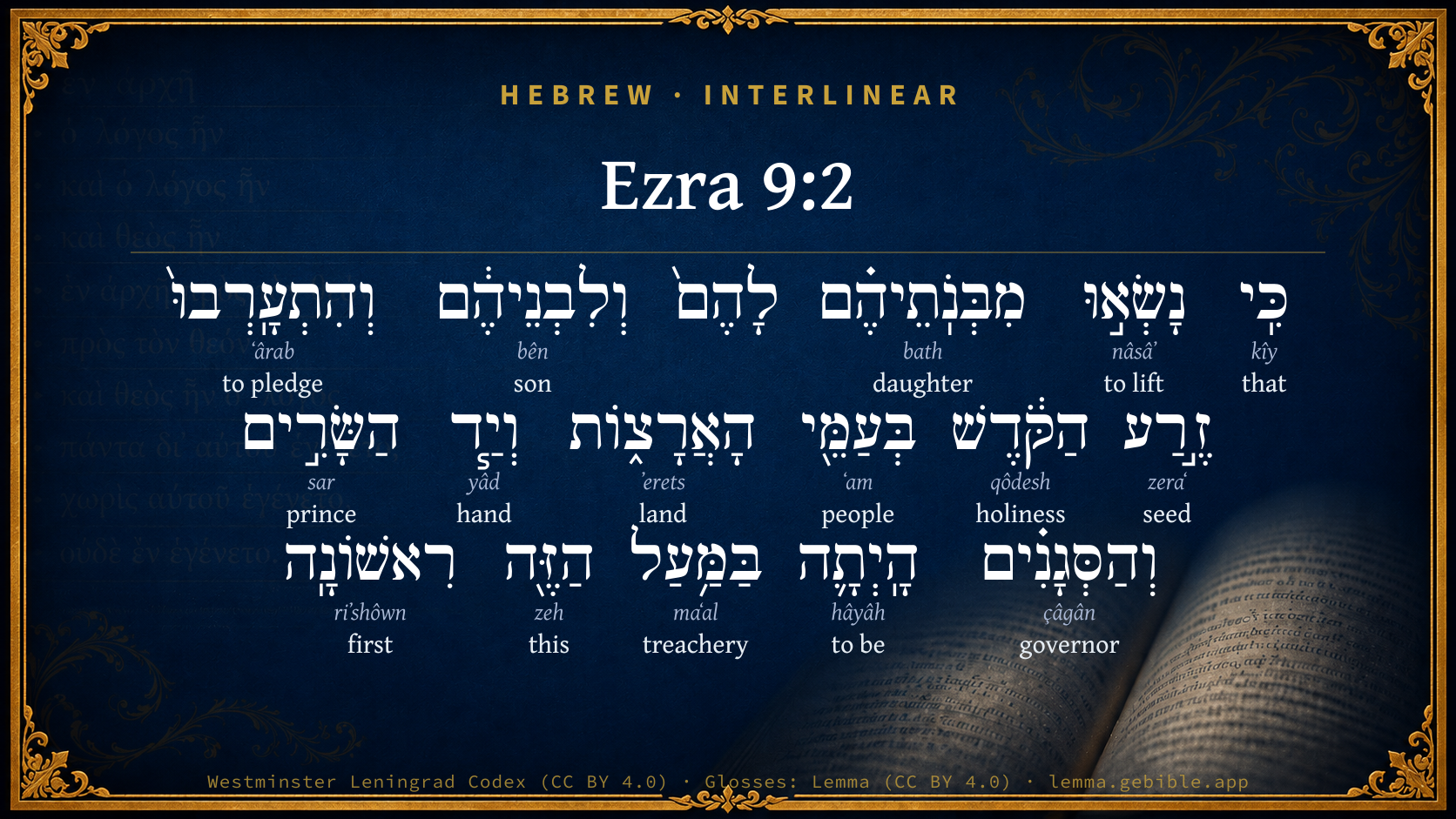
Ezra 9:2

Hebrew (Westminster Leningrad Codex) Ezra 9:2 appears in the Hebrew Old Testament. The text above is from the Westminster Leningrad Codex. Each word links to its Strong’s number, a concise gloss, and parsing drawn from the Open Scriptures Hebrew Bible morphology. Click any word for its full Brown-Driver-Briggs (BDB) entry.
Download image
Cite this verse

Ezra 9:2 (World English Bible). Public Domain. Lemma interlinear Bible study tool, https://lemma.gebible.app/v/ezra/9/2.

Show BibTeX & RIS
BibTeX
RIS
English Translation
For they have taken of their daughters for themselves and for their sons, so that the holy seed have mixed themselves with the peoples of the lands: yes, the hand of the princes and rulers has been chief in this trespass.
World English Bible · Public Domain
Highlights
  • 1 first appearance in the Hebrew Bible
Full analysis ↓
Download a study sheet

One document with this verse’s original text, its word-by-word gloss line, the meaning frame, cross-references with their text, attributed commentary, and full source and license credits — printable, and it pastes into notes with its structure intact.

This verse Autodidact and up

Study sheet (.html) Plain text (.txt)

A passage Seminary Student

Up to 50 verses in one chapter. A passage sheet keeps up to 6 commentary sources and 12 cross-references per verse, in the order this page ranks them, and says so on the sheet whenever that leaves anything out. Ask for a single verse and you get the Autodidact verse sheet above.

Everything on this page stays free to read, with no account — the sheet is a download of what is already on screen, not access to it.

Want to remove ads? Support Godless Engineer
Compare translations 3

The same verse in 3 English versions, stacked beneath the original-language interlinear above. Click any original word for its lexicon entry.

Each is an independent rendering of the whole verse — the interlinear is not word-aligned to these translations.

Highlighted words mark where these versions differ — a whole-verse word diff, not a word-by-word alignment.

  • World English Bible Public Domain
    For they have taken of their daughters for themselves and for their sons, so that the holy seed have mixed themselves with the peoples of the lands: yes, the hand of the princes and rulers has been chief in this trespass.
  • King James Version Public Domain
    For they have taken of their daughters for themselves, and for their sons: so that the holy seed have mingled themselves with the people of those lands: yea, the hand of the princes and rulers hath been chief in this trespass.
  • unfoldingWord Literal Text CC BY-SA 4.0
    For they have lifted from their daughters for themselves and for their sons, so they have mixed the seed of holiness with the peoples of the lands. And the hand of the leaders and the rulers has been first in this unfaithfulness.”

unfoldingWord Literal Text — © unfoldingWord, licensed CC BY-SA 4.0. Word-aligned USFM3 via Door43 (git.door43.org/unfoldingWord/en_ult).

Versions to compare (up to 4)

3 of 4 selected

Show all 18 translations

Every available English version of this verse, each an independent rendering of the whole verse.

  • World English Bible Public Domain
    For they have taken of their daughters for themselves and for their sons, so that the holy seed have mixed themselves with the peoples of the lands: yes, the hand of the princes and rulers has been chief in this trespass.
  • Berean Standard Bible Public Domain
    Indeed, the Israelites have taken some of their daughters as wives for themselves and their sons, so that the holy seed has been mixed with the people of the land. And the leaders and officials have taken the lead in this unfaithfulness!”
  • Majority Standard Bible Public Domain
    Indeed, the Israelites have taken some of their daughters as wives for themselves and their sons, so that the holy seed has been mixed with the people of the land. And the leaders and officials have taken the lead in this unfaithfulness!”
  • King James Version Public Domain
    For they have taken of their daughters for themselves, and for their sons: so that the holy seed have mingled themselves with the people of those lands: yea, the hand of the princes and rulers hath been chief in this trespass.
  • American Standard Version (1901) Public Domain
    For they have taken of their daughters for themselves and for their sons, so that the holy seed have mingled themselves with the peoples of the lands: yea, the hand of the princes and rulers hath been chief in this trespass.
  • Revised Version (1885) Public Domain
    For they have taken of their daughters for themselves and for their sons; so that the holy seed have mingled themselves with the peoples of the lands: yea, the hand of the princes and rulers hath been chief in this trespass.
  • Geneva Bible (1599) Public Domain
    For they haue taken their daughters to theselues, and to their sonnes, and they haue mixed the holy seede with the people of the landes, and the hande of the princes and rulers hath bene chiefe in this trespasse.
  • Douay-Rheims (1899) Public Domain
    For they have taken of their daughters for themselves and for their sons, and they have mingled the holy seed with the people of the lands. And the hand of the princes and magistrates hath been first in this transgression.
  • Young's Literal Translation Public Domain
    for they have taken of their daughters to them, and to their sons, and the holy seed have mingled themselves among the peoples of the lands, and the hand of the heads and of the seconds have been first in this trespass.'
  • Literal Standard Version CC BY-SA 4.0
    for they have taken of their daughters to them, and to their sons, and the holy seed have mingled themselves among the peoples of the lands, and the hand of the heads and of the seconds have been first in this trespass.”
  • Unlocked Literal Bible CC BY-SA 4.0
    For they have taken some of their daughters and sons, and have mixed the holy people with the people of other lands, and the officials and leaders have been first in this faithlessness.”
  • unfoldingWord Literal Text CC BY-SA 4.0
    For they have lifted from their daughters for themselves and for their sons, so they have mixed the seed of holiness with the peoples of the lands. And the hand of the leaders and the rulers has been first in this unfaithfulness.”
  • Darby Bible Public Domain
    for they have taken of their daughters for themselves and for their sons, and have mingled the holy seed with the peoples of the lands; and the hand of the princes and rulers has been chief in this unfaithfulness.
  • World Messianic Bible Public Domain
    For they have taken of their daughters for themselves and for their sons, so that the holy offspring have mixed themselves with the peoples of the lands. Yes, the hand of the princes and rulers has been chief in this trespass.”
  • Webster's Bible Public Domain
    For they have taken of their daughters for themselves, and for their sons: so that the holy seed have mingled themselves with the people of those lands: yea, the hand of the princes and rulers hath been chief in this trespass.
  • Free Bible Version CC BY-SA 4.0
    Some Israelites have even married women from these people, both themselves and their sons, mixing the holy race with these people of the land. Our leaders and officials are at the forefront of this sinful behavior.”
  • Bible in Basic English Public Domain
    For they have taken their daughters for themselves and for their sons, so that the holy seed has been mixed with the peoples of the lands; and in fact the captains and rulers have been the first to do this evil.
  • JPS Tanakh (1917) Public Domain
    For they have taken of their daughters for themselves and for their sons; so that the holy seed have mingled themselves with the peoples of the lands; yea, the hand of the princes and rulers hath been first in this faithlessness.'

Literal Standard Version (2020), Covenant Press — licensed CC BY-SA 4.0. Text via the HelloAO Bible API (eBible.org). Unlocked Literal Bible (unfoldingWord) — licensed CC BY-SA 4.0. Text via the HelloAO Bible API (eBible.org). unfoldingWord Literal Text — © unfoldingWord, licensed CC BY-SA 4.0. Word-aligned USFM3 via Door43 (git.door43.org/unfoldingWord/en_ult). Free Bible Version, Dr. Jonathan Gallagher — licensed CC BY-SA 4.0. Text via the HelloAO Bible API (eBible.org).

Word by word

More ways to search: Search by grammar → Find every occurrence → Compare this word →

Practice this passage: Drill this verse → Learn its vocabulary →

וְהַסְּגָנִ֗ים
çâgân
H5461
“and · the · governors”
Conjunction + Particle, Definite Article + Noun, Common, Masculine, Plural, Absolute
Part of Speech
Conjunction + Particle + Noun
Type
Common
Gender
Masculine
Number
Plural
State
Absolute
Full BDB Definition

Origin: from an unused root meaning to superintend

TWOT: 1461

ruler, prefect, governor, a subordinate ruler - prefects (of Assyria and Babylon) - petty rulers or officials
  1. כִּֽי kîy H3588 “that” Conjunction
  2. נָשְׂא֣וּ nâsâʼ H5375 “to lift” Verb, Qal, Perfect, 3rd Person, Common, Plural
  3. מִבְּנֹֽתֵיהֶ֗ם bath H1323 “from · daughters · their” Preposition + Noun, Common, Feminine, Plural, Construct + Suffix, Personal, 3rd Person, Masculine, Plural
  4. וְלִבְנֵיהֶ֔ם bên H1121 “and · to/for · sons · their” Conjunction + Preposition + Noun, Common, Masculine, Plural, Construct + Suffix, Personal, 3rd Person, Masculine, Plural
  5. וְהִתְעָֽרְבוּ֙ ʻârab H6148 “and · to pledge” Conjunction + Verb, Hithpael, Perfect, 3rd Person, Common, Plural
  6. זֶ֣רַע zeraʻ H2233 “seed of” Noun, Common, Masculine, Singular, Construct
  7. הַקֹּ֔דֶשׁ qôdesh H6944 “the · holiness” Particle, Definite Article + Noun, Common, Masculine, Singular, Absolute
  8. בְּעַמֵּ֖י ʻam H5971 “in/at · peoples of” Preposition + Noun, Common, Masculine, Plural, Construct
  9. הָאֲרָצ֑וֹת ʼerets H776 “the · lands” Particle, Definite Article + Noun, Common, Both, Plural, Absolute
  10. וְיַ֧ד yâd H3027 “and · hand of” Conjunction + Noun, Common, Both, Singular, Construct
  11. הַשָּׂרִ֣ים sar H8269 “the · princes” Particle, Definite Article + Noun, Common, Masculine, Plural, Absolute
  12. הָֽיְתָ֛ה hâyâh H1961 “to be” Verb, Qal, Perfect, 3rd Person, Feminine, Singular
  13. בַּמַּ֥עַל maʻal H4604 “in/at the · treachery” Preposition, Determined + Preposition
  14. הַזֶּ֖ה zeh H2088 “the · this” Particle, Definite Article + Pronoun, Demonstrative, Masculine, Singular
  15. רִאשׁוֹנָֽה riʼshôwn H7223 “first” Adjective, Adjective, Feminine, Singular, Absolute

About this verse

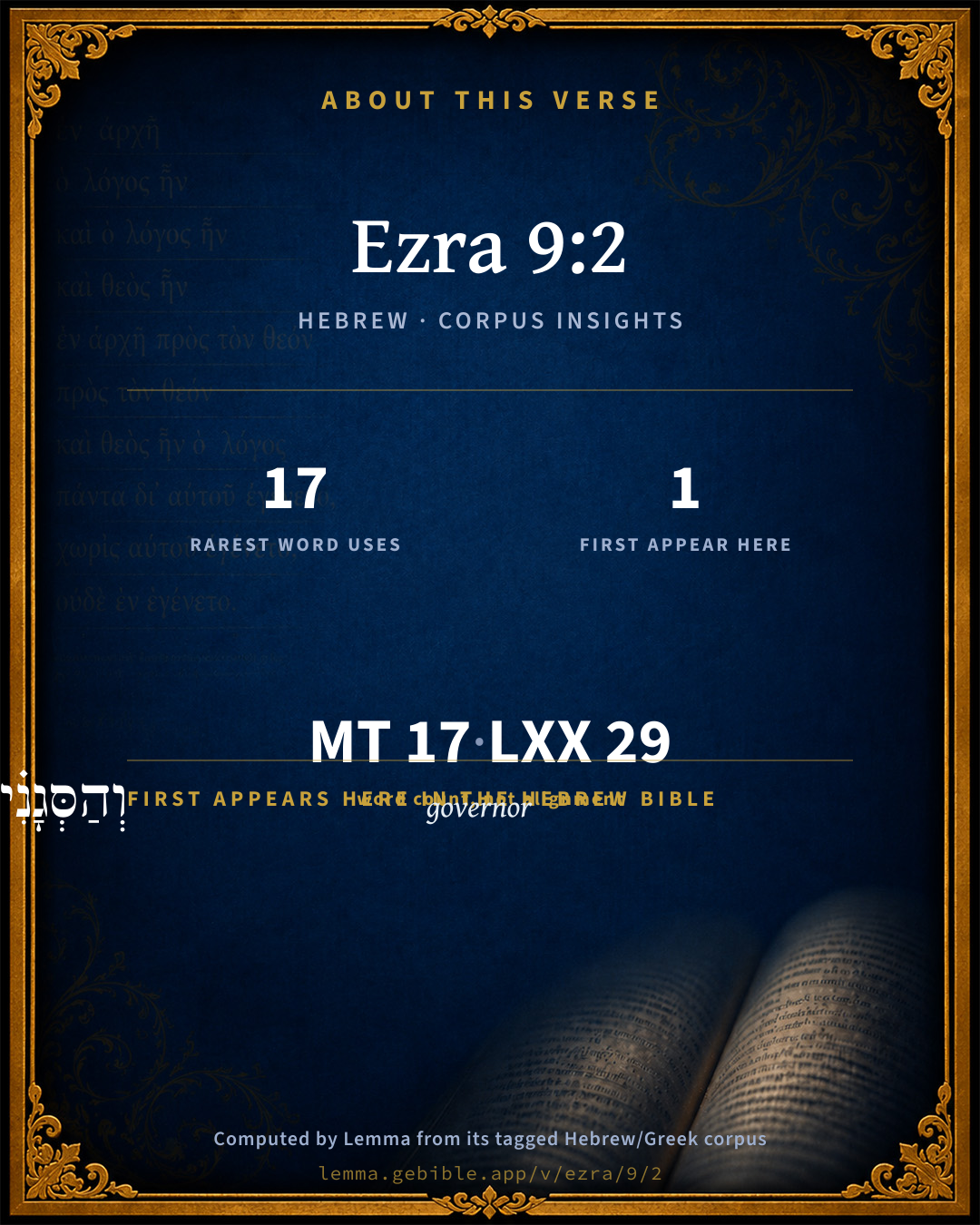
These counts appear in no published source. They are computed here, from the morphology-tagged text and Lemma’s own curated glosses. What Lemma adds →

17
words
16
distinct lemmas
Historical
section

Notable vocabulary

The rarest word here is וְהַסְּגָנִ֗ים governor H5461 — appearing just 17 times in the whole Hebrew Bible.

First appearance in Scripture

This word makes its first canonical appearance in the Hebrew Bible here:

  • וְהַסְּגָנִ֗ים governor H5461

Shared distinctive vocabulary

וְהַסְּגָנִ֗ים governor H5461 occurs in 16 verses of the Hebrew Bible. Also found in:

Grammatical profile

  • 3 verbs
  • 9 nouns
  • 1 adjective
  • 1 pronoun
  • 2 prepositions
  • 1 conjunction

Verb forms

  • נָשְׂא֣וּ Qal · Perfect
  • וְהִתְעָֽרְבוּ֙ Hithpael · Perfect
  • הָֽיְתָ֛ה Qal · Perfect

Hebrew & Septuagint length

In English translation the verse runs 41 words from the Hebrew and 36 from the Septuagint (LXX English) — closely comparable.

A rough comparison of the two English renderings, which tokenize alike — not a word-level alignment.

Word counts can differ between the Hebrew and the Greek without any difference in meaning — e.g. the Hebrew direct-object marker אֵת has no separate Greek word, and Greek often adds the article ὁ.

In the original languages it is 17 Hebrew tokens and 29 Greek tokens — but the two are counted differently (Hebrew bundles its prefixes and suffixes into one token; the Greek is in lemma form), so that isn’t a like-for-like length.

Cross-references

18

Topical passages linked to Ezra 9:2 in the Treasury of Scripture Knowledge — connected by theme and wording, ordered by reader-vote popularity; previews shown in the World English Bible.

  • Nehemiah 13:23–24 In those days also saw I the Jews who had married women of Ashdod, of Ammon, [and] of Moab:
  • Exodus 34:16 and you take of their daughters to your sons, and their daughters play the prostitute after their gods, and make your sons play the prostitute after their gods.
  • Ezra 10:2 Shecaniah the son of Jehiel, one of the sons of Elam, answered Ezra, We have trespassed against our God, and have married foreign women of the peoples of the land: yet now there is hope for Israel concerning this thing.
  • Ezra 10:18–44 Among the sons of the priests there were found who had married foreign women: [namely], of the sons of Jeshua, the son of Jozadak, and his brothers, Maaseiah, and Eliezer, and Jarib, and Gedaliah.
  • Deuteronomy 7:1–4 When Yahweh your God shall bring you into the land where you go to possess it, and shall cast out many nations before you, the Hittite, and the Girgashite, and the Amorite, and the Canaanite, and the Perizzite, and the Hivite, and the Jebusite, seven nations greater and mightier than you;
  • Deuteronomy 7:6 For you are a holy people to Yahweh your God: Yahweh your God has chosen you to be a people for his own possession, above all peoples who are on the face of the earth.
  • Exodus 19:6 and you shall be to me a kingdom of priests, and a holy nation.' These are the words which you shall speak to the children of Israel."
  • Exodus 22:31 "You shall be holy men to me, therefore you shall not eat any flesh that is torn by animals in the field. You shall cast it to the dogs.
  • Deuteronomy 14:2 For you are a holy people to Yahweh your God, and Yahweh has chosen you to be a people for his own possession, above all peoples who are on the face of the earth.
  • Malachi 2:11 Judah has dealt treacherously, and an abomination is committed in Israel and in Jerusalem; for Judah has profaned the holiness of Yahweh which he loves, and has married the daughter of a foreign god.
  • Malachi 2:15 Did he not make one, although he had the residue of the Spirit? Why one? He sought a godly seed. Therefore take heed to your spirit, and let none deal treacherously against the wife of his youth.
  • 1 Corinthians 7:14 For the unbelieving husband is sanctified in the wife, and the unbelieving wife is sanctified in the husband. Otherwise your children would be unclean, but now are they holy.
  • Nehemiah 13:3–4 It came to pass, when they had heard the law, that they separated from Israel all the mixed multitude.
  • 2 Corinthians 6:14 Don't be unequally yoked with unbelievers, for what fellowship have righteousness and iniquity? Or what communion has light with darkness?
  • Genesis 6:2 that God's sons saw that men's daughters were beautiful, and they took for themselves wives of all that they chose.
  • Nehemiah 13:17 Then I contended with the nobles of Judah, and said to them, What evil thing is this that you do, and profane the Sabbath day?
  • Nehemiah 13:28 One of the sons of Joiada, the son of Eliashib the high priest, was son-in-law to Sanballat the Horonite: therefore I chased him from me.
  • Isaiah 6:13 If there are yet a tenth in it, It also shall in turn be eaten up: As a terebinth, and as an oak, whose stock remains, when they are felled; So the holy seed is its stock."

Cross-references courtesy of OpenBible.info (CC BY 4.0).

Hebrew and Greek witnesses Masoretic Hebrew ↔ Greek Septuagint

The same verse in the two great witnesses to the Old Testament, shown verse-for-verse.

These are two independent witnesses, not word-aligned to each other, and the Septuagint is shown in lemma (dictionary) form.

Hebrew Ezra 9:2 Masoretic · Westminster Leningrad Codex

כִּֽי נָשְׂא֣וּ מִבְּנֹֽתֵיהֶ֗ם לָהֶם֙ וְלִבְנֵיהֶ֔ם וְהִתְעָֽרְבוּ֙ זֶ֣רַע הַקֹּ֔דֶשׁ בְּעַמֵּ֖י הָאֲרָצ֑וֹת וְיַ֧ד הַשָּׂרִ֣ים וְהַסְּגָנִ֗ים הָֽיְתָ֛ה בַּמַּ֥עַל הַזֶּ֖ה רִאשׁוֹנָֽה

For they have taken of their daughters for themselves and for their sons, so that the holy seed have mixed themselves with the peoples of the lands: yes, the hand of the princes and rulers has been chief in this trespass.

World English Bible · Public Domain

Greek LXX Ezra 9:2 Septuagint · lemma form

ὅτι λαμβάνω ἀπό θυγάτηρ αὐτός ἑαυτοῦ καί ὁ υἱός αὐτός καί παραἄγω σπέρμα ὁ ἅγιος ἐν λαός ὁ γαῖα καί χείρ ὁ ἄρχων ἐν ὁ ἀσυνθεσία οὗτος ἐν ἀρχή

For they have taken of their daughters for themselves and their sons; and the holy seed has passed among the nations of the lands, and the hand of the rulers has been first in this transgression.

LXX2012 (modern English Septuagint) · Public Domain

In the Septuagint this is one book — Esdras B (2 Esdras): Ezra is chapters 1–10, Nehemiah 11–23.

On this verse, Haydock's Catholic Bible Commentary discusses the Septuagint’s reading. Read the note in Commentary ↓

Hebrew: Westminster Leningrad Codex (CC BY 4.0). Greek: Septuagint (public domain); English from LXX2012 (modern English Septuagint) (Public Domain). How the Septuagint differs from the Hebrew →

Commentary

Notes on Ezra 9:2 from classic Christian and Jewish commentators (each source and its license shown beneath its notes). The classic Christian expositions comment on the surrounding passage and are grouped to its opening verse, so a note may address several verses; the Jewish commentaries on the Tanakh (Rashi and others) are per-verse, so they appear only where the commentator wrote on this verse.

Lemma curates 59 commentaries, every one of them public domain or Creative Commons licensed, each selected and text-cleaned for this edition rather than reprinted as found. About our sources →

Trapp's Complete Commentary

John Trapp

Ezr 9:2 For they have taken of their daughters for themselves, and for their sons: so that the holy seed have mingled themselves with the people of [those] lands: yea, the hand of the princes and rulers hath been chief in this trespass.

Ver. 2. For they have taken of their daughters] Taken them for wives: which was flatly forbidden, Deu 7:3, and a reason given, Ezr 9:4, from the evil effect of such unblest marriages. This abuse Malachi complaineth of, Mal 2:11; Mal 2:13, whom some make to be the same man with Ezra.

For themselves, and for their sons] Whom they herein helped to a cold armful (as Lycephron calleth a bad wife, ψυχρον παραγκαλισμα), or rather to an unnatural heat, worse than that of a quartan ague, as said Simonides; as bad as that of an evil spirit, said another heathen.

So that the holy seed] i.e. The children of Israel, who were all federally holy at least, Deu 7:6, as are also all the children of Christian parents, 1Co 7:14.

Hath been chief in this trespass] Which they think audaciously to bear out with their big looks, to obtrude and justify to the world this most malapert misdemeanour, because it is facinus maioris abollae, the fact of a great one (Juvenal).

John Trapp, A Commentary or Exposition upon All the Books of the Old and New Testament (1647–1656) — public domain. Text from a community e-Sword module.

Joseph Benson's Commentary

Ezr 9:2. So that the holy seed, &c. — They are called a holy seed, because of the covenant which God had made with them, whereby they were constituted a peculiar people, separated from all other nations. Have mingled themselves with the people of those lands — Since their return, as may be gathered from Ezr 9:8-14. Yea, the hand of the princes and rulers hath been chief in this trespass — Who ought to have restrained the people from it by their authority and example; and who, by acting otherwise, have made the sin more general, and have involved themselves and the nation in the guilt of it. The case, certainly, was much the more dangerous, because the great men of the nation were the principal offenders; for through this the people would be freed from all fear of punishment, and therefore would the more readily imitate their bad example. It is probable the princes, who informed Ezra of this enormous practice, had endeavoured to reform it, but could not, because they were opposed by men as great as themselves.

Joseph Benson's Commentary on the Old and New Testaments (1811–1818) — public domain. Text from a community e-Sword module.

Geneva Bible (1599)

Geneva Bible translators

That is, the governors are the chief beginners hereof.

Geneva Bible (1599) marginal notes — public domain. Text via Bolls.life.

Adam Clarke's Commentary

Verse 2. Hath been chief in this trespass.] They who are the first men have been the most capital offenders; so VIRGIL, AEn. ix. 783: -

Unus homo, vestris, o cives, undique septus

Aggeribus, tantas strages impune per urbem

Ediderit? Juvenum primos tot miserit orco?

"Shall one, and he enclosed within your walls,

One rash imprisoned warrior, vanquish all?

Calm you look on, and see the furious foe

Plunge crowds of heroes to the shades below!"

PITT.

The first of the Trojan youth were the chief, the most illustrious; so we say the first men of the kingdom for the nobles, &c.

Adam Clarke's Commentary on the Bible (1810–1826) — public domain. Text from a community e-Sword/MySword module.

The Cambridge Bible for Schools and Colleges

gen. ed. J. J. S. Perowne

2. they have taken] i.e. ‘taken wives’ as in Ezr_10:44; 2Ch_11:21; 2Ch_13:21.

the holy seed] i.e. the race set apart and consecrated to God, cf. Exo_19:5-6. The term ‘the holy seed’ is found also in Isa_6:13.

have mingled themselves] The same phrase occurs in a passage which well illustrates our verse. Psa_106:34-35. ‘They did not destroy the peoples (‘ammîm) as the Lord commanded them; but mingled themselves with the nations (haggoyyim) and learned their works’.

with the people of those lands] R.V. with the peoples of the lands, as in Ezr_9:1.

the hand of the princes and rulers] marg. ‘princes and deputies’. compare the same phrase Neh_5:7.

The word rendered ‘rulers’ (marg. ‘deputies’) ‘segânîm’ is of Assyrian origin. It occurs in Isa_41:25, and preceded by ‘pekhah’ in Jer_51:23; Jer_51:28; Jer_51:57; Eze_23:6; Eze_23:12; Eze_23:23 as ‘governors and deputies’; in Neh_4:14; Neh_4:19; Neh_5:7; Neh_7:5; Neh_12:40; Neh_13:11 as ‘rulers’ (marg. ‘deputies’).

‘The princes’ seem to have been the chief authorities. A ruler or deputy (sagan) held under the governor a post of subordinate responsibility.

chief in this trespass] R.V. marg. first. This is probably more correct; the chiefs and rulers had set the example of wrong-doing, ‘Trespass’ Ezr_9:4, Ezr_10:6. Compare the use of this word with reference to national sin, Jos_7:1; Jos_22:16.

The Cambridge Bible for Schools and Colleges (gen. ed. J. J. S. Perowne; Cambridge University Press, 1878–1918) — public domain. Text from a community e-Sword module.

John Gill's Exposition

For they have taken of their daughters for themselves, and for their sorts,.... Some that were widowers not only took wives to themselves of the above nations, either when they were of Babylon, where many of these nations also were, or rather since their return; but they took for their sons also; yea, some that had wives took Heathenish ones to them, see Mal 2:13,

so that the holy seed; such as the Lord had separated from other nations, chosen them to be an holy people above all others, and devoted them to his service and worship:

have mingled themselves with the people of those lands; before mentioned, by marrying with them:

yea, the hand of the princes and rulers hath been chief in this trespass; they were the first that went into it, were ringleaders of it, who should by their authority and example have restrained others; or they were

in this first trespass (i); which was the first gross and capital one the people fell into after their return from the captivity.

(i) "in praevaricatione ista prima", Pagninus, Montanus.

John Gill's Exposition of the Whole Bible (1746–1763) — public domain (CC PDM 1.0). Text via the HelloAO Bible API.

Haydock's Catholic Bible Commentary

First. Or "was in this first transgression," incurred by those who returned with Zorobabel; or "was concerned in this very heinous transgression;" in transgressione hac prima. (Calmet) --- Protestants, "hath been chief." 3 Esdras, "and the leaders and grandees partook in this illegal affair, from its commencement." Septuagint, "and the hand of the chiefs was in this transgress, in the beginning." This would greatly increase the difficulty of reformation. Some of the princes were however ready to undertake the work, and had preserved themselves from the two general contagion. (Haydock) --- All marriages with the Moabites, &c., were prohibited, if the women remained infidels, Exodus xxxiv. (Tirinus)

George Leo Haydock (1774–1849), Haydock's Catholic Family Bible and Commentary, 1859 edition — public domain. Excludes Psalms (Douay-Rheims chapter numbering differs from Protestant) and Deuterocanonical books (Catholic canon only).

Matthew Poole's English Annotations

This they had done, either,

1. In the land of their captivity, into which these people were carried as well as others, as appears from Jer 25:9, &c. Or rather,

2. Since their return, as may be gathered from Ezr 9:8,9,10,14.

The princes and rulers; who should have restrained the people from this sin by their authority and example; and, by doing otherwise, made the sin more general, and involved themselves and the nation in the guilt of it.

Matthew Poole's English Annotations on the Holy Bible (1683–1685) — public domain. Text from a community e-Sword/MySword module.

Whedon's Commentary on the Bible

Daniel D. Whedon

2. Holy seed — Jehovah’s chosen people. See marginal references.

Princes and rulers… chief in this trespass — This was the most alarming fact of all. When the rulers transgress the law the people must needs become corrupt and demoralized.

Daniel D. Whedon (gen. ed.), Commentary on the Old and New Testaments (1874–1909) — public domain. Text from a community e-Sword module.

The Pulpit Commentary

The holy seed. Compare (Isa_6:13) The "seed of Israel,"however much it polluted itself by transgressions, was still "holy" by profession, by call, by obligation, by prophetic announcement. They were "a kingdom of priests, a holy nation"; (Exo_19:6) bound to be "separated from all the people that were on the face of the earth", (Exo_33:16) and to keep themselves a "peculiar people." When they mingled themselves with the people of the lands, they not only broke a positive command, (Deu_7:3) but did their best to frustrate God"s entire purpose in respect of them, and to render all that he had done for them of no effect. The hand of the princes and rulers hath been chief in the trespass. "Princes and rulers" are here opposed to people of the middle and lower ranks. The upper classes, whether clerical or lay, had been the chief offenders; (see Ezr_10:18) and compare the similar defection of Jews of the upper classes in Nehemiah"s time. (Neh_6:17, 18 13:4, 28)

The Pulpit Commentary (1880–1919), ed. H.D.M. Spence-Jones & Joseph S. Exell — public domain. Text from a community e-Sword module.

Rashi

Rabbi Shlomo Yitzchaki (Rashi)

was first in this treachery for they commenced to deal treacherously by intermarrying with the peoples of the lands.

Rashi on the Tanakh — English translations: “The Judaica Press complete Tanach with Rashi, translated by A. J. Rosenberg” (CC BY 4.0); “Pentateuch with Rashi's commentary by M. Rosenbaum and A.M. Silbermann, 1929-1934” (public domain); “The Metsudah Tanach series, Lakewood, N.J” (CC BY 4.0); and “The Book of Joshua, Metsudah Publications, 1997” (CC BY 4.0). Text via Sefaria.

Lesson kit

Teaching starters — assembled from the data on this page, not authored interpretation. Every prompt links to the verse data it draws on. Edit before teaching.

Ezra, in the Historical, opens this verse with 17 words (16 distinct Hebrew lemmas). Its most distinctive word is çâgân (“governor”). A historical commentator’s framing appears above. Read the whole chapter for the surrounding context.

Discussion questions

  1. How does “governor” (çâgân) shape what this verse is saying?
  2. This is the first place “governor” appears in Scripture (first appears here). What does its debut here establish?
  3. How does Nehemiah 2:16, which shares the word «governor», read alongside this verse?
  4. These translations render this verse differently. What is at stake in choosing one wording over another?
  5. «נָשְׂא֣וּ» is a Qal Perfect verb. How does that grammatical form shape the action described?
  6. Compare how Trapp's Complete Commentary and Joseph Benson's Commentary read this verse. Where do they agree or differ?

Things to notice

Reading settings

Reading text

Shown beneath each verse's original-language words.

Old Testament
Old Testament edition

Read the OT as the Masoretic Hebrew (MT) or the Greek Septuagint (LXX).

English shown for the Greek Septuagint (in the Hebrew ↔ Greek comparison).

Comparing translations? Open the Compare panel on any verse page to stack up to four side by side.