
2 Samuel 23:16

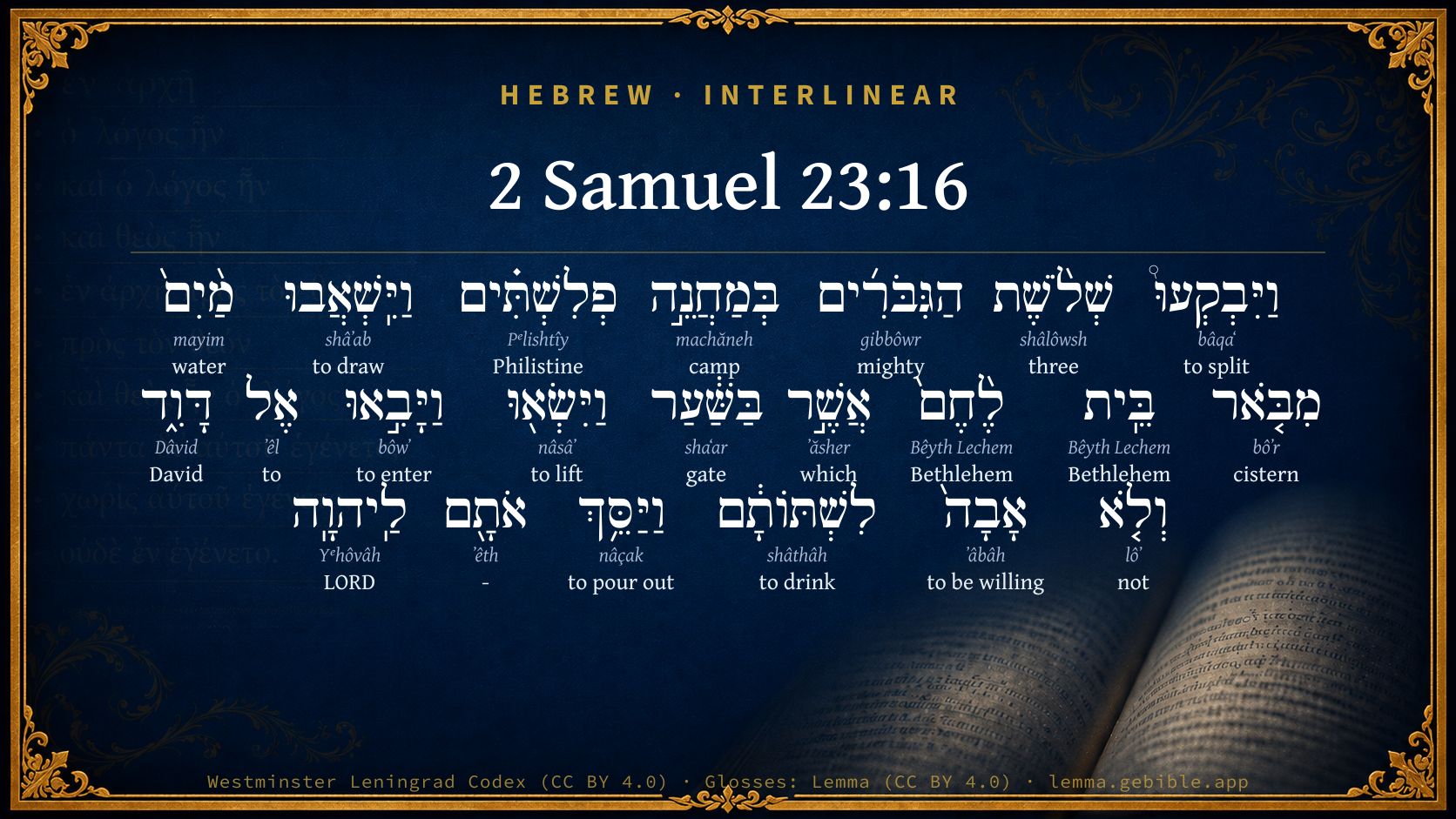
Hebrew (Westminster Leningrad Codex) 2 Samuel 23:16 appears in the Hebrew Old Testament. The text above is from the Westminster Leningrad Codex. Each word links to its Strong’s number, a concise gloss, and parsing drawn from the Open Scriptures Hebrew Bible morphology. Click any word for its full Brown-Driver-Briggs (BDB) entry.
Download image
Cite this verse

2 Samuel 23:16 (World English Bible). Public Domain. Lemma interlinear Bible study tool, https://lemma.gebible.app/v/2-samuel/23/16.

Show BibTeX & RIS
BibTeX
RIS
English Translation
The three mighty men broke through the host of the Philistines, and drew water out of the well of Bethlehem, that was by the gate, and took it, and brought it to David: but he would not drink of it, but poured it out to Yahweh.
World English Bible · Public Domain
Download a study sheet

One document with this verse’s original text, its word-by-word gloss line, the meaning frame, cross-references with their text, attributed commentary, and full source and license credits — printable, and it pastes into notes with its structure intact.

This verse Autodidact and up

Study sheet (.html) Plain text (.txt)

A passage Seminary Student

Up to 50 verses in one chapter. A passage sheet keeps up to 6 commentary sources and 12 cross-references per verse, in the order this page ranks them, and says so on the sheet whenever that leaves anything out. Ask for a single verse and you get the Autodidact verse sheet above.

Everything on this page stays free to read, with no account — the sheet is a download of what is already on screen, not access to it.

Want to remove ads? Support Godless Engineer
Compare translations 3

The same verse in 3 English versions, stacked beneath the original-language interlinear above. Click any original word for its lexicon entry.

Each is an independent rendering of the whole verse — the interlinear is not word-aligned to these translations.

Highlighted words mark where these versions differ — a whole-verse word diff, not a word-by-word alignment.

  • World English Bible Public Domain
    The three mighty men broke through the host of the Philistines, and drew water out of the well of Bethlehem, that was by the gate, and took it, and brought it to David: but he would not drink of it, but poured it out to Yahweh.
  • King James Version Public Domain
    And the three mighty men brake through the host of the Philistines, and drew water out of the well of Bethlehem, that was by the gate, and took it, and brought it to David: nevertheless he would not drink thereof, but poured it out unto the LORD.
  • unfoldingWord Literal Text CC BY-SA 4.0
    And the three warriors broke through the camp of the Philistines, and they drew water from the well of Bethlehem that at the gate. And they carried away and brought to David. But he was not willing to drink it, and he poured it out to Yahweh.

unfoldingWord Literal Text — © unfoldingWord, licensed CC BY-SA 4.0. Word-aligned USFM3 via Door43 (git.door43.org/unfoldingWord/en_ult).

Versions to compare (up to 4)

3 of 4 selected

Show all 18 translations

Every available English version of this verse, each an independent rendering of the whole verse.

  • World English Bible Public Domain
    The three mighty men broke through the host of the Philistines, and drew water out of the well of Bethlehem, that was by the gate, and took it, and brought it to David: but he would not drink of it, but poured it out to Yahweh.
  • Berean Standard Bible Public Domain
    So the three mighty men broke through the Philistine camp, drew water from the well near the gate of Bethlehem, and brought it back to David. But he refused to drink it; instead, he poured it out to the LORD,
  • Majority Standard Bible Public Domain
    So the three mighty men broke through the Philistine camp, drew water from the well near the gate of Bethlehem, and brought it back to David. But he refused to drink it; instead, he poured it out to the LORD,
  • King James Version Public Domain
    And the three mighty men brake through the host of the Philistines, and drew water out of the well of Bethlehem, that was by the gate, and took it, and brought it to David: nevertheless he would not drink thereof, but poured it out unto the LORD.
  • American Standard Version (1901) Public Domain
    And the three mighty men brake through the host of the Philistines, and drew water out of the well of Beth-lehem, that was by the gate, and took it, and brought it to David: but he would not drink thereof, but poured it out unto Jehovah.
  • Revised Version (1885) Public Domain
    And the three mighty men brake through the host of the Philistines, and drew water out of the well of Beth-lehem, that was by the gate, and took it, and brought it to David: but he would not drink thereof, but poured it out unto the LORD.
  • Geneva Bible (1599) Public Domain
    The the three mightie brake into the host of the Philistims, and drew water out of the well of Beth-lehem that was by the gate, and tooke and brought it to Dauid, who woulde not drinke thereof, but powred it for an offring vnto ye Lord,
  • Douay-Rheims (1899) Public Domain
    And the three valiant men broke through the camp of the Philistines, and drew water out of the cistern of Bethlehem, that was by the gate, and brought it to David: but he would not drink, but offered it to the Lord,
  • Young's Literal Translation Public Domain
    And the three mighty ones cleave through the camp of the Philistines, and draw water out of the well of Beth-Lehem, which `is' by the gate, and take `it' up, and bring in unto David; and he was not willing to drink it, and poureth it out to Jehovah,
  • Literal Standard Version CC BY-SA 4.0
    And the three mighty ones cleave through the camp of the Philistines, and draw water out of the well of Beth-Lehem, which [is] by the gate, and take [it] up, and bring [it] to David; and he was not willing to drink it, and pours it out to YHWH,
  • Unlocked Literal Bible CC BY-SA 4.0
    So these three mighty men broke through the army of the Philistines and drew water out of the well of Bethlehem, the well at the gate. They took the water and brought it to David, but he refused to drink it. Instead, he poured it out to Yahweh.
  • unfoldingWord Literal Text CC BY-SA 4.0
    And the three warriors broke through the camp of the Philistines, and they drew water from the well of Bethlehem that at the gate. And they carried away and brought to David. But he was not willing to drink it, and he poured it out to Yahweh.
  • Darby Bible Public Domain
    And the three mighty men broke through the camp of the Philistines, and drew water out of the well of Bethlehem, which is in the gate, and took it, and brought it to David; however he would not drink of it, but poured it out to Jehovah.
  • World Messianic Bible Public Domain
    The three mighty men broke through the army of the Philistines, and drew water out of the well of Bethlehem that was by the gate and took it and brought it to David; but he would not drink of it, but poured it out to the LORD.
  • Webster's Bible Public Domain
    And the three mighty men broke through the host of the Philistines, and drew water out of the well of Beth-lehem, that was by the gate, and took it, and brought it to David: nevertheless he would not drink of it, but poured it out to the LORD.
  • Free Bible Version CC BY-SA 4.0
    The Three leading warriors broke through the Philistine defenses, took some water from the well at Bethelehem's gate, and brought it back to David. But David refused to drink it, and poured it out as an offering to the Lord.
  • Bible in Basic English Public Domain
    And the three men, forcing their way through the Philistine army, got water from the water-hole of Beth-lehem, by the doorway into the town, and took it back to David: but he would not take it, but, draining it out, made an offering of it to the Lord.
  • JPS Tanakh (1917) Public Domain
    And the three mighty men broke through the host of the Philistines, and drew water out of the well of Beth-lehem, that was by the gate, and took it, and brought it to David; but he would not drink thereof, but poured it out unto the LORD.

Literal Standard Version (2020), Covenant Press — licensed CC BY-SA 4.0. Text via the HelloAO Bible API (eBible.org). Unlocked Literal Bible (unfoldingWord) — licensed CC BY-SA 4.0. Text via the HelloAO Bible API (eBible.org). unfoldingWord Literal Text — © unfoldingWord, licensed CC BY-SA 4.0. Word-aligned USFM3 via Door43 (git.door43.org/unfoldingWord/en_ult). Free Bible Version, Dr. Jonathan Gallagher — licensed CC BY-SA 4.0. Text via the HelloAO Bible API (eBible.org).

Word by word

More ways to search: Search by grammar → Find every occurrence → Compare this word →

Practice this passage: Drill this verse → Learn its vocabulary →

מִבֹּ֤אר
bôʼr
H877
“from · cistern of”
Preposition + Noun, Common, Masculine, Singular, Construct
Part of Speech
Preposition + Noun
Type
Common
Gender
Masculine
Number
Singular
State
Construct
Full BDB Definition

Origin: from H874

TWOT: 194d

cistern, pit, well
  1. וַיִּבְקְעוּ֩ bâqaʻ H1234 “and · to split” Conjunction + Verb, Qal, Sequential Imperfect, 3rd Person, Masculine, Plural
  2. שְׁלֹ֨שֶׁת shâlôwsh H7969 “three” Adjective, Cardinal number, Masculine, Singular, Construct
  3. הַגִּבֹּרִ֜ים gibbôwr H1368 “the · mighty” Particle, Definite Article + Adjective, Adjective, Masculine, Plural, Absolute
  4. בְּמַחֲנֵ֣ה machăneh H4264 “in/at · camp of” Preposition + Noun, Common, Both, Singular, Construct
  5. פְלִשְׁתִּ֗ים Pᵉlishtîy H6430 “Philistines” Noun, Gentilic, Masculine, Plural, Absolute
  6. וַיִּֽשְׁאֲבוּ shâʼab H7579 “and · to draw” Conjunction + Verb, Qal, Sequential Imperfect, 3rd Person, Masculine, Plural
  7. מַ֨יִם֙ mayim H4325 “water(s)” Noun, Common, Masculine, Plural, Absolute
  8. בֵּֽית Bêyth Lechem H1035 “Bethlehem” Noun, Proper
  9. לֶ֨חֶם֙ Bêyth Lechem H1035 “Bethlehem” Noun, Proper
  10. אֲשֶׁ֣ר ʼăsher H834 “which” Particle, Relative
  11. בַּשַּׁ֔עַר shaʻar H8179 “in/at the · gate” Preposition, Determined + Noun, Common, Masculine, Singular, Absolute
  12. וַיִּשְׂא֖וּ nâsâʼ H5375 “and · to lift” Conjunction + Verb, Qal, Sequential Imperfect, 3rd Person, Masculine, Plural
  13. וַיָּבִ֣אוּ bôwʼ H935 “and · to enter” Conjunction + Verb, Hiphil, Sequential Imperfect, 3rd Person, Masculine, Plural
  14. אֶל ʼêl H413 “to” Preposition
  15. דָּוִ֑ד Dâvid H1732 “David” Noun, Proper
  16. וְלֹ֤א lôʼ H3808 “and · not” Conjunction + Particle, Negative
  17. אָבָה֙ ʼâbâh H14 “to be willing” Verb, Qal, Perfect, 3rd Person, Masculine, Singular
  18. לִשְׁתּוֹתָ֔ם shâthâh H8354 “to drink · them” Preposition + Verb, Qal, Infinitive Construct + Suffix, Personal, 3rd Person, Masculine, Plural
  19. וַיַּסֵּ֥ךְ nâçak H5258 “and · to pour out” Conjunction + Verb, Hiphil, Sequential Imperfect, 3rd Person, Masculine, Singular
  20. אֹתָ֖ם ʼêth H853 “- · them” Particle, Direct Object + Suffix, Personal, 3rd Person, Masculine, Plural
  21. לַֽיהוָֽה Yᵉhôvâh H3068 “to/for · LORD” Preposition + Noun, Proper

About this verse

These counts appear in no published source. They are computed here, from the morphology-tagged text and Lemma’s own curated glosses. What Lemma adds →

22
words
21
distinct lemmas
Historical
section

Notable vocabulary

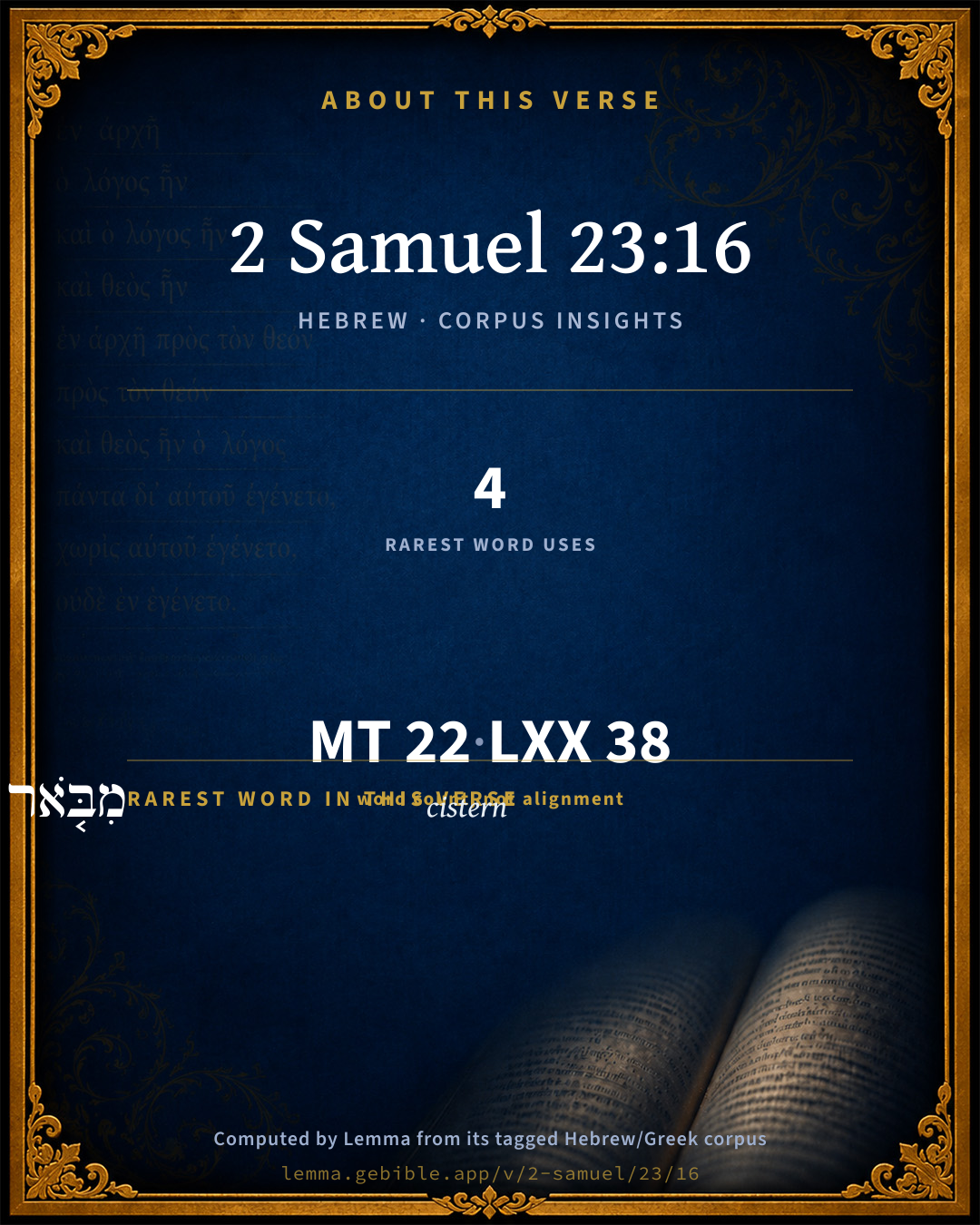
The rarest word here is מִבֹּ֤אר cistern H877 — appearing just 4 times in the whole Hebrew Bible.

Shared distinctive vocabulary

מִבֹּ֤אר cistern H877 occurs in 3 verses of the Hebrew Bible. Also found in:

Grammatical profile

  • 7 verbs
  • 9 nouns
  • 2 adjectives
  • 1 preposition
  • 3 particles

Verb forms

  • וַיִּבְקְעוּ֩ Qal · Sequential Imperfect
  • וַיִּֽשְׁאֲבוּ Qal · Sequential Imperfect
  • וַיִּשְׂא֖וּ Qal · Sequential Imperfect
  • וַיָּבִ֣אוּ Hiphil · Sequential Imperfect
  • אָבָה֙ Qal · Perfect
  • לִשְׁתּוֹתָ֔ם Qal · Infinitive Construct
  • וַיַּסֵּ֥ךְ Hiphil · Sequential Imperfect

Repetition

A word recurs within this verse — often emphatic in Hebrew:

  • בֵּֽית Bethlehem H1035 ×2

Hebrew & Septuagint length

In English translation the verse runs 46 words from the Hebrew and 48 from the Septuagint (LXX English) — closely comparable.

A rough comparison of the two English renderings, which tokenize alike — not a word-level alignment.

Word counts can differ between the Hebrew and the Greek without any difference in meaning — e.g. the Hebrew direct-object marker אֵת has no separate Greek word, and Greek often adds the article ὁ.

In the original languages it is 22 Hebrew tokens and 38 Greek tokens — but the two are counted differently (Hebrew bundles its prefixes and suffixes into one token; the Greek is in lemma form), so that isn’t a like-for-like length.

Cross-references

10

Topical passages linked to 2 Samuel 23:16 in the Treasury of Scripture Knowledge — connected by theme and wording, ordered by reader-vote popularity; previews shown in the World English Bible.

  • Genesis 35:14 Jacob set up a pillar in the place where he spoke with him, a pillar of stone. He poured out a drink-offering on it, and poured oil on it.
  • 2 Corinthians 5:14 For the love of Christ constrains us; because we judge thus, that one died for all, therefore all died.
  • Numbers 28:7 The drink-offering of it shall be the fourth part of a hin for the one lamb: in the holy place shall you pour out a drink-offering of strong drink to Yahweh.
  • 1 Samuel 7:6 They gathered together to Mizpah, and drew water, and poured it out before Yahweh, and fasted on that day, and said there, We have sinned against Yahweh. Samuel judged the children of Israel in Mizpah.
  • Lamentations 2:19 Arise, cry out in the night, at the beginning of the watches; Pour out your heart like water before the face of the Lord: Lift up your hands toward him for the life of your young children, that faint for hunger at the head of every street.
  • Romans 5:7 For one will hardly die for a righteous man. Yet perhaps for a righteous person someone would even dare to die.
  • Philippians 2:17 Yes, and if I am poured out on the sacrifice and service of your faith, I rejoice, and rejoice with you all.
  • 1 Samuel 19:5 for he put his life in his hand, and struck the Philistine, and Yahweh worked a great victory for all Israel: you saw it, and did rejoice; why then will you sin against innocent blood, to kill David without a cause?
  • 2 Samuel 23:9 After him was Eleazar the son of Dodai the son of an Ahohite, one of the three mighty men with David, when they defied the Philistines who were there gathered together to battle, and the men of Israel were gone away.
  • Acts 20:24 But these things don't count; nor do I hold my life dear to myself, so that I may finish my race with joy, and the ministry which I received from the Lord Jesus, to fully testify to the Gospel of the grace of God.

Cross-references courtesy of OpenBible.info (CC BY 4.0).

Hebrew and Greek witnesses Masoretic Hebrew ↔ Greek Septuagint

The same verse in the two great witnesses to the Old Testament, shown verse-for-verse.

These are two independent witnesses, not word-aligned to each other, and the Septuagint is shown in lemma (dictionary) form.

Hebrew 2 Samuel 23:16 Masoretic · Westminster Leningrad Codex

וַיִּבְקְעוּ֩ שְׁלֹ֨שֶׁת הַגִּבֹּרִ֜ים בְּמַחֲנֵ֣ה פְלִשְׁתִּ֗ים וַיִּֽשְׁאֲבוּ מַ֨יִם֙ מִבֹּ֤אר בֵּֽית לֶ֨חֶם֙ אֲשֶׁ֣ר בַּשַּׁ֔עַר וַיִּשְׂא֖וּ וַיָּבִ֣אוּ אֶל דָּוִ֑ד וְלֹ֤א אָבָה֙ לִשְׁתּוֹתָ֔ם וַיַּסֵּ֥ךְ אֹתָ֖ם לַֽיהוָֽה

The three mighty men broke through the host of the Philistines, and drew water out of the well of Bethlehem, that was by the gate, and took it, and brought it to David: but he would not drink of it, but poured it out to Yahweh.

World English Bible · Public Domain

Greek LXX 2 Samuel 23:16 Septuagint · lemma form

καί διαῥήγνυμι ὁ τρεῖς δυνατός ἐν ὁ παρεμβολή ὁ ἀλλόφυλος καί ὑδρεύω ὕδωρ ἐκ ὁ λάκκος ὁ ἐν βαιθλεεμ ὁ ἐν ὁ πύλη καί λαμβάνω καί παραγίγνομαι πρός δαυίδ καί οὐ θέλω πίνω αὐτός καί αὐτός ὁ κύριος

And the three mighty men broke through the host of the Philistines, and drew water out of the well that was in Bethleem in the gate: and they took it, and brought it to David, and he would not drink it, but poured it out before the Lord.

LXX2012 (modern English Septuagint) · Public Domain

On this verse, Haydock's Catholic Bible Commentary discusses the Septuagint’s reading. Read the note in Commentary ↓

Hebrew: Westminster Leningrad Codex (CC BY 4.0). Greek: Septuagint (public domain); English from LXX2012 (modern English Septuagint) (Public Domain). How the Septuagint differs from the Hebrew →

Targum (Aramaic paraphrase)

1

The Targum is the ancient Jewish Aramaic paraphrase of the Hebrew Scriptures — an interpretive translation, not the Hebrew text itself. Onkelos (literal) and Pseudo-Jonathan (expansive) render the Torah, and Jonathan the Prophets. Coverage is partial: where no permissively-licensed English translation exists for a verse, only the Aramaic is shown. This is verse-level text, not a word-by-word alignment to the Hebrew.

  1. Targum Jonathan Prophets (Joshua–Malachi)
    וּבְזָעוּ תְלָתָא גִבָּרַיָא בְּמַשִׁרְיַת פְּלִשְׁתָּאֵי וּמְלוֹ מַיָא מִגוֹבָא דְבֵית לֶחֶם דִבְתַרְעָא וּנְסִיבוּ וְאַיְתִיאוּ לְוַת דָוִד וְלָא אֲבָא לְמִשְׁתֵּיהוֹן וַאֲמַר לְנַסָכָא יַתְהוֹן קֳדָם יְיָ:

    (no public-domain English translation for this verse)

    Targum Jonathan — Aramaic: “Mikraot Gedolot” (public domain). English: “Sefaria Community Translation” (CC0 1.0 (public-domain dedication)); “London "Chaldee Paraphrase," 1871” (public domain). Text via Sefaria.

Commentary

Notes on 2 Samuel 23:16 from classic Christian and Jewish commentators (each source and its license shown beneath its notes). The classic Christian expositions comment on the surrounding passage and are grouped to its opening verse, so a note may address several verses; the Jewish commentaries on the Tanakh (Rashi and others) are per-verse, so they appear only where the commentator wrote on this verse.

Lemma curates 59 commentaries, every one of them public domain or Creative Commons licensed, each selected and text-cleaned for this edition rather than reprinted as found. About our sources →

Trapp's Complete Commentary

John Trapp

2Sa 23:16 And the three mighty men brake through the host of the Philistines, and drew water out of the well of Bethlehem, that [was] by the gate, and took [it], and brought [it] to David: nevertheless he would not drink thereof, but poured it out unto the LORD.

Ver. 16. Nevertheless he would not drink thereof.] Accounting it too dear a draught for himself, he poured it out unto the Lord, out of a religious respect; and this put a difference betwixt this act of David’s, and the like done by Alexander the Great and Julius Caesar. {a} Finibus, non officiis, a vitiis discernuntur virtutes, saith Augustine, propter Te, Domine.

{a} Curt., lib. vii.

John Trapp, A Commentary or Exposition upon All the Books of the Old and New Testament (1647–1656) — public domain. Text from a community e-Sword module.

The Biblical Illustrator

Joseph S. Exell

2Sa_23:16-17

Nevertheless he would not drink thereof, but poured it out before the Lord.

The sacredness of life

This event is probably to be referred to the time which immediately succeeded Davids accession to the throne over an undivided people. (2Sa_5:3; 2Sa_5:17.)

I. The sacredness of life. To the Hebrew the blood was the vital principle (Gen_4:4.) Hence it was not to be eaten. Even the blood of a hunted animal or bird was to be reverently covered with dust (Lev_17:13.) Because of its sacredness it was used in the temple worship in acts of consecration (Exo_29:20), and in acts of propitiation (Lev_4:6), and in its Divine sacredness, as flowing from the Incarnate Word, it was poured out for, that full, perfect and sufficient sacrifice, oblation and satisfaction for the sins of the whole world. So, too, the solemn act of David expressed the fact that life is a sacred thing.

1. With what mysteries is it linked, and mankind has ever associated the mysterious with the sacred. In what manner did life, in its most rudimentary form, enter into a world that till then had been lifeless? How wondrous is the chain of life--each following link made of more precious material arid more curiously wrought--that runs up from its first appearing to man, to the angels, and to the Eternal!

2. How strangely is life interwoven with life, husband and wife, child and parent, brother and brother, friend and friend. Weakness is linked to strength, and folly to wisdom; while the weakness that is wise is helped by and vet delivers the strength that is foolish. No man liveth to himself in the economy of God.

3. What possibilities lie undeveloped in life. The child that slumbers in its cradle may be a Croesus, a Raphael, a Napoleon, a Shakespeare, a Luther. Even when lifes first stages may seem to justify a forecast of the future, what possibilities remain to us in virtue of diligence, application, fortitude, or through that overruling of things which we name fortune.

4. The everlastingness of its issues makes life sacred. The character it fashions lasts. Any chord once made to vibrate--be it of feeling or thought, or word, or act, or influence--may vibrate for ever. Death far from ending rather reveals lifes issues.

5. Yet in the fact that the Son of God took to Himself a human nature, lived a human life in its varied stages as babe and boy, as youth and man, has life obtained its weightiest and indelible sanctity.

II. What is gained by lifes risk partakes of lifes sanctity. Unharmed the three returned bearing with them a draught of water for which their king and captain had longed. It was the Balaclava of Israelitish history--an act of fruitless bravery, a blunder only possible to heroes--though less fatal in its consequences. Had a warrior been lost then regret for the foolish wish might have prompted the libation. But though no evil had overtaken them the jeopardy had made the water bleed-like and sacred, and lie poured it out unto the Lord.

1. Things necessary when purchased by lifes risk partake of this sacredness. Every life sacrificed in the service of mankind makes man a debtor, and sets the seal of sanctity upon the survivors. The substitute for the conscript who dies upon the battlefield, the fireman who perishes at his task, the lifeboatman who falls a victim to the raging sea, the physician and nurse who die saving the patient, should make these whom they ransom at so great a cost feel that every breath they draw is no common but a most sacred thing.

2. But things of convenience, hardly of necessity, are purchased at the same cost, and obtain a like sanctity. Our boasted and elaborate civilisation is costly in lives. To some it gives comfort and days, for others it shortens the span of existence. And the civilisation which lengthens life is largely dispensible; life without these blessings would be possible, though far less enjoyable. Men could still live in wattled huts and warm themselves with a wood or turf fire. There need be no coal fire, no steam engine, no railway travelling, no great engineering works such as we are accustomed to. Yet, how many and terrible are the disasters to life and limb, which have given us these advantages, and to our nation so much of her wealth. Very costly are many of the comforts and conveniences of our modern civilisation. The cutlery which, bright and sharp, lies upon our dining table, has meant a reduction of the years of life to the grinders who gave it edge. In many of the chemical and mechanical processes which furnish us the conveniences of modern life there is a similar sacrifice of the health and life of the workers. We should shrink from doing without these things; deprived of them men would question if life be worth living; but in the use of things purchased at such a cost let us remember that cost; it would give an earnestness to much of the morally relaxed life we live, could we see these things bedabbled with the blood that procured them.

3. Still more must we feel our responsibility when whims are gratified by the risk of life. That water from the well by the gate was not a necessity; it was the gratification of a sentiment; And it was the sense that life had been jeoparded for a sentiment that made David treat it as he did.

III. There are two directions in which these words have their bearing upon modern life.

1. Employment means employment of life, the hiring of blood. To say a man employs so many hands is to mention the least important of the powers he gets a claim upon. He employs lives, hearts, characters; souls that must live for ever, destinies that never become spent. But these lives must be regarded as sacred things, and every employer should bear with him the solemn sense of responsibility. If he feels as David felt, Is it not the blood of those men who jeoparded their lives? he will give in respect of those who serve him every care for life and for health. Such a man would never send men to sea in an unworthy ship, or to work with deficient apparatus, or expose them to the peril of a risky boiler. Neither should the moral perils of employees be forgotten. No man can justly retain as foreman a man of good ability but bad morals. No clerk should be asked to pen a letter that goes against his moral convictions; no traveller should be permitted to feel he must get orders by means which are not as the noonday clear, The wealth that comes from ruined health, lost lives, seared consciences, damned souls, is it not the blood of these men?

2. Perhaps it is well to remember that most persons are the employers of those who afford amusement. The stern Puritan days are largely past, and the average Christian man does not refrain from public spectacles on the high principle that the world passeth away and the fashion thereof. But dare men believing in the Bible countenance amusements involving the risk of life; did not the early church bring to an end the cruel sport of the Roman amphitheatre? should not such sports as to-day involve the health and lives of those who afford others pleasure be discountenanced, and by moral influence suppressed by the followers of Christ. When we see in the coveted water from the well that is by the gate, in the gratification we have or craved, the whim we have indulged, the needless convenience we have thoughtlessly enjoyed--the blood of men who have jeoparded their lives--then will a solemn sense of lifes sacredness steal upon us, and we shall pray, Deliver me from blood-guiltiness, O God. (J. T. L. Maggs, B. A.)

Waste

We speak of things being wasted when they are not used, or when they are used for an inferior purpose to that which was originally intended. But waste is a relative term; and in these economic days some of the most valuable products have been obtained from substances that used to be thrown out as utter refuse. The most brilliant colours are got from the waste of gas manufacture; the sweetest perfumes and most delicate flavourings from the offal of the street; and the mounds of rubbish excavated from the placer mines of California have formed ever since the most fertile soil, in which have grown harvests far more valuable than their richest gold. That which is said to be wasted is often more precious than that which is employed for some utilitarian purpose. The well of Bethlehem was associated with the happiest days of Davids life, when, as a shepherd boy, without any care or trouble, he drank of it, and went on his way rejoicing. The heat and burden of the day had consumed him in the beleaguered garrison, and the thought of that water was to him like the beautiful mirage--the deserts dream of dewy fields and sparkling streams. And yet, when a goblet full of the clear cold water was put into his bands, and he was free to drink and slake his burning thirst, he would not take it. His spirit rose above his languid frame and asserted its superiority. He nobly denied himself what his body weakly craved. Some might call such spilling of the water upon the ground an uncalled-for waste, and might blame David severely for appearing to lightly esteem the act of the brave men. What though the water had been procured at the cost of so much trouble and danger, did not that circumstance enhance its value? Was it not the very reason why it should not have been thrown away? The worst use to which it could be put was surely to pour it upon the dry ground, where it would do no good to living thing, but would speedily evaporate into the hot air, and leave no trace behind. We have all heard such selfish reasonings, and witnessed such penurious prudence in regard to similar acts of apparently rash generosity. But though the narrow-minded, capable only of the most short-sighted policy, may condemn it, every enlightened conscience, every generous heart, must deeply feel that Davids act of seeming wastefulness was in reality one of the noblest in his life. It would have been selfish in him to drink the water; but it was the height of unselfishness to refuse to drink it. By not using it, he put it to the highest use. By pouring it out upon the ground, seeming to waste it, he put a far greater value upon it than could possibly have been done if it had been used only to slake his thirst. Drunk, it would have refreshed the parched lips of David for a moment, and then the incident would have been forgotten. The draught of water would have accomplished its purpose, and that would have been the end of it for ever. But by being refused, by being wasted upon the ground,, and offered as a libation to the Lord of heaven and earth, its use remained unexhausted, its memory would be for ever cherished. To all generations the deed will he spoken of as one of the finest examples of generous self-denial and pious gratitude; and it will have an inspiring effect upon all who come to know of it, inducing them to practice similar self-denial and devotion in their own lives. The water spilt upon the ground in this way, which could not be gathered up again, rose up to heaven, a beautiful cloud gilded by the sun, to adorn the sky, to be seen and admired of all eyes, and to fall again in fertilising rain and dew upon ground that, but for it would have been for ever barren. (H. Macmillan, D. D.)

The Biblical Illustrator, edited by Joseph S. Exell (c. 1880s–1900s) — public domain. Text from a community e-Sword module.

Geneva Bible (1599)

Geneva Bible translators

Bridling his affection, and also desiring God not to be offended for that rash enterprise.

Geneva Bible (1599) marginal notes — public domain. Text via Bolls.life.

Adam Clarke's Commentary

Verse 16. Poured it out unto the Lord.] To make libations, both of water and wine, was a frequent custom among the heathens. We have an almost similar account in Arrian's Life of Alexander: "When his army was greatly oppressed with heat and thirst, a soldier brought him a cup of water; he ordered it to be carried back, saying, I cannot bear to drink alone while so many are in want, and this cup is too small to be divided among the whole." Tunc poculo pleno sicut oblatum est reddito: Non solus, inquit, bibere sustineo, nec tam exiguum dividere omnibus possum. - ARRIAN, lib. vi.

The example was noble in both cases, but David added piety to bravery; he poured it out unto the Lord.

Adam Clarke's Commentary on the Bible (1810–1826) — public domain. Text from a community e-Sword/MySword module.

Ellicott's Commentary for English Readers

(16) Poured it out unto the Lord.—The brave act of the three heroes shows strikingly the personal power of David over his followers and the enthusiasm with which he inspired them. Yet, on the other hand, David would not suffer his own longing to be gratified by the hazard of men’s lives. Taking the water, therefore, he “poured it out unto the Lord.” The word is the technical term for the sacrificial libation, and David assimilated his act to a sacrifice by a solemn consecration of this dangerously won water to the Lord.

A Bible Commentary for English Readers, edited by Charles John Ellicott (1878–1897) — public domain. Text from a community e-Sword module.

The Cambridge Bible for Schools and Colleges

gen. ed. J. J. S. Perowne

16. brake through the host of the Philistines] A striking proof of the enthusiasm which David inspired in his followers, and a noble instance of the true spirit of chivalry, which fears no danger and shrinks from no self-sacrifice, in order to do the smallest service for the object of its devotion; the spirit which is perfected in the highest example of love (Joh_15:13).

poured it out unto the Lord] The sacrificial term for pouring out a drink-offering or libation (Gen_35:14, &c.). “That which had been won by the lives of those three gallant chiefs was too sacred for him to drink, but it was on that very account deemed by him as worthy to be consecrated in sacrifice to God, as any of the prescribed offerings of the Levitical ritual. Pure Chivalry and pure Religion there formed an absolute union.” Stanley’s Lect. II. 54.

The Cambridge Bible for Schools and Colleges (gen. ed. J. J. S. Perowne; Cambridge University Press, 1878–1918) — public domain. Text from a community e-Sword module.

John Gill's Exposition

And the three mighty men brake through the host of the Philistines,.... Which lay in the valley of Rephaim, between the hold in which David was and the well of Bethlehem; these three men hearing David express himself in the above manner, though without any view that any should risk their lives to obtain it, only in a general way said, oh for a draught of the water of the well of Bethlehem! immediately set out, and made their way through the army of the Philistines to the well:

and drew water out of the well of Bethlehem, that was by the gate,

and took it, and brought it to David; in a vessel which they probably carried with them for that purpose:

nevertheless he would not drink thereof; because, say they who take these words in a spiritual sense, it was not this water, but spiritual water, he desired: but the reason is given in Sa2 23:17,

but poured it out unto the Lord; as a libation to him, it being rather blood than water, being fetched at the hazard of men's lives, and therefore more fit to be offered as a sacrifice to God than to be drank by him; and this he might do in thankfulness to God for preserving the lives of the men. Gersom thinks it was now the feast of tabernacles, which was the feast of ingathering the fruits of the earth, when great quantities of water were drawn and poured out at the altar, which was done to obtain the blessing of the former rain; See Gill on Joh 7:37 and See Gill on Joh 7:38.

John Gill's Exposition of the Whole Bible (1746–1763) — public domain (CC PDM 1.0). Text via the HelloAO Bible API.

Albert Barnes' Notes on the Bible

Brake through the host - Their camp was pitched in the valley of Rephaim 2Sa 23:13; 1Ch 11:15. It follows from this that the way from Adullam to Bethlehem lay through or across the valley of Rephaim.

Poured it out unto the Lord - It was too costly for his own use, none but the Lord was worthy of it. For libations, see Jdg 6:20 note.

Albert Barnes' Notes on the Bible (1834–1885) — public domain. Text from a community e-Sword/MySword module.

Haydock's Catholic Bible Commentary

Camp, or station of soldiers, ver. 13, 14. --- Offered it, as "a libation," according to the Hebrew and Septuagint. Vayasec is commonly used; but vinsoc, in Paralipomenon is the truer reading, as "it contains the three radical letters; and it were greatly to be wished that the verbs in every other place had also those radical letters restored, which have been omitted by the Masorets, and supplied by their punctuations." (Kennicott, Dis. i. p. 154.) --- Lord, as a sacrifice, worthy of him, and to teach his followers to be temperate, (Menochius) and not to expose their lives unnecessarily. (Haydock) -- "He had formerly indulged himself in forbidden pleasures." (St. Gregory) --- David thus asked pardon for having, undesignedly, hazarded the lives of his men, (Kennicott) and gave thanks for their safe return. (Josephus) --- A libation of water was solemnly made, 1 Kings vii. 6. The pagans used water when they had no wine, as they never sat down to meat, or offered sacrifice, without making a libation. (Calmet) See Homer, Iliad H.; Virgil, Æneid viii. 279. Dixit & in mensa laticum libavit honorem. (Virgil, Æneid i. 740.)

George Leo Haydock (1774–1849), Haydock's Catholic Family Bible and Commentary, 1859 edition — public domain. Excludes Psalms (Douay-Rheims chapter numbering differs from Protestant) and Deuterocanonical books (Catholic canon only).

Matthew Poole's English Annotations

The host of the Philistines was in the valley of Rephaim, 2Sa 23:13, and in the way to Beth-lehem.

He would not drink thereof; lest by gratifying himself upon such terms, he should seem either to set too high a price upon the satisfaction of his appetite, or too low a price upon the lives of his soldiers, or should encourage others to the like vain-glorious and foolish attempts.

Poured it out unto the Lord, as a kind of drink-offering, and acknowledgment of God’s goodness in preserving the lives of his captains in so dangerous an enterprise; and to show that he esteemed it as a sacred thing, which, considering all things, it was not fit for him to drink it.

Matthew Poole's English Annotations on the Holy Bible (1683–1685) — public domain. Text from a community e-Sword/MySword module.

Whedon's Commentary on the Bible

Daniel D. Whedon

16. Poured it out unto the Lord — As a drink offering.

Daniel D. Whedon (gen. ed.), Commentary on the Old and New Testaments (1874–1909) — public domain. Text from a community e-Sword module.

The Pulpit Commentary

Vers. 16, 17. Brake through the host (or, camp) of the Philistines. The Philistine camp was pitched in the valley of Rephaim, and to reach Bethlehem, which was more than twenty or twenty-five miles distant, these three heroes must pass close to the ground occupied by the enemy. The valley of Rephaim, in fact, extended from Jerusalem to Bethlehem, and, to guard their position, the Philistines held Bethlehem with a strong garrison. Of course the heroes would use every precaution; for to be discovered would be certain death. The story of their perils and presence of mind in danger, and hairbreadth escape, would be full of interest; but we are told only that they succeeded, and returned in safety, bearing their precious burden; but David would not drink, and poured it out unto Jehovah. The word is that used of a sacrificial libation; for David regarded it as holy, and consecrated to God, because it had been bought with blood at the risk, that is, of the lives of these gallant men. Nothing is recorded in the romances of the Middle Ages, when knightly chivalry was at its height, more gallant and noble than the exploit of these men. And the very essence of its devotion lay in the fact that it was done to gratify a mere sick longing, and therefore out of pure love. Sick, no doubt, David was, and burning with fever; and even more depressed by the apparent hopelessness of his position. The exploit changed the course of his thoughts. What could he not do with such heroes! Though racked during their absence with anxiety and self-reproach, yet on their return he would be dispirited no longer, but filled with confidence. The words, "Shall I drink?" inserted in the Revised Version, have apparently dropped out of the text by accident. They are found in the parallel place in Chronicles, and in the Septuagint and Vulgate here. The Syriac has, "At the peril of their life"s blood these men went."

The Pulpit Commentary (1880–1919), ed. H.D.M. Spence-Jones & Joseph S. Exell — public domain. Text from a community e-Sword module.

John Wesley's Explanatory Notes

Would not - Lest by gratifying himself upon such terms, he should seem either to set too high a price upon the satisfaction of his appetite, or too low a price upon the lives of his soldiers. Poured it - As a kind of drink offering, and acknowledgment of God's goodness in preserving the lives of his captains in so dangerous an enterprize; and to shew, that he esteemed it as a sacred thing, which it was not fit for him to drink.

John Wesley, Explanatory Notes Upon the Whole Bible (1754–1765) — public domain. Text via the GEBible commentary corpus.

Rashi

Rabbi Shlomo Yitzchaki (Rashi)

He offered it as a libation to Adonoy. He said, "This is what I learned at Shmuel the Romosi's court: If anyone risks his life for words of Torah, we should not recite the halachah in his name." If so, what is meant by "And instead he offerred it as a libation to Adonoy", he [only] recited it in the name of the Gemorah.

Rashi on the Tanakh — English translations: “The Judaica Press complete Tanach with Rashi, translated by A. J. Rosenberg” (CC BY 4.0); “Pentateuch with Rashi's commentary by M. Rosenbaum and A.M. Silbermann, 1929-1934” (public domain); “The Metsudah Tanach series, Lakewood, N.J” (CC BY 4.0); and “The Book of Joshua, Metsudah Publications, 1997” (CC BY 4.0). Text via Sefaria.

Lesson kit

Teaching starters — assembled from the data on this page, not authored interpretation. Every prompt links to the verse data it draws on. Edit before teaching.

2 Samuel, in the Historical, opens this verse with 22 words (21 distinct Hebrew lemmas). Its most distinctive word is bôʼr (“cistern”). A historical commentator’s framing appears above. Read the whole chapter for the surrounding context.

Discussion questions

  1. The word bôʼr carries the sense “cistern.” How does it shape the verse?
  2. How does 2 Samuel 23:15, which shares the word «cistern», read alongside this verse?
  3. What does the repetition of “Bethlehem” (2× in this one verse) do in this verse?
  4. These translations render this verse differently; the difference is in the English rendering, not the original. What questions does that raise?
  5. «וַיִּבְקְעוּ֩» is a Qal Sequential Imperfect verb. How does that grammatical form shape the action described?
  6. Compare how Trapp's Complete Commentary and The Biblical Illustrator read this verse. Where do they agree or differ?

Things to notice

Reading settings

Reading text

Shown beneath each verse's original-language words.

Old Testament
Old Testament edition

Read the OT as the Masoretic Hebrew (MT) or the Greek Septuagint (LXX).

English shown for the Greek Septuagint (in the Hebrew ↔ Greek comparison).

Comparing translations? Open the Compare panel on any verse page to stack up to four side by side.