
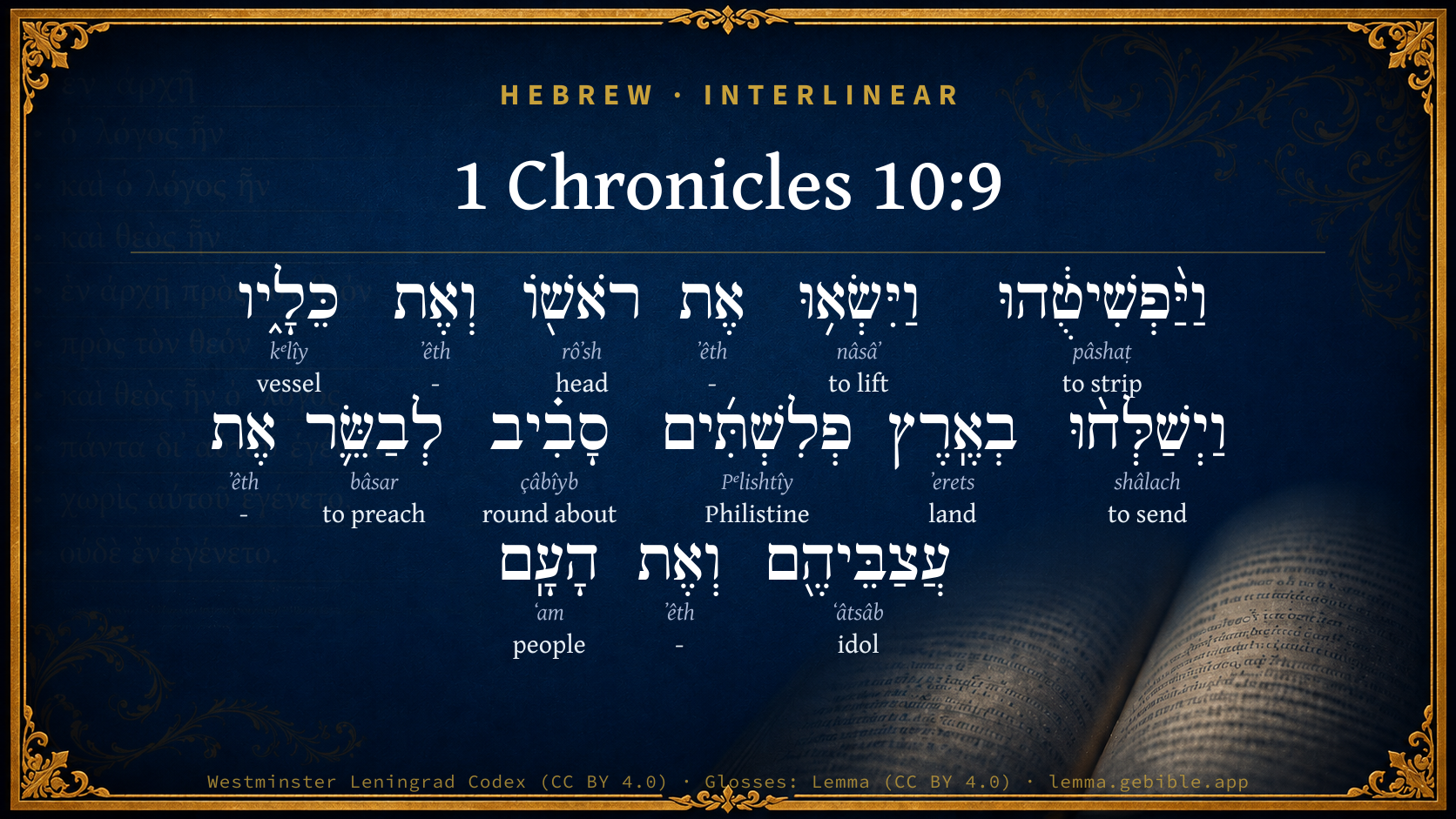
1 Chronicles 10:9

Hebrew (Westminster Leningrad Codex) 1 Chronicles 10:9 appears in the Hebrew Old Testament. The text above is from the Westminster Leningrad Codex. Each word links to its Strong’s number, a concise gloss, and parsing drawn from the Open Scriptures Hebrew Bible morphology. Click any word for its full Brown-Driver-Briggs (BDB) entry.
Download image
Cite this verse

1 Chronicles 10:9 (World English Bible). Public Domain. Lemma interlinear Bible study tool, https://lemma.gebible.app/v/1-chronicles/10/9.

Show BibTeX & RIS
BibTeX
RIS
English Translation
They stripped him, and took his head, and his armor, and sent into the land of the Philistines round about, to carry the news to their idols, and to the people.
World English Bible · Public Domain
Download a study sheet

One document with this verse’s original text, its word-by-word gloss line, the meaning frame, cross-references with their text, attributed commentary, and full source and license credits — printable, and it pastes into notes with its structure intact.

This verse Autodidact and up

Study sheet (.html) Plain text (.txt)

A passage Seminary Student

Up to 50 verses in one chapter. A passage sheet keeps up to 6 commentary sources and 12 cross-references per verse, in the order this page ranks them, and says so on the sheet whenever that leaves anything out. Ask for a single verse and you get the Autodidact verse sheet above.

Everything on this page stays free to read, with no account — the sheet is a download of what is already on screen, not access to it.

Want to remove ads? Support Godless Engineer
Compare translations 3

The same verse in 3 English versions, stacked beneath the original-language interlinear above. Click any original word for its lexicon entry.

Each is an independent rendering of the whole verse — the interlinear is not word-aligned to these translations.

Highlighted words mark where these versions differ — a whole-verse word diff, not a word-by-word alignment.

  • World English Bible Public Domain
    They stripped him, and took his head, and his armor, and sent into the land of the Philistines round about, to carry the news to their idols, and to the people.
  • King James Version Public Domain
    And when they had stripped him, they took his head, and his armor, and sent into the land of the Philistines round about, to carry tidings unto their idols, and to the people.
  • unfoldingWord Literal Text CC BY-SA 4.0
    And they stripped him, and they carried away his head and his weapons. And they sent into the land of the Philistines all around to proclaim to their idols and to the people.

unfoldingWord Literal Text — © unfoldingWord, licensed CC BY-SA 4.0. Word-aligned USFM3 via Door43 (git.door43.org/unfoldingWord/en_ult).

Versions to compare (up to 4)

3 of 4 selected

Show all 18 translations

Every available English version of this verse, each an independent rendering of the whole verse.

  • World English Bible Public Domain
    They stripped him, and took his head, and his armor, and sent into the land of the Philistines round about, to carry the news to their idols, and to the people.
  • Berean Standard Bible Public Domain
    They stripped Saul, cut off his head, took his armor, and sent messengers throughout the land of the Philistines to proclaim the news in the temple of their idols and among their people.
  • Majority Standard Bible Public Domain
    They stripped Saul, cut off his head, took his armor, and sent messengers throughout the land of the Philistines to proclaim the news in the temple of their idols and among their people.
  • King James Version Public Domain
    And when they had stripped him, they took his head, and his armor, and sent into the land of the Philistines round about, to carry tidings unto their idols, and to the people.
  • American Standard Version (1901) Public Domain
    And they stripped him, and took his head, and his armor, and sent into the land of the Philistines round about, to carry the tidings unto their idols, and to the people.
  • Revised Version (1885) Public Domain
    And they stripped him, and took his head, and his armour, and sent into the land of the Philistines round about, to carry the tidings unto their idols, and to the people.
  • Geneva Bible (1599) Public Domain
    And when they had stript him, they tooke his head and his armour, and sent them into the land of the Philistims round about, to publish it vnto their idoles, and to the people.
  • Douay-Rheims (1899) Public Domain
    And when they had stripped him, and cut off his head, and taken away his armour, they sent it into their land, to be carried about, and shewn in the temples of the idols and to the people.
  • Young's Literal Translation Public Domain
    and strip him, and bear away his head, and his weapons, and send into the land of the Philistines round about to proclaim tidings `to' their idols and the people,
  • Literal Standard Version CC BY-SA 4.0
    and strip him, and carry away his head and his weapons, and send [them] into the land of the surrounding Philistines to proclaim tidings [to] their idols and the people;
  • Unlocked Literal Bible CC BY-SA 4.0
    They stripped him and took his head and his armor. They sent messengers throughout Philistia to carry the news to their idols and to the people.
  • unfoldingWord Literal Text CC BY-SA 4.0
    And they stripped him, and they carried away his head and his weapons. And they sent into the land of the Philistines all around to proclaim to their idols and to the people.
  • Darby Bible Public Domain
    And they stripped him, and took his head, and his armour, and sent [them] into the land of the Philistines round about, to announce the glad tidings to their idols, and to the people.
  • World Messianic Bible Public Domain
    They stripped him and took his head and his armor, then sent into the land of the Philistines all around to carry the news to their idols and to the people.
  • Webster's Bible Public Domain
    And when they had stripped him, they took his head, and his armor, and sent into the land of the Philistines around, to carry tidings to their idols, and to the people.
  • Free Bible Version CC BY-SA 4.0
    They stripped him, cut off his head, and took his armor. Then they sent the news throughout the land of Philistia, to their idols and their people.
  • Bible in Basic English Public Domain
    And they took everything off him, and took his head and his war-dress, and sent word into the land of the Philistines round about to give the news to their gods and to the people.
  • JPS Tanakh (1917) Public Domain
    And they stripped him, and took his head, and his armour, and sent into the land of the Philistines round about, to carry the tidings unto their idols, and to the people.

Literal Standard Version (2020), Covenant Press — licensed CC BY-SA 4.0. Text via the HelloAO Bible API (eBible.org). Unlocked Literal Bible (unfoldingWord) — licensed CC BY-SA 4.0. Text via the HelloAO Bible API (eBible.org). unfoldingWord Literal Text — © unfoldingWord, licensed CC BY-SA 4.0. Word-aligned USFM3 via Door43 (git.door43.org/unfoldingWord/en_ult). Free Bible Version, Dr. Jonathan Gallagher — licensed CC BY-SA 4.0. Text via the HelloAO Bible API (eBible.org).

Word by word

More ways to search: Search by grammar → Find every occurrence → Compare this word →

Practice this passage: Drill this verse → Learn its vocabulary →

עֲצַבֵּיהֶ֖ם
ʻâtsâb
H6091
“idols · their”
Noun, Common, Masculine, Plural, Construct + Suffix, Personal, 3rd Person, Masculine, Plural
Part of Speech
Noun
Type
Common
Gender
Masculine
Number
Plural
State
Construct
Full BDB Definition

Origin: from H6087

TWOT: 1667c

idol, image
  1. וַיַּ֨פְשִׁיטֻ֔הוּ pâshaṭ H6584 “and · to strip · him” Conjunction + Verb, Hiphil, Sequential Imperfect, 3rd Person, Masculine, Plural + Suffix, Personal, 3rd Person, Masculine, Singular
  2. וַיִּשְׂא֥וּ nâsâʼ H5375 “and · to lift” Conjunction + Verb, Qal, Sequential Imperfect, 3rd Person, Masculine, Plural
  3. אֶת ʼêth H853 “-” Particle, Direct Object
  4. רֹאשׁ֖וֹ rôʼsh H7218 “head · his” Noun, Common, Masculine, Singular, Construct + Suffix, Personal, 3rd Person, Masculine, Singular
  5. וְאֶת ʼêth H853 “and · -” Conjunction + Particle, Direct Object
  6. כֵּלָ֑יו kᵉlîy H3627 “vessels · his” Noun, Common, Masculine, Plural, Construct + Suffix, Personal, 3rd Person, Masculine, Singular
  7. וַיְשַׁלְּח֨וּ shâlach H7971 “and · to send” Conjunction + Verb, Piel, Sequential Imperfect, 3rd Person, Masculine, Plural
  8. בְאֶֽרֶץ ʼerets H776 “in/at · land of” Preposition + Noun, Common, Both, Singular, Construct
  9. פְלִשְׁתִּ֜ים Pᵉlishtîy H6430 “Philistines” Noun, Gentilic, Masculine, Plural, Absolute
  10. סָבִ֗יב çâbîyb H5439 “round about” Noun, Common, Both, Singular, Absolute
  11. לְבַשֵּׂ֛ר bâsar H1319 “to preach” Preposition + Verb, Piel, Infinitive Construct
  12. אֶת ʼêth H853 “-” Particle, Direct Object
  13. וְאֶת ʼêth H853 “and · -” Conjunction + Particle, Direct Object
  14. הָעָֽם ʻam H5971 “the · people” Particle, Definite Article + Noun, Common, Masculine, Singular, Absolute

About this verse

These counts appear in no published source. They are computed here, from the morphology-tagged text and Lemma’s own curated glosses. What Lemma adds →

15
words
12
distinct lemmas
Historical
section

Notable vocabulary

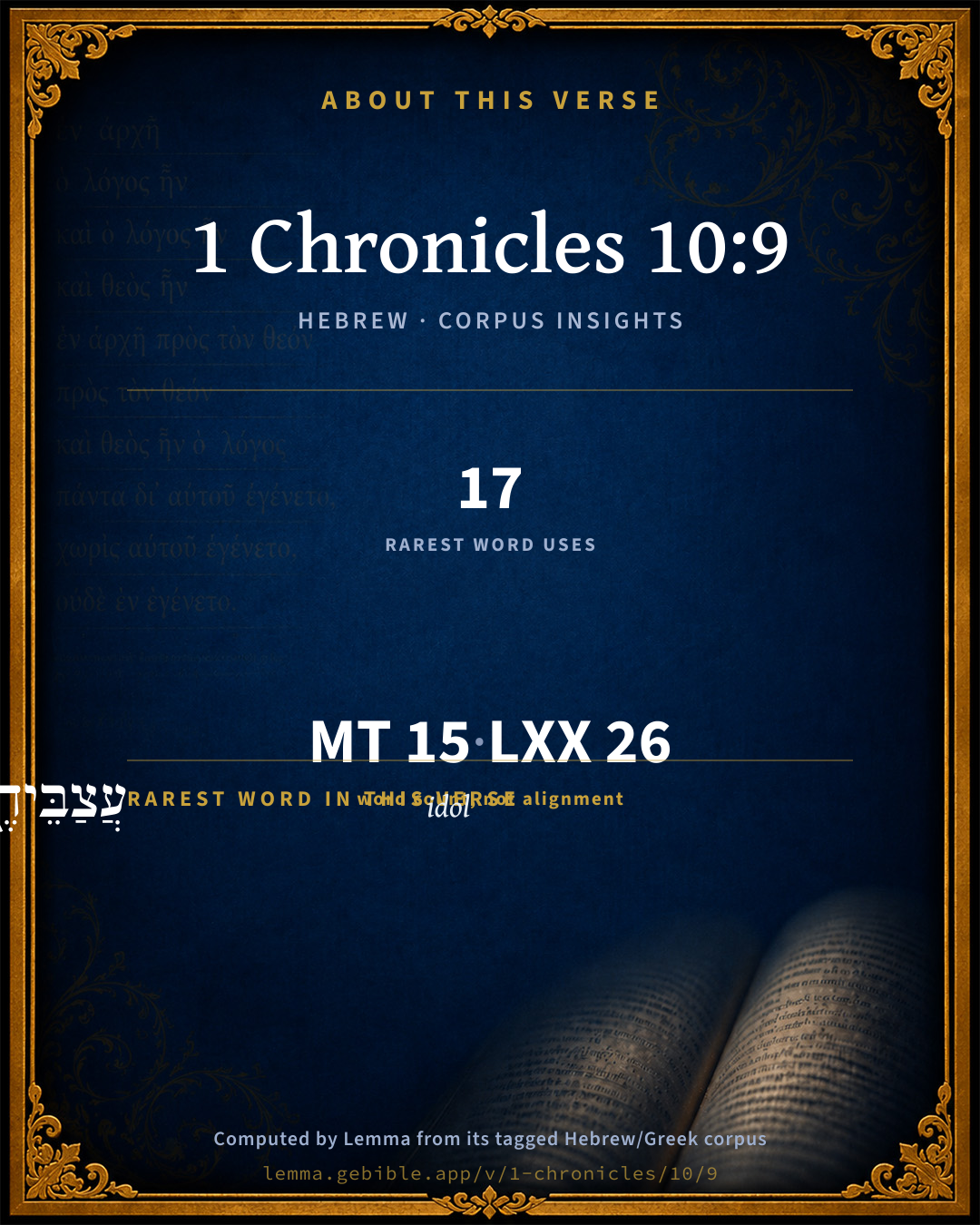
The rarest word here is עֲצַבֵּיהֶ֖ם idol H6091 — appearing just 17 times in the whole Hebrew Bible.

Shared distinctive vocabulary

עֲצַבֵּיהֶ֖ם idol H6091 occurs in 17 verses of the Hebrew Bible. Also found in:

Grammatical profile

  • 4 verbs
  • 7 nouns
  • 4 particles

Verb forms

  • וַיַּ֨פְשִׁיטֻ֔הוּ Hiphil · Sequential Imperfect
  • וַיִּשְׂא֥וּ Qal · Sequential Imperfect
  • וַיְשַׁלְּח֨וּ Piel · Sequential Imperfect
  • לְבַשֵּׂ֛ר Piel · Infinitive Construct

Hebrew & Septuagint length

In English translation the verse runs 31 words from the Hebrew and 34 from the Septuagint (LXX English) — closely comparable.

A rough comparison of the two English renderings, which tokenize alike — not a word-level alignment.

Word counts can differ between the Hebrew and the Greek without any difference in meaning — e.g. the Hebrew direct-object marker אֵת has no separate Greek word, and Greek often adds the article ὁ.

In the original languages it is 15 Hebrew tokens and 26 Greek tokens — but the two are counted differently (Hebrew bundles its prefixes and suffixes into one token; the Greek is in lemma form), so that isn’t a like-for-like length.

Cross-references

7

Topical passages linked to 1 Chronicles 10:9 in the Treasury of Scripture Knowledge — connected by theme and wording, ordered by reader-vote popularity; previews shown in the World English Bible.

  • 1 Samuel 31:9–10 They cut off his head, and stripped off his armor, and sent into the land of the Philistines round about, to carry the news to the house of their idols, and to the people.
  • 2 Samuel 1:20 Don't tell it in Gath, Don't publish it in the streets of Ashkelon; Lest the daughters of the Philistines rejoice, Lest the daughters of the uncircumcised triumph.
  • Judges 16:23–24 The lords of the Philistines gathered them together to offer a great sacrifice to Dagon their god, and to rejoice; for they said, Our god has delivered Samson our enemy into our hand.
  • 1 Chronicles 10:4 Then said Saul to his armor-bearer, Draw your sword, and thrust me through therewith, lest these uncircumcised come and abuse me. But his armor-bearer would not; for he was sore afraid. Therefore Saul took his sword, and fell on it.
  • Daniel 5:2–4 Belshazzar, while he tasted the wine, commanded to bring the golden and silver vessels which Nebuchadnezzar his father had taken out of the temple which was in Jerusalem; that the king and his lords, his wives and his concubines, might drink from it.
  • Daniel 5:23 but have lifted up yourself against the Lord of heaven; and they have brought the vessels of his house before you, and you and your lords, your wives and your concubines, have drunk wine from them; and you have praised the gods of silver and gold, of brass, iron, wood, and stone, which don't see, nor hear, nor know; and the God in whose hand your breath is, and whose are all your ways, you have not glorified.
  • Matthew 14:11 His head was brought on a platter, and given to the young lady: and she brought it to her mother.

Cross-references courtesy of OpenBible.info (CC BY 4.0).

Hebrew and Greek witnesses Masoretic Hebrew ↔ Greek Septuagint

The same verse in the two great witnesses to the Old Testament, shown verse-for-verse.

These are two independent witnesses, not word-aligned to each other, and the Septuagint is shown in lemma (dictionary) form.

Hebrew 1 Chronicles 10:9 Masoretic · Westminster Leningrad Codex

וַיַּ֨פְשִׁיטֻ֔הוּ וַיִּשְׂא֥וּ אֶת רֹאשׁ֖וֹ וְאֶת כֵּלָ֑יו וַיְשַׁלְּח֨וּ בְאֶֽרֶץ פְלִשְׁתִּ֜ים סָבִ֗יב לְבַשֵּׂ֛ר אֶת עֲצַבֵּיהֶ֖ם וְאֶת הָעָֽם

They stripped him, and took his head, and his armor, and sent into the land of the Philistines round about, to carry the news to their idols, and to the people.

World English Bible · Public Domain

Greek LXX 1 Chronicles 10:9 Septuagint · lemma form

καί ἐκδύω αὐτός καί λαμβάνω ὁ κεφαλή αὐτός καί ὁ σκεῦος αὐτός καί ἀποστέλλω εἰς γῆ ἀλλόφυλος κύκλος ὁ εὐαγγελίζω ὁ εἴδωλον αὐτός καί ὁ λαός

And they stripped him, and took his head, and his armor, and sent them into the land of the Philistines round about, to proclaim the glad tidings to their idols, and to the people.

LXX2012 (modern English Septuagint) · Public Domain

On this verse, Ellicott's Commentary for English Readers discusses the Septuagint’s reading. Read the note in Commentary ↓

Hebrew: Westminster Leningrad Codex (CC BY 4.0). Greek: Septuagint (public domain); English from LXX2012 (modern English Septuagint) (Public Domain). How the Septuagint differs from the Hebrew →

Commentary

Notes on 1 Chronicles 10:9 from classic Christian and Jewish commentators (each source and its license shown beneath its notes). The classic Christian expositions comment on the surrounding passage and are grouped to its opening verse, so a note may address several verses; the Jewish commentaries on the Tanakh (Rashi and others) are per-verse, so they appear only where the commentator wrote on this verse.

Lemma curates 59 commentaries, every one of them public domain or Creative Commons licensed, each selected and text-cleaned for this edition rather than reprinted as found. About our sources →

Trapp's Complete Commentary

John Trapp

1Ch 10:9 And when they had stripped him, they took his head, and his armour, and sent into the land of the Philistines round about, to carry tidings unto their idols, and to the people.

Ver. 9. They took his head.] Heb., His brainpan; the seat of his understanding; wherein he had hammered so many evil devices against good David and others.

To carry tidings.] Ad evangelizandum.

John Trapp, A Commentary or Exposition upon All the Books of the Old and New Testament (1647–1656) — public domain. Text from a community e-Sword module.

Ellicott's Commentary for English Readers

(9) And when they had stripped him.—Better, and they stripped him, and carried off his head, &c. Samuel, “and they cut off his head, and stripped his armour off.” With the phrase “carried off his head,” comp. Gen_40:19, “Pharaoh will lift thy head from off thee,” where the same Hebrew verb is used (yissâ).

And sent (Saul’s head and armour) to carry tidings unto their idols.—The verb bassçr is used of good and bad tidings, especially of the former, as in 2Sa_18:19-20.

Unto their idols.—Samuel, “house of their idols.” But the LXX. reading there is the same as here, τοῖς εἰδώλοις. The expression of Samuel looks original, though it may have been copied by mistake from 1Ch_10:10. Note the strictly local conception of deities implied in this act of the Philistines; as if their idols could neither see nor hear beyond their own temples. (Comp. 1Ki_20:23; 1Ki_20:28; Psa_94:9.)

A Bible Commentary for English Readers, edited by Charles John Ellicott (1878–1897) — public domain. Text from a community e-Sword module.

The Cambridge Bible for Schools and Colleges

gen. ed. J. J. S. Perowne

9. And when they had stripped him, they took] R.V. And they stripped him, and took.

to carry tidings unto their idols] In Samuel, “to publish it in the house (or houses) of their idols”; cp. 1Sa_31:10. The news was published by the exhibition of trophies of the victory in the Philistine temples. The reading in Chron. is inferior.

The Cambridge Bible for Schools and Colleges (gen. ed. J. J. S. Perowne; Cambridge University Press, 1878–1918) — public domain. Text from a community e-Sword module.

Haydock's Catholic Bible Commentary

To be. Hebrew, "to carry tidings to their idols, (sorrows) and to the people." They exposed the spoils in the temples, and gave thanks to their idols for the victory.

George Leo Haydock (1774–1849), Haydock's Catholic Family Bible and Commentary, 1859 edition — public domain. Excludes Psalms (Douay-Rheims chapter numbering differs from Protestant) and Deuterocanonical books (Catholic canon only).

The Pulpit Commentary

And when they had stripped him, they took his head, and his armour. Some comparing this with the parallel, (1Sa_31:9) "They cut off his head, and stripped off his armour," say "our author" leaves the beheading unmentioned! It is certainly sufficiently implied. To carry tidings unto their idols. This sentence is more clearly explained, and brought into rather unexpected and perhaps unwished accord with the most modern of our ecclesiastical habits, when in the parallel as above, we find "to publish it in the house of their idols "as the form of expression.

The Pulpit Commentary (1880–1919), ed. H.D.M. Spence-Jones & Joseph S. Exell — public domain. Text from a community e-Sword module.

unfoldingWord translationNotes

Door43 World Missions Community

They stripped him

"The Philistines removed everything from Saul's body"

to carry the news to their idols and to the people

They told the people what had happened and praised their idols in prayer.

to carry the news

A person telling others about something that has happened is spoken of as if the person were carrying a solid object and giving it to those other people. AT: "to tell what had happened" (See: Metaphor)

They put his armor

"The Philistines put Saul's armor"

Dagon

This is the name of a false god. (See: How to Translate Names)

translationWords

armor

send

messenger

Philistia

false god

people group

temple

false god

unfoldingWord translationNotes — © Distant Shores Media and the Door43 World Missions Community, licensed CC BY-SA 4.0. Source: git.door43.org/Door43/en_tn.

Lesson kit

Teaching starters — assembled from the data on this page, not authored interpretation. Every prompt links to the verse data it draws on. Edit before teaching.

1 Chronicles, in the Historical, opens this verse with 15 words (12 distinct Hebrew lemmas). Its most distinctive word is ʻâtsâb (“idol”). A historical commentator’s framing appears above. Read the whole chapter for the surrounding context.

Discussion questions

  1. How does “idol” (ʻâtsâb) shape what this verse is saying?
  2. How does 1 Samuel 31:9, which shares the word «idol», read alongside this verse?
  3. These translations render this verse differently. What is at stake in choosing one wording over another?
  4. «וַיַּ֨פְשִׁיטֻ֔הוּ» is a Hiphil Sequential Imperfect verb. How does that grammatical form shape the action described?
  5. Compare how Trapp's Complete Commentary and Ellicott's Commentary for English Readers read this verse. Where do they agree or differ?

Things to notice

Reading settings

Reading text

Shown beneath each verse's original-language words.

Old Testament
Old Testament edition

Read the OT as the Masoretic Hebrew (MT) or the Greek Septuagint (LXX).

English shown for the Greek Septuagint (in the Hebrew ↔ Greek comparison).

Comparing translations? Open the Compare panel on any verse page to stack up to four side by side.