
Isaiah 33:10

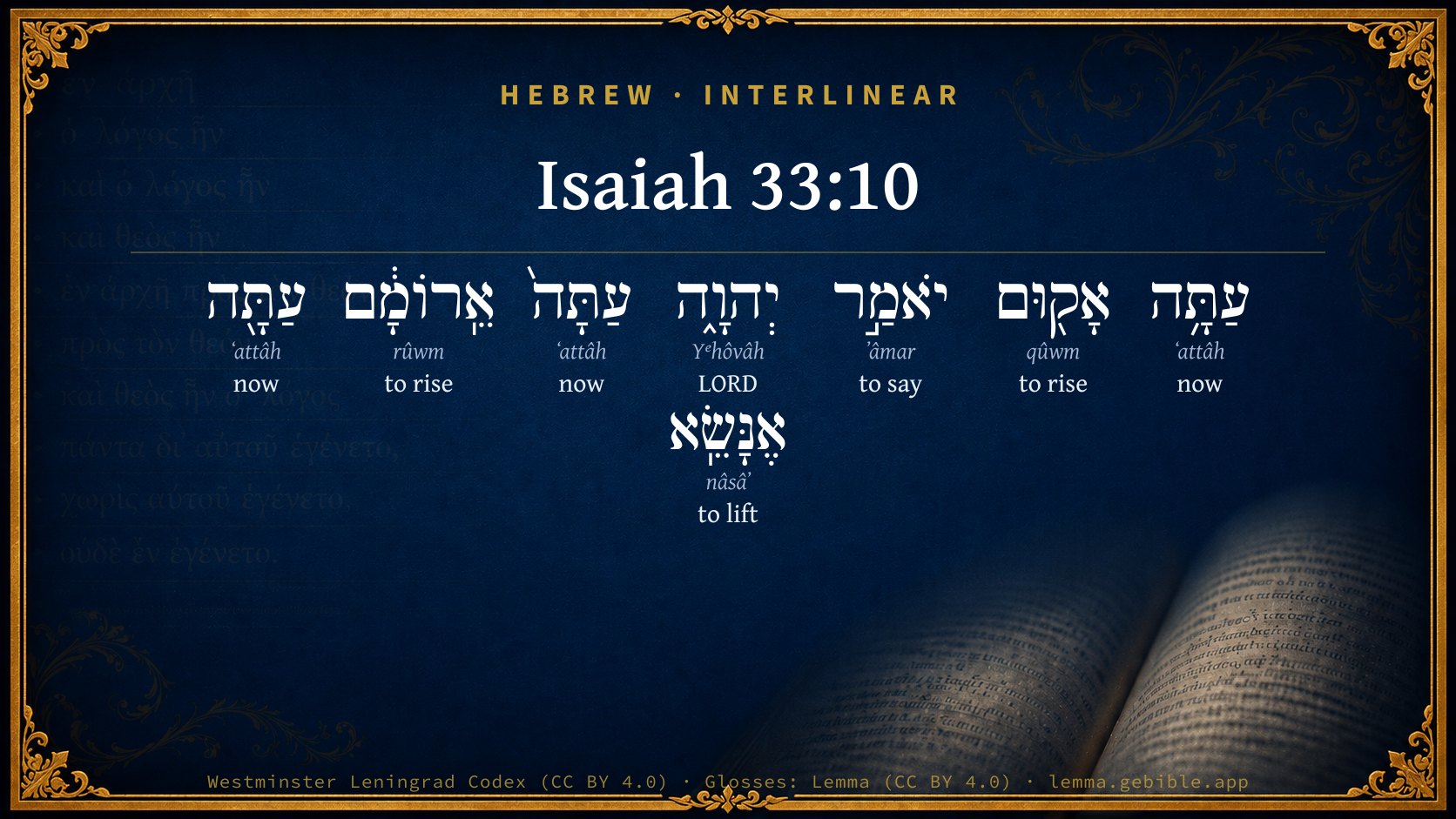
Hebrew (Westminster Leningrad Codex) Isaiah 33:10 appears in the Hebrew Old Testament. The text above is from the Westminster Leningrad Codex. Each word links to its Strong’s number, a concise gloss, and parsing drawn from the Open Scriptures Hebrew Bible morphology. Click any word for its full Brown-Driver-Briggs (BDB) entry.
Download image
Cite this verse

Isaiah 33:10 (World English Bible). Public Domain. Lemma interlinear Bible study tool, https://lemma.gebible.app/v/isaiah/33/10.

Show BibTeX & RIS
BibTeX
RIS
English Translation
Now will I arise, says Yahweh; now will I lift up myself; now will I be exalted.
World English Bible · Public Domain
Download a study sheet

One document with this verse’s original text, its word-by-word gloss line, the meaning frame, cross-references with their text, attributed commentary, and full source and license credits — printable, and it pastes into notes with its structure intact.

This verse Autodidact and up

Study sheet (.html) Plain text (.txt)

A passage Seminary Student

Up to 50 verses in one chapter. A passage sheet keeps up to 6 commentary sources and 12 cross-references per verse, in the order this page ranks them, and says so on the sheet whenever that leaves anything out. Ask for a single verse and you get the Autodidact verse sheet above.

Everything on this page stays free to read, with no account — the sheet is a download of what is already on screen, not access to it.

Want to remove ads? Support Godless Engineer
Compare translations 3

The same verse in 3 English versions, stacked beneath the original-language interlinear above. Click any original word for its lexicon entry.

Each is an independent rendering of the whole verse — the interlinear is not word-aligned to these translations.

Highlighted words mark where these versions differ — a whole-verse word diff, not a word-by-word alignment.

  • World English Bible Public Domain
    Now will I arise, says Yahweh; now will I lift up myself; now will I be exalted.
  • King James Version Public Domain
    Now will I rise, saith the LORD; now will I be exalted; now will I lift up myself.
  • unfoldingWord Literal Text CC BY-SA 4.0
    “Now I will arise,” says Yahweh. “Now I will exalt myself; now I will lift myself up.

unfoldingWord Literal Text — © unfoldingWord, licensed CC BY-SA 4.0. Word-aligned USFM3 via Door43 (git.door43.org/unfoldingWord/en_ult).

Versions to compare (up to 4)

3 of 4 selected

Show all 18 translations

Every available English version of this verse, each an independent rendering of the whole verse.

  • World English Bible Public Domain
    Now will I arise, says Yahweh; now will I lift up myself; now will I be exalted.
  • Berean Standard Bible Public Domain
    “Now I will arise,” says the LORD. “Now I will lift Myself up. Now I will be exalted.
  • Majority Standard Bible Public Domain
    “Now I will arise,” says the LORD. “Now I will lift Myself up. Now I will be exalted.
  • King James Version Public Domain
    Now will I rise, saith the LORD; now will I be exalted; now will I lift up myself.
  • American Standard Version (1901) Public Domain
    Now will I arise, saith Jehovah; now will I lift up myself; now will I be exalted.
  • Revised Version (1885) Public Domain
    How will I arise, saith the LORD; now will I lift up myself; now will I be exalted.
  • Geneva Bible (1599) Public Domain
    Now will I arise, saith the Lord: now will I be exalted, now will I lift vp my selfe.
  • Douay-Rheims (1899) Public Domain
    Now will I rise up, saith the Lord: now will I be exalted, now will I lift up myself.
  • Young's Literal Translation Public Domain
    Now, do I arise, saith Jehovah, Now I am exalted, now I am lifted up.
  • Literal Standard Version CC BY-SA 4.0
    Now I arise, says YHWH, || Now I am exalted, now I am lifted up.
  • Unlocked Literal Bible CC BY-SA 4.0
    “Now will I arise,” says Yahweh; “now I will be lifted up; now I will be elevated.
  • unfoldingWord Literal Text CC BY-SA 4.0
    “Now I will arise,” says Yahweh. “Now I will exalt myself; now I will lift myself up.
  • Darby Bible Public Domain
    Now will I arise, saith Jehovah; now will I be exalted, now will I lift up myself.
  • World Messianic Bible Public Domain
    “Now I will arise,” says the LORD. “Now I will lift myself up. Now I will be exalted.
  • Webster's Bible Public Domain
    Now will I rise, saith the LORD; now will I be exalted; now will I lift up myself.
  • Free Bible Version CC BY-SA 4.0
    “But now I'm going to intervene!” says the Lord. “I'm prepared to act! I will show myself to be above all others!
  • Bible in Basic English Public Domain
    Now will I come forward, says the Lord; now will I be lifted up; now will my power be seen.
  • JPS Tanakh (1917) Public Domain
    Now will I arise, saith the LORD; now will I be exalted; now will I lift Myself up.

Literal Standard Version (2020), Covenant Press — licensed CC BY-SA 4.0. Text via the HelloAO Bible API (eBible.org). Unlocked Literal Bible (unfoldingWord) — licensed CC BY-SA 4.0. Text via the HelloAO Bible API (eBible.org). unfoldingWord Literal Text — © unfoldingWord, licensed CC BY-SA 4.0. Word-aligned USFM3 via Door43 (git.door43.org/unfoldingWord/en_ult). Free Bible Version, Dr. Jonathan Gallagher — licensed CC BY-SA 4.0. Text via the HelloAO Bible API (eBible.org).

Word by word

More ways to search: Search by grammar → Find every occurrence → Compare this word →

Practice this passage: Drill this verse → Learn its vocabulary →

אֵֽרוֹמָ֔ם
rûwm
H7311
“to rise”
Verb, Hithpolel, Imperfect, 1st Person, Common, Singular
Part of Speech
Verb
Stem
Hithpolel
Form
Imperfect
Person
1st Person
Gender
Common
Number
Singular
Full BDB Definition

Origin: a primitive root

TWOT: 2133

to rise, rise up, be high, be lofty, be exalted - (Qal) - to be high, be set on high - to be raised, be uplifted, be exalted - to be lifted, rise - (Polel) - to raise or rear (children), cause to grow up - to lift up, raise, exalt - to exalt, extol - (Polal) to be lifted up - (Hiphil) - to raise, lift, lift up, take up, set up, erect, exalt, set on high - to lift up (and take away), remove - to lift off and present, contribute, offer, contribute - (Hophal) to be taken off, be abolished - (Hithpolel) to exalt oneself, magnify oneself - (Qal) to be rotten, be wormy
  1. עַתָּ֥ה ʻattâh H6258 “now” Adverb
  2. אָק֖וּם qûwm H6965 “to rise” Verb, Qal, Imperfect, 1st Person, Common, Singular
  3. יֹאמַ֣ר ʼâmar H559 “to say” Verb, Qal, Imperfect, 3rd Person, Masculine, Singular
  4. יְהוָ֑ה Yᵉhôvâh H3068 “LORD” Noun, Proper
  5. עַתָּה֙ ʻattâh H6258 “now” Adverb
  6. עַתָּ֖ה ʻattâh H6258 “now” Adverb
  7. אֶנָּשֵֽׂא nâsâʼ H5375 “to lift” Verb, Niphal, Imperfect, 1st Person, Common, Singular

About this verse

These counts appear in no published source. They are computed here, from the morphology-tagged text and Lemma’s own curated glosses. What Lemma adds →

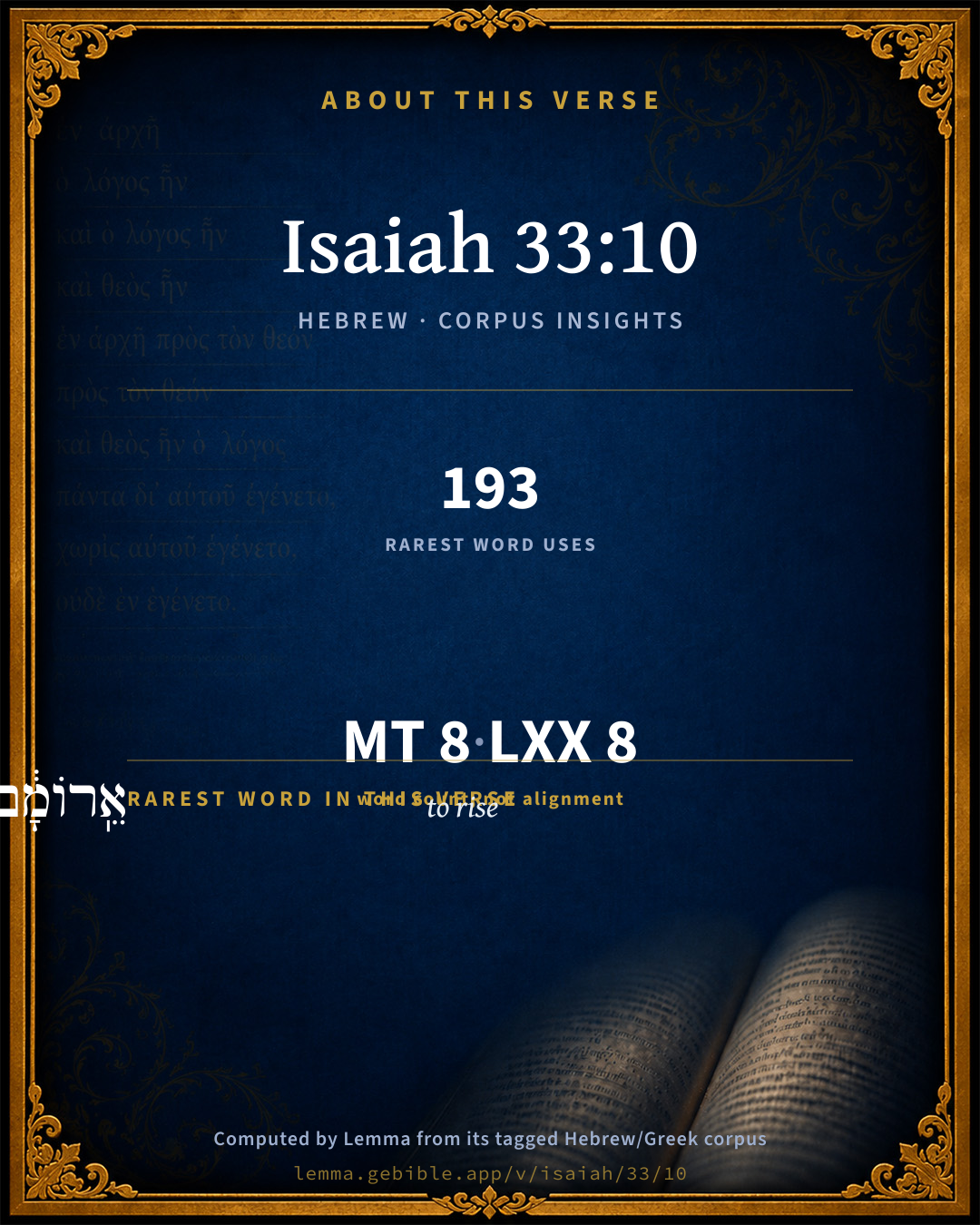
8
words
6
distinct lemmas
Prophets
section

Grammatical profile

  • 4 verbs
  • 1 noun
  • 3 adverbs

Verb forms

  • אָק֖וּם Qal · Imperfect
  • יֹאמַ֣ר Qal · Imperfect
  • אֵֽרוֹמָ֔ם Hithpolel · Imperfect
  • אֶנָּשֵֽׂא Niphal · Imperfect

Repetition

A word recurs within this verse — often emphatic in Hebrew:

  • עַתָּ֥ה now H6258 ×3

Hebrew & Septuagint length

In English translation the verse runs 17 words from the Hebrew and 17 from the Septuagint (LXX English) — the same length.

A rough comparison of the two English renderings, which tokenize alike — not a word-level alignment.

Word counts can differ between the Hebrew and the Greek without any difference in meaning — e.g. the Hebrew direct-object marker אֵת has no separate Greek word, and Greek often adds the article ὁ.

In the original languages it is 8 Hebrew tokens and 8 Greek tokens — but the two are counted differently (Hebrew bundles its prefixes and suffixes into one token; the Greek is in lemma form), so that isn’t a like-for-like length.

Cross-references

16

Topical passages linked to Isaiah 33:10 in the Treasury of Scripture Knowledge — connected by theme and wording, ordered by reader-vote popularity; previews shown in the World English Bible.

  • Psalms 12:5 "Because of the oppression of the weak and because of the groaning of the needy, I will now arise," says Yahweh; "I will set him in safety from those who malign him."
  • Psalms 102:13–18 You will arise and have mercy on Zion; For it is time to have pity on her. Yes, the set time has come.
  • Isaiah 30:17–18 One thousand [shall flee] at the threat of one; at the threat of five shall you flee: until you be left as a beacon on the top of a mountain, and as an ensign on a hill.
  • Isaiah 42:13–14 Yahweh will go forth as a mighty man; he will stir up [his] zeal like a man of war: he will cry, yes, he will shout aloud; he will do mightily against his enemies.
  • Isaiah 59:16–17 He saw that there was no man, and wondered that there was no intercessor: therefore his own arm brought salvation to him; and his righteousness, it upheld him.
  • Amos 6:1 Woe to those who are at ease in Zion, And to those who are secure on the mountain of Samaria, The notable men of the chief of the nations, To whom the house of Israel come!
  • Exodus 14:18 The Egyptians shall know that I am Yahweh, when I have gotten myself honor over Pharaoh, over his chariots, and over his horsemen."
  • Exodus 15:9–12 The enemy said, 'I will pursue, I will overtake, I will divide the spoil. My desire shall be satisfied on them. I will draw my sword, my hand shall destroy them.'
  • Deuteronomy 32:36–43 For Yahweh will judge his people, Repent himself for his servants; When he sees that [their] power is gone, There is none [remaining], shut up or left at large.
  • Psalms 7:6 Arise, Yahweh, in your anger. Lift up yourself against the rage of my adversaries. Awake for me. You have commanded judgment.
  • Psalms 46:10 "Be still, and know that I am God. I will be exalted among the nations. I will be exalted in the earth."
  • Psalms 78:65 Then the Lord awakened as one out of sleep, Like a mighty man who shouts by reason of wine.
  • Isaiah 10:16 Therefore will the Lord, Yahweh of Hosts, send among his fat ones leanness; and under his glory there shall be kindled a burning like the burning of fire.
  • Isaiah 10:33 Behold, the Lord, Yahweh of Hosts, will lop the boughs with terror: and the high of stature shall be hewn down, and the lofty shall be brought low.
  • Zephaniah 3:8 "Therefore wait for me," says Yahweh, "until the day that I rise up to the prey, for my determination is to gather the nations, that I may assemble the kingdoms, to pour on them my indignation, even all my fierce anger, for all the earth will be devoured with the fire of my jealousy.
  • Isaiah 2:21 To go into the caverns of the rocks, And into the clefts of the ragged rocks, From before the terror of Yahweh, And from the glory of his majesty, When he arises to shake the earth mightily.

Cross-references courtesy of OpenBible.info (CC BY 4.0).

Hebrew and Greek witnesses Masoretic Hebrew ↔ Greek Septuagint

The same verse in the two great witnesses to the Old Testament, shown verse-for-verse.

These are two independent witnesses, not word-aligned to each other, and the Septuagint is shown in lemma (dictionary) form.

Hebrew Isaiah 33:10 Masoretic · Westminster Leningrad Codex

עַתָּ֥ה אָק֖וּם יֹאמַ֣ר יְהוָ֑ה עַתָּה֙ אֵֽרוֹמָ֔ם עַתָּ֖ה אֶנָּשֵֽׂא

Now will I arise, says Yahweh; now will I lift up myself; now will I be exalted.

World English Bible · Public Domain

Greek LXX Isaiah 33:10 Septuagint · lemma form

νῦν ἀναἵστημι λέγω κύριος νῦν δοξάζω νῦν ὑψόω

Now will I arise, says the Lord, now will I be glorified; now will I be exalted.

LXX2012 (modern English Septuagint) · Public Domain

Hebrew: Westminster Leningrad Codex (CC BY 4.0). Greek: Septuagint (public domain); English from LXX2012 (modern English Septuagint) (Public Domain). How the Septuagint differs from the Hebrew →

Targum (Aramaic paraphrase)

1

The Targum is the ancient Jewish Aramaic paraphrase of the Hebrew Scriptures — an interpretive translation, not the Hebrew text itself. Onkelos (literal) and Pseudo-Jonathan (expansive) render the Torah, and Jonathan the Prophets. Coverage is partial: where no permissively-licensed English translation exists for a verse, only the Aramaic is shown. This is verse-level text, not a word-by-word alignment to the Hebrew.

  1. Targum Jonathan Prophets (Joshua–Malachi)
    כְּעַן אֶתְגְלֵי אֲמַר יְיָ כְּעַן אֶתְרוֹמֵם כְּעַן אֶתְנַטָל:

    Now I will reveal myself, saith the Lord; now will I lift myself up on high; now will I be exalted.

    Targum Jonathan — Aramaic: “Mikraot Gedolot” (public domain). English: “Sefaria Community Translation” (CC0 1.0 (public-domain dedication)); “London "Chaldee Paraphrase," 1871” (public domain). Text via Sefaria.

Commentary

Notes on Isaiah 33:10 from classic Christian and Jewish commentators (each source and its license shown beneath its notes). The classic Christian expositions comment on the surrounding passage and are grouped to its opening verse, so a note may address several verses; the Jewish commentaries on the Tanakh (Rashi and others) are per-verse, so they appear only where the commentator wrote on this verse.

Lemma curates 59 commentaries, every one of them public domain or Creative Commons licensed, each selected and text-cleaned for this edition rather than reprinted as found. About our sources →

Trapp's Complete Commentary

John Trapp

Isa 33:10 Now will I rise, saith the LORD; now will I be exalted; now will I lift up myself.

Ver. 10. Now will I rise, saith the Lord, now.] Now, now, now. Emphasin habet ingeminatio vocis "nunc." This "now," thrice repeated, importeth both the opportunity of time and God’s readiness to relieve. Cum duplicantur lateres, venit Moses, When things are at worst, they will mend, we say.

Now will I lift up myself.] Who have hitherto been held an underling, and inferior to the enemy.

John Trapp, A Commentary or Exposition upon All the Books of the Old and New Testament (1647–1656) — public domain. Text from a community e-Sword module.

Joseph Benson's Commentary

Isa 33:10-13. Now will I rise — In this extremity I will appear on the behalf of my people and land. Ye shall bring forth stubble — Instead of solid corn. Your great hopes and designs, O ye Assyrians, shall be utterly disappointed. Your breath, as fire, shall devour you — Your rage against my people shall bring ruin upon yourselves. Or, the arrogance, pride, wrath, and blasphemies which you vent against God shall be your destruction. Dr. Waterland renders the clause, “Your breath shall be the fire that shall consume you.” The people shall be as the burnings of lime — Shall be perfectly consumed, as when chalk-stones are reduced to lime; calcining, or reducing to ashes, being one of the last effects of fire. Thus we learn from this period, that when the calamity of the people, as well as the insolence of their enemies, should be come to the height, God would delay no longer, but immediately interpose and severely punish the oppressors, and thereby exalt his glory before the eyes of the nations, whom he calls upon, in the next words, to consider his doings. Hear, ye afar off, &c. — So remarkable a judgment as this deserves to be known, and laid to heart, by all men, both far and near.

Joseph Benson's Commentary on the Old and New Testaments (1811–1818) — public domain. Text from a community e-Sword module.

Geneva Bible (1599)

Geneva Bible translators

To help and deliver my Church.

Geneva Bible (1599) marginal notes — public domain. Text via Bolls.life.

Jamieson, Fausset & Brown

Robert Jamieson, A. R. Fausset & David Brown

The sight of His people's misery arouses Jehovah; He has let the enemy go far enough.

I--emphatic; God Himself will do what man could not.

Jamieson, Fausset & Brown — Commentary Critical and Explanatory on the Whole Bible (1871) — public domain (CC PDM 1.0). Text via the HelloAO Bible API.

Ellicott's Commentary for English Readers

(10) Now will I rise . . .—We note the emphatic iteration of the adverb of time. Man’s necessity was, as ever, to be God’s opportunity. He had been, as it were, waiting for this crisis, and would at once arise in His might.

A Bible Commentary for English Readers, edited by Charles John Ellicott (1878–1897) — public domain. Text from a community e-Sword module.

The Cambridge Bible for Schools and Colleges

gen. ed. J. J. S. Perowne

10–13. Jehovah’s answer to the complaint and prayer of His people.

The Cambridge Bible for Schools and Colleges (gen. ed. J. J. S. Perowne; Cambridge University Press, 1878–1918) — public domain. Text from a community e-Sword module.

John Gill's Exposition

Now will I rise, saith the Lord,.... At the last extremity, when things are come to a crisis; his interest at the lowest, and the kingdom of antichrist at its highest pitch; the whore of Rome triumphing over the slain witnesses, and boasting she was a queen, and knew no sorrow: this will be God's fit time to exert himself, and get him honour and glory: he before was as one lain down and asleep, as if quite negligent and careless about his honour and interest; but now he determines to arise, and show himself strong on the behalf of it; see Psa 12:5,

now will I be exalted; that is, in his power, by the destruction of the enemies of his church; and in the hearts and mouths of his people, on account of their deliverance and salvation:

now will I lift up myself; show himself above his enemies, higher and greater than they, and reduce them to a low estate and condition. The repetition of the word "now" has its emphasis; and is designed to observe the time of God's appearing in the cause of his people, and the fitness and propriety of it; and to quicken their attention to it, as well as to express the certainty of it, and the firmness of his resolution to do it without delay, and the vehemence and ardour with which he would set about it.

John Gill's Exposition of the Whole Bible (1746–1763) — public domain (CC PDM 1.0). Text via the HelloAO Bible API.

Albert Barnes' Notes on the Bible

Now - This verse commences another transition. In the previous verses, the desolation of the land had been described, and the hopelessness of obtaining any terms of favor from Sennacherib, or of binding him to any compact, bad been stated. In this state of things, when inevitable ruin seemed to be coming upon the nation, God said that he would interpose.

Will I rise - To vengeance; or to punish the invading host. The emphasis in this passage should be placed on ‘I,’ indicating that Yahweh would himself do what could not be effected by people.

Now will I be exalted - That is, God would so interpose that it should be manifest that it was his hand that brought deliverance.

Albert Barnes' Notes on the Bible (1834–1885) — public domain. Text from a community e-Sword/MySword module.

Haydock's Catholic Bible Commentary

Myself, when all human aid fails.

George Leo Haydock (1774–1849), Haydock's Catholic Family Bible and Commentary, 1859 edition — public domain. Excludes Psalms (Douay-Rheims chapter numbering differs from Protestant) and Deuterocanonical books (Catholic canon only).

Matthew Poole's English Annotations

In this extremity, I will appear on the behalf of my people and land.

Matthew Poole's English Annotations on the Holy Bible (1683–1685) — public domain. Text from a community e-Sword/MySword module.

Whedon's Commentary on the Bible

Daniel D. Whedon

10-12. This iniquity is now full. The day of judgment to Assyria has come. As though indifferently sitting still, Jehovah has looked on long enough, and says,

Now will I rise… now… be exalted; now… lift up myself — The thrice repeated “now” denotes earnest business. On hearing this the prophet knows what is to come, and cries out as if to the enemy, Ye… conceive chaff, ye… bring forth stubble — Your vainglorious swell and threat amounts to utter nothing. Your furious, snorting menace is turned back to you, an inward, self-consuming flame. God’s purpose is to make the nations here represented in this your devouring army to become utterly consumed, as the burnings of lime; speedily consumed, as thorns, or dead brushwood, cut and dried for immediate heating.

Daniel D. Whedon (gen. ed.), Commentary on the Old and New Testaments (1874–1909) — public domain. Text from a community e-Sword module.

The Pulpit Commentary

Now will I rise. Judah"s extremity is Jehovah"s opportunity. "Now" at length the time is come for God to show himself, tic will rise from his throne, and actively display his power; he will exalt himself above the heathen lift himself up above the nations.

The opportuneness of God"s judgments.

It is characteristic of Divine interpositions that they take place at the moment of greatest need. Isaac is on the point of being sacrificed when the angel calls to Abraham out of heaven. (Gen_22:10, Gen_22:11) Elisha is compassed about with horsemen and chariots, and on the point of falling into his enemies" hands, when they are smitten with blindness. (2Ki_6:15-18) The Israelites are hemmed in between the Egyptians and the sea, and must perish on the morrow, when the waters are divided for them, and a way opened to them for escape. (Exo_14:10-22) More especially is the appropriateness of the time noticeable, when the interposition is in the shape of a judgment. Judgments are opportune doubly:

(1) with respect to those on whom they fall;

(2) with respect to those whom they relieve.

I JUDGMENTS ARE OPPORTUNE WITH RESPECT TO THOSE ON WHOM THEY FALL. God is so merciful that he will not judge men "before the time," or until they have "filled up the measure of their iniquities." Hence it is the general rule that his enemies are at their greatest height of exaltation, and at the very acing of their haughtiness and pride, when the fatal blow falls upon them. Assyria had reached the zenith of her greatness under Sennacherib in B.C. 700. He himself had reached a pitch of arrogance unknown to former kings, (2Ki_19:23, 2Ki_19:24; ver. 8) when the destroying angel went forth. So Nebuchadnezzar was stricken down at the height of his glory and his glorying; (Dan_4:29-33) and Haman had attained to the greatest elevation possible for a subject (Est_5:11) when he was seized and hanged in front of his house. Herod Agrippa (Act_12:21-23) is another instance; and so, perhaps, is Arius.

II JUDGMENTS ARE OPPORTUNE WITH RESPECT TO THOSE WHOM THEY RELIEVE. Generally, though not always, a deliverance accompanies a judgment. God, when he "putteth down one, setteth up another." Hezekiah and the Jewish nation were delivered by the destruction of Sennacherib"s host. Mordecai was saved when Haman suffered death. Alexander and the Catholics of Constantinople breathed again when Arius suddenly expired. The Church had rest when Galerius perished miserably. It is in their utmost need especially that God succors men, perhaps because they then turn to him with most sincerity, and offer their supplications to him with most earnestness. When they call to him "out of the depth," their need and their faith both plead for them, and he "hears their voice". (Psa_130:1, Psa_130:2)

Vers. 10-16. In the presence of the Holy One.

The great question which, in a somewhat different form from that of the text, Balak proposed to Balaam (Mic_6:6) is one that has always stirred the hearts of men everywhere and in all ages. We must find an answer to it if we are to enjoy any "rest unto our souls.

I THE THRICE-HOLY LORD OUR GOD. That which makes God"s intervening purpose (ver. 10) so serious to his creatures is that when he arises he will be found to be as "the devouring Fire," as "everlasting Burnings;" i.e. he will prove himself to be the Holy One of Israel:

(1) Whose Spirit is absolutely intolerant of iniquity, hating it with perfect hatred, to whom it is so abhorrent that he "cannot look" upon it. And

(2) whose action is inflexibly opposed to it;

(a) placing limits to its temporary success (ver. 11);

(b) bringing its decrees and its achievements to nothing, as the lime-kiln reduces everything to ashes;

(c) consuming the strength of the impious and the rebellious as easily and as swiftly as the fiery flames burn up the thorns (ver. 12). To fallen, guilty man, whose character has been depraved and whose life has been stained by sin, God is obliged to make himself known, and to make himself feared as "the devouring fire," as "the everlasting "the continual burnings," consuming iniquity in the holy ardor of his unquenchable purity.

II THE PRESENCE OF THE HOLY ONE. Who among us shall dwell with this Holy One, this consuming Fire? Who shall abide in his presence and dwell in his holy hill? (Psa_15:1 Psa_24:3) There are different senses in which we are before God, or stand in his presence.

1. His observant presence, which is constant, of which we do well to remind ourselves often, with the thought of which our minds and hearts may well be filled.

2. His interposing presence. Those times and occasions in particular when he arises to judgment (ver. 10); when he stretches forth his hand in punishment or in reward; when he sends back the Assyrian monarch in humiliating flight, and at the same time lifts up the head of bowed and trembling Jerusalem; when he breaks the arm of the oppressor and the chains of the captive; when he scatters his enemies and redeems his people.

3. His presence in the sanctuary. When he manifests himself to his waiting ones as he does not unto the world.

4. His nearer presence in another world. When in a most solemn sense we shall "stand before" him, and when in a most blessed sense we shall "dwell with" him.

III THOSE WHO CAN ABIDE IN HIS PRESENCE. The answer is negative and positive.

1. Negative.

(1) Not the guilty ones among the unprivileged. To those who" have not the Law," but who are guilty of transgressing the unwritten law; to all who act as Assyria did on this occasion, spoiling those who had not spoiled them, etc. (ver. 1), God will mete out his indignation (see ver. 11).

(2) Not the insincere among the children of privilege. "Fearfulness will surprise the hypocrites" (ver. 14). Let all who sing the praises and utter the words of the Redeemer consider whether gratitude and devotedness are in their hearts as well as on their lips.

2. Positive. They can dwell with the Holy One who are possessed of moral because of spiritual integrity. "He that walketh righteously," etc.; i.e. he that is of sound heart, and therefore of a pure life. With us, in this Christian era, it may be said of spiritual integrity

(1) that its foundation is laid in genuine repentance, in a change of heart towards God;

(2) that it takes the form of a living faith in the Lord Jesus Christ;

(3) that it manifests itself in excellency of character. And this last is seen in the marks, which the prophet here indicates: in upright conduct (walking righteously, refusing bribes); in soundness of speech ; in refusing all access to evil (stopping the ears and shutting the eyes from hearing and seeing what is injurious and defiling); in a hearty hatred of injustice (despising the gain of oppression).

IV THE BLESSEDNESS OF THOSE WHO DWELL WITH GOD. Whether here or hereafter, but in a higher degree and more perfect form hereafter, there are promised these two great blessings.

1. Security. "He shall dwell on high: his place of defense," etc. Nothing shall harm him, no sin shall have dominion over him; in the arms of God"s protecting care his home shall be impregnable to assault.

2. Sufficiency. "Bread shall be given him," etc. He may not have all he would desire, but he shall have everything he needs for his real welfare and his true joy. C.

The Pulpit Commentary (1880–1919), ed. H.D.M. Spence-Jones & Joseph S. Exell — public domain. Text from a community e-Sword module.

J. A. Alexander on Isaiah

Joseph Addison Alexander

“Now will I arise, saith Jehovah, now will I be lifted up, now will I exalt myself.” The emphasis is upon the adverb now, which is twice repeated to imply that the time for the divine interposition is arrived, and that there shall be no more delay.

Joseph Addison Alexander, The Prophecies of Isaiah (1846–1847; New York: Scribner, 1870–1878) — public domain. Text from a community e-Sword module.

unfoldingWord translationNotes

Door43 World Missions Community

will I arise

To arise or stand up is a metaphor for no longer watching and thinking and instead beginning to act. AT: "will I begin to act" (See: Metaphor)

now I will be lifted up; now I will be elevated

This can be stated in active form. These two phrases have basically the same meaning and emphasize Yahweh being exalted. AT: "now I will exalt myself and show that I deserve for everyone to honor me" (See: Active or Passive and Parallelism)

You conceive chaff, and you give birth to stubble

This speaks of the Assyrians making plans as if they were conceiving and giving birth to their plans as a mother gives birth to a baby. This speaks of their plans being useless by comparing them to chaff. AT: "You make plans that are as useless as chaff and straw" (See: Metaphor)

stubble

The dry pieces of plants that are left in the ground after the stalks have been cut.

your breath is a fire that will consume you

Here the Assyrians' plans are referred to as their "breath." This speaks of their plans causing them to die as if their plans would literally burn up their bodies. AT: "your plans will cause you to die" (See: Metonymy and Metaphor)

The peoples will be burned to lime, as thornbushes are cut down and are burned

This compares how the peoples' dead bodies will be burned to the way thornbushes are burned. Also, this can be stated in active form. AT: "Fire will burn the peoples' bodies to lime in the same way that a farmer cuts down thornbushes and burns them" (See: Simile and Active or Passive)

lime

the ashes from burned bones

translationWords

Yahweh

exalt

chaff

fire

consume

people group

unfoldingWord translationNotes — © Distant Shores Media and the Door43 World Missions Community, licensed CC BY-SA 4.0. Source: git.door43.org/Door43/en_tn.

Rashi

Rabbi Shlomo Yitzchaki (Rashi)

Now I will rise Because of the many evils the enemy perpetrated against My people, I will no longer restrain Myself; now I will rise, be raised and be exalted.

Rashi on the Tanakh — English translations: “The Judaica Press complete Tanach with Rashi, translated by A. J. Rosenberg” (CC BY 4.0); “Pentateuch with Rashi's commentary by M. Rosenbaum and A.M. Silbermann, 1929-1934” (public domain); “The Metsudah Tanach series, Lakewood, N.J” (CC BY 4.0); and “The Book of Joshua, Metsudah Publications, 1997” (CC BY 4.0). Text via Sefaria.

Ibn Ezra

Rabbi Abraham ibn Ezra

Now, that he has already destroyed too much, will I rise.

אתרומם═ ארומם will I be exalted. It is Hithpael; the ר should have a Dagesh to compensate for the omission of the ת, as the נ of אֶנָּשֵׂא has.

Ibn Ezra on the Tanakh — English translations: “Sefaria Community Translation” (CC0 1.0 (public-domain dedication)); “Yalkut, Sifsei Chachomim Chumash, Metsudah Publications, 2009” (CC BY 4.0); and “Commentary of Ibn Ezra on Isaiah - trans. by M. Friedlander, 1873” (public domain). Text via Sefaria.

Lesson kit

Teaching starters — assembled from the data on this page, not authored interpretation. Every prompt links to the verse data it draws on. Edit before teaching.

Isaiah, in the Prophets, opens this verse with 8 words (6 distinct Hebrew lemmas). Its most distinctive word is rûwm (“to rise”). A historical commentator’s framing appears above. Read the whole chapter for the surrounding context.

Discussion questions

  1. What does “to rise” (rûwm) contribute to the verse as a whole?
  2. Psalms 12:5 shares this passage’s theme. How do the two illuminate each other?
  3. “now” occurs 3× in this one verse. What is the effect of the repetition?
  4. The translations on this page render this verse differently — a whole-verse word diff, not a word-by-word alignment. What might account for the different wordings?
  5. The verb «אָק֖וּם» is Qal Imperfect. How does its form color the action?
  6. Reading how Trapp's Complete Commentary and Joseph Benson's Commentary read this verse, where do the two commentators agree and where do they part?

Things to notice

Reading settings

Reading text

Shown beneath each verse's original-language words.

Old Testament
Old Testament edition

Read the OT as the Masoretic Hebrew (MT) or the Greek Septuagint (LXX).

English shown for the Greek Septuagint (in the Hebrew ↔ Greek comparison).

Comparing translations? Open the Compare panel on any verse page to stack up to four side by side.