
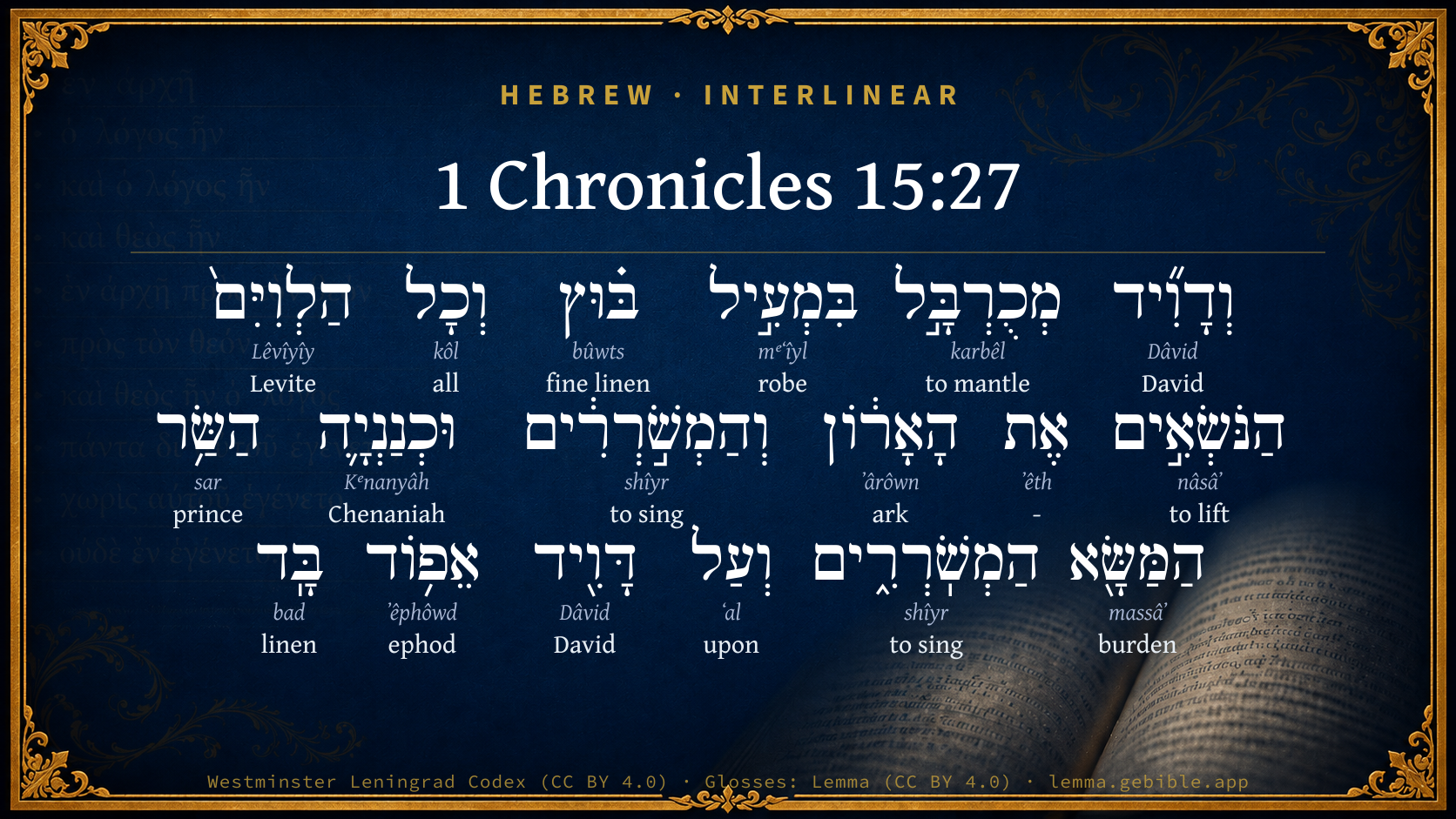
1 Chronicles 15:27

Hebrew (Westminster Leningrad Codex) 1 Chronicles 15:27 appears in the Hebrew Old Testament. The text above is from the Westminster Leningrad Codex. Each word links to its Strong’s number, a concise gloss, and parsing drawn from the Open Scriptures Hebrew Bible morphology. Click any word for its full Brown-Driver-Briggs (BDB) entry.
Download image
Cite this verse

1 Chronicles 15:27 (World English Bible). Public Domain. Lemma interlinear Bible study tool, https://lemma.gebible.app/v/1-chronicles/15/27.

Show BibTeX & RIS
BibTeX
RIS
English Translation
David was clothed with a robe of fine linen, and all the Levites who bore the ark, and the singers, and Chenaniah the master of the song [with] the singers: and David had on him an ephod of linen.
World English Bible · Public Domain
Highlights
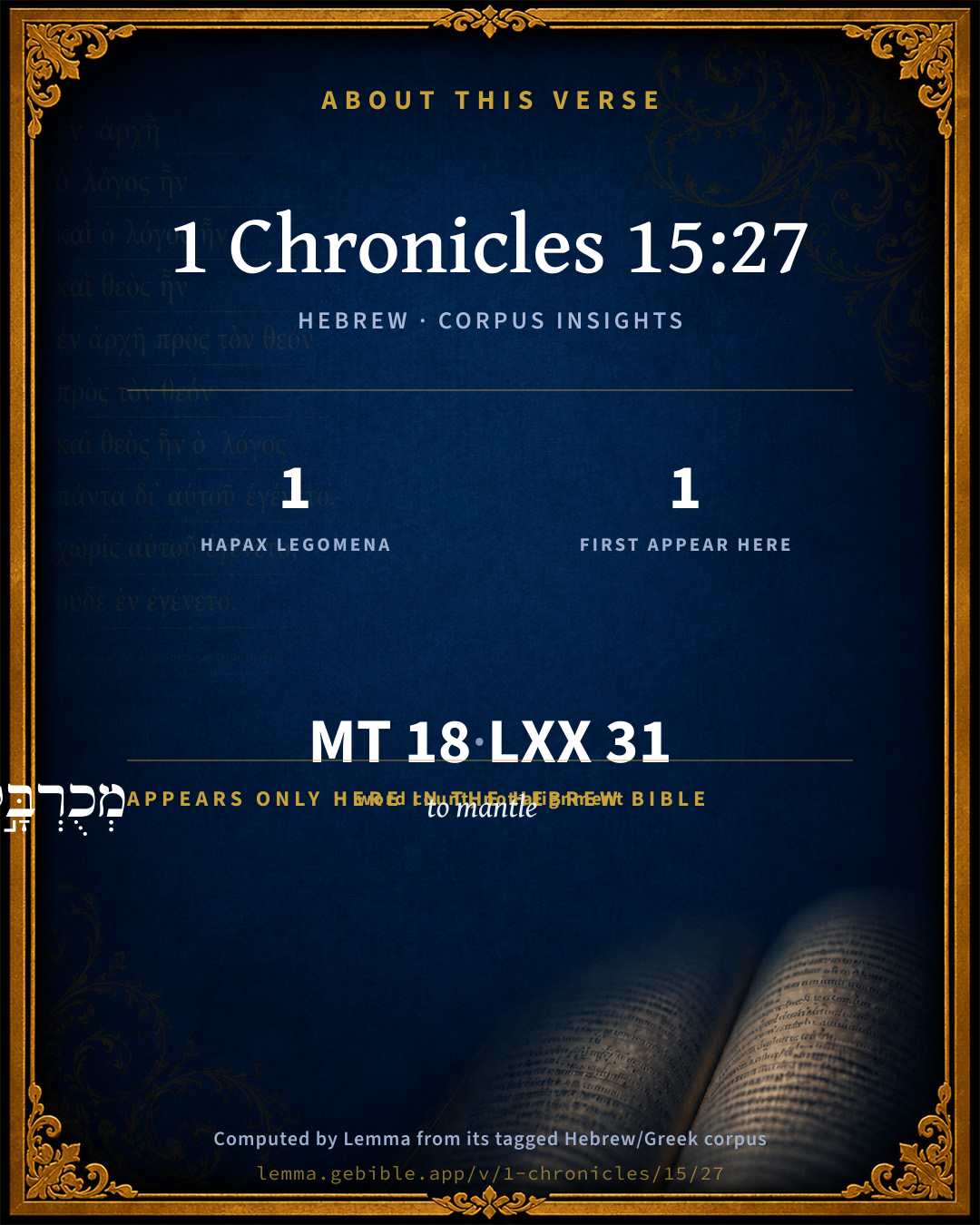
  • 1 hapax legomenon — only here in the Hebrew Bible
  • 1 first appearance in the Hebrew Bible
Full analysis ↓
Download a study sheet

One document with this verse’s original text, its word-by-word gloss line, the meaning frame, cross-references with their text, attributed commentary, and full source and license credits — printable, and it pastes into notes with its structure intact.

This verse Autodidact and up

Study sheet (.html) Plain text (.txt)

A passage Seminary Student

Up to 50 verses in one chapter. A passage sheet keeps up to 6 commentary sources and 12 cross-references per verse, in the order this page ranks them, and says so on the sheet whenever that leaves anything out. Ask for a single verse and you get the Autodidact verse sheet above.

Everything on this page stays free to read, with no account — the sheet is a download of what is already on screen, not access to it.

Want to remove ads? Support Godless Engineer
Compare translations 3

The same verse in 3 English versions, stacked beneath the original-language interlinear above. Click any original word for its lexicon entry.

Each is an independent rendering of the whole verse — the interlinear is not word-aligned to these translations.

Highlighted words mark where these versions differ — a whole-verse word diff, not a word-by-word alignment.

  • World English Bible Public Domain
    David was clothed with a robe of fine linen, and all the Levites who bore the ark, and the singers, and Chenaniah the master of the song [with] the singers: and David had on him an ephod of linen.
  • King James Version Public Domain
    And David was clothed with a robe of fine linen, and all the Levites that bare the ark, and the singers, and Chenaniah the master of the song with the singers: David also had upon him an ephod of linen.
  • unfoldingWord Literal Text CC BY-SA 4.0
    And David was clothed in a robe of fine linen, and all of the Levites carrying the Box and the singers and Kenaniah, the chief of the lifting up the singers. And an ephod of linen on David.

unfoldingWord Literal Text — © unfoldingWord, licensed CC BY-SA 4.0. Word-aligned USFM3 via Door43 (git.door43.org/unfoldingWord/en_ult).

Versions to compare (up to 4)

3 of 4 selected

Show all 18 translations

Every available English version of this verse, each an independent rendering of the whole verse.

  • World English Bible Public Domain
    David was clothed with a robe of fine linen, and all the Levites who bore the ark, and the singers, and Chenaniah the master of the song [with] the singers: and David had on him an ephod of linen.
  • Berean Standard Bible Public Domain
    Now David was dressed in a robe of fine linen, as were all the Levites who were carrying the ark, as well as the singers and Chenaniah, the director of music for the singers. David also wore a linen ephod.
  • Majority Standard Bible Public Domain
    Now David was dressed in a robe of fine linen, as were all the Levites who were carrying the ark, as well as the singers and Chenaniah, the director of music for the singers. David also wore a linen ephod.
  • King James Version Public Domain
    And David was clothed with a robe of fine linen, and all the Levites that bare the ark, and the singers, and Chenaniah the master of the song with the singers: David also had upon him an ephod of linen.
  • American Standard Version (1901) Public Domain
    And David was clothed with a robe of fine linen, and all the Levites that bare the ark, and the singers, and Chenaniah the master of the song `with' the singers: and David had upon him an ephod of linen.
  • Revised Version (1885) Public Domain
    And David was clothed with a robe of fine linen, and all the Levites that bare the ark, and the singers, and Chenaniah the master of the song with the singers: and David had upon him an ephod of linen.
  • Geneva Bible (1599) Public Domain
    And Dauid had on him a linen garment, as all the Leuites that bare the Arke, and the singers and Chenaniah that had the chiefe charge of the singers: and vpon Dauid was a linnen Ephod.
  • Douay-Rheims (1899) Public Domain
    And David was clothed with a robe of fine linen, and all the Levites that carried the ark, and the singing men, and Chonenias the ruler of the prophecy among the singers: and David also had on him an ephod of linen.
  • Young's Literal Translation Public Domain
    And David is wrapped in an upper robe of fine linen, and all the Levites who are bearing the ark, and the singers, and Chenaniah head of the burden of the singers; and on David `is' an Ephod of linen.
  • Literal Standard Version CC BY-SA 4.0
    And David is wrapped in an upper robe of fine linen, and all the Levites who are carrying the Ark, and the singers, and Chenaniah head of the burden of the singers; and an Ephod of linen [is] on David.
  • Unlocked Literal Bible CC BY-SA 4.0
    David was clothed with a robe of fine linen, as were the Levites who carried the ark, the singers, and Kenaniah, the leader of the song with the singers. David was wearing a linen ephod.
  • unfoldingWord Literal Text CC BY-SA 4.0
    And David was clothed in a robe of fine linen, and all of the Levites carrying the Box and the singers and Kenaniah, the chief of the lifting up the singers. And an ephod of linen on David.
  • Darby Bible Public Domain
    And David was clothed with a robe of byssus, and all the Levites that bore the ark, and the singers, and Chenaniah chief of the music of the singers; and David had upon him a linen ephod.
  • World Messianic Bible Public Domain
    David was clothed with a robe of fine linen, as were all the Levites who bore the ark, the singers, and Chenaniah the choir master with the singers; and David had an ephod of linen on him.
  • Webster's Bible Public Domain
    And David was clothed with a robe of fine linen, and all the Levites that bore the ark, and the singers, and Chenaniah the master of the song with the singers: David also had upon him an ephod of linen.
  • Free Bible Version CC BY-SA 4.0
    David wore a robe of fine linen like all the Levites who were carrying the Ark, and the singers and Kenaniah the leader of the music and singers. David also wore a linen ephod.
  • Bible in Basic English Public Domain
    And David was clothed with a robe of fair linen, as were all the Levites who took up the ark, and those who made melody, and Chenaniah the master of those who made melody; and David had on a linen ephod;
  • JPS Tanakh (1917) Public Domain
    And David was clothed with a robe of fine linen, and all the Levites that bore the ark, and the singers, and Chenaniah the master of the singers in the song; and David had upon him an ephod of linen.

Literal Standard Version (2020), Covenant Press — licensed CC BY-SA 4.0. Text via the HelloAO Bible API (eBible.org). Unlocked Literal Bible (unfoldingWord) — licensed CC BY-SA 4.0. Text via the HelloAO Bible API (eBible.org). unfoldingWord Literal Text — © unfoldingWord, licensed CC BY-SA 4.0. Word-aligned USFM3 via Door43 (git.door43.org/unfoldingWord/en_ult). Free Bible Version, Dr. Jonathan Gallagher — licensed CC BY-SA 4.0. Text via the HelloAO Bible API (eBible.org).

Word by word

More ways to search: Search by grammar → Find every occurrence → Compare this word →

Practice this passage: Drill this verse → Learn its vocabulary →

מְכֻרְבָּ֣ל
karbêl
H3736
“mantled”
Verb, Pual, Participle Passive, Masculine, Singular, Absolute
Part of Speech
Verb
Stem
Pual
Form
Participle Passive
Gender
Masculine
Number
Singular
State
Absolute
Full BDB Definition

Origin: from the same as H3525

TWOT: 1032

to put a mantle on, be-mantle, bind around - (Pual) bemantled (participle)
  1. וְדָוִ֞יד Dâvid H1732 “and · David” Conjunction + Noun, Proper
  2. בִּמְעִ֣יל mᵉʻîyl H4598 “in/at · robe of” Preposition + Noun, Common, Masculine, Singular, Construct
  3. בּ֗וּץ bûwts H948 “fine linen” Noun, Common, Masculine, Singular, Absolute
  4. וְכָל kôl H3605 “and · all of” Conjunction + Noun, Common, Masculine, Singular, Construct
  5. הַלְוִיִּם֙ Lêvîyîy H3881 “the · Levites” Particle, Definite Article + Noun, Gentilic, Masculine, Plural, Absolute
  6. הַנֹּשְׂאִ֣ים nâsâʼ H5375 “the · lifting” Particle, Definite Article + Verb, Qal, Participle Active, Masculine, Plural, Absolute
  7. אֶת ʼêth H853 “-” Particle, Direct Object
  8. הָאָר֔וֹן ʼârôwn H727 “the · ark” Particle, Definite Article + Noun, Common, Both, Singular, Absolute
  9. וְהַמְשֹׁ֣רְרִ֔ים shîyr H7891 “and · the · singing” Conjunction + Particle, Definite Article + Verb, Polel, Participle Active, Masculine, Plural, Absolute
  10. וּכְנַנְיָ֛ה Kᵉnanyâh H3663 “and · Chenaniah” Conjunction + Noun, Proper
  11. הַשַּׂ֥ר sar H8269 “the · prince” Particle, Definite Article + Noun, Common, Masculine, Singular, Absolute
  12. הַמַּשָּׂ֖א massâʼ H4853 “the · burden” Particle, Definite Article + Noun, Common, Masculine, Singular, Absolute
  13. הַמְשֹֽׁרְרִ֑ים shîyr H7891 “the · singing” Particle, Definite Article + Verb, Polel, Participle Active, Masculine, Plural, Absolute
  14. וְעַל ʻal H5921 “and · upon” Conjunction + Preposition
  15. דָּוִ֖יד Dâvid H1732 “David” Noun, Proper
  16. אֵפ֥וֹד ʼêphôwd H646 “ephod of” Noun, Common, Masculine, Singular, Construct
  17. בָּֽד bad H906 “linen” Noun, Common, Masculine, Singular, Absolute

About this verse

These counts appear in no published source. They are computed here, from the morphology-tagged text and Lemma’s own curated glosses. What Lemma adds →

18
words
16
distinct lemmas
Historical
section

Notable vocabulary

1 hapax legomenon — a word that appears only here in the entire Hebrew Bible:

  • מְכֻרְבָּ֣ל to mantle H3736

First appearance in Scripture

This word makes its first canonical appearance in the Hebrew Bible here:

  • מְכֻרְבָּ֣ל to mantle H3736

Shared distinctive vocabulary

וּכְנַנְיָ֛ה Chenaniah H3663 occurs in 3 verses of the Hebrew Bible. Also found in:

Grammatical profile

  • 4 verbs
  • 12 nouns
  • 1 preposition
  • 1 particle

Verb forms

  • מְכֻרְבָּ֣ל Pual · Participle Passive
  • הַנֹּשְׂאִ֣ים Qal · Participle Active
  • וְהַמְשֹׁ֣רְרִ֔ים Polel · Participle Active
  • הַמְשֹֽׁרְרִ֑ים Polel · Participle Active

Repetition

Words recur within this verse — often emphatic in Hebrew:

  • וְדָוִ֞יד David H1732 ×2
  • וְהַמְשֹׁ֣רְרִ֔ים to sing H7891 ×2

Hebrew & Septuagint length

In English translation the verse runs 39 words from the Hebrew and 46 from the Septuagint (LXX English) — closely comparable.

A rough comparison of the two English renderings, which tokenize alike — not a word-level alignment.

Word counts can differ between the Hebrew and the Greek without any difference in meaning — e.g. the Hebrew direct-object marker אֵת has no separate Greek word, and Greek often adds the article ὁ.

In the original languages it is 18 Hebrew tokens and 31 Greek tokens — but the two are counted differently (Hebrew bundles its prefixes and suffixes into one token; the Greek is in lemma form), so that isn’t a like-for-like length.

Cross-references

2

Topical passages linked to 1 Chronicles 15:27 in the Treasury of Scripture Knowledge — connected by theme and wording, ordered by reader-vote popularity; previews shown in the World English Bible.

  • 1 Samuel 2:18 But Samuel ministered before Yahweh, being a child, girded with a linen ephod.
  • 2 Samuel 6:14 David danced before Yahweh with all his might; and David was girded with a linen ephod.

Cross-references courtesy of OpenBible.info (CC BY 4.0).

Hebrew and Greek witnesses Masoretic Hebrew ↔ Greek Septuagint

The same verse in the two great witnesses to the Old Testament, shown verse-for-verse.

These are two independent witnesses, not word-aligned to each other, and the Septuagint is shown in lemma (dictionary) form.

Hebrew 1 Chronicles 15:27 Masoretic · Westminster Leningrad Codex

וְדָוִ֞יד מְכֻרְבָּ֣ל בִּמְעִ֣יל בּ֗וּץ וְכָל הַלְוִיִּם֙ הַנֹּשְׂאִ֣ים אֶת הָאָר֔וֹן וְהַמְשֹׁ֣רְרִ֔ים וּכְנַנְיָ֛ה הַשַּׂ֥ר הַמַּשָּׂ֖א הַמְשֹֽׁרְרִ֑ים וְעַל דָּוִ֖יד אֵפ֥וֹד בָּֽד

David was clothed with a robe of fine linen, and all the Levites who bore the ark, and the singers, and Chenaniah the master of the song [with] the singers: and David had on him an ephod of linen.

World English Bible · Public Domain

Greek LXX 1 Chronicles 15:27 Septuagint · lemma form

καί δαυίδ περιζώννυμι ἐν στολή βύσσινος καί πᾶς ὁ λευίτης αἴρω ὁ κιβωτός διαθήκη κύριος καί ὁ ψαλτῳδός καί χωνενιας ὁ ἄρχων ὁ ᾠδή ὁ ᾄδω καί ἐπί δαυίδ στολή βύσσινος

And David was girded with a fine linen robe, and all the Levites who were bearing the ark of the covenant of the Lord, and the singers, and Chonenias the master of the band of singers; also upon David there was a robe of fine linen.

LXX2012 (modern English Septuagint) · Public Domain

On this verse, Haydock's Catholic Bible Commentary discusses the Septuagint’s reading. Read the note in Commentary ↓

Hebrew: Westminster Leningrad Codex (CC BY 4.0). Greek: Septuagint (public domain); English from LXX2012 (modern English Septuagint) (Public Domain). How the Septuagint differs from the Hebrew →

Commentary

Notes on 1 Chronicles 15:27 from classic Christian and Jewish commentators (each source and its license shown beneath its notes). The classic Christian expositions comment on the surrounding passage and are grouped to its opening verse, so a note may address several verses; the Jewish commentaries on the Tanakh (Rashi and others) are per-verse, so they appear only where the commentator wrote on this verse.

Lemma curates 59 commentaries, every one of them public domain or Creative Commons licensed, each selected and text-cleaned for this edition rather than reprinted as found. About our sources →

Ellicott's Commentary for English Readers

(27) And David was clothed with a robe of fine linen.—Samuel reads, “And David was dancing before Jehovah with all might” (Heb.). The Hebrew of our text may be a corruption or intentional alteration of this. The word for “clothed” is the Aramaic (Dan_3:21, mĕkurbâl), which might easily be, by inadvertence or design, substituted for the rare word mĕkarkçr (Sam.), “dancing.”

A robe of fine linen.—Heb., a me’il of byssus. The me’il was an upper garment worn by persons of rank (2Sa_12:18; 1Sa_15:27; Job_29:14).

And all the Levites . . . and the singers, and Chenaniah.—Scil., were clothed with a me‘îl of byssus.

The master of the song.—Rather, the chief (overseer) of the bearing. (Comp. 1Ch_15:22.)

With the singers.—Omit, as an accidental repetition. The word “with” is wanting in the Hebrew, which is ungrammatical as it stands. The entire clause, “and all the Levites . . . with the singers,” is not read in the parallel account.

David also had upon him an ephod of linen.—Literally, and upon David (was) an ephod of linen. (See 2Sa_6:14.) The ephod, a sort of cope, was distinctive of the priests (1Sa_22:18).

A Bible Commentary for English Readers, edited by Charles John Ellicott (1878–1897) — public domain. Text from a community e-Sword module.

Trapp's Complete Commentary

John Trapp

1Ch 15:27 And David [was] clothed with a robe of fine linen, and all the Levites that bare the ark, and the singers, and Chenaniah the master of the song with the singers: David also [had] upon him an ephod of linen.

Ver. 27-29.] See on 2Sa 6:14-15, &c.

John Trapp, A Commentary or Exposition upon All the Books of the Old and New Testament (1647–1656) — public domain. Text from a community e-Sword module.

Joseph Benson's Commentary

1Ch 15:27. David was clothed with a robe of fine linen, also an ephod of linen — “David was clothed with a double garment, with a robe of fine linen, and with a linen ephod. These two garments are expressly distinguished in the account of the vestments of the high-priest, Exo 29:5; Exo 28:4; Exo 28:6; Exo 39:23. The fabric of them was different; the ephod was made of gold, blue, purple, scarlet; whereas the robe was formed all of blue. The shape of them was different; the ephod reaching only to the knees, the robe flowing down even to the very covering of the feet. The robe had no division in it throughout, but was made whole and round, with an opening in the middle of it, at the top; so that it was impossible any part of the body could be seen through it, especially as the ephod, on this occasion of David’s dancing, was thrown over it, and tied, probably, with a girdle, as the priest’s ephod always was. David clothed himself with these linen garments on this solemnity, both out of reverence to God, and for convenience, because they were cooler. It may be further observed, that this robe was worn by kings, their children, princes, priests, Levites, and prophets, when they appeared on any solemn occasion, and it covered their other garments: see 1Sa 28:14; 2Sa 13:8. David, therefore, dressed himself on this occasion with this long, flowing linen robe, instead of the robe of state proper to him as king of Israel, and which was made of richer materials; and hence he was scornfully insulted by Saul’s daughter, as uncovering himself as a king, and appearing in a habit wholly unworthy, as she thought, of his royal character and dignity.” See on 2Sa 6:20; Chandler’s Review, and Dodd.

Joseph Benson's Commentary on the Old and New Testaments (1811–1818) — public domain. Text from a community e-Sword module.

Geneva Bible (1599)

Geneva Bible translators

Read 2 Sam. 6:14.

Geneva Bible (1599) marginal notes — public domain. Text via Bolls.life.

Jamieson, Fausset & Brown

Robert Jamieson, A. R. Fausset & David Brown

a robe of fine linen--Hebrew, Butz--is rather supposed in the later books to denote cotton.

an ephod--a shoulder-garment, a cincture or cape over his dress. It was worn by the priests, but was not so peculiar to them as to be forbidden others (Sa1 2:18; Sa1 22:18).

Jamieson, Fausset & Brown — Commentary Critical and Explanatory on the Whole Bible (1871) — public domain (CC PDM 1.0). Text via the HelloAO Bible API.

Adam Clarke's Commentary

Verse 27. A robe of flue linen] A robe made of בוץ buts, probably the tuft or beard of the Pinna Magna, a species of muscle found every where on the shores of the Mediterranean, growing sometimes, as I have seen, to a foot and a half in length. I have seen a pair of gloves made of this very rich stuff; the colour is a deep dark yellow, something inclining to what is called the lilac. The buts or byssus was not heard of in Israel before the time of David: after that it is frequently mentioned.

Adam Clarke's Commentary on the Bible (1810–1826) — public domain. Text from a community e-Sword/MySword module.

The Cambridge Bible for Schools and Colleges

gen. ed. J. J. S. Perowne

27. the master of the song] R.V. mg., the master of the carrying of the ark. Cp. 1Ch_15:22, note.

an ephod of linen] A linen ephod was the ordinary vestment for all priests (1Sa_22:18). The highpriest’s ephod was a more elaborate garment (Exo_28:6-12), fitted with the means of divination (1Sa_23:6; 1Sa_23:9-12).

The Cambridge Bible for Schools and Colleges (gen. ed. J. J. S. Perowne; Cambridge University Press, 1878–1918) — public domain. Text from a community e-Sword module.

John Gill's Exposition

Thus all Israel brought up the ark of the covenant of the Lord with shouting,.... See Sa2 6:15.

1 Chronicles 15:29

John Gill's Exposition of the Whole Bible (1746–1763) — public domain (CC PDM 1.0). Text via the HelloAO Bible API.

Albert Barnes' Notes on the Bible

“Fine linen” (byssus) is here first spoken of as used for dress. It seems to have been reserved for nobles of the highest rank Est 8:15, for kings, and for priests 2Ch 5:12. David’s robe was probably worn, like that of the high priest, immediately under the ephod, and may, like that, have reached the feet.

Albert Barnes' Notes on the Bible (1834–1885) — public domain. Text from a community e-Sword/MySword module.

Haydock's Catholic Bible Commentary

Linen. Hebrew, "a cloak of byssus," or of the finest white linen. (Du Hamel) --- Bysus has often occurred before in the Vulgate, but we find the Hebrew buts, here for the first time. It probably denotes the brilliant yellow silk taken from the fish pinna, of which St. Basil speaks. (Hexa. vii.) Justinian was clothed with it, on account of its rarity and brightness. (Procopius, de fabric. Yet as it would hardly assume any colour but black, it was not so much sought after as the silk of Persia. Not only David, but all the Levites, were thus richly adorned; as the latter were at the dedication of the temple, 2 Paralipomenon ii. 14. There was a manufactory of this byssus established by David, chap. iv. 21. That of Egypt was white, and is called schesch, or "cotton," Exodus xvi. 4. (Calmet) --- Ephod. Septuagint, "a stole of byssus," or a long silken robe, (Haydock) which has been already expressed; (Tirinus) or rather, the ephod was only a girdle, which was not peculiar to the sacred ministers, 1 Kings ii. 18. (Calmet) --- Samuel, though a child, wore one. (Worthington)

George Leo Haydock (1774–1849), Haydock's Catholic Family Bible and Commentary, 1859 edition — public domain. Excludes Psalms (Douay-Rheims chapter numbering differs from Protestant) and Deuterocanonical books (Catholic canon only).

Matthew Poole's English Annotations

With a robe of fine linen, i.e. with a linen ephod, as it is explained in the close of this verse, where this circumstance is repeated, because it was a notable and unusual thing for David, who was no Levite, to wear a Levitical garment. Of this and the following verses, See Poole "2Sa 6:14", See Poole "2Sa 6:15", See Poole "2Sa 6:16".

Matthew Poole's English Annotations on the Holy Bible (1683–1685) — public domain. Text from a community e-Sword/MySword module.

Whedon's Commentary on the Bible

Daniel D. Whedon

27. The master of the song — Rather, prince of the burden. See note above on 1Ch_15:22.

With the singers — There is no with in the Hebrew, and the word singers is probably an interpolation, being a repetition from the previous line made by some ancient transcriber.

Daniel D. Whedon (gen. ed.), Commentary on the Old and New Testaments (1874–1909) — public domain. Text from a community e-Sword module.

The Pulpit Commentary

Several things in this verse indicate a somewhat uncertain and unsteady selection of particulars by the compiler from his original sources. The natural reading of the verse would seem to say that David and all those Levites who bore the ark, and the singers, and Chenaniah, all wore the robe of byssus, while David had, in addition, the ephod of linen. Yet it is unlikely that all did wear the robe. Again, the Hebrew text exhibits no preposition before the singers, on the second occasion of the occurrence of the expression in this verse. Yet little sense can be found without a preposition. The robe was not distinctively a priest"s garment (1Sa_18:4 1Sa_24:5, 1Sa_24:12; 2Sa_13:8; Job_1:20 Job_2:12) though priests did wear it. The robe of byssus is spoken of only here; 2Ch_5:12; and Est_8:15. Byssus, however, is spoken of as material for other purposes in 1Ch_4:21; 2Ch_2:14; Est_1:6; Eze_27:16. The ephod , on the other hand, was no doubt distinctively a high priest"s garment, (Exo_28:4-12) though we read of Samuel wearing one, (1Sa_2:18, 1Sa_2:28) and of David doing the same, as on this occasion. The fine linen (xwB), in the first clause of this verse, is not the same with that ( in the last clause. The first clause of this verse (which makes the last clause somewhat redundant) bears some resemblance in letters to the fourteenth verse of 2Ch 6. first clause, which means, "and David danced with all his might," and the two clauses exactly answer to one another in position another suggestion of an uncertain text here.

The Pulpit Commentary (1880–1919), ed. H.D.M. Spence-Jones & Joseph S. Exell — public domain. Text from a community e-Sword module.

John Wesley's Explanatory Notes

Linen - With a linen ephod. This circumstance is repeated, because it was an unusual thing for one, who was no Levite, to wear a Levitical garment.

John Wesley, Explanatory Notes Upon the Whole Bible (1754–1765) — public domain. Text via the GEBible commentary corpus.

Keil & Delitzsch

C. F. Keil & F. Delitzsch

Thus all Israel brought up the ark of the covenant of the Lord with shouting,.... See Sa2 6:15.

1 Chronicles 15:29

Keil & Delitzsch — Biblical Commentary on the Old Testament (1861–1891) — public domain (CC PDM 1.0). Text via the HelloAO Bible API. (Old Testament only.)

unfoldingWord translationNotes

Door43 World Missions Community

David was clothed with a robe of fine linen, as were the Levites who carried the ark, the singers, and Kenaniah, the leader of the song with the singers

This can be stated in active form. AT: "David, the Levites who carried the ark, the singers, and Kenaniah, the leader of the song with the singers all wore fine linen robes" (See: Active or Passive)

linen

a cloth made from fibers of the flax plant

Kenaniah

This is the name of a man. (See: How to Translate Names)

So all Israel brought up the ark

Here the word "all" is a generalization. AT: "So a great crowd of Israelites brought up the ark" (See: Hyperbole and Generalization)

cymbals

two thin, round metal plates that are hit together to make a loud sound. See how you translated this in 1 Chronicles 13:8. (See: Translate Unknowns)

translationWords

David

clothe

robe

ephod

trumpet

harp

unfoldingWord translationNotes — © Distant Shores Media and the Door43 World Missions Community, licensed CC BY-SA 4.0. Source: git.door43.org/Door43/en_tn.

Rashi

Rabbi Shlomo Yitzchaki (Rashi)

And David was enwrapped in a linen robe - Heb. מְכֻרְבָּל enwrapped, as in Daniel (3:21): “their robes (וְכַרְבְּלָתְהוֹן).” A similar case is the comb (כַּרְבַּלְתָּא) of a rooster.

and all the Levites were likewise enwrapped in linen robes, and since David was a singer like the Levites, he too wore their raiments, which they wore, and proof of this - to distinguish between the unclean and the clean: It was the custom of the heathen kings and princes, that when they would dine with their priests according to their custom, they would don the garb of their priests.

and on David was a linen ephod like the ephod of Aaron, which was like two felt cloths, one in the front and one in the back, and it reached to his loins, and the girdle was woven from it, and he would gird himself with it.

Rashi on the Tanakh — English translations: “The Judaica Press complete Tanach with Rashi, translated by A. J. Rosenberg” (CC BY 4.0); “Pentateuch with Rashi's commentary by M. Rosenbaum and A.M. Silbermann, 1929-1934” (public domain); “The Metsudah Tanach series, Lakewood, N.J” (CC BY 4.0); and “The Book of Joshua, Metsudah Publications, 1997” (CC BY 4.0). Text via Sefaria.

Lesson kit

Teaching starters — assembled from the data on this page, not authored interpretation. Every prompt links to the verse data it draws on. Edit before teaching.

1 Chronicles, in the Historical, opens this verse with 18 words (16 distinct Hebrew lemmas). Its most distinctive word is karbêl (“to mantle”). A historical commentator’s framing appears above. Read the whole chapter for the surrounding context.

Discussion questions

  1. The word karbêl carries the sense “to mantle.” How does it shape the verse?
  2. This verse holds 1 word here found nowhere else in the Hebrew Bible. What might the rare word draw attention to?
  3. The word “to mantle” first appears here in Scripture. What is being introduced at this debut?
  4. 1 Chronicles 15:22 shares the word «Chenaniah» with this verse. How do the two illuminate each other?
  5. “David” occurs 2× in this one verse. What is the effect of the repetition?
  6. These translations render this verse differently; the difference is in the English rendering, not the original. What questions does that raise?
  7. The verb «מְכֻרְבָּ֣ל» is Pual Participle Passive. How does its form color the action?
  8. Reading how Ellicott's Commentary for English Readers and Trapp's Complete Commentary read this verse, where do the two commentators agree and where do they part?

Things to notice

  • 1 word in this verse appears nowhere else in the Hebrew Bible.
  • 1 word makes its first canonical appearance in Scripture here.
  • This verse counts 18 Hebrew ↔ 31 Greek words.
  • These translations choose different wording for 17 words in this verse.
  • “David” occurs 2× in this single verse.

Reading settings

Reading text

Shown beneath each verse's original-language words.

Old Testament
Old Testament edition

Read the OT as the Masoretic Hebrew (MT) or the Greek Septuagint (LXX).

English shown for the Greek Septuagint (in the Hebrew ↔ Greek comparison).

Comparing translations? Open the Compare panel on any verse page to stack up to four side by side.