Exodus 10:17

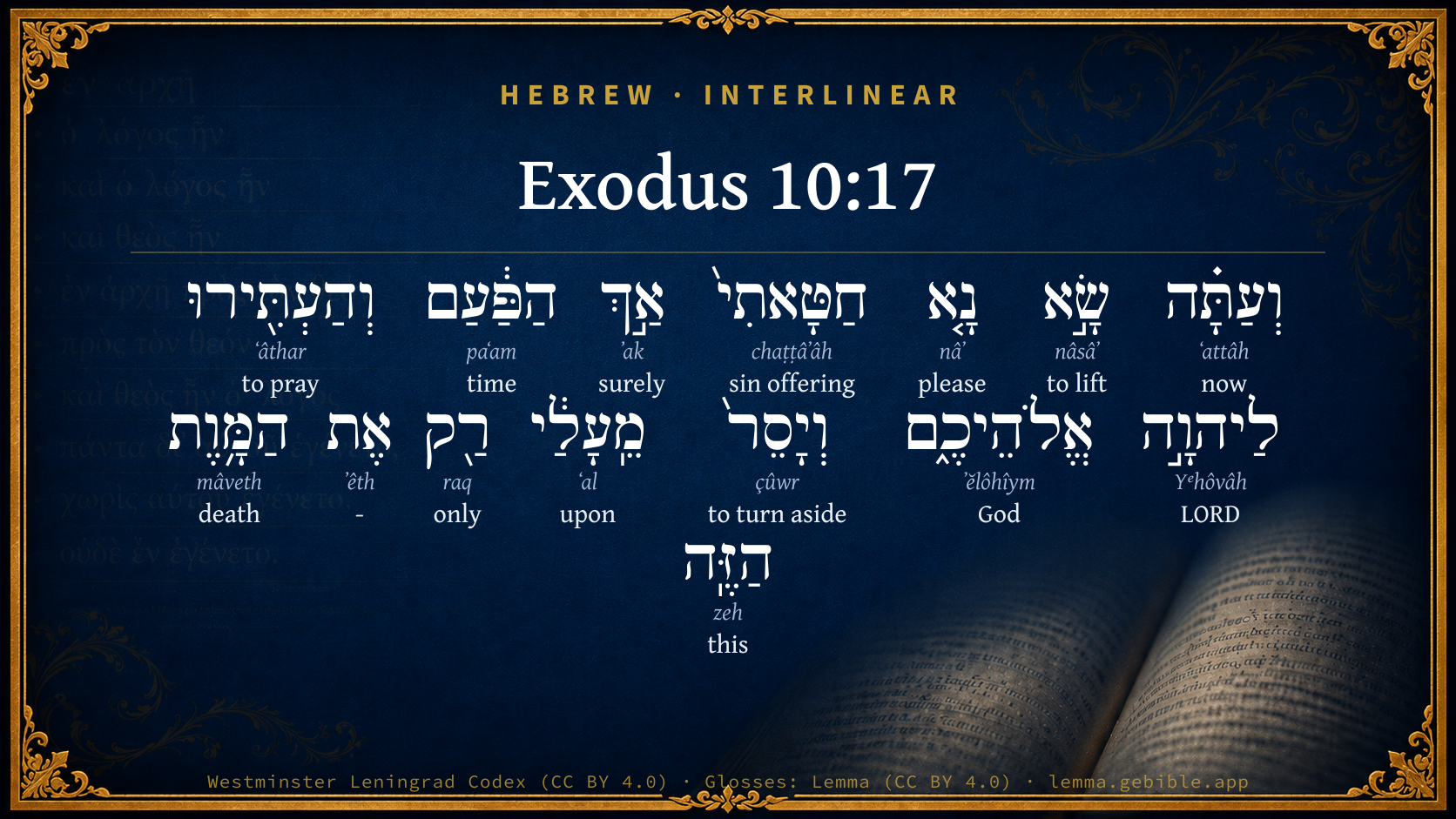
Hebrew (Westminster Leningrad Codex) Exodus 10:17 appears in the Hebrew Old Testament. The text above is from the Westminster Leningrad Codex. Each word links to its Strong’s number, a concise gloss, and parsing drawn from the Open Scriptures Hebrew Bible morphology. Click any word for its full Brown-Driver-Briggs (BDB) entry.
Download image
Cite this verse

Exodus 10:17 (World English Bible). Public Domain. Lemma interlinear Bible study tool, https://lemma.gebible.app/v/exodus/10/17.

Show BibTeX & RIS
BibTeX
RIS
English Translation
Now therefore please forgive my sin again, and pray to Yahweh your God, that he may also take away from me this death."
World English Bible · Public Domain
Download a study sheet

One document with this verse’s original text, its word-by-word gloss line, the meaning frame, cross-references with their text, attributed commentary, and full source and license credits — printable, and it pastes into notes with its structure intact.

This verse Autodidact and up

Study sheet (.html) Plain text (.txt)

A passage Seminary Student

Up to 50 verses in one chapter. A passage sheet keeps up to 6 commentary sources and 12 cross-references per verse, in the order this page ranks them, and says so on the sheet whenever that leaves anything out. Ask for a single verse and you get the Autodidact verse sheet above.

Everything on this page stays free to read, with no account — the sheet is a download of what is already on screen, not access to it.

Want to remove ads? Support Godless Engineer
Compare translations 3

The same verse in 3 English versions, stacked beneath the original-language interlinear above. Click any original word for its lexicon entry.

Each is an independent rendering of the whole verse — the interlinear is not word-aligned to these translations.

Highlighted words mark where these versions differ — a whole-verse word diff, not a word-by-word alignment.

  • World English Bible Public Domain
    Now therefore please forgive my sin again, and pray to Yahweh your God, that he may also take away from me this death."
  • King James Version Public Domain
    Now therefore forgive, I pray thee, my sin only this once, and entreat the LORD your God, that he may take away from me this death only.
  • unfoldingWord Literal Text CC BY-SA 4.0
    And now, please bear my sin, just this once, and pray to Yahweh your God and let him take this death only away from me.”

unfoldingWord Literal Text — © unfoldingWord, licensed CC BY-SA 4.0. Word-aligned USFM3 via Door43 (git.door43.org/unfoldingWord/en_ult).

Versions to compare (up to 4)

3 of 4 selected

Show all 18 translations

Every available English version of this verse, each an independent rendering of the whole verse.

  • World English Bible Public Domain
    Now therefore please forgive my sin again, and pray to Yahweh your God, that he may also take away from me this death."
  • Berean Standard Bible Public Domain
    Now please forgive my sin once more and appeal to the LORD your God, that He may remove this death from me.”
  • Majority Standard Bible Public Domain
    Now please forgive my sin once more and appeal to the LORD your God, that He may remove this death from me.”
  • King James Version Public Domain
    Now therefore forgive, I pray thee, my sin only this once, and entreat the LORD your God, that he may take away from me this death only.
  • American Standard Version (1901) Public Domain
    Now therefore forgive, I pray thee, my sin only this once, and entreat Jehovah your God, that he may take away from me this death only.
  • Revised Version (1885) Public Domain
    Now therefore forgive, I pray thee, my sin only this once, and entreat the LORD your God, that he may take away from me this death only.
  • Geneva Bible (1599) Public Domain
    And nowe forgiue mee my sinne onely this once, and pray vnto the Lord your God, that hee may take away from me this death onely.
  • Douay-Rheims (1899) Public Domain
    But now forgive me my sin this time also, and pray to the Lord your God, that he take away from me this death.
  • Young's Literal Translation Public Domain
    and now, bear with, I pray you, my sin, only this time, and make ye supplication to Jehovah your God, that He turn aside from off me only this death.'
  • Literal Standard Version CC BY-SA 4.0
    and now, please bear with my sin, only this time, and make supplication to your God YHWH, that He may turn aside from off me only this death.”
  • Unlocked Literal Bible CC BY-SA 4.0
    Now then, forgive my sin this time, and pray to Yahweh your God that he will take this death away from me.”
  • unfoldingWord Literal Text CC BY-SA 4.0
    And now, please bear my sin, just this once, and pray to Yahweh your God and let him take this death only away from me.”
  • Darby Bible Public Domain
    And now, forgive, I pray you, my sin only this time, and intreat Jehovah your God that he may take away from me this death only!
  • World Messianic Bible Public Domain
    Now therefore please forgive my sin again, and pray to the LORD your God, that he may also take away from me this death.”
  • Webster's Bible Public Domain
    Now therefore forgive, I pray thee, my sin only this once, and entreat the LORD your God that he may take away from me this death only.
  • Free Bible Version CC BY-SA 4.0
    So please forgive my sin just this one time and plead with the Lord your God, asking him to at least take away this deathly plague from me.”
  • Bible in Basic English Public Domain
    Let me now have forgiveness for my sin this time only, and make prayer to the Lord your God that he will take away from me this death only.
  • JPS Tanakh (1917) Public Domain
    Now therefore forgive, I pray thee, my sin only this once, and entreat the LORD your God, that He may take away from me this death only.'

Literal Standard Version (2020), Covenant Press — licensed CC BY-SA 4.0. Text via the HelloAO Bible API (eBible.org). Unlocked Literal Bible (unfoldingWord) — licensed CC BY-SA 4.0. Text via the HelloAO Bible API (eBible.org). unfoldingWord Literal Text — © unfoldingWord, licensed CC BY-SA 4.0. Word-aligned USFM3 via Door43 (git.door43.org/unfoldingWord/en_ult). Free Bible Version, Dr. Jonathan Gallagher — licensed CC BY-SA 4.0. Text via the HelloAO Bible API (eBible.org).

Word by word

More ways to search: Search by grammar → Find every occurrence → Compare this word →

Practice this passage: Drill this verse → Learn its vocabulary →

וְהַעְתִּ֖ירוּ
ʻâthar
H6279
“and · pray”
Conjunction + Verb, Hiphil, Imperative, 2nd Person, Masculine, Plural
Part of Speech
Conjunction + Verb
Stem
Hiphil
Form
Imperative
Person
2nd Person
Gender
Masculine
Number
Plural
Full BDB Definition

Origin: a primitive root [rather denominative from H6281 ]

TWOT: 1722

to pray, entreat, supplicate - (Qal) to pray, entreat - (Niphal) to be supplicated, be entreated - (Hiphil) to make supplication, plead
  1. וְעַתָּ֗ה ʻattâh H6258 “and · now” Conjunction + Adverb
  2. שָׂ֣א nâsâʼ H5375 “lift” Verb, Qal, Imperative, 2nd Person, Masculine, Singular
  3. נָ֤א nâʼ H4994 “please” Particle, Exhortation
  4. חַטָּאתִי֙ chaṭṭâʼâh H2403 “sin offering · my” Noun, Common, Feminine, Singular, Construct + Suffix, Personal, 1st Person, Common, Singular
  5. אַ֣ךְ ʼak H389 “surely” Particle, Accusative
  6. הַפַּ֔עַם paʻam H6471 “the · time” Particle, Definite Article + Noun, Common, Feminine, Singular, Absolute
  7. לַיהוָ֣ה Yᵉhôvâh H3068 “to/for · LORD” Preposition + Noun, Proper
  8. אֱלֹהֵיכֶ֑ם ʼĕlôhîym H430 “God(s) · your” Noun, Common, Masculine, Plural, Construct + Suffix, Personal, 2nd Person, Masculine, Plural
  9. וְיָסֵר֙ çûwr H5493 “and · to turn aside” Conjunction + Verb, Hiphil, Jussive, 3rd Person, Masculine, Singular
  10. מֵֽעָלַ֔י ʻal H5921 “from · upon · me” Preposition + Preposition + Suffix, Personal, 1st Person, Common, Singular
  11. רַ֖ק raq H7535 “only” Particle, Accusative
  12. אֶת ʼêth H853 “-” Particle, Direct Object
  13. הַמָּ֥וֶת mâveth H4194 “the · death” Particle, Definite Article + Noun, Common, Masculine, Singular, Absolute
  14. הַזֶּֽה zeh H2088 “the · this” Particle, Definite Article + Pronoun, Demonstrative, Masculine, Singular

About this verse

These counts appear in no published source. They are computed here, from the morphology-tagged text and Lemma’s own curated glosses. What Lemma adds →

15
words
15
distinct lemmas
Pentateuch
section

Notable vocabulary

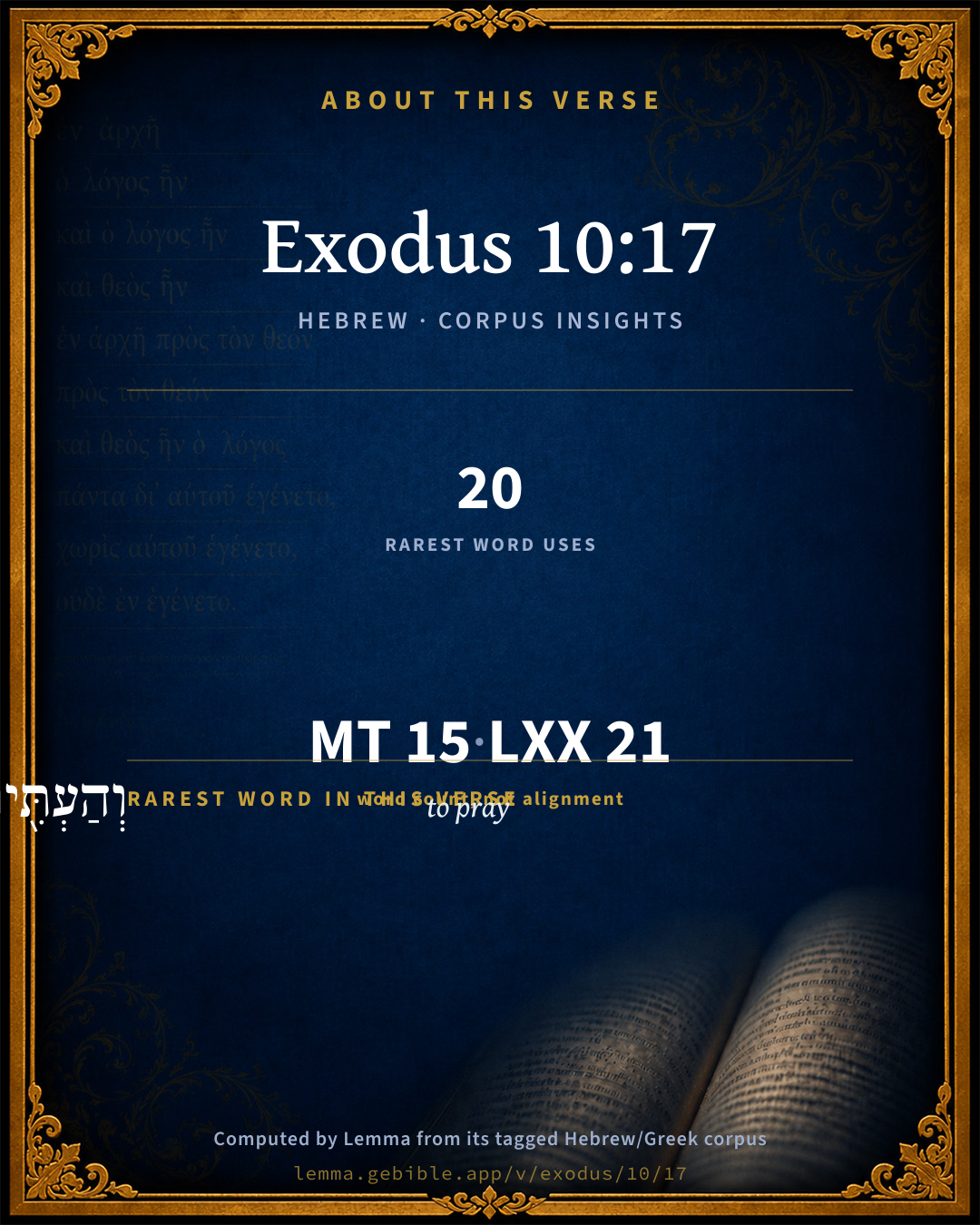
The rarest word here is וְהַעְתִּ֖ירוּ to pray H6279 — appearing just 20 times in the whole Hebrew Bible.

Shared distinctive vocabulary

וְהַעְתִּ֖ירוּ to pray H6279 occurs in 19 verses of the Hebrew Bible. Also found in:

Grammatical profile

  • 3 verbs
  • 5 nouns
  • 1 pronoun
  • 1 preposition
  • 1 adverb
  • 4 particles

Verb forms

  • שָׂ֣א Qal · Imperative
  • וְהַעְתִּ֖ירוּ Hiphil · Imperative
  • וְיָסֵר֙ Hiphil · Jussive

Hebrew & Septuagint length

In English translation the verse runs 23 words from the Hebrew and 23 from the Septuagint (LXX English) — the same length.

A rough comparison of the two English renderings, which tokenize alike — not a word-level alignment.

Word counts can differ between the Hebrew and the Greek without any difference in meaning — e.g. the Hebrew direct-object marker אֵת has no separate Greek word, and Greek often adds the article ὁ.

In the original languages it is 15 Hebrew tokens and 21 Greek tokens — but the two are counted differently (Hebrew bundles its prefixes and suffixes into one token; the Greek is in lemma form), so that isn’t a like-for-like length.

Cross-references

9

Topical passages linked to Exodus 10:17 in the Treasury of Scripture Knowledge — connected by theme and wording, ordered by reader-vote popularity; previews shown in the World English Bible.

  • Exodus 8:8 Then Pharaoh called for Moses and Aaron, and said, "Entreat Yahweh, that he take away the frogs from me, and from my people; and I will let the people go, that they may sacrifice to Yahweh."
  • Exodus 9:28 Pray to Yahweh; for there has been enough of mighty thunderings and hail. I will let you go, and you shall stay no longer."
  • 1 Kings 13:6 The king answered the man of God, Entreat now the favor of Yahweh your God, and pray for me, that my hand may be restored me again. The man of God entreated Yahweh, and the king's hand was restored him again, and became as it was before.
  • 1 Samuel 15:25 Now therefore, please pardon my sin, and turn again with me, that I may worship Yahweh.
  • 2 Kings 4:40 So they poured out for the men to eat. It happened, as they were eating of the stew, that they cried out, and said, man of God, there is death in the pot. They could not eat of it.
  • Isaiah 26:16 Yahweh, in trouble have they visited you; they poured out a prayer [when] your chastening was on them.
  • Acts 8:24 Simon answered, "Pray for me to the Lord, that none of the things which you have spoken happen to me."
  • Romans 15:30 Now I beg you, brothers, by our Lord Jesus Christ, and by the love of the Spirit, that you strive together with me in your prayers to God for me,
  • 2 Corinthians 1:10 who delivered us out of so great a death, and does deliver; on whom we have set our hope that he will also still deliver us;

Cross-references courtesy of OpenBible.info (CC BY 4.0).

Hebrew and Greek witnesses Masoretic Hebrew ↔ Greek Septuagint

The same verse in the two great witnesses to the Old Testament, shown verse-for-verse.

These are two independent witnesses, not word-aligned to each other, and the Septuagint is shown in lemma (dictionary) form.

Hebrew Exodus 10:17 Masoretic · Westminster Leningrad Codex

וְעַתָּ֗ה שָׂ֣א נָ֤א חַטָּאתִי֙ אַ֣ךְ הַפַּ֔עַם וְהַעְתִּ֖ירוּ לַיהוָ֣ה אֱלֹהֵיכֶ֑ם וְיָסֵר֙ מֵֽעָלַ֔י רַ֖ק אֶת הַמָּ֥וֶת הַזֶּֽה

Now therefore please forgive my sin again, and pray to Yahweh your God, that he may also take away from me this death."

World English Bible · Public Domain

Greek LXX Exodus 10:17 Septuagint · lemma form

προςδέχομαι οὖν ἐγώ ὁ ἁμαρτία ἔτι νῦν καί προςεὔχομαι πρός κύριος ὁ θεός σύ καί περιαἱρέω ἀπό ἐγώ ὁ θάνατος οὗτος

pardon therefore my sin yet this time, and pray to the Lord your God, and let him take away from me this death.

LXX2012 (modern English Septuagint) · Public Domain

Hebrew: Westminster Leningrad Codex (CC BY 4.0). Greek: Septuagint (public domain); English from LXX2012 (modern English Septuagint) (Public Domain). How the Septuagint differs from the Hebrew →

Targum (Aramaic paraphrase)

2

The Targum is the ancient Jewish Aramaic paraphrase of the Hebrew Scriptures — an interpretive translation, not the Hebrew text itself. Onkelos (literal) and Pseudo-Jonathan (expansive) render the Torah, and Jonathan the Prophets. Coverage is partial: where no permissively-licensed English translation exists for a verse, only the Aramaic is shown. This is verse-level text, not a word-by-word alignment to the Hebrew.

  1. Targum Onkelos Torah (Genesis–Deuteronomy)
    וּכְעַן שְׁבוֹק כְּעַן לְחוֹבִי בְּרַם זִמְנָא הָדָא וְצַלוֹ קָדָם יְיָ אֱלָהֲכוֹן וְיַעְדֵי מִנִי לְחוֹד יָת מוֹתָא הָדֵין:

    (no public-domain English translation for this verse)

    Targum Onkelos — Aramaic: “Onkelos Genesis” (public domain); “Onkelos Exodus” (public domain); “Onkelos Leviticus” (public domain); “Onkelos Numbers” (public domain); “Onkelos Deuteronomy” (public domain). English: “Sefaria Community Translation” (CC0 1.0 (public-domain dedication)); “J.W. Etheridge. The Targums of Onkelos and Jonathan Ben Uzziel on the Pentateuch. London: Longmans, Green, 1862” (public domain). Text via Sefaria.

  2. Targum Pseudo-Jonathan Torah (Genesis–Deuteronomy)
    וּכְדוּן שְׁבוֹק כְּדוּן חוֹבִי לְחוֹד זִמְנָא הָדָא וּצְלוּ קֳדָם יְיָ וְיַעֲדֵי מִינִי לְחוֹד יַת מוֹתָא הָדֵין

    But now, pardon my sin only this once, and pray before the Lord, that He would only remove from me this death.

    Targum Pseudo-Jonathan — Aramaic: “Targum Jonathan on Genesis” (public domain); “Targum Jonathan on Exodus” (public domain); “Targum Jonathan on Leviticus” (public domain); “Targum Jonathan on Numbers” (public domain); “Targum Jonathan on Deuteronomy” (public domain). English: “The Targum of Jonathan ben Uzziel, trans. J. W. Etheridge, London, 1862” (public domain). Text via Sefaria.

Commentary

Notes on Exodus 10:17 from classic Christian and Jewish commentators (each source and its license shown beneath its notes). The classic Christian expositions comment on the surrounding passage and are grouped to its opening verse, so a note may address several verses; the Jewish commentaries on the Tanakh (Rashi and others) are per-verse, so they appear only where the commentator wrote on this verse.

Lemma curates 59 commentaries, every one of them public domain or Creative Commons licensed, each selected and text-cleaned for this edition rather than reprinted as found. About our sources →

Trapp's Complete Commentary

John Trapp

Exo 10:17 Now therefore forgive, I pray thee, my sin only this once, and intreat the LORD your God, that he may take away from me this death only.

Ver. 17. Now therefore forgive.] Moses must forgive his sin: God is not in all his thoughts. David cries, Peccavi; Pharaoh, Perii: David, "Against thee, thee only, have I sinned"; Pharaoh cries to Moses to pardon his sin. Man may forgive the trespass, but God only the transgression.

John Trapp, A Commentary or Exposition upon All the Books of the Old and New Testament (1647–1656) — public domain. Text from a community e-Sword module.

Joseph Benson's Commentary

Exo 10:17. Pharaoh desires their prayers that this death only might be taken away, not this sin: he deprecates the plague of locusts, not the plague of a hard heart.

Joseph Benson's Commentary on the Old and New Testaments (1811–1818) — public domain. Text from a community e-Sword module.

Tyndale Open Study Notes

Tyndale Open Resources

10:17 Forgive my sin: Pharaoh’s recognition grew deeper; he admitted that his pride and refusal to keep his word were sins, and he recognized that sin cannot be ignored but must be forgiven. Unfortunately, his correct theological understanding did not in itself change his heart.

Tyndale Open Study Notes — © Tyndale Open Resources, licensed CC BY-SA 4.0. Text via the HelloAO Bible API.

Adam Clarke's Commentary

Verse 17. Forgive, I pray thee, my sin only this once] What a strange case! And what a series of softening and hardening, of sinning and repenting! Had he not now another opportunity of returning to God? But the love of gain, and the gratification of his own self-will and obstinacy, finally prevailed.

Adam Clarke's Commentary on the Bible (1810–1826) — public domain. Text from a community e-Sword/MySword module.

Ellicott's Commentary for English Readers

(17) This death.—Comp, Exo_10:7. The entire destruction of the harvest threatened death to large numbers of the poorer class of persons.

A Bible Commentary for English Readers, edited by Charles John Ellicott (1878–1897) — public domain. Text from a community e-Sword module.

The Cambridge Bible for Schools and Colleges

gen. ed. J. J. S. Perowne

17. only this once] Gen_18:32.

this death only] only this terribly destructive pest. The term ‘death’ depicts vividly the consternation which the Pharaoh feels at it.

The Cambridge Bible for Schools and Colleges (gen. ed. J. J. S. Perowne; Cambridge University Press, 1878–1918) — public domain. Text from a community e-Sword module.

John Gill's Exposition

Now therefore forgive, I pray thee, my sin, only this once,.... Pretending that he would never offend any more, and if he did, he did not desire it should be forgiven him, but that due punishment should be inflicted on him. These words are directed to Moses, he being the principal person that came to him with a commission from the Lord, and who was made a god to Pharaoh; and therefore he does not ask forgiveness of the Lord, but of Moses:

and entreat the Lord your God, that he may take away from me this death only; this deadly plague of the locusts, which devouring all the fruits of the earth, must in course produce a famine, and that the death of men. Moreover, the author of the book of Wisdom says, that the bites of the locusts killed men,"For them the bitings of grasshoppers and flies killed, neither was there found any remedy for their life: for they were worthy to be punished by such.'' (Wisdom 16:9)Pharaoh was sensible that this plague came from God, and that he only could remove it; and therefore begs the prayers of Moses and Aaron to him for the removal of it, and suggests that he would never desire such another favour; but that if he offended again, and another plague was inflicted on him, he could not desire it to be taken away; by which he would be understood, that he determined to offend no more, or give them any occasion for any other judgment to come upon him, was he once clear of this.

John Gill's Exposition of the Whole Bible (1746–1763) — public domain (CC PDM 1.0). Text via the HelloAO Bible API.

Albert Barnes' Notes on the Bible

This death only - Pliny calls locusts a pestilence brought on by divine wrath. Pharaoh now recognizes the justice of his servants’ apprehensions, Exo 10:7.

Albert Barnes' Notes on the Bible (1834–1885) — public domain. Text from a community e-Sword/MySword module.

Haydock's Catholic Bible Commentary

Also. Hebrew, "only," and I will amend. --- Death, or plague. (Menochius)

George Leo Haydock (1774–1849), Haydock's Catholic Family Bible and Commentary, 1859 edition — public domain. Excludes Psalms (Douay-Rheims chapter numbering differs from Protestant) and Deuterocanonical books (Catholic canon only).

Matthew Poole's English Annotations

I desire no further favour, I will no more offend nor need your pardon.

This death; this deadly plague, compare 2Ki 4:40; 2Co 11:23. Besides it did destroy the life of herbs and trees, yea, of beasts and men, either directly, or at least by consequence, in depriving them of the necessary supports of life.

Matthew Poole's English Annotations on the Holy Bible (1683–1685) — public domain. Text from a community e-Sword/MySword module.

The Pulpit Commentary

Only this once. Compare Gen_18:32. Pharaoh kept this promise. He did not ask any more for the removal of a plague. This death onlyi.e. "this fatal visitation this visitation, which, by producing famine, causes numerous deaths in a nation. Pharaoh feels now, as his courtiers had felt when the plague was first threatened, that "Egypt is destroyed" (ver. 7).

The Pulpit Commentary (1880–1919), ed. H.D.M. Spence-Jones & Joseph S. Exell — public domain. Text from a community e-Sword module.

John Wesley's Explanatory Notes

Pharaoh desires their prayers that this death only might be taken away, not this sin: he deprecates the plague of locusts, not the plague of a hard heart.

John Wesley, Explanatory Notes Upon the Whole Bible (1754–1765) — public domain. Text via the GEBible commentary corpus.

Ramban (Nachmanides)

Rabbi Moshe ben Nachman (Ramban / Nachmanides)

NOW THEREFORE FORGIVE, I PRAY THEE, MY SIN. This is an expression of respect to Moses [on the part of Pharaoh] since Moses was in G-d’s stead to Pharaoh, and very great in the land of Egypt. [Hence Pharaoh addressed this appeal to Moses alone, as the singular verb sa (forgive) indicates, for the king knew of the extraordinary position of Moses, as explained.] And entreat ye the Eternal your G-d. He addressed this appeal to both Moses and Aaron. He respectfully spoke thus every time [that he asked for prayer on his behalf] (pray ye) in the plural. although Pharaoh knew that Moses alone was the one who prayed, for so he told him: Against what time shall I entreat for thee;, 8:5. And I will entreat the Eternal;, Verse 25. I will spread forth my hands to the Eternal., 9:29. Moses did not say it in the plural, [i.e., “we shall entreat”], so that he should not utter a falsehood, [but Pharaoh nevertheless addressed himself to both as an expression of respect].

Ramban (Nachmanides) on the Tanakh — English translation: “Commentary on the Torah by Ramban (Nachmanides). Translated and annotated by Charles B. Chavel. New York, Shilo Pub. House, 1971-1976” (CC BY 4.0). Text via Sefaria.

Lesson kit

Teaching starters — assembled from the data on this page, not authored interpretation. Every prompt links to the verse data it draws on. Edit before teaching.

Exodus, in the Pentateuch, opens this verse with 15 words (15 distinct Hebrew lemmas). Its most distinctive word is ʻâthar (“to pray”). A historical commentator’s framing appears above. Read the whole chapter for the surrounding context.

Discussion questions

  1. What does “to pray” (ʻâthar) contribute to the verse as a whole?
  2. How does Genesis 25:21, which shares the word «to pray», read alongside this verse?
  3. The translations on this page render this verse differently — a whole-verse word diff, not a word-by-word alignment. What might account for the different wordings?
  4. «שָׂ֣א» is a Qal Imperative verb. How does that grammatical form shape the action described?
  5. Compare how Trapp's Complete Commentary and Joseph Benson's Commentary read this verse. Where do they agree or differ?

Things to notice

Reading settings

Reading text

Shown beneath each verse's original-language words.

Old Testament
Old Testament edition

Read the OT as the Masoretic Hebrew (MT) or the Greek Septuagint (LXX).

English shown for the Greek Septuagint (in the Hebrew ↔ Greek comparison).

Comparing translations? Open the Compare panel on any verse page to stack up to four side by side.