

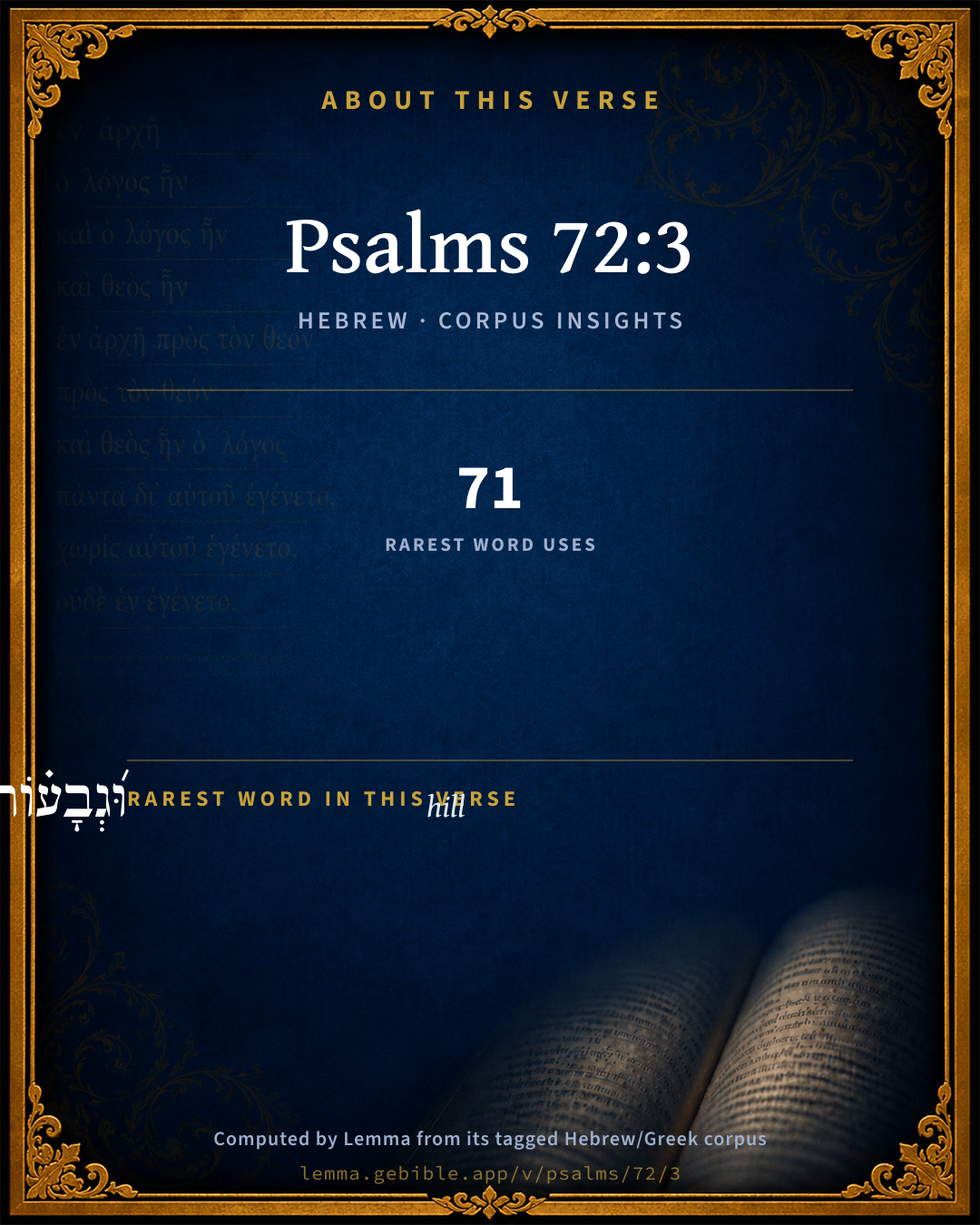
Psalms 72:3

Hebrew (Westminster Leningrad Codex) Psalms 72:3 appears in the Hebrew Old Testament. The text above is from the Westminster Leningrad Codex. Each word links to its Strong’s number, a concise gloss, and parsing drawn from the Open Scriptures Hebrew Bible morphology. Click any word for its full Brown-Driver-Briggs (BDB) entry.
Download image
Cite this verse

Psalms 72:3 (World English Bible). Public Domain. Lemma interlinear Bible study tool, https://lemma.gebible.app/v/psalms/72/3.

Show BibTeX & RIS
BibTeX
RIS
English Translation
The mountains shall bring prosperity to the people. The hills bring the fruit of righteousness.
World English Bible · Public Domain
Download a study sheet

One document with this verse’s original text, its word-by-word gloss line, the meaning frame, cross-references with their text, attributed commentary, and full source and license credits — printable, and it pastes into notes with its structure intact.

This verse Autodidact and up

Study sheet (.html) Plain text (.txt)

A passage Seminary Student

Up to 50 verses in one chapter. A passage sheet keeps up to 6 commentary sources and 12 cross-references per verse, in the order this page ranks them, and says so on the sheet whenever that leaves anything out. Ask for a single verse and you get the Autodidact verse sheet above.

Everything on this page stays free to read, with no account — the sheet is a download of what is already on screen, not access to it.

Want to remove ads? Support Godless Engineer
Compare translations 3

The same verse in 3 English versions, stacked beneath the original-language interlinear above. Click any original word for its lexicon entry.

Each is an independent rendering of the whole verse — the interlinear is not word-aligned to these translations.

Highlighted words mark where these versions differ — a whole-verse word diff, not a word-by-word alignment.

  • World English Bible Public Domain
    The mountains shall bring prosperity to the people. The hills bring the fruit of righteousness.
  • King James Version Public Domain
    The mountains shall bring peace to the people, and the little hills, by righteousness.
  • unfoldingWord Literal Text CC BY-SA 4.0
    May the mountains bring peace to the people, and the hills, in righteousness.

unfoldingWord Literal Text — © unfoldingWord, licensed CC BY-SA 4.0. Word-aligned USFM3 via Door43 (git.door43.org/unfoldingWord/en_ult).

Versions to compare (up to 4)

3 of 4 selected

Show all 18 translations

Every available English version of this verse, each an independent rendering of the whole verse.

  • World English Bible Public Domain
    The mountains shall bring prosperity to the people. The hills bring the fruit of righteousness.
  • Berean Standard Bible Public Domain
    May the mountains bring peace to the people, and the hills bring righteousness.
  • Majority Standard Bible Public Domain
    May the mountains bring peace to the people, and the hills bring righteousness.
  • King James Version Public Domain
    The mountains shall bring peace to the people, and the little hills, by righteousness.
  • American Standard Version (1901) Public Domain
    The mountains shall bring peace to the people, And the hills, in righteousness.
  • Revised Version (1885) Public Domain
    The mountains shall bring peace to the people, and the hills, in righteousness.
  • Geneva Bible (1599) Public Domain
    The mountaines and the hilles shall bring peace to the people by iustice.
  • Douay-Rheims (1899) Public Domain
    Let the mountains receive peace for the people: and the hills justice.
  • Young's Literal Translation Public Domain
    The mountains bear peace to the people, And the heights by righteousness.
  • Literal Standard Version CC BY-SA 4.0
    The mountains bear peace to the people, || And the heights by righteousness.
  • Unlocked Literal Bible CC BY-SA 4.0
    May the mountains produce peace for the people; may the hills produce righteousness.
  • unfoldingWord Literal Text CC BY-SA 4.0
    May the mountains bring peace to the people, and the hills, in righteousness.
  • Darby Bible Public Domain
    The mountains shall bring peace to the people, and the hills, by righteousness.
  • World Messianic Bible Public Domain
    The mountains shall bring prosperity to the people. The hills bring the fruit of righteousness.
  • Webster's Bible Public Domain
    The mountains shall bring peace to the people, and the little hills, by righteousness.
  • Free Bible Version CC BY-SA 4.0
    May the mountains bring peace to the people, and the hills bring goodness.
  • Bible in Basic English Public Domain
    May the mountains give peace to the people, and the hills righteousness.
  • JPS Tanakh (1917) Public Domain
    Let the mountains bear peace to the people, and the hills, through righteousness.

Literal Standard Version (2020), Covenant Press — licensed CC BY-SA 4.0. Text via the HelloAO Bible API (eBible.org). Unlocked Literal Bible (unfoldingWord) — licensed CC BY-SA 4.0. Text via the HelloAO Bible API (eBible.org). unfoldingWord Literal Text — © unfoldingWord, licensed CC BY-SA 4.0. Word-aligned USFM3 via Door43 (git.door43.org/unfoldingWord/en_ult). Free Bible Version, Dr. Jonathan Gallagher — licensed CC BY-SA 4.0. Text via the HelloAO Bible API (eBible.org).

Word by word

More ways to search: Search by grammar → Find every occurrence → Compare this word →

Practice this passage: Drill this verse → Learn its vocabulary →

About this verse

These counts appear in no published source. They are computed here, from the morphology-tagged text and Lemma’s own curated glosses. What Lemma adds →

6
words
6
distinct lemmas
Wisdom
section

Grammatical profile

  • 1 verb
  • 5 nouns

Verb forms

  • יִשְׂא֤וּ Qal · Imperfect

Hebrew & Septuagint length

In English translation the verse runs 15 words from the Hebrew and 11 from the Septuagint (LXX English) — closely comparable.

A rough comparison of the two English renderings, which tokenize alike — not a word-level alignment.

Word counts can differ between the Hebrew and the Greek without any difference in meaning — e.g. the Hebrew direct-object marker אֵת has no separate Greek word, and Greek often adds the article ὁ.

Cross-references

11

Topical passages linked to Psalms 72:3 in the Treasury of Scripture Knowledge — connected by theme and wording, ordered by reader-vote popularity; previews shown in the World English Bible.

  • Isaiah 52:7 How beautiful on the mountains are the feet of him who brings good news, who publishes peace, who brings good news of good, who publishes salvation, who says to Zion, Your God reigns!
  • Psalms 65:12 The wilderness grasslands overflow. The hills are clothed with gladness.
  • Psalms 72:16 There shall be abundance of grain throughout the land. Its fruit sways like Lebanon. Let it flourish, thriving like the grass of the field.
  • Psalms 85:10–11 Mercy and truth meet together. Righteousness and peace have kissed each other.
  • Psalms 96:11–13 Let the heavens be glad, and let the earth rejoice. Let the sea roar, and it's fullness!
  • Psalms 98:8–9 Let the rivers clap their hands. Let the mountains sing for joy together.
  • Isaiah 32:16–17 Then justice shall dwell in the wilderness; and righteousness shall abide in the fruitful field.
  • Ezekiel 34:13–14 I will bring them out from the peoples, and gather them from the countries, and will bring them into their own land; and I will feed them on the mountains of Israel, by the watercourses, and in all the inhabited places of the country.
  • Daniel 9:24 Seventy weeks are decreed on your people and on your holy city, to finish disobedience, and to make an end of sins, and to make reconciliation for iniquity, and to bring in everlasting righteousness, and to seal up vision and prophecy, and to anoint the most holy.
  • Joel 3:18 It will happen in that day, That the mountains will drop down sweet wine, The hills will flow with milk, All the brooks of Judah will flow with waters; And a fountain will come forth from the house of Yahweh, And will water the valley of Shittim.
  • 2 Corinthians 5:19–21 namely, that God was in Christ reconciling the world to himself, not reckoning to them their trespasses, and having committed to us the word of reconciliation.

Cross-references courtesy of OpenBible.info (CC BY 4.0).

Hebrew and Greek witnesses Masoretic Hebrew ↔ Greek Septuagint

The same verse in the two great witnesses to the Old Testament, shown verse-for-verse.

You’re reading Greek Psalm 71 (Hebrew Psalm 72). The Septuagint counts the superscription, so verse numbers can differ from the Hebrew — chapter-level alignment, not verse-by-verse. Numbering follows Rahlfs.

These are two independent witnesses, not word-aligned to each other, and the Septuagint is shown in lemma (dictionary) form.

Hebrew Psalms 72:3 Masoretic · Westminster Leningrad Codex

יִשְׂא֤וּ הָרִ֓ים שָׁ֘ל֥וֹם לָעָ֑ם וּ֝גְבָע֗וֹת בִּצְדָקָֽה

The mountains shall bring prosperity to the people. The hills bring the fruit of righteousness.

World English Bible · Public Domain

Greek LXX Greek Psalm 71:3 Septuagint · lemma form

ἀναλαμβάνω ὁ ὄρος εἰρήνη ὁ λαός σύ καί ὁ βουνός ἐν δικαιοσύνη

Let the mountains and the hills raise peace to your people:

LXX2012 (modern English Septuagint) · Public Domain

On this verse, Adam Clarke's Commentary discusses the Septuagint’s reading. Read the note in Commentary ↓

Hebrew: Westminster Leningrad Codex (CC BY 4.0). Greek: Septuagint (public domain); English from LXX2012 (modern English Septuagint) (Public Domain). How the Septuagint differs from the Hebrew →

Commentary

Notes on Psalms 72:3 from classic Christian and Jewish commentators (each source and its license shown beneath its notes). The classic Christian expositions comment on the surrounding passage and are grouped to its opening verse, so a note may address several verses; the Jewish commentaries on the Tanakh (Rashi and others) are per-verse, so they appear only where the commentator wrote on this verse.

Lemma curates 59 commentaries, every one of them public domain or Creative Commons licensed, each selected and text-cleaned for this edition rather than reprinted as found. About our sources →

Trapp's Complete Commentary

John Trapp

Psa 72:3 The mountains shall bring peace to the people, and the little hills, by righteousness.

Ver. 3. The mountains shall bring peace] i.e. They shall not be so pestered and infested by thieves and robbers, who usually haunt and hide themselves in hills and hollow places.

By righteousness] By right administration of justice, as it was here in King Alfred’s days, who ordained that his subjects should be divided into tens, or tithings, every one of which severally should give bond for the good abearing of each other; and he who was of that dissolute behaviour, that he could not be admitted to these tithings, was forthwith conveyed to the house of correction. The most ancient of these men were called by a specialty the tithing men.

John Trapp, A Commentary or Exposition upon All the Books of the Old and New Testament (1647–1656) — public domain. Text from a community e-Sword module.

The Biblical Illustrator

Joseph S. Exell

Psa_72:3

The mountains shall bring peace to the people, and the little hills, by righteousness.

Mountain peace

Sympathy between the moral and physical worlds pervades the whole of Scripture and especially this seventy-second psalm. The beauty of the redeemed soul will be reflected, as it was at the first, in the beauty of a regenerated earth. Man will be then like another Adam in another Eden. Through the righteous rule of the new King of Israel, the physical features of the land of promise are pictured as contributing to the tranquillity and happiness of its people. Mountains in olden times were associated with gloom and terror. Imagination saw in them shapes of evil, and they seemed to belong to an alien, accursed land. Scenes of grandeur which the traveller will traverse half the globe to gaze upon with rapture were of old avoided altogether, or passed quickly through with shuddering dread. But we do not feel so now. The causes of this are varied. Increase of population, facility for travel, the pressure of crowded city life making us long for the quiet and grandeur of nature, increase of knowledge, etc. Now, in our text the security which mountains give is mainly referred to. Hence we learn--

I. The peace which they give is the peace of safety. In the plains man is exposed to attack on all sides, but amongst the mountains nature is his defence. See the Waldenses, Covenanters, Jews. For Palestine is an alpine land; hence in Babylon the exiles thought of their mountains as they sang, I will lift up mine eyes unto the hills, from whence cometh my help.

II. And of elevation. It is in the heights of the soul that we can get true and lasting peace. On the low levels of sense life we are as was he who went down to Jericho--stripped and wounded by the evils of life. Mans moral career has run parallel with his physical. He descended from the mountain ranges of Asia to her level plains, and to Egypt; and so has it been spiritually. But we cannot be satisfied there. We must ascend again, cost what it will. Then we regain peace to our souls. If the strain of the ascent be great, so is the peace likewise. For on the height we are above the changes of this world. The soul that dwells ever on high has perpetual sunshine.

III. And it is the peace of compensation. The heavens come near and expand as the earth recedes and lessens. The men who saw most of heaven were they who possessed the least of earth. See Moses.

IV. Unification. From the mountain top we see the whole landscape, not merely isolated portions. And so to ascend into the hill of the Lord is to see our life as a whole, and how parts of it that have distressed us belong to the goodly whole.

V. Isolation. Mountains are as retreats from the fevered conventional life of cities. We can be alone with God, as in the secret chamber. So has it been wit, h all Gods great saints, they ascended often where the noisy echoes of the world did not penetrate, and where only the still small voices of the sanctuary were heard. As we rise in spiritual life, the more lonely do we become. Our citizenship is in heaven. (Hugh Macmillan, D. D.)

The use of great men

The king is as a mountain. It is the meaning and the vindication of all greatness--of position, intellect, or character--that the great should live for the humble.

I. The use of great men. Consider the uses of mountains. Besides their value as the bulwarks of a country, their services in kindling patriotism and educating feeling, they have very homely uses. They catch for us the sunshine, at once radiating and tempering the light and heat; the dews of heaven rest on them; underneath their mosses the rain lingers, filling the springs, trickling in runlets that supply the rivers; they bear the snows that all through the early summer refresh the heated land, and when autumn comes they precipitate the thunder showers and draw the passing wealth of storms; they bear the fury of the tempest, and shield the valleys from hurricane and hail; the lightning smites them harmless, which else might shiver homesteads and destroy the beasts; their waste supplies the lack of the lowlands; rich vegetable soil is washed from them over the hungry fields; the sands which descend from them bank in the rivers; of their stones the husbandman makes his fences, and from their forests he makes his tools. Mighty mountains--useful as mighty, benignant as strong; useful because so mighty, peaceful because so strong. I am not going to draw out these analogies at length, though every one of them is capable of copious exposition; t would simply say we need great men. There are many things the world wants done which only a few can do. We rest under the shadow of a truly great man as shepherds underneath a friendly mountain. If great men will only help the lowly, they may be sure of trusting friends. The strong is sure to be followed by the weaker. We want the tender to soothe troubled hearts; the saint to help us with his prayers. Both in their privileges and their trials great men are not inaptly symbolized by mountains. It is not that God does not care for the lowly; it is not that, like the blossoms on a fruit tree, only a few are reserved for ripening, and it matters not what becomes of the rest. God has not given the many to the few. He has given the few to and for the many. And if a great man does not care to learn the lesson, he is great no longer. There is no enduring greatness save in righteousness. But if it is idle to deny the advantages of greatness, it is unthankful to forget its trials. Freedom from meaner cares means exposure to strong temptations. The wind sweeps round the mountain top when the valley below is still; and humbler souls know nothing of the struggles that shake the lofty. Two distinct elements of character must meet in every one who shall be great with this protecting, helping greatness--courage of Soul enough to bear the tribulation--graciousness of character enough to count their anguish light, and remember it no more in readiness to be made helpful. Many a sour man is a great man marred in the making; the truly great must have not only ready courage and triumphant patience, they must have also unfaltering faith, unchanging love.

II. The sources of greatness in a man. They are two--righteousness and tenderness. The office of a judge is here set before us as the noblest human office; protective justice is the thing which makes a man like the great mountains (A. Mackennal, D. D.)

Peace by power

This an unusual view of the conditions of peace. We expect impressions of tranquillity in the lowlier, not the loftier places of a landscape. The doctrine of the text is, that the quiet of the human soul is to be found not in descending to its lower and feebler states, but in the freedom of its highest qualities, and through its stronger exercises; or, that Christian peace is an attainment of the spiritual energies, and not a mere acquiescence in inferiority. See the Saviours promise, My peace I give unto you. But how did He obtain this peace? Was it not by way of the Cross? Power of character is before happiness. We are to be suspicious of effeminate contentments. Look again at the image of our text. The three obvious attributes of mountains are elevation, magnitude, permanency. Now, in just such attributes of human character are we to find real peace. Spiritual serenity is spiritual strength. The most intrepid are the most pacific. Magnanimity makes no quarrels. (F. D. Huntington, D. D.)

Peace on the mountain

The reason for choosing the mountain for prayer is poetic, but it is more than poetic, it is also practical. There one can be alone and quite still; the sights and sounds of earth are far down below in the valley. And as one is quite still one gets closer to God. Instinctively we think of our heavenly Father as in the sky above us; and so far as we may we approach His kingdom more closely by getting up into the mountain. This you may say is simply poetic, imaginative, but it has a spiritual aspect too, inasmuch as the lifting up of the nature in spirit to heavenly things disposes it to pray with greater realization of the Divine presence, and less of distraction from earthly anxieties. It suggests a beautiful thought that our Lord should thus choose the most retired and ideal spots for His prayers. Because He needed no accessories of this kind. He could without difficulty withdraw Himself from the sights and sounds of earth which would be distracting to others. His devotions could not really be hindered by these things; yet inasmuch as He had taken upon Him the form of a servant, He willed to use all the helps to spiritual living which the Father has provided for His servants. It is the mountain considered as the place of prayer, which is to bring us peace in this world. The outer life is not likely to be peaceful, so far as temporal conditions are concerned. The sphere of human existence is almost invariably a troubled one. The peace is to be found within. And how can one secure it for himself? I know of no way except that of prayer. The thought of the mountains may suggest to us characteristics of genuine prayer, too little accented by us generally. The heart must be still to speak with God, all alone with Him, and pervaded with a sense of the nearness and the solemnity of His presence. When we pray after this sort the peace of God steals gradually over ones whole nature. The tribulations of life do not vanish, the anxieties are still there, but in the transfiguring light of the sense of the Divine nearness they no longer seem unbearable, no longer hopeless. If one really can feel that God cares, and is watching over him, he cannot be greatly disturbed by anything which happens in this present world. No evil spirit or wicked man, no blow of fate can take God from him or him from God, and one needs no more than that. Prayer rightly used throws all about this common weary life of ours a heavenly atmosphere, a halo of the eternal love and goodness. Everything in that celestial haze assumes its true relation to the immortal creature; the temporal things become the dreams, the illusions of a moment; the eternal things are the verities, and in them nought dwells but peace. (Arthur Ritchie.)

The Biblical Illustrator, edited by Joseph S. Exell (c. 1880s–1900s) — public domain. Text from a community e-Sword module.

Joseph Benson's Commentary

Psa 72:3-4. The mountains, &c. — Which are so dangerous to passengers, on account of robbers or wild beasts, which commonly abide there; shall bring forth peace — Shall be travelled over, or inhabited, with perfect security and safety. Or peace is here put for that prosperity, ease, and plenty, which is the fruit of peace; when the mountains and hills are cultivated and tilled, and so are capable of producing abundance of grain, though naturally full of stones and barren. He shall judge the poor of the people — That is, vindicate them from their potent oppressors, as judging often means. He shall save the children of the needy — Whom the rich had, or would have seized upon, for bond-men, upon some pretence or other.

Joseph Benson's Commentary on the Old and New Testaments (1811–1818) — public domain. Text from a community e-Sword module.

J. A. Alexander on Psalms

Joseph Addison Alexander

Psa 72:3. (Then) shall the mountains bear peace for the people, and the hills, by righteousness. The effect of the divine gift asked at the beginning of the psalm is still described in this verse, under the figure of a general growth or harvest of peace, to spring up in the whole land. Bear, in the sense of bringing forth, producing. Mountains and hills are mentioned as the salient points or prominent features of the country. This was the more natural, as the hills of Palestine were carefully tilled in ancient times, as appears from the terraces still visible. See above, Psa 65:12, and below, Psa 147:8, and compare Deu 33:15. Peace, as opposed to war and its accompanying evils. This is often mentioned as a characteristic trait of the Messiah's reign. See Isa 2:4; Isa 9:5-6; Isa 11:9; Isa 65:25, Mic 4:3, Zec 9:10. It was typified by the peaceful reign of Solomon (1Ki 5:4), whose very name suggests it. The hills, i.e. the hills shall bear peace or produce it. The words by righteousness belong to both clauses, and denote that the peace here promised was to be the fruit of righteous government.

Joseph Addison Alexander, The Psalms Translated and Explained (1850) — public domain. Text from a community e-Sword module.

Tyndale Open Study Notes

Tyndale Open Resources

72:3 The administration of justice transforms the earth into fruitfulness, abundance, harmony, and goodness (see Isa 32:16-17).

Tyndale Open Study Notes — © Tyndale Open Resources, licensed CC BY-SA 4.0. Text via the HelloAO Bible API.

Geneva Bible (1599)

Geneva Bible translators

When justice reigneth, even the places most barren shall be enriched with thy blessings.

Geneva Bible (1599) marginal notes — public domain. Text via Bolls.life.

Adam Clarke's Commentary

Verse 3. The mountains shall bring peace] Perhaps mountains and hills are here taken in their figurative sense, to signify princes and petty governors; and it is a prediction that all governors of provinces and magistrates should administer equal justice in their several departments and jurisdictions; so that universal peace should be preserved, and the people be every where prosperous; for shalom signifies both peace and prosperity, for without the former the latter never existed.

But what is the meaning of "the little hills by righteousness?" Why, it has no meaning: and it has none, because it is a false division of the verse. The word בצדקה bitsedakah, in righteousness, at the end of verse 3, should begin verse 4, and then the sense will be plain. Ver. 3: "The mountains and the hills shall bring prosperity to the people." Ver. 4: "In righteousness he shall judge the poor of the people: he shall save the children of the needy, and shall break in pieces the oppressor."

The effects, mentioned in the fourth verse, show that King Solomon should act according to the law of his God; and that all officers, magistrates, and governors, should minister equal rights through every part of the land. The Septuagint has the true division: Αναλαβετω τα ορη ειρηνην τῳ λαῳ σου, και οἱ βουνοι· Εν δικαιοσυνῃ κρινει τους πτωχους του λαου, κ. τ. λ. "The mountains shall bring peace to thy people, and the hills: In righteousness shall he judge the poor of thy people," &c.

Adam Clarke's Commentary on the Bible (1810–1826) — public domain. Text from a community e-Sword/MySword module.

Ellicott's Commentary for English Readers

(3) The mountains . . .—Better, literally, Let the mountains and the hills bring forth to the people peace in (or by) righteousness. This imperative sense, instead of the future, is by most modern commentators preserved throughout the psalm. The LXX. give it here and in Psa_72:17, but else use the future.

The verb here employed (properly meaning “lift up”) is used in Eze_17:8, for “bearing fruit,” and in Isa_32:17 peace is described as the natural work or fruit of righteousness. (Comp. Psa_85:10.) For the same prominence given to its hills as the characteristic feature of Palestine, a land which is “not only mountainous, but a heap of mountains,” comp. Joe_3:18.

A Bible Commentary for English Readers, edited by Charles John Ellicott (1878–1897) — public domain. Text from a community e-Sword module.

The Cambridge Bible for Schools and Colleges

gen. ed. J. J. S. Perowne

3. Logically this verse forms but one sentence, and the exact reproduction of the Heb. division into two clauses for the sake of rhythm has an awkward effect. The sense is, By righteousness shall the mountains and the hills bear peace for the people. The mountains and the hills, which are the characteristic features of Palestine, represent poetically the whole land, which, under a just government, will bear the fruit of peace and general welfare for its inhabitants. Similarly Isaiah describes peace as the result of righteousness (Isa_32:17); and peace was the distinguishing characteristic of Solomon’s reign (1Ch_22:9), as well as of its antitype the Messianic age (Isa_2:4; Isa_9:6-7; Zec_9:10).

The Cambridge Bible for Schools and Colleges (gen. ed. J. J. S. Perowne; Cambridge University Press, 1878–1918) — public domain. Text from a community e-Sword module.

John Gill's Exposition

The mountains shall bring peace to the people,.... The people of God, as before. Kimchi and Ben Melech interpret this of the nations, and kings of the nations, comparable to mountains and hills, as in Mic 6:1; that should make peace with Israel in the days of Solomon, and in the days of the King Messiah. Jarchi, of the abundance of fruit the mountains and hills should bring forth; so that there would be no contention among men about gathering it; but everyone would invite his neighbour to partake thereof, according to Zac 3:10, and so the Midrash (p). The Targum explains it of the inhabitants of the mountains; and may be applied to the churches of Christ, comparable to the mountains for their firmness and stability, Isa 2:2; and to the abundance of peace, holiness, and righteousness, that should be found in them in the times of Christ; or to the ministers of the Gospel, whose feet are beautiful, upon the mountains publishing peace and salvation by Christ, Isa 52:7;

and the little hills by righteousness: that is, shall bring peace, by or with righteousness, the righteousness of Christ; the effect of which is spiritual peace and joy, Rom 5:1.

(p) In Yalkut Simeoni, ut supra. (par. 2. fol. 112. 2.)

John Gill's Exposition of the Whole Bible (1746–1763) — public domain (CC PDM 1.0). Text via the HelloAO Bible API.

Albert Barnes' Notes on the Bible

The mountains shall bring peace to the people - The idea in this verse is that the land would be full of peace and the fruits of peace. All parts of it would be covered with the evidences that it was a land of quietness and security, where people could pursue their callings in safety, and enjoy the fruit of their labors. On the mountains and on all the little hills in the land there would be abundant harvests, the result of peace (so strongly in contrast with the desolations of war) - all showing the advantages of a peaceful reign. It is to be remembered that Judea is a country abounding in hills and mountains, and that a great part of its former fertility resulted from terracing the hills, and cultivating them as far as possible toward the summit. The idea here is, that one who should look upon the land - who could take in at a glance the whole country - would see those mountains and hills cultivated in the most careful manner, and everywhere bringing forth the productions of peace. Compare Psa 65:11-13. See also the notes at Psa 85:11-12.

And the little hills, by righteousness - That is, By the prevalence of righteousness, or under a reign of righteousness, the little hills would furnish illustrations of the influence of a reign of peace. Everywhere there would be the effects of a reign of peace. The whole land would be cultivated, and there would be abundance. Peace always produces these blessings; war always spreads desolation.

Albert Barnes' Notes on the Bible (1834–1885) — public domain. Text from a community e-Sword/MySword module.

Matthew Poole's English Annotations

He mentioneth the

mountains and

hills, as bringing forth this blessed fruit; either because such places are usually barren, and therefore this was an evidence of extraordinary fruitfulness, and a special blessing of God; or because they are dangerous to passengers, in regard of the robbers and wild beasts, which commonly abide there; whereby it is implied that other places should do so too, and that it should be common and universal.

Peace; all manner of prosperity and felicity, which the Hebrews frequently express by that word.

Matthew Poole's English Annotations on the Holy Bible (1683–1685) — public domain. Text from a community e-Sword/MySword module.

The Treasury of David

Charles H. Spurgeon

Ver. 3. The mountains shall bring peace to the people. Thence, aforetime, rushed the robber bands which infested the country; but now the forts there erected are the guardians of the land, and the watchmen publish far and near the tidings that no foe is to be seen. Where Jesus is there is peace, lasting, deep, eternal. Even those things which were once our dread, lose all terror when Jesus is owned as monarch of the heart: death itself, that dark mountain, loses all its gloom. Trials and afflictions, when the Lord is with us, bring us an increase rather than a diminution of peace.

And the little hills, by righteousness. Seeing that the rule of the monarch was just, every little hill seemed clothed with peace. Injustice has made Palestine a desert; if the Turk and Bedouin were gone, the land would smile again; for even in the most literal sense, justice is the fertilizer of lands, and men are diligent to plough and raise harvests when they have the prospect of eating the fruit of their labours. In a spiritual sense, peace is given to the heart by the righteousness of Christ; and all the powers and passions of the soul are filled with a holy calm, when the way of salvation, by a divine righteousness, is revealed. Then do we go forth with joy, and are led forth with peace; the mountains and the hills break forth before us into singing.

Ver. 3. The mountains shall bring peace to the people, etc. Those who apply this Psalm to Solomon expound the distich thus; "That the steep mountains on the frontier, strongly garrisoned, shall secure the land from hostile invasion; and the hills, cleared of the banditti, which in the rude ages were accustomed to inhabit them, under the government of the king, intended in this Psalm, should be the peaceful seats of a useful, civilised peasantry." This sense is not ill expressed in Mr. Merrick's translation:

"Peace, from the fort clad mountain's brow,

Descending, bless the plain below;

And justice from each rocky cell,

Shall violence and fraud expel."

But so little of the Psalm is at all applicable to Solomon, and the greater part of it so exclusively belongs to the Messiah, that I think these mountains and hills allude to the nature of the land of Judaea; and the general sense is, that, in the times of the great king, the inhabitants of that mountainous region shall live in a state of peace and tranquillity. The thing intended is the happy condition of the natural Israel, in the latter day restored to God's favour, and to the peaceful possession of their own land. It is a great confirmation of this sense, that righteousness is mentioned as the means of the peace which shall be enjoyed. Samuel Horsley.

Ver. 3. The mountains shall bring peace to the people. It was, and still is, common in the East to announce good or bad news from the tops of mountains and other eminences. By this means acts of justice were speedily communicated to the remotest parts of the country. Thus, when Solomon decided the controversy between the two harlots, the decision was quickly known over all the land. See 1Ki 3:28. Alexander Geddes.

Ver. 3. The mountains shall bring peace. The reference is to the fertility of the soil, which now is shown in an extraordinary way, when mountain summits, which are either oppressed with hopeless sterility or yield at a far inferior rate to the valleys, produce all things plentifully. And by this figure he signifies that this happiness of his kingdom shall not be the portion of a few only, but shall abound in all places and to all people, of every condition and of every age. No corner of the land, he affirms, shall be destitute of this fertility. Mollerus.

Ver. 3. The mountains shall bring peace. You may be sure to have peace when your mountains shall bring forth peace; when those mountains, which heretofore were mountains of prey and hills of the robbers, shall be a quiet habitation; when peace shall not be walled up in cities, or fenced in by bulwarks, but the open fields and highways, the mountains and the hills shall yield it abundantly; under every hedge, and under every green tree, there shall you find it; when the cottagers and the mountaineers shall have their fill of it; when they shall eat and be satisfied, lie down and none shall make them afraid, then the blessing is universal: and this is the work of righteousness. Joseph Caryl.

Ver. 3. The mountains and hills are not at all named as the most unfruitful places of the land, which they really were not, in Palestine, compare De 33:15 Ps 147:8, "Who maketh grass to grow upon the mountains; " Ps 65:12, --nor even because what is on them can be seen everywhere, and from all sides. (Tholuck), compare against this, Joe 3:18, "The mountains shall drop down new wine, and the hills shall flow with milk, "Isa 55:12, --but, as being the most prominent points and ornaments of the country, and, therefore, as representing it, well fitted to express the thought that the country shall be everywhere filled with peace. E. W. Hengstenberg.

Ver. 3. Mountains of divine decree, of immutable truth, of almighty power, of eternal grace, etc. These mountains of God are securities of peace.

Psalms 72:4*

Charles H. Spurgeon's The Treasury of David (1869–1885) — public domain. Psalms only. Text from a community e-Sword/MySword module.

Whedon's Commentary on the Bible

Daniel D. Whedon

3. Mountains shall bring peace—The verb may be taken in the sense of to elevate, lift up, as a signal, and hence the ensigns of war upon the tops of the mountains shall give place to peace-signals and publishers of good tidings. See Isa_40:9; Isa_52:7-8; or, it may be taken in the sense of bring forth, and allude to the fact that cities and villages were generally built upon mountains or hills for better military defence, and here, naturally, would be the centres of war. But those, being now at peace, would bring peace to the nation. Anciently nations were composed of municipalities. Country life was little known.

Daniel D. Whedon (gen. ed.), Commentary on the Old and New Testaments (1874–1909) — public domain. Text from a community e-Sword module.

The Pulpit Commentary

The mountains shall bring peace to the people, and the little hills, by righteousness. Through the general establishment prominent features.

The Pulpit Commentary (1880–1919), ed. H.D.M. Spence-Jones & Joseph S. Exell — public domain. Text from a community e-Sword module.

John Wesley's Explanatory Notes

The mountains - Which are so dangerous to passengers, in regard of robbers and wild beasts. Hereby it is implied, that other places should do so too, and that it should be common and universal.

John Wesley, Explanatory Notes Upon the Whole Bible (1754–1765) — public domain. Text via the GEBible commentary corpus.

Rashi

Rabbi Shlomo Yitzchaki (Rashi)

May the mountains bear peace for the people in his days.

peace for the people. Now what is the peace that the mountains bear? When they produce fruit, people will not be jealous, and “each man will call his neighbor [to come] under [his] vine and under [his] fig tree.”

and the hillsthrough righteousness And the hills will bear peace for them through the righteousness that they will perform.

Rashi on the Tanakh — English translations: “The Judaica Press complete Tanach with Rashi, translated by A. J. Rosenberg” (CC BY 4.0); “Pentateuch with Rashi's commentary by M. Rosenbaum and A.M. Silbermann, 1929-1934” (public domain); “The Metsudah Tanach series, Lakewood, N.J” (CC BY 4.0); and “The Book of Joshua, Metsudah Publications, 1997” (CC BY 4.0). Text via Sefaria.

Lesson kit

Teaching starters — assembled from the data on this page, not authored interpretation. Every prompt links to the verse data it draws on. Edit before teaching.

Psalms, in the Wisdom, opens this verse with 6 words (6 distinct Hebrew lemmas). Its most distinctive word is gibʻâh (“hill”). A historical commentator’s framing appears above. Read the whole chapter for the surrounding context.

Discussion questions

  1. The word gibʻâh carries the sense “hill.” How does it shape the verse?
  2. Isaiah 52:7 shares this passage’s theme. How do the two illuminate each other?
  3. These translations render this verse differently; the difference is in the English rendering, not the original. What questions does that raise?
  4. The verb «יִשְׂא֤וּ» is Qal Imperfect. How does its form color the action?
  5. Reading how Trapp's Complete Commentary and The Biblical Illustrator read this verse, where do the two commentators agree and where do they part?

Things to notice

Reading settings

Reading text

Shown beneath each verse's original-language words.

Old Testament
Old Testament edition

Read the OT as the Masoretic Hebrew (MT) or the Greek Septuagint (LXX).

English shown for the Greek Septuagint (in the Hebrew ↔ Greek comparison).

Comparing translations? Open the Compare panel on any verse page to stack up to four side by side.