
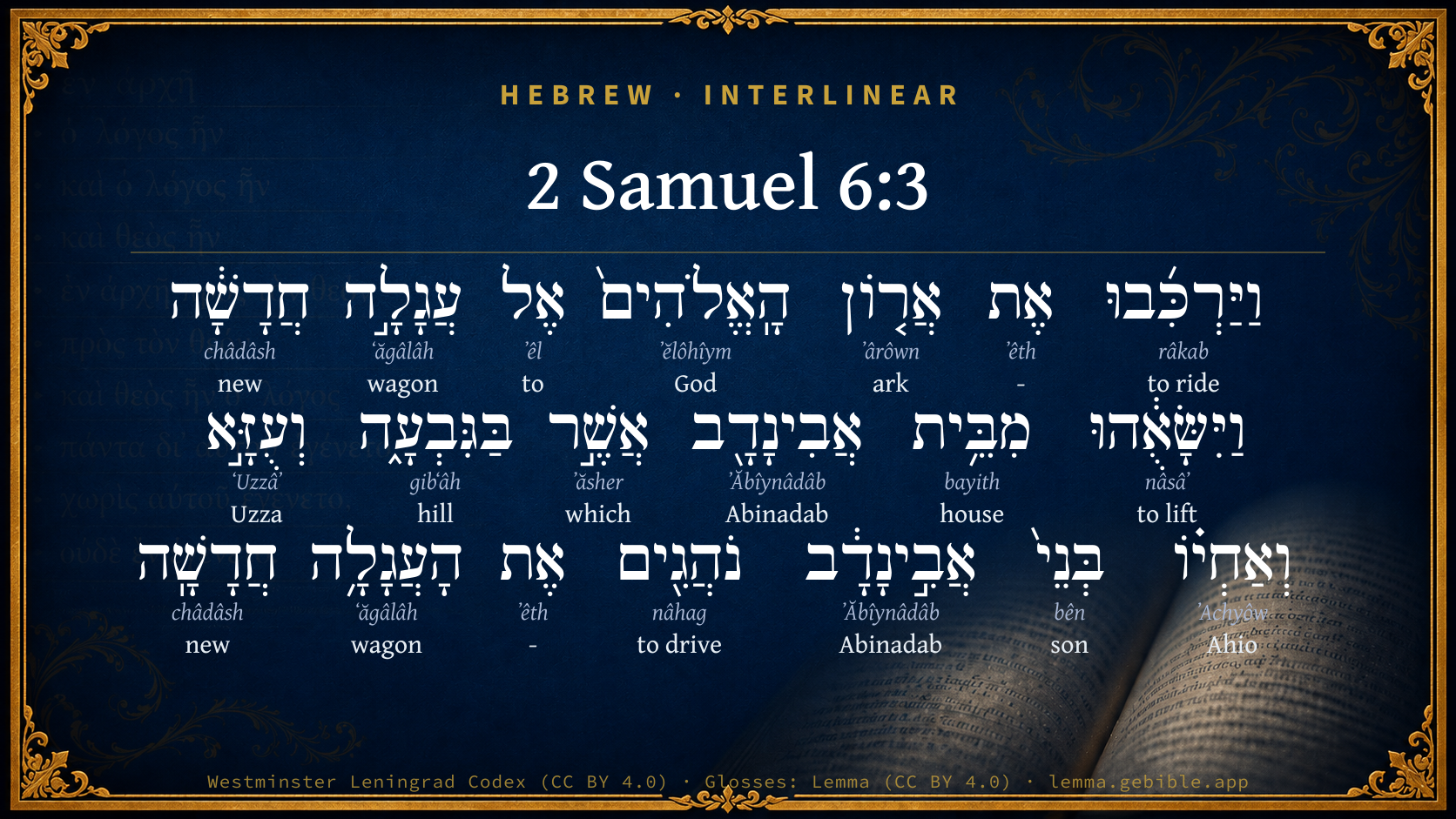
2 Samuel 6:3

Hebrew (Westminster Leningrad Codex) 2 Samuel 6:3 appears in the Hebrew Old Testament. The text above is from the Westminster Leningrad Codex. Each word links to its Strong’s number, a concise gloss, and parsing drawn from the Open Scriptures Hebrew Bible morphology. Click any word for its full Brown-Driver-Briggs (BDB) entry.
Download image
Cite this verse

2 Samuel 6:3 (World English Bible). Public Domain. Lemma interlinear Bible study tool, https://lemma.gebible.app/v/2-samuel/6/3.

Show BibTeX & RIS
BibTeX
RIS
English Translation
They set the ark of God on a new cart, and brought it out of the house of Abinadab that was in the hill: and Uzzah and Ahio, the sons of Abinadab, drove the new cart.
World English Bible · Public Domain
Highlights
  • 2 first appearances in the Hebrew Bible
Full analysis ↓
Download a study sheet

One document with this verse’s original text, its word-by-word gloss line, the meaning frame, cross-references with their text, attributed commentary, and full source and license credits — printable, and it pastes into notes with its structure intact.

This verse Autodidact and up

Study sheet (.html) Plain text (.txt)

A passage Seminary Student

Up to 50 verses in one chapter. A passage sheet keeps up to 6 commentary sources and 12 cross-references per verse, in the order this page ranks them, and says so on the sheet whenever that leaves anything out. Ask for a single verse and you get the Autodidact verse sheet above.

Everything on this page stays free to read, with no account — the sheet is a download of what is already on screen, not access to it.

Want to remove ads? Support Godless Engineer
Compare translations 3

The same verse in 3 English versions, stacked beneath the original-language interlinear above. Click any original word for its lexicon entry.

Each is an independent rendering of the whole verse — the interlinear is not word-aligned to these translations.

Highlighted words mark where these versions differ — a whole-verse word diff, not a word-by-word alignment.

  • World English Bible Public Domain
    They set the ark of God on a new cart, and brought it out of the house of Abinadab that was in the hill: and Uzzah and Ahio, the sons of Abinadab, drove the new cart.
  • King James Version Public Domain
    And they set the ark of God upon a new cart, and brought it out of the house of Abinadab that was in Gibeah: and Uzzah and Ahio, the sons of Abinadab, drave the new cart.
  • unfoldingWord Literal Text CC BY-SA 4.0
    And they mounted the Box of God on a new cart, and they bore it from the house of Abinadab, which on the hill. And Uzzah and Ahio, the sons of Abinadab, were guiding the new cart.

unfoldingWord Literal Text — © unfoldingWord, licensed CC BY-SA 4.0. Word-aligned USFM3 via Door43 (git.door43.org/unfoldingWord/en_ult).

Versions to compare (up to 4)

3 of 4 selected

Show all 18 translations

Every available English version of this verse, each an independent rendering of the whole verse.

  • World English Bible Public Domain
    They set the ark of God on a new cart, and brought it out of the house of Abinadab that was in the hill: and Uzzah and Ahio, the sons of Abinadab, drove the new cart.
  • Berean Standard Bible Public Domain
    They set the ark of God on a new cart and brought it from the house of Abinadab, which was on the hill. Uzzah and Ahio, the sons of Abinadab, were guiding the new cart,
  • Majority Standard Bible Public Domain
    They set the ark of God on a new cart and brought it from the house of Abinadab, which was on the hill. Uzzah and Ahio, the sons of Abinadab, were guiding the new cart,
  • King James Version Public Domain
    And they set the ark of God upon a new cart, and brought it out of the house of Abinadab that was in Gibeah: and Uzzah and Ahio, the sons of Abinadab, drave the new cart.
  • American Standard Version (1901) Public Domain
    And they set the ark of God upon a new cart, and brought it out of the house of Abinadab that was in the hill: and Uzzah and Ahio, the sons of Abinadab, drove the new cart.
  • Revised Version (1885) Public Domain
    And they set the ark of God upon a new cart, and brought it out of the house of Abinadab that was in the hill: and Uzzah and Ahio, the sons of Abinadab, drave the new cart.
  • Geneva Bible (1599) Public Domain
    And they put the Arke of God vpon a newe cart, and brought it out of the house of Abinadab that was in Gibeah. And Vzzah and Ahio the sonnes of Abinadab did driue the newe carte.
  • Douay-Rheims (1899) Public Domain
    And they laid the ark of God upon a new cart: and took it out of the house of Abinadab, who was in Gabaa: and Oza, and Ahio, the sons of Abinadab, drove the new cart.
  • Young's Literal Translation Public Domain
    And they cause the ark of God to ride on a new cart, and lift it up from the house of Abinadab, which `is' in the height, and Uzzah and Ahio sons of Abinadab are leading the new cart;
  • Literal Standard Version CC BY-SA 4.0
    And they cause the Ark of God to ride on a new cart, and lift it up from the house of Abinadab, which [is] in the height, and Uzzah and Ahio sons of Abinadab are leading the new cart;
  • Unlocked Literal Bible CC BY-SA 4.0
    They set the ark of God on a new cart. They brought it out of Abinadab's house, which was on a hill. Uzzah and Ahio, his sons, were guiding the new cart.
  • unfoldingWord Literal Text CC BY-SA 4.0
    And they mounted the Box of God on a new cart, and they bore it from the house of Abinadab, which on the hill. And Uzzah and Ahio, the sons of Abinadab, were guiding the new cart.
  • Darby Bible Public Domain
    And they set the ark of God upon a new cart, and brought it out of the house of Abinadab, which was upon the hill; and Uzzah and Ahio, the sons of Abinadab, drove the new cart.
  • World Messianic Bible Public Domain
    They set God’s ark on a new cart, and brought it out of Abinadab’s house that was on the hill; and Uzzah and Ahio, the sons of Abinadab, drove the new cart.
  • Webster's Bible Public Domain
    And they set the ark of God upon a new cart, and brought it out of the house of Abinadab that was in Gibeah: and Uzzah and Ahio the sons of Abinadab drove the new cart.
  • Free Bible Version CC BY-SA 4.0
    They placed the Ark of God on a new cart and brought it from Abinadab's house, which was on a hill. Uzzah and Ahio, Abinadab's sons, were directing the cart
  • Bible in Basic English Public Domain
    And they put the ark of God on a new cart and took it out of the house of Abinadab which was on the hill: and Uzzah and Ahio, the sons of Abinadab, were the drivers of the cart.
  • JPS Tanakh (1917) Public Domain
    And they set the ark of God upon a new cart, and brought it out of the house of Abinadab that was in the hill; and Uzzah and Ahio, the sons of Abinadab, drove the new cart.

Literal Standard Version (2020), Covenant Press — licensed CC BY-SA 4.0. Text via the HelloAO Bible API (eBible.org). Unlocked Literal Bible (unfoldingWord) — licensed CC BY-SA 4.0. Text via the HelloAO Bible API (eBible.org). unfoldingWord Literal Text — © unfoldingWord, licensed CC BY-SA 4.0. Word-aligned USFM3 via Door43 (git.door43.org/unfoldingWord/en_ult). Free Bible Version, Dr. Jonathan Gallagher — licensed CC BY-SA 4.0. Text via the HelloAO Bible API (eBible.org).

Word by word

More ways to search: Search by grammar → Find every occurrence → Compare this word →

Practice this passage: Drill this verse → Learn its vocabulary →

וְאַחְי֗וֹ
ʼAchyôw
H283
“and · Ahio”
Conjunction + Noun, Proper
Part of Speech
Conjunction + Noun
Type
Proper
Full BDB Definition

Origin: prolonged from H251

TWOT: None

Ahio = "brotherly" or " fraternal" - son of Abinadab who sheltered the ark - a Benjamite - another Benjamite of Saul's ancestry
  1. וַיַּרְכִּ֜בוּ râkab H7392 “and · to ride” Conjunction + Verb, Hiphil, Sequential Imperfect, 3rd Person, Masculine, Plural
  2. אֶת ʼêth H853 “-” Particle, Direct Object
  3. אֲר֤וֹן ʼârôwn H727 “ark of” Noun, Common, Both, Singular, Construct
  4. הָֽאֱלֹהִים֙ ʼĕlôhîym H430 “the · God(s)” Particle, Definite Article + Noun, Common, Masculine, Plural, Absolute
  5. אֶל ʼêl H413 “to” Preposition
  6. עֲגָלָ֣ה ʻăgâlâh H5699 “wagon” Noun, Common, Feminine, Singular, Absolute
  7. חֲדָשָׁ֔ה châdâsh H2319 “new” Adjective, Adjective, Feminine, Singular, Absolute
  8. וַיִּשָּׂאֻ֔הוּ nâsâʼ H5375 “and · to lift · him” Conjunction + Verb, Qal, Sequential Imperfect, 3rd Person, Masculine, Plural + Suffix, Personal, 3rd Person, Masculine, Singular
  9. מִבֵּ֥ית bayith H1004 “from · house of” Preposition + Noun, Common, Masculine, Singular, Construct
  10. אֲבִינָדָ֖ב ʼĂbîynâdâb H41 “Abinadab” Noun, Proper
  11. אֲשֶׁ֣ר ʼăsher H834 “which” Particle, Relative
  12. בַּגִּבְעָ֑ה gibʻâh H1389 “in/at the · hill” Preposition, Determined + Noun, Common, Feminine, Singular, Absolute
  13. וְעֻזָּ֣א ʻUzzâʼ H5798 “and · Uzza” Conjunction + Noun, Proper
  14. בְּנֵי֙ bên H1121 “sons of” Noun, Common, Masculine, Plural, Construct
  15. אֲבִ֣ינָדָ֔ב ʼĂbîynâdâb H41 “Abinadab” Noun, Proper
  16. נֹהֲגִ֖ים nâhag H5090 “driving” Verb, Qal, Participle Active, Masculine, Plural, Absolute
  17. אֶת ʼêth H853 “-” Particle, Direct Object
  18. הָעֲגָלָ֥ה ʻăgâlâh H5699 “the · wagon” Particle, Definite Article + Noun, Common, Feminine, Singular, Absolute
  19. חֲדָשָֽׁה châdâsh H2319 “new” Adjective, Adjective, Feminine, Singular, Absolute

About this verse

These counts appear in no published source. They are computed here, from the morphology-tagged text and Lemma’s own curated glosses. What Lemma adds →

20
words
16
distinct lemmas
Historical
section

Notable vocabulary

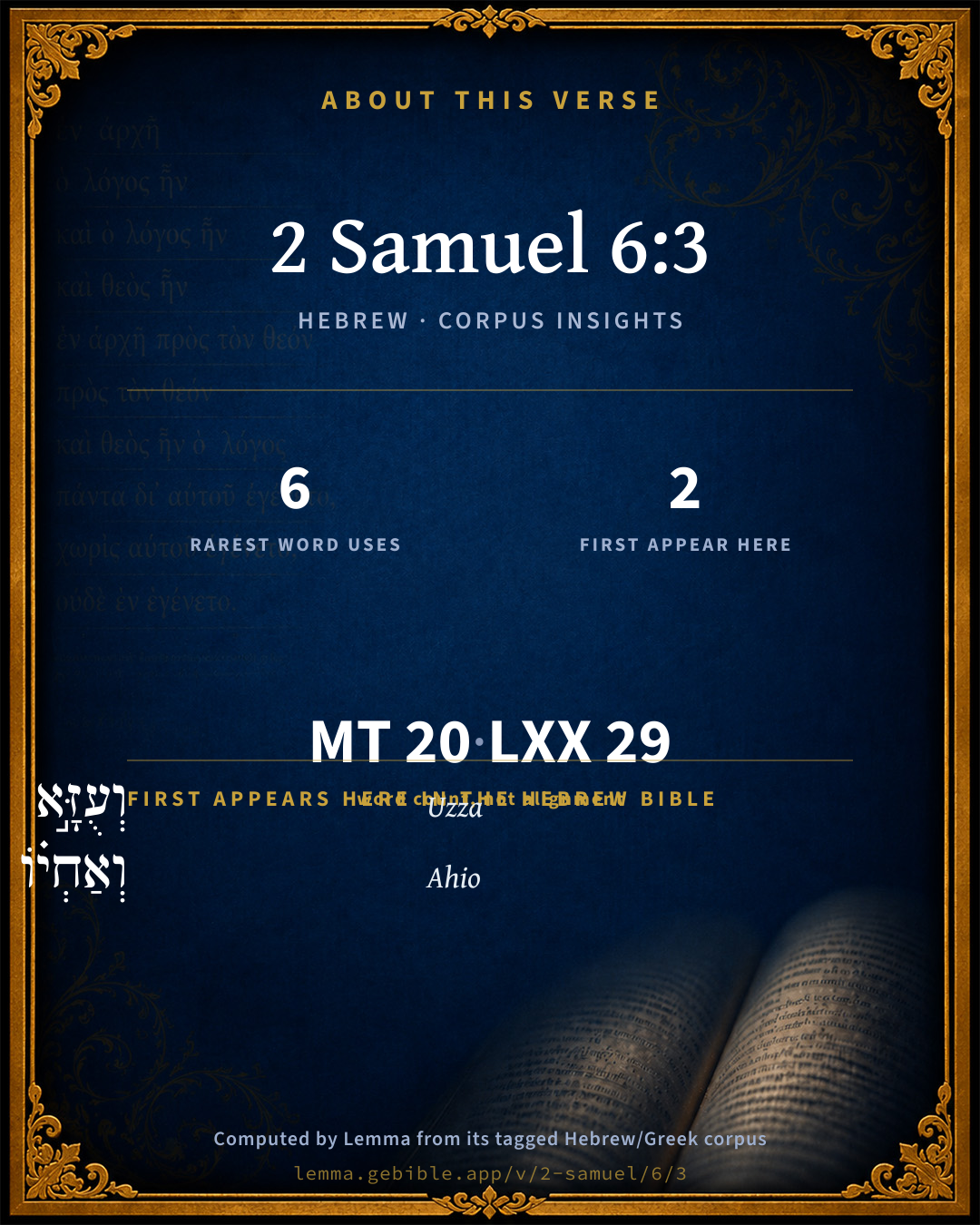
The rarest word here is וְאַחְי֗וֹ Ahio H283 — appearing just 6 times in the whole Hebrew Bible.

First appearance in Scripture

These words make their first canonical appearance in the Hebrew Bible here:

  • וְעֻזָּ֣א Uzza H5798
  • וְאַחְי֗וֹ Ahio H283

Shared distinctive vocabulary

וְאַחְי֗וֹ Ahio H283 occurs in 6 verses of the Hebrew Bible. Also found in:

Grammatical profile

  • 3 verbs
  • 11 nouns
  • 2 adjectives
  • 1 preposition
  • 3 particles

Verb forms

  • וַיַּרְכִּ֜בוּ Hiphil · Sequential Imperfect
  • וַיִּשָּׂאֻ֔הוּ Qal · Sequential Imperfect
  • נֹהֲגִ֖ים Qal · Participle Active

Repetition

Words recur within this verse — often emphatic in Hebrew:

  • עֲגָלָ֣ה wagon H5699 ×2
  • חֲדָשָׁ֔ה new H2319 ×2
  • אֲבִינָדָ֖ב Abinadab H41 ×2

Hebrew & Septuagint length

In English translation the verse runs 36 words from the Hebrew and 41 from the Septuagint (LXX English) — closely comparable.

A rough comparison of the two English renderings, which tokenize alike — not a word-level alignment.

Word counts can differ between the Hebrew and the Greek without any difference in meaning — e.g. the Hebrew direct-object marker אֵת has no separate Greek word, and Greek often adds the article ὁ.

In the original languages it is 20 Hebrew tokens and 29 Greek tokens — but the two are counted differently (Hebrew bundles its prefixes and suffixes into one token; the Greek is in lemma form), so that isn’t a like-for-like length.

Cross-references

2

Topical passages linked to 2 Samuel 6:3 in the Treasury of Scripture Knowledge — connected by theme and wording, ordered by reader-vote popularity; previews shown in the World English Bible.

  • 1 Samuel 6:7 Now therefore take and prepare yourselves a new cart, and two milk cattle, on which there has come no yoke; and tie the cattle to the cart, and bring their calves home from them;
  • Numbers 7:4–9 Yahweh spoke to Moses, saying,

Cross-references courtesy of OpenBible.info (CC BY 4.0).

Hebrew and Greek witnesses Masoretic Hebrew ↔ Greek Septuagint

The same verse in the two great witnesses to the Old Testament, shown verse-for-verse.

These are two independent witnesses, not word-aligned to each other, and the Septuagint is shown in lemma (dictionary) form.

Hebrew 2 Samuel 6:3 Masoretic · Westminster Leningrad Codex

וַיַּרְכִּ֜בוּ אֶת אֲר֤וֹן הָֽאֱלֹהִים֙ אֶל עֲגָלָ֣ה חֲדָשָׁ֔ה וַיִּשָּׂאֻ֔הוּ מִבֵּ֥ית אֲבִינָדָ֖ב אֲשֶׁ֣ר בַּגִּבְעָ֑ה וְעֻזָּ֣א וְאַחְי֗וֹ בְּנֵי֙ אֲבִ֣ינָדָ֔ב נֹהֲגִ֖ים אֶת הָעֲגָלָ֥ה חֲדָשָֽׁה

They set the ark of God on a new cart, and brought it out of the house of Abinadab that was in the hill: and Uzzah and Ahio, the sons of Abinadab, drove the new cart.

World English Bible · Public Domain

Greek LXX 2 Samuel 6:3 Septuagint · lemma form

καί ἐπιβιβάζω ὁ κιβωτός κύριος ἐπί ἅμαξα καινός καί αἴρω αὐτός ἐκ οἶκος αμιναδαβ ὁ ἐν ὁ βουνός καί οζα καί ὁ ἀδελφός αὐτός υἱός αμιναδαβ ἄγω ὁ ἅμαξα

And they put the ark of the Lord on a new wagon, and took it out of the house of Aminadab who lived on the hill, and Oza and his brethren the sons of Aminadab drove the wagon with the ark.

LXX2012 (modern English Septuagint) · Public Domain

On this verse, The Cambridge Bible for Schools and Colleges discusses the Septuagint’s reading. Read the note in Commentary ↓

Hebrew: Westminster Leningrad Codex (CC BY 4.0). Greek: Septuagint (public domain); English from LXX2012 (modern English Septuagint) (Public Domain). How the Septuagint differs from the Hebrew →

Targum (Aramaic paraphrase)

1

The Targum is the ancient Jewish Aramaic paraphrase of the Hebrew Scriptures — an interpretive translation, not the Hebrew text itself. Onkelos (literal) and Pseudo-Jonathan (expansive) render the Torah, and Jonathan the Prophets. Coverage is partial: where no permissively-licensed English translation exists for a verse, only the Aramaic is shown. This is verse-level text, not a word-by-word alignment to the Hebrew.

  1. Targum Jonathan Prophets (Joshua–Malachi)
    וַאֲחִיתוּ יַת אֲרוֹנָא דַייָ בְּעֶגְלָתָא חַדְתָּא וּנְטָלוֹהִי מִבֵּית אֲבִינָדָב דִי בְּגִבְעֲתָא וְעֻזָא וְאַחְיוֹ בְנֵי אֲבִינָדָב מַדְבְּרִין יַת עֶגְלָתָא חַדְתָּא:

    (no public-domain English translation for this verse)

    Targum Jonathan — Aramaic: “Mikraot Gedolot” (public domain). English: “Sefaria Community Translation” (CC0 1.0 (public-domain dedication)); “London "Chaldee Paraphrase," 1871” (public domain). Text via Sefaria.

Commentary

Notes on 2 Samuel 6:3 from classic Christian and Jewish commentators (each source and its license shown beneath its notes). The classic Christian expositions comment on the surrounding passage and are grouped to its opening verse, so a note may address several verses; the Jewish commentaries on the Tanakh (Rashi and others) are per-verse, so they appear only where the commentator wrote on this verse.

Lemma curates 59 commentaries, every one of them public domain or Creative Commons licensed, each selected and text-cleaned for this edition rather than reprinted as found. About our sources →

The Cambridge Bible for Schools and Colleges

gen. ed. J. J. S. Perowne

3. set the ark] Lit. made the ark to ride.

upon a new cart] Not desecrated by common uses. Cp. 1Sa_6:7. This was however a breach of the Levitical law, which prescribed that the Ark should be borne upon the shoulders of the Levites (Num_3:29-31; Num_7:9).

in Gibeah] Rather, on the hill, as the same word is correctly translated in 1Sa_7:1. Some eminence in or near Kirjath-jearim is meant.

Uzzah and Ahio, the sons of Abinadab] The Ark had been in the house of Abinadab for seventy or eighty years—twenty during the Philistine oppression, forty or fifty under Samuel and Saul, and perhaps ten of David’s reign. See the Chronological Table in the Introd. to 1 Sam. p. 24.

As Eleazar the son of Abinadab was old enough to be entrusted with the charge of the Ark when it was placed in his father’s house, we must clearly understand “sons” here in the wider sense of “descendants,” grandsons or great-grandsons. Cp. ch. 2Sa_9:9.

3, 4. The text of these verses is corrupt. Some words have been accidentally repeated by a scribe in copying the Hebrew, and should be struck out, on the authority of the LXX., and the end of 2Sa_6:3 and 2Sa_6:4 read thus: “Now Uzzah and Ahio the sons of Abinadab were driving the cart with the Ark of God, and Ahio was going before he Ark.” 2Sa_6:4 is omitted altogether in 1 Chr. It is doubtful moreover whether Ahio is a proper name at all. The same consonants with different vowels would mean his brethren, as the Sept. renders the word here, or his brother, as the Vulg. renders it in 1Ch_13:7.

The Cambridge Bible for Schools and Colleges (gen. ed. J. J. S. Perowne; Cambridge University Press, 1878–1918) — public domain. Text from a community e-Sword module.

John Gill's Exposition

And they brought it out of the house of Abinadab, which was at Gibeah,.... That is, the new cart, which is the last thing spoken of, Sa2 6:3; and the bringing of the ark out of his house is mentioned before; though some take this to be the coffer in which were the presents of the Philistines, which was now brought out along with the ark, see Sa1 6:8,

accompanying the ark of God; or "with the ark of God" (f); that is, they brought the new cart "from" the house of Abinadab on the hill, with the ark of God upon it:

and Ahio went before the ark; guiding the oxen that drew it, and Uzzah might go behind, or on one side, to take care that the ark fell not out of it.

(f) "cum arca Dei", Pagninus, Montanus, Tigurine version, Piscator.

John Gill's Exposition of the Whole Bible (1746–1763) — public domain (CC PDM 1.0). Text via the HelloAO Bible API.

Trapp's Complete Commentary

John Trapp

2Sa 6:3 And they set the ark of God upon a new cart, and brought it out of the house of Abinadab that [was] in Gibeah: and Uzzah and Ahio, the sons of Abinadab, drave the new cart.

Ver. 3. And they set the ark of God upon a new cart.] After the example of the Philistines, {1Sa 6:7} but not after God’s command. {Num 4:15; Num 7:9} It was no good that Israelites could learn of Philistines: and that which God will take from Philistines he will not brook from Israel. The staff rings that were upon the ark might have minded the Kohathites of their duty; but it may be that they thought it was a long way from Kirjathjearim to Jerusalem, and were willing to be eased of the burden.

John Trapp, A Commentary or Exposition upon All the Books of the Old and New Testament (1647–1656) — public domain. Text from a community e-Sword module.

The Biblical Illustrator

Joseph S. Exell

2Sa_6:3

And they set the Ark of God upon a now cart.

Novelties in religion and their end

The ark is taken from its resting place amid the reverent joy of the assembly, and placed upon a vehicle specially manufactured for the transit, while Uzzah and Ahio, the sons of Abinadab, drave the new cart.

I. The fact that the ark was placed upon a new cart shows how, in the desire to serve God, even a good man may err. It is a fact substantiated by experience, and supported by the voice of history, that man at his best is but an erring creature. His folly is often exhibited in his best moments. At his highest point of wisdom--loftiest step of knowledge.

his feebleness of judgment and folly are displayed. The claim to infallibility is but the ambition of the child--the blundering of the blind. Would it not be a wonderful improvement on the old style of things to have a new cart? Will it not harmonise with the new order established? Pay no attention to that worn-out, obsolete plan of carrying the ark; abandon the old poles and have a new cart. It will save the shoulders of the Levites; it will be a new feature in its way; it will be admired for its construction, and commended for the use to which it will be devoted. And so we reason in our work for God. Antiquity gains no reverence from us. The old poles with which our fathers did their work are considered out of date and useless, and we drag out our new cart on every occasion when our labour is required. Starting some fresh thing, inventing some novelty, forgetting all the while that Gods way is best.

II. See the extent to which novelty is tolerated in religion, The old charge against the Athenians is still true of many in modern times. Novelty secures admiration wherever it is found. Have a new cart, and the world will stop and stare. Affect originality, even if it be a spurious thing, and you may speak to listening ears. Stop not to ask questions about propriety; pay no respect to the past; be extravagant and sensational, and you will gather a crowd. We have grown liberal all at once. Gods commandments are without authority in this age; you may be religious in whatever way is most appropriate. By all means have a cart. If you find yourself in doubt as to the Saviours Divinity, you can have an Unitarian cart; if you think the mode of Nonconformist worship too dull, and that more aesthetic beauty is desirable in the service then have a Ritualistic cart; if you have any scruples about the immortality of your soul, then have the Annihilationist cart; if you admire religion being done by attorney, then have a Roman Catholic cart; if you think the Church should be a club, where everything may be believed and everything denied, then have a Broad Church cart. Get rid of the old poles; new carts are the fashion of this novelty-loving age. Let all the old-fashioned things rot. Reform your plans, improve your methods, tax your inventive genius, produce a new cart. Oh! how fond we are of novelties! The last new thing is the best. The last new creed; the latest criticism on supernatural religion; the last utterance of the scientist; the last sceptical theory from, the professor; these are the things that win admiration. But give me religion without these inventions. Let it be pure and simple, without any man-made additions--the old ark borne by the consecrated poles. Take away those mocking substitutes. For other foundation can no man lay, than that is laid, which is Jesus Christ.

III. see the ruinous consequences of novelties in religion. They set out with the cart but soon disasters befel it on the road; and Uzzah, lifting his hand to steady the falling ark, was stricken dead at its wheels. That put an end to the new cart system with David. It taught him a lesson he never forgot. Never after that did he order another. He went back immediately to the forsaken poles. Let us keep to Gods way in religion, and while the spirit of the age is clamorous for something new, let us stand by the old, and revere the ark. (W. J. Hall.)

The Biblical Illustrator, edited by Joseph S. Exell (c. 1880s–1900s) — public domain. Text from a community e-Sword module.

Joseph Benson's Commentary

2Sa 6:3. And they set the ark of God upon a new cart — Which ought to have been carried upon the shoulders of the Kohathites, Num 7:9; for which reason, no wagons, were allowed to them, as there were to the rest of the Levites, to carry several parts of the tabernacle. “It is matter of astonishment to me,” says Delaney, “how David and all the priests and people could fall into so great an error, and deviate so strangely from the plain precepts of the law of God in this point, which expressly prohibited any but the priest to touch the ark, upon pain of death, Num 4:5; Num 4:15; and any but the Levites to carry it. The best apology that can be made for them is, that David now succeeded to the throne after a long irreligious reign, in which the ark, and every thing relating to it, were utterly neglected; especially after the massacre of all those priests whose peculiar business it was to attend the tabernacle, (all but one young man,) and who were, in all probability, the only priests of that realm that had ever seen it, or knew any thing of its rituals; and there was not then, probably, any one priest or Levite alive who had ever seen it removed. In short, the public worship of God had long been discouraged and neglected in Israel; and with that the study of the Scriptures, except so much as was absolutely necessary for the administration of the civil affairs of the state. Would to God Israel were the only nation upon which this sad truth could at any time be pronounced! Add to all this, that David and his people had now been for many years immersed in wars; and the voice of religion, as well as reason, is often drowned in the din of arms. It is true, the Philistines had, about ninety years before, removed the ark with impunity, 1Sa 6:17, in the same manner as the Israelites did now; but they forgot, that what was pardonable in the Philistines might be highly criminal in the Israelites;” because the Philistines were ignorant of God’s laws; but the Israelites knew, or might have known, that the Lord commanded that the Levites should bear the ark upon their shoulders. But their present transports of joy, on account of the happy change of their affairs, and their greedy desire of having the ark of God removed, made them inconsiderate. In Gibeah — Or on the hill, as 1Sa 7:1.

Joseph Benson's Commentary on the Old and New Testaments (1811–1818) — public domain. Text from a community e-Sword module.

Tyndale Open Study Notes

Tyndale Open Resources

6:3-4 According to God’s instructions (Exod 25:14; 37:5; Num 4:6), the Ark was to be carried by Levites of the clan of Kohath, holding two poles slipped through four rings at the corners of the Ark. God’s instructions were ignored in this instance. • Uzzah and Ahio: In 1 Sam 7:1, Eleazar, another son of Abinadab, was put in charge of the Ark.

Tyndale Open Study Notes — © Tyndale Open Resources, licensed CC BY-SA 4.0. Text via the HelloAO Bible API.

Geneva Bible (1599)

Geneva Bible translators

Which was an high place of the city of Baal.

Geneva Bible (1599) marginal notes — public domain. Text via Bolls.life.

Jamieson, Fausset & Brown

Robert Jamieson, A. R. Fausset & David Brown

they set the ark of God upon a new cart--or a covered wagon (see on Sa1 6:7). This was a hasty and inconsiderate procedure, in violation of an express statute (see on Num 4:15 and see Num 7:9; Num 18:3).

Jamieson, Fausset & Brown — Commentary Critical and Explanatory on the Whole Bible (1871) — public domain (CC PDM 1.0). Text via the HelloAO Bible API.

Adam Clarke's Commentary

Verse 3. A new cart] Every thing used in the worship of God was hallowed or set apart for that purpose: a new cart was used through respect, as that had never been applied to any profane or common purpose. But this was not sufficient, for the ark should have been carried on the shoulders of the priests; and the neglect of this ceremony was the cause of the death of Uzzah.

Adam Clarke's Commentary on the Bible (1810–1826) — public domain. Text from a community e-Sword/MySword module.

Ellicott's Commentary for English Readers

(3) Upon a new cart.—The new cart, one which had been used for no other purpose, was doubtless intended as a mark of respect (comp. 1Sa_6:7); yet it was a violation of the law (Num_7:9), requiring that the ark should be borne by the Levites. It is not necessary to suppose that David intended to violate the law; but the ark having been left neglected for more than two generations, the exact requirements in regard to it may easily have passed out of mind.

Abinadab that was in Gibeah.—Rather, in the hill, as the same word is translated in 1Sa_7:1. Abinadab himself may have been long since dead, and Uzzah and Ahio may have been either his sons, now advanced in life, or his grandsons.

A Bible Commentary for English Readers, edited by Charles John Ellicott (1878–1897) — public domain. Text from a community e-Sword module.

Albert Barnes' Notes on the Bible

The house of Abinadab in Gibeah - . Rather, on the hill (as in margin and 1Sa 7:1). It does not at all follow that Abinadab was still alive, nor can we conclude from Uzzah and Ahio being called sons of Abinadab, that they were literally his children. They may well have been sons of Eleazar and grandsons of Abinadab, or yet more remote descendants; since there is no distinct evidence that Abinadab was alive even when the ark was brought to Kirjath-jearim. The house may have retained the name of “the house of Abinadab” long after his death.

Albert Barnes' Notes on the Bible (1834–1885) — public domain. Text from a community e-Sword/MySword module.

Haydock's Catholic Bible Commentary

Cart, out of respect, as the Philistines had done, 1 Kings vi. 7. But God had ordered the Levites to carry it themselves, and the neglect here proved so dreadful; for which reason, David required the priests to attend when he removed the ark from the house of Obededom, 1 Paralipomenon xv. 12. --- Gabaa means "the hill of Cariathiarim," where the ark had been in the house of Abinadab, from the time of its being restored back by the Philistines. (Challoner) --- Hunnius would multiply the places where the ark was fixed, to show, against Catholics, that the Church is not confined to one place; (Amama) as if Catholic did not maintain the universality of the Church! (Haydock)

George Leo Haydock (1774–1849), Haydock's Catholic Family Bible and Commentary, 1859 edition — public domain. Excludes Psalms (Douay-Rheims chapter numbering differs from Protestant) and Deuterocanonical books (Catholic canon only).

Matthew Poole's English Annotations

They set the ark upon a new cart; being taught and encouraged to do so by the example of the Philistines, who did so without any token of God’s displeasure upon them for so doing. But they did not sufficiently consider that God might wink at the Philistines, because they were ignorant of God’s laws; and yet be angry with them for the same thing, because they knew, or might and should have known, the law of God, which commanded the priests to bear it upon their shoulders, Num 4:14,15; 7:9. But their present transports of joy at, the happy change of their affairs, and their greedy desire of having the ark removed, make them hasty and inconsiderate.

In Gibeah; or, on the hill, as 1Sa 7:1.

Uzzah and Ahio, the sons of Abinadab; for Abinadab himself seems now to have been dead, or at least detained at home through infirmity or indispensable occasions.

Matthew Poole's English Annotations on the Holy Bible (1683–1685) — public domain. Text from a community e-Sword/MySword module.

Whedon's Commentary on the Bible

Daniel D. Whedon

3. A new cart — Like that which the Philistine diviners ordered for the removal of this same ark from their coasts. 1Sa_6:7. Strange carelessness on the part of the Israelites, amounting to sacrilege. The only lawful way to bear this holy shrine was by means of the staves extending through the rings on its sides. Exo_25:14.

That was in Gibeah — Rather, that was in the hill, as the margin and 1Sa_7:1. Here the ark had stood in obscurity and neglect for more than sixty years.

Sons of Abinadab — Born, doubtless, many years after the ark had been given in charge of their father.

Daniel D. Whedon (gen. ed.), Commentary on the Old and New Testaments (1874–1909) — public domain. Text from a community e-Sword module.

The Pulpit Commentary

And they set the ark of God (Hebrew, made it ride) upon a new cart. This was contrary to the Levitical Law, which required that only Levites should bear the ark, and that it should be veiled even from their. (Num_4:15) But this mistake is not surprising. It is easy enough for us to turn to our Bibles, and see what the exact letter of a command was. But such reference was no easy matter when the Law was contained in manuscripts which were rare and costly. We cannot imagine that David or even Abiathar carried a manuscript about with them in their wanderings. David very probably had a considerable knowledge of the Pentateuch, gained in Samuel"s schools, and stored up in his memory, as was the custom in old days when books were scarce. But this knowledge would be chiefly of its narratives and doctrines, and would comprise such portions as Samuel thought most fitting to influence the lives of his scholars. Abiathar probably added to this a knowledge of all such ritual as was in daily use in the sanctuary at Nob. He had fled thence in terror, escaping alone from the cruel destruction of the priests by Saul"s decree; but even there the restoration of the Levitical services had been too recent to have given time for much study of the old Law. We can quite believe that the murder of the priests at Nob, following upon the catastrophe at Shiloh, had reduced the knowledge of the priests to a very low ebb. Now, the exact way of bearing the ark was a matter that had long been dismissed from their memories, but they would call to mind that it had been brought to Abinadab"s house in a new cart drawn by oxen; and they would take this as a precedent, which would justify them in acting in the same manner a second time. But in so solemn a matter the priests ought to have made diligent search, and have gone for instruction to the copies which they possessed of the Divine Law. David did so subsequently, (1Ch_15:2) but possibly there was no such copy at present in Jerusalem, and they would have to go to Ramah, where Samuel would deposit whatever records he had saved from the ruin of Shiloh, and where the great work of the prophets was to study the sacred books, and even copy them. But this want of inquiry and easy assumption, that as the ark was brought in a cart to Abinadab"s house, so in a cart it should be carried away, was an act of great irreverence, and all the guilty were punished. The heaviest blow fell on the house of Abinadab, which lost a dear son. Entrusted for seventy years with the care of so sacred a symbol of Jehovah"s presence, Abinadab and his family ought to have made a special study of the taws concerning it. Apparently they left it very much to itself; for it is never said that God blessed them for their care of it as he did Obed-Edom. And David also was in fault; for he ought to have commanded the priests to make diligent search. His punishment was the breaking out of the Divine wrath, terrifying the people, and turning the joy of the day to mourning. The house of Abinadab that was in Gibeah; really, that was upon the hill. Uzzah and Able, the sons of Abinadab. "Sons" in Hebrew is used in a large sense, and these two men were probably the grandsons of Eleazar, the son of Abinadab, who had been set apart to keep the ark. For seventy years, as it seems, lind passed since the ark was hurriedly put in Abinadab"s house, namely, twenty during the Philistine supremacy up to the battle of Ebenezer, forty during the reign of Saul, and about ten since. As Eleazar must have been thirty years of age for his consecration to be legal, he must have died long ago, and his sons would be old and decrepit men. His grandsons would be in the prime of life.

Vers. 3-5 (KIRJATH-JEARIM.) (1Ch_13:7, 1Ch_13:8)

The ark brought out of deep obscurity.

The enterprise was marked by

I A GREAT DISCOVERY. "We found it in the fields of the wood". (Psa_132:6)

1. An invaluable treasure, long hidden, from view; like the "treasure hid in a field," and the "pearl of great price". (Mat_13:44-46)

2. A significant memorial of God"s mercies in times past. What manifold and mighty events would be brought to remembrance by the sight of the sacred, venerable, and mysterious coffer, when it came forth, as from its grave, into the light of day!

3. A sure pledge of the continued favour of God in time to come. "The ark was, as it were, the palladium of Israel, the moving sacrament of that rude people; not itself Divine any more than our sacramental bread is Christ"s body, or our symbolic water God"s grace, but the visible symbol of a presence supposed to be local, or of a power manifested in answer to prayer" (Rowland Williams). Yet it was "not a mere dead, idle shadow to look upon, but what certainly declared God"s nearness to his Church" (Calvin).

II A JOYFUL PROCESSION. "And they set carried the ark. of God upon a new cart waggon; and Uzzah and Ahio, the sons grandsons of Abinadab, drave the cart; and Ahio went before Uzzah going alongside. the ark. And David and all Israel played sported before Jehovah with all their might, with songs, and with harps," etc.. (1Sa_10:10 1Sa_19:20) Already commenced the higher order of Divine service, to be afterwards more fully organized and established. For this occasion (as some have supposed) David wrote Psalm 68. "The ark setting forward in victorious might.

Let God arise, let his enemies be scattered, And let them that hate him flee before his face.

Such language was historically appropriate. (Num_10:35) The sacred procession served:

1. To express their gratitude, gladness, and triumph.

2. To deepen their devotion, union, and joy.

3. To produce a beneficial and lasting impression on the nation.

4. To exalt the Name of Jehovah among surrounding peoples.

less than eleven psalms, either in their traditional titles, or in the irresistible evidence of their contents, bear traces of this great festival. The twenty-ninth psalm (by its title in the LXX), is said to be on the "going forth of the tabernacle." The thirtieth (by its title), the fifteenth, and the hundred and first (by their contents), express the feelings of David on his occupation of his new home. The sixty-eighth, at least in part, and the twenty-fourth, seem to have been actually composed for the entrance of the ark into the ancient gates of the heathen fortress" (Ps 96 Ps 105 Psa_106:6 Ps 46 Ps 132) (Smith"s "Dictionary"). "The hymns of David excel no less in sublimity and tenderness of expression than in loftiness and purity of religious sentiment. In comparison with them, the sacred poetry of all other nations sinks into mediocrity. They have embodied so exquisitely the universal language of religious emotion, that (a few fierce and vindictive passages excepted, natural in the warrior poet of a sterner age) they have entered, with unquestioned propriety, into the ritual of the holier and more perfect religion of Christ How many human hearts have they softened, purified, and exalted! Of how many wretched beings have they been the secret of consolation! On how many communities have they drawn down the blessings of Divine providence, by bringing the affections into unison with their deep devotional fervour!" (Milman).

III AN INEXCUSABLE TRANSGRESSION. "The act of David and of Israel was evidently intended as a return to the Lord and submission to his revealed ordinances; but, if so, obedience must be complete in every particular" (Edersheim). It was ordained that the ark should be borne with staves on the shoulders of men, the elect men of the nation, (Num_7:9) and, in placing it on a new cart drawn by oxen, after the manner of the heathen, (1Sa_6:10, 1Sa_6:12) they acted contrary to the Divine ordinance, as David subsequently recognized. (1Ch_15:13) Were they fully aware of the nature and importance of that ordinance? Perhaps not; especially after it had been so long in abeyance. Were they altogether ignorant of its existence? This could hardly have been the case with the priests and Levites. Such ignorance, moreover, would have been highly culpable: They were doubtless acquainted with it; but they were forgetful, careless, negligent, and adopted the method which seemed most expedient and to have been previously sanctioned.

1. "All religious reformations which are wrought by men, are blemished byhuman infirmities" (Wordsworth).

2. Long neglect of Divine ordinances commonly renders, the renewedperformance of them exceedingly defective.

3. Fresh and fervid zeal is often inconsiderate, self-confident, and rash.

4. Example is apt to mislead; and should be imitated only in so far as itaccords with the Word of God.

5. The end sought may be in accordance with the Divine will, whilst themeans employed for the attainment thereof are contrary to it.

6. Good intentions do not justify forbidden actions. "Two things make agood Christian good actions and good aims. A good aim maketh not a bad action good, as here; and yet a bad aim maketh a good action bad, as we see in Jehu" (Trapp).

7. The conduct which is blameless in some may be sinful in others whohave received higher privileges.

8. Although the transgression of God"s Law may be borne with for a time,it is sure to be followed by deserved chastisement.

9. If negligence and disobedience in relation to the material symbol weredispleasing to God, much more must they be so in relation to the spiritual truth of which it was a shadow. (Heb_10:29)

10. The noblest agents should be chosen for the performance of the noblest services. D.

The Pulpit Commentary (1880–1919), ed. H.D.M. Spence-Jones & Joseph S. Exell — public domain. Text from a community e-Sword module.

John Wesley's Explanatory Notes

They set, &c. - Being taught, and encouraged to do so, by the example of the Philistines, who did so without any token of God's displeasure upon them for so doing. But they did not sufficiently consider, that God might wink at the Philistines, because they were ignorant of God's laws; and yet be angry with them for the same thing, because they knew, or might have known the law of God, which commanded the priests to bear it upon their shoulders. But their present transports of joy of the happy change of their affairs, and their greedy desire of having the ark of God removed, made them inconsiderate. In Gibeah - Or, on the hill, as 1 Sam. vii, 1.

John Wesley, Explanatory Notes Upon the Whole Bible (1754–1765) — public domain. Text via the GEBible commentary corpus.

Scofield Reference Notes

C. I. Scofield

new cart

The story of David’s new cart and its results is a striking illustration of the spiritual truth that blessing does not follow even the best intentions in the service of God except as that service is rendered in God’s way. It is a constant point of failure. God had given explicit directions how the ark should be borne. Num 4:1-15 but David adopted a Philistine expedient.

1Sa 6:7; 1Sa 6:8. The church is full of Philistine ways of doing service to Christ. Cf.; 1Co 1:17-31; 2Co 10:4; 2Co 10:5. See, also, 1Ch 15:2.

The Scofield Reference Bible (1917 edition), notes by C. I. Scofield — public domain. Text from a community e-Sword module.

unfoldingWord translationNotes

Door43 World Missions Community

General Information:

David and the army of the nation of Israel move the ark of the covenant.

Abinadab ... Uzzah ... Ahio

These are names of men. (See: How to Translate Names)

all the house of Israel

This metonym represents the people of Israel. AT: "all the other Israelites with him" (See: Metonymy)

tambourines

A tambourine is a musical instrument like the head of a drum with pieces of metal around the side that sound when the instrument is shaken or hit. (See: Translate Unknowns)

rattles

musical instruments with many small, hard objects inside a hard shell, making rhythmic noise when shaken (See: Translate Unknowns)

cymbals

two thin, round metal plates that are hit together to make a loud sound (See: Translate Unknowns)

translationWords

ark of the covenant

house

harp

lute

unfoldingWord translationNotes — © Distant Shores Media and the Door43 World Missions Community, licensed CC BY-SA 4.0. Source: git.door43.org/Door43/en_tn.

Rashi

Rabbi Shlomo Yitzchaki (Rashi)

On a new wagon. [Dovid] made a mistake about something that even children at their Rebbe's school know "Because the sacred work was [incumbent] upon them, which they had to carry on their shoulders" (Bamidbar 7:9). And because [Dovid] said, "Your statutes were songs for me in the house of my dwelling," (Tehilim 119:54) he was punished to come to this, and [to have] Uzoh die through his hand. Therefore when they brought [the Ark] from the house of Oveid they brought it by shoulder as it says (Divrei Hayomim I, 15:12), "And he said to them, 'You, the heads of households for the Levites, you and your brothers sanctify yourselves and bring up the Ark… because, the first time you did it not. Hashem, Elokeinu made a breach upon us because we did not consult with Him as was proper'."

Rashi on the Tanakh — English translations: “The Judaica Press complete Tanach with Rashi, translated by A. J. Rosenberg” (CC BY 4.0); “Pentateuch with Rashi's commentary by M. Rosenbaum and A.M. Silbermann, 1929-1934” (public domain); “The Metsudah Tanach series, Lakewood, N.J” (CC BY 4.0); and “The Book of Joshua, Metsudah Publications, 1997” (CC BY 4.0). Text via Sefaria.

Lesson kit

Teaching starters — assembled from the data on this page, not authored interpretation. Every prompt links to the verse data it draws on. Edit before teaching.

2 Samuel, in the Historical, opens this verse with 20 words (16 distinct Hebrew lemmas). Its most distinctive word is ʼAchyôw (“Ahio”). A historical commentator’s framing appears above. Read the whole chapter for the surrounding context.

Discussion questions

  1. How does “Ahio” (ʼAchyôw) shape what this verse is saying?
  2. 2 words here appear for the first time in Scripture. What is being introduced at this debut?
  3. 2 Samuel 6:4 shares the word «Ahio» with this verse. How do the two illuminate each other?
  4. “wagon” occurs 2× in this one verse. What is the effect of the repetition?
  5. The translations on this page render this verse differently — a whole-verse word diff, not a word-by-word alignment. What might account for the different wordings?
  6. The verb «וַיַּרְכִּ֜בוּ» is Hiphil Sequential Imperfect. How does its form color the action?
  7. Reading how The Cambridge Bible for Schools and Colleges and John Gill's Exposition read this verse, where do the two commentators agree and where do they part?

Things to notice

Reading settings

Reading text

Shown beneath each verse's original-language words.

Old Testament
Old Testament edition

Read the OT as the Masoretic Hebrew (MT) or the Greek Septuagint (LXX).

English shown for the Greek Septuagint (in the Hebrew ↔ Greek comparison).

Comparing translations? Open the Compare panel on any verse page to stack up to four side by side.