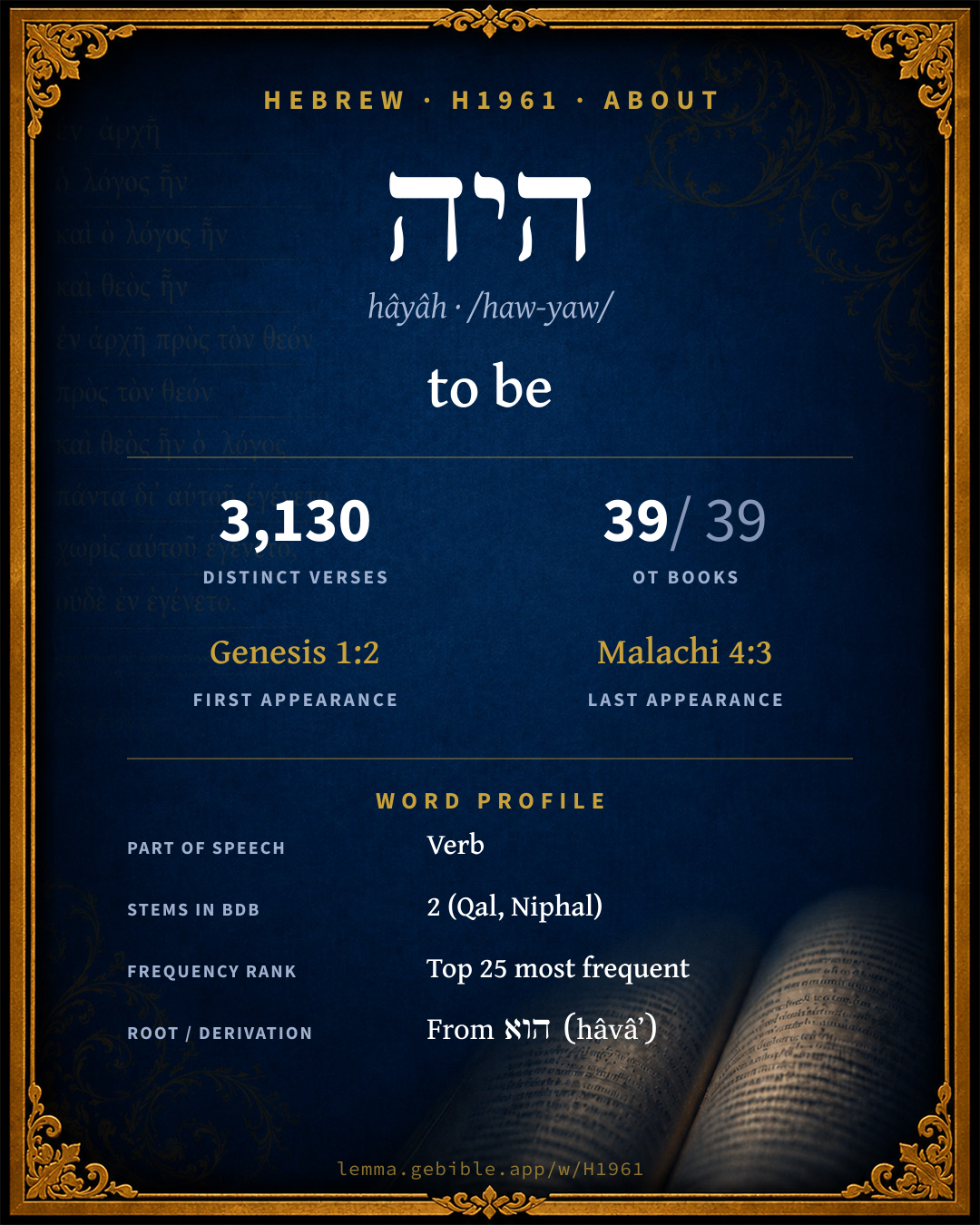
הָיָה
to be
also: become, come to pass, exist, happen fuller range ↓
Full lexicon entry — Brown-Driver-Briggs (BDB)
From Brown-Driver-Briggs (BDB)
Where this word appears
See every Qal verb in the Hebrew Bible →
Grammar key — what these labels mean
Part of speech
- Verb
- An action or state-of-being word.
- Adverb
- A word that modifies a verb, adjective, or other adverb.
Stem
- Qal
- The basic, simple active stem — the plain form of the verb (“he wrote”). Here: ‘occur’
- Niphal
- Usually the simple passive or reflexive of the Qal (“he was written”). Here: ‘became c.’
Form
- Sequential Imperfect
- An imperfect with prefixed waw — the standard past-narrative form (waw-consecutive imperfect).
- Imperfect
- An incomplete, ongoing, or future action (“he will / would write”).
- Sequential Perfect
- A perfect with prefixed waw continuing a preceding imperfect or command (waw-consecutive perfect).
- Perfect
- A completed action or state — Hebrew marks aspect (completeness) more than strict tense (“he wrote”).
- Infinitive Construct
- A bound verbal noun, frequently with prepositions (“to write / in writing”).
- Jussive
- A third- or second-person volitional form expressing wish or command (“let him write”).
- Imperative
- A direct command (“write!”).
- Infinitive Absolute
- An unbound verbal noun, often intensifying or standing in for a finite verb.
- Participle Active
- A verbal adjective expressing ongoing or characteristic action (“writing / one who writes”).
State
- Absolute
- The independent form of a noun, not bound to a following word.
Person
- 3rd Person
- The one spoken about (“he / she / it / they”).
- 1st Person
- The speaker (“I / we”).
- 2nd Person
- The one addressed (“you”).
Gender
- Masculine
- Grammatically masculine.
- Common
- Either gender — not distinguished for this form.
- Feminine
- Grammatically feminine.
Number
- Singular
- One.
- Plural
- More than one (in Hebrew, generally three or more).
Page 10 of 16 — showing verses 1,801–2,000 of 3,115 distinct verses where H1961 appears in the Qal stem, across 39 books. Filtered view — show all forms. Click any verse to open its interlinear word-by-word view. Verse text shown in the World English Bible for context — . Each verse’s Hebrew form is shown with its reference; the English is not keyword-highlighted, since the data carries no word-level English alignment. Use “Compare translations” on any verse to read it across multiple English versions. This concordance covers the Hebrew Bible; Septuagint (Greek Old Testament) occurrences are not indexed here.
1 Chronicles 94 verses
- 1 Chronicles 23:3 וַ/יְהִ֨י conj + Qal wimpf 3ms The Levites were numbered from thirty years old and upward: and their number by their polls, man by man, was thirty-eight thousand.
- 1 Chronicles 23:11 וַֽ/יְהִי וַ/יִּֽהְיוּ֙ conj + Qal wimpf 3ms conj + Qal wimpf 3mp Jahath was the chief, and Zizah the second: but Jeush and Beriah didn't have many sons; therefore they became a fathers' house in one reckoning.
- 1 Chronicles 23:17 וַ/יִּֽהְי֥וּ הָיָ֤ה conj + Qal wimpf 3mp Qal pf 3ms The sons of Eliezer were: Rehabiah the chief; and Eliezer had no other sons; but the sons of Rehabiah were very many.
- 1 Chronicles 23:22 הָ֥יוּ Qal pf 3cp Eleazar died, and had no sons, but daughters only: and their brothers the sons of Kish took them [to wife].
- 1 Chronicles 24:2 הָי֣וּ Qal pf 3cp But Nadab and Abihu died before their father, and had no children: therefore Eleazar and Ithamar executed the priest's office.
- 1 Chronicles 24:5 הָי֤וּ Qal pf 3cp Thus were they divided impartially by drawing lots; for there were princes of the sanctuary, and princes of God, both of the sons of Eleazar, and of the sons of Ithamar.
- 1 Chronicles 24:28 הָ֥יָה Qal pf 3ms Of Mahli: Eleazar, who had no sons.
- 1 Chronicles 25:1 וַֽ/יְהִי֙ conj + Qal wimpf 3ms Moreover, David and the captains of the host set apart for the service certain of the sons of Asaph, and of Heman, and of Jeduthun, who should prophesy with harps, with psalteries, and with cymbals: and the number of those who did the work according to their service was:
- 1 Chronicles 25:7 וַ/יְהִ֤י conj + Qal wimpf 3ms The number of them, with their brothers who were instructed in singing to Yahweh, even all who were skillful, was two hundred eighty-eight.
- 1 Chronicles 26:10 הָיָ֣ה Qal pf 3ms Also Hosah, of the children of Merari, had sons: Shimri the chief, (for though he was not the firstborn, yet his father made him chief),
- 1 Chronicles 27:24 וַ/יְהִ֥י conj + Qal wimpf 3ms Joab the son of Zeruiah began to number, but didn't finish; and there came wrath for this on Israel; neither was the number put into the account in the chronicles of king David.
- 1 Chronicles 28:4 לִ/הְי֨וֹת prep + Qal inf.cs However Yahweh, the God of Israel, chose me out of all the house of my father to be king over Israel forever: for he has chosen Judah to be prince; and in the house of Judah, the house of my father; and among the sons of my father he took pleasure in me to make me king over all Israel;
- 1 Chronicles 28:6 אֶֽהְיֶה Qal impf 1cs He said to me, Solomon your son, he shall build my house and my courts; for I have chosen him to be my son, and I will be his father.
- 1 Chronicles 28:12 הָיָ֤ה Qal pf 3ms and the pattern of all that he had by the Spirit, for the courts of the house of Yahweh, and for all the surrounding rooms, for the treasuries of the house of God, and for the treasuries of the dedicated things;
- 1 Chronicles 29:25 הָיָ֧ה Qal pf 3ms Yahweh magnified Solomon exceedingly in the sight of all Israel, and bestowed on him such royal majesty as had not been on any king before him in Israel.
2 Chronicles 118 verses
- 2 Chronicles 1:3 הָיָ֗ה Qal pf 3ms So Solomon, and all the assembly with him, went to the high place that was at Gibeon; for there was the tent of meeting of God, which Moses the servant of Yahweh had made in the wilderness.
- 2 Chronicles 1:11 הָיְתָ֨ה Qal pf 3fs God said to Solomon, Because this was in your heart, and you have not asked riches, wealth, or honor, nor the life of those who hate you, neither yet have asked long life; but have asked wisdom and knowledge for yourself, that you may judge my people, over whom I have made you king:
- 2 Chronicles 1:12 הָ֣יָה יִֽהְיֶה Qal pf 3ms Qal impf 3ms wisdom and knowledge is granted to you; and I will give you riches, and wealth, and honor, such as none of the kings have had who have been before you; neither shall there any after you have the like.
- 2 Chronicles 1:14 וַֽ/יְהִי conj + Qal wimpf 3ms Solomon gathered chariots and horsemen: and he had one thousand four hundred chariots, and twelve thousand horsemen, that he placed in the chariot cities, and with the king at Jerusalem.
- 2 Chronicles 5:8 וַ/יִּהְי֤וּ conj + Qal wimpf 3mp For the cherubim spread forth their wings over the place of the ark, and the cherubim covered the ark and the poles of it above.
- 2 Chronicles 5:9 וַֽ/יְהִי conj + Qal wimpf 3ms The poles were so long that the ends of the poles were seen from the ark before the oracle; but they were not seen outside: and there it is to this day.
- 2 Chronicles 5:11 וַ/יְהִ֕י conj + Qal wimpf 3ms It happened, when the priests were come out of the holy place, (for all the priests who were present had sanctified themselves, and did not keep their divisions;
- 2 Chronicles 5:13 וַ/יְהִ֣י conj + Qal wimpf 3ms it happened, when the trumpeters and singers were as one, to make one sound to be heard in praising and thanking Yahweh; and when they lifted up their voice with the trumpets and cymbals and instruments of music, and praised Yahweh, [saying], For he is good; for his loving kindness endures forever; that then the house was filled with a cloud, even the house of Yahweh,
- 2 Chronicles 6:5 לִ/הְי֥וֹת לִ/הְי֥וֹת prep + Qal inf.cs prep + Qal inf.cs Since the day that I brought forth my people out of the land of Egypt, I chose no city out of all the tribes of Israel to build a house in, that my name might be there; neither chose I any man to be prince over my people Israel:
- 2 Chronicles 6:6 לִ/הְי֥וֹת לִ/הְי֖וֹת prep + Qal inf.cs prep + Qal inf.cs but I have chosen Jerusalem, that my name might be there; and have chosen David to be over my people Israel.
- 2 Chronicles 6:7 וַ/יְהִ֕י conj + Qal wimpf 3ms Now it was in the heart of David my father to build a house for the name of Yahweh, the God of Israel.
- 2 Chronicles 6:8 הָיָה֙ הָיָ֖ה Qal pf 3ms Qal pf 3ms But Yahweh said to David my father, Whereas it was in your heart to build a house for my name, you did well that it was in your heart:
- 2 Chronicles 6:20 לִ/הְיוֹת֩ prep + Qal inf.cs that your eyes may be open toward this house day and night, even toward the place where you have said that you would put your name there; to listen to the prayer which your servant shall pray toward this place.
- 2 Chronicles 6:26 יִהְיֶ֥ה Qal impf 3ms When the sky is shut up, and there is no rain, because they have sinned against you; if they pray toward this place, and confess your name, and turn from their sin, when you do afflict them:
- 2 Chronicles 6:28 יִהְיֶ֣ה יִֽ֠הְיֶה יִהְיֶ֔ה Qal impf 3ms Qal impf 3ms Qal impf 3ms If there be in the land famine, if there be pestilence, if there be blasting or mildew, locust or caterpillar; if their enemies besiege them in the land of their cities; whatever plague or whatever sickness there be;
- 2 Chronicles 6:29 יִהְיֶה֙ Qal impf 3ms whatever prayer and supplication be made by any man, or by all your people Israel, who shall know every man his own plague and his own sorrow, and shall spread forth his hands toward this house:
- 2 Chronicles 6:40 יִֽהְיוּ Qal juss 3mp Now, my God, let, I beg you, your eyes be open, and let your ears be attentive, to the prayer that is made in this place.
- 2 Chronicles 7:13 יִהְיֶ֣ה Qal impf 3ms If I shut up the sky so that there is no rain, or if I command the locust to devour the land, or if I send pestilence among my people;
- 2 Chronicles 7:15 יִהְי֣וּ Qal impf 3mp Now my eyes shall be open, and my ears attentive, to the prayer that is made in this place.
- 2 Chronicles 7:16 לִ/הְיוֹת וְ/הָי֨וּ prep + Qal inf.cs conj + Qal wpf 3cp For now have I chosen and made this house holy, that my name may be there forever; and my eyes and my heart shall be there perpetually.
- 2 Chronicles 7:21 הָיָ֣ה Qal pf 3ms This house, which is so high, everyone who passes by it shall be astonished, and shall say, Why has Yahweh done thus to this land, and to this house?
- 2 Chronicles 8:1 וַ/יְהִ֞י conj + Qal wimpf 3ms It happened at the end of twenty years, in which Solomon had built the house of Yahweh, and his own house,
- 2 Chronicles 8:6 הָי֣וּ Qal pf 3cp and Baalath, and all the store-cities that Solomon had, and all the cities for his chariots, and the cities for his horsemen, and all that Solomon desired to build for his pleasure in Jerusalem, and in Lebanon, and in all the land of his dominion.
- 2 Chronicles 9:1 הָיָ֖ה Qal pf 3ms When the queen of Sheba heard of the fame of Solomon, she came to prove Solomon with hard questions at Jerusalem, with a very great train, and camels that bore spices, and gold in abundance, and precious stones: and when she was come to Solomon, she talked with him of all that was in her heart.
- 2 Chronicles 9:4 הָ֥יָה Qal pf 3ms and the food of his table, and the sitting of his servants, and the attendance of his ministers, and their clothing, his cup bearers also, and their clothing, and his ascent by which he went up to the house of Yahweh; there was no more spirit in her.
- 2 Chronicles 9:8 יְהִ֨י Qal juss 3ms Blessed be Yahweh your God, who delighted in you, to set you on his throne, to be king for Yahweh your God: because your God loved Israel, to establish them forever, therefore made he you king over them, to do justice and righteousness.
- 2 Chronicles 9:9 הָיָה֙ Qal pf 3ms She gave the king one hundred and twenty talents of gold, and spices in great abundance, and precious stones: neither was there any such spice as the queen of Sheba gave to king Solomon.
- 2 Chronicles 9:13 וַ/יְהִי֙ conj + Qal wimpf 3ms Now the weight of gold that came to Solomon in one year was six hundred and sixty-six talents of gold,
- 2 Chronicles 9:25 וַ/יְהִ֨י conj + Qal wimpf 3ms Solomon had four thousand stalls for horses and chariots, and twelve thousand horsemen, that he bestowed in the chariot cities, and with the king at Jerusalem.
- 2 Chronicles 9:26 וַ/יְהִ֥י conj + Qal wimpf 3ms He ruled over all the kings from the River even to the land of the Philistines, and to the border of Egypt.
- 2 Chronicles 10:2 וַ/יְהִ֞י conj + Qal wimpf 3ms It happened, when Jeroboam the son of Nebat heard of it, (for he was in Egypt, where he had fled from the presence of king Solomon), that Jeroboam returned out of Egypt.
- 2 Chronicles 10:6 הָי֣וּ בִּֽ/הְיֹת֥/וֹ Qal pf 3cp prep + Qal inf.cs + sfx pers 3ms King Rehoboam took counsel with the old men, who had stood before Solomon his father while he yet lived, saying, What counsel give you me to return answer to this people?
- 2 Chronicles 10:7 תִּֽהְיֶ֨ה וְ/הָי֥וּ Qal impf 2ms conj + Qal wpf 3cp They spoke to him, saying, If you are kind to this people, and please them, and speak good words to them, then they will be your servants forever.
- 2 Chronicles 10:15 הָיְתָ֤ה Qal pf 3fs So the king didn't listen to the people; for it was brought about of God, that Yahweh might establish his word, which he spoke by Ahijah the Shilonite to Jeroboam the son of Nebat.
- 2 Chronicles 11:2 וַ/יְהִי֙ conj + Qal wimpf 3ms But the word of Yahweh came to Shemaiah the man of God, saying,
- 2 Chronicles 11:12 וַ/יְהִי conj + Qal wimpf 3ms In every city [he put] shields and spears, and made them exceeding strong. Judah and Benjamin belonged to him.
- 2 Chronicles 12:1 וַ/יְהִ֗י conj + Qal wimpf 3ms It happened, when the kingdom of Rehoboam was established, and he was strong, that he forsook the law of Yahweh, and all Israel with him.
- 2 Chronicles 12:2 וַ/יְהִ֞י conj + Qal wimpf 3ms It happened in the fifth year of king Rehoboam, that Shishak king of Egypt came up against Jerusalem, because they had trespassed against Yahweh,
- 2 Chronicles 12:7 הָיָה֩ Qal pf 3ms When Yahweh saw that they humbled themselves, the word of Yahweh came to Shemaiah, saying, They have humbled themselves: I will not destroy them; but I will grant them some deliverance, and my wrath shall not be poured out on Jerusalem by the hand of Shishak.
- 2 Chronicles 12:8 יִהְיוּ Qal impf 3mp Nevertheless they shall be his servants, that they may know my service, and the service of the kingdoms of the countries.
- 2 Chronicles 12:11 וַ/יְהִ֛י conj + Qal wimpf 3ms It was so, that as often as the king entered into the house of Yahweh, the guard came and bore them, and brought them back into the guard-chamber.
- 2 Chronicles 12:12 הָיָ֖ה Qal pf 3ms When he humbled himself, the wrath of Yahweh turned from him, so as not to destroy him altogether: and moreover in Judah there were good things [found].
- 2 Chronicles 13:2 הָיְתָ֛ה Qal pf 3fs Three years reigned he in Jerusalem: and his mother's name was Micaiah the daughter of Uriel of Gibeah. There was war between Abijah and Jeroboam.
- 2 Chronicles 13:7 הָ֤יָה Qal pf 3ms There were gathered to him worthless men, base fellows, who strengthened themselves against Rehoboam the son of Solomon, when Rehoboam was young and tender-hearted, and could not withstand them.
- 2 Chronicles 13:9 וְ/הָיָ֥ה conj + Qal wpf 3ms Haven't you driven out the priests of Yahweh, the sons of Aaron, and the Levites, and made you priests after the manner of the peoples of [other] lands? so that whoever comes to consecrate himself with a young bull and seven rams, the same may be a priest of [those who are] no gods.
- 2 Chronicles 13:13 וַ/יִּֽהְיוּ֙ conj + Qal wimpf 3mp But Jeroboam caused an ambush to come about behind them: so they were before Judah, and the ambush was behind them.
- 2 Chronicles 13:15 וַ/יְהִ֗י conj + Qal wimpf 3ms Then the men of Judah gave a shout: and as the men of Judah shouted, it happened, that God struck Jeroboam and all Israel before Abijah and Judah.
- 2 Chronicles 14:8 וַ/יְהִ֣י conj + Qal wimpf 3ms Asa had an army that bore bucklers and spears, out of Judah three hundred thousand; and out of Benjamin, that bore shields and drew bows, two hundred eighty thousand: all these were mighty men of valor.
- 2 Chronicles 14:14 הָיָ֥ה הָיְתָ֥ה Qal pf 3ms Qal pf 3fs They struck all the cities round about Gerar; for the fear of Yahweh came on them: and they despoiled all the cities; for there was much spoil in them.
- 2 Chronicles 15:1 הָיְתָ֥ה Qal pf 3fs The Spirit of God came on Azariah the son of Oded:
- 2 Chronicles 15:2 בִּֽ/הְיֽוֹתְ/כֶ֣ם prep + Qal inf.cs + sfx pers 2mp and he went out to meet Asa, and said to him, Hear you me, Asa, and all Judah and Benjamin: Yahweh is with you, while you are with him; and if you seek him, he will be found of you; but if you forsake him, he will forsake you.
- 2 Chronicles 15:17 הָיָ֥ה Qal pf 3ms But the high places were not taken away out of Israel: nevertheless the heart of Asa was perfect all his days.
- 2 Chronicles 15:19 הָיָ֑תָה Qal pf 3fs There was no more war to the five and thirtieth year of the reign of Asa.
- 2 Chronicles 16:5 וַ/יְהִי֙ conj + Qal wimpf 3ms It happened, when Baasha heard of it, that he left off building Ramah, and let his work cease.
- 2 Chronicles 16:8 הָי֨וּ Qal pf 3cp Weren't the Ethiopians and the Lubim a huge host, with chariots and horsemen exceeding many? yet, because you did rely on Yahweh, he delivered them into your hand.
- 2 Chronicles 17:3 וַ/יְהִ֥י conj + Qal wimpf 3ms Yahweh was with Jehoshaphat, because he walked in the first ways of his father David, and didn't seek the Baals,
- 2 Chronicles 17:5 וַֽ/יְהִי conj + Qal wimpf 3ms Therefore Yahweh established the kingdom in his hand; and all Judah brought to Jehoshaphat tribute; and he had riches and honor in abundance.
- 2 Chronicles 17:10 וַ/יְהִ֣י conj + Qal wimpf 3ms The fear of Yahweh fell on all the kingdoms of the lands that were round about Judah, so that they made no war against Jehoshaphat.
- 2 Chronicles 17:12 וַ/יְהִ֧י conj + Qal wimpf 3ms Jehoshaphat grew great exceedingly; and he built in Judah castles and cities of store.
- 2 Chronicles 17:13 הָ֥יָה Qal pf 3ms He had many works in the cities of Judah; and men of war, mighty men of valor, in Jerusalem.
- 2 Chronicles 18:1 וַ/יְהִ֧י conj + Qal wimpf 3ms Now Jehoshaphat had riches and honor in abundance; and he joined affinity with Ahab.
- 2 Chronicles 18:12 וִֽ/יהִי conj + Qal juss 3ms The messenger who went to call Micaiah spoke to him, saying, Behold, the words of the prophets [declare] good to the king with one mouth: let your word therefore, Please be like one of theirs, and speak you good.
- 2 Chronicles 18:21 וְ/הָיִ֨יתִי֙ conj + Qal wpf 1cs He said, 'I will go forth, and will be a lying spirit in the mouth of all his prophets.' He said, 'You shall entice him, and shall prevail also: go forth, and do so.'
- 2 Chronicles 18:31 וַ/יְהִ֡י conj + Qal wimpf 3ms It happened, when the captains of the chariots saw Jehoshaphat, that they said, It is the king of Israel. Therefore they turned about to fight against him: but Jehoshaphat cried out, and Yahweh helped him; and God moved them [to depart] from him.
- 2 Chronicles 18:32 וַ/יְהִ֗י הָיָ֖ה conj + Qal wimpf 3ms Qal pf 3ms It happened, when the captains of the chariots saw that it was not the king of Israel, that they turned back from pursuing him.
- 2 Chronicles 18:34 הָיָ֨ה Qal pf 3ms The battle increased that day: however the king of Israel stayed himself up in his chariot against the Syrians until the even; and about the time of the going down of the sun he died.
- 2 Chronicles 19:7 יְהִ֥י Qal juss 3ms Now therefore let the fear of Yahweh be on you; take heed and do it: for there is no iniquity with Yahweh our God, nor respect of persons, nor taking of bribes.
- 2 Chronicles 19:10 וְ/הָֽיָה conj + Qal pf 3ms Whenever any controversy shall come to you from your brothers who dwell in their cities, between blood and blood, between law and commandment, statutes and ordinances, you shall warn them, that they not be guilty towards Yahweh, and so wrath come on you and on your brothers: this do, and you shall not be guilty.
- 2 Chronicles 19:11 וִ/יהִ֥י conj + Qal impf 3ms Behold, Amariah the chief priest is over you in all matters of Yahweh; and Zebadiah the son of Ishmael, the ruler of the house of Judah, in all the king's matters: also the Levites shall be officers before you. Deal courageously, and Yahweh be with the good.
- 2 Chronicles 20:1 וַ/יְהִ֣י conj + Qal wimpf 3ms It happened after this, that the children of Moab, and the children of Ammon, and with them some of the Ammonites, came against Jehoshaphat to battle.
- 2 Chronicles 20:14 הָיְתָ֤ה Qal pf 3fs Then on Jahaziel the son of Zechariah, the son of Benaiah, the son of Jeiel, the son of Mattaniah, the Levite, of the sons of Asaph, came the Spirit of Yahweh in the midst of the assembly;
- 2 Chronicles 20:25 וַ/יִּֽהְי֞וּ conj + Qal wimpf 3mp When Jehoshaphat and his people came to take the spoil of them, they found among them in abundance both riches and dead bodies, and precious jewels, which they stripped off for themselves, more than they could carry away: and they were three days in taking the spoil, it was so much.
- 2 Chronicles 20:29 וַ/יְהִי֙ conj + Qal wimpf 3ms The fear of God was on all the kingdoms of the countries, when they heard that Yahweh fought against the enemies of Israel.
- 2 Chronicles 21:6 הָ֥יְתָה Qal pf 3fs He walked in the way of the kings of Israel, as did the house of Ahab; for he had the daughter of Ahab as wife: and he did that which was evil in the sight of Yahweh.
- 2 Chronicles 21:9 וַ/יְהִי֙ conj + Qal wimpf 3ms Then Jehoram passed over with his captains, and all his chariots with him: and he rose up by night, and struck the Edomites who surrounded him, along with the captains of the chariots.
- 2 Chronicles 21:19 וַ/יְהִ֣י conj + Qal wimpf 3ms It happened, in process of time, at the end of two years, that his bowels fell out by reason of his sickness, and he died of sore diseases. His people made no burning for him, like the burning of his fathers.
- 2 Chronicles 21:20 הָיָ֣ה Qal pf 3ms Thirty-two years old was he when he began to reign, and he reigned in Jerusalem eight years: and he departed without being desired; and they buried him in the city of David, but not in the tombs of the kings.
- 2 Chronicles 22:3 הָיְתָ֥ה Qal pf 3fs He also walked in the ways of the house of Ahab; for his mother was his counselor to do wickedly.
- 2 Chronicles 22:4 הָֽיוּ Qal pf 3cp He did that which was evil in the sight of Yahweh, as did the house of Ahab; for they were his counselors after the death of his father, to his destruction.
- 2 Chronicles 22:7 הָיְתָה֙ Qal pf 3fs Now the destruction of Ahaziah was of God, in that he went to Joram: for when he was come, he went out with Jehoram against Jehu the son of Nimshi, whom Yahweh had anointed to cut off the house of Ahab.
- 2 Chronicles 22:8 וַ/יְהִ֕י conj + Qal wimpf 3ms It happened, when Jehu was executing judgment on the house of Ahab, that he found the princes of Judah, and the sons of the brothers of Ahaziah, ministering to Ahaziah, and killed them.
- 2 Chronicles 22:11 הָיְתָ֨ה Qal pf 3fs But Jehoshabeath, the daughter of the king, took Joash the son of Ahaziah, and stole him away from among the king's sons who were slain, and put him and his nurse in the bedchamber. So Jehoshabeath, the daughter of king Jehoram, the wife of Jehoiada the priest (for she was the sister of Ahaziah), hid him from Athaliah, so that she didn't kill him.
- 2 Chronicles 22:12 וַ/יְהִ֤י conj + Qal wimpf 3ms He was with them hid in the house of God six years: and Athaliah reigned over the land.
- 2 Chronicles 23:7 וִֽ/הְי֥וּ conj + Qal impv 2mp The Levites shall compass the king round about, every man with his weapons in his hand; and whoever comes into the house, let him be slain: and be you with the king when he comes in, and when he goes out.
- 2 Chronicles 23:16 לִ/הְי֥וֹת prep + Qal inf.cs Jehoiada made a covenant between himself, and all the people, and the king, that they should be Yahweh's people.
- 2 Chronicles 24:4 וַ/יְהִ֖י הָיָה֙ conj + Qal wimpf 3ms Qal pf 3ms It happened after this, that Joash was minded to restore the house of Yahweh.
- 2 Chronicles 24:11 וַ/יְהִ֡י conj + Qal wimpf 3ms It was so, that whenever the chest was brought to the king's officers by the hand of the Levites, and when they saw that there was much money, the king's scribe and the chief priest's officer came and emptied the chest, and took it, and carried it to its place again. Thus they did day by day, and gathered money in abundance.
- 2 Chronicles 24:12 וַ/יִּֽהְי֤וּ conj + Qal wimpf 3mp The king and Jehoiada gave it to such as did the work of the service of the house of Yahweh; and they hired masons and carpenters to restore the house of Yahweh, and also such as worked iron and brass to repair the house of Yahweh.
- 2 Chronicles 24:14 וַ֠/יִּֽהְיוּ conj + Qal wimpf 3mp When they had made an end, they brought the rest of the money before the king and Jehoiada, of which were made vessels for the house of Yahweh, even vessels with which to minister and to offer, and spoons, and vessels of gold and silver. They offered burnt offerings in the house of Yahweh continually all the days of Jehoiada.
- 2 Chronicles 24:18 וַֽ/יְהִי conj + Qal wimpf 3ms They forsook the house of Yahweh, the God of their fathers, and served the Asherim and the idols: and wrath came on Judah and Jerusalem for this their guiltiness.
- 2 Chronicles 24:23 וַ/יְהִ֣י conj + Qal wimpf 3ms It happened at the end of the year, that the army of the Syrians came up against him: and they came to Judah and Jerusalem, and destroyed all the princes of the people from among the people, and sent all the spoil of them to the king of Damascus.
- 2 Chronicles 25:3 וַ/יְהִ֕י conj + Qal wimpf 3ms Now it happened, when the kingdom was established to him, that he killed his servants who had killed the king his father.
- 2 Chronicles 25:14 וַ/יְהִ֗י conj + Qal wimpf 3ms Now it happened, after that Amaziah was come from the slaughter of the Edomites, that he brought the gods of the children of Seir, and set them up to be his gods, and bowed down himself before them, and burned incense to them.
- 2 Chronicles 25:16 וַ/יְהִ֣י conj + Qal wimpf 3ms It happened, as he talked with him, that [the king] said to him, Have we made you of the king's counsel? Stop! Why should you be struck down? Then the prophet stopped, and said, I know that God has determined to destroy you, because you have done this, and have not listened to my counsel.
- 2 Chronicles 26:5 וַ/יְהִי֙ conj + Qal wimpf 3ms He set himself to seek God in the days of Zechariah, who had understanding in the vision of God: and as long as he sought Yahweh, God made him to prosper.
- 2 Chronicles 26:10 הָ֣יָה הָיָֽה Qal pf 3ms Qal pf 3ms He built towers in the wilderness, and hewed out many cisterns, for he had much cattle; in the lowland also, and in the plain: [and he had] farmers and vineyard keepers in the mountains and in the fruitful fields; for he loved farming.
- 2 Chronicles 26:11 וַ/יְהִ֣י conj + Qal wimpf 3ms Moreover Uzziah had an army of fighting men, who went out to war by bands, according to the number of their reckoning made by Jeiel the scribe and Maaseiah the officer, under the hand of Hananiah, one of the king's captains.
- 2 Chronicles 26:15 לִ/הְי֤וֹת prep + Qal inf.cs He made in Jerusalem engines, invented by skillful men, to be on the towers and on the battlements, with which to shoot arrows and great stones. His name spread far abroad; for he was marvelously helped, until he was strong.
- 2 Chronicles 26:21 וַ/יְהִי֩ conj + Qal wimpf 3ms Uzziah the king was a leper to the day of his death, and lived in a separate house, being a leper; for he was cut off from the house of Yahweh: and Jotham his son was over the king's house, judging the people of the land.
- 2 Chronicles 27:8 הָיָ֣ה Qal pf 3ms He was five and twenty years old when he began to reign, and reigned sixteen years in Jerusalem.
- 2 Chronicles 28:9 הָיָ֨ה Qal pf 3ms But a prophet of Yahweh was there, whose name was Oded: and he went out to meet the host that came to Samaria, and said to them, Behold, because Yahweh, the God of your fathers, was angry with Judah, he has delivered them into your hand, and you have slain them in a rage which has reached up to heaven.
- 2 Chronicles 28:23 הָֽיוּ Qal pf 3cp For he sacrificed to the gods of Damascus, which struck him; and he said, Because the gods of the kings of Syria helped them, [therefore] will I sacrifice to them, that they may help me. But they were the ruin of him, and of all Israel.
- 2 Chronicles 29:8 וַ/יְהִי֙ conj + Qal wimpf 3ms Therefore the wrath of Yahweh was on Judah and Jerusalem, and he has delivered them to be tossed back and forth, to be an astonishment, and a hissing, as you see with your eyes.
- 2 Chronicles 29:11 וְ/לִ/הְי֥וֹת conj + prep + Qal inf.cs My sons, don't be negligent now; for Yahweh has chosen you to stand before him, to minister to him, and that you should be his ministers, and burn incense.
- 2 Chronicles 29:32 וַ/יְהִ֞י conj + Qal wimpf 3ms The number of the burnt offerings which the assembly brought was seventy bulls, one hundred rams, and two hundred lambs: all these were for a burnt offering to Yahweh.
- 2 Chronicles 29:34 הָי֣וּ Qal pf 3cp But the priests were too few, so that they could not flay all the burnt offerings: therefore their brothers the Levites helped them, until the work was ended, and until the priests had sanctified themselves; for the Levites were more upright in heart to sanctify themselves than the priests.
- 2 Chronicles 29:36 הָיָ֥ה Qal pf 3ms Hezekiah rejoiced, and all the people, because of that which God had prepared for the people: for the thing was done suddenly.
- 2 Chronicles 30:7 תִּֽהְי֗וּ Qal juss 2mp Don't be you like your fathers, and like your brothers, who trespassed against Yahweh, the God of their fathers, so that he gave them up to desolation, as you see.
- 2 Chronicles 30:10 וַ/יִּֽהְי֨וּ וַ/יִּֽהְיוּ֙ conj + Qal wimpf 3mp conj + Qal wimpf 3mp So the posts passed from city to city through the country of Ephraim and Manasseh, even to Zebulun: but they ridiculed them, and mocked them.
- 2 Chronicles 30:12 הָֽיְתָה֙ Qal pf 3fs Also on Judah came the hand of God to give them one heart, to do the commandment of the king and of the princes by the word of Yahweh.
- 2 Chronicles 30:26 וַ/תְּהִ֥י conj + Qal wimpf 3fs So there was great joy in Jerusalem; for since the time of Solomon the son of David king of Israel there was not the like in Jerusalem.
- 2 Chronicles 32:25 וַ/יְהִ֤י conj + Qal wimpf 3ms But Hezekiah didn't render again according to the benefit done to him; for his heart was lifted up: therefore there was wrath on him, and on Judah and Jerusalem.
- 2 Chronicles 32:27 וַ/יְהִ֧י conj + Qal wimpf 3ms Hezekiah had exceeding much riches and honor: and he provided him treasuries for silver, and for gold, and for precious stones, and for spices, and for shields, and for all manner of goodly vessels;
- 2 Chronicles 32:31 הָיָ֣ה Qal pf 3ms However in [the business of] the ambassadors of the princes of Babylon, who sent to him to inquire of the wonder that was done in the land, God left him, to try him, that he might know all that was in his heart.
- 2 Chronicles 33:4 יִֽהְיֶה Qal impf 3ms He built altars in the house of Yahweh, of which Yahweh said, In Jerusalem shall my name be forever.
- 2 Chronicles 34:19 וַ/יְהִי֙ conj + Qal wimpf 3ms It happened, when the king had heard the words of the law, that he tore his clothes.
- 2 Chronicles 36:16 וַ/יִּֽהְי֤וּ conj + Qal wimpf 3mp but they mocked the messengers of God, and despised his words, and scoffed at his prophets, until the wrath of Yahweh arose against his people, until there was no remedy.
- 2 Chronicles 36:20 וַֽ/יִּהְיוּ conj + Qal wimpf 3mp Those who had escaped from the sword carried he away to Babylon; and they were servants to him and his sons until the reign of the kingdom of Persia:
Ezra 5 verses
- Ezra 1:3 יְהִ֤י Qal juss 3ms Whoever there is among you of all his people, his God be with him, and let him go up to Jerusalem, which is in Judah, and build the house of Yahweh, the God of Israel (he is God), which is in Jerusalem.
- Ezra 4:4 וַ/יְהִי֙ conj + Qal wimpf 3ms Then the people of the land weakened the hands of the people of Judah, and troubled them in building,
- Ezra 8:31 הָיְתָ֣ה Qal pf 3fs Then we departed from the river Ahava on the twelfth [day] of the first month, to go to Jerusalem: and the hand of our God was on us, and he delivered us from the hand of the enemy and the bandit by the way.
- Ezra 9:2 הָֽיְתָ֛ה Qal pf 3fs For they have taken of their daughters for themselves and for their sons, so that the holy seed have mixed themselves with the peoples of the lands: yes, the hand of the princes and rulers has been chief in this trespass.
- Ezra 9:8 הָיְתָ֨ה Qal pf 3fs Now for a little moment grace has been shown from Yahweh our God, to leave us a remnant to escape, and to give us a nail in his holy place, that our God may lighten our eyes, and give us a little reviving in our bondage.
Nehemiah 40 verses
- Nehemiah 1:1 וַ/יְהִ֤י הָיִ֖יתִי conj + Qal wimpf 3ms Qal pf 1cs The words of Nehemiah the son of Hacaliah. Now it happened in the month Chislev, in the twentieth year, as I was in Shushan the palace,
- Nehemiah 1:4 וַ/יְהִ֞י וָֽ/אֱהִ֥י conj + Qal wimpf 3ms conj + Qal wimpf 1cs It happened, when I heard these words, that I sat down and wept, and mourned certain days; and I fasted and prayed before the God of heaven,
- Nehemiah 1:6 תְּהִ֣י Qal juss 3fs Let your ear now be attentive, and your eyes open, that you may listen to the prayer of your servant, which I pray before you at this time, day and night, for the children of Israel your servants while I confess the sins of the children of Israel, which we have sinned against you. Yes, I and my father's house have sinned:
- Nehemiah 1:9 יִהְיֶ֨ה Qal impf 3ms but if you return to me, and keep my commandments and do them, though your outcasts were in the uttermost part of the heavens, yet will I gather them from there, and will bring them to the place that I have chosen, to cause my name to dwell there.
- Nehemiah 1:11 תְּהִ֣י הָיִ֥יתִי Qal juss 3fs Qal pf 1cs Lord, I beg you, let now your ear be attentive to the prayer of your servant, and to the prayer of your servants, who delight to fear your name; and please prosper your servant this day, and grant him mercy in the sight of this man. Now I was cup bearer to the king.
- Nehemiah 2:1 וַ/יְהִ֣י הָיִ֥יתִי conj + Qal wimpf 3ms Qal pf 1cs It happened in the month Nisan, in the twentieth year of Artaxerxes the king, when wine was before him, that I took up the wine, and gave it to the king. Now I had not been [before] sad in his presence.
- Nehemiah 2:6 יִהְיֶ֥ה Qal impf 3ms The king said to me (the queen also sitting by him), For how long shall your journey be? and when will you return? So it pleased the king to send me; and I set him a time.
- Nehemiah 2:11 וָ/אֱהִי conj + Qal wimpf 1cs So I came to Jerusalem, and was there three days.
- Nehemiah 2:13 וָ/אֱהִ֨י conj + Qal wimpf 1cs I went out by night by the valley gate, even toward the jackal's well, and to the dung gate, and viewed the walls of Jerusalem, which were broken down, and the gates of it were consumed with fire.
- Nehemiah 2:15 וָ/אֱהִ֨י וָ/אֱהִ֥י conj + Qal wimpf 1cs conj + Qal wimpf 1cs Then went I up in the night by the brook, and viewed the wall; and I turned back, and entered by the valley gate, and so returned.
- Nehemiah 2:17 נִהְיֶ֥ה Qal impf 1cp Then said I to them, You see the evil case that we are in, how Jerusalem lies waste, and the gates of it are burned with fire: come, and let us build up the wall of Jerusalem, that we be no more a reproach.
- Nehemiah 3:26 הָי֥וּ Qal pf 3cp (Now the Nethinim lived in Ophel, to the place over against the water gate toward the east, and the tower that stands out.)
- Nehemiah 4:1 וַ/יְהִ֞י conj + Qal wimpf 3ms But it happened that when Sanballat heard that we were building the wall, he was angry, and took great indignation, and mocked the Jews.
- Nehemiah 4:4 הָיִ֣ינוּ Qal pf 1cp Hear, our God; for we are despised: and turn back their reproach on their own head, and give them up for a spoil in a land of captivity;
- Nehemiah 4:6 וַ/יְהִ֧י conj + Qal wimpf 3ms So we built the wall; and all the wall was joined together to half [the height] of it: for the people had a mind to work.
- Nehemiah 4:7 וַ/יְהִ֣י conj + Qal wimpf 3ms But it happened that when Sanballat, Tobiah, the Arabians, the Ammonites, and the Ashdodites heard that the repairing of the walls of Jerusalem went forward, [and] that the breaches began to be stopped, then they were very angry;
- Nehemiah 4:12 וַֽ/יְהִי֙ conj + Qal wimpf 3ms It happened that when the Jews who lived by them came, they said to us ten times from all places, You must return to us.
- Nehemiah 4:15 וַ/יְהִ֞י conj + Qal wimpf 3ms It happened, when our enemies heard that it was known to us, and God had brought their counsel to nothing, that we returned all of us to the wall, everyone to his work.
- Nehemiah 4:16 וַ/יְהִ֣י conj + Qal wimpf 3ms It happened from that time forth, that half of my servants worked in the work, and half of them held the spears, the shields, and the bows, and the coats of mail; and the rulers were behind all the house of Judah.
- Nehemiah 4:22 וְ/הָֽיוּ conj + Qal wpf 3cp Likewise at the same time said I to the people, Let everyone with his servant lodge within Jerusalem, that in the night they may be a guard to us, and may labor in the day.
- Nehemiah 5:1 וַ/תְּהִ֨י conj + Qal wimpf 3fs Then there arose a great cry of the people and of their wives against their brothers the Jews.
- Nehemiah 5:13 יִהְיֶ֥ה Qal impf 3ms Also I shook out my lap, and said, So God shake out every man from his house, and from his labor, that doesn't perform this promise; even thus be he shaken out, and emptied. All the assembly said, Amen, and praised Yahweh. The people did according to this promise.
- Nehemiah 5:14 לִ/הְי֣וֹת prep + Qal inf.cs Moreover from the time that I was appointed to be their governor in the land of Judah, from the twentieth year even to the two and thirtieth year of Artaxerxes the king, [that is], twelve years, I and my brothers have not eaten the bread of the governor.
- Nehemiah 5:18 הָיָ֨ה Qal pf 3ms Now that which was prepared for one day was one ox and six choice sheep; also fowls were prepared for me, and once in ten days store of all sorts of wine: yet for all this I didn't demand the bread of the governor, because the bondage was heavy on this people.
- Nehemiah 6:1 וַ/יְהִ֣י conj + Qal wimpf 3ms Now it happened, when it was reported to Sanballat and Tobiah, and to Geshem the Arabian, and to the rest of our enemies, that I had built the wall, and that there was no breach left therein; (though even to that time I had not set up the doors in the gates;)
- Nehemiah 6:13 וְ/הָיָ֤ה conj + Qal wpf 3ms For this cause was he hired, that I should be afraid, and do so, and sin, and that they might have matter for an evil report, that they might reproach me.
- Nehemiah 6:14 הָי֖וּ Qal pf 3cp Remember, my God, Tobiah and Sanballat according to these their works, and also the prophetess Noadiah, and the rest of the prophets, that would have put me in fear.
- Nehemiah 6:16 וַ/יְהִ֗י conj + Qal wimpf 3ms It happened, when all our enemies heard [of it], that all the nations that were about us feared, and were much cast down in their own eyes; for they perceived that this work was worked of our God.
- Nehemiah 6:19 הָי֤וּ הָי֥וּ Qal pf 3cp Qal pf 3cp Also they spoke of his good deeds before me, and reported my words to him. Tobiah sent letters to put me in fear.
- Nehemiah 7:1 וַ/יְהִ֗י conj + Qal wimpf 3ms Now it happened, when the wall was built, and I had set up the doors, and the porters and the singers and the Levites were appointed,
- Nehemiah 8:5 הָיָ֑ה Qal pf 3ms Ezra opened the book in the sight of all the people; (for he was above all the people;) and when he opened it, all the people stood up:
- Nehemiah 8:17 וַ/תְּהִ֥י conj + Qal wimpf 3fs All the assembly of those who were come again out of the captivity made booths, and lived in the booths; for since the days of Jeshua the son of Nun to that day the children of Israel had not done so. There was very great gladness.
- Nehemiah 10:38 וְ/הָיָ֨ה conj + Qal wpf 3ms The priest the son of Aaron shall be with the Levites, when the Levites take tithes: and the Levites shall bring up the tithe of the tithes to the house of our God, to the chambers, into the treasure-house.
- Nehemiah 12:12 הָי֥וּ Qal pf 3cp In the days of Joiakim were priests, heads of fathers' [houses]: of Seraiah, Meraiah; of Jeremiah, Hananiah;
- Nehemiah 13:3 וַ/יְהִ֖י conj + Qal wimpf 3ms It came to pass, when they had heard the law, that they separated from Israel all the mixed multitude.
- Nehemiah 13:5 הָי֪וּ Qal pf 3cp had prepared for him a great chamber, where before they laid the meal-offerings, the frankincense, and the vessels, and the tithes of the grain, the new wine, and the oil, which were given by commandment to the Levites, and the singers, and the porters; and the heave-offerings for the priests.
- Nehemiah 13:6 הָיִ֖יתִי Qal pf 1cs But in all this [time] I was not at Jerusalem; for in the two and thirtieth year of Artaxerxes king of Babylon I went to the king: and after certain days asked I leave of the king,
- Nehemiah 13:19 וַ/יְהִ֡י conj + Qal wimpf 3ms It came to pass that, when the gates of Jerusalem began to be dark before the Sabbath, I commanded that the doors should be shut, and commanded that they should not be opened until after the Sabbath: and some of my servants set I over the gates, that there should no burden be brought in on the Sabbath day.
- Nehemiah 13:22 יִֽהְי֤וּ Qal impf 3mp I commanded the Levites that they should purify themselves, and that they should come and keep the gates, to sanctify the Sabbath day. Remember to me, my God, this also, and spare me according to the greatness of your loving kindness.
- Nehemiah 13:26 הָיָ֨ה הָיָ֔ה Qal pf 3ms Qal pf 3ms Did not Solomon king of Israel sin by these things? yet among many nations was there no king like him, and he was beloved of his God, and God made him king over all Israel: nevertheless even him did foreign women cause to sin.
Esther 17 verses
- Esther 1:1 וַ/יְהִ֖י conj + Qal wimpf 3ms Now it happened in the days of Ahasuerus (this is Ahasuerus who reigned from India even to Ethiopia, over one hundred twenty-seven provinces),
- Esther 1:22 לִ/הְי֤וֹת prep + Qal inf.cs for he sent letters into all the king's provinces, into every province according to the writing of it, and to every people after their language, that every man should bear rule in his own house, and should speak according to the language of his people.
- Esther 2:5 הָיָ֖ה Qal pf 3ms There was a certain Jew in Shushan the palace, whose name was Mordecai, the son of Jair, the son of Shimei, the son of Kish, a Benjamite,
- Esther 2:7 וַ/יְהִ֨י conj + Qal wimpf 3ms He brought up Hadassah, who is, Esther, his uncle's daughter: for she had neither father nor mother, and the maiden was fair and beautiful; and when her father and mother were dead, Mordecai took her for his own daughter.
- Esther 2:8 וַ/יְהִ֗י conj + Qal wimpf 3ms So it happened, when the king's commandment and his decree was heard, and when many maidens were gathered together to Shushan the palace, to the custody of Hegai, that Esther was taken into the king's house, to the custody of Hegai, keeper of the women.
- Esther 2:12 הֱי֨וֹת Qal inf.cs Now when the turn of every maiden was come to go in to king Ahasuerus, after it had been done to her as prescribed for the women twelve months (for so were the days of their purification accomplished, [to wit], six months with oil of myrrh, and six months with sweet odors and with the things for the purifying of the women),
- Esther 2:15 וַ/תְּהִ֤י conj + Qal wimpf 3fs Now when the turn of Esther, the daughter of Abihail the uncle of Mordecai, who had taken her for his daughter, was come to go in to the king, she required nothing but what Hegai the king's chamberlain, the keeper of the women, appointed. Esther obtained favor in the sight of all those who looked at her.
- Esther 2:20 הָיְתָ֥ה Qal pf 3fs Esther had not yet made known her relatives nor her people; as Mordecai had charged her: for Esther did the commandment of Mordecai, like as when she was brought up with him.
- Esther 3:4 וַ/יְהִ֗י conj + Qal wimpf 3ms Now it came to pass, when they spoke daily to him, and he didn't listen to them, that they told Haman, to see whether Mordecai's matters would stand: for he had told those who he was a Jew.
- Esther 3:14 לִ/הְי֥וֹת prep + Qal inf.cs A copy of the writing, that the decree should be given out in every province, was published to all the peoples, that they should be ready against that day.
- Esther 5:1 וַ/יְהִ֣י conj + Qal wimpf 3ms Now it happened on the third day, that Esther put on her royal clothing, and stood in the inner court of the king's house, over against the king's house: and the king sat on his royal throne in the royal house, over against the entrance of the house.
- Esther 5:2 וַ/יְהִי֩ conj + Qal wimpf 3ms It was so, when the king saw Esther the queen standing in the court, that she obtained favor in his sight; and the king held out to Esther the golden scepter that was in his hand. So Esther drew near, and touched the top of the scepter.
- Esther 6:1 וַ/יִּהְי֥וּ conj + Qal wimpf 3mp On that night the king couldn't sleep; and he commanded to bring the book of records of the chronicles, and they were read before the king.
- Esther 8:13 וְ/לִ/הְי֨וֹת conj + prep + Qal inf.cs A copy of the writing, that the decree should be given out in every province, was published to all the peoples, and that the Jews should be ready against that day to avenge themselves on their enemies.
- Esther 8:16 הָֽיְתָ֥ה Qal pf 3fs The Jews had light and gladness, and joy and honor.
- Esther 9:21 לִ/הְי֣וֹת prep + Qal inf.cs to enjoin those who they should keep the fourteenth day of the month Adar, and the fifteenth day of the same, yearly,
- Esther 9:27 לִ/הְי֣וֹת prep + Qal inf.cs the Jews ordained, and took on them, and on their seed, and on all such as joined themselves to them, so that it should not fail, that they would keep these two days according to the writing of it, and according to the appointed time of it, every year;
Job 46 verses
- Job 1:1 הָיָ֥ה וְ/הָיָ֣ה Qal pf 3ms conj + Qal pf 3ms There was a man in the land of Uz, whose name was Job. That man was blameless and upright, and one who feared God, and turned away from evil.
- Job 1:3 וַ/יְהִ֣י וַ/יְהִי֙ conj + Qal wimpf 3ms conj + Qal wimpf 3ms His possessions also were seven thousand sheep, three thousand camels, five hundred yoke of oxen, five hundred she-donkeys, and a very great household; so that this man was the greatest of all the children of the east.
- Job 1:5 וַ/יְהִ֡י conj + Qal wimpf 3ms It was so, when the days of their feasting had run their course, that Job sent and sanctified them, and rose up early in the morning, and offered burnt offerings according to the number of them all. For Job said, "It may be that my sons have sinned, and renounced God in their hearts." Thus did Job continually.
- Job 1:6 וַ/יְהִ֣י conj + Qal wimpf 3ms Now it happened on the day when the sons of God came to present themselves before Yahweh, that Satan also came among them.
- Job 1:13 וַ/יְהִ֖י conj + Qal wimpf 3ms It fell on a day when his sons and his daughters were eating and drinking wine in their eldest brother's house,
About this entry
At a glance — auto-summarized from this page’s data, not written by a person. Every figure links to its source below. This summary describes the numbers; it doesn’t interpret them.
היה (hâyâh) is a Hebrew verb most often rendered “to be.” Older and newer Bibles part ways — “shall be” in the King James Version, “will be” (Berean Standard Bible) and “was” (unfoldingWord Literal Text) in modern versions. See the renderings breakdown. It turns up in 3,130 verses across 39 books, one of the most common footprint. Scripture first uses it in Genesis 1:2. Read the stem: it spans 2 stems, including Qal and Niphal. The sections below give every sense, occurrence, and version rendering.
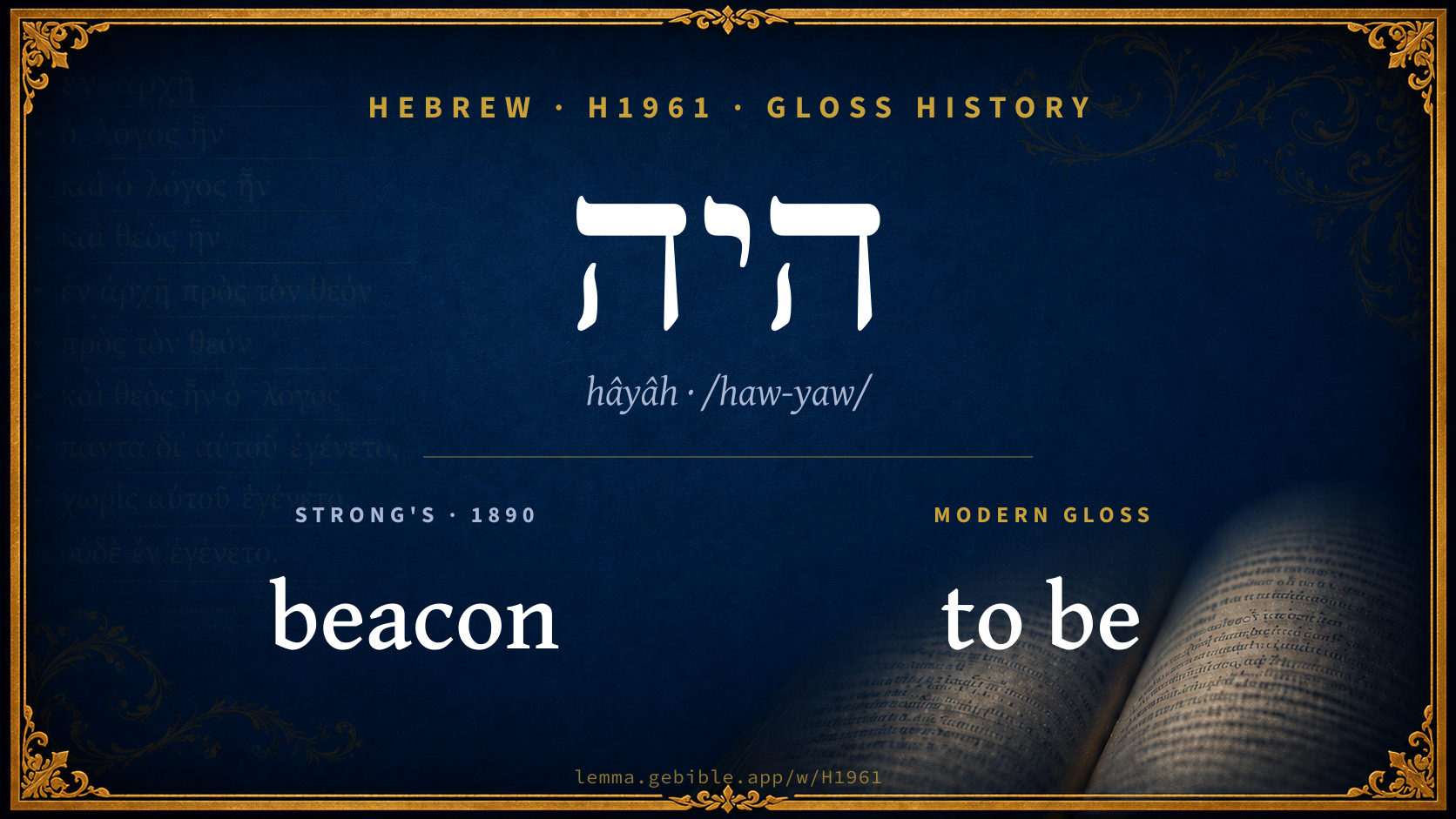
Gloss history
Strong's 1890 vs modern scholarship
About this word
Strong's H1961 catalogs a Hebrew word from the Hebrew Old Testament.
These counts are not copied from any lexicon or concordance. They are computed here, from the morphology-tagged Hebrew Old Testament. What Lemma adds →
- 3,130
- distinct verses
- The word appears in 3,130 distinct verses.
- 39 / 39
- OT books
- The word appears in 39 of 39 Old Testament books.
- #11
- by frequency
- Top 25 most frequent Hebrew words (rank 11 of 8,640 Hebrew words by occurrence).
View all 3,130 occurrences in the concordance →
By section of the Old Testament
By traditional corpus
Conventional, traditional groupings — biblical authorship is debated, so this is a traditional corpus grouping, not an authorship claim. Each share is this word’s portion of its verses in that division of the Hebrew canon. Each figure is a share of the word’s 3,130 distinct verses.
- Prophets (Nevi'im) 1,662 verses · 53%
- Torah (Pentateuch) 919 verses · 29%
- Writings (Ketuvim) 549 verses · 18%
How translations render this word
Counts come from each version’s own published word-to-Strong’s tagging or interlinear alignment — an approximate guide to how each version renders this word, not a word-level alignment the data otherwise carries. Because each total is that version’s own tagged count, the per-version totals vary from one another and need not match the appearance or distinct-verse counts above. These counts may also differ from a printed concordance because Lemma counts each distinctly tagged rendering and does not collapse phrase taggings into a single head-word total. This is a fixed set of word-tagged versions (KJV, ASV, BSB, ULT) and does not change with the reading translation you choose elsewhere. Each version’s license is shown beside its name below (and on Sources).
- King James Version: Shall be 8×, Be 5×, Was 4×
- American Standard Version: Be 7×, Shall be 4×, Was 4×
- Berean Standard Bible: Will be 265×, Was 236×, Came 159×
- unfoldingWord Literal Text: Was 497×, Will be 433×, And 354×
King James Version Public Domain
Renders H1961 across 76 tagged occurrences — most commonly:
Plus 44 renderings that appear only once — usually multi-word phrases or single function words the recovered tagging swept in, not distinct renderings.
American Standard Version Public Domain
Renders H1961 across 76 tagged occurrences — most commonly:
Plus 45 renderings that appear only once — usually multi-word phrases or single function words the recovered tagging swept in, not distinct renderings.
Berean Standard Bible Public Domain
Renders H1961 across 2,843 tagged occurrences — most commonly:
Plus other, less common renderings. Plus 474 renderings that appear only once — usually multi-word phrases or single function words the recovered tagging swept in, not distinct renderings. Not rendered by a distinct English word in 693 further occurrences.
unfoldingWord Literal Text CC BY-SA 4.0
Renders H1961 across 4,104 tagged occurrences — most commonly:
Plus other, less common renderings. Plus 160 renderings that appear only once — usually multi-word phrases or single function words the recovered tagging swept in, not distinct renderings.
34 senses and sub-senses in the full BDB
Hebrew verbs can shift meaning by stem (binyan): Qal is the basic action, Niphal is often passive or reflexive, Piel often intensifies or makes it factitive, and Hiphil is typically causative. The senses below are grouped under the stem BDB assigns to each.
What do BDB’s symbols mean?
BDB uses these scholarly abbreviations:
| Symbol | Meaning |
|---|---|
| 𝔊 | the Septuagint (the ancient Greek translation, LXX) |
| 𝔙 | the Vulgate (the Latin translation) |
| 𝔖 | the Syriac version (the Peshitta) |
| 𝔗 | the Targum (the Aramaic translation) |
| ψ | the Psalms |
| √ | root (the underlying root or stem) |
| ‖ | parallel passage (a synonymous or contrasted parallel) |
| † | the dagger: every passage where the word occurs is cited |
The 34 senses and sub-senses the full Brown-Driver-Briggs lexicon distinguishes for this word, in lexicon order (not ranked by frequency), with BDB’s own verbatim wording and sub-sense lettering. Shown in Hebrew script with BDB’s own scholarly abbreviations. The condensed entry is in the Lexicon Entry tab. See also the Forms in the corpus table below.
Qal
- Pf. 3 ms. הָיָה Gn 3:1 +; וְהָיָה consec. Gn 4:14 +; 3 fs. הָֽיְתָה Gn 1:2 +; הָיָתָ֑ה Is 14:24 + 3 times; וְהָֽיְתָה consec. Gn 9:13 +; והית 2 K 9:37 Kt (Qr וְהָיְתָה); 2 ms. הָיִיתָ Dt 5:15 +; 1 s. הָיִיתִי Gn 31:40; 3 pl. הָיוּ Gn 6:4 +; 2 mpl. הֱיִיתֶם Ex 22:20 +; וִהְיִיתֶם consec. Gn 3:5 +; 1 pl. הָיִינוּ Is 1:9 +; etc.; Impf. 3 ms. יִהְיֶה Gn 1:29 +; juss. יְהִי Gn 1:3 +; יֶהִ֑י Ez 16:15; וִיהִי Gn 1:6 +; וַיְהִי Gn 1:3 +; וַיֶּהִ֑י ψ 33:9 Ez 16:19; 3 fs. תִּהְיֶה Gn 21:30 +; 1 s. אֶהְיֶה Ex 3:12 +; וָאֶהְיֶה 2 S 7:6 + 9 times; וָאֱהִי Ju 18:4 + 12 times; 3 mpl. יִהְיוּ Gn 6:19 +; 3 fpl. תִּהְיֶינָה Is 16:2 + 19 times; תִּהְיֶיןָ Gn 41:36 + 11 times; וְתִהְיֶנָה Je 18:21; 48:6; וַתִּהְיֶינָה 2 S 20:3 + 6 times; וַתִּהְיֶיןָ Gn 26:35; 1 S 25:43; וַתִּהְיֶנָה 1 Ch 7:15; 2 mpl. תִּהְיוּ Gn 34:15 +; תִּהְיוּן Ex 22:20; 1 pl. נִהְיֶה Gn 38:23 +; וַנִּהְיֶה 2 S 11:23; Je 44:17; וַנְּהִי Nu 13:33; Is 64:5, etc.; Imv. ms. הֱיֵה Ex 18:19 +; fs. הֲיִי Gn 24:60; mpl. הֱיוּ Ex 19:15; Nu 16:16, וִהְיוּ 1 S 4:9 + 6 times; Inf. abs. הָיוֹ Gn 18:18 + 3 times; הָיֹה 1 K 13:32 Ez 1:3; cstr. הֱיוֹת Gn 2:18 +, so read prob. also for הֱיֵה Ez 21:15 cf. Sm Köi p. 600 f. (Co em. היה־לה to הָהֵל shine, glitter); with pref. בִּהְיוֹת Ex 5:13 +, בִּהְיֹת Ex 19:16 +; לִהְיוֹת Gn 10:8 +, לִהְיֹת Ex 23:1 +; sf. הֱיוֹתִי Jon 4:2; הֱיוֹתְךָ Ju 18:19(×2); לִהְיֹתְךָ Dt 26:19, etc.; Pt. f. הוֹיָה Ex 9:3. e.g. Genesis 3:1
- I.
- 1.
- a. Fall out, happen מֶה־הָיָה הַדָּבָר 1 S 4:16 how has the matter fallen out, (gone, turned out)? so 2 S 1:4; מֶה־הָיָה לוֹ Ex 32:1, 23 (both JE) what has happened to him? cf. 1 S 10:12; מִקְרֶה הוּא הָיָה לָנוּ 1 S 6:9 a chance it is that has befallen us; also וַיְהִי־לוֹ כֵּן 2 K 7:20 and so it happened to him, cf. וַיְהִי־כֵן infr. e.g. 1 Samuel 4:16
- b. occur, take place, come about, come to pass:—מַגֵּפָה גְדוֹלָה הָֽיְתָה בָּעָם 1 S 4:17 a great slaughter has taken place among the people, cf. 2 S 17:9; הַמִּלְחָמָה בְּיַעַר אֶפְרַיִם וַתְּהִי 2 S 18:6 and the battle took place in the wood of Ephraim (on אפרים cf. Klo Dr); Jos 22:17 (P; of plague); תְּהִי נָא אָלָה Gn 26:28 (J) let an oath take place (be taken) so Ju 21:5; cf. 2 K 17:7 (si vera l.), Ez 16:34; especially late, 2 Ch 29:36; 32:31; Ec 1:9, 10; 3:22; 8:7; 10:14 etc.; often of fulfilment of prediction, command, expectation, etc.:—כֵּן הָיָה Gn 41:3 (E) so it came to pass, 2 S 13:25, וַיְהִי־כֵן Ju 6:38 2 K 15:12 Is 29:5, & especially וַיְהִי־כֵן Gn 1:7, 9, 11, 15, 24, 30 (all P) +; יְהִי כִדְבָרֶ֑ךָ Gn 30:34 let it be as thou sayest, Zc 6:15, v. also לֹא תָקוּם וְלֹא יִהְיֶה Is 7:7 it shall not arise (be realized) & shall not come about, 14:24; (so often בּוֹא q.v. 2 c, p. 98 supr.) e.g. 1 Samuel 4:17
- 2. especially & very often, come about, come to pass sq. substantive (subj.) cl. almost always + modifying (usually temporal) cl. or phr.:
- a. (1) וַיְהִי and it came to pass that, most often (c. 292 times) foll. by (a) Impf. consec.: α. with Inf. c. כְּ temp. Gn 12:14; 19:17 (both J) + 75 times + Est 3:4 Qr (Hex chiefly J,—so always Gn,—& JE; P only Ex 16:10, D only Dt 5:20; 31:24 Jos 5:1; 9:1; 27 times in K),—somewhat diff. is 2 K 7:18; β. with Inf. c. בְּ Gn 4:8; 11:2 (both J) + 29 times + Est 3:4 Kt (in Hex 10 times JE; 3 times P, Gn 19:29; Ex 34:29; Nu 17:7; not in D); γ. with בְּ sq. nom. temp. (יוֹם, בֹּקֶר, etc.) Gn 21:22 (E) 26:32 (J) + 45 times (Hex 14 times JE; 3 times P, Ex 6:28; 16:13 Nu 7:1; not D); δ. לְ temp. 1 S 1:20; 2 S 13:23; 1 K 20:26; 1 Ch 20:1; ε. כְּ temp. Gn 39:11 1 S 25:38; ζ. מִן temp. viz.: מֵאָז Gn 39:5, מִיּוֹם 1 S 7:2 cf. 30:25, מִיָּמִים Ju 11:4; 15:1, מִקֵּץ Gn 4:3; 8:6 + 6 times, מִקְצֵה Jos 3:2 2 K 8:3 Ez 3:16, especially מִמָּחֳרָת Gn 19:34 Ex 18:13 + 11 times; η. כַּאֲשֶׁר temp. Gn 12:11 (J) 20:13 (E) + 31 times (Hex 13 times JE, Dt 2:16, not P), characteristic of Neh.’s memoirs, †Ne 3:33; 4:1, 6, 9; 6:1, 16; 7:1; 13:19; θ. with כִּי temp. Gn 6:1 (J) Ex 3:21 (E) + 14 times + Ju 16:25 Kt; ι. אַחֲרֵי temp. Gn 22:20 (J) + 13 times, אַחַר Gn 39:7 Jb 42:7, אַחֲרֵי־כֵן Ju 16:4 + 6 times; κ. sq. עַד temp. 1 S 14:19 (on which cf. Dr); comp. עַד־כֹּה וְעַד־כֹּה 1 K 18:45; λ. with combinations; as בְּ c. nom. temp. + בְּ Inf. Gn 34:25 Ex 19:16 1 S 25:37; בְּ Inf. + כְּ Inf. Jos 3:14; double prep. כְּמִשְּׁלשׁ חֳדָשִׁים Gn 38:24; מִקְצֵה + אַחֲרֵי אֲשֶׁר Jos 9:16; מִיָּמִים + id. 23:1; μ. other unusual constructions under this head are: those where temporal idea is expr. by a circumst. cl. Is 22:7 1 K 13:20 2 K 8:21 (Dr§ 165, & Obs.) = 2 Ch 21:9; those with indef. כֹּל 1 S 10:11; 2 S 2:23; 15:2, or with pt. = rel. cl. 1 S 11:1 (on all v. Dr§ 78 n. & Sm); quite unique is 1 K 16:31, with הֲנָקֵל לֶכְתּוֹ וגו׳ in place of temp. cl. (b) וַיְהִי sometimes sq. simple Pf., with a negative Gn 39:10 (c. כְּ Inf.), Ex 13:17 (c. בְּ Inf.) 2 K 12:7; 17:25 (both c. בְּ temp.); & without neg., Gn 8:13 (P) 14:1 +, usually c. בְּ temp. (38 times), Hex chiefly P; rarely c. other prep. & adv. as above; note especially מִדֵּי sq. Inf. 1 S 18:20 2 Ch 12:11; sometimes the subj. of foll. Pf. precedes it c. וְ, as Gn 22:1; 41:1; 1 S 18:19; 30:1; 2 K 2:9; 4:40 +; note especially 2 S 17:27 where several subj. & also several objects precede the Pf. (cf. Dr); in these cases the temporal modifier is occasionally a circumst. cl. 2 S 13:30; 1 K 8:10; 2 K 19:37 = Is 37:38; rarely subj. precedes Pf. without וְ 1 K 11:4; 21:1, comp. subj. preceding Pt. without וְ Ne 4:10; in 2 Ch 8:1 the obj. (with וְ) precedes what is appar. the principal vb. (c) וַיְהִי sq. וְהִנֵּה Gn 24:15 (J; טֶרֶם in temp. cl.), 29:25 (E), 38:27 (J, both בְּ temp.) v 29 (כְּ Pt.), 1 S 13:10 (כְּ Inf.); also 2 S 1:2; 13:36; 15:32 (circumst. cl.) 2 K 2:11 (id.), 3:20, 13:21 (circumst. cl.). (d) rarely וַיְהִי (in this sense) sq. other constructions: אָז יִתֵּן 1 K 9:10 (c. מִקְצֵה); Impf. frequentat. 14:28 (c. מִדֵּי־בֹּא, 2 K 4:8 (c. מִדֵּי עָבְרוֹ) Je 36:23 (c. כְּ Inf.); Pf. consec. frequentat. 2 Ch 24:11 (c. בְּ temp.). (2) really also Pf. c. וְ conj. וְהָיָה (cf. Dr§ 133) sq. Impf. consec. as subj. cl.: 1 S 1:12 (c. several circumst. cl.), 10:9 (c. כְּ Inf.) 2 K 3:15 (id.), 1 S 17:48 (c. כִּי), Je 37:11 (c. בְּ Inf.), Am 7:2 (c. אִם temp.); also Je 3:9 (appar. c. מִן causat., but obscure); 1 S 13:22 (c. בְּ temp.) is foll. by וְלֹא & Pf. as well as Impf. consec. e.g. Genesis 12:14
- b. less often וְהָיָה Pf. consec. and it shall come to pass, or frequentat., came to pass (repeatedly, etc.) usually (a) sq. simple Impf. (c. 100 times): α. c. בְּ temp. Dt 21:16; 25:19 + 37 times, (especially בַּיּוֹם הַהוּא Ho 2:18, 23 Is 7:18, 21, 23 + 21 times); β. c. בְּ loc. Ez 47:23 Zc 13:8 cf. also Ho 2:1 (בִּמְקוֹם אֲשֶׁר, but perhaps = instead of, cf. VB); γ. c. indef. rel. cl., or its equiv. (כֹּל indef., etc.), cf. Dr§ 121, Obs. 1: Gn 4:14; Nu 17:20; Dt 12:11; 18:19; Jos 7:14, 15; Ju 7:4; 1 S 2:36; 17:25; 2 S 15:35; 1 K 19:17; 20:6; Is 4:3; 24:18; Na 3:7; Je 27:8; 42:4; Ez 47:9; Zc 14:17; Jo 3:5; δ. c. כַּאֲשֶׁר Nu 33:56; Dt 28:63; Jos 23:15; Ju 7:17; Is 29:8; Je 31:28; Zc 8:13; ε. less often with other modif. phr.: כְּ Inf. Ex 33:8, 9 (both frequentat.), Jos 3:13; 8:8; Je 25:12; 51:63; בְּ Inf. Gn 9:14 (P) 2 K 4:10; Ez 44:17; אִם condit. Dt 20:11 (+ v 11 Dr§ 118 n.), also Jos 22:18, where the arrangement is peculiar, & the condit. is expressed without אִם (cf. Dr§ 155); לְ temp. Dt 23:12; מִקֵּץ Is 23:17; טֶרֶם Is 65:24; מִדֵּי חֹדֶשׁ בְּחָדְשׁוֹ Is 66:23, etc. (b) וְהָיָה sq. Pf. consec. (c. 85 times): α. most often + cl. c. כִּי temp. Gn 12:12; 46:33 (both J) Ex 1:10 (E) Dt 11:29; Is 8:21 + 25 times; β. c. אִם Ex 4:8, 9 Nu 15:24; Dt 11:13 + 14 times; also Gn 38:9; Nu 21:9 (both frequentat.); γ. c. בְּ temp. Gn 30:41 (frequentat.) 47:24 (but cf. Ol Di) Ex 16:5 + 11 times; δ. c. indef. rel. cl. or equivalent (Dr§ 121 Obs. 1): Gn 24:14; Nu 10:32 (Dr§ 118 n.) 21:18; Dt 21:3 Ju 11:31; 19:30; Zc 14:16; ε. occas. with other modif. phr.: כַּאֲשֶׁר Gn 27:40 +; כְּ Inf. Gn 44:31 +; בְּ Inf. Ex 33:22 +; מִקֵּץ 2 S 14:26; עֵקֶב causat. Dt 7:12; also (c) sq. וְלֹא + simple Impf. Ex 3:21 (c. כִּי temp.). (d) וְהָיָה sq. Imv. (very rare) Dt 6:10 (c. כִּי temp.), 1 S 10:7 (c. כִּי), cf. 29:10, cf. Pf. consec. in command 1 S 3:9 (c. אִם). (e) וְהָיָה sq. simple Pf. (also very rare) Dt 8:19 (c. אִם). (f) וְהָיָה sq. cl. without vb.: Gn 24:43 Jos 2:19 1 K 18:24 (all c. indef. rel. modifier, or equiv., v. (a) γ, (b) δ, supr.). (g) וְהָיָה (ו conj.) sq. Impf. consec. v. a. (e) supr. e.g. Deuteronomy 21:16
- 1.
- II. Come into being, become:—
- 1.
- a. abs., in lively narrative, arise, appear, come וַתְּהִי צְעָקָה גְדֹלָה Ex 12:30 (J) and there arose a great cry in Egypt; וַיְהִי־קוֹל Ez 1:25 (del. Co cf. Da), 37:7 (del. קוֹל 𝔊 Co); כִּי הָֽיְתָה הָֽרְוָחָה Ex 8:11 (J) Pharaoh saw that respite had come; Mi 7:4 now shall come their confusion (‖ בוא); also of concrete objects וְהָֽיְתָה הַקֶּשֶׁת בֶּעָנָן Gn 9:16 (P) and the bow shall appear in the clouds (‖ וְנִרְאֲתָה); וְרִמָּה לֹא הָֽיְתָה בּוֹ Ex 16:24 (P) and worms did not appear in it; of condition or action begun & continuing, as: famine Gn 12:10; 26:1, 1 (all J), 41:54 (E), Ru 1:1; 2 S 21:1; 2 K 6:25; strife Gn 13:7, 8 (J), Hb 1:3 (‖ מָדוֹן יִשָּׂא); often of action of the elements, as the coming of hail Ex 9:18, 24, 26 (all J), thunder & lightning, etc., Ex 19:16 (E), rain 1 K 18:45, storm Jon 1:4; especially of creative fiats יְהִי אוֹר וַיְהִי אוֹר Gn 1:3 let light appear, and light appeared, cf. v 5, 8, 13, 19, 23, 31 (all P); also arise, come on the stage or scene, וְאַחֲרָיו הָיָה שַׁמְגַּר Ju 3:31 and after him arose Shamgar (= וַיָּקָם 10:1); further וַעֲלָטָה הָיָה Gn 15:17 (JE) and darkness came on; הַבֹּקֶר הָיָה Ex 10:13 (J) the morning came, 19:16 (E); וַיְהִי הַיּוֹם †1 S 1:4 and the day came, when (v. Dr), 14:1 2 K 4:8, 11, 18 Jb 1:6, 13; 2:1. e.g. Exodus 12:30
- b. sq. prep.: בְּ, וְיָדֵנוּ אַל־תְּהִי־בוֹ (Gn 37:27 (J) but out hand, let it not come upon him, of hand of י׳ 1 S 5:9; 7:13; 12:15 + (all in hostile sense); וַיְהִי בִּרְכַּת י׳ בְּכָל־אֲשֶׁר יֶשׁ־לוֹ Gn 39:5 (J) and the blessing of י׳ came into (on) all that he had; but also of plague Ex 12:13 (P); sq. עַל, וּמֵי הַמַּבּוּל הָיוּ עַל־הָאָרֶץ Gn 7:10 (J) that the waters of the flood came upon the earth; עָלַי הָיוּ כֻלָּ֑נָה Gn 42:36 (E) Gn 9:2 (P) fear shall come upon, cf. 35:5 (P) 2 Ch 14:13; 17:10; 20:29 +; of wrath Jos 22:20 1 K 3:27; so of Saul’s evil spirit from God 1 S 16:16, 23; 19:9 (אֶל); but sq. עַל also in good sense וַתְּהִי עָלָיו רוּחַ י׳ conferring strength & efficiency Ju 3:10; 11:29 (היה = צלח Ju 14:6 + often), cf. Nu 24:2 (JE) of prophetic power; (on וַתְּהִי עָלָיו יַד י׳ 2 K 3:15 Ez 3:22 and the like, vid. יָד); יַד אֱלֹהֵינוּ הָֽיְתָה עָלֵינוּ Ezr 8:31, so ψ 80:18; even וַתְּהִי עַל־רֹאשׁ דָּוִד 2 S 12:30 and it (the crown, עֲטֶרֶת) came (i.e. was put, set) on David’s head; with a diff. meaning וַנִּהְיֶה עֲלֵיהֶם עַד־פֶּתַח הַשָּׁ֑עַר 2 S 11:23 and we were close upon them even to the gateway (cf. We Dr); come, go, follow (sq. אַחֲרֵי) i.e. take the side of, adhere to, Ex 23:2 (JE) 1 S 12:14 2 S 2:10 1 K 12:20; 16:21; sq. לְ, of blessings Gn 49:26 (poem); of judgment, punishment Je 40:3; especially ויהי דבר … אֶל and the word of … came unto: word of Samuel 1 S 4:1; usually word of God (or י׳) Gn 15:1 1 S 15:10 +; constantly in prophets: Ho 1:1 Mi 1:1 etc.; especially Je & Ez: Je 1:4, 11, 13; 2:1; 13:8 +; Ez 3:16; 6:1; 7:1; 11:14, 17, 21, 26, 12:1, 8;+; so also abs. הָיָה הַמַּשָּׂא הַזֶּה Is 14:28 in the death-year of king Ahaz came this utterance; also sq. מִן; מַלְכֵי עַמִּים מִמֶּנָּה יִהְיוּ Gn 17:16 (P), וּקְהַל גּוֹיִם יִהְיֶה מִמֶּ֑ךָּ 35:11 (P), וְהָיָה אַדִּירוֹ מִמֶּנּוּ Je 30:21 (‖ מִקִּרְבּוֹ יֵצֵא); הַכֹּל הָיָה מִן־הֶעָפָר וְהַכֹּל שָׁב אֶל הֶעָפָר Ec 3:20 all came from the dust, & all return unto the dust; וַיְהִי קֶצֶף גָּדוֹל מֵאֵת י׳ צְבָאוֹת Zc 7:12. e.g. Genesis 37:27
- 2. become:
- a. sq. pred. noun (to be viewed as implicit accus. Dr§ 161, 3 n. according to the Arabic usage WAG ii, § 41.44.74): הִוא הָֽיְתָה אֵם כָּל־חָ֑י Gn 3:20 (J) it was she that became the mother of all living; וַיְהִי הֶבֶל רֹעֵה צֹאן וְקַיִן הָיָה עֹבֵד אֲדָמָה 4:2 (J) and Abel became a shepherd of flocks, while Cain became a tiller of ground; 2 S 8:14 Mi 2:11 + often e.g. Genesis 3:20
- b. sq. pred. adj. Gn 38:7; Ex 36:13 +; cf. Gn 37:20 let us see what his dream will become (turn out to be, signify); e.g. Genesis 38:7
- c. become like (כְּ), וִהְיִיתֶם כֵּאלֹהִים Gn 3:5 and ye shall become like gods cf. v 22, Nu 11:1 (JE), Ho 2:1; 7:11; Is 9:18; 1 K 7:8; Zc 9:7 +; cf. Gn 15:5 so (כֹּה) shall thy seed become; specif. of likeness in punishment Is 1:9 1 S 17:36 +; also with כְּ repeated וְהָיָה כָעָם כַּכֹּהֵן Ho 4:9 and the people shall become like the priest (lit., and the like of the people shall become the like of the priest), so especially Is 24:2 (6 pairs of words as above); וְהָיָה כַצַּדִּיק כָּרָשָׁע Gn 18:25 (J), v. כְּ. b + c Gn 27:23 his hands had become like the hands of Esau his brother, hairy. e.g. Genesis 3:5
- d. sq. pred. + לְ pers. וּתְהִי אִשָּׁה לְבֶן־אֲדֹנֶיךָ Gn 24:51 (J) and let her become wife to the son of thy lord, 1 S 16:21; 1 K 11:25 ψ 89:42; 1 Ch 18:6 +; = be instituted, established, וְהָיָה לָהֶם חָק־עוֹלָם Ex 30:21 (P) and it shall be established for them as a perpetual ordinance (cf. f infr.). e.g. Genesis 24:51
- e. sq. לְ pred.: וַיְהִי הָאָדָם לְנֶפֶשׁ חַיָּה Gn 2:7 (J) and the man became a living soul; וְהָיָה לְאַרְבָּעָה רָאשִׁים Gn 2:10 (J) and it became four heads; גַּם־הוּא יִהְיֶה־לְעָם Gn 48:19 (J) he too shall become a people; וִהְיוּ לַאֲנָשִׁים 1 S 4:9 and become (shew yourselves to be) men (‖ הִתְחַזְּקוּ; cf. with double לְ, f infr.); Zp 1:13; Ez 17:6; 47:12; Jb 16:8; וְהָיָה י׳ לְמֶלֶךְ עַל־כָּל־הָאָרֶץ Zc 14:9; וַיְהִי לְמַס עֹבֵד †Gn 49:15; Jos 16:10; so often; also in sense of turn into, be changed so as to become, וַיְהִי לְנָחָשׁ Ex 4:3 and it became a serpent, v 4; 7:10; Is 1:22; Dt 26:5 +; fig. וַיְהִי לְמָ֑יִם Jos 7:5 and it (their heart) turned to water, so וְהוּא הָיָה לְאֶבֶן 1 S 25:37; or, serve as וְהָיוּ לִמְאוֹרֹת Gn 1:15 (P) and they shall become (fulfil the function of, serve as) luminaries, cf. v 14; וְהָיָה לְאוֹת בְּרִית Gn 9:13; 17:11 (both P). e.g. Genesis 2:7
- f. often c. לְ pred. + לְ pers.: וַתְּהִי לָהֶם הַלְּבֵנָה לְאָ֑בֶן Gn 11:3 (J) and the bricks became (served as) stone for them; וַתְּהִי לִי לְאִשָּׁה Gn 20:12 (E) cf. 24:67 (J) +, וַתִּהְיֶינָה מַחְלָה וְחָגְלָה … לַבְנֵי דֹדֵיהֶן לְנָשִׁים Nu 36:11; וְהָיָה לְךָ וְלָהֶם לְאָכְלָה 6:21 (P), Ex 2:10; 15:2 Ju 8:27; וְהָיָה י׳ לִי לֵאלֹהִים Gn 28:21 (E); אֲנִי אֶהְיֶה לוֹ לְאָב וְהוּא יִהְיֶה־לִי לְבֵן 1 Ch 17:3 +; = shew or prove oneself as הֱיֵה־לִי לְבֶן־חַיִל 1 S 18:17 shew thyself for me a valiant man (cf. 1 S 4:9 e supr.); = be instituted, established (cf. e supr.) וְהָיָה לְאַהֲרֹן וּלְבָנָיו לְחָק־עוֹלָם Ex 29:28 and it shall be instituted for Aaron and his sons as a perpetual ordinance; cf. v 9 Lv 10:15; וְהָֽיְתָה לִהְיֹת לָהֶם מָשְׁחָתָם לִכְהֻנַּת עוֹלָם לְדֹרֹתָם Ex 40:15 (all P). e.g. Genesis 11:3
- g. with עַל and לְ 1 S 22:2 וַיְהִי עֲלֵיהֶם לְשָׂר and he became over them prince. e.g. 1 Samuel 22:2
- h. sometimes c. לְ pers. only = become the property of, come into the possession of וַיְהִי־לוֹ צֹאן־וּבָקָר וְגו׳ Gn 12:16 (J), and he came to have flocks and herds etc., 26:14; 30:43; לֹא לוֹ יִהְיֶה הַזָּ֑רַע Gn 38:9 not his should the seed become; וְהָיָה לי׳ Ju 11:31 it shall become Yahweh’s; Dt 10:9; Jos 13:29; 1 K 10:26; 11:3 + often; so of a woman, as wife תְּהִי־נָא לְךָ Ju 15:2 pray let her become thine, cf. also וַתְּהִי אֵשֶׁת שִׁמְשׁוֹן לְמֵרֵעֵהוּ 14:20, Ho 3:3 Ru 1:13 Lv 21:3; Dt 24:2; Je 3:1; Ez 16:8 (and also + לְאִשָּׁה, לְנָשִׁים v. f supr.) e.g. Genesis 12:16
- 1.
- III. Be (often with subordinate idea of becoming);—
- 1. exist, be in existence (i.e. orig. have come into existence), כָּל־הַיָּמִים אֲשֶׁר הָיָה 1 S 1:28 all the days which he shall have been (lived, = חַי Gn 5:5 etc., cf. DrSm), Jb 3:16, Is 23:13; often c. בְּ loc. וְכֹל שִׂיחַ הַשָּׂדֶה טֶרֶם יִהְיֶה בָאָרֶץ Gn 2:5 (J) and there was not yet in the earth any shrub of the field; וּבְאֵלֶּה לֹא הָיָה אִישׁ וגו׳ Nu 26:64 (P) and among them there was not a man to be found, etc.; also וְלֹא הָיָה כַּיּוֹם הַהוּא לְפָנָיו וְאַחֲרָיו Jos 10:14 (JE) & there hath not been a day like that before it nor since, cf. 2 S 14:25; 1 K 18:5; 21:25; 2 K 23:25; Ne 13:26 +; somewhat weaker, in the freq. introductory clause וַיְהִי אִישׁ now there was a man Ju 13:2; 1 S 1:1; 9:1; Nu 9:6 (P), Jb 1:1 +; on אֶהְיֶה אֲשֶׁר אֶהְיֶה Ex 3:14 v. יהוֹה. e.g. 1 Samuel 1:28
- 2. abide, remain, continue (with word of place or time) וַיְהִי מֹשֶׁה בָּהָר Ex 24:18 and Moses remained in the mount forty days, etc., so 34:28 (both JE), Ju 17:4, 12 1 S 6:1 1 K 11:20 2 K 11:3 = 2 Ch 22:12 +; also Lv 22:27; 25:28 (both H), etc.; sq. עַד temp. remain until Dt 22:2 1 K 11:40; 2 K 15:5; 2 Ch 5:9; 26:21; Dn 1:21 etc.; cf. הוּא יִהְיֶה לְעוֹלָם Ec 3:14; so also of space sq. עַד extend unto, as far as, Jos 19:10: of net beneath altar, Ex 27:5 shall reach as far as (עַד) the middle of the altar. e.g. Exodus 24:18
- 3. with word of locality, be in or at a place, be situated, stand, lie; בִּהְיוֹתָם בַּשָּׂדֶה Gn 4:8 (J) when they were in the field, הַמָּקוֹם אֲשֶׁר־הָיָה שָׁם אָהֳלֹה בַּתְּחִלָּה 13:3 (J) the place where his tent had stood at first; וְהָאָרֶץ תִּהְיֶה לִפְנֵיכֶם 34:10 and the land, it lieth before you; cf. Jos 19:1; Ju 7:1, 8; Mi 5:6, 7; sq. עַל be, be found or situated upon Is 30:25 and there shall be upon every high mountain etc., streams, water-courses; Ez 37:27 and my dwelling-place shall be over them; fig. of guilt וְהָיָה עָלָיךָ דָּמִים Dt 19:10 and blood (-guilt) be upon thee. e.g. Genesis 4:8
- 4. as copula, joining subj. & pred.:—
- a. sq. pred. adj. וַיִּהְיוּ שְׁנֵיהֶם עֲרוּמִּים Gn 2:25, וְהַנָּחָשׁ הָיָה עָרוּם 3:1, בִּהְיוֹתָם כֹּאֲבִים 34:25, וַיְהִי יוֹסֵף יְפֵה־תֹאַר 39:6; Dt 23:15; Jos 19:9; Ju 11:1; Jb 1:1, 3b 2 Ch 7:21. e.g. Genesis 2:25
- b. sq. pred. noun Gn 1:2; 9:18; 25:3; 36:14; 40:13; 1 S 17:34, 42 2 S 8:10; 20:26; 1 K 10:6; 2 K 3:4; 5:1(×2) 1 Ch 9:20; 11:20; 18:10; 26:10; 2 Ch 13:7; כִּי לֹא־הָיָה מֶלֶךְ יִשְׂרָאֵל 2 Ch 18:32 (‖ 1 K 22:33 כִּי־לֹא־מֶלֶךְ ישׂראל הוּא) +; often of age: וַיְהִי אַבְרָם בֶּן־תִּשְׁעִים שָׁנָה וְתֵשַׁע שָׁנִים Gn 17:1 (P) 2 K 8:17; 14:2; 15:2, 33; 18:2; 2 Ch 21:20; 27:8 +; sq. pred. Inf. abs. (very anomal.) וְהַמַּיִם הָיוּ הָלוֹךְ וְחָסוֹר Gn 8:5; = amount to, come to, in enum. of days of life, number of people, amounts of money, etc.: Gn 5:4, 5, 8, 11, 14; 9:29; 11:32; 23:1 +; Ex 38:24 Nu 1:46, etc. e.g. Genesis 1:2
- c. sq. adv. & adverbial phr.: לֹא־טוֹב הֱיוֹת הָאָדָם לְבַדּוֹ Gn 2:18 (J) it is not good that the man be alone; חָדַל לִהְיוֹת לְשָׂרָה אֹרַח כַּנָּשִׁים 18:11 (J). e.g. Genesis 2:18
- d. sq. prep.: (a) be with, accompany c. עִם, subj. most often י׳ or אלהים with added idea of protection, aid Gn 26:3; 31:3; 39:10; 48:21 Jos 1:3; 6:27; Ju 1:19; 2:18; 1 S 3:19; 18:12; 20:13; 1 K 1:37; 1 Ch 11:13; 2 Ch 17:3; sq. עִמָּדִי Gn 28:20; 31:5; 35:3; sq. עִם, human subj., of accompaniment וְהָיָה הַכֹּהֵן בֶּן־אַהֲרֹן עִם־הַלְוִיִּם Ne 10:39; 1 Ch 11:12, read also in ‖ 2 S 23:9 (Th We Dr); = be on the side of 1 K 1:8; c. עִם also = be near וּמַלְאַךְ י׳ הָיָה עִם־גֹּרֶן האורנה 2 S 24:16 (cf. Dr); also 2 S 13:20 implying sexual intercourse, so Gn 39:10 (perhaps gloss, cf. Di); peculiar uses with עִם are: וּדְבַר־אַבְנֵר הָיָה עִם־זִקְנֵי יִשְׂרָאֵל 2 S 3:17 and the speech of A. had been with the elders of Isr., cf. 1 K 1:7; וַיְהִי עִם־לְבַב דָּוִד אָבִי לִבְנוֹת 1 K 8:17 and it was with (i.e. in) the heart of David my father to build, = 2 Ch 6:7 cf. 1 K 8:18(×2) 1 Ch 22:7; 2 Ch 6:8(×2); 24:4; also 1 K 10:2 = 2 Ch 9:1; (b) be with, sq. אֶת, subj. י׳, אלהים, Gn 21:20; 39:2, 21 but also c. human subj. וּבָנָיו הָיוּ אֶת־מִקְנֵהוּ Gn 34:5, cf. 1 S 29:3 +; (c) sq. לְ of possessor כֶּרֶם הָיָה לִידִדִי Is 5:1 a vineyard had my beloved, Gn 30:30 cf. Ex 20:3 = Dt 5:7, Ju 18:27; 1 S 9:2; 1 K 5:6 + often (cf. I. 2 d, f, h); (d) sq. לְ + other prep.: of boundary וַיְהִי לָהֶם הַגְּבוּל מֵעֲרוֹעֵר Jos 13:16, cf. וַיְהִי גְבוּלָם מִמַּחֲנַיִם v 30; וַיְהִי לָהֶם הַגְּבוּל לִפְאַת צָפוֹנָה מִיַּרְדֵּן 18:12, etc.; (e) sq. בְּ be among, or of, Am 1:1 who was one of the herdsmen, 1 K 2:7 let them be among those eating, Pr 22:26; 23:20. e.g. Genesis 26:3
- 5. periphrastic conjug.:
- a. היה + pt., of continuous state, or condition, sometimes, especially late (cf. NH), of habit, c. וַיְהִי also of beginning and continuance (cf. Dr§ 135, (5)): pt. act. Gn 39:22 (J), Ex 3:1 (E), 1 S 2:11; 7:10; 18:9 (cf. Dr) v 14, 29 2 S 8:15 = 1 Ch 18:14, Dt 28:29; Is 30:20; 1 K 5:1, 15, 24 2 K 6:5; 9:14; 2 Ch 9:26; Ezr 4:4; Ne 1:4, 2:13; Dn 1:16 +; Gn 1:6 (P); הָיָה יָרֵא אֶת־י׳ 1 K 18:3; 2 K 4:1; 2 Ch 26:1; pt. pass. Jos 10:26; 1 K 13:24; 22:35 וְהַמֶּלֶךְ הָיָה מָעֳמָד בַּמֶּרְכָּבָה (‖ 2 Ch 18:34 הָיָה מַעֲמִיד), Is 2:2 = Mi 4:1, וְהָיָה סָגוּר Ez 44:2, ה׳ נַעֲשֶׂה Ne 5:18, וְאָהוּב לֵאלֹהָיו ה׳ 13:26;—on 2 S 13:32 cf. Dr e.g. Genesis 39:22
- b. sq. Inf. c. לְ (Dr§ 203, 204): וְהָיָה לְבָעֵר Is 5:5 and it shall be to burn (is to be, is destined to be burned) etc.; וַיְהִי הַשֶּׁמֶשׁ לָבוֹא Gn 15:12 and the sun was about to set; וַיְהִי הַשַּׁעַר לִסְגּוֹר Jos 2:5 and the gate was about to be shut; but also וַיְהִי לִדְרשׁ אֱלֹהִים 2 Ch 26:5 (nearly = וַיְהִי + Pt.) e.g. Isaiah 5:5
Niphal
- Pf. נִהְיָה 1 K 1:27 + 6 times + Mi 2:4 (cf. infr. ad fin.); 3 fs. נִהְיְתָה Ju 19:30 + 5 times, נִהְיָ֑תָה Ex 11:6 Je 48:19, וְנִהְיָ֑תָה consec. Ez 39:8 + 21:12 (del. B Codd 𝔊 Co); 2 ms. נִהְיֵיתָ Dt 27:9; 1 s. נִהְיֵיתִי Dn 8:27; Pt. fs. נִהְיָה Pr 13:19;— e.g. 1 Kings 1:27
- 1. became c. ל Dt 27:9. e.g. Deuteronomy 27:9
- 2. either, be done, or, come to pass: in the strong expressions אֲשֶׁר כָּמֹהוּ לֹא נ׳ וְכָמֹהוּ לֹא תֹסִף Ex 11:6 (J) a cry such as hath not occurred (been raised), and will not be again, cf. Dt 4:32 (be done; ‖ נִשְׁמַע), & Ju 19:30 (‖ נִרְאֲתָה);—but simply intrans. Jo 2:2; Dn 12:1 & appar. Ez 21:12 (‖ בָּאָ֫ה; on text, however, v. supr.) 39:8 (‖ id.);—also אֵיכָה נִהְיְתָה הָרָעָה הַזֹּאת Ju 20:3 how hath this wickedness been done? cf. v 12 Je 5:30; 48:19 also Ne 6:8; c. לֹא, existence denied לֹא נ׳ Zc 8:10 (‖ אֵינֶ֑נָּה); in all the above (except Jo 2:2; Dn 12:1 & Ez 21:12; 39:8) personal agency is clearly implied; it is expressed מֵאֵת אֲדֹנִי הַמֶּלֶךְ נ׳ הַדָּבָר הַזֶּה 1 K 1:27, so of divine agency (מֵאִתִּי) 1 K 12:24 = 2 Ch 11:4; further be attained, secured, of wages Zc 8:10 (c. לֹא, ‖ אֵינֶ֑נָּה); תַּאֲוָה נִהְיָה Pr 13:19 a desire come to pass, realized. e.g. Exodus 11:6
- 3. be done, finished, gone, only Dn וּשְׁנָתוֹ נִהְיְתָה עָלָיו Dn 2:1 and his sleep was finished upon him, i.e. left him (cf. Aramaic Dn 6:19); נִהְיֵיתִי 8:27 I came to an end, was exhausted (si vera l., del. 𝔊; ‖ נֶחֱלֵיתִי); נִהְיָה, in וְנָהָה נְהִי נִהְיָה Mi 2:4, is dub.; it is done, over, the ruin is come RobGes Ew Hi Ca Che RVm;? ZAW 1866, 122 f. cf. JBL1890, 74.77. e.g. Daniel 2:1
Senses from the full Brown-Driver-Briggs lexicon (Brown, Driver, Briggs; Oxford 1906 — public domain), digitized via Sefaria, supplemented by the OpenScriptures HebrewLexicon (CC BY 4.0). Full attribution on Sources.
Word origin
vb. fall out, come to pass, become, be (SI 1.6 היה, ib.3 הית; parallel form of הוה, Arabic هَوَى, Aramaic הֲוָא, ܗܘܳܐ; v. הָוָה supr.)—
— Brown-Driver-Briggs (Oxford 1906, public domain), digitized via Sefaria, supplemented by the OpenScriptures HebrewLexicon (CC BY 4.0). See Sources.
Derived from הוא (hâvâʼ) (H1933) — to be.
Jastrow Dictionary
A second Hebrew/Aramaic lexicon for comparison, covering Aramaic and post-biblical (Talmudic, Targumic, Midrashic) usage that the biblical-Hebrew BDB does not. Matched by lemma rather than by Strong’s number, so a lemma may carry more than one Jastrow headword (shown separately below), and the entries cover usage well beyond the Bible.
הוי
- (b. h.) to exist; to be, become; to occur, come to pass.—With part. ה׳ מביט he looked; ה׳ אומר he said, freq. used to say. Gen. R. s. 1, beg. אני הָיִיתִי וכ׳ I was the implement &c. Ib. ה׳ הקב"ה מביט וכ׳ the Lord looked into the Law (as often as a thing was to be created). Ab. I, 13 הוא ה׳ אומר the same used to say. Gen. R. s. 2 ה׳ ללמה ולא כלום became a nothing; a. v. fr.—Apocopate forms: אֱהִי, אֱהֵא, תְּהִי, תְּהֵא, יְהִי, יְהֵא; תְּהוּ (= תִּהְיוּ), יְהוּ (= יִהְיוּ). Yoma 66ᵇ אהא בשלום אני נכ׳ (Tosef. ib. IV (III), 14 נִהְיֶה) may I and you be as well; Y. ib. VI, 43ᶜ bot. כן תהו וכ׳ so may ye be well. B. Mets. 35ᵃ תהא במאמינו let this be (speak of a case) when he accepts his opponent’s statement; a. v. fr.—Part. הוֶֹה, הוֶֹוה
- 1. frequent, usual. Sabb. VI, 6 דברו חכמים בה׳ the scholars (in using the words ‘Arabian women’) speak of the ordinary custom (not to the exclusion of other people); a. fr.
- 2. existing, enduring. Pesik. R. s. 11, end הם הווִֹים ודומים [להקב"ה] they shall be existing for themselves (not merely as an attachment) and resembling [the Lord]; ib. אף הם הווים אש וכ׳ they, too, shall endure as a consuming fire.—Cant. R. to II, 13 עניות ירבה ויוקר הווה (read תרבה) poverty shall increase, and prices remain high (different in Snh. 97ᵃ a. Sot. 49ᵇ, v. אָמַר II). Imper. הֱוֵי, הֱוֵא; pl. הֱווּ. Ab. I, 4. Ib. II, 3; a. fr.—הֱוֵי אוֹמֵר, also elliptically הֱוֵי say, i.e. you must admit, this proves, that is meant by saying. Taan. 2ᵃ which is the service of the heart? ה׳ אומר זו תפלה you must admit, it is prayer. Tosef. Nidd. I, 6 ה׳ לא אמרום וכ׳ that is to say, the scholars have spoken &c. Cant. R. to I, 6 ה׳ כרמי שלי וכ׳ this is meant by ‘my vineyard &c.’—Y. Shebu. VII, 38ᶜ top הווי לא צורכה וכ׳ it is evident that it would not have been necessary &c.; a. fr.
- (v. הְוָיָה
- 1. to change one’s legal status, to dispose of. Keth. 40ᵇ (ref. to תהיה Deut. XXII, 19) במְהַוָּה עצמה וכ׳ the text speaks of a woman who can dispose of herself. e.g. Deuteronomy 22:19
- 2. to produce, make. Kidd. 58ᵃ (ref. to והיית, Deut. VII, 26) כל שאתה מְהַיֶּיה הימנה whatever thou makest out of it; Tem. 30ᵇ מְהַיֶּה ממנה; a. e. e.g. Deuteronomy 7:26
A Dictionary of the Targumim, the Talmud Babli and Yerushalmi, and the Midrashic Literature (Marcus Jastrow; London, Luzac, 1903) — Public Domain. Digitized via Sefaria. Digitized via Sefaria. Full attribution on Sources.
Forms in the corpus
The 681 distinct written forms H1961 takes in the Hebrew Bible, most frequent first — each parse links to that stem’s occurrences in the concordance. Hebrew forms include their vowel points and cantillation, so a single lemma takes many written forms.
The 60 most common forms are shown; 621 rarer forms follow in the full concordance.
Same root — word family
Other BDB entries built from the same root as H1961, grouped by Strong’s listed origin. These share a root / origin per the lexicon — not necessarily a shared meaning. Each links to that word’s own entry.
Derives from
Shares the same root
Proper names from this root
People and places named from this root — a name, not an additional meaning of the word.
Compare all same-root words → Showing 4 of 5 — not the complete family. 1 of the same-root words is a proper name (a person or place). They share a root, not necessarily a meaning.
Septuagint verse parallels
Most of the 3,130 Hebrew verses this word occurs in also exist in the Greek Old Testament (Septuagint), so the same passages can be read in Greek by switching the Old Testament edition to the Septuagint.
Read these verses in the Septuagint
- Genesis 1:2
- Exodus 1:5
- Leviticus 2:1
- Numbers 1:4
- Deuteronomy 1:3
- Joshua 1:1
- Judges 1:1
- Ruth 1:1
- 1 Samuel 1:1
- 2 Samuel 1:1
- 1 Kings 1:2
- 2 Kings 1:17
This is a verse-level parallel only — the same verses exist in both the Hebrew and Greek Old Testaments. No word-level Hebrew↔Greek correspondence is claimed: the data carries no such alignment, so no Greek word is shown as this Hebrew word’s translation. Coverage is not total — the Septuagint omits the deuterocanon and renumbers the Psalms, so some Hebrew verses have no direct Greek parallel.