
2 Chronicles 10:15

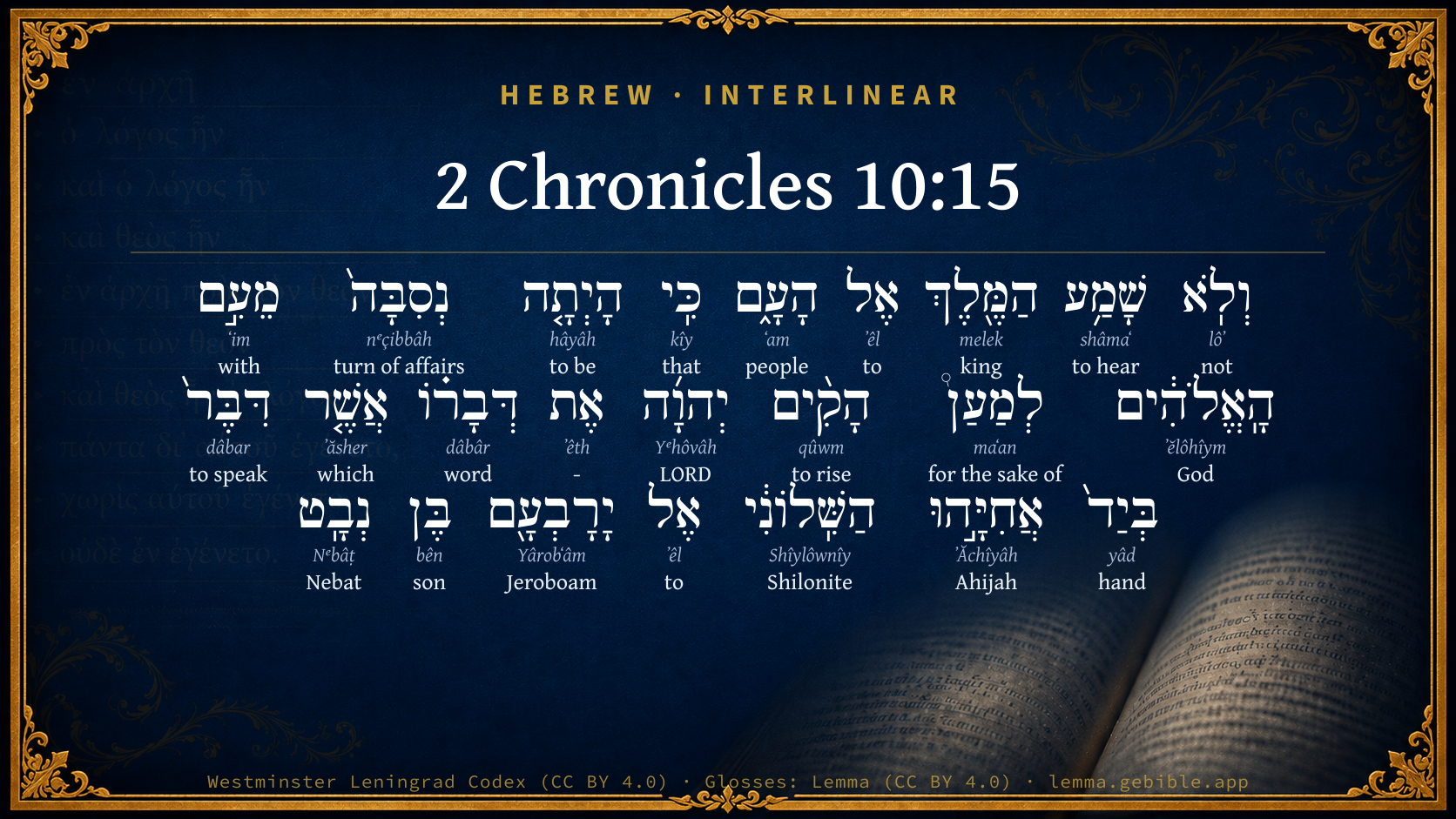
Hebrew (Westminster Leningrad Codex) 2 Chronicles 10:15 appears in the Hebrew Old Testament. The text above is from the Westminster Leningrad Codex. Each word links to its Strong’s number, a concise gloss, and parsing drawn from the Open Scriptures Hebrew Bible morphology. Click any word for its full Brown-Driver-Briggs (BDB) entry.
Download image
Cite this verse

2 Chronicles 10:15 (World English Bible). Public Domain. Lemma interlinear Bible study tool, https://lemma.gebible.app/v/2-chronicles/10/15.

Show BibTeX & RIS
BibTeX
RIS
English Translation
So the king didn't listen to the people; for it was brought about of God, that Yahweh might establish his word, which he spoke by Ahijah the Shilonite to Jeroboam the son of Nebat.
World English Bible · Public Domain
Highlights
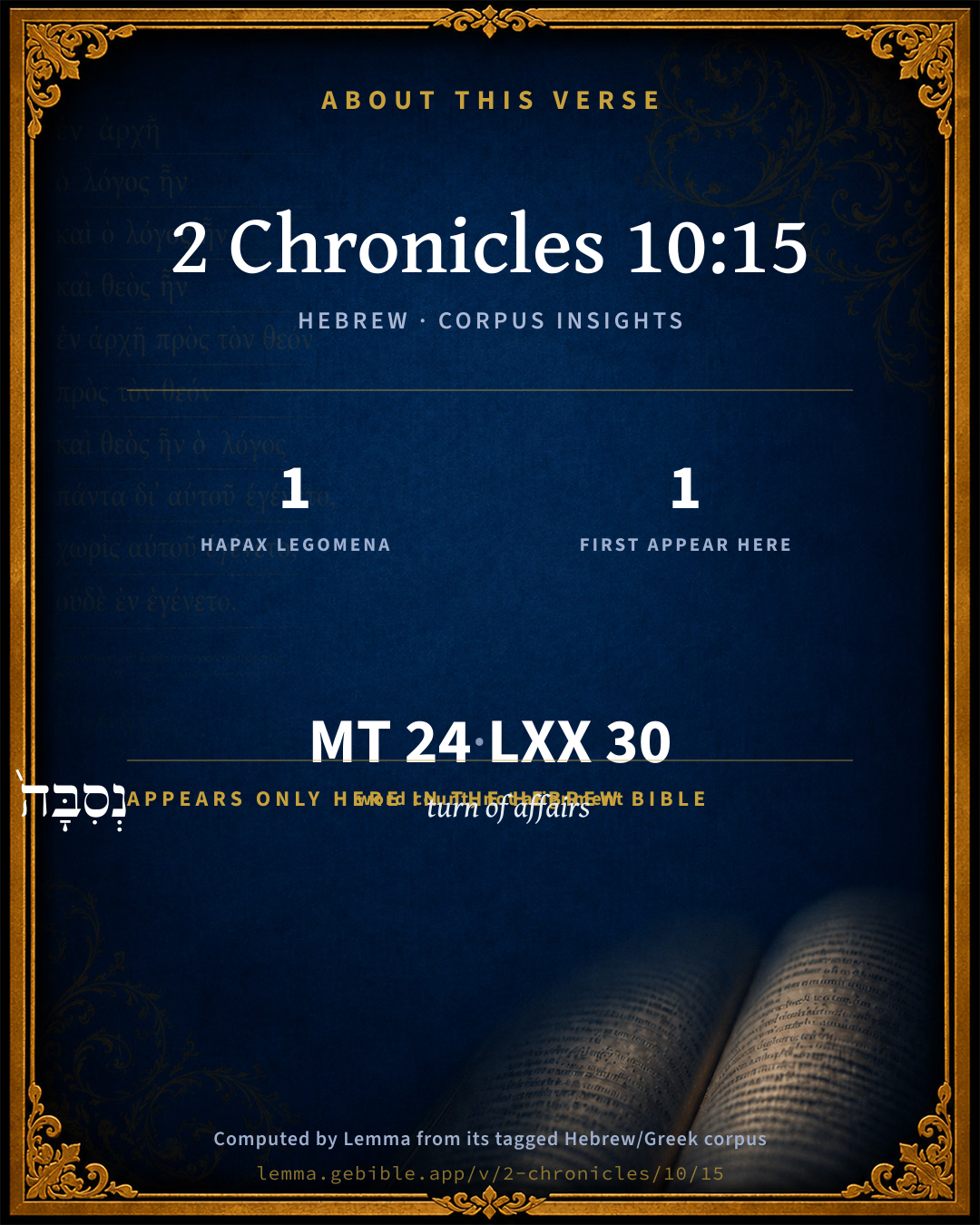
  • 1 hapax legomenon — only here in the Hebrew Bible
  • 1 first appearance in the Hebrew Bible
Full analysis ↓
Download a study sheet

One document with this verse’s original text, its word-by-word gloss line, the meaning frame, cross-references with their text, attributed commentary, and full source and license credits — printable, and it pastes into notes with its structure intact.

This verse Autodidact and up

Study sheet (.html) Plain text (.txt)

A passage Seminary Student

Up to 50 verses in one chapter. A passage sheet keeps up to 6 commentary sources and 12 cross-references per verse, in the order this page ranks them, and says so on the sheet whenever that leaves anything out. Ask for a single verse and you get the Autodidact verse sheet above.

Everything on this page stays free to read, with no account — the sheet is a download of what is already on screen, not access to it.

Want to remove ads? Support Godless Engineer
Compare translations 3

The same verse in 3 English versions, stacked beneath the original-language interlinear above. Click any original word for its lexicon entry.

Each is an independent rendering of the whole verse — the interlinear is not word-aligned to these translations.

Highlighted words mark where these versions differ — a whole-verse word diff, not a word-by-word alignment.

  • World English Bible Public Domain
    So the king didn't listen to the people; for it was brought about of God, that Yahweh might establish his word, which he spoke by Ahijah the Shilonite to Jeroboam the son of Nebat.
  • King James Version Public Domain
    So the king hearkened not unto the people: for the cause was of God, that the LORD might perform his word, which he spake by the hand of Ahijah the Shilonite to Jeroboam the son of Nebat.
  • unfoldingWord Literal Text CC BY-SA 4.0
    And the king did not listen to the people, because it was a turn of affairs from God, in order that Yahweh would establish his word that he spoke by the hand of Ahijah the Shilonite to Jeroboam the son of Nebat.

unfoldingWord Literal Text — © unfoldingWord, licensed CC BY-SA 4.0. Word-aligned USFM3 via Door43 (git.door43.org/unfoldingWord/en_ult).

Versions to compare (up to 4)

3 of 4 selected

Show all 18 translations

Every available English version of this verse, each an independent rendering of the whole verse.

  • World English Bible Public Domain
    So the king didn't listen to the people; for it was brought about of God, that Yahweh might establish his word, which he spoke by Ahijah the Shilonite to Jeroboam the son of Nebat.
  • Berean Standard Bible Public Domain
    So the king did not listen to the people, and indeed this turn of events was from God, in order that the LORD might fulfill the word that He had spoken through Ahijah the Shilonite to Jeroboam son of Nebat.
  • Majority Standard Bible Public Domain
    So the king did not listen to the people, and indeed this turn of events was from God, in order that the LORD might fulfill the word that He had spoken through Ahijah the Shilonite to Jeroboam son of Nebat.
  • King James Version Public Domain
    So the king hearkened not unto the people: for the cause was of God, that the LORD might perform his word, which he spake by the hand of Ahijah the Shilonite to Jeroboam the son of Nebat.
  • American Standard Version (1901) Public Domain
    So the king hearkened not unto the people; for it was brought about of God, that Jehovah might establish his word, which he spake by Ahijah the Shilonite to Jeroboam the son of Nebat.
  • Revised Version (1885) Public Domain
    So the king hearkened not unto the people; for it was brought about of God, that the LORD might establish his word, which he spake by the hand of Ahijah the Shilonite to Jeroboam the son of Nebat.
  • Geneva Bible (1599) Public Domain
    So the king hearkened not vnto the people: for it was the ordinance of God that the Lord might performe his saying, which hee had spoken by Ahiiah the Shilonite to Ieroboam the sonne of Nebat.
  • Douay-Rheims (1899) Public Domain
    And he condescended not to the people's requests: for it was the will of God, that his word might be fulfilled which he had spoken by the hand of Ahias the Silonite to Jeroboam the son of Nabat.
  • Young's Literal Translation Public Domain
    And the king hath not hearkened unto the people, for the revolution hath been from God, for the sake of Jehovah's establishing His word that He spake by the hand of Abijah the Shilonite unto Jeroboam son of Nebat.
  • Literal Standard Version CC BY-SA 4.0
    And the king has not listened to the people, for the revolution has been from God, for the sake of YHWH’s establishing His word that He spoke by the hand of Abijah the Shilonite to Jeroboam son of Nebat.
  • Unlocked Literal Bible CC BY-SA 4.0
    So the king did not listen to the people, for it was a turn in events brought about by God, that Yahweh might carry out his word that Ahijah the Shilonite had spoken to Jeroboam son of Nebat.
  • unfoldingWord Literal Text CC BY-SA 4.0
    And the king did not listen to the people, because it was a turn of affairs from God, in order that Yahweh would establish his word that he spoke by the hand of Ahijah the Shilonite to Jeroboam the son of Nebat.
  • Darby Bible Public Domain
    So the king hearkened not to the people; for it was brought about by God, that Jehovah might give effect to his word, which he spoke through Ahijah the Shilonite to Jeroboam the son of Nebat.
  • World Messianic Bible Public Domain
    So the king didn’t listen to the people; for it was brought about by God, that the LORD might establish his word, which he spoke by Ahijah the Shilonite to Jeroboam the son of Nebat.
  • Webster's Bible Public Domain
    So the king hearkened not to the people: for the cause was of God, that the LORD might perform his word, which he spoke by the hand of Ahijah the Shilonite to Jeroboam the son of Nebat.
  • Free Bible Version CC BY-SA 4.0
    The king did not listen to what the people said, for this change in circumstances was from God, to fulfill what the Lord had told Jeroboam son of Nebat through Ahijah the Shilonite.
  • Bible in Basic English Public Domain
    So the king did not give ear to the people; for this came about by the purpose of God, so that the Lord might give effect to his word which he had said by Ahijah the Shilonite to Jeroboam, the son of Nebat.
  • JPS Tanakh (1917) Public Domain
    So the king hearkened not unto the people; for it was brought about of God, that the LORD might establish His word, which He spoke by the hand of Ahijah the Shilonite to Jeroboam the son of Nebat.

Literal Standard Version (2020), Covenant Press — licensed CC BY-SA 4.0. Text via the HelloAO Bible API (eBible.org). Unlocked Literal Bible (unfoldingWord) — licensed CC BY-SA 4.0. Text via the HelloAO Bible API (eBible.org). unfoldingWord Literal Text — © unfoldingWord, licensed CC BY-SA 4.0. Word-aligned USFM3 via Door43 (git.door43.org/unfoldingWord/en_ult). Free Bible Version, Dr. Jonathan Gallagher — licensed CC BY-SA 4.0. Text via the HelloAO Bible API (eBible.org).

Word by word

More ways to search: Search by grammar → Find every occurrence → Compare this word →

Practice this passage: Drill this verse → Learn its vocabulary →

נְסִבָּה֙
nᵉçibbâh
H5252
“turn of affairs”
Noun, Common, Feminine, Singular, Absolute
Part of Speech
Noun
Type
Common
Gender
Feminine
Number
Singular
State
Absolute
Full BDB Definition

Origin: participle pass. of H5437

TWOT: 1456a

turn of affairs, a bringing about
  1. וְלֹֽא lôʼ H3808 “and · not” Conjunction + Particle, Negative
  2. שָׁמַ֥ע shâmaʻ H8085 “to hear” Verb, Qal, Perfect, 3rd Person, Masculine, Singular
  3. הַמֶּ֖לֶךְ melek H4428 “the · king” Particle, Definite Article + Noun, Common, Masculine, Singular, Absolute
  4. אֶל ʼêl H413 “to” Preposition
  5. הָעָ֑ם ʻam H5971 “the · people” Particle, Definite Article + Noun, Common, Masculine, Singular, Absolute
  6. כִּֽי kîy H3588 “that” Conjunction
  7. הָיְתָ֤ה hâyâh H1961 “to be” Verb, Qal, Perfect, 3rd Person, Feminine, Singular
  8. מֵעִ֣ם ʻim H5973 “from · with” Preposition + Preposition
  9. הָֽאֱלֹהִ֔ים ʼĕlôhîym H430 “the · God(s)” Particle, Definite Article + Noun, Common, Masculine, Plural, Absolute
  10. לְמַעַן֩ maʻan H4616 “for the sake of” Preposition
  11. הָקִ֨ים qûwm H6965 “to rise” Verb, Hiphil, Infinitive Construct
  12. יְהוָ֜ה Yᵉhôvâh H3068 “LORD” Noun, Proper
  13. אֶת ʼêth H853 “-” Particle, Direct Object
  14. דְּבָר֗וֹ dâbâr H1697 “word · his” Noun, Common, Masculine, Singular, Construct + Suffix, Personal, 3rd Person, Masculine, Singular
  15. אֲשֶׁ֤ר ʼăsher H834 “which” Particle, Relative
  16. דִּבֶּר֙ dâbar H1696 “to speak” Verb, Piel, Perfect, 3rd Person, Masculine, Singular
  17. בְּיַד֙ yâd H3027 “in/at · hand of” Preposition + Noun, Common, Both, Singular, Construct
  18. אֲחִיָּ֣הוּ ʼĂchîyâh H281 “Ahijah” Noun, Proper
  19. הַשִּֽׁלוֹנִ֔י Shîylôwnîy H7888 “the · Shilonite” Particle, Definite Article + Noun, Gentilic, Masculine, Singular, Absolute
  20. אֶל ʼêl H413 “to” Preposition
  21. יָרָבְעָ֖ם Yârobʻâm H3379 “Jeroboam” Noun, Proper
  22. בֶּן bên H1121 “son of” Noun, Common, Masculine, Singular, Construct
  23. נְבָֽט Nᵉbâṭ H5028 “Nebat” Noun, Proper

About this verse

These counts appear in no published source. They are computed here, from the morphology-tagged text and Lemma’s own curated glosses. What Lemma adds →

24
words
23
distinct lemmas
Historical
section

Notable vocabulary

1 hapax legomenon — a word that appears only here in the entire Hebrew Bible:

  • נְסִבָּה֙ turn of affairs H5252

First appearance in Scripture

This word makes its first canonical appearance in the Hebrew Bible here:

  • נְסִבָּה֙ turn of affairs H5252

Shared distinctive vocabulary

הַשִּֽׁלוֹנִ֔י Shilonite H7888 occurs in 6 verses of the Hebrew Bible. Also found in:

Grammatical profile

  • 4 verbs
  • 12 nouns
  • 4 prepositions
  • 1 conjunction
  • 3 particles

Verb forms

  • שָׁמַ֥ע Qal · Perfect
  • הָיְתָ֤ה Qal · Perfect
  • הָקִ֨ים Hiphil · Infinitive Construct
  • דִּבֶּר֙ Piel · Perfect

Repetition

A word recurs within this verse — often emphatic in Hebrew:

  • אֶל to H413 ×2

Hebrew & Septuagint length

In English translation the verse runs 34 words from the Hebrew and 45 from the Septuagint (LXX English) — closely comparable.

A rough comparison of the two English renderings, which tokenize alike — not a word-level alignment.

Word counts can differ between the Hebrew and the Greek without any difference in meaning — e.g. the Hebrew direct-object marker אֵת has no separate Greek word, and Greek often adds the article ὁ.

In the original languages it is 24 Hebrew tokens and 30 Greek tokens — but the two are counted differently (Hebrew bundles its prefixes and suffixes into one token; the Greek is in lemma form), so that isn’t a like-for-like length.

Cross-references

16

Topical passages linked to 2 Chronicles 10:15 in the Treasury of Scripture Knowledge — connected by theme and wording, ordered by reader-vote popularity; previews shown in the World English Bible.

  • 1 Kings 11:29–39 It happened at that time, when Jeroboam went out of Jerusalem, that the prophet Ahijah the Shilonite found him in the way; now [Ahijah] had clad himself with a new garment; and they two were alone in the field.
  • 1 Samuel 2:25 If one man sin against another, God shall judge him; but if a man sin against Yahweh, who shall entreat for him? Notwithstanding, they didn't listen to the voice of their father, because Yahweh was minded to kill them.
  • 2 Chronicles 25:16–20 It happened, as he talked with him, that [the king] said to him, Have we made you of the king's counsel? Stop! Why should you be struck down? Then the prophet stopped, and said, I know that God has determined to destroy you, because you have done this, and have not listened to my counsel.
  • Acts 2:23 him, being delivered up by the determined counsel and foreknowledge of God, you have taken by the hand of lawless men, crucified and killed;
  • Judges 14:4 But his father and his mother didn't know that it was of Yahweh; for he sought an occasion against the Philistines. Now at that time the Philistines had rule over Israel.
  • 1 Kings 12:15 So the king didn't listen to the people; for it was a thing brought about of Yahweh, that he might establish his word, which Yahweh spoke by Ahijah the Shilonite to Jeroboam the son of Nebat.
  • 1 Kings 12:24 Thus says Yahweh, You shall not go up, nor fight against your brothers the children of Israel: return every man to his house; for this thing is of me. So they listened to the word of Yahweh, and returned and went their way, according to the word of Yahweh.
  • 1 Kings 22:20 Yahweh said, Who shall entice Ahab, that he may go up and fall at Ramoth-gilead? One said on this manner; and another said on that manner.
  • Isaiah 19:14 Yahweh has mixed a spirit of perverseness in the midst of her; and they have caused Egypt to go astray in every work of it, as a drunken man staggers in his vomit.
  • Deuteronomy 2:30 But Sihon king of Heshbon would not let us pass by him; for Yahweh your God hardened his spirit, and made his heart obstinate, that he might deliver him into your hand, as at this day.
  • 2 Chronicles 9:29 Now the rest of the acts of Solomon, first and last, aren't they written in the history of Nathan the prophet, and in the prophecy of Ahijah the Shilonite, and in the visions of Iddo the seer concerning Jeroboam the son of Nebat?
  • Isaiah 30:12–13 Therefore thus says the Holy One of Israel, "Because you despise this word, and trust in oppression and perverseness, and rely thereon;
  • John 12:37–39 But though he had done so many signs before them, yet they didn't believe in him,
  • John 19:24 Then they said to one another, "Let's not tear it, but cast lots for it to decide whose it will be," that the Scripture might be fulfilled, which says, "They parted my garments among them. For my cloak they cast lots." Therefore the soldiers did these things.
  • John 19:32–36 Therefore the soldiers came, and broke the legs of the first, and of the other who was crucified with him;
  • Acts 4:28 to do whatever your hand and your council foreordained to happen.

Cross-references courtesy of OpenBible.info (CC BY 4.0).

Hebrew and Greek witnesses Masoretic Hebrew ↔ Greek Septuagint

The same verse in the two great witnesses to the Old Testament, shown verse-for-verse.

These are two independent witnesses, not word-aligned to each other, and the Septuagint is shown in lemma (dictionary) form.

Hebrew 2 Chronicles 10:15 Masoretic · Westminster Leningrad Codex

וְלֹֽא שָׁמַ֥ע הַמֶּ֖לֶךְ אֶל הָעָ֑ם כִּֽי הָיְתָ֤ה נְסִבָּה֙ מֵעִ֣ם הָֽאֱלֹהִ֔ים לְמַעַן֩ הָקִ֨ים יְהוָ֜ה אֶת דְּבָר֗וֹ אֲשֶׁ֤ר דִּבֶּר֙ בְּיַד֙ אֲחִיָּ֣הוּ הַשִּֽׁלוֹנִ֔י אֶל יָרָבְעָ֖ם בֶּן נְבָֽט

So the king didn't listen to the people; for it was brought about of God, that Yahweh might establish his word, which he spoke by Ahijah the Shilonite to Jeroboam the son of Nebat.

World English Bible · Public Domain

Greek LXX 2 Chronicles 10:15 Septuagint · lemma form

καί οὐ ἀκούω ὁ βασιλεύς ὁ λαός ὅτι εἰμί μεταστροφή παρά ὁ θεός λέγω ἀναἵστημι κύριος ὁ λόγος αὐτός ὅς λαλέω ἐν χείρ αχια ὁ σηλωνίτης περί ιεροβοαμ υἱός ναβατ

And the king listened not to the people, for there was a change of their minds from God, saying, The Lord has confirmed his word, which he spoke by the hand of Achia the Selonite concerning Jeroboam the son of Nabat, and concerning all Israel;

LXX2012 (modern English Septuagint) · Public Domain

Hebrew: Westminster Leningrad Codex (CC BY 4.0). Greek: Septuagint (public domain); English from LXX2012 (modern English Septuagint) (Public Domain). How the Septuagint differs from the Hebrew →

Commentary

Notes on 2 Chronicles 10:15 from classic Christian and Jewish commentators (each source and its license shown beneath its notes). The classic Christian expositions comment on the surrounding passage and are grouped to its opening verse, so a note may address several verses; the Jewish commentaries on the Tanakh (Rashi and others) are per-verse, so they appear only where the commentator wrote on this verse.

Lemma curates 59 commentaries, every one of them public domain or Creative Commons licensed, each selected and text-cleaned for this edition rather than reprinted as found. About our sources →

Geneva Bible (1599)

Geneva Bible translators

Hebrew, by the hand of.

God’s will imposeth such a necessity to the second causes, that nothing can be done but according to the same, and yet man’s will worketh as of itself, so that it cannot be excused in doing that it is God’s ordinance.

Geneva Bible (1599) marginal notes — public domain. Text via Bolls.life.

Jamieson, Fausset & Brown

Robert Jamieson, A. R. Fausset & David Brown

the king hearkened not unto the people, for the cause was of God--Rehoboam, in following an evil counsel, and the Hebrew people, in making a revolutionary movement, each acted as free agents, obeying their own will and passions. But God, who permitted the revolt of the northern tribes, intended it as a punishment of the house of David for Solomon's apostasy. That event demonstrates the immediate superintendence of His providence over the revolutions of kingdoms; and thus it affords an instance, similar to many other striking instances that are found in Scripture, of divine predictions, uttered long before, being accomplished by the operation of human passions, and in the natural course of events.

Next: 2 Chronicles Chapter 11

Jamieson, Fausset & Brown — Commentary Critical and Explanatory on the Whole Bible (1871) — public domain (CC PDM 1.0). Text via the HelloAO Bible API.

Adam Clarke's Commentary

Verse 15. For the cause was of God] "For there was an occasion Divinely given." - Targum.

Adam Clarke's Commentary on the Bible (1810–1826) — public domain. Text from a community e-Sword/MySword module.

Ellicott's Commentary for English Readers

(15) The cause was of God.—It was brought about by God. Literally, it was a turn or turning-point (of events) from with God. The word n’sibbah is equivalent to sibbah of Kings. Both are isolated in the Old Testament. The latter is the common word for “cause” in Rabbinic, as sibbath sibbôth—causa causarum.

That the Lord might perform his word.—The chronicler does not deviate from the text of Kings here, although he has not mentioned Ahijah’s prophecy to Jeroboam before. (Comp. 2Ch_9:29. )

A Bible Commentary for English Readers, edited by Charles John Ellicott (1878–1897) — public domain. Text from a community e-Sword module.

The Cambridge Bible for Schools and Colleges

gen. ed. J. J. S. Perowne

15. the cause was of God] R.V. it was brought about of God.

might perform] R.V. might establish.

Ahijah] Cp. 1Ki_11:29-39. The incident referred to is not narrated in Chron., being assumed to be known.

The Cambridge Bible for Schools and Colleges (gen. ed. J. J. S. Perowne; Cambridge University Press, 1878–1918) — public domain. Text from a community e-Sword module.

Haydock's Catholic Bible Commentary

Will of God: not that the king should act foolishly, or the people rebel, but to effect what he had promised. (Haydock) --- Syriac has well expressed the sense: "because this rebellion happened by the divine permission, that they might behold the truth of the prediction of Ahias;" (Calmet) and that the fault of Solomon might be punished. (Du Hamel)

George Leo Haydock (1774–1849), Haydock's Catholic Family Bible and Commentary, 1859 edition — public domain. Excludes Psalms (Douay-Rheims chapter numbering differs from Protestant) and Deuterocanonical books (Catholic canon only).

The Pulpit Commentary

So the king hearkened not for the cause was of God his word, which he spake by Ahijah. (see, as before, 1Ki_11:29-31, 1Ki_11:9-39) Rehoboam hearkened not, as Pharaoh hearkened not, but hardened his heart. The Divine word foretold, as the Divine mind foreknew, the inevitable course of the stream, that took its source in and from Solomon"s faithless heart and life. Solomon "being dead yet" bears his full share of the responsibility of what Rehoboam was, and shortly came to show he was. Everything must fall out as God foretells it shall fall out, not because "the cause is from him" in this sense that he has made it, but in the sense that he has pronounced it, through knowing it with an absolute knowledge. It were but a thing to be expected also, that just in the measure that the Bible is the Word of God, it shall exhibit and pronounce plainly the phenomena of his own ultimate fiats, rather than linger to track or describe the uncertainties of human morality or conduct. Let but that result appear, which God has with his sure and abiding Word declared, and the practical attitude and language of Scripture are that it is vain to fight against it; for the thing is of God. It was known of him and said of him. And it carries its punishment or its recompense in it, as of him. It will be noticed, again, how our compiler refers to the incident of Ahijah, as though he had recorded it, which he had not done.

The Pulpit Commentary (1880–1919), ed. H.D.M. Spence-Jones & Joseph S. Exell — public domain. Text from a community e-Sword module.

unfoldingWord translationNotes

Door43 World Missions Community

So the king did not listen to the people

Here "listen to the people" represents not care about what they said or about actually doing what they asked. AT: "So the king did not do what the people had asked him to do" or "So the king ignored the people" (See: Metonymy)

it was a turn in events brought about by God

This is an idiom and can be stated in active form. AT: "God caused things to happen like this" (See: Idiom and Active or Passive)

that Yahweh might carry out his word ... Nebat

"that Yahweh might do according to the message that he told Ahijah the Shilonite to tell Jeroboam son of Nebat" or "that Yahweh might do what he had said he would do when he told Ahijah the Shilonite to give a message to Jeroboam son of Nebat"

that Yahweh might carry out his word

The idiom "carry out his word" means to do what he had said he would do. (See: Idiom)

his word that Ahijah the Shilonite had spoken to Jeroboam son of Nebat

This refers to the message that God gave Ahijah to tell Jeroboam.

Ahijah the Shilonite ... Jeroboam son of Nebat

See how you translated these names in 2 Chronicles 9:29. (See: How to Translate Names)

translationWords

God

Yahweh

word

Ahijah

unfoldingWord translationNotes — © Distant Shores Media and the Door43 World Missions Community, licensed CC BY-SA 4.0. Source: git.door43.org/Door43/en_tn.

Rashi

Rabbi Shlomo Yitzchaki (Rashi)

because it was brought about, etc. so that the Lord God might establish His word as is delineated in I Kings (11:31–37), to remove from him the ten tribes and to give them to Jeroboam, and this is the meaning of (Gen. 49:10): “The scepter will not depart from Judah” [meaning that] he will not be banished from his kingdom, “until he comes to Shiloh,” meaning until Judah comes to Shiloh to crown Rehoboam there, and there “peoples will gather to him” to crown him, and there the kingdom was divided, and the reign over the ten tribes was lost. Now Shechem is a small city adjacent to Shiloh, as it is written at the end of Judges (21:19): “Behold, there is a sacrifice before the Lord in Shiloh from time to time, etc. on the east side of the highway that goes up from Beth-El to Shechem,” and it is written in Jeremiah (41:5): “from Shechem (and) from Shiloh,” and in honor of the Tabernacle of Shiloh, they would gather in Shechem, which was fit for the people to assemble in, and it adjoined Shiloh. And when they would assemble in Shechem, the scepter would depart from Judah, for there the kingdom was divided.

Rashi on the Tanakh — English translations: “The Judaica Press complete Tanach with Rashi, translated by A. J. Rosenberg” (CC BY 4.0); “Pentateuch with Rashi's commentary by M. Rosenbaum and A.M. Silbermann, 1929-1934” (public domain); “The Metsudah Tanach series, Lakewood, N.J” (CC BY 4.0); and “The Book of Joshua, Metsudah Publications, 1997” (CC BY 4.0). Text via Sefaria.

Lesson kit

Teaching starters — assembled from the data on this page, not authored interpretation. Every prompt links to the verse data it draws on. Edit before teaching.

2 Chronicles, in the Historical, opens this verse with 24 words (23 distinct Hebrew lemmas). Its most distinctive word is nᵉçibbâh (“turn of affairs”). A historical commentator’s framing appears above. Read the whole chapter for the surrounding context.

Discussion questions

  1. How does “turn of affairs” (nᵉçibbâh) shape what this verse is saying?
  2. 1 word here appears nowhere else in the Hebrew Bible. Why might the author reach for such rare wording?
  3. This is the first place “turn of affairs” appears in Scripture (first appears here). What does its debut here establish?
  4. How does 1 Kings 11:29, which shares the word «Shilonite», read alongside this verse?
  5. What does the repetition of “to” (2× in this one verse) do in this verse?
  6. These translations render this verse differently; the difference is in the English rendering, not the original. What questions does that raise?
  7. «שָׁמַ֥ע» is a Qal Perfect verb. How does that grammatical form shape the action described?
  8. Compare how Geneva Bible (1599) and Jamieson, Fausset & Brown read this verse. Where do they agree or differ?

Things to notice

  • 1 word in this verse appears nowhere else in the Hebrew Bible.
  • 1 word makes its first canonical appearance in Scripture here.
  • This verse counts 24 Hebrew ↔ 30 Greek words.
  • These translations choose different wording for 21 words in this verse.
  • “to” occurs 2× in this single verse.

Reading settings

Reading text

Shown beneath each verse's original-language words.

Old Testament
Old Testament edition

Read the OT as the Masoretic Hebrew (MT) or the Greek Septuagint (LXX).

English shown for the Greek Septuagint (in the Hebrew ↔ Greek comparison).

Comparing translations? Open the Compare panel on any verse page to stack up to four side by side.