
Deuteronomy 27:9

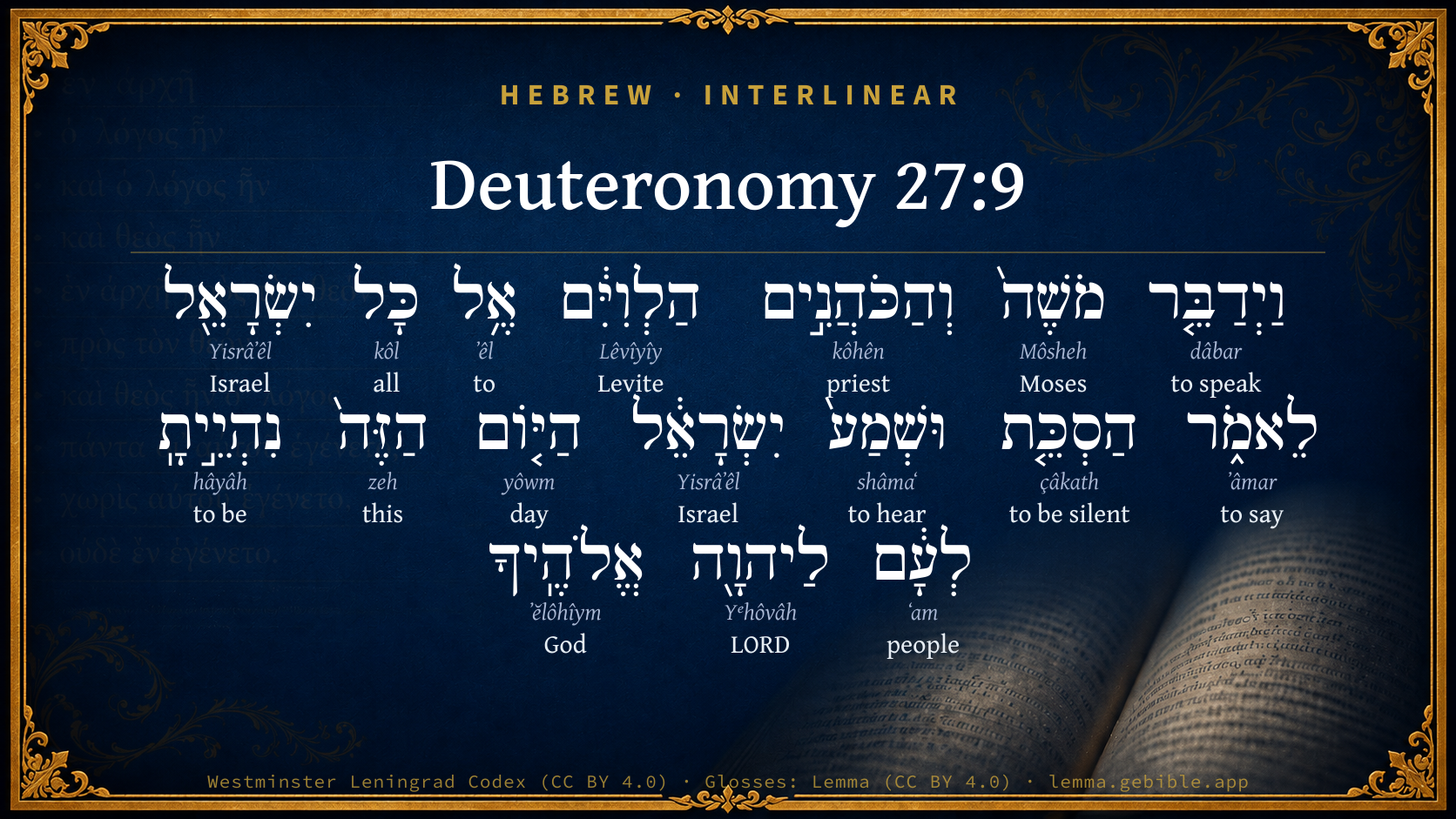
Hebrew (Westminster Leningrad Codex) Deuteronomy 27:9 appears in the Hebrew Old Testament. The text above is from the Westminster Leningrad Codex. Each word links to its Strong’s number, a concise gloss, and parsing drawn from the Open Scriptures Hebrew Bible morphology. Click any word for its full Brown-Driver-Briggs (BDB) entry.
Download image
Cite this verse

Deuteronomy 27:9 (World English Bible). Public Domain. Lemma interlinear Bible study tool, https://lemma.gebible.app/v/deuteronomy/27/9.

Show BibTeX & RIS
BibTeX
RIS
English Translation
Moses and the priests the Levites spoke to all Israel, saying, Keep silence, and listen, Israel: this day you are become the people of Yahweh your God.
World English Bible · Public Domain
Highlights
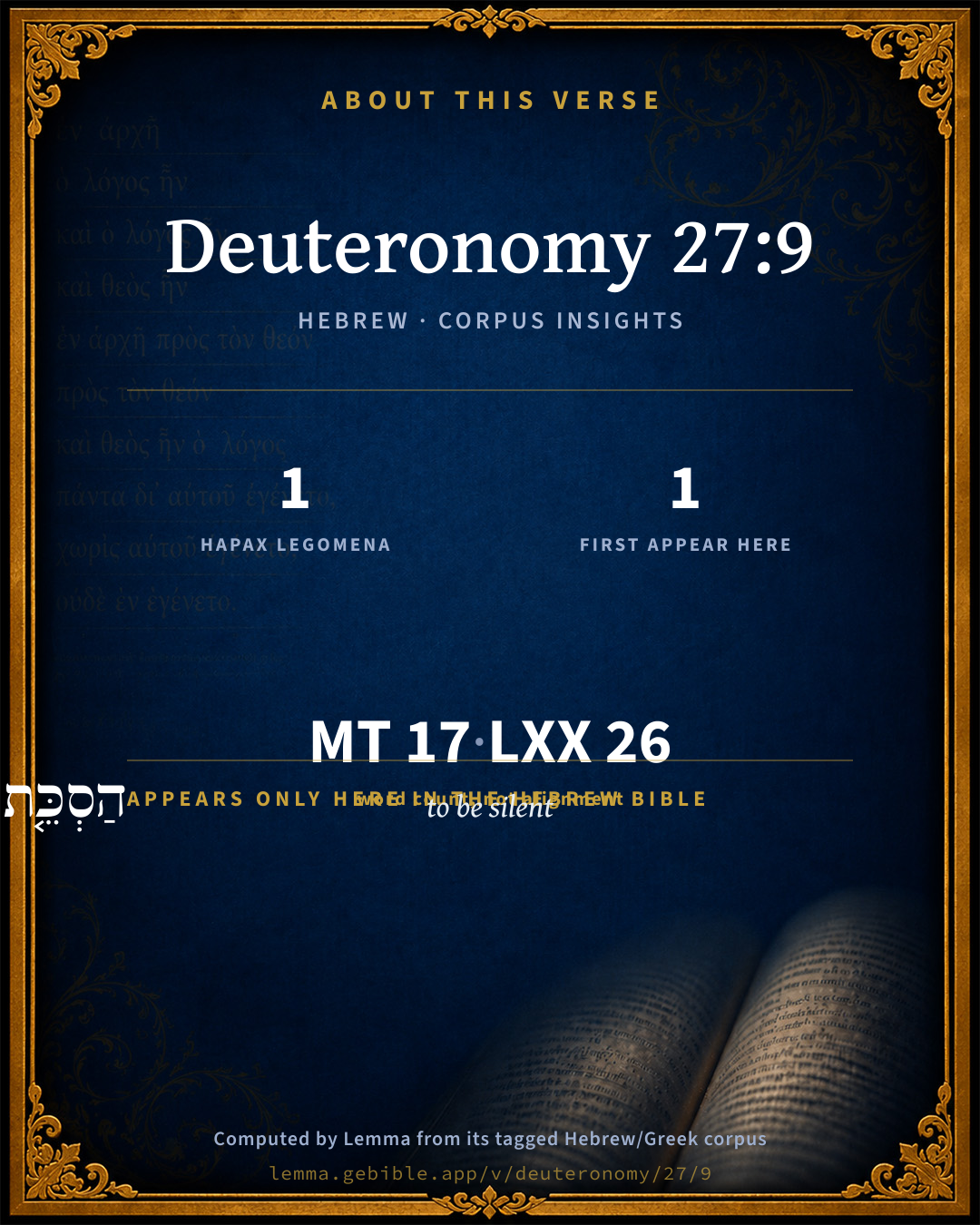
  • 1 hapax legomenon — only here in the Hebrew Bible
  • 1 first appearance in the Hebrew Bible
Full analysis ↓
Download a study sheet

One document with this verse’s original text, its word-by-word gloss line, the meaning frame, cross-references with their text, attributed commentary, and full source and license credits — printable, and it pastes into notes with its structure intact.

This verse Autodidact and up

Study sheet (.html) Plain text (.txt)

A passage Seminary Student

Up to 50 verses in one chapter. A passage sheet keeps up to 6 commentary sources and 12 cross-references per verse, in the order this page ranks them, and says so on the sheet whenever that leaves anything out. Ask for a single verse and you get the Autodidact verse sheet above.

Everything on this page stays free to read, with no account — the sheet is a download of what is already on screen, not access to it.

Want to remove ads? Support Godless Engineer
Compare translations 3

The same verse in 3 English versions, stacked beneath the original-language interlinear above. Click any original word for its lexicon entry.

Each is an independent rendering of the whole verse — the interlinear is not word-aligned to these translations.

Highlighted words mark where these versions differ — a whole-verse word diff, not a word-by-word alignment.

  • World English Bible Public Domain
    Moses and the priests the Levites spoke to all Israel, saying, Keep silence, and listen, Israel: this day you are become the people of Yahweh your God.
  • King James Version Public Domain
    And Moses and the priests the Levites spake unto all Israel, saying, Take heed, and hearken, O Israel; this day thou art become the people of the LORD thy God.
  • unfoldingWord Literal Text CC BY-SA 4.0
    And Moses and the priests, the Levites, spoke to all Israel, saying, “Be silent and listen, Israel! This day you have become the people of Yahweh your God.

unfoldingWord Literal Text — © unfoldingWord, licensed CC BY-SA 4.0. Word-aligned USFM3 via Door43 (git.door43.org/unfoldingWord/en_ult).

Versions to compare (up to 4)

3 of 4 selected

Show all 18 translations

Every available English version of this verse, each an independent rendering of the whole verse.

  • World English Bible Public Domain
    Moses and the priests the Levites spoke to all Israel, saying, Keep silence, and listen, Israel: this day you are become the people of Yahweh your God.
  • Berean Standard Bible Public Domain
    Then Moses and the Levitical priests spoke to all Israel: “Be silent, O Israel, and listen! This day you have become the people of the LORD your God.
  • Majority Standard Bible Public Domain
    Then Moses and the Levitical priests spoke to all Israel: “Be silent, O Israel, and listen! This day you have become the people of the LORD your God.
  • King James Version Public Domain
    And Moses and the priests the Levites spake unto all Israel, saying, Take heed, and hearken, O Israel; this day thou art become the people of the LORD thy God.
  • American Standard Version (1901) Public Domain
    And Moses and the priests the Levites spake unto all Israel, saying, Keep silence, and hearken, O Israel: this day thou art become the people of Jehovah thy God.
  • Revised Version (1885) Public Domain
    And Moses and the priests the Levites spake unto all Israel, saying, Keep silence, and hearken, O Israel; this day thou art become the people of the LORD thy God.
  • Geneva Bible (1599) Public Domain
    And Moses and the Priestes of the Leuites spake vnto all Israel, saying, Take heede and heare, O Israel: this day thou art become the people of the Lord thy God.
  • Douay-Rheims (1899) Public Domain
    And Moses and the priests of the race of Levi said to all Israel: Attend, and hear, O Israel: This day thou art made the people of the Lord thy God.
  • Young's Literal Translation Public Domain
    And Moses speaketh -- the priests, the Levites, also -- unto all Israel, saying, `Keep silent, and hear, O Israel, this day thou hast become a people to Jehovah thy God;
  • Literal Standard Version CC BY-SA 4.0
    And Moses speaks—the priests, the Levites, also—to all Israel, saying, “Keep silent and hear, O Israel: This day you have become a people for your God YHWH;
  • Unlocked Literal Bible CC BY-SA 4.0
    Moses and the priests, the Levites, spoke to all Israel and said, “Be silent and listen, Israel: Today you have become the people of Yahweh your God.
  • unfoldingWord Literal Text CC BY-SA 4.0
    And Moses and the priests, the Levites, spoke to all Israel, saying, “Be silent and listen, Israel! This day you have become the people of Yahweh your God.
  • Darby Bible Public Domain
    And Moses and the priests, the Levites, spoke to all Israel, saying, Be silent and hearken, Israel! this day thou art become the people of Jehovah thy God.
  • World Messianic Bible Public Domain
    Moses and the Levitical priests spoke to all Israel, saying, “Be silent and listen, Israel! Today you have become the people of the LORD your God.
  • Webster's Bible Public Domain
    And Moses and the priests the Levites spoke to all Israel, saying, Take heed and hearken, O Israel, this day thou art become the people of the LORD thy God.
  • Free Bible Version CC BY-SA 4.0
    Moses and the Levitical priests gave these orders to all the Israelites: “Be quiet, people of Israel, and listen! Today you have become the people of the Lord your God.
  • Bible in Basic English Public Domain
    Then Moses and the priests, the Levites, said to all Israel, Be quiet and give ear, O Israel; today you have become the people of the Lord your God.
  • JPS Tanakh (1917) Public Domain
    And Moses and the priests the Levites spoke unto all Israel, saying: 'Keep silence, and hear, O Israel; this day thou art become a people unto the LORD thy God.

Literal Standard Version (2020), Covenant Press — licensed CC BY-SA 4.0. Text via the HelloAO Bible API (eBible.org). Unlocked Literal Bible (unfoldingWord) — licensed CC BY-SA 4.0. Text via the HelloAO Bible API (eBible.org). unfoldingWord Literal Text — © unfoldingWord, licensed CC BY-SA 4.0. Word-aligned USFM3 via Door43 (git.door43.org/unfoldingWord/en_ult). Free Bible Version, Dr. Jonathan Gallagher — licensed CC BY-SA 4.0. Text via the HelloAO Bible API (eBible.org).

Word by word

More ways to search: Search by grammar → Find every occurrence → Compare this word →

Practice this passage: Drill this verse → Learn its vocabulary →

הַסְכֵּ֤ת
çâkath
H5535
“be silent”
Verb, Hiphil, Imperative, 2nd Person, Masculine, Singular
Part of Speech
Verb
Stem
Hiphil
Form
Imperative
Person
2nd Person
Gender
Masculine
Number
Singular
Full BDB Definition

Origin: a primitive root to be silent

TWOT: 1499

to be silent - (Hiphil) to keep silence, show silence
  1. וַיְדַבֵּ֤ר dâbar H1696 “and · to speak” Conjunction + Verb, Piel, Sequential Imperfect, 3rd Person, Masculine, Singular
  2. מֹשֶׁה֙ Môsheh H4872 “Moses” Noun, Proper
  3. וְהַכֹּהֲנִ֣ים kôhên H3548 “and · the · priests” Conjunction + Particle, Definite Article + Noun, Common, Masculine, Plural, Absolute
  4. הַלְוִיִּ֔ם Lêvîyîy H3881 “the · Levites” Particle, Definite Article + Noun, Gentilic, Masculine, Plural, Absolute
  5. אֶ֥ל ʼêl H413 “to” Preposition
  6. כָּל kôl H3605 “all of” Noun, Common, Masculine, Singular, Construct
  7. יִשְׂרָאֵ֖ל Yisrâʼêl H3478 “Israel” Noun, Proper
  8. לֵאמֹ֑ר ʼâmar H559 “to say” Preposition + Verb, Qal, Infinitive Construct
  9. וּשְׁמַע֙ shâmaʻ H8085 “and · hear” Conjunction + Verb, Qal, Imperative, 2nd Person, Masculine, Singular
  10. יִשְׂרָאֵ֔ל Yisrâʼêl H3478 “Israel” Noun, Proper
  11. הַיּ֤וֹם yôwm H3117 “the · day” Particle, Definite Article + Noun, Common, Masculine, Singular, Absolute
  12. הַזֶּה֙ zeh H2088 “the · this” Particle, Definite Article + Pronoun, Demonstrative, Masculine, Singular
  13. נִהְיֵ֣יתָֽ hâyâh H1961 “to be” Verb, Niphal, Perfect, 2nd Person, Masculine, Singular
  14. לְעָ֔ם ʻam H5971 “to/for · people” Preposition + Noun, Common, Masculine, Singular, Absolute
  15. לַיהוָ֖ה Yᵉhôvâh H3068 “to/for · LORD” Preposition + Noun, Proper
  16. אֱלֹהֶֽיךָ ʼĕlôhîym H430 “God(s) · your” Noun, Common, Masculine, Plural, Construct + Suffix, Personal, 2nd Person, Masculine, Singular

About this verse

These counts appear in no published source. They are computed here, from the morphology-tagged text and Lemma’s own curated glosses. What Lemma adds →

17
words
16
distinct lemmas
Pentateuch
section

Notable vocabulary

1 hapax legomenon — a word that appears only here in the entire Hebrew Bible:

  • הַסְכֵּ֤ת to be silent H5535

First appearance in Scripture

This word makes its first canonical appearance in the Hebrew Bible here:

  • הַסְכֵּ֤ת to be silent H5535

Grammatical profile

  • 5 verbs
  • 10 nouns
  • 1 pronoun
  • 1 preposition

Verb forms

  • וַיְדַבֵּ֤ר Piel · Sequential Imperfect
  • לֵאמֹ֑ר Qal · Infinitive Construct
  • הַסְכֵּ֤ת Hiphil · Imperative
  • וּשְׁמַע֙ Qal · Imperative
  • נִהְיֵ֣יתָֽ Niphal · Perfect

Repetition

A word recurs within this verse — often emphatic in Hebrew:

  • יִשְׂרָאֵ֖ל Israel H3478 ×2

Hebrew & Septuagint length

In English translation the verse runs 27 words from the Hebrew and 30 from the Septuagint (LXX English) — closely comparable.

A rough comparison of the two English renderings, which tokenize alike — not a word-level alignment.

Word counts can differ between the Hebrew and the Greek without any difference in meaning — e.g. the Hebrew direct-object marker אֵת has no separate Greek word, and Greek often adds the article ὁ.

In the original languages it is 17 Hebrew tokens and 26 Greek tokens — but the two are counted differently (Hebrew bundles its prefixes and suffixes into one token; the Greek is in lemma form), so that isn’t a like-for-like length.

Cross-references

6

Topical passages linked to Deuteronomy 27:9 in the Treasury of Scripture Knowledge — connected by theme and wording, ordered by reader-vote popularity; previews shown in the World English Bible.

  • 1 Peter 2:10–11 who in time past were no people, but now are God's people, who had not obtained mercy, but now have obtained mercy.
  • Deuteronomy 26:16–18 This day Yahweh your God commands you to do these statutes and ordinances: you shall therefore keep and do them with all your heart, and with all your soul.
  • 1 Corinthians 6:9–11 Or don't you know that the unrighteous will not inherit the Kingdom of God? Don't be deceived. Neither the sexually immoral, nor idolaters, nor adulterers, nor male prostitutes, nor homosexuals,
  • Ephesians 5:8–9 For you were once darkness, but are now light in the Lord. Walk as children of light,
  • Romans 6:17–18 But thanks be to God, that, whereas you were bondservants of sin, you became obedient from the heart to that form of teaching whereunto you were delivered.
  • Romans 6:22 But now, being made free from sin, and having become servants of God, you have your fruit of sanctification, and the result of eternal life.

Cross-references courtesy of OpenBible.info (CC BY 4.0).

Hebrew and Greek witnesses Masoretic Hebrew ↔ Greek Septuagint

The same verse in the two great witnesses to the Old Testament, shown verse-for-verse.

These are two independent witnesses, not word-aligned to each other, and the Septuagint is shown in lemma (dictionary) form.

Hebrew Deuteronomy 27:9 Masoretic · Westminster Leningrad Codex

וַיְדַבֵּ֤ר מֹשֶׁה֙ וְהַכֹּהֲנִ֣ים הַלְוִיִּ֔ם אֶ֥ל כָּל יִשְׂרָאֵ֖ל לֵאמֹ֑ר הַסְכֵּ֤ת וּשְׁמַע֙ יִשְׂרָאֵ֔ל הַיּ֤וֹם הַזֶּה֙ נִהְיֵ֣יתָֽ לְעָ֔ם לַיהוָ֖ה אֱלֹהֶֽיךָ

Moses and the priests the Levites spoke to all Israel, saying, Keep silence, and listen, Israel: this day you are become the people of Yahweh your God.

World English Bible · Public Domain

Greek LXX Deuteronomy 27:9 Septuagint · lemma form

καί λαλέω μωυσῆς καί ὁ ἱερεύς ὁ λευίτης πᾶς ἰσραήλ λέγω σιωπάω καί ἀκούω ἰσραήλ ἐν ὁ ἡμέρα οὗτος γίγνομαι εἰς λαός κύριος ὁ θεός σύ

And Moses and the priests the Levites spoke to all Israel, saying, Be silent and hear, O Israel; this day you are become a people to the Lord your God.

LXX2012 (modern English Septuagint) · Public Domain

On this verse, The Pulpit Commentary discusses the Septuagint’s reading. Read the note in Commentary ↓

Hebrew: Westminster Leningrad Codex (CC BY 4.0). Greek: Septuagint (public domain); English from LXX2012 (modern English Septuagint) (Public Domain). How the Septuagint differs from the Hebrew →

Targum (Aramaic paraphrase)

2

The Targum is the ancient Jewish Aramaic paraphrase of the Hebrew Scriptures — an interpretive translation, not the Hebrew text itself. Onkelos (literal) and Pseudo-Jonathan (expansive) render the Torah, and Jonathan the Prophets. Coverage is partial: where no permissively-licensed English translation exists for a verse, only the Aramaic is shown. This is verse-level text, not a word-by-word alignment to the Hebrew.

  1. Targum Onkelos Torah (Genesis–Deuteronomy)
    וּמַלִיל מֹשֶׁה וְכָהֲנַיָא לֵוָאֵי לְכָל יִשְׂרָאֵל לְמֵימָר אֲצֵית וּשְׁמַע יִשְׂרָאֵל יוֹמָא הָדֵין הֲוֵיתָא לְעַמָא קֳדָם יְיָ אֱלָהָךְ

    (no public-domain English translation for this verse)

    Targum Onkelos — Aramaic: “Onkelos Genesis” (public domain); “Onkelos Exodus” (public domain); “Onkelos Leviticus” (public domain); “Onkelos Numbers” (public domain); “Onkelos Deuteronomy” (public domain). English: “Sefaria Community Translation” (CC0 1.0 (public-domain dedication)); “J.W. Etheridge. The Targums of Onkelos and Jonathan Ben Uzziel on the Pentateuch. London: Longmans, Green, 1862” (public domain). Text via Sefaria.

  2. Targum Pseudo-Jonathan Torah (Genesis–Deuteronomy)
    וּמַלֵיל משֶׁה וְכַהֲנַיָא בְּנֵי לֵוִי עִם כָּל עַמָא לְמֵימָר צַיְיתוּ וּשְׁמָעוּ יִשְרָאֵל יוֹמָנָא הָדֵין אִתְבְּחַרְתּוּן לְמֶהֱוֵי עַמָא קֳדָם יְיָ אֱלָהָכוֹן

    And Mosheh and the priests, the sons of Levi, spake with all the people, saying: Listen, O Israel, and hear: This day are you chosen to be a people before the Lord your God.

    Targum Pseudo-Jonathan — Aramaic: “Targum Jonathan on Genesis” (public domain); “Targum Jonathan on Exodus” (public domain); “Targum Jonathan on Leviticus” (public domain); “Targum Jonathan on Numbers” (public domain); “Targum Jonathan on Deuteronomy” (public domain). English: “The Targum of Jonathan ben Uzziel, trans. J. W. Etheridge, London, 1862” (public domain). Text via Sefaria.

Commentary

Notes on Deuteronomy 27:9 from classic Christian and Jewish commentators (each source and its license shown beneath its notes). The classic Christian expositions comment on the surrounding passage and are grouped to its opening verse, so a note may address several verses; the Jewish commentaries on the Tanakh (Rashi and others) are per-verse, so they appear only where the commentator wrote on this verse.

Lemma curates 59 commentaries, every one of them public domain or Creative Commons licensed, each selected and text-cleaned for this edition rather than reprinted as found. About our sources →

The Biblical Illustrator

Joseph S. Exell

Deu_27:9-10

Obey the voice of the lord thy god.

Of obedience to Gods revealed will

I. What is the rule of obedience? The written Word.

II. What are the right ingredients in our obedience to make it acceptable?

1. Obedience must be free and cheerful, else it is penance, not sacrifice (Isa_1:19). Willingness is the soul of obedience; God sometimes accepts of willingness without the work, but never of the work without willingness. Cheerfulness shows that there is love in the duty; and love doth to our services, as the sun doth to the fruits, mellow and ripen them and make them come off with a better relish.

2. Obedience must be devout and fervent: the heart must boil over with hot affections in the service of God.

3. Obedience must be extensive, it must reach to all Gods commands (Psa_119:6). True obedience runs through all duties of religion, as the blood through all the veins, or the sun through all the signs of the zodiac.

4. Obedience must be sincere--namely, we must aim at the glory of God in it, in religion the end is all. The end of our obedience must not be to stop the mouth of conscience, or to gain applause, but that we may grow more like God, and bring more glory to God.

5. Obedience must be in and through Christ, He made us accepted in the Beloved.

6. Obedience must be constant, Blessed is he who doeth righteousness at all times. True obedience is not like an high colour in a fit, but it is a right sanguine; it is like the fire on the altar which was always kept burning.

III. Whence is it that men do not obey God?

1. The not obeying of God is for want of faith: Who hath believed our report? Did men believe sin were so bitter that hell followed at the heels of it, would they go on in sin? Did they believe there were such a reward for the righteous that godliness were gain, would they not pursue it?

2. The not obeying God is for want of self-denial. God commands one thing, and mens lusts command another, and they will rather die than deny their lusts; now, if lust cannot be denied God cannot be obeyed.

IV. What are the great arguments or incentives to obedience?

1. Obedience makes us precious to God; we shall be His favourites (Exo_19:5; Isa_43:3).

2. There is nothing lost by obedience. To obey Gods will is the way to have our will. (T. Watson.)

Implicit obedience

Implicit obedience is our first duty to God, and one for which nothing else will compensate. If a lad at school is bidden to cipher, and chooses to write a copy instead, the goodness of the writing will not save him from censure. We must obey whether we see the reason or not; for God knows best. A guide through an unknown country must be followed without demur. A captain, in coming up the Humber or Southampton Water, yields complete authority to the pilot. A soldier in battle must fight when and where he is ordered; when the conflict is over he may reflect upon and perceive the wisdom of his commander in movements that at the time of their execution were perplexing. The farmer must obey Gods natural laws of the seasons if he would win a harvest; and we must all obey Gods spiritual laws if we would reap happiness here and hereafter.

Obedience proceeding from love

The son of a poor man that hath not a penny to give or leave him, yields his father obedience as cheerfully as the son of a rich man that looks for a great inheritance. It is, indeed, love to the father, not wages from the father, that is the ground of a good childs obedience. If there were no heaven Gods children would obey Him; and though there were no hell yet would they do their duty; so powerfully doth the love of the Father constrain them. (J. Spencer.)

The Biblical Illustrator, edited by Joseph S. Exell (c. 1880s–1900s) — public domain. Text from a community e-Sword module.

Joseph Benson's Commentary

Deu 27:9. The priests spake unto all Israel — They assisted Moses in pressing the people to attend duly to the meaning and design of this solemnity. Thou art become the people of the Lord — By thy solemn renewing of thy covenant with him.

Joseph Benson's Commentary on the Old and New Testaments (1811–1818) — public domain. Text from a community e-Sword module.

Tyndale Open Study Notes

Tyndale Open Resources

27:9 Today: The Israelites were already the Lord’s people prior to this moment, but each time Israel affirmed itself to be God’s people and renewed the covenant (as here), they became God’s people in a fresh, new way. Recommitment to the Lord is like beginning a new relationship with him.

Tyndale Open Study Notes — © Tyndale Open Resources, licensed CC BY-SA 4.0. Text via the HelloAO Bible API.

Ellicott's Commentary for English Readers

(9) Moses and the priests.—As in Deu_27:1, “Moses and the elders.”

Take heed.—A word used nowhere else in the Old Testament.

This day thou art become the people.—“Every day His commandments shall be before thine eyes, as though thou hadst that day entered into covenant with Him.” It would seem that the passage of Jordan, which is the thing in view here, pledged Israel more completely to God’s Law than even the covenant at Sinai did. He had gone farther with them, and given them a more distinct position. It became more necessary than ever that they should remember whose they were.

(12,13) These shall stand upon mount Gerizim to bless . . . and these . . . upon mount Ebal to curse.—The expressions “to bless” and “to curse” are misleading. It is not meant that six tribes were to bless, and six to curse their brethren. The phrase will be best understood by noticing the manner in which the ceremony was performed, according to Jewish tradition. According to the treatise Sotah, six, tribes went up to the top of Gerizim, and six ascended mount Ebal, and the priests and the Levites and the ark remained below, between the hills. The Levites turned their faces towards Mount Gerizim, and began with the blessing, “Blessed is the man,” &c., and both sides answered “Amen.” They then turned their faces towards Mount Ebal, and began the curse, saying, “Cursed is the man,” &c. The “Amen” again resounded; and the process was repeated until the last curse was reached. The question whether all the blessings preceded all the cursings is discussed; but the opinion preferred is, that each blessing had its corresponding curse, and were pronounced alternately.

If this account be correct, and it seems both intelligible and probable, we see that the tribes were divided equally to “receive” the blessing and the curse, implying that all were equally liable to either, according as they should obey or transgress. If the one side had answered amen to the blessings, and the other to the curses, the tribes would literally have blessed and cursed the people. But the rule is explicit that all the people shall say “Amen;” and therefore we seem to gather this meaning from the Hebrew: These shall stand on Mount Gerizim for the blessing of the people, i.e., to receive the blessing on behalf of the whole, and these on Mount Ebal for the curse (i.e., to receive it on behalf of the rest). It is noticeable that “the law” which inflicts the curse, and the altar which represents in its sacrifices Him who bare the curse, are both on the same hill, Ebal. If the tribes redeemed are on the hill of blessing, the tribes that receive the curse are on the same hill with the Redeemer.

(12,13) Simeon, and Levi . . . and Naphtali.—Strictly speaking, there would be seven tribes on Gerizim to receive the blessing, and six on Ebal for the curse; because, tribally, Joseph must include Ephraim and Manasseh. The general position is that of the audience in an amphitheatre, the speakers being in the centre beneath, and the people on either side above. The more honourable tribes of Judah, Joseph, Benjamin, and Levi are posted on the southern hill, Gerizim. The tribes on Ebal are the four sons of the handmaids Bilhah and Zilpah, with Leah’s youngest son Zebulun; and the disinherited firstborn, Reuben, is placed at their head. These last tribes, upon the whole, may be said to have occupied the outer circle of Israel’s territory, to the east and to the north. The tribes on Gerizim are the more central tribes.

A Bible Commentary for English Readers, edited by Charles John Ellicott (1878–1897) — public domain. Text from a community e-Sword module.

The Cambridge Bible for Schools and Colleges

gen. ed. J. J. S. Perowne

9. the priests the Levites] See on Deu_18:1, and cp. Deu_10:8 f. The association of the Levites with Moses in the enforcement of the Law is striking; and as only one speaker is implied by the next v. (which I command thee) the words have been regarded as the addition of the editor who combined 9, 10 with 14–26 (Dillm., Steuern., Berth., Marti.). This reasoning is not conclusive.

all Israel] See on Deu_1:1, Deu_5:1; and contr. Deu_4:44-46.

Keep silence] The Heb. vb. only here; in Ar. the root, sakata = to be quiet or mute.

hearken, O Israel] Deu_5:1.

this day thou art become the people, etc.] Cp. Deu_26:18.

9, 10. Further Enforcement of the Law

These vv. with their sequel in Deu_28:1 repeat the substance and, with variations, the phraseology of Deu_16:6-19. They have been taken as the link between these passages, and as original to D (see above small print of note to chs. 27–30). They are by no means a necessary link (Oxf. Hex. which because of the introduction of the Levites suggests that the vv. are the continuation of Deu_31:29). Rather, as the notes below show, they are parallel to Deu_26:16-19, and may therefore have originally belonged to the supplement to a different edition of the Code from that to which Deu_26:16-19 was attached.

The Cambridge Bible for Schools and Colleges (gen. ed. J. J. S. Perowne; Cambridge University Press, 1878–1918) — public domain. Text from a community e-Sword module.

John Gill's Exposition

And Moses and the priests the Levites spake unto all Israel,.... The priests who were Levites, as all the priests that were lawful ones were; and there were none but such at this time, who were. Eleazar and Ithamar, and their sons; these joined with Moses in the following exhortations to the people of Israel, as being particularly concerned in instructing them in the knowledge of the laws, and in seeing them put in execution:

saying, take heed, and hearken, O Israel; to what was about to be said unto them, as well as to what had: been said:

this day thou art become the people of the Lord thy God; they were his people before; he had chosen them to be his special people above all others; he had redeemed them out of Egypt; he had led them through the wilderness, and provided for them and protected them there, and had given them laws and statutes to observe to walk in; all which showed them to be his peculiar people: but now in a very formal and solemn manner they were avouched and declared by him to be his people, and they had solemnly avouched and declared that he was their God and King; and every day, according to Jarchi, was to be considered as this day, as if it was the day of entering into covenant with him.

John Gill's Exposition of the Whole Bible (1746–1763) — public domain (CC PDM 1.0). Text via the HelloAO Bible API.

Matthew Poole's English Annotations

By thy solemn renewing of thy covenant with him.

Matthew Poole's English Annotations on the Holy Bible (1683–1685) — public domain. Text from a community e-Sword/MySword module.

Whedon's Commentary on the Bible

Daniel D. Whedon

9, 10. The words of the aged lawgiver, so soon to be taken from the people he had led and loved so many years, are peculiarly impressive.

Take heed, and hearken — This invocation calls for the closest attention to what is to follow.

Daniel D. Whedon (gen. ed.), Commentary on the Old and New Testaments (1874–1909) — public domain. Text from a community e-Sword module.

The Pulpit Commentary

Vers. 9, 10. When Israel renewed the covenant with the Lord, by solemnly setting up the Law in Canaan, it became thereby the nation of God, and bound itself at the same time to hearken to the voice of the Lord, and keep his commandments, as it had already done. (cf. Deu_26:17, Deu_26:18; Mic_4:5) Take heed; literally, Be silent; LXX, siwpa, with silent attention listen. (cf. Zec_2:13)

Vers. 9, 10. A people of God.

I A PEOPLE BOUND TO GOD BY MANY TIES. Both by what God had done for them, and by the vows which, on different occasions, they had taken on themselves. They were his by covenant with the fathers. He had made them his by redemption from Egypt. He had covenanted with them at Sinai. The covenant being broken, he had, at Moses" intercession, graciously renewed it. He had kept covenant with the children, even when rejecting the fathers. Thirty-eight years he had led them in the wilderness, and once more had gathered them together, to hear them renew their vows of obedience. Which things are a figure. They remind us of the many bonds by which numbers of Christ"s people are bound to his covenant. By redemption, by dedication of parents, by personal choice of the Savior, by public profession, by repeated visits to his table, by special vows, etc.

II A PEOPLE REAFFIRMED TO BE GOD"S BY RENEWAL OF COVENANT. We "become" the Lord"s by revival and renewal of profession, as well as by original entrance into grace. As Christ"s Sonship is from eternity, yet is dated from successive epochs his birth, (Luk_1:32, Luk_1:35) his resurrection (Act_14:3; Rom_1:4) so each new act of self-dedication, each new approach of God to the soul, each renewal of covenant, may be taken by the Christian as a new date from which to reckon his acceptance.

III A PEOPLE UNDER WEIGHTY RESPONSIBILITIES. The believer"s relation to God entails a solemn obligation to obedience. The very name, "people of God," reminds us of our "holy calling of the obligation resting on us to be holy as God is holy; (1Pe_2:15, 1Pe_2:16) exhibiting to the world a pattern of good works, and proving our discipleship by likeness of character to him whose Name we bear. J.O.

The Pulpit Commentary (1880–1919), ed. H.D.M. Spence-Jones & Joseph S. Exell — public domain. Text from a community e-Sword module.

John Wesley's Explanatory Notes

The people of the Lord - By thy solemn renewing of thy covenant with him.

John Wesley, Explanatory Notes Upon the Whole Bible (1754–1765) — public domain. Text via the GEBible commentary corpus.

Kretzmann's Popular Commentary

Paul E. Kretzmann

The Curse Pronounced from Mount Ebal

v. 9. And Moses and the priests, the Levites, the children of Levi, spake unto all Israel, saying, take heed and hearken, listen very quietly, in order not to lose one word, O Israel; this day thou art become the people of the Lord, thy God, by the solemn establishing of the Law in Canaan the covenant with Jehovah was renewed.

v. 10. Thou shalt therefore obey the voice of the Lord, thy God, and do His commandments and His statutes which I command thee this day. This was the obligation which was laid upon Israel as the people of the covenant.

v. 11. And Moses charged the people the same day, saying,

v. 12. These shall stand upon Mount Gerizim, the mountain just south of Mount Ebal, separated from it by a narrow valley, to bless the people, when ye are come over Jordan: Simeon, and Levi, and Judah, and Issachar, and Joseph, and Benjamin, the sons more highly esteemed in the family of Jacob;

v. 13. and these shall stand upon Mount Ebal to curse, to pronounce the curse upon the transgressors: Reuben, Gad, and Asher, and Zebulun, Dan, and Naphtali, the sons of the handmaids and those less highly esteemed in the family of Jacob.

v. 14. And the Levites shall speak, the Levitical priests, the duty of whose position it was, and say unto all the men of Israel, assembled on the two mountains, with a loud voice,

v. 15. Cursed be them an that maketh any grave nor molten image, Exo 20:4-23; Exo 34:17, an abomination unto the Lord, the work of the hands of the craftsman, Isa 44:12-13, and putteth it in a secret place. And all the people shall answer and say, Amen, thus signifying their full assent to the curse.

v. 16. Cursed be he that setteth light by his father or his mother, Exo 21:17. And all the people shall say, Amen.

v. 17. Cursed be he that removeth his neighbor’s landmark, Deu 19:14. And all the people shall say, Amen.

v. 18. Cursed be he that maketh the blind to wander out of the way, Lev 19:14. And all the people shall say, Amen.

v. 19. Cursed be he that perverteth the judgment of the stranger, fatherless, and widow, Deu 24:17. And all the people shall say, Amen.

v. 20. Cursed be he that lieth with his father’s wife; because he uncovereth his father’s skirt, Deu 23:1; Lev 18:8. And all the people shall say, Amen.

v. 21. Cursed be he that lieth with any manner of beast, Lev 18:23. And all the people shall say, Amen.

v. 22. Cursed be he that lieth with his sister, stepsister, half-sister, the daughter of his father or the daughter of his mother, Lev 18:9. And all the people shall say, Amen.

v. 23. Cursed be he that lieth with his mother-in-law, Lev 18:17. And all the people shall say, Amen.

v. 24. Cursed be he that smiteth his neighbor secretly, Exo 20:13. And all the people shall say, Amen.

v. 25. Cursed be he that taketh reward to slay an innocent person, hired to commit cold-blooded murder, Exo 23:7-8. And all the people shall say, Amen.

v. 26. Cursed be he that confirmeth not all the words of this Law to do them. And all the people shall say, Amen. This last curse, which condemns any and every transgression of the divine Law, shows that the individual cases mentioned in the preceding curses are only examples, and for the most part such as imply a secret transgression. The curses only are mentioned in this list, because it was the object of the Law to awaken a desire for the Messiah, who would take the curse away and bring the true blessing. We see here also that the office of the Law is that of proclaiming the divine curse and damnation, from which only He who became a curse for us is able to deliver all men, Gal 3:10-13.

Paul E. Kretzmann, Popular Commentary of the Bible (1921–1924) — public domain. Text from a community e-Sword module.

unfoldingWord translationNotes

Door43 World Missions Community

General Information:

Moses speaks to the Israelites as if they were one man, so the words "you" and "your" here are singular. (See: Forms of You)

obey the voice of Yahweh your God

Here the metonym "voice of Yahweh" refers to what he says. AT: "obey what Yahweh your God says" (See: Metonymy)

I am commanding

Moses is commanding. The Levites are there in agreement with Moses, but he is the only one speaking.

translationWords

Moses

priest

Levi

Israel

people of God

Yahweh

obey

voice

command

statute

unfoldingWord translationNotes — © Distant Shores Media and the Door43 World Missions Community, licensed CC BY-SA 4.0. Source: git.door43.org/Door43/en_tn.

Rashi

Rabbi Shlomo Yitzchaki (Rashi)

הסכת — Understand this as the Targum does: אצית listen!

היום הזה נהיית לעם THIS DAY YOU HAVE BECOME THE PEOPLE [OF THE LORD YOUR GOD] — On each day it should appear to you as though it were “today” that you have entered the covenant with him (Berachot 63b).

Rashi on the Tanakh — English translations: “The Judaica Press complete Tanach with Rashi, translated by A. J. Rosenberg” (CC BY 4.0); “Pentateuch with Rashi's commentary by M. Rosenbaum and A.M. Silbermann, 1929-1934” (public domain); “The Metsudah Tanach series, Lakewood, N.J” (CC BY 4.0); and “The Book of Joshua, Metsudah Publications, 1997” (CC BY 4.0). Text via Sefaria.

Lesson kit

Teaching starters — assembled from the data on this page, not authored interpretation. Every prompt links to the verse data it draws on. Edit before teaching.

Deuteronomy, in the Pentateuch, opens this verse with 17 words (16 distinct Hebrew lemmas). Its most distinctive word is çâkath (“to be silent”). A historical commentator’s framing appears above. Read the whole chapter for the surrounding context.

Discussion questions

  1. How does “to be silent” (çâkath) shape what this verse is saying?
  2. 1 word here appears nowhere else in the Hebrew Bible. Why might the author reach for such rare wording?
  3. This is the first place “to be silent” appears in Scripture (first appears here). What does its debut here establish?
  4. How does 1 Peter 2:10–11, which shares this passage’s theme, read alongside this verse?
  5. What does the repetition of “Israel” (2× in this one verse) do in this verse?
  6. These translations render this verse differently. What is at stake in choosing one wording over another?
  7. «וַיְדַבֵּ֤ר» is a Piel Sequential Imperfect verb. How does that grammatical form shape the action described?
  8. Compare how The Biblical Illustrator and Joseph Benson's Commentary read this verse. Where do they agree or differ?

Things to notice

  • 1 word in this verse appears nowhere else in the Hebrew Bible.
  • 1 word makes its first canonical appearance in Scripture here.
  • This verse counts 17 Hebrew ↔ 26 Greek words.
  • These translations choose different wording for 14 words in this verse.
  • “Israel” occurs 2× in this single verse.

Reading settings

Reading text

Shown beneath each verse's original-language words.

Old Testament
Old Testament edition

Read the OT as the Masoretic Hebrew (MT) or the Greek Septuagint (LXX).

English shown for the Greek Septuagint (in the Hebrew ↔ Greek comparison).

Comparing translations? Open the Compare panel on any verse page to stack up to four side by side.