
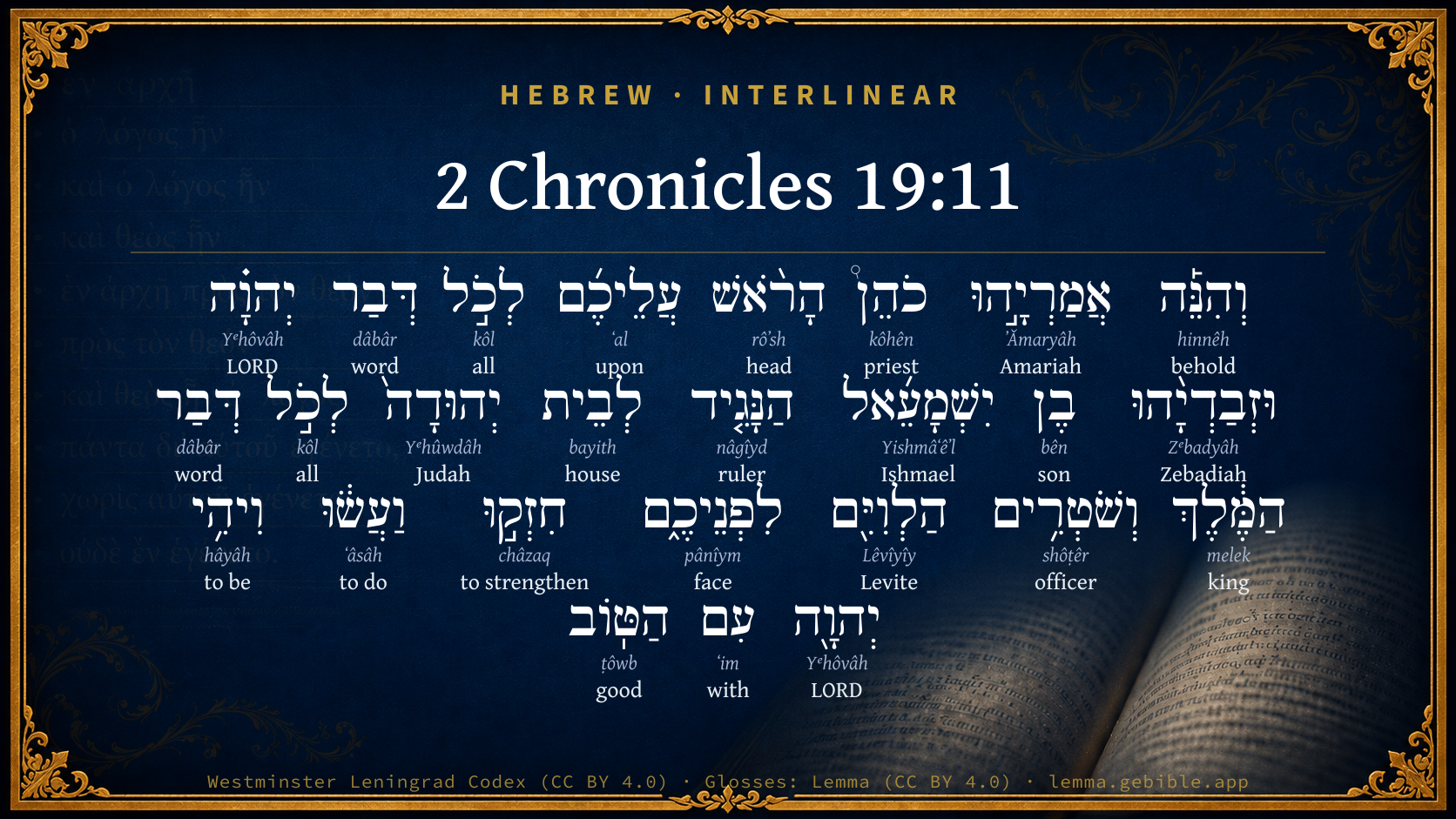
2 Chronicles 19:11

Hebrew (Westminster Leningrad Codex) 2 Chronicles 19:11 appears in the Hebrew Old Testament. The text above is from the Westminster Leningrad Codex. Each word links to its Strong’s number, a concise gloss, and parsing drawn from the Open Scriptures Hebrew Bible morphology. Click any word for its full Brown-Driver-Briggs (BDB) entry.
Download image
Cite this verse

2 Chronicles 19:11 (World English Bible). Public Domain. Lemma interlinear Bible study tool, https://lemma.gebible.app/v/2-chronicles/19/11.

Show BibTeX & RIS
BibTeX
RIS
English Translation
Behold, Amariah the chief priest is over you in all matters of Yahweh; and Zebadiah the son of Ishmael, the ruler of the house of Judah, in all the king's matters: also the Levites shall be officers before you. Deal courageously, and Yahweh be with the good.
World English Bible · Public Domain
Download a study sheet

One document with this verse’s original text, its word-by-word gloss line, the meaning frame, cross-references with their text, attributed commentary, and full source and license credits — printable, and it pastes into notes with its structure intact.

This verse Autodidact and up

Study sheet (.html) Plain text (.txt)

A passage Seminary Student

Up to 50 verses in one chapter. A passage sheet keeps up to 6 commentary sources and 12 cross-references per verse, in the order this page ranks them, and says so on the sheet whenever that leaves anything out. Ask for a single verse and you get the Autodidact verse sheet above.

Everything on this page stays free to read, with no account — the sheet is a download of what is already on screen, not access to it.

Want to remove ads? Support Godless Engineer
Compare translations 3

The same verse in 3 English versions, stacked beneath the original-language interlinear above. Click any original word for its lexicon entry.

Each is an independent rendering of the whole verse — the interlinear is not word-aligned to these translations.

Highlighted words mark where these versions differ — a whole-verse word diff, not a word-by-word alignment.

  • World English Bible Public Domain
    Behold, Amariah the chief priest is over you in all matters of Yahweh; and Zebadiah the son of Ishmael, the ruler of the house of Judah, in all the king's matters: also the Levites shall be officers before you. Deal courageously, and Yahweh be with the good.
  • King James Version Public Domain
    And, behold, Amariah the chief priest is over you in all matters of the LORD; and Zebadiah the son of Ishmael, the ruler of the house of Judah, for all the king's matters: also the Levites shall be officers before you. Deal courageously, and the LORD shall be with the good.
  • unfoldingWord Literal Text CC BY-SA 4.0
    And behold, Amariah the head priest is over you all for any matter of Yahweh. And Zebadiah, the son of Ishmael, is the leader of the house of Judah for any matter of the king. And officials of the Levites are before you all. Be strong and act! And let Yahweh be with the good!”

unfoldingWord Literal Text — © unfoldingWord, licensed CC BY-SA 4.0. Word-aligned USFM3 via Door43 (git.door43.org/unfoldingWord/en_ult).

Versions to compare (up to 4)

3 of 4 selected

Show all 18 translations

Every available English version of this verse, each an independent rendering of the whole verse.

  • World English Bible Public Domain
    Behold, Amariah the chief priest is over you in all matters of Yahweh; and Zebadiah the son of Ishmael, the ruler of the house of Judah, in all the king's matters: also the Levites shall be officers before you. Deal courageously, and Yahweh be with the good.
  • Berean Standard Bible Public Domain
    Note that Amariah, the chief priest, will be over you in all that pertains to the LORD, and Zebadiah son of Ishmael, the ruler of the house of Judah, in all that pertains to the king. And the Levites will serve as officers before you. Act resolutely; may the LORD be with the upright!”
  • Majority Standard Bible Public Domain
    Note that Amariah, the chief priest, will be over you in all that pertains to the LORD, and Zebadiah son of Ishmael, the ruler of the house of Judah, in all that pertains to the king. And the Levites will serve as officers before you. Act resolutely; may the LORD be with the upright!”
  • King James Version Public Domain
    And, behold, Amariah the chief priest is over you in all matters of the LORD; and Zebadiah the son of Ishmael, the ruler of the house of Judah, for all the king's matters: also the Levites shall be officers before you. Deal courageously, and the LORD shall be with the good.
  • American Standard Version (1901) Public Domain
    And, behold, Amariah the chief priest is over you in all matters of Jehovah; and Zebadiah the son of Ishmael, the ruler of the house of Judah, in all the king's matters: also the Levites shall be officers before you. Deal courageously, and Jehovah be with the good.
  • Revised Version (1885) Public Domain
    And, behold, Amariah the chief priest is over you in all matters of the LORD; and Zebadiah the son of Ishmael, the ruler of the house of Judah, in all the king’s matters: also the Levites shall be officers before you. Deal courageously, and the LORD be with the good.
  • Geneva Bible (1599) Public Domain
    And behold, Amariah the Priest shalbe the chiefe ouer you in all matters of the Lord, and Zebadiah ye sonne of Ishmael, a ruler of the house of Iudah, shalbe for al the Kings affaires, and the Leuites shalbe officers before you. Bee of courage, and doe it, and the Lord shalbe with the good.
  • Douay-Rheims (1899) Public Domain
    And Amarias the priest your high priest shell be chief in the things which regard God: and Zabadias the son of Ismahel, who is ruler in the house of Juda, shall be over those matters which belong to the king's office: and you have before you the Levites for masters, take courage and do diligently, and the Lord will be with you in good things.
  • Young's Literal Translation Public Domain
    `And, lo, Amariah the head priest `is' over you for every matter of Jehovah, and Zebadiah son of Ishmael, the leader of the house of Judah, `is' for every matter of the king, and officers the Levites `are' before you; be strong and do, and Jehovah is with the good.'
  • Literal Standard Version CC BY-SA 4.0
    And behold, Amariah the head priest [is] over you for every matter of YHWH, and Zebadiah son of Ishmael, the leader of the house of Judah, [is] for every matter of the king, and the Levites [are] officers before you; be strong and do, and YHWH is with the good.”
  • Unlocked Literal Bible CC BY-SA 4.0
    See, Amariah the chief priest is over you in all the matters of Yahweh. Zebadiah son of Ishmael, the leader of the house of Judah, is in charge of all the matters of the king. Also, the Levites will be officers serving you. Be strong and obey your instructions, and may Yahweh be with those who are good.”
  • unfoldingWord Literal Text CC BY-SA 4.0
    And behold, Amariah the head priest is over you all for any matter of Yahweh. And Zebadiah, the son of Ishmael, is the leader of the house of Judah for any matter of the king. And officials of the Levites are before you all. Be strong and act! And let Yahweh be with the good!”
  • Darby Bible Public Domain
    And behold, Amariah the chief priest is over you in all matters of Jehovah, and Zebadiah the son of Ishmael, prince of the house of Judah, in all the king's matters; and ye have the Levites before you as officers. Be strong and do it, and Jehovah will be with the good.
  • World Messianic Bible Public Domain
    Behold, Amariah the chief priest is over you in all matters of the LORD; and Zebadiah the son of Ishmael, the ruler of the house of Judah, in all the king’s matters. Also the Levites shall be officers before you. Deal courageously, and may the LORD be with the good.”
  • Webster's Bible Public Domain
    And behold, Amariah the chief priest is over you in all matters of the LORD; and Zebadiah the son of Ishmael, the ruler of the house of Judah, for all the king's matters: also the Levites shall be officers before you. Deal courageously, and the LORD will be with the good.
  • Free Bible Version CC BY-SA 4.0
    Amariah, the chief priest, will make the final decision for you in everything that relates to the Lord, and Zebadiah, son of Ishmael, the leader of the tribe of Judah, in all that relates to the king. The Levites will serve as officers to assist you. Be firm, and may the Lord be with those who do what is right.”
  • Bible in Basic English Public Domain
    And now, Amariah, the chief priest, is over you in all questions to do with the Lord; and Zebadiah the son of Ishmael, the head of the family of Judah, in everything to do with the king's business; and the Levites will be overseers for you. Be strong to do the work; and may the Lord be with the upright.
  • JPS Tanakh (1917) Public Domain
    And, behold, Amariah the chief priest is over you in all matters of the LORD; and Zebadiah the son of Ishmael, the ruler of the house of Judah, in all the king's matters; also the officers of the Levites before you. Deal courageously, and the LORD be with the good.'

Literal Standard Version (2020), Covenant Press — licensed CC BY-SA 4.0. Text via the HelloAO Bible API (eBible.org). Unlocked Literal Bible (unfoldingWord) — licensed CC BY-SA 4.0. Text via the HelloAO Bible API (eBible.org). unfoldingWord Literal Text — © unfoldingWord, licensed CC BY-SA 4.0. Word-aligned USFM3 via Door43 (git.door43.org/unfoldingWord/en_ult). Free Bible Version, Dr. Jonathan Gallagher — licensed CC BY-SA 4.0. Text via the HelloAO Bible API (eBible.org).

Word by word

More ways to search: Search by grammar → Find every occurrence → Compare this word →

Practice this passage: Drill this verse → Learn its vocabulary →

וּזְבַדְיָ֨הוּ
Zᵉbadyâh
H2069
“and · Zebadiah”
Conjunction + Noun, Proper
Part of Speech
Conjunction + Noun
Type
Proper
Full BDB Definition

Origin: from H2064 and H3050

TWOT: None

Zebadiah = "endowment of Jehovah" - a Benjamite of the sons of Beriah - a Benjamite of the sons of Elpaal - one of the sons of Jeroham of Gedor and one of David's men - son of Asahel, brother of Joab, and one of David's men - son of Michael, of the sons of Shephatiah - a priest of the sons of Immer, who had a foreign wife in the time of Ezra - a Levite, 3rd son of Meshelemiah the Korhite - a Levite in the reign of Jehoshaphat - son of Ishmael and prince of the house of Judah in the reign of Jehoshaphat
  1. וְהִנֵּ֡ה hinnêh H2009 “and · behold” Conjunction + Particle, Demonstrative
  2. אֲמַרְיָ֣הוּ ʼĂmaryâh H568 “Amariah” Noun, Proper
  3. כֹהֵן֩ kôhên H3548 “priest of” Noun, Common, Masculine, Singular, Construct
  4. הָרֹ֨אשׁ rôʼsh H7218 “the · head” Particle, Definite Article + Noun, Common, Masculine, Singular, Absolute
  5. עֲלֵיכֶ֜ם ʻal H5921 “upon · you” Preposition + Suffix, Personal, 2nd Person, Masculine, Plural
  6. לְכֹ֣ל kôl H3605 “to/for · all of” Preposition + Noun, Common, Masculine, Singular, Construct
  7. דְּבַר dâbâr H1697 “word of” Noun, Common, Masculine, Singular, Construct
  8. יְהוָ֗ה Yᵉhôvâh H3068 “LORD” Noun, Proper
  9. בֶן bên H1121 “son of” Noun, Common, Masculine, Singular, Construct
  10. יִשְׁמָעֵ֜אל Yishmâʻêʼl H3458 “Ishmael” Noun, Proper
  11. הַנָּגִ֤יד nâgîyd H5057 “the · ruler” Particle, Definite Article + Noun, Common, Masculine, Singular, Absolute
  12. לְבֵית bayith H1004 “to/for · house of” Preposition + Noun, Common, Masculine, Singular, Construct
  13. יְהוּדָה֙ Yᵉhûwdâh H3063 “Judah” Noun, Proper
  14. לְכֹ֣ל kôl H3605 “to/for · all of” Preposition + Noun, Common, Masculine, Singular, Construct
  15. דְּבַר dâbâr H1697 “word of” Noun, Common, Masculine, Singular, Construct
  16. הַמֶּ֔לֶךְ melek H4428 “the · king” Particle, Definite Article + Noun, Common, Masculine, Singular, Absolute
  17. וְשֹׁטְרִ֥ים shôṭêr H7860 “and · officer” Conjunction + Verb, Qal, Participle Active, Masculine, Plural, Absolute
  18. הַלְוִיִּ֖ם Lêvîyîy H3881 “the · Levites” Particle, Definite Article + Noun, Gentilic, Masculine, Plural, Absolute
  19. לִפְנֵיכֶ֑ם pânîym H6440 “to/for · face(s) · your” Preposition + Noun, Common, Both, Plural, Construct + Suffix, Personal, 2nd Person, Masculine, Plural
  20. חִזְק֣וּ châzaq H2388 “strengthen” Verb, Qal, Imperative, 2nd Person, Masculine, Plural
  21. וַעֲשׂ֔וּ ʻâsâh H6213 “and · do” Conjunction + Verb, Qal, Imperative, 2nd Person, Masculine, Plural
  22. וִיהִ֥י hâyâh H1961 “and · to be” Conjunction + Verb, Qal, Imperfect, 3rd Person, Masculine, Singular
  23. יְהוָ֖ה Yᵉhôvâh H3068 “LORD” Noun, Proper
  24. עִם ʻim H5973 “with” Preposition
  25. הַטּֽוֹב ṭôwb H2896 “the · good” Particle, Definite Article + Adjective, Adjective, Masculine, Singular, Absolute

About this verse

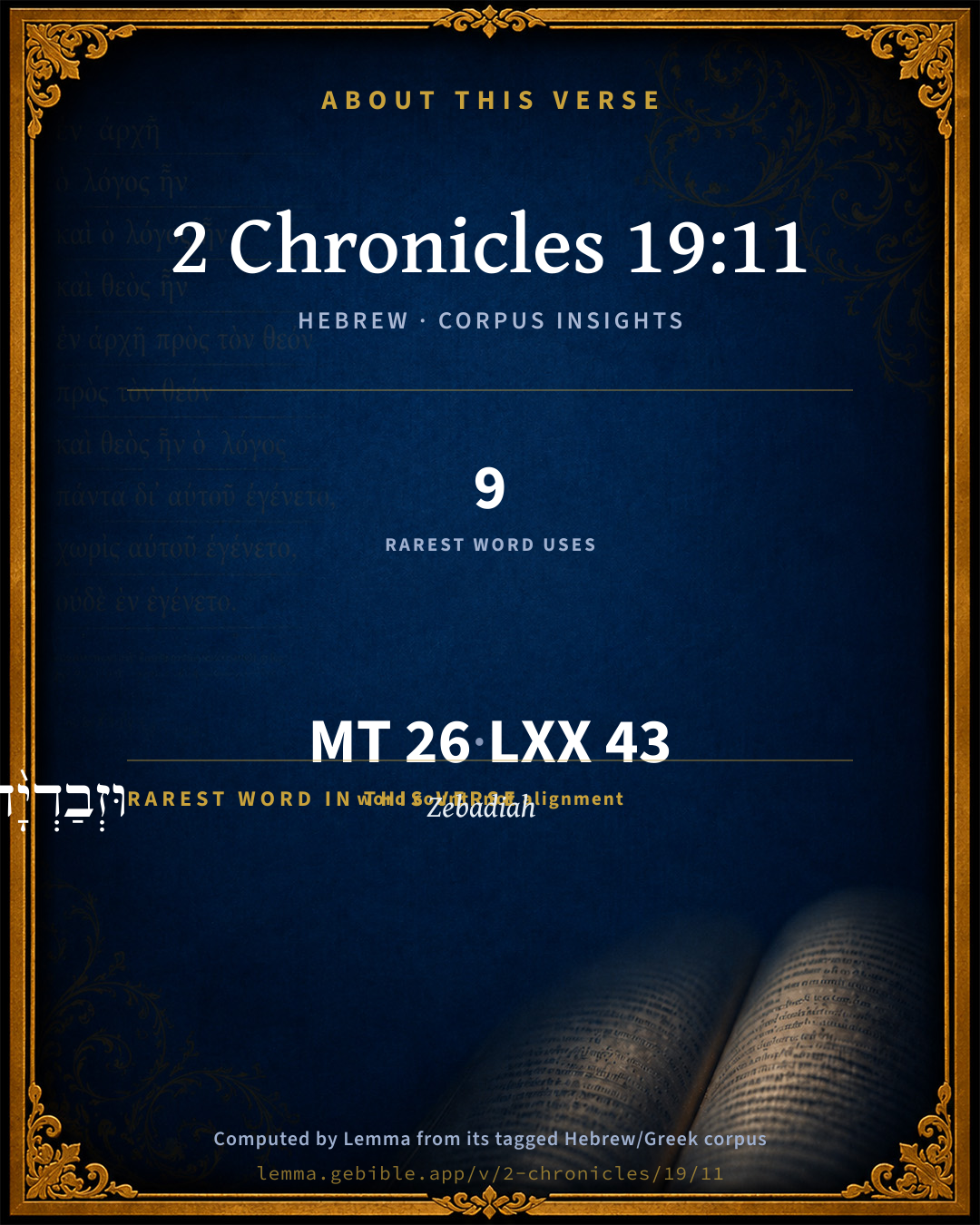
These counts appear in no published source. They are computed here, from the morphology-tagged text and Lemma’s own curated glosses. What Lemma adds →

26
words
23
distinct lemmas
Historical
section

Notable vocabulary

The rarest word here is וּזְבַדְיָ֨הוּ Zebadiah H2069 — appearing just 9 times in the whole Hebrew Bible.

Shared distinctive vocabulary

וּזְבַדְיָ֨הוּ Zebadiah H2069 occurs in 9 verses of the Hebrew Bible. Also found in:

Grammatical profile

  • 4 verbs
  • 18 nouns
  • 1 adjective
  • 2 prepositions
  • 1 particle

Verb forms

  • וְשֹׁטְרִ֥ים Qal · Participle Active
  • חִזְק֣וּ Qal · Imperative
  • וַעֲשׂ֔וּ Qal · Imperative
  • וִיהִ֥י Qal · Imperfect

Repetition

Words recur within this verse — often emphatic in Hebrew:

  • לְכֹ֣ל all H3605 ×2
  • דְּבַר word H1697 ×2
  • יְהוָ֗ה LORD H3068 ×2

Hebrew & Septuagint length

In English translation the verse runs 47 words from the Hebrew and 54 from the Septuagint (LXX English) — closely comparable.

A rough comparison of the two English renderings, which tokenize alike — not a word-level alignment.

Word counts can differ between the Hebrew and the Greek without any difference in meaning — e.g. the Hebrew direct-object marker אֵת has no separate Greek word, and Greek often adds the article ὁ.

In the original languages it is 26 Hebrew tokens and 43 Greek tokens — but the two are counted differently (Hebrew bundles its prefixes and suffixes into one token; the Greek is in lemma form), so that isn’t a like-for-like length.

Cross-references

24

Topical passages linked to 2 Chronicles 19:11 in the Treasury of Scripture Knowledge — connected by theme and wording, ordered by reader-vote popularity; previews shown in the World English Bible.

  • 2 Chronicles 19:8 Moreover in Jerusalem did Jehoshaphat set of the Levites and the priests, and of the heads of the fathers' [houses] of Israel, for the judgment of Yahweh, and for controversies. They returned to Jerusalem.
  • Psalms 18:25–26 With the merciful you will show yourself merciful. With the perfect man, you will show yourself perfect.
  • Philippians 4:8–9 Finally, brothers, whatever things are true, whatever things are honorable, whatever things are just, whatever things are pure, whatever things are lovely, whatever things are of good report; if there is any virtue, and if there is any praise, think about these things.
  • 2 Timothy 2:1 You therefore, my child, be strengthened in the grace that is in Christ Jesus.
  • Joshua 1:6 Be strong and of good courage; for you shall cause this people to inherit the land which I swore to their fathers to give them.
  • Joshua 1:9 Haven't I commanded you? Be strong and of good courage; don't be afraid, neither be dismayed: for Yahweh your God is with you wherever you go.
  • 1 Chronicles 6:11 and Azariah became the father of Amariah, and Amariah became the father of Ahitub,
  • 1 Chronicles 22:11 Now, my son, Yahweh be with you; and prosper you, and build the house of Yahweh your God, as he has spoken concerning you.
  • 1 Chronicles 22:16 of the gold, the silver, and the brass, and the iron, there is no number. Arise and be doing, and Yahweh be with you.
  • 1 Chronicles 22:19 Now set your heart and your soul to seek after Yahweh your God; arise therefore, and build the sanctuary of Yahweh God, to bring the ark of the covenant of Yahweh, and the holy vessels of God, into the house that is to be built to the name of Yahweh.
  • 1 Chronicles 26:30 Of the Hebronites, Hashabiah and his brothers, men of valor, one thousand seven hundred, had the oversight of Israel beyond the Jordan westward, for all the business of Yahweh, and for the service of the king.
  • 1 Chronicles 28:20 David said to Solomon his son, Be strong and of good courage, and do it: don't be afraid, nor be dismayed; for Yahweh God, even my God, is with you; he will not fail you, nor forsake you, until all the work for the service of the house of Yahweh is finished.
  • 2 Chronicles 15:2 and he went out to meet Asa, and said to him, Hear you me, Asa, and all Judah and Benjamin: Yahweh is with you, while you are with him; and if you seek him, he will be found of you; but if you forsake him, he will forsake you.
  • 2 Chronicles 19:6 and said to the judges, Consider what you do: for you don't judge for man, but for Yahweh; and [he is] with you in the judgment.
  • Psalms 37:23 A man's goings are established by Yahweh. He delights in his way.
  • Psalms 112:5 It is well with the man who deals graciously and lends. He will maintain his cause in judgment.
  • Proverbs 2:20 That you may walk in the way of good men, And keep the paths of the righteous.
  • Ecclesiastes 2:26 For to the man who pleases him, God gives wisdom, knowledge, and joy; but to the sinner he gives travail, to gather and to heap up, that he may give to him who pleases God. This also is vanity and a chasing after wind.
  • Malachi 2:7 For the priest's lips should keep knowledge, and they should seek the law at his mouth; for he is the messenger of Yahweh of Hosts.
  • Luke 23:50 Behold, a man named Joseph, who was a member of the council, a good and righteous man
  • John 14:23–24 Jesus answered him, "If a man loves me, he will keep my word. My Father will love him, and we will come to him, and make our home with him.
  • Acts 11:24 For he was a good man, and full of the Holy Spirit and of faith, and many people were added to the Lord.
  • Romans 2:4–13 Or do you despise the riches of his goodness, forbearance, and patience, not knowing that the goodness of God leads you to repentance?
  • 1 Corinthians 16:13 Watch! Stand firm in the faith! Be courageous! Be strong!

Cross-references courtesy of OpenBible.info (CC BY 4.0).

Hebrew and Greek witnesses Masoretic Hebrew ↔ Greek Septuagint

The same verse in the two great witnesses to the Old Testament, shown verse-for-verse.

These are two independent witnesses, not word-aligned to each other, and the Septuagint is shown in lemma (dictionary) form.

Hebrew 2 Chronicles 19:11 Masoretic · Westminster Leningrad Codex

וְהִנֵּ֡ה אֲמַרְיָ֣הוּ כֹהֵן֩ הָרֹ֨אשׁ עֲלֵיכֶ֜ם לְכֹ֣ל דְּבַר יְהוָ֗ה וּזְבַדְיָ֨הוּ בֶן יִשְׁמָעֵ֜אל הַנָּגִ֤יד לְבֵית יְהוּדָה֙ לְכֹ֣ל דְּבַר הַמֶּ֔לֶךְ וְשֹׁטְרִ֥ים הַלְוִיִּ֖ם לִפְנֵיכֶ֑ם חִזְק֣וּ וַעֲשׂ֔וּ וִיהִ֥י יְהוָ֖ה עִם הַטּֽוֹב

Behold, Amariah the chief priest is over you in all matters of Yahweh; and Zebadiah the son of Ishmael, the ruler of the house of Judah, in all the king's matters: also the Levites shall be officers before you. Deal courageously, and Yahweh be with the good.

World English Bible · Public Domain

Greek LXX 2 Chronicles 19:11 Septuagint · lemma form

καί ἰδού αμαριας ὁ ἱερεύς ἡγέομαι ἐπί σύ εἰς πᾶς λόγος κύριος καί ζαβδιας υἱός ισμαηλ ὁ ἡγέομαι εἰς οἶκος ἰουδά πρός πᾶς λόγος βασιλεύς καί ὁ γραμματεύς καί ὁ λευείτης πρό πρόσωπον σύ ἰσχύω καί ποιέω καί εἰμί κύριος μετά ὁ ἀγαθός

And, behold, Amarias the priest is head over you in every matter of the Lord; and Zabdias the son of Ismael is head over the house of Juda in every matter of the king; and the scribes and Levites are before you: be strong and active, and the Lord shall be with the good.

LXX2012 (modern English Septuagint) · Public Domain

Hebrew: Westminster Leningrad Codex (CC BY 4.0). Greek: Septuagint (public domain); English from LXX2012 (modern English Septuagint) (Public Domain). How the Septuagint differs from the Hebrew →

Commentary

Notes on 2 Chronicles 19:11 from classic Christian and Jewish commentators (each source and its license shown beneath its notes). The classic Christian expositions comment on the surrounding passage and are grouped to its opening verse, so a note may address several verses; the Jewish commentaries on the Tanakh (Rashi and others) are per-verse, so they appear only where the commentator wrote on this verse.

Lemma curates 59 commentaries, every one of them public domain or Creative Commons licensed, each selected and text-cleaned for this edition rather than reprinted as found. About our sources →

Trapp's Complete Commentary

John Trapp

2Ch 19:11 And, behold, Amariah the chief priest [is] over you in all matters of the LORD; and Zebadiah the son of Ishmael, the ruler of the house of Judah, for all the king’s matters: also the Levites [shall be] officers before you. Deal courageously, and the LORD shall be with the good.

Ver. 11. In all the matters of the Lord.] In matters ecclesiastical.

For all the king’s matters,] i.e., In civil affairs.

And the Levites shall be officers before you.] Apparitores, lectores, praefecti, to see things rightly carried and good laws executed. The Greeks had their νομοφυλακας, officers of the same sort.

Deal courageously.] Heb., Take courage and do, {a} i.e., do your office, forti et excelso animo. Fear no colours, but act vigorously, and the work is done. Possunt, saith he, quia posse videntur. They are able who seem to be able. Historians ascribe most of Alexander’s success to his courage: he never thought anything unfeasible. The ruler’s offering must be a male; the people’s might be a female, {Lev 4:22-23; Lev 4:27-28} to show that a ruler or judge must be of a masculine spirit.

And the Lord shall be with the good.] To protect and direct them; to assist and accept them; to reward their integrity, what hardship soever here they meet with: as Judge Hales did, being imprisoned in the Marshalsea, Counter, and Fleet, because that in the beginning of Queen Mary’s reign, before any new laws were yet made, he did at the Quarter Sessions give charge upon the statutes made in the time of King Henry VIII and Edward VI, for supremacy and religion. {b}

{a} Audete et agite. , Be prepared and act.

{b} Act. and Mon., 1282.

John Trapp, A Commentary or Exposition upon All the Books of the Old and New Testament (1647–1656) — public domain. Text from a community e-Sword module.

The Biblical Illustrator

Joseph S. Exell

2Ch_19:11

Deal courageously, and the Lord shall be with the good.

The blessedness of the good

I. Who are the good? The Scripture points out two things on this subject.

1. The only way in which men become good--by faith in Christ and the consequent reception of the Holy Spirit to create us anew.

2. The principal ingredients of the goodness of the regenerate.

(1) Integrity of character.

(2) Benevolence of character.

(3) Piety of character.

II. The meaning of this declaration and how its truth is supported. The Lord shall be with the good. This means that the Lord will be with them in the supply of His Spirit, in providing for them in providence, preserving them from trouble, supporting them in it, or delivering them out of it, and blessing others for their sakes. This truth is justified--

1. From the purposes of God and the relation in which His people stand to Him.

2. By the promises of Scripture.

3. By all experience and by all history.

Conclusion:

1. He shall be with the good nationally if they act consistently and faithfully.

2. He shall be with them individually. Fear not that He will ever leave His work of grace unfinished in you. (J. Leifchild.)

A tonic promise

Explain what is meant by good. The melancholy fact that all men are not good. The promise of the text justifies three inquiries.

1. Why should the good be fearful? They that be with us, etc.

2. How can bad designs finally prevail?

3. How are men to know that God is surely with them?

The answer involves character: the good. God identifies Himself with all that is good in thought as well as in act; in purpose as well as in service. Even when the godly man ceaseth God will maintain the cause that is good. This promise, like all the promises of God, is designated not as a sedative, but a stimulant. Deal courageously! See how the text might have read: The Lord shall be with the good, therefore sit still; the Lord shall be with the good, therefore let wickedness have its own way in the world; the Lord shall be with the good, therefore pay no attention to self-discipline. The text reads contrariwise. The Lord is with the good, therefore deal courageously. Goodness is not to be merely passive--it is to be aggressive, defiant of all evil. (J. Parker, D. D.)

Courage

Probably few of us ever sufficiently consider the value and need of courage in order to any high condition of character. There are to be found in one of the letters of one of the most interesting men of modern times these words, How rare is it to have a friend who will defend you thoroughly and boldly! Mr.

missed an opportunity of doing this for me, and has not the courage to do it now as he ought to do, leaving me in consequence defenceless against a slander, though I put the proof into his hands. How indispensable strength is for high goodness-strength moral or intellectual, neither depending necessarily on physical strength. Many a man neglects to live a Christian life not because he lacks Christian sympathies, sentiments, and feelings, not even because he has no Christian ideas, but simply for lack of courage to put himself where he properly belongs. This lack of courage denotes, of course, either want of confidence in himself or want of depth of feeling as to religious truth, or fear of some man or men, which fear has too much influence over him to allow him to act conscientiously and in the line of his best sympathies.

1. In speaking of courage let us recognise that there is animal courage as well as intellectual and moral courage. Animal courage is of the lowest kind. Oftentimes it is nothing more than bull-dog ferocity. It oftentimes makes men good soldiers, successful pugilists, stalwart seamen--even daring adventurers. Men may have it without any intellectual or moral courage. A little of it is good. An excess tends to brutality. This form of courage--the courage to take physical punishment without flinching--is of a kind which the most uncultured and unrefined can appreciate. It will always have an attraction for the coarse, undeveloped, and unrespectable classes of society.

2. Intellectual courage is of another order, and indicates a superior type of man. It means practically the ability to think for ones self, and to follow out ones thinkings to their inevitable conclusions. It is necessary, however, to guard this language. Taking opinions into ones mind is not thinking. There is a period in our life when we have more conceit than wisdom, and more independence than politeness. We say to ourselves and others that we mean to do our own thinking, which often amounts to this--that we mean to assert ourselves as not agreeing with certain persons who are said to be narrow and exclusive, and agreeing with those who shake themselves free from everybody else except a few intellectual rakes and dandies. Alas, how silly it all seems when we get a little older! Then it appears to us that it was the want of ability to think which made us so impertinent and ridiculous. Of course all young birds have to learn to do their own flying, and, after rolling and tumbling about for awhile, they settle down to do it precisely after the fashion of the old birds. So, also, with thinking. From the beginning even until now it has been done in exactly the same way. The process has consisted of the discernments of comparisons and contrasts, likenesses and unlikenesses, of induction, deduction, and inference. Every man has to do his own thinking to some extent, as every man has to do his own sating and his own digesting. There is no possibility of any one eating our food for us, or digesting it for us. And no man can possibly begin at the beginning of things, and think out each problem of life as if no one had been on the earth before him. The present is so related to the past, as that the past is in it and the future is in it. Everything is in the present. We inherit the earth, not as it first came out from the hands of the Creator before man was on it, but as it is, modified by mans co-operation with God. So of everything--that which is moral and mental as well as that which is material. In each department of things there are men who have thinking power and erudition far, far beyond what is possible to us. In each department they are our helpers, our instructors; yes, our masters. That independence which we assume in youth is only ignorance, foolishness, unthinkingness. The greatest men the world has ever known have been the most receptive and dependent men; the most diligent students, the aptest learners. If I am to learn painting it would be folly indeed if I said, I am going to be independent of Murillo and Raphael, of Turner and Correggio and Rubens and all other artists who have gone before me. So in music the man who thinks for himself and never appropriates the science of others is idiotic. So everywhere in all departments. Not less so in theology, the revelation of God and of man, and of the relation of the human to the Divine. If I set up on my own account, and did not open my mind to the thinkings of others, the name of Verdant Green would be the only name that could fit me. I would have our younger people distinguish between two ideas which are very distinct, and yet are often confounded the one with the other--viz., thinking for ones self and cultivating a spirit of truth. The truth is that which corresponds to the fact. As a fact reports itself to your mind that is the truth for you. By and by as your mind grows it may report itself somewhat differently, then there will be something added to the original impression, and that will be the truth. Now, intellectual courage consists in this perfect truthfulness--this faithfulness to report what you see and recognise. It may sometimes put you in seeming inconsistency with yourself. It may subject you to being accused of inconsistency. But never mind. God does not ask us to be consistent--on that shallow view of consistency--but to be faithful and true. There is a deeper consistency--a nobler consistency. If I see a thing very partially in youth, because of the undeveloped condition of my mind, and see it more completely in manhood, because I have had more experience and more vision; if I truly say what I saw then and truly say what I see now, though I see now more than I saw then, am I not consistent--more nobly consistent--than I should be if I were afraid, under more experience, to contradict my former self? What is life for if not to educate us into deeper and larger views of truth? Only we must take good heed that they are deeper and larger. Many people change, but their change is not growth. Let us recognise that, in order to be assured of the leading of the Spirit of God into all truth, we must have intellectual courage--the courage to follow the truth wherever it leads and to own up to believing that it is the truth. Often it takes even sublime courage to do it. Every child ought to read the story of the martyrs of old. It is dreadful to think how little the religion of some of us means. The loss of the ability to grow deep-rooted convictions, and the loss of courage to be faithful in owning to them, is, wherever it occurs, a dreadful loss. It means the loss of that nobility of soul the possession of which is one of the surest marks of our being children of God.

3. But of all kinds of courage, moral courage is the noblest. Of course it enters into intellectual courage. The two are not distinct, and yet while intellectual courage implies thinking power and faithful following where the light seems to be, moral courage does not necessarily mean the courage of the crack thinker, but the courage of character; the courage which acts conscientiously in trying circumstances. For instance, the liar is always the coward. A man lies because he has not the courage to speak the truth and take the consequences. There is one exception to that rule. It is conceivable that a really truthful man might need courage to tell a lie which he thought would shelter a friend from injury or harm. My intellect may sometimes stand in contradiction to my conscience, but conscience is given me to act by. In matters of duty, therefore, I am bound to obey my conscience rather than my intellect. Hence moral courage amounts pretty much to this--the steady, persistent following of the light which is in conscience. It involves, of course, the bringing of the conscience into the light, where it may be illuminated, for conscience is a light receiver, not a light originator. Courage, and much of it, is needed to act always and everywhere conscientiously. Intelligence is needed to distinguish between conscience and prejudice. Many a man assumes to be acting conscientiously when he is really acting only from prejudice and feeling. If he quietly took himself to task, he would recognise his true motive. Conscience represents Gods judgment throne. The very fact that a man condemns himself in spite of his natural unwillingness to do it, proves that the voice of conscience is not his own voice.

4. But how are we to get the courage we need--intellectual courage to follow the truth wherever it leads, to utter it always in love, but to utter it; and the moral courage to obey conscience? Where did those apostles in the early Christian days get theirs? Few of them were more than average men. At the approach of calamity all the disciples forsook Jesus and fled. If there was an exception it was John. Peter disgraced himself pitifully. Yet within a few weeks we find men of such sublime courage that we hardly recognise them as the same men. Not Luther himself at the Diet of Worms, challenging the old ecclesiastical order of centuries, was braver. Not the Prince de Conde was braver as he stood before the King of France when given the choice of three things--first, to go to Mass; second, to die; third, to be imprisoned for life. He replied with regard to the first, I am fully determined never to go to Mass; as to the other two I am so perfectly indifferent that I leave the choice to your Majesty. These are illustrations of the noble courage of noble men. They seem phenomenal and unusual. But there may be here amongst us men and women, yes, and children, capable of as determined a courage if put in similar circumstances. None of us can tell what we should do in any condition till we get there. It requires as much courage to suffer and be quiet and self-controlled as it does to act. Nothing is more admirable than the quiet domestic courage which many illustrate. I am inclined to adopt and endorse the words of one who has written, few persons have courage enough to appear as good as they really are. That is the essence of moral courage. The religious life of business men is very shy and timid. There are men in this and every congregation who feel and believe more--far more--than they act. Sydney Smith has said that a great deal of talent is lost to the world for the want of a little courage. With more truth still we may say that a great deal of influence is lost to the Church for want of a little courage. I believe that few persons have the courage to appear as good as they really are. Courage is opposed to the spirit of compromise--the spirit of indolence--the spirit of silence when silence will be interpreted as consent on our part to what we do not believe. The spirit of fear, of indolence, of compromise, of guilty silence has to be overcome. How? The Spirit of God is granted to every seeking soul that the soul may overcome. (Reuen Thomas, D.D.)

.

The Biblical Illustrator, edited by Joseph S. Exell (c. 1880s–1900s) — public domain. Text from a community e-Sword module.

Joseph Benson's Commentary

2Ch 19:11. The chief priest is over you — Shall be your president to direct and assist you; in all matters of the Lord — In spiritual or ecclesiastical matters. And Zebadiah, the ruler of the house of Judah — The prince, or chief ruler, under the king, of the tribe of Judah; for all the king’s matters — For civil causes, or controversies, either between the king and his people, or between subject and subject, which may be called the king’s matters, because it was a principal part of his office to see them justly decided. The Levites shall be officers before you — Shall be at your command, to see your just sentences executed; which work was fitly committed to the Levites, as persons who might add their instructions to the corrections, and might bring the guilty to an acknowledgment of their fault, and a submission to their punishment. Deal courageously — Act with resolution, and fear not the face of man; but be bold and daring in the discharge of your duty. And the Lord shall be with the good — Shall protect and bless good judges in their pronouncing just sentences, and doing good things.

Joseph Benson's Commentary on the Old and New Testaments (1811–1818) — public domain. Text from a community e-Sword module.

Geneva Bible (1599)

Geneva Bible translators

They shall have the handling of inferior causes.

Shall be chief overseer of the public’s affairs of the Realm.

God will assist them that do justice.

Geneva Bible (1599) marginal notes — public domain. Text via Bolls.life.

Adam Clarke's Commentary

Verse 11. Behold, Amariah] Here was a two-fold jurisdiction, ecclesiastical and civil: in the ecclesiastical court, Amariah the high-priest was supreme judge, in the civil court, Zebadiah was supreme. To assist both the Levites were a sort of counsellors.

WITHOUT good and wholesome laws, no nation can be prosperous: and vain are the best laws if they be not judiciously and conscientiously administered. The things of GOD and the things of the KING should never be confounded in the administration of justice. Amariah the priest, and Zebadiah the ruler, should ever have their distinct places of jurisdiction.

Adam Clarke's Commentary on the Bible (1810–1826) — public domain. Text from a community e-Sword/MySword module.

Ellicott's Commentary for English Readers

(11) And behold.—For the form of the sentence, comp. 1Ch_28:21.

Amariah the chief priest.—Rather, High Priest (ha-rosh), the Head (2Ch_24:6). Vulg., “sacerdos et pontifex vester.” In 1Ch_6:11 Amariah is the fifth from Zadok, the famous High Priest of David and Solomon’s time. As Jehoshaphat was the fifth king from David, the name Amariah probably denotes the same person in both places.

Over you in all matters of the Lord.—The High Priest was naturally declared the President of the Court in all spiritual cases (see on 2Ch_19:8).

Zebadiah the son of Ishmael (or, Zachariah the son of Shemaiah, Syr. and Arab.) “the ruler of the house of Judah,” the nagîd, emîr, or tribal prince, was appointed President of the Court in civil causes (“for all the king’s matters”).

Also the Levites shall be officers.—Literally. And Writers shall the Levites be; inferior officials of the Court, such as scribes and notaries.

Before you.—In your presence, and under your direction (2Ch_14:5).

Deal courageously.—Literally, be strong and act. A favourite locution of the chronicler’s. (Comp. 1Ch_28:10; 1Ch_28:20.)

The Lord shall be.—Or, Jehovah be! a wish or prayer. This too is a characteristic expression of the writer. (Comp. 1Ch_9:20, 1Ch_15:2, 1 Chron. 20:17.)

A Bible Commentary for English Readers, edited by Charles John Ellicott (1878–1897) — public domain. Text from a community e-Sword module.

The Cambridge Bible for Schools and Colleges

gen. ed. J. J. S. Perowne

11. Amariah] Perhaps he who is mentioned 1Ch_6:11 [5:37, Heb.].

officers before you] i.e. waiting to execute your instructions.

Deal courageously] Render, Be strong and work (as in Hag_2:4).

shall be with the good] R.V. be with the good (a blessing rather than a promise).

The Cambridge Bible for Schools and Colleges (gen. ed. J. J. S. Perowne; Cambridge University Press, 1878–1918) — public domain. Text from a community e-Sword module.

Albert Barnes' Notes on the Bible

In religious causes, Amariah, the high priest, was to preside over the court; in civil or criminal causes, Zebadiah was to be president. And to Levites, other than the judges, he assigned the subordinate offices about the court.

Albert Barnes' Notes on the Bible (1834–1885) — public domain. Text from a community e-Sword/MySword module.

Haydock's Catholic Bible Commentary

Amarias, (1 Paralipomenon vi. 11.) or rather Azarias, the father of Johanan, 1 Paralipomenon v. 9. --- Office, in civil matters. C. --- Here is a plain distinction between the spiritual and temporal authority, instituted by God, Deut. xvii., and Num. xxvii. W. T. --- Masters. Heb. shoterim, to execute the sentence; (D.) or "officers." --- You. Prot. "with the good." H.

George Leo Haydock (1774–1849), Haydock's Catholic Family Bible and Commentary, 1859 edition — public domain. Excludes Psalms (Douay-Rheims chapter numbering differs from Protestant) and Deuterocanonical books (Catholic canon only).

Matthew Poole's English Annotations

Is over you; shall be your president to direct and assist you.

In all matters of the Lord; in spiritual or ecclesiastical matters.

The ruler of the house of Judah; either,

1. The prince, or chief ruler, under the king, of the tribe of Judah, which is called

the house of Judah, 2Sa 2:4,7,10; 1Ki 12:21,23; 1Ch 28:4; Jer 13:11; Eze 4:6. Or,

2. The ruler of the king’s house, which also seems to be called the house of Judah, 2Ch 22:10, and more fitly the king’s house of Judah, Jer 22:6. And who so fit to manage the king’s matters as the ruler of the king’s house?

For all the king’s matters; for civil causes or controversies which might arise either between the king and his people, or between subject and subject, which may be called the king’s matters, because it was a principal part of his office to see them justly decided.

The Levites shall be officers before you; they shall be at your command to see your just sentences executed; which work was fitly committed to the Levites, as persons who might add their instructions to the corrections, and might work the guilty to an acknowledgment of their fault, and a submission to their punishment. And so this is an argument to encourage the judges to proceed courageously and vigorously in their work, because they had the Levites to stand by them and assist them.

The Lord shall be with the good, i. e. shall protect and bless good judges in their doing of good and just things.

Matthew Poole's English Annotations on the Holy Bible (1683–1685) — public domain. Text from a community e-Sword/MySword module.

Whedon's Commentary on the Bible

Daniel D. Whedon

11. Amariah the chief priest — This dignitary would naturally and of right have oversight of all questions concerning religion and worship, as Zebadiah… the ruler of the house of Judah, (that is, the tribal prince, and probably oldest and most honoured representative of his tribe,) would have oversight of all civil suits that came to Jerusalem.

Matters of the Lord… king’s matters — See the note on 2Ch_19:8.

Daniel D. Whedon (gen. ed.), Commentary on the Old and New Testaments (1874–1909) — public domain. Text from a community e-Sword module.

The Pulpit Commentary

Amariah. Probably the Amariah of 1Ch_7:11. To the priest plainly the sacred causes are entrusted. Zebadiah is not known elsewhere. Officers. (see Exo_5:10) The Lord shall be with the good. (2Ch_15:3, 2Ch_15:4)

The Pulpit Commentary (1880–1919), ed. H.D.M. Spence-Jones & Joseph S. Exell — public domain. Text from a community e-Sword module.

John Wesley's Explanatory Notes

Over you - Shall be your president. Matters of the Lord - In Spiritual, or ecclesiastical matters. Ruler - The prince, or chief ruler, under the king, of the tribe of Judah. The king's matters - For civil causes, or controversies either between the king and his people; or between subject and subject, which may be called the king's matters, because it was a principal part of his office to see them justly decided. The Levites - Shall be at your command to see your just sentences executed; which work was fitly committed to the Levites, as persons who might add their instructions to the corrections, and might work the guilty to an acknowledgement of their fault and a submission to their punishment. The Lord - Shall protect and bless good Judges.

John Wesley, Explanatory Notes Upon the Whole Bible (1754–1765) — public domain. Text via the GEBible commentary corpus.

unfoldingWord translationNotes

Door43 World Missions Community

Connecting Statement:

Jehoshaphat continues to instruct some of the Levites and the priests, and some of the heads of the ancestral houses of Israel, who he appointed to be judges.

General Information:

The words "you" and "your" in this verse refers to those persons Jehoshaphat appointed to be judges.

See, Amariah

"Pay attention, because what I am about to say is both true and important: Amariah"

Amariah ... Zebadiah ... Ishmael

These are the names of men. (See: How to Translate Names)

is over you

"is in charge of you"

of all the matters of the king

Here Jehoshaphat speaks of himself in the third person. This can be translated in the first person. AT: "of all my royal matters" (See: First, Second, or Third Person)

translationWords

chief priests

Levi

unfoldingWord translationNotes — © Distant Shores Media and the Door43 World Missions Community, licensed CC BY-SA 4.0. Source: git.door43.org/Door43/en_tn.

Rashi

Rabbi Shlomo Yitzchaki (Rashi)

and may the Lord be with the good with the one who performs that which is good and upright.

Rashi on the Tanakh — English translations: “The Judaica Press complete Tanach with Rashi, translated by A. J. Rosenberg” (CC BY 4.0); “Pentateuch with Rashi's commentary by M. Rosenbaum and A.M. Silbermann, 1929-1934” (public domain); “The Metsudah Tanach series, Lakewood, N.J” (CC BY 4.0); and “The Book of Joshua, Metsudah Publications, 1997” (CC BY 4.0). Text via Sefaria.

Lesson kit

Teaching starters — assembled from the data on this page, not authored interpretation. Every prompt links to the verse data it draws on. Edit before teaching.

2 Chronicles, in the Historical, opens this verse with 26 words (23 distinct Hebrew lemmas). Its most distinctive word is Zᵉbadyâh (“Zebadiah”). A historical commentator’s framing appears above. Read the whole chapter for the surrounding context.

Discussion questions

  1. What does “Zebadiah” (Zᵉbadyâh) contribute to the verse as a whole?
  2. 1 Chronicles 8:15 shares the word «Zebadiah» with this verse. How do the two illuminate each other?
  3. “all” occurs 2× in this one verse. What is the effect of the repetition?
  4. These translations render this verse differently; the difference is in the English rendering, not the original. What questions does that raise?
  5. The verb «וְשֹׁטְרִ֥ים» is Qal Participle Active. How does its form color the action?
  6. Reading how Trapp's Complete Commentary and The Biblical Illustrator read this verse, where do the two commentators agree and where do they part?

Things to notice

Reading settings

Reading text

Shown beneath each verse's original-language words.

Old Testament
Old Testament edition

Read the OT as the Masoretic Hebrew (MT) or the Greek Septuagint (LXX).

English shown for the Greek Septuagint (in the Hebrew ↔ Greek comparison).

Comparing translations? Open the Compare panel on any verse page to stack up to four side by side.