
Daniel 1:16

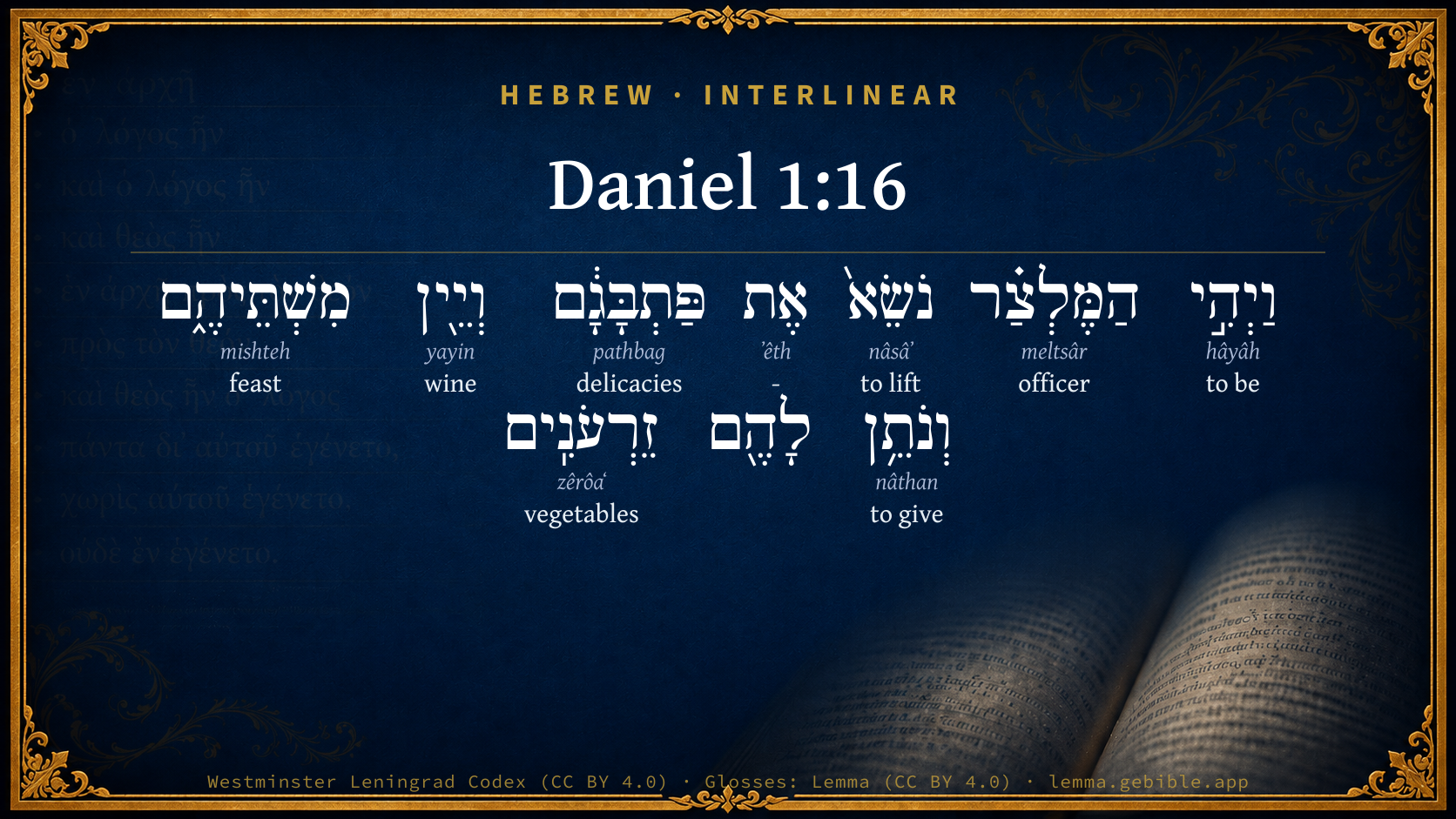
Hebrew (Westminster Leningrad Codex) Daniel 1:16 appears in the Hebrew Old Testament. The text above is from the Westminster Leningrad Codex. Each word links to its Strong’s number, a concise gloss, and parsing drawn from the Open Scriptures Hebrew Bible morphology. Click any word for its full Brown-Driver-Briggs (BDB) entry.
Download image
Cite this verse

Daniel 1:16 (World English Bible). Public Domain. Lemma interlinear Bible study tool, https://lemma.gebible.app/v/daniel/1/16.

Show BibTeX & RIS
BibTeX
RIS
English Translation
So the steward took away their dainties, and the wine that they should drink, and gave them pulse.
World English Bible · Public Domain
Download a study sheet

One document with this verse’s original text, its word-by-word gloss line, the meaning frame, cross-references with their text, attributed commentary, and full source and license credits — printable, and it pastes into notes with its structure intact.

This verse Autodidact and up

Study sheet (.html) Plain text (.txt)

A passage Seminary Student

Up to 50 verses in one chapter. A passage sheet keeps up to 6 commentary sources and 12 cross-references per verse, in the order this page ranks them, and says so on the sheet whenever that leaves anything out. Ask for a single verse and you get the Autodidact verse sheet above.

Everything on this page stays free to read, with no account — the sheet is a download of what is already on screen, not access to it.

Want to remove ads? Support Godless Engineer
Compare translations 3

The same verse in 3 English versions, stacked beneath the original-language interlinear above. Click any original word for its lexicon entry.

Each is an independent rendering of the whole verse — the interlinear is not word-aligned to these translations.

Highlighted words mark where these versions differ — a whole-verse word diff, not a word-by-word alignment.

  • World English Bible Public Domain
    So the steward took away their dainties, and the wine that they should drink, and gave them pulse.
  • King James Version Public Domain
    Thus Melzar took away the portion of their meat, and the wine that they should drink; and gave them pulse.
  • unfoldingWord Literal Text CC BY-SA 4.0
    So the steward took away their choice food and the wine they were to drink and gave them vegetables.

unfoldingWord Literal Text — © unfoldingWord, licensed CC BY-SA 4.0. Word-aligned USFM3 via Door43 (git.door43.org/unfoldingWord/en_ult).

Versions to compare (up to 4)

3 of 4 selected

Show all 18 translations

Every available English version of this verse, each an independent rendering of the whole verse.

  • World English Bible Public Domain
    So the steward took away their dainties, and the wine that they should drink, and gave them pulse.
  • Berean Standard Bible Public Domain
    So the steward continued to withhold their choice food and the wine they were to drink, and he gave them vegetables instead.
  • Majority Standard Bible Public Domain
    So the steward continued to withhold their choice food and the wine they were to drink, and he gave them vegetables instead.
  • King James Version Public Domain
    Thus Melzar took away the portion of their meat, and the wine that they should drink; and gave them pulse.
  • American Standard Version (1901) Public Domain
    So the steward took away their dainties, and the wine that they should drink, and gave them pulse.
  • Revised Version (1885) Public Domain
    So the steward took away their meat, and the wine that they should drink, and gave them pulse.
  • Geneva Bible (1599) Public Domain
    Thus Melzar tooke away the portion of their meat, and the wine that they should drinke, and gaue them pulse.
  • Douay-Rheims (1899) Public Domain
    So Malasar took their portions, and the wine that they should drink: and he gave them pulse.
  • Young's Literal Translation Public Domain
    And the Meltzar is taking away their portion of food, and the wine of their drink, and is giving to them vegetables.
  • Literal Standard Version CC BY-SA 4.0
    And the Meltzar is taking away their portion of food, and the wine of their drink, and is giving to them vegetables.
  • Unlocked Literal Bible CC BY-SA 4.0
    So the steward took away their delicacies and their wine and gave them only vegetables.
  • unfoldingWord Literal Text CC BY-SA 4.0
    So the steward took away their choice food and the wine they were to drink and gave them vegetables.
  • Darby Bible Public Domain
    So the steward took away their delicate food, and the wine that they should drink; and gave them pulse.
  • World Messianic Bible Public Domain
    So the steward took away their delicacies and the wine that they were given to drink, and gave them vegetables.
  • Webster's Bible Public Domain
    Thus Melzar took away the portion of their food, and the wine that they should drink, and gave them pulse.
  • Free Bible Version CC BY-SA 4.0
    After that the guard didn't give them the rich food and wine, just vegetables.
  • Bible in Basic English Public Domain
    So the keeper regularly took away their meat and the wine which was to have been their drink, and gave them grain.
  • JPS Tanakh (1917) Public Domain
    So the steward took away their food, and the wine that they should drink, and gave them pulse.

Literal Standard Version (2020), Covenant Press — licensed CC BY-SA 4.0. Text via the HelloAO Bible API (eBible.org). Unlocked Literal Bible (unfoldingWord) — licensed CC BY-SA 4.0. Text via the HelloAO Bible API (eBible.org). unfoldingWord Literal Text — © unfoldingWord, licensed CC BY-SA 4.0. Word-aligned USFM3 via Door43 (git.door43.org/unfoldingWord/en_ult). Free Bible Version, Dr. Jonathan Gallagher — licensed CC BY-SA 4.0. Text via the HelloAO Bible API (eBible.org).

Word by word

More ways to search: Search by grammar → Find every occurrence → Compare this word →

Practice this passage: Drill this verse → Learn its vocabulary →

הַמֶּלְצַ֗ר
meltsâr
H4453
“the · officer”
Particle, Definite Article + Noun, Common, Masculine, Singular, Absolute
Part of Speech
Particle + Noun
Type
Common
Gender
Masculine
Number
Singular
State
Absolute
Full BDB Definition

Origin: of Persian derivation

TWOT: 1206

guardian, an officer of the court - meaning dubious
  1. וַיְהִ֣י hâyâh H1961 “and · to be” Conjunction + Verb, Qal, Sequential Imperfect, 3rd Person, Masculine, Singular
  2. נֹשֵׂא֙ nâsâʼ H5375 “lifting” Verb, Qal, Participle Active, Masculine, Singular, Absolute
  3. אֶת ʼêth H853 “-” Particle, Direct Object
  4. פַּתְבָּגָ֔ם pathbag H6598 “delicacies · their” Noun, Common, Masculine, Singular, Construct + Suffix, Personal, 3rd Person, Masculine, Plural
  5. וְיֵ֖ין yayin H3196 “and · wine of” Conjunction + Noun, Common, Masculine, Singular, Construct
  6. מִשְׁתֵּיהֶ֑ם mishteh H4960 “feast · their” Noun, Common, Masculine, Singular, Construct + Suffix, Personal, 3rd Person, Masculine, Plural
  7. וְנֹתֵ֥ן nâthan H5414 “and · giving” Conjunction + Verb, Qal, Participle Active, Masculine, Singular, Absolute
  8. זֵרְעֹנִֽים zêrôaʻ H2235 “vegetables” Noun, Common, Masculine, Plural, Absolute

About this verse

These counts appear in no published source. They are computed here, from the morphology-tagged text and Lemma’s own curated glosses. What Lemma adds →

10
words
9
distinct lemmas
Prophets
section

Notable vocabulary

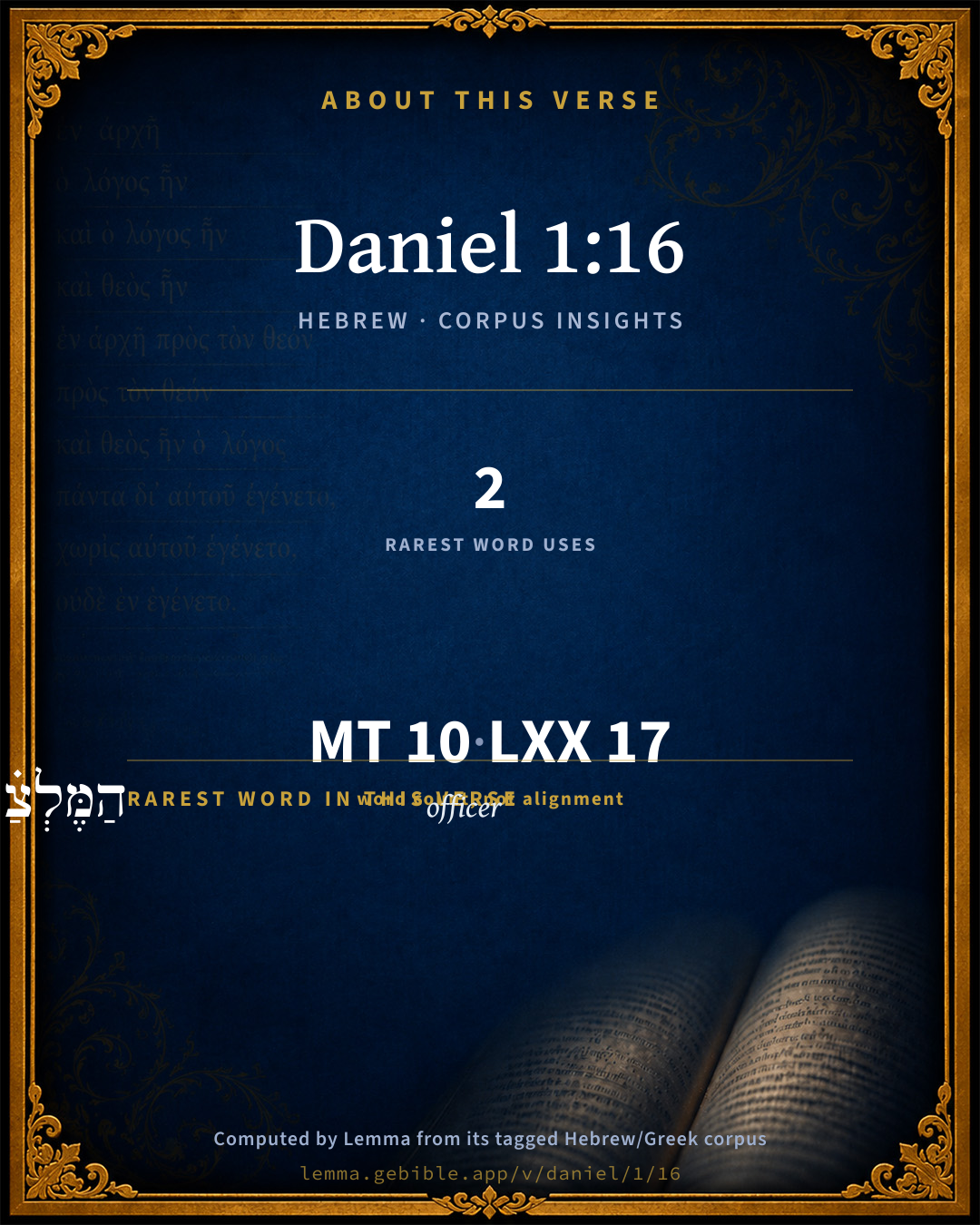
The rarest word here is הַמֶּלְצַ֗ר officer H4453 — appearing just 2 times in the whole Hebrew Bible.

Shared distinctive vocabulary

הַמֶּלְצַ֗ר officer H4453 occurs in 2 verses of the Hebrew Bible. Also found in:

Grammatical profile

  • 3 verbs
  • 5 nouns
  • 1 preposition
  • 1 particle

Verb forms

  • וַיְהִ֣י Qal · Sequential Imperfect
  • נֹשֵׂא֙ Qal · Participle Active
  • וְנֹתֵ֥ן Qal · Participle Active

Hebrew & Septuagint length

In English translation the verse runs 18 words from the Hebrew and 16 from the Septuagint (LXX English) — closely comparable.

A rough comparison of the two English renderings, which tokenize alike — not a word-level alignment.

Word counts can differ between the Hebrew and the Greek without any difference in meaning — e.g. the Hebrew direct-object marker אֵת has no separate Greek word, and Greek often adds the article ὁ.

In the original languages it is 10 Hebrew tokens and 17 Greek tokens — but the two are counted differently (Hebrew bundles its prefixes and suffixes into one token; the Greek is in lemma form), so that isn’t a like-for-like length.

Cross-references

1

Topical passages linked to Daniel 1:16 in the Treasury of Scripture Knowledge — connected by theme and wording, ordered by reader-vote popularity; previews shown in the World English Bible.

  • Daniel 1:12 Prove your servants, I beg you, ten days; and let them give us pulse to eat, and water to drink.

Cross-references courtesy of OpenBible.info (CC BY 4.0).

Hebrew and Greek witnesses Masoretic Hebrew ↔ Greek Septuagint

The same verse in the two great witnesses to the Old Testament, shown verse-for-verse.

These are two independent witnesses, not word-aligned to each other, and the Septuagint is shown in lemma (dictionary) form.

Hebrew Daniel 1:16 Masoretic · Westminster Leningrad Codex

וַיְהִ֣י הַמֶּלְצַ֗ר נֹשֵׂא֙ אֶת פַּתְבָּגָ֔ם וְיֵ֖ין מִשְׁתֵּיהֶ֑ם וְנֹתֵ֥ן לָהֶ֖ם זֵרְעֹנִֽים

So the steward took away their dainties, and the wine that they should drink, and gave them pulse.

World English Bible · Public Domain

Greek LXX Daniel 1:16 Septuagint · lemma form

καί εἰμί αβιεσδρι ἀνααἱρέω ὁ δεῖπνον αὐτός καί ὁ οἶνος αὐτός καί ἀντιδίδωμι αὐτός ἀπό ὁ ὄσπριον

So Amelsad took away their supper and the wine of their drink, and gave them pulse.

LXX2012 (modern English Septuagint) · Public Domain

On this verse, The Pulpit Commentary discusses the Septuagint’s reading. Read the note in Commentary ↓

Hebrew: Westminster Leningrad Codex (CC BY 4.0). Greek: Septuagint (public domain); English from LXX2012 (modern English Septuagint) (Public Domain). How the Septuagint differs from the Hebrew →

Commentary

Notes on Daniel 1:16 from classic Christian and Jewish commentators (each source and its license shown beneath its notes). The classic Christian expositions comment on the surrounding passage and are grouped to its opening verse, so a note may address several verses; the Jewish commentaries on the Tanakh (Rashi and others) are per-verse, so they appear only where the commentator wrote on this verse.

Lemma curates 59 commentaries, every one of them public domain or Creative Commons licensed, each selected and text-cleaned for this edition rather than reprinted as found. About our sources →

Trapp's Complete Commentary

John Trapp

Dan 1:16 Thus Melzar took away the portion of their meat, and the wine that they should drink; and gave them pulse.

Ver. 16. Thus Melzar took away.] See on Dan 1:14.

And gave them pulse.] This slender diet was some help to their studies; for leaden bellies make leaden wits, {a} saith the Greek Senary; and pinguis venter macra mens, saith Jerome, A fat belly maketh a lean mind. A body farced with delicious meats and drinks unfitteth a man for divine contemplation.

{a} γαστηρ παχεια λεπτον ου τικτει νοον.

John Trapp, A Commentary or Exposition upon All the Books of the Old and New Testament (1647–1656) — public domain. Text from a community e-Sword module.

Ibn Ezra

Rabbi Abraham ibn Ezra

[Daniel 1:16] Vayehi... nosei (וַיְהִי... נֹשֵׂא - And it was... removing): [Meaning the guard/Meltsar] took it upon himself (be-nafsho - בְּנַפְשׁוֹ) [to consistently remove their royal rations]. And that which he [Daniel] was brief in mentioning [i.e., omitted mentioning] the wine [in Daniel 1:13], he [the guard, acting, or the text, describing] mentioned it now. And the Nun [element] of legumes (zeronim - זֵרְעֹנִים) is additional [forming the -on suffix before the plural ending, rather than the simpler plural zera'im (זְרָעִים)]. Like [the K'tiv (written form) in Psalms 123:4] le-ga’yonim (לגאיונים - referring to 'the haughty'), and many [words] are like them [formed with such additional elements].

Ibn Ezra on the Tanakh — English translations: “Sefaria Community Translation” (CC0 1.0 (public-domain dedication)); “Yalkut, Sifsei Chachomim Chumash, Metsudah Publications, 2009” (CC BY 4.0); and “Commentary of Ibn Ezra on Isaiah - trans. by M. Friedlander, 1873” (public domain). Text via Sefaria.

John Calvin's Commentaries

After Melsar saw it possible to gratify Daniel and his companions without danger and promote his own profit, he was humane and easily dealt with, and had no need of long disputation. For an intervening obstacle often deters us from the pursuit of gain, and we forbear to seek what we very much crave when it requires oppressive labor; but when our profit is at hand, and we are freed from all danger, then every one naturally pursues it. We see, then, what Daniel means in this verse, namely, when Melsar saw the usefulness of this plan, and the possibility of his gaining by the diet assigned by the king to the four youths, then he gave them pulse. But we must notice also Daniel’s intention. He wishes to shew that we ought not to ascribe it to the kindness of man, that he and his companions could preserve themselves pure and unspotted. Why so? Because he never could have obtained anything from this man Melsar, until he perceived it could be granted safely. Since, therefore, Melsar consulted his own advantage and his private interest, and wished to escape all risks and hazards, we easily gather that the benefit is not to be ascribed entirely to him. Daniel and his companions obtained their wish, but God’s providence rendered this man tractable, and governed the whole event. Meanwhile, God openly shews how all the praise was due to himself, purposely to exercise the gratitude of Daniel and his associates.

John Calvin's Commentaries (1540-1563) — public domain. Text from the Calvin Translation Society English edition (1840s-50s) via the Christian Classics Ethereal Library (ccel.org). Calvin's coverage is partial (roughly two-thirds of the Bible); uncommented books and verses are honest gaps, never fabricated. The 19th-century editor's footnotes and remarks are omitted so the notes are faithfully Calvin's own voice.

The Cambridge Bible for Schools and Colleges

gen. ed. J. J. S. Perowne

16. And the melẓar continued taking away their delicacies, … and giving them vegetable food] The Heb. idiom employed implies that the treatment which they received was now continuous.

The Cambridge Bible for Schools and Colleges (gen. ed. J. J. S. Perowne; Cambridge University Press, 1878–1918) — public domain. Text from a community e-Sword module.

John Gill's Exposition

Thus Melzar took away the portion of their meat,.... To himself, as the Syriac version adds; he took and carried it to his own family, and made use of it himself; and the portion of four such young gentlemen, maintained at the king's expense, and who had their provision from his table, must be, especially in the course of three years, of great advantage to this man and his family; for this was continued, as the word signifies, and may be rendered, "and Melzar was taking away &c." (f); so he did from time to time; and thus, by serving the Lord's people, he served himself:

and the wine that they should drink; which he also took for his own use:

and gave them pulse; to eat, and water to drink, as the Syriac version adds, and which they desired; when he found this agreed so well with them, and he could safely do it without exposing himself to danger, and being to his profit and advantage.

(f) "fuit ferens", Montanus; "auferens", Piscator, Gejerus; "perseveravit auferre cibum"; Cocceius; "erat capiens", Michaelis.

John Gill's Exposition of the Whole Bible (1746–1763) — public domain (CC PDM 1.0). Text via the HelloAO Bible API.

Albert Barnes' Notes on the Bible

Thus Melzar took away the portion of their meat ... - Doubtless permanently. The experiment had been satisfactory, and it was inferred that if the course of temperance could be practiced for ten days without unhappy results, there would be safety in suffering it to be continued. We may remark on this:

I. That the experiment was a most important one, not only for the object then immediately in view, but for furnishing lessons of permanent instruction adapted to future times. It was worth one such trial, and it was desirable to have one such illustration of the effect of temperance recorded. There are so strong propensities in our nature to indulgence; there are so many temptations set before the young; there is so much that allures in a luxurious mode of life, and so much of conviviality and happiness is supposed to be connected with the social glass, that it was well to have a fair trial made, and that the result should be recorded for the instruction of future times.

II. It was especially desirable that the experiment should be made of the effect of strict abstinence from the use of “wine.” Distilled liquors were indeed then unknown; but alcohol, the intoxicating principle in all ardent spirits, then existed, as it does now, in wine, and was then, as it is now, of the same nature as when found in other substances. It was in the use of wine that the principal danger of intemperance then lay; and it may be added, that in reference to a very large class of persons of both sexes, it is in the use of wine that the principal danger always lies. There are multitudes, especially of young men, who are in little or no danger of becoming intemperate from the use of the stronger kinds of intoxicating drinks. They would never “begin” with them. But the use of “wine” is so respectable in the view of the upper classes of society; it is deemed so essential to the banquet; it constitutes so much, apparently, a mark of distinction, from the fact that ordinarily only the rich can afford to indulge in it; its use is regarded extensively as so proper for even refined and delicate females, and is so often sanctioned by their participating in it; it is so difficult to frame an argument against it that will be decisive; there is so much that is plausible that may be said in favor or in justification of its use, and it is so much sanctioned by the ministers of religion, and by those of influence in the churches, that one of the principal dangers of the young arises from the temptation to indulgence in wine, and it was well that there should be a fair trial of the comparative benefit of total abstinence. A trial could scarcely have been made under better circumstances than in the case before us. There was every inducement to indulgence which is ever likely to occur; there was as much to make it a mere matter of “principle” to abstain from it as can be found now in any circumstances, and the experiment was as triumphant and satisfactory as could be desired.

III. The result of the experiment.

(a) It was complete and satisfactory. “More” was accomplished in the matter of the trial by abstinence than by indulgence. Those who abstained were more healthful, more beautiful, more vigorous than the others. And there was nothing miraculous - nothing that occurred in that case which does not occur in similar cases. Sir John Chardin remarks, respecting those whom he had seen in the East, “that the countenances of the kechicks (monks) are in fact more rosy and smooth than those of others; and that those who fast much, I mean the Armenians and the Greeks, are, notwithstanding, very beautiful, sparkling with health, with a clear and lively countenance.” He also takes notice of the very great abstemiousness of the Brahmins in the Indies, who lodge on the ground, abstain from music, from all sorts of agreeable smells, who go very meanly clothed, are almost always wet, either by going into water, or by rain; “yet,” says he, “I have seen also many of them very handsome and healthful.” Harmer’s “Observa.” ii. pp. 112, 113.

(b) The experiment has often been made, and with equal success, in modern times, and especially since the commencement of the temperance reformation, and an opportunity has been given of furnishing the most decisive proofs of the effects of temperance in contrast with indulgence in the use of wine and of other intoxicating drinks. This experiment has been made on a wide scale, and with the same result. It is demonstrated, as in the case of Daniel, that “more” will be secured of what men are so anxious usually to obtain, and of what it is desirable to obtain, than can be by indulgence.

(1) There will be “more” beauty of personal appearance. Indulgence in intoxicating drinks leaves its traces on the countenance - the skin, the eye, the nose, the whole expression - as God “meant” it should. See the notes at Dan 1:15. No one can hope to retain beauty of complexion or countenance who indulges freely in the use of intoxicating drinks.

(2) “More” clearness of mind and intellectual vigour can be secured by abstinence than by indulgence. It is true that, as was often the case with Byron and Burns, stimulating drinks may excite the mind to brilliant temporary efforts; but the effect soon ceases, and the mind makes a compensation for its over-worked powers by sinking down below its proper level as it had been excited above. It will demand a penalty in the exhausted energies, and in the incapacity for even its usual efforts, and unless the exhausting stimulus be again applied, it cannot rise even to its usual level, and when often applied the mind is divested of “all” its elasticity and vigour; the physical frame loses its power to endure the excitement; and the light of genius is put out, and the body sinks to the grave. He who wishes to make the most of his mind “in the long run,” whatever genius he may be endowed with, will be a temperate man. His powers will be retained uniformly at a higher elevation, and they will maintain their balance and their vigour longer.

(3) The same is true in regard to everything which requires vigour of body. The Roman soldier, who carried his eagle around the world, and who braved the dangers of every clime - equally bold and vigorous, and hardy, and daring amidst polar snows, and the burning sands of the equator - was a stranger to intoxicating drinks. He was allowed only vinegar and water, and his extraordinary vigour was the result of the most abstemious fare. The wrestlers in the Olympic and Isthmian games, who did as much to give suppleness, vigour, and beauty to the body, as could be done by the most careful training, abstained from the use of wine and all that would enervate. Since the temperance reformation commenced in this land, the experiment has been made in every way possible, and it has been “settled” that a man will do more work, and do it better; that he can bear more fatigue, can travel farther, can better endure the severity of cold in the winter, and of toil in the heat of summer, by strict temperance, than he can if he indulges in the use of intoxicating drinks. Never was the result of an experiment more uniform than this has been; never has there been a case where the testimony of those who have had an opportunity of witnessing it was more decided and harmonious; never was there a question in regard to the effect of a certain course on health in which the testimony of physicians has been more uniform; and never has there been a question in regard to the amount of labor which a man could do, on which the testimony of respectable farmers, and master mechanics, and overseers of public works, could be more decided.

(4) The full force of these remarks about temperance in general, applies to the use of “wine.” It was in respect to “wine” that the experiment before us was made, and it is this which gives it, in a great degree, its value and importance. Distilled spirits were then unknown, but it was of importance that a fair experiment should be made of the effect of abstinence from wine. The great danger of intemperance, taking the world at large, has been, and is still, from the use of wine. This danger affects particularly the upper classes in society and young men. It is by the use of wine, in a great majority of instances, that the peril commences, and that the habit of drinking is formed. Let it be remembered, also, that the intoxicating principle is the same in wine as in any other drink that produces intemperance. It is “alcohol” - the same substance precisely, whether it be driven off by heat from wine, beer, or cider, and condensed by distillation, or whether it remain in these liquids without being distilled. It is neither more nor less intoxicating in one form than it is in the other. It is only more condensed and concentrated in one case than in the other, better capable of preservation, and more convenient for purposes of commerce. Every “principle,” therefore, which applies to the temperance cause at all, applies to the use of wine; and every consideration derived from health, beauty, vigour, length of days, reputation, property, or salvation, which should induce a young man to abstain from ardent spirits at all should induce him to abstain, as Daniel did, from the use of wine.

Albert Barnes' Notes on the Bible (1834–1885) — public domain. Text from a community e-Sword/MySword module.

Matthew Poole's English Annotations

Which he could not but take well, for hereby he gained the costly provision of four men for the space of three years to his own use and profit. Hence observe that courtiers are no losers by the favours they procure for God’s servants. They are most willing to serve God’s servants when they can therein also serve themselves by it.

Matthew Poole's English Annotations on the Holy Bible (1683–1685) — public domain. Text from a community e-Sword/MySword module.

The Pulpit Commentary

Thus Melzar took away the portion of their moat, and the wine that they should drink; and gave them pulse. The Massoretic has the article here before "Melzar a fact that the Authorized does not indicate; the Revised renders more correctly, "the steward." The version of the Septuagint does not differ much from the Massoretic, only the word translated "that they should drink" is omitted; on the other hand, we have the verb didwmi (ejdidou) put in composition with ajnti (ajntedidou), "gave them instead," as if, in the text before the translator, the mem, which begins mishtayhem, had been put to the end of yayin, "wine," making it "their wine a construction which would be more symmetrical than the present. Only it is difficult to see how either tahath asher could be changed into shtayhem, or vice versa. The Septuagint translation suggests a simpler and more natural text not a simplified one therefore it is, on the whole, to be preferred. The careful word-for-word translation of the beginning of the verse renders it little likely that the translator would paraphrase at the end; c g. the word translated in our version "thus" is really veeayhe , "it was," and in the LXX this is rendered h+n, "it was." Theodotion is in absolute agreement with the Massoretic text. The Peshitta calls the steward ma-nitzor, and renders the last clause, and he gave to them seeds to eat, and water to drink," evidently borrowed from the twelfth verse. The result of the success of the experiment is that the youths are no more importuned to partake of the king"s dainties. The steward, or the attendant who looked after their mess , supplied them with pulse. It has occurred to two commentators, widely separated from each other in point of time, that the consent of the "Melzar" was all the more easily gained, that he could utilize the abstemiousness of these Hebrew youths to his own private advantage. Both Jephet-ibn-Ali in the beginning of the eleventh century, and Ewald in the middle of the nineteenth, maintain that the "Melzar" used to his own purposes, possibly sold, the portion of food and wine that the Hebrew youths abjured. Certainly the verb nasa means the lifting and carrying away, and suggests that every day the portions of food and wine were first carried to the table of these Hebrews, and then, after having been placed before them, were removed and pulse brought instead. When we think of it, some such process would have to take place. If it had been observed that one table was never supplied with a portion from the king"s table, there might have been remarks made, and the Melzar" would have fallen into disgrace with his sovereign, and the Hebrew youths would possibly have shared his disgrace. As to how the portions thus retained were disposed of, we need not be curious; there would, no doubt, be plenty of claimants for the broken victuals from the King of Babylon"s table, without accusing the "Melzar" of dishonest motives. The fact that the verbs are in participle implies that henceforth it was the regular habit of the Melzar" to remove from before the tour friends the royal dainties, and supply them instead with pulse. We have already referred to the word used for pulse"; it is here zayroneem, whereas in the twelfth verse it is zayroeem. Not impossibly in the verse before us we have another case of the original Aramaic shining through the translation; in the Peshitta the word is zeroona, Whatever the word was, it seems certain that originally it was the same in both places, as in none of the versions is there any variation. It is not so impossible that originally the vocalization was different, and that the word was the ordinary word zeraim, "seeds." This certainly is the translation of Theodotion.

The Pulpit Commentary (1880–1919), ed. H.D.M. Spence-Jones & Joseph S. Exell — public domain. Text from a community e-Sword module.

Rashi

Rabbi Shlomo Yitzchaki (Rashi)

carry away their food He would take it for himself.

Rashi on the Tanakh — English translations: “The Judaica Press complete Tanach with Rashi, translated by A. J. Rosenberg” (CC BY 4.0); “Pentateuch with Rashi's commentary by M. Rosenbaum and A.M. Silbermann, 1929-1934” (public domain); “The Metsudah Tanach series, Lakewood, N.J” (CC BY 4.0); and “The Book of Joshua, Metsudah Publications, 1997” (CC BY 4.0). Text via Sefaria.

Lesson kit

Teaching starters — assembled from the data on this page, not authored interpretation. Every prompt links to the verse data it draws on. Edit before teaching.

Daniel, in the Prophets, opens this verse with 10 words (9 distinct Hebrew lemmas). Its most distinctive word is meltsâr (“officer”). A historical commentator’s framing appears above. Read the whole chapter for the surrounding context.

Discussion questions

  1. The word meltsâr carries the sense “officer.” How does it shape the verse?
  2. How does Daniel 1:11, which shares the word «officer», read alongside this verse?
  3. The translations on this page render this verse differently — a whole-verse word diff, not a word-by-word alignment. What might account for the different wordings?
  4. «וַיְהִ֣י» is a Qal Sequential Imperfect verb. How does that grammatical form shape the action described?
  5. Compare how Trapp's Complete Commentary and Ibn Ezra read this verse. Where do they agree or differ?

Things to notice

Reading settings

Reading text

Shown beneath each verse's original-language words.

Old Testament
Old Testament edition

Read the OT as the Masoretic Hebrew (MT) or the Greek Septuagint (LXX).

English shown for the Greek Septuagint (in the Hebrew ↔ Greek comparison).

Comparing translations? Open the Compare panel on any verse page to stack up to four side by side.