Exodus 10:22

Hebrew (Westminster Leningrad Codex) Exodus 10:22 appears in the Hebrew Old Testament. The text above is from the Westminster Leningrad Codex. Each word links to its Strong’s number, a concise gloss, and parsing drawn from the Open Scriptures Hebrew Bible morphology. Click any word for its full Brown-Driver-Briggs (BDB) entry.
Download image
Cite this verse

Exodus 10:22 (World English Bible). Public Domain. Lemma interlinear Bible study tool, https://lemma.gebible.app/v/exodus/10/22.

Show BibTeX & RIS
BibTeX
RIS
English Translation
Moses stretched forth his hand toward the sky, and there was a thick darkness in all the land of Egypt three days.
World English Bible · Public Domain
Highlights
  • 1 first appearance in the Hebrew Bible
Full analysis ↓
Download a study sheet

One document with this verse’s original text, its word-by-word gloss line, the meaning frame, cross-references with their text, attributed commentary, and full source and license credits — printable, and it pastes into notes with its structure intact.

This verse Autodidact and up

Study sheet (.html) Plain text (.txt)

A passage Seminary Student

Up to 50 verses in one chapter. A passage sheet keeps up to 6 commentary sources and 12 cross-references per verse, in the order this page ranks them, and says so on the sheet whenever that leaves anything out. Ask for a single verse and you get the Autodidact verse sheet above.

Everything on this page stays free to read, with no account — the sheet is a download of what is already on screen, not access to it.

Want to remove ads? Support Godless Engineer
Compare translations 3

The same verse in 3 English versions, stacked beneath the original-language interlinear above. Click any original word for its lexicon entry.

Each is an independent rendering of the whole verse — the interlinear is not word-aligned to these translations.

Highlighted words mark where these versions differ — a whole-verse word diff, not a word-by-word alignment.

  • World English Bible Public Domain
    Moses stretched forth his hand toward the sky, and there was a thick darkness in all the land of Egypt three days.
  • King James Version Public Domain
    And Moses stretched forth his hand toward heaven; and there was a thick darkness in all the land of Egypt three days:
  • unfoldingWord Literal Text CC BY-SA 4.0
    And Moses stretched out his hand above the heavens, and dark darkness was in all of the land of Egypt for three days.

unfoldingWord Literal Text — © unfoldingWord, licensed CC BY-SA 4.0. Word-aligned USFM3 via Door43 (git.door43.org/unfoldingWord/en_ult).

Versions to compare (up to 4)

3 of 4 selected

Show all 18 translations

Every available English version of this verse, each an independent rendering of the whole verse.

  • World English Bible Public Domain
    Moses stretched forth his hand toward the sky, and there was a thick darkness in all the land of Egypt three days.
  • Berean Standard Bible Public Domain
    So Moses stretched out his hand toward heaven, and total darkness covered all the land of Egypt for three days.
  • Majority Standard Bible Public Domain
    So Moses stretched out his hand toward heaven, and total darkness covered all the land of Egypt for three days.
  • King James Version Public Domain
    And Moses stretched forth his hand toward heaven; and there was a thick darkness in all the land of Egypt three days:
  • American Standard Version (1901) Public Domain
    And Moses stretched forth his hand toward heaven; and there was a thick darkness in all the land of Egypt three days;
  • Revised Version (1885) Public Domain
    And Moses stretched forth his hand toward heaven; and there was a thick darkness in all the land of Egypt three days;
  • Geneva Bible (1599) Public Domain
    Then Moses stretched forth his hande towarde heauen, and there was a blacke darkenesse in all the land of Egypt three daies.
  • Douay-Rheims (1899) Public Domain
    And Moses stretch forth his hand towards heaven: and there came horrible darkness in all the land of Egypt for three days.
  • Young's Literal Translation Public Domain
    And Moses stretcheth out his hand towards the heavens, and there is darkness -- thick darkness in all the land of Egypt three days;
  • Literal Standard Version CC BY-SA 4.0
    And Moses stretches out his hand toward the heavens, and there is darkness—thick darkness in all the land of Egypt [for] three days;
  • Unlocked Literal Bible CC BY-SA 4.0
    Moses reached out with his hand toward the sky, and there was a thick darkness in all the land of Egypt for three days.
  • unfoldingWord Literal Text CC BY-SA 4.0
    And Moses stretched out his hand above the heavens, and dark darkness was in all of the land of Egypt for three days.
  • Darby Bible Public Domain
    And Moses stretched out his hand toward the heavens; and there was a thick darkness throughout the land of Egypt three days:
  • World Messianic Bible Public Domain
    Moses stretched out his hand toward the sky, and there was a thick darkness in all the land of Egypt for three days.
  • Webster's Bible Public Domain
    And Moses stretched forth his hand towards heaven: and there was a thick darkness in all the land of Egypt three days:
  • Free Bible Version CC BY-SA 4.0
    Moses lifted up his hand toward heaven, and the whole of Egypt went completely dark for three days.
  • Bible in Basic English Public Domain
    And when Moses' hand was stretched out, dark night came over all the land of Egypt for three days;
  • JPS Tanakh (1917) Public Domain
    And Moses stretched forth his hand toward heaven; and there was a thick darkness in all the land of Egypt three days;

Literal Standard Version (2020), Covenant Press — licensed CC BY-SA 4.0. Text via the HelloAO Bible API (eBible.org). Unlocked Literal Bible (unfoldingWord) — licensed CC BY-SA 4.0. Text via the HelloAO Bible API (eBible.org). unfoldingWord Literal Text — © unfoldingWord, licensed CC BY-SA 4.0. Word-aligned USFM3 via Door43 (git.door43.org/unfoldingWord/en_ult). Free Bible Version, Dr. Jonathan Gallagher — licensed CC BY-SA 4.0. Text via the HelloAO Bible API (eBible.org).

Word by word

More ways to search: Search by grammar → Find every occurrence → Compare this word →

Practice this passage: Drill this verse → Learn its vocabulary →

אֲפֵלָ֛ה
ʼăphêlâh
H653
“darkness”
Noun, Common, Feminine, Singular, Absolute
Part of Speech
Noun
Type
Common
Gender
Feminine
Number
Singular
State
Absolute
Full BDB Definition

Origin: from H651

TWOT: 145c

darkness, gloominess, calamity - wickedness (figuratively)
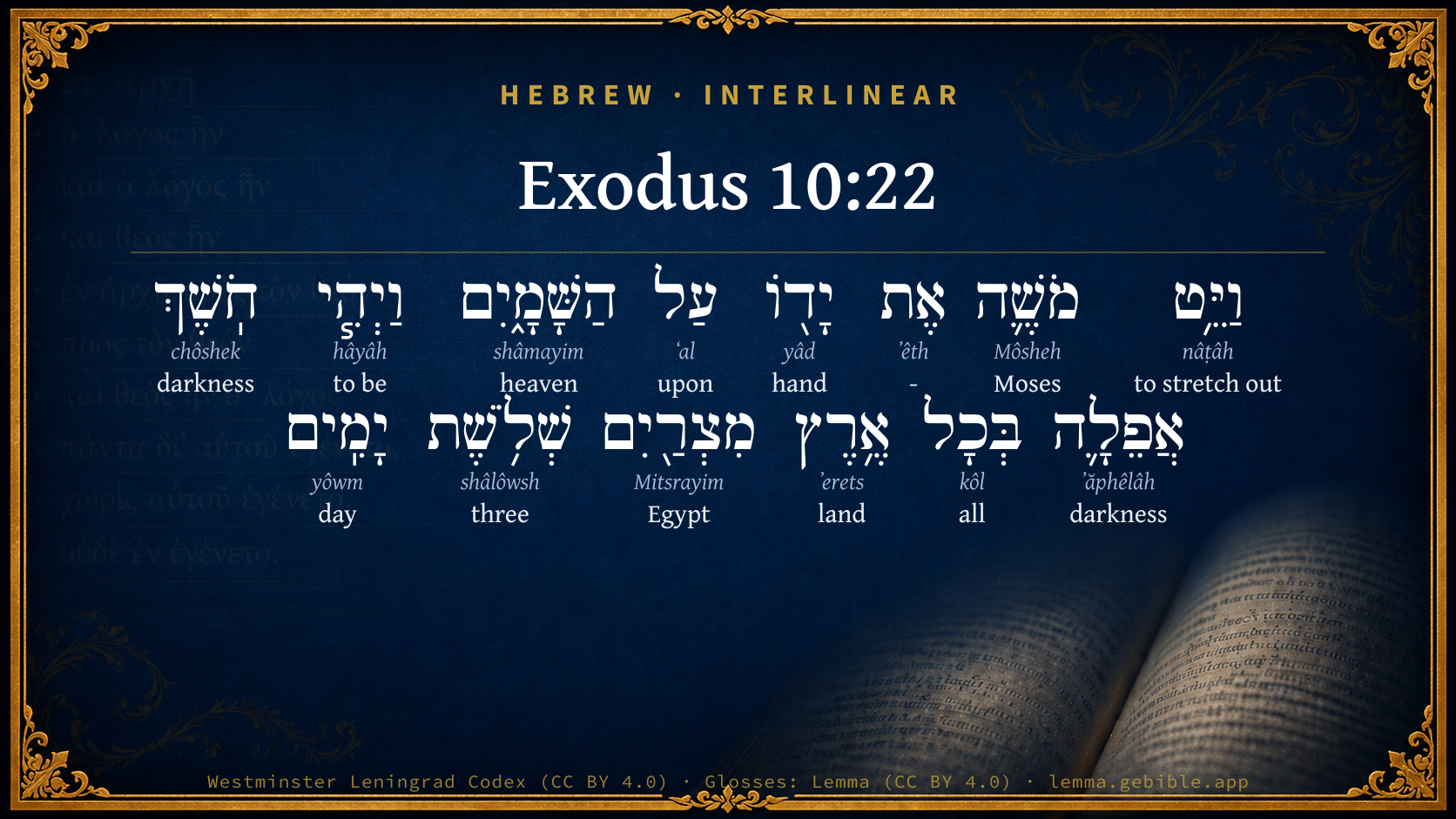
  1. וַיֵּ֥ט nâṭâh H5186 “and · to stretch out” Conjunction + Verb, Qal, Sequential Imperfect, 3rd Person, Masculine, Singular
  2. מֹשֶׁ֛ה Môsheh H4872 “Moses” Noun, Proper
  3. אֶת ʼêth H853 “-” Particle, Direct Object
  4. יָד֖וֹ yâd H3027 “hand · his” Noun, Common, Both, Singular, Construct + Suffix, Personal, 3rd Person, Masculine, Singular
  5. עַל ʻal H5921 “upon” Preposition
  6. הַשָּׁמָ֑יִם shâmayim H8064 “the · heaven(s)” Particle, Definite Article + Noun, Common, Masculine, Plural, Absolute
  7. וַיְהִ֧י hâyâh H1961 “and · to be” Conjunction + Verb, Qal, Sequential Imperfect, 3rd Person, Masculine, Singular
  8. חֹֽשֶׁךְ chôshek H2822 “darkness of” Noun, Common, Masculine, Singular, Construct
  9. בְּכָל kôl H3605 “in/at · all of” Preposition + Noun, Common, Masculine, Singular, Construct
  10. אֶ֥רֶץ ʼerets H776 “land of” Noun, Common, Both, Singular, Construct
  11. מִצְרַ֖יִם Mitsrayim H4714 “Egypt” Noun, Proper
  12. שְׁלֹ֥שֶׁת shâlôwsh H7969 “three” Adjective, Cardinal number, Masculine, Singular, Construct
  13. יָמִֽים yôwm H3117 “days” Noun, Common, Masculine, Plural, Absolute

About this verse

These counts appear in no published source. They are computed here, from the morphology-tagged text and Lemma’s own curated glosses. What Lemma adds →

14
words
14
distinct lemmas
Pentateuch
section

Notable vocabulary

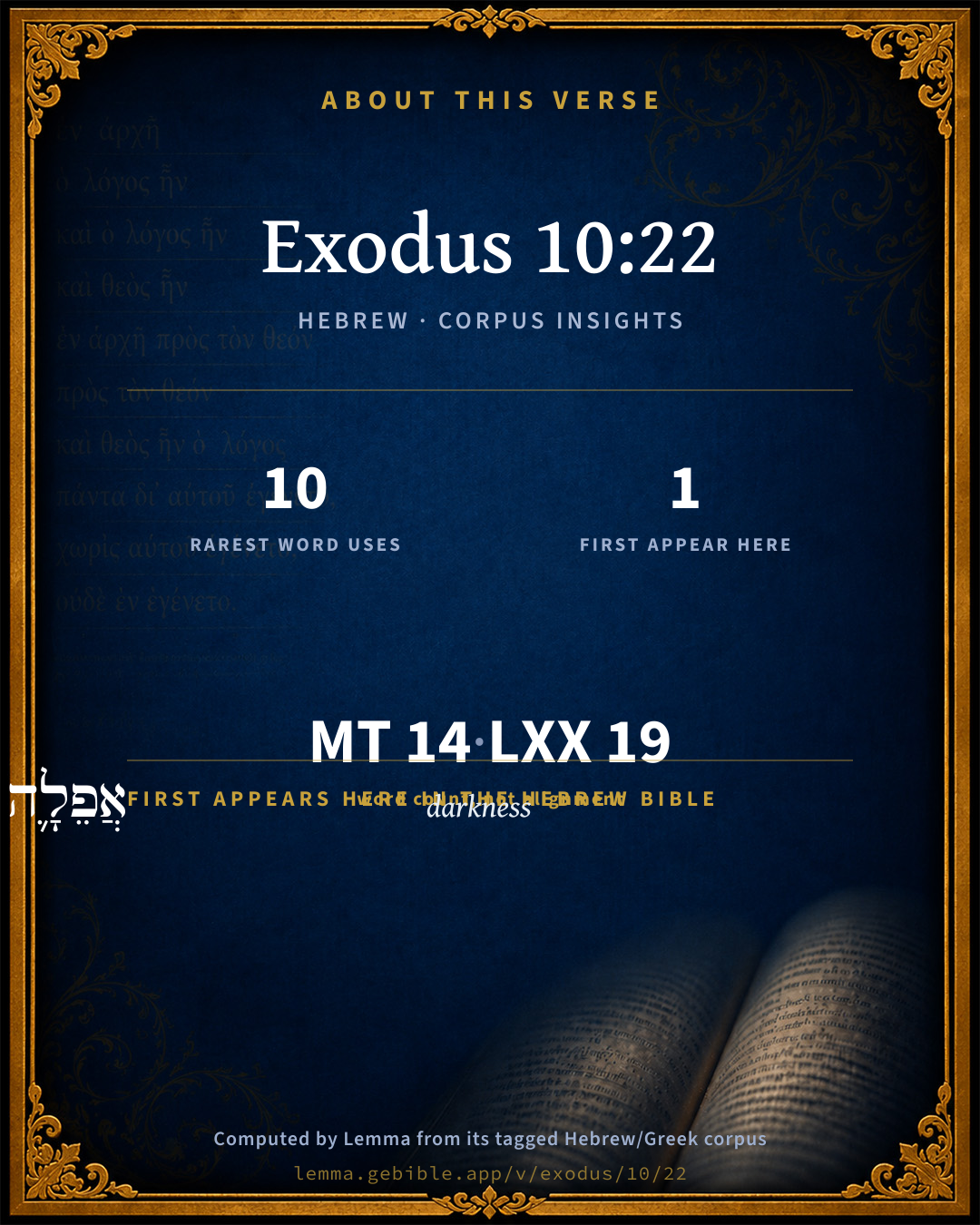
The rarest word here is אֲפֵלָ֛ה darkness H653 — appearing just 10 times in the whole Hebrew Bible.

First appearance in Scripture

This word makes its first canonical appearance in the Hebrew Bible here:

  • אֲפֵלָ֛ה darkness H653

Shared distinctive vocabulary

אֲפֵלָ֛ה darkness H653 occurs in 10 verses of the Hebrew Bible. Also found in:

Grammatical profile

  • 2 verbs
  • 9 nouns
  • 1 adjective
  • 1 preposition
  • 1 particle

Verb forms

  • וַיֵּ֥ט Qal · Sequential Imperfect
  • וַיְהִ֧י Qal · Sequential Imperfect

Hebrew & Septuagint length

In English translation the verse runs 22 words from the Hebrew and 25 from the Septuagint (LXX English) — closely comparable.

A rough comparison of the two English renderings, which tokenize alike — not a word-level alignment.

Word counts can differ between the Hebrew and the Greek without any difference in meaning — e.g. the Hebrew direct-object marker אֵת has no separate Greek word, and Greek often adds the article ὁ.

In the original languages it is 14 Hebrew tokens and 19 Greek tokens — but the two are counted differently (Hebrew bundles its prefixes and suffixes into one token; the Greek is in lemma form), so that isn’t a like-for-like length.

Cross-references

8

Topical passages linked to Exodus 10:22 in the Treasury of Scripture Knowledge — connected by theme and wording, ordered by reader-vote popularity; previews shown in the World English Bible.

  • Psalms 105:28 He sent darkness, and made it dark. They didn't rebel against his words.
  • Revelation 16:10 The fifth poured out his bowl on the throne of the beast, and his kingdom was darkened. They gnawed their tongues because of the pain,
  • Exodus 20:21 The people stayed at a distance, and Moses drew near to the thick darkness where God was.
  • Deuteronomy 4:11 You came near and stood under the mountain; and the mountain burned with fire to the heart of the sky, with darkness, cloud, and thick darkness.
  • Deuteronomy 5:22 These words Yahweh spoke to all your assembly on the mountain out of the midst of the fire, of the cloud, and of the thick darkness, with a great voice: and he added no more. He wrote them on two tables of stone, and gave them to me.
  • Joel 2:2 A day of darkness and gloominess, A day of clouds and thick darkness. As the dawn spreading on the mountains, A great and strong people; There has never been the like, Neither will there be any more after them, Even to the years of many generations.
  • Joel 2:31 The sun will be turned into darkness, And the moon into blood, Before the great and terrible day of Yahweh comes.
  • Amos 4:13 For, behold, he who forms the mountains, And creates the wind, And declares to man what is his thought; Who makes the morning darkness, And treads on the high places of the Earth: Yahweh, the God of hosts, is his name."

Cross-references courtesy of OpenBible.info (CC BY 4.0).

Hebrew and Greek witnesses Masoretic Hebrew ↔ Greek Septuagint

The same verse in the two great witnesses to the Old Testament, shown verse-for-verse.

These are two independent witnesses, not word-aligned to each other, and the Septuagint is shown in lemma (dictionary) form.

Hebrew Exodus 10:22 Masoretic · Westminster Leningrad Codex

וַיֵּ֥ט מֹשֶׁ֛ה אֶת יָד֖וֹ עַל הַשָּׁמָ֑יִם וַיְהִ֧י חֹֽשֶׁךְ אֲפֵלָ֛ה בְּכָל אֶ֥רֶץ מִצְרַ֖יִם שְׁלֹ֥שֶׁת יָמִֽים

Moses stretched forth his hand toward the sky, and there was a thick darkness in all the land of Egypt three days.

World English Bible · Public Domain

Greek LXX Exodus 10:22 Septuagint · lemma form

ἐκτείνω δέ μωυσῆς ὁ χείρ εἰς ὁ οὐρανός καί γίγνομαι σκότος γνόφος θύελλα ἐπί πᾶς γῆ αἴγυπτος τρεῖς ἡμέρα

And Moses stretched out his hand to heaven, and there was darkness very black, even a storm over all the land of Egypt three days.

LXX2012 (modern English Septuagint) · Public Domain

Hebrew: Westminster Leningrad Codex (CC BY 4.0). Greek: Septuagint (public domain); English from LXX2012 (modern English Septuagint) (Public Domain). How the Septuagint differs from the Hebrew →

Targum (Aramaic paraphrase)

2

The Targum is the ancient Jewish Aramaic paraphrase of the Hebrew Scriptures — an interpretive translation, not the Hebrew text itself. Onkelos (literal) and Pseudo-Jonathan (expansive) render the Torah, and Jonathan the Prophets. Coverage is partial: where no permissively-licensed English translation exists for a verse, only the Aramaic is shown. This is verse-level text, not a word-by-word alignment to the Hebrew.

  1. Targum Onkelos Torah (Genesis–Deuteronomy)
    וַאֲרֵים משֶׁה יָת יְדֵהּ עַל צֵית שְׁמַיָא וַהֲוָה חֲשׁוֹךְ קְבֵל בְּכָל אַרְעָא דְמִצְרַיִם תְּלָתָא יוֹמִין:

    (no public-domain English translation for this verse)

    Targum Onkelos — Aramaic: “Onkelos Genesis” (public domain); “Onkelos Exodus” (public domain); “Onkelos Leviticus” (public domain); “Onkelos Numbers” (public domain); “Onkelos Deuteronomy” (public domain). English: “Sefaria Community Translation” (CC0 1.0 (public-domain dedication)); “J.W. Etheridge. The Targums of Onkelos and Jonathan Ben Uzziel on the Pentateuch. London: Longmans, Green, 1862” (public domain). Text via Sefaria.

  2. Targum Pseudo-Jonathan Torah (Genesis–Deuteronomy)
    וַאֲרֵים משֶׁה יַת יְדֵיהּ עַל צֵית שְׁמַיָא וַהֲוָה חֲשׁוֹךְ דִּקְבֵיל בְּכָל אַרְעָא דְמִצְרַיִם תְּלָתָא יוֹמִין

    And Mosheh stretched out his hand towards the height of the heavens, and there was dark darkness in all the land of Mizraim three days.

    Targum Pseudo-Jonathan — Aramaic: “Targum Jonathan on Genesis” (public domain); “Targum Jonathan on Exodus” (public domain); “Targum Jonathan on Leviticus” (public domain); “Targum Jonathan on Numbers” (public domain); “Targum Jonathan on Deuteronomy” (public domain). English: “The Targum of Jonathan ben Uzziel, trans. J. W. Etheridge, London, 1862” (public domain). Text via Sefaria.

Commentary

Notes on Exodus 10:22 from classic Christian and Jewish commentators (each source and its license shown beneath its notes). The classic Christian expositions comment on the surrounding passage and are grouped to its opening verse, so a note may address several verses; the Jewish commentaries on the Tanakh (Rashi and others) are per-verse, so they appear only where the commentator wrote on this verse.

Lemma curates 59 commentaries, every one of them public domain or Creative Commons licensed, each selected and text-cleaned for this edition rather than reprinted as found. About our sources →

Trapp's Complete Commentary

John Trapp

Exo 10:22 And Moses stretched forth his hand toward heaven; and there was a thick darkness in all the land of Egypt three days:

Ver. 22. Thick darkness.] It was thick indeed, that might be felt: {a} so thick and foggy were the vapours that caused it.

{a} ψηλαφητον ακοτος. - Sept.

John Trapp, A Commentary or Exposition upon All the Books of the Old and New Testament (1647–1656) — public domain. Text from a community e-Sword module.

Geneva Bible (1599)

Geneva Bible translators

The ninth plague.

Geneva Bible (1599) marginal notes — public domain. Text via Bolls.life.

John Gill's Exposition

And Pharaoh called unto Moses,.... After the three days, as the Targum of Jonathan, when the darkness was over, or at least much diminished, fearing that still worse evils would befall him:

and said, go ye, serve the Lord, only let your flocks and your herds be stayed; stopped or remained behind, as a pledge and security of their return; and these the rather he was desirous of retaining, because of the great loss of cattle he had sustained by the murrain and boils upon them, and by the hail: let your little ones also go with you; this he had refused before, but now consents to it, which he thought was doing them a great favour, and that upon such terms they might be content to go.

John Gill's Exposition of the Whole Bible (1746–1763) — public domain (CC PDM 1.0). Text via the HelloAO Bible API.

Whedon's Commentary on the Bible

Daniel D. Whedon

22. And there was a thick darkness in all the land of Egypt three days — As all the plagues seem in some way connected with natural causes, this preternatural darkness is by many assigned to a sand-storm, such as accompanies the simoom or the chamaseen, miraculously increased in intensity. Neither of these winds are ever known to produce so deep a darkness as is here described, though they obscure the sun and cause a twilight gloom. The simoom, or samoom, is a hot parching wind, raising clouds of dust and sand, which give the whole air a reddish-yellow tinge, and make the sun at first look like a globe of blood, and then blot it wholly from view. It is painfully suffocating both to man and beast while it lasts, but it is of short duration, especially if extremely hot and violent, generally passing within half an hour. The chamaseen, or khamsin, is less hot and violent, but lasts two or three days at a time, occurring at frequent intervals during a period of fifty days before and after the vernal equinox, that is, during March and the first of April, which corresponds well with the time of the plague of darkness. It darkens the sun with clouds of sand, which fill the air like a yellow fog, or like a heavy storm of snow or hail; men and beasts hide themselves while it rages, the inhabitants taking refuge in the innermost apartments or in subterranean vaults. The streets are deserted, as in the night, and all business ceases. But all these characteristics must have been supernaturally intensified to produce the effects described in the text. Both the simoom and the chamaseen are local, and very limited in range, so that such a wind might have blows up the Nile valley and left Goshen, in the eastern part of the Delta, untouched.

Daniel D. Whedon (gen. ed.), Commentary on the Old and New Testaments (1874–1909) — public domain. Text from a community e-Sword module.

The Pulpit Commentary

A thick darkness. Literally, "An obscurity of darkness." The phrase is intensitive.

The Pulpit Commentary (1880–1919), ed. H.D.M. Spence-Jones & Joseph S. Exell — public domain. Text from a community e-Sword module.

Rashi

Rabbi Shlomo Yitzchaki (Rashi)

שלשת ימים denotes a triad of days. old French terziane; so, too, שבעת ימים everywhere it occurs denotes in old French a septaine of days (a period of seven days).

ויהי חשך אפלה … שלשת ימים — there was darkness of gloom when no man saw another during those three days, and there was moreover another period of three days’ darkness twice as thick as this when no man rose from his place: one who happened to be sitting when this second period of darkness began was unable to rise, and one who was then standing was unable to sit down. And why did He bring darkness upon them? Because there were wicked people amongst the Israelites of that generation who had no desire to leave Egypt, and these died during the three days of darkness so that the Egyptians might not see their destruction and say, “These, (the Israelites) too have been stricken as we have”. And a further reason is that the Israelites searched (the darkness came just in order that they might do this) and saw their (the Egyptians’) jewels, and when they were leaving Egypt and asked them for their jewels, and they replied, “We have none at all in our possession”, they answered them, “I have seen it in your house and it is in such and such a place” (cf. Midrash Tanchuma, Bo 1; Exodus Rabbah 14:3).

Rashi on the Tanakh — English translations: “The Judaica Press complete Tanach with Rashi, translated by A. J. Rosenberg” (CC BY 4.0); “Pentateuch with Rashi's commentary by M. Rosenbaum and A.M. Silbermann, 1929-1934” (public domain); “The Metsudah Tanach series, Lakewood, N.J” (CC BY 4.0); and “The Book of Joshua, Metsudah Publications, 1997” (CC BY 4.0). Text via Sefaria.

Lesson kit

Teaching starters — assembled from the data on this page, not authored interpretation. Every prompt links to the verse data it draws on. Edit before teaching.

Exodus, in the Pentateuch, opens this verse with 14 words (14 distinct Hebrew lemmas). Its most distinctive word is ʼăphêlâh (“darkness”). A historical commentator’s framing appears above. Read the whole chapter for the surrounding context.

Discussion questions

  1. What does “darkness” (ʼăphêlâh) contribute to the verse as a whole?
  2. This is the first place “darkness” appears in Scripture (first appears here). What does its debut here establish?
  3. How does Deuteronomy 28:29, which shares the word «darkness», read alongside this verse?
  4. These translations render this verse differently. What is at stake in choosing one wording over another?
  5. «וַיֵּ֥ט» is a Qal Sequential Imperfect verb. How does that grammatical form shape the action described?
  6. Compare how Trapp's Complete Commentary and Geneva Bible (1599) read this verse. Where do they agree or differ?

Things to notice

Reading settings

Reading text

Shown beneath each verse's original-language words.

Old Testament
Old Testament edition

Read the OT as the Masoretic Hebrew (MT) or the Greek Septuagint (LXX).

English shown for the Greek Septuagint (in the Hebrew ↔ Greek comparison).

Comparing translations? Open the Compare panel on any verse page to stack up to four side by side.