2 Chronicles 23:16

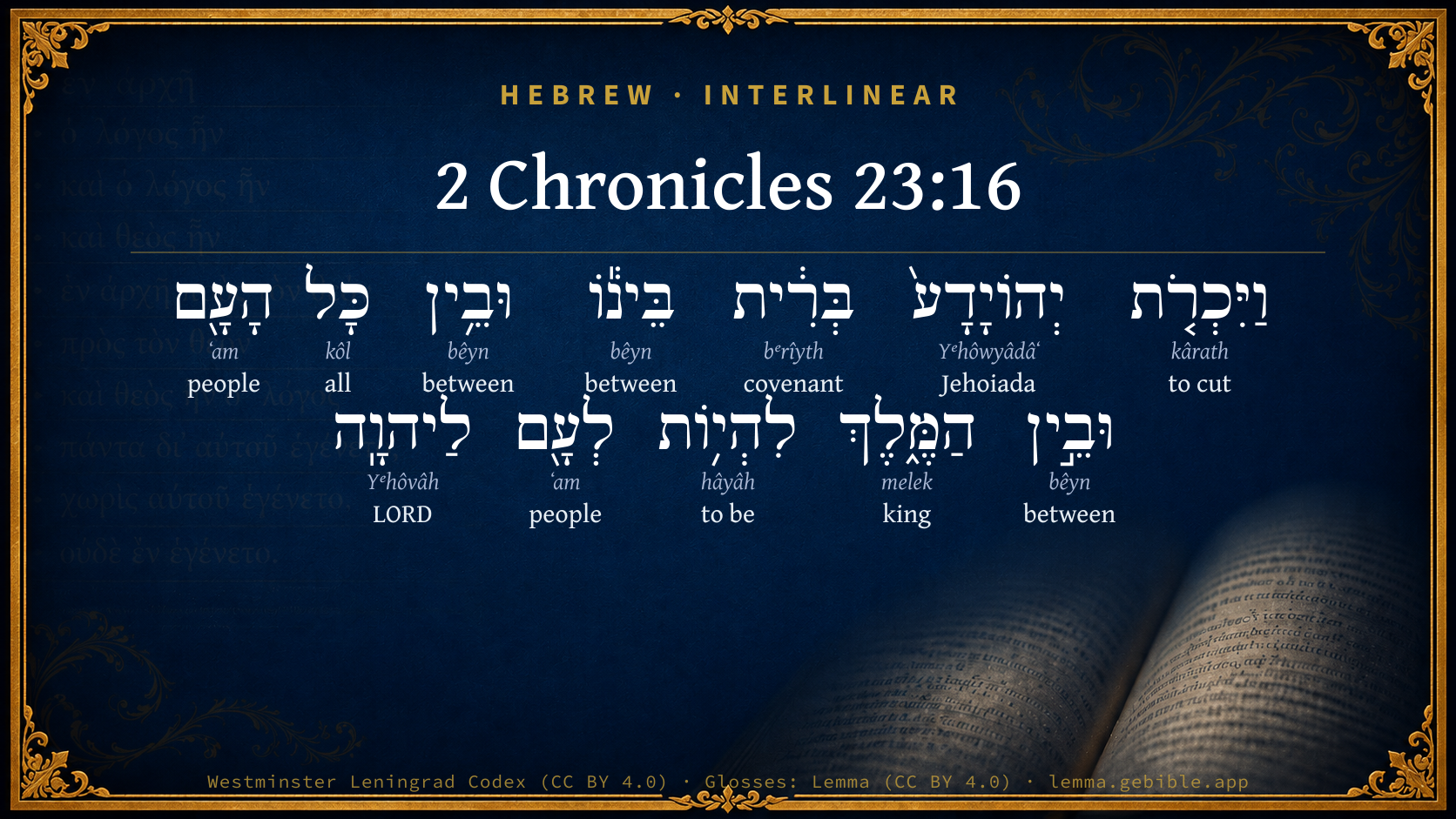
Hebrew (Westminster Leningrad Codex) 2 Chronicles 23:16 appears in the Hebrew Old Testament. The text above is from the Westminster Leningrad Codex. Each word links to its Strong’s number, a concise gloss, and parsing drawn from the Open Scriptures Hebrew Bible morphology. Click any word for its full Brown-Driver-Briggs (BDB) entry.
Download image
Cite this verse

2 Chronicles 23:16 (World English Bible). Public Domain. Lemma interlinear Bible study tool, https://lemma.gebible.app/v/2-chronicles/23/16.

Show BibTeX & RIS
BibTeX
RIS
English Translation
Jehoiada made a covenant between himself, and all the people, and the king, that they should be Yahweh's people.
World English Bible · Public Domain
Download a study sheet

One document with this verse’s original text, its word-by-word gloss line, the meaning frame, cross-references with their text, attributed commentary, and full source and license credits — printable, and it pastes into notes with its structure intact.

This verse Autodidact and up

Study sheet (.html) Plain text (.txt)

A passage Seminary Student

Up to 50 verses in one chapter. A passage sheet keeps up to 6 commentary sources and 12 cross-references per verse, in the order this page ranks them, and says so on the sheet whenever that leaves anything out. Ask for a single verse and you get the Autodidact verse sheet above.

Everything on this page stays free to read, with no account — the sheet is a download of what is already on screen, not access to it.

Want to remove ads? Support Godless Engineer
Compare translations 3

The same verse in 3 English versions, stacked beneath the original-language interlinear above. Click any original word for its lexicon entry.

Each is an independent rendering of the whole verse — the interlinear is not word-aligned to these translations.

Highlighted words mark where these versions differ — a whole-verse word diff, not a word-by-word alignment.

  • World English Bible Public Domain
    Jehoiada made a covenant between himself, and all the people, and the king, that they should be Yahweh's people.
  • King James Version Public Domain
    And Jehoiada made a covenant between him, and between all the people, and between the king, that they should be the LORD's people.
  • unfoldingWord Literal Text CC BY-SA 4.0
    And Jehoiada cut a covenant between himself, and between all the people, and between the king, to become a people for Yahweh.

unfoldingWord Literal Text — © unfoldingWord, licensed CC BY-SA 4.0. Word-aligned USFM3 via Door43 (git.door43.org/unfoldingWord/en_ult).

Versions to compare (up to 4)

3 of 4 selected

Show all 18 translations

Every available English version of this verse, each an independent rendering of the whole verse.

  • World English Bible Public Domain
    Jehoiada made a covenant between himself, and all the people, and the king, that they should be Yahweh's people.
  • Berean Standard Bible Public Domain
    Then Jehoiada made a covenant between himself and the king and the people that they would be the LORD’s people.
  • Majority Standard Bible Public Domain
    Then Jehoiada made a covenant between himself and the king and the people that they would be the LORD’s people.
  • King James Version Public Domain
    And Jehoiada made a covenant between him, and between all the people, and between the king, that they should be the LORD's people.
  • American Standard Version (1901) Public Domain
    And Jehoiada made a covenant between himself, and all the people, and the king, that they should be Jehovah's people.
  • Revised Version (1885) Public Domain
    And Jehoiada made a covenant between himself, and all the people, and the king, that they should be the LORD’S people.
  • Geneva Bible (1599) Public Domain
    And Iehoiada made a couenant betweene him, and all the people, and the King, that they would be the Lords people.
  • Douay-Rheims (1899) Public Domain
    And Joiada made a covenant between himself and all the people, and the king, that they should be the people of the Lord.
  • Young's Literal Translation Public Domain
    And Jehoiada maketh a covenant between him, and between all the people, and between the king, to be for a people to Jehovah;
  • Literal Standard Version CC BY-SA 4.0
    And Jehoiada makes a covenant between him, and between all the people, and between the king, to be for a people to YHWH;
  • Unlocked Literal Bible CC BY-SA 4.0
    Then Jehoiada made a covenant between himself, all the people, and the king, that they should be Yahweh's people.
  • unfoldingWord Literal Text CC BY-SA 4.0
    And Jehoiada cut a covenant between himself, and between all the people, and between the king, to become a people for Yahweh.
  • Darby Bible Public Domain
    And Jehoiada made a covenant between himself and all the people and the king, that they should be the people of Jehovah.
  • World Messianic Bible Public Domain
    Jehoiada made a covenant between himself, all the people, and the king, that they should be the LORD’s people.
  • Webster's Bible Public Domain
    And Jehoiada made a covenant between him, and between all the people, and between the king, that they should be the LORD'S people.
  • Free Bible Version CC BY-SA 4.0
    Then Jehoiada made a solemn agreement between himself and all the people and the king that they would be the Lord's people.
  • Bible in Basic English Public Domain
    And Jehoiada made an agreement between the Lord and all the people and the king, that they would be the Lord's people.
  • JPS Tanakh (1917) Public Domain
    And Jehoiada made a covenant between himself, and all the people, and the king, that they should be the LORD'S people.

Literal Standard Version (2020), Covenant Press — licensed CC BY-SA 4.0. Text via the HelloAO Bible API (eBible.org). Unlocked Literal Bible (unfoldingWord) — licensed CC BY-SA 4.0. Text via the HelloAO Bible API (eBible.org). unfoldingWord Literal Text — © unfoldingWord, licensed CC BY-SA 4.0. Word-aligned USFM3 via Door43 (git.door43.org/unfoldingWord/en_ult). Free Bible Version, Dr. Jonathan Gallagher — licensed CC BY-SA 4.0. Text via the HelloAO Bible API (eBible.org).

Word by word

More ways to search: Search by grammar → Find every occurrence → Compare this word →

Practice this passage: Drill this verse → Learn its vocabulary →

יְהוֹיָדָע֙
Yᵉhôwyâdâʻ
H3077
“Jehoiada”
Noun, Proper
Part of Speech
Noun
Type
Proper
Full BDB Definition

Origin: from H3068 and H3045

TWOT: None

Jehoiada = "Jehovah knows" - father of Benaiah, David's mighty warrior - leader of the priests who joined David at Hebron - high priest at the time of Athaliah's usurpation of the throne of Judah; hid Joash, the king's son, for six years and eventually replaced him on the throne of Judah - second priest, or sagan, to Seraiah the high priest
  1. וַיִּכְרֹ֤ת kârath H3772 “and · to cut” Conjunction + Verb, Qal, Sequential Imperfect, 3rd Person, Masculine, Singular
  2. בְּרִ֔ית bᵉrîyth H1285 “covenant” Noun, Common, Feminine, Singular, Absolute
  3. בֵּינ֕וֹ bêyn H996 “between · him” Preposition + Suffix, Personal, 3rd Person, Masculine, Singular
  4. וּבֵ֥ין bêyn H996 “and · between” Conjunction + Preposition
  5. כָּל kôl H3605 “all of” Noun, Common, Masculine, Singular, Construct
  6. הָעָ֖ם ʻam H5971 “the · people” Particle, Definite Article + Noun, Common, Masculine, Singular, Absolute
  7. וּבֵ֣ין bêyn H996 “and · between” Conjunction + Preposition
  8. הַמֶּ֑לֶךְ melek H4428 “the · king” Particle, Definite Article + Noun, Common, Masculine, Singular, Absolute
  9. לִהְי֥וֹת hâyâh H1961 “to be” Preposition + Verb, Qal, Infinitive Construct
  10. לְעָ֖ם ʻam H5971 “to/for · people” Preposition + Noun, Common, Masculine, Singular, Absolute
  11. לַיהוָֽה Yᵉhôvâh H3068 “to/for · LORD” Preposition + Noun, Proper

About this verse

These counts appear in no published source. They are computed here, from the morphology-tagged text and Lemma’s own curated glosses. What Lemma adds →

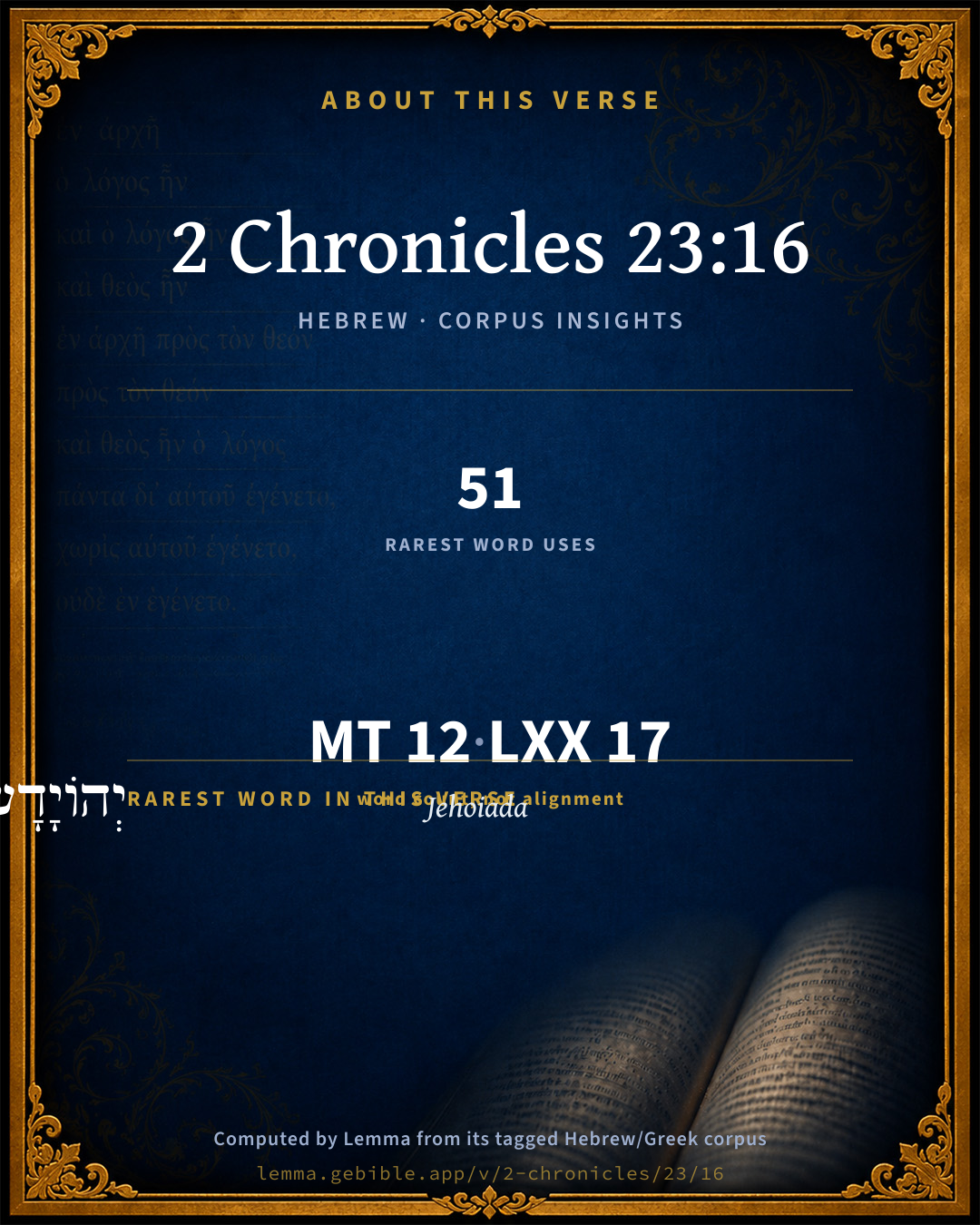
12
words
9
distinct lemmas
Historical
section

Shared distinctive vocabulary

יְהוֹיָדָע֙ Jehoiada H3077 occurs in 48 verses of the Hebrew Bible. Also found in:

Grammatical profile

  • 2 verbs
  • 7 nouns
  • 3 prepositions

Verb forms

  • וַיִּכְרֹ֤ת Qal · Sequential Imperfect
  • לִהְי֥וֹת Qal · Infinitive Construct

Repetition

Words recur within this verse — often emphatic in Hebrew:

  • בֵּינ֕וֹ between H996 ×3
  • הָעָ֖ם people H5971 ×2

Hebrew & Septuagint length

In English translation the verse runs 19 words from the Hebrew and 20 from the Septuagint (LXX English) — closely comparable.

A rough comparison of the two English renderings, which tokenize alike — not a word-level alignment.

Word counts can differ between the Hebrew and the Greek without any difference in meaning — e.g. the Hebrew direct-object marker אֵת has no separate Greek word, and Greek often adds the article ὁ.

In the original languages it is 12 Hebrew tokens and 17 Greek tokens — but the two are counted differently (Hebrew bundles its prefixes and suffixes into one token; the Greek is in lemma form), so that isn’t a like-for-like length.

Cross-references

14

Topical passages linked to 2 Chronicles 23:16 in the Treasury of Scripture Knowledge — connected by theme and wording, ordered by reader-vote popularity; previews shown in the World English Bible.

  • 2 Kings 11:17 Jehoiada made a covenant between Yahweh and the king and the people, that they should be Yahweh's people; between the king also and the people.
  • 2 Chronicles 29:10 Now it is in my heart to make a covenant with Yahweh, the God of Israel, that his fierce anger may turn away from us.
  • Nehemiah 9:38 Yet for all this we make a sure covenant, and write it; and our princes, our Levites, [and] our priests, seal to it.
  • Deuteronomy 5:2–3 Yahweh our God made a covenant with us in Horeb.
  • Deuteronomy 26:17–19 You have declared Yahweh this day to be your God, and that you would walk in his ways, and keep his statutes, and his commandments, and his ordinances, and listen to his voice:
  • Deuteronomy 29:1–15 These are the words of the covenant which Yahweh commanded Moses to make with the children of Israel in the land of Moab, besides the covenant which he made with them in Horeb.
  • Joshua 24:21–25 The people said to Joshua, No; but we will serve Yahweh.
  • 2 Chronicles 15:12 They entered into the covenant to seek Yahweh, the God of their fathers, with all their heart and with all their soul;
  • 2 Chronicles 15:14 They swore to Yahweh with a loud voice, and with shouting, and with trumpets, and with cornets.
  • 2 Chronicles 34:31–32 The king stood in his place, and made a covenant before Yahweh, to walk after Yahweh, and to keep his commandments, and his testimonies, and his statutes, with all his heart, and with all his soul, to perform the words of the covenant that were written in this book.
  • Ezra 10:3 Now therefore let us make a covenant with our God to put away all the wives, and such as are born of them, according to the counsel of my lord, and of those who tremble at the commandment of our God; and let it be done according to the law.
  • Nehemiah 5:12–13 Then said they, We will restore them, and will require nothing of them; so will we do, even as you say. Then I called the priests, and took an oath of them, that they would do according to this promise.
  • Nehemiah 10:29–39 They joined with their brothers, their nobles, and entered into a curse, and into an oath, to walk in God's law, which was given by Moses the servant of God, and to observe and do all the commandments of Yahweh our Lord, and his ordinances and his statutes;
  • Isaiah 44:5 One shall say, I am Yahweh's; and another shall call [himself] by the name of Jacob; and another shall subscribe with his hand to Yahweh, and surname [himself] by the name of Israel.

Cross-references courtesy of OpenBible.info (CC BY 4.0).

Hebrew and Greek witnesses Masoretic Hebrew ↔ Greek Septuagint

The same verse in the two great witnesses to the Old Testament, shown verse-for-verse.

These are two independent witnesses, not word-aligned to each other, and the Septuagint is shown in lemma (dictionary) form.

Hebrew 2 Chronicles 23:16 Masoretic · Westminster Leningrad Codex

וַיִּכְרֹ֤ת יְהוֹיָדָע֙ בְּרִ֔ית בֵּינ֕וֹ וּבֵ֥ין כָּל הָעָ֖ם וּבֵ֣ין הַמֶּ֑לֶךְ לִהְי֥וֹת לְעָ֖ם לַיהוָֽה

Jehoiada made a covenant between himself, and all the people, and the king, that they should be Yahweh's people.

World English Bible · Public Domain

Greek LXX 2 Chronicles 23:16 Septuagint · lemma form

καί διατίθημι ιωδαε διαθήκη ἀνά μέσος αὐτός καί ὁ λαός καί ὁ βασιλεύς εἰμί λαός ὁ κύριος

And Jodae made a covenant between himself, and the people, and the king, that the people should be the Lord's.

LXX2012 (modern English Septuagint) · Public Domain

Hebrew: Westminster Leningrad Codex (CC BY 4.0). Greek: Septuagint (public domain); English from LXX2012 (modern English Septuagint) (Public Domain). How the Septuagint differs from the Hebrew →

Commentary

Notes on 2 Chronicles 23:16 from classic Christian and Jewish commentators (each source and its license shown beneath its notes). The classic Christian expositions comment on the surrounding passage and are grouped to its opening verse, so a note may address several verses; the Jewish commentaries on the Tanakh (Rashi and others) are per-verse, so they appear only where the commentator wrote on this verse.

Lemma curates 59 commentaries, every one of them public domain or Creative Commons licensed, each selected and text-cleaned for this edition rather than reprinted as found. About our sources →

Jamieson, Fausset & Brown

Robert Jamieson, A. R. Fausset & David Brown

JEHOIADA RESTORES THE WORSHIP OF GOD, AND SETTLES THE KING. (Ch2 23:16)

Jehoiada made a covenant--(See on Kg2 11:17).

Next: 2 Chronicles Chapter 24

Jamieson, Fausset & Brown — Commentary Critical and Explanatory on the Whole Bible (1871) — public domain (CC PDM 1.0). Text via the HelloAO Bible API.

Ellicott's Commentary for English Readers

RENEWAL OF THE THEOCRATIC COVENANT AND ABOLITION OF BAAL-WORSHIP

(2Ch_23:16-21).

(16) A covenant between . . . the king.—A slight but characteristic variation from 2Ki_11:17 : “the covenant between Jehovah and the king and the people, that they should become a people for Jehovah.”

Between him.—Or rather, himself. The high priest is thus regarded as representing Jehovah in the transaction; and the apparent irreverence of making the Deity a direct co-partner with men in a compact is avoided.

Be the Lord’s people.—Literally, become a people for Jehovah. Kings adds: “and between the king and the people,” a not unimportant clause, for it relates to certain limitations of the royal prerogative, which were usually agreed upon at the beginning of a reign (2Sa_3:21; 2Sa_5:3; 1Sa_10:25).

A Bible Commentary for English Readers, edited by Charles John Ellicott (1878–1897) — public domain. Text from a community e-Sword module.

Trapp's Complete Commentary

John Trapp

2Ch 23:16 And Jehoiada made a covenant between him, and between all the people, and between the king, that they should be the LORD’S people.

Ver. 16. And Jehoiada made a covenant between him.] As God’s minister, representing his person in this action.

And between the king.] Whom he bindeth not to himself, as the Pope doth Christian princes, but to God.

John Trapp, A Commentary or Exposition upon All the Books of the Old and New Testament (1647–1656) — public domain. Text from a community e-Sword module.

Joseph Benson's Commentary

2Ch 23:16. Jehoiada made a covenant between him, &c. — In 2Ki 11:17, it is said, Jehoiada made a covenant between the Lord, and the king, and the people. Here it is said to be made between him, the people, and the king. But the two passages do not contradict each other. For Jehoiada, as God’s priest, was his representative in this transaction, or a sort of mediator, as Moses was. God covenanted by him to take them for his people; and the king and people covenanted with him to be his; and then the king covenanted with the people to govern them as the people of God; and the people with the king, to be subject to him as the Lord’s people, in his fear, and for his sake. For it must be observed, that this covenant, and others made in like manner, were solemn promises on the part of the Jewish king and people, that, for the future, they would observe God’s laws: in return to which the high-priest promised, on the part of God, that, if they did so, they should enjoy all the blessings promised in those divine laws to obedience.

Joseph Benson's Commentary on the Old and New Testaments (1811–1818) — public domain. Text from a community e-Sword module.

Tyndale Open Study Notes

Tyndale Open Resources

23:16-17 The covenant included vows between the king and the people, between the Lord and the king, and between the Lord and the people. The vows with the Lord included eliminating the worship of Baal.

Tyndale Open Study Notes — © Tyndale Open Resources, licensed CC BY-SA 4.0. Text via the HelloAO Bible API.

Geneva Bible (1599)

Geneva Bible translators

That they would only serve him and renounce all idolatry.

Geneva Bible (1599) marginal notes — public domain. Text via Bolls.life.

Adam Clarke's Commentary

Verse 16. Made a covenant between him] The high priest was, on this occasion, the representative of GOD; whom both the people and the king must have had in view, through the medium of his priest.

Adam Clarke's Commentary on the Bible (1810–1826) — public domain. Text from a community e-Sword/MySword module.

The Cambridge Bible for Schools and Colleges

gen. ed. J. J. S. Perowne

16–21 (= 2Ki_11:17-20). The Sequel of the Fall of Athaliah

16. between him … the king] R.V. between himself, and all the people, and the king. Jehoiada puts himself first as regent. Better in 2 Kin. “between the Lord and the king and the people.”

that they should be the Lord’s people] Cp. 2Ch_29:10, 2Ch_34:31; Exo_24:1-11; Deu_26:17-18; Neh_9:36-38.

The Cambridge Bible for Schools and Colleges (gen. ed. J. J. S. Perowne; Cambridge University Press, 1878–1918) — public domain. Text from a community e-Sword module.

Albert Barnes' Notes on the Bible

Between him ... - In 2Ki 11:17 the covenant is said to have been made “between the Lord,” etc. To the writer of Chronicles Jehoiada was God’s representative, and received the pledges of king and people.

Albert Barnes' Notes on the Bible (1834–1885) — public domain. Text from a community e-Sword/MySword module.

Haydock's Catholic Bible Commentary

Himself, as God’s vicegerent. C. --- A double covenant was made between God and the people, and between the king and his subjects. D.

George Leo Haydock (1774–1849), Haydock's Catholic Family Bible and Commentary, 1859 edition — public domain. Excludes Psalms (Douay-Rheims chapter numbering differs from Protestant) and Deuterocanonical books (Catholic canon only).

Matthew Poole's English Annotations

Between him, i.e. the Lord, as is sufficiently implied in the end of this verse, and plainly expressed 2Ki 11:17. Or, between himself; that the people might see that he brought them under no bond but what he would take upon himself.

That they should be the Lord’s people, i.e. that every one in his place and station would maintain the law and worship of God, and root out all false worship; which they did in the next verse.

Matthew Poole's English Annotations on the Holy Bible (1683–1685) — public domain. Text from a community e-Sword/MySword module.

The Pulpit Commentary

Between him. The Revised Version reads "himself," which is the evident meaning. The parallel leaves out, however, mention of Jehoiada as party to the covenant, viewing him rather as the promoter of it.

The basis of national prosperity.

Jehoiada knew that it would be of very little use to be rid of one ruler and to place another on the throne unless the nation itself could be bound in strong bonds to Jehovah, its true and almighty Sovereign. Hence the action he took as here described.

I THE TRUE BASES OF NATIONAL PROSPERITY. Not a population outgrowing that of all other countries; nor an army and navy such as no other nation can equip; nor a full national exchequer; nor an extensive and extending territory. A country may have any or even all of these things, and yet be declining in strength and on the road to utter weakness and decay. The foundation of a people"s strength is in the possession of the.Divine favour. And this because:

1. God will grant his Divine blessing to those that seek him.

2. And because God "loves righteousness and hates iniquity," whether inthe individual man or in the nation; and it is in "the fear of the Lord" that all moral and spiritual integrity rests as in its very root and source. That people, therefore, which would live and thrive must be a people seeking God"s face and acting in accordance with his will. Then will it enjoy his blessing that favour and succour with which it cannot fail to prosper, without which it is bound to fall.

II A SOURCE OF SPIRITUAL STRENGTH. Jehoiada took advantage of the dynastic revolution to make it an occasion for entering into a solemn covenant "between all the people and between the king, that they should be the Lord s people. " The time was suitable for this renewal of their covenant with God. He himself, a priest of the Lord, had headed, indeed had originated and effected, the overthrow of the old idolatrous regime; the young king was to be placed on the throne as a worshipper of Jehovah, and now they might pledge themselves, in the most solemn and binding form, to be loyal to that Divine Lord whose, indeed, they were by a thousand ties. It was wisely and worthily done. Acts of national acknowledgment of God must need be rare. But it is open to Churches, to families, and especially to individual men, to renew their vows of attachment to their Divine Lord; to affirm to themselves or to declare to their friends and neighbours that they are "the Lord"s people." It is right and wise to employ any and every favourable opportunity of doing this. Such opportunity is found in:

1. The time when the soul returns to God from the far country ofindifference and disloyalty, and realizes that it is admitted to the Father"s home.

2. The time when the spirit is recalled from a temporary lapse, and againrecognizes the supreme claims of a Divine Redeemer.

3. When we meet one another at the table of the Lord, and there are vividlyreminded of the supreme fact that he "gave himself for us" unto shame and death.

4. On the reception of any special, personal, or domestic mercies at thekind hand of our heavenly Father. C.

Vers. 16-21.

The close of a revolution.

I COVENANT-MAKING. (Ver. 16.) Read in connection with 2Ki_11:17, this verse points to two covenant transactions.

1. Between Jehovah and the king and people.

(1) In this the priest Jehoiada acted as Jehovah"s representative symbolizing the greater High Priest over the house of God, who in the new and better covenant of grace is to sinful men the Image of the invisible God. (Heb_1:3 Heb_3:1 Heb_4:14 Heb_5:5)

(2) Of this the object was that they, Joash and his subjects, should be Jehovah"s people, observing his worship and keeping his commandments, and that he should be their God, defending them against their adversaries, and bestowing on them temporal and spiritual, individual and national prosperity. This was the substance of the covenant Jehovah had made with the nation at Sinai (Exo_19:3-6; Deu_5:2 Deu_26:17, Deu_26:18) and is the tenor of God"s covenant with his people in the gospel. (Heb_8:8-13)

2. Between the king and the people.

(1) On his side that he would govern in accordance with the testimony put into his hand that day; and

(2) on their side that they would be loyal to the throne on which he sat. This covenant is implicitly involved in all relationships of king and subjects. An unjust and tyrannical ruler ipso facto violates the contract between himself and his people, and to that extent absolves them from allegiance to his authority. Piety in the sovereign and loyalty in the people are the two best supports of an earthly throne.

II IDOL-PURGING. In a fit of reforming zeal the excited people entered without delay on a crusade against the false worship which had been introduced and patronized by Athaliah.

1. The temple of Baal wrecked. This idolatrous shrine had probably been erected by Jehoram to please Athaliah (2Ch_21:11; Josephus, "Ant.," 9:7. 4), as a similar edifice had been constructed in Samaria by Ahab, under the influence of Jezebel. (1Ki_16:32) Most likely it stood on Mount Moriah, alongside of the temple, if not within its outer court (Thenius, Bertheau), rather than on a different elevation (Bahr). Its proximity to the temple would account for its having become so soon a prey to popular fury, as when building its vicinity to the temple suggested the idea of tearing down the temple walls for stones to construct it. (2Ch_24:7) Now a day of Nemesis had dawned for it, as similar days had already overtaken its builders. Its walls and pillars, altars and imagos, were shattered in pieces. Compare the destruction of the Roman Catholic edifices in Perth on May 11, 1559, after a sermon by Knox. "The congregation in the church of St. John"s was still undispersed, when a priest came in, went up to the altar, opened the tabernacle, and prepared to say Mass. A boy who was present said something insolent. The priest struck him; and the boy, snatching up a stone, flung it at the crucifix, which fell broken to the ground. The common instinct shot through the gathered crowd; altar, ornaments, images, in a few moments lay in ruins on the chancel floor. The saints were flung from their niches, the storied windows dashed in atoms. Then the cry rose," To the Greyfriars!" and in an hour or two the poor monks, started from their noonday dinner, were adrift upon the world, and their homes going up in smoke and flame into the sky" (Froude"s "History of England," vol. 6. pp. 228, 229). "For a day or two after Knox preached his famous sermon, the besom of destruction was exceedingly busy in and about the fair city. Somebody perhaps Knox himself had remarked that "if the nests were pulled down the rooks would fly away;" and so all hands were laid to the nests. Popular fury raged uncontrollably. The monasteries and chapels which had given stately adornment to the city and its environs were reduced to ruins, only the bare and broken walls remaining, and most of these gaunt wrecks speedily disappeared" (Fittis"s " Ecclesiastical Annals of Perth," 1885, p. 81).

2. The priest of Baal slain. Marian the "priestling" (the Targum), having attempted to lead the people astray, had incurred the penalty of death, (Deu_13:9) which was summarily inflicted, perhaps as Moses had directed, by stoning him beside the altars at which he had served. Compare the murder of Zechariah by Joash"s minions in the later years of his reign. (2Ch_24:20)

III WORSHIP-REFORMING. (Vers. 18, 19.)

1. Irregularities corrected. The offices of the house of the Lord with reference to burnt offerings were arranged in accordance with the prescriptions of the Law of Moses. No worship was acceptable under the Hebrew economy that did not adhere to the regulations of that divinely inspired ritual; no worship is acceptable under the gospel dispensation that departs from the rubric laid clown by Jesus in his sermon at the well. (Joh_4:24)

1. Impurities prevented. Watchers were established at the temple gates, that none should enter in who were in any respect unclean, i.e. ceremonially defiled. Under the Law such persons were separated from the congregation (Num_19:20; Lev_11:24 Lev_22:5) and, until they were purified, could take no part in the solemnities of Divine worship. The truth therein symbolized was that worship derives its quality from the character of the worshipper. An unclean Israelite could not render acceptable worship to a God holy as Jehovah was. got until an atonement had been offered for his trespass by the officiating priest, and his body had been washed in pure water, could he take his place in the congregation of them who had a right to draw near to Jehovah. And neither can any render acceptable worship under the gospel who do not do so on the basis of an atonement offered for them by the great High Priest over the house of God, and with the Heaven-inspired emotions of a renewed life, "with hearts sprinkled from an evil conscience, and bodies washed with pure water". (Heb_10:19-22)

2. Hilarities superadded. That the service of Jehovah was designed to be a perennial fount of joy for Jehovah"s people was understood and proclaimed by Moses. (Deu_33:29) Until David"s time this was not so widely apprehended as might have been expected. The second king of Israel, however, discerned with penetrating vision that the worship of Jehovah should ever be accompanied with gladness; (Psa_5:11 Psa_32:11 Psa_68:3 Psa_89:15, 16 100:1, 2) and in order to express this idea, with the concurrence and approval of the captains of the host, he "separated to the service of the sons of Asaph, and of Heman, and of Jeduthun, those who should prophesy with harps, with psalteries, and with cymbals". (1Ch_25:1) During the reigns of Jehoram, Ahaziah, and Athaliah this part of the Divine service had been discontinued. When Joash acceded to the throne it was restored. So should Christians always serve God "with singing and rejoicing;" and this they will do in proportion as they are filled with that Spirit of which the fruit is joy (Gal_5:22; Eph_5:18, Eph_5:19; Php_4:4; 1Th_5:16; 1Jn_1:4)

IV KING-ENTHRONING. (Ver. 20.)

1. Led by the priest. Having completed his arrangements for the restoration of the temple service, Jehoiada proceeded with what was still needful to perfect the revolution. Lifting the boy-king from the platform, he led him forth from the temple down the causeway which conducted towards the palace.

2. Escorted by the people. As the crowd a little before had opened its ranks to let Athaliah pass to her destruction, so now it opens them again to let the young sovereign march to his regal residence. Probably preceded by the centurions, the princes, and the heads of fathers" houses, as in the temple he had been encompassed by the Levites, he is followed by the people of the land.

3. Conducted through the upper gate. This, called, "the gate of the guard", (2Ki_11:19) was not a temple door (Keil), but an entrance into the palace (Bertheau), perhaps the principal one, through which the royal guards were accustomed to pass. It was fitting that David"s heir should publicly take possession of David"s house.

4. Set upon the throne. This the natural termination of the ceremony. Joash was established upon the throne of the kingdom, the throne of his fathers, the throne which derived its authority from Jehovah alone.

V POPULAR REJOICING. (Ver. 21.)

1. The country was glad that the queen was slain. Her government had been a usurpation and a curse. Nobody lamented her. If she had a funeral, those who bore her to her last resting-place gave vent to their emotions, not in sobs, but in songs. If they shed tears above her sepulchre, these were tears of joy, not of grief. A terrible commentary on any one"s life, that one"s contemporaries, whether equals or dependents, are glad to be rid of one to see one"s career ended, one"s breath stopped, and one"s carcase huddled out of sight!

2. The city was quiet though the queen was slain. No one dreamt of drawing a sword to avenge her assassination. Those who knew her best, who had most frequent opportunities of studying her character and observing her behaviour, had nothing to say in extenuation of her faults or in commiseration of her fate. The consciences of her people were satisfied that she had deserved her doom. Perhaps the pious among them added, "So let all thine enemies perish, O Jehovah". (Jud_1:5:31)

Learn:

1. That the secret of all true prosperity, for Church or state, for society orfor the individual, is piety towards God and rectitude towards man.

2. That true religion can admit of no compromise with false religion, butmust aim at its extermination.

3. That in all matters of faith and practice, doctrine and duty, ritual andworship, the will of God, not the opinion of man, is the supreme rule.

4. That the enemy most requiring to be guarded against by God"sworshippers is sin.

5. That the King"s house for Christians is not the material temples in whichthey worship, but their own hearts, in which Christ desires to be enthroned.

6. That it is legitimate to rejoice over the destruction of the enemies ofGod and his people. W. (Pro_11:10)

The Pulpit Commentary (1880–1919), ed. H.D.M. Spence-Jones & Joseph S. Exell — public domain. Text from a community e-Sword module.

John Wesley's Explanatory Notes

Him - The Lord, as is expressed, 2 Kings xi, 17.

John Wesley, Explanatory Notes Upon the Whole Bible (1754–1765) — public domain. Text via the GEBible commentary corpus.

Kretzmann's Popular Commentary

Paul E. Kretzmann

The Right Worship Restored

v. 16. And Jehoiada, who represented Jehovah at this assembly, 2Ki 11:17, made a covenant between him and between all the people and between the king, all of them joining in a solemn covenant of loyalty, that they should be the Lord’s people.

v. 17. Then all the people went to the house of Baal, a temple of idolatry erected under the direction of Athaliah somewhere in that neighborhood, and brake it down, and brake his altars and his images in pieces, and slew Mat-tan, the priest of Baal, before the altars, thus putting an end to idolatry in Jerusalem.

v. 18. Also Jehoiada appointed the offices of the house of the Lord, all the various orders of assistants and ministers on duty in the Temple and its grounds, by the hand of the priests, the Levites, whom David had distributed in the house of the Lord, assigning both their special tasks and the order of their serving by lot, 1 Chronicles 23-25, to offer the burnt offerings of the Lord, as it is written in the Law of Moses, Num 28:2, with rejoicing and with singing, as it was ordained by David, for the orders of singers were especially designated.

v. 19. And he set the porters, in special divisions guarding the various entrances, at the gates of the house of the Lord, that none which was unclean in anything should enter in, for the contact of Levitically unclean persons defiled the Sanctuary, Lev 5:2-3.

v. 20. And he took the captains of hundreds, and the nobles, and the governors of the people, all those occupying positions of influence and authority in ruling the people, and all the people of the land, and brought down the king from the house of the Lord. And they came through the high gate, probably the gate of the Temple which led to the royal palace, into the king’s house, and set the king upon the throne of the kingdom, the great ivory throne of Solomon.

v. 21. And all the people of the land rejoiced; and the city was quiet after that they had slain Athaliah with the sword, any followers whom she might still have had in the city thought it best to hold their peace and not to attempt any hostile demonstration. Thus the Lord had put an end to the persecution of the tyrant and restored the true worship in Jerusalem. The usual result of persecution has ever been to cause the Church to be filled with new zeal for God and for His Word.

Paul E. Kretzmann, Popular Commentary of the Bible (1921–1924) — public domain. Text from a community e-Sword module.

unfoldingWord translationNotes

Door43 World Missions Community

General Information:

Throughout chapter 23, Joash is referred to as "the king." It may be helpful to your readers to occasionally add "King Joash" or "Joash the king" to make his identity explicit. (See: Assumed Knowledge and Implicit Information)

all the people went to the house of Baal

This is a generalization that means a large group of the people did this. AT: "a very large group of the people went to the temple of Baal" (See: Hyperbole and Generalization)

Mattan

This is the name of a man. (See: How to Translate Names)

translationWords

covenant

people of God

Baal

altar

image

unfoldingWord translationNotes — © Distant Shores Media and the Door43 World Missions Community, licensed CC BY-SA 4.0. Source: git.door43.org/Door43/en_tn.

Rashi

Rabbi Shlomo Yitzchaki (Rashi)

between himself and all the people and the king that all of them, the king and the people, should follow the Lord.

Rashi on the Tanakh — English translations: “The Judaica Press complete Tanach with Rashi, translated by A. J. Rosenberg” (CC BY 4.0); “Pentateuch with Rashi's commentary by M. Rosenbaum and A.M. Silbermann, 1929-1934” (public domain); “The Metsudah Tanach series, Lakewood, N.J” (CC BY 4.0); and “The Book of Joshua, Metsudah Publications, 1997” (CC BY 4.0). Text via Sefaria.

Lesson kit

Teaching starters — assembled from the data on this page, not authored interpretation. Every prompt links to the verse data it draws on. Edit before teaching.

2 Chronicles, in the Historical, opens this verse with 12 words (9 distinct Hebrew lemmas). Its most distinctive word is Yᵉhôwyâdâʻ (“Jehoiada”). A historical commentator’s framing appears above. Read the whole chapter for the surrounding context.

Discussion questions

  1. The word Yᵉhôwyâdâʻ carries the sense “Jehoiada.” How does it shape the verse?
  2. 2 Samuel 8:18 shares the word «Jehoiada» with this verse. How do the two illuminate each other?
  3. “between” occurs 3× in this one verse. What is the effect of the repetition?
  4. The translations on this page render this verse differently — a whole-verse word diff, not a word-by-word alignment. What might account for the different wordings?
  5. The verb «וַיִּכְרֹ֤ת» is Qal Sequential Imperfect. How does its form color the action?
  6. Reading how Jamieson, Fausset & Brown and Ellicott's Commentary for English Readers read this verse, where do the two commentators agree and where do they part?

Things to notice

Reading settings

Reading text

Shown beneath each verse's original-language words.

Old Testament
Old Testament edition

Read the OT as the Masoretic Hebrew (MT) or the Greek Septuagint (LXX).

English shown for the Greek Septuagint (in the Hebrew ↔ Greek comparison).

Comparing translations? Open the Compare panel on any verse page to stack up to four side by side.