
Deuteronomy 21:13

Hebrew (Westminster Leningrad Codex) Deuteronomy 21:13 appears in the Hebrew Old Testament. The text above is from the Westminster Leningrad Codex. Each word links to its Strong’s number, a concise gloss, and parsing drawn from the Open Scriptures Hebrew Bible morphology. Click any word for its full Brown-Driver-Briggs (BDB) entry.
Download image
Cite this verse

Deuteronomy 21:13 (World English Bible). Public Domain. Lemma interlinear Bible study tool, https://lemma.gebible.app/v/deuteronomy/21/13.

Show BibTeX & RIS
BibTeX
RIS
English Translation
and she shall put the clothing of her captivity from off her, and shall remain in your house, and bewail her father and her mother a full month: and after that you shall go in to her, and be her husband, and she shall be your wife.
World English Bible · Public Domain
Download a study sheet

One document with this verse’s original text, its word-by-word gloss line, the meaning frame, cross-references with their text, attributed commentary, and full source and license credits — printable, and it pastes into notes with its structure intact.

This verse Autodidact and up

Study sheet (.html) Plain text (.txt)

A passage Seminary Student

Up to 50 verses in one chapter. A passage sheet keeps up to 6 commentary sources and 12 cross-references per verse, in the order this page ranks them, and says so on the sheet whenever that leaves anything out. Ask for a single verse and you get the Autodidact verse sheet above.

Everything on this page stays free to read, with no account — the sheet is a download of what is already on screen, not access to it.

Want to remove ads? Support Godless Engineer
Compare translations 3

The same verse in 3 English versions, stacked beneath the original-language interlinear above. Click any original word for its lexicon entry.

Each is an independent rendering of the whole verse — the interlinear is not word-aligned to these translations.

Highlighted words mark where these versions differ — a whole-verse word diff, not a word-by-word alignment.

  • World English Bible Public Domain
    and she shall put the clothing of her captivity from off her, and shall remain in your house, and bewail her father and her mother a full month: and after that you shall go in to her, and be her husband, and she shall be your wife.
  • King James Version Public Domain
    And she shall put the raiment of her captivity from off her, and shall remain in thine house, and bewail her father and her mother a full month: and after that thou shalt go in unto her, and be her husband, and she shall be thy wife.
  • unfoldingWord Literal Text CC BY-SA 4.0
    and she shall remove the clothes of her captivity from upon her, and she shall live in your house and weep her father and her mother a month of days. And afterwards, you shall go in to her and marry her, and she shall be your wife.

unfoldingWord Literal Text — © unfoldingWord, licensed CC BY-SA 4.0. Word-aligned USFM3 via Door43 (git.door43.org/unfoldingWord/en_ult).

Versions to compare (up to 4)

3 of 4 selected

Show all 18 translations

Every available English version of this verse, each an independent rendering of the whole verse.

  • World English Bible Public Domain
    and she shall put the clothing of her captivity from off her, and shall remain in your house, and bewail her father and her mother a full month: and after that you shall go in to her, and be her husband, and she shall be your wife.
  • Berean Standard Bible Public Domain
    and put aside the clothing of her captivity. After she has lived in your house a full month and mourned her father and mother, you may have relations with her and be her husband, and she shall be your wife.
  • Majority Standard Bible Public Domain
    and put aside the clothing of her captivity. After she has lived in your house a full month and mourned her father and mother, you may have relations with her and be her husband, and she shall be your wife.
  • King James Version Public Domain
    And she shall put the raiment of her captivity from off her, and shall remain in thine house, and bewail her father and her mother a full month: and after that thou shalt go in unto her, and be her husband, and she shall be thy wife.
  • American Standard Version (1901) Public Domain
    and she shall put the raiment of her captivity from off her, and shall remain in thy house, and bewail her father and her mother a full month: and after that thou shalt go in unto her, and be her husband, and she shall be thy wife.
  • Revised Version (1885) Public Domain
    and she shall put the raiment of her captivity from off her, and shall remain in thine house, and bewail her father and her mother a full month: and after that thou shalt go in unto her, and be her husband, and she shall be thy wife.
  • Geneva Bible (1599) Public Domain
    And she shall put off the garment that shee was taken in, and she shall remaine in thine house, and bewaile her father and her mother a moneth long: and after that shalt thou go in vnto her, and marry her, and she shalbe thy wife.
  • Douay-Rheims (1899) Public Domain
    And shall put off the raiment, wherein she was taken: and shall remain in thy house, and mourn for her father and mother one month: and after that thou shalt go in unto her, and shalt sleep with her, and she shall be thy wife.
  • Young's Literal Translation Public Domain
    and turned aside the raiment of her captivity from off her, and hath dwelt in thy house, and bewailed her father and her mother a month of days, and afterwards thou dost go in unto her and hast married her, and she hath been to thee for a wife:
  • Literal Standard Version CC BY-SA 4.0
    and turned aside the raiment of her captivity from off her, and has dwelt in your house, and lamented her father and her mother [for] a month of days, and afterward you go in to her and have married her, and she has been to you for a wife.
  • Unlocked Literal Bible CC BY-SA 4.0
    Then she will take off the clothes she was wearing when she was taken captive and she will remain in your house and mourn for her father and her mother a full month. After that you may sleep with her and be her husband, and she will be your wife.
  • unfoldingWord Literal Text CC BY-SA 4.0
    and she shall remove the clothes of her captivity from upon her, and she shall live in your house and weep her father and her mother a month of days. And afterwards, you shall go in to her and marry her, and she shall be your wife.
  • Darby Bible Public Domain
    and she shall put the clothes of her captivity from off her, and shall abide in thy house, and bewail her father and mother a full month, and afterwards thou mayest go in unto her, and be her husband, and she shall be thy wife.
  • World Messianic Bible Public Domain
    She shall take off the clothing of her captivity, and shall remain in your house, and bewail her father and her mother a full month. After that you shall go in to her and be her husband, and she shall be your wife.
  • Webster's Bible Public Domain
    And she shall put off from her the raiment of her captivity, and shall remain in thy house, and bewail her father and her mother a full month: and after that, thou shalt go in to her, and be her husband, and she shall be thy wife.
  • Free Bible Version CC BY-SA 4.0
    and get rid of the clothes she was wearing when she was captured. After she has lived in your home and has finished her month of mourning for her father and mother, you may sleep with her and marry her, and she shall be your wife.
  • Bible in Basic English Public Domain
    And let her take off the dress in which she was made prisoner and go on living in your house and weeping for her father and mother for a full month: and after that you may go in to her and be her husband and she will be your wife.
  • JPS Tanakh (1917) Public Domain
    and she shall put the raiment of her captivity from off her, and shall remain in thy house, and bewail her father and her mother a full month; and after that thou mayest go in unto her, and be her husband, and she shall be thy wife.

Literal Standard Version (2020), Covenant Press — licensed CC BY-SA 4.0. Text via the HelloAO Bible API (eBible.org). Unlocked Literal Bible (unfoldingWord) — licensed CC BY-SA 4.0. Text via the HelloAO Bible API (eBible.org). unfoldingWord Literal Text — © unfoldingWord, licensed CC BY-SA 4.0. Word-aligned USFM3 via Door43 (git.door43.org/unfoldingWord/en_ult). Free Bible Version, Dr. Jonathan Gallagher — licensed CC BY-SA 4.0. Text via the HelloAO Bible API (eBible.org).

Word by word

More ways to search: Search by grammar → Find every occurrence → Compare this word →

Practice this passage: Drill this verse → Learn its vocabulary →

שִׁבְיָ֜הּ
shibyâh
H7633
“captivity · her”
Noun, Common, Both, Singular, Construct + Suffix, Personal, 3rd Person, Feminine, Singular
Part of Speech
Noun
Type
Common
Gender
Both
Number
Singular
State
Construct
Full BDB Definition

Origin: from H7628

TWOT: 2311c

captivity, captives - (state of) captivity - captives
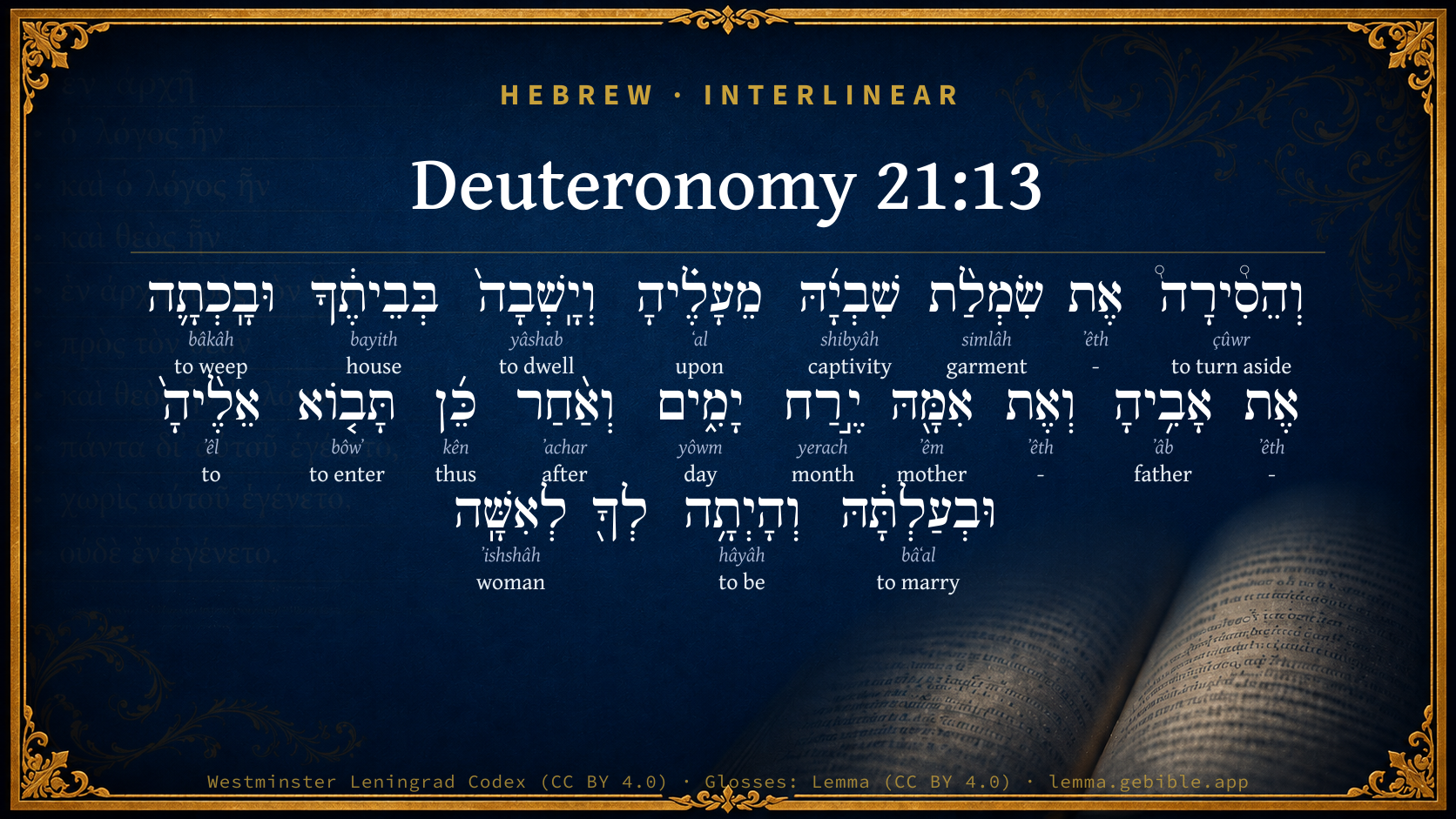
  1. וְהֵסִ֩ירָה֩ çûwr H5493 “and · to turn aside” Conjunction + Verb, Hiphil, Sequential Perfect, 3rd Person, Feminine, Singular
  2. אֶת ʼêth H853 “-” Particle, Direct Object
  3. שִׂמְלַ֨ת simlâh H8071 “garment of” Noun, Common, Feminine, Singular, Construct
  4. מֵעָלֶ֗יהָ ʻal H5921 “from · upon · her” Preposition + Preposition + Suffix, Personal, 3rd Person, Feminine, Singular
  5. וְיָֽשְׁבָה֙ yâshab H3427 “and · to dwell” Conjunction + Verb, Qal, Sequential Perfect, 3rd Person, Feminine, Singular
  6. בְּבֵיתֶ֔ךָ bayith H1004 “in/at · house · your” Preposition + Noun, Common, Masculine, Singular, Construct + Suffix, Personal, 2nd Person, Masculine, Singular
  7. וּבָֽכְתָ֛ה bâkâh H1058 “and · to weep” Conjunction + Verb, Qal, Sequential Perfect, 3rd Person, Feminine, Singular
  8. אֶת ʼêth H853 “-” Particle, Direct Object
  9. אָבִ֥יהָ ʼâb H1 “father · her” Noun, Common, Masculine, Singular, Construct + Suffix, Personal, 3rd Person, Feminine, Singular
  10. וְאֶת ʼêth H853 “and · -” Conjunction + Particle, Direct Object
  11. אִמָּ֖הּ ʼêm H517 “mother · her” Noun, Common, Feminine, Singular, Construct + Suffix, Personal, 3rd Person, Feminine, Singular
  12. יֶ֣רַח yerach H3391 “month of” Noun, Common, Masculine, Singular, Construct
  13. יָמִ֑ים yôwm H3117 “days” Noun, Common, Masculine, Plural, Absolute
  14. וְאַ֨חַר ʼachar H310 “and · after” Conjunction + Preposition
  15. כֵּ֜ן kên H3651 “thus” Particle, Demonstrative
  16. תָּב֤וֹא bôwʼ H935 “to enter” Verb, Qal, Imperfect, 2nd Person, Masculine, Singular
  17. אֵלֶ֨יהָ֙ ʼêl H413 “to · her” Preposition + Suffix, Personal, 3rd Person, Feminine, Singular
  18. וּבְעַלְתָּ֔הּ bâʻal H1166 “and · to marry · her” Conjunction + Verb, Qal, Sequential Perfect, 2nd Person, Masculine, Singular + Suffix, Personal, 3rd Person, Feminine, Singular
  19. וְהָיְתָ֥ה hâyâh H1961 “and · to be” Conjunction + Verb, Qal, Sequential Perfect, 3rd Person, Feminine, Singular
  20. לְאִשָּֽׁה ʼishshâh H802 “to/for · woman” Preposition + Noun, Common, Feminine, Singular, Absolute

About this verse

These counts appear in no published source. They are computed here, from the morphology-tagged text and Lemma’s own curated glosses. What Lemma adds →

22
words
19
distinct lemmas
Pentateuch
section

Notable vocabulary

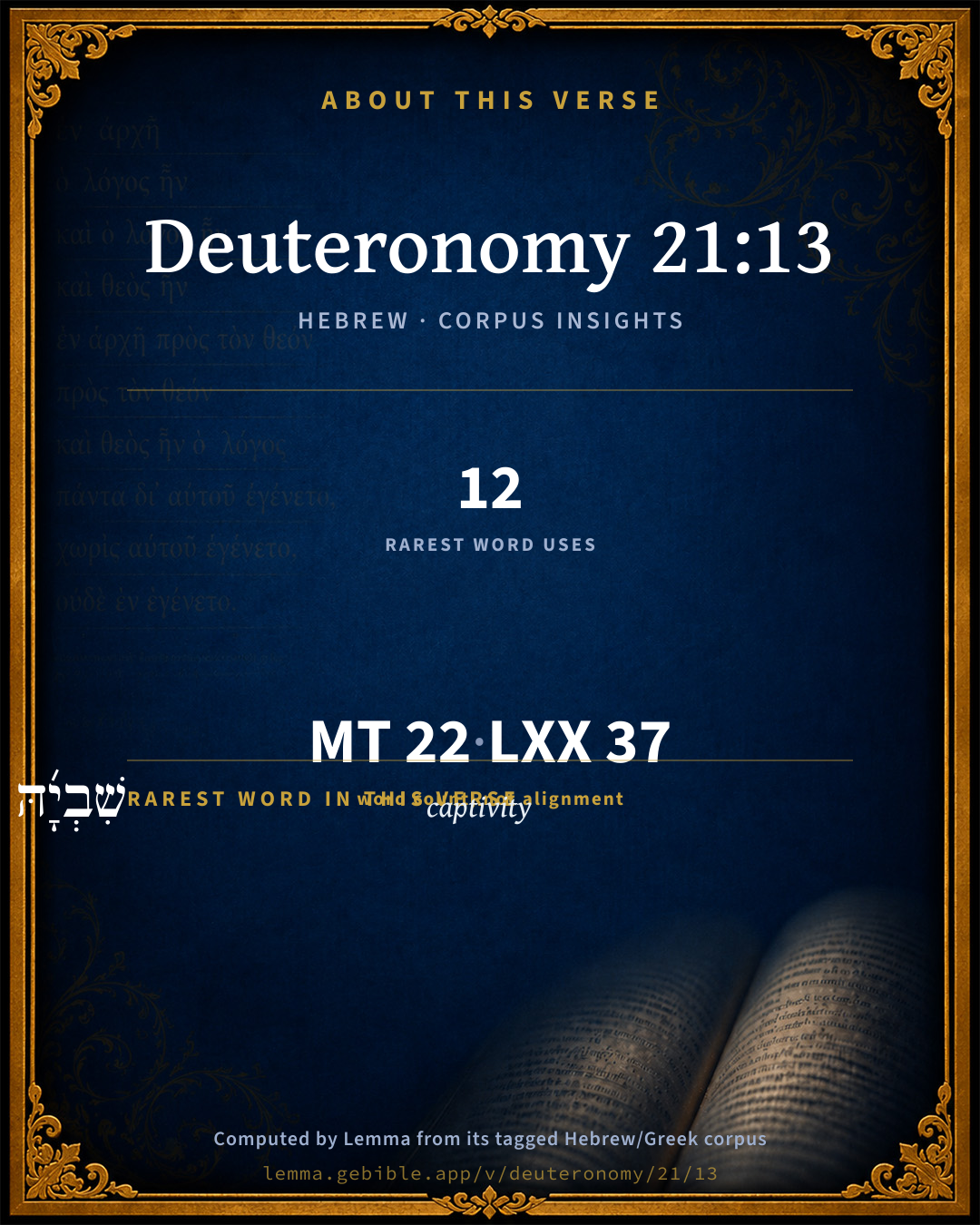
The rarest word here is שִׁבְיָ֜הּ captivity H7633 — appearing just 12 times in the whole Hebrew Bible.

Shared distinctive vocabulary

שִׁבְיָ֜הּ captivity H7633 occurs in 12 verses of the Hebrew Bible. Also found in:

Grammatical profile

  • 6 verbs
  • 8 nouns
  • 4 prepositions
  • 4 particles

Verb forms

  • וְהֵסִ֩ירָה֩ Hiphil · Sequential Perfect
  • וְיָֽשְׁבָה֙ Qal · Sequential Perfect
  • וּבָֽכְתָ֛ה Qal · Sequential Perfect
  • תָּב֤וֹא Qal · Imperfect
  • וּבְעַלְתָּ֔הּ Qal · Sequential Perfect
  • וְהָיְתָ֥ה Qal · Sequential Perfect

Hebrew & Septuagint length

In English translation the verse runs 47 words from the Hebrew and 48 from the Septuagint (LXX English) — closely comparable.

A rough comparison of the two English renderings, which tokenize alike — not a word-level alignment.

Word counts can differ between the Hebrew and the Greek without any difference in meaning — e.g. the Hebrew direct-object marker אֵת has no separate Greek word, and Greek often adds the article ὁ.

In the original languages it is 22 Hebrew tokens and 37 Greek tokens — but the two are counted differently (Hebrew bundles its prefixes and suffixes into one token; the Greek is in lemma form), so that isn’t a like-for-like length.

Cross-references

2

Topical passages linked to Deuteronomy 21:13 in the Treasury of Scripture Knowledge — connected by theme and wording, ordered by reader-vote popularity; previews shown in the World English Bible.

  • Psalms 45:10–11 Listen, daughter, consider, and turn your ear. Forget your own people, and also your father's house.
  • Luke 14:26–27 "If anyone comes to me, and doesn't hate his own father, mother, wife, children, brothers, and sisters, yes, and his own life also, he can't be my disciple.

Cross-references courtesy of OpenBible.info (CC BY 4.0).

Hebrew and Greek witnesses Masoretic Hebrew ↔ Greek Septuagint

The same verse in the two great witnesses to the Old Testament, shown verse-for-verse.

These are two independent witnesses, not word-aligned to each other, and the Septuagint is shown in lemma (dictionary) form.

Hebrew Deuteronomy 21:13 Masoretic · Westminster Leningrad Codex

וְהֵסִ֩ירָה֩ אֶת שִׂמְלַ֨ת שִׁבְיָ֜הּ מֵעָלֶ֗יהָ וְיָֽשְׁבָה֙ בְּבֵיתֶ֔ךָ וּבָֽכְתָ֛ה אֶת אָבִ֥יהָ וְאֶת אִמָּ֖הּ יֶ֣רַח יָמִ֑ים וְאַ֨חַר כֵּ֜ן תָּב֤וֹא אֵלֶ֨יהָ֙ וּבְעַלְתָּ֔הּ וְהָיְתָ֥ה לְךָ֖ לְאִשָּֽׁה

and she shall put the clothing of her captivity from off her, and shall remain in your house, and bewail her father and her mother a full month: and after that you shall go in to her, and be her husband, and she shall be your wife.

World English Bible · Public Domain

Greek LXX Deuteronomy 21:13 Septuagint · lemma form

καί περιαἱρέω ὁ ἱμάτιον ὁ αἰχμαλωσία αὐτός ἀπό αὐτός καί καταἵζω ἐν ὁ οἰκία σύ καί κλαίω ὁ πατήρ καί ὁ μήτηρ μήν ἡμέρα καί μετά οὗτος εἰςἔρχομαι πρός αὐτός καί συνοἰκίζω αὐτός καί εἰμί σύ γυνή

and shall take away her garments of captivity from off her, and she shall abide in your house, and shall bewail her father and mother the days of a month; and afterwards you shall go in to her and dwell with her, and she shall be your wife.

LXX2012 (modern English Septuagint) · Public Domain

Hebrew: Westminster Leningrad Codex (CC BY 4.0). Greek: Septuagint (public domain); English from LXX2012 (modern English Septuagint) (Public Domain). How the Septuagint differs from the Hebrew →

Targum (Aramaic paraphrase)

2

The Targum is the ancient Jewish Aramaic paraphrase of the Hebrew Scriptures — an interpretive translation, not the Hebrew text itself. Onkelos (literal) and Pseudo-Jonathan (expansive) render the Torah, and Jonathan the Prophets. Coverage is partial: where no permissively-licensed English translation exists for a verse, only the Aramaic is shown. This is verse-level text, not a word-by-word alignment to the Hebrew.

  1. Targum Onkelos Torah (Genesis–Deuteronomy)
    וְתֶעְדֵי יָת כְּסוּת שִׁבְיַהּ מִנַהּ וְתֵיתַב בְּבֵיתָךְ וְתִבְכֵּי יָת אֲבוּהָא וְיָת אִמַהּ יְרַח יוֹמִין וּבָתַר כֵּן תֵּיעוּל לְוָתַהּ וְתִבְעֲלִנַהּ וּתְהֵי לָךְ לְאִנְתּוּ

    (no public-domain English translation for this verse)

    Targum Onkelos — Aramaic: “Onkelos Genesis” (public domain); “Onkelos Exodus” (public domain); “Onkelos Leviticus” (public domain); “Onkelos Numbers” (public domain); “Onkelos Deuteronomy” (public domain). English: “Sefaria Community Translation” (CC0 1.0 (public-domain dedication)); “J.W. Etheridge. The Targums of Onkelos and Jonathan Ben Uzziel on the Pentateuch. London: Longmans, Green, 1862” (public domain). Text via Sefaria.

  2. Targum Pseudo-Jonathan Torah (Genesis–Deuteronomy)
    וּתְשַׁנֵי יַת כְּסוּת שִׁבְיָיתָהּ מִינָהּ וְתִטְבְּלִינָהּ וּתְגַיְירִינָהּ בְּבֵיתָךְ וְתִבְכֵּי עַל טַעֲוַות בֵּית אַבָּהּ וְאִמָּהּ וְתִשְׁהֵי תְּלַת יַרְחִין דִּי תֵדַע אִין הִיא מְעַבְּרָא וּמִן בָּתַר כְּדֵין תֵּיעוּל לְוָותָהּ וְתַפְרִין יָתָהּ וְתֶהֱוֵי לָךְ לְאִנְתּוּ

    and put off the dress of her captivity, and, dipping herself, become a proselyte in thy house, and weep on account of the idols of the house of her father and mother. And thou shalt wait three months to know whether she be with child; and afterwards thou mayest go to her, endow her, and make her thy wife.

    Targum Pseudo-Jonathan — Aramaic: “Targum Jonathan on Genesis” (public domain); “Targum Jonathan on Exodus” (public domain); “Targum Jonathan on Leviticus” (public domain); “Targum Jonathan on Numbers” (public domain); “Targum Jonathan on Deuteronomy” (public domain). English: “The Targum of Jonathan ben Uzziel, trans. J. W. Etheridge, London, 1862” (public domain). Text via Sefaria.

Commentary

Notes on Deuteronomy 21:13 from classic Christian and Jewish commentators (each source and its license shown beneath its notes). The classic Christian expositions comment on the surrounding passage and are grouped to its opening verse, so a note may address several verses; the Jewish commentaries on the Tanakh (Rashi and others) are per-verse, so they appear only where the commentator wrote on this verse.

Lemma curates 59 commentaries, every one of them public domain or Creative Commons licensed, each selected and text-cleaned for this edition rather than reprinted as found. About our sources →

Trapp's Complete Commentary

John Trapp

Deu 21:13 And she shall put the raiment of her captivity from off her, and shall remain in thine house, and bewail her father and her mother a full month: and after that thou shalt go in unto her, and be her husband, and she shall be thy wife.

Ver. 13. A full month.] Worldly sorrow, like a land flood, is for the present impetuous and violent, but time wears it out, not so godly sorrow.

John Trapp, A Commentary or Exposition upon All the Books of the Old and New Testament (1647–1656) — public domain. Text from a community e-Sword module.

Tyndale Open Study Notes

Tyndale Open Resources

21:13 To change the clothes she was wearing symbolically communicated taking on a new life and identifying with a new family.

Tyndale Open Study Notes — © Tyndale Open Resources, licensed CC BY-SA 4.0. Text via the HelloAO Bible API.

Geneva Bible (1599)

Geneva Bible translators

This only was permitted in the wars, otherwise the Israelites could not marry strangers.

As having renounced parents and country.

Geneva Bible (1599) marginal notes — public domain. Text via Bolls.life.

The Cambridge Bible for Schools and Colleges

gen. ed. J. J. S. Perowne

13. a full month] Lit. a month of days, a usual period of mourning, Deu_34:8, Num_20:29, etc., cp. Gen_50:3. Contrast Mohammed’s practice above.

be her husband] Heb. a ba‘al to her; so Deu_24:1, R.V. marrieth.

The Cambridge Bible for Schools and Colleges (gen. ed. J. J. S. Perowne; Cambridge University Press, 1878–1918) — public domain. Text from a community e-Sword module.

John Gill's Exposition

And she shall put the raiment of her captivity from off her,.... Her beautiful garments, and gay apparel, in which she was taken captive; and which tended to stir up the stronger affection for her, and greater desire after her; and therefore, as some think, were ordered to be removed, to abate the ardour of love to her. Jarchi observes, that the daughters of the Gentiles used to adorn themselves in war, that they might cause others to commit fornication with them; and another writer before referred to says (o), the daughters of Heathens used to adorn themselves in raiment of silk, and purple, and fine linen, and needlework, to allure and entice men with them; and therefore the law obliges to put off her beautiful garments, and clothe her with old worn out ones, that she might be less agreeable to him; though the putting off her fine clothes, and being clad with sordid ones, might be only as a token of mourning; as it was customary at such times to lay aside richer clothing, and put on sackcloth, Jon 3:6.

and shall remain in thine house: shut up there, and never stir out, as the same writer interprets it. Maimonides (p) says, that she was to be with him in the house, that going in and out he might see her, and she become abominable to him; though perhaps it was only that he might have an opportunity of observing her manners, and of conversing with her, in order to make a proselyte of her; so the Targum of Jonathan interprets it of dipping herself, and becoming a proselytess in his house; or else, as the rest, her abiding in the house, and not going out, might be on account of mourning, as follows:

and bewail her father and her mother a full month; who were either dead in the battle, or however she had no hope of seeing them any more, being a captive, and likely to be settled in another man's house in a foreign country, and so take her farewell of her father's house in this mournful manner. The Jews are divided about the sense of these words; some take them simply to signify her parents, others her idols, according to Jer 2:17. The Targum of Jonathan is,"and weep for the idols of the house of her father and her mother;''meaning not for the loss of them, but for the idolatry of her father's house she was now convinced of, being become a proselytess, according to the paraphrast; but the last seems only to have respect to the loss of her father and mother, which she was to bewail a whole month, or "a moon of days" (q); as many days as the moon is going its course, which it finishes in twenty seven days, seven hours, and forty three minutes, and this is called the periodical month; but is longer in passing from one conjunction of it with the sun to another, called the synodical month, and its quantity is twenty nine days, twelve hours, and forty four minutes. Maimonides (r) says, she was to stay in his house three months, one month of mourning, and two after that, and then he was to marry her. The reason of this the Targum of Jonathan explains, by paraphrasing the words thus,"and shall stay three months, that it may be known whether she is with child;''that is, by his lying with her before when taken with her beauty, that so he might distinguish this child begotten on her in Heathenism, from what he might have by her after marriage, which is supposed to be the case of Tamar and Absalom; but as there is no foundation in the text for a permission to lie with her before marriage, so neither for these additional months; only one month was required, which was the usual time for mourning for deceased relations; see Num 20:29.

and after that thou shalt go in unto her; and not before:

and be her husband, and she shall be thy wife he continuing to love her, and she having become a proselytess.

(o) R. Abraham Seba in Tzeror. Hammor, fol. 146. 2. (p) Ut supra. (Hilchot Melachim, c. 8. sect. 2.) (q) "luna dierum", Montanus, Piscator, Grotius. (r) Ut supra (Hilchot Melachim, c. 8.), sect. 6.

John Gill's Exposition of the Whole Bible (1746–1763) — public domain (CC PDM 1.0). Text via the HelloAO Bible API.

Albert Barnes' Notes on the Bible

Bewail her father and her mother a full month - This is prescribed from motives of humanity, that the woman might have time and leisure to detach her affections from their natural ties, and prepare her mind for new ones.

Albert Barnes' Notes on the Bible (1834–1885) — public domain. Text from a community e-Sword/MySword module.

Haydock's Catholic Bible Commentary

Raiment. In mourning, people wore different clothes from what they did at other times, 2 Kings xiv. 2. --- One month. So long the mourning for Aaron and Moses continued, chap. xxxiv., and Numbers xx. (Menochius)

George Leo Haydock (1774–1849), Haydock's Catholic Family Bible and Commentary, 1859 edition — public domain. Excludes Psalms (Douay-Rheims chapter numbering differs from Protestant) and Deuterocanonical books (Catholic canon only).

Matthew Poole's English Annotations

The raiment of her captivity, i.e. either,

1. Those goodly raiments in which she was when she was taken captive, instead of which she now must put on a servile habit, as this is generally understood; or rather,

2. Those servile and sordid raiments which were put upon her when she was taken captive, as the manner was to do with captives, as the phrase itself seems to intimate; as prison garments (Jer 52:33) are such garments as prisoners use to wear; and garments of praise are praiseworthy or glorious garments; and it seems harsh to call those garments of captivity, which are made for and generally worn by free persons only, and which are usually taken away from persons when they come into captivity. Add, that this doth not seem to be any part or token of her sorrow, but rather a mending of her condition, and exchanging her servile habit for a better and more decent one, which might be, though this were a mourning habit.

Her father and mother; either their death, or, which was in effect the same, her final separation from them. Withal this signified her alienation from them or from their superstitious and idolatrous courses, and her translation of her love from all other persons to her husband and to the true religion. Compare Psa 45:11.

She shall be thy wife; supposing what might very rationally be supposed of one in her circumstances, and what she signified by the foregoing rites, that she should submit to her husband’s religion, in which case the marriage might be tolerable. Or this was a permission and indulgence given to them for the hardness of their hearts, as in the case of divorce, Deu 24:1; Mat 19:8.

Matthew Poole's English Annotations on the Holy Bible (1683–1685) — public domain. Text from a community e-Sword/MySword module.

The Pulpit Commentary

The raiment of her captivity; i.e. the raiment she had on whoa taken captive; this she was to lay aside, that she might put on garments of mourning. A full month; literally, a month of days; the period of mourning was forty days. (cf. Gen_50:3)

The Pulpit Commentary (1880–1919), ed. H.D.M. Spence-Jones & Joseph S. Exell — public domain. Text from a community e-Sword module.

John Wesley's Explanatory Notes

Raiment of captivity - Those sordid raiments which were put upon her when she was taken captive. Bewail her father and mother - Either their death, or which was in effect the same, her final separation from them.

John Wesley, Explanatory Notes Upon the Whole Bible (1754–1765) — public domain. Text via the GEBible commentary corpus.

unfoldingWord translationNotes

Door43 World Missions Community

General Information:

Moses continues speaking to the people of Israel as if he were speaking to one man, so the words "you" and "your" are singular. (See: Forms of You)

she will take off the clothes she was wearing

She will do this after the man brings her to his house and when she shaves her head and cuts her fingernails and toenails as mentioned in Deuteronomy 21:12. The full meaning of this statement can be made explicit. AT: "she will take off the clothes of her people and put on Israelite clothes" (See: Assumed Knowledge and Implicit Information)

when she was taken captive

This can be stated in active form. AT: "when you took her captive" (See: Active or Passive)

a full month

"an entire month" or "a whole month"

But if you take no delight in her

You may need to make explicit that the man sleeps with the woman. AT: "But if you sleep with her and then decide that you do not want her as your wife" (See: Assumed Knowledge and Implicit Information)

let her go where she wishes

"let her go wherever she wants to go"

because you have humiliated her

"because you shamed her by sleeping with her and then sending her away"

translationWords

mourn

month

had relations with

servant

humiliate

unfoldingWord translationNotes — © Distant Shores Media and the Door43 World Missions Community, licensed CC BY-SA 4.0. Source: git.door43.org/Door43/en_tn.

Rashi

Rabbi Shlomo Yitzchaki (Rashi)

והסירה את שמלת שביה AND SHE SHALL REMOVE THE RAIMENT OF HER CAPTIVITY — the reason is because these are fine clothes, for the women of the heathen peoples adorned themselves in time of war in order to lure others (the enemy) to unchastity with them (Sifrei Devarim 213:1).

וישבה בביתך AND SHE SHALL DWELL IN “THY” HOUSE — [not in the women’s apartments, but] in the house which he constantly uses: when he goes in he stumbles upon her, when he leaves he stumbles upon her (i.e. he cannot avoid meeting her constantly and the novelty of her beauty wears off); he sees her endless crying, sees her neglected appearance — and all this in order that she should become repulsive to him (Sifrei Devarim 213:2).

ובכתה את אביה AND SHE SHALL WEEP FOR HER FATHER [AND HER MOTHER A FULL MONTH] — Why all this? In order to make a contrast — that while the Jewish woman (the captor’s Jewish wife) is gladsome, she should be downhearted, while the Jewish woman adorns herself, this one should bear a neglected appearance (Sifrei Devarim 213:5).

Rashi on the Tanakh — English translations: “The Judaica Press complete Tanach with Rashi, translated by A. J. Rosenberg” (CC BY 4.0); “Pentateuch with Rashi's commentary by M. Rosenbaum and A.M. Silbermann, 1929-1934” (public domain); “The Metsudah Tanach series, Lakewood, N.J” (CC BY 4.0); and “The Book of Joshua, Metsudah Publications, 1997” (CC BY 4.0). Text via Sefaria.

Ramban (Nachmanides)

Rabbi Moshe ben Nachman (Ramban / Nachmanides)

AND AFTER THAT THOU MAYEST COME UNTO HER, AND BE HER HUSBAND. The Rabbis have commented in the Sifre: 213 and Yebamoth 48b. “You have no privilege in her except cohabitation.” By this the Rabbis meant to say that betrothal with money or a writ is not binding on her. Even the cohabitation is not for the purpose of betrothal, since her status is still that of an idolatress upon whom betrothal is not binding; however, Scripture permitted him to cohabit with her. And because Scripture states [at the expiration of the thirty-day mourning period], and she shall be thy wife, it indicates that she becomes his real wife, and if she commits adultery while living with him, she is to be tried as a married woman. Thus the Rabbis have said in the Gemara of Tractate Kiddushin: “And thou wouldest take her to thee to wife. You have possession of her [through legal marriage],” that is, after following these regulations. And in the Sifre the Rabbis have said, 213 and Yebamoth 48b. “And she shall be thy wife, similar to what is stated, her food, her raiment, and her conjugal rights, he shall not diminish.” If so, she is his wife in all respects seeing that the Torah gave him possession of her.And in line with the simple meaning of Scripture it appears that he is prohibited from cohabiting with her at all until after he has gone through this entire procedure, this being the sense of the expression, and after that thou mayest come unto her, and be her husband. And that which Scripture stated, and thou desirest her, and thou wouldest take her to thee to wife, means that he would take her for his wife after [complying with] all these regulations which it will command. Similarly, so that I took her to be my wife [means that Pharaoh took her to his house to be his wife]. However, in the Gemara of Tractate Kiddushin the Rabbis have said that he is permitted to engage in the first cohabitation [even before the procedure prescribed in this section], this being the sense of the expression, and thou wouldest take her to thee to wife. They interpreted the expression, “And thou shalt bring her home to thy house — this teaches that he is not to coerce her during battle.” The Rabbis connected it with the verse above, and thou wouldest take her to thee to wife [stated in Verse 11] meaning, when thou shalt bring her home to thy house [Verse 12]. Thus he takes her captive in battle and brings her to his home and to his city, and he cohabits with her in order to bring his lustful heart under control, and after his first cohabitation she is prohibited to him until he follows through the entire procedure with her. This is the way of the Gemara in many places. But I have seen in the Yerushalmi of Tractate Sanhedrin: “Rabbi Yochanan sent to the Rabbis there [in Babylon], in the Land of Israel during the generation following the death of Rabbi Yehudah Hanasi, redactor of the Mishnah. His contemporary in Babylon was Rav, leader of the Academy of Sura. ‘You say two things in the name of Rav which are not so. You say in the name of Rav, a beautiful woman was permitted only for the first cohabitation [prior to the prescribed procedure].’ And I say neither the first cohabitation nor the second is permitted save only after [complying with] all these regulations, [for it is written], and after that thou mayest come unto her, and be her husband — after she has gone through all these prescribed deeds.” And this is the plain sense of the verse.

Ramban (Nachmanides) on the Tanakh — English translation: “Commentary on the Torah by Ramban (Nachmanides). Translated and annotated by Charles B. Chavel. New York, Shilo Pub. House, 1971-1976” (CC BY 4.0). Text via Sefaria.

Lesson kit

Teaching starters — assembled from the data on this page, not authored interpretation. Every prompt links to the verse data it draws on. Edit before teaching.

Deuteronomy, in the Pentateuch, opens this verse with 22 words (19 distinct Hebrew lemmas). Its most distinctive word is shibyâh (“captivity”). A historical commentator’s framing appears above. Read the whole chapter for the surrounding context.

Discussion questions

  1. What does “captivity” (shibyâh) contribute to the verse as a whole?
  2. Deuteronomy 21:11 shares the word «captivity» with this verse. How do the two illuminate each other?
  3. These translations render this verse differently. What is at stake in choosing one wording over another?
  4. The verb «וְהֵסִ֩ירָה֩» is Hiphil Sequential Perfect. How does its form color the action?
  5. Reading how Trapp's Complete Commentary and Tyndale Open Study Notes read this verse, where do the two commentators agree and where do they part?

Things to notice

Reading settings

Reading text

Shown beneath each verse's original-language words.

Old Testament
Old Testament edition

Read the OT as the Masoretic Hebrew (MT) or the Greek Septuagint (LXX).

English shown for the Greek Septuagint (in the Hebrew ↔ Greek comparison).

Comparing translations? Open the Compare panel on any verse page to stack up to four side by side.