
2 Chronicles 6:7

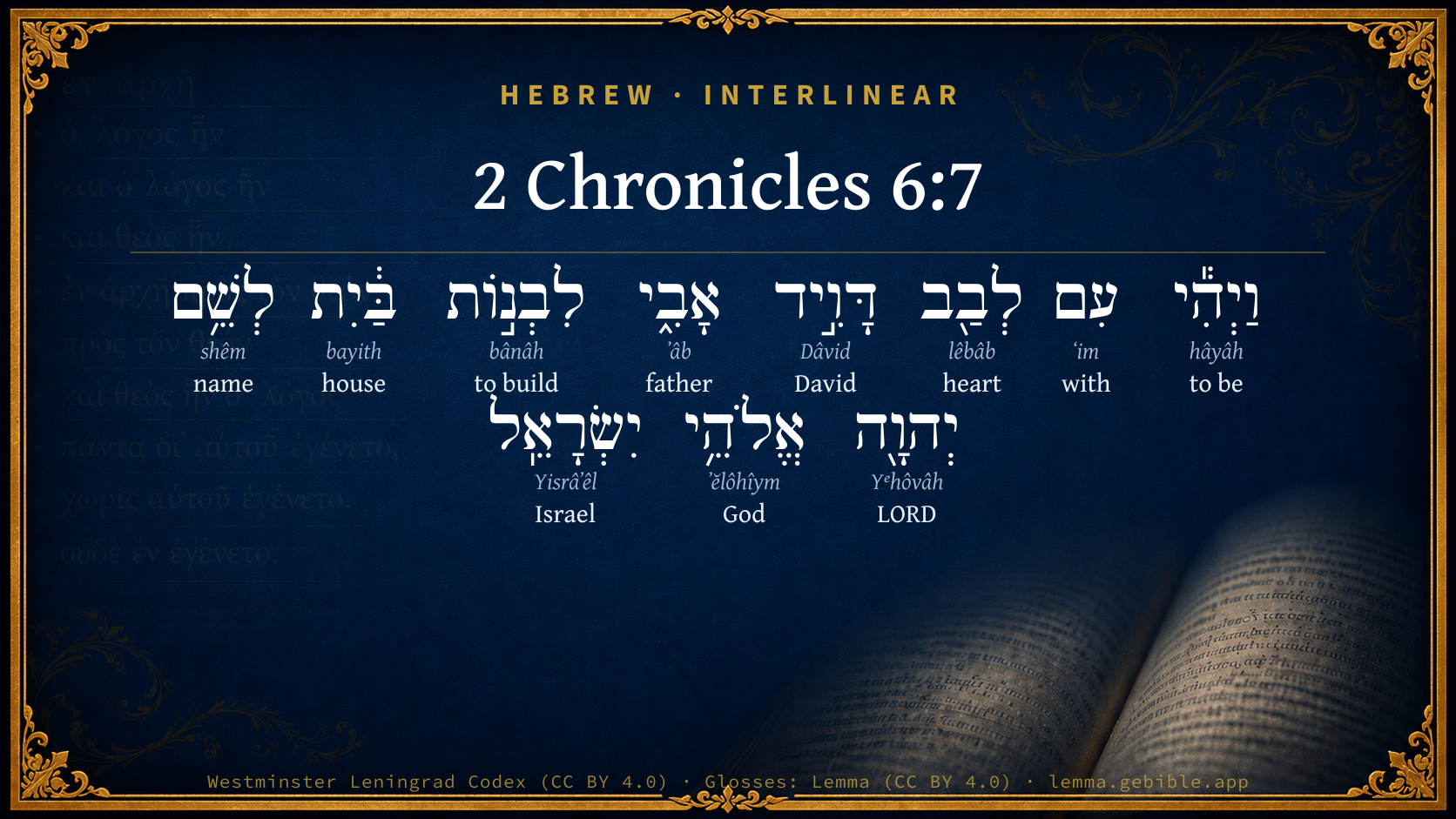
Hebrew (Westminster Leningrad Codex) 2 Chronicles 6:7 appears in the Hebrew Old Testament. The text above is from the Westminster Leningrad Codex. Each word links to its Strong’s number, a concise gloss, and parsing drawn from the Open Scriptures Hebrew Bible morphology. Click any word for its full Brown-Driver-Briggs (BDB) entry.
Download image
Cite this verse

2 Chronicles 6:7 (World English Bible). Public Domain. Lemma interlinear Bible study tool, https://lemma.gebible.app/v/2-chronicles/6/7.

Show BibTeX & RIS
BibTeX
RIS
English Translation
Now it was in the heart of David my father to build a house for the name of Yahweh, the God of Israel.
World English Bible · Public Domain
Download a study sheet

One document with this verse’s original text, its word-by-word gloss line, the meaning frame, cross-references with their text, attributed commentary, and full source and license credits — printable, and it pastes into notes with its structure intact.

This verse Autodidact and up

Study sheet (.html) Plain text (.txt)

A passage Seminary Student

Up to 50 verses in one chapter. A passage sheet keeps up to 6 commentary sources and 12 cross-references per verse, in the order this page ranks them, and says so on the sheet whenever that leaves anything out. Ask for a single verse and you get the Autodidact verse sheet above.

Everything on this page stays free to read, with no account — the sheet is a download of what is already on screen, not access to it.

Want to remove ads? Support Godless Engineer
Compare translations 3

The same verse in 3 English versions, stacked beneath the original-language interlinear above. Click any original word for its lexicon entry.

Each is an independent rendering of the whole verse — the interlinear is not word-aligned to these translations.

Highlighted words mark where these versions differ — a whole-verse word diff, not a word-by-word alignment.

  • World English Bible Public Domain
    Now it was in the heart of David my father to build a house for the name of Yahweh, the God of Israel.
  • King James Version Public Domain
    Now it was in the heart of David my father to build an house for the name of the LORD God of Israel.
  • unfoldingWord Literal Text CC BY-SA 4.0
    And it was with the heart of David my father to build a house for the name of Yahweh, the God of Israel.

unfoldingWord Literal Text — © unfoldingWord, licensed CC BY-SA 4.0. Word-aligned USFM3 via Door43 (git.door43.org/unfoldingWord/en_ult).

Versions to compare (up to 4)

3 of 4 selected

Show all 18 translations

Every available English version of this verse, each an independent rendering of the whole verse.

  • World English Bible Public Domain
    Now it was in the heart of David my father to build a house for the name of Yahweh, the God of Israel.
  • Berean Standard Bible Public Domain
    Now it was in the heart of my father David to build a house for the Name of the LORD, the God of Israel.
  • Majority Standard Bible Public Domain
    Now it was in the heart of my father David to build a house for the Name of the LORD, the God of Israel.
  • King James Version Public Domain
    Now it was in the heart of David my father to build an house for the name of the LORD God of Israel.
  • American Standard Version (1901) Public Domain
    Now it was in the heart of David my father to build a house for the name of Jehovah, the God of Israel.
  • Revised Version (1885) Public Domain
    Now it was in the heart of David my father to build an house for the name of the LORD, the God of Israel.
  • Geneva Bible (1599) Public Domain
    And it was in the heart of Dauid my father to builde an house vnto the Name of the Lord God of Israel,
  • Douay-Rheims (1899) Public Domain
    And whereas David my father had a mind to build a house to the name of the Lord the God of Israel,
  • Young's Literal Translation Public Domain
    `And it is with the heart of David my father to build a house for the name of Jehovah God of Israel,
  • Literal Standard Version CC BY-SA 4.0
    And it is with the heart of my father David to build a house for the Name of YHWH God of Israel,
  • Unlocked Literal Bible CC BY-SA 4.0
    Now it was in the heart of David my father, to build a house for the name of Yahweh, the God of Israel.
  • unfoldingWord Literal Text CC BY-SA 4.0
    And it was with the heart of David my father to build a house for the name of Yahweh, the God of Israel.
  • Darby Bible Public Domain
    And it was in the heart of David my father to build a house unto the name of Jehovah the God of Israel.
  • World Messianic Bible Public Domain
    Now it was in the heart of David my father to build a house for the name of the LORD, the God of Israel.
  • Webster's Bible Public Domain
    Now it was in the heart of David my father to build a house for the name of the LORD God of Israel:
  • Free Bible Version CC BY-SA 4.0
    My father David really wanted to build this Temple to honor the Lord, the God of Israel.
  • Bible in Basic English Public Domain
    Now it was in the heart of my father David to put up a house for the name of the Lord, the God of Israel.
  • JPS Tanakh (1917) Public Domain
    Now it was in the heart of David my father to build a house for the name of the LORD, the God of Israel.

Literal Standard Version (2020), Covenant Press — licensed CC BY-SA 4.0. Text via the HelloAO Bible API (eBible.org). Unlocked Literal Bible (unfoldingWord) — licensed CC BY-SA 4.0. Text via the HelloAO Bible API (eBible.org). unfoldingWord Literal Text — © unfoldingWord, licensed CC BY-SA 4.0. Word-aligned USFM3 via Door43 (git.door43.org/unfoldingWord/en_ult). Free Bible Version, Dr. Jonathan Gallagher — licensed CC BY-SA 4.0. Text via the HelloAO Bible API (eBible.org).

Word by word

More ways to search: Search by grammar → Find every occurrence → Compare this word →

Practice this passage: Drill this verse → Learn its vocabulary →

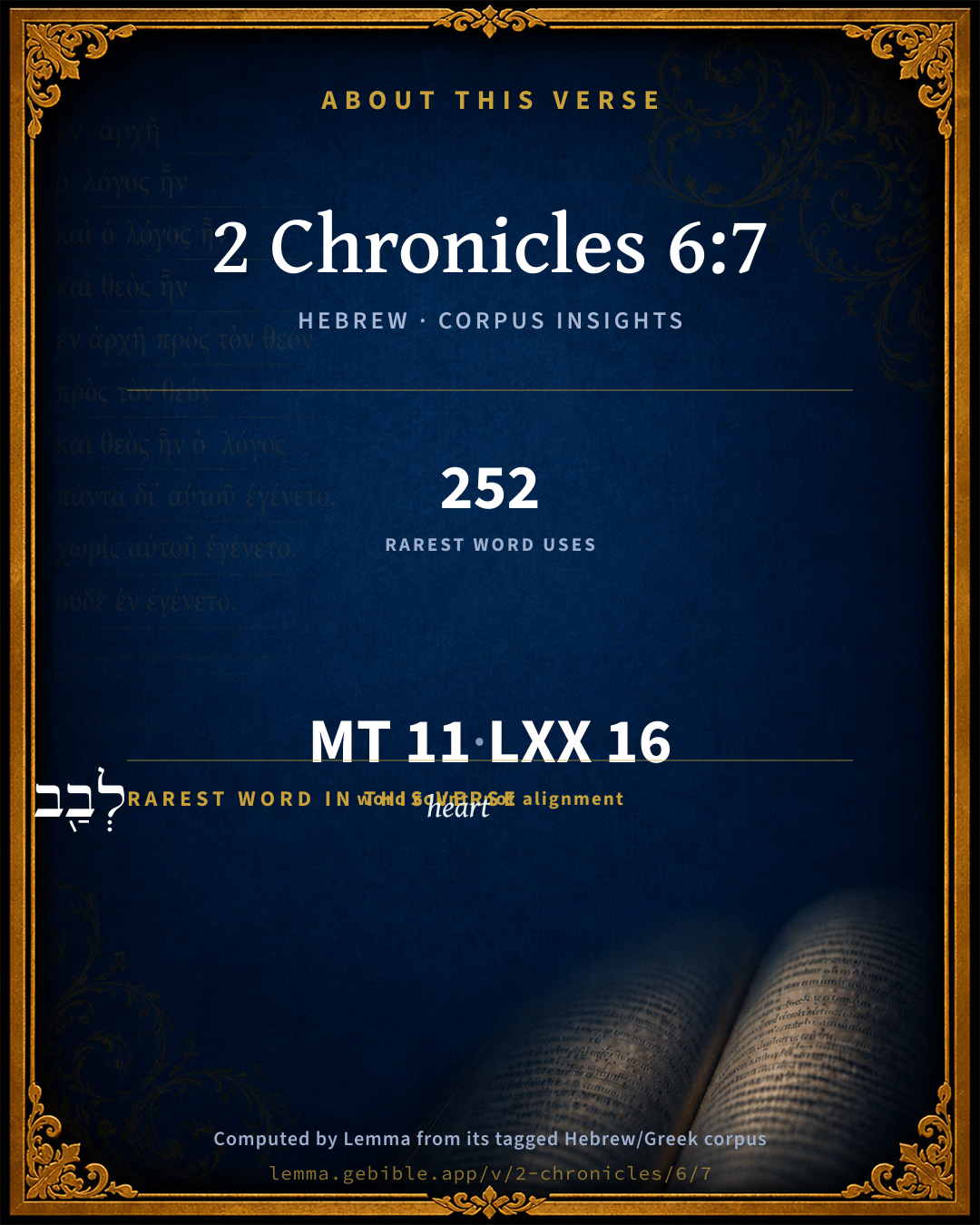
לְבַ֖ב
lêbâb
H3824
“heart of”
Noun, Common, Masculine, Singular, Construct
Part of Speech
Noun
Type
Common
Gender
Masculine
Number
Singular
State
Construct
Full BDB Definition

Origin: from H3823

TWOT: 1071a

inner man, mind, will, heart, soul, understanding - inner part, midst - midst (of things) - heart (of man) - soul, heart (of man) - mind, knowledge, thinking, reflection, memory - inclination, resolution, determination (of will) - conscience - heart (of moral character) - as seat of appetites - as seat of emotions and passions - as seat of courage
  1. וַיְהִ֕י hâyâh H1961 “and · to be” Conjunction + Verb, Qal, Sequential Imperfect, 3rd Person, Masculine, Singular
  2. עִם ʻim H5973 “with” Preposition
  3. דָּוִ֣יד Dâvid H1732 “David” Noun, Proper
  4. אָבִ֑י ʼâb H1 “father · my” Noun, Common, Masculine, Singular, Construct + Suffix, Personal, 1st Person, Common, Singular
  5. לִבְנ֣וֹת bânâh H1129 “to build” Preposition + Verb, Qal, Infinitive Construct
  6. בַּ֔יִת bayith H1004 “house” Noun, Common, Masculine, Singular, Absolute
  7. לְשֵׁ֥ם shêm H8034 “to/for · name of” Preposition + Noun, Common, Masculine, Singular, Construct
  8. יְהוָ֖ה Yᵉhôvâh H3068 “LORD” Noun, Proper
  9. אֱלֹהֵ֥י ʼĕlôhîym H430 “God(s) of” Noun, Common, Masculine, Plural, Construct
  10. יִשְׂרָאֵֽל Yisrâʼêl H3478 “Israel” Noun, Proper

About this verse

These counts appear in no published source. They are computed here, from the morphology-tagged text and Lemma’s own curated glosses. What Lemma adds →

11
words
11
distinct lemmas
Historical
section

Grammatical profile

  • 2 verbs
  • 8 nouns
  • 1 preposition

Verb forms

  • וַיְהִ֕י Qal · Sequential Imperfect
  • לִבְנ֣וֹת Qal · Infinitive Construct

Hebrew & Septuagint length

In English translation the verse runs 23 words from the Hebrew and 23 from the Septuagint (LXX English) — the same length.

A rough comparison of the two English renderings, which tokenize alike — not a word-level alignment.

Word counts can differ between the Hebrew and the Greek without any difference in meaning — e.g. the Hebrew direct-object marker אֵת has no separate Greek word, and Greek often adds the article ὁ.

In the original languages it is 11 Hebrew tokens and 16 Greek tokens — but the two are counted differently (Hebrew bundles its prefixes and suffixes into one token; the Greek is in lemma form), so that isn’t a like-for-like length.

Cross-references

6

Topical passages linked to 2 Chronicles 6:7 in the Treasury of Scripture Knowledge — connected by theme and wording, ordered by reader-vote popularity; previews shown in the World English Bible.

  • 1 Kings 5:3 You know how that David my father could not build a house for the name of Yahweh his God for the wars which were about him on every side, until Yahweh put them under the soles of his feet.
  • 1 Chronicles 17:1 It happened, when David lived in his house, that David said to Nathan the prophet, Behold, I dwell in a house of cedar, but the ark of the covenant of Yahweh [dwells] under curtains.
  • 2 Samuel 7:2–3 that the king said to Nathan the prophet, See now, I dwell in a house of cedar, but the ark of God dwells within curtains.
  • 1 Kings 8:17 Now it was in the heart of David my father to build a house for the name of Yahweh, the God of Israel.
  • 1 Chronicles 22:7 David said to Solomon his son, As for me, it was in my heart to build a house to the name of Yahweh my God.
  • 1 Chronicles 28:2–4 Then David the king stood up on his feet, and said, Hear me, my brothers, and my people: as for me, it was in my heart to build a house of rest for the ark of the covenant of Yahweh, and for the footstool of our God; and I had made ready for the building.

Cross-references courtesy of OpenBible.info (CC BY 4.0).

Hebrew and Greek witnesses Masoretic Hebrew ↔ Greek Septuagint

The same verse in the two great witnesses to the Old Testament, shown verse-for-verse.

These are two independent witnesses, not word-aligned to each other, and the Septuagint is shown in lemma (dictionary) form.

Hebrew 2 Chronicles 6:7 Masoretic · Westminster Leningrad Codex

וַיְהִ֕י עִם לְבַ֖ב דָּוִ֣יד אָבִ֑י לִבְנ֣וֹת בַּ֔יִת לְשֵׁ֥ם יְהוָ֖ה אֱלֹהֵ֥י יִשְׂרָאֵֽל

Now it was in the heart of David my father to build a house for the name of Yahweh, the God of Israel.

World English Bible · Public Domain

Greek LXX 2 Chronicles 6:7 Septuagint · lemma form

καί γίγνομαι ἐπί καρδία δαυίδ ὁ πατήρ ἐγώ ὁ οἰκοδομέω οἶκος ὁ ὄνομα κύριος θεός ἰσραήλ

And it came into the heart of David my father, to build a house for the name of the Lord God of Israel.

LXX2012 (modern English Septuagint) · Public Domain

Hebrew: Westminster Leningrad Codex (CC BY 4.0). Greek: Septuagint (public domain); English from LXX2012 (modern English Septuagint) (Public Domain). How the Septuagint differs from the Hebrew →

Commentary

Notes on 2 Chronicles 6:7 from classic Christian and Jewish commentators (each source and its license shown beneath its notes). The classic Christian expositions comment on the surrounding passage and are grouped to its opening verse, so a note may address several verses; the Jewish commentaries on the Tanakh (Rashi and others) are per-verse, so they appear only where the commentator wrote on this verse.

Lemma curates 59 commentaries, every one of them public domain or Creative Commons licensed, each selected and text-cleaned for this edition rather than reprinted as found. About our sources →

The Cambridge Bible for Schools and Colleges

gen. ed. J. J. S. Perowne

7. in the heart of David] Cp. 1Ch_17:1-2; 1Ch_22:7.

The Cambridge Bible for Schools and Colleges (gen. ed. J. J. S. Perowne; Cambridge University Press, 1878–1918) — public domain. Text from a community e-Sword module.

The Pulpit Commentary

Vers. 7, 8.

The worth of a wish the estimate of Christ.

did well in that it was in his heart" to build a house for the Lord. The purpose of his heart, though it "lost the name of action," was acceptable to the God he served. Almost everything, in the estimate of him who "trieth the reins and the heart," depends on the motives by which we are inspired. Hence we may speak of

I THE WORTHLESSNESS OF SOLOMON"S EXECUTION apart from the excellency of his motive. That building now complete (at the time of the text) was very grand, very costly, very beautiful; it was very elaborate in its workmanship; it was very complete in all its parts; it lacked nothing that treasure and time, that skill and strength, could furnish. But, supposing that Solomon had done everything with the one desire to signalize his reign over Israel, his execution would have counted for much among men, but it would have weighed nothing at all with God. It would not have advanced him by one step in the favour of the Most High. We need not, however, think that Solomon was devoid of a sincere desire to magnify Jehovah"s Name. He said that he had "built the house for the Name of the Lord God of Israel" (ver. 10); and this prayer of dedication, adopted if not composed by him, is indicative of a reverent as well as a patriotic spirit. (see 1Co_13:1-3)

II THE WORTH OF A TRUE AND PURE DESIRE. God was pleased with David that he wished to build him a house; he "did well in that it was in his heart.

1. It is our motive that makes our action to be our own. Another may command our speech or our action, our tongue or our hand; but we are masters of our own thoughts; our desires and purposes are our own. "As a man thinketh in his heart, so is he" (see Mar_7:21, 22; Mat_26:12, Mat_26:41)

2. There is an ascending scale in our motives, reaching from the very lowto the very high. Men may have enough of the Satanic in them to be actuated in their conduct by absolute vindictiveness or even a positive delight in the misery and ruin of their neighbours; at the other end of the scale they may have enough of the Divine in them to be inspired by pure magnanimity, by a wish to befriend those who have done them injury. (Mat_5:45) Very high up in this scale stands the motive of desiring the glory of God, longing for the coming of the kingdom of Christ, an earnest wish to do something for his exaltation. And though the voice may be too feeble to speak any words that men may care to listen to, though the hand may be too weak to strike any blow that will shake the walls of iniquity, yet the very wish to do something for Christ, the prayer, "Make use of me, my God," weighs much in the balances of Heaven. It may be a pure desire to give of our substance to the needy, or to go forth to comfort some stricken heart, or to take a class in a ragged or a Sunday school, or to enter the ranks of the Christian ministry, or to do work in the foreign field. In Christian homes, in every land, there are hearts that sincerely and even ardently desire to serve their Saviour and to be a blessing to their brethren; but there intervenes some forbidding word of God, some frustrating providence of his. The purse is emptied, or health fails, or home duties suddenly assume a new form or take much larger proportions; and God says, "This is not for thee." But the desire is accepted; the purpose of the soul is taken for the deed; it is chronicled in the hooks of Heaven, "Thou didst well in that it was in thine heart.

III ITS EFFECTIVE VALUE. When the pure desire of the true heart is not granted, it does not follow that it is without effect. Certainly it was not so in David"s case. This desire of his heart, expressed to God but not granted by him, had very much to do with the ultimate result. It led to the Divine permission and direction extended to Solomon; it led to Solomon"s personal aspiration and resolution; it led to the preparation and storage of many valuable materials. It would hardly be an exaggeration to say that the temple was the work of David as much as of his son; for he who originates the idea and inspires the people with his thought is as effective an agent as he who executes it. And many, since then, in the kingdom of Christ have succeeded where they seemed to fail; many a lonely and, apparently, unblessed worker for his Master, both at home and abroad; both in the haunts and slums of some great city here, or in the depths of India, or in the heart of Africa, or in the midst of the idolatry and iniquity of China, or amid some island population; many such have gone home with no reward in their hand, unable to point to the gathered fruits of their toil and patience; and yet their unaccomplished efforts have been a precious and powerful inspiration, moved by which others have followed in their track, like Solomon in David"s, and have built the edifice, have wrought the work, in the Name and in the strength of God. The finished work is, in some real sense and perhaps even in a large degree, the fruit of the good thought "in the heart" of him whom no one regards as its author. We do more than we know when we think and feel in the spirit of our Lord. C.

The Pulpit Commentary (1880–1919), ed. H.D.M. Spence-Jones & Joseph S. Exell — public domain. Text from a community e-Sword module.

unfoldingWord translationNotes

Door43 World Missions Community

Connecting Statement:

King Solomon continues speaking to the people at the temple.

it was in the heart of David my father ... it was in your heart ... for it to be in your heart

Here David's heart is spoken of as if it were a container, and what he desired is spoken of as if it were an item in the container. AT: "David my father desired ... you desired ... to desire to do that" (See: Metaphor)

for the name of Yahweh ... for my name

Possible meanings are 1) Yahweh's name represents himself. AT: "for Yahweh ... for me" or 2) Yahweh's name represents his reputation. AT: "for Yahweh's reputation ... for my reputation" (See: Metonymy)

In that it was in your heart

"Because it was in your heart" or "Because you wanted"

one who will come from your loins

"one who will be your own offspring" or "one whom you yourself will father"

translationWords

heart

loins

unfoldingWord translationNotes — © Distant Shores Media and the Door43 World Missions Community, licensed CC BY-SA 4.0. Source: git.door43.org/Door43/en_tn.

Lesson kit

Teaching starters — assembled from the data on this page, not authored interpretation. Every prompt links to the verse data it draws on. Edit before teaching.

2 Chronicles, in the Historical, opens this verse with 11 words (11 distinct Hebrew lemmas). Its most distinctive word is lêbâb (“heart”). Read the whole chapter for the surrounding context.

Discussion questions

  1. What does “heart” (lêbâb) contribute to the verse as a whole?
  2. How does 1 Kings 5:3, which shares this passage’s theme, read alongside this verse?
  3. These translations render this verse differently; the difference is in the English rendering, not the original. What questions does that raise?
  4. «וַיְהִ֕י» is a Qal Sequential Imperfect verb. How does that grammatical form shape the action described?
  5. Compare how The Cambridge Bible for Schools and Colleges and The Pulpit Commentary read this verse. Where do they agree or differ?

Things to notice

Reading settings

Reading text

Shown beneath each verse's original-language words.

Old Testament
Old Testament edition

Read the OT as the Masoretic Hebrew (MT) or the Greek Septuagint (LXX).

English shown for the Greek Septuagint (in the Hebrew ↔ Greek comparison).

Comparing translations? Open the Compare panel on any verse page to stack up to four side by side.