
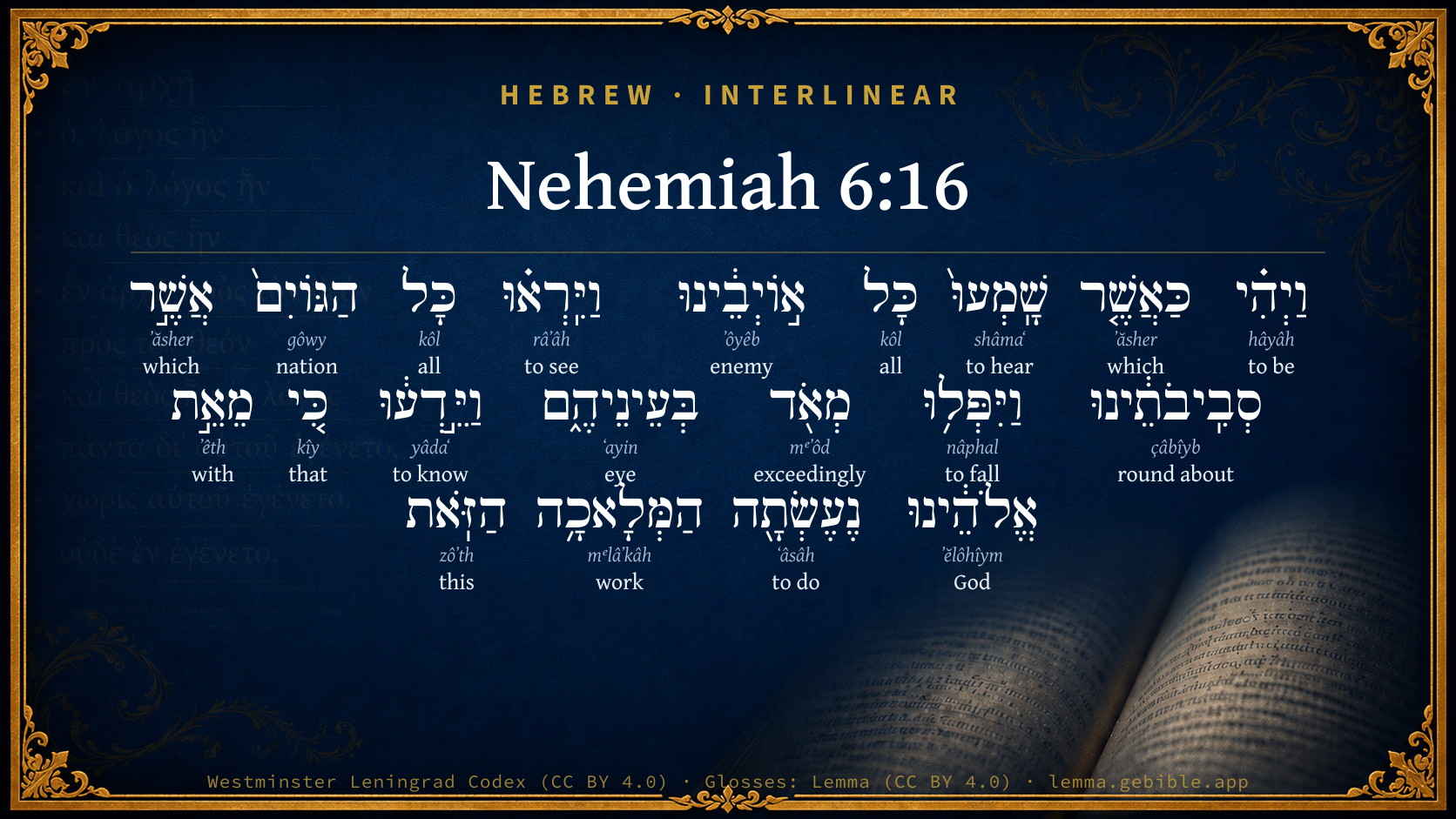
Nehemiah 6:16

Hebrew (Westminster Leningrad Codex) Nehemiah 6:16 appears in the Hebrew Old Testament. The text above is from the Westminster Leningrad Codex. Each word links to its Strong’s number, a concise gloss, and parsing drawn from the Open Scriptures Hebrew Bible morphology. Click any word for its full Brown-Driver-Briggs (BDB) entry.
Download image
Cite this verse

Nehemiah 6:16 (World English Bible). Public Domain. Lemma interlinear Bible study tool, https://lemma.gebible.app/v/nehemiah/6/16.

Show BibTeX & RIS
BibTeX
RIS
English Translation
It happened, when all our enemies heard [of it], that all the nations that were about us feared, and were much cast down in their own eyes; for they perceived that this work was worked of our God.
World English Bible · Public Domain
Download a study sheet

One document with this verse’s original text, its word-by-word gloss line, the meaning frame, cross-references with their text, attributed commentary, and full source and license credits — printable, and it pastes into notes with its structure intact.

This verse Autodidact and up

Study sheet (.html) Plain text (.txt)

A passage Seminary Student

Up to 50 verses in one chapter. A passage sheet keeps up to 6 commentary sources and 12 cross-references per verse, in the order this page ranks them, and says so on the sheet whenever that leaves anything out. Ask for a single verse and you get the Autodidact verse sheet above.

Everything on this page stays free to read, with no account — the sheet is a download of what is already on screen, not access to it.

Want to remove ads? Support Godless Engineer
Compare translations 3

The same verse in 3 English versions, stacked beneath the original-language interlinear above. Click any original word for its lexicon entry.

Each is an independent rendering of the whole verse — the interlinear is not word-aligned to these translations.

Highlighted words mark where these versions differ — a whole-verse word diff, not a word-by-word alignment.

  • World English Bible Public Domain
    It happened, when all our enemies heard [of it], that all the nations that were about us feared, and were much cast down in their own eyes; for they perceived that this work was worked of our God.
  • King James Version Public Domain
    And it came to pass, that when all our enemies heard thereof, and all the heathen that were about us saw these things, they were much cast down in their own eyes: for they perceived that this work was wrought of our God.
  • unfoldingWord Literal Text CC BY-SA 4.0
    And it happened that, when all our enemies heard, all the nations that were around us were afraid, and they fell extremely in their eyes. And they knew that this work was done by our God.

unfoldingWord Literal Text — © unfoldingWord, licensed CC BY-SA 4.0. Word-aligned USFM3 via Door43 (git.door43.org/unfoldingWord/en_ult).

Versions to compare (up to 4)

3 of 4 selected

Show all 18 translations

Every available English version of this verse, each an independent rendering of the whole verse.

  • World English Bible Public Domain
    It happened, when all our enemies heard [of it], that all the nations that were about us feared, and were much cast down in their own eyes; for they perceived that this work was worked of our God.
  • Berean Standard Bible Public Domain
    When all our enemies heard about this, all the surrounding nations were afraid and disheartened, for they realized that this task had been accomplished by our God.
  • Majority Standard Bible Public Domain
    When all our enemies heard about this, all the surrounding nations were afraid and disheartened, for they realized that this task had been accomplished by our God.
  • King James Version Public Domain
    And it came to pass, that when all our enemies heard thereof, and all the heathen that were about us saw these things, they were much cast down in their own eyes: for they perceived that this work was wrought of our God.
  • American Standard Version (1901) Public Domain
    And it came to pass, when all our enemies heard `thereof', that all the nations that were about us feared, and were much cast down in their own eyes; for they perceived that this work was wrought of our God.
  • Revised Version (1885) Public Domain
    And it came to pass, when all our enemies heard thereof, that all the heathen that were about us feared, and were much cast down in their own eyes: for they perceived that this work was wrought of our God.
  • Geneva Bible (1599) Public Domain
    And when all our enemies heard thereof, euen all the heathen that were about vs, they were afraid, and their courage failed them: for they knew, that this worke was wrought by our God.
  • Douay-Rheims (1899) Public Domain
    And it came to pass when all our enemies heard of it, that all nations which were round about us, were afraid, and were cast down within themselves, for they perceived that this work was the work of God.
  • Young's Literal Translation Public Domain
    and it cometh to pass, when all our enemies have heard, and all the nations who are round about us see, that they fall greatly in their own eyes, and know that by our God hath this work been done.
  • Literal Standard Version CC BY-SA 4.0
    and it comes to pass, when all our enemies have heard, and all the nations who are all around us see, that they fall greatly in their own eyes, and know that by our God has this work been done.
  • Unlocked Literal Bible CC BY-SA 4.0
    When all our enemies heard of it, all the nations around us, they became afraid and they fell greatly in their own eyes. For they knew the work was done with the help of our God.
  • unfoldingWord Literal Text CC BY-SA 4.0
    And it happened that, when all our enemies heard, all the nations that were around us were afraid, and they fell extremely in their eyes. And they knew that this work was done by our God.
  • Darby Bible Public Domain
    And it came to pass that when all our enemies heard [of it], all the nations that were about us were afraid and were much cast down in their own eyes, and they perceived that this work was wrought by our God.
  • World Messianic Bible Public Domain
    When all our enemies heard of it, all the nations that were around us were afraid, and they lost their confidence; for they perceived that this work was done by our God.
  • Webster's Bible Public Domain
    And it came to pass, that when all our enemies heard of it, and all the heathen that were about us saw these things, they were much cast down in their own eyes: for they perceived that this work was wrought by our God.
  • Free Bible Version CC BY-SA 4.0
    When all our enemies found out they were frightened; all the nations around were very discouraged, for they recognized that this had been done by our God.
  • Bible in Basic English Public Domain
    And when our haters had news of this, all the nations round about us were full of fear and were greatly shamed, for they saw that this work had been done by our God.
  • JPS Tanakh (1917) Public Domain
    And it came to pass, when all our enemies heard thereof, that all the nations that were about us feared, and were much cast down in their own eyes; for they perceived that this work was wrought of our God.

Literal Standard Version (2020), Covenant Press — licensed CC BY-SA 4.0. Text via the HelloAO Bible API (eBible.org). Unlocked Literal Bible (unfoldingWord) — licensed CC BY-SA 4.0. Text via the HelloAO Bible API (eBible.org). unfoldingWord Literal Text — © unfoldingWord, licensed CC BY-SA 4.0. Word-aligned USFM3 via Door43 (git.door43.org/unfoldingWord/en_ult). Free Bible Version, Dr. Jonathan Gallagher — licensed CC BY-SA 4.0. Text via the HelloAO Bible API (eBible.org).

Word by word

More ways to search: Search by grammar → Find every occurrence → Compare this word →

Practice this passage: Drill this verse → Learn its vocabulary →

הַמְּלָאכָ֥ה
mᵉlâʼkâh
H4399
“the · work”
Particle, Definite Article + Noun, Common, Feminine, Singular, Absolute
Part of Speech
Particle + Noun
Type
Common
Gender
Feminine
Number
Singular
State
Absolute
Full BDB Definition

Origin: from the same as H4397

TWOT: 1068b

occupation, work, business - occupation, business - property - work (something done or made) - workmanship - service, use - public business - political - religious
  1. וַיְהִ֗י hâyâh H1961 “and · to be” Conjunction + Verb, Qal, Sequential Imperfect, 3rd Person, Masculine, Singular
  2. כַּאֲשֶׁ֤ר ʼăsher H834 “like/as · which” Preposition + Particle, Relative
  3. שָֽׁמְעוּ֙ shâmaʻ H8085 “to hear” Verb, Qal, Perfect, 3rd Person, Common, Plural
  4. כָּל kôl H3605 “all of” Noun, Common, Masculine, Singular, Construct
  5. א֣וֹיְבֵ֔ינוּ ʼôyêb H341 “enemy · us” Verb, Qal, Participle Active, Masculine, Plural, Construct + Suffix, Personal, 1st Person, Common, Plural
  6. וַיִּֽרְא֗וּ râʼâh H7200 “and · to see” Conjunction + Verb, Qal, Sequential Imperfect, 3rd Person, Masculine, Plural
  7. כָּל kôl H3605 “all of” Noun, Common, Masculine, Singular, Construct
  8. הַגּוֹיִם֙ gôwy H1471 “the · nations” Particle, Definite Article + Noun, Common, Masculine, Plural, Absolute
  9. אֲשֶׁ֣ר ʼăsher H834 “which” Particle, Relative
  10. סְבִֽיבֹתֵ֔ינוּ çâbîyb H5439 “surroundings · our” Noun, Common, Both, Plural, Construct + Suffix, Personal, 1st Person, Common, Plural
  11. וַיִּפְּל֥וּ nâphal H5307 “and · to fall” Conjunction + Verb, Qal, Sequential Imperfect, 3rd Person, Masculine, Plural
  12. מְאֹ֖ד mᵉʼôd H3966 “exceedingly” Adverb
  13. בְּעֵינֵיהֶ֑ם ʻayin H5869 “in/at · eyes · their” Preposition + Noun, Common, Both, Dual, Construct + Suffix, Personal, 3rd Person, Masculine, Plural
  14. וַיֵּ֣דְע֔וּ yâdaʻ H3045 “and · to know” Conjunction + Verb, Qal, Sequential Imperfect, 3rd Person, Masculine, Plural
  15. כִּ֚י kîy H3588 “that” Conjunction
  16. מֵאֵ֣ת ʼêth H854 “from · with” Preposition + Preposition
  17. אֱלֹהֵ֔ינוּ ʼĕlôhîym H430 “God(s) · our” Noun, Common, Masculine, Plural, Construct + Suffix, Personal, 1st Person, Common, Plural
  18. נֶעֶשְׂתָ֖ה ʻâsâh H6213 “to do” Verb, Niphal, Perfect, 3rd Person, Feminine, Singular
  19. הַזֹּֽאת zôʼth H2063 “the · this” Particle, Definite Article + Pronoun, Demonstrative, Feminine, Singular

About this verse

These counts appear in no published source. They are computed here, from the morphology-tagged text and Lemma’s own curated glosses. What Lemma adds →

20
words
18
distinct lemmas
Historical
section

Grammatical profile

  • 7 verbs
  • 7 nouns
  • 1 pronoun
  • 1 preposition
  • 1 conjunction
  • 1 adverb
  • 2 particles

Verb forms

  • וַיְהִ֗י Qal · Sequential Imperfect
  • שָֽׁמְעוּ֙ Qal · Perfect
  • א֣וֹיְבֵ֔ינוּ Qal · Participle Active
  • וַיִּֽרְא֗וּ Qal · Sequential Imperfect
  • וַיִּפְּל֥וּ Qal · Sequential Imperfect
  • וַיֵּ֣דְע֔וּ Qal · Sequential Imperfect
  • נֶעֶשְׂתָ֖ה Niphal · Perfect

Repetition

Words recur within this verse — often emphatic in Hebrew:

  • כָּל all H3605 ×2
  • כַּאֲשֶׁ֤ר which H834 ×2

Cross-references

9

Topical passages linked to Nehemiah 6:16 in the Treasury of Scripture Knowledge — connected by theme and wording, ordered by reader-vote popularity; previews shown in the World English Bible.

  • Joshua 5:1 It happened, when all the kings of the Amorites, who were beyond the Jordan westward, and all the kings of the Canaanites, who were by the sea, heard how that Yahweh had dried up the waters of the Jordan from before the children of Israel, until we were passed over, that their heart melted, neither was there spirit in them any more, because of the children of Israel.
  • Psalms 126:2 Then our mouth was filled with laughter, And our tongue with singing. Then they said among the nations, "Yahweh has done great things for them."
  • Nehemiah 4:7 But it happened that when Sanballat, Tobiah, the Arabians, the Ammonites, and the Ashdodites heard that the repairing of the walls of Jerusalem went forward, [and] that the breaches began to be stopped, then they were very angry;
  • Nehemiah 2:10 When Sanballat the Horonite, and Tobiah the servant, the Ammonite, heard of it, it grieved them exceedingly, because a man had come to seek the welfare of the children of Israel.
  • Nehemiah 4:1 But it happened that when Sanballat heard that we were building the wall, he was angry, and took great indignation, and mocked the Jews.
  • Acts 5:38 Now I tell you, withdraw from these men, and leave them alone. For if this counsel or this work is of men, it will be overthrown.
  • Numbers 23:23 Surely there is no enchantment with Jacob; Neither is there any divination with Israel: Now shall it be said of Jacob and of Israel, What has God done!
  • Exodus 14:25 He took off their chariot wheels, and they drove them heavily; so that the Egyptians said, "Let's flee from the face of Israel, for Yahweh fights for them against the Egyptians!"
  • Nehemiah 6:1–2 Now it happened, when it was reported to Sanballat and Tobiah, and to Geshem the Arabian, and to the rest of our enemies, that I had built the wall, and that there was no breach left therein; (though even to that time I had not set up the doors in the gates;)

Cross-references courtesy of OpenBible.info (CC BY 4.0).

Hebrew and Greek witnesses Masoretic Hebrew ↔ Greek Septuagint

The same verse in the two great witnesses to the Old Testament, shown verse-for-verse.

These are two independent witnesses, not word-aligned to each other, and the Septuagint is shown in lemma (dictionary) form.

Hebrew Nehemiah 6:16 Masoretic · Westminster Leningrad Codex

וַיְהִ֗י כַּאֲשֶׁ֤ר שָֽׁמְעוּ֙ כָּל א֣וֹיְבֵ֔ינוּ וַיִּֽרְא֗וּ כָּל הַגּוֹיִם֙ אֲשֶׁ֣ר סְבִֽיבֹתֵ֔ינוּ וַיִּפְּל֥וּ מְאֹ֖ד בְּעֵינֵיהֶ֑ם וַיֵּ֣דְע֔וּ כִּ֚י מֵאֵ֣ת אֱלֹהֵ֔ינוּ נֶעֶשְׂתָ֖ה הַמְּלָאכָ֥ה הַזֹּֽאת

It happened, when all our enemies heard [of it], that all the nations that were about us feared, and were much cast down in their own eyes; for they perceived that this work was worked of our God.

World English Bible · Public Domain

Greek LXX Structure differs

The Septuagint has no separate book of Nehemiah. Its Greek text is the second half of Esdras B (2 Esdras), chapters 11–23; Ezra is the first half (1–10).

A verse-for-verse comparison isn’t shown here because the chapters and verses don’t line up. Switch to the LXX edition with the MT / LXX toggle above to read the Greek directly.

On this verse, The Cambridge Bible for Schools and Colleges discusses the Septuagint’s reading. Read the note in Commentary ↓

Hebrew: Westminster Leningrad Codex (CC BY 4.0). Greek: Septuagint (public domain); English from a public-domain English Septuagint. How the Septuagint differs from the Hebrew →

Commentary

Notes on Nehemiah 6:16 from classic Christian and Jewish commentators (each source and its license shown beneath its notes). The classic Christian expositions comment on the surrounding passage and are grouped to its opening verse, so a note may address several verses; the Jewish commentaries on the Tanakh (Rashi and others) are per-verse, so they appear only where the commentator wrote on this verse.

Lemma curates 59 commentaries, every one of them public domain or Creative Commons licensed, each selected and text-cleaned for this edition rather than reprinted as found. About our sources →

Trapp's Complete Commentary

John Trapp

Neh 6:16 And it came to pass, that when all our enemies heard [thereof], and all the heathen that [were] about us saw [these things], they were much cast down in their own eyes: for they perceived that this work was wrought of our God.

Ver. 16. When all our enemies heard thereof] So famous a matter could not be concealed from them who listened with the left ear, and readily received these βλαβαι ποδωκεις, as the Greeks call, galling reports.

Saw these things] For they ran to the sight of it, as to a miracle; they looked also upon it with an evil and envious eye; like as the Papists do upon the Reformation.

They were much cast down in their own eyes] They were crest fallen, and dejected from the high tops of their proud hopes and designs. See what biles and ulcers the antichristian rout are vexed with, and how they are scorched with the sunshine of the gospel, Rev 16:2; Rev 16:11. What moan Babel’s merchants make to see her ruin and the rise of the new Jerusalem, Rev 18:11. Envy is vitium Diabolicum, the devil’s disease, saith Austin, in Psa 139:1-24; and those that are troubled with it can never want woe.

For they perceived that this work was wrought of our God] With such incredible swiftness was it carried on and accomplished, that they could not but say among the heathen, "The Lord hath done great things for them; God is with them of a truth."

John Trapp, A Commentary or Exposition upon All the Books of the Old and New Testament (1647–1656) — public domain. Text from a community e-Sword module.

The Biblical Illustrator

Joseph S. Exell

Neh_6:16

For they perceived that the work was wrought of our God.

The crown of Christian evidence

Christianity does not stand in any merely literary defence, although its literary defence is complete; it stands rather in its beneficent accomplishments, in its regenerated hearts, its elevated lives, its new spirit of consecration, its broad unselfishness, its generous sympathy--Go and show John again those things which ye do hear and see. (J. Parker, D. D.)

The worlds acknowledgment of God

I. Worlds past acknowledgment of God.

1. Biblical instances.

2. Later instances.

II. Worlds present acknowledgment of God.

1. Unconscious acknowledgments. Think of the way in which Christianity penetrates the life of the modern world.

2. Unwilling acknowledgment.

3. Frank acknowledgment.

III. The worlds future acknowledgment.

1. Willing.

2. Enforced.

Application:

1. Make acknowledgment of God.

2. Now. (Homiletic Commentary.)

Nothing succeeds like success

It is amazing sometimes to find how many there are who heartily endorse a good work when it has arrived at or is approaching success, however much they may have frowned at it, or even opposed it, when it was struggling with difficulties. (W. P. Lockhart.)

God acknowledged in results

In the present day there is an impatient craving for immediate results which comes perilously near to mistrust of God. But verily there are results, and when such results are seen, then even enemies are constrained to admit that Gods hand is in the work. The faith of converts must always be evidenced by their works, otherwise the world will not, cannot, perceive that God is working with us. (W. P. Lockhart.)

The Biblical Illustrator, edited by Joseph S. Exell (c. 1880s–1900s) — public domain. Text from a community e-Sword module.

Joseph Benson's Commentary

Neh 6:16. They were much cast down in their own eyes — That is, in their opinion, or themselves being judges. For though usually men are very prone to judge partially, and still to flatter themselves with vain hopes, yet this case was so clear and remarkable that they began to despair. Now they saw that all was lost, that their designs were broken, and that their mischief was likely to fall upon their own heads. For they perceived that this work was of our God — From that admirable courage, constancy, and quickness, wherewith this work was managed, notwithstanding all the difficulties and discouragements in the way, they concluded that it was the work of the mighty God of Israel, whom they had great reason to fear. And withal they took it for an ill omen to them, and a sure presage that God would still watch over that city and people, and crush those who should oppose or disturb them.

Joseph Benson's Commentary on the Old and New Testaments (1811–1818) — public domain. Text from a community e-Sword module.

Adam Clarke's Commentary

Verse 16. This work was wrought of our God.] This is an additional reason why we should not wonder at the shortness of the time in which so great a work was done, for God helped them by an especial providence; and this was so very observable, that their carnal enemies could discover it.

Adam Clarke's Commentary on the Bible (1810–1826) — public domain. Text from a community e-Sword/MySword module.

Ellicott's Commentary for English Readers

(16) The enemies heard of it, and saw the result, and were ashamed.

A Bible Commentary for English Readers, edited by Charles John Ellicott (1878–1897) — public domain. Text from a community e-Sword module.

The Cambridge Bible for Schools and Colleges

gen. ed. J. J. S. Perowne

16. all our enemies] Cf. Neh_4:1, Neh_5:9, Neh_6:1.

that when … and all the heathen … saw these things, they, &c.] R.V. when … that all the heathen … feared, and, &c. Marg. ‘According to another reading, saw’. There is little distinction to be drawn between ‘the enemies’ and ‘the heathen.’ The leaders of the hostile races heard, and then the races themselves feared. The reading ‘feared,’ which is also that of the LXX. ἐφοβήθησαν, and the Vulg. ‘timerent,’ gives a preferable sense to ‘saw.’ The distinction in the A.V. between the ‘seeing’ of ‘the heathen’ and the ‘hearing’ of ‘the enemies’ is quite meaningless, and tells against that reading. The rendering of the R.V. suggests that the news first reached Tobiah, Sanballat and Geshem, and then spread a panic among the Moabites, Samaritans, Arabians, &c.

they were much cast down in their own eyes] A peculiar expression which occurs only in this passage; literally, ‘they fell much in their own eyes.’ According to the present text, two explanations have been given: (a) = ‘they were much vexed and disconcerted.’ ‘To fall in one’s eyes’ is then to be compared with the ‘falling’ or ‘lowering’ of the countenance. Cf. Gen_4:5-6; 1Sa_17:32. (b) = ‘they had fallen greatly in their own estimation,’ i.e. they despised themselves. In their own eyes, i.e. in their own opinion, their power had received a heavy blow; they had ‘fallen,’ as it were, and the Jews were exalted.

A different text is followed in the three renderings: (a) the LXX. ‘And fear fell upon their eyes exceedingly,’ καὶ ἐπέπεσεν φόβος σφόδρα ἐν ὀφθαλμοῖς αὐτῶν. (b) the Vulgate ‘et conciderent inter semet ipsos’ (bayneyhem for b’ay-neyhem). (c) ‘And they caused their eyes to fall’, with the same meaning as that given in Jer_3:12, ‘I will not look in anger upon you’ (marg. Heb. ‘cause my countenance to fall upon you’).

this work was wrought of our God] In the completion of the wall the special favour of the God of Israel must have been recognised. What else could explain the unexpected commission from Artaxerxes at the beginning, and the frustration of all the machinations of the enemy? Cf. Psa_126:2, ‘Then said they among the nations, The Lord hath done great things for them.’ For the phrase, cf. Psa_118:23.

The Cambridge Bible for Schools and Colleges (gen. ed. J. J. S. Perowne; Cambridge University Press, 1878–1918) — public domain. Text from a community e-Sword module.

John Gill's Exposition

And it came to pass, that when all our enemies heard thereof,.... That the wall was finished:

and all the Heathen that were about us saw these things; the neighbouring nations, who not only heard with their ears, but saw with their eyes what was done:

they were much cast down in their own eyes; through shame and confusion, because of their own scoffs and jeers; through grief and vexation at the unexpected success of the Jews, and through the fear of them that was fallen upon them, as Jarchi notes:

for they perceived that this work was wrought of our God; his special providence and blessing attending it, as appeared by its being so soon effected.

John Gill's Exposition of the Whole Bible (1746–1763) — public domain (CC PDM 1.0). Text via the HelloAO Bible API.

Matthew Poole's English Annotations

In their own eyes, i.e. in their opinion, or themselves being judges; for though ordinarily men are very prone to judge partially, and still to flatter themselves with vain hopes and fancies, yet this case was so clear and remarkable, that they began to despair. Now they saw that all was lost, that their designs were broken, and that their mischief was now likely to fall upon their own heads. They perceived, by that admirable courage, and constancy, and quickness wherewith this work was managed, notwithstanding all their difficulties and discouragements.

That this work was wrought of our God; that it was the work of that mighty God of Israel, whom they had great reason to fear; and withal they took it for an ill omen to them, and a sure presage that God would still watch over that city and people, and crush those who should oppose or disturb them. Corresponding with him against Nehemiah, and against their own city and nation.

Matthew Poole's English Annotations on the Holy Bible (1683–1685) — public domain. Text from a community e-Sword/MySword module.

Whedon's Commentary on the Bible

Daniel D. Whedon

16. They were much cast down — Disappointed and chagrined to find that all their opposition had been futile.

Work was wrought of our God — That is, it was evident to all — to enemies as well as Jews — that Divine providence had signally favoured the work of rebuilding Jerusalem.

Daniel D. Whedon (gen. ed.), Commentary on the Old and New Testaments (1874–1909) — public domain. Text from a community e-Sword module.

The Pulpit Commentary

Our enemies. The Samaritans, the Ammonites, the Ashdodites, and the Arabians under Oeshem are the special "enemies" here spoken of. The Phoenicians, Syrians, Moabites, etc. are the other "heathen round about" the Jews. Even these last were unfriendly, and disliked any increase of Jewish power and prosperity. They perceived that this work was wrought of our God. They could not but recognise a special Providence as befriending and protecting the Jews, who, after having been utterly crushed and rooted out by Nebuchadnezzar, were now reestablished in a commanding position in Palestine, and allowed to make their city once more an almost impregnable fortress.

God"s work recognised.

"They perceived that this work was wrought of our God." The work which had been done was so great; it had been accomplished by so feeble a people, in spite of so much opposition and so many obstacles, and in so short a time, that the people around, even those most opposed, could not but recognise that the God of Israel had wrought with his servants. The work of Christ"s servants may produce a similar impression on others, not only fellow Christians, but those without. It is much to be desired that our work should be of such a kind, and so favoured of God, as to make such an impression.

I WHEN IS GOD"S HAND APPARENT IN THE WORK OF HIS PEOPLE?

1. When the work done is manifestly good in itself. This can hardly be said of the merely outward: of the erection of churches, however grand and beautiful; of the maintenance of imposing services; of the gathering of great crowds, or the making of mere proselytes. Such work may spring from good and tend to good; but it may not. Merely human motives and impulses, perhaps quite unchristian, may explain all. But when the bad become good, and the good become eminently so; when through Christian teaching and influence the licentious become pure, drunkards sober, the proud humble, the selfish benevolent, the harsh kind; when a Christian people shines in the beauty of the loftiest Christian holiness and love, and especially in those practical virtues which all can appreciate, then the conviction is likely to be produced on others that God is working in and by them.

2. When the work done is extensive. Whole neighbourhoods, a whole class of irreligious and morally degraded men, have sometimes been transformed by the preaching of the gospel; even a nation to a great extent quickened and elevated. He must be blinded by sin or the worst bigotry who fails to see in such changes the agency of God.

3. When such beneficial changes are wrought very rapidly. As the work to which the text refers.

4. When serious difficulties and formidable opposition are overcome.

5. When the work proves lasting.

6. When the human instrumentality is manifestly insufficient to account for the results.

II THE EFFECTS WHICH THE PERCEPTION OF GOD"s HAND IN SUCH WORK WILL PRODUCE.

1. On the workers. Gratitude, humility, encouragement to labour on.

2. On fellow Christians. Praise to God. Recognition of the workers as their brethren. Prayer for them. Congratulations and good wishes. Co-operation if practicable. At least respect, and the withholding of censorious criticism.

3. On those desiring good for themselves. Attraction toward such people. "We will go with you, for we have heard nay, we see God is with you.

4. On enemies. Discouragement, mortification, perhaps abandonment of active opposition; (see Exo_14:25) perhaps transformation into friends and fellow workers, which is best of all.

In conclusion

1. The evidences of Divine agency in Christianity and its effects should be seriously pondered by unbelievers.

2. Blindness to God"s agency in the work of Christians is a fearful symptom. Yet it is found in some who profess to be Christians in respect to the work of those who "follow not with" them. Let them beware lest they become partakers of the guilt of those highly religious men of our Lord"s day who saw not God in the works of Christ, but ascribed them to the agency of the devil, and whom he warned against, if he did not pronounce guilty of the unpardonable sin of "blasphemy against the Holy Ghost.

3. Let all Christians pray for such manifestations of the power of the Holy Spirit in the Church as shall produce general conviction of his agency. The ordinary condition of our Churches, and results of their work, are, alas, little fitted to produce such a conviction. "Awake, awake, put on strength, O arm of the Lord; awake, as in the ancient days, in the generations of old."

The Pulpit Commentary (1880–1919), ed. H.D.M. Spence-Jones & Joseph S. Exell — public domain. Text from a community e-Sword module.

Rashi

Rabbi Shlomo Yitzchaki (Rashi)

Now it came to pass when all our enemies heard this matter, that the construction of the wall was completed.

that all the nations became frightened when all the nations saw that the construction of the wall of the city had been completed.

and they fell very low in their own eyes They themselves fell in their own eyes; they despised themselves, for the fear of the Jews had fallen upon them.

Rashi on the Tanakh — English translations: “The Judaica Press complete Tanach with Rashi, translated by A. J. Rosenberg” (CC BY 4.0); “Pentateuch with Rashi's commentary by M. Rosenbaum and A.M. Silbermann, 1929-1934” (public domain); “The Metsudah Tanach series, Lakewood, N.J” (CC BY 4.0); and “The Book of Joshua, Metsudah Publications, 1997” (CC BY 4.0). Text via Sefaria.

Lesson kit

Teaching starters — assembled from the data on this page, not authored interpretation. Every prompt links to the verse data it draws on. Edit before teaching.

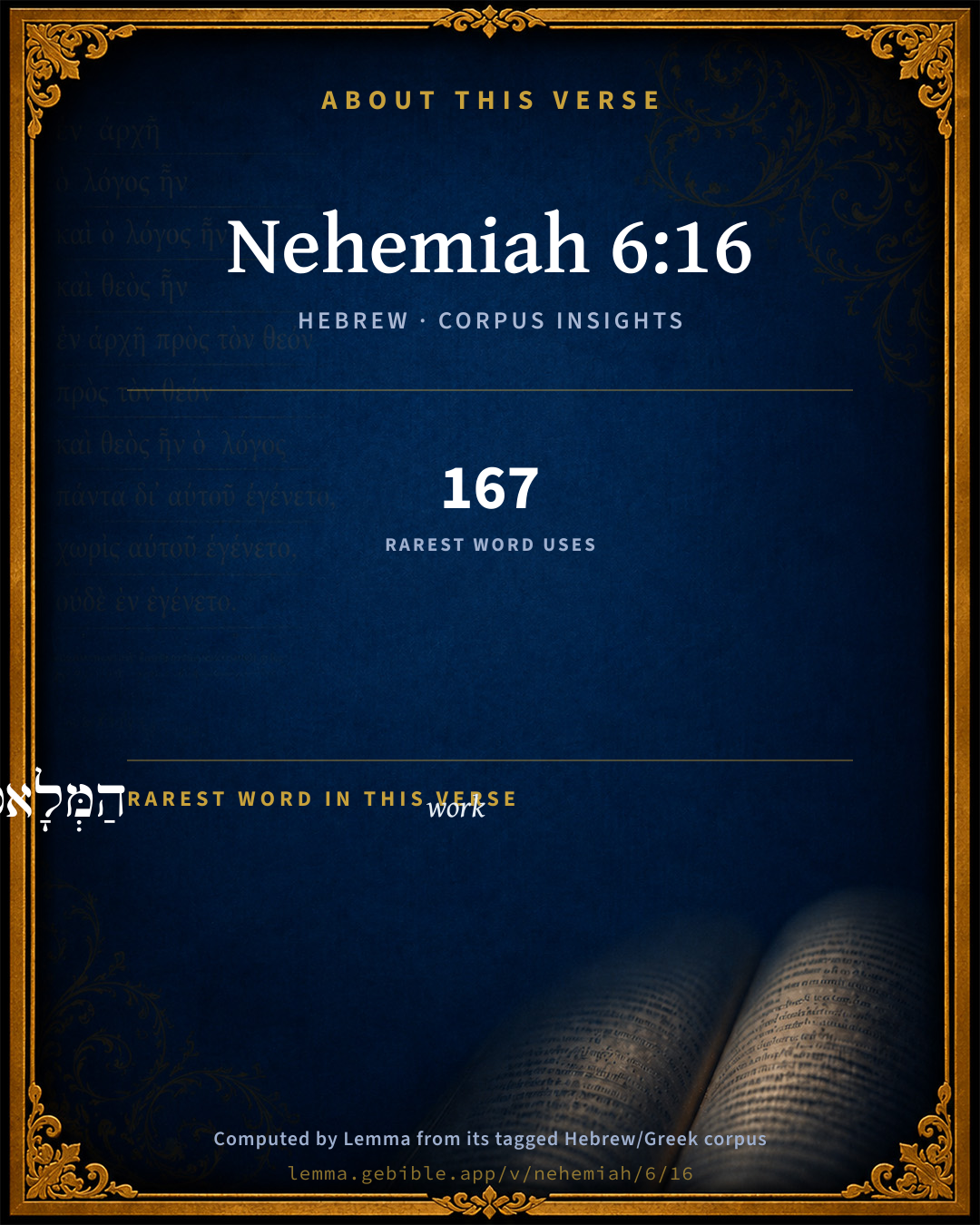
Nehemiah, in the Historical, opens this verse with 20 words (18 distinct Hebrew lemmas). Its most distinctive word is mᵉlâʼkâh (“work”). A historical commentator’s framing appears above. Read the whole chapter for the surrounding context.

Discussion questions

  1. How does “work” (mᵉlâʼkâh) shape what this verse is saying?
  2. Joshua 5:1 shares this passage’s theme. How do the two illuminate each other?
  3. “all” occurs 2× in this one verse. What is the effect of the repetition?
  4. These translations render this verse differently; the difference is in the English rendering, not the original. What questions does that raise?
  5. The verb «וַיְהִ֗י» is Qal Sequential Imperfect. How does its form color the action?
  6. Reading how Trapp's Complete Commentary and The Biblical Illustrator read this verse, where do the two commentators agree and where do they part?

Things to notice

Reading settings

Reading text

Shown beneath each verse's original-language words.

Old Testament
Old Testament edition

Read the OT as the Masoretic Hebrew (MT) or the Greek Septuagint (LXX).

English shown for the Greek Septuagint (in the Hebrew ↔ Greek comparison).

Comparing translations? Open the Compare panel on any verse page to stack up to four side by side.