
Esther 8:13

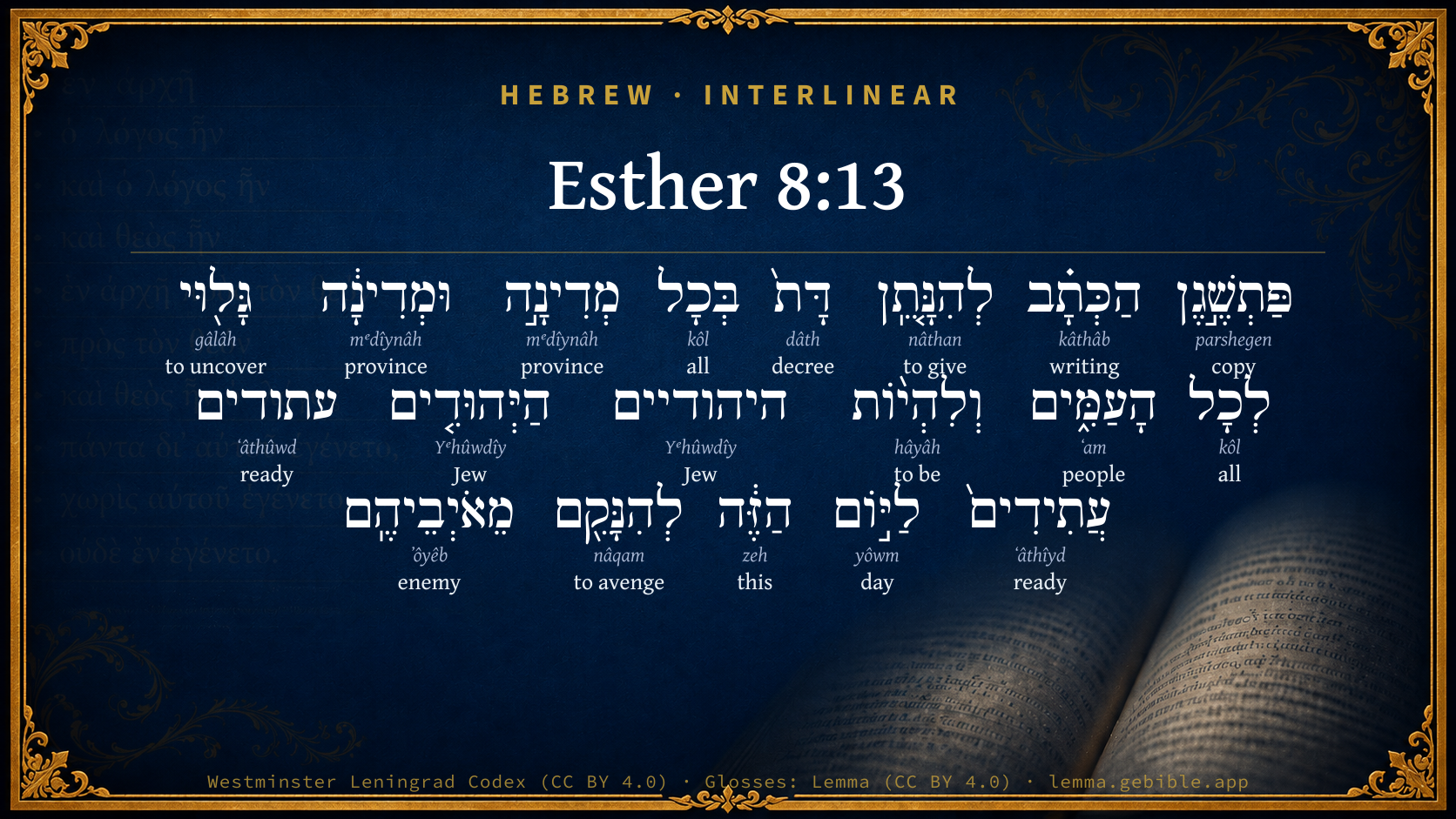
Hebrew (Westminster Leningrad Codex) Esther 8:13 appears in the Hebrew Old Testament. The text above is from the Westminster Leningrad Codex. Each word links to its Strong’s number, a concise gloss, and parsing drawn from the Open Scriptures Hebrew Bible morphology. Click any word for its full Brown-Driver-Briggs (BDB) entry.
Download image
Cite this verse

Esther 8:13 (World English Bible). Public Domain. Lemma interlinear Bible study tool, https://lemma.gebible.app/v/esther/8/13.

Show BibTeX & RIS
BibTeX
RIS
English Translation
A copy of the writing, that the decree should be given out in every province, was published to all the peoples, and that the Jews should be ready against that day to avenge themselves on their enemies.
World English Bible · Public Domain
Highlights Full analysis ↓
Download a study sheet

One document with this verse’s original text, its word-by-word gloss line, the meaning frame, cross-references with their text, attributed commentary, and full source and license credits — printable, and it pastes into notes with its structure intact.

This verse Autodidact and up

Study sheet (.html) Plain text (.txt)

A passage Seminary Student

Up to 50 verses in one chapter. A passage sheet keeps up to 6 commentary sources and 12 cross-references per verse, in the order this page ranks them, and says so on the sheet whenever that leaves anything out. Ask for a single verse and you get the Autodidact verse sheet above.

Everything on this page stays free to read, with no account — the sheet is a download of what is already on screen, not access to it.

Want to remove ads? Support Godless Engineer
Compare translations 3

The same verse in 3 English versions, stacked beneath the original-language interlinear above. Click any original word for its lexicon entry.

Each is an independent rendering of the whole verse — the interlinear is not word-aligned to these translations.

Highlighted words mark where these versions differ — a whole-verse word diff, not a word-by-word alignment.

  • World English Bible Public Domain
    A copy of the writing, that the decree should be given out in every province, was published to all the peoples, and that the Jews should be ready against that day to avenge themselves on their enemies.
  • King James Version Public Domain
    The copy of the writing for a commandment to be given in every province was published unto all people, and that the Jews should be ready against that day to avenge themselves on their enemies.
  • unfoldingWord Literal Text CC BY-SA 4.0
    A copy of the writing was to be given as a law in every province by province, being uncovered for all the peoples, and for the Jews to be prepared for that day to take revenge from their enemies.

unfoldingWord Literal Text — © unfoldingWord, licensed CC BY-SA 4.0. Word-aligned USFM3 via Door43 (git.door43.org/unfoldingWord/en_ult).

Versions to compare (up to 4)

3 of 4 selected

Show all 18 translations

Every available English version of this verse, each an independent rendering of the whole verse.

  • World English Bible Public Domain
    A copy of the writing, that the decree should be given out in every province, was published to all the peoples, and that the Jews should be ready against that day to avenge themselves on their enemies.
  • Berean Standard Bible Public Domain
    A copy of the text of the edict was to be issued in every province and published to all the people, so that the Jews would be ready on that day to avenge themselves on their enemies.
  • Majority Standard Bible Public Domain
    A copy of the text of the edict was to be issued in every province and published to all the people, so that the Jews would be ready on that day to avenge themselves on their enemies.
  • King James Version Public Domain
    The copy of the writing for a commandment to be given in every province was published unto all people, and that the Jews should be ready against that day to avenge themselves on their enemies.
  • American Standard Version (1901) Public Domain
    A copy of the writing, that the decree should be given out in every province, was published unto all the peoples, and that the Jews should be ready against that day to avenge themselves on their enemies.
  • Revised Version (1885) Public Domain
    A copy of the writing, that the decree should be given out in every province, was published unto all the peoples, and that the Jews should be ready against that day to avenge themselves on their enemies.
  • Geneva Bible (1599) Public Domain
    The copie of the writing was, howe there should be a commandement giuen in all and euery prouince, published among all the people, and that the Iewes should be ready against that day to auenge themselues on their enemies.
  • Douay-Rheims (1899) Public Domain
    And this was the content of the letter, that it should be notified in all lands and peoples that were subject to the empire of king Assuerus, that the Jews were ready to be revenged of their enemies.
  • Young's Literal Translation Public Domain
    a copy of the writing to be made law in every province and province is revealed to all the peoples, and for the Jews being ready at this day to be avenged of their enemies.
  • Literal Standard Version CC BY-SA 4.0
    a copy of the writing to be made law in each and every province is revealed to all the peoples, and for the Jews being ready at this day to be avenged of their enemies.
  • Unlocked Literal Bible CC BY-SA 4.0
    A copy of the decree was to be issued as a law and publicly displayed to all the peoples. The Jews were to be ready on that day to take vengeance on their enemies.
  • unfoldingWord Literal Text CC BY-SA 4.0
    A copy of the writing was to be given as a law in every province by province, being uncovered for all the peoples, and for the Jews to be prepared for that day to take revenge from their enemies.
  • Darby Bible Public Domain
    That the decree might be given in every province, a copy of the writing was published to all the peoples, and that the Jews should be ready against that day to avenge themselves on their enemies.
  • World Messianic Bible Public Domain
    A copy of the letter, that the decree should be given out in every province, was published to all the peoples, that the Jews should be ready for that day to avenge themselves on their enemies.
  • Webster's Bible Public Domain
    The copy of the writing for a commandment, to be given in every province was published to all people, and that the Jews should be ready against that day to avenge themselves on their enemies.
  • Free Bible Version CC BY-SA 4.0
    A copy of the decree was to be issued as law in every province and publicized to the people so that the Jews would be ready on that day to pay back their enemies.
  • Bible in Basic English Public Domain
    A copy of the writing, to be made public as an order in every division of the kingdom, was given out to all the peoples, so that the Jews might be ready when that day came to give punishment to their haters.
  • JPS Tanakh (1917) Public Domain
    The copy of the writing, to be given out for a decree in every province, was to be published unto all the peoples, and that the Jews should be ready against that day to avenge themselves on their enemies.

Literal Standard Version (2020), Covenant Press — licensed CC BY-SA 4.0. Text via the HelloAO Bible API (eBible.org). Unlocked Literal Bible (unfoldingWord) — licensed CC BY-SA 4.0. Text via the HelloAO Bible API (eBible.org). unfoldingWord Literal Text — © unfoldingWord, licensed CC BY-SA 4.0. Word-aligned USFM3 via Door43 (git.door43.org/unfoldingWord/en_ult). Free Bible Version, Dr. Jonathan Gallagher — licensed CC BY-SA 4.0. Text via the HelloAO Bible API (eBible.org).

Word by word

More ways to search: Search by grammar → Find every occurrence → Compare this word →

Practice this passage: Drill this verse → Learn its vocabulary →

עתודים
ʻâthûwd
H6259
“ready”
Adjective, Adjective, Masculine, Plural, Absolute
Part of Speech
Adjective
Type
Adjective
Gender
Masculine
Number
Plural
State
Absolute
Full BDB Definition

Origin: pass. part. of H6257

TWOT: 1719a

ready, prepared
  1. פַּתְשֶׁ֣גֶן parshegen H6572 “copy of” Noun, Common, Masculine, Singular, Construct
  2. הַכְּתָ֗ב kâthâb H3791 “the · writing” Particle, Definite Article + Noun, Common, Masculine, Singular, Absolute
  3. לְהִנָּ֤תֵֽן nâthan H5414 “to give” Preposition + Verb, Niphal, Infinitive Construct
  4. דָּת֙ dâth H1881 “decree” Noun, Common, Feminine, Singular, Absolute
  5. בְּכָל kôl H3605 “in/at · all of” Preposition + Noun, Common, Masculine, Singular, Construct
  6. מְדִינָ֣ה mᵉdîynâh H4082 “province” Noun, Common, Feminine, Singular, Absolute
  7. וּמְדִינָ֔ה mᵉdîynâh H4082 “and · province” Conjunction + Noun, Common, Feminine, Singular, Absolute
  8. גָּל֖וּי gâlâh H1540 “uncovered” Verb, Qal, Participle Passive, Masculine, Singular, Absolute
  9. לְכָל kôl H3605 “to/for · all of” Preposition + Noun, Common, Masculine, Singular, Construct
  10. הָעַמִּ֑ים ʻam H5971 “the · peoples” Particle, Definite Article + Noun, Common, Masculine, Plural, Absolute
  11. וְלִהְי֨וֹת hâyâh H1961 “and · to be” Conjunction + Preposition + Verb, Qal, Infinitive Construct
  12. היהודיים Yᵉhûwdîy H3064 “the · Jews” Particle, Definite Article + Noun, Gentilic, Masculine, Plural, Absolute
  13. הַיְּהוּדִ֤ים Yᵉhûwdîy H3064 “the · Jews” Particle, Definite Article + Noun, Gentilic, Masculine, Plural, Absolute
  14. עֲתִידִים֙ ʻâthîyd H6264 “ready” Adjective, Adjective, Masculine, Plural, Absolute
  15. לַיּ֣וֹם yôwm H3117 “to/for the · day” Preposition, Determined + Noun, Common, Masculine, Singular, Absolute
  16. הַזֶּ֔ה zeh H2088 “the · this” Particle, Definite Article + Pronoun, Demonstrative, Masculine, Singular
  17. לְהִנָּקֵ֖ם nâqam H5358 “to avenge” Preposition + Verb, Niphal, Infinitive Construct
  18. מֵאֹיְבֵיהֶֽם ʼôyêb H341 “from · enemy · them” Preposition + Verb, Qal, Participle Active, Masculine, Plural, Construct + Suffix, Personal, 3rd Person, Masculine, Plural

About this verse

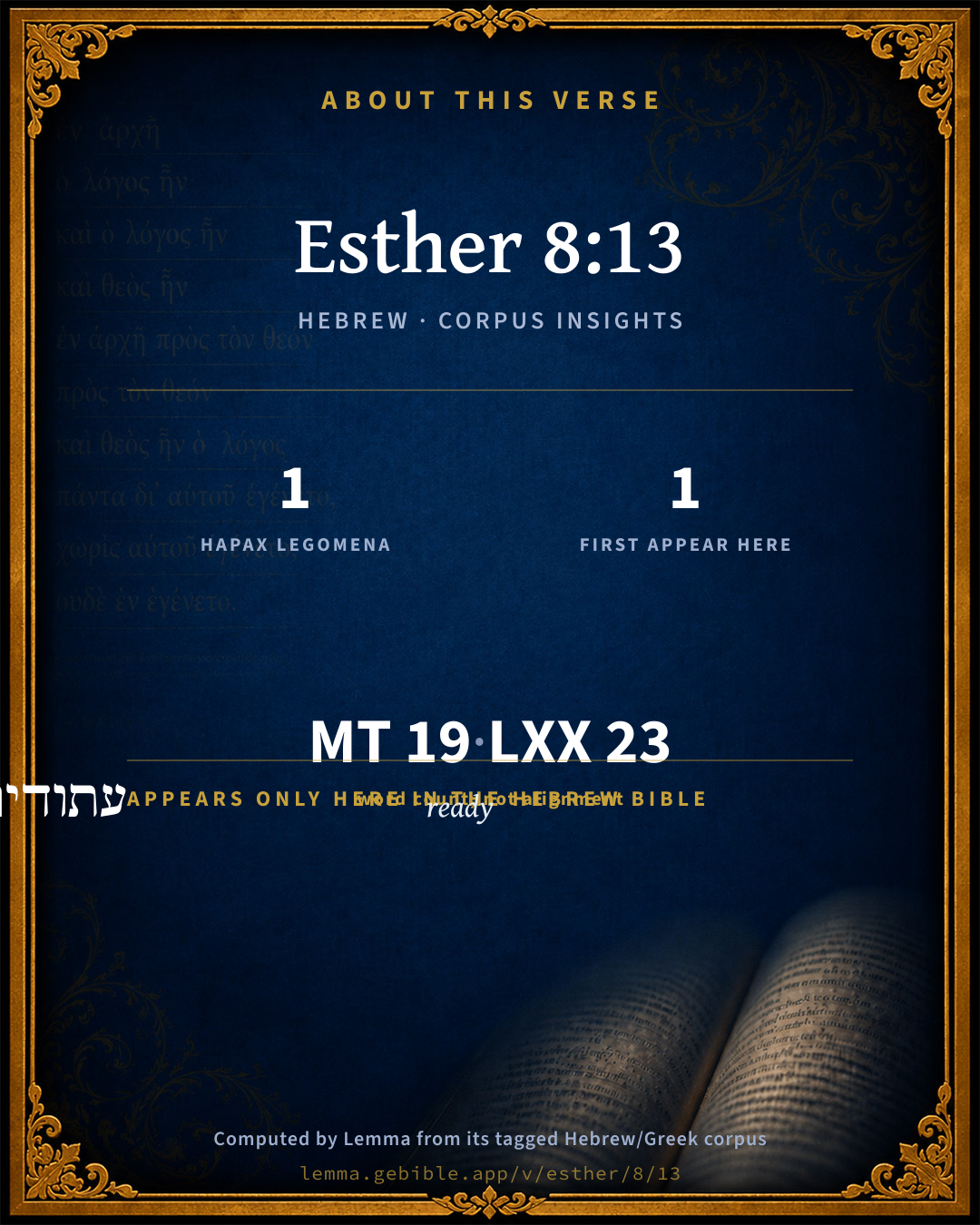
These counts appear in no published source. They are computed here, from the morphology-tagged text and Lemma’s own curated glosses. What Lemma adds →

19
words
16
distinct lemmas
Historical
section

Notable vocabulary

1 hapax legomenon — a word that appears only here in the entire Hebrew Bible:

  • עתודים ready H6259

First appearance in Scripture

This word makes its first canonical appearance in the Hebrew Bible here:

  • עתודים ready H6259

Shared distinctive vocabulary

פַּתְשֶׁ֣גֶן copy H6572 occurs in 4 verses of the Hebrew Bible. Also found in:

Grammatical profile

  • 5 verbs
  • 11 nouns
  • 2 adjectives
  • 1 pronoun

Verb forms

  • לְהִנָּ֤תֵֽן Niphal · Infinitive Construct
  • גָּל֖וּי Qal · Participle Passive
  • וְלִהְי֨וֹת Qal · Infinitive Construct
  • לְהִנָּקֵ֖ם Niphal · Infinitive Construct
  • מֵאֹיְבֵיהֶֽם Qal · Participle Active

Repetition

Words recur within this verse — often emphatic in Hebrew:

  • בְּכָל all H3605 ×2
  • מְדִינָ֣ה province H4082 ×2
  • היהודיים Jew H3064 ×2

Hebrew & Septuagint length

In English translation the verse runs 37 words from the Hebrew and 723 from the Septuagint (LXX English) — the Septuagint runs noticeably longer here. See the side-by-side →

A rough comparison of the two English renderings, which tokenize alike — not a word-level alignment.

Word counts can differ between the Hebrew and the Greek without any difference in meaning — e.g. the Hebrew direct-object marker אֵת has no separate Greek word, and Greek often adds the article ὁ.

In the original languages it is 19 Hebrew tokens and 23 Greek tokens — but the two are counted differently (Hebrew bundles its prefixes and suffixes into one token; the Greek is in lemma form), so that isn’t a like-for-like length.

Cross-references

8

Topical passages linked to Esther 8:13 in the Treasury of Scripture Knowledge — connected by theme and wording, ordered by reader-vote popularity; previews shown in the World English Bible.

  • Esther 3:14 A copy of the writing, that the decree should be given out in every province, was published to all the peoples, that they should be ready against that day.
  • Revelation 6:10 They cried with a loud voice, saying, "How long, Master, the holy and true, until you judge and avenge our blood on those who dwell on the earth?"
  • Judges 16:28 Samson called to Yahweh, and said, Lord Yahweh, remember me, Please, and strengthen me, Please, only this once, God, that I may be at once avenged of the Philistines for my two eyes.
  • Psalms 37:14–15 The wicked have drawn out the sword, and have bent their bow, To cast down the poor and needy, To kill those who are upright in the way.
  • Psalms 68:23 That you may crush them, dipping your foot in blood, That the tongues of your dogs may have their portion from your enemies."
  • Psalms 92:10–11 But you have exalted my horn like that of the wild ox. I am anointed with fresh oil.
  • Psalms 149:6–9 May the high praises of God be in their mouths, And a two-edged sword in their hand;
  • Luke 18:7 Won't God avenge his chosen ones, who are crying out to him day and night, and yet he exercises patience with them?

Cross-references courtesy of OpenBible.info (CC BY 4.0).

Hebrew and Greek witnesses Masoretic Hebrew ↔ Greek Septuagint

The same verse in the two great witnesses to the Old Testament, shown verse-for-verse.

Here the Septuagint runs noticeably longer than the Hebrew — LXX2012 (modern English Septuagint) 723 words vs World English Bible 37. A rough length comparison of the two English translations, not a word-level alignment — read both below.

These are two independent witnesses, not word-aligned to each other, and the Septuagint is shown in lemma (dictionary) form.

Hebrew Esther 8:13 Masoretic · Westminster Leningrad Codex

פַּתְשֶׁ֣גֶן הַכְּתָ֗ב לְהִנָּ֤תֵֽן דָּת֙ בְּכָל מְדִינָ֣ה וּמְדִינָ֔ה גָּל֖וּי לְכָל הָעַמִּ֑ים וְלִהְי֨וֹת היהודיים הַיְּהוּדִ֤ים עתודים עֲתִידִים֙ לַיּ֣וֹם הַזֶּ֔ה לְהִנָּקֵ֖ם מֵאֹיְבֵיהֶֽם

A copy of the writing, that the decree should be given out in every province, was published to all the peoples, and that the Jews should be ready against that day to avenge themselves on their enemies.

World English Bible · Public Domain

Greek LXX Esther 8:13 Septuagint · lemma form

ὁ δέ ἀντίγραφον ἐκτίθημι ὀφθαλμοφανῶς ἐν πᾶς ὁ βασιλεία ἕτοιμος τε εἰμί πᾶς ὁ ἰουδαῖος εἰς οὗτος ὁ ἡμέρα πολεμέω αὐτός ὁ ὑπεναντίος

And let the copies be posted in conspicuous places throughout the kingdom, and let all the Jews be ready against this day, to fight against their enemies. And the following is the copy of the letter of the orders. [The great king Artaxerxes sends greetings to the rulers of provinces in one hundred and twenty-seven satrapies, from India to Ethiopia, even to those who are faithful to our interests. Many who have been frequently honored by the most abundant kindness of their benefactors have conceived ambitious designs, and not only endeavor to hurt our subjects, but moreover, not being able to bear prosperity, they also endeavor to plot against their own benefactors. And they not only would utterly abolish gratitude from among men, but also, elated by the boastings of men who are strangers to all that is good, they supposed that they shall escape the sin-hating vengeance of the ever-seeing God. And oftentimes evil exhortation has made partakers of the guilt of shedding innocent blood, and has involved in irremediable calamities, many of those who had been appointed to offices of authority, who had been entrusted with the management of their friends' affairs; while men, by the false sophistry of an evil disposition, have deceived the simple candour of the ruling powers. And it is possible to see this, not so much from more ancient traditionary accounts, as it is immediately in your power to see it by examining what things have been wickedly perpetrated by the baseness of men unworthily holding power. And it is right to take heed with regard to the future, that we may maintain the government in undisturbed peace for all men, adopting needful changes, and ever judging those cases which come under our notice, with truly equitable decision. For whereas Aman, a Macedonian, the son of Amadathes, in reality an alien from the blood of the Persians, and differing widely from our mild course of government, having been hospitable entertained by us, obtained so large a share of our universal kindness, as to be called our father, and to continue the person next to the royal throne, reverenced of all; he however, overcome by the pride of his station, endeavored to deprive us of our dominion, and our life: having by various and subtle artifices demanded for destruction both Mardochaeus our deliverer and perpetual benefactor, and Esther the blameless consort of our kingdom, with their whole nation. For by these methods he thought, having surprised us in a defenceless state, to transfer the dominion of the Persians to the Macedonians. But we find that the Jews, who have been consigned to destruction by the most abominable of men, are not malefactors, but living according to the justest laws, and being the sons of the living God, the most high and mighty, who maintains the kingdom. to us as well as to our forefathers, in the most excellent order. You⌃ will therefore do well in refusing to obey the letter sent by Aman the son of Amadathes, because he that has done these things, has been hanged with his whole family at the gates of Susa, Almighty God having swiftly returned to him a worthy recompence, We enjoin you then, having openly published a copy of this letter in every place, to give the Jews permission to use their own lawful customs, and to strengthen them, that on the thirteenth of the twelfth month Adar, on the self-same day, they may defend themselves against those who attack them in a time of affliction. For in the place of the destruction of the chosen race, Almighty God has granted them this time of gladness. Do you⌃ therefore also, among your notable feasts, keep a distinct day with all festivity, that both now and hereafter it may be a day of deliverance to us and who are well disposed toward the Persians, but to those that plotted against us a memorial of destruction. And every city and province collectively, which shall not do accordingly, shall be consumed with vengeance by spear and fire: it shall be made not only inaccessible to men, but most hateful to wild beasts and birds for ever.] And let the copies be posted in conspicuous places throughout the kingdom and let all the Jews be ready against this day, to fight against their enemies.

LXX2012 (modern English Septuagint) · Public Domain

On this verse, John Gill's Exposition discusses the Septuagint’s reading. Read the note in Commentary ↓

Hebrew: Westminster Leningrad Codex (CC BY 4.0). Greek: Septuagint (public domain); English from LXX2012 (modern English Septuagint) (Public Domain). How the Septuagint differs from the Hebrew →

Commentary

Notes on Esther 8:13 from classic Christian and Jewish commentators (each source and its license shown beneath its notes). The classic Christian expositions comment on the surrounding passage and are grouped to its opening verse, so a note may address several verses; the Jewish commentaries on the Tanakh (Rashi and others) are per-verse, so they appear only where the commentator wrote on this verse.

Lemma curates 59 commentaries, every one of them public domain or Creative Commons licensed, each selected and text-cleaned for this edition rather than reprinted as found. About our sources →

Trapp's Complete Commentary

John Trapp

Est 8:13 The copy of the writing for a commandment to be given in every province [was] published unto all people, and that the Jews should be ready against that day to avenge themselves on their enemies.

Ver. 13. The copy of the writing] Transcripts of the original were everywhere published and proclaimed, as the contrary edict had been before, Est 3:14. This must needs amuse and amaze the people, but who durst say to their monarch, What doest thou? Is it safe to take a lion by the beard, or a bear by the tooth?

That the Jews should be ready against that day] God sometimes taketh notice (in his vindictive justice), as of the offending member, Jdg 1:6-7 Luk 16:24, so of the place where, 1Ki 21:19 (Henry III of France was stabbed to death in that very chamber where he had contrived the Massacre of Paris), and of the time when, mischief should have been acted, to prevent and punish it, as Exo 15:9-10. Ladislaus, king of Bohemia and Hungary, having conspired with other Popish princes to root out the true Christians in Bohemia, on such a day, on his marriage day, was immediately before, in the midst of his great, preparations, visited with a pestilent sore in his groin, whereof within thirty-six hours he died (Mr Clark’s Examples). Henry II, king of France, the selfsame day that he had purposed to persecute the Church, and burn certain of his guard whom he had in prison for religion (at whose execution be had promised to have been himself in person), in the midst of his triumph, at a tourney, was wounded so sore in the head with a spear, by one of his own subjects, that ere long he died (Acts & Mon. 1784). The duke of Guise threatened to destroy utterly the town of Orleans, but was himself slain that very evening. The constable of France made a vow, that as soon as he had taken St Quintons he would set upon Geneva; but sped as ill as Julian the apostate did, when going against the Persians, he swore that upon his return he would offer the blood of Christians. But the Galilean (as he called Christ in scorn) took an order with him ere that day came; the carpenter’s son had made ready his coffin; as was foretold him by a Christian, in answer to that bitter jeer.

To avenge themselves on their enemies] This was no private revenge, but licensed by the chief magistrates, intrusted by God with the administration of his kingdom upon earth, by the exercise of vindictive and remunerative justice, Rom 13:4. And here, Bonis nocet qui malis parcit. He wrongeth the good that punisheth not the bad. True it is, that private revenge is utterly unlawful unless it be in a man’s own necessary defence, where the case is so sudden that a man cannot call in the help of the magistrate, but must either kill or be killed. Otherwise that of Lactantius holdeth true, Non minus mali est iniuriam referre quam inferre. It is no lesser evil to pay back a wrong than to inflict it. And that of Seneca, immune verbum est ultio, revenge is a cruel word, manhood some call it, but it is rather doghood. The manlier any man is the milder and more merciful, as David, 2Sa 1:12, and Julius Caesar, who when he had Pompey’s head presented to him, wept and said, Non mihi placet vindicta sed victoria, I seek not revenge, but victory. The Jews here sought not revenge, but safety. If they had been sold for bondmen, they had borne it in silence and sufferance, the language of the lamb, dumb before the shearer, Est 7:4.

John Trapp, A Commentary or Exposition upon All the Books of the Old and New Testament (1647–1656) — public domain. Text from a community e-Sword module.

Tyndale Open Study Notes

Tyndale Open Resources

8:13 The Hebrew word translated to take revenge could also mean to establish justice. In situations where civil government could not exercise authority over all the parties involved in a conflict, this law would allow people who were attacked to establish justice by redressing wrongs committed against them.

Tyndale Open Study Notes — © Tyndale Open Resources, licensed CC BY-SA 4.0. Text via the HelloAO Bible API.

Geneva Bible (1599)

Geneva Bible translators

The king gave them liberty to kill all that did oppress them.

Geneva Bible (1599) marginal notes — public domain. Text via Bolls.life.

Ellicott's Commentary for English Readers

(13) To avenge themselves on their enemies.—The Hebrew word used here “does not necessarily signify a violent emotion of a resentful spirit, but a steady resolve to defend the right; it is used of the Almighty Himself, rescuing the oppressed, defending the right, and punishing the assailant and the oppressor” (Wordsworth).

A Bible Commentary for English Readers, edited by Charles John Ellicott (1878–1897) — public domain. Text from a community e-Sword module.

John Gill's Exposition

And Mordecai went out from the presence of the king,.... And walked or rode about in the city to show himself to his friends:

in royal apparel of blue and white; such as the Persian kings wore, and were not allowed to any other, as Xenophon writes (g):

and with a great crown of gold; a coronet, such as princes and nobles wear; the latter Targum calls it a great golden chain, and such the eastern kings used to give to their favourites; see Dan 5:29,

and with a garment of fine linen and purple; this must be an inner garment, since it is distinct from the royal robe before mentioned; though as the word signifies a wrap, or roll, it may design a turban, which was a roll of linen wrapped about the head; and such was the Persian diadem, according to Curtius (h), which was of a purple colour, mixed with white; and so the Septuagint version is, "and a diadem of fine linen, of a purple colour"; and if so, the crown of gold was not worn on his head, nor is it likely it should be allowed, but was carried before him; see Gill on Est 6:8,

and the city of Shushan rejoiced, and was glad; not only the Jews in it, but the native inhabitants of it, that had any sense of humanity, expressed their joy at the sight of Mordecai thus arrayed; that so good a man was advanced at court, and so bad a man as Haman was displaced and put to death; see Pro 29:2.

(g) Cyropaedia, l. 8. c. 23. (h) Hist. l. 3. c. 3. & l. 6. c. 6. Vid. Solerium de Pileo, sect. 9.

John Gill's Exposition of the Whole Bible (1746–1763) — public domain (CC PDM 1.0). Text via the HelloAO Bible API.

The Pulpit Commentary

This verse reproduces ver. 14 of ch. 3., with a slight modification of the last clause. It is probable that a copy of the decree was originally inserted at the end of the verse.

The Pulpit Commentary (1880–1919), ed. H.D.M. Spence-Jones & Joseph S. Exell — public domain. Text from a community e-Sword module.

unfoldingWord translationNotes

Door43 World Missions Community

to take vengeance on their enemies

"To take vengeance on people" here is an idiom meaning to hurt people who have hurt you. AT: "to fight back against their enemies" (See: Idiom)

They went without delay

"Without delay" here is an idiom meaning that they did not delay or wait. AT: "They went immediately" (See: Idiom)

Susa

This is the city where the king's palace was. See how you translated it in Esther 1:2. (See: How to Translate Names)

translationWords

decree

law, laws

people group

Jew

royal

king

unfoldingWord translationNotes — © Distant Shores Media and the Door43 World Missions Community, licensed CC BY-SA 4.0. Source: git.door43.org/Door43/en_tn.

Rashi

Rabbi Shlomo Yitzchaki (Rashi)

The copy an explicit letter.

Rashi on the Tanakh — English translations: “The Judaica Press complete Tanach with Rashi, translated by A. J. Rosenberg” (CC BY 4.0); “Pentateuch with Rashi's commentary by M. Rosenbaum and A.M. Silbermann, 1929-1934” (public domain); “The Metsudah Tanach series, Lakewood, N.J” (CC BY 4.0); and “The Book of Joshua, Metsudah Publications, 1997” (CC BY 4.0). Text via Sefaria.

Lesson kit

Teaching starters — assembled from the data on this page, not authored interpretation. Every prompt links to the verse data it draws on. Edit before teaching.

Esther, in the Historical, opens this verse with 19 words (16 distinct Hebrew lemmas). Its most distinctive word is ʻâthûwd (“ready”). The Greek Septuagint runs longer here. A historical commentator’s framing appears above. Read the whole chapter for the surrounding context.

Discussion questions

  1. How does “ready” (ʻâthûwd) shape what this verse is saying?
  2. 1 word here appears nowhere else in the Hebrew Bible. Why might the author reach for such rare wording?
  3. This is the first place “ready” appears in Scripture (first appears here). What does its debut here establish?
  4. How does Ezra 7:11, which shares the word «copy», read alongside this verse?
  5. What does the repetition of “all” (2× in this one verse) do in this verse?
  6. The Septuagint runs longer here than the Hebrew. What might account for the difference?
  7. These translations render this verse differently. What is at stake in choosing one wording over another?
  8. «לְהִנָּ֤תֵֽן» is a Niphal Infinitive Construct verb. How does that grammatical form shape the action described?

Things to notice

  • 1 word in this verse appears nowhere else in the Hebrew Bible.
  • 1 word makes its first canonical appearance in Scripture here.
  • This verse counts 19 Hebrew ↔ 23 Greek words.
  • These translations choose different wording for 17 words in this verse.
  • “all” occurs 2× in this single verse.

Reading settings

Reading text

Shown beneath each verse's original-language words.

Old Testament
Old Testament edition

Read the OT as the Masoretic Hebrew (MT) or the Greek Septuagint (LXX).

English shown for the Greek Septuagint (in the Hebrew ↔ Greek comparison).

Comparing translations? Open the Compare panel on any verse page to stack up to four side by side.