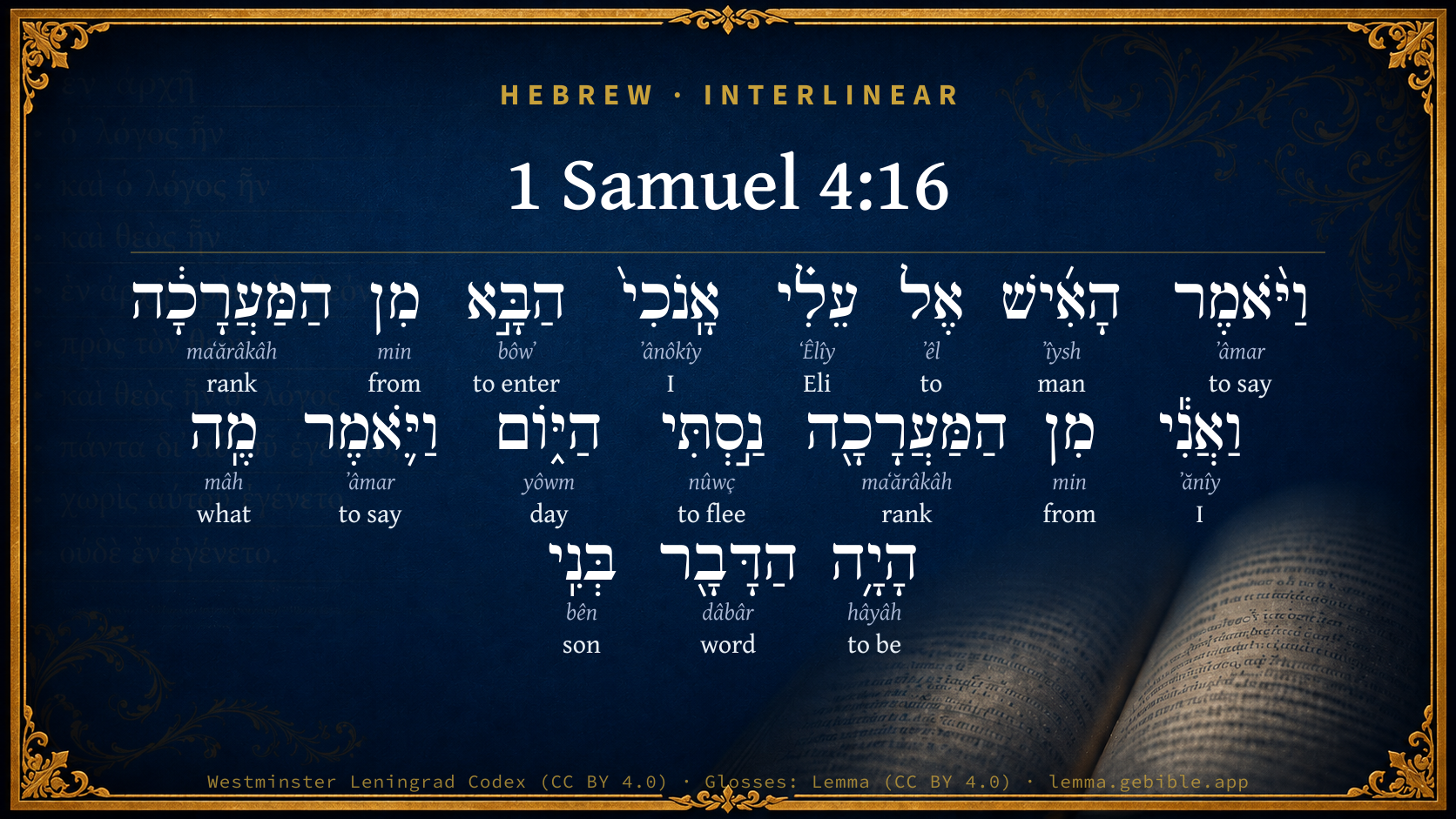
1 Samuel 4:16

Hebrew (Westminster Leningrad Codex) 1 Samuel 4:16 appears in the Hebrew Old Testament. The text above is from the Westminster Leningrad Codex. Each word links to its Strong’s number, a concise gloss, and parsing drawn from the Open Scriptures Hebrew Bible morphology. Click any word for its full Brown-Driver-Briggs (BDB) entry.
Download image
Cite this verse

1 Samuel 4:16 (World English Bible). Public Domain. Lemma interlinear Bible study tool, https://lemma.gebible.app/v/1-samuel/4/16.

Show BibTeX & RIS
BibTeX
RIS
English Translation
The man said to Eli, I am he who came out of the army, and I fled today out of the army. He said, How went the matter, my son?
World English Bible · Public Domain
Download a study sheet

One document with this verse’s original text, its word-by-word gloss line, the meaning frame, cross-references with their text, attributed commentary, and full source and license credits — printable, and it pastes into notes with its structure intact.

This verse Autodidact and up

Study sheet (.html) Plain text (.txt)

A passage Seminary Student

Up to 50 verses in one chapter. A passage sheet keeps up to 6 commentary sources and 12 cross-references per verse, in the order this page ranks them, and says so on the sheet whenever that leaves anything out. Ask for a single verse and you get the Autodidact verse sheet above.

Everything on this page stays free to read, with no account — the sheet is a download of what is already on screen, not access to it.

Want to remove ads? Support Godless Engineer
Compare translations 3

The same verse in 3 English versions, stacked beneath the original-language interlinear above. Click any original word for its lexicon entry.

Each is an independent rendering of the whole verse — the interlinear is not word-aligned to these translations.

Highlighted words mark where these versions differ — a whole-verse word diff, not a word-by-word alignment.

  • World English Bible Public Domain
    The man said to Eli, I am he who came out of the army, and I fled today out of the army. He said, How went the matter, my son?
  • King James Version Public Domain
    And the man said unto Eli, I am he that came out of the army, and I fled to day out of the army. And he said, What is there done, my son?
  • unfoldingWord Literal Text CC BY-SA 4.0
    And the man said to Eli, “I the one coming from the array, and I myself fled from the array today.” And he said, “What was the event, my son?”

unfoldingWord Literal Text — © unfoldingWord, licensed CC BY-SA 4.0. Word-aligned USFM3 via Door43 (git.door43.org/unfoldingWord/en_ult).

Versions to compare (up to 4)

3 of 4 selected

Show all 18 translations

Every available English version of this verse, each an independent rendering of the whole verse.

  • World English Bible Public Domain
    The man said to Eli, I am he who came out of the army, and I fled today out of the army. He said, How went the matter, my son?
  • Berean Standard Bible Public Domain
    “I have just come from the battle,” the man said to Eli. “I fled from there today.” “What happened, my son?” Eli asked.
  • Majority Standard Bible Public Domain
    “I have just come from the battle,” the man said to Eli. “I fled from there today.” “What happened, my son?” Eli asked.
  • King James Version Public Domain
    And the man said unto Eli, I am he that came out of the army, and I fled to day out of the army. And he said, What is there done, my son?
  • American Standard Version (1901) Public Domain
    And the man said unto Eli, I am he that came out of the army, and I fled to-day out of the army. And he said, How went the matter, my son?
  • Revised Version (1885) Public Domain
    And the man said unto Eli, I am he that came out of the army, and I fled today out of the army. And he said, How went the matter, my son?
  • Geneva Bible (1599) Public Domain
    And the man sayd vnto Eli, I came from the armie, and I fled this day out of the hoste: and he sayd, What thing is done, my sonne?
  • Douay-Rheims (1899) Public Domain
    And he said to Heli: I am he that came from the battle, and have fled out of the field this day. And he said to him: What is there done, my son?
  • Young's Literal Translation Public Domain
    And the man saith unto Eli, `I `am' he who hath come out of the ranks, and I out of the ranks have fled to-day;' and he saith, `What hath been the matter, my son?'
  • Literal Standard Version CC BY-SA 4.0
    And the man says to Eli, “I [am] he who has come out of the ranks, and I have fled out of the ranks today”; and he says, “What has been the matter, my son?”
  • Unlocked Literal Bible CC BY-SA 4.0
    The man said to Eli, “I am the one who came from the battle line. I fled from the battle today.” Eli said, “How did it go, my son?”
  • unfoldingWord Literal Text CC BY-SA 4.0
    And the man said to Eli, “I the one coming from the array, and I myself fled from the array today.” And he said, “What was the event, my son?”
  • Darby Bible Public Domain
    And the man said to Eli, I am he that came out of the battle, and I have fled to-day out of the battle. And he said, What has taken place, my son?
  • World Messianic Bible Public Domain
    The man said to Eli, “I am he who came out of the army, and I fled today out of the army.” He said, “How did the matter go, my son?”
  • Webster's Bible Public Domain
    And the man said to Eli, I am he that came out of the army, and I fled to-day out of the army. And he said, What is there done, my son?
  • Free Bible Version CC BY-SA 4.0
    “I've just come from the battle,” the man said. “I ran away from it today.” “What happened, my son?” Eli asked.
  • Bible in Basic English Public Domain
    And the man said to Eli, I have come from the army and have come in flight today from the fight. And he said, How did it go, my son?
  • JPS Tanakh (1917) Public Domain
    And the man said unto Eli: 'I am he that came out of the army, and I fled to-day out of the army.' And he said: 'How went the matter, my son?'

Literal Standard Version (2020), Covenant Press — licensed CC BY-SA 4.0. Text via the HelloAO Bible API (eBible.org). Unlocked Literal Bible (unfoldingWord) — licensed CC BY-SA 4.0. Text via the HelloAO Bible API (eBible.org). unfoldingWord Literal Text — © unfoldingWord, licensed CC BY-SA 4.0. Word-aligned USFM3 via Door43 (git.door43.org/unfoldingWord/en_ult). Free Bible Version, Dr. Jonathan Gallagher — licensed CC BY-SA 4.0. Text via the HelloAO Bible API (eBible.org).

Word by word

More ways to search: Search by grammar → Find every occurrence → Compare this word →

Practice this passage: Drill this verse → Learn its vocabulary →

הַמַּעֲרָכָ֔ה
maʻărâkâh
H4634
“the · rank”
Particle, Definite Article + Noun, Common, Feminine, Singular, Absolute
Part of Speech
Particle + Noun
Type
Common
Gender
Feminine
Number
Singular
State
Absolute
Full BDB Definition

Origin: from H4633

TWOT: 1694d

row, rank, battle-line - battle-line - rank - row
  1. וַיֹּ֨אמֶר ʼâmar H559 “and · to say” Conjunction + Verb, Qal, Sequential Imperfect, 3rd Person, Masculine, Singular
  2. הָאִ֜ישׁ ʼîysh H376 “the · man” Particle, Definite Article + Noun, Common, Masculine, Singular, Absolute
  3. אֶל ʼêl H413 “to” Preposition
  4. עֵלִ֗י ʻÊlîy H5941 “Eli” Noun, Proper
  5. אָֽנֹכִי֙ ʼânôkîy H595 “I” Pronoun, Personal, 1st Person, Common, Singular
  6. הַבָּ֣א bôwʼ H935 “the · entering” Particle, Definite Article + Verb, Qal, Participle Active, Masculine, Singular, Absolute
  7. מִן min H4480 “from” Preposition
  8. וַאֲנִ֕י ʼănîy H589 “and · I” Conjunction + Pronoun, Personal, 1st Person, Common, Singular
  9. מִן min H4480 “from” Preposition
  10. הַמַּעֲרָכָ֖ה maʻărâkâh H4634 “the · rank” Particle, Definite Article + Noun, Common, Feminine, Singular, Absolute
  11. נַ֣סְתִּי nûwç H5127 “to flee” Verb, Qal, Perfect, 1st Person, Common, Singular
  12. הַיּ֑וֹם yôwm H3117 “the · day” Particle, Definite Article + Noun, Common, Masculine, Singular, Absolute
  13. וַיֹּ֛אמֶר ʼâmar H559 “and · to say” Conjunction + Verb, Qal, Sequential Imperfect, 3rd Person, Masculine, Singular
  14. מֶֽה mâh H4100 “what” Particle, Interrogative
  15. הָיָ֥ה hâyâh H1961 “to be” Verb, Qal, Perfect, 3rd Person, Masculine, Singular
  16. הַדָּבָ֖ר dâbâr H1697 “the · word” Particle, Definite Article + Noun, Common, Masculine, Singular, Absolute
  17. בְּנִֽי bên H1121 “son · my” Noun, Common, Masculine, Singular, Construct + Suffix, Personal, 1st Person, Common, Singular

About this verse

These counts appear in no published source. They are computed here, from the morphology-tagged text and Lemma’s own curated glosses. What Lemma adds →

18
words
15
distinct lemmas
Historical
section

Notable vocabulary

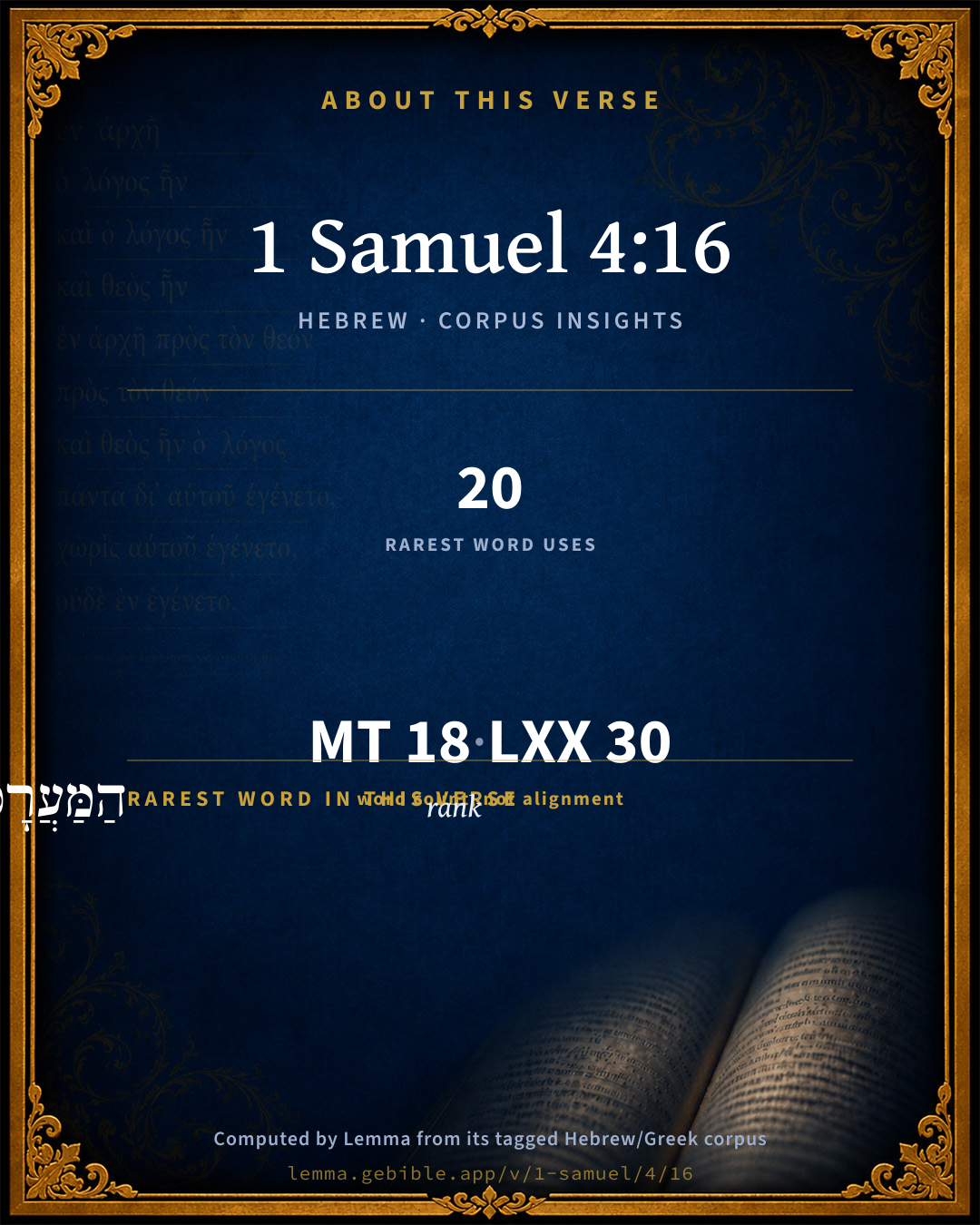
The rarest word here is הַמַּעֲרָכָ֔ה rank H4634 — appearing just 20 times in the whole Hebrew Bible.

Shared distinctive vocabulary

הַמַּעֲרָכָ֔ה rank H4634 occurs in 18 verses of the Hebrew Bible. Also found in:

Grammatical profile

  • 5 verbs
  • 7 nouns
  • 2 pronouns
  • 3 prepositions
  • 1 particle

Verb forms

  • וַיֹּ֨אמֶר Qal · Sequential Imperfect
  • הַבָּ֣א Qal · Participle Active
  • נַ֣סְתִּי Qal · Perfect
  • וַיֹּ֛אמֶר Qal · Sequential Imperfect
  • הָיָ֥ה Qal · Perfect

Repetition

Words recur within this verse — often emphatic in Hebrew:

  • וַיֹּ֨אמֶר to say H559 ×2
  • הַמַּעֲרָכָ֔ה rank H4634 ×2
  • מִן from H4480 ×2

Hebrew & Septuagint length

In English translation the verse runs 30 words from the Hebrew and 56 from the Septuagint (LXX English) — the Septuagint runs noticeably longer here. See the side-by-side →

A rough comparison of the two English renderings, which tokenize alike — not a word-level alignment.

Word counts can differ between the Hebrew and the Greek without any difference in meaning — e.g. the Hebrew direct-object marker אֵת has no separate Greek word, and Greek often adds the article ὁ.

In the original languages it is 18 Hebrew tokens and 30 Greek tokens — but the two are counted differently (Hebrew bundles its prefixes and suffixes into one token; the Greek is in lemma form), so that isn’t a like-for-like length.

Cross-references

3

Topical passages linked to 1 Samuel 4:16 in the Treasury of Scripture Knowledge — connected by theme and wording, ordered by reader-vote popularity; previews shown in the World English Bible.

  • 2 Samuel 1:4 David said to him, How went the matter? Please tell me. He answered, The people are fled from the battle, and many of the people also are fallen and dead; and Saul and Jonathan his son are dead also.
  • Joshua 7:19 Joshua said to Achan, My son, please give glory to Yahweh, the God of Israel, and make confession to him; and tell me now what you have done; don't hide it from me.
  • 1 Samuel 3:6 Yahweh called yet again, Samuel. Samuel arose and went to Eli, and said, Here am I; for you called me. He answered, I didn't call, my son; lie down again.

Cross-references courtesy of OpenBible.info (CC BY 4.0).

Hebrew and Greek witnesses Masoretic Hebrew ↔ Greek Septuagint

The same verse in the two great witnesses to the Old Testament, shown verse-for-verse.

Here the Septuagint runs noticeably longer than the Hebrew — LXX2012 (modern English Septuagint) 56 words vs World English Bible 30. A rough length comparison of the two English translations, not a word-level alignment — read both below.

These are two independent witnesses, not word-aligned to each other, and the Septuagint is shown in lemma (dictionary) form.

Hebrew 1 Samuel 4:16 Masoretic · Westminster Leningrad Codex

וַיֹּ֨אמֶר הָאִ֜ישׁ אֶל עֵלִ֗י אָֽנֹכִי֙ הַבָּ֣א מִן הַמַּעֲרָכָ֔ה וַאֲנִ֕י מִן הַמַּעֲרָכָ֖ה נַ֣סְתִּי הַיּ֑וֹם וַיֹּ֛אמֶר מֶֽה הָיָ֥ה הַדָּבָ֖ר בְּנִֽי

The man said to Eli, I am he who came out of the army, and I fled today out of the army. He said, How went the matter, my son?

World English Bible · Public Domain

Greek LXX 1 Samuel 4:16 Septuagint · lemma form

καί ὁ ἀνήρ σπεύδω προςἔρχομαι πρός ηλι καί εἶπον αὐτός ἐγώ εἰμί ὁ ἥκω ἐκ ὁ παρεμβολή καΐἐγώ φεύγω ἐκ ὁ παράταξις σήμερον καί εἶπον τίς ὁ γίγνομαι ῥῆμα τέκνον

And Heli said to them that stood round about him, What is the voice of this sound? And the man hasted and advanced to Heli, and said to him, I am he that is come out of the camp, and I have fled from the battle today: and Heli said, What is the even, my son?

LXX2012 (modern English Septuagint) · Public Domain

On this verse, Keil & Delitzsch discusses the Septuagint’s reading. Read the note in Commentary ↓

Hebrew: Westminster Leningrad Codex (CC BY 4.0). Greek: Septuagint (public domain); English from LXX2012 (modern English Septuagint) (Public Domain). How the Septuagint differs from the Hebrew →

Targum (Aramaic paraphrase)

1

The Targum is the ancient Jewish Aramaic paraphrase of the Hebrew Scriptures — an interpretive translation, not the Hebrew text itself. Onkelos (literal) and Pseudo-Jonathan (expansive) render the Torah, and Jonathan the Prophets. Coverage is partial: where no permissively-licensed English translation exists for a verse, only the Aramaic is shown. This is verse-level text, not a word-by-word alignment to the Hebrew.

  1. Targum Jonathan Prophets (Joshua–Malachi)
    וַאֲמַר גַבְרָא לְעֵלִי אֲנָא אֲתֵית מִן סִדְרָא וַאֲנָא מִן סִדְרָא דִקְרָבָא אַפָּכִית יוֹמָא דֵין וַאֲמַר מֶה הֲוָה פִּתְגָמָא בְּרִי:

    (no public-domain English translation for this verse)

    Targum Jonathan — Aramaic: “Mikraot Gedolot” (public domain). English: “Sefaria Community Translation” (CC0 1.0 (public-domain dedication)); “London "Chaldee Paraphrase," 1871” (public domain). Text via Sefaria.

Commentary

Notes on 1 Samuel 4:16 from classic Christian and Jewish commentators (each source and its license shown beneath its notes). The classic Christian expositions comment on the surrounding passage and are grouped to its opening verse, so a note may address several verses; the Jewish commentaries on the Tanakh (Rashi and others) are per-verse, so they appear only where the commentator wrote on this verse.

Lemma curates 59 commentaries, every one of them public domain or Creative Commons licensed, each selected and text-cleaned for this edition rather than reprinted as found. About our sources →

Trapp's Complete Commentary

John Trapp

1Sa 4:16 And the man said unto Eli, I [am] he that came out of the army, and I fled to day out of the army. And he said, What is there done, my son?

Ver. 16. And I fled today out of the army.] I am an eyewitness, and therefore may be credited. But he should not have poured forth all the ill news at once, to the crushing of the old man’s heart.

John Trapp, A Commentary or Exposition upon All the Books of the Old and New Testament (1647–1656) — public domain. Text from a community e-Sword module.

Ellicott's Commentary for English Readers

(16) I fled to day out of the army.—The fatal battle had taken place very early that same morning. The utter rout, the awful slaughter, the death of Hophni and Phinehas, and the loss of the Ark of the Covenant, all this the messenger knew, and with this terrible news had hasted to the seat of the government—the now empty sanctuary.

The very words of the runner were remembered. The whole vivid scene was evidently related by a bystander—some have even suggested that it was Samuel who stood by Eli’s side.

A Bible Commentary for English Readers, edited by Charles John Ellicott (1878–1897) — public domain. Text from a community e-Sword module.

The Cambridge Bible for Schools and Colleges

gen. ed. J. J. S. Perowne

16. I am he] He has to announce himself to the blind old man who cannot see the tale of disaster which his dust-soiled, blood-stained garments tell all too plainly to the people.

the army] Better, as in 1Sa_4:12, the battle-array.

What is there done] Lit., What was the affair? Vulg. quid actum est? David uses the same phrase to the Amalekite in 2Sa_1:4.

The Cambridge Bible for Schools and Colleges (gen. ed. J. J. S. Perowne; Cambridge University Press, 1878–1918) — public domain. Text from a community e-Sword module.

John Gill's Exposition

And the man said unto Eli, I am he that came out of the army,.... It is very probable that the people Eli inquired of told him there was a messenger come from the army, though they did not choose to relate to him the news he brought:

and I fled today out of the army; so that as he was an eyewitness of what was done in the army, the account he brought was the earliest that could be had, in bringing which he had made great dispatch, having ran perhaps all the way:

and he said, what is there done, my son? has a battle been fought? on which side is the victory? is Israel beaten, or have they conquered? how do things go? he uses the kind and tender appellation, my son, to engage him to tell him all freely and openly.

John Gill's Exposition of the Whole Bible (1746–1763) — public domain (CC PDM 1.0). Text via the HelloAO Bible API.

Matthew Poole's English Annotations

I am he that came out of the army; I speak not what I have by uncertain rumours, but what mine eyes were witnesses of.

Matthew Poole's English Annotations on the Holy Bible (1683–1685) — public domain. Text from a community e-Sword/MySword module.

The Pulpit Commentary

Vers. 16, 17. What is there done, my son? Literally, What is the thing? Or, as the phrase is translated in 2Sa_1:4, "How went the matter?" Eli must have gathered from the words of the messenger that Israel had been defeated; for he expressly says, I fled, and his haste, as testified by the added words today, showed that the defeat was a severe one. Eli, therefore, anxiously asks what has happened, and the answer piles misery upon misery, rapidly heaping together four crushing catastrophes. For Israel had fled before the Philistines; there had been a great slaughter; among the slain were Eli"s two sons; and, worst of all, the ark of God was taken.

The Pulpit Commentary (1880–1919), ed. H.D.M. Spence-Jones & Joseph S. Exell — public domain. Text from a community e-Sword module.

Keil & Delitzsch

C. F. Keil & F. Delitzsch

When the messenger informed him of the defeat of the Israelites, the death of his sons, and the capture of the ark, at the last news Eli fell back from his seat by the side of the gate, and broke his neck, and died. The loss of the ark was to him the most dreadful of all - more dreadful than the death of his two sons. Eli had judged Israel forty years. The reading twenty in the Septuagint does not deserve the slightest notice, if only because it is perfectly incredible that Eli should have been appointed judge of the nation in his seventy-eight year.

Keil & Delitzsch — Biblical Commentary on the Old Testament (1861–1891) — public domain (CC PDM 1.0). Text via the HelloAO Bible API. (Old Testament only.)

unfoldingWord translationNotes

Door43 World Missions Community

my son

Eli was not the other man's true father. Eli speaks as if he were the man's father to show the man that he is not angry but that the man needs to answer him. (See: Metaphor)

Israel fled from the Philistines

This is a general statement about what happened. The rest of the man's words give details.

Also, there has been ... people. Also, your two sons

"I will now tell you something worse ... I will now tell you something worse" or "Not only has there been ... people, but your two sons"

the ark of God has been taken

This can be stated in active form. AT: "the Philistines have taken the ark of God" (See: Active or Passive)

translationWords

son

unfoldingWord translationNotes — © Distant Shores Media and the Door43 World Missions Community, licensed CC BY-SA 4.0. Source: git.door43.org/Door43/en_tn.

Lesson kit

Teaching starters — assembled from the data on this page, not authored interpretation. Every prompt links to the verse data it draws on. Edit before teaching.

1 Samuel, in the Historical, opens this verse with 18 words (15 distinct Hebrew lemmas). Its most distinctive word is maʻărâkâh (“rank”). The Greek Septuagint runs longer here. A historical commentator’s framing appears above. Read the whole chapter for the surrounding context.

Discussion questions

  1. What does “rank” (maʻărâkâh) contribute to the verse as a whole?
  2. How does Exodus 39:37, which shares the word «rank», read alongside this verse?
  3. What does the repetition of “to say” (2× in this one verse) do in this verse?
  4. The Septuagint runs longer here than the Hebrew. What might account for the difference?
  5. The translations on this page render this verse differently — a whole-verse word diff, not a word-by-word alignment. What might account for the different wordings?
  6. «וַיֹּ֨אמֶר» is a Qal Sequential Imperfect verb. How does that grammatical form shape the action described?
  7. Compare how Trapp's Complete Commentary and Ellicott's Commentary for English Readers read this verse. Where do they agree or differ?

Things to notice

Reading settings

Reading text

Shown beneath each verse's original-language words.

Old Testament
Old Testament edition

Read the OT as the Masoretic Hebrew (MT) or the Greek Septuagint (LXX).

English shown for the Greek Septuagint (in the Hebrew ↔ Greek comparison).

Comparing translations? Open the Compare panel on any verse page to stack up to four side by side.