
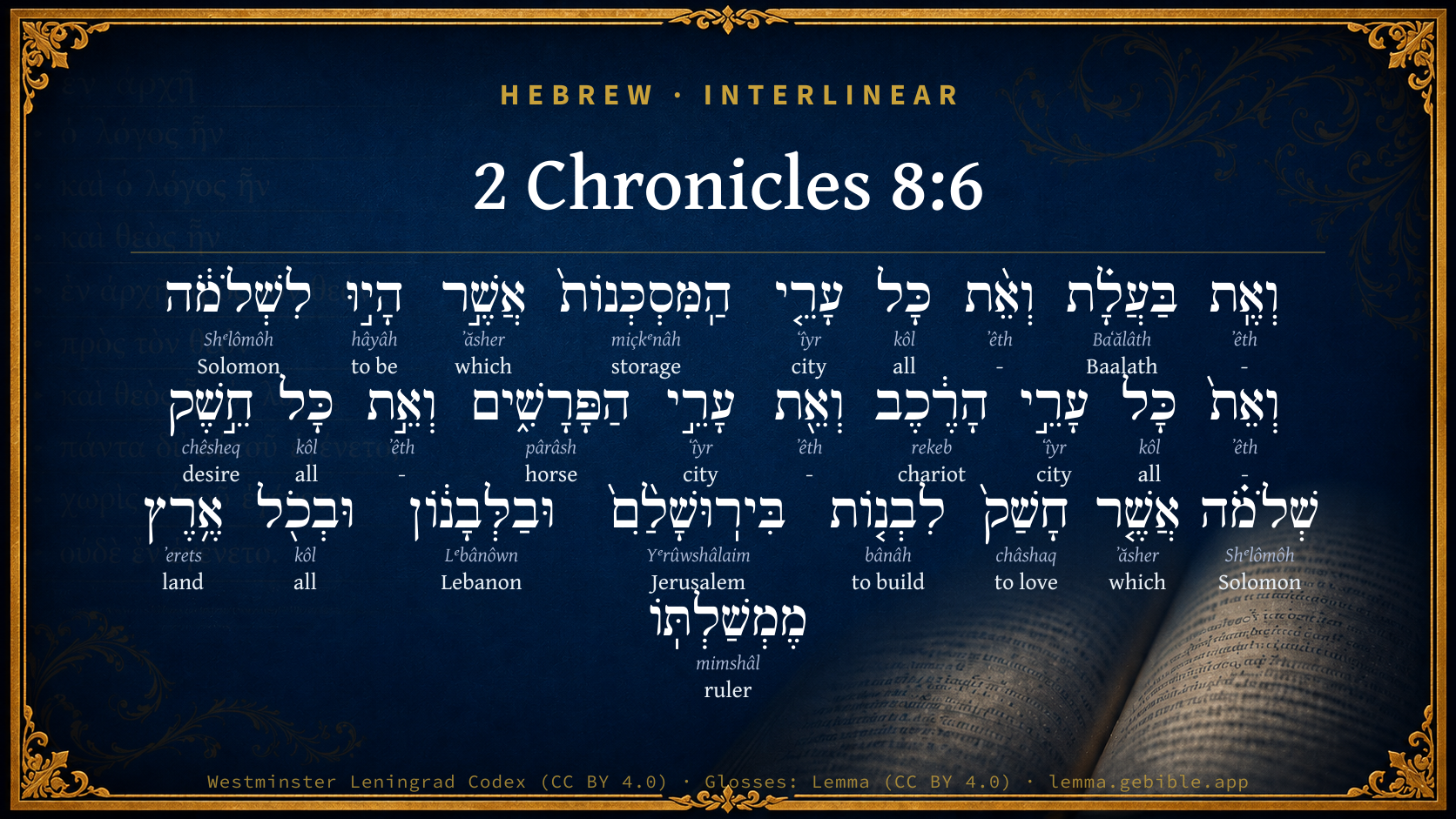
2 Chronicles 8:6

Hebrew (Westminster Leningrad Codex) 2 Chronicles 8:6 appears in the Hebrew Old Testament. The text above is from the Westminster Leningrad Codex. Each word links to its Strong’s number, a concise gloss, and parsing drawn from the Open Scriptures Hebrew Bible morphology. Click any word for its full Brown-Driver-Briggs (BDB) entry.
Download image
Cite this verse

2 Chronicles 8:6 (World English Bible). Public Domain. Lemma interlinear Bible study tool, https://lemma.gebible.app/v/2-chronicles/8/6.

Show BibTeX & RIS
BibTeX
RIS
English Translation
and Baalath, and all the store-cities that Solomon had, and all the cities for his chariots, and the cities for his horsemen, and all that Solomon desired to build for his pleasure in Jerusalem, and in Lebanon, and in all the land of his dominion.
World English Bible · Public Domain
Download a study sheet

One document with this verse’s original text, its word-by-word gloss line, the meaning frame, cross-references with their text, attributed commentary, and full source and license credits — printable, and it pastes into notes with its structure intact.

This verse Autodidact and up

Study sheet (.html) Plain text (.txt)

A passage Seminary Student

Up to 50 verses in one chapter. A passage sheet keeps up to 6 commentary sources and 12 cross-references per verse, in the order this page ranks them, and says so on the sheet whenever that leaves anything out. Ask for a single verse and you get the Autodidact verse sheet above.

Everything on this page stays free to read, with no account — the sheet is a download of what is already on screen, not access to it.

Want to remove ads? Support Godless Engineer
Compare translations 3

The same verse in 3 English versions, stacked beneath the original-language interlinear above. Click any original word for its lexicon entry.

Each is an independent rendering of the whole verse — the interlinear is not word-aligned to these translations.

Highlighted words mark where these versions differ — a whole-verse word diff, not a word-by-word alignment.

  • World English Bible Public Domain
    and Baalath, and all the store-cities that Solomon had, and all the cities for his chariots, and the cities for his horsemen, and all that Solomon desired to build for his pleasure in Jerusalem, and in Lebanon, and in all the land of his dominion.
  • King James Version Public Domain
    And Baalath, and all the store cities that Solomon had, and all the chariot cities, and the cities of the horsemen, and all that Solomon desired to build in Jerusalem, and in Lebanon, and throughout all the land of his dominion.
  • unfoldingWord Literal Text CC BY-SA 4.0
    and Baalath and all the cities of stores which were to Solomon, and all the cities of the chariots and the cities of the horsemen, and all the desire of Solomon which he desired to build in Jerusalem, and in Lebanon, and in all the land of his kingdom.

unfoldingWord Literal Text — © unfoldingWord, licensed CC BY-SA 4.0. Word-aligned USFM3 via Door43 (git.door43.org/unfoldingWord/en_ult).

Versions to compare (up to 4)

3 of 4 selected

Show all 18 translations

Every available English version of this verse, each an independent rendering of the whole verse.

  • World English Bible Public Domain
    and Baalath, and all the store-cities that Solomon had, and all the cities for his chariots, and the cities for his horsemen, and all that Solomon desired to build for his pleasure in Jerusalem, and in Lebanon, and in all the land of his dominion.
  • Berean Standard Bible Public Domain
    as well as Baalath, all the store cities that belonged to Solomon, and all the cities for his chariots and horses—whatever he desired to build in Jerusalem, Lebanon, and throughout the land of his dominion.
  • Majority Standard Bible Public Domain
    as well as Baalath, all the store cities that belonged to Solomon, and all the cities for his chariots and horses—whatever he desired to build in Jerusalem, Lebanon, and throughout the land of his dominion.
  • King James Version Public Domain
    And Baalath, and all the store cities that Solomon had, and all the chariot cities, and the cities of the horsemen, and all that Solomon desired to build in Jerusalem, and in Lebanon, and throughout all the land of his dominion.
  • American Standard Version (1901) Public Domain
    and Baalath, and all the store-cities that Solomon had, and all the cities for his chariots, and the cities for his horsemen, and all that Solomon desired to build for his pleasure in Jerusalem, and in Lebanon, and in all the land of his dominion.
  • Revised Version (1885) Public Domain
    and Baalath, and all the store cities that Solomon had, and all the cities for his chariots, and the cities for his horsemen, and all that Solomon desired to build for his pleasure in Jerusalem, and in Lebanon, and in all the land of his dominion.
  • Geneva Bible (1599) Public Domain
    Also Baalath, and al the cities of store that Salomon had, and all the charet cities, and the cities of the horsemen, and euery pleasant place that Salomon had a minde to builde in Ierusalem, and in Lebanon, and throughout all the lande of his dominion.
  • Douay-Rheims (1899) Public Domain
    Balaath also and all the strong cities that were Solomon's, and all the cities of the chariots, and the cities of the horsemen. All that Solomon had a mind, and designed, he built in Jerusalem and in Libanus, and in all the land of his dominion.
  • Young's Literal Translation Public Domain
    and Baalath, and all the cities of store that Solomon had, and all the cities of the chariot, and the cities of the horsemen, and all the desire of Solomon that he desired to build in Jerusalem, and in Lebanon, and in all the land of his dominion.
  • Literal Standard Version CC BY-SA 4.0
    and Ba‘alath, and all the cities of store that Solomon had, and all the cities of the chariot, and the cities of the horsemen, and all the desire of Solomon that he desired to build in Jerusalem, and in Lebanon, and in all the land of his dominion.
  • Unlocked Literal Bible CC BY-SA 4.0
    He built Baalath and all the store cities that he possessed, and all the cities for his chariots and the cities for his horsemen, and whatever he wished to build for his pleasure in Jerusalem, in Lebanon, and in all the lands under his rule.
  • unfoldingWord Literal Text CC BY-SA 4.0
    and Baalath and all the cities of stores which were to Solomon, and all the cities of the chariots and the cities of the horsemen, and all the desire of Solomon which he desired to build in Jerusalem, and in Lebanon, and in all the land of his kingdom.
  • Darby Bible Public Domain
    and Baalath, and all the store-cities that Solomon had, and all the cities for chariots, and the cities for the horsemen, and all that Solomon desired to build in Jerusalem, and on Lebanon, and in all the land of his dominion.
  • World Messianic Bible Public Domain
    and Baalath, and all the storage cities that Solomon had, and all the cities for his chariots, the cities for his horsemen, and all that Solomon desired to build for his pleasure in Jerusalem, in Lebanon, and in all the land of his dominion.
  • Webster's Bible Public Domain
    And Baalath, and all the store cities that Solomon had, and all the chariot cities, and the cities of the horsemen, and all that Solomon desired to build in Jerusalem, and in Lebanon, and throughout all the land of his dominion.
  • Free Bible Version CC BY-SA 4.0
    and also Baalath. He built all the storehouse towns that belonged to him, and all the towns where he kept his chariots and horses. He built everything he wanted to in Jerusalem, Lebanon, and throughout his entire kingdom.
  • Bible in Basic English Public Domain
    And of Baalath, and all the store-towns which Solomon had, and the towns where he kept his war-carriages and his horse men, and everything which it was his pleasure to put up in Jerusalem and in Lebanon and in all the land under his rule.
  • JPS Tanakh (1917) Public Domain
    and Baalath, and all the store-cities that Solomon had, and all the cities for his chariots, and the cities for his horsemen, and all that Solomon desired to build for his pleasure in Jerusalem, and in Lebanon, and in all the land of his dominion.

Literal Standard Version (2020), Covenant Press — licensed CC BY-SA 4.0. Text via the HelloAO Bible API (eBible.org). Unlocked Literal Bible (unfoldingWord) — licensed CC BY-SA 4.0. Text via the HelloAO Bible API (eBible.org). unfoldingWord Literal Text — © unfoldingWord, licensed CC BY-SA 4.0. Word-aligned USFM3 via Door43 (git.door43.org/unfoldingWord/en_ult). Free Bible Version, Dr. Jonathan Gallagher — licensed CC BY-SA 4.0. Text via the HelloAO Bible API (eBible.org).

Word by word

More ways to search: Search by grammar → Find every occurrence → Compare this word →

Practice this passage: Drill this verse → Learn its vocabulary →

בַּעֲלָ֗ת
Baʻălâth
H1191
“Baalath”
Noun, Proper
Part of Speech
Noun
Type
Proper
Full BDB Definition

Origin: a modification of H1172

TWOT: None

Baalath = "mistress" - a town in Dan
  1. וְאֶֽת ʼêth H853 “and · -” Conjunction + Particle, Direct Object
  2. וְאֵ֨ת ʼêth H853 “and · -” Conjunction + Particle, Direct Object
  3. כָּל kôl H3605 “all of” Noun, Common, Masculine, Singular, Construct
  4. עָרֵ֤י ʻîyr H5892 “cities of” Noun, Common, Feminine, Plural, Construct
  5. הַֽמִּסְכְּנוֹת֙ miçkᵉnâh H4543 “the · storehouses” Particle, Definite Article + Noun, Common, Feminine, Plural, Absolute
  6. אֲשֶׁ֣ר ʼăsher H834 “which” Particle, Relative
  7. הָי֣וּ hâyâh H1961 “to be” Verb, Qal, Perfect, 3rd Person, Common, Plural
  8. לִשְׁלֹמֹ֔ה Shᵉlômôh H8010 “to/for · Solomon” Preposition + Noun, Proper
  9. וְאֵת֙ ʼêth H853 “and · -” Conjunction + Particle, Direct Object
  10. כָּל kôl H3605 “all of” Noun, Common, Masculine, Singular, Construct
  11. עָרֵ֣י ʻîyr H5892 “cities of” Noun, Common, Feminine, Plural, Construct
  12. הָרֶ֔כֶב rekeb H7393 “the · chariot” Particle, Definite Article + Noun, Common, Masculine, Singular, Absolute
  13. וְאֵ֖ת ʼêth H853 “and · -” Conjunction + Particle, Direct Object
  14. עָרֵ֣י ʻîyr H5892 “cities of” Noun, Common, Feminine, Plural, Construct
  15. הַפָּרָשִׁ֑ים pârâsh H6571 “the · horses” Particle, Definite Article + Noun, Common, Masculine, Plural, Absolute
  16. וְאֵ֣ת ʼêth H853 “and · -” Conjunction + Particle, Direct Object
  17. כָּל kôl H3605 “all of” Noun, Common, Masculine, Singular, Construct
  18. חֵ֣שֶׁק chêsheq H2837 “desire of” Noun, Common, Masculine, Singular, Construct
  19. שְׁלֹמֹ֗ה Shᵉlômôh H8010 “Solomon” Noun, Proper
  20. אֲשֶׁ֤ר ʼăsher H834 “which” Particle, Relative
  21. חָשַׁק֙ châshaq H2836 “to love” Verb, Qal, Perfect, 3rd Person, Masculine, Singular
  22. לִבְנ֤וֹת bânâh H1129 “to build” Preposition + Verb, Qal, Infinitive Construct
  23. בִּירֽוּשָׁלִַ֨ם֙ Yᵉrûwshâlaim H3389 “in/at · Jerusalem” Preposition + Noun, Proper
  24. וּבַלְּבָנ֔וֹן Lᵉbânôwn H3844 “and · in/at the · Lebanon” Conjunction + Preposition, Determined + Noun, Proper
  25. וּבְכֹ֖ל kôl H3605 “and · in/at · all of” Conjunction + Preposition + Noun, Common, Masculine, Singular, Construct
  26. אֶ֥רֶץ ʼerets H776 “land of” Noun, Common, Both, Singular, Construct
  27. מֶמְשַׁלְתּֽוֹ mimshâl H4474 “ruler · his” Noun, Common, Both, Singular, Construct + Suffix, Personal, 3rd Person, Masculine, Singular

About this verse

These counts appear in no published source. They are computed here, from the morphology-tagged text and Lemma’s own curated glosses. What Lemma adds →

28
words
17
distinct lemmas
Historical
section

Notable vocabulary

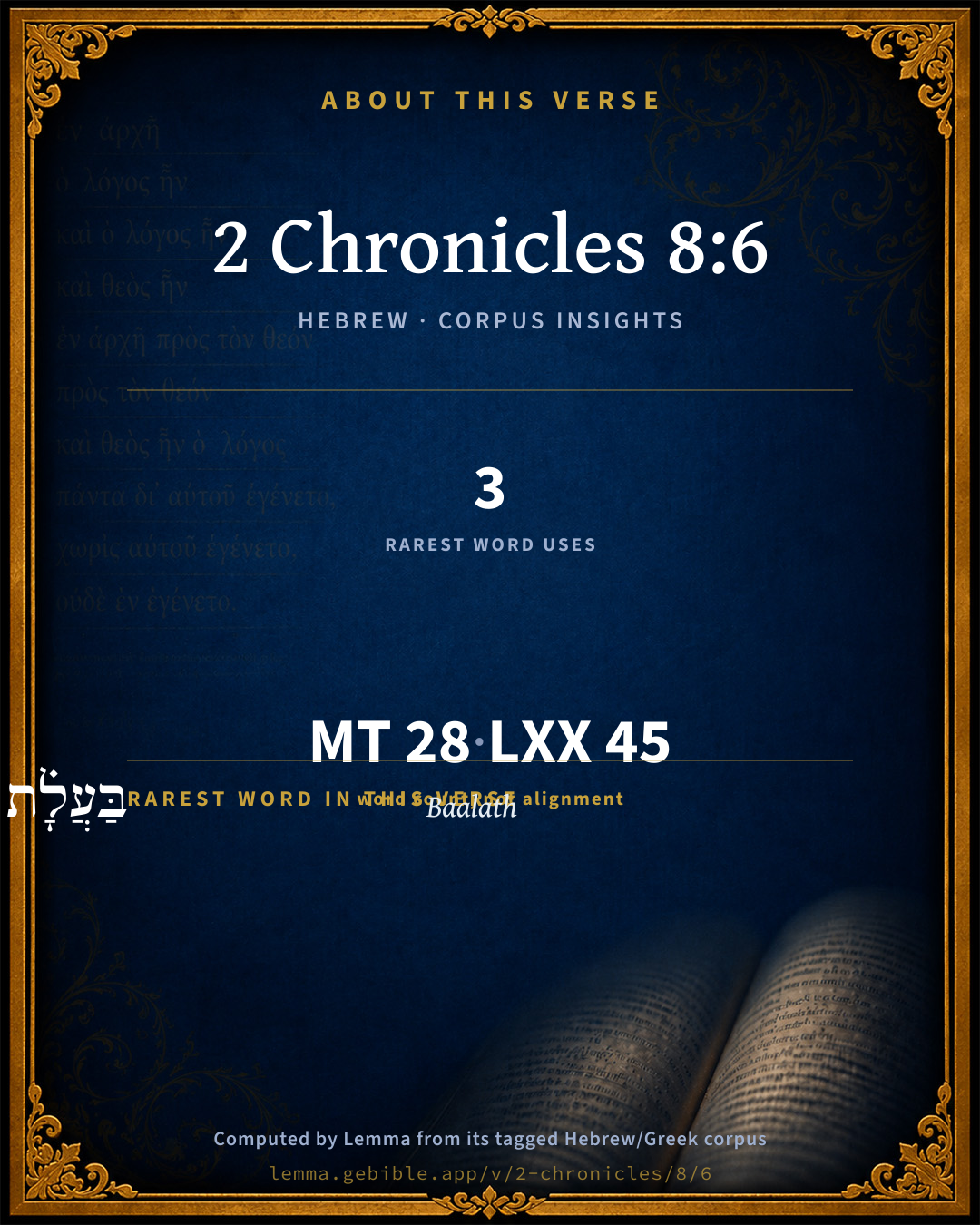
The rarest word here is בַּעֲלָ֗ת Baalath H1191 — appearing just 3 times in the whole Hebrew Bible.

Shared distinctive vocabulary

בַּעֲלָ֗ת Baalath H1191 occurs in 3 verses of the Hebrew Bible. Also found in:

Grammatical profile

  • 3 verbs
  • 18 nouns
  • 7 particles

Verb forms

  • הָי֣וּ Qal · Perfect
  • חָשַׁק֙ Qal · Perfect
  • לִבְנ֤וֹת Qal · Infinitive Construct

Repetition

Words recur within this verse — often emphatic in Hebrew:

  • כָּל all H3605 ×4
  • עָרֵ֤י city H5892 ×3
  • לִשְׁלֹמֹ֔ה Solomon H8010 ×2
  • אֲשֶׁ֣ר which H834 ×2

Hebrew & Septuagint length

In English translation the verse runs 45 words from the Hebrew and 41 from the Septuagint (LXX English) — closely comparable.

A rough comparison of the two English renderings, which tokenize alike — not a word-level alignment.

Word counts can differ between the Hebrew and the Greek without any difference in meaning — e.g. the Hebrew direct-object marker אֵת has no separate Greek word, and Greek often adds the article ὁ.

In the original languages it is 28 Hebrew tokens and 45 Greek tokens — but the two are counted differently (Hebrew bundles its prefixes and suffixes into one token; the Greek is in lemma form), so that isn’t a like-for-like length.

Cross-references

10

Topical passages linked to 2 Chronicles 8:6 in the Treasury of Scripture Knowledge — connected by theme and wording, ordered by reader-vote popularity; previews shown in the World English Bible.

  • Joshua 19:44 and Eltekeh, and Gibbethon, and Baalath,
  • 1 Kings 7:2 For he built the house of the forest of Lebanon; the length of it was one hundred cubits, and the breadth of it fifty cubits, and the height of it thirty cubits, on four rows of cedar pillars, with cedar beams on the pillars.
  • 1 Kings 9:18–19 and Baalath, and Tamar in the wilderness, in the land,
  • 1 Kings 10:26 Solomon gathered together chariots and horsemen: and he had a thousand and four hundred chariots, and twelve thousand horsemen, that he bestowed in the chariot cities, and with the king at Jerusalem.
  • 2 Chronicles 1:14 Solomon gathered chariots and horsemen: and he had one thousand four hundred chariots, and twelve thousand horsemen, that he placed in the chariot cities, and with the king at Jerusalem.
  • 2 Chronicles 8:4 He built Tadmor in the wilderness, and all the store-cities, which he built in Hamath.
  • 2 Chronicles 17:12 Jehoshaphat grew great exceedingly; and he built in Judah castles and cities of store.
  • Ecclesiastes 2:4 I made myself great works. I built myself houses. I planted myself vineyards.
  • Ecclesiastes 2:10–26 Whatever my eyes desired, I didn't keep from them. I didn't withhold my heart from any joy, for my heart rejoiced because of all my labor, and this was my portion from all my labor.
  • Song of Solomon 4:8 Come with me from Lebanon, my bride, With me from Lebanon. Look from the top of Amana, From the top of Senir and Hermon, From the lions' dens, From the mountains of the leopards.

Cross-references courtesy of OpenBible.info (CC BY 4.0).

Hebrew and Greek witnesses Masoretic Hebrew ↔ Greek Septuagint

The same verse in the two great witnesses to the Old Testament, shown verse-for-verse.

These are two independent witnesses, not word-aligned to each other, and the Septuagint is shown in lemma (dictionary) form.

Hebrew 2 Chronicles 8:6 Masoretic · Westminster Leningrad Codex

וְאֶֽת בַּעֲלָ֗ת וְאֵ֨ת כָּל עָרֵ֤י הַֽמִּסְכְּנוֹת֙ אֲשֶׁ֣ר הָי֣וּ לִשְׁלֹמֹ֔ה וְאֵת֙ כָּל עָרֵ֣י הָרֶ֔כֶב וְאֵ֖ת עָרֵ֣י הַפָּרָשִׁ֑ים וְאֵ֣ת כָּל חֵ֣שֶׁק שְׁלֹמֹ֗ה אֲשֶׁ֤ר חָשַׁק֙ לִבְנ֤וֹת בִּירֽוּשָׁלִַ֨ם֙ וּבַלְּבָנ֔וֹן וּבְכֹ֖ל אֶ֥רֶץ מֶמְשַׁלְתּֽוֹ

and Baalath, and all the store-cities that Solomon had, and all the cities for his chariots, and the cities for his horsemen, and all that Solomon desired to build for his pleasure in Jerusalem, and in Lebanon, and in all the land of his dominion.

World English Bible · Public Domain

Greek LXX 2 Chronicles 8:6 Septuagint · lemma form

καί ὁ βααλαθ καί πᾶς ὁ πόλις ὁ ὀχυρός ὅς εἰμί ὁ σαλωμών καί πᾶς ὁ πόλις ὁ ἅρμα καί ὁ πόλις ὁ ἱππεύς καί ὅσος ἐπιθυμέω σαλωμών κατά ὁ ἐπιθυμία ὁ οἰκοδομέω ἐν ἰερουσαλήμ καί ἐν ὁ λιβάνος καί ἐν πᾶς ὁ βασιλεία αὐτός

and Balaath, and all the strong cities which Solomon had, and all his chariot cities, and cities of horsemen, and all things that Solomon desired according to his desire of building, in Jerusalem, and in Libanus, and in all his kingdom.

LXX2012 (modern English Septuagint) · Public Domain

Hebrew: Westminster Leningrad Codex (CC BY 4.0). Greek: Septuagint (public domain); English from LXX2012 (modern English Septuagint) (Public Domain). How the Septuagint differs from the Hebrew →

Commentary

Notes on 2 Chronicles 8:6 from classic Christian and Jewish commentators (each source and its license shown beneath its notes). The classic Christian expositions comment on the surrounding passage and are grouped to its opening verse, so a note may address several verses; the Jewish commentaries on the Tanakh (Rashi and others) are per-verse, so they appear only where the commentator wrote on this verse.

Lemma curates 59 commentaries, every one of them public domain or Creative Commons licensed, each selected and text-cleaned for this edition rather than reprinted as found. About our sources →

Trapp's Complete Commentary

John Trapp

2Ch 8:6 And Baalath, and all the store cities that Solomon had, and all the chariot cities, and the cities of the horsemen, and all that Solomon desired to build in Jerusalem, and in Lebanon, and throughout all the land of his dominion.

Ver. 6. And in Lebanon.] In the forest of Lebanon, where he had his summer house.

John Trapp, A Commentary or Exposition upon All the Books of the Old and New Testament (1647–1656) — public domain. Text from a community e-Sword module.

Tyndale Open Study Notes

Tyndale Open Resources

8:6 Some cities were used for storage and for military cavalry. Large building complexes at Hazor, Megiddo, and Gezer contained long rooms divided into three sections with two rows of pillars. They might have been used as stables and storehouses, or they might have provided barracks for a professional army.

Tyndale Open Study Notes — © Tyndale Open Resources, licensed CC BY-SA 4.0. Text via the HelloAO Bible API.

Geneva Bible (1599)

Geneva Bible translators

Read 1 Kings 7:2

Geneva Bible (1599) marginal notes — public domain. Text via Bolls.life.

Adam Clarke's Commentary

Verse 6. All the store cities] 1Kg 9:19.

Adam Clarke's Commentary on the Bible (1810–1826) — public domain. Text from a community e-Sword/MySword module.

Ellicott's Commentary for English Readers

(6) And Baalath.—1Ki_9:18. Like the two Beth-horons, it lay west of Jerusalem, and was a bulwark against the Philistines: (Comp. Jos_19:44, a Danite town.) The rest of this verse is identical with 1Ki_9:19, which see. (Chronicler has twice added all.)

In the above section no mention is made of the fortification of Jerusalem, and the building of Hazor, Megiddo, and Gezer, which last city had been taken by Pharaoh, and given by him to his daughter, Solomon’s wife. (See 1Ki_9:15-16.) On the other hand, as we have seen, the chronicler supplies several important details which are wanting in the parallel account.

A Bible Commentary for English Readers, edited by Charles John Ellicott (1878–1897) — public domain. Text from a community e-Sword module.

The Cambridge Bible for Schools and Colleges

gen. ed. J. J. S. Perowne

6. Baalath] A city in the tribe of Dan not far from Gezer and Beth-horon (1Ki_9:18).

chariot cities] See note on 2Ch_1:14.

The Cambridge Bible for Schools and Colleges (gen. ed. J. J. S. Perowne; Cambridge University Press, 1878–1918) — public domain. Text from a community e-Sword module.

John Gill's Exposition

Even after a certain rate every day, according to the commandment of Moses,.... The daily sacrifice, morning and evening, Exo 29:38,

on the sabbaths, and on the new moons; when there were additional sacrifices, Num 28:9, &c.

and on the solemn feasts three times in the year, even in the feast of unleavened bread, and in the feast of weeks, and in the feast of tabernacles; which serves to explain the three times in Kg1 9:25.

John Gill's Exposition of the Whole Bible (1746–1763) — public domain (CC PDM 1.0). Text via the HelloAO Bible API.

The Pulpit Commentary

Baalath (parallel. (1Ki_9:18) This place belonged to Dan. (Jos_19:40-45) Nothing is known about it; some take it to be one with Baalah of Jos_15:9, Jos_15:10. Store cities chariot cities cities of the horsemen (see 2Ch_16:4 2Ch_32:28; 1Ki_4:26 1Ki_9:19) In the parallel some of the names of the places built, or rebuilt, or repaired by Solomon in this connection are given as "Mille and the wall of Jerusalem" (Millo"s foundations occupied the hollow at the south-west corner of the hill of the temple), "and Hazer and Megiddo and Gezer". (1Ki_9:15) All that Solomen desired to build; i.e. for purposes of personal enjoyment or ornament.

The Pulpit Commentary (1880–1919), ed. H.D.M. Spence-Jones & Joseph S. Exell — public domain. Text from a community e-Sword module.

Lesson kit

Teaching starters — assembled from the data on this page, not authored interpretation. Every prompt links to the verse data it draws on. Edit before teaching.

2 Chronicles, in the Historical, opens this verse with 28 words (17 distinct Hebrew lemmas). Its most distinctive word is Baʻălâth (“Baalath”). A historical commentator’s framing appears above. Read the whole chapter for the surrounding context.

Discussion questions

  1. The word Baʻălâth carries the sense “Baalath.” How does it shape the verse?
  2. Joshua 19:44 shares the word «Baalath» with this verse. How do the two illuminate each other?
  3. “all” occurs 4× in this one verse. What is the effect of the repetition?
  4. These translations render this verse differently. What is at stake in choosing one wording over another?
  5. The verb «הָי֣וּ» is Qal Perfect. How does its form color the action?
  6. Reading how Trapp's Complete Commentary and Tyndale Open Study Notes read this verse, where do the two commentators agree and where do they part?

Things to notice

Reading settings

Reading text

Shown beneath each verse's original-language words.

Old Testament
Old Testament edition

Read the OT as the Masoretic Hebrew (MT) or the Greek Septuagint (LXX).

English shown for the Greek Septuagint (in the Hebrew ↔ Greek comparison).

Comparing translations? Open the Compare panel on any verse page to stack up to four side by side.