
Nehemiah 8:17

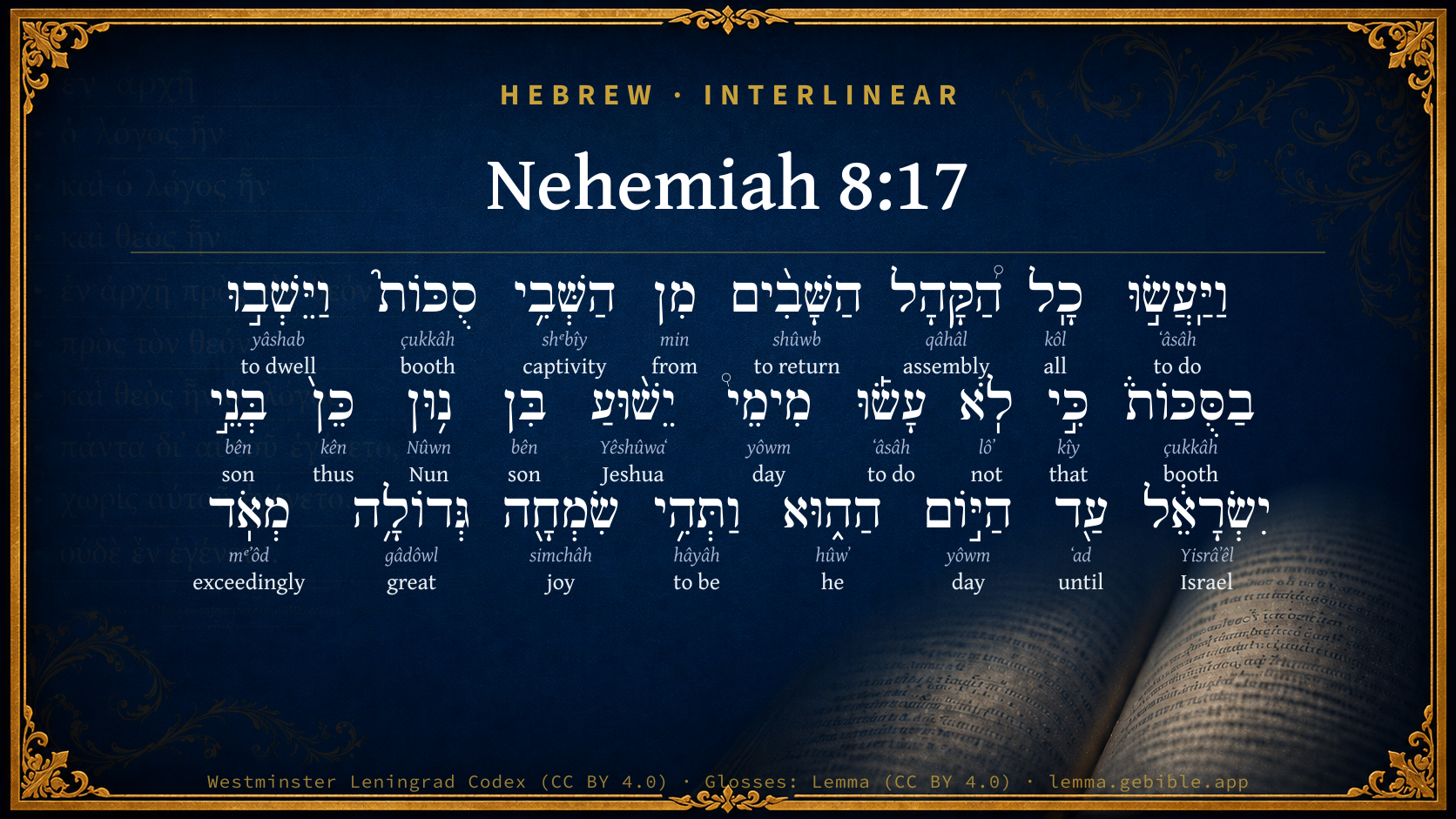
Hebrew (Westminster Leningrad Codex) Nehemiah 8:17 appears in the Hebrew Old Testament. The text above is from the Westminster Leningrad Codex. Each word links to its Strong’s number, a concise gloss, and parsing drawn from the Open Scriptures Hebrew Bible morphology. Click any word for its full Brown-Driver-Briggs (BDB) entry.
Download image
Cite this verse

Nehemiah 8:17 (World English Bible). Public Domain. Lemma interlinear Bible study tool, https://lemma.gebible.app/v/nehemiah/8/17.

Show BibTeX & RIS
BibTeX
RIS
English Translation
All the assembly of those who were come again out of the captivity made booths, and lived in the booths; for since the days of Jeshua the son of Nun to that day the children of Israel had not done so. There was very great gladness.
World English Bible · Public Domain
Download a study sheet

One document with this verse’s original text, its word-by-word gloss line, the meaning frame, cross-references with their text, attributed commentary, and full source and license credits — printable, and it pastes into notes with its structure intact.

This verse Autodidact and up

Study sheet (.html) Plain text (.txt)

A passage Seminary Student

Up to 50 verses in one chapter. A passage sheet keeps up to 6 commentary sources and 12 cross-references per verse, in the order this page ranks them, and says so on the sheet whenever that leaves anything out. Ask for a single verse and you get the Autodidact verse sheet above.

Everything on this page stays free to read, with no account — the sheet is a download of what is already on screen, not access to it.

Want to remove ads? Support Godless Engineer
Compare translations 3

The same verse in 3 English versions, stacked beneath the original-language interlinear above. Click any original word for its lexicon entry.

Each is an independent rendering of the whole verse — the interlinear is not word-aligned to these translations.

Highlighted words mark where these versions differ — a whole-verse word diff, not a word-by-word alignment.

  • World English Bible Public Domain
    All the assembly of those who were come again out of the captivity made booths, and lived in the booths; for since the days of Jeshua the son of Nun to that day the children of Israel had not done so. There was very great gladness.
  • King James Version Public Domain
    And all the congregation of them that were come again out of the captivity made booths, and sat under the booths: for since the days of Jeshua the son of Nun unto that day had not the children of Israel done so. And there was very great gladness.
  • unfoldingWord Literal Text CC BY-SA 4.0
    And all the assembly, the ones who returned from the captivity, made huts, and they dwelt in the huts. For the sons of Israel had not done thus from the days of Joshua the son of Nun until that day. And there was extremely great rejoicing.

unfoldingWord Literal Text — © unfoldingWord, licensed CC BY-SA 4.0. Word-aligned USFM3 via Door43 (git.door43.org/unfoldingWord/en_ult).

Versions to compare (up to 4)

3 of 4 selected

Show all 18 translations

Every available English version of this verse, each an independent rendering of the whole verse.

  • World English Bible Public Domain
    All the assembly of those who were come again out of the captivity made booths, and lived in the booths; for since the days of Jeshua the son of Nun to that day the children of Israel had not done so. There was very great gladness.
  • Berean Standard Bible Public Domain
    The whole assembly who had returned from exile made booths and lived in them. From the days of Joshua son of Nun until that day, the Israelites had not celebrated like this. And there was great rejoicing.
  • Majority Standard Bible Public Domain
    The whole assembly that had returned from exile made booths and lived in them. From the days of Joshua son of Nun until that day, the Israelites had not celebrated like this. And there was great rejoicing.
  • King James Version Public Domain
    And all the congregation of them that were come again out of the captivity made booths, and sat under the booths: for since the days of Jeshua the son of Nun unto that day had not the children of Israel done so. And there was very great gladness.
  • American Standard Version (1901) Public Domain
    And all the assembly of them that were come again out of the captivity made booths, and dwelt in the booths; for since the days of Jeshua the son of Nun unto that day had not the children of Israel done so. And there was very great gladness.
  • Revised Version (1885) Public Domain
    And all the congregation of them that were come again out of the captivity made booths, and dwelt in the booths: for since the days of Jeshua the son of Nun unto that day had not the children of Israel done so. And there was very great gladness.
  • Geneva Bible (1599) Public Domain
    And all the Congregation of them that were come againe out of the captiuitie made boothes, and sate vnder the boothes: for since the time of Ieshua the sonne of Nun vnto this day, had not the children of Israel done so, and there was very great ioy.
  • Douay-Rheims (1899) Public Domain
    And all the assembly of them that were returned from the captivity, made tabernacles, and dwelt in tabernacles: for since the days of Josue the son of Nun the children of Israel had not done so, until that day: and there was exceeding great joy.
  • Young's Literal Translation Public Domain
    And they make -- all the assembly of the captives of the captivity -- booths, and they sit in booths; for the sons of Israel had not done, from the days of Jeshua son of Nun, so unto that day, and there is very great joy.
  • Literal Standard Version CC BY-SA 4.0
    And they make—all the assembly of the captives of the captivity—shelters, and they sit in shelters; for the sons of Israel had not done, from the days of Jeshua son of Nun, so to that day, and there is very great joy.
  • Unlocked Literal Bible CC BY-SA 4.0
    All the assembly of those who had returned from captivity made shelters and lived in them. For since the days of Joshua son of Nun to that day, the people of Israel had not celebrated this festival, and so their joy was very great.
  • unfoldingWord Literal Text CC BY-SA 4.0
    And all the assembly, the ones who returned from the captivity, made huts, and they dwelt in the huts. For the sons of Israel had not done thus from the days of Joshua the son of Nun until that day. And there was extremely great rejoicing.
  • Darby Bible Public Domain
    And all the congregation of them that had come back from the captivity made booths, and dwelt in the booths. For since the days of Jeshua the son of Nun until that day had not the children of Israel done so. And there was very great gladness.
  • World Messianic Bible Public Domain
    All the assembly of those who had come back out of the captivity made temporary shelters and lived in the temporary shelters, for since the days of Joshua the son of Nun to that day the children of Israel had not done so. There was very great gladness.
  • Webster's Bible Public Domain
    And all the congregation of them that had returned from the captivity made booths, and sat under the booths: for since the days of Jeshua the son of Nun to that day, had not the children of Israel done so. And there was very great gladness.
  • Free Bible Version CC BY-SA 4.0
    Everyone who came back from exile made shelters and stayed in them. They had not celebrated like this since the time of Joshua, son of Nun. Everyone was very happy.
  • Bible in Basic English Public Domain
    All the people who had been prisoners and had come back, made tents and were living in them: for from the time of Jeshua, the son of Nun, till that day, the children of Israel had not done so. And there was very great joy.
  • JPS Tanakh (1917) Public Domain
    And all the congregation of them that were come back out of the captivity made booths, and dwelt in the booths; for since the days of Joshua the son of Nun unto that day had not the children of Israel done so. And there was very great gladness.

Literal Standard Version (2020), Covenant Press — licensed CC BY-SA 4.0. Text via the HelloAO Bible API (eBible.org). Unlocked Literal Bible (unfoldingWord) — licensed CC BY-SA 4.0. Text via the HelloAO Bible API (eBible.org). unfoldingWord Literal Text — © unfoldingWord, licensed CC BY-SA 4.0. Word-aligned USFM3 via Door43 (git.door43.org/unfoldingWord/en_ult). Free Bible Version, Dr. Jonathan Gallagher — licensed CC BY-SA 4.0. Text via the HelloAO Bible API (eBible.org).

Word by word

More ways to search: Search by grammar → Find every occurrence → Compare this word →

Practice this passage: Drill this verse → Learn its vocabulary →

יֵשׁ֨וּעַ
Yêshûwaʻ
H3442
“Jeshua”
Noun, Proper
Part of Speech
Noun
Type
Proper
Full BDB Definition

Origin: for H3091

TWOT: None

Jeshua = "he is saved" - son of Nun of the tribe of Ephraim and successor to Moses as the leader of the children of Israel; led the conquest of Canaan (noun proper masculine) - son of Jehozadak and high priest after the restoration (noun proper masculine) - a priest in the time of David who had charge of the 9th course (noun proper masculine) - a Levite in the reign of Hezekiah (noun proper masculine) - head of a Levitical house which returned from captivity in Babylon (noun proper masculine) - father of a builder of the wall of Jerusalem in the time of Nehemiah (noun proper masculine) - a town in southern Judah reinhabited by the people of Judah after the return from captivity (noun proper locative)
  1. וַיַּֽעֲשׂ֣וּ ʻâsâh H6213 “and · to do” Conjunction + Verb, Qal, Sequential Imperfect, 3rd Person, Masculine, Plural
  2. כָֽל kôl H3605 “all of” Noun, Common, Masculine, Singular, Construct
  3. הַ֠קָּהָל qâhâl H6951 “the · assembly” Particle, Definite Article + Noun, Common, Masculine, Singular, Absolute
  4. הַשָּׁבִ֨ים shûwb H7725 “the · returning” Particle, Definite Article + Verb, Qal, Participle Active, Masculine, Plural, Absolute
  5. מִן min H4480 “from” Preposition
  6. הַשְּׁבִ֥י shᵉbîy H7628 “the · captivity” Particle, Definite Article + Noun, Common, Both, Singular, Absolute
  7. סֻכּוֹת֮ çukkâh H5521 “booths” Noun, Common, Feminine, Plural, Absolute
  8. וַיֵּשְׁב֣וּ yâshab H3427 “and · to dwell” Conjunction + Verb, Qal, Sequential Imperfect, 3rd Person, Masculine, Plural
  9. בַסֻּכּוֹת֒ çukkâh H5521 “in/at the · booths” Preposition, Determined + Noun, Common, Feminine, Plural, Absolute
  10. כִּ֣י kîy H3588 “that” Conjunction
  11. לֹֽא lôʼ H3808 “not” Particle, Negative
  12. עָשׂ֡וּ ʻâsâh H6213 “to do” Verb, Qal, Perfect, 3rd Person, Common, Plural
  13. מִימֵי֩ yôwm H3117 “from · days of” Preposition + Noun, Common, Masculine, Plural, Construct
  14. בִּן bên H1121 “son of” Noun, Common, Masculine, Singular, Construct
  15. נ֥וּן Nûwn H5126 “Nun” Noun, Proper
  16. כֵּן֙ kên H3651 “thus” Particle, Demonstrative
  17. בְּנֵ֣י bên H1121 “sons of” Noun, Common, Masculine, Plural, Construct
  18. יִשְׂרָאֵ֔ל Yisrâʼêl H3478 “Israel” Noun, Proper
  19. עַ֖ד ʻad H5704 “until” Preposition
  20. הַיּ֣וֹם yôwm H3117 “the · day” Particle, Definite Article + Noun, Common, Masculine, Singular, Absolute
  21. הַה֑וּא hûwʼ H1931 “the · he” Particle, Definite Article + Pronoun, Personal, 3rd Person, Masculine, Singular
  22. וַתְּהִ֥י hâyâh H1961 “and · to be” Conjunction + Verb, Qal, Sequential Imperfect, 3rd Person, Feminine, Singular
  23. שִׂמְחָ֖ה simchâh H8057 “joy” Noun, Common, Feminine, Singular, Absolute
  24. גְּדוֹלָ֥ה gâdôwl H1419 “great” Adjective, Adjective, Feminine, Singular, Absolute
  25. מְאֹֽד mᵉʼôd H3966 “exceedingly” Adverb

About this verse

These counts appear in no published source. They are computed here, from the morphology-tagged text and Lemma’s own curated glosses. What Lemma adds →

26
words
22
distinct lemmas
Historical
section

Shared distinctive vocabulary

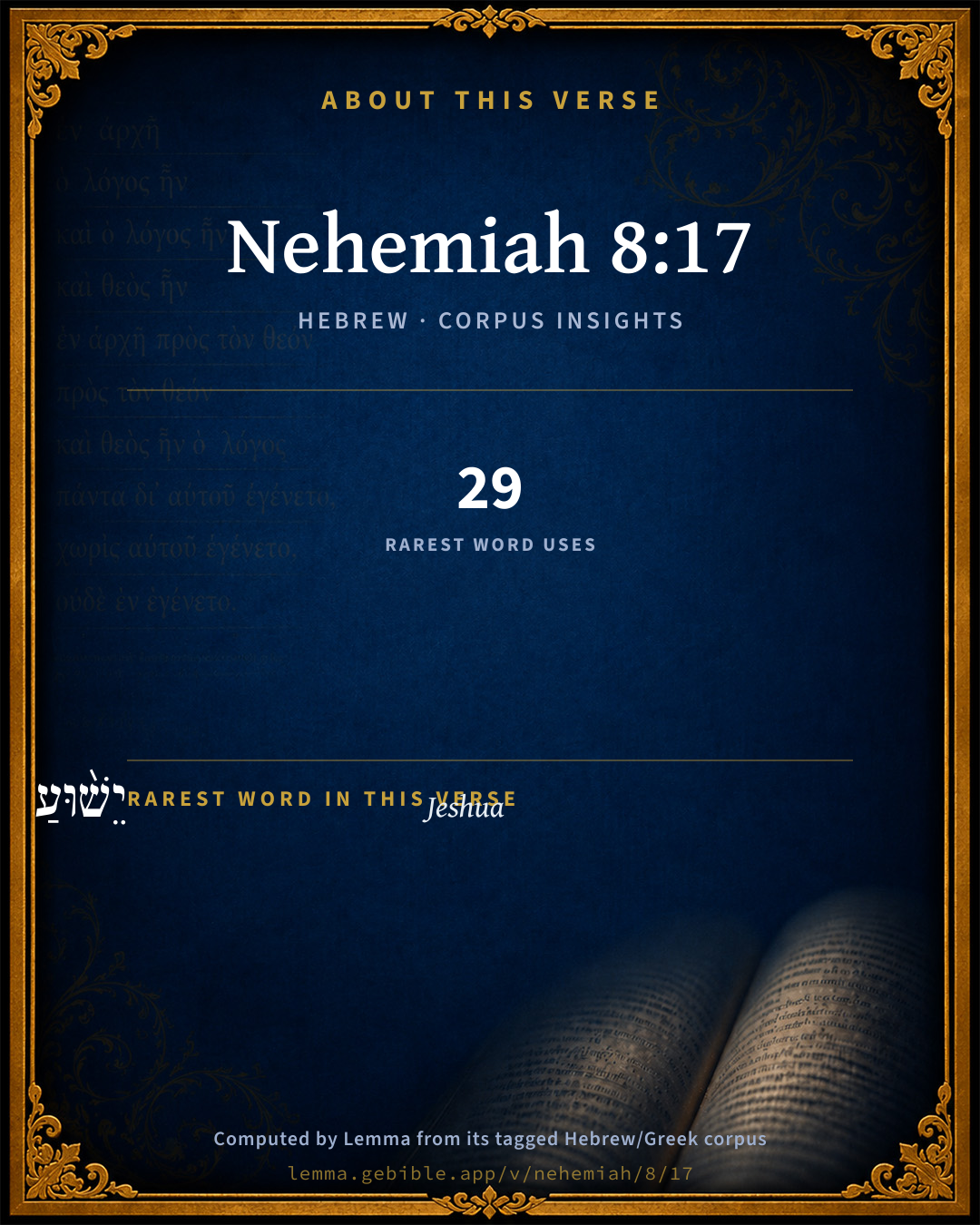
יֵשׁ֨וּעַ Jeshua H3442 occurs in 29 verses of the Hebrew Bible. Also found in:

Grammatical profile

  • 5 verbs
  • 13 nouns
  • 1 adjective
  • 1 pronoun
  • 2 prepositions
  • 1 conjunction
  • 1 adverb
  • 2 particles

Verb forms

  • וַיַּֽעֲשׂ֣וּ Qal · Sequential Imperfect
  • הַשָּׁבִ֨ים Qal · Participle Active
  • וַיֵּשְׁב֣וּ Qal · Sequential Imperfect
  • עָשׂ֡וּ Qal · Perfect
  • וַתְּהִ֥י Qal · Sequential Imperfect

Repetition

Words recur within this verse — often emphatic in Hebrew:

  • וַיַּֽעֲשׂ֣וּ to do H6213 ×2
  • סֻכּוֹת֮ booth H5521 ×2
  • מִימֵי֩ day H3117 ×2
  • בִּן son H1121 ×2

Cross-references

12

Topical passages linked to Nehemiah 8:17 in the Treasury of Scripture Knowledge — connected by theme and wording, ordered by reader-vote popularity; previews shown in the World English Bible.

  • 2 Chronicles 8:13 even as the duty of every day required, offering according to the commandment of Moses, on the Sabbaths, and on the new moons, and on the set feasts, three times in the year, [even] in the feast of unleavened bread, and in the feast of weeks, and in the feast of tents.
  • 2 Chronicles 7:8–10 So Solomon held the feast at that time seven days, and all Israel with him, a very great assembly, from the entrance of Hamath to the brook of Egypt.
  • Ezra 3:4 They kept the feast of tents, as it is written, and [offered] the daily burnt offerings by number, according to the ordinance, as the duty of every day required;
  • Joshua 1:1 Now it happened after the death of Moses the servant of Yahweh, that Yahweh spoke to Joshua the son of Nun, Moses' minister, saying,
  • 1 Chronicles 29:22 and ate and drink before Yahweh on that day with great gladness. They made Solomon the son of David king the second time, and anointed him to Yahweh to be prince, and Zadok to be priest.
  • 2 Chronicles 30:21–23 The children of Israel who were present at Jerusalem kept the feast of unleavened bread seven days with great gladness; and the Levites and the priests praised Yahweh day by day, [singing] with loud instruments to Yahweh.
  • 2 Chronicles 30:26 So there was great joy in Jerusalem; for since the time of Solomon the son of David king of Israel there was not the like in Jerusalem.
  • 2 Chronicles 35:18 There was no Passover like that kept in Israel from the days of Samuel the prophet; neither did any of the kings of Israel keep such a Passover as Josiah kept, and the priests, and the Levites, and all Judah and Israel who were present, and the inhabitants of Jerusalem.
  • John 1:14 The Word became flesh, and lived among us. We saw his glory, such glory as of the one and only Son of the Father, full of grace and truth.
  • Hebrews 4:8 For if Joshua had given them rest, he would not have spoken afterward of another day.
  • Hebrews 11:9 By faith, he lived as an alien in the land of promise, as in a land not his own, dwelling in tents, with Isaac and Jacob, the heirs with him of the same promise.
  • Hebrews 11:13 These all died in faith, not having received the promises, but having seen them and embraced them from afar, and having confessed that they were strangers and pilgrims on the earth.

Cross-references courtesy of OpenBible.info (CC BY 4.0).

Hebrew and Greek witnesses Masoretic Hebrew ↔ Greek Septuagint

The same verse in the two great witnesses to the Old Testament, shown verse-for-verse.

These are two independent witnesses, not word-aligned to each other, and the Septuagint is shown in lemma (dictionary) form.

Hebrew Nehemiah 8:17 Masoretic · Westminster Leningrad Codex

וַיַּֽעֲשׂ֣וּ כָֽל הַ֠קָּהָל הַשָּׁבִ֨ים מִן הַשְּׁבִ֥י סֻכּוֹת֮ וַיֵּשְׁב֣וּ בַסֻּכּוֹת֒ כִּ֣י לֹֽא עָשׂ֡וּ מִימֵי֩ יֵשׁ֨וּעַ בִּן נ֥וּן כֵּן֙ בְּנֵ֣י יִשְׂרָאֵ֔ל עַ֖ד הַיּ֣וֹם הַה֑וּא וַתְּהִ֥י שִׂמְחָ֖ה גְּדוֹלָ֥ה מְאֹֽד

All the assembly of those who were come again out of the captivity made booths, and lived in the booths; for since the days of Jeshua the son of Nun to that day the children of Israel had not done so. There was very great gladness.

World English Bible · Public Domain

Greek LXX Structure differs

The Septuagint has no separate book of Nehemiah. Its Greek text is the second half of Esdras B (2 Esdras), chapters 11–23; Ezra is the first half (1–10).

A verse-for-verse comparison isn’t shown here because the chapters and verses don’t line up. Switch to the LXX edition with the MT / LXX toggle above to read the Greek directly.

Hebrew: Westminster Leningrad Codex (CC BY 4.0). Greek: Septuagint (public domain); English from a public-domain English Septuagint. How the Septuagint differs from the Hebrew →

Commentary

Notes on Nehemiah 8:17 from classic Christian and Jewish commentators (each source and its license shown beneath its notes). The classic Christian expositions comment on the surrounding passage and are grouped to its opening verse, so a note may address several verses; the Jewish commentaries on the Tanakh (Rashi and others) are per-verse, so they appear only where the commentator wrote on this verse.

Lemma curates 59 commentaries, every one of them public domain or Creative Commons licensed, each selected and text-cleaned for this edition rather than reprinted as found. About our sources →

Trapp's Complete Commentary

John Trapp

Neh 8:17 And all the congregation of them that were come again out of the captivity made booths, and sat under the booths: for since the days of Jeshua the son of Nun unto that day had not the children of Israel done so. And there was very great gladness.

Ver. 17. Made booths, and sat under the booths] See Neh 8:14-16. They that turn this history into mystery make an allusion of it, 1. To Christ, as dwelling in our flesh. 2. To Christians, as travelling toward heaven, and having here no settled habitation, Heb 11:13.

For since the days of Jeshua] Moses is not mentioned; because during his days, till Jeshua brought them into the promised land, they kept not this feast, likely.

Had not the children of Israel done so] Kept this feast they had, but not so kept it; viz, with that devotion, solemnity, and great gladness, being in so poor a case, and yet so unanimous in the work, as one man. But one would wonder that all along during the reign of David and Solomon (who gave the pattern of, and built the temple), and all those succeeding reformers, there should something be omitted about the feast of tabernacles (kept, as it is thought, by Solomon, 2Ch 7:8) till their return from Babylon; yet so it was.

John Trapp, A Commentary or Exposition upon All the Books of the Old and New Testament (1647–1656) — public domain. Text from a community e-Sword module.

Joseph Benson's Commentary

Neh 8:17. Since the days of Jeshua, had not the children of Israel done so — The meaning here cannot be that this festival had never been observed since Joshua’s time, because we are informed, (Ezr 3:4,) that it was kept at their return from Babylon; but the joy, since that time, had never been so great as it was now, “for which the Jews themselves,” says Dr. Dodd, “assign this reason; that in the days of Joshua they rejoiced, because they had gotten possession of the land of Canaan; and now they equally rejoiced, because they were restored and quietly settled in it, after they had been long cast out of it.” Or, we should rather say, they not only had the same causes for rejoicing which they formerly had, but special causes to increase their joy. To this Poole adds, They never, since Joshua’s time, kept this feast so solemnly and religiously: for whereas, at other times, only the first and last day of that feast were celebrated with a holy convocation, now there was a holy convocation, and the people assembled, and attended upon the reading of the law every day of this feast.

Joseph Benson's Commentary on the Old and New Testaments (1811–1818) — public domain. Text from a community e-Sword module.

Tyndale Open Study Notes

Tyndale Open Resources

8:17 since the days of Joshua: Although Israel had observed this festival on numerous occasions (1 Kgs 8:2; 2 Kgs 23:22; 2 Chr 7:8-10; 30:26; 35:18; Ezra 3:4), this was an exceptional celebration.

Tyndale Open Study Notes — © Tyndale Open Resources, licensed CC BY-SA 4.0. Text via the HelloAO Bible API.

Geneva Bible (1599)

Geneva Bible translators

Which was almost a thousand years.

Geneva Bible (1599) marginal notes — public domain. Text via Bolls.life.

Jamieson, Fausset & Brown

Robert Jamieson, A. R. Fausset & David Brown

since the days of Jeshua . . . had not the children of Israel done so--This national feast had not been neglected for so protracted a period. Besides that it is impossible that such a flagrant disregard of the law could have been tolerated by Samuel, David, and other pious rulers, its observance is sufficiently indicated (Kg1 8:2, Kg1 8:65; Ch2 7:9) and expressly recorded (Ezr 3:4). But the meaning is, that the popular feelings had never been raised to such a height of enthusiastic joy since the time of their entrance into Canaan, as now on their return after a long and painful captivity.

Jamieson, Fausset & Brown — Commentary Critical and Explanatory on the Whole Bible (1871) — public domain (CC PDM 1.0). Text via the HelloAO Bible API.

Adam Clarke's Commentary

Verse 17. Since the days of Joshua] No feast of tabernacles since Joshua's time had been so heartily and so piously celebrated. The story of the sacred fire now discovered, which had been hidden by the order of Jeremiah in a dry well, and now, some of the mud from the bottom being brought upon the altar, was kindled afresh by the rays of the sun, which suddenly broke out, though before covered with clouds, c., is worthy of no credit. Those who wish to see the detail may consult 2Mac 1:18-36.

ON the subject in Ne 8:8, I beg leave to make a few observations:-So they read in the book in the law of God distinctly, and gave the sense, and caused them to understand the reading. The Israelites, having been lately brought out of the Babylonish captivity, in which they had continued seventy years, according to the prediction of Jeremiah, Jer 25:11, were not only extremely corrupt, but it appears that they had in general lost the knowledge of the ancient Hebrew to such a degree, that when the book of the law was read, they did not understand it: but certain Levites stood by, and gave the sense, i. e., translated into the Chaldee dialect. This was not only the origin of the Chaldee Targums, or translation of the law and prophets into that tongue but was also, in all probability, the origin of preaching from a text for it appears that the people were not only ignorant of their ancient language, but also of the rites and ceremonies of their religion, having been so long in Babylon, where they were not permitted to observe them. This being the case, not only the language must be interpreted, but the meaning of the rites and ceremonies must also be explained; for we find from Ne 8:13, c., of this chapter, that they had even forgotten the feast of tabernacles, and every thing relative to that ceremony.

As we nowhere find that what is called preaching on or expounding a text was ever in use before that period, we are probably beholden to the Babylonish captivity for producing, in the hand of Divine Providence, a custom the most excellent and beneficial ever introduced among men.

What the nature of preaching or expounding the word of God was, at this early period of its institution, we learn from the above cited text.

I. They read in the book of the law of God. - The words of God, the doctrines of Divine revelation, are the proper matter of preaching for they contain the wisdom of the Most High, and teach man the things which belong to his peace and happiness.

II. They read distinctly - מפרש mephorash, from פרש parash, to expand; they analyzed, dilated, and expounded it at large, showing the import and genuine meaning of every word.

III. They gave the sense - ושום שכל vesom sechel, they put weight to it; showed its value and utility, and how intimately concerned they were in all that was revealed: thus applying verbal criticism, and general exposition to their true and most important purposes.

IV. They caused them to understand the reading - ויבינו במקרא vaiyabinu bammikra: and they understood-had a mental taste and perception of the things which were in the reading, i. e., in the letter and spirit of the text. Thus they knew the Divine will, and approved the things that were more excellent, being (thus) instructed out of the law, Ro 2:18.

This was the ancient method of expounding the word of God among the Jews; and this mode is still more necessary for US: -

1. Because the sacred writings, as they came from God, are shut up in languages no longer vernacular; and no translation ever did or ever can reach the force of the original words, though perhaps our own in general, comes nearest to this of all versions, whether ancient or modern.

2. Ninety-nine out of a hundred know nothing of these languages; and consequently cannot, of themselves, reap all the requisite benefit from reading the Scriptures.

3. Sacred things are illustrated in the Bible by a reference to arts and sciences, of which the mass of the people are as ignorant as they are of the original tongues.

4. Provincial customs and fashions are mentioned in these writings, which must be understood, or the force and meaning of many texts cannot be comprehended.

5. There is a depth in the word of God which cannot be fathomed except either by Divine inspiration, or by deep study and research, for which the majority of the people have no time.

6. The people in general trust to the piety, learning and abilities of their ministers, and maintain them as persons capable of instructing them in all the deep things of God; and believing them to be holy men, they are confident they will not take their tithes, their food, and their raiment, under a pretence of doing a work for which they have not the ordinary qualifications. Where there is not such preaching as this, the people "sit in darkness, and in the valley of the shadow of death;" sinners are not converted unto God; neither are believers "built up on their most holy faith."

Reader-Art thou a Christian minister? Dost thou feed the flock of God? Let thy conduct, thy conscience, and the fruits of thy ministry answer for thee.

Adam Clarke's Commentary on the Bible (1810–1826) — public domain. Text from a community e-Sword/MySword module.

Ellicott's Commentary for English Readers

(17) The children of the captivity.—The pathos of this designation is evident here.

Done so.—Though the feast had been kept (1 Kings 8; Ezra 3), it had never thus been kept with universal dwelling in booths.

A Bible Commentary for English Readers, edited by Charles John Ellicott (1878–1897) — public domain. Text from a community e-Sword module.

The Cambridge Bible for Schools and Colleges

gen. ed. J. J. S. Perowne

17. that were come again out of the captivity] Compare for this expression Ezr_6:21, ‘the children of Israel, which were come again out of the captivity’ (haggôlah). Here the word for ‘captivity’ is sh’bhi with a possible play on the word for ‘that were come again’ (hasshâbim). The fullest description is given in the wording of Ezr_8:35.

since the days of Jeshua … done so] It is quite clear that the writer does not mean that the Feast of Tabernacles had never been celebrated ‘since the days of Jeshua the son of Nun’; but that the strict observance had not been carried out during all that long period. The emphasis therefore rests on ‘done so.’ See notes on Ezr_3:4, &c., where the celebration of this feast by Zerubbabel and Jeshua is described. We gather from Hos_12:9, ‘I will yet again make thee to dwell in tents, as in the days of the solemn feast,’ that tents had been commonly substituted for booths. The character of this sentence may be illustrated by the very similar description of Josiah’s Passover, 2Ki_23:22, ‘Surely there was not kept such a passover from the days of the judges that judged Israel, nor in all the days of the kings of Israel, nor of the kings of Judah,’ 2Ch_35:18.

‘Jeshua.’ The only passage in the O.T. where Joshua’s name is so spelt; except in the Pentateuch and the book of Joshua, his name is only mentioned in the O.T. in Jdg_1:1; Jdg_2:6-8; Jdg_2:21; Jdg_2:23; 1Ki_16:34.

great gladness] This corresponds to the commands in Lev_23:40, ‘And ye shall rejoice before the Lord your God seven days.’ Deu_16:14, ‘Thou shalt rejoice in thy feast;’ Deu_16:15, ‘And thou shalt be altogether joyful.’

The Cambridge Bible for Schools and Colleges (gen. ed. J. J. S. Perowne; Cambridge University Press, 1878–1918) — public domain. Text from a community e-Sword module.

John Gill's Exposition

And all the congregation of them that were come again out of captivity made booths,.... These came to Jerusalem, and made them booths there; for there only was this feast kept, see Joh 7:2,

and sat under the booths; there they dwelt during the seven days of it, in commemoration of their ancestors dwelling in booths in the wilderness, see Lev 23:42

for since the days of Jeshua the son of Nun unto that day had not the children of Israel done so; Joshua observed it, when be had brought and settled the people of Israel in the land of Canaan; and it had been observed since, before this time, as appears from Kg1 8:2 Ezr 3:4; but not so, with such exactness, with such zeal and affection, with such a regard to the law of God, as to read it every day of the feast, as in the next verse, and with such joy and gladness; wherefore there is no reason to suspect a corruption in the text, as a learned man (w) does, who supposes that Joshua is put for Josiah:

and there was very great gladness; that they were restored unto and settled in their land, had the book of the law, and the knowledge of it, and were directed and enabled to observe it.

(w) Delancy's Life of King David, vol. 1. p. 395. marg.

John Gill's Exposition of the Whole Bible (1746–1763) — public domain (CC PDM 1.0). Text via the HelloAO Bible API.

Albert Barnes' Notes on the Bible

It is not the intention of the writer to state that the Feast of tabernacles had not been kept from the time of Joshua until this occasion (see 1Ki 8:2, 1Ki 8:65; Ezr 3:4); but that there had been no such celebration as this since Joshua’s time. Compare 2Ki 23:22; 2Ch 35:18.

Albert Barnes' Notes on the Bible (1834–1885) — public domain. Text from a community e-Sword/MySword module.

Haydock's Catholic Bible Commentary

Done so, with such alacrity, though they had displayed more magnificence. See the meaning of similar expressions, 4 Kings xxiii. 22. (Calmet)

George Leo Haydock (1774–1849), Haydock's Catholic Family Bible and Commentary, 1859 edition — public domain. Excludes Psalms (Douay-Rheims chapter numbering differs from Protestant) and Deuterocanonical books (Catholic canon only).

Matthew Poole's English Annotations

For since the days of Jeshua, or, surely since the days, as the Hebrew chi is oft used, as hath been noted before. For the following words seem not so much to give a reason of what was last said or done concerning their dwelling in booths, as to contain the holy writer’s reflection upon the present celebration of this feast.

Had not the children of Israel done so; either,

1. So as to the matter or substance of the thing. So it implies that all this while the feast of tabernacles was not observed; which seems altogether improbable, considering how expressly this was commanded to be celebrated, Le 23, &c, and what excellent kings, and priests, and prophets there had been within that time, such as were persons of great understanding, and most expert and studious in God’s word, and therefore could not be ignorant of so plain a duty; and withal so thoroughly pious, and careful, and zealous for God, and the observation of his law and worship, and some of them commended for their universal obedience to all God’s commands; and therefore would not be guilty of so gross a neglect. Besides, that this feast was observed is sufficiently implied in 1Ki 8:2,65; 2Ch 7:9, and is particularly expressed Ezr 3:4. Or rather,

2. So, as to the manner and circumstances. They never kept this feast so joyfully, as the next words declare, having not only the same causes of rejoicing which they formerly had, but some special causes to increase their joy, to wit, the remembrance of their stupendous deliverance, both out of the land of their captivity, and out of the hands of their wicked and malicious neighbours ever since their return, and especially now when they were new building the walls of Jerusalem: they never kept it so solemnly and religiously; for whereas at other times only the first and last day of that feast were celebrated with a holy convocation, Lev 23:35,36; Joh 7:37, now there was a holy convocation, and the people assembled, and attended upon the reading of the law, every day of this feast, as is noted in the next verse.

Matthew Poole's English Annotations on the Holy Bible (1683–1685) — public domain. Text from a community e-Sword/MySword module.

Whedon's Commentary on the Bible

Daniel D. Whedon

17. Since the days of Joshua… had not the children of Israel done so — The emphasis is on so. The feast of tabernacles had often been observed since the time of Joshua, but not in such a way as on this occasion, when all the congregation… made booths, and sat under the booths. “The words do not imply,” says Keil, “that since the days of Joshua to that time no booths at all had been made at the celebration of the feast of tabernacles, but only that this had not been done by the whole congregation. On former occasions, those who came up to Jerusalem may have regarded this precept as non-essential, and contented themselves by keeping the feast with solemn assemblies, sacrifices, and sacrificial feasts, without making booths and dwelling in them for seven days.”

Daniel D. Whedon (gen. ed.), Commentary on the Old and New Testaments (1874–1909) — public domain. Text from a community e-Sword module.

The Pulpit Commentary

Jeshua the son of Nun. Jeshua" and "Joshua" are two modes of contracting the full name of Jehoshua, the latter prevalent in early, the former in later times. The Grecised form of Jeshua was "Jesus". (see Act_7:45 Heb_4:8) When it is said that since the days of Jeshua had not the children of Israel done so, we must understand, not that there had been no celebration of the feast of tabernacles since that time not even that there had been no celebration accompanied by "dwelling in booths," but only that there had been no such joyous and general celebration of the festival (comp. what is said in 2Ki_23:22 and 2Ch_35:18 of the passover kept in Josiah"s eighteenth year). It is the very great gladness that is especially insisted upon.

The Pulpit Commentary (1880–1919), ed. H.D.M. Spence-Jones & Joseph S. Exell — public domain. Text from a community e-Sword module.

John Wesley's Explanatory Notes

Done so - So, as to the manner and circumstances. They never kept this feast so joyfully, having not only the same causes of rejoicing which they formerly had, but special causes to increase their joy; they never kept it so solemnly and religiously: for whereas at other times, only the first and last day of that feast were celebrated with an holy convocation, now there was an holy convocation, and the people assembled, and attended upon the reading of the law, every day of this feast.

John Wesley, Explanatory Notes Upon the Whole Bible (1754–1765) — public domain. Text via the GEBible commentary corpus.

Scofield Reference Notes

C. I. Scofield

for since the days of Jeshua

It is not meant that there had not been some formal observance of the feast of tabernacles (cf) 2Ch 8:13; Eze 3:4, but that the people had not dwelt in booths since Joshua’s days.

The Scofield Reference Bible (1917 edition), notes by C. I. Scofield — public domain. Text from a community e-Sword module.

Lesson kit

Teaching starters — assembled from the data on this page, not authored interpretation. Every prompt links to the verse data it draws on. Edit before teaching.

Nehemiah, in the Historical, opens this verse with 26 words (22 distinct Hebrew lemmas). Its most distinctive word is Yêshûwaʻ (“Jeshua”). A historical commentator’s framing appears above. Read the whole chapter for the surrounding context.

Discussion questions

  1. The word Yêshûwaʻ carries the sense “Jeshua.” How does it shape the verse?
  2. How does 1 Chronicles 24:11, which shares the word «Jeshua», read alongside this verse?
  3. What does the repetition of “to do” (2× in this one verse) do in this verse?
  4. The translations on this page render this verse differently — a whole-verse word diff, not a word-by-word alignment. What might account for the different wordings?
  5. «וַיַּֽעֲשׂ֣וּ» is a Qal Sequential Imperfect verb. How does that grammatical form shape the action described?
  6. Compare how Trapp's Complete Commentary and Joseph Benson's Commentary read this verse. Where do they agree or differ?

Things to notice

Reading settings

Reading text

Shown beneath each verse's original-language words.

Old Testament
Old Testament edition

Read the OT as the Masoretic Hebrew (MT) or the Greek Septuagint (LXX).

English shown for the Greek Septuagint (in the Hebrew ↔ Greek comparison).

Comparing translations? Open the Compare panel on any verse page to stack up to four side by side.