
Deuteronomy 1:3

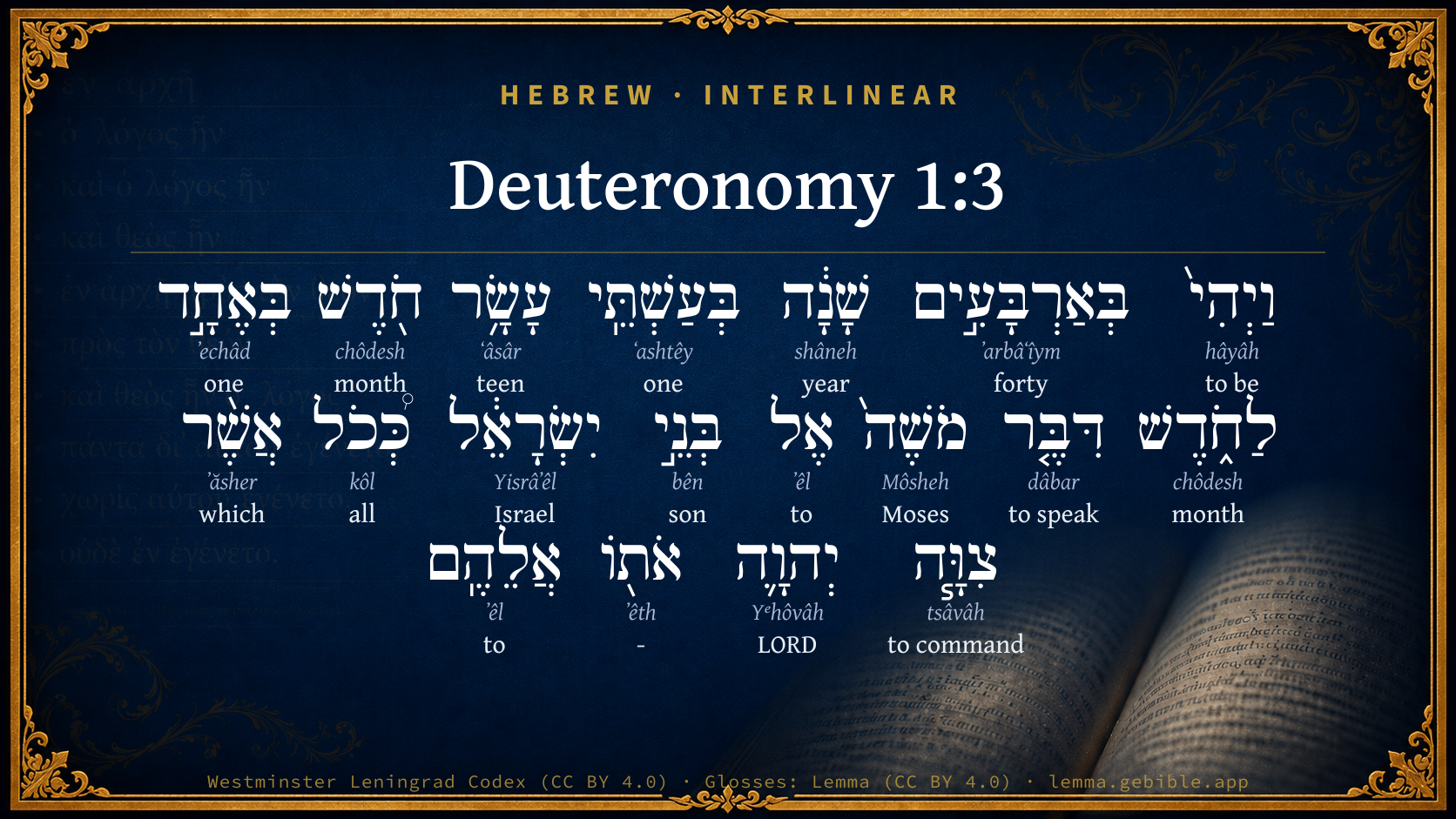
Hebrew (Westminster Leningrad Codex) Deuteronomy 1:3 appears in the Hebrew Old Testament. The text above is from the Westminster Leningrad Codex. Each word links to its Strong’s number, a concise gloss, and parsing drawn from the Open Scriptures Hebrew Bible morphology. Click any word for its full Brown-Driver-Briggs (BDB) entry.
Download image
Cite this verse

Deuteronomy 1:3 (World English Bible). Public Domain. Lemma interlinear Bible study tool, https://lemma.gebible.app/v/deuteronomy/1/3.

Show BibTeX & RIS
BibTeX
RIS
English Translation
It happened in the fortieth year, in the eleventh month, on the first day of the month, that Moses spoke to the children of Israel, according to all that Yahweh had given him in commandment to them;
World English Bible · Public Domain
Download a study sheet

One document with this verse’s original text, its word-by-word gloss line, the meaning frame, cross-references with their text, attributed commentary, and full source and license credits — printable, and it pastes into notes with its structure intact.

This verse Autodidact and up

Study sheet (.html) Plain text (.txt)

A passage Seminary Student

Up to 50 verses in one chapter. A passage sheet keeps up to 6 commentary sources and 12 cross-references per verse, in the order this page ranks them, and says so on the sheet whenever that leaves anything out. Ask for a single verse and you get the Autodidact verse sheet above.

Everything on this page stays free to read, with no account — the sheet is a download of what is already on screen, not access to it.

Want to remove ads? Support Godless Engineer
Compare translations 3

The same verse in 3 English versions, stacked beneath the original-language interlinear above. Click any original word for its lexicon entry.

Each is an independent rendering of the whole verse — the interlinear is not word-aligned to these translations.

Highlighted words mark where these versions differ — a whole-verse word diff, not a word-by-word alignment.

  • World English Bible Public Domain
    It happened in the fortieth year, in the eleventh month, on the first day of the month, that Moses spoke to the children of Israel, according to all that Yahweh had given him in commandment to them;
  • King James Version Public Domain
    And it came to pass in the fortieth year, in the eleventh month, on the first day of the month, that Moses spake unto the children of Israel, according unto all that the LORD had given him in commandment unto them;
  • unfoldingWord Literal Text CC BY-SA 4.0
    And it happened, in the fortieth year, in the eleventh month, on one of the month, Moses spoke to the sons of Israel according to all that Yahweh commanded him concerning them,

unfoldingWord Literal Text — © unfoldingWord, licensed CC BY-SA 4.0. Word-aligned USFM3 via Door43 (git.door43.org/unfoldingWord/en_ult).

Versions to compare (up to 4)

3 of 4 selected

Show all 18 translations

Every available English version of this verse, each an independent rendering of the whole verse.

  • World English Bible Public Domain
    It happened in the fortieth year, in the eleventh month, on the first day of the month, that Moses spoke to the children of Israel, according to all that Yahweh had given him in commandment to them;
  • Berean Standard Bible Public Domain
    In the fortieth year, on the first day of the eleventh month, Moses proclaimed to the Israelites all that the LORD had commanded him concerning them.
  • Majority Standard Bible Public Domain
    In the fortieth year, on the first day of the eleventh month, Moses proclaimed to the Israelites all that the LORD had commanded him concerning them.
  • King James Version Public Domain
    And it came to pass in the fortieth year, in the eleventh month, on the first day of the month, that Moses spake unto the children of Israel, according unto all that the LORD had given him in commandment unto them;
  • American Standard Version (1901) Public Domain
    And it came to pass in the fortieth year, in the eleventh month, on the first day of the month, that Moses spake unto the children of Israel, according unto all that Jehovah had given him in commandment unto them;
  • Revised Version (1885) Public Domain
    And it came to pass in the fortieth year, in the eleventh month, on the first day of the month, that Moses spake unto the children of Israel, according unto all that the LORD had given him in commandment unto them;
  • Geneva Bible (1599) Public Domain
    And it came to passe in the first day of the eleuenth moneth, in the fourtieth yeere that Moses spake vnto the children of Israel according vnto all that the Lord had giuen him in commandement vnto them,
  • Douay-Rheims (1899) Public Domain
    In the fortieth year, the eleventh month, the first day of the month, Moses spoke to the children of Israel all that the Lord had commanded him to say to them:
  • Young's Literal Translation Public Domain
    And it cometh to pass in the fortieth year, in the eleventh month, on the first of the month hath Moses spoken unto the sons of Israel according to all that Jehovah hath commanded him concerning them;
  • Literal Standard Version CC BY-SA 4.0
    And it comes to pass in the fortieth year, in the eleventh month, on the first of the month, Moses has spoken to the sons of Israel according to all that YHWH has commanded him concerning them,
  • Unlocked Literal Bible CC BY-SA 4.0
    It happened in the fortieth year, in the eleventh month, on the first day of the month, that Moses spoke to the people of Israel, telling them all that Yahweh commanded him concerning them.
  • unfoldingWord Literal Text CC BY-SA 4.0
    And it happened, in the fortieth year, in the eleventh month, on one of the month, Moses spoke to the sons of Israel according to all that Yahweh commanded him concerning them,
  • Darby Bible Public Domain
    And it came to pass in the fortieth year, in the eleventh month, on the first of the month, that Moses spoke to the children of Israel, according to all that Jehovah had given him in command to them;
  • World Messianic Bible Public Domain
    In the fortieth year, in the eleventh month, on the first day of the month, Moses spoke to the children of Israel according to all that the LORD had given him in commandment to them,
  • Webster's Bible Public Domain
    And it came to pass in the fortieth year, in the eleventh month, on the first day of the month, that Moses spoke to the children of Israel, according to all that the LORD had given him in commandment to them;
  • Free Bible Version CC BY-SA 4.0
    On the first day of the eleventh month of the fortieth year, Moses recounted to the Israelites everything that the Lord had instructed him to tell them.
  • Bible in Basic English Public Domain
    Now in the fortieth year, on the first day of the eleventh month, Moses gave to the children of Israel all the orders which the Lord had given him for them;
  • JPS Tanakh (1917) Public Domain
    And it came to pass in the fortieth year, in the eleventh month, on the first day of the month, that Moses spoke unto the children of Israel, according unto all that the LORD had given him in commandment unto them;

Literal Standard Version (2020), Covenant Press — licensed CC BY-SA 4.0. Text via the HelloAO Bible API (eBible.org). Unlocked Literal Bible (unfoldingWord) — licensed CC BY-SA 4.0. Text via the HelloAO Bible API (eBible.org). unfoldingWord Literal Text — © unfoldingWord, licensed CC BY-SA 4.0. Word-aligned USFM3 via Door43 (git.door43.org/unfoldingWord/en_ult). Free Bible Version, Dr. Jonathan Gallagher — licensed CC BY-SA 4.0. Text via the HelloAO Bible API (eBible.org).

Word by word

More ways to search: Search by grammar → Find every occurrence → Compare this word →

Practice this passage: Drill this verse → Learn its vocabulary →

בְּעַשְׁתֵּֽי
ʻashtêy
H6249
“in/at · one”
Preposition + Adjective, Cardinal number, Both, Singular, Construct
Part of Speech
Preposition + Adjective
Type
Cardinal number
Gender
Both
Number
Singular
State
Construct
Full BDB Definition

Origin: apparently masc. pl. construction of H6247 in the sense of an afterthought (used only in connection with H6240 in lieu of H259 ) eleven or (ordinal) eleventh

TWOT: 1717c

one, eleven, eleventh
  1. וַיְהִי֙ hâyâh H1961 “and · to be” Conjunction + Verb, Qal, Sequential Imperfect, 3rd Person, Masculine, Singular
  2. בְּאַרְבָּעִ֣ים ʼarbâʻîym H705 “in/at · forty” Preposition + Adjective, Cardinal number, Both, Plural, Absolute
  3. שָׁנָ֔ה shâneh H8141 “year” Noun, Common, Feminine, Singular, Absolute
  4. עָשָׂ֥ר ʻâsâr H6240 “teen” Adjective, Cardinal number, Masculine, Singular, Absolute
  5. חֹ֖דֶשׁ chôdesh H2320 “month” Noun, Common, Masculine, Singular, Absolute
  6. בְּאֶחָ֣ד ʼechâd H259 “in/at · one” Preposition + Adjective, Cardinal number, Masculine, Singular, Absolute
  7. לַחֹ֑דֶשׁ chôdesh H2320 “to/for the · month” Preposition, Determined + Noun, Common, Masculine, Singular, Absolute
  8. דִּבֶּ֤ר dâbar H1696 “to speak” Verb, Piel, Perfect, 3rd Person, Masculine, Singular
  9. מֹשֶׁה֙ Môsheh H4872 “Moses” Noun, Proper
  10. אֶל ʼêl H413 “to” Preposition
  11. בְּנֵ֣י bên H1121 “sons of” Noun, Common, Masculine, Plural, Construct
  12. יִשְׂרָאֵ֔ל Yisrâʼêl H3478 “Israel” Noun, Proper
  13. כְּ֠כֹל kôl H3605 “like/as · all” Preposition + Noun, Common, Masculine, Singular, Absolute
  14. אֲשֶׁ֨ר ʼăsher H834 “which” Particle, Relative
  15. צִוָּ֧ה tsâvâh H6680 “to command” Verb, Piel, Perfect, 3rd Person, Masculine, Singular
  16. יְהוָ֛ה Yᵉhôvâh H3068 “LORD” Noun, Proper
  17. אֹת֖וֹ ʼêth H853 “- · him” Particle, Direct Object + Suffix, Personal, 3rd Person, Masculine, Singular
  18. אֲלֵהֶֽם ʼêl H413 “to · them” Preposition + Suffix, Personal, 3rd Person, Masculine, Plural

About this verse

These counts appear in no published source. They are computed here, from the morphology-tagged text and Lemma’s own curated glosses. What Lemma adds →

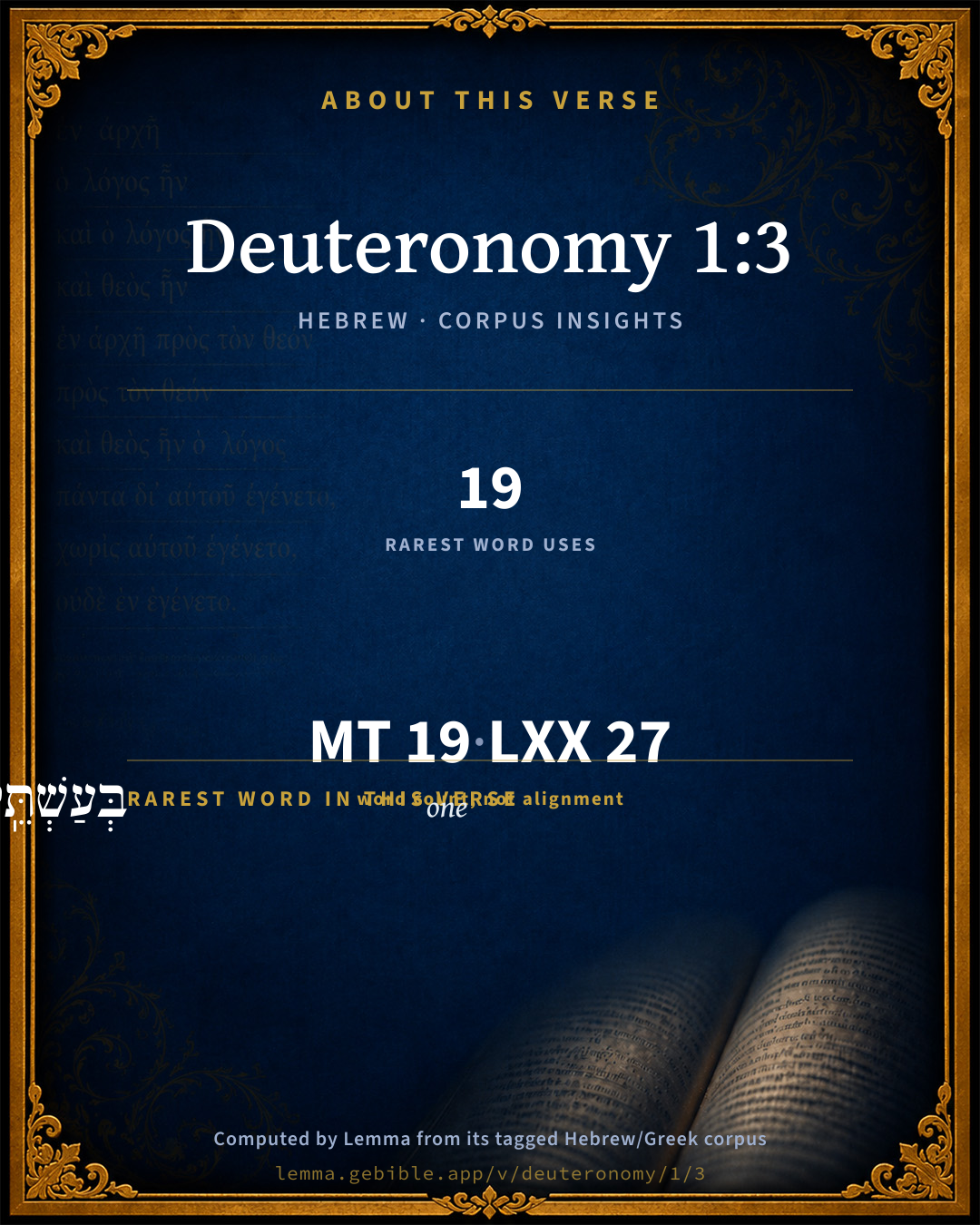
19
words
17
distinct lemmas
Pentateuch
section

Notable vocabulary

The rarest word here is בְּעַשְׁתֵּֽי one H6249 — appearing just 19 times in the whole Hebrew Bible.

Shared distinctive vocabulary

בְּעַשְׁתֵּֽי one H6249 occurs in 18 verses of the Hebrew Bible. Also found in:

Grammatical profile

  • 3 verbs
  • 8 nouns
  • 4 adjectives
  • 2 prepositions
  • 2 particles

Verb forms

  • וַיְהִי֙ Qal · Sequential Imperfect
  • דִּבֶּ֤ר Piel · Perfect
  • צִוָּ֧ה Piel · Perfect

Repetition

Words recur within this verse — often emphatic in Hebrew:

  • חֹ֖דֶשׁ month H2320 ×2
  • אֶל to H413 ×2

Hebrew & Septuagint length

In English translation the verse runs 37 words from the Hebrew and 39 from the Septuagint (LXX English) — closely comparable.

A rough comparison of the two English renderings, which tokenize alike — not a word-level alignment.

Word counts can differ between the Hebrew and the Greek without any difference in meaning — e.g. the Hebrew direct-object marker אֵת has no separate Greek word, and Greek often adds the article ὁ.

In the original languages it is 19 Hebrew tokens and 27 Greek tokens — but the two are counted differently (Hebrew bundles its prefixes and suffixes into one token; the Greek is in lemma form), so that isn’t a like-for-like length.

Cross-references

3

Topical passages linked to Deuteronomy 1:3 in the Treasury of Scripture Knowledge — connected by theme and wording, ordered by reader-vote popularity; previews shown in the World English Bible.

  • Numbers 33:38 Aaron the priest went up into Mount Hor at the commandment of Yahweh, and died there, in the fortieth year after the children of Israel were come out of the land of Egypt, in the fifth month, on the first day of the month.
  • Numbers 20:1 The children of Israel, even the whole congregation, came into the wilderness of Zin in the first month: and the people abode in Kadesh; and Miriam died there, and was buried there.
  • Deuteronomy 4:1–2 Now, Israel, listen to the statutes and to the ordinances, which I teach you, to do them; that you may live, and go in and possess the land which Yahweh, the God of your fathers, gives you.

Cross-references courtesy of OpenBible.info (CC BY 4.0).

Hebrew and Greek witnesses Masoretic Hebrew ↔ Greek Septuagint

The same verse in the two great witnesses to the Old Testament, shown verse-for-verse.

These are two independent witnesses, not word-aligned to each other, and the Septuagint is shown in lemma (dictionary) form.

Hebrew Deuteronomy 1:3 Masoretic · Westminster Leningrad Codex

וַיְהִי֙ בְּאַרְבָּעִ֣ים שָׁנָ֔ה בְּעַשְׁתֵּֽי עָשָׂ֥ר חֹ֖דֶשׁ בְּאֶחָ֣ד לַחֹ֑דֶשׁ דִּבֶּ֤ר מֹשֶׁה֙ אֶל בְּנֵ֣י יִשְׂרָאֵ֔ל כְּ֠כֹל אֲשֶׁ֨ר צִוָּ֧ה יְהוָ֛ה אֹת֖וֹ אֲלֵהֶֽם

It happened in the fortieth year, in the eleventh month, on the first day of the month, that Moses spoke to the children of Israel, according to all that Yahweh had given him in commandment to them;

World English Bible · Public Domain

Greek LXX Deuteronomy 1:3 Septuagint · lemma form

καί γίγνομαι ἐν ὁ τεσσαρακοστός ἔτος ἐν ὁ ἑνδέκατος μήν εἷς ὁ μήν λαλέω μωυσῆς πρός πᾶς υἱός ἰσραήλ κατά πᾶς ὅσος ἐντέλλομαι κύριος αὐτός πρός αὐτός

And it came to pass in the fortieth year, in the eleventh month, on the first day of the month, Moses spoke to all the children of Israel, according to all things which the Lord commanded him for them:

LXX2012 (modern English Septuagint) · Public Domain

Hebrew: Westminster Leningrad Codex (CC BY 4.0). Greek: Septuagint (public domain); English from LXX2012 (modern English Septuagint) (Public Domain). How the Septuagint differs from the Hebrew →

Targum (Aramaic paraphrase)

2

The Targum is the ancient Jewish Aramaic paraphrase of the Hebrew Scriptures — an interpretive translation, not the Hebrew text itself. Onkelos (literal) and Pseudo-Jonathan (expansive) render the Torah, and Jonathan the Prophets. Coverage is partial: where no permissively-licensed English translation exists for a verse, only the Aramaic is shown. This is verse-level text, not a word-by-word alignment to the Hebrew.

  1. Targum Onkelos Torah (Genesis–Deuteronomy)
    וַהֲוָה בְּאַרְבְּעִין שְׁנִין בְּחַד עֲשַׂר יַרְחָא בְּחַד לְיַרְחָא מַלִיל מֹשֶׁה עִם בְּנֵי יִשְׂרָאֵל כְּכֹל דִי פַקִיד יְיָ יָתֵהּ לְוָתְהוֹן

    (no public-domain English translation for this verse)

    Targum Onkelos — Aramaic: “Onkelos Genesis” (public domain); “Onkelos Exodus” (public domain); “Onkelos Leviticus” (public domain); “Onkelos Numbers” (public domain); “Onkelos Deuteronomy” (public domain). English: “Sefaria Community Translation” (CC0 1.0 (public-domain dedication)); “J.W. Etheridge. The Targums of Onkelos and Jonathan Ben Uzziel on the Pentateuch. London: Longmans, Green, 1862” (public domain). Text via Sefaria.

  2. Targum Pseudo-Jonathan Torah (Genesis–Deuteronomy)
    וַהֲוָה לְסוֹף אַרְבְּעִין שְׁנִין בְּחַדְסַר יֶרַח הוּא יַרְחָא דִשְׁבַט בְּחַד בְּיַרְחָא מַלֵּיל משֶׁה עִם בְּנֵי יִשְרָאֵל כְּכָל דִּי פַקֵּיד יְיָ יָתֵיהּ לְוַתְהוֹן

    And it was at the end of forty years, in the eleventh month, the month of Shebat, on the first of the month, that Mosheh spake with the sons of Israel according to all that the Lord had given him commandment for them.

    Targum Pseudo-Jonathan — Aramaic: “Targum Jonathan on Genesis” (public domain); “Targum Jonathan on Exodus” (public domain); “Targum Jonathan on Leviticus” (public domain); “Targum Jonathan on Numbers” (public domain); “Targum Jonathan on Deuteronomy” (public domain). English: “The Targum of Jonathan ben Uzziel, trans. J. W. Etheridge, London, 1862” (public domain). Text via Sefaria.

Commentary

Notes on Deuteronomy 1:3 from classic Christian and Jewish commentators (each source and its license shown beneath its notes). The classic Christian expositions comment on the surrounding passage and are grouped to its opening verse, so a note may address several verses; the Jewish commentaries on the Tanakh (Rashi and others) are per-verse, so they appear only where the commentator wrote on this verse.

Lemma curates 59 commentaries, every one of them public domain or Creative Commons licensed, each selected and text-cleaned for this edition rather than reprinted as found. About our sources →

Trapp's Complete Commentary

John Trapp

Deu 1:3 And it came to pass in the fortieth year, in the eleventh month, on the first [day] of the month, [that] Moses spake unto the children of Israel, according unto all that the LORD had given him in commandment unto them;

Ver. 3. In the eleventh month.] And in the twelfth month of this same year he died; so that this was his swan song: Sic, ubi fata vocant, &c.

John Trapp, A Commentary or Exposition upon All the Books of the Old and New Testament (1647–1656) — public domain. Text from a community e-Sword module.

Joseph Benson's Commentary

Deu 1:3-4. The eleventh month — Which was but a little before his death. All that the Lord had given him in command — Which shows not only that what he now delivered was in substance the same with what had formerly been commanded, but that God now commanded him to repeat it. He gave this rehearsal and exhortation by divine direction: God appointed him to leave this legacy to the church. Og — His palace or mansion-house was at Astaroth, and he was slain at Edrei.

Joseph Benson's Commentary on the Old and New Testaments (1811–1818) — public domain. Text from a community e-Sword module.

Jamieson, Fausset & Brown

Robert Jamieson, A. R. Fausset & David Brown

in the fortieth year . . . Moses spake unto the children of Israel, &c.--This impressive discourse, in which Moses reviewed all that God had done for His people, was delivered about a month before his death, and after peace and tranquillity had been restored by the complete conquest of Sihon and Og.

Jamieson, Fausset & Brown — Commentary Critical and Explanatory on the Whole Bible (1871) — public domain (CC PDM 1.0). Text via the HelloAO Bible API.

Adam Clarke's Commentary

Verse 3. The fortieth year] This was a melancholy year to the Hebrews in different respects; in the first month of this year Miriam died, Nu 20:1; on the first day of the fifth month Aaron died, Nu 33:38; and about the conclusion of it, Moses himself died.

Adam Clarke's Commentary on the Bible (1810–1826) — public domain. Text from a community e-Sword/MySword module.

Ellicott's Commentary for English Readers

(3) And it came to pass in the fortieth year, in the eleventh month.—The “and” is the real beginning of Deuteronomy, and connects it with the previous books. The moral of these words has been well pointed out by Jewish writers. It was but eleven days’ journey from Sinai to Kadesh-barnea—the place from whence Israel should have begun the conquest of the promised land; but not only eleven days of the second year of the exodus, but eleven months of the fortieth year found them still in the wilderness. “We see that they could not enter in because of unbelief.”

(3, 4) Moses spake unto the children of Israel . . . after he had slain Sihon . . . and Og.—The conquest of these two kings and their territories was one of the exploits of the fortieth year. (See Num_21:21-35.) Before the eleventh month of that year, not only Sihon and Og, but also the five princes of Midian, “who were dukes of Sihon, dwelling in the country” (Jos_13:21), had also been slain (Numbers 31). This completed the conquest, and was the last exploit of Moses’ life. In the period of repose that followed he found a suitable time to exhort the children of Israel, “according unto all that the Lord had given him in commandment unto them” From Deu_34:8, we learn that “the children of Israel wept for Moses thirty days.” These days would seem to be the last month of the fortieth year, for “on the tenth day of the first month” (probably of the next year, Jos_4:19) they passed over Jordan. Thus the last delivery of the discourses recorded in Deuteronomy would seem to lie within a single month.

A Bible Commentary for English Readers, edited by Charles John Ellicott (1878–1897) — public domain. Text from a community e-Sword module.

The Cambridge Bible for Schools and Colleges

gen. ed. J. J. S. Perowne

3. And it came to pass in the fortieth year, etc.] P alone of the Hex. documents dates by months and days (I. P. 58, 71); and its division of the year is not that which, beginning with the autumn, prevailed in early Israel, but the Babyl. division which began with the spring. The Babyl. system was first adopted by the Jews, not during the exile (as usually supposed, Marti, Enc. Bibl. ‘Year’), but, as we gather from Baruch’s narratives in the Bk of Jeremiah, during Manasseh’s reign, when the Assyrians imposed on Judah many of their institutions (Jerusalem, ii. 189 f.). Another mark of P is the term for eleventh used in the Hex. by P alone and elsewhere only by late writers. Wellh. (Hist. 384 f.) takes the verse as from the editor who incorporated D with P, but Driver, as the introd. to a summary narrative in P, and as followed immediately by Deu_32:48-52; the self-same day there being the day specified here. On the date the 40th year and the different dating of JE and D see below on Deu_2:1-8.

the children of Israel] Another designation characteristic of P; D all Israel. See on Deu_1:1, Deu_4:44.

The Cambridge Bible for Schools and Colleges (gen. ed. J. J. S. Perowne; Cambridge University Press, 1878–1918) — public domain. Text from a community e-Sword module.

John Gill's Exposition

And it came to pass in the fortieth year,.... That is, of the coming of the children of Israel out of Egypt:

in the eleventh month; the month Shebet, as the Targum of Jonathan, which answers to part of January and part of February:

in the first day of the month, that Moses spoke unto the children of Israel according to all that the Lord had given him in commandment unto them; repeated to them the several commandments, which the Lord had delivered to him at different times.

John Gill's Exposition of the Whole Bible (1746–1763) — public domain (CC PDM 1.0). Text via the HelloAO Bible API.

Haydock's Catholic Bible Commentary

Month, corresponding with our January, if the ecclesiastical calculation be followed; but if we date from Tisri, this eleventh month will be our July or August. Moses died on the 7th of the following month. (Du Hamel)

George Leo Haydock (1774–1849), Haydock's Catholic Family Bible and Commentary, 1859 edition — public domain. Excludes Psalms (Douay-Rheims chapter numbering differs from Protestant) and Deuterocanonical books (Catholic canon only).

Matthew Poole's English Annotations

This was but a little before his death.

Matthew Poole's English Annotations on the Holy Bible (1683–1685) — public domain. Text from a community e-Sword/MySword module.

Whedon's Commentary on the Bible

Daniel D. Whedon

3-5. The time and place of the delivery of the discourses that constitute this book are now mentioned. In the early part of this fortieth year Miriam had died. Num_20:1. Aaron died on the first day of its fifth month. Num_33:38. Moses is left almost alone; and he is soon to die at the command of Jehovah, (Deu_34:5.) The time is significant, also, from the fact that Moses had conquered the kings Sihon and Og. Num_21:21; Num_21:33. Jehovah is giving assurance of the fulfilling of his promises. The place is full of interest. In the plains of Moab, near the crossing of Jordan, with Jericho in sight, Moses undertook to expound the law.

Daniel D. Whedon (gen. ed.), Commentary on the Old and New Testaments (1874–1909) — public domain. Text from a community e-Sword module.

The Pulpit Commentary

Vers. 3, 4. Here is intimated the time when the following addresses were delivered to the people. It was on the first day of the eleventh month in the fortieth year; therefore near the end of their wanderings, and towards the close of the lawgiver"s own career. He could thus speak to them according unto all that the Lord had given him in commandment unto them, i.e. in accordance with the legislative contents of the preceding books. (comp. Deu_4:5 23 5:28-33 6:1) It was also after the destruction of Sihon and Og. (Num_21:21-35) This also is significant. By the destruction of these kings, who sought to bar the access of the Israelites to the Promised Land, God had given proof that he would indeed fulfill his promise to his people, and had at once laid them under obligations to obedience, and given them encouragement to go forward on the course to which he had called them. The "he" here is Moses, who, at the command of God, had led the Israelites against Sihon and "Og. Edrei, hod Draa (Num_21:33) was the second capital of "Og; he "reigned in Ashtaroth and in Edrei". (Jos_13:12) Here, however, it denotes the place where he was slain in battle, and the words "in Edrei" are to be referred to the verb "smote" and not to "dwelt" (cf. Deu_3:1; Num_21:33)

The Pulpit Commentary (1880–1919), ed. H.D.M. Spence-Jones & Joseph S. Exell — public domain. Text from a community e-Sword module.

John Wesley's Explanatory Notes

The eleventh month - Which was but a little before his death. All that the Lord had given him in commandment - Which shews not only that what he now delivered was in substance the same with what had formerly been commanded, but that God now commanded him to repeat it. He gave this rehearsal and exhortation by divine direction: God appointed him to leave this legacy to the church.

John Wesley, Explanatory Notes Upon the Whole Bible (1754–1765) — public domain. Text via the GEBible commentary corpus.

Scofield Reference Notes

C. I. Scofield

eleventh

i.e. February.

The Scofield Reference Bible (1917 edition), notes by C. I. Scofield — public domain. Text from a community e-Sword module.

unfoldingWord translationNotes

Door43 World Missions Community

It happened in the fortieth year, in the eleventh month, on the first day of the month, that Moses spoke

The ordinal numbers can be translated as cardinal numbers. AT: "They had lived in the wilderness for 40 years, 11 months, and 1 day, when Moses spoke" (See: Ordinal Numbers)

fortieth

40th (See: Numbers)

in the eleventh month, on the first day of the month

This is the eleventh month of the Hebrew calendar. The first day is near the middle of January on Western calendars. (See: Hebrew Months and Ordinal Numbers)

eleventh

11th (See: Numbers)

Yahweh

This is the name of God that he revealed to his people in the Old Testament. See the translationWord page about Yahweh concerning how to translate this.

Yahweh had attacked

"Yahweh had enabled the Israelites to defeat"

Sihon ... Og

These are names of kings. (See: How to Translate Names)

Heshbon ... Ashtaroth at Edrei

These are names of cities. (See: How to Translate Names)

translationWords

year

day

Moses

Israel

Yahweh

command

king

Amorite

Bashan

unfoldingWord translationNotes — © Distant Shores Media and the Door43 World Missions Community, licensed CC BY-SA 4.0. Source: git.door43.org/Door43/en_tn.

Rashi

Rabbi Shlomo Yitzchaki (Rashi)

ויהי בארבעים שנה בעשתי עשר חדש באחד לחדש AND IT CAME TO PASS IN THE FORTIETH YEAR, IN THE ELEVENTH MONTH, ON THE FIRST OF THE MONTH, [MOSES SPAKE] — This tells us that he reproved them only shortly before his death (Jewish tradition holds that Moses died on the seventh day of the twelfth month; cf. Megillah 13b). From whom did he learn this? From Jacob, who reproved his sons only shortly before his death. He said, “Reuben, my son, I will tell you why I have not reproved you for your unfitial conduct during all these years: it was in order that you should not leave me and go and join Esau, my wicked brother". — And on account of four things one should not reprove a person except shortly before one's death: that one should not reprove him and again have to reprove him; and that his fellow whom he reproves should not, when he afterwards happens to see him, feel ashamed before him, etc.; as it is set forth in Siphre. And similarly, Joshua reproved Israel only shortly before his death (cf. Joshua 24:1—29), and so, too, Samuel, as it is said, (I Samuel 12:3) “Behold, testify against me", and so, also, David reproved his son Solomon only shortly before his death (cf. 1 Kings 2:1—9).

Rashi on the Tanakh — English translations: “The Judaica Press complete Tanach with Rashi, translated by A. J. Rosenberg” (CC BY 4.0); “Pentateuch with Rashi's commentary by M. Rosenbaum and A.M. Silbermann, 1929-1934” (public domain); “The Metsudah Tanach series, Lakewood, N.J” (CC BY 4.0); and “The Book of Joshua, Metsudah Publications, 1997” (CC BY 4.0). Text via Sefaria.

Lesson kit

Teaching starters — assembled from the data on this page, not authored interpretation. Every prompt links to the verse data it draws on. Edit before teaching.

Deuteronomy, in the Pentateuch, opens this verse with 19 words (17 distinct Hebrew lemmas). Its most distinctive word is ʻashtêy (“one”). A historical commentator’s framing appears above. Read the whole chapter for the surrounding context.

Discussion questions

  1. The word ʻashtêy carries the sense “one.” How does it shape the verse?
  2. How does Exodus 26:7, which shares the word «one», read alongside this verse?
  3. What does the repetition of “month” (2× in this one verse) do in this verse?
  4. These translations render this verse differently; the difference is in the English rendering, not the original. What questions does that raise?
  5. «וַיְהִי֙» is a Qal Sequential Imperfect verb. How does that grammatical form shape the action described?
  6. Compare how Trapp's Complete Commentary and Joseph Benson's Commentary read this verse. Where do they agree or differ?

Things to notice

Reading settings

Reading text

Shown beneath each verse's original-language words.

Old Testament
Old Testament edition

Read the OT as the Masoretic Hebrew (MT) or the Greek Septuagint (LXX).

English shown for the Greek Septuagint (in the Hebrew ↔ Greek comparison).

Comparing translations? Open the Compare panel on any verse page to stack up to four side by side.