
2 Chronicles 13:9

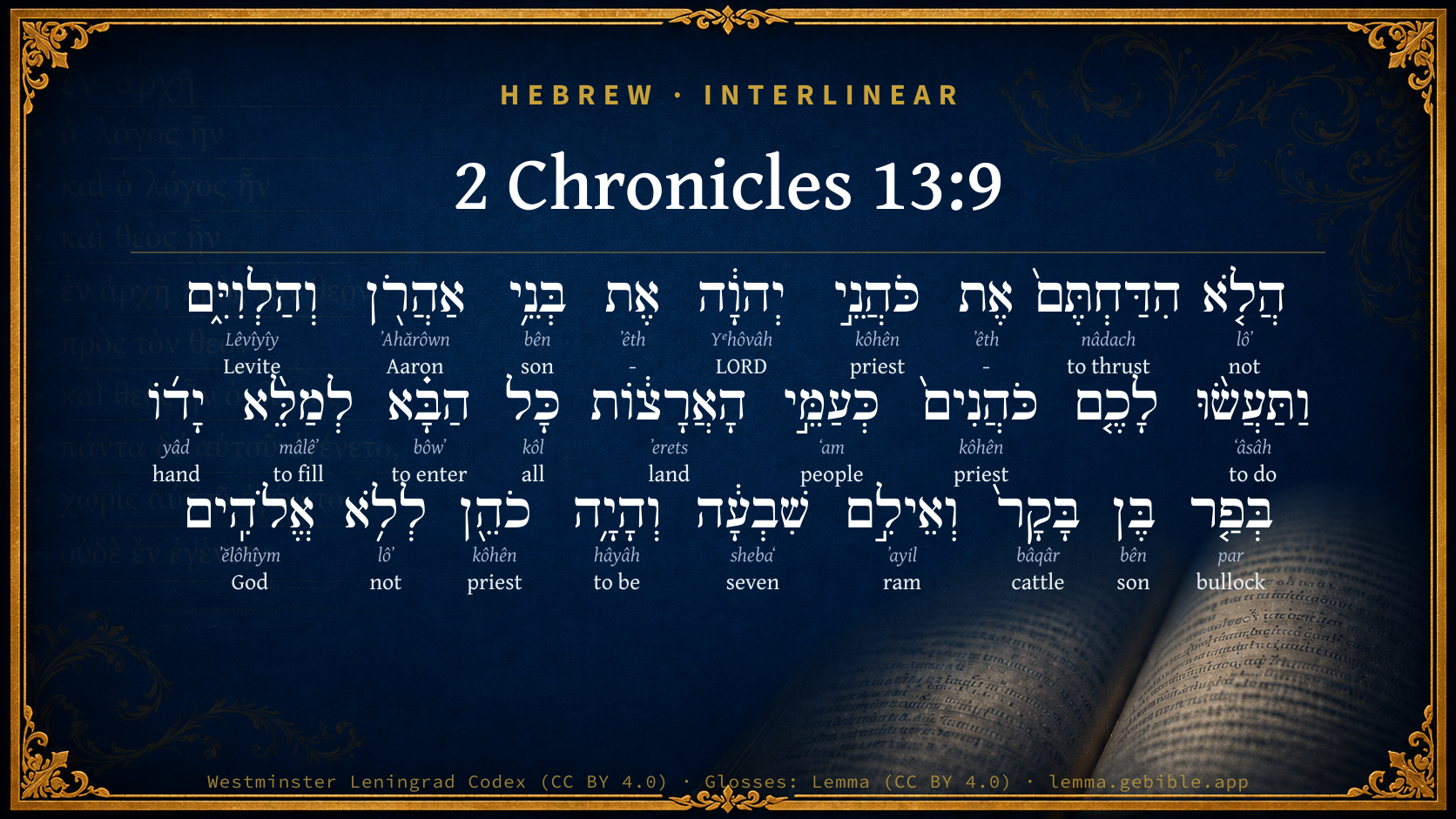
Hebrew (Westminster Leningrad Codex) 2 Chronicles 13:9 appears in the Hebrew Old Testament. The text above is from the Westminster Leningrad Codex. Each word links to its Strong’s number, a concise gloss, and parsing drawn from the Open Scriptures Hebrew Bible morphology. Click any word for its full Brown-Driver-Briggs (BDB) entry.
Download image
Cite this verse

2 Chronicles 13:9 (World English Bible). Public Domain. Lemma interlinear Bible study tool, https://lemma.gebible.app/v/2-chronicles/13/9.

Show BibTeX & RIS
BibTeX
RIS
English Translation
Haven't you driven out the priests of Yahweh, the sons of Aaron, and the Levites, and made you priests after the manner of the peoples of [other] lands? so that whoever comes to consecrate himself with a young bull and seven rams, the same may be a priest of [those who are] no gods.
World English Bible · Public Domain
Download a study sheet

One document with this verse’s original text, its word-by-word gloss line, the meaning frame, cross-references with their text, attributed commentary, and full source and license credits — printable, and it pastes into notes with its structure intact.

This verse Autodidact and up

Study sheet (.html) Plain text (.txt)

A passage Seminary Student

Up to 50 verses in one chapter. A passage sheet keeps up to 6 commentary sources and 12 cross-references per verse, in the order this page ranks them, and says so on the sheet whenever that leaves anything out. Ask for a single verse and you get the Autodidact verse sheet above.

Everything on this page stays free to read, with no account — the sheet is a download of what is already on screen, not access to it.

Want to remove ads? Support Godless Engineer
Compare translations 3

The same verse in 3 English versions, stacked beneath the original-language interlinear above. Click any original word for its lexicon entry.

Each is an independent rendering of the whole verse — the interlinear is not word-aligned to these translations.

Highlighted words mark where these versions differ — a whole-verse word diff, not a word-by-word alignment.

  • World English Bible Public Domain
    Haven't you driven out the priests of Yahweh, the sons of Aaron, and the Levites, and made you priests after the manner of the peoples of [other] lands? so that whoever comes to consecrate himself with a young bull and seven rams, the same may be a priest of [those who are] no gods.
  • King James Version Public Domain
    Have ye not cast out the priests of the LORD, the sons of Aaron, and the Levites, and have made you priests after the manner of the nations of other lands? so that whosoever cometh to consecrate himself with a young bullock and seven rams, the same may be a priest of them that are no gods.
  • unfoldingWord Literal Text CC BY-SA 4.0
    Did you all not drive out the priests of Yahweh, the sons of Aaron, and the Levites, and make for yourselves priests like the peoples of the lands? Any who comes to fill his hand with a young bull, a son of a herd, and seven rams, and he will be a priest of what are not gods.

unfoldingWord Literal Text — © unfoldingWord, licensed CC BY-SA 4.0. Word-aligned USFM3 via Door43 (git.door43.org/unfoldingWord/en_ult).

Versions to compare (up to 4)

3 of 4 selected

Show all 18 translations

Every available English version of this verse, each an independent rendering of the whole verse.

  • World English Bible Public Domain
    Haven't you driven out the priests of Yahweh, the sons of Aaron, and the Levites, and made you priests after the manner of the peoples of [other] lands? so that whoever comes to consecrate himself with a young bull and seven rams, the same may be a priest of [those who are] no gods.
  • Berean Standard Bible Public Domain
    But did you not drive out the priests of the LORD, the sons of Aaron, and the Levites? And did you not make priests for yourselves as do the peoples of other lands? Now whoever comes to consecrate himself with a young bull and seven rams can become a priest of things that are not gods.
  • Majority Standard Bible Public Domain
    But did you not drive out the priests of the LORD, the sons of Aaron, and the Levites? And did you not make priests for yourselves as do the peoples of other lands? Now whoever comes to consecrate himself with a young bull and seven rams can become a priest of things that are not gods.
  • King James Version Public Domain
    Have ye not cast out the priests of the LORD, the sons of Aaron, and the Levites, and have made you priests after the manner of the nations of other lands? so that whosoever cometh to consecrate himself with a young bullock and seven rams, the same may be a priest of them that are no gods.
  • American Standard Version (1901) Public Domain
    Have ye not driven out the priests of Jehovah, the sons of Aaron, and the Levites, and made you priests after the manner of the peoples of `other' lands? so that whosoever cometh to consecrate himself with a young bullock and seven rams, the same may be a priest of `them that are' no gods.
  • Revised Version (1885) Public Domain
    Have ye not driven out the priests of the LORD, the sons of Aaron, and the Levites, and have made you priests after the manner of the peoples of other lands? so that whosoever cometh to consecrate himself with a young bullock and seven rams, the same may be a priest of them that are no gods.
  • Geneva Bible (1599) Public Domain
    Haue ye not driuen away the Priestes of the Lord the sonnes of Aaron and the Leuites, and haue made you Priests like the people of other countreis? whosoeuer commeth to consecrate with a yong bullocke and seuen rams, the same may be a Priest of them that are no gods.
  • Douay-Rheims (1899) Public Domain
    And you have cast out the priests of the Lord, the sons of Aaron, and the Levites: and you have made you priests, like all the nations of the earth: whosoever cometh and consecrateth his hand with a bullock of the herd, and with seven rams, is made a priest of those who are no gods.
  • Young's Literal Translation Public Domain
    `Have ye not cast out the priests of Jehovah, the sons of Aaron, and the Levites, and make to you priests like the peoples of the lands? every one who hath come to fill his hand with a bullock, a son of the herd, and seven rams, even he hath been a priest to No-gods!
  • Literal Standard Version CC BY-SA 4.0
    Have you not cast out the priests of YHWH, the sons of Aaron, and the Levites, and make priests for yourselves like the peoples of the lands? Everyone who has come to fill his hand with a bullock, a son of the herd, and seven rams, even he has been a priest for [those which are] not gods!
  • Unlocked Literal Bible CC BY-SA 4.0
    But did you not drive out the priests of Yahweh, the descendants of Aaron, and the Levites, and make priests of your own in the same way as the people of other lands do? Whoever comes to serve as a priest, sacrificing a young bullock and seven rams, he becomes a priest of what are not gods.
  • unfoldingWord Literal Text CC BY-SA 4.0
    Did you all not drive out the priests of Yahweh, the sons of Aaron, and the Levites, and make for yourselves priests like the peoples of the lands? Any who comes to fill his hand with a young bull, a son of a herd, and seven rams, and he will be a priest of what are not gods.
  • Darby Bible Public Domain
    Have ye not cast out the priests of Jehovah, the sons of Aaron, and the Levites, and made you priests as the peoples of the lands? whoever comes to consecrate himself with a young bullock and seven rams, he becomes a priest of what is not God.
  • World Messianic Bible Public Domain
    Haven’t you driven out the priests of the LORD, the sons of Aaron, and the Levites, and made priests for yourselves according to the ways of the peoples of other lands? Whoever comes to consecrate himself with a young bull and seven rams may be a priest of those who are no gods.
  • Webster's Bible Public Domain
    Have ye not cast out the priests of the LORD, the sons of Aaron, and the Levites, and have made for you priests after the manner of the nations of other lands? so that whoever cometh to consecrate himself with a young bullock and seven rams, the same may be a priest of them that are no gods.
  • Free Bible Version CC BY-SA 4.0
    But didn't you drive out the priests of the Lord, Aaron's descendants, and the Levites, and make priests for yourselves just like people in other nations do? Now anyone who wants to can come and dedicate himself, sacrificing a young bull and seven rams, and he can become a priest of things that really are not gods.
  • Bible in Basic English Public Domain
    And after driving out the priests of the Lord, the sons of Aaron and the Levites, have you not made priests for yourselves as the people of other lands do? so that anyone who comes to make himself priest by offering an ox or seven sheep, may be a priest of those who are no gods.
  • JPS Tanakh (1917) Public Domain
    Have ye not driven out the priests of the LORD, the sons of Aaron, and the Levites, and have made you priests after the manner of the peoples of other lands? so that whosoever cometh to consecrate himself with a young bullock and seven rams, the same becometh a priest of them that are no gods.

Literal Standard Version (2020), Covenant Press — licensed CC BY-SA 4.0. Text via the HelloAO Bible API (eBible.org). Unlocked Literal Bible (unfoldingWord) — licensed CC BY-SA 4.0. Text via the HelloAO Bible API (eBible.org). unfoldingWord Literal Text — © unfoldingWord, licensed CC BY-SA 4.0. Word-aligned USFM3 via Door43 (git.door43.org/unfoldingWord/en_ult). Free Bible Version, Dr. Jonathan Gallagher — licensed CC BY-SA 4.0. Text via the HelloAO Bible API (eBible.org).

Word by word

More ways to search: Search by grammar → Find every occurrence → Compare this word →

Practice this passage: Drill this verse → Learn its vocabulary →

הִדַּחְתֶּם֙
nâdach
H5080
“to thrust”
Verb, Hiphil, Perfect, 2nd Person, Masculine, Plural
Part of Speech
Verb
Stem
Hiphil
Form
Perfect
Person
2nd Person
Gender
Masculine
Number
Plural
Full BDB Definition

Origin: a primitive root

TWOT: 1304

to impel, thrust, drive away, banish - (Qal) - to impel - to thrust away, banish - (Niphal) - to be impelled - to be thrust out, be banished - banished, outcast (participle) - to be driven away - to be thrust away, thrust aside - (Pual) to be thrust into - thrust (participle) - (Hiphil) - to thrust, move, impel - to thrust out, banish - to thrust away, thrust aside - (Hophal) to be chased, be hunted - chased, hunted (participle)
  1. הֲלֹ֤א lôʼ H3808 “not” Particle, Interrogative + Particle, Negative
  2. אֶת ʼêth H853 “-” Particle, Direct Object
  3. כֹּהֲנֵ֣י kôhên H3548 “priests of” Noun, Common, Masculine, Plural, Construct
  4. יְהוָ֔ה Yᵉhôvâh H3068 “LORD” Noun, Proper
  5. אֶת ʼêth H853 “-” Particle, Direct Object
  6. בְּנֵ֥י bên H1121 “sons of” Noun, Common, Masculine, Plural, Construct
  7. אַהֲרֹ֖ן ʼAhărôwn H175 “Aaron” Noun, Proper
  8. וְהַלְוִיִּ֑ם Lêvîyîy H3881 “and · the · Levites” Conjunction + Particle, Definite Article + Noun, Gentilic, Masculine, Plural, Absolute
  9. וַתַּעֲשׂ֨וּ ʻâsâh H6213 “and · to do” Conjunction + Verb, Qal, Sequential Imperfect, 2nd Person, Masculine, Plural
  10. כֹּהֲנִים֙ kôhên H3548 “priests” Noun, Common, Masculine, Plural, Absolute
  11. כְּעַמֵּ֣י ʻam H5971 “like/as · peoples of” Preposition + Noun, Common, Masculine, Plural, Construct
  12. הָאֲרָצ֔וֹת ʼerets H776 “the · lands” Particle, Definite Article + Noun, Common, Both, Plural, Absolute
  13. כָּל kôl H3605 “all of” Noun, Common, Masculine, Singular, Construct
  14. הַבָּ֗א bôwʼ H935 “the · entering” Particle, Definite Article + Verb, Qal, Participle Active, Masculine, Singular, Absolute
  15. לְמַלֵּ֨א mâlêʼ H4390 “to fill” Preposition + Verb, Piel, Infinitive Construct
  16. יָד֜וֹ yâd H3027 “hand · his” Noun, Common, Both, Singular, Construct + Suffix, Personal, 3rd Person, Masculine, Singular
  17. בְּפַ֤ר par H6499 “in/at · bullock” Preposition + Noun, Common, Masculine, Singular, Absolute
  18. בֶּן bên H1121 “son of” Noun, Common, Masculine, Singular, Construct
  19. בָּקָר֙ bâqâr H1241 “cattle” Noun, Common, Both, Singular, Absolute
  20. וְאֵילִ֣ם ʼayil H352 “and · rams” Conjunction + Noun, Common, Masculine, Plural, Absolute
  21. שִׁבְעָ֔ה shebaʻ H7651 “seven” Adjective, Cardinal number, Masculine, Singular, Absolute
  22. וְהָיָ֥ה hâyâh H1961 “and · to be” Conjunction + Verb, Qal, Sequential Perfect, 3rd Person, Masculine, Singular
  23. כֹהֵ֖ן kôhên H3548 “priest” Noun, Common, Masculine, Singular, Absolute
  24. לְלֹ֥א lôʼ H3808 “to/for · not” Preposition + Particle, Negative
  25. אֱלֹהִֽים ʼĕlôhîym H430 “God(s)” Noun, Common, Masculine, Plural, Absolute

About this verse

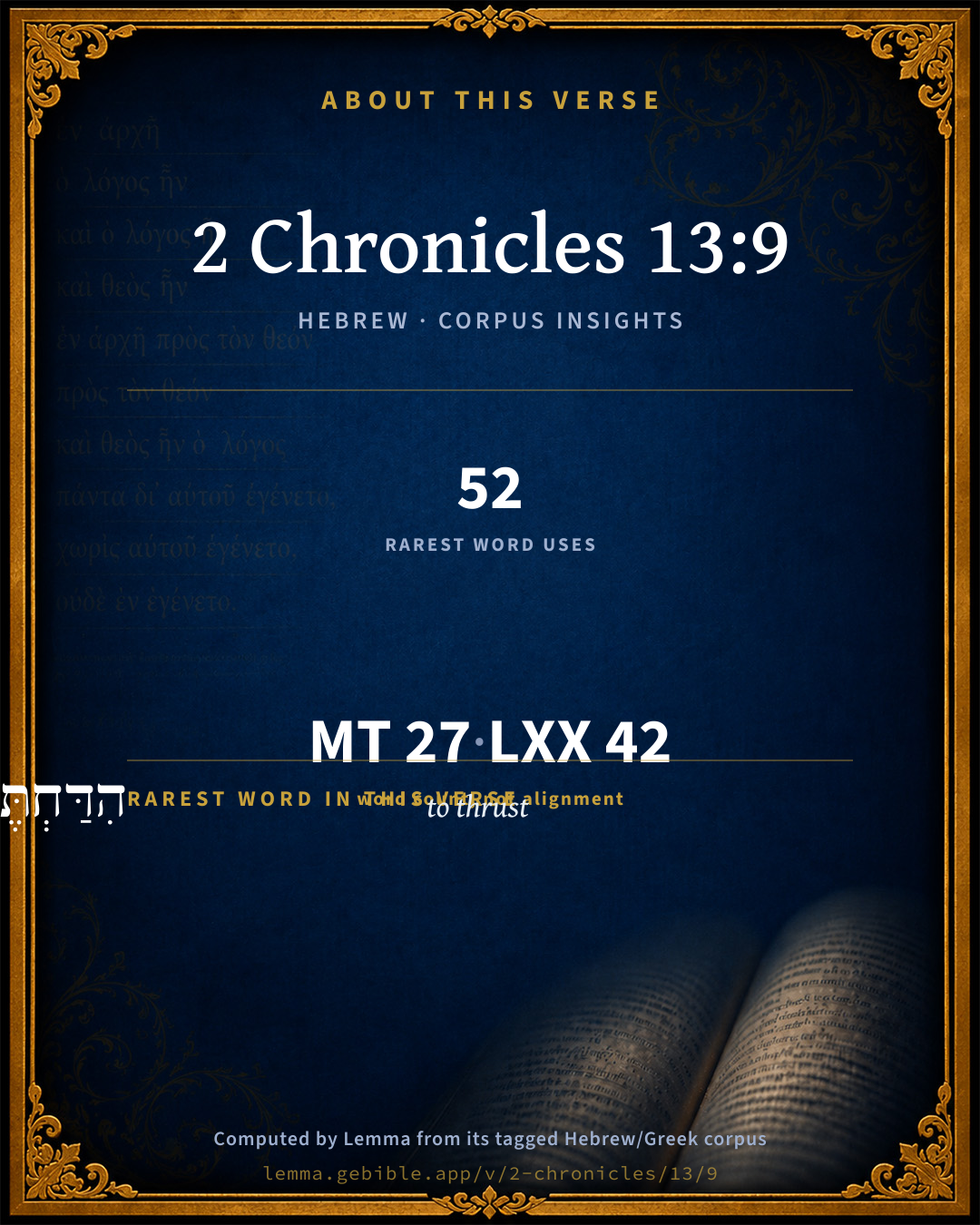
These counts appear in no published source. They are computed here, from the morphology-tagged text and Lemma’s own curated glosses. What Lemma adds →

27
words
21
distinct lemmas
Historical
section

Shared distinctive vocabulary

הִדַּחְתֶּם֙ to thrust H5080 occurs in 51 verses of the Hebrew Bible. Also found in:

Grammatical profile

  • 5 verbs
  • 16 nouns
  • 1 adjective
  • 1 preposition
  • 4 particles

Verb forms

  • הִדַּחְתֶּם֙ Hiphil · Perfect
  • וַתַּעֲשׂ֨וּ Qal · Sequential Imperfect
  • הַבָּ֗א Qal · Participle Active
  • לְמַלֵּ֨א Piel · Infinitive Construct
  • וְהָיָ֥ה Qal · Sequential Perfect

Repetition

Words recur within this verse — often emphatic in Hebrew:

  • כֹּהֲנֵ֣י priest H3548 ×3
  • בְּנֵ֥י son H1121 ×2
  • הֲלֹ֤א not H3808 ×2

Hebrew & Septuagint length

In English translation the verse runs 54 words from the Hebrew and 54 from the Septuagint (LXX English) — the same length.

A rough comparison of the two English renderings, which tokenize alike — not a word-level alignment.

Word counts can differ between the Hebrew and the Greek without any difference in meaning — e.g. the Hebrew direct-object marker אֵת has no separate Greek word, and Greek often adds the article ὁ.

In the original languages it is 27 Hebrew tokens and 42 Greek tokens — but the two are counted differently (Hebrew bundles its prefixes and suffixes into one token; the Greek is in lemma form), so that isn’t a like-for-like length.

Cross-references

16

Topical passages linked to 2 Chronicles 13:9 in the Treasury of Scripture Knowledge — connected by theme and wording, ordered by reader-vote popularity; previews shown in the World English Bible.

  • 2 Chronicles 11:14–15 For the Levites left their suburbs and their possession, and came to Judah and Jerusalem: for Jeroboam and his sons cast them off, that they should not execute the priest's office to Yahweh;
  • Jeremiah 2:11 Has a nation changed [its] gods, which yet are no gods? but my people have changed their glory for that which does not profit.
  • Exodus 29:35 "Thus shall you do to Aaron, and to his sons, according to all that I have commanded you. Seven days shall you consecrate them.
  • Exodus 29:1 "This is the thing that you shall do to them to make them holy, to minister to me in the priest's office: take one young bull and two rams without blemish,
  • Exodus 32:29 Moses said, "Consecrate yourselves today to Yahweh, yes, every man against his son, and against his brother; that he may bestow on you a blessing this day."
  • Leviticus 8:2 "Take Aaron and his sons with him, and the garments, and the anointing oil, and the bull of the sin offering, and the two rams, and the basket of unleavened bread;
  • Leviticus 16:32 The priest, who is anointed and who is consecrated to be priest in his father's place, shall make the atonement, and shall put on the linen garments, even the holy garments.
  • Deuteronomy 32:17 They sacrificed to demons, [which were] no God, To gods that they didn't know, To new [gods] that came up of late, Which your fathers didn't dread.
  • 1 Kings 12:31–33 He made houses of high places, and made priests from among all the people, who were not of the sons of Levi.
  • 1 Kings 13:33 After this thing Jeroboam didn't return from his evil way, but made again from among all the people priests of the high places: whoever would, he consecrated him, that there might be priests of the high places.
  • 2 Kings 19:18 and have cast their gods into the fire; for they were no gods, but the work of men's hands, wood and stone; therefore they have destroyed them.
  • 1 Chronicles 29:5 of gold for the [things of] gold, and of silver for the [things of] silver, and for all manner of work [to be made] by the hands of artificers. Who then offers willingly to consecrate himself this day to Yahweh?
  • Jeremiah 5:7 How can I pardon you? your children have forsaken me, and sworn by them that are no gods: when I had fed them to the full, they committed adultery, and assembled themselves in troops at the prostitutes' houses.
  • Hosea 8:6 For this is even from Israel! The workman made it, and it is no God; Indeed, the calf of Samaria shall be broken in pieces.
  • Acts 19:26 You see and hear, that not at Ephesus alone, but almost throughout all Asia, this Paul has persuaded and turned away many people, saying that they are no gods, that are made with hands.
  • Galatians 4:8 However at that time, not knowing God, you were in bondage to those who by nature are not gods.

Cross-references courtesy of OpenBible.info (CC BY 4.0).

Hebrew and Greek witnesses Masoretic Hebrew ↔ Greek Septuagint

The same verse in the two great witnesses to the Old Testament, shown verse-for-verse.

These are two independent witnesses, not word-aligned to each other, and the Septuagint is shown in lemma (dictionary) form.

Hebrew 2 Chronicles 13:9 Masoretic · Westminster Leningrad Codex

הֲלֹ֤א הִדַּחְתֶּם֙ אֶת כֹּהֲנֵ֣י יְהוָ֔ה אֶת בְּנֵ֥י אַהֲרֹ֖ן וְהַלְוִיִּ֑ם וַתַּעֲשׂ֨וּ לָכֶ֤ם כֹּהֲנִים֙ כְּעַמֵּ֣י הָאֲרָצ֔וֹת כָּל הַבָּ֗א לְמַלֵּ֨א יָד֜וֹ בְּפַ֤ר בֶּן בָּקָר֙ וְאֵילִ֣ם שִׁבְעָ֔ה וְהָיָ֥ה כֹהֵ֖ן לְלֹ֥א אֱלֹהִֽים

Haven't you driven out the priests of Yahweh, the sons of Aaron, and the Levites, and made you priests after the manner of the peoples of [other] lands? so that whoever comes to consecrate himself with a young bull and seven rams, the same may be a priest of [those who are] no gods.

World English Bible · Public Domain

Greek LXX 2 Chronicles 13:9 Septuagint · lemma form

ἤ οὐ ἐκβάλλω ὁ ἱερεύς κύριος ὁ υἱός ἀαρών καί ὁ λευείτης καί ποιέω ἑαυτοῦ ἱερεύς ἐκ ὁ λαός ὁ γῆ πᾶς ὁ προςπορεύομαι πληρόω ὁ χείρ ἐν μόσχος ἐκ βοῦς καί κριός ἑπτά καί γίγνομαι εἰς ἱερεύς ὁ μή εἰμί θεός

Did you⌃ not cast out the priests of the Lord, the sons of Aaron, and the Levites, and make to yourselves priests of the people of any other land? whoever came to consecrate himself with a calf of the heard and seven rams, he forthwith became a priest to that which is no god.

LXX2012 (modern English Septuagint) · Public Domain

Hebrew: Westminster Leningrad Codex (CC BY 4.0). Greek: Septuagint (public domain); English from LXX2012 (modern English Septuagint) (Public Domain). How the Septuagint differs from the Hebrew →

Commentary

Notes on 2 Chronicles 13:9 from classic Christian and Jewish commentators (each source and its license shown beneath its notes). The classic Christian expositions comment on the surrounding passage and are grouped to its opening verse, so a note may address several verses; the Jewish commentaries on the Tanakh (Rashi and others) are per-verse, so they appear only where the commentator wrote on this verse.

Lemma curates 59 commentaries, every one of them public domain or Creative Commons licensed, each selected and text-cleaned for this edition rather than reprinted as found. About our sources →

Trapp's Complete Commentary

John Trapp

2Ch 13:9 Have ye not cast out the priests of the LORD, the sons of Aaron, and the Levites, and have made you priests after the manner of the nations of [other] lands? so that whosoever cometh to consecrate himself with a young bullock and seven rams, [the same] may be a priest of [them that are] no gods.

Ver. 9. Have you not cast out the priests of the Lord?] Who should pray for you, and make atonement.

So that whosoever cometh to consecrate himself.] Heb., To fill his hand, sc., with sacrifices; or haply with bribes.

John Trapp, A Commentary or Exposition upon All the Books of the Old and New Testament (1647–1656) — public domain. Text from a community e-Sword module.

Joseph Benson's Commentary

2Ch 13:9. Have ye not cast out the priests of the Lord? — The house of Aaron, whom God appointed to minister in holy things. And have made you priests, after the manner of the nations? — In conformity to the custom of the idolatrous nations. So that whosoever cometh to consecrate himself with a young bullock — To make himself a priest, Lev 7:3. Whosoever desires to be in the office, and will be at the charge of his consecration, though ever so much a scandal to the character; the same may be a priest of them that are no gods — That have nothing of the nature or power of gods, though you give them that name. Such, however, though very unfit to be priests, were most fit of all others to be their priests. For what could be more suitable to gods that were no gods, than priests that were no priests?

Joseph Benson's Commentary on the Old and New Testaments (1811–1818) — public domain. Text from a community e-Sword module.

Geneva Bible (1599)

Geneva Bible translators

He showeth the nature of idolaters which take no trial of the vocation, life and doctrine of their ministers, but think the most vilest and greatest beasts sufficient to serve their turn.

Hebrew, fill his hand.

Geneva Bible (1599) marginal notes — public domain. Text via Bolls.life.

Adam Clarke's Commentary

Verse 9. A young bullock and seven rams] He who could provide these for his own consecration was received into the order of this spurious and wicked priesthood. Some think he who could give to Jeroboam a young bullock and seven rams, was thereby received into the priesthood; this being the price for which the priesthood was conferred. The former is most likely.

Adam Clarke's Commentary on the Bible (1810–1826) — public domain. Text from a community e-Sword/MySword module.

Ellicott's Commentary for English Readers

(9) The priests of the Lord . . . and the Levites.—The Hebrew seems to include the Levites among the priests of the Lord.

Cast out.—Banished (Jer_8:3).

After the manner of the nations of other lands.—Literally, like the peoples of the lands; that is, priests of all classes of the nation, and not members of the divinely chosen tribe of Levi. (See 1Ki_12:31; 1Ki_13:33). The surrounding heathen had no exclusive sacerdotal castes.

So that whosoever cometh . . .—Literally, every one that cometh, that they may fill his hand, with a steer, son of a herd, and seven rams, becometh a priest unto non-gods. “To fill a man’s hand” was the legal phrase for giving him authority and instituting him as a priest. (See Exo_28:41; Exo_29:9; Jdg_17:5.) Every one that came with the prescribed sacrifices (see Exodus 29) was admissible to the new priesthood. The phrase “a young bullock and seven rams” is not a full account of the sacrifices required by the law of Moses for the consecration of a priest. Perhaps Abijah did not care to be exact; but it is quite possible that Jeroboam had modified the Mosaic rule.

The compound substantive “no-gods” (lô’ ’elôhîm) is like lô’ ’êl and lô’ ’elôah (Deu_32:17; Deu_32:21). The calves are spoken of as mere idols, although there is little doubt that Jeroboam set them up as representations of the God of Israel.

A Bible Commentary for English Readers, edited by Charles John Ellicott (1878–1897) — public domain. Text from a community e-Sword module.

The Cambridge Bible for Schools and Colleges

gen. ed. J. J. S. Perowne

9. cast out] R.V. driven out; cp. note on 2Ch_11:14.

to consecrate himself] Lit. to fill his hand. Moses is directed (Exo_29:1 ff.) to ordain Aaron and his sons priests by three ceremonies: (1) by anointing them, (2) by filling their hands, i.e. by presenting them with victims upon which they laid their hands, (3) by hallowing them, i.e. by sprinkling some of the blood of the victim upon them.

a young bullock and seven rams] Aaronic priests were consecrated with a young bullock and two rams (Exo_29:1).

The Cambridge Bible for Schools and Colleges (gen. ed. J. J. S. Perowne; Cambridge University Press, 1878–1918) — public domain. Text from a community e-Sword module.

John Gill's Exposition

But as for us, the Lord is our God,.... The Word of the Lord, as the Targum; we know and acknowledge no other; not the calves at Dan and Bethel, nor any other idols, only the one living and true God:

and we have not forsaken him; his laws, statutes, ordinances, and worship; for though Abijah was not a religious man, yet it seems the form of religion was kept up, and temple service was observed, in his days:

and the priests which minister unto the Lord; by offering sacrifices, and burning incense:

are the sons of Aaron; and they only:

and the Levites wait upon their business; some in singing songs of praise, vocally and instrumentally, others in keeping the doors of the temple and the treasures of the house of God, and others in assisting the priests at the altar.

John Gill's Exposition of the Whole Bible (1746–1763) — public domain (CC PDM 1.0). Text via the HelloAO Bible API.

Albert Barnes' Notes on the Bible

Seven rams - “A bullock and two rams” was the offering which God had required at the original consecration of the sons of Aaron Exo 29:1; Lev 8:2. Jeroboam, for reasons of his own, enlarged the sacrifice, and required it at the consecration of every priest.

Albert Barnes' Notes on the Bible (1834–1885) — public domain. Text from a community e-Sword/MySword module.

Haydock's Catholic Bible Commentary

Rams. These were sacrificed by the false priests, who acted in a very different manner from those of the Lord, Leviticus viii., and ix. (Calmet)

George Leo Haydock (1774–1849), Haydock's Catholic Family Bible and Commentary, 1859 edition — public domain. Excludes Psalms (Douay-Rheims chapter numbering differs from Protestant) and Deuterocanonical books (Catholic canon only).

Matthew Poole's English Annotations

To consecrate himself, i. e. to make himself a priest. See Poole "Lev 7:37".

That are no gods; that have nothing of the nature or power, though you give them the name of gods.

Matthew Poole's English Annotations on the Holy Bible (1683–1685) — public domain. Text from a community e-Sword/MySword module.

John Wesley's Explanatory Notes

Consecrate - To make himself a priest.

John Wesley, Explanatory Notes Upon the Whole Bible (1754–1765) — public domain. Text via the GEBible commentary corpus.

Rashi

Rabbi Shlomo Yitzchaki (Rashi)

like the peoples of the lands Whoever wishes to come and be initiated to be a priest to a golden calf, shall bring a young bull and seven rams, and be accepted.

to initiate himself - Heb. לְמַלֵּא יָדוֹ. To differentiate between impure and pure, similar to (Exod. 29:29): “to be anointed and initiated (וּלְמַלֵּא בָם אֶת יָדָם) through them.”

Rashi on the Tanakh — English translations: “The Judaica Press complete Tanach with Rashi, translated by A. J. Rosenberg” (CC BY 4.0); “Pentateuch with Rashi's commentary by M. Rosenbaum and A.M. Silbermann, 1929-1934” (public domain); “The Metsudah Tanach series, Lakewood, N.J” (CC BY 4.0); and “The Book of Joshua, Metsudah Publications, 1997” (CC BY 4.0). Text via Sefaria.

Lesson kit

Teaching starters — assembled from the data on this page, not authored interpretation. Every prompt links to the verse data it draws on. Edit before teaching.

2 Chronicles, in the Historical, opens this verse with 27 words (21 distinct Hebrew lemmas). Its most distinctive word is nâdach (“to thrust”). A historical commentator’s framing appears above. Read the whole chapter for the surrounding context.

Discussion questions

  1. What does “to thrust” (nâdach) contribute to the verse as a whole?
  2. How does Deuteronomy 4:19, which shares the word «to thrust», read alongside this verse?
  3. What does the repetition of “priest” (3× in this one verse) do in this verse?
  4. The translations on this page render this verse differently — a whole-verse word diff, not a word-by-word alignment. What might account for the different wordings?
  5. «הִדַּחְתֶּם֙» is a Hiphil Perfect verb. How does that grammatical form shape the action described?
  6. Compare how Trapp's Complete Commentary and Joseph Benson's Commentary read this verse. Where do they agree or differ?

Things to notice

Reading settings

Reading text

Shown beneath each verse's original-language words.

Old Testament
Old Testament edition

Read the OT as the Masoretic Hebrew (MT) or the Greek Septuagint (LXX).

English shown for the Greek Septuagint (in the Hebrew ↔ Greek comparison).

Comparing translations? Open the Compare panel on any verse page to stack up to four side by side.