
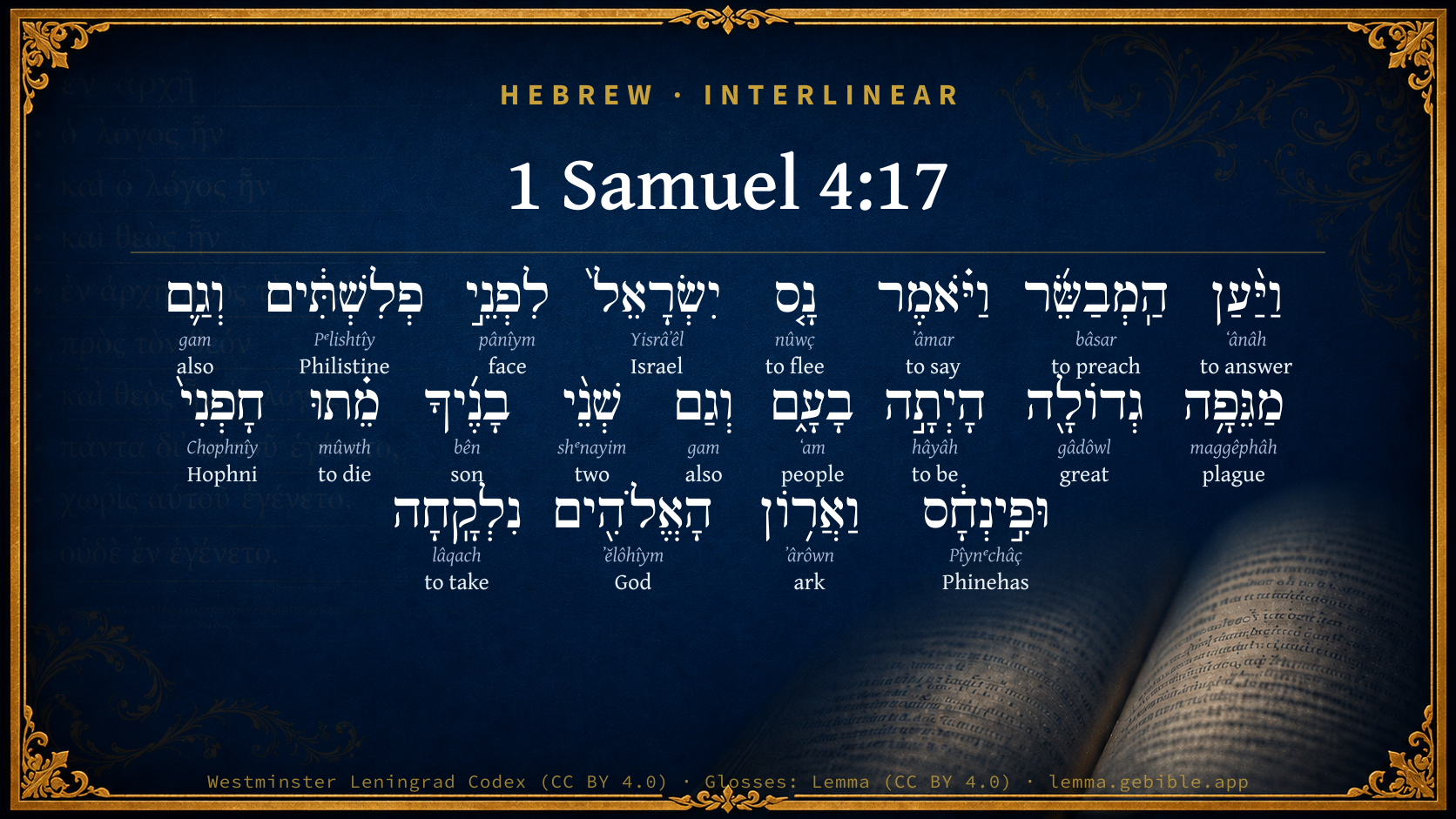
1 Samuel 4:17

Hebrew (Westminster Leningrad Codex) 1 Samuel 4:17 appears in the Hebrew Old Testament. The text above is from the Westminster Leningrad Codex. Each word links to its Strong’s number, a concise gloss, and parsing drawn from the Open Scriptures Hebrew Bible morphology. Click any word for its full Brown-Driver-Briggs (BDB) entry.
Download image
Cite this verse

1 Samuel 4:17 (World English Bible). Public Domain. Lemma interlinear Bible study tool, https://lemma.gebible.app/v/1-samuel/4/17.

Show BibTeX & RIS
BibTeX
RIS
English Translation
He who brought the news answered, Israel is fled before the Philistines, and there has been also a great slaughter among the people, and your two sons also, Hophni and Phinehas, are dead, and the ark of God is taken.
World English Bible · Public Domain
Highlights
  • 1 first appearance in the Hebrew Bible
Full analysis ↓
Download a study sheet

One document with this verse’s original text, its word-by-word gloss line, the meaning frame, cross-references with their text, attributed commentary, and full source and license credits — printable, and it pastes into notes with its structure intact.

This verse Autodidact and up

Study sheet (.html) Plain text (.txt)

A passage Seminary Student

Up to 50 verses in one chapter. A passage sheet keeps up to 6 commentary sources and 12 cross-references per verse, in the order this page ranks them, and says so on the sheet whenever that leaves anything out. Ask for a single verse and you get the Autodidact verse sheet above.

Everything on this page stays free to read, with no account — the sheet is a download of what is already on screen, not access to it.

Want to remove ads? Support Godless Engineer
Compare translations 3

The same verse in 3 English versions, stacked beneath the original-language interlinear above. Click any original word for its lexicon entry.

Each is an independent rendering of the whole verse — the interlinear is not word-aligned to these translations.

Highlighted words mark where these versions differ — a whole-verse word diff, not a word-by-word alignment.

  • World English Bible Public Domain
    He who brought the news answered, Israel is fled before the Philistines, and there has been also a great slaughter among the people, and your two sons also, Hophni and Phinehas, are dead, and the ark of God is taken.
  • King James Version Public Domain
    And the messenger answered and said, Israel is fled before the Philistines, and there hath been also a great slaughter among the people, and thy two sons also, Hophni and Phinehas, are dead, and the ark of God is taken.
  • unfoldingWord Literal Text CC BY-SA 4.0
    And the one bringing news answered and said, “Israel fled to the face of the Philistines. And also a great slaughter has been among the people. And also the two of your sons, Hophni and Phinehas, have died, and the Box of God has been taken.”

unfoldingWord Literal Text — © unfoldingWord, licensed CC BY-SA 4.0. Word-aligned USFM3 via Door43 (git.door43.org/unfoldingWord/en_ult).

Versions to compare (up to 4)

3 of 4 selected

Show all 18 translations

Every available English version of this verse, each an independent rendering of the whole verse.

  • World English Bible Public Domain
    He who brought the news answered, Israel is fled before the Philistines, and there has been also a great slaughter among the people, and your two sons also, Hophni and Phinehas, are dead, and the ark of God is taken.
  • Berean Standard Bible Public Domain
    The messenger answered, “Israel has fled before the Philistines, and there has been a great slaughter among the people. Your two sons, Hophni and Phinehas, are both dead, and the ark of God has been captured.”
  • Majority Standard Bible Public Domain
    The messenger answered, “Israel has fled before the Philistines, and there has been a great slaughter among the people. Your two sons, Hophni and Phinehas, are both dead, and the ark of God has been captured.”
  • King James Version Public Domain
    And the messenger answered and said, Israel is fled before the Philistines, and there hath been also a great slaughter among the people, and thy two sons also, Hophni and Phinehas, are dead, and the ark of God is taken.
  • American Standard Version (1901) Public Domain
    And he that brought the tidings answered and said, Israel is fled before the Philistines, and there hath been also a great slaughter among the people, and thy two sons also, Hophni and Phinehas, are dead, and the ark of God is taken.
  • Revised Version (1885) Public Domain
    And he that brought the tidings answered and said, Israel is fled before the Philistines, and there hath been also a great slaughter among the people, and thy two sons also, Hophni and Phinehas, are dead, and the ark of God is taken.
  • Geneva Bible (1599) Public Domain
    Then the messenger answered and sayd, Israel is fled before the Philistims, and there hath bene also a great slaughter among the people: and moreouer thy two sonnes, Hophni and Phinehas are dead, and the Arke of God is taken.
  • Douay-Rheims (1899) Public Domain
    And he that brought the news answered, and said: Israel has fled before the Philistines, and there has been a great slaughter of the people: moreover thy two sons, Ophni and Phinees, are dead: and the ark of God is taken.
  • Young's Literal Translation Public Domain
    And he who is bearing tidings answereth and saith, `Israel hath fled before the Philistines, and also a great slaughter hath been among the people, and also thy two sons have died -- Hophni and Phinehas -- and the ark of God hath been captured.'
  • Literal Standard Version CC BY-SA 4.0
    And he who is bearing tidings answers and says, “Israel has fled before the Philistines, and also a great slaughter has been among the people, and also your two sons have died—Hophni and Phinehas—and the Ark of God has been captured.”
  • Unlocked Literal Bible CC BY-SA 4.0
    The man who brought the news answered and said, “Israel fled from the Philistines. Also, there has been a great defeat among the people. Also, your two sons, Hophni and Phinehas, are dead, and the ark of God has been taken.”
  • unfoldingWord Literal Text CC BY-SA 4.0
    And the one bringing news answered and said, “Israel fled to the face of the Philistines. And also a great slaughter has been among the people. And also the two of your sons, Hophni and Phinehas, have died, and the Box of God has been taken.”
  • Darby Bible Public Domain
    And the messenger answered and said, Israel has fled before the Philistines, and there has been also a great slaughter among the people, and thy two sons also, Hophni and Phinehas, are dead, and the ark of God is taken.
  • World Messianic Bible Public Domain
    He who brought the news answered, “Israel has fled before the Philistines, and there has been also a great slaughter among the people. Your two sons also, Hophni and Phinehas, are dead, and God’s ark has been captured.”
  • Webster's Bible Public Domain
    And the messenger answered and said, Israel hath fled before the Philistines, and there hath been also a great slaughter among the people, and thy two sons also, Hophni and Phinehas, are dead, and the ark of God is taken.
  • Free Bible Version CC BY-SA 4.0
    “Israel ran away from the Philistines—we were badly defeated,” the messenger replied. “Also your two sons, Hophni and Phinehas, were killed, and the Ark of God has been captured.”
  • Bible in Basic English Public Domain
    And the man said, Israel went in flight from the Philistines, and there has been great destruction among the people, and your two sons, Hophni and Phinehas, are dead, and the ark of God has been taken.
  • JPS Tanakh (1917) Public Domain
    And he that brought the tidings answered and said: 'Israel is fled before the Philistines, and there hath been also a great slaughter among the people, and thy two sons also, Hophni and Phinehas, are dead, and the ark of God is taken.'

Literal Standard Version (2020), Covenant Press — licensed CC BY-SA 4.0. Text via the HelloAO Bible API (eBible.org). Unlocked Literal Bible (unfoldingWord) — licensed CC BY-SA 4.0. Text via the HelloAO Bible API (eBible.org). unfoldingWord Literal Text — © unfoldingWord, licensed CC BY-SA 4.0. Word-aligned USFM3 via Door43 (git.door43.org/unfoldingWord/en_ult). Free Bible Version, Dr. Jonathan Gallagher — licensed CC BY-SA 4.0. Text via the HelloAO Bible API (eBible.org).

Word by word

More ways to search: Search by grammar → Find every occurrence → Compare this word →

Practice this passage: Drill this verse → Learn its vocabulary →

חָפְנִי֙
Chophnîy
H2652
“Hophni”
Noun, Proper
Part of Speech
Noun
Type
Proper
Full BDB Definition

Origin: from H2651

TWOT: None

Hophni = "pugilist" - one of the two sons of Eli who were priests at Shiloh and were noted for their brutality and lust; their sinfulness provoked a curse against their father's house and were judged by the Lord when they took the ark into battle; the ark was lost and both brothers were killed and Eli died when he heard the news
  1. וַיַּ֨עַן ʻânâh H6030 “and · to answer” Conjunction + Verb, Qal, Sequential Imperfect, 3rd Person, Masculine, Singular
  2. הַֽמְבַשֵּׂ֜ר bâsar H1319 “the · preaching” Particle, Definite Article + Verb, Piel, Participle Active, Masculine, Singular, Absolute
  3. וַיֹּ֗אמֶר ʼâmar H559 “and · to say” Conjunction + Verb, Qal, Sequential Imperfect, 3rd Person, Masculine, Singular
  4. נָ֤ס nûwç H5127 “to flee” Verb, Qal, Perfect, 3rd Person, Masculine, Singular
  5. יִשְׂרָאֵל֙ Yisrâʼêl H3478 “Israel” Noun, Proper
  6. לִפְנֵ֣י pânîym H6440 “to/for · face(s) of” Preposition + Noun, Common, Both, Plural, Construct
  7. פְלִשְׁתִּ֔ים Pᵉlishtîy H6430 “Philistines” Noun, Gentilic, Masculine, Plural, Absolute
  8. וְגַ֛ם gam H1571 “and · also” Conjunction + Particle, Accusative
  9. מַגֵּפָ֥ה maggêphâh H4046 “plague” Noun, Common, Feminine, Singular, Absolute
  10. גְדוֹלָ֖ה gâdôwl H1419 “great” Adjective, Adjective, Feminine, Singular, Absolute
  11. הָיְתָ֣ה hâyâh H1961 “to be” Verb, Qal, Perfect, 3rd Person, Feminine, Singular
  12. בָעָ֑ם ʻam H5971 “in/at the · people” Preposition, Determined + Noun, Common, Masculine, Singular, Absolute
  13. וְגַם gam H1571 “and · also” Conjunction + Particle, Accusative
  14. שְׁנֵ֨י shᵉnayim H8147 “two” Adjective, Cardinal number, Masculine, Dual, Construct
  15. בָנֶ֜יךָ bên H1121 “sons · your” Noun, Common, Masculine, Plural, Construct + Suffix, Personal, 2nd Person, Masculine, Singular
  16. מֵ֗תוּ mûwth H4191 “to die” Verb, Qal, Perfect, 3rd Person, Common, Plural
  17. וּפִ֣ינְחָ֔ס Pîynᵉchâç H6372 “and · Phinehas” Conjunction + Noun, Proper
  18. וַאֲר֥וֹן ʼârôwn H727 “and · ark of” Conjunction + Noun, Common, Both, Singular, Construct
  19. הָאֱלֹהִ֖ים ʼĕlôhîym H430 “the · God(s)” Particle, Definite Article + Noun, Common, Masculine, Plural, Absolute
  20. נִלְקָֽחָה lâqach H3947 “to take” Verb, Niphal, Perfect, 3rd Person, Feminine, Singular

About this verse

These counts appear in no published source. They are computed here, from the morphology-tagged text and Lemma’s own curated glosses. What Lemma adds →

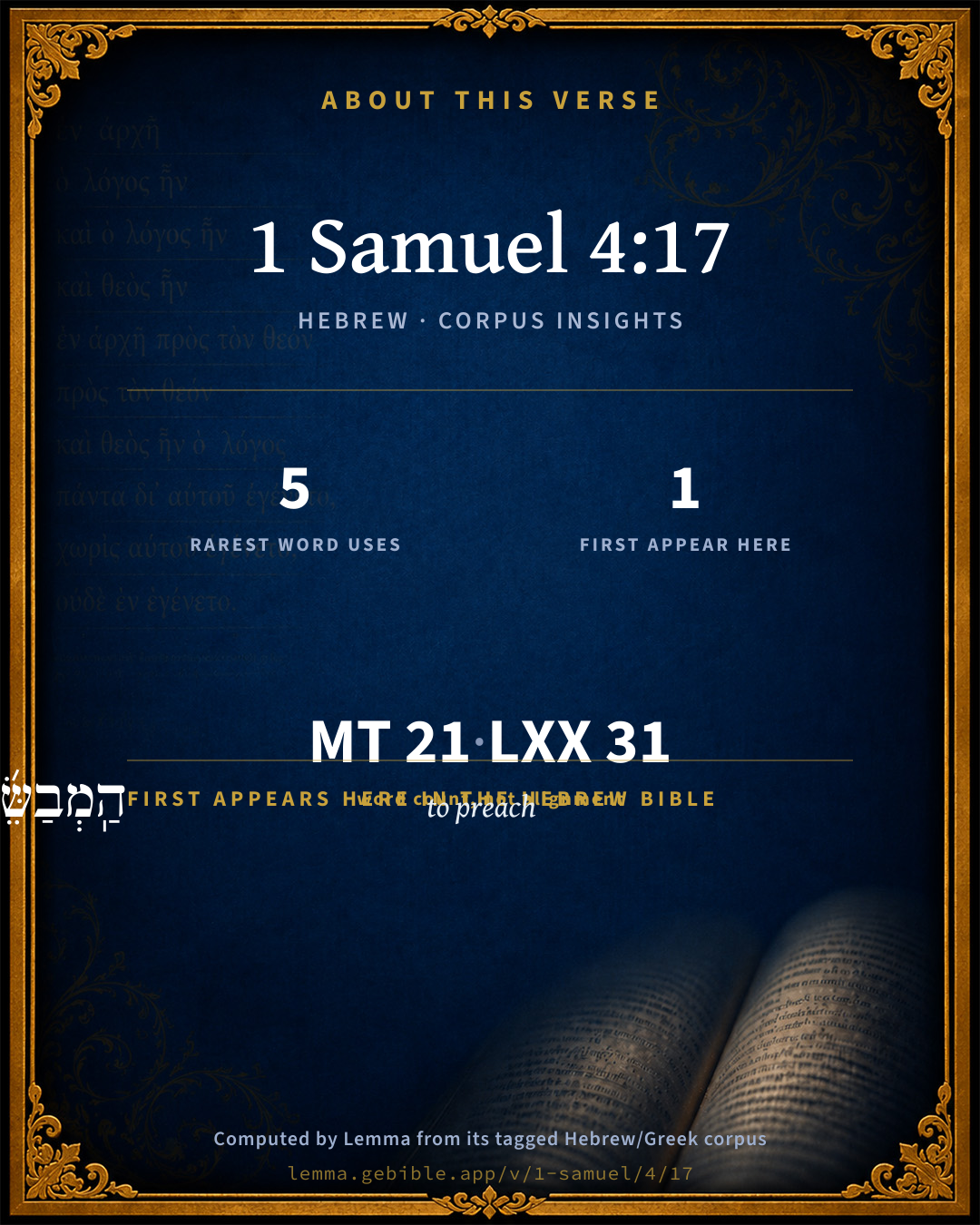
21
words
20
distinct lemmas
Historical
section

Notable vocabulary

The rarest word here is חָפְנִי֙ Hophni H2652 — appearing just 5 times in the whole Hebrew Bible.

First appearance in Scripture

This word makes its first canonical appearance in the Hebrew Bible here:

  • הַֽמְבַשֵּׂ֜ר to preach H1319

Shared distinctive vocabulary

חָפְנִי֙ Hophni H2652 occurs in 5 verses of the Hebrew Bible. Also found in:

Grammatical profile

  • 7 verbs
  • 10 nouns
  • 2 adjectives
  • 2 particles

Verb forms

  • וַיַּ֨עַן Qal · Sequential Imperfect
  • הַֽמְבַשֵּׂ֜ר Piel · Participle Active
  • וַיֹּ֗אמֶר Qal · Sequential Imperfect
  • נָ֤ס Qal · Perfect
  • הָיְתָ֣ה Qal · Perfect
  • מֵ֗תוּ Qal · Perfect
  • נִלְקָֽחָה Niphal · Perfect

Repetition

A word recurs within this verse — often emphatic in Hebrew:

  • וְגַ֛ם also H1571 ×2

Hebrew & Septuagint length

In English translation the verse runs 40 words from the Hebrew and 40 from the Septuagint (LXX English) — the same length.

A rough comparison of the two English renderings, which tokenize alike — not a word-level alignment.

Word counts can differ between the Hebrew and the Greek without any difference in meaning — e.g. the Hebrew direct-object marker אֵת has no separate Greek word, and Greek often adds the article ὁ.

In the original languages it is 21 Hebrew tokens and 31 Greek tokens — but the two are counted differently (Hebrew bundles its prefixes and suffixes into one token; the Greek is in lemma form), so that isn’t a like-for-like length.

Cross-references

2

Topical passages linked to 1 Samuel 4:17 in the Treasury of Scripture Knowledge — connected by theme and wording, ordered by reader-vote popularity; previews shown in the World English Bible.

  • 1 Samuel 3:11 Yahweh said to Samuel, Behold, I will do a thing in Israel, at which both the ears of everyone who hears it shall tingle.
  • 1 Samuel 4:10–11 The Philistines fought, and Israel was struck, and they fled every man to his tent: and there was a very great slaughter; for there fell of Israel thirty thousand footmen.

Cross-references courtesy of OpenBible.info (CC BY 4.0).

Hebrew and Greek witnesses Masoretic Hebrew ↔ Greek Septuagint

The same verse in the two great witnesses to the Old Testament, shown verse-for-verse.

These are two independent witnesses, not word-aligned to each other, and the Septuagint is shown in lemma (dictionary) form.

Hebrew 1 Samuel 4:17 Masoretic · Westminster Leningrad Codex

וַיַּ֨עַן הַֽמְבַשֵּׂ֜ר וַיֹּ֗אמֶר נָ֤ס יִשְׂרָאֵל֙ לִפְנֵ֣י פְלִשְׁתִּ֔ים וְגַ֛ם מַגֵּפָ֥ה גְדוֹלָ֖ה הָיְתָ֣ה בָעָ֑ם וְגַם שְׁנֵ֨י בָנֶ֜יךָ מֵ֗תוּ חָפְנִי֙ וּפִ֣ינְחָ֔ס וַאֲר֥וֹן הָאֱלֹהִ֖ים נִלְקָֽחָה

He who brought the news answered, Israel is fled before the Philistines, and there has been also a great slaughter among the people, and your two sons also, Hophni and Phinehas, are dead, and the ark of God is taken.

World English Bible · Public Domain

Greek LXX 1 Samuel 4:17 Septuagint · lemma form

καί ἀποκρίνω ὁ παιδάριον καί εἶπον φεύγω ἀνήρ ἰσραήλ ἐκ πρόσωπον ἀλλόφυλος καί γίγνομαι πληγή μέγας ἐν ὁ λαός καί ἀμφότεροι ὁ υἱός σύ θνήσκω καί ὁ κιβωτός ὁ θεός λαμβάνω

And they young man answered and said, The men of Israel fled from the face of the Philistines, and there was a great slaughter among the people, and both your sons are dead, and the ark of God is taken.

LXX2012 (modern English Septuagint) · Public Domain

Hebrew: Westminster Leningrad Codex (CC BY 4.0). Greek: Septuagint (public domain); English from LXX2012 (modern English Septuagint) (Public Domain). How the Septuagint differs from the Hebrew →

Targum (Aramaic paraphrase)

1

The Targum is the ancient Jewish Aramaic paraphrase of the Hebrew Scriptures — an interpretive translation, not the Hebrew text itself. Onkelos (literal) and Pseudo-Jonathan (expansive) render the Torah, and Jonathan the Prophets. Coverage is partial: where no permissively-licensed English translation exists for a verse, only the Aramaic is shown. This is verse-level text, not a word-by-word alignment to the Hebrew.

  1. Targum Jonathan Prophets (Joshua–Malachi)
    וַאֲתֵיב דִמְבַשֵׂר וַאֲמַר אַפֵּךְ יִשְׂרָאֵל קֳדָם פְּלִשְׁתָּאֵי וְאַף מְחָתָא רַבְּתָא הֲוַת בְּעַמָא וְאַף תְּרֵין בְּנָךְ אִתְקְטָלוּ חָפְנִי וּפִינְחָס וַאֲרוֹנָא דַייָ אִשְׁתְּבִי:

    (no public-domain English translation for this verse)

    Targum Jonathan — Aramaic: “Mikraot Gedolot” (public domain). English: “Sefaria Community Translation” (CC0 1.0 (public-domain dedication)); “London "Chaldee Paraphrase," 1871” (public domain). Text via Sefaria.

Commentary

Notes on 1 Samuel 4:17 from classic Christian and Jewish commentators (each source and its license shown beneath its notes). The classic Christian expositions comment on the surrounding passage and are grouped to its opening verse, so a note may address several verses; the Jewish commentaries on the Tanakh (Rashi and others) are per-verse, so they appear only where the commentator wrote on this verse.

Lemma curates 59 commentaries, every one of them public domain or Creative Commons licensed, each selected and text-cleaned for this edition rather than reprinted as found. About our sources →

Trapp's Complete Commentary

John Trapp

1Sa 4:17 And the messenger answered and said, Israel is fled before the Philistines, and there hath been also a great slaughter among the people, and thy two sons also, Hophni and Phinehas, are dead, and the ark of God is taken.

Ver. 17. Israel is fled, &c.] Themselves had by their sins abandoned the victory, and sent it to the enemy. They should have said as Jerome {a} did after the overthrow of the Roman army by the barbarians, Infelices nos qui tantum displicemus Deo, ut per rabiem barbarorum illius in nos ira desaeviat.

{a} Epist. iii. Ad Heliodor.

John Trapp, A Commentary or Exposition upon All the Books of the Old and New Testament (1647–1656) — public domain. Text from a community e-Sword module.

Geneva Bible (1599)

Geneva Bible translators

According as God had afore said.

Geneva Bible (1599) marginal notes — public domain. Text via Bolls.life.

Adam Clarke's Commentary

Verse 17. And the messenger answered] Never was a more afflictive message, containing such a variety of woes, each rising above the preceding, delivered in so few words.

1. Israel is fled before the Philistines.

This was a sore evil: that Israel should turn their backs upon their enemies, was bad; and that they should turn their backs on such enemies as the Philistines, was yet worse; for now they might expect the chains of their slavery to be strengthened and riveted more closely.

2. There hath also been a great slaughter among the people.

A rout might have taken place without any great previous slaughter; but in this case the field was warmly contested, thirty thousand were laid dead on the spot. This was a deeper cause of distress than the preceding; as if he had said, "The flower of our armies is destroyed; scarcely a veteran now to take the field."

3. Thy two sons also, Hophni and Phinehas, are dead.

This was still more afflictive to him as a father, to lose both his sons, the only hope of the family; and to have them taken away by a violent death when there was so little prospect of their having died in the peace of God, was more grievous than all.

4. The ark of God is taken.

This was the most dreadful of the whole; now Israel is dishonoured in the sight of the heathen, and the name of the Lord will be blasphemed by them. Besides, the capture of the ark shows that God is departed from Israel; and now there is no farther hope of restoration for the people, but every prospect of the destruction of the nation, and the final ruin of all religion! How high does each wo rise on the back of the preceding! And with what apparent art is this very laconic message constructed! And yet, probably, no art at all was used, and the messenger delivered the tidings just as the facts rose up in his own mind.

How vapid, diffused, and alliterated, is the report of the messenger in the Persae of AEschylus, who comes to the queen with the tremendous account of the destruction of the whole naval power of the Persians, at the battle of Salamis? I shall give his first speech, and leave the reader to compare the two accounts.

Ω γης ἁπασης Ασιδος πολισματα,

Ω Περσις αια, και πολυς πλουτου λιμην,

Ὡς εν μιᾳ πληγῃ κατεφθαρται πολυς

Ολβος, το Περσων δ' ανθος οιχται πεσον.

Ωμοι, κακον μεν πρωτον αγγελλειν κακα·

Περσαις, στρατος γαρ πας αλωλε βαρβαρων.

Of which I subjoin the following translation by Mr. Potter: -

Wo to the towns through Asia's peopled realms!

Wo to the land of Persia, once the port

Of boundless wealth! how is thy glorious state

Vanish'd at once, and all thy spreading honours

Fallen, lost! Ah me! unhappy is his task

That bears unhappy tidings; but constraint

Compels me to relate this tale of wo:

Persians! the whole barbaric host is fallen.

This is the sum of his account, which he afterwards details in about a dozen of speeches.

Heroes and conquerors, ancient and modern, have been celebrated for comprising a vast deal of information in a few words. I will give three examples, and have no doubt that the Benjamite in the text will be found to have greatly the advantage.

1. Julius Caesar having totally defeated Pharnaces, king of Pontus, wrote a letter to the Roman senate, which contained only these three words: -

VENI, VIDI, VICI;

I came, I saw, I conquered. This war was begun and ended in one day.

2. Admiral HAWKE having totally defeated the French fleet, in 1759, off the coast of Brittany, wrote as follows to King George II.:-

"SIRE, I have taken, burnt, and destroyed all the French fleet, as per margin. - HAWKE."

3. NAPOLEON BUONAPARTE, then general-in-chief of the French armies in Italy, wrote to Josephine, his wife, the evening before he attacked Field Marshal Alvinzi, the imperial general: -

"Demain j'attaquerai l'enemie; je le battrai; et j'en finirai." "To-morrow I shall attack the enemy; I shall defeat them, and terminate the business." He did so: the imperialists were totally defeated, Mantua surrendered, and the campaign for that year (1796) was concluded.

In the above examples, excellent as they are in their kind, we find little more than one idea, whereas the report of the Benjamite includes several; for, in the most forcible manner, he points out the general and particular disasters of the day, the rout of the army, the great slaughter, the death of the priests, who were in effect the whole generals of the army, and the capture of the ark; all that, on such an occasion, could affect and distress the heart of an Israelite. And all this he does in four simple assertions.

Adam Clarke's Commentary on the Bible (1810–1826) — public domain. Text from a community e-Sword/MySword module.

The Cambridge Bible for Schools and Colleges

gen. ed. J. J. S. Perowne

17. Observe the climax. Each blow is heavier than the preceding one. The rout of the army, the slaughter of the people, Eli’s personal bereavement, the loss of the most precious treasure of Israel. The last blow is more than the aged High-priest can bear.

The Cambridge Bible for Schools and Colleges (gen. ed. J. J. S. Perowne; Cambridge University Press, 1878–1918) — public domain. Text from a community e-Sword module.

John Gill's Exposition

And the messenger answered and said,.... He delivered his account gradually, beginning with generals, and then proceeding to particulars, and with what he thought Eli could better bear the news of, and so prepared him for the worst; in which he acted a wise part:

Israel is fled before the Philistines; they have given way and retreated, and which might possibly be done without great loss, and which, though it was bad news, might not be so very bad:

and there hath also been a great slaughter among the people; this is worse news still; however, the number of the slain is not given, nor any mention of particular persons that were killed: so that, for any thing yet said, his own sons might be safe: but then it follows:

and thy two sons also, Hophni and Phinehas, are dead; the news of which must be very affecting to him, and strike him closely; though he might expect and be prepared for it by what both the man of God and Samuel from the Lord had related to him:

and the ark of God is taken; the thing he feared, and his heart trembled before for it; this was the closing and cutting part of the account; the messenger foresaw that this would the most affect him, and therefore referred it to the last.

John Gill's Exposition of the Whole Bible (1746–1763) — public domain (CC PDM 1.0). Text via the HelloAO Bible API.

Haydock's Catholic Bible Commentary

Taken. Every sentence expresses something more distressing to the aged judge and father; the flight and slaughter of his people, the ruin of his children, and the loss of the ark, which must have filled all Israel with a mortal gloom and terror, lest God should have abandoned them. So many dismal circumstances oppressing the heart of Heli, he fainted away, and falling backwards, expired. (Haydock) --- The Scripture takes notice of his great age, that we might not think that he killed himself in despair. (Salien)

George Leo Haydock (1774–1849), Haydock's Catholic Family Bible and Commentary, 1859 edition — public domain. Excludes Psalms (Douay-Rheims chapter numbering differs from Protestant) and Deuterocanonical books (Catholic canon only).

Whedon's Commentary on the Bible

Daniel D. Whedon

17. The messenger answered and said — The simple, direct, and yet climacteric way in which the messenger tells his tale of sorrow has attracted the notice of all critics. How few the words used to relate all the items of this thrilling message! How each successive statement rises in the announcement of a still severer loss! First he says:

Israel is fled before the Philistines — This was the beginning of sorrows.

A great slaughter among the people — This was worse than flight, and the cause of lamentation in thousands of Israelitish homes.

Thy two sons also, Hophni and Phinehas, are dead — Most terrible tidings for a devoted father! And perhaps those sons had gone forth to the field of battle despite the father’s prayer and entreaties. Thus was fulfilled the prophecy of the man of God who had before announced the downfall of his house, (1Sa_2:34,) and this was to be for Eli the sign of yet heavier woes.

The ark of God is taken — This was the calamity of the tabernacle in that which was Israel’s highest hope and glory. 1Sa_2:32. The ark was the symbol of the Divine Presence, and its loss foreshadowed, in Eli’s mind, the utter destruction of his nation and the abolishment of Jehovah’s covenant with them. In Jdg_18:30, this capture of the ark is called “the captivity of the land,” so deeply was it, from the theocratic standpoint, identified and associated with the highest interests and holiest hopes of all Israel. And the wickedness of his sons had been largely the cause of all this woe! All these thoughts, and many more, rushed in upon his mind as the last terrible announcement fell upon his ear, and his enfeebled constitution and trembling heart could not endure the shock.

Daniel D. Whedon (gen. ed.), Commentary on the Old and New Testaments (1874–1909) — public domain. Text from a community e-Sword module.

Lesson kit

Teaching starters — assembled from the data on this page, not authored interpretation. Every prompt links to the verse data it draws on. Edit before teaching.

1 Samuel, in the Historical, opens this verse with 21 words (20 distinct Hebrew lemmas). Its most distinctive word is Chophnîy (“Hophni”). A historical commentator’s framing appears above. Read the whole chapter for the surrounding context.

Discussion questions

  1. What does “Hophni” (Chophnîy) contribute to the verse as a whole?
  2. The word “to preach” first appears here in Scripture. What is being introduced at this debut?
  3. 1 Samuel 1:3 shares the word «Hophni» with this verse. How do the two illuminate each other?
  4. “also” occurs 2× in this one verse. What is the effect of the repetition?
  5. These translations render this verse differently; the difference is in the English rendering, not the original. What questions does that raise?
  6. The verb «וַיַּ֨עַן» is Qal Sequential Imperfect. How does its form color the action?
  7. Reading how Trapp's Complete Commentary and Geneva Bible (1599) read this verse, where do the two commentators agree and where do they part?

Things to notice

Reading settings

Reading text

Shown beneath each verse's original-language words.

Old Testament
Old Testament edition

Read the OT as the Masoretic Hebrew (MT) or the Greek Septuagint (LXX).

English shown for the Greek Septuagint (in the Hebrew ↔ Greek comparison).

Comparing translations? Open the Compare panel on any verse page to stack up to four side by side.