Exodus 40:17

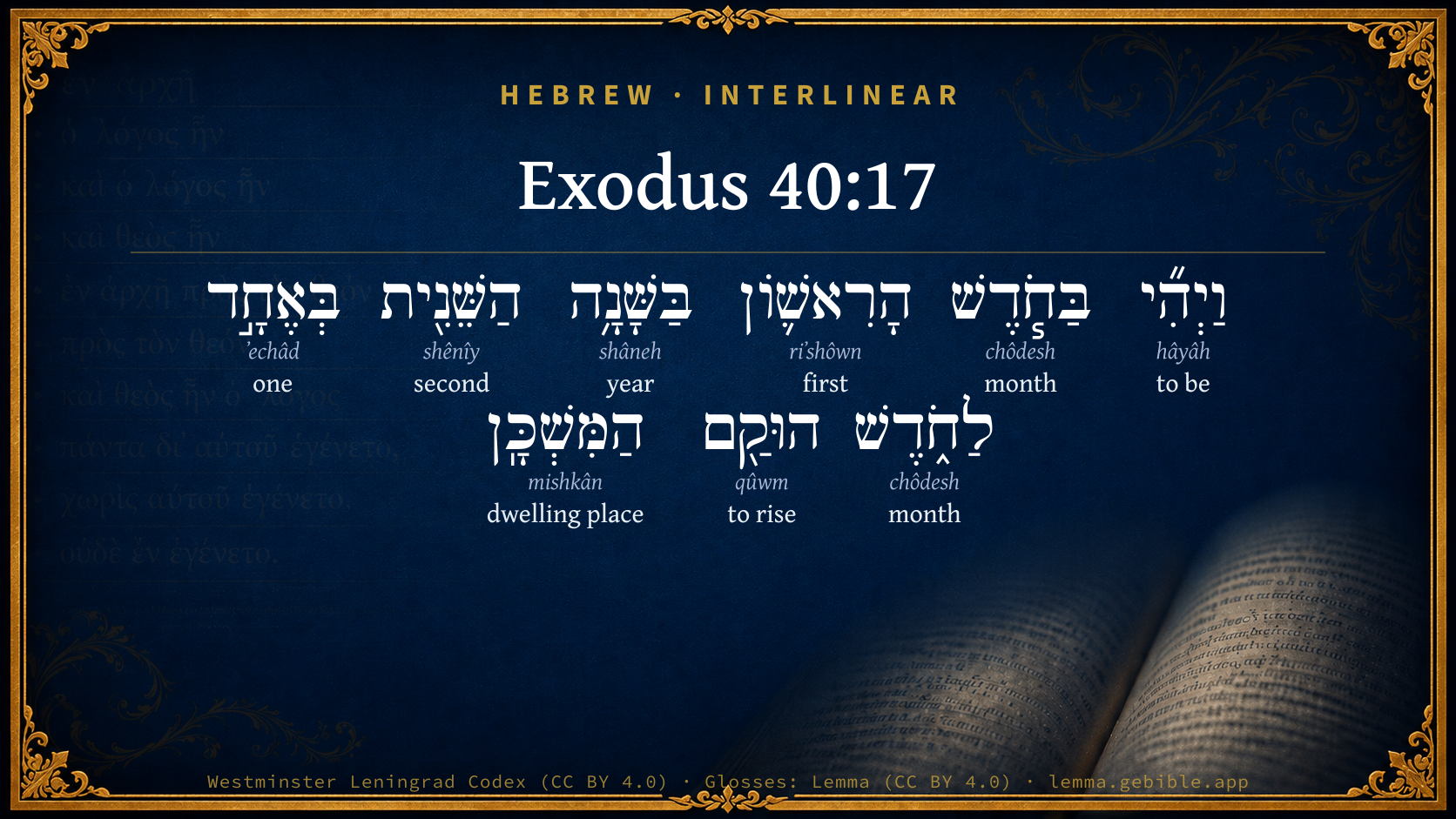
Hebrew (Westminster Leningrad Codex) Exodus 40:17 appears in the Hebrew Old Testament. The text above is from the Westminster Leningrad Codex. Each word links to its Strong’s number, a concise gloss, and parsing drawn from the Open Scriptures Hebrew Bible morphology. Click any word for its full Brown-Driver-Briggs (BDB) entry.
Download image
Cite this verse

Exodus 40:17 (World English Bible). Public Domain. Lemma interlinear Bible study tool, https://lemma.gebible.app/v/exodus/40/17.

Show BibTeX & RIS
BibTeX
RIS
English Translation
It happened in the first month in the second year, on the first day of the month, that the tent was raised up.
World English Bible · Public Domain
Download a study sheet

One document with this verse’s original text, its word-by-word gloss line, the meaning frame, cross-references with their text, attributed commentary, and full source and license credits — printable, and it pastes into notes with its structure intact.

This verse Autodidact and up

Study sheet (.html) Plain text (.txt)

A passage Seminary Student

Up to 50 verses in one chapter. A passage sheet keeps up to 6 commentary sources and 12 cross-references per verse, in the order this page ranks them, and says so on the sheet whenever that leaves anything out. Ask for a single verse and you get the Autodidact verse sheet above.

Everything on this page stays free to read, with no account — the sheet is a download of what is already on screen, not access to it.

Want to remove ads? Support Godless Engineer
Compare translations 3

The same verse in 3 English versions, stacked beneath the original-language interlinear above. Click any original word for its lexicon entry.

Each is an independent rendering of the whole verse — the interlinear is not word-aligned to these translations.

Highlighted words mark where these versions differ — a whole-verse word diff, not a word-by-word alignment.

  • World English Bible Public Domain
    It happened in the first month in the second year, on the first day of the month, that the tent was raised up.
  • King James Version Public Domain
    And it came to pass in the first month in the second year, on the first day of the month, that the tabernacle was reared up.
  • unfoldingWord Literal Text CC BY-SA 4.0
    And it was in the first month, the second year, on the first of the month the Dwelling was raised up.

unfoldingWord Literal Text — © unfoldingWord, licensed CC BY-SA 4.0. Word-aligned USFM3 via Door43 (git.door43.org/unfoldingWord/en_ult).

Versions to compare (up to 4)

3 of 4 selected

Show all 18 translations

Every available English version of this verse, each an independent rendering of the whole verse.

  • World English Bible Public Domain
    It happened in the first month in the second year, on the first day of the month, that the tent was raised up.
  • Berean Standard Bible Public Domain
    So the tabernacle was set up on the first day of the first month of the second year.
  • Majority Standard Bible Public Domain
    So the tabernacle was set up on the first day of the first month of the second year.
  • King James Version Public Domain
    And it came to pass in the first month in the second year, on the first day of the month, that the tabernacle was reared up.
  • American Standard Version (1901) Public Domain
    And it came to pass in the first month in the second year, on the first day of the month, that the tabernacle was reared up.
  • Revised Version (1885) Public Domain
    And it came to pass in the first month in the second year, on the first day of the month, that the tabernacle was reared up.
  • Geneva Bible (1599) Public Domain
    Thus was the Tabernacle reared vp the first day of the first moneth in the seconde yeere.
  • Douay-Rheims (1899) Public Domain
    And spread the roof over the tabernacle, putting over it a cover, as the Lord had commanded.
  • Young's Literal Translation Public Domain
    And it cometh to pass, in the first month, in the second year, in the first of the month, the tabernacle hath been raised up;
  • Literal Standard Version CC BY-SA 4.0
    And it comes to pass, in the first month, in the second year, on the first of the month, the Dwelling Place has been raised up;
  • Unlocked Literal Bible CC BY-SA 4.0
    So the tabernacle was set up on the first day of the first month in the second year.
  • unfoldingWord Literal Text CC BY-SA 4.0
    And it was in the first month, the second year, on the first of the month the Dwelling was raised up.
  • Darby Bible Public Domain
    And it came to pass in the first month in the second year, on the first of the month, that the tabernacle was set up.
  • World Messianic Bible Public Domain
    In the first month in the second year, on the first day of the month, the tabernacle was raised up.
  • Webster's Bible Public Domain
    And it came to pass in the first month, in the second year, on the first day of the month, that the tabernacle was reared up.
  • Free Bible Version CC BY-SA 4.0
    The Tabernacle was put up on the first day of the first month of the second year.
  • Bible in Basic English Public Domain
    So on the first day of the first month in the second year the House was put up.
  • JPS Tanakh (1917) Public Domain
    And it came to pass in the first month in the second year, on the first day of the month, that the tabernacle was reared up.

Literal Standard Version (2020), Covenant Press — licensed CC BY-SA 4.0. Text via the HelloAO Bible API (eBible.org). Unlocked Literal Bible (unfoldingWord) — licensed CC BY-SA 4.0. Text via the HelloAO Bible API (eBible.org). unfoldingWord Literal Text — © unfoldingWord, licensed CC BY-SA 4.0. Word-aligned USFM3 via Door43 (git.door43.org/unfoldingWord/en_ult). Free Bible Version, Dr. Jonathan Gallagher — licensed CC BY-SA 4.0. Text via the HelloAO Bible API (eBible.org).

Word by word

More ways to search: Search by grammar → Find every occurrence → Compare this word →

Practice this passage: Drill this verse → Learn its vocabulary →

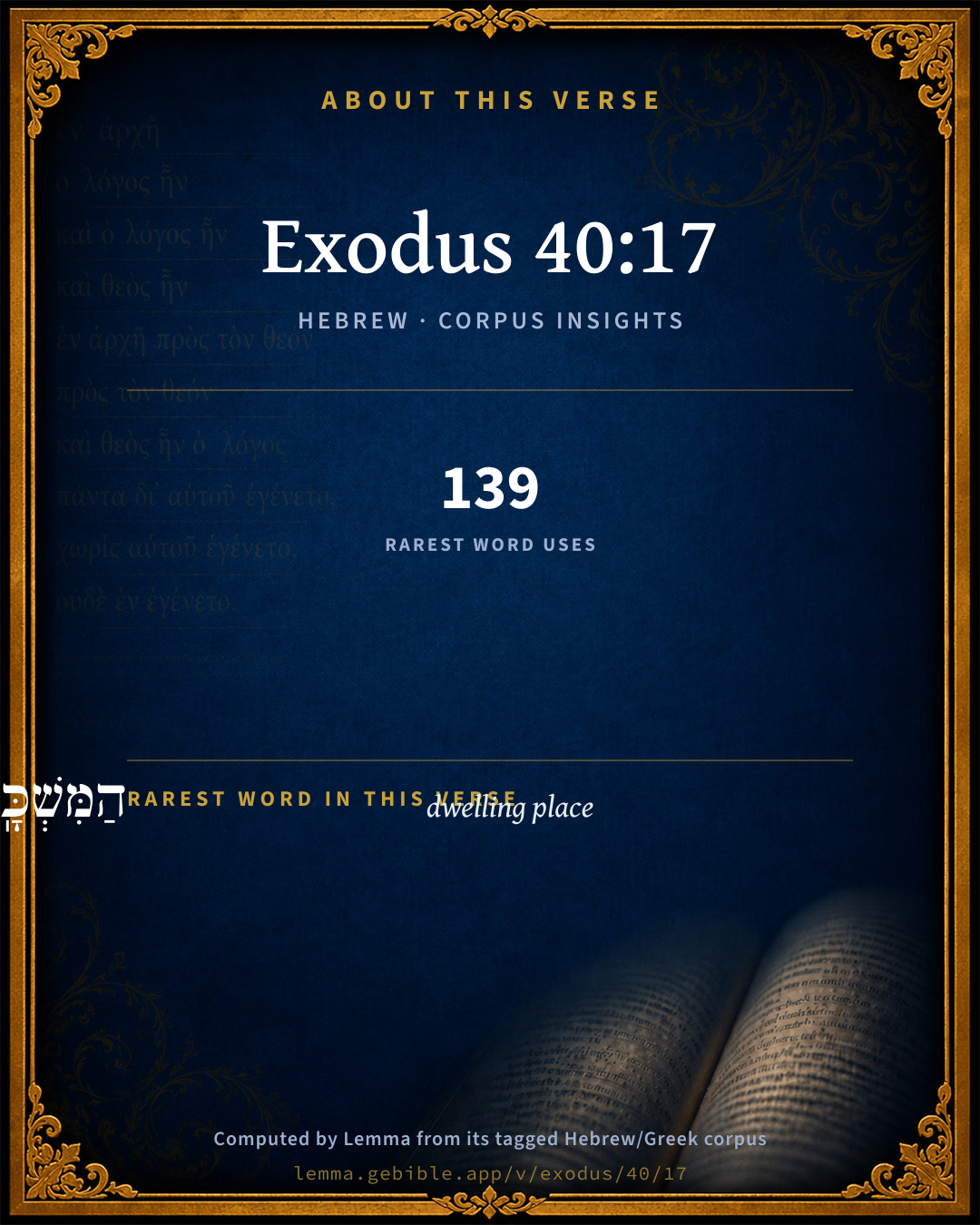
הַמִּשְׁכָּֽן
mishkân
H4908
“the · dwelling place”
Particle, Definite Article + Noun, Common, Masculine, Singular, Absolute
Part of Speech
Particle + Noun
Type
Common
Gender
Masculine
Number
Singular
State
Absolute
Full BDB Definition

Origin: from H7931

TWOT: 2387c

dwelling place, tabernacle - dwelling-place - dwellings
  1. וַיְהִ֞י hâyâh H1961 “and · to be” Conjunction + Verb, Qal, Sequential Imperfect, 3rd Person, Masculine, Singular
  2. בַּחֹ֧דֶשׁ chôdesh H2320 “in/at the · month” Preposition, Determined + Noun, Common, Masculine, Singular, Absolute
  3. הָרִאשׁ֛וֹן riʼshôwn H7223 “the · first” Particle, Definite Article + Adjective, Ordinal number, Masculine, Singular, Absolute
  4. בַּשָּׁנָ֥ה shâneh H8141 “in/at the · year” Preposition, Determined + Noun, Common, Feminine, Singular, Absolute
  5. הַשֵּׁנִ֖ית shênîy H8145 “the · second” Particle, Definite Article + Adjective, Ordinal number, Feminine, Singular, Absolute
  6. בְּאֶחָ֣ד ʼechâd H259 “in/at · one” Preposition + Adjective, Cardinal number, Masculine, Singular, Absolute
  7. לַחֹ֑דֶשׁ chôdesh H2320 “to/for the · month” Preposition, Determined + Noun, Common, Masculine, Singular, Absolute
  8. הוּקַ֖ם qûwm H6965 “to rise” Verb, Hophal, Perfect, 3rd Person, Masculine, Singular

About this verse

These counts appear in no published source. They are computed here, from the morphology-tagged text and Lemma’s own curated glosses. What Lemma adds →

9
words
8
distinct lemmas
Pentateuch
section

Grammatical profile

  • 2 verbs
  • 4 nouns
  • 3 adjectives

Verb forms

  • וַיְהִ֞י Qal · Sequential Imperfect
  • הוּקַ֖ם Hophal · Perfect

Repetition

A word recurs within this verse — often emphatic in Hebrew:

  • בַּחֹ֧דֶשׁ month H2320 ×2

Hebrew & Septuagint length

In English translation the verse runs 23 words from the Hebrew and 30 from the Septuagint (LXX English) — closely comparable.

A rough comparison of the two English renderings, which tokenize alike — not a word-level alignment.

Word counts can differ between the Hebrew and the Greek without any difference in meaning — e.g. the Hebrew direct-object marker אֵת has no separate Greek word, and Greek often adds the article ὁ.

Cross-references

3

Topical passages linked to Exodus 40:17 in the Treasury of Scripture Knowledge — connected by theme and wording, ordered by reader-vote popularity; previews shown in the World English Bible.

  • Numbers 7:1 It happened on the day that Moses had finished setting up the tabernacle, and had anointed it and sanctified it, with all its furniture, and the altar with all its vessels, and had anointed and sanctified them;
  • Exodus 40:1–2 Yahweh spoke to Moses, saying,
  • Numbers 9:1 Yahweh spoke to Moses in the wilderness of Sinai, in the first month of the second year after they had come out of the land of Egypt, saying,

Cross-references courtesy of OpenBible.info (CC BY 4.0).

Hebrew and Greek witnesses Masoretic Hebrew ↔ Greek Septuagint

The same verse in the two great witnesses to the Old Testament, shown verse-for-verse.

These are two independent witnesses, not word-aligned to each other, and the Septuagint is shown in lemma (dictionary) form.

Hebrew Exodus 40:17 Masoretic · Westminster Leningrad Codex

וַיְהִ֞י בַּחֹ֧דֶשׁ הָרִאשׁ֛וֹן בַּשָּׁנָ֥ה הַשֵּׁנִ֖ית בְּאֶחָ֣ד לַחֹ֑דֶשׁ הוּקַ֖ם הַמִּשְׁכָּֽן

It happened in the first month in the second year, on the first day of the month, that the tent was raised up.

World English Bible · Public Domain

Greek LXX Exodus 40:17 Septuagint · lemma form

καί γίγνομαι ἐν ὁ μήν ὁ πρῶτος ὁ δεύτερος ἔτος ἐκπορεύομαι αὐτός ἐκ αἴγυπτος νουμηνία ἵστημι ὁ σκηνή

And it came to pass in the first month, in the second year after their going forth out of Egypt, at the new moon, that the tabernacle was set up.

LXX2012 (modern English Septuagint) · Public Domain

Hebrew: Westminster Leningrad Codex (CC BY 4.0). Greek: Septuagint (public domain); English from LXX2012 (modern English Septuagint) (Public Domain). How the Septuagint differs from the Hebrew →

Targum (Aramaic paraphrase)

2

The Targum is the ancient Jewish Aramaic paraphrase of the Hebrew Scriptures — an interpretive translation, not the Hebrew text itself. Onkelos (literal) and Pseudo-Jonathan (expansive) render the Torah, and Jonathan the Prophets. Coverage is partial: where no permissively-licensed English translation exists for a verse, only the Aramaic is shown. This is verse-level text, not a word-by-word alignment to the Hebrew.

  1. Targum Onkelos Torah (Genesis–Deuteronomy)
    וַהֲוָה בְּיַרְחָא קַדְמָאָה בְּשַׁתָּא תִנְיֵתָא בְּחַד לְיַרְחָא אִתָּקַם מַשְׁכְּנָא:

    (no public-domain English translation for this verse)

    Targum Onkelos — Aramaic: “Onkelos Genesis” (public domain); “Onkelos Exodus” (public domain); “Onkelos Leviticus” (public domain); “Onkelos Numbers” (public domain); “Onkelos Deuteronomy” (public domain). English: “Sefaria Community Translation” (CC0 1.0 (public-domain dedication)); “J.W. Etheridge. The Targums of Onkelos and Jonathan Ben Uzziel on the Pentateuch. London: Longmans, Green, 1862” (public domain). Text via Sefaria.

  2. Targum Pseudo-Jonathan Torah (Genesis–Deuteronomy)
    וַהֲוָה בְּיַרְחָא קַמָאָה הוּא יַרְחָא דְנִיסָן בְּשַׁתָּא תִּנְיֵינְתָא בְּחַד לְיַרְחָא אִיתָקַם מַשְׁכְּנָא

    And it was in the first month, that is, the month Nisan, in the second year, in the first of the month, that he reared up the tabernacle.

    Targum Pseudo-Jonathan — Aramaic: “Targum Jonathan on Genesis” (public domain); “Targum Jonathan on Exodus” (public domain); “Targum Jonathan on Leviticus” (public domain); “Targum Jonathan on Numbers” (public domain); “Targum Jonathan on Deuteronomy” (public domain). English: “The Targum of Jonathan ben Uzziel, trans. J. W. Etheridge, London, 1862” (public domain). Text via Sefaria.

Commentary

Notes on Exodus 40:17 from classic Christian and Jewish commentators (each source and its license shown beneath its notes). The classic Christian expositions comment on the surrounding passage and are grouped to its opening verse, so a note may address several verses; the Jewish commentaries on the Tanakh (Rashi and others) are per-verse, so they appear only where the commentator wrote on this verse.

Lemma curates 59 commentaries, every one of them public domain or Creative Commons licensed, each selected and text-cleaned for this edition rather than reprinted as found. About our sources →

Whedon's Commentary on the Bible

Daniel D. Whedon

ERECTION OF THE TABERNACLE, Exo_40:17-33.

17. It came to pass — After all the work of the tabernacle and its furniture was finished, as related in chaps. 36-39.

The first month — Abib, (Exo_13:4,) or Nisan, (Neh_2:1,) corresponding nearly with our April. See note on Exo_12:2.

The second year — The second year after the exodus. The deliverance from Egypt was an appropriate and memorable epoch in Hebrew chronology — the beginning of years, as Abib was the beginning of months. Compare 1Ki_6:1.

The first day of the month — Israel’s first free new year’s day, for the first day of the previous year had found them yet in the house of bondage, and fourteen days of that year passed before they departed from Egypt. About half the year had gone before they commenced the work of the tabernacle, for it was the third month when they reached the wilderness of Sinai, (Exo_19:1,) and Moses spent two periods of forty days each in the mount, (Exo_34:18; Exo 24:28,) which was nearly three months more. But six months was ample time for the work; for the tabernacle was no such elaborate structure as the temple of Solomon; and as the zeal of the people showed itself in their offering more than enough material for the structure, so that Moses had even to restrain them from bringing more, (Exo_36:5-7,) so also the work itself was doubtless carried forward with equal zeal till all was finished.

The tabernacle was reared up — According to the directions which the Lord had given Moses. Exo_40:1-6.

18. Moses reared up the tabernacle — We must not suppose that Moses personally and alone did all that is attributed to him in this chapter. He was probably assisted by Aaron and the “wise-hearted men.” Exo_36:1. But Moses had the oversight and command of all these, and Aaron and his sons were not yet set apart to the priesthood. The word rendered tabernacle here is mishcan, and is used both of the enclosure of boards, and of the ornamented cloth which is described in Exo_26:1-6. No mention is made of stakes, tent-pins, ropes, ridge-poles, etc., but all these are presupposed or implied in every erection of a tent. The description here given is very brief, and presupposes in the reader’s mind the fuller descriptions which have been given in the preceding chapters.

Sockets — The silver bases for the boards, (Exo_26:19-21,) and the brazen ones for the pillars, (Exo_26:37,) to rest in. These served to hold the boards and pillars in their places, and to keep them from decay. The sockets in which the boards rested probably formed in appearance a sort of plinth around the bottom of their walls.

The boards — Of shittim or acacia wood. which formed the inner enclosure. Exo_26:15-25; Exo_36:20-23.

The bars — These were also of shittim wood, and made to pass through gold rings, (or staples,) probably on the outside of the boards. Exo_26:26-29. They were five in number for each side and for the western end, the middle bar in each case reaching from end to end. Both the boards and the bars were overlaid with gold, presenting to the gaze of the beholder, either on the outside or within, a vast golden surface.

Pillars — Five in number, at the entrance or east end of the tent. Exo_26:37. There were also four pillars within the tabernacle to support the vail which separated the holy place from the holy of holies. Exo_26:32; Exo_36:36.

19. Spread abroad the tent over the tabernacle — The tent here refers to the curtains of goats’ hair, which, in Exo_26:7, are called “a covering upon the tabernacle.” The Hebrew words are the same in each passage, and designate the tent cloth which was placed over or above the ornamented curtains described in Exo_26:1-6. It served as a covering and protection for the “curtains of fine linen, and blue, and purple, and scarlet: with cherubim of cunning work.” Exo_26:1. These latter, according to Fergusson, (see p. 520,) formed the ornamented roof of the tabernacle as seen from the inside. They may, however, have been thrown over the board structure, and drawn down tightly on the outer sides. The objections to a flat roof would not apply to this set of curtains if thus adjusted, inasmuch as the tent of goat’s hair above it would have protected it from rain.

The covering of the tent above upon it — This was an additional covering made of rams’ skins, dyed red, and sealskins, and spread on the top of the goat’s hair canvas for a further protection from the weather. See Exo_26:14. These several coverings made the roofing utterly impervious to the rain.

As the Lord commanded Moses — This expression is here used seven times within the space of fourteen verses, (19-32,) and shows how very careful Moses was to make all things according to the pattern shown him by Jehovah. Compare Exo_25:9; Exo_25:40; Heb_8:5.

20. The testimony — The two tables of stone on which the ten commandments were written by the finger of God. Exo_31:18; Exo_32:15-16. Those first written were broken by Moses, (Exo_32:19,) but another set was afterward prepared. Exo_34:4. The decalogue graven on the two stone tablets was called the testimony, because it was Jehovah’s most emphatic testimony or witness against sin — a monumental expression of his will; and it was placed in the ark that it might be a witness against rebellion and sin in Israel. Compare Deu_31:26-27. When, after the lapse of several hundred years, the ark was deposited in the most holy place of the temple of Solomon, there was nothing in it but these two tables of stone. 1Ki_8:9. According to Heb_9:4, it originally contained also the golden pot of manna and Aaron’s rod that budded, though these latter, according to Exo_16:34, and Num_17:10, were placed “before the testimony.” Most writers have understood “before the testimony” as equivalent to before the ark; but according to the inspired writer of Hebrews it would mean before the testimony itself, that is, the tables inside the ark. For a description of the ark, the staves, and the mercy seat, see Exo_25:10-22.

21. Brought the ark into the tabernacle — Its place was in the holy of holies, within the inner vail.

The vail of the covering — The vail described in Exo_26:31-32, which hung upon four pillars, and served to cover or screen the most holy place from human eyes.

And covered the ark — That is, he covered it by the vail just mentioned, and so concealed it from the gaze of men.

22. The table — The table on which the “showbread” was always kept. This table is particularly described in Exo_25:23-30, where see notes.

Northward, without the vail — As the tent faced the east, the north side would be to the right hand of one entering. The position of the table would thus be near the north-west corner of the holy place, and just in front, or outside of, the vail which hid the holy of holies from view.

23. Set the bread in order — The manner of making this bread, and of arranging it upon the table, is described in Lev_24:5-9, where see notes. Whether Moses immediately arranged the bread, lighted the lamps, (Exo_40:25,) burnt incense, (27,) and offered sacrifices, (29,) as soon as the table, candlestick, and altars were set each in its place, according to the order of this narrative, is not quite clear. But as Aaron and his sons were not consecrated to the priesthood until after the tabernacle was set up, (Exo_40:12-15,) and so did not wash in the laver until after their consecration, (Exo_40:31-32,) it is probable that the table, lamps, and altars, like the laver, were not put to their uses until Aaron and his sons were consecrated priests. This, however, was done as soon as the tabernacle was reared up; perhaps on the same day.

24. The candlestick — See Exo_25:31-37.

Side… southward — To the left of one entering, opposite to the showbread table. So the table and the candlestick were on opposite sides of the golden altar. See on Exo_40:26.

25. Lighted the lamps — The lamps were to be kept burning, just as the showbread was to be kept standing, “before the Lord continually.” Lev_24:1-4.

26. The golden altar — Not to be confounded with the brazen altar, or altar of burnt offerings, which was placed not in the tent, but outside of it, in the court, Exo_40:29. The golden altar, or altar of incense, was placed in the holy place before the vail, so that it must have stood between the table of showbread and the golden candlestick. Compare Exo_40:22; Exo_40:24, notes. For description of this altar see notes and cut, page 535.

27. Sweet incense — Hebrew, incense of spices, or aromatics. Its ingredients, and the manner of their preparation, are mentioned in Exo_30:34-36. The incense was, strictly speaking, the perfume exhaled by fire from the compounded aromatics. Incense was used in connexion with the religious ceremonies of most ancient nations. In the tabernacle service it was to be offered morning and evening, (Exo_30:7-8,) and was a beautiful and expressive symbol of the prayer of saints. Psa_141:2; Rev_5:8; Rev_8:3-4.

28. The hanging — Described in Exo_26:36-37, where see notes.

29. The altar of burnt offering — This was made of shittim wood, and overlaid with brass, as described in Exo_27:1-8, and so is to be distinguished from “the golden altar” mentioned in Exo_40:26, where see note. It was five times larger in breadth and width than the golden altar, and one cubit higher.

By the door — Before, or in front of the door, Exo_40:6. It was placed in the open court that surrounded the tabernacle, (Exo_40:33,) and some distance in front of the tent, so as to leave room between it and the tent for the laver, Exo_40:33. On the burnt offering and the meat offering, see Lev_7:37-38, notes.

30. The laver — A large circular basin, to hold water, in which the priests were to wash their hands and feet. Solomon made for the temple ten lavers, and set them on “ten bases of brass,” (1Ki_7:27-38,) but this laver of the tabernacle was probably of more simple construction. See Exo_30:18-21, notes.

33. The court round about — A large enclosure of linen curtains, one hundred cubits by fifty, with a gate or entrance twenty cubits wide. See full description in Exo_27:9-18.

Daniel D. Whedon (gen. ed.), Commentary on the Old and New Testaments (1874–1909) — public domain. Text from a community e-Sword module.

Geneva Bible (1599)

Geneva Bible translators

After they came out of Egypt, Num. 7:1.

Geneva Bible (1599) marginal notes — public domain. Text via Bolls.life.

Ellicott's Commentary for English Readers

THE UPREARING OF THE TABERNACLE.

(17) On the first day of the month . . . the tabernacle was reared up.—The Tabernacle was so constructed as to be capable of being rapidly both put together and taken to pieces. The erection of the framework, and the stretching upon it of the fine linen and goats’-hair coverings, must have been the main difficulty. But the family of Abraham had been familiar with tent life from the time of its quitting Ur of the Chaldees to the descent into Egypt, and its location in Egypt on the borders of the desert, in close neighbourhood to various nomadic races, had kept up its familiarity with tents, their structure, and the most approved methods of pitching and striking them. Thus it is not surprisiug that the first erection was completed in less than a day.

A Bible Commentary for English Readers, edited by Charles John Ellicott (1878–1897) — public domain. Text from a community e-Sword module.

The Cambridge Bible for Schools and Colleges

gen. ed. J. J. S. Perowne

17. the tabernacle] the Dwelling. So vv. 18, 19, 21, &c.

17–33. Moses sets up the Tent of Meeting, and the Court, and arranges the sacred vessels according to the instructions given in vv. 1–8, or (in some cases) in chs. 25–31 only. He also (vv. 23, 25, 27, 29) begins the daily services.

The Cambridge Bible for Schools and Colleges (gen. ed. J. J. S. Perowne; Cambridge University Press, 1878–1918) — public domain. Text from a community e-Sword module.

John Gill's Exposition

And he spread abroad the tent over the tabernacle,.... Which were curtains of goats' hair:

and put the covering of the tent above upon it; which was of rams' skins died red, and over that another covering of badgers' skins:

as the Lord commanded Moses; Exo 26:7.

John Gill's Exposition of the Whole Bible (1746–1763) — public domain (CC PDM 1.0). Text via the HelloAO Bible API.

Albert Barnes' Notes on the Bible

On the first day of the month - That is, on the first of the month Nisan Exo 12:2; Exo 13:4, one year, wanting fourteen days, after the departure of the Israelites from Egypt. They had been nearly three months in reaching the foot of Mount Sinai Exo 19:1; Moses had spent eighty days on the mountain Exo 24:18; Exo 34:28, and some time must be allowed for what is related in Exo. 24, as well as for the interval between the two periods which Moses spent on the mountain Exo. 33:1-23. The construction of the tabernacle and its furniture would thus appear to have occupied something less than half a year.

Albert Barnes' Notes on the Bible (1834–1885) — public domain. Text from a community e-Sword/MySword module.

Haydock's Catholic Bible Commentary

Cover of purple, goat skins, &c.

George Leo Haydock (1774–1849), Haydock's Catholic Family Bible and Commentary, 1859 edition — public domain. Excludes Psalms (Douay-Rheims chapter numbering differs from Protestant) and Deuterocanonical books (Catholic canon only).

Matthew Poole's English Annotations

Second year after their coming out of Egypt, Num 7:1.

1490

Matthew Poole's English Annotations on the Holy Bible (1683–1685) — public domain. Text from a community e-Sword/MySword module.

The Pulpit Commentary

Vers. 17-33. The actual setting up of the tabernacle.

On the first day the tabernacle was reared up. Being constructed after the fashion of a tent, it was quite possible to rear up and also to take down, the tabernacle in less than a day.

The Pulpit Commentary (1880–1919), ed. H.D.M. Spence-Jones & Joseph S. Exell — public domain. Text from a community e-Sword module.

Kretzmann's Popular Commentary

Paul E. Kretzmann

The Various Appointments in Place

v. 17. And it came to pass in the first month in the second year, on the first day of the month, that the Tabernacle was reared up, the great tent of worship was solemnly erected.

v. 18. And Moses reared up the Tabernacle, and fastened his sockets, the bases of the large planks, and set up the boards thereof, and put in the bars thereof, and reared up his pillars, those from which the two curtains were suspended.

v. 19. And he spread abroad the tent over the Tabernacle, first the splendid variegated curtain, and then the curtain of goats’ hair, and put the covering of the tent above upon it, the protective covering of rams’ skins and seacow leather, as the Lord commanded Moses.

v. 20. And he took and put the testimony into the ark, the stone tables with the Decalog, and set the staves on the ark, and put the mercy-seat above upon the ark.

v. 21. And he brought the ark into the Tabernacle, into the Most Holy Place, and set up the veil of the covering, and covered the Ark of the Testimony, shut it off from the gaze of all but the high priest on the great Day of Atonement, as the Lord commanded Moses.

v. 22. And he put the table of showbread in the Tent of the Congregation, in the Holy Place, upon the side of the Tabernacle northward, without the veil, on the right, or north, side of the altar of incense.

v. 23. And he set the bread in order upon it before the Lord, he arranged the showbread in the two heaps according to orders, as the Lord had commanded Moses.

v. 24. And he put the candlestick in the Tent of the Congregation over against the table, on the side opposite the table of showbread, on the side of the Tabernacle southward, to the left of the altar of incense.

v. 25. And he lighted the lamps before the Lord, as the Lord commanded Moses.

v. 26. And he put the golden altar of incense in the Tent of the Congregation, the Holy Place, before the veil;

v. 27. and he burned sweet incense thereon, as the Lord commanded Moses.

v. 28. And he set up the hanging at the door of the Tabernacle, suspending it from the pillars at the eastern entrance.

v. 29. And he put the altar of burnt offering by the door of the Tabernacle of the Tent of the Congregation, and offered upon it the burnt offering and the meat-offering, as the Lord commanded Moses. Both the burning of incense and the bringing of sacrifices at this time were extraordinary acts of Moses, and did not belong to the ordinary worship of the people, as it was done after the consecration of the Sanctuary.

v. 30. And he set the laver between the Tent of the Congregation and the altar, and put water there to wash withal.

v. 31. And Moses and Aaron and his sons washed their hands and their feet thereat;

v. 32. when they went into the Tent of the Congregation, and when they came near unto the altar, they washed, as the Lord commanded Moses. This signified that the Lord wanted not only clean hands, but clean hearts as well, in all those that were and are engaged in His worship.

v. 33. And he reared up the court round about the Tabernacle and the altar, and set up the hanging of the court gate. So Moses finished the work.

Paul E. Kretzmann, Popular Commentary of the Bible (1921–1924) — public domain. Text from a community e-Sword module.

unfoldingWord translationNotes

Door43 World Missions Community

So the tabernacle was set up

This can be stated in active form. AT: "So the people set up the tabernacle" (See: Active or Passive)

the first day of the first month

This refers to exactly one year after God rescued his people from Egypt. This happens around the middle of March on Western calendars. See how you translated this in Exodus 40:2. (See: Hebrew Months and Ordinal Numbers)

in the second year

This is the second year after Yahweh brought his people out of Egypt. (See: Ordinal Numbers)

Moses set up

Moses was the leader. The people helped him set up the tabernacle. (See: Assumed Knowledge and Implicit Information)

posts

a strong piece of wood set upright and used as a support

translationWords

tabernacle

year

Moses

column

tent

Yahweh

command

ark of the covenant

atonement lid

unfoldingWord translationNotes — © Distant Shores Media and the Door43 World Missions Community, licensed CC BY-SA 4.0. Source: git.door43.org/Door43/en_tn.

Ramban (Nachmanides)

Rabbi Moshe ben Nachman (Ramban / Nachmanides)

AND IT CAME TO PASS IN THE FIRST MONTH… ON THE FIRST DAY OF THE MONTH. In the opinion of our Rabbis [who hold, as mentioned above, that the eighth day of the installation was on the first of Nisan], Scripture stated that the Tabernacle was first put up on a permanent basis on the first day of the first month, as He had commanded. It states, And Moses put up the Tabernacle, in order to tell us what he did when putting it up from the first day that he began to do so, which was on the twenty-third day of Adar. Scripture does not mention here the anointing of the Tabernacle and its vessels, nor the anointing of Aaron and his sons and the offerings of the installation, since Moses did not do these until he had finished putting up the Tabernacle [on each of the seven days of the installation], and was commanded thereon a second time, Take Aaron and his sons, as is explained in the section of Tzav. Now the Tabernacle and its vessels were only sanctified for the Divine Service through their anointing, just as it is said, and thou shalt anoint the Tabernacle, and all that is therein, and shalt hallow it, and all the vessels thereof. Therefore the meaning of the verses, And he set a row of bread upon it, And he lighted the lamps, Verse 25. must be that he did so at the time that was appropriate for them, that is, after they were anointed [on each of the seven days of the installation], and the sense of the verses is that such was their ultimate purpose [i.e., he put the table in the Tent of Meeting so that he would later on be able to set a row of bread upon it; he put the candelabrum so that he would be able to light the lamps]. And that which Scripture states above, And thou shalt bring in the table, and set in order the bread that is upon it, also means that he is to set the bread upon it after the anointing of the table. The same meaning applies to the verse, And thou shalt set the golden altar for incense., Verse 5. Similarly, and he offered upon it the burnt-offering and the meal-offering means at its proper time, for the court around the Tabernacle had not yet been put up, and no sacrifices can be brought without the hangings of the court, for that would be considered slaughtering outside [the Tabernacle]. But all these mean that they were done at their proper time.And he took and put the Testimony into the ark.

Ramban (Nachmanides) on the Tanakh — English translation: “Commentary on the Torah by Ramban (Nachmanides). Translated and annotated by Charles B. Chavel. New York, Shilo Pub. House, 1971-1976” (CC BY 4.0). Text via Sefaria.

Lesson kit

Teaching starters — assembled from the data on this page, not authored interpretation. Every prompt links to the verse data it draws on. Edit before teaching.

Exodus, in the Pentateuch, opens this verse with 9 words (8 distinct Hebrew lemmas). Its most distinctive word is mishkân (“dwelling place”). A historical commentator’s framing appears above. Read the whole chapter for the surrounding context.

Discussion questions

  1. How does “dwelling place” (mishkân) shape what this verse is saying?
  2. Numbers 7:1 shares this passage’s theme. How do the two illuminate each other?
  3. “month” occurs 2× in this one verse. What is the effect of the repetition?
  4. These translations render this verse differently. What is at stake in choosing one wording over another?
  5. The verb «וַיְהִ֞י» is Qal Sequential Imperfect. How does its form color the action?
  6. Reading how Whedon's Commentary on the Bible and Geneva Bible (1599) read this verse, where do the two commentators agree and where do they part?

Things to notice

  • These translations choose different wording for 9 words in this verse.
  • “month” occurs 2× in this single verse.
  • 8 distinct Hebrew lemmas span 9 words in this verse.

Reading settings

Reading text

Shown beneath each verse's original-language words.

Old Testament
Old Testament edition

Read the OT as the Masoretic Hebrew (MT) or the Greek Septuagint (LXX).

English shown for the Greek Septuagint (in the Hebrew ↔ Greek comparison).

Comparing translations? Open the Compare panel on any verse page to stack up to four side by side.