2 Chronicles 17:3

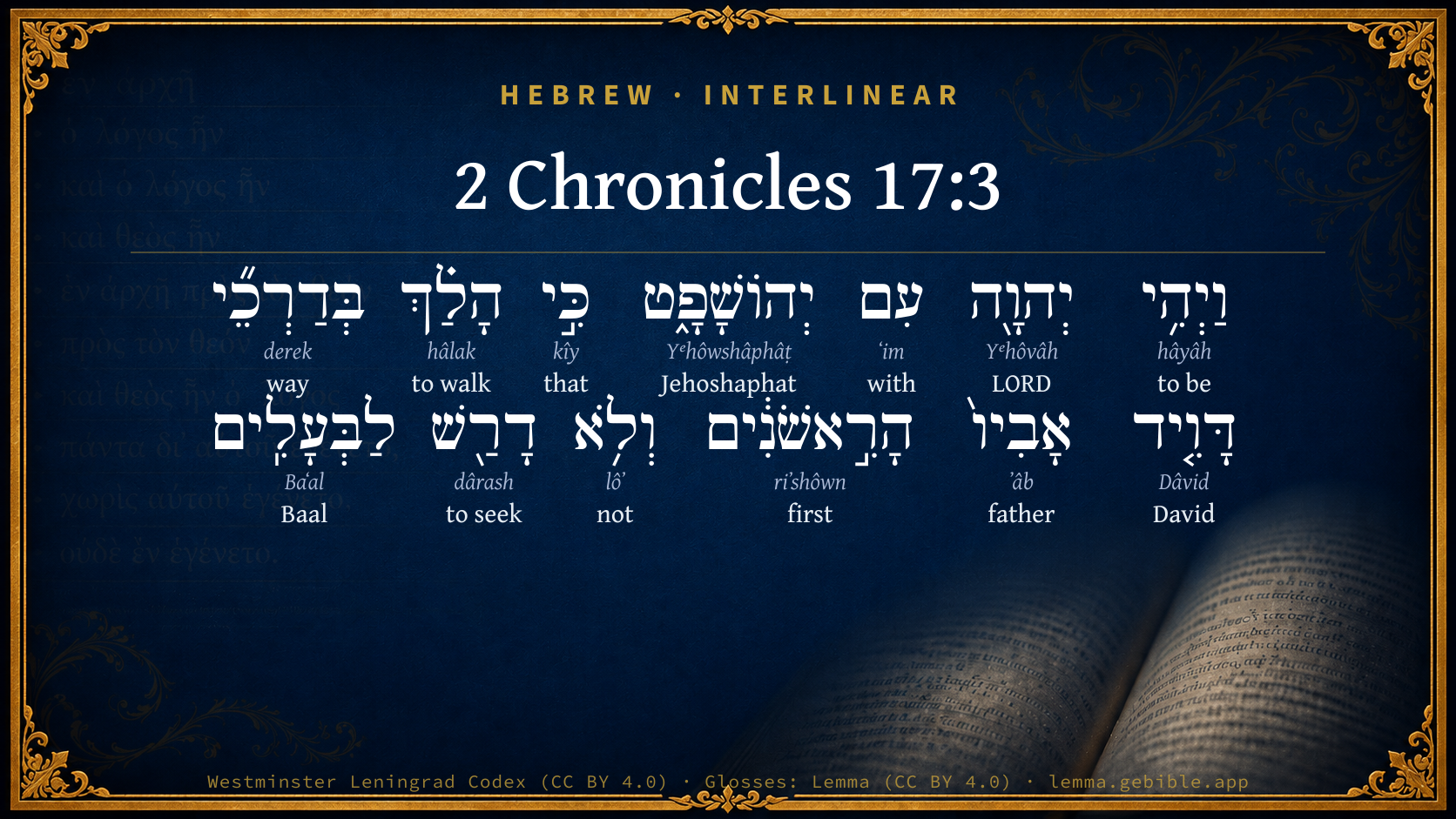
Hebrew (Westminster Leningrad Codex) 2 Chronicles 17:3 appears in the Hebrew Old Testament. The text above is from the Westminster Leningrad Codex. Each word links to its Strong’s number, a concise gloss, and parsing drawn from the Open Scriptures Hebrew Bible morphology. Click any word for its full Brown-Driver-Briggs (BDB) entry.
Download image
Cite this verse

2 Chronicles 17:3 (World English Bible). Public Domain. Lemma interlinear Bible study tool, https://lemma.gebible.app/v/2-chronicles/17/3.

Show BibTeX & RIS
BibTeX
RIS
English Translation
Yahweh was with Jehoshaphat, because he walked in the first ways of his father David, and didn't seek the Baals,
World English Bible · Public Domain
Download a study sheet

One document with this verse’s original text, its word-by-word gloss line, the meaning frame, cross-references with their text, attributed commentary, and full source and license credits — printable, and it pastes into notes with its structure intact.

This verse Autodidact and up

Study sheet (.html) Plain text (.txt)

A passage Seminary Student

Up to 50 verses in one chapter. A passage sheet keeps up to 6 commentary sources and 12 cross-references per verse, in the order this page ranks them, and says so on the sheet whenever that leaves anything out. Ask for a single verse and you get the Autodidact verse sheet above.

Everything on this page stays free to read, with no account — the sheet is a download of what is already on screen, not access to it.

Want to remove ads? Support Godless Engineer
Compare translations 3

The same verse in 3 English versions, stacked beneath the original-language interlinear above. Click any original word for its lexicon entry.

Each is an independent rendering of the whole verse — the interlinear is not word-aligned to these translations.

Highlighted words mark where these versions differ — a whole-verse word diff, not a word-by-word alignment.

  • World English Bible Public Domain
    Yahweh was with Jehoshaphat, because he walked in the first ways of his father David, and didn't seek the Baals,
  • King James Version Public Domain
    And the LORD was with Jehoshaphat, because he walked in the first ways of his father David, and sought not unto Baalim;
  • unfoldingWord Literal Text CC BY-SA 4.0
    And Yahweh was with Jehoshaphat because he walked in the first ways of David his father, and he did not seek the Baals.

unfoldingWord Literal Text — © unfoldingWord, licensed CC BY-SA 4.0. Word-aligned USFM3 via Door43 (git.door43.org/unfoldingWord/en_ult).

Versions to compare (up to 4)

3 of 4 selected

Show all 18 translations

Every available English version of this verse, each an independent rendering of the whole verse.

  • World English Bible Public Domain
    Yahweh was with Jehoshaphat, because he walked in the first ways of his father David, and didn't seek the Baals,
  • Berean Standard Bible Public Domain
    Now the LORD was with Jehoshaphat because he walked in the earlier ways of his father David. He did not seek out the Baals,
  • Majority Standard Bible Public Domain
    Now the LORD was with Jehoshaphat because he walked in the earlier ways of his father David. He did not seek the Baals,
  • King James Version Public Domain
    And the LORD was with Jehoshaphat, because he walked in the first ways of his father David, and sought not unto Baalim;
  • American Standard Version (1901) Public Domain
    And Jehovah was with Jehoshaphat, because he walked in the first ways of his father David, and sought not unto the Baalim,
  • Revised Version (1885) Public Domain
    And the LORD was with Jehoshaphat, because he walked in the first ways of his father David, and sought not unto the Baalim;
  • Geneva Bible (1599) Public Domain
    And the Lord was with Iehoshaphat, because he walked in the first wayes of his father Dauid, and sought not Baalim,
  • Douay-Rheims (1899) Public Domain
    And the Lord was with Josaphat, because he walked in the first ways of David his father: and trusted not in Baalim,
  • Young's Literal Translation Public Domain
    And Jehovah is with Jehoshaphat, for he hath walked in the first ways of David his father, and hath not sought to Baalim,
  • Literal Standard Version CC BY-SA 4.0
    And YHWH is with Jehoshaphat, for he has walked in the first ways of his father David, and has not sought for the Ba‘alim,
  • Unlocked Literal Bible CC BY-SA 4.0
    Yahweh was with Jehoshaphat because he walked in the first ways of his father David, and did not seek the Baals.
  • unfoldingWord Literal Text CC BY-SA 4.0
    And Yahweh was with Jehoshaphat because he walked in the first ways of David his father, and he did not seek the Baals.
  • Darby Bible Public Domain
    And Jehovah was with Jehoshaphat, for he walked in the first ways of his father David, and sought not unto the Baals;
  • World Messianic Bible Public Domain
    The LORD was with Jehoshaphat, because he walked in the first ways of his father David, and didn’t seek the Baals,
  • Webster's Bible Public Domain
    And the LORD was with Jehoshaphat, because he walked in the first ways of his father David, and sought not to Baalim;
  • Free Bible Version CC BY-SA 4.0
    The Lord supported Jehoshaphat because he followed the ways of his father David. He did not believe in the Baals,
  • Bible in Basic English Public Domain
    And the Lord was with Jehoshaphat, because he went in the early ways of his father, not turning to the Baals,
  • JPS Tanakh (1917) Public Domain
    And the LORD was with Jehoshaphat, because he walked in the first ways of his father David, and sought not unto the Baalim;

Literal Standard Version (2020), Covenant Press — licensed CC BY-SA 4.0. Text via the HelloAO Bible API (eBible.org). Unlocked Literal Bible (unfoldingWord) — licensed CC BY-SA 4.0. Text via the HelloAO Bible API (eBible.org). unfoldingWord Literal Text — © unfoldingWord, licensed CC BY-SA 4.0. Word-aligned USFM3 via Door43 (git.door43.org/unfoldingWord/en_ult). Free Bible Version, Dr. Jonathan Gallagher — licensed CC BY-SA 4.0. Text via the HelloAO Bible API (eBible.org).

Word by word

More ways to search: Search by grammar → Find every occurrence → Compare this word →

Practice this passage: Drill this verse → Learn its vocabulary →

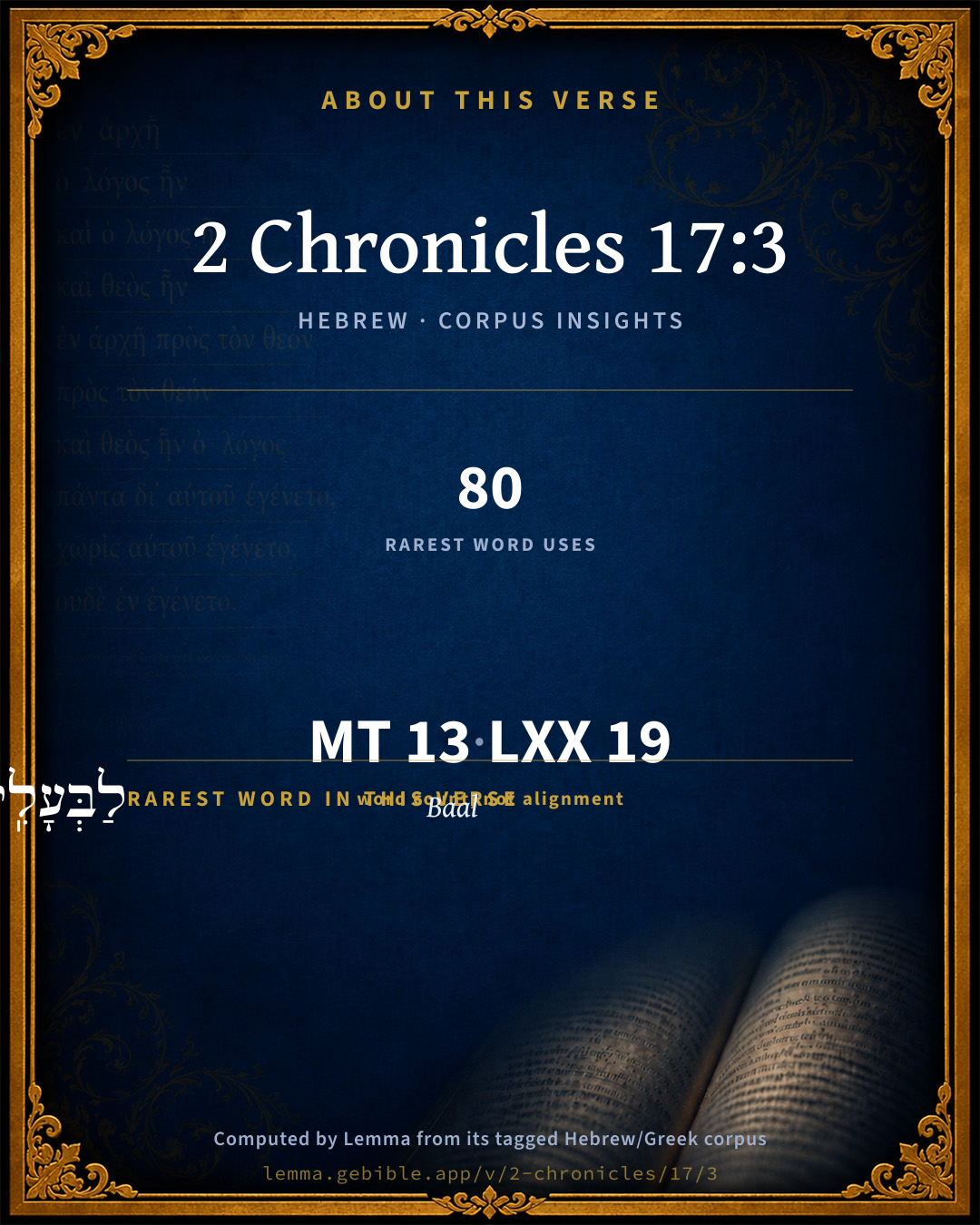
לַבְּעָלִֽים
Baʻal
H1168
“to/for the · Baal”
Preposition, Determined + Noun, Proper
Part of Speech
Preposition + Noun
Type
Proper
Full BDB Definition

Origin: the same as H1167

TWOT: 262a

Baal = "lord" - supreme male divinity of the Phoenicians or Canaanites (noun proper masculine) - a Reubenite (noun proper masculine) - the son of Jehiel and grandfather of Saul (noun proper masculine) - a town of Simeon, probably identical to Baalath-beer (noun proper locative)
  1. וַיְהִ֥י hâyâh H1961 “and · to be” Conjunction + Verb, Qal, Sequential Imperfect, 3rd Person, Masculine, Singular
  2. יְהוָ֖ה Yᵉhôvâh H3068 “LORD” Noun, Proper
  3. עִם ʻim H5973 “with” Preposition
  4. יְהוֹשָׁפָ֑ט Yᵉhôwshâphâṭ H3092 “Jehoshaphat” Noun, Proper
  5. כִּ֣י kîy H3588 “that” Conjunction
  6. הָלַ֗ךְ hâlak H1980 “to walk” Verb, Qal, Perfect, 3rd Person, Masculine, Singular
  7. בְּדַרְכֵ֞י derek H1870 “in/at · ways of” Preposition + Noun, Common, Both, Plural, Construct
  8. דָּוִ֤יד Dâvid H1732 “David” Noun, Proper
  9. אָבִיו֙ ʼâb H1 “father · his” Noun, Common, Masculine, Singular, Construct + Suffix, Personal, 3rd Person, Masculine, Singular
  10. הָרִ֣אשֹׁנִ֔ים riʼshôwn H7223 “the · first” Particle, Definite Article + Adjective, Adjective, Masculine, Plural, Absolute
  11. וְלֹ֥א lôʼ H3808 “and · not” Conjunction + Particle, Negative
  12. דָרַ֖שׁ dârash H1875 “to seek” Verb, Qal, Perfect, 3rd Person, Masculine, Singular

About this verse

These counts appear in no published source. They are computed here, from the morphology-tagged text and Lemma’s own curated glosses. What Lemma adds →

13
words
13
distinct lemmas
Historical
section

Grammatical profile

  • 3 verbs
  • 6 nouns
  • 1 adjective
  • 1 preposition
  • 1 conjunction
  • 1 particle

Verb forms

  • וַיְהִ֥י Qal · Sequential Imperfect
  • הָלַ֗ךְ Qal · Perfect
  • דָרַ֖שׁ Qal · Perfect

Hebrew & Septuagint length

In English translation the verse runs 20 words from the Hebrew and 22 from the Septuagint (LXX English) — closely comparable.

A rough comparison of the two English renderings, which tokenize alike — not a word-level alignment.

Word counts can differ between the Hebrew and the Greek without any difference in meaning — e.g. the Hebrew direct-object marker אֵת has no separate Greek word, and Greek often adds the article ὁ.

In the original languages it is 13 Hebrew tokens and 19 Greek tokens — but the two are counted differently (Hebrew bundles its prefixes and suffixes into one token; the Greek is in lemma form), so that isn’t a like-for-like length.

Cross-references

32

Topical passages linked to 2 Chronicles 17:3 in the Treasury of Scripture Knowledge — connected by theme and wording, ordered by reader-vote popularity; previews shown in the World English Bible.

  • 2 Kings 22:2 He did that which was right in the eyes of Yahweh, and walked in all the way of David his father, and didn't turn aside to the right hand or to the left.
  • Isaiah 41:10 Don't you be afraid, for I am with you; don't be dismayed, for I am your God; I will strengthen you; yes, I will help you; yes, I will uphold you with the right hand of my righteousness.
  • 2 Timothy 4:22 The Lord Jesus Christ be with your spirit. Grace be with you. Amen.
  • Genesis 39:2–3 Yahweh was with Joseph, and he was a prosperous man. He was in the house of his master the Egyptian.
  • Genesis 39:21 But Yahweh was with Joseph, and showed kindness to him, and gave him favor in the sight of the keeper of the prison.
  • Joshua 1:9 Haven't I commanded you? Be strong and of good courage; don't be afraid, neither be dismayed: for Yahweh your God is with you wherever you go.
  • Judges 6:12 The angel of Yahweh appeared to him, and said to him, Yahweh is with you, you mighty man of valor.
  • Psalms 46:11 Yahweh of Hosts is with us. The God of Jacob is our refuge. Selah.
  • Matthew 28:20 teaching them to observe all things that I commanded you. Behold, I am with you always, even to the end of the age." Amen.
  • Joshua 1:5 There shall not any man be able to stand before you all the days of your life. As I was with Moses, so I will be with you; I will not fail you, nor forsake you.
  • 2 Samuel 5:10 David grew greater and greater; for Yahweh, the God of hosts, was with him.
  • 1 Chronicles 22:18 Isn't Yahweh your God with you? Hasn't he given you rest on every side? for he has delivered the inhabitants of the land into my hand; and the land is subdued before Yahweh, and before his people.
  • Isaiah 8:10 Take counsel together, and it shall be brought to nothing; speak the word, and it shall not stand: for God is with us.
  • Matthew 1:23 "Behold, the virgin shall be with child, And shall bring forth a son. They shall call his name Immanuel;" Which is, being interpreted, "God with us."
  • Exodus 3:12 He said, "Certainly I will be with you. This will be the token to you, that I have sent you: when you have brought forth the people out of Egypt, you shall serve God on this mountain."
  • Exodus 4:12 Now therefore go, and I will be with your mouth, and teach you what you shall speak."
  • 2 Samuel 8:15 David reigned over all Israel; and David executed justice and righteousness to all his people.
  • 1 Kings 11:6 Solomon did that which was evil in the sight of Yahweh, and didn't go fully after Yahweh, as did David his father.
  • 2 Kings 18:3 He did that which was right in the eyes of Yahweh, according to all that David his father had done.
  • 2 Chronicles 15:2 and he went out to meet Asa, and said to him, Hear you me, Asa, and all Judah and Benjamin: Yahweh is with you, while you are with him; and if you seek him, he will be found of you; but if you forsake him, he will forsake you.
  • 2 Chronicles 15:8–13 When Asa heard these words, and the prophecy of Oded the prophet, he took courage, and put away the abominations out of all the land of Judah and Benjamin, and out of the cities which he had taken from the hill-country of Ephraim; and he renewed the altar of Yahweh, that was before the porch of Yahweh.
  • Psalms 46:7 Yahweh of Hosts is with us. The God of Jacob is our refuge. Selah.
  • Psalms 132:1–5 Yahweh, remember David and all his affliction,
  • Jeremiah 2:23 How can you say, I am not defiled, I have not gone after the Baals? see your way in the valley, know what you have done: [you are] a swift dromedary traversing her ways;
  • Matthew 18:20 For where two or three are gathered together in my name, there I am in the midst of them."
  • Judges 2:11 The children of Israel did that which was evil in the sight of Yahweh, and served the Baals;
  • Judges 2:18 When Yahweh raised them up judges, then Yahweh was with the judge, and saved them out of the hand of their enemies all the days of the judge: for it repented Yahweh because of their groaning by reason of those who oppressed them and vexed them.
  • Judges 8:33 It happened, as soon as Gideon was dead, that the children of Israel turned again, and played the prostitute after the Baals, and made Baal Berith their god.
  • 1 Kings 15:3–4 He walked in all the sins of his father, which he had done before him; and his heart was not perfect with Yahweh his God, as the heart of David his father.
  • 2 Kings 16:2 Twenty years old was Ahaz when he began to reign; and he reigned sixteen years in Jerusalem: and he didn't do that which was right in the eyes of Yahweh his God, like David his father.
  • 2 Chronicles 14:2–5 Asa did that which was good and right in the eyes of Yahweh his God:
  • 2 Chronicles 14:11 Asa cried to Yahweh his God, and said, Yahweh, there is none besides you to help, between the mighty and him who has no strength: help us, Yahweh our God; for we rely on you, and in your name are we come against this multitude. Yahweh, you are our God; don't let man prevail against you.

Cross-references courtesy of OpenBible.info (CC BY 4.0).

Hebrew and Greek witnesses Masoretic Hebrew ↔ Greek Septuagint

The same verse in the two great witnesses to the Old Testament, shown verse-for-verse.

These are two independent witnesses, not word-aligned to each other, and the Septuagint is shown in lemma (dictionary) form.

Hebrew 2 Chronicles 17:3 Masoretic · Westminster Leningrad Codex

וַיְהִ֥י יְהוָ֖ה עִם יְהוֹשָׁפָ֑ט כִּ֣י הָלַ֗ךְ בְּדַרְכֵ֞י דָּוִ֤יד אָבִיו֙ הָרִ֣אשֹׁנִ֔ים וְלֹ֥א דָרַ֖שׁ לַבְּעָלִֽים

Yahweh was with Jehoshaphat, because he walked in the first ways of his father David, and didn't seek the Baals,

World English Bible · Public Domain

Greek LXX 2 Chronicles 17:3 Septuagint · lemma form

καί γίγνομαι κύριος μετά ιωσαφατ ὅτι πορεύομαι ἐν ὁδός ὁ πατήρ αὐτός ὁ πρῶτος καί οὐ ἐκζητέω ὁ εἴδωλον

And the Lord was with Josaphat, for he walked in the first ways of his father, and did not seek to idols;

LXX2012 (modern English Septuagint) · Public Domain

On this verse, Joseph Benson's Commentary discusses the Septuagint’s reading. Read the note in Commentary ↓

Hebrew: Westminster Leningrad Codex (CC BY 4.0). Greek: Septuagint (public domain); English from LXX2012 (modern English Septuagint) (Public Domain). How the Septuagint differs from the Hebrew →

Commentary

Notes on 2 Chronicles 17:3 from classic Christian and Jewish commentators (each source and its license shown beneath its notes). The classic Christian expositions comment on the surrounding passage and are grouped to its opening verse, so a note may address several verses; the Jewish commentaries on the Tanakh (Rashi and others) are per-verse, so they appear only where the commentator wrote on this verse.

Lemma curates 59 commentaries, every one of them public domain or Creative Commons licensed, each selected and text-cleaned for this edition rather than reprinted as found. About our sources →

Trapp's Complete Commentary

John Trapp

2Ch 17:3 And the LORD was with Jehoshaphat, because he walked in the first ways of his father David, and sought not unto Baalim;

Ver. 3. Because he walked in the first ways of his father David.] Who during his trouble kept himself free from scandalous and reproachful practices, innocent from the great transgression. {Psa 19:13} David rectior fuit in servitio quam in regno, saith Gregory.

John Trapp, A Commentary or Exposition upon All the Books of the Old and New Testament (1647–1656) — public domain. Text from a community e-Sword module.

Joseph Benson's Commentary

2Ch 17:3-4. He walked in the first ways of his father David — His ways before he fell so foully, in the matter of Uriah, which were good ways. David, indeed, recovered from that fall, but, perhaps, never, while he lived, fully retrieved the spiritual strength and comfort which he had lost. Jehoshaphat followed David as far as he followed God, and no farther. St. Paul himself thus limits our imitation of him, 1Co 11:1, Follow me, as I follow Christ, and not otherwise. The first ways of many pious people have been their best ways, and their first love their strongest love: which, however, ought not to be the case: for the last ought to be more than the first, Rev 2:19. But in every copy we propose to write after, as we ought to single out that only which is good, so that chiefly which is best. The original words here are literally rendered, He walked in the ways of David his father, הראשׁונים, hareshonim, those first, or ancient ways. He proposed to himself, for his example, the primitive times of the royal family, those purest times, before the corruptions of the late reigns came in. See Jer 6:16. The LXX. leave out David, and so refer this to Asa: He walked in the first ways of his father Asa, and did not imitate him in what was amiss in him toward the latter end of his time. It is well to be cautious in following the best men, lest we step aside after them. And sought not unto Baalim — The neighbouring nations had their Baalim: one had one Baal, and another had another; but he abhorred them all, and had nothing to do with any of them. He sought the Lord God of his father, and him only; prayed to him only; and inquired of him only.

Joseph Benson's Commentary on the Old and New Testaments (1811–1818) — public domain. Text from a community e-Sword module.

Tyndale Open Study Notes

Tyndale Open Resources

17:3-4 For the first time, the Chronicler compares Judah’s practices with those of northern Israel, showing his awareness that the Baal cult from Tyre had been introduced into northern worship (see 1 Kgs 16:31-32).

Tyndale Open Study Notes — © Tyndale Open Resources, licensed CC BY-SA 4.0. Text via the HelloAO Bible API.

Geneva Bible (1599)

Geneva Bible translators

That is, his virtues: meaning before he had committed with Bathsheba, and against Uriah.

Sought not help at strange Gods.

Geneva Bible (1599) marginal notes — public domain. Text via Bolls.life.

Jamieson, Fausset & Brown

Robert Jamieson, A. R. Fausset & David Brown

he walked in the first ways of his father David--He imitated the piety of his great ancestor in the early part of his reign before he made those unhappy lapses which dishonored his character.

and sought not unto Baalim--a term used for idols generally in contradistinction to the Lord God of his father.

Jamieson, Fausset & Brown — Commentary Critical and Explanatory on the Whole Bible (1871) — public domain (CC PDM 1.0). Text via the HelloAO Bible API.

Adam Clarke's Commentary

Verse 3. The Lord was with Jehoshaphat] "The WORD of the Lord was Jehoshaphat's Helper." - Targum.

Adam Clarke's Commentary on the Bible (1810–1826) — public domain. Text from a community e-Sword/MySword module.

Ellicott's Commentary for English Readers

(3) He walked in the first ways.—The former or earlier ways of David, as contrasted with his later conduct—a tacit allusion to the adultery with Bathsheba and other sins of David committed in his later years (2 Samuel 11-24). A few MSS. and the LXX. omit David.

And sought not unto Baalim.—And sought not the Baals (dârash lĕ, a late construction). The Baals were different local aspects of the sun-god. Here the term no doubt includes the illegal worship of Jehovah under the form of a bullock, as instituted by Jeroboam, and practised in the northern kingdom (“the doing of Israel” 2Ch_17:4). Syriac, “and prayed not to images.”

A Bible Commentary for English Readers, edited by Charles John Ellicott (1878–1897) — public domain. Text from a community e-Sword module.

The Cambridge Bible for Schools and Colleges

gen. ed. J. J. S. Perowne

3. in the first ways of his father David] Omit David (so LXX.), the person referred to being Asa (1Ki_22:43). Asa’s first ways (ch. 14, 15) were good, his latter ways (ch. 16), according to the Chronicler, were evil.

unto Baalim] R.V. unto the Baalim. Baal is not a proper name, but a title meaning “Lord,” which was generally given to false gods. Israel might not call Jehovah, “My Baal” (Baali), Hos_2:16-17.

The Cambridge Bible for Schools and Colleges (gen. ed. J. J. S. Perowne; Cambridge University Press, 1878–1918) — public domain. Text from a community e-Sword module.

John Gill's Exposition

And the Lord was with Jehoshaphat,.... Guiding and directing, prospering and succeeding him in all things; he had, no doubt, his gracious presence in spiritual things, as well as his powerful and directing presence in things civil; the Targum is,"the Word of the Lord was for his help;"

because he walked in the first ways of his father David; which were his best; some of his last ways not being good, as in the affair of Uriah and Bathsheba, and his numbering of the people; Jehoshaphat followed him in the one, but not in the other: or, "in the ways of David and his father, the first"; the first of them both; for the latter ways of his father Asa were not so good as his first, as the preceding chapter shows; and the Septuagint version leaves out the word "David", and so restrains it to his own father:

and sought not unto Baalim; as did Ahab king of Israel, who now reigned there; Kg1 15:24.

John Gill's Exposition of the Whole Bible (1746–1763) — public domain (CC PDM 1.0). Text via the HelloAO Bible API.

Albert Barnes' Notes on the Bible

The first ways of his father David - The Septuagint and several Hebrew manuscripts omit “David,” which has probably crept in from the margin, for David’s “first ways” are nowhere else contrasted with his later ways. The real meaning of the writer is, that Jehoshaphat followed the example set by his father Asa in his earlier years 2Ch 14:1-15; 15.

Baalim - On the plural form, see 1Ki 18:18 note.

Albert Barnes' Notes on the Bible (1834–1885) — public domain. Text from a community e-Sword/MySword module.

Haydock's Catholic Bible Commentary

First. Before his fall: some copies add, "and last," (La Haye) as the Gothic MS. used by Mariana does, agreeably to the Scripture style. D. --- David began and ended well. H.

George Leo Haydock (1774–1849), Haydock's Catholic Family Bible and Commentary, 1859 edition — public domain. Excludes Psalms (Douay-Rheims chapter numbering differs from Protestant) and Deuterocanonical books (Catholic canon only).

Matthew Poole's English Annotations

In the first ways, which David walked in before he fell into those horrid sins of murder and adultery. Or, in the ways of David, and his father’s first ways. For the beginning of Asa’s reign was laudable, as we have seen, though he declined at last. For it seems more probable that this passage is a reflection upon Asa, whose last ways were much his worst, and of whose repentance we have no evidence, than upon David, who, though he fell dreadfully in the matter of Uriah, yet did manifestly repent of it, and return to his first and holy course of life, in which also he continued until death; having this character given him by the Holy Ghost after his death, that he did right in all things, saving that of Uriah, 1Ki 15:5.

Matthew Poole's English Annotations on the Holy Bible (1683–1685) — public domain. Text from a community e-Sword/MySword module.

Whedon's Commentary on the Bible

Daniel D. Whedon

3. The first ways of his father David — The first or earlier ways of David are contrasted with his later ways “in the matter of Uriah,” and his sin in numbering the people. The Septuagint omits the word David, and some have therefore thought it an interpolation, and understand the earlier ways of Asa to be intended.

Daniel D. Whedon (gen. ed.), Commentary on the Old and New Testaments (1874–1909) — public domain. Text from a community e-Sword module.

The Pulpit Commentary

The first ways of his father David. Although there would be no difficulty in reconciling this statement with history, yet probably the name David should not stand here. It is not in the Septuagint. The most natural and sufficient reference is to Asa. And sought not unto Ballim; literally, to the Baalim; i.e. to the various false gods of surrounding peoples, (Jud_1:2:11) Baal-berith, (Jud_1:8:33 9:4, 46) Baal-, (2Ki_1:2) Baal-peor, (Num_23:28, etc.; Num_25:3) according to the places where the idolatrous worship was carried on. (For the preposition l, "to," after "sought," in this and following verse, see 1Ch_22:19)

Vers. 3-6.

The wise choice and the happy course.

We have before us here the king who made the wise choice, and who consequently ran through a very happy course. In him we have an example; in it a promise for ourselves.

I THE WISE CHOICE, WHICH IS AN EXAMPLE TO US. Jehoshaphat:

1. Preferred the true God to the false deities; he "sought to the Lord Godof his father," and he "sought not unto Baalim." Moreover, he set before him, as that which he should copy:

2. The best part of the best man"s life. Not the life of the less perfect Abijah or Rehoboam, or even Solomon, but David; and of his life, not the latter part, which was more luxurious and less pure, but the first ways of his father David," which were lees luxurious and more pure than the last. Herein he showed an excellent judgment. He could not have done a wiser thing, as he certainly could not have done anything more solemnly and stringently binding upon him, than resolve to cleave to the "God of his fathers the God who had called both king and kingdom into existence, to whom he and his people owed all that they were and had. There were certain fascinations connected with the worship of Baalim appealing to their lower nature; but what were these to the weighty and overwhelming considerations that bound him to Jehovah? And he could not have done better than choose for his exemplar the devout and faithful David; and, choosing him, to select the earlier and worthier part of his very checkered and somewhat uneven life. Before us is a similar choice, and we must make up our mind what we will decide upon.

(1) We have to choose what God we will serve; whether the Lord God of our fathers, whether the heavenly Father, the Divine Saviour and Friend of our souls, or whether this passing world with its lower interests, its fading honours, its transient joys.

(2) We have to determine in whose steps we will follow; whether those of the ambitious, or of the pleasure-seeking, or of the aimless man, or those of the reverent and earnest man; and again, if we choose the last, whether we will direct our eye to those elements in his character and to those portions of his life which are not the second-best, but the noblest and worthiest of all.

II THE HAPPY COURSE, WHICH IS A PROMISE FOR US. Jehoshaphat had all that a king could well wish for.

1. A sense of God"s favouring presence (ver. 3).

2. A sense of growing security throughout his kingdom (ver. 5).

3. The testimony of his people"s attachment to his person (ver. 5). Honour as well as abundance (ver. 5).

4. Elation of heart, great and continuous gladness in the service of Jehovah( ver. 6).

5. The expenditure of his power m further cleansing usefulness (ver. 6). What rewards of the king"s fidelity were due to his royal position we, of course, cannot look for. But if we make the wiser choice we may reckon upon a life of true and real blessedness. To us there will be secured

(1) all needful temporal good (Psa_37:25 Psa_34:22; Mat_6:33; 1Ti_4:8)

(2) the conscious and abiding presence of God (Joh_14:23 Joh_15:4; Rev_3:20)

(3) the peace which, not as the world gives, Christ gives to his own, and the joy which no man taketh from us;

(4) the spiritual conditions of holy usefulness, the means and opportunity of exerting a pure and elevating influence on many hearts, and thus of uplifting and ennobling many lives;

(5) the hope that maketh not ashamed. C.

The Pulpit Commentary (1880–1919), ed. H.D.M. Spence-Jones & Joseph S. Exell — public domain. Text from a community e-Sword module.

John Wesley's Explanatory Notes

Sought not, &c. - It is true, he recovered from that fall. "Yet perhaps, says Mr. Henry, he never, while he lived, fully retrieved the spiritual strength he lost by it."

John Wesley, Explanatory Notes Upon the Whole Bible (1754–1765) — public domain. Text via the GEBible commentary corpus.

Scofield Reference Notes

C. I. Scofield

father

After the Jewish custom of calling a family, or tribal head, father; e.g. Joh 8:53.

The Scofield Reference Bible (1917 edition), notes by C. I. Scofield — public domain. Text from a community e-Sword module.

unfoldingWord translationNotes

Door43 World Missions Community

Yahweh was with Jehoshaphat

Here "was with" is an idiom. AT: "God supported him" or "God helped him" (See: Idiom)

walked in the first ways of his father

Here the way a person lives and conducts himself is spoken of as if it were walking. For most of David's life he lived righteously and followed Yahweh closely. AT: "lived in the first ways of his father David" or "lived righteously as has father David had done in his earlier years" (See: Idiom and Assumed Knowledge and Implicit Information)

did not seek the Baals

This means that he did not worship the Baal idols in order to seek help from them. (See: Assumed Knowledge and Implicit Information)

walked in

The word "walked" is used here as an idiom. AT: "followed" (See: Idiom)

not after the behavior of Israel

"and did not behave in the ways of the people of Israel." This refers to how most of the people of Israel did not follow Yahweh. AT: "and did not follow the evil practices that were common in Israel" (See: Assumed Knowledge and Implicit Information)

translationWords

Yahweh

walk

David

Baal

God

command

unfoldingWord translationNotes — © Distant Shores Media and the Door43 World Missions Community, licensed CC BY-SA 4.0. Source: git.door43.org/Door43/en_tn.

Rashi

Rabbi Shlomo Yitzchaki (Rashi)

in the first ways of David, his father But not the last ways, when he sinned in the incident of Bathsheba, and when the Adversary enticed him to count Israel. This is the most accurate interpretation, but others explain “first” as meaning superior to Solomon and Rehoboam. Regarding Solomon, it is written (I Kings 11:4): “his wives turned away his heart” at the end of his days, and he built a high place for Chemosh, the abomination of Moab, and for Molech, the abomination of the children of Ammon.” Regarding Rehoboam, it is written (above 12:1): “And when he became strong, he abandoned the Law of the Lord.” [Jehoshaphat was also not] like Abijam, about whom it is written (I Kings 15:2): “and his heart was not complete with the Lord, his God,” or like Asa, who did not rely on the Lord; [Jehoshaphat] resembled his father, David, who had only one heart for his Father in heaven.

and did not inquire of the baalim like the practice of Israel in his time, for Ahab, who was in his time, worshipped the baalim, as did Israel in his time.

Rashi on the Tanakh — English translations: “The Judaica Press complete Tanach with Rashi, translated by A. J. Rosenberg” (CC BY 4.0); “Pentateuch with Rashi's commentary by M. Rosenbaum and A.M. Silbermann, 1929-1934” (public domain); “The Metsudah Tanach series, Lakewood, N.J” (CC BY 4.0); and “The Book of Joshua, Metsudah Publications, 1997” (CC BY 4.0). Text via Sefaria.

Lesson kit

Teaching starters — assembled from the data on this page, not authored interpretation. Every prompt links to the verse data it draws on. Edit before teaching.

2 Chronicles, in the Historical, opens this verse with 13 words (13 distinct Hebrew lemmas). Its most distinctive word is Baʻal (“Baal”). A historical commentator’s framing appears above. Read the whole chapter for the surrounding context.

Discussion questions

  1. How does “Baal” (Baʻal) shape what this verse is saying?
  2. How does 2 Kings 22:2, which shares this passage’s theme, read alongside this verse?
  3. The translations on this page render this verse differently — a whole-verse word diff, not a word-by-word alignment. What might account for the different wordings?
  4. «וַיְהִ֥י» is a Qal Sequential Imperfect verb. How does that grammatical form shape the action described?
  5. Compare how Trapp's Complete Commentary and Joseph Benson's Commentary read this verse. Where do they agree or differ?

Things to notice

Reading settings

Reading text

Shown beneath each verse's original-language words.

Old Testament
Old Testament edition

Read the OT as the Masoretic Hebrew (MT) or the Greek Septuagint (LXX).

English shown for the Greek Septuagint (in the Hebrew ↔ Greek comparison).

Comparing translations? Open the Compare panel on any verse page to stack up to four side by side.