2 Chronicles 30:26

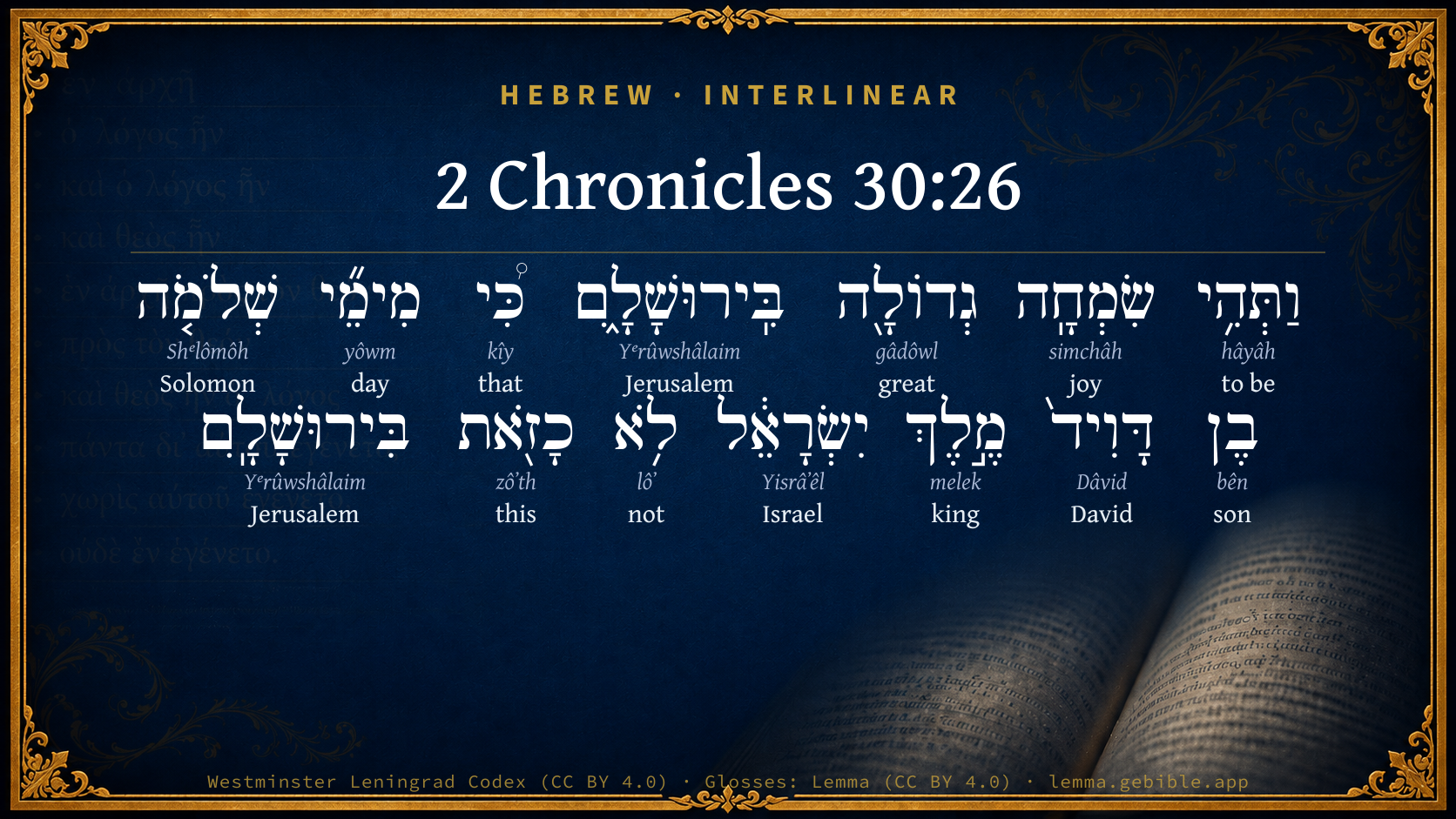
Hebrew (Westminster Leningrad Codex) 2 Chronicles 30:26 appears in the Hebrew Old Testament. The text above is from the Westminster Leningrad Codex. Each word links to its Strong’s number, a concise gloss, and parsing drawn from the Open Scriptures Hebrew Bible morphology. Click any word for its full Brown-Driver-Briggs (BDB) entry.
Download image
Cite this verse

2 Chronicles 30:26 (World English Bible). Public Domain. Lemma interlinear Bible study tool, https://lemma.gebible.app/v/2-chronicles/30/26.

Show BibTeX & RIS
BibTeX
RIS
English Translation
So there was great joy in Jerusalem; for since the time of Solomon the son of David king of Israel there was not the like in Jerusalem.
World English Bible · Public Domain
Download a study sheet

One document with this verse’s original text, its word-by-word gloss line, the meaning frame, cross-references with their text, attributed commentary, and full source and license credits — printable, and it pastes into notes with its structure intact.

This verse Autodidact and up

Study sheet (.html) Plain text (.txt)

A passage Seminary Student

Up to 50 verses in one chapter. A passage sheet keeps up to 6 commentary sources and 12 cross-references per verse, in the order this page ranks them, and says so on the sheet whenever that leaves anything out. Ask for a single verse and you get the Autodidact verse sheet above.

Everything on this page stays free to read, with no account — the sheet is a download of what is already on screen, not access to it.

Want to remove ads? Support Godless Engineer
Compare translations 3

The same verse in 3 English versions, stacked beneath the original-language interlinear above. Click any original word for its lexicon entry.

Each is an independent rendering of the whole verse — the interlinear is not word-aligned to these translations.

Highlighted words mark where these versions differ — a whole-verse word diff, not a word-by-word alignment.

  • World English Bible Public Domain
    So there was great joy in Jerusalem; for since the time of Solomon the son of David king of Israel there was not the like in Jerusalem.
  • King James Version Public Domain
    So there was great joy in Jerusalem: for since the time of Solomon the son of David king of Israel there was not the like in Jerusalem.
  • unfoldingWord Literal Text CC BY-SA 4.0
    And there was great joy in Jerusalem, for from the days of Solomon the son of David, the king of Israel, there was not like this in Jerusalem.

unfoldingWord Literal Text — © unfoldingWord, licensed CC BY-SA 4.0. Word-aligned USFM3 via Door43 (git.door43.org/unfoldingWord/en_ult).

Versions to compare (up to 4)

3 of 4 selected

Show all 18 translations

Every available English version of this verse, each an independent rendering of the whole verse.

  • World English Bible Public Domain
    So there was great joy in Jerusalem; for since the time of Solomon the son of David king of Israel there was not the like in Jerusalem.
  • Berean Standard Bible Public Domain
    So there was great rejoicing in Jerusalem, for nothing like this had happened there since the days of Solomon son of David king of Israel.
  • Majority Standard Bible Public Domain
    So there was great rejoicing in Jerusalem, for nothing like this had happened there since the days of Solomon son of David king of Israel.
  • King James Version Public Domain
    So there was great joy in Jerusalem: for since the time of Solomon the son of David king of Israel there was not the like in Jerusalem.
  • American Standard Version (1901) Public Domain
    So there was great joy in Jerusalem; for since the time of Solomon the son of David king of Israel there was not the like in Jerusalem.
  • Revised Version (1885) Public Domain
    So there was great joy in Jerusalem: for since the time of Solomon the son of David king of Israel there was not the like in Jerusalem.
  • Geneva Bible (1599) Public Domain
    So there was great ioye in Ierusalem: for since the time of Salomon the sonne of Dauid King of Israel there was not the like thing in Ierusalem.
  • Douay-Rheims (1899) Public Domain
    And all the multitude of Juda with the priests and Levites, and all the assembly, that came out of Israel; and the proselytes of the land of Israel, and that dwelt in Juda were full of joy.
  • Young's Literal Translation Public Domain
    and there is great joy in Jerusalem; for from the days of Solomon son of David king of Israel there is not like this in Jerusalem,
  • Literal Standard Version CC BY-SA 4.0
    and there is great joy in Jerusalem; for from the days of Solomon son of David, king of Israel, there is not like this in Jerusalem,
  • Unlocked Literal Bible CC BY-SA 4.0
    So there was great joy in Jerusalem, for since the time of Solomon son of David, king of Israel, there had not been anything like it in Jerusalem.
  • unfoldingWord Literal Text CC BY-SA 4.0
    And there was great joy in Jerusalem, for from the days of Solomon the son of David, the king of Israel, there was not like this in Jerusalem.
  • Darby Bible Public Domain
    And there was great joy in Jerusalem; for since the time of Solomon the son of David, king of Israel, there had not been the like in Jerusalem.
  • World Messianic Bible Public Domain
    So there was great joy in Jerusalem; for since the time of Solomon the son of David king of Israel there was nothing like this in Jerusalem.
  • Webster's Bible Public Domain
    So there was great joy in Jerusalem: for since the time of Solomon the son of David king of Israel there was not the like in Jerusalem.
  • Free Bible Version CC BY-SA 4.0
    There was such tremendous happiness in Jerusalem, for since the time of Solomon, son of David, king of Israel, nothing like this had happened in the city.
  • Bible in Basic English Public Domain
    So there was great joy in Jerusalem: for nothing like this had been seen in Jerusalem from the time of Solomon, the son of David, king of Israel.
  • JPS Tanakh (1917) Public Domain
    So there was great joy in Jerusalem; for since the time of Solomon the son of David king of Israel there was not the like in Jerusalem.

Literal Standard Version (2020), Covenant Press — licensed CC BY-SA 4.0. Text via the HelloAO Bible API (eBible.org). Unlocked Literal Bible (unfoldingWord) — licensed CC BY-SA 4.0. Text via the HelloAO Bible API (eBible.org). unfoldingWord Literal Text — © unfoldingWord, licensed CC BY-SA 4.0. Word-aligned USFM3 via Door43 (git.door43.org/unfoldingWord/en_ult). Free Bible Version, Dr. Jonathan Gallagher — licensed CC BY-SA 4.0. Text via the HelloAO Bible API (eBible.org).

Word by word

More ways to search: Search by grammar → Find every occurrence → Compare this word →

Practice this passage: Drill this verse → Learn its vocabulary →

שִׂמְחָֽה
simchâh
H8057
“joy”
Noun, Common, Feminine, Singular, Absolute
Part of Speech
Noun
Type
Common
Gender
Feminine
Number
Singular
State
Absolute
Full BDB Definition

Origin: from H8056

TWOT: 2268b

joy, mirth, gladness - mirth, gladness, joy, gaiety, pleasure - joy (of God) - glad result, happy issue
  1. וַתְּהִ֥י hâyâh H1961 “and · to be” Conjunction + Verb, Qal, Sequential Imperfect, 3rd Person, Feminine, Singular
  2. גְדוֹלָ֖ה gâdôwl H1419 “great” Adjective, Adjective, Feminine, Singular, Absolute
  3. בִּֽירוּשָׁלִָ֑ם Yᵉrûwshâlaim H3389 “in/at · Jerusalem” Preposition + Noun, Proper
  4. כִּ֠י kîy H3588 “that” Conjunction
  5. מִימֵ֞י yôwm H3117 “from · days of” Preposition + Noun, Common, Masculine, Plural, Construct
  6. שְׁלֹמֹ֤ה Shᵉlômôh H8010 “Solomon” Noun, Proper
  7. בֶן bên H1121 “son of” Noun, Common, Masculine, Singular, Construct
  8. דָּוִיד֙ Dâvid H1732 “David” Noun, Proper
  9. מֶ֣לֶךְ melek H4428 “king of” Noun, Common, Masculine, Singular, Construct
  10. יִשְׂרָאֵ֔ל Yisrâʼêl H3478 “Israel” Noun, Proper
  11. לֹ֥א lôʼ H3808 “not” Particle, Negative
  12. כָזֹ֖את zôʼth H2063 “like/as · this” Preposition + Pronoun, Demonstrative, Feminine, Singular
  13. בִּירוּשָׁלִָֽם Yᵉrûwshâlaim H3389 “in/at · Jerusalem” Preposition + Noun, Proper

About this verse

These counts appear in no published source. They are computed here, from the morphology-tagged text and Lemma’s own curated glosses. What Lemma adds →

14
words
13
distinct lemmas
Historical
section

Grammatical profile

  • 1 verb
  • 9 nouns
  • 1 adjective
  • 1 pronoun
  • 1 conjunction
  • 1 particle

Verb forms

  • וַתְּהִ֥י Qal · Sequential Imperfect

Repetition

A word recurs within this verse — often emphatic in Hebrew:

  • בִּֽירוּשָׁלִָ֑ם Jerusalem H3389 ×2

Hebrew & Septuagint length

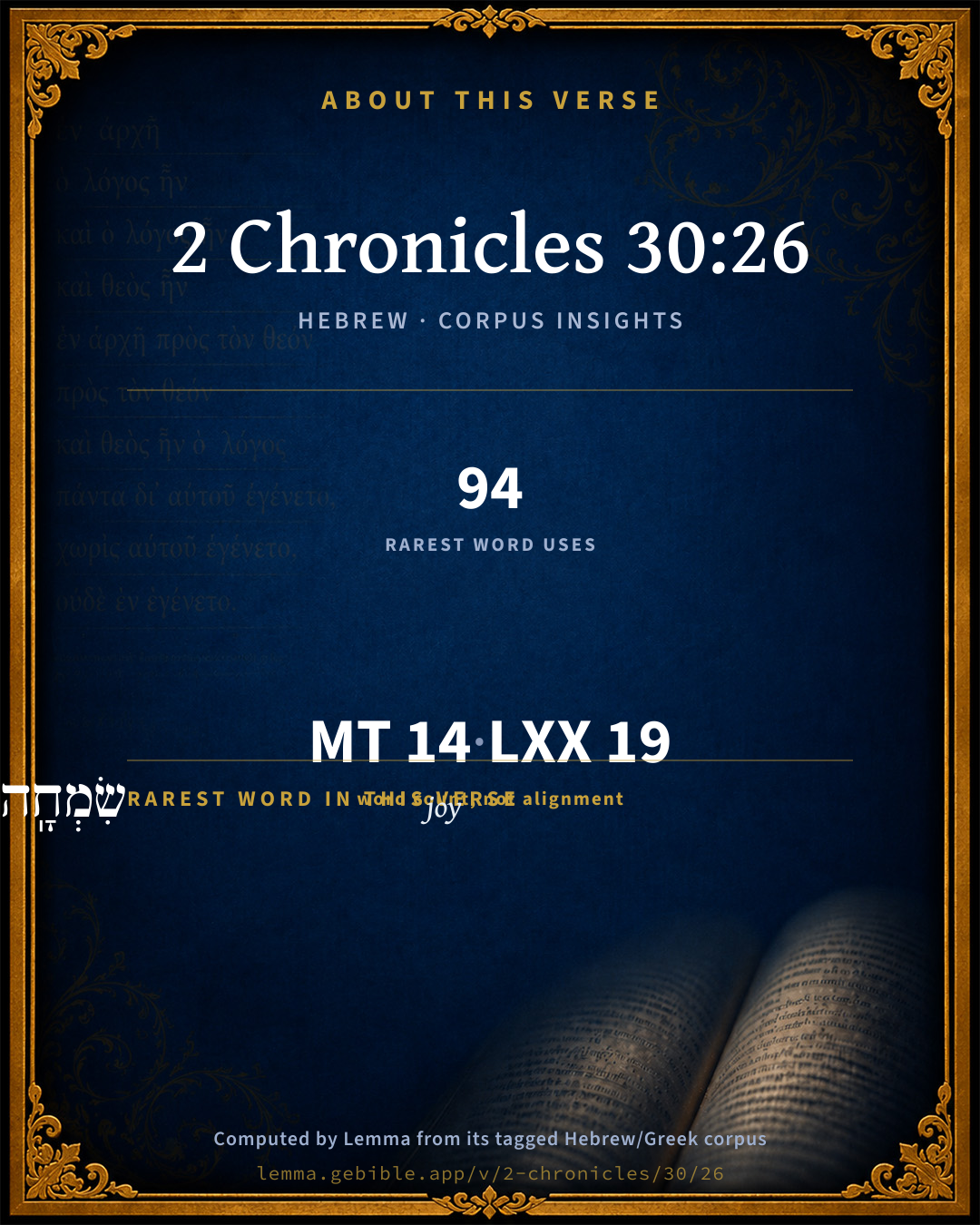
In English translation the verse runs 27 words from the Hebrew and 27 from the Septuagint (LXX English) — the same length.

A rough comparison of the two English renderings, which tokenize alike — not a word-level alignment.

Word counts can differ between the Hebrew and the Greek without any difference in meaning — e.g. the Hebrew direct-object marker אֵת has no separate Greek word, and Greek often adds the article ὁ.

In the original languages it is 14 Hebrew tokens and 19 Greek tokens — but the two are counted differently (Hebrew bundles its prefixes and suffixes into one token; the Greek is in lemma form), so that isn’t a like-for-like length.

Cross-references

1

Topical passages linked to 2 Chronicles 30:26 in the Treasury of Scripture Knowledge — connected by theme and wording, ordered by reader-vote popularity; previews shown in the World English Bible.

  • 2 Chronicles 7:8–10 So Solomon held the feast at that time seven days, and all Israel with him, a very great assembly, from the entrance of Hamath to the brook of Egypt.

Cross-references courtesy of OpenBible.info (CC BY 4.0).

Hebrew and Greek witnesses Masoretic Hebrew ↔ Greek Septuagint

The same verse in the two great witnesses to the Old Testament, shown verse-for-verse.

These are two independent witnesses, not word-aligned to each other, and the Septuagint is shown in lemma (dictionary) form.

Hebrew 2 Chronicles 30:26 Masoretic · Westminster Leningrad Codex

וַתְּהִ֥י שִׂמְחָֽה גְדוֹלָ֖ה בִּֽירוּשָׁלִָ֑ם כִּ֠י מִימֵ֞י שְׁלֹמֹ֤ה בֶן דָּוִיד֙ מֶ֣לֶךְ יִשְׂרָאֵ֔ל לֹ֥א כָזֹ֖את בִּירוּשָׁלִָֽם

So there was great joy in Jerusalem; for since the time of Solomon the son of David king of Israel there was not the like in Jerusalem.

World English Bible · Public Domain

Greek LXX 2 Chronicles 30:26 Septuagint · lemma form

καί γίγνομαι εὐφροσύνη μέγας ἐν ἰερουσαλήμ ἀπό ἡμέρα σαλωμών υἱός δαυίδ βασιλεύς ἰσραήλ οὐ γίγνομαι τοιοῦτος ἑορτή ἐν ἰερουσαλήμ

And there was great joy in Jerusalem: from the days of Solomon the son of David king of Israel there was not such a feast in Jerusalem.

LXX2012 (modern English Septuagint) · Public Domain

Hebrew: Westminster Leningrad Codex (CC BY 4.0). Greek: Septuagint (public domain); English from LXX2012 (modern English Septuagint) (Public Domain). How the Septuagint differs from the Hebrew →

Commentary

Notes on 2 Chronicles 30:26 from classic Christian and Jewish commentators (each source and its license shown beneath its notes). The classic Christian expositions comment on the surrounding passage and are grouped to its opening verse, so a note may address several verses; the Jewish commentaries on the Tanakh (Rashi and others) are per-verse, so they appear only where the commentator wrote on this verse.

Lemma curates 59 commentaries, every one of them public domain or Creative Commons licensed, each selected and text-cleaned for this edition rather than reprinted as found. About our sources →

Trapp's Complete Commentary

John Trapp

2Ch 30:26 So there was great joy in Jerusalem: for since the time of Solomon the son of David king of Israel [there was] not the like in Jerusalem.

Ver. 26. There was not the like in Jerusalem.] Since the revolt of the ten tribes, there was not such a panegyris, or general assembly, nor so great a festivity.

John Trapp, A Commentary or Exposition upon All the Books of the Old and New Testament (1647–1656) — public domain. Text from a community e-Sword module.

Tyndale Open Study Notes

Tyndale Open Resources

30:26 No celebration like this had occurred since the days of Solomon. Hezekiah put into place the conditions for covenant faithfulness equal to those during the time of David and Solomon.

Tyndale Open Study Notes — © Tyndale Open Resources, licensed CC BY-SA 4.0. Text via the HelloAO Bible API.

Adam Clarke's Commentary

Verse 26. Since the time of Solomon - there was not the like in Jerusalem.] For from that time the ten tribes had been separated from the true worship of God, and now many of them for the first time, especially from Asher, Issachar, Ephraim, Manasseh, and Zebulun, joined to celebrate the passover.

Adam Clarke's Commentary on the Bible (1810–1826) — public domain. Text from a community e-Sword/MySword module.

Ellicott's Commentary for English Readers

(26) For since the time of Solomon . . . there was not the like.—The chronicler himself thus compares this great festival with the twofold Feast of the Dedication of the Temple (2Ch_7:1-10). That festival, like this one, had been prolonged seven days, because the Feast of Tabernacles immediately followed upon it; and “there had been no other since the time of Solomon that could compare with this in respect of duration, or abundance of sacrifices, or number of participants, or the joy that distinguished it” (Bertheau).

A Bible Commentary for English Readers, edited by Charles John Ellicott (1878–1897) — public domain. Text from a community e-Sword module.

The Cambridge Bible for Schools and Colleges

gen. ed. J. J. S. Perowne

26. there was not the like] Cp. what is said of Josiah’s Passover; 2Ch_35:18.

The Cambridge Bible for Schools and Colleges (gen. ed. J. J. S. Perowne; Cambridge University Press, 1878–1918) — public domain. Text from a community e-Sword module.

John Gill's Exposition

Then the priests the Levites arose,.... The priests who were of the tribe of Levi; for there were some in Israel that were not, but were made of any of the people, as in the times of Jeroboam; though some supply the copulative "and"; so the Targum: "and blessed the people"; which was the proper work and business of the priests to do; though, while they were blessing, the Levites might be singing:

and their voice was heard; meaning not by the people, though undoubtedly it was, but by the Lord; the Targum is,"their prayer was heard or received;''for the blessing was delivered in a petitionary way, Num 6:24, and was no other than a request that God would bless them, which he did:

and their prayer came up to his holy dwellingplace, even unto heaven; see Psa 3:4 by what means it was known their prayer was heard and accepted cannot be said; there might be some visible token of it, as the people were dismissed, and departed.

Next: 2 Chronicles Chapter 31

John Gill's Exposition of the Whole Bible (1746–1763) — public domain (CC PDM 1.0). Text via the HelloAO Bible API.

Albert Barnes' Notes on the Bible

Since the time of Solomon - Compare 2Ch 7:8-10.

Albert Barnes' Notes on the Bible (1834–1885) — public domain. Text from a community e-Sword/MySword module.

Haydock's Catholic Bible Commentary

Israel: as many of the tribes came to join with their brethren of Juda.

George Leo Haydock (1774–1849), Haydock's Catholic Family Bible and Commentary, 1859 edition — public domain. Excludes Psalms (Douay-Rheims chapter numbering differs from Protestant) and Deuterocanonical books (Catholic canon only).

Whedon's Commentary on the Bible

Daniel D. Whedon

26. Since the time of Solomon… there was not the like in Jerusalem — At the dedication of the temple Solomon had held a feast fourteen days, (chap. 2Ch_7:9,) and probably this was the first time since then that any feast had been continued fourteen days in Jerusalem. Neither had there been since Solomon’s day a passover at which so many of the tribes had been represented, and over which there had been such enthusiasm and general joy.

Daniel D. Whedon (gen. ed.), Commentary on the Old and New Testaments (1874–1909) — public domain. Text from a community e-Sword module.

The Pulpit Commentary

Since the time of Solomon. The reference is to Solomon"s "Feast of Tabernacles". (2Ch_7:9)

An ideal city: Jerusalem in the first days of Hezekiah.

I ITS GOD WAS GRACIOUS. (Ver. 9.) Its people had a Divinity who was:

1. Propitious towards their persons. He had given them one heart (ver. 12).

2. Propitious towards their sacrifices. He accepted them, although offered not in perfect accordance with the Law of Moses (ver. 16).

3. Propitious towards their prayers. He heard the king"s intercession (ver. 20), the priests" prayers (ver. 27), and the people"s confessions (ver. 22).

II ITS KING WAS RELIGIOUS, (2Ch_29:2) This was manifested by:

1. His care for the institutions of religion. Exemplified in his purification and dedication of the temple, including his rearrangement of the Levitical orders of musicians.

2. His zeal in the observances of religion. Shown by his revival of the Passover ordinance, and the efforts made by him to secure a national observance of the same. (2Ch_30:1)

3. His possession of the spirit of religion. Besides being a man of prayer (ver. 18), he delighted to encourage others in good works (ver. 22), and evinced his own sincerity by the abundance of his liberality (ver. 24).

III ITS MINISTERS WERE INDUSTRIOUS. (Ver. 17.)

1. In attending to their own personal sanctification. (Ver. 15.) This no ministers of religion under the New Testament dispensation can afford to neglect. He who cares nothing for the cultivation of piety in himself is not likely to be zealous in aiming at the good of others.

2. 1n discharging the public services of the sanctuary. Under the Hebrew economy these services were the offering of sacrifice and the blessing of the people (ver. 27) by the priests, with the making of music by the Levites; under the Christian economy they are chiefly the preaching of the gospel, the conducting of worship, and the superintendence of the Church. Where the ordinances of religion fall into abeyance and neglect, and the ministers of religion are as heedless of the souls of others as of their own, it is idle to expect prosperity, in either Church or state, in city or in country.

IV ITS INHABITANTS WERE JOYOUS. (Ver. 26.)

1. Exulting in Jehovahs favor. Without a conviction that they possessed this, the mere external celebration would not have filled them with such long-continued, deep, and exuberant emotion (Psa_33:21; Rom_5:11)

1. Observing the rites of religion. In turning from the worship of idols to serve the living God, they experienced an inward satisfaction which made them "sing in the ways of the Lord". (Psa_138:5)

2. Enjoying the affection of their brethren. Of one heart and mind, there was not a jarring note in their melody. They dwelt together in peace, and loved as brethren, each esteeming the other as better than himself, and all preferring one another and honouring one another. W.

The Pulpit Commentary (1880–1919), ed. H.D.M. Spence-Jones & Joseph S. Exell — public domain. Text from a community e-Sword module.

Rashi

Rabbi Shlomo Yitzchaki (Rashi)

for since the days of Solomon the son of David, king of Israel, there had not been the like in Jerusalem It is possible that a greater multitude had come for the festival to Jerusalem in the days of Solomon, but there had never been such a great rejoicing as this in Jerusalem since the days of Solomon. They were joyful about this [gathering], for if they had gathered in Jerusalem on every festival, it would have been nothing new and they would have had no cause for [special] joy But now, since they had not performed the festival pilgrimage to Jerusalem all the days of Ahaz and the wicked kings of Judah, and they were now permitted to go up to Jerusalem they rejoiced greatly. And since it was so many years since they had gone to Jerusalem, the seven days of the Festival of Matzoth were too few in their eyes and they added another seven days in which to rejoice, and they rejoiced a great rejoicing.

Rashi on the Tanakh — English translations: “The Judaica Press complete Tanach with Rashi, translated by A. J. Rosenberg” (CC BY 4.0); “Pentateuch with Rashi's commentary by M. Rosenbaum and A.M. Silbermann, 1929-1934” (public domain); “The Metsudah Tanach series, Lakewood, N.J” (CC BY 4.0); and “The Book of Joshua, Metsudah Publications, 1997” (CC BY 4.0). Text via Sefaria.

Lesson kit

Teaching starters — assembled from the data on this page, not authored interpretation. Every prompt links to the verse data it draws on. Edit before teaching.

2 Chronicles, in the Historical, opens this verse with 14 words (13 distinct Hebrew lemmas). Its most distinctive word is simchâh (“joy”). A historical commentator’s framing appears above. Read the whole chapter for the surrounding context.

Discussion questions

  1. The word simchâh carries the sense “joy.” How does it shape the verse?
  2. How does 2 Chronicles 7:8–10, which shares this passage’s theme, read alongside this verse?
  3. What does the repetition of “Jerusalem” (2× in this one verse) do in this verse?
  4. These translations render this verse differently; the difference is in the English rendering, not the original. What questions does that raise?
  5. «וַתְּהִ֥י» is a Qal Sequential Imperfect verb. How does that grammatical form shape the action described?
  6. Compare how Trapp's Complete Commentary and Tyndale Open Study Notes read this verse. Where do they agree or differ?

Things to notice

Reading settings

Reading text

Shown beneath each verse's original-language words.

Old Testament
Old Testament edition

Read the OT as the Masoretic Hebrew (MT) or the Greek Septuagint (LXX).

English shown for the Greek Septuagint (in the Hebrew ↔ Greek comparison).

Comparing translations? Open the Compare panel on any verse page to stack up to four side by side.