Esther 3:14

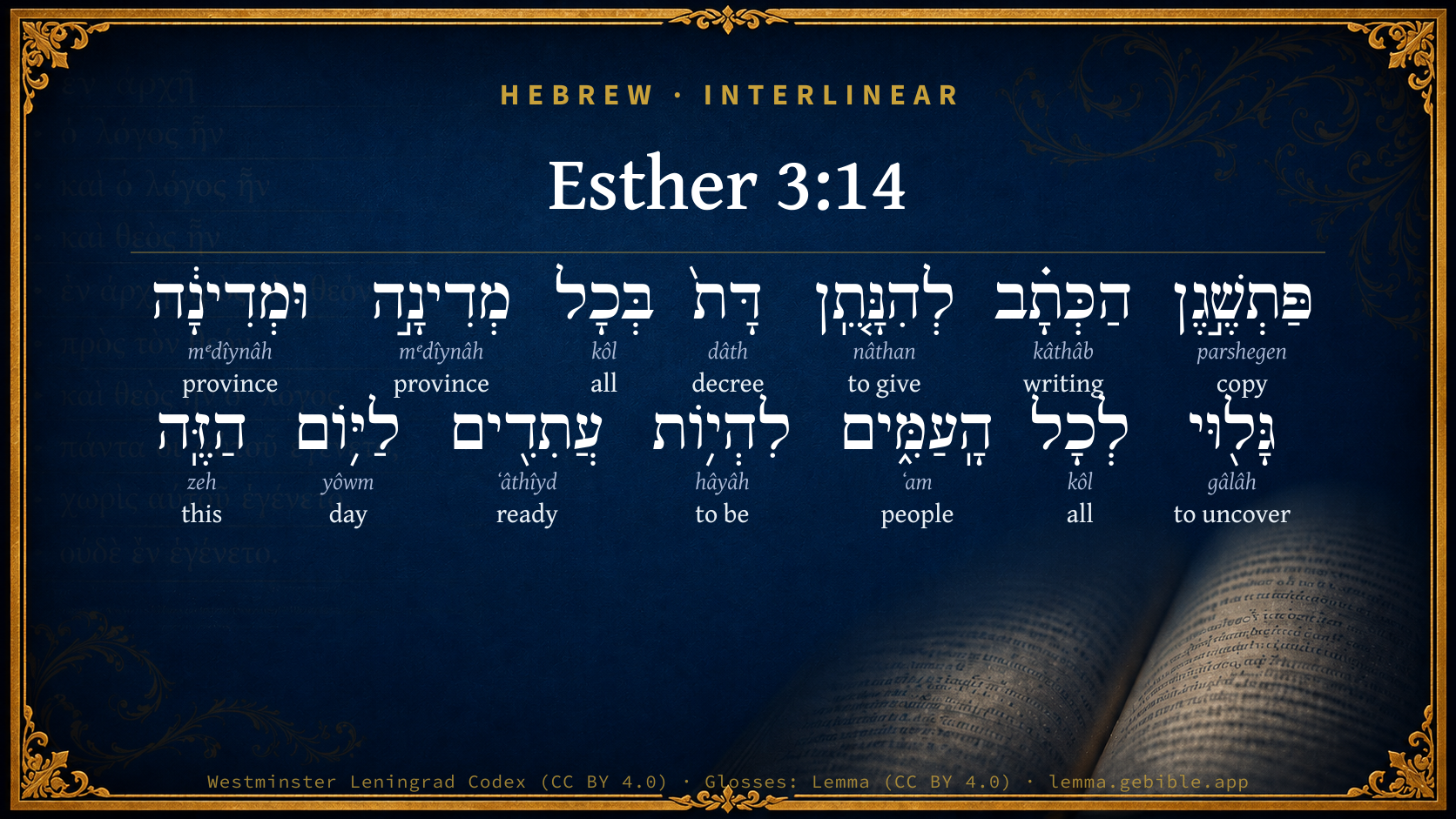
Hebrew (Westminster Leningrad Codex) Esther 3:14 appears in the Hebrew Old Testament. The text above is from the Westminster Leningrad Codex. Each word links to its Strong’s number, a concise gloss, and parsing drawn from the Open Scriptures Hebrew Bible morphology. Click any word for its full Brown-Driver-Briggs (BDB) entry.
Download image
Cite this verse

Esther 3:14 (World English Bible). Public Domain. Lemma interlinear Bible study tool, https://lemma.gebible.app/v/esther/3/14.

Show BibTeX & RIS
BibTeX
RIS
English Translation
A copy of the writing, that the decree should be given out in every province, was published to all the peoples, that they should be ready against that day.
World English Bible · Public Domain
Download a study sheet

One document with this verse’s original text, its word-by-word gloss line, the meaning frame, cross-references with their text, attributed commentary, and full source and license credits — printable, and it pastes into notes with its structure intact.

This verse Autodidact and up

Study sheet (.html) Plain text (.txt)

A passage Seminary Student

Up to 50 verses in one chapter. A passage sheet keeps up to 6 commentary sources and 12 cross-references per verse, in the order this page ranks them, and says so on the sheet whenever that leaves anything out. Ask for a single verse and you get the Autodidact verse sheet above.

Everything on this page stays free to read, with no account — the sheet is a download of what is already on screen, not access to it.

Want to remove ads? Support Godless Engineer
Compare translations 3

The same verse in 3 English versions, stacked beneath the original-language interlinear above. Click any original word for its lexicon entry.

Each is an independent rendering of the whole verse — the interlinear is not word-aligned to these translations.

Highlighted words mark where these versions differ — a whole-verse word diff, not a word-by-word alignment.

  • World English Bible Public Domain
    A copy of the writing, that the decree should be given out in every province, was published to all the peoples, that they should be ready against that day.
  • King James Version Public Domain
    The copy of the writing for a commandment to be given in every province was published unto all people, that they should be ready against that day.
  • unfoldingWord Literal Text CC BY-SA 4.0
    A copy of the writing, to be given as a law in every province by province, was uncovered for all the peoples to be ready for this day.

unfoldingWord Literal Text — © unfoldingWord, licensed CC BY-SA 4.0. Word-aligned USFM3 via Door43 (git.door43.org/unfoldingWord/en_ult).

Versions to compare (up to 4)

3 of 4 selected

Show all 18 translations

Every available English version of this verse, each an independent rendering of the whole verse.

  • World English Bible Public Domain
    A copy of the writing, that the decree should be given out in every province, was published to all the peoples, that they should be ready against that day.
  • Berean Standard Bible Public Domain
    A copy of the text of the edict was to be issued in every province and published to all the people, so that they would be ready on that day.
  • Majority Standard Bible Public Domain
    A copy of the text of the edict was to be issued in every province and published to all the people, so that they would be ready on that day.
  • King James Version Public Domain
    The copy of the writing for a commandment to be given in every province was published unto all people, that they should be ready against that day.
  • American Standard Version (1901) Public Domain
    A copy of the writing, that the decree should be given out in every province, was published unto all the peoples, that they should be ready against that day.
  • Revised Version (1885) Public Domain
    A copy of the writing, that the decree should be given out in every province, was published unto all the peoples, that they should be ready against that day.
  • Geneva Bible (1599) Public Domain
    The contents of the writing was, that there shoulde be giuen a commandement in all prouinces, and published vnto all people, that they should be ready against the same day.
  • Douay-Rheims (1899) Public Domain
    And the contents of the letters were to this effect, that all provinces might know and be ready against that day.
  • Young's Literal Translation Public Domain
    a copy of the writing to be made law in every province and province is revealed to all the peoples, to be ready for this day.
  • Literal Standard Version CC BY-SA 4.0
    a copy of the writing to be made law in each and every province is revealed to all the peoples, to be ready for this day.
  • Unlocked Literal Bible CC BY-SA 4.0
    A copy of the letter was made law in every province. In every province it was made known to all the people that they should prepare for this day.
  • unfoldingWord Literal Text CC BY-SA 4.0
    A copy of the writing, to be given as a law in every province by province, was uncovered for all the peoples to be ready for this day.
  • Darby Bible Public Domain
    That the decree might be given in every province, a copy of the writing was published to all peoples, that they should be ready against that day.
  • World Messianic Bible Public Domain
    A copy of the letter, that the decree should be given out in every province, was published to all the peoples, that they should be ready against that day.
  • Webster's Bible Public Domain
    The copy of the writing for a commandment to be given in every province, was published to all people, that they should be ready against that day.
  • Free Bible Version CC BY-SA 4.0
    A copy of the decree was to be issued as law in every province and publicized to the people so that they would be ready for the day.
  • Bible in Basic English Public Domain
    A copy of the writing, to be made public in every part of the kingdom, was sent out to all the peoples, so that they might be ready when that day came.
  • JPS Tanakh (1917) Public Domain
    The copy of the writing, to be given out for a decree in every province, was to be published unto all peoples, that they should be ready against that day.

Literal Standard Version (2020), Covenant Press — licensed CC BY-SA 4.0. Text via the HelloAO Bible API (eBible.org). Unlocked Literal Bible (unfoldingWord) — licensed CC BY-SA 4.0. Text via the HelloAO Bible API (eBible.org). unfoldingWord Literal Text — © unfoldingWord, licensed CC BY-SA 4.0. Word-aligned USFM3 via Door43 (git.door43.org/unfoldingWord/en_ult). Free Bible Version, Dr. Jonathan Gallagher — licensed CC BY-SA 4.0. Text via the HelloAO Bible API (eBible.org).

Word by word

More ways to search: Search by grammar → Find every occurrence → Compare this word →

Practice this passage: Drill this verse → Learn its vocabulary →

פַּתְשֶׁ֣גֶן
parshegen
H6572
“copy of”
Noun, Common, Masculine, Singular, Construct
Part of Speech
Noun
Type
Common
Gender
Masculine
Number
Singular
State
Construct
Full BDB Definition

Origin: of foreign origin

TWOT: 1837

copy
  1. הַכְּתָ֗ב kâthâb H3791 “the · writing” Particle, Definite Article + Noun, Common, Masculine, Singular, Absolute
  2. לְהִנָּ֤תֵֽן nâthan H5414 “to give” Preposition + Verb, Niphal, Infinitive Construct
  3. דָּת֙ dâth H1881 “decree” Noun, Common, Feminine, Singular, Absolute
  4. בְּכָל kôl H3605 “in/at · all of” Preposition + Noun, Common, Masculine, Singular, Construct
  5. מְדִינָ֣ה mᵉdîynâh H4082 “province” Noun, Common, Feminine, Singular, Absolute
  6. וּמְדִינָ֔ה mᵉdîynâh H4082 “and · province” Conjunction + Noun, Common, Feminine, Singular, Absolute
  7. גָּל֖וּי gâlâh H1540 “uncovered” Verb, Qal, Participle Passive, Masculine, Singular, Absolute
  8. לְכָל kôl H3605 “to/for · all of” Preposition + Noun, Common, Masculine, Singular, Construct
  9. הָֽעַמִּ֑ים ʻam H5971 “the · peoples” Particle, Definite Article + Noun, Common, Masculine, Plural, Absolute
  10. לִהְי֥וֹת hâyâh H1961 “to be” Preposition + Verb, Qal, Infinitive Construct
  11. עֲתִדִ֖ים ʻâthîyd H6264 “ready” Adjective, Adjective, Masculine, Plural, Absolute
  12. לַיּ֥וֹם yôwm H3117 “to/for the · day” Preposition, Determined + Noun, Common, Masculine, Singular, Absolute
  13. הַזֶּֽה zeh H2088 “the · this” Particle, Definite Article + Pronoun, Demonstrative, Masculine, Singular

About this verse

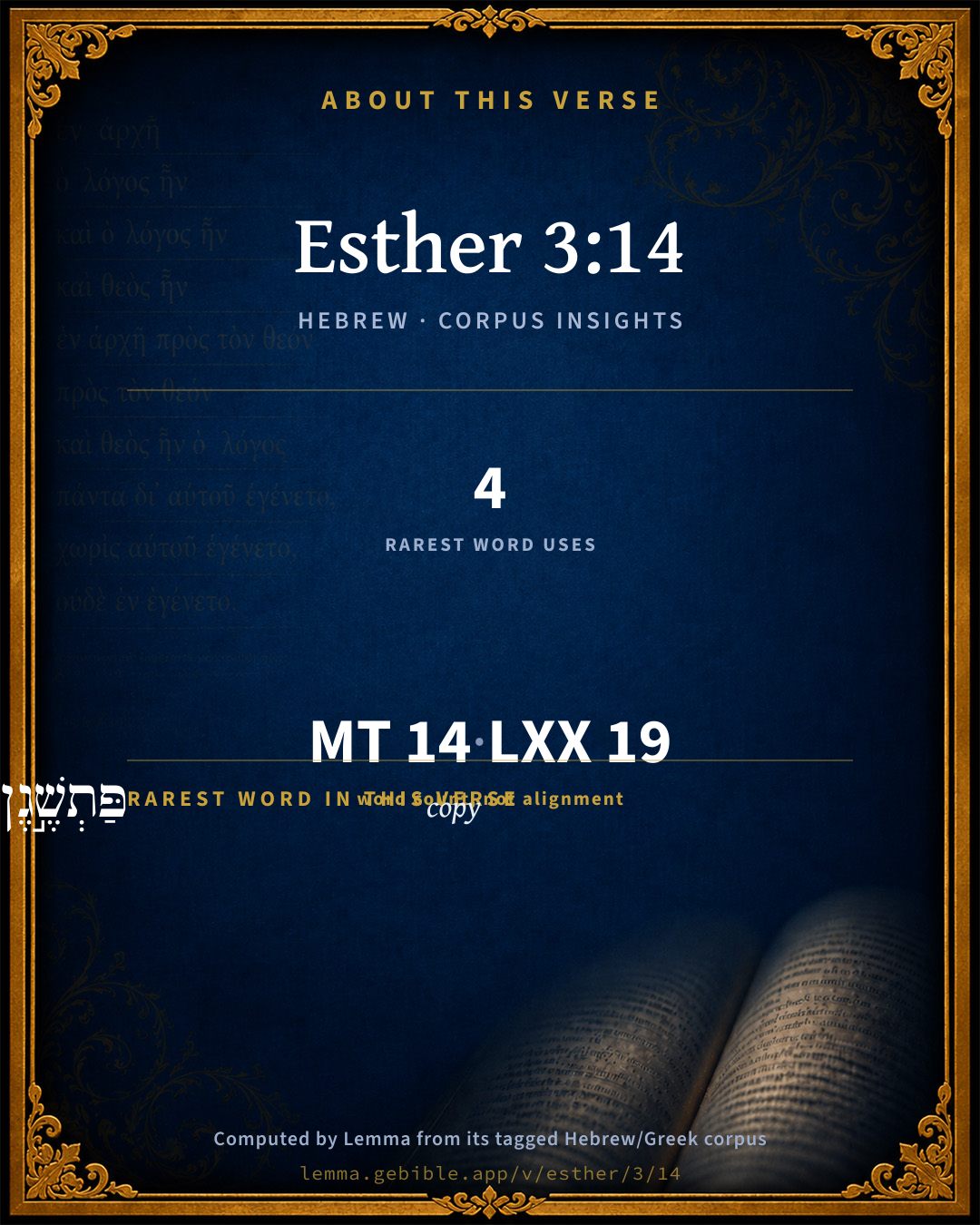
These counts appear in no published source. They are computed here, from the morphology-tagged text and Lemma’s own curated glosses. What Lemma adds →

14
words
12
distinct lemmas
Historical
section

Notable vocabulary

The rarest word here is פַּתְשֶׁ֣גֶן copy H6572 — appearing just 4 times in the whole Hebrew Bible.

Shared distinctive vocabulary

פַּתְשֶׁ֣גֶן copy H6572 occurs in 4 verses of the Hebrew Bible. Also found in:

Grammatical profile

  • 3 verbs
  • 9 nouns
  • 1 adjective
  • 1 pronoun

Verb forms

  • לְהִנָּ֤תֵֽן Niphal · Infinitive Construct
  • גָּל֖וּי Qal · Participle Passive
  • לִהְי֥וֹת Qal · Infinitive Construct

Repetition

Words recur within this verse — often emphatic in Hebrew:

  • בְּכָל all H3605 ×2
  • מְדִינָ֣ה province H4082 ×2

Hebrew & Septuagint length

In English translation the verse runs 29 words from the Hebrew and 26 from the Septuagint (LXX English) — closely comparable.

A rough comparison of the two English renderings, which tokenize alike — not a word-level alignment.

Word counts can differ between the Hebrew and the Greek without any difference in meaning — e.g. the Hebrew direct-object marker אֵת has no separate Greek word, and Greek often adds the article ὁ.

In the original languages it is 14 Hebrew tokens and 19 Greek tokens — but the two are counted differently (Hebrew bundles its prefixes and suffixes into one token; the Greek is in lemma form), so that isn’t a like-for-like length.

Cross-references

1

Topical passages linked to Esther 3:14 in the Treasury of Scripture Knowledge — connected by theme and wording, ordered by reader-vote popularity; previews shown in the World English Bible.

  • Esther 8:13–14 A copy of the writing, that the decree should be given out in every province, was published to all the peoples, and that the Jews should be ready against that day to avenge themselves on their enemies.

Cross-references courtesy of OpenBible.info (CC BY 4.0).

Hebrew and Greek witnesses Masoretic Hebrew ↔ Greek Septuagint

The same verse in the two great witnesses to the Old Testament, shown verse-for-verse.

These are two independent witnesses, not word-aligned to each other, and the Septuagint is shown in lemma (dictionary) form.

Hebrew Esther 3:14 Masoretic · Westminster Leningrad Codex

פַּתְשֶׁ֣גֶן הַכְּתָ֗ב לְהִנָּ֤תֵֽן דָּת֙ בְּכָל מְדִינָ֣ה וּמְדִינָ֔ה גָּל֖וּי לְכָל הָֽעַמִּ֑ים לִהְי֥וֹת עֲתִדִ֖ים לַיּ֥וֹם הַזֶּֽה

A copy of the writing, that the decree should be given out in every province, was published to all the peoples, that they should be ready against that day.

World English Bible · Public Domain

Greek LXX Esther 3:14 Septuagint · lemma form

ὁ δέ ἀντίγραφον ὁ ἐπιστολή ἐκτίθημι κατά χώρα καί προςτάσσω πᾶς ὁ ἔθνος ἕτοιμος εἰμί εἰς ὁ ἡμέρα οὗτος

And the copies of the letters were published in every province; and an order was given to all the nations to be ready against that day.

LXX2012 (modern English Septuagint) · Public Domain

Hebrew: Westminster Leningrad Codex (CC BY 4.0). Greek: Septuagint (public domain); English from LXX2012 (modern English Septuagint) (Public Domain). How the Septuagint differs from the Hebrew →

Commentary

Notes on Esther 3:14 from classic Christian and Jewish commentators (each source and its license shown beneath its notes). The classic Christian expositions comment on the surrounding passage and are grouped to its opening verse, so a note may address several verses; the Jewish commentaries on the Tanakh (Rashi and others) are per-verse, so they appear only where the commentator wrote on this verse.

Lemma curates 59 commentaries, every one of them public domain or Creative Commons licensed, each selected and text-cleaned for this edition rather than reprinted as found. About our sources →

Trapp's Complete Commentary

John Trapp

Est 3:14 The copy of the writing for a commandment to be given in every province was published unto all people, that they should be ready against that day.

Ver. 14. The copy of the writing … was published] Phathsegin, a Syriac word, saith R. David, and not found but in the books about the captivity. The Vulgate rendereth it Summa, highest, R. Nathan τυπος, to the same sense. Transcripts of the original were sent to all places, that none might be ignorant or negligent in doing execution. But why did not the Jews upon such notice save themselves by flight, may some say? Alas, whither should the poor souls flee with their families? being compassed about with so many deadly enemies, having none that durst own them in that distress? It was a just wonder, and a special work of God, that their enemies forbore to fall upon them before the black day came, if but for the sake of spoil. We read, Est 9:1; Est 9:5-11 that notwithstanding the known favour of the king, the patronage of Mordecai, and the hanging up of Haman, &c., the thirteenth of Adar is still meant to be a bloody day. Haman’s abettors join together to perform that sentence, whereof the author repented, &c. But God was seen in the mount; he loveth to help those that are forsaken from their hopes, as he did these poor prisoners then, when it might seem that there was neither left unto them hope of better or place of worse. Who would not therefore trust in God? Deo confisi nunquam confusi? Trust in God will surely triumph.

That they should be ready against that day] That long looked for day by Haman and his party, wherein they meant to roll themselves, and wallow in the blood of those Jews, and to say, as Hannibal did, when he saw a ditch filled with man’s blood, O iucundum spectaculum! O pleasant sight! Or as Valesus, when he had slain three hundred, O rem regiam! O kingly act! Or as that queen, who, when she saw some of her Protestant subjects lying dead and stripped upon the earth, cried out, the godliest tapestry that ever she beheld! Are not such blood suckers of the vulturine kind spoken of in Job, whose young ones glut-glut blood (the original word seemeth made from the sound), "and where the slain are there is she," Job 39:30.

John Trapp, A Commentary or Exposition upon All the Books of the Old and New Testament (1647–1656) — public domain. Text from a community e-Sword module.

Joseph Benson's Commentary

Est 3:14-15. The copy of the writing to be given in every province — Copies of this original decree of the king were sent into every province, and there ordered to be published, requiring the people to be ready against the day appointed. The posts went out, being hastened by the king’s commandment — Either by this decree made in the king’s name, or by some particular and succeeding command which Haman obtained from the king. And the king and Haman sat down to drink — Haman was afraid, probably, lest the king’s conscience should smite him for what he had done, and he should begin to wish it undone again; to prevent which he engrossed him to himself, and kept him drinking. This cursed method many take to drown their convictions, and harden their own hearts, and the hearts of others, in sin. But the city Shushan was perplexed — Not only the Jews, but a great number of the citizens, either because they were related to them, or engaged with them in worldly concerns; or out of humanity and compassion toward so vast a number of innocent people, appointed as sheep for the slaughter. They might apprehend likewise that, upon the execution of the decree, some sedition or tumult might ensue; that in so great a slaughter it was hard to tell who would escape without being killed or plundered, because those who were employed in this bloody work would be more mindful to enrich themselves than to observe their orders. They might also fear that a public judgment from God would come upon them all for so bloody a decree.

We see in the exaltation of Haman, recorded in this chapter, and in his subsequent fall, that God sometimes permits wicked men to arrive at the highest degree of honour and power, but that he soon brings them low, and exposes them to shame and misery. And we learn by the sequel of this history, that he suffered things to proceed to extremities, only the more effectually to confound Haman; and convince the Jews, in a more surprising manner, of his care and protection. We see also the sin and folly of Ahasuerus, in giving credit too easily to Haman’s suggestion against the Jews, by which credulity he had well nigh occasioned many millions of innocent persons to perish. This shows how dangerous it is to listen to detracters, and that we ought never to credit evil reports till we have first inquired and ascertained the truth of them.

Joseph Benson's Commentary on the Old and New Testaments (1811–1818) — public domain. Text from a community e-Sword module.

Tyndale Open Study Notes

Tyndale Open Resources

3:14-15 This decree carried the full weight of Xerxes’ royal authority. • The foolish king and wicked Haman celebrated this occasion, but the people of the fortress of Susa were perplexed, bewildered, and confused at such a ruthless and unjust decree.

Tyndale Open Study Notes — © Tyndale Open Resources, licensed CC BY-SA 4.0. Text via the HelloAO Bible API.

Ellicott's Commentary for English Readers

(14) Copy.—Heb., pathshegen. A Persian word, only occurring here and in Est_4:8; Est_8:13.

A Bible Commentary for English Readers, edited by Charles John Ellicott (1878–1897) — public domain. Text from a community e-Sword module.

The Cambridge Bible for Schools and Colleges

gen. ed. J. J. S. Perowne

14. A copy] The word in the original is of Persian origin, and occurs again in Est_4:8, Est_8:13.

that the decree should be given out] The marg. to be given out for a decree, is probably better, the writing and the decree being one and the same.

unto all the peoples] See on Est_1:11.

that they should be ready against that day] A few weeks would suffice for the edict to reach even remote provinces of the Empire. Thus the Jews’ enemies would have ample time to make preparations for the carrying out of its purpose. It is of course obvious that the intended victims would also hereby be given an opportunity of defending themselves; and this must be acknowledged to be a difficulty, if we assume the accuracy of the dates given for the successive parts of the transaction. Clearly, however, we are not in a position to impugn their accuracy by conjecturing a shorter interval between the inception of the scheme and the date appointed for its execution, inasmuch as a considerable time is demanded by the exigencies of the narrative for circumstances attending the overthrow of Haman, the change in the king’s sentiments, and the transmission of letters permitting the Jews to defend themselves.

The Cambridge Bible for Schools and Colleges (gen. ed. J. J. S. Perowne; Cambridge University Press, 1878–1918) — public domain. Text from a community e-Sword module.

John Gill's Exposition

The copy of the writing, for a commandment to be given in every province, was published unto all people,.... Not only letters were sent to the governors, but a copy, or the sum of the contents of them, was published by heralds, or stuck up as with us, in various places, that it might be publicly known by the common people everywhere:

that they should be ready against that day; and fall upon the people of the Jews, and slay them, and seize on their goods as a prey.

John Gill's Exposition of the Whole Bible (1746–1763) — public domain (CC PDM 1.0). Text via the HelloAO Bible API.

Haydock's Catholic Bible Commentary

Letter. It should appear here, as it is in Greek, but the Hebrew, &c., omitting it, the Vulgate give it, chap. xiii. 1.

George Leo Haydock (1774–1849), Haydock's Catholic Family Bible and Commentary, 1859 edition — public domain. Excludes Psalms (Douay-Rheims chapter numbering differs from Protestant) and Deuterocanonical books (Catholic canon only).

The Pulpit Commentary

The exact import of this verse is uncertain. Some suppose it to be a mere heading to a copy of the decree, which was originally inserted in the text between verses 14 and 15. In this case the translation should be; "A copy of the writing for giving commandment to every province, published to all peoples, that they should be ready against that day."

The Pulpit Commentary (1880–1919), ed. H.D.M. Spence-Jones & Joseph S. Exell — public domain. Text from a community e-Sword module.

unfoldingWord translationNotes

Door43 World Missions Community

A copy of the letter was made law in every province

This can be stated in active form. AT: "The officials in every province made a copy of the letter become the law" (See: Active or Passive)

province

A province is a large area into which some countries are divided for the purposes of government. See how you translated this in Esther 1:1.

In every province it was made known to all the people

This can be stated in active form. AT: "They told all the people in every province" (See: Active or Passive)

this day

"that day"

The decree was also distributed

This can be stated in active form. AT: "They also distributed the decree" (See: Active or Passive)

the fortress

This refers to a castle, stronghold or fortified city. See how you translated this in Esther 1:2.

Susa

See how you translated the name of this place in Esther 1:2. (See: How to Translate Names)

was in turmoil

"was in a state of great confusion"

translationWords

law, laws

king

decree

unfoldingWord translationNotes — © Distant Shores Media and the Door43 World Missions Community, licensed CC BY-SA 4.0. Source: git.door43.org/Door43/en_tn.

Rashi

Rabbi Shlomo Yitzchaki (Rashi)

The copy of the writ Heb. פַּתְשֶּׁגֶן, an Aramaism, the account of the writ, deresmant in Old French, text, contents, account.

for an edict to be given The command of the writ was that it proclaimed that the decree of the king should be issued as a statute.

published to all the peoples This matter.

Rashi on the Tanakh — English translations: “The Judaica Press complete Tanach with Rashi, translated by A. J. Rosenberg” (CC BY 4.0); “Pentateuch with Rashi's commentary by M. Rosenbaum and A.M. Silbermann, 1929-1934” (public domain); “The Metsudah Tanach series, Lakewood, N.J” (CC BY 4.0); and “The Book of Joshua, Metsudah Publications, 1997” (CC BY 4.0). Text via Sefaria.

Lesson kit

Teaching starters — assembled from the data on this page, not authored interpretation. Every prompt links to the verse data it draws on. Edit before teaching.

Esther, in the Historical, opens this verse with 14 words (12 distinct Hebrew lemmas). Its most distinctive word is parshegen (“copy”). A historical commentator’s framing appears above. Read the whole chapter for the surrounding context.

Discussion questions

  1. What does “copy” (parshegen) contribute to the verse as a whole?
  2. How does Ezra 7:11, which shares the word «copy», read alongside this verse?
  3. What does the repetition of “all” (2× in this one verse) do in this verse?
  4. These translations render this verse differently. What is at stake in choosing one wording over another?
  5. «לְהִנָּ֤תֵֽן» is a Niphal Infinitive Construct verb. How does that grammatical form shape the action described?
  6. Compare how Trapp's Complete Commentary and Joseph Benson's Commentary read this verse. Where do they agree or differ?

Things to notice

Reading settings

Reading text

Shown beneath each verse's original-language words.

Old Testament
Old Testament edition

Read the OT as the Masoretic Hebrew (MT) or the Greek Septuagint (LXX).

English shown for the Greek Septuagint (in the Hebrew ↔ Greek comparison).

Comparing translations? Open the Compare panel on any verse page to stack up to four side by side.