
2 Chronicles 32:27

Hebrew (Westminster Leningrad Codex) 2 Chronicles 32:27 appears in the Hebrew Old Testament. The text above is from the Westminster Leningrad Codex. Each word links to its Strong’s number, a concise gloss, and parsing drawn from the Open Scriptures Hebrew Bible morphology. Click any word for its full Brown-Driver-Briggs (BDB) entry.
Download image
Cite this verse

2 Chronicles 32:27 (World English Bible). Public Domain. Lemma interlinear Bible study tool, https://lemma.gebible.app/v/2-chronicles/32/27.

Show BibTeX & RIS
BibTeX
RIS
English Translation
Hezekiah had exceeding much riches and honor: and he provided him treasuries for silver, and for gold, and for precious stones, and for spices, and for shields, and for all manner of goodly vessels;
World English Bible · Public Domain
Download a study sheet

One document with this verse’s original text, its word-by-word gloss line, the meaning frame, cross-references with their text, attributed commentary, and full source and license credits — printable, and it pastes into notes with its structure intact.

This verse Autodidact and up

Study sheet (.html) Plain text (.txt)

A passage Seminary Student

Up to 50 verses in one chapter. A passage sheet keeps up to 6 commentary sources and 12 cross-references per verse, in the order this page ranks them, and says so on the sheet whenever that leaves anything out. Ask for a single verse and you get the Autodidact verse sheet above.

Everything on this page stays free to read, with no account — the sheet is a download of what is already on screen, not access to it.

Want to remove ads? Support Godless Engineer
Compare translations 3

The same verse in 3 English versions, stacked beneath the original-language interlinear above. Click any original word for its lexicon entry.

Each is an independent rendering of the whole verse — the interlinear is not word-aligned to these translations.

Highlighted words mark where these versions differ — a whole-verse word diff, not a word-by-word alignment.

  • World English Bible Public Domain
    Hezekiah had exceeding much riches and honor: and he provided him treasuries for silver, and for gold, and for precious stones, and for spices, and for shields, and for all manner of goodly vessels;
  • King James Version Public Domain
    And Hezekiah had exceeding much riches and honor: and he made himself treasuries for silver, and for gold, and for precious stones, and for spices, and for shields, and for all manner of pleasant jewels;
  • unfoldingWord Literal Text CC BY-SA 4.0
    And there was to Hezekiah very many riches and glory, and treasuries he made for himself for silver, and for gold, and for precious stones, and for spices, and for shields, and for all desirable items,

unfoldingWord Literal Text — © unfoldingWord, licensed CC BY-SA 4.0. Word-aligned USFM3 via Door43 (git.door43.org/unfoldingWord/en_ult).

Versions to compare (up to 4)

3 of 4 selected

Show all 18 translations

Every available English version of this verse, each an independent rendering of the whole verse.

  • World English Bible Public Domain
    Hezekiah had exceeding much riches and honor: and he provided him treasuries for silver, and for gold, and for precious stones, and for spices, and for shields, and for all manner of goodly vessels;
  • Berean Standard Bible Public Domain
    Hezekiah had very great riches and honor, and he made treasuries for his silver, gold, precious stones, spices, shields, and all kinds of valuable articles.
  • Majority Standard Bible Public Domain
    Hezekiah had very great riches and honor, and he made treasuries for his silver, gold, precious stones, spices, shields, and all kinds of valuable articles.
  • King James Version Public Domain
    And Hezekiah had exceeding much riches and honor: and he made himself treasuries for silver, and for gold, and for precious stones, and for spices, and for shields, and for all manner of pleasant jewels;
  • American Standard Version (1901) Public Domain
    And Hezekiah had exceeding much riches and honor: and he provided him treasuries for silver, and for gold, and for precious stones, and for spices, and for shields, and for all manner of goodly vessels;
  • Revised Version (1885) Public Domain
    And Hezekiah had exceeding much riches and honour: and he provided him treasuries for silver, and for gold, and for precious stones, and for spices, and for shields, and for all manner of goodly vessels;
  • Geneva Bible (1599) Public Domain
    Hezekiah also had exceeding much riches and honour, and he gate him treasures of siluer, and of golde, and of precious stones, and of sweete odours, and of shieldes, and of all pleasant vessels:
  • Douay-Rheims (1899) Public Domain
    And Ezechias was rich, and very glorious, and he gathered himself great treasures of silver and of gold, and of precious stones, of spices, and of arms, of all kinds, and of vessels of great price.
  • Young's Literal Translation Public Domain
    And Hezekiah hath riches and honour very much, and treasures he hath made to himself of silver, and of gold, and of precious stone, and of spices, and of shields, and of all `kinds' of desirable vessels,
  • Literal Standard Version CC BY-SA 4.0
    And Hezekiah has very much riches and honor, and he has made treasures for himself of silver, and of gold, and of precious stone, and of spices, and of shields, and of all [kinds] of desirable vessels,
  • Unlocked Literal Bible CC BY-SA 4.0
    Hezekiah had very many riches and much honor. He provided himself with storerooms for silver, gold, precious stones, and for spices, as well as for shields and for all kinds of valuable objects.
  • unfoldingWord Literal Text CC BY-SA 4.0
    And there was to Hezekiah very many riches and glory, and treasuries he made for himself for silver, and for gold, and for precious stones, and for spices, and for shields, and for all desirable items,
  • Darby Bible Public Domain
    And Hezekiah had very much riches and honour; and he made himself treasuries for silver, and for gold, and for precious stones, and for spices, and for shields, and for all manner of pleasant vessels;
  • World Messianic Bible Public Domain
    Hezekiah had exceedingly great riches and honor. He provided himself with treasuries for silver, for gold, for precious stones, for spices, for shields, and for all kinds of valuable vessels;
  • Webster's Bible Public Domain
    And Hezekiah had very great riches and honor: and he made himself treasuries for silver, and for gold, and for precious stones, and for spices, and for shields, and for all manner of pleasant jewels:
  • Free Bible Version CC BY-SA 4.0
    Hezekiah was very rich and highly honored, and he built treasury storerooms to hold silver, gold, precious stones, spices, shields, and all kinds of valuable things.
  • Bible in Basic English Public Domain
    And Hezekiah had very great wealth and honour; and he made himself store-houses for his gold and silver and jewels and spices, and for body-covers and all sorts of beautiful vessels.
  • JPS Tanakh (1917) Public Domain
    And Hezekiah had exceeding much riches and honour; and he provided him treasuries for silver, and for gold, and for precious stones, and for spices, and for shields, and for all manner of goodly vessels;

Literal Standard Version (2020), Covenant Press — licensed CC BY-SA 4.0. Text via the HelloAO Bible API (eBible.org). Unlocked Literal Bible (unfoldingWord) — licensed CC BY-SA 4.0. Text via the HelloAO Bible API (eBible.org). unfoldingWord Literal Text — © unfoldingWord, licensed CC BY-SA 4.0. Word-aligned USFM3 via Door43 (git.door43.org/unfoldingWord/en_ult). Free Bible Version, Dr. Jonathan Gallagher — licensed CC BY-SA 4.0. Text via the HelloAO Bible API (eBible.org).

Word by word

More ways to search: Search by grammar → Find every occurrence → Compare this word →

Practice this passage: Drill this verse → Learn its vocabulary →

חֶמְדָּֽה
chemdâh
H2532
“desirable”
Noun, Common, Feminine, Singular, Absolute
Part of Speech
Noun
Type
Common
Gender
Feminine
Number
Singular
State
Absolute
Full BDB Definition

Origin: from H2531

TWOT: 673b

desire, that which is desirable (noun feminine) - pleasant, precious (adjective)
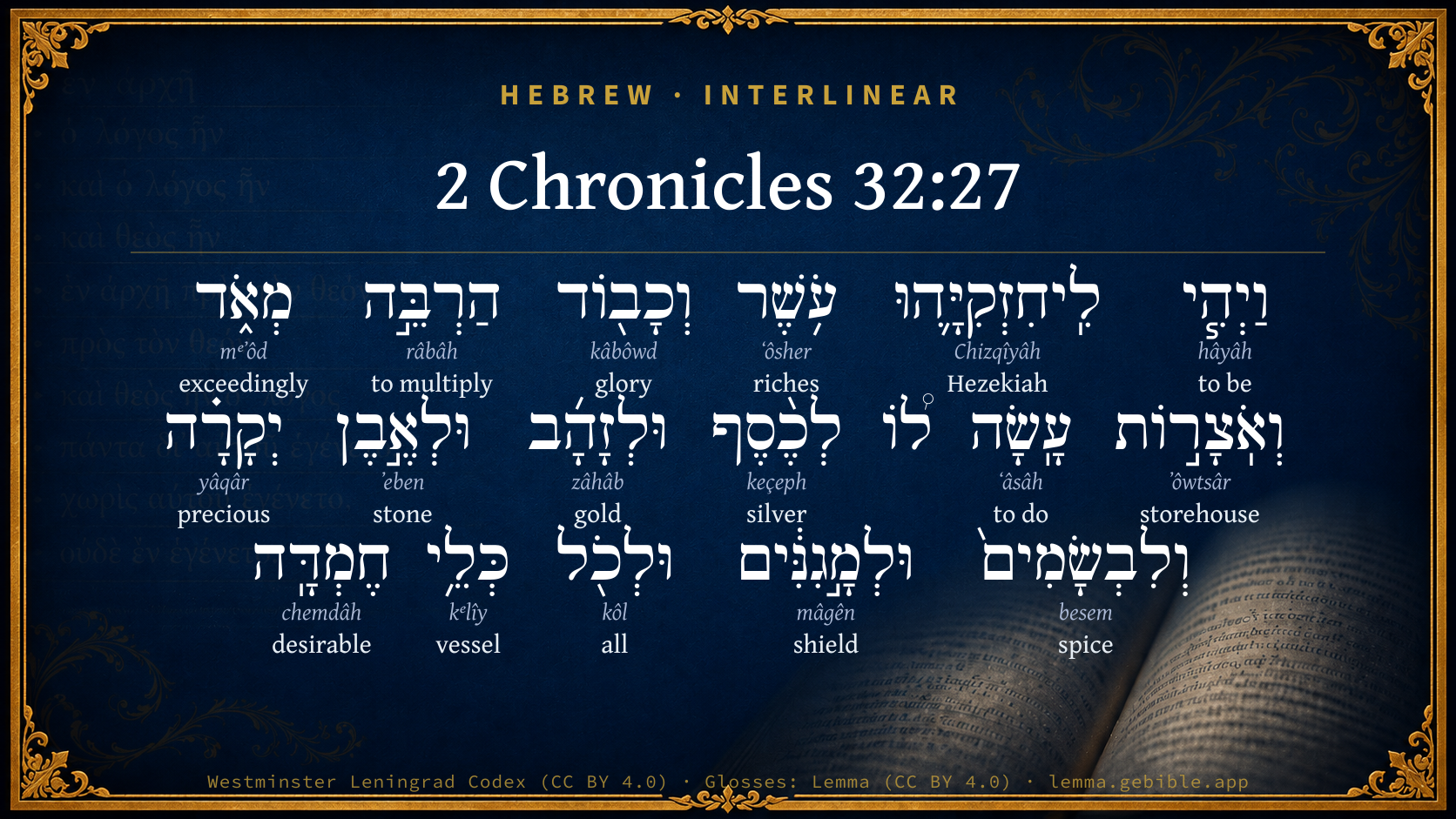
  1. וַיְהִ֧י hâyâh H1961 “and · to be” Conjunction + Verb, Qal, Sequential Imperfect, 3rd Person, Masculine, Singular
  2. לִֽיחִזְקִיָּ֛הוּ Chizqîyâh H2396 “to/for · Hezekiah” Preposition + Noun, Proper
  3. עֹ֥שֶׁר ʻôsher H6239 “riches” Noun, Common, Masculine, Singular, Absolute
  4. וְכָב֖וֹד kâbôwd H3519 “and · glory” Conjunction + Noun, Common, Both, Singular, Absolute
  5. הַרְבֵּ֣ה râbâh H7235 “to multiply” Verb, Hiphil, Infinitive Absolute
  6. מְאֹ֑ד mᵉʼôd H3966 “exceedingly” Adverb
  7. וְאֹֽצָר֣וֹת ʼôwtsâr H214 “and · storehouses” Conjunction + Noun, Common, Masculine, Plural, Absolute
  8. עָֽשָׂה ʻâsâh H6213 “to do” Verb, Qal, Perfect, 3rd Person, Masculine, Singular
  9. לְכֶ֨סֶף keçeph H3701 “to/for · silver” Preposition + Noun, Common, Masculine, Singular, Absolute
  10. וּלְזָהָ֜ב zâhâb H2091 “and · to/for · gold” Conjunction + Preposition + Noun, Common, Masculine, Singular, Absolute
  11. וּלְאֶ֣בֶן ʼeben H68 “and · to/for · stone” Conjunction + Preposition + Noun, Common, Feminine, Singular, Absolute
  12. יְקָרָ֗ה yâqâr H3368 “precious” Adjective, Adjective, Feminine, Singular, Absolute
  13. וְלִבְשָׂמִים֙ besem H1314 “and · to/for · spices” Conjunction + Preposition + Noun, Common, Masculine, Plural, Absolute
  14. וּלְמָ֣גִנִּ֔ים mâgên H4043 “and · to/for · shields” Conjunction + Preposition + Noun, Common, Both, Plural, Absolute
  15. וּלְכֹ֖ל kôl H3605 “and · to/for · all of” Conjunction + Preposition + Noun, Common, Masculine, Singular, Construct
  16. כְּלֵ֥י kᵉlîy H3627 “vessels of” Noun, Common, Masculine, Plural, Construct

About this verse

These counts appear in no published source. They are computed here, from the morphology-tagged text and Lemma’s own curated glosses. What Lemma adds →

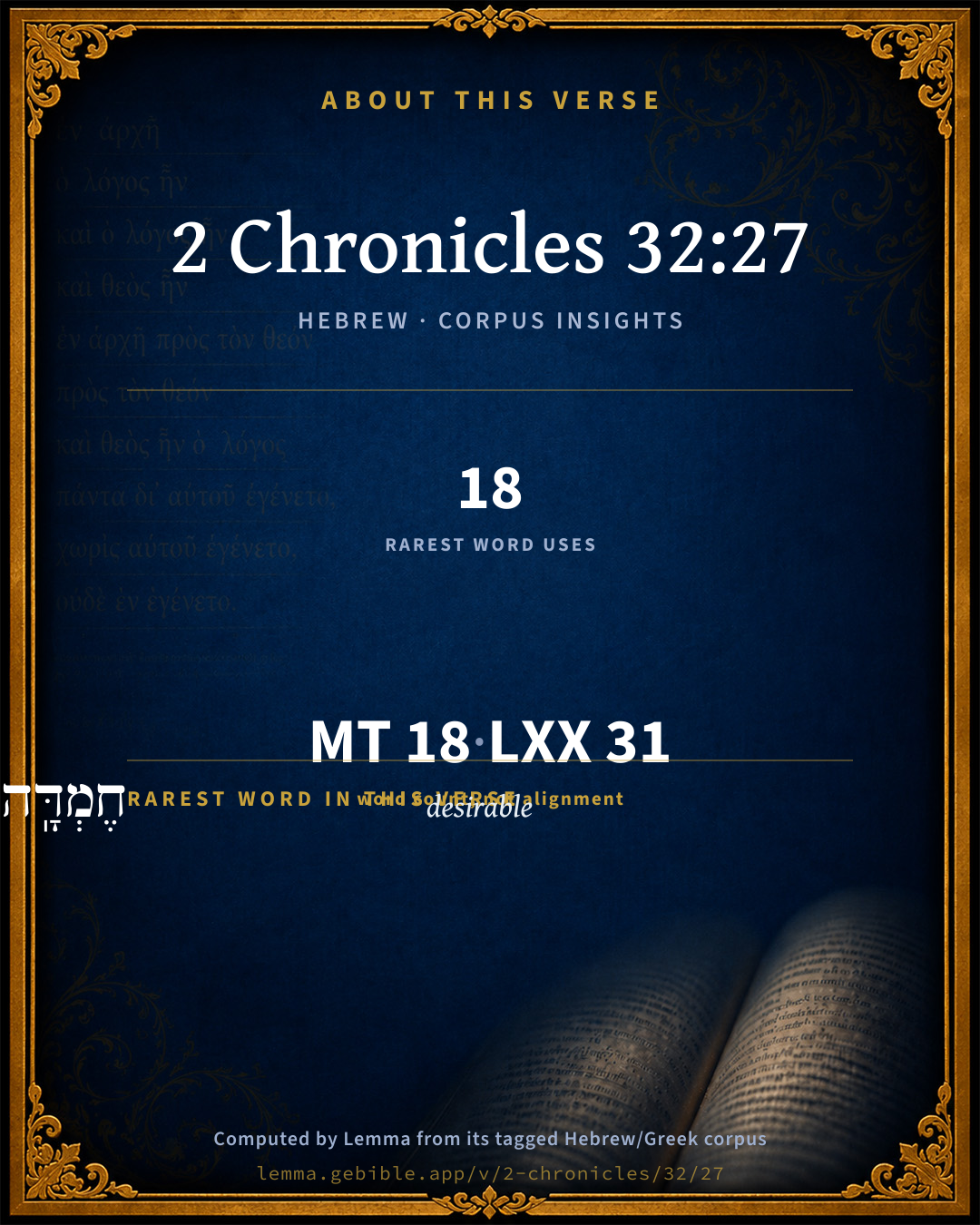
18
words
17
distinct lemmas
Historical
section

Notable vocabulary

The rarest word here is חֶמְדָּֽה desirable H2532 — appearing just 18 times in the whole Hebrew Bible.

Shared distinctive vocabulary

חֶמְדָּֽה desirable H2532 occurs in 18 verses of the Hebrew Bible. Also found in:

Grammatical profile

  • 3 verbs
  • 12 nouns
  • 1 adjective
  • 1 preposition
  • 1 adverb

Verb forms

  • וַיְהִ֧י Qal · Sequential Imperfect
  • הַרְבֵּ֣ה Hiphil · Infinitive Absolute
  • עָֽשָׂה Qal · Perfect

Hebrew & Septuagint length

In English translation the verse runs 34 words from the Hebrew and 32 from the Septuagint (LXX English) — closely comparable.

A rough comparison of the two English renderings, which tokenize alike — not a word-level alignment.

Word counts can differ between the Hebrew and the Greek without any difference in meaning — e.g. the Hebrew direct-object marker אֵת has no separate Greek word, and Greek often adds the article ὁ.

In the original languages it is 18 Hebrew tokens and 31 Greek tokens — but the two are counted differently (Hebrew bundles its prefixes and suffixes into one token; the Greek is in lemma form), so that isn’t a like-for-like length.

Cross-references

5

Topical passages linked to 2 Chronicles 32:27 in the Treasury of Scripture Knowledge — connected by theme and wording, ordered by reader-vote popularity; previews shown in the World English Bible.

  • 1 Chronicles 27:25–31 Over the king's treasures was Azmaveth the son of Adiel: and over the treasures in the fields, in the cities, and in the villages, and in the towers, was Jonathan the son of Uzziah:
  • 2 Chronicles 1:12 wisdom and knowledge is granted to you; and I will give you riches, and wealth, and honor, such as none of the kings have had who have been before you; neither shall there any after you have the like.
  • 2 Chronicles 9:27 The king made silver to be in Jerusalem as stones, and cedars made he to be as the sycamore trees that are in the lowland, for abundance.
  • 2 Chronicles 17:5 Therefore Yahweh established the kingdom in his hand; and all Judah brought to Jehoshaphat tribute; and he had riches and honor in abundance.
  • Proverbs 10:22 Yahweh's blessing brings wealth, And he adds no trouble to it.

Cross-references courtesy of OpenBible.info (CC BY 4.0).

Hebrew and Greek witnesses Masoretic Hebrew ↔ Greek Septuagint

The same verse in the two great witnesses to the Old Testament, shown verse-for-verse.

These are two independent witnesses, not word-aligned to each other, and the Septuagint is shown in lemma (dictionary) form.

Hebrew 2 Chronicles 32:27 Masoretic · Westminster Leningrad Codex

וַיְהִ֧י לִֽיחִזְקִיָּ֛הוּ עֹ֥שֶׁר וְכָב֖וֹד הַרְבֵּ֣ה מְאֹ֑ד וְאֹֽצָר֣וֹת עָֽשָׂה ל֠וֹ לְכֶ֨סֶף וּלְזָהָ֜ב וּלְאֶ֣בֶן יְקָרָ֗ה וְלִבְשָׂמִים֙ וּלְמָ֣גִנִּ֔ים וּלְכֹ֖ל כְּלֵ֥י חֶמְדָּֽה

Hezekiah had exceeding much riches and honor: and he provided him treasuries for silver, and for gold, and for precious stones, and for spices, and for shields, and for all manner of goodly vessels;

World English Bible · Public Domain

Greek LXX 2 Chronicles 32:27 Septuagint · lemma form

καί γίγνομαι ὁ εζεκιας πλοῦτος καί δόξα πολύς σφόδρα καί θησαυρός ποιέω ἑαυτοῦ ἀργύριον καί χρυσίον καί ὁ λίθος ὁ τίμιος καί εἰς ὁ ἄρωμα καί ὁπλοθήκη καί εἰς σκεῦος ἐπιθυμητός

And Ezekias had wealth and very great glory: and he made for himself treasuries of gold, and silver, and precious stones, also for spices, and stores for arms, and for precious vessels;

LXX2012 (modern English Septuagint) · Public Domain

On this verse, The Cambridge Bible for Schools and Colleges discusses the Septuagint’s reading. Read the note in Commentary ↓

Hebrew: Westminster Leningrad Codex (CC BY 4.0). Greek: Septuagint (public domain); English from LXX2012 (modern English Septuagint) (Public Domain). How the Septuagint differs from the Hebrew →

Commentary

Notes on 2 Chronicles 32:27 from classic Christian and Jewish commentators (each source and its license shown beneath its notes). The classic Christian expositions comment on the surrounding passage and are grouped to its opening verse, so a note may address several verses; the Jewish commentaries on the Tanakh (Rashi and others) are per-verse, so they appear only where the commentator wrote on this verse.

Lemma curates 59 commentaries, every one of them public domain or Creative Commons licensed, each selected and text-cleaned for this edition rather than reprinted as found. About our sources →

Jamieson, Fausset & Brown

Robert Jamieson, A. R. Fausset & David Brown

HIS RICHES AND WORKS. (Ch2 32:27-33)

he had exceeding much riches and honour--(compare Kg2 20:13; Isa 39:2). A great portion of his personal wealth, like that of David and Uzziah, consisted in immense possessions of agricultural and pastoral produce. Besides, he had accumulated large treasures in gold, silver, and precious things, which he had taken as spoils from the Philistines, and which he had received as presents from neighboring states, among which he was held in great honor as a king under the special protection of Heaven. Much of his great wealth he expended in improving his capital, erecting forts, and promoting the internal benefit of his kingdom.

Jamieson, Fausset & Brown — Commentary Critical and Explanatory on the Whole Bible (1871) — public domain (CC PDM 1.0). Text via the HelloAO Bible API.

Trapp's Complete Commentary

John Trapp

2Ch 32:27 And Hezekiah had exceeding much riches and honour: and he made himself treasuries for silver, and for gold, and for precious stones, and for spices, and for shields, and for all manner of pleasant jewels;

Ver. 27. And Hezekiah had exceeding much riches and honour.] And these puffed him up; his heart was lifted up with his wealth, as a boat riseth with the rising of the water that carrieth it.

And for all manner of pleasant jewels.] Heb., Instruments of desire. All these were lawful enough, and useful, had he not shot his affections too far into them.

“ Difficile est amimos opibus non tradere. ”

John Trapp, A Commentary or Exposition upon All the Books of the Old and New Testament (1647–1656) — public domain. Text from a community e-Sword module.

Tyndale Open Study Notes

Tyndale Open Resources

32:27-30 Hezekiah’s wealth marked him as a king like Solomon.

Tyndale Open Study Notes — © Tyndale Open Resources, licensed CC BY-SA 4.0. Text via the HelloAO Bible API.

Adam Clarke's Commentary

Verse 27. Pleasant jewels] כלי חמדה keley chemdah, desirable vessels or utensils.

Adam Clarke's Commentary on the Bible (1810–1826) — public domain. Text from a community e-Sword/MySword module.

Ellicott's Commentary for English Readers

(27) Had.—Or, got.

Riches and honour (or, wealth; kâbôd).—Comp. 1Ch_29:28 (David); 2Ch_1:12 (Solomon), 2Ch_17:5; 2Ch_18:1 (Jehoshaphat).

He made himself treasuries.—Comp. 2Ki_20:13; Isa_39:2, where silver and gold and spices are mentioned among the treasures of Hezekiah.

Shields.—Comp. Solomon’s golden, and Rehoboam’s brazen, shields. No doubt the term is here used to suggest arms in general. Kings and Isaiah mention “his armoury.”

All manner of pleasant jewels.—Literally, all vessels of desire. (Comp. Nah_2:10, “wealth of every vessel of desire.”) Costly implements and utensils of all sorts are included.

A Bible Commentary for English Readers, edited by Charles John Ellicott (1878–1897) — public domain. Text from a community e-Sword module.

The Cambridge Bible for Schools and Colleges

gen. ed. J. J. S. Perowne

27. riches and honour] Cp. 2Ki_20:13 (= Isa_39:2).

shields] If the text be correct we must think of silver and gold in the form of shields; cp. 2Ch_9:15-16; but perhaps we should read migdânoth, “precious things,” (as in 2Ch_32:23), for mâginnoth “shields.” LXX. ὁπλοθήκας, i.e. “armouries”; Pesh. (text being doubtful here) “shields” or “pearls” or “precious gifts.”

pleasant jewels] R.V. goodly vessels.

The Cambridge Bible for Schools and Colleges (gen. ed. J. J. S. Perowne; Cambridge University Press, 1878–1918) — public domain. Text from a community e-Sword module.

John Gill's Exposition

Now the rest of the acts of Hezekiah, and his goodness,.... His acts of piety and liberality:

behold, they are written in the vision of Isaiah the prophet, the son of Amoz; in the prophecy of Isaiah, Isa 36:1, whose book is called the Vision of Isaiah, Isa 1:1.

and in the book of the kings of Judah and Israel; in Kg2 18:1.

John Gill's Exposition of the Whole Bible (1746–1763) — public domain (CC PDM 1.0). Text via the HelloAO Bible API.

Haydock's Catholic Bible Commentary

Arms. Heb. "shields." Sept. "arsenals."

George Leo Haydock (1774–1849), Haydock's Catholic Family Bible and Commentary, 1859 edition — public domain. Excludes Psalms (Douay-Rheims chapter numbering differs from Protestant) and Deuterocanonical books (Catholic canon only).

Whedon's Commentary on the Bible

Daniel D. Whedon

27. Pleasant jewels — Rather, precious vessels. The reference may be to jewels or to splendid furniture.

Daniel D. Whedon (gen. ed.), Commentary on the Old and New Testaments (1874–1909) — public domain. Text from a community e-Sword module.

The Pulpit Commentary

If Hezekiah not only began to negotiate, but actually paid the precious metals, etc., with which he offered to buy off the invasion of Sennacherib, (2Ki_18:14-16) he may have become considerably recouped by the presents and gifts subsequently, liberally it would appear, brought to him (see our ver. 23), and it is possible that this may give us some further clue to where it was that his heart strayed, while displaying his wealth and treasures to the messengers of Berodach-Baladan King of Babylon.

Vers. 27-30, 32, 33.

Hezekiah"s happiness.

1. There can be no question at all as to Hezekiah"s greatness. He was one of the greatest of the kings of Judah; not more than two, or three at the most, can be named as being greater than he.

2. Or as to the excellency of his estate (see text, vers. 27-29). He had allthat his heart could wish, so far as temporal possessions were concerned.

3. Or as to the regard in which he was held by his subjects. They evidently"delighted to honour" him, as they showed by their action when he died (ver. 33). When the restraints of a great man"s presence are taken away, we see what his fellows really think, and how they feel about him. But was he a happy man, an enviable man, one with whose condition for state with all attendants we should like to exchange our own? That may well be doubted. Consider

I THE DEEPENING SHADOW THAT LAY ALONG HIS PATH, He knew that, from the time of his sickness, he had fifteen years to live. (2Ki_20:6) Now, with such a sensitive and thoughtful spirit as his was, (Isa_38:2, Isa_38:3) we may be sure that he counted the years as they wentby, and that he realized with painful force the diminution of those that remained to him. How much more happy are we who are in ignorance of the number of the years before us! To know positively that only so many more remain must cast an ever-darkening shadow on the path of life.

II THE LACK OF THE LIGHT BEYOND THE SHADOW. Hezekiah does not seem to have cherished any hope, to have entertained any expectation that could be truly called a hope, concerning the future. (see Isa_38:9-20) And to be drawing nearer and nearer, day by day, by a distinctly measurable distance, the hour when the light of life would go out into the thick darkness, what a saddened life must that have been to a thoughtful and imaginative spirit!

III THE FEAR HE MUST HAVE FELT CONCERNING HIS COUNTRY"S FUTURE, Manasseh, his son, may have been too young to have given any very decided intimation of his probable future. But, looking behind him, remembering the imperfections or the reactions and apostasies of Solomon, of Jehoram, of Ahaz, he must have been seriously concerned lest his son should undo what he himself had so laboriously done. What security was there that the evil and idolatrous practices he had so fearlessly and so faithfully suppressed would not be revived? that the religion of Jehovah he had so carefully re-established would not be set aside, and thus his life-labour lost? Such reflections especially if he had any insight into, and therefore any foresight of, Manasseh"s character and course must have tinged his thought with a melancholy hue. Yet was there one compensating and reassuring thought, which may have balanced all others, and have brightened his latter days. That was

IV THE REVIEW OF HIS OWN LIFE, and of the work he had wrought since he had occupied the throne. It was not the recollection of his prosperities (ver. 30) which would gladden his heart in the after-years; they become of continually smaller consequence as we leave them behind us. It was the remembrance of his kindnesses (ver. 32, marginal reading) and of his faithfulness as the chief servant of Jehovah, that would give gladness to his heart, as they gave lustre to his reign. Let us remember that physical enjoyments, mental excitements, earthly honours, human congratulations or landations, all these melt away into nothingness as time comes between them and our spirit. Soon the one vital and only serious question will be What have we done of all that God gave us to do? what have we achieved with the faculties and the facilities he placed in our charge? Prosperities and enjoyments do for the passing hour, but kindnesses and fidelities attend us to the dying pillow, and they cross the last stream and await us as we land on the other side. C.

Vers. 27-30.

The greatness of Hezekiah.

I HIS WEALTH.

1. Large. "Much riches" (ver. 27); "very much substance" (ver. 29). In this he resembled Solomon (2Ch_9:22) and Jehoshaphat. (2Ch_17:5)

2. Varied.

(1) Precious metals. "Gold. silver, precious stones.

(2) Flocks and herds. "All manner of beasts and flocks" (ver. 28). Cf. the wealth of Abraham (Gen_13:2) and Lot. (Gen_13:5)

(3) Miscellaneous articles. Spices, shields, goodly vessels.

(4) Field produce. Corn and wine and oil (ver, 28).

II HIS WORKS.

1. Treasuries. For his gold, silver, precious stones; for spices, shields, and goodly vessels.

2. Storehouses. For his corn, wine, and oil.

3. Stalls. For his beasts and herds.

4. Folds. For his flocks.

5. Cities i.e. either watchtowers for his shepherds or (2Ch_26:10) dwelling-places for his herds and beasts.

6. Reservoirs. Containing water for the use of the inhabitants, especially in the time of a siege (ver. 30).

III HIS HONOUR.

1. In life.

(1) By Jehovah, who had exalted and prospered him in all his undertakings, public and private, military and commercial (ver. 30).

(2) By his subjects, who trusted, obeyed, revered, and loved him.

(3) By foreign princes and peoples, who brought presents to him in Jerusalem (ver. 23).

2. At death.

(1) By his people all Judah and the inhabitants of Jerusalem who buried him in the chiefest, or in the ascent, of the sepulchres of the sons of David; i.e. in a special grave prepared for him and succeeding kings, and did him honour, most likely by burning spices. (2Ch_16:14 2Ch_21:19)

(2) By God, who gave him a son to reign in his stead. His throne passed not to a stranger, but continued in the line of David"s house, according to the promise.

3. After death. By receiving a double, yea, a threefold memorial:

(1) in the vision of Isaiah the prophet;

(2) in the book of the kings of Judah and Israel; and

(3) in the chronicles of the kings of Judah.

LESSONS.

1. The best wealth grace.

2. The noblest deeds works of faith.

3. The highest honour salvation and glory. W.

The Pulpit Commentary (1880–1919), ed. H.D.M. Spence-Jones & Joseph S. Exell — public domain. Text from a community e-Sword module.

unfoldingWord translationNotes

Door43 World Missions Community

stalls

This is a small enclosure where horses are kept. See how you translated this in 2 Chronicles 9:25

pens

a storage place for small animals

translationWords

honor

silver

gold

storehouse

harvest

grain

wine

oil

flocks

possess

unfoldingWord translationNotes — © Distant Shores Media and the Door43 World Missions Community, licensed CC BY-SA 4.0. Source: git.door43.org/Door43/en_tn.

Rashi

Rabbi Shlomo Yitzchaki (Rashi)

and for all precious vessels he made various kinds of treasure-houses.

Rashi on the Tanakh — English translations: “The Judaica Press complete Tanach with Rashi, translated by A. J. Rosenberg” (CC BY 4.0); “Pentateuch with Rashi's commentary by M. Rosenbaum and A.M. Silbermann, 1929-1934” (public domain); “The Metsudah Tanach series, Lakewood, N.J” (CC BY 4.0); and “The Book of Joshua, Metsudah Publications, 1997” (CC BY 4.0). Text via Sefaria.

Lesson kit

Teaching starters — assembled from the data on this page, not authored interpretation. Every prompt links to the verse data it draws on. Edit before teaching.

2 Chronicles, in the Historical, opens this verse with 18 words (17 distinct Hebrew lemmas). Its most distinctive word is chemdâh (“desirable”). A historical commentator’s framing appears above. Read the whole chapter for the surrounding context.

Discussion questions

  1. What does “desirable” (chemdâh) contribute to the verse as a whole?
  2. Genesis 27:15 shares the word «desirable» with this verse. How do the two illuminate each other?
  3. These translations render this verse differently. What is at stake in choosing one wording over another?
  4. The verb «וַיְהִ֧י» is Qal Sequential Imperfect. How does its form color the action?
  5. Reading how Jamieson, Fausset & Brown and Trapp's Complete Commentary read this verse, where do the two commentators agree and where do they part?

Things to notice

Reading settings

Reading text

Shown beneath each verse's original-language words.

Old Testament
Old Testament edition

Read the OT as the Masoretic Hebrew (MT) or the Greek Septuagint (LXX).

English shown for the Greek Septuagint (in the Hebrew ↔ Greek comparison).

Comparing translations? Open the Compare panel on any verse page to stack up to four side by side.