
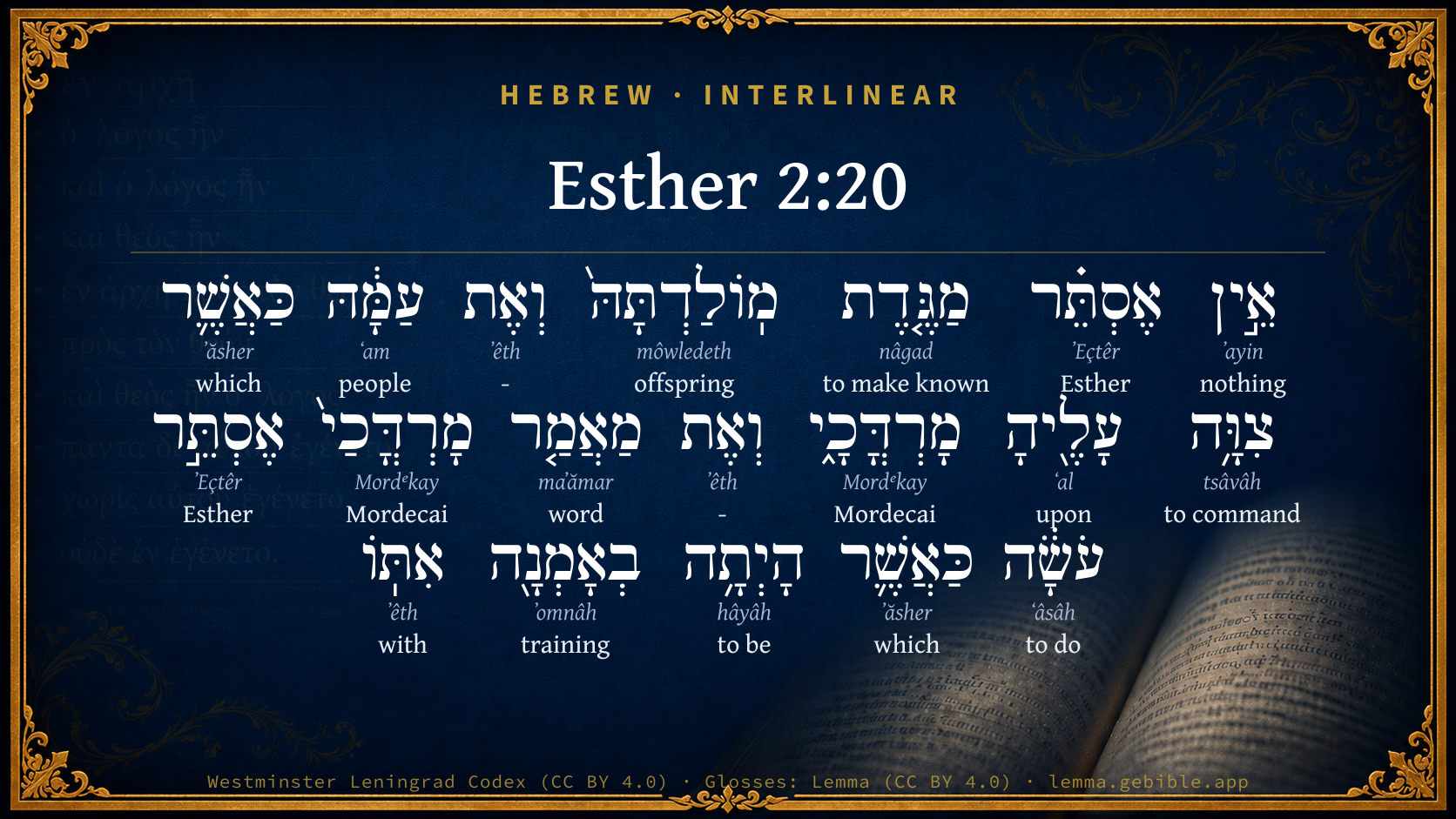
Esther 2:20

Hebrew (Westminster Leningrad Codex) Esther 2:20 appears in the Hebrew Old Testament. The text above is from the Westminster Leningrad Codex. Each word links to its Strong’s number, a concise gloss, and parsing drawn from the Open Scriptures Hebrew Bible morphology. Click any word for its full Brown-Driver-Briggs (BDB) entry.
Download image
Cite this verse

Esther 2:20 (World English Bible). Public Domain. Lemma interlinear Bible study tool, https://lemma.gebible.app/v/esther/2/20.

Show BibTeX & RIS
BibTeX
RIS
English Translation
Esther had not yet made known her relatives nor her people; as Mordecai had charged her: for Esther did the commandment of Mordecai, like as when she was brought up with him.
World English Bible · Public Domain
Highlights
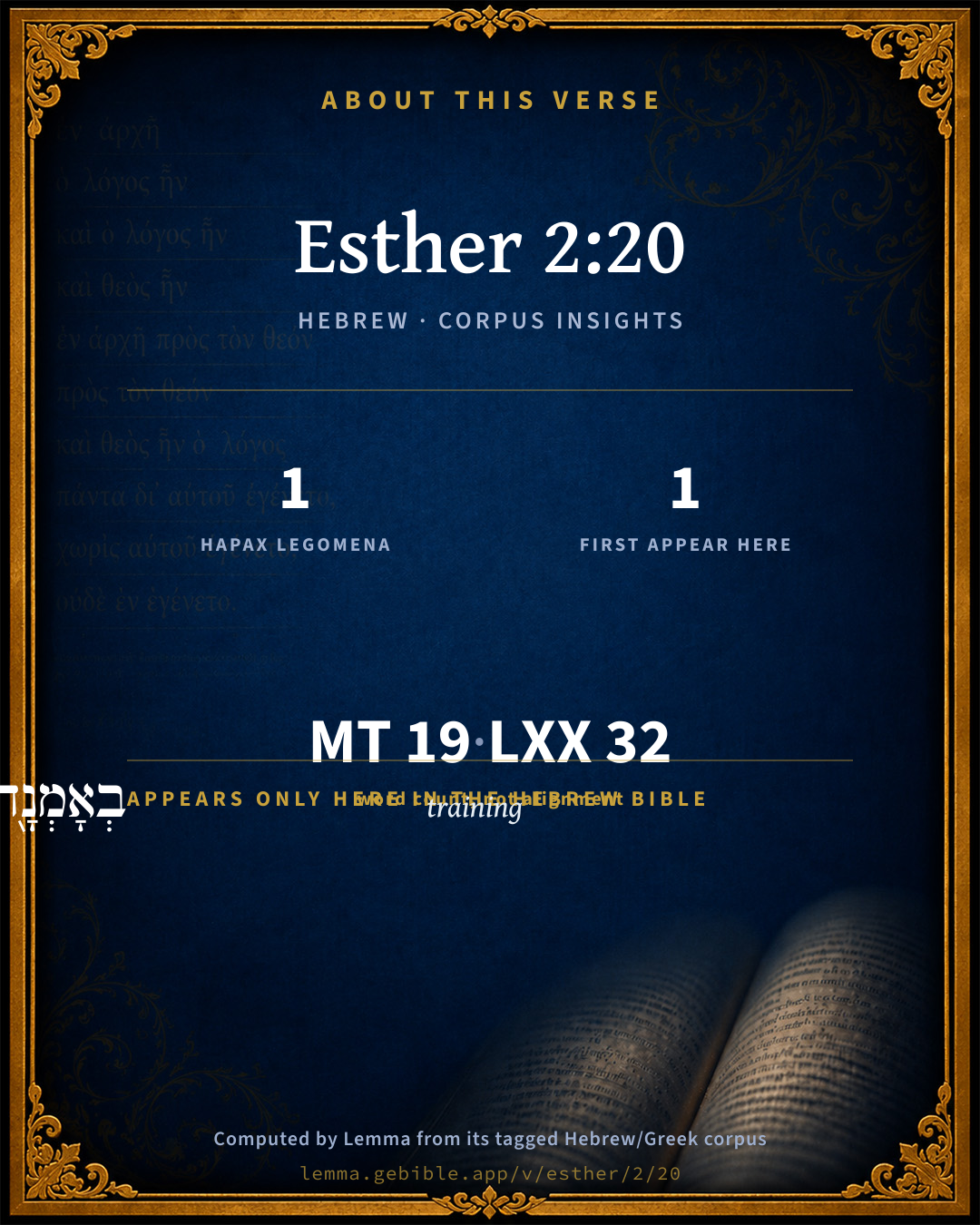
  • 1 hapax legomenon — only here in the Hebrew Bible
  • 1 first appearance in the Hebrew Bible
Full analysis ↓
Download a study sheet

One document with this verse’s original text, its word-by-word gloss line, the meaning frame, cross-references with their text, attributed commentary, and full source and license credits — printable, and it pastes into notes with its structure intact.

This verse Autodidact and up

Study sheet (.html) Plain text (.txt)

A passage Seminary Student

Up to 50 verses in one chapter. A passage sheet keeps up to 6 commentary sources and 12 cross-references per verse, in the order this page ranks them, and says so on the sheet whenever that leaves anything out. Ask for a single verse and you get the Autodidact verse sheet above.

Everything on this page stays free to read, with no account — the sheet is a download of what is already on screen, not access to it.

Want to remove ads? Support Godless Engineer
Compare translations 3

The same verse in 3 English versions, stacked beneath the original-language interlinear above. Click any original word for its lexicon entry.

Each is an independent rendering of the whole verse — the interlinear is not word-aligned to these translations.

Highlighted words mark where these versions differ — a whole-verse word diff, not a word-by-word alignment.

  • World English Bible Public Domain
    Esther had not yet made known her relatives nor her people; as Mordecai had charged her: for Esther did the commandment of Mordecai, like as when she was brought up with him.
  • King James Version Public Domain
    Esther had not yet shewed her kindred nor her people; as Mordecai had charged her: for Esther did the commandment of Mordecai, like as when she was brought up with him.
  • unfoldingWord Literal Text CC BY-SA 4.0
    Esther had not yet declared her ancestry (that is, her people), according to the charge that Mordecai had laid upon her. And Esther continued to do the command of Mordecai according to how she was with him in her fostering.

unfoldingWord Literal Text — © unfoldingWord, licensed CC BY-SA 4.0. Word-aligned USFM3 via Door43 (git.door43.org/unfoldingWord/en_ult).

Versions to compare (up to 4)

3 of 4 selected

Show all 18 translations

Every available English version of this verse, each an independent rendering of the whole verse.

  • World English Bible Public Domain
    Esther had not yet made known her relatives nor her people; as Mordecai had charged her: for Esther did the commandment of Mordecai, like as when she was brought up with him.
  • Berean Standard Bible Public Domain
    Esther still had not revealed her lineage or her people, just as Mordecai had instructed. She obeyed Mordecai’s command, as she had done under his care.
  • Majority Standard Bible Public Domain
    Esther still had not revealed her lineage or her people, just as Mordecai had instructed. She obeyed Mordecai’s command, as she had done under his care.
  • King James Version Public Domain
    Esther had not yet shewed her kindred nor her people; as Mordecai had charged her: for Esther did the commandment of Mordecai, like as when she was brought up with him.
  • American Standard Version (1901) Public Domain
    Esther had not yet made known her kindred nor her people; as Mordecai had charged her: for Esther did the commandment of Mordecai, like as when she was brought up with him.
  • Revised Version (1885) Public Domain
    Esther had not yet shewed her kindred nor her people; as Mordecai had charged her: for Esther did the commandment of Mordecai, like as when she was brought up with him.
  • Geneva Bible (1599) Public Domain
    Ester had not yet shewed her kindred nor her people, as Mordecai had charged her: for Ester did after the worde of Mordecai, as when she was nourished with him.
  • Douay-Rheims (1899) Public Domain
    Neither had Esther as yet declared her country and people, according to his commandment. For whatsoever he commanded, Esther observed: and she did all things in the same manner as she was wont at that time when he brought her up a little one.
  • Young's Literal Translation Public Domain
    Esther is not declaring her kindred and her people, as Mordecai hath laid a charge upon her, and the saying of Mordecai Esther is doing as when she was truly with him.
  • Literal Standard Version CC BY-SA 4.0
    Esther is not declaring her family and her people, as Mordecai has laid a charge on her, and the saying of Mordecai Esther is doing as when she was truly with him.
  • Unlocked Literal Bible CC BY-SA 4.0
    Esther had not yet told anyone about her relatives or her people, as Mordecai had instructed her. She continued to follow Mordecai's advice, as she had done when she was raised by him.
  • unfoldingWord Literal Text CC BY-SA 4.0
    Esther had not yet declared her ancestry (that is, her people), according to the charge that Mordecai had laid upon her. And Esther continued to do the command of Mordecai according to how she was with him in her fostering.
  • Darby Bible Public Domain
    (Esther, as Mordecai had charged her, had not yet made known her birth nor her people; for Esther did what Mordecai told her, like as when she was brought up with him.)
  • World Messianic Bible Public Domain
    Esther had not yet made known her relatives nor her people, as Mordecai had commanded her; for Esther obeyed Mordecai, like she did when she was brought up by him.
  • Webster's Bible Public Domain
    Esther had not yet showed her kindred, nor her people; as Mordecai had charged her: for Esther performed the commandment of Mordecai, as when she was brought up with him.
  • Free Bible Version CC BY-SA 4.0
    Esther still did not let anyone know about her family or her nationality, as Mordecai had ordered her. She followed Mordecai's instructions just as she did when he brought her up.
  • Bible in Basic English Public Domain
    Esther had still said nothing of her family or her people, as Mordecai had given her orders; for Esther did what Mordecai said, as when she was living with him.
  • JPS Tanakh (1917) Public Domain
    Esther had not yet made known her kindred nor her people; as Mordecai had charged her; for Esther did the commandment of Mordecai, like as when she was brought up with him —

Literal Standard Version (2020), Covenant Press — licensed CC BY-SA 4.0. Text via the HelloAO Bible API (eBible.org). Unlocked Literal Bible (unfoldingWord) — licensed CC BY-SA 4.0. Text via the HelloAO Bible API (eBible.org). unfoldingWord Literal Text — © unfoldingWord, licensed CC BY-SA 4.0. Word-aligned USFM3 via Door43 (git.door43.org/unfoldingWord/en_ult). Free Bible Version, Dr. Jonathan Gallagher — licensed CC BY-SA 4.0. Text via the HelloAO Bible API (eBible.org).

Word by word

More ways to search: Search by grammar → Find every occurrence → Compare this word →

Practice this passage: Drill this verse → Learn its vocabulary →

בְאָמְנָ֖ה
ʼomnâh
H545
“in/at · training”
Preposition + Noun, Common, Feminine, Singular, Absolute
Part of Speech
Preposition + Noun
Type
Common
Gender
Feminine
Number
Singular
State
Absolute
Full BDB Definition

Origin: from H544 (in the specific sense of training)

TWOT: 116f

bringing up, nourishment, rearing, training, providing for (as a parent)
  1. אֵ֣ין ʼayin H369 “nothing” Particle, Negative
  2. אֶסְתֵּ֗ר ʼEçtêr H635 “Esther” Noun, Proper
  3. מַגֶּ֤דֶת nâgad H5046 “making known” Verb, Hiphil, Participle Active, Feminine, Singular, Absolute
  4. מֽוֹלַדְתָּהּ֙ môwledeth H4138 “offspring · her” Noun, Common, Feminine, Singular, Construct + Suffix, Personal, 3rd Person, Feminine, Singular
  5. וְאֶת ʼêth H853 “and · -” Conjunction + Particle, Direct Object
  6. עַמָּ֔הּ ʻam H5971 “people · her” Noun, Common, Masculine, Singular, Construct + Suffix, Personal, 3rd Person, Feminine, Singular
  7. כַּאֲשֶׁ֛ר ʼăsher H834 “like/as · which” Preposition + Particle, Relative
  8. צִוָּ֥ה tsâvâh H6680 “to command” Verb, Piel, Perfect, 3rd Person, Masculine, Singular
  9. עָלֶ֖יהָ ʻal H5921 “upon · her” Preposition + Suffix, Personal, 3rd Person, Feminine, Singular
  10. מָרְדֳּכָ֑י Mordᵉkay H4782 “Mordecai” Noun, Proper
  11. וְאֶת ʼêth H853 “and · -” Conjunction + Particle, Direct Object
  12. מַאֲמַ֤ר maʼămar H3982 “word of” Noun, Common, Masculine, Singular, Construct
  13. מָרְדֳּכַי֙ Mordᵉkay H4782 “Mordecai” Noun, Proper
  14. אֶסְתֵּ֣ר ʼEçtêr H635 “Esther” Noun, Proper
  15. עֹשָׂ֔ה ʻâsâh H6213 “doing” Verb, Qal, Participle Active, Feminine, Singular, Absolute
  16. כַּאֲשֶׁ֛ר ʼăsher H834 “like/as · which” Preposition + Particle, Relative
  17. הָיְתָ֥ה hâyâh H1961 “to be” Verb, Qal, Perfect, 3rd Person, Feminine, Singular
  18. אִתּֽוֹ ʼêth H854 “with · him” Preposition + Suffix, Personal, 3rd Person, Masculine, Singular

About this verse

These counts appear in no published source. They are computed here, from the morphology-tagged text and Lemma’s own curated glosses. What Lemma adds →

19
words
15
distinct lemmas
Historical
section

Notable vocabulary

1 hapax legomenon — a word that appears only here in the entire Hebrew Bible:

  • בְאָמְנָ֖ה training H545

First appearance in Scripture

This word makes its first canonical appearance in the Hebrew Bible here:

  • בְאָמְנָ֖ה training H545

Shared distinctive vocabulary

מַאֲמַ֤ר word H3982 occurs in 3 verses of the Hebrew Bible. Also found in:

Grammatical profile

  • 4 verbs
  • 8 nouns
  • 2 prepositions
  • 5 particles

Verb forms

  • מַגֶּ֤דֶת Hiphil · Participle Active
  • צִוָּ֥ה Piel · Perfect
  • עֹשָׂ֔ה Qal · Participle Active
  • הָיְתָ֥ה Qal · Perfect

Repetition

Words recur within this verse — often emphatic in Hebrew:

  • אֶסְתֵּ֗ר Esther H635 ×2
  • מָרְדֳּכָ֑י Mordecai H4782 ×2
  • כַּאֲשֶׁ֛ר which H834 ×2

Hebrew & Septuagint length

In English translation the verse runs 32 words from the Hebrew and 33 from the Septuagint (LXX English) — closely comparable.

A rough comparison of the two English renderings, which tokenize alike — not a word-level alignment.

Word counts can differ between the Hebrew and the Greek without any difference in meaning — e.g. the Hebrew direct-object marker אֵת has no separate Greek word, and Greek often adds the article ὁ.

In the original languages it is 19 Hebrew tokens and 32 Greek tokens — but the two are counted differently (Hebrew bundles its prefixes and suffixes into one token; the Greek is in lemma form), so that isn’t a like-for-like length.

Cross-references

3

Topical passages linked to Esther 2:20 in the Treasury of Scripture Knowledge — connected by theme and wording, ordered by reader-vote popularity; previews shown in the World English Bible.

  • Esther 2:10 Esther had not made known her people nor her relatives; for Mordecai had charged her that she should not make it known.
  • Ephesians 6:1–3 Children, obey your parents in the Lord, for this is right.
  • Esther 2:7 He brought up Hadassah, who is, Esther, his uncle's daughter: for she had neither father nor mother, and the maiden was fair and beautiful; and when her father and mother were dead, Mordecai took her for his own daughter.

Cross-references courtesy of OpenBible.info (CC BY 4.0).

Hebrew and Greek witnesses Masoretic Hebrew ↔ Greek Septuagint

The same verse in the two great witnesses to the Old Testament, shown verse-for-verse.

These are two independent witnesses, not word-aligned to each other, and the Septuagint is shown in lemma (dictionary) form.

Hebrew Esther 2:20 Masoretic · Westminster Leningrad Codex

אֵ֣ין אֶסְתֵּ֗ר מַגֶּ֤דֶת מֽוֹלַדְתָּהּ֙ וְאֶת עַמָּ֔הּ כַּאֲשֶׁ֛ר צִוָּ֥ה עָלֶ֖יהָ מָרְדֳּכָ֑י וְאֶת מַאֲמַ֤ר מָרְדֳּכַי֙ אֶסְתֵּ֣ר עֹשָׂ֔ה כַּאֲשֶׁ֛ר הָיְתָ֥ה בְאָמְנָ֖ה אִתּֽוֹ

Esther had not yet made known her relatives nor her people; as Mordecai had charged her: for Esther did the commandment of Mordecai, like as when she was brought up with him.

World English Bible · Public Domain

Greek LXX Esther 2:20 Septuagint · lemma form

ὁ δέ εσθηρ οὐ ὑποδεικνύω ὁ πατρίς αὐτός οὕτως γάρ ἐντέλλω αὐτός μαρδοχαῖος φοβέω ὁ θεός καί ποιέω ὁ πρόσταγμα αὐτός καθώς εἰμί μετά αὐτός καί εσθηρ οὐ μεταἀλλάσσω ὁ ἀγωγή αὐτός

Now Esther had not revealed her kindred; for so Mardochaeus commanded her, to fear God, and perform his commandments, as when she was with him: and Esther changed not her manner of life.

LXX2012 (modern English Septuagint) · Public Domain

Hebrew: Westminster Leningrad Codex (CC BY 4.0). Greek: Septuagint (public domain); English from LXX2012 (modern English Septuagint) (Public Domain). How the Septuagint differs from the Hebrew →

Commentary

Notes on Esther 2:20 from classic Christian and Jewish commentators (each source and its license shown beneath its notes). The classic Christian expositions comment on the surrounding passage and are grouped to its opening verse, so a note may address several verses; the Jewish commentaries on the Tanakh (Rashi and others) are per-verse, so they appear only where the commentator wrote on this verse.

Lemma curates 59 commentaries, every one of them public domain or Creative Commons licensed, each selected and text-cleaned for this edition rather than reprinted as found. About our sources →

Trapp's Complete Commentary

John Trapp

Est 2:20 Esther had not [yet] shewed her kindred nor her people; as Mordecai had charged her: for Esther did the commandment of Mordecai, like as when she was brought up with him.

Ver. 20. Esther had not yet shewed her kindred] Taciturnity is sometimes a virtue, and Tacitus the best historian. Queen Elizabeth’s motto was, Video, taceo, I see, and say nothing. Sophocles saith, nothing better becometh a woman than silence. Euripides also saith, that silence, and modesty, and keeping at home, are the greatest commendation to a woman that can be. Curtius telleth us, that the Persians never trust one whom they find to be talkative, Cui tacere grave sit (Curt. 1. 4). Why Esther concealed her kindred, see the note, {See Trapp on "Est 2:11"}, and know that this is no warrant for Popish equivocation; a device of the Jesuits, for the comfort of afflicted Catholics (as Blackwell and Garnet profess), and for the instruction of all the godly.

For Esther did the commandment of Mordecai] Her honours had not altered her manners. She was semper eadem, always the same, as obsequious and observant of Mordecai still as ever. So was Joseph, David, Solomon, Epaminondas, and others, of their old and poorer parents. Pope Benedict, a Lombard, A.D. 1303, a shepherd’s son, would not acknowledge his poor mother when she came to him lady like, but caused her to put on her shepherdess apparel, and then did her all the honour that might be. Sir Thomas Moore would in Westminster Hall beg his father’s blessing on his knees. Mordecai was Esther’s foster father, and had given her, though not her being, yet her well being; and hence she so respects him, and is so ruled by him. She had gotten from him that nurture and admonition in the Lord that was better to her than the crown of the kingdom; for what is unsanctified greatness but eminent dishonour? and what is dignitas in indigno but ornamentum in luto? (Salvian). If any parents find disobedient children, let them consider whether, Eli-like, they have not honoured (I mean cockered) their sons too much, 1Sa 2:29, which is the reason they honour them now so little. Will they keep meat well savoured, yet never salt it? will they have sprigs sprout right, yet never lop them? Our Henry II so cockered his eldest son, Henry, that he crowned him while himself was yet alive, which made his ambition quite turn off his obedience, to his father’s great heart break.

John Trapp, A Commentary or Exposition upon All the Books of the Old and New Testament (1647–1656) — public domain. Text from a community e-Sword module.

The Biblical Illustrator

Joseph S. Exell

Est_2:20

For Esther did the commandment of Mordecai, like as when she was brought up with him.

Repaying parental kindness

Then I would say that there is a lesson here for the young. How can they repay in any measure--for fully they can never repay--the tenderness of their godly parents to them in their youth, and the anxiety which has been felt on their account as they advanced toward maturity? In one way only--by endeavouring to pursue the path which leads to present respectability and usefulness, and which Christ in His Word has marked out as that which His disciples must tread. (A. B. Davidson, D. D.)

The Biblical Illustrator, edited by Joseph S. Exell (c. 1880s–1900s) — public domain. Text from a community e-Sword module.

Joseph Benson's Commentary

Est 2:20. Esther did the commandment of Mordecai, &c. — A rare example of virtue, that she should be so observant of him when she was a queen: for most persons forget what they were when they are unexpectedly advanced to great honour, dignity, or riches.

Joseph Benson's Commentary on the Old and New Testaments (1811–1818) — public domain. Text from a community e-Sword module.

Tyndale Open Study Notes

Tyndale Open Resources

2:20 keep her family background and nationality a secret: That this is mentioned twice (see also 2:10) indicates how important it was for the rest of the story. • With humility, she was still following Mordecai’s directions. She did not become conceited and forget her people or the family that raised her.

Tyndale Open Study Notes — © Tyndale Open Resources, licensed CC BY-SA 4.0. Text via the HelloAO Bible API.

Ellicott's Commentary for English Readers

(20) Esther had not yet . . .—Perhaps this verse is added to meet the supposition that the king wished to replace Esther through finding out her nation.

A Bible Commentary for English Readers, edited by Charles John Ellicott (1878–1897) — public domain. Text from a community e-Sword module.

The Cambridge Bible for Schools and Colleges

gen. ed. J. J. S. Perowne

20. Esther had not yet shewed etc.] In the East, when persons rise in rank, it is expected that their relatives will rise with them. But the connexion between Esther and Mordecai had not been disclosed, the queen having been faithful in carrying out the direction of her foster-father to that effect. There is no great improbability of a secret of this sort having been kept under the circumstances of the story.

The Cambridge Bible for Schools and Colleges (gen. ed. J. J. S. Perowne; Cambridge University Press, 1878–1918) — public domain. Text from a community e-Sword module.

John Gill's Exposition

Esther had not showed her kindred nor her people, as Mordecai had charged her,.... As not before, so neither since she was made queen, see Est 2:10, though, according to the Targums, she was urged to it by the king himself:

for Esther did the commandment of Mordecai, like as when she was brought up with him: which showed great humility in her, notwithstanding her advancement, great respect to him, and a sense of gratitude for the kindness he had shown; and this charge to her was still continued by Mordecai, partly that she might not fall into contempt, and partly to prevent hatred and envy to the Jewish nation, through her promotion; but chiefly so it was ordered in Providence, the proper time being not yet come.

John Gill's Exposition of the Whole Bible (1746–1763) — public domain (CC PDM 1.0). Text via the HelloAO Bible API.

Haydock's Catholic Bible Commentary

Commandment. No one interrogated her, as she had been educated as Susa, and was taken for a Persian lady, ver. 10. (Menochius)

George Leo Haydock (1774–1849), Haydock's Catholic Family Bible and Commentary, 1859 edition — public domain. Excludes Psalms (Douay-Rheims chapter numbering differs from Protestant) and Deuterocanonical books (Catholic canon only).

Whedon's Commentary on the Bible

Daniel D. Whedon

20. Esther had not… showed — This verse should be regarded as a parenthesis, and is designed, as a circumstantial clause, to show that Esther was obedient to Mordecai as much after she became queen as before. It also shows that this second collection of virgins sprang from no prejudice against Esther as a Jewess.

Daniel D. Whedon (gen. ed.), Commentary on the Old and New Testaments (1874–1909) — public domain. Text from a community e-Sword module.

The Pulpit Commentary

Esther had not yet showed, etc. This is inserted to account for the humble position still occupied by Mordecai. In the East a person"s relations usually rise with him; and the reader would naturally expect that when Esther was once queen, Mordecai would have become rich and great. Esther"s silence accounts for Mordecai"s low estate; Mordecai"s command (see ver. 10) accounts for Esther"s silence. For Esther did the commandment of Mordecai. The royal dignity did not change Esther"s heart. She was still the dutiful child she had been so many years. Mordecai had forbidden her to tell her kindred; he had not removed his prohibition, so she had kept silence.

Ver. 20.

Filial obedience.

Esther was an adopted child. Her debt to Mordecai was very great, for nurture, care, training, and affection. And she was not forgetful of her obligation; she gladly repaid the solicitude of her cousin by her gratitude, reverential regard, and filial obedience. The habit of obedience continued in after life. As far as was consistent with the higher relation of married life, she maintained her grateful and affectionate subjection to her kinsman. If this was right and just, how evidently is it a duty for children carefully to display and exercise the virtue of filial obedience.

I THE HABIT OF FILIAL OBEDIENCE SHOULD BE FORMED EARLY. It is of very little use for a parent to begin to exercise authority, to require obedience, in after life. If the child has not from its infancy been accustomed to obey, it is highly improbable that the habit will be formed in youth.

"Tis education forms the youthful mind; Just as the twig is bent, the tree"s inclined.

There is reason to fear that in our days more children are ruined by indulgence than by harshness; multitudes by the foolish alternation of the two opposite and equally pernicious modes of treatment. If early formed, the habit of obedience will "grow with the child"s growth, and strengthen with his strength.

II THE DEMANDS UPON FILIAL DUTY SHOULD BE REASONABLE. There was occasion for the admonition, "Fathers, provoke not your children to wrath." Capricious and arbitrary requirements are destructive of all respect, and will only secure compliance whilst there is no power to withhold it. Little children cannot always understand the reason for parental injunctions and prohibitions. But it is wise, as children grow up, to show them the justice and expediency of household regulations, etc. Tyranny on the part of the parent is likely to awaken resentment or to foster deceit on the part of the child.

III AFFECTION AND GRATITUDE WILL MAKE OBEDIENCE EASY AND DELIGHTFUL. There may be a stage in a child"s education when compulsion is necessary and proper; but, generally speaking, the appeal must be that of love to love. A parent"s will is a child"s law where the parent is wise and the child is grateful and affectionate.

IV THE REVERENCE AND OBEDIENCE OF CHILDREN SHOULD, WITHIN LIMITS, BE CONTINUED IN MATURER LIFE. A wife"s obligations are primarily towards her husband. Still there is force in the English proverb, "A daughter"s a daughter all her life." Still she will not forget her father"s house, her mother"s love. God"s blessing ever rests upon this beautiful virtue of filial love and obedience. This was expressed in the commandment with promise, "Honour thy father," etc.

HOMILIES BY D. ROWLANDS Ver. 20.

Worldly policy.

A superficial view might lead to an unqualified admiration of Esther and Mordecai, the principal characters in the scene before us. And not without reason, for they exemplify in their conduct some of the nobler qualities of human nature. With regard to Esther, note

1. That she remembered in her prosperity the associations of the past. This did credit both to her head and to her heart; it evinced her sound sense as well as her humble-mindedness. It is pitiable to witness sometimes the way in which those who have risen in the world forget their lowly origin; they look down with contempt upon those who are still in the position which they themselves once occupied; and nothing wounds their pride more keenly than the slightest allusion to the home of their childhood. But such a miserable display of weakness only degrades them in the estimation of all right-minded men. Esther was very different from this. Amidst the splendours of the royal palace she could not forget her former obscure lot. And this must have been an ennobling power in her soul, elevating her above the corrupt influences of a profligate court.

2. That she showed gratitude to the man who had befriended her in adversity. She had been left a helpless orphan; and must have been thrown upon the mercy of a heartless world, had it not been for the timely succour of her generous kinsman. But there are natures upon whom such services make no lasting impression. They are altogether absorbed in self. Affluence, luxury, ease, harden their hearts, and make them utterly insensible even to the claims of gratitude. But Mordecai"s kindness to Esther embraced her entire being; it pervaded all the motives which fashioned her life. Whenever She hesitated how to act, she would put to herself the question, "What would Mordecai advise?" and upon the answer would depend her course of conduct. And this is the highest style of affection, which issues in obedience, self-renunciation, submission to another"s will. With regard to Mordecai, note

3. That he had made the greatest sacrifice for the sake of another. He must have loved Esther deeply, tenderly, devotedly. And no wonder. Her beautiful form, and still more beautiful soul, could not have developed themselves beneath his eye without stealing away his heart. But when the grand prospect of her being raised to the throne presented itself, he hesitated not to give her up. So far we are constrained to admire. But deeper reflection makes us pause. In this most important juncture they seem to have been too completely actuated by mere POLICY. That success crowned their efforts is no excuse for their conduct. On the same ground you might justify some of the most hideous stratagems ever devised by depraved ingenuity. Never let the dazzling glare of the prosperity sometimes attendant upon false moves make us blind to the beauty of eternal principles. Nor can they be excused on the ground that they were carrying out the designs of Providence. For in the same manner you might justify the conduct of Joseph"s brethren in selling their brother, and even the conduct of the Jews in crucifying the Saviour. What is POLICY? It is the substitution of the expedient for the right. It is the spirit which constantly asks, What will best promote our own interests? instead of asking, What will best satisfy the immutable claims of justice, truth, and honour? Observe

I THAT POLICY HAS A WORLDLY AIM. What is worldliness? An inordinate love of the present, the sensual, the temporal, with corresponding" neglect of the future, the spiritual, the eternal. Any line of conduct that is prompted by this temper of the heart must be accounted worldly. Esther had set her mind upon the crown, and Mordecai supported her ambitious views. From a heathen standpoint it was a glorious prize, but to a Jew it was a forbidden acquisition. Probably they contrived to conceal from themselves their real aim by investing it with fictitious attributes.

1. Esther might have desired to elevate the religious tone of the court bygradually making known the God of Israel.

2. Mordecai might have hoped to serve his nation by placing at the seat ofpower one who would be willing to help them in time of need. But wrong can never be right. We may glorify it with fine names, forgetting that a change of name does not necessarily imply a change of nature. Let us consider how policy affects men"s conduct in politics, in religion, and in private life.

(1) In politics. Wars are sometimes undertaken, with the professed aim of extending to benighted races the blessings of civilisation and Christianity, whose real object may be to flatter national vanity, and satisfy the greed of rulers. Thus base acts acquire a dignity from the halo cast around them by high-sounding names.

(2) In religion. Men will contend for the success of a religious party, with whose prosperity their own honour is bound up, under the mistaken notion that they are fighting the battles of religion itself. Like the idol-makers who defended the faith of their ancestors by crying out, "Great is the Diana of the Ephesians," while they thought of nothing so much as the gains of their own craft.

(3) In private life. Think of illegitimate trades. They are engaged in simply because they happen to be lucrative. A man opens a gin palace, and finds that his coffers are rapidly filling with gold. To allay any qualms of conscience which may occasionally disturb his peace, tie pictures to himself the vast power for good which an accumulated fortune may place at his command; but in his heart of hearts he really worships wealth.

II POLICY STOOPS TO QUESTIONABLE MEANS. Granted that the crown which Esther sought to secure was a lawful object of an Israelite"s desire, how did she endeavour to accomplish her purpose?

1. By contracting an alliance with a heathen monarch, which the Jews, asGod"s chosen people, were expressly forbidden to do.

2. By becoming that monarch"s concubine before she became his wife. Theloose notions in reference to this amidst which she had been educated may explain her conduct, but cannot justify it. It may also be urged that she had no option in the matter, that the monarch"s will would brook no opposition, that disobedience might bring death. The only reply is that death is better than dishonour.

3. By having recourse to duplicity. She never made known her people, forfear it might interfere with her chance of promotion. In all this it is evident that Esther and Mordecai, her adviser, too had thought more of what was expedient than what was right. Note

(1) That the conduct of good people, even in the most important transactions, are not always to be imitated. Not only in small matters, but also in great matters, are they liable to err. Precedent is a poor standard to appeal to, for it may mislead us when the most momentous principles are at stake.

(2) That true heroism, consists in doing right, irrespective of the consequences. This heroism has its type in Daniel rather than in Esther; in Shadrach, Meshach, and Abednego rather than in Mordecai. If you want to see the highest heroism, you need not gaze upon the battle-field, where men, through the maddening excitement of the conflict, defy death at the cannon"s mouth, for there it cannot be found. Rather let your wondering eyes be directed to the martyr dying at the stake, to the pioneer of truth braving the scorn of the world, to the patient worker for the common good who toils in obscurity, and seeks no higher reward than the approval of his own conscience. R.

The Pulpit Commentary (1880–1919), ed. H.D.M. Spence-Jones & Joseph S. Exell — public domain. Text from a community e-Sword module.

Rashi

Rabbi Shlomo Yitzchaki (Rashi)

Esther would not tell her lineage because Mordecai was sitting in the king’s gate; he was encouraging her and hinting to her about it.

Rashi on the Tanakh — English translations: “The Judaica Press complete Tanach with Rashi, translated by A. J. Rosenberg” (CC BY 4.0); “Pentateuch with Rashi's commentary by M. Rosenbaum and A.M. Silbermann, 1929-1934” (public domain); “The Metsudah Tanach series, Lakewood, N.J” (CC BY 4.0); and “The Book of Joshua, Metsudah Publications, 1997” (CC BY 4.0). Text via Sefaria.

Lesson kit

Teaching starters — assembled from the data on this page, not authored interpretation. Every prompt links to the verse data it draws on. Edit before teaching.

Esther, in the Historical, opens this verse with 19 words (15 distinct Hebrew lemmas). Its most distinctive word is ʼomnâh (“training”). A historical commentator’s framing appears above. Read the whole chapter for the surrounding context.

Discussion questions

  1. The word ʼomnâh carries the sense “training.” How does it shape the verse?
  2. 1 word here appears nowhere else in the Hebrew Bible. Why might the author reach for such rare wording?
  3. This is the first place “training” appears in Scripture (first appears here). What does its debut here establish?
  4. How does Esther 1:15, which shares the word «word», read alongside this verse?
  5. What does the repetition of “Esther” (2× in this one verse) do in this verse?
  6. The translations on this page render this verse differently — a whole-verse word diff, not a word-by-word alignment. What might account for the different wordings?
  7. «מַגֶּ֤דֶת» is a Hiphil Participle Active verb. How does that grammatical form shape the action described?
  8. Compare how Trapp's Complete Commentary and The Biblical Illustrator read this verse. Where do they agree or differ?

Things to notice

  • 1 word in this verse appears nowhere else in the Hebrew Bible.
  • 1 word makes its first canonical appearance in Scripture here.
  • This verse counts 19 Hebrew ↔ 32 Greek words.
  • These translations choose different wording for 23 words in this verse.
  • “Esther” occurs 2× in this single verse.

Reading settings

Reading text

Shown beneath each verse's original-language words.

Old Testament
Old Testament edition

Read the OT as the Masoretic Hebrew (MT) or the Greek Septuagint (LXX).

English shown for the Greek Septuagint (in the Hebrew ↔ Greek comparison).

Comparing translations? Open the Compare panel on any verse page to stack up to four side by side.